There is a great hymn, an antiphon actually, written by St. Thomas Aquinas for the Office of Corpus Christi. It is O Sacrum Convivium and it serves as a wonderful summary of Eucharistic theology that is worth our attention. With that in mind I’d like to make a brief reflection on some of its compact teachings. First the text, then some commentary:
O sacrum convivium! in quo Christus sumitur: recolitur memoria passionis eius: mens impletur gratia: et futurae gloriae nobis pignus datur.
O sacred Banquet
In which Christ is received
The memory of his Passion is recalled
The Mind is filled with grace
And Pledge of future Glory is given to us.
O Sacred banquet (O Sacrum convivium) – In recent decades there was perhaps a tendency to over emphasize the meal aspect of the holy Mass, without due and balanced reference to the sacrificial aspect of the holy Mass. But the necessary correction in more recent times, back toward emphasizing that the Mass makes present the Sacrifice of the Cross, should not lead us to forget the mass is also a holy banquet, a sacred meal with the Lord.
For the Lord says, For my flesh is real food and my blood is real drink (Jn 6:55). Thus, the Holy Eucharist is no mere sign, or symbol, but is in fact the true food of Christ’s true Body, true Blood, Soul and Divinity. The Eucharist, is also a foretaste, a praegustatum, of the great banquet in heaven, of which Christ says, And I confer on you a kingdom, just as my Father conferred one on me, so that you may eat and drink at my table in my kingdom and sit on thrones, judging the twelve tribes of Israel (Lk 22:29-30). And yet again, Here I am! I stand at the door and knock. If anyone hears my voice and opens the door, I will come in and eat with him, and he with me (Rev 3:20).
Note too that the Latin word convivium, of which “banquet” is an adequate translation, but also contains nuances that go beyond a mere meal. The Latin emphasizes a kind of coming together a sort of celebration of life. Con (with) + vivere (to live). Hence, the meal here is no mere supplying the food or calories. It is a coming together to celebrate new life. We receive the food of Christ’s Body and Blood, which not only gives an ingredient for life, but is in fact the true and very life of Christ.
In the Eucharist, we receive Life Himself, for Christ said of himself, I am the life (Jn 14:6). And further, he declares, As the living Father sent me, and I live because of the Father, so whoever feeds on me, he also will have life because of me. (Jn 6:57).
Of this life, he further describes it as “eternal life,” a term which refers not merely to the length of life, but also to the fullness of life.
Thus the Holy Eucharist is a meal, but no mere meal, it is Life, it is a convivial celebration of that life; it is a banquet which gives Life Himself.
In which Christ is received (in quo Christus sumitur)– Here again, is affirmation that we do not receive mere food, we receive Christ himself. This is no mere symbol, no mere wafer, no mere memory. It is Christ himself that we receive.
The verb here, sumitur, is in some sense bold. More literally translated than “received,” it is more literally translated as “taken up.” It is a present passive indicative form of the verb. And this indicates the great humility of our Lord. He lets himself “be taken up.”
Imagine, the Lord being in a moment of a passive relationship with us. He lets himself be taken up, or taken in by us. He is taken up, and becomes our food. Here is an astonishing humbling by our God, who then allows himself to be assimilated by us, and thereby assimilates us into him.
His humility, is meant to conquer pride in us. Yes, in this great banquet Christ himself is taken up, is received, is assimilated by us. And in this humble manner we are taken up into him, taken in, more perfectly to be a member of his body.
The memory of his passion is recalled (recolitur memoria passionis eius) – The Eucharist is not only a meal, it is the making present of the Passion, Death and Resurrection of Jesus Christ. In every mass, we are brought to the foot of the cross, and the fruits of that Cross are applied to us.
We are also at the resurrection, for in Holy Communion we receive Christ who is living, present, and active.
The Latin verb recolitur, is properly translated “recalled.” However, once again there are nuances in the Latin verb which are hard to render with one English word. The Latin verb recolere means “to cultivate anew.” This somewhat agrarian image points to a kind of careful and intentional growing and fostering of something, in this case the memory of Christ’s Passion.
To cultivate in agriculture, is also to prepare for, and or pave the way for the growth of something. It means to prepare the soil.
In non agrarian settings, to cultivate anything implies a kind of care for it, and intention to foster the growth of something, to further or encourage something.
In all these images we see that the memory of Christ’s Passion is something that we should cherish, encourage and foster. It is something in which we should prepare the ground of our heart for ever deeper insights and for new growth in the memory of what He’s done for us
The other word, “memory,” is also a very precious word. What is memory and what does it mean to “remember?” To remember is to have deeply present in my mind and my heart what Christ has done for me, so that I am grateful, and I am different. It means to have it finally dawn on us what Christ has done for us in such a vivid and real way that our hearts and minds are grateful, transformed, and different. Our hearts of stone are broken open and God’s light and love flood in and we are changed. This is what it means to remember.
It is of course and ever deepening process to recall the memory of His Passion, not a mere one time event.
The Mind is filled with Grace (mens impletur gratia)– There are many graces of course that come with holy Communion:
Our venial sins are forgiven, our holiness is increased, our union with Christ becomes more perfected, we gradually become the One we receive, we receive strength and food for the journey across the desert of this world unto the Promised Land of Heaven, we receive life, and begin to participate in eternal life, our union with Christ and membership in his body is strengthened, as is our union with one another, and our union with the saints in heaven.
Yes, so many grace are infused, are poured forth into the mind and heart!
And a pledge of future glory is given to us (et futurae gloriae nobis pignus datur) – with the reception of Holy Communion come promises from Christ:
But here is the bread that comes down from heaven, which a man may eat and not die. I am the living bread that came down from heaven. If anyone eats of this bread, he will live forever….Whoever eats my flesh and drinks my blood has eternal life, and I will raise him up at the last day….Whoever eats my flesh and drinks my blood remains in me, and I in him. Just as the living Father sent me and I live because of the Father, so the one who feeds on me will live because of me. This is the bread that came down from heaven. Your forefathers ate manna and died, but he who feeds on this bread will live forever.” (John 6:50-58)
Yes, here is a pledge of future glory, of victory. Jesus alludes to the manna in the wilderness that sustained them for forty years in the desert. It was a sign of the victory to come. For why would God sustain them in the desert if he did not will to lead them ultimately to the Promised Land? It is the same for us. That God feeds us in this way is a sign and promise of his will to save us and bring us to the Promised Land of Heaven. He blesses and strengthens the journey and so adds surety and the pledge of the destination of future glory.
To this pledge the Lord also adds a warning:I tell you the truth, unless you eat the flesh of the Son of Man and drink his blood, you have no life in you (Jn 6:53)
And St. Paul also adds:Therefore, whoever eats the bread or drinks the cup of the Lord in an unworthy manner will be guilty of sinning against the body and blood of the Lord. A man ought to examine himself before he eats of the bread and drinks of the cup. For anyone who eats and drinks without recognizing the body of the Lord eats and drinks judgment on himself. (1 Cor 11:27-29)
Not a bad little summary of Eucharistic theology, all in a short antiphon.
I have found myself in recent years insisting that people believe their ears and not their eyes.
Now our flesh demands to see by its own unregenerate power, only then will the flesh say it believes. But the truth is, our flesh does not often believe even when it sees. We usually figure, “they have some way of doing that” or perhaps we’ll say, “This is a trick, an illusion.” And illusionist can do some pretty amazing stuff! (See the video below).
But the Scriptures are clear to say that Faith comes by hearing and hearing by the Word of God (Rom 10:17) . It also says, Faith is the substance of things hoped for and the evidence of things unseen (Heb 11:1). Even Thomas who is said to believe because he sees is really confessing something he cannot see, that Jesus is Lord and God (Jn 20:29).
For example, when it comes to the sacraments we have to believe our ears, for our eyes cannot see the reality that faith declares to be so. St. Thomas Aquinas in the beautiful hymn Adoro Te Devote says:
Visus, tactus, gustus in te fallitur, (Sight and taste and touch in thee fall short)
Sed auditu solo tuto creditur; (But only the hearing is safely believed)
Credo quidquid dixit Dei Filius, (I believe whatever the Son of God has said)
Nil hoc verbo veritatis verius. (Nothing is truer than this word of truth)
And thus I must often remind people when it comes to sacraments:
Eucharist – Though your eyes may still see bread and wine, believe your ears: “This is my Body, This is my Blood…..” (Matt 26:26 inter al). The Bread I will give is my flesh for the Life of the world….(Jn 6:51).”
Marriage – Though your eyes may still see a newly married bride and groom as two separate distinct individuals, believe your ears: “They are no longer two, they are one. What God has joined together let no one divide.” (Matt 19:6)
Baptism – Though your eyes may see a newly baptized baby as just the same, believe your ears: “This is my beloved son in whom I am well pleased….(Lk 3:21) If anyone is in Christ he is a new creation (2 Cor 5:17)…..We who were baptized into Christ Jesus were baptized into his death so that just as Christ was raised from the dead by the glory of God the Father we too might live in newness of life (Rom 6:4)
Confession – A person who emerges from a confessional may appear just the same, but believe your ears: I absolve you from your sins..…Whose sins you forgive, they are forgiven them (Jn 20:23).
What are you going to believe….your eyes or your ears?
[For] we look not to what is seen but to what is unseen; for what is seen is transitory, but what is unseen is eternal….for we walk by faith, not by sight (2 Cor 4:18, 5:7).
And to the Pharisees who claimed they could see (but still refused to believe) the Lord said, “If you were blind, you would not be guilty, But you remain guilty because you claim you can see. (John 9:41)
And to those who do believe the Lord says through Peter: You have not seen him, yet you love him; and still without seeing him you believe in him and so are already filled with a joy so glorious that it cannot be described (1 Peter 1:8)
What are you going to believe, your eyes or your ears?
Your flesh demands to see. But I promise you, even if you do see, your flesh will explain it away. Consider this video. Illusionists can do some pretty amazing things. But notice how quickly your flesh is willing to explain it away. And this case it should for these are illusions. But what if you saw a real miracle? What do you suppose your flesh would do? What do you suppose?
There is, to me, a certain sad division in the Church that has set up in recent decades that is rooted in what I think is ultimately a false dichotomy. It makes me particularly sad because I respect and esteem people in both camps. And though I hold them both in my heart, they barely speak to one another and hold one another in deep suspicion and sometimes outright contempt.
I speak specifically of the division in the Church between those who focus especially on the moral issues related to Life, sexuality and family and those who focus on the moral issues related to the social teachings of the Church such as poverty, immigration, housing, healthcare, wages and so forth.
The issue recently resurfaced on the comment thread of this blog on Saturday. The blog post featured a video (re-posted below) that speak to the problem of being Catholic in name only.
Certain commentors opined that the video was unbalanced because it ends by highlighting the corporal works of mercy as essential to being a good Catholic. To be fair, the video also deals with issues of mass attendance, modesty, chastity, and respect for authority and is aimed at teenagers.
Despite this, some readers saw the video as only emphasizing the corporal works of mercy and were troubled that no mention was made about abortion, redefining marriage, and other issues often termed non-negotiables. Here is a sample of some of the comments:
I think there is the danger that the “take away” here is that as long as I am freely volunteering to help the poor that is all that is needed to be a good Catholic. I know many students at the nearby Jesuit high school who have gone New Age or totally lapsed into religious non-observance and yet are service oriented.
Strangely, there is not a single criterion mentioned in this video that would help identify this young lady as a Catholic. Generic Christian, yes, but not Catholic. The defense lawyer should have asked her whether she completely upheld the truth of the Scripture, Tradition and Magisterium; whether she unreservedly believed in the doctrine of transubstantiation; and whether the Pope was for her the visible head of the one true holy and apostolic Church (to name just a few pertinent issues). One can be an atheist and still follow Jesus’ call for charitable behavior.
I’ll echo some of the other comments by saying the video, while clever, runs the risk of reducing Catholicism to social service work. Jenny Smith could well have claimed to be Catholic and worked in a soup kitchen and still not have been Catholic. It would have been nice to have seen the defense attorney ask her if she believed abortion to be evil (with her being pro-choice) or if she could explain transubstantiation (with her holding the Eucharist to be just a symbol) or have her recite the new translation of the Nicene Creed (which of course she wouldn’t be able to do from heart) or even ask her when the last time she went to confession was (years, no doubt).
Interesting. The Gospel of Matthew is clear about the corporal works of mercy. But, the movie would be good for discussion with youth if there were clear Catholic teachings that were in question.
Well OK, you get the point. The comments above all think the focus was either wrong or incomplete. Though, as I point out, the movie does reference things other than the corporal works of mercy.
To be sure, there is a special priority to be had on the life issues especially today. As some have rightly observed, it is necessary to be alive in order to enjoy other things such as decent housing, healthcare, just immigration laws etc.
That said, I think the sorts of comments highlighted above do call for some concern, and show forth the need for some distinctions. I would like to highlight some of the following concerns distinctions:
I. The comment expressed concern about balance. But the comments themselves show some lack of balance. For, critical and foundational as they are, focusing in the life/sex/marriage issues cannot eclipse the fact that there are a wide range of other moral issues as well.
Both Scripture and tradition set forth a wide range of issues, certain issues ranking higher importance than others. But that some issues are more foundational and critical than others should not artificially truncate the wholistic presentation of Biblical and Catholic moral teaching tradition.
For example, the necessary discussion and emphasis on mortal sin, should not preclude any discussion of venial sin. Indeed, venial sins often contribute to mortal sin and lay the foundation for it.
So the discussion on being an authentic Catholic is not a zero-sum game, as if discussing and focusing on certain critical issues, means we cannot thereby engage other issues as well. Certain areas may need special attention, but it is not healthy to completely forsake one thing for another. The priority the urgent should not wholly eclipse the priority of the important, and the whole is often in service of the particular and the urgent.
Thus, the Catholic teachings on the sacredness of life are part of a wider teaching that respects the dignity of the human person at many levels. Demonstrating the Catholic concern for the individual involves wide and diverse issues, fosters credibility in terms of our concerns for issues of life and family.
II. The comments seem to presume an animus against certain issues or intentionally omission of them where it may not be. While it is true, but the video does not mention abortion, the marriage issue or euthanasia, it is also true it does not mention divorce, or theft. This does not thereby mean video either supports divorce or theft, or is indifferent to these issues. It may simply mean that not everything could be covered in the span of a short video.
Jesus does not cover every moral topic in the Sermon on the Mount (Matt 5-7) either. In fact, some very critical issues are left out from that sermon. Many gay activists love to emphasize that Jesus never explicitly mentioned homosexuality. (Never mind that the Apostles He commissioned to speak in his name did speak to the issue very clearly and excluded it entirely). Never mind all that, they say Jesus never mentioned it!
But an argument from silence, is one of the weakest inductive arguments. To argue a position from someone based on something they did not say is at best chancy, and at worst unjust. The video’s silence on abortion and other important moral issues does not constitute an argument or just accusation that the video makers intend thereby a selective reading of Catholic teaching, or a setting aside of pro-life priorities.
III. Many things help make the whole. The Church today faces a world and a culture that is in increasing and widespread disrepair. There are many things that need attention and it is good that we have some in the Church who specialize in many different ways.
I am mindful of a recent experience when, after I tripped over a loose pavement stone and had a bad fall, I was knocked unconscious. The rescue squad was summoned and I was taken to a nearby shock-trauma unit. As I was wheeled in, now conscious, no less than six people went immediately to work, and each had a very specific job. One took my blood pressure, another got other vitals such as EKG. Yet another had a job to remove my outside clothing, and another interviewed me in order to test my mental state. Still another collected information on my medical history from a brother priest who accompanied me to the hospital. Someone else drew true blood, and so forth. Eventually I was handed to others and got a brain scan and an x-ray of my sprained ankle. Each one had an important job to do, some things were more critical than others, but all were necessary and important.
As a pastor, and priest who walks in the wide Church, I am grateful that there is not only a diversity of gifts, but also the diversity of specialties and interests. I have parishioners who are passionate pro-life activists, and others who are wonderfully dedicated to the cause of affordable housing and youth programs in the community. I am glad that I have people passionate and concerned and committed in all these areas and more besides. Some issues are more critical than others, but all are important, all affect human beings, their dignity, and how we best and justly treat one another.
I live for the day when we will all appreciate and respect that there is some need for a division of labor, and come to appreciate that it is good thing that some work for affordable housing, so that others are free to work for pro-life, that’s some volunteer in crisis pregnancy centers run by the Church, so that others can reach out to immigrants, or provide clothing for the poor.
IV. I am aware, and share the concern that, in recent decades to some extent, the Church drifted too strongly in the direction of social action, and away from the sacramental life, prayer, and the study of the faith.
But that said, it does not follow that we should over-correct and or be suspicious of every reference to the social Gospel. The fact is, there are corporal works of mercy, as well as spiritual works of mercy.
And, the fact is, God is passionately concerned about how we treat the poor. A significant amount of Scripture is devoted to matters of justice for the poor, the widow, the resident alien, and other socially vulnerable individuals. Some of God’s greatest anger is directed toward those who would neglect obligations to the poor and needy.
Nowhere does scripture require or even envision that this should be a large role for big government. But God does speak to Israel both individually and collectively. That is to say, we all have individual obligations, and also communal obligations.
The Church cannot be the Church, and cannot credibly claim lay hold of faith without consistently and strongly advocating for the poor. And thus, whatever correction we need to do to add back the spiritual and personal moral conversion we have sometimes neglected, neither can we neglect to mention the very things which this video well articulates, namely the corporal works of mercy.
We ought to avoid either-or scenarios. It is not the spiritual works of mercy or the corporal works of mercy, it is not the moral issues or the social issues, it is all of these things in proper balance. This is necessary both for catholicity and credibility.
Let me again be clear that I am not hereby advocating large government programs, or expansive federal management of problems related to the poor.
And to be fair, neither is the video. The video speaks directly to the young lady named Jenny and to what she has or has not done. Reasonable Catholics will disagree on how best to help the poor, but we cannot disagree that we must help the poor, and that God expects, even demands it of us. Poverty is complicated, many social ills are very complicated, but this does not exempt us from entering into vigorous discussion and action regarding solutions.
I have written more on my concerns in this matter on the Blog of the US Bishops (to read CLICK HERE). In the article there I argue that the Church needs two wings and one heart to fly. Thank God for the diverse passions and actions of many in the Church on many and different fronts. In the end it is one battle to usher in the full kingdom of God and insist on the whole counsel of God. The “justice wing” is not in competition with the “life wing”. Both wings are needed and necessary. And both wings are and must be united in one Heart, the heart of the Church, the heart of Christ.
I’ll tell you what, perhaps the most discouraging thing about being a blogger and being out there is not the scorn of the secular. It is the death by a thousand cuts executed by some (thank God not most) fellow believers who nit-pick, and object that something I say is not said just they way they want it said. This is very painful and part of the cost of being out there. But think about it now, how many give way under such scorn, and fear to be “out there.”
It is very unfortunate by my estimation that some have seen fit to criticize this video for what it does not (even) say. To my mind it is an excellent video, well produced and thought-provoking. Brevity cannot permit every issue to be addressed.
If you think you can do better or add to it, raise your own money and do your own project. More is better. But the kind of particularism and the narrow-casting attitudes that set up in the blogosphere can be very discouraging and even harmful. It is a big Church and a lot issues need addressing in this dysfunctional culture of the West. Lets thank God for each other and learn to appreciate the diverse efforts that are needed today.
In case you missed it, here is the video in question.
I was recently talking with someone and I recalled that there is a common misunderstanding of the meaning of the Biblical phrase “the flesh.” There are many references to “the flesh” in New Testament Scripture, especially in the letters of St. Paul. The phrase confuses some who think it synonymous with the physical body.
It is true that there are many times when Scripture uses the word “flesh” to refer to the physical body. However when the definite article “the” is placed before the word “flesh” we are dealing with something else. Only very rarely does the Biblical phrase “the flesh” (ἡ σὰρξ (he sarx), in Greek) refer only to the physical body (eg. John 6:53; Phil 3:2; 1 John 4:2) , but almost always the phrase refers to something quite distinct from merely the physical body.
What then is meant by the term “the flesh” (ἡ σὰρξ)? Perhaps most plainly it refers to that part of us that is alienated from God. It is the rebellious, unruly and obstinate part of our inner self that is operative all the time. It is that part of us that does not want to be told what to do. It is stubborn, refuses correction, and does not want to have a thing to do with God. It bristles at limits and rules. It recoils at anything that might cause me to be diminished or something less than the center of the universe. The flesh hates to be under authority or to have to yield to anything other than its own wishes and desires. The flesh often desires something simply because it is forbidden.
The recent Protestant translations of the Bible such as the NIV often call the flesh our “sin nature” which is not a bad term in summarizing what the flesh is. In Catholic tradition the flesh is where concupiscence sets up shop. Concupiscence refers to the strong inclination to sin that is in us as a result of the wound of Original Sin. If you do not think that your flesh is strong, just try to pray for five minutes and watch how quickly your mind wants to think of anything but God. Just try to fast, or be less selfish, and watch how quickly your flesh goes to war.
The flesh is in direct conflict with the spirit. “The spirit” here refers not to the Holy Spirit but to the human spirit. The (human) spirit is that part of us which is open to God, which desires him and is drawn to him. It is that part of us which is attracted by goodness, beauty and truth, which yearns for completion in God and to see His face. Without the spirit we would be totally turned in on ourselves and consumed by the flesh. Thankfully our spirit, assisted by the Holy Spirit draws us to desire what is best, what is upright, good and helpful.
Perhaps it is good that we look at just a few texts which reference “the flesh” and thus here in Lent learn more of the flesh and its ways. This will help us to be on our guard and to rebuke it by God’s grace and learn not to feed it. I make some comments in red with each quote.
The Flesh does not grasp spiritual teachings – [Jesus said] The Spirit gives life; the flesh counts for nothing. The words I have spoken to you are spirit and they are life. (John 6:63) Having taught on the Eucharist, most of his listeners ridicule his teaching and will no longer take Jesus seriously. So Jesus indicates that their hostility to the teaching on the Eucharist is of the flesh. The flesh demands that everything be obvious to it on its own terms. The flesh demands to see physical proof for everything; demands that it be able to “see” using its own unregenerate power. And if it cannot see based on its own limited view, it simply rejects spiritual truth out of hand. In effect the flesh refuses to believe at all since what it really demands is something that will “force” it to accept something. Inexorable proof which faith demands takes things out of the realm of faith and trust. Faith is no longer necessary when something is absolutely proven and plainly visible to the eyes of flesh. The flesh simply refuses to believe and demands proof.
The flesh is not willing to depend on anyone or anything outside its own power or control – For it is we who are the circumcision, we who worship by the Spirit of God, who glory in Christ Jesus, and who put no confidence in the flesh— though I myself have reasons for such confidence. If anyone else thinks he has reasons to put confidence in the flesh, I have more: circumcised on the eighth day, of the people of Israel, of the tribe of Benjamin, a Hebrew of Hebrews; in regard to the law, a Pharisee; as for zeal, persecuting the church; as for legalistic righteousness, faultless….I [now] consider this rubbish, that I may gain Christ and be found in him, not having a righteousness of my own that comes from the law, but that which is through faith in Christ (Phil 3:3-9 selected) The flesh wants to be in control rather than to have to trust in God. Hence it sets up its own observance, under its own control. And when it has met its own demands it declares itself to be righteous. Since the flesh hates being told what to do it takes God’s law and makes it “manageable” based on the flesh’s own terms. So, for example, if I am supposed to love, let me limit it to my family and countrymen but I am “allowed” to hate my enemy. But Jesus says, no, love your enemy. The flesh recoils at this for unless the law is manageable and within the power of the flesh to accomplish it, the Law cannot be controlled. The flesh trusts only in its own power. The Pharisees were “self-righteous” That is to say, they believed in a righteousness that they themselves brought about through their flesh power. But the Law and flesh cannot save. Only Jesus Christ can save. The flesh refuses this and wants to control the outcome based on its own power and terms.
The Flesh hates to be told what to do – For when we were controlled by the flesh, the sinful passions aroused by the law were at work in our bodies, so that we bore fruit for death. (Rom 7:5) The disobedience and rebelliousness of the flesh roots us in sinful behavior and prideful attitudes. The prideful attitude of the flesh is even more dangerous than the sins that flow from the flesh since pride precludes instruction in holiness and possible repentance that lead to life. But the flesh does not like to be told what to do. Hence it rejects the testimony of the the Church, the scriptures and the conscience. Notice, according to the text, the very existence of God’s Law arouses the passions of the flesh. The fact that something is forbidden makes the flesh want it all the more! This strong inclination to sin is in the flesh and comes from pride and indignation at “being told what to do.” The flesh is refuses God’s Law and sets up its own rules. The flesh will not be told what to do.
Flesh is as flesh does – Those who live according to the flesh have their minds set on what the flesh desires; but those who live in accordance with the spirit have their minds set on what the spirit desires. The concern of the flesh is death, but the concern of the spirit is life and peace (Rom 8:5-6) The flesh is intent on things of this world, upon gratifying its own passions and desires. On account of the flesh we are concerned primarily with ourselves and seek to be at the center. The flesh is turned primarily inward. St Augustine describes the human person in the flesh as “curvatus in se” (turned in upon himself). But the spirit is that part of us that looks outward toward God and opens us the truth and holiness that God offers. Ultimately the flesh is focused on death for it is concerned with what is passing away: the body and the world. The human spirit is focused on life for it focuses on God who is life and light.
The Flesh is intrinsically hostile to God – The mind of the flesh is hostile to God. It does not submit to God’s law, nor can it do so. Those controlled by the flesh cannot please God. (Rom 8:7-8) The flesh is hostile to God because it is pridefully hostile to any one more important than itself. Further the flesh does not like being told what to do. Hence it despises authority or anyone who tries to tell it what to do. It cannot please God because it does not want to.
The Flesh abuses freedom – You, my brothers, were called to be free. But do not use your freedom to indulge the flesh; rather, serve one another in love. (Gal 5:13) The flesh turns God given freedom into licentiousness. Licentiousness is to demand freedom without limit. Since the flesh does not want to be told what to do it demands to be able to do what ever it wants. In effect the flesh says, “I will do what I want to do and I will decide if it is right or wrong.” This is licentiousness and it is an abuse of freedom. It results in indulgence and paradoxically leads to a slavery to the senses and the passions.
The Flesh Demands to be fed – So I say, live by the Spirit, and you will not gratify the desires of the flesh. For the flesh desires what is contrary to the Spirit, and the Spirit what is contrary to the sinful nature. They are in conflict with each other, so that you do not do what you want. (Gal 5:16-17) Within the human person is this deep conflict between the flesh and spirit. We must not be mistaken, the flesh is in us and it is strong. It has declared war on our spirit and on the Holy Spirit of God. When the spirit tries to obey the flesh resists and tries to sabotage the best aspirations of the spirit. We must be sober about this conflict and understand that this is why we do not do what we most know is right. The flesh has to die and the spirit come more alive. What you feed grows. If we feed the flesh it will grow. If we feed the spirit it will grow. What are you feeding? Are you sober about the power of the flesh and do you and I therefore feed our spirit well through God’s word and holy communion, through prayer and the healing power of confession. What are you feeding?
The Flesh fuels sin – The acts of the flesh are obvious: sexual immorality, impurity and debauchery; idolatry and witchcraft; hatred, discord, jealousy, fits of rage, selfish ambition, dissensions, factions and envy; drunkenness, orgies, and the like. I warn you, as I did before, that those who live like this will not inherit the kingdom of God (Gal 5:19-210) This catalogue of sins that flow from the flesh is not exhaustive but is representative of the offensive and obnoxious behavior that flows from the flesh. Be sober about the flesh, it produces ugly children.
This [condemnation by God] is especially true of those who follow the corrupt desire of the flesh and despise authority. (2 Peter 2:10) Clear enough, the flesh hates authority and, did I mention (?) The flesh does not want to be told what to do.
So here is a portrait of “the flesh.” It is ugly. You may say I have exaggerated, that the flesh is not really this bad. Well I am not, just buy a newspaper and see what the flesh is up to. You may, by God’s grace, have seen a diminishment in the power of the flesh in your life. That is ultimately what God can and will do for us. He will put the flesh to death in us and bring alive our spirit by the power of his Holy Spirit. But step one is to appreciate what the flesh is and understand its moves. Step two is to bring this understanding to God through repentance. Step three is, by God’s grace, to stop feeding the flesh and start feeding the spirit on prayer, scripture, Church teaching and Holy Communion. Step four is to repeat steps 1-3 for the rest of our lives. God by his grace will cause the flesh to die and the spirit to live by his grace at work in us through Jesus Christ.
There is no musical better at (humorously) depicting the flesh as Camelot. Here are a few video clips that depict well the flesh
In this first video Sir Lancelot ponders what a great and perfect guy he is. He goes so far as to say that “Had I been made the partner of Eve we’d be Eden still!”
In this clip, the Knights (in the flesh) ridicule goodness and sing “Fie On Goodness!” It well illustrates the tendency of the flesh not only to indulge sin, but also to resist and ridicule what is good.
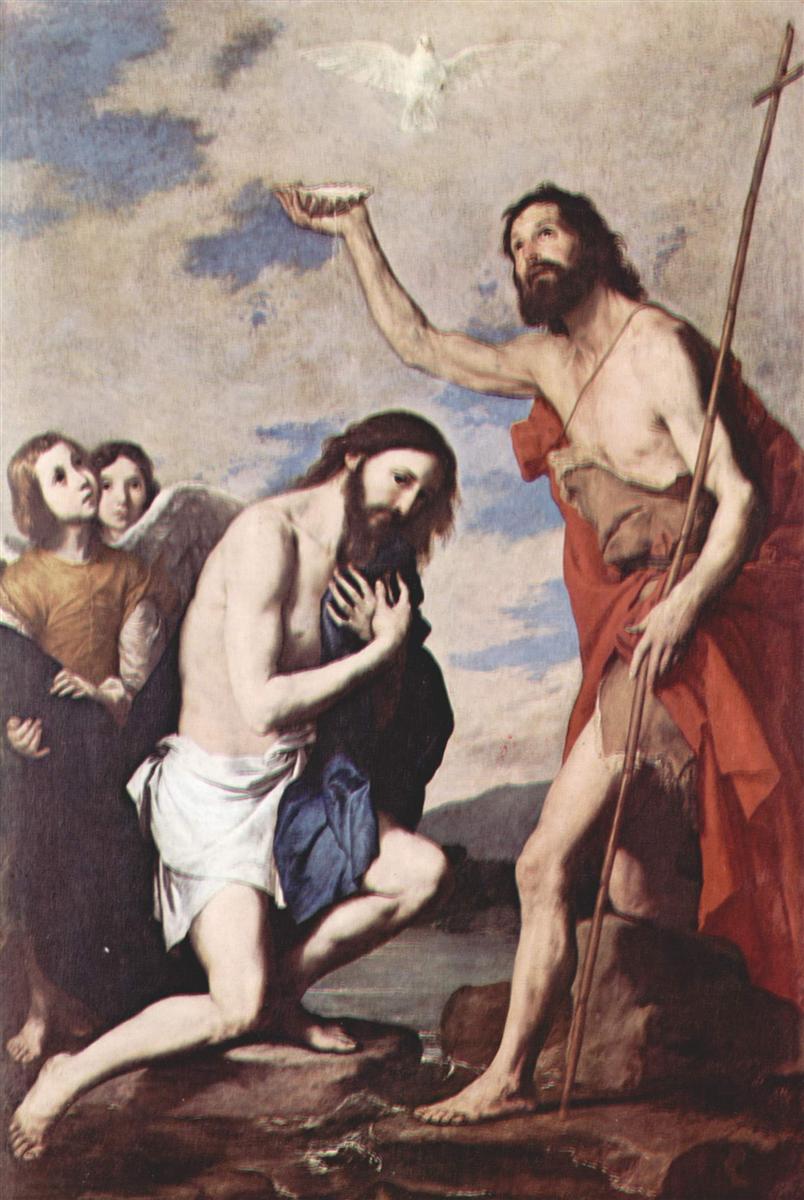
Today’s feast of the Baptism of the Lord is a moment to reflect not only on the Lord’s baptism, but also on our own. For in an extended sense, when Christ is baptized, so are we, for we are members of his body. As Christ enters the water, he makes holy the water that will baptize us. He enters the water and we follow. And in these waters he acquires gifts to give us, as we shall see below.
Let’s examine this text in three stages:
1. The Fraternity of Baptism– The text says After all the people had been baptized and Jesus also had been baptized”
Luke puts the fact of Jesus’ baptism in the middle of a sentence. Perhaps he mentions it in passing because he, like many of us is puzzled about Jesus requesting baptism. Why? John’s baptism of repentance presumes the presence of sin. But the scriptures are clear, Jesus had no sin.
For we have not a high priest who is unable to sympathize with our weaknesses, but one who in every respect has been tempted as we are, yet without sin (Heb 4:15 ).
You know that he appeared to take away sins, and in him there is no sin (1 John 3:5 ).
Jesus identifies with sinners, even if he never sinned. As he comes to the riverside he has no ego concerns. He is not embarrassed or ashamed that some might think him a sinner even though he was not. It is a remarkable humiliation he accepts to be found in the company of sinners like us, and even to be seen as one of us. He freely enters the waters and, to any outsider who knew him not, he would simply be numbered among the sinners, which he was not.
Consider how amazing this is. The Scripture says He is not ashamed to call us his Brethren (Heb 2:11). It also says God made him who had no sin to be sin for us, so that in him we might become the righteousness of God (2 Cor 5:21).
Jesus ate with sinners to the scandal of many of the religious leaders: -This man welcomes sinners and eats with them!” (Lk 15:2). Jesus was known as a friend of sinners, had pity on the woman caught in adultery, allowed a sinful woman to touch him and anoint his feet. He cast out demons and fought for sinners. He suffered and died for sinners in the way reserved for the worst criminals. He was crucified between two thieves and He was assigned a grave among the wicked (Is 53).
Praise God, Jesus is not ashamed to be found in our presence and to share a brotherhood with us. There is a great shedding of his glory in doing this. Again, Scripture says, [Jesus], being in very nature God, did not consider equality with God something to be grasped, but made himself nothing, taking the very nature of a servant, being made in human likeness. And being found in appearance as a man, he humbled himself (Phil 1:3)
2. The Foreshadowing of our Baptism – In accepting Baptism, Jesus does not enter the water alone. He takes us with him, for we are members of His Body. He the Head of the Body, goes where the members will follow. St. Maximus says:
I understand the mystery as this. The column of fire went before the sons of Israel through the Red Sea so that they could follow on their brave journey; the column went first through the waters to prepare a path for those who followed……But Christ the Lord does all these things: in the column of fire He went through the sea before the sons of Israel; so now in the column of his body he goes through baptism before the Christian people….At the time of the Exodus the column…made a pathway through the waters; now it strengthens the footsteps of faith in the bath of baptism. (de sancta Epiphania 1.3)
So what God promised in the in the Old Testament by way of prefigurement he now fulfills in Christ. They were delivered from the slavery of Egypt as the column led them through the waters. But more wonderfully, we are delivered from the slavery to sin as the column of Christ’s body leads us through the waters of baptism. God’s righteousness is his fidelity to his promises. Hence Jesus says, in his baptism and all it signifies (his death and resurrection) he has come to fulfill all righteous and he thus fulfills the promises made by God at the Red Sea and throughout the Old Testament.
3. The Four Gifts of Baptism– The Text says, heaven was opened and the Holy Spirit descended upon him in bodily form like a dove. And a voice came from heaven, “You are my beloved Son; with you I am well pleased.“
Eph 5:30 says we are members of Christ’s body. Thus when Jesus goes into the water we go with him. And in going there he acquires four gifts on our behalf as this text sets them forth. Lets look at the four gifts he acquires on our behalf:
Access – the heavens are opened . The heavens and paradise had been closed to us after Original Sin. But now, at Jesus’ baptism, the text says the heavens are opened. Jesus acquires this gift for us. So, at our baptism, the heavens open for us and we have access to the Father and to the heavenly places. Scripture says: Therefore, since we are justified by faith, we have peace with God through our Lord Jesus Christ. Through him we have obtained access to this grace in which we stand, (Romans 5:1) It also says, For through Jesus we have access in one Spirit to the Father. So then you are no longer strangers and sojourners, but you are fellow citizens with the saints and members of the household of God (Eph 2:17). Hence the heavens are opened also at our own Baptism and we have access to the Father.
Anointing –the Spirit of God descends on him like a dove – Here too, Jesus acquires the Gift of the Holy Spirit for us. In Baptism we are not just washed of sins, but we also become temples of the Holy Spirit. After baptism there is the anointing with chrism which signifies the presence of the Holy Spirit. For adults this is Confirmation. But even for infants, there is an anointing at baptism to recognize that the Spirit of God dwells in the baptized as in a temple. Scripture says, Do you not know that you are God’s temple and that God’s Spirit dwells in you? (1 Cor 3:16)
Acknowledgment – You are my beloved Son. Jesus receives this acknowledgment from his Father for the faith of those who heard, but also to acquire this gift for us. In our own Baptism we become the children of God. Since we become members of Christ’s body, we now have the status of sons of God. On the day of your Baptism the heavenly Father acknowledged you as his own dear Child. Scripture says: You are all sons of God through faith in Christ Jesus, for all of you who were baptized into Christ have clothed yourselves with Christ (Gal 3:26)
Approval – With you I am pleased . Jesus had always pleased his Father. But now he acquires this gift for you as well. Our own Baptism gives us sanctifying grace. Sanctifying grace is the grace to be holy and pleasing to God. Scripture says, Blessed be the God and Father of our Lord Jesus Christ, who has blessed us in Christ with every spiritual blessing in the heavens, as he chose us in him, before the foundation of the world, to be holy and blameless in his sight. (Eph 1:1-3)
Thus, at his Baptism, Christ acquired these gifts for us so that our own Baptism we could receive them. Consider well the glorious gift of your Baptism. Perhaps you know the exact day. It should be a day as highly celebrated as your birthday. Christ is baptized for our sakes, not his own. All these gifts had always been his. Now, in his baptism he fulfills God’s righteousness by going into the water to get them for you. It’s alright to say, “Hallelujah!”
There is an old saying, “If being a Catholic were against the Law, would there be enough evidence to convict you?” Tragically for many Catholics, being a Catholic is little less than a sound or label they go by when they need to fill in the blank on a questionnaire: Religion ______________. Only 25% go to Mass on Sunday and even many at Mass dissent on many critical matters.
In a more ecumenical vein, the writer Maya Angelou once wrote: “A woman said to me the other day, regarding herself, “I am a Christian.” And I said in reply, “Already?”
Indeed, for Christian is more than a label, it is a life.
The video below is a very creative one that addresses the question of being a Catholic. A young woman is a trial for “the crime” of being Catholic and the case seems like a slam-dunk when she “admits” to “the crime.” But her defense attorney comes “to the rescue” and in so doing well illustrates that there is more to being a Catholic that saying you are one. Consider watching this video. It is more creative than first meets the eye, and it lays out a lot of tendencies that are quite common today.
There is a line in the first letter of John (read on the Monday of this week), a line that proves of critical important to many difficulties today with heresy, unbelief and moral decay. The line says:
Beloved, do not trust every spirit but test the spirits to see whether they belong to God, because many false prophets have gone out into the world. This is how you can know the Spirit of God: every spirit that acknowledges Jesus Christ come in the flesh belongs to God, and every spirit that does not acknowledge Jesus does not belong to God. This is the spirit of the antichrist... (1 John 4:1-3)
John also writes in the second Letter:
Many deceivers, who do not acknowledge Jesus Christ as coming in the flesh, have gone out into the world. Any such person is the deceiver and the antichrist. 2 John 1:7
One of those fundamental principles at the heart of the Johannine scriptures is that the Word become flesh. Jesus actually came in the flesh, we could touch our God. The true faith is incarnational. In Jesus Christ, God takes up the physical order, Justice, Truth springs up from the earth (cf Ps 85:11). God actually becomes man. The love of God and his salvation are tangible, and real, not merely ideals, wishes, or hopes, but real and tangible. Faith is about reality. This is John and the Holy Spirit’s insistence, and it is adamantly expressed that we not let this true slip from our understanding even for a moment.
For there are, and have been, many Gnostic and neo-gnostic tendencies down through the centuries which seek to reduce faith merely to intellectualism, to ideas or opinions, and to remove things from the world of reality. Thus St. John and the Church have had to insist over and over that Jesus is real, that faith is real, and is about real, tangible, even material things.
When Jesus came among us, He was not content merely to speak of ideas. He did not simply advance ethical theories or set forth merely philosophical notions. He also spoke to actual human behaviors, not merely speaking of them, but actually living them, and modeling them in the flesh. He demands for his followers not mere intellectual affirmations, but an actual walking in his truth, using our very bodies, and living his teaching. We are to renounce unnecessary possessions, actually feed the poor, confess him with our lips, reverence human sexuality through chaste living, accept suffering, even embraced it, for the sake of the kingdom, and so forth.
Yes, faith is about real things, about actual concrete behaviors that involve not only what we think, but actually how we physically move our body through the created order, how we interact with the physical order, and with one another.
Jesus also took up and made use of the physical and created order in his saving mission. Obviously he took it up in the incarnation, but he also referenced creation in many of his parables, pointing to the lilies of the field, to the sparrow. He made paste with saliva and mud, anointed with oil, change water to wine, laid hands on the bodies of countless individuals in healing, took bread and wine and change it to the body and blood. He took up The wood of the cross, lay down his body in suffering and death, and raised it up again on the third day. Then He took his body, yes his physical body with him to heaven and sat down at the right hand of the Father.
Yet despite this radical physicality seen in the Gospel and the work of God, there remains a persistent tendency on the part of many to reduce the faith by removing it from the physical and temporal order rendering it a merely ethical notion, an intellectualism, or a set of ideas, and even mere opinion. Faith rooted in daily reality, and with measurable parameters, is set aside, and sophistry takes place. Never mind what a person does, all that seems to matter to many us what they think about it, or what their intentions are.
Gnostic tendencies have existed in every stage, but were most severe in the early centuries among heretical groups, only to resurface in recent centuries, especially since the so-called enlightenment where human reason is exulted unreasonably.
The Protestant revolt took up the rationalism of those “enlightenment” times and brought the first great blow to the house of faith by rendering the Sacraments mere symbols, no longer the touch of God. No longer for them does baptism actually save us by washing away our sins, for many of them it only symbolizes faith. Holy Communion for most of them was no longer the actual Body, Blood, Soul and Divinity of Jesus Christ, but only a symbol of him, something that evokes thoughts and memories what he said and did. For the Protestant groups, most of the other Sacraments simply fell away. No longer was it necessary to lay hands on the sick, to lay hands on to ordain or bless. All such things were unnecessary, even abhorrent to many Protestants who took up enlightenment rationalism, and reduced faith to intellectualism, ideas, and words on the page.
Along with the Sacraments, many of the Enlightenment-era Protestants banished most beauty in the churches with iconoclastic tendencies. No longer should creation in the pigmented paints, beautiful stained glass, precious metals, candles incense and so forth be raised up to the glory of God. This too is far too incarnational for the the “purity” of the rationalist mind. Stark white-washed churches were exulted, and the feast of the senses common in Catholicism was frowned upon. Faith that was “purified” of all this incarnational “excess” and was to exist only in one’s mind and heart.
The use of the body to worship in Protestantism was also largely banished. Kneeling, sitting, standing, signs of the cross, vestments, all of this was banished. Afterall what did the body have to do with it? It was in the mind, and in the heart that one worshiped God. Why bend the knee when it sufficed to bow in one’s heart?
And thus, there was a great retreat from the bodily aspect of the incarnation.
We should be clear, that not all Protestant denominations equally indulged iconoclastic and rationalistic tendencies in this aftermath of the enlightenment. There remained many great artistic and musical accomplishments within the Protestant realm, to include architecture. But the general pattern is clear to some extent in all the denominations founded by men after the “Enlightenment.” Worship and faith moved more into the mind, and world of ideas and away from the created, tangible and physical realities of this world.
Many other moral troubles of our day also bespeak a Gnostic, anti-incarnational tendency. For example the exultation of intention over actual behavior. Never mind what a person actually does. The only morally significant matter is what they intend, that they mean well.
Yet another tendency is the word-smithing of our day. It’s not abortion, it’s choice. It is not contraception, it is reproductive choice. I’m not religious, but I’m spiritual. They’re not fornicating, they’re cohabiting, it’s not an act of sodomy it is “gay” etc. The more vague, vapid and non-descriptive the word the better. Abstractions and generalities replace clearer and reality based descriptions.
Here then is a brief tour of the Gnosticism of our times. We can see why St. John and the Holy Spirit were so passionate to warn against any false teachers who denied the incarnation, call them not only false teachers, but “antichrist.” We live on the ever darker side of the Cartesian divide, living in our minds, denying that creation or our bodies are revelation or have anything to say to us.
Of course this is antichrist, it is a slap in the face of God who made all things and established the created by his Word, the Logos. And since all things were made through Christ, the Logos, then all creation has a “logike” (a logic) that is clearly perceived in what God has made. To go on denying this is “illogical” is “anti-logical” is contrary to the Logos, the Word through whom God created and sustains all things. Contrary to the Logos is just another way of saying, “antichrist.”
(One paradox to all this is the flourishing o the material (physical) sciences in our times. I have written more on this paradox here: Cartesian Anxiety)
It occurs that our capacity to converse and to set forth arguments for the truth are often hindered today on account of many factors. One of those factors is a paradoxical relationship between a kind of skepticism and and exaggerated insistence on absolute proof that results. The fact is, absolute certitude in our human condition is rare, and to insist on it is usually unreasonable. This of course does not mean that firm certitude cannot be had in many matters as well as lesser degrees that remain a firm confidence as to the facts in a matter.
On Monday there was posted a reflection on the nature of thinking (Here)and argumentation and there was a promise of a follow-up. Herein is an attempt at that follow-through. First a quick review of Monday’s post:
We can distinguish two types of argumentation: Deductive and inductive.
Deductive arguments are supposed to be water-tight. For a deductive argument to be a valid, it must be impossible for both its premises to be true, and its conclusion to be false. The truth of the premises establishes the truth of the conclusion.
The classic example of deductive argumentation is:
1 All men are mortal.
2 Socrates is a man. Therefore:
3 Socrates is mortal.
It is simply not possible that both 1 and 2 are true, but 3 is false, so this argument is deductively valid.
Any deductive argument must meet this high standard or it commits a logical error, and so, technically, is fallacious.
Now to be sure, not all our arguments can meet this high standard of deductive reasoning since not every premise can be as firm as “all men are mortal.” This includes many arguments that we would usually accept as good arguments, arguments that make their conclusions highly probable, but, they are not absolutely certain. Thus an argument that claims the high standard of deductive reasoning, but cannot meet its high standards is said to commit a “formal fallacy”. This does not mean that the argument is without any merit, only that it claims too much for itself. We often set an impossibly high standard, namely, that all things must be absolutely certain for me, every argument absolutely airtight, and purely deductive.
And that leads us to inductive arguments which do not propose to be as rigorous as deductive argumentation. But note, they are STILL good arguments, and often the only argumentation available to us in many matters. A good inductive argument lends support to its conclusions and sets forth good reasons for them. But it does not assert and cannot claim the 100% certainty of deductive arguments. This is because they often use premises or assert conclusions that are not self evident, but only likely and probable. Thus the terms most often used to distinguish good and bad inductive arguments are “strong” and “weak” rather than certain or “proved.”
The fallacies discussed here in today’s post relate to inductive reasoning and argumentation rather than deductive.
One of the things that make inductive arguments strong or weak are the premises and reasoned conclusions drawn from them. Sometimes premises are weak, or sometimes, even if the premises are strong the conclusion is either erroneous or too strong. Errors in inductive arguments are called informal fallacies.
We do well to review some of the fallacies that commonly come up, especially in modern discourse, since they affect our discussion here on blogs like this, and may at times harm our ability to discuss matters and/or to engage in strong apologetics.
Not let it also be clear, in inductive reasoning and argumentation we are not in the realm of absolute proof and certitude and thus, not every fallacy renders an argument wholly in valid. A fallacy is a conclusion based on unsound argument, a failure in reasoning that renders an argument invalid or very weak. The conclusion in a given argument may still be valid, but our reasons set forth are weaker than they should be due to some fallacy or weakness in the argument. Thus, before we look at any fallacy we must first set forth the cautionary fallacy meant to warn the skeptic. Namely the:
Fallacist’s Fallacy – The fallacist’s fallacy involves rejecting an idea as false simply because the argument offered for it is fallacious. Having examined the case for a particular point of view, and found it wanting, it can be tempting to conclude that the whole point of view is utterly false. This, however, would be to go beyond the evidence. For it is possible to offer a fallacious argument even for proposals that are true. For example, One could argue that 2+2=4 but do so on the basis of an appeal to authority: “Mathematician Al Jones says so″ But using the argument from authority is weak, unnecessary and it does not follow that 2+2=4 merely because Jones says so. So, Perhaps the argument is bad, but it has a true conclusion. A proposition therefore should not be dismissed because one argument offered in its favor is faulty.
Thus, those who would like to think they can dismiss any claim to truth merely because they can find a fallacy in arguments are themselves committing a fallacy for an error in a premise, or conclusion does not of itself prove the point wrong in an absolute sense. And that leads to:
Argument from Authority – arguing that a point is true merely because some one in authority says so. Strictly speaking this is not a fallacy, at least in inductive reasoning. There are times when the testimony of an authority is an important aspect in inductive arguments. This is especially so when the authority is so beause they have witnessed something, or are highly expert in a complicated matter. But generally the argument from authority is a weaker argument.
Take Scripture for example, or the Magisterium. Arguments form authority can and do hold sway in the realm of faith, but it is also important to remember that something is not merely true because it is said by the Bible or a Sacred Council, but also that the Scriptures say these things because they are true, the Church teaches them because they are true. Hence we do well, especially in apologetics not merely to quote authority, but also to appeal to reason, natural law, human experience, the order of creation and other evidence to build the case.
The argument from authority is ineffectual to those outside the realm of faith and thus the instinct of the Church has usually been to rely on more than internal authority to make her case.
Ad Hominem (Personal Attack) – Arguments of this kind focus not on the evidence for a view but on the character of the person advancing it; they seek to discredit positions by discrediting those who hold them. It is important to attack arguments, rather than arguers, and this is where arguments that commit the ad hominem fallacy fall down. Now not every personal observation is ipso facto an ad hominem attack. It is not always invalid to question if one was a true witness to an event about which they speak, or even, to a certain extent if they are properly schooled in the matter whereof they speak. Neither is it necessarily an ad hominem attack to note personal mannerisms or tone that indicate something of substance related to the argument, perhaps of hostility to the subject or a lack of seriousness.
But again, generally speaking, ad hominem arguments are rather weak and implicitly suggest that that the interlocutor is not able to assail he argument on a more substantial level. It is not uncommon that Christians today are simply dismissed as backwards, old-fashioned, hateful, bigoted etc., as if that were somehow an argument. We too will often be dismissive of one another using labels such as conservative, liberal, etc as if that were an argument.
Appeal to Popularity – These are arguments that appeal to the mere fact that an idea is fashionable as evidence that the idea is true. This is a fallacy because there are many factors that can contribute to a rapid increase in popularity of an idea. Peer pressure, tangible benefits, or even mass stupidity could lead to a false idea being adopted by lots of people. A rise in the popularity of an idea, then, is no guarantee of its truth.
This is a common fallacy today in the era of opinion polls, focus groups and democratic notions. It is often said the Church must come more into line with the views of her members and the view of moderns Americans. The implication is that what is popular is therefore right. But this does not follow, for what is popular is not always right and what is right is not always popular. Further, the Church does not exist to reflect the views of its members, but rather of its founder.
Fallacy of Stereotyping – applying the observed property or characteristic of one part of a group to all the members of that group indiscriminately. Here too this fallacy is commonly exhibited in comments, a great deal of which I have to delete which like to presume that all Catholic priests are pedophiles because a small number were. There are other charges of this nature that fly: all Catholics suffer from guilt, the Catholic Church is just the Republican party at prayer, the Bishop are all a bunch of liberals, etc. All of us must be careful, for it is very easy to sterotype and we often get a lot of support for this behavior. But it too is weak for of argumentation at best and an outright lie at worse.
Appeal to Novelty – Appeals to novelty assume that the newness of an idea is evidence of its truth. That an idea is new certainly doesn’t entail that it is true. Merely being a new idea, of course, is no guarantee of truth. In our modern age this attitude is very pervasive. Old for many equals stuffy, prejudiced, uninformed, nonscientific etc. New is exulted by many as ipso facto better, more accurate, more informed, and some how right just because it is what we think now. Many scold the Church for not embracing modern attitudes about women, sexuality, authority and the like. We are told that we need to listen to the young and follow their lead. But the only real reason it would seem that we should do this is because these things are new and/or their proponents are young. Again, this is not a strong argument since new does not thereby equal right. To be sure there are some new things worth embracing, but that is because they are true for other reasons, rather than merely that they are new.
Appeal to Antiquity – Appeals to antiquity assume that the mere fact that an idea has been around for a while shows that it is true. That is, the only evidence that it offers is age. Age of itself can be a motive for credibility in that it indicates, to some degree, that an idea has stood the test of time. Age is also of value when looking the root meaning or origins of historical realities. Hence ancient sources can be more valuable when studying historical matters.
But of itself, age alone is not proof that something is right, since even some long stand ideas have fallen away based on better evidence. Further, even ancient documents (e.g. Gnostic gospels), contain error. Some years ago Pope Pius XII warned against an antiquarianism that seemed to be impressed with older and often rites and forms in the liturgy simply because they were old.
As an ancient Church we reverence antiquity and uphold the democracy of the dead that tradition is. But things are not good simply because they are old. Every appeal to antiquity is not to be excluded but of itself mere antiquity is not a strong argument since it does not follow that old always equals good or right. Otherwise, if someone can demonstrate something is older than Christianity, (e.g. the Jewish faith) then they would right and we would be wrong.
Appeal to Emotion – An argument that attempts to persuade using emotion, rather than evidence. This type of argument is fallacious because our emotional responses are not always a good guide to truth; emotions can cloud, rather than clarify, issues. Arguments are best based upon reason, rather than on emotion, if we want to demonstrate something as true. This is a common form of argumentation in the popular media and culture today. The “sob story” is a mechanism used to persuade that a particular course of action is right. And if someone cries on national television, it is often implied that what they are saying or proposing is somehow more true or carries more weight.
But something is not true simply because the person expressing it is emotional, whether angry or weeping or enthusiastic. Emotion may indicate some sincerity but as a form of argumentation it is weak.
I sometimes get comments on the blog that assert that a certain teaching of the Church is somehow hurtful to that commenter or offensive. Regrettable though this is, it is not an indicator that that Church teaching is necessarily wrong. Jesus of course offended a lot of people but it does not follow that he was wrong or committed error.
Appeal to Poverty – The appeal to poverty fallacy is committed when it is assumed that a position is correct because it is held by the poor. This is usually rooted in the a priori assumption and tendency to categorize in an unquestioning way and contrast the excesses, greed, and immorality of certain rich with the simplicity, virtue, and humility of certain poor. This can give rise to arguments that commit the appeal to poverty fallacy. The poverty of a person that holds a view, of course, does not establish that the view is true; even the poor can sometimes err in their beliefs.
Some years ago Liberation Theology was popular and many of its proponents argued its veracity since it had emerged from the poor and the experience of poverty. Perhaps there were elements of truth in the theology but it does not follow that merely because it came from the poor or was popular among them that there was truth for that reason.
There is another version of this argument that presumes that something is good or right merely because it seeks to alleviate poverty or address the issue. While that may be a good goal, it does not follow that the action is for that reason alone. In fact it can argued that great harm has been done in the name of do-goodism
Appeal to Wealth – An argument that assumes that someone or something is better simply because they are wealthier or more expensive. It is a thinking that everything that is associated with wealth is good. Rich people can be thought to deserve more respect than poorer people; more expensive goods can be thought to be better than less expensive goods solely because of their price.
There was a notion among some, especially back in the 1980s that the views of American Catholics should be more adopted by the Vatican that Catholics in the third world since we contributed most of the money and, on account of our wealth were more advanced. Arguments such as this makes an association with money a sign of superiority.
It may be of value to consult wealthier and successful people in matters of the business in which they excel, but wealth alone is not an argument of whether a position is right or wrong.
Is/ought Fallacy – An argument whose premises merely describe the way that the world is, but whose conclusion describes the way that the world ought to be. You can’t get an ‘ought’ simply from an ‘is’. For example consider the following: (1) Feeling lust is only natural and common. Therefore: (2) There’s nothing wrong with feeling lust. This argument’s premise simply describes the way that the world is for many people, asserting that it is natural to feel lust. To describe the way that the world is, though, is to say nothing of the way that it ought to be, namely that we ought not condemn lust.
And there are many who argue what ought to be from what is, often pointing to widespread misbehavior then concluding that we ought to therefore approve of it. But this does not follow, it is a fallacy. Now here we must be careful, for the point is not that there is no relationship between what is and the determination of what ought to be, only that merely moving from is to ought is not of itself sufficient.
Post Hoc Fallacy – The Latin phrase “post hoc ergo propter hoc” means, literally, “after this therefore because of this.” The post hoc fallacy is committed when it is assumed that because one thing occurred after another, it must have occurred as a result of it. Mere temporal succession, however, does not entail causal succession. Just because one thing follows another does not mean that it was caused by it. This sort of argumentation is especially weak when it comes to social and cultural phenomenon which are often complex and multivariate.
The most common form of this argument on blogs like this is the Vatican II argument wherein it is observed that things went south after the Council, therefore the Council caused it. Perhaps, perhaps not. Perhaps things would have been worse without the Council. But like most widespread social phenomena, it is difficult to point to only one thing as the cause for a complex matter. Simple temporal sucession in matters like these does not necessarily argue for cause and the post hoc argument is exceptionally weak in such matters.
Cum Hoc Fallacy – The cum hoc fallacy is committed when it is assumed that because two things occur together, they must be causally related. This, however, does not follow; correlation is possible without causation. Here in DC last year it was noted that whenever the Redskins lost the game closest to the election, that meant that the incumbent president or presidential party lost. But correlation does not equal cause. By the way the incumbent (Mr Obama) did not lose. Another famous example is that there were more pirates back when the planet was cooler and less pirates now that it is warmer. But no one would seriously argue that the solution to global warming (if that even exists) is to recruit more pirates.
An example is the Church regarding this fallacy is widely held notion that celibacy is somehow a cause of pedophilia. Never mind that the vast majority of celibate priests never offended and that Married men offend in greater percentages. Never mind that, many people connected celibacy and pedophilia and assumed that since they were together, in this case, celibacy must be a cause of this criminal behavior. They went on to suggest the elimination of celibacy. But again it does not follow that correlation (in this case a very weak correlation) equals cause.
Equivocation Fallacy – The fallacy of equivocation is committed when a word is used in two or more different senses within a single argument. For an argument to work, words must have the same meaning each time they appear in its premises or conclusion. Arguments that switch between different meanings of words equivocate, and so don’t work. This is because the change in meaning introduces a change in subject. If the words in the premises and the conclusion mean different things, then the premises and the conclusion are about different things, and so the former cannot support the latter.
This sort of error happens a lot in people who read the Bible. Consider this: 1. Salt is a compound of Sodium and Chloride and it often found in salt shakers.
2. Jesus said, you are the Salt of the Earth. 3. You are therefore sodium and chloride and likely live inside a salt shaker. But of course this does not follow since the literal meaning exists in the premise and the metaphorical or allegorical meaning in the conclusion.
Unfortunately today there is also and extended aspect of this problem wherein many miss the subtlety of language and fail to understand that words can be used literally, denotatively, connotatively, metaphorically, allegorically, euphemistically, hyperbolically and so forth. But not every word should be be equivocated to its literal meaning. Language is subtle and creative and care must be taken to examine the context and intention of the speaker or the message may be misunderstood. Offense is often taken when none is intended, error is presumed when in fact the word is used in a way other than the listener or reader understands. There is a tendency today to be crudely literalistic in interpreting many things and makes people quick to snap at what is meant in ways other than the merely literal.
Fallacy of Good intention – This fallacy says that something is good based merely on the good intention of the doer. Consider however if I place a key in a lock, thinking it is the correct key. Thus my intentions are good. But it does not follow that the lock will turn simply because I had good or right intentions. In fact that door will not open with the wrong key. Thus good intentions do not by themselves make an action good or right. Good intentions may speak to culpability, but not rectitude.
In the world as well many insist that things are good or right merely because some one means well. But it does not follow. Moral assessments must reasonably be made on what is actually done and how that act corresponds to what is reasonable, just, and in conformity to the truth.
Well OK, here are just a few fallacies that are common today. Remember, fallacies are a failure in reasoning that renders an argument invalid, but not always the conclusion. And thus, while noting fallacies like these above, we must also recall that not all of them are as egregious as others, and not all of them as devastating to the right conclusion as others. In inductive reasoning and and argumentation we are on a continuum wherein an argument may be said to be strong or weak. These fallacies obvious weaken an argument but they do not always render its conclusion absolutely wrong.
In the end we would discuss things among ourselves and also engage the world in argumentation ought to become more aware of fallacies such as these and more Here.

 There is a great hymn, an antiphon actually, written by St. Thomas Aquinas for the Office of Corpus Christi. It is O Sacrum Convivium and it serves as a wonderful summary of Eucharistic theology that is worth our attention. With that in mind I’d like to make a brief reflection on some of its compact teachings. First the text, then some commentary: