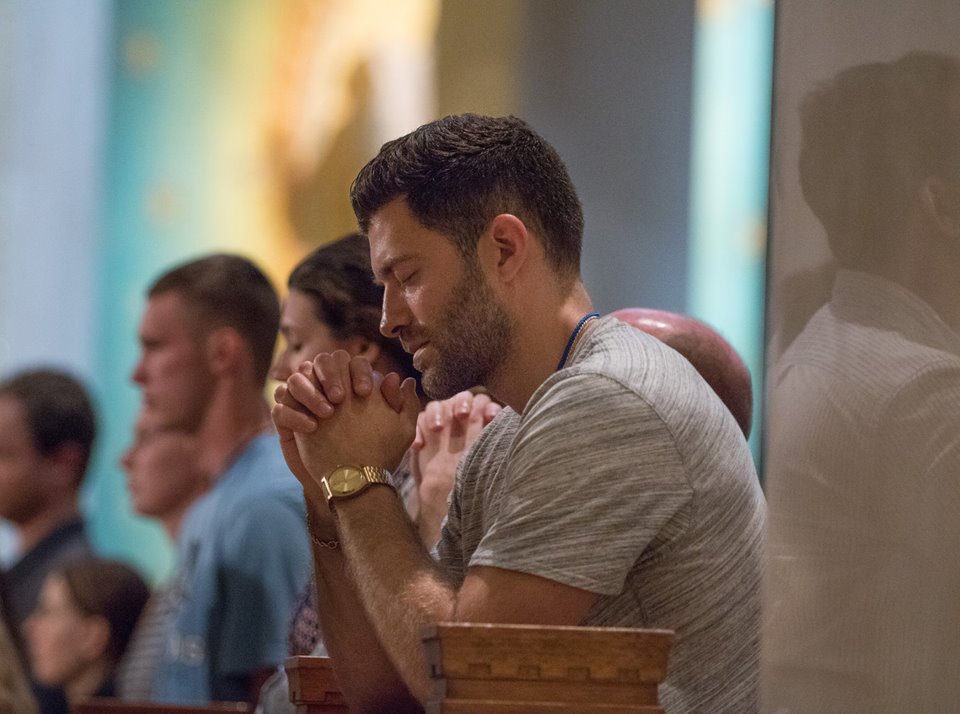
If You Can Use Anything Lord, You Can Use Me – A Homily for the 11th Sunday of the Year

The readings for this Sunday speak of God’s providence, which is often displayed in humble, hidden, and mysterious ways. While it is true that God sometimes works in overpowering ways, His more common method seems to be using the humble and even unlikely things of the created order to accomplish His goals.

For us who are disciples, there are three related teachings given to us that speak of how God will make use of us and others. It is also good to link these teaching to Father’s Day, which occurs this weekend here in the U.S. These three teachings can be described as Adaptability, “Awe-Ability,” and Accountability.

ADAPTABILITY – In today’s first reading and in the Gospel, we hear how God can take something humble and adapt it to be something mighty and powerful.

The tender shoot of the first reading becomes a mighty oak: I [the Lord] will take from the crest of the cedar…a tender shoot, and plant it on a high and lofty mountain. … It shall put forth branches and bear fruit and become a majestic cedar (Ezekiel 17:22-23).

The mustard seed of the first reading which becomes a great shade tree: The … kingdom of God … is like a mustard seed that, when it is sown in the ground, is the smallest of all the seeds on the earth. But once it is sown, it springs up and becomes the largest of plants and puts forth large branches, so that the birds of the sky can dwell in its shade (Mk 4:32-33).

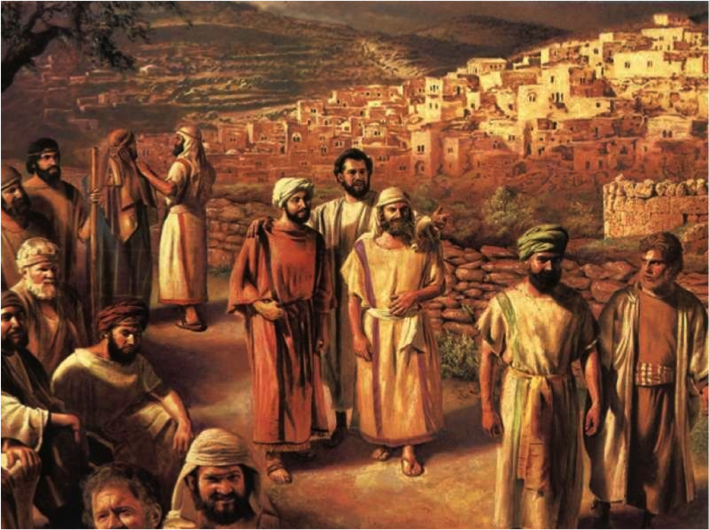
Yes, God adapts us for His purposes and no one should say, “I cannot be used.” An old song says, “If you can use anything Lord, you can use me.” There’s a litany I’ve seen floating around the Internet that says,

The next time you think God can’t use you, remember

Noah was a drunk
Abraham was too old
Isaac was a daydreamer
Jacob was a liar
Leah was ugly
Joseph was abused
Moses was murderer had a stuttering problem
Gideon was afraid
Samson had long hair and was a womanizer
Rahab was a prostitute
Jeremiah and Timothy were too young
David had an affair and was a murderer
Elijah was suicidal
Isaiah preached naked
Jonah ran from God
Naomi was a widow
Job went bankrupt and was depressed
Peter denied Christ
The Disciples fell asleep while praying
Martha worried about everything
The Samaritan woman was divorced, more than once
Zaccheus was too small
Paul was too argumentative
Timothy had an ulcer
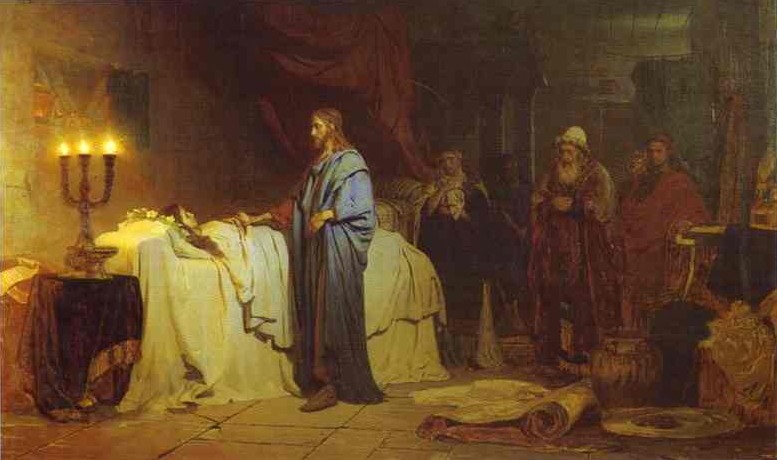
and Lazarus was dead!

No excuses, then, God chooses the weak and makes them strong

In fact, it is often our very weakness that is the open door for God. In our strength we are usually too proud to be of any use to Him. Moses was too strong at age forty when he pridefully murdered a man, thinking he was doing both the Jews and God a favor. Only forty years later, at the age of eighty, was Moses weak and humble enough to depend on God. Only then could God use him.

We are invited in this principle to consider that it is not merely in the “biggie-wow” things we do that God can work. It is also in the humble and imperfect things about us—the mustard seed of faith, the tiny shoots, the humble growth—that God can magnify His power.

So, God can adapt even the humblest, most ordinary, lowliest things and from them bring forth might and lasting fruit. Never despair of what is most humble about you, or that you are of little account on the world’s stage. It is precisely our humble state that God most often uses to bring forth His greatest and most lasting works.

“AWE-ABILITY” – This is the capacity to reverence mystery and to have wonder and awe at what God does. In today’s Gospel, Jesus emphasizes that although a man plants seeds, he does not really know the deeper mysteries of life and growth:

This is how it is with the kingdom of God; it is as if a man were to scatter seed on the land and would sleep and rise night and day and through it all the seed would sprout and grow, he knows not how (Mk 4:26-27).

Despite our often-self-congratulatory celebration of our scientific prowess and of how much we know, there is much more that we neither know nor understand. We do well to maintain a reverential awe of the deeper mysteries of God’s works and His ways. We are also rather poor at assessing the effectiveness of our methods. We may come away from a project considering it to have been very effective, and yet little comes of it in the long run. Conversely, sometimes what we consider to have been an ineffective effort may bear great fruit. God works in His own ways and we do well to remember that He can surprise us, reminding us that He is able and is in charge.

Some years ago, a friend of mine had on her desk a “God can.” It was a metal cookie tin with the following saying on its lid: He worketh in strange and mysterious ways, his wonders to perform. Into this box she would place slips of papers on which were written the challenges, struggles, and failures of her life. When she reached the limits of her strengths and abilities, she would say, “I can’t, but God can.” So, into this metal “God can” went the slips of paper, placed there in the hope that God would make a way out of no way. Quite often He did.

We do well to cultivate a sense of wonder and awe at who God is and how He works. Not only does this bring us joy, but it also opens us to hope. It reminds us that God can work in hidden ways to exult what is humble and to bring great transformation to those who are cast down and troubled. As we saw in the “adaptability” section of this post, it is often in the humblest things that God performs His mightiest works.

ACCOUNTABILITY – If it is true that we can’t, but God can; if it is true that God can use us mightily despite our humble state, our weakness, and even our sinfulness; then there can be no excuse for not bearing fruit in our life. Each of us is accountable to the Lord for how we let Him use us and work through us to further His Kingdom.

The second reading reminds that we must all appear before the judgment seat of Christ, so that each may receive recompense, according to what he did in the body, whether good or evil (2 Cor 5:9-10).

God is able to adapt and to work in wondrous and hidden ways to lift us up, even if we are humble and struggle. Given this capacity of God’s, we must one day render an account of how we have responded to God’s grace and His invitation to be used for His work.

On that day of judgment, the answer “I couldn’t” will ring hollow, because God can. Today’s readings remind us to be open to what God can do, often in mysterious ways, and even with the most humble things in our life.

Today is also Father’s Day, and so the following litany of resolution seems appropriate:

I DO solemnly resolve before God to take full responsibility for myself, my wife, and my children.

I WILL love them, protect them, serve them, and teach them the Word of God as the spiritual leader of my home.

I WILL be faithful to my wife, to love and honor her, and be willing to lay down my life for her as Jesus Christ did for me.

I WILL bless my children and teach them to love God with all of their hearts, all of their minds, and all of their strength.

I WILL train them to honor authority and live responsibly.

I WILL confront evil, pursue justice, and love mercy.

I WILL pray for others and treat them with kindness, respect, and compassion.

I WILL work diligently to provide for the needs of my family.

I WILL forgive those who have wronged me and reconcile with those I have wronged.

I WILL learn from my mistakes, repent of my sins, and walk with integrity as a man answerable to God.

I WILL seek to honor God, be faithful to His church, obey His Word, and do His will.

I WILL courageously work with the strength God provides to fulfill this resolution for the rest of my life and for His glory.

As for me and my house, we will serve the Lord (Joshua 24:15).

This resolution comes from the 2011 movie Courageous, which I strongly recommend seeing.

All of us, men and women, will be held accountable, for even if we can’t, God can. Even if we feel too humble and insignificant, God does His greatest work with humble things and humble people. For us, it is simply to say that we have an adaptability that God can use. This should inspire in us an “awe-ability” that joyfully acknowledges God’s often secretive and hidden power. If that be the case, then, knowing our accountability, it simply remains for us to say, “If you can use anything, Lord, you can use me!”


Three Crucial Questions, One Crucial Plan: A Homily for the 10th Sunday of the Year

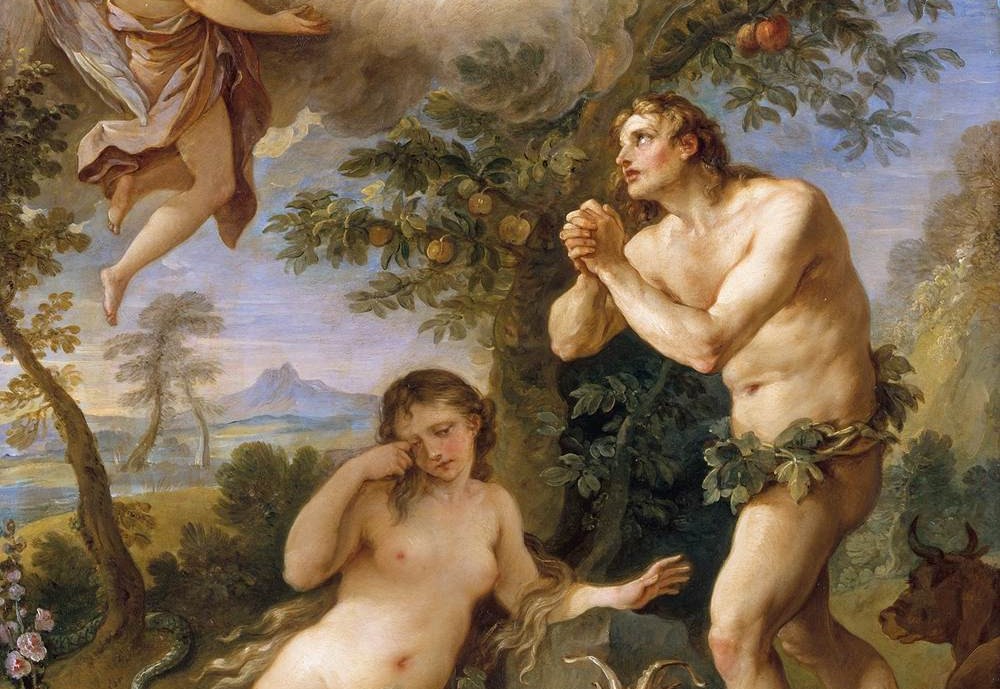
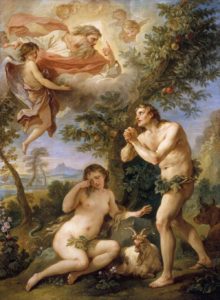
Adam and Eve, Charles-Joseph Natoire (1740)

In the first reading for Sunday (from Genesis) the Lord asks three important questions and sets into motion a “crucial” plan for our salvation. The word “crucial” is rooted in the Latin word for cross (crux or crucis). As such, it indicates something that is central by a coming together of the horizontal and vertical. It also points to a suffering that needs healing. Let’s look at each question in turn and then observe God’s saving plan.

I.  “Adam, where are you?” – God’s first question has almost the quality of a plaintive cry. Because Adam is the head of his household, when God calls Adam He is also seeking Eve.

Of course, God knows where Adam and Eve are. He is really saying, “Adam, Eve: your heart has been hidden from me. What has happened? Where are you going with your life?” This is a crucial question for all of us who are so easily wayward and dull of heart: Where are you?

It is almost as if Adam and Eve had a place in God’s heart and suddenly are absent from that place. Noticing it at once, God seeks them as a shepherd looks for lost sheep.

It is interesting that He is seeking them, not pursuing them. There is nothing here to imply an angry Father, bent on punishment and venting His anger, pursuing those who have done wrong. No, this is a soulful cry.

God is not unaware of what has happened or where they are. The question is deeper: Where is your heart?

We are asked this same question: Where is our heart? On what are our desires focused? Where are we and where are we going? It is much like what Jesus asked Peter: “Do you love me?” How will we answer?

II.  “Who told you that you were naked?” – We do well to understand that the nakedness here is about more than a lack of clothes (which they didn’t even need moments ago). It more fully refers to the experience of feeling exposed, vulnerable, inadequate, and unduly humiliated before God and others.

Proper sorrow for sin is a good thing, but if it descends to deep degradation and feelings of worthlessness, we are robbed of our dignity and capacity to withstand sin in the future. St. Paul says,

Godly sorrow brings repentance that leads to salvation and leaves no regret, but worldly sorrow brings death. (2 Cor. 7:10).

Proper sorrow bids us to seek God for healing. Note that Adam is hiding from God. He has a servile fear of punishment. Instead of running to God, Adam hides; he is fearful and resentful. How quickly he blames his wife for the whole thing: “It was that woman you put here with me!”

God asks us this question, too: “Who told you that you were naked?” In other words, who told you that were wretched and inadequate such that you need to hide from me? I never told you that. Clearly, Satan has bedeviled you and lied to you.

Here are some further things for many of us: “Who told you that you are ugly, that others are better than you, that you do not measure up, that others are laughing at you, that your inadequacies are all that others see? I did not tell you this. They are not the source of your dignity, I am.”

It is a terrible thing to sin, but it is even worse to then lose all hope, to despair, and to feel incapable of emerging from the nakedness of humiliation. Judas despaired of his sin in this way and refused to live with his nakedness and exposure to humiliation. In contrast, Peter waited for the Lord, lived with his sorrow, and then experienced His forgiveness at the lakeside (Jn 21:15ff).

Let the Lord ask you: “Who told you that you were naked?” What does nakedness mean in your life?

Remember, the Lord did not forsake Adam and Eve. He prepares their salvation (as we shall see) and meanwhile He clothed them: The Lord God made garments of skin for Adam and his wife and clothed them (Gen 3:21). Later, Jesus clothed us in righteousness (Rev 19:8).

III. “Why did you do such a thing?” – The tone here could be rhetorical, as if to say, “How could you have done such a thing?” For our purpose, though, it is better to understand the question as an invitation to look into our heart and ponder our motivations.

The Catechism speaks to Adam and Eve’s motivations in the following way:

Man, tempted by the devil, let his trust in his Creator die in his heart and, abusing his freedom, disobeyed God’s command. This is what man’s first sin consisted of. All subsequent sin would be disobedience toward God and lack of trust in his goodness (CCC # 397).

So, at the heart of Adam and Eve’s fall was a lack of trust in God’s goodness and truthfulness. They accepted Satan’s lie that God was not really good and that He was holding the best things back from them, that He was preventing them from being gods. This also aroused their pride and made them ungrateful for what they had. These are the deeper drives behind their external act.

In asking this question, God invites Adam and Eve to ponder the motivations of their hearts and come to greater self-knowledge.

This same question must be asked of us when we sin: Why did you do such a thing? It is good to confess our sinful behavior, but it is more healing to ponder the deep drives of sin and seek the Lord’s healing. There are many deep drives of sin: pride, greed, lust, anger, envy, gluttony, sloth, ingratitude, fear, worldliness, stubbornness, and so forth. We do well to study our hearts and learn to name the vices and virtues we discover there. Through self-knowledge and grace, we can take greater authority over our lives.

The Crucial Plan: The text from Genesis 3 also announces the “protoevangelium” (the first Gospel) after Original Sin. The Lord does not forsake Adam, Eve, or us. He sets forth a crucial plan wherein one of Eve’s own progeny will rise to conquer Satan’s pride by His humble acceptance of the Cross:

Then the LORD God said to the serpent: “Because you have done this, you shall be banned from all the animals and from all the wild creatures; on your belly shall you crawl, and dirt shall you eat all the days of your life. I will put enmity between you and the woman, and between your offspring and hers; he will strike at your head, while you strike at his heel.”

In effect, God says that this attack on His people will not stand. He will set this right. In setting it right He will include His people in the very solution. The man, woman, and tree involved in this fall will also be its undoing. There will be a new Adam (Christ), a new Eve (Mary), and the tree of the Cross. In the very act of striking at Christ’s heel, the serpent’s head will be crushed. Your power will be crushed, Satan.

So indeed, it happened. God had a “crucial” plan: the plan of the Cross. Humility would defeat pride as light casts out darkness and love drives out hatred.

Whatever your sins, never forget that God has a plan to save you. Let God find you as He calls “Where are you?” Let Him clothe your nakedness and help you to understand your heart. Finally, let Him apply the crucial remedy, the cross. All He needs is your ongoing yes!

Unless – A Homily for Corpus Christi

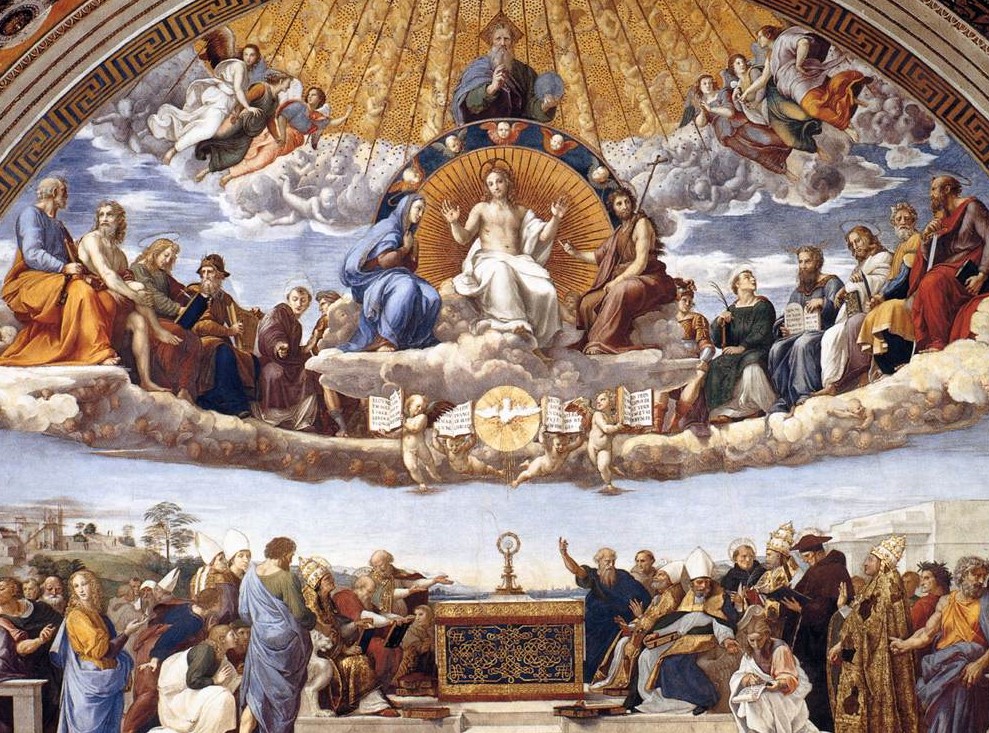
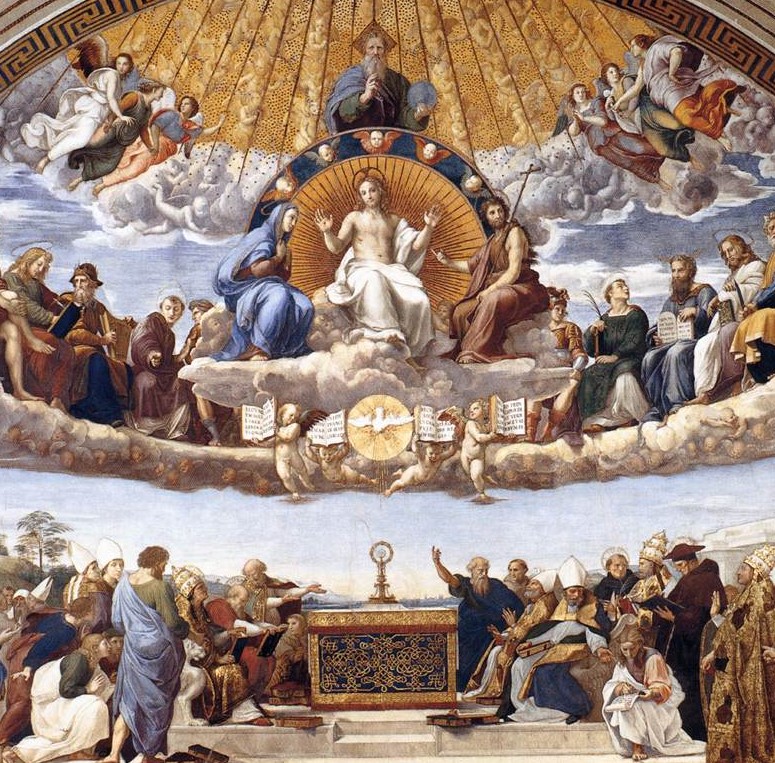
Disputation of the Holy Sacrament, Raphael (1510-11)
I.  The Reality of the Eucharist

On this solemn feast we are called above all to faith in the fact (as revealed by the Lord Himself) that the Eucharist, the Holy Communion of which we partake, is in fact a reception of the very Body, Blood, Soul, and Divinity of Jesus Christ, whole and entire, in His glorified state.

We do not partake of a symbol; the Eucharist is truly the Lord. Neither is it a “piece” of His flesh; it is Christ, whole and entire. Scripture attests to this in many places.

And he took bread, and when he had given thanks he broke it and gave it to them, saying, “This is my body which is given for you. Do this in remembrance of me.” And likewise the cup after supper, saying, “This cup which is poured out for you is the new covenant in my blood” (Luke 22:19-20).

The cup of blessing which we bless, is it not a partaking in the blood of Christ? The bread which we break, is it not a partaking in the body of Christ? (1 Cor 10:16).

They recognized him in the breaking of the bread. (Luke 24:35).

For anyone who eats and drinks without recognizing the body of the Lord eats and drinks judgment on himself. (1 Cor 11:29).

I am the living bread which came down from heaven; if any one eats of this bread, he will live for ever; and the bread which I shall give for the life of the world is my flesh. (John 6:51).

This last passage is a profound theology of the Eucharist from Jesus Himself. He makes it clear that we are not to think of the Eucharist as symbolic.

As Jesus spoke the words saying that the bread was His flesh, the Jewish people grumbled in protest. Jesus did not seek to reassure them or to say that He was speaking only symbolically. Rather, He became even more adamant, shifting His choice of words from the polite form of eating, φάγητε (phagete, meaning to eat), to the impolite form, τρώγων (trogon, meaning to munch, gnaw, or chew).

So insistent was He that they grasp this, that He permitted most of them to leave, no longer following in His company due to this teaching (cf Jn 6:66). Yes, the Lord paid quite a price for His graphic and “hard” teaching (Jn 6:60).

Today, He asks us, Do you also want to leave me? (Jn 6:67) We must give our answer each time we approach the altar and hear the words, “The Body of Christ.” It is at this time that we respond, “Amen,” as if to say, “Lord, to whom shall we go? You have the words of eternal life” (Jn 6:68).

Would that people grasped that the Lord Himself is truly present in our Churches! Were that so, one would never be able to empty our parishes of those seeking to pray with the Lord. As it is, though, only about 25% of Catholics attend Mass regularly. This is more evidence of the “narrow road” and of how few there are who find it. Two thousand years ago, Jesus experienced that most left Him; many today continue to leave Him (or stand far away), either through indifference or false notions.

What father would not be alarmed if one of his children stopped eating? Consider, then, God’s alarm that many of us have stopped eating.

II.  The Requirement for the Eucharist

This is where the “Unless” in the title of this post comes in. When I was young I thought of Mass and Communion as just something my mother made me do; it was just a bunch of rituals to me. I never thought of it as essential for my survival. Jesus teaches something very profound in John’s Gospel today. In effect, He says that without Holy Communion, the Eucharist, we will starve and die spiritually.

Here is what Jesus says: Unless you eat the flesh of the Son of Man and drink his blood, you have no life in you (John 6:53).

As a child and even as a young adult I never thought of Holy Communion as essential for my life, as something that, if not received regularly, would cause me to die spiritually. It makes sense, though, doesn’t it? If we don’t eat food in our physical life, we would grow weak and eventually die. It is the same with Holy Communion with respect to our spiritual life.

Remember in the Book of Exodus that the people in the desert were without food and feared for their lives. In response, God gave them bread from Heaven called “manna,” which they collected each morning. Without eating that bread from Heaven, they would never have made it to the Promised Land; they would have perished in the desert.

It is the same with us. Without receiving Jesus, our Living Manna from Heaven, in Holy Communion, we will not make it to our Promised Land of Heaven. It is not just a ritual; it is essential for our survival.

Don’t miss Holy Communion! Jesus urges you to eat. A number of years ago, a mother and father in my parish noticed that their daughter wasn’t eating. They wasted no time in taking her to a doctor, who diagnosed the problem and prescribed the remedy. Those parents would have moved Heaven and Earth to get their daughter eating again! It is the same for God. Jesus urges us to eat, to receive Holy Communion every Sunday. Jesus urges us with this word: “Unless.” Holy Communion is our required food.

III.  The Reverence for the Eucharist

One of the common, mistaken notions about the Eucharist is confusing this sacred meal with the table fellowship Jesus had with sinners. He was known to “welcome sinners and eat with them.” Holy Mass, however, is not one of those sorts of meals. The Last Supper, at which the essential reality of the Mass was first set forth, was held in the context of the Passover. Passover was a sacred meal shared within the family. Therefore, Jesus celebrated that Last Supper with the twelve Apostles.

This lack of understanding of the difference between the sacred meal of the Eucharist and common table fellowship leads many to misconstrue the Eucharist; it also helps to explain the Church’s stance.

Those who think of the Mass as the mere table fellowship Jesus had with sinners tend to interpret the Eucharist as a “Come one, come all” sort of meal. Many also add, “Come as you are.” In their view, there are no requirements; all that matters is that Jesus is offering. “Don’t worry,” they say, “about ‘membership’ or the need to be reconciled from sin. After all, Jesus ate with sinners and He didn’t worry about those things.”

Again, however, this is not what the Last Supper was. Jesus celebrated the Mass in the context of the Passover. Such meals presupposed that the people gathered together were family. This was an intimate meal celebrated in the context of faith, however weak or strong, but a faith that was presupposed. Jesus said to them, You are the men who have stood by me in my trials (Lk 22:28).

This is one reason that the Church has always limited the reception of the Eucharist to those who are initiated, who are “members of Christ’s Body” through faith, and who keep communion with His Body the Church through assent to her teachings, remaining members of His Body by being in a state of grace.

It further explains the need to receive the Eucharist worthily by first confessing serious sins through the Sacrament of Confession. St. Paul teaches,

Let a person examine himself, then, and so eat of the bread and drink of the cup. For anyone who eats and drinks without discerning the body eats and drinks judgment on himself. That is why many of you are weak and ill, and some have died (1 Cor 11:28-30).

Here, too, we see that the Mass is not akin to the table fellowship that Jesus at times kept with sinners. Rather, it is a sacred meal that presupposes membership in Christ’s Body through faith and the forgiveness of all serious sins that might have severed that communion. Holy Communion is meant to strengthen a communion that already exists. Thus, our “Amen” before receiving Holy Communion is not a lie, but is consonant with the reality of existing communion.

I will write more on this topic in the coming week, but for now simply note that our reverence for Holy Communion requires us to receive worthily, in a state of grace that has preserved the communion we celebrate. Further, to receive worthily also requires that we have the faith of the Church, the Body of Christ, and keep communion by a belief in conformity and communion with it.

On this Solemnity of the Body of Christ we are summoned to deepen our faith in the Lord, present in the Eucharist and acting through His Sacraments. Routine may have somewhat of a dulling effect, but it cannot be so much so that we receive the Lord of glory in any way that could be called mindless or lacking in the reverence we ought to have for Him.

Ask the Lord to anoint your mind so that you never forget your need for the Eucharist. Unless! Unless you eat the flesh of the Son of Man and drink His Blood, you have no life in you (cf Jn 6:53). However, receive this great gift worthily and with a communion that befits the Holy Communion to which we are summoned.

One and One and One Are One – A Homily for Trinity Sunday

TrinityThere is an old spiritual that says, “My God is so high you can’t get over Him. He’s so low you can’t get under Him. He’s so wide you can’t get around Him. You must come in, by and through the Lamb.”

It’s not a bad way of saying that God is “other.” He is beyond what human words can describe, beyond what human thoughts can conjure. On the Feast of the Most Holy Trinity we do well to remember that we are pondering a mystery that cannot fit in our minds.

A mystery, though, is not something wholly unknown. In the Christian tradition, the word “mystery” refers to (among other things) something that is partially revealed, something much more of which remains hidden. As we ponder the Trinity, consider that although there are some things we can know by revelation, much more is beyond our understanding.

Let’s ponder the Trinity by exploring it, seeing how it is exhibited in Scripture, and observing how we, who are made in God’s image, experience it.

I. The Teaching on the Trinity Explored

Perhaps we do best to begin by quoting the Catechism, which says, The Trinity is One. We do not confess three Gods, but one God in three persons: [Father, Son, and Holy Spirit] … The divine persons do not share the one divinity among themselves but each of them is God, whole and entire (Catechism, 253).

There is one God and each of the three persons of the Trinity possesses the one divine nature fully. The Father is God; He is not one-third of God. Likewise, the Son, Jesus, is God; He is not one-third of God. And the Holy Spirit is God, not merely one-third of God.

It is our human experience that if there is only one of something, and someone possesses it fully, then there is nothing left for anyone else. Yet mysteriously, each of the three persons of the Trinity fully possesses the one and only divine nature while remaining a distinct person.

One of the great masterpieces of the Latin Liturgy is the preface for Trinity Sunday. It compactly and clearly sets forth the Christian teaching on the Trinity. The following translation of the Latin is my own:

It is truly fitting and just, right and helpful unto salvation that we should always and everywhere give thanks to you O Holy Lord, Father almighty and eternal God: who, with your only begotten Son and the Holy Spirit are one God, one Lord: not in the oneness of a single person, but in a Trinity of one substance. For that which we believe from your revelation concerning your glory, we acknowledge of your Son and the Holy Spirit without difference or distinction. Thus, in the confession of the true and eternal Godhead there is adored a distinctness of persons, a oneness in essence, and an equality in majesty, whom the angels and archangels, the Cherubim also and the Seraphim, do not cease to daily cry out with one voice saying, Holy, Holy, Holy

Wow! It’s a careful and clear masterpiece, but one that baffles the mind. So deep is this mystery that we had to “invent” a paradoxical word to summarize it: Triune (or Trinity). Triune literally means “three-one” (tri + unus), and “Trinity” is a conflation of “Tri-unity,” meaning the “three-oneness” of God.

If all of this baffles you, good! If you were to say that you fully understood all this, I would have to say you were likely a heretic. The teaching on the Trinity, while not contrary to reason per se, does transcend it and it is surely beyond human understanding.

Here is a final image before we leave our exploration stage. The picture at the upper right is from an experiment I remember doing when I was in high school. We took three projectors, each of which projected a circle: one red, one green, and one blue (the three primary colors). At the intersection of the three circles the color white appeared. Mysteriously, the three primary colors are present in the color white, but only one shows forth. The analogy is not perfect (no analogy is or it wouldn’t be an analogy) for Father, Son, and Spirit do not “blend” to make God, but it does manifest a mysterious “three-oneness” of the color white. Somehow in the one, three are present. (By the way, this experiment only works with light; don’t try it with paint!)

II. The Teaching on the Trinity Exhibited – Scripture also presents images of the Trinity. Interestingly enough, most of the ones I want to present here are from the Old Testament.

As a disclaimer, I’d like to point out that Scripture scholars debate the meaning of these texts; that’s what they get paid the big bucks to do. I am reading these texts as a New Testament Christian and seeing in them a doctrine that later became clear. I am not getting into a time machine and trying to understand them as a Jew from the 8th century B.C. might have. Why should I? That’s not what I am. I am reading these texts as a Christian in the light of the New Testament, as I have a perfect right to do. You, of course, are free to decide whether you think these texts really are images or hints of the Trinity. Here they are:

1. Then God said, “Let us make man in our image, after our likeness …” (Gen 1:26)

God speaks of himself in the plural: “Let us … our …” Some claim that this is just an instance of the “royal we” being used. Perhaps, but I see an image of the Trinity. There is one (“God said”) but there is also a plural (us, our). Right at the very beginning in Genesis there is already a hint that God is not all by himself, but rather is in a communion of love.

2. Elohim

In the passage above, the word used for God is אֱלֹהִ֔ים (Elohim). It is interesting to note that this word is in the plural form. From a grammatical standpoint, Elohim actually means “Gods,” but the Jewish people understood the sense of the word to be singular. This is a much debated point, however. You can read more about it from a Jewish perspective here: Elohim as Plural yet Singular.

(We have certain words like this in English, words that are plural in form but singular in meaning such as news, mathematics, and acoustics.) My point here is not to try to understand it as a Jew from the 8th century B.C. or even as a present day Jew. Rather, I am observing with interest that one of the main words for God in the Old Testament is plural yet singular, singular yet plural. God is one yet three. I say this as a Christian observing this about one of the main titles of God, and I see an image of the Trinity.

3. And the LORD appeared to [Abram] by the oaks of Mamre, as he sat at the door of his tent in the heat of the day. He lifted up his eyes and looked, and behold, three men stood in front of him. When he saw them, he ran from the tent door to meet them, and bowed himself to the earth, and said, “My Lord, if I have found favor in your sight, do not pass by your servant. Let a little water be brought, and wash your feet, and rest yourselves under the tree, while I fetch a morsel of bread, that you may refresh yourselves, and after that you may pass on—since you have come to your servant.” So they said, “Do as you have said (Gen 18:1-5).

From a purely grammatical standpoint this is a very difficult passage because it switches back and forth between singular and plural references. The Lord (singular) appears to Abram, yet Abram sees three men (some have said that this is just God and two angels, but I think it is the Trinity). Then when Abram addresses “them” he says, “My Lord” (singular). The tortured grammar continues as Abram suggests that the Lord (singular) rest “yourselves” (plural) under the tree. The same thing happens in the next sentence, in which Abram wants to fetch bread so that you may refresh “yourselves” (plural). In the end, the Lord (singular) answers, but it is rendered as “So they said.” Plural, singular … which is it? Both. God is one and God is three. For me as a Christian, this is a picture of the Trinity. Because the reality of God cannot be reduced to mere words, this is a grammatically difficult passage, but I can “see” what is going on: God is one and God is three; He is singular and He is plural.

4. Having come down in a cloud, the Lord stood with Moses there and proclaimed his Name, “Lord.” Thus the Lord passed before him and cried out, “The Lord, the Lord, a merciful and gracious God, slow to anger and rich in kindness and fidelity” (Exodus 34:5).

When God announces His name, He does so in a threefold way: Lord! … The Lord, the Lord. There is implicit a threefold introduction or announcement of God. Is it a coincidence or is it significant? You decide.

5. In the year that King Uzziah died I saw the Lord sitting upon a throne, high and lifted up; and his train filled the temple. Above him stood the Seraphim; each had six wings: with two he covered his face, and with two he covered his feet, and with two he flew. And one called to another and said: “Holy, holy, holy is the Lord of hosts; the whole earth is full of his glory” (Is 6:1-3).

God is Holy, Holy, and yet again, Holy. Some say that this is just a Jewish way of saying “very Holy,” but as Christian I see more. I see a reference to each of the three persons of the Trinity. Perfect praise here requires three “holys.” Why? Omni Trinum Perfectum (all things are perfect in threes). But why? As a Christian, I see the angels praising each of the three persons of the Trinity. God is three (Holy, holy, holy …) and yet God is one (holy is the Lord …). There are three declarations of the word “Holy.” Is it a coincidence or is it significant? You decide.

6. Here are three (of many) references to the Trinity in the New Testament:

  1. Jesus says, The Father and I are one (Jn 10:30).
  2. Jesus also says, To have seen me is to have seen the Father (Jn 14:9).
  3. Have you ever noticed that in the baptismal formula, Jesus uses “bad” grammar? He says, Baptize them in the name (not names (plural)) of the Father and of the Son and of the Holy Spirit (Matt 28:19). God is one (name) and God is three (Father, Son, and Holy Spirit).

Thus Scripture exhibits the teaching of the Trinity, going back even to the beginning.

III. The Teaching of the Trinity Experienced – We who are made in the image and likeness of God ought to experience something of the mystery of the Trinity within us, and sure enough, we do.

  • It is clear that we are all distinct individuals. I am not you; you are not I. Yet it is also true that we are made for communion. We humans cannot exist apart from one another. Obviously we depend on our parents, through whom God made us, but even beyond that we need one another for completion.
  • Despite what the Paul Simon song says, no man is a rock or an island. There is no such thing as a self-made man. Even the private business owner needs customers, suppliers, shippers, and other middlemen. He uses roads he did not build, has electricity supplied to him over lines he did not string, and speaks a language to his customers that he did not create. Further, the product he makes was likely the result of technologies and processes he did not invent. The list could go on and on.
  • We are individual, but we are social. We are one, but we are linked to many. Clearly we do not possess the kind of unity that God does, but the “three-oneness” of God echoes in us. We are one, yet we are many.
  • We have entered into perilous times where our interdependence and communal influence are under-appreciated. The attitude that prevails today is a rather extreme individualism: “I can do as I please.” There is a reduced sense of how our individual choices affect the community, Church, or nation. That I am an individual is true, but it is also true that I live in communion with others and must respect that dimension of who I am. I exist not only for me, but for others. What I do affects others, for good or ill.
  • The attitude that it’s none of my business what others do needs some attention. Privacy and discretion have important places in our life, but so does concern for what others think and do, the choices they make, and the effects that such things have on others. A common moral and religious vision is an important thing to cultivate. It is ultimately quite important what others think and do. We should care about fundamental things like respect for life, love, care for the poor, education, marriage, and family. Indeed, marriage and family are fundamental to community, nation, and the Church. I am one, but I am also in communion with others and they with me.
  • Finally, there is a rather remarkable conclusion that some have drawn: the best image of God in us is not a man alone or a woman alone, but rather a man and a woman together in the lasting and fruitful relationship we call marriage. When God said, “Let us make man in our image” (Genesis 1:26), the text goes on to say, “Male and female he created them” (Genesis 1:27). God then says to them, “Be fruitful and multiply” (Gen 1:28). So the image of God (as He sets it forth most perfectly) is the married and fruitful couple.

We must be careful to understand that what humans manifest sexually, God manifests spiritually, for God is neither male nor female in His essence. We may say that the First Person loves the Second Person and the Second Person loves the First Person. So real is that love that it bears fruit in the Third Person. In this way the married couple images God, for the husband and wife love each other and their love bears fruit in their children (See, USCCB, “Marriage: Love and Life in the Divine Plan”).

So today, as we extol the great mystery of the Trinity, we look not merely outward and upward so as to understand, but also inward to discover that mystery at work in us, who are made in the image and likeness of God.


The Spirit of the Lord Filled the Earth – A Homily for Pentecost

What a wondrous and challenging feast we celebrate at Pentecost! A feast like this challenges us because it puts to the lie a lazy, sleepy, hidden, and tepid Christian life. The Lord Jesus said to apostles, and still says to us, I have come to cast a fire on the earth (Luke 12:49). This is a feast about fire, a transformative, refining, purifying fire that the Lord wants to kindle in us and in this world. It is about a necessary fire, for as the Lord first judged the world by fire, the present heavens and the earth are reserved for fire. Because it is going to be the fire next time, we need the tongues of Pentecost fire to fall on us in order to set us on fire and bring us up to the temperature of glory.

The readings today speak to us of the Holy Spirit in three ways: the portraits of the Spirit, the proclamation of the Spirit, and the propagation by the Spirit.

I. The Portraits of the Spirit – The reading today speaks of the Holy Spirit using two images: rushing wind and tongues of fire. These two images recall Psalm 50, which says, Our God comes, he does not keep silence, before him is a devouring fire, round about him a mighty tempest.

Rushing Wind – Notice how the text from Acts opens: When the time for Pentecost was fulfilled, they were all in one place together. And suddenly there came from the sky a noise like a strong driving wind, and it filled the entire house in which they were.

This text brings us to the very root meaning of the word “spirit.” Spirit refers to breath. This is preserved in the word “respiration,” which is the act of breathing. So, the Spirit of God is the breath of God, the Ruah Adonai (the Spirit, the breath of God).

Genesis 1:2 speaks of this, saying, the Spirit of God was moving over the face of the waters. Genesis 2:7 speaks even more remarkably of something God did only for man (not for the animals): then the LORD God formed man of dust from the ground and breathed into his nostrils the breath of life; and man became a living soul.

So, the very Spirit of God was breathed into Adam! As we know, though, Adam lost this gift and died spiritually when he sinned.

Thus, we see in this passage from Acts an amazing and wonderful resuscitation of the human person, as these first Christians experience the rushing wind of God’s Spirit breathing spiritual life back into them. God does C.P.R. and brings humanity, dead in sin, back to life! The Holy Spirit comes to dwell in us once again as in a temple (cf 1 Cor 3:16). It has been said that Christmas is the feast of God with us, Good Friday is the Feast of God for us, but Pentecost is the Feast of God in us.

Tongues of Fire – The text from Acts then says, Then there appeared to them tongues as of fire, which parted and came to rest on each one of them.

The Bible often speaks of God as fire or in fiery terms. Moses saw God as a burning bush. God led the people out of Egypt through the desert as a pillar of fire. Moses went up onto a fiery Mt. Sinai where God was. Psalm 97 says,

The LORD reigns; let the earth rejoice; let the many coastlands be glad! Clouds and thick darkness are round about him; righteousness and justice are the foundation of his throne. Fire goes before him and burns up his adversaries round about. His lightnings lighten the world; the earth sees and trembles. The mountains melt like wax before the LORD, before the Lord of all the earth. The heavens proclaim his righteousness; and all the peoples behold his glory.

Scriptures also call God a Holy fire, a consuming fire (cf Heb 12:29) and a refining fire (cf Is. 48:10; Jer 9:7; Zec 13:9; Mal 3:3).

So it is that our God, who is a Holy Fire, comes to dwell in us through His Holy Spirit. As a Holy Fire, He refines us by burning away our sins and purifying us. As Job once said, But he knows the way that I take; when he has tested me, I will come forth as gold (Job 23:10).

God is also preparing us for judgment, for if He is a Holy Fire, then who may endure the day of His coming or of going to Him? What can endure the presence of Fire Himself? Only that which is already fire. Thus, we must be set afire by God’s love.

So, in the coming of the Holy Spirit, God sets us on fire to make us a kind of fire. In so doing, He purifies us and prepares us to meet Him one day, to meet Him who is a Holy Fire.

II. The Proclamation of the Spirit – Notice that the Spirit came upon them like “tongues” of fire. The reference to tongues is no accident, for the Holy Spirit moves them to speak and ultimately to witness. The text says, And they were all filled with the Holy Spirit and began to speak in different tongues, as the Spirit enabled them to proclaim. Now there were devout Jews from every nation under heaven staying in Jerusalem. At this sound, they gathered in a large crowd, but they were confused because each one heard them speaking in his own language. They were astounded, and in amazement they asked, “Are not all these people who are speaking Galileans? Then how does each of us hear them in his native language? We are Parthians, Medes, and Elamites, inhabitants of Mesopotamia, Judea and Cappadocia, Pontus and Asia, Phrygia and Pamphylia, Egypt and the districts of Libya near Cyrene, as well as travelers from Rome, both Jews and converts to Judaism, Cretans and Arabs, yet we hear them speaking in our own tongues of the mighty acts of God.”

Behold how the Holy Spirit moves them to proclaim, not just within the safety of the upper room, but also in holy boldness before the crowds that have gathered.

Notice the transformation! Moments ago, these were frightened men who gathered in secrecy behind locked doors, huddled together in fear. Now, they go forth to the crowds and proclaim Christ boldly. They have gone from fear to faith, from cowardice to courage, from terror to testimony!

What about us? Too many Christians are silent, overcome by fear. Perhaps they fear being called names or being unpopular. Perhaps they are anxious about being laughed at or resisted, or of being asked questions they don’t feel capable of answering. Some Christians are able to gather in the “upper room” of the parish and to be active, even to be leaders, but once outside the safe confines of the “upper room” they slip into undercover mode. They become “secret agent Christians.”

Well, the Holy Spirit wants to change that. The more we have really met Jesus Christ and experienced His Holy Spirit, the less able we are to keep silent. An old gospel song says, “I thought I wasn’t gonna testify, but I couldn’t keep it to myself, what the Lord has done for me.” The Holy Spirit, if authentically received, gives us zeal and joy, burning away our fear so that testifying and witnessing come naturally.

Note also how the Spirit “translates” for the apostles. The people in the crowd before them spoke different languages, yet each heard Peter and the others in his own language. The Spirit, therefore, assists not only us but also those who hear us. My testimony is not dependent on my eloquence alone but also on the grace of the Holy Spirit, who casts out deafness and opens hearts. Every Christian should remember this. Some of our most doubt-filled encounters with others can still bear great fruit because of the work of the Holy Spirit, who “translates” for us and overcomes many obstacles we might think insurmountable.

III. The Propagation by the Spirit – In the great commission, the Lord said, Go, therefore, and make disciples of all nations, baptizing them in the name of the Father, and of the Son, and of the Holy Spirit, teaching them to observe all that I have commanded you. And behold, I am with you always, until the end of the age (Matt 28:19ff). He also said, I have come to cast a fire on the earth and How I wish the blaze were already ignited (Luke 12:49).

How is the Lord going to do this?

Perhaps a picture will help to illustrate. My parish church is dedicated to the Holy Spirit under the title Holy Comforter. Above the high altar is the following Latin inscription: Spiritus Domini, replevit orbem terrarum (The Spirit of the Lord, filled the orb of the earth). (See the photo above of our high altar.)

The walls of my parish Church answer the question. The clerestory walls are painted Spanish red, and upon this great canvas are also painted the stories of the lives of twenty saints, surrounding us like a great cloud of witnesses (cf Heb 12:1). (See also the video below.) Over the head of every saint is a tongue of fire.

This is how the Spirit of the Lord fills the earth. It is not via “magic fairy dust.” It is in the fiery transformation of every Christian going forth to bring warmth and light to a cold, dark world. This is how the Lord casts fire upon the earth. This is how the Spirit of the Lord fills the orb of the earth—in the lives of saints (and in your life)!

In the end, the great commission (Matt 28) is our first and most important job. No matter what else we do, we are supposed to do this. Parishes do not deserve to exist if they do not do this. As individual Christians, we are a disgrace and not worthy of the name if we fail to win souls for Jesus Christ. The Spirit of the Lord is going to fill the orb of the earth, but only through us. The spread of the Gospel has been placed in your hands. It’s scary, isn’t it!

In my short time on this planet, I have seen it. Parishes that were once big and booming (and, frankly, sometimes arrogant) are now in decline; some are near closure. It happens to the best if they do not evangelize, if they do not accomplish “job one.” The Lord wants to light a fire. Why not become fire? Let the Spirit propagate the Church through you. (I’m not talking about the person next to you; I’m talking to you.)

Happy feast of Pentecost! Don’t forget that the basic image is very challenging, for it means getting out of the “upper room,” opening the doors, and proclaiming Christ to the world. Let the Holy Spirit light a fire in you. Then you can’t help but spread light and heat to a dark, cold world.

Let the evangelization of the whole world begin with you.

The video below features details from the clerestory of my parish, Holy Comforter in Washington, D.C. Notice the tongue of fire above each saint. The paintings show how the Spirit of the Lord fills the orb of the earth through the lives of the lives of the saints (and through you, too). It is not magic; it is grace, working in your life, through your gifts and your relationships, so that the Lord will reach each soul. The witnesses on the walls of my Church say, “You are the way that He will fill the earth and set it on fire.” Let the blaze be ignited in you!

The song says, “We are surrounded by a great cloud of witnesses, looking on, encouraging us to do the will of the Lord. Let us stand worthy and be faithful to God’s call … We must not grow weary …!”

Dum complerentur dies Pentecostes,
erant omnes pariter dicentes, alleluia,
et subito factus est sonus de coelo, alleluia,
tamquam spiritus vehementis,
et replevit totam domum, alleluia.

When the Day of Pentecost had fully come,
they were all with one accord in one place, saying, alleluia.
And suddenly there came a sound from heaven, alleluia.

What Does the Ascension Accomplish for Us? A Homily for the Feast of the Ascension

The Ascension of the Lord, Giotto (1304-06)
This marvelous feast is not merely about something that took place two thousand years ago, for although Christ our Head has ascended, we the members of His body are ascending with Him. Because He ascended, we too have ascended. In my own life as a Christian, I am brought higher every year by the Lord, who is drawing me up with Him. This is not some mere slogan; it is something I am actually experiencing. An old Baptist hymn says, “I was sinking deep in sin, far from the peaceful shore. Very deeply stained with sin, sinking to rise no more. But the master of the sea, heard my despairing cry. And from the waters lifted me. Now safe am I. Love lifted me, when nothing else could help. Love lifted me.”

Yes, if we are faithful, the feast of the Lord’s Ascension is our feast, too. Let’s look at it from three perspectives.

I. The Fact of the Ascension – The readings today describe a wondrous event that the apostles witnessed. The Lord, by His own power, is taken to Heaven. In so doing He opens a path for us, too. The gates of paradise swing open again: Lift up your heads, O gates! and be lifted up, O ancient doors! that the King of glory may come in (Psalm 24:7). In Christ, man returns to God. Consider three things about the Ascension:

The Reality – Imagine the glory of this moment. Scripture says, As they were looking on, he was lifted up and cloud took him from their sight … they were looking intently in the sky as he was going (Acts 1:9). So impressive was the sight that the angels had to beckon them to get along to Jerusalem as the Lord had said, “Men of Galilee,” they said, “why do you stand here looking into the sky? This same Jesus, who has been taken from you into heaven, will come back in the same way you have seen him go into heaven” (Acts 1:11). Yes, it was glorious. As a summons to faith, Jesus had once said, What if you were to see the Son of Man ascending to where he was before? (John 6:62) He had also encouraged them by saying, Truly, truly, I say to you, you will see heaven opened, and the angels of God ascending and descending upon the Son of man (John 1:51). So here is a glorious reality and a fulfillment of what Jesus had said.

The Rescue – In the Ascension it does not seem that the Lord entered Heaven alone. In His mystical body we also ascend with Him. Consider this remarkable text, which affirms that: Therefore, it is said, “When he ascended on high he led a host of captives, and he gave gifts to men.” In saying, “He ascended,” what does it mean but that he had also descended into the lower parts of the earth? He who descended is he who also ascended far above all the heavens, that he might fill all things (Eph 4:8ff). Yes, the Lord had earlier, just after His death, descended to Sheol, awakened the dead, and preached the gospel to them (cf 1 Peter 4:6). Now, for those He had justified, came the moment to ascend with Jesus as a “host,” as an army of former captives now set free. Behold the great procession that enters behind Christ through the now-opened gates of Heaven: Adam and Eve, Noah, Abraham, Sarah, Isaac, Jacob, Rachel, Judith, Deborah, David, Samuel, Isaiah, Jeremiah, Ezekiel, Malachi, John the Baptist, … and one day, you! Yes, this is a great rescue. Adam and his descendants have not simply been restored to some paradisiacal garden; they have entered Heaven.

The Rejoicing – Consider how this once captive train sings exultantly as they follow Christ upward to Heaven. The liturgy today presents a song they likely sang: God mounts his throne to shouts of Joy! The Lord amid trumpet blasts. All you peoples clap your hands, shout to God with cries of gladness, for the Lord, the most high, the awesome, is the great king over all the earth. God reigns over the nations, God sits upon his holy throne (Psalm 47:6-7). I also have it on the best of authority that they were singing this old gospel song: “I’m so glad, Jesus lifted me!” They were even singing this old Motown song: “Your love is lifting me higher, than I’ve ever been lifted before!”

II. The Fellowship of the Ascension – When Christ ascends, we ascend. Why and how? Scripture says, Now you are the body of Christ and individually members of it (1 Cor 12:27). It also says, All of us who were baptized into Christ Jesus were baptized into his death. By baptism we were buried together with him so that Just as Christ was raised from the dead by the glory of God the Father, we too might live a new and glorious life. For if we have been united with him by likeness to his death we shall be united with him by likeness to his resurrection (Rom 6:3ff). So, when Christ died, we died. When Christ rose, we rose. When Christ ascends, we ascend.

But, you may say, He is in glory while I am still here. How is it that I am ascended or ascending? Consider the following humorous example about our physical bodies. When I get on an elevator and push the button for the top floor, although the top of my head gets there before the soles of my feet, my whole body will get there (unless some strange loss of integrity or tragic dismemberment takes place). So it is also with Jesus’ mystical body. In Christ, our head, we are already in glory. Some members of His body have already gotten there. We will get there too, provided we remain members of His Body. Yes, we are already ascended in Christ, our head. If we hold fast and remain members of His Body, we are already enthroned in glory with Him. This is the fellowship of the Ascension.

III. The Fruitfulness of the Ascension – Jesus does not return to Heaven in order to abandon us. In fact, He is more present to us than we are to ourselves. He is with us always to the end of the age (cf Matt 28:20). In ascending (without abandoning us) He goes to procure some very important things. Consider four of them:

Holy Ghost power – Jesus teaches very clearly that He is ascending in order to send us the Holy Spirit: Nevertheless, I tell you the truth: it is to your advantage that I go away, for if I do not go away, the Counselor will not come to you; but if I go, I will send him to you (Jn 16:7ff). He also says, These things I have spoken to you, while I am still with you. But the Counselor, the Holy Spirit, whom the Father will send in my name, he will teach you all things, and bring to your remembrance all that I have said to you (Jn 14:25ff). Later He says, I still have many things to say to you, but you cannot bear them now. When the Spirit of truth comes, he will guide you into all the truth, for he will not speak on his own authority, but whatever he hears he will speak, and he will declare to you the things that are to come (Jn 16:13-14). So, the Lord goes so that He might, with the Father, send the Holy Spirit to live within us as in a temple. In this way, and through the Eucharist, He will dwell with us even more intimately than when He walked this earth.

Harvest – Jesus says, And I, if I be lifted up from the earth, will draw all men unto me (John 12:32). While the immediate context of this verse is the crucifixion, the wonder of John’s Gospel is that there are often intentional double meanings. Clearly Christ’s glorification is His crucifixion, but it also includes his resurrection and ascension. So, from His place in glory, Christ is drawing all people to Himself. He is also bestowing grace on us, from His Father’s right hand, to be His co-workers in the harvest: But you shall receive power when the Holy Spirit has come upon you; and you shall be my witnesses in Jerusalem and in all Judea and Samaria and to the end of the earth (Acts 1:8). Yes, from His place in glory, Christ is bringing in a great harvest. As He said in Scripture, Do you not say, “Four months more and then the harvest”? I tell you, open your eyes and look at the fields! They are ripe for harvest. Even now the reaper draws his wages, even now he harvests the crop for eternal life, so that the sower and the reaper may be glad together. Thus, the saying “One sows and another reaps” is true. I sent you to reap what you have not worked for. Others have done the hard work, and you have reaped the benefits of their labor (Jn 4:35-38). Harvest! And it is the Lord’s work from Heaven in which we participate.

Help – At the Father’s right hand, Jesus intercedes for us. Scripture says, Consequently he is able, for all time, to save those who draw near to God through him, since he lives always to make intercession for them (Heb 7:25). The Lord links His ascension to an unleashing of special power: Amen, amen, I say to you, he who believes in me will also do the works that I do; and greater works than these will he do, because I go to the Father. Whatever you ask in my name, I will do it, that the Father may be glorified in the Son (Jn 14:12). We must not understand that asking in the name of Jesus is some incantation. To ask in His name means to ask in accordance with His will. Yet we must come to experience the power of Jesus to draw us up to great and wondrous things in His sight. Despite the mystery of iniquity all about us, we trust that Christ is conquering, even in the apparent and puzzling victories of this world’s rebellion. In putting everything under him, God left nothing that is not subject to him. Though, at present we do not see everything subject to him, yet we see Jesus, who was made a little lower than the angels, now crowned with glory and honor….so that by his death he might destroy him who holds the power of death—that is, the devil—and free those who all their lives were held in slavery by their fear of death (Heb 2:8-9; 14-15). Thus, from Heaven, we have the help of the Lord’s grace, which, if we will accept it, is an ever-present help unto our salvation.

Habitation – Simply put, Jesus indicates that in going to Heaven He is preparing a place for us: In my Father’s house are many mansions: if it were not so, I would have told you. I go to prepare a place for you. And if I go and prepare a place for you, I will come again, and receive you unto myself; that where I am, there ye may be also (Jn 14:2ff). Yes indeed, He has the blueprints out and a hard hat on. He is overseeing the construction of a mansion for each of us so that we may dwell with Him, the Father, and the Spirit forever.

Here, then, are the ways that Christ, by His love, is lifting us higher (than we’ve ever been lifted before). Yes, love lifted me, when nothing else could help; love lifted me.


On the Paradoxical Connection Between Love and Law – A Homily for the 6th Sunday of Easter

In the Sunday Gospel, Jesus cuts right through the modern Western tendency to place love in opposition with law, and law in opposition with joy. Jesus joins all three concepts and summons us to a new attitude.

I. Connections – Jesus says, As the Father loves me, so I also love you. Remain in my love. If you keep my commandments, you will remain in my love, just as I have kept my Father’s commandments and remain in his love. I have told you this so that my joy may be in you and your joy might be complete.

Note how the Lord joins the three concepts of love, law, and joy. This is precisely the opposite of what Western culture does. The best that Western culture will admit of law is that it is a necessary evil; more routinely it is viewed as an unloving imposition by the powerful on the weak, the hierarchy on the laity, the (evil, oppressive, pharisaical) Church on decent people.

Whereas the modern world disconnects law from love, Jesus links them. How do we both experience and show love? Jesus says that we do so by keeping His commandments. He sets forth a vision whereby we, having experienced God’s love, desire and rejoice in His commands. We also show love to the Lord through this very obedience and joyful adherence to His commands. This loving obedience goes even further by setting forth an abundant joy through the very keeping of those commands.

Again, this is completely contrary to modern notions. According to the modern world, a “loving” God has few or no rules. He merely affirms, encourages, accepts, and includes—or so goes the thinking.

The real Jesus is far more complex. He is surely loving, especially of sinners. He encourages, includes the outcast, and so forth, but He also speaks of sin and rebukes it. He embraces the sinner but directs him to “Sin no more.” He sets forth a demanding moral vision even as He shows mercy. In this Gospel, Jesus joins love and the law, saying that the law brings joy. They are not opposed. It is not an either/or, but a both/and. Jesus was not just the “affirmer in chief” who went about saying nothing but pleasant things. In fact, He often held many contrary ideas in tension and balance.

Consider the following portrait painted by Ross Douthat in his book Bad Religion, How We Became a Nation of Heretics.:

Christianity is a paradoxical religion because the Jew of Nazareth is a paradoxical character. No figure in history or fiction contains as many multitudes as the New Testament’s Jesus. He’s a celibate ascetic who enjoys dining with publicans and changing water into wine at weddings. He’s an apocalyptic prophet one moment, a [careful and] wise ethicist the next. … He promises to set [spouses against one another and] parents against children, and then disallows divorce; he consorts with prostitutes while denouncing even lustful thoughts. … He can be egalitarian and hierarchical, gentle and impatient, extraordinarily charitable and extraordinarily judgmental. He sets impossible standards and then forgives the worst of sinners. He blesses the peacemakers and then promises that he’s brought not peace but the sword. He’s superhuman one moment; the next he’s weeping.

Douthat goes on to conclude:

The boast of Christian orthodoxy, as codified by the councils of the early Church and expounded in the Creeds, has always been its fidelity to the whole of Jesus. … [Where heresy says which one] Both, says orthodoxy…. The goal of the great heresies, on the other hand, has often been to extract from the tensions of the gospel narratives a more consistent, streamlined, and noncontradictory Jesus.

The main point is that Jesus, who is love, does not hesitate to teach on many moral topics and to warn sinners of judgment. He both personally and through his inspired apostles speaks with clarity about anger, greed, malice, neglect of the poor, divorce, fornication, adultery, impure thoughts, homosexual acts, lack of faith, revenge, dishonesty, the sin of human respect, false and worldly priorities, and countless other matters.

In the Sunday Gospel, not only does Jesus link love to the keeping of the commandments, but also says that the keeping of the commandments leads to joy.

Of this, I am a witness. God’s law gives joy to my heart. As a priest, I live as a celibate, like Jesus, and my life is very fulfilling. I have been faithful to my celibate commitment without fail. I have not strayed from proper boundaries. I do not view pornography. I am not in any way sexually active. In all this I am not repressed; I am not sad or lonely. My life is joyful; I am fulfilled and see my celibacy as a gift. To those who cannot marry, whether because they are homosexual, too young, or have not met the right person, I say that God can and still does bless you. Living celibately can be fulfilling and joyful for those who are temporarily and/or permanently called to it.

The Church cannot and will not affirm or call good what God calls sin, whether it is greed, violence, or (more controversially) homosexual acts or illicit heterosexual acts. In so doing we are not being any more unloving, repressed, or sad than Jesus—and He is none of these things. Neither can we affirm any other acts or attitudes that the Bible calls sinful. These things are all taught in love and they bring joy to those who will accept them.

The Lord is no liar, and He promises that love, His commandments, and joy are all interrelated. I am a witness that this is true.

II. The Core – The Lord says, This is my commandment, Love one another as I have loved you. While it is true that the Church and all of us as individuals must speak the truth, we must speak it in love. We are not out to win an argument, to overpower, or merely to criticize. Our goal is to love. It is not helpful, and quite likely harmful, to correct people whom we do not first love.

Hence the Lord’s command to love one another is at the core of any preaching or teaching task. There are many today who declare that they do not experience love from the Church, only “denunciation.” It is difficult for the Church to convey our love to a large number of people, to a nation, or to a culture. To the degree that we have failed to love or to convey that love, we must repent and strive even harder both to love and to express that love.

That said, the mere fact that we announce God’s law and summon others to it does not make us unloving. As we have seen above, Jesus links these concepts. There is no doubt that some will take offense no matter what we say or how we say it, but the fact that others are angry or hurt does not necessarily mean that we have done or said something wrong. Jesus, who was sinless, offended many and was a sign of contradiction both then and now.

As for the Church, we must never fail to ask for a deepening love for all, even for those who hate us, misunderstand us, or misrepresent us. The core of Jesus’ teaching is this: “Love one another.”

Jesus goes so far as to say that we must be willing to endure martyrdom in order to speak the truth to others. He says, No one has greater love than this, to lay down one’s life for one’s friends. Are we willing to endure hatred? Are we willing to be spat upon and mocked? Are we willing to be called hateful, bigoted, homophobic, backward, repressed, intolerant, and so forth? Jesus was willing because He had the kind of love to stay in the conversation even when many (though not all) hated Him. What are you willing to bear to proclaim the truth in love?

III. Camaraderie – Jesus also links friendship to the knowledge of His law. He says, You are my friends if you do what I command you. I no longer call you slaves, because a slave does not know what his master is doing. I have called you friends, because I have told you everything I have heard from my Father.

Here is another connection Jesus makes that the modern world rarely does. The world thinks of rules, laws, and commandments in terms of slavery and subservience. Jesus, however links these to friendship. A friend knows what his friend is about and gladly seeks to understand and support him. Scripture says, Happy are we, O Israel, for what pleases God is known to us (Baruch 4:4).

True friendship means seeking to know and understand one’s friend and to accomplish what is important to him. Many today call themselves friends of Jesus but give Him little more than lip service. A true friend of Jesus is delighted to know His will and to accomplish it.

IV. Call – Jesus says, It was not you who chose me, but I who chose you and appointed you to go and bear fruit that will remain, so that whatever you ask the Father in my name he may give you. This I command you: love one another. In these final lines, we are reminded that the Lord, who has chosen us, can and will equip us to live His law, to bear fruit in the keeping of the commandments, and to be someone whom the Father can trust with blessings.

To be rebellious and resentful is to be untrustworthy of further blessings, but here again the Lord stresses that the keeping of the commandments is linked to love and to further blessings.

The commandments bring joy; they are rooted in love and bring blessings. Do we really believe this? Or will we accept the worldly thinking that places these in opposition with each other: love and law, law and joy, and law and friendship? The choice is ours. As for me, I am already a witness that the law is love, joy, and friendship. How about you?

This song rejoices in the Light of Jesus, the clear Sun (Son) of Righteousness, who shows the way to the Father:

The King of Love My Shepherd Is – A Homily for the 4th Sunday of Easter

good shepherd
The Good Shepherd, St. John the Baptist’s Anglican Church, by Alfred Handel. Photo credit: Toby Hudson

On this fourth Sunday of Easter, we turn a corner of sorts. Up until now we have been reading of the resurrection appearances themselves. Today we begin to see how the risen Lord ministers to us as the Good Shepherd. In effect, the Lord gives us four basic pictures or teachings of how, as the King of Love, He shepherds us. Here, then, are four portraits of His love:

I. Passionate love – Jesus says, I am the Good Shepherd, a good shepherd lays down his life for the sheep. Purely gratuitous love is a hard thing to come by in human relationships. In one sense we are too needy to be able to give it purely. In another sense our motives tend to be a mixture of self-love and love of the other. This is our human condition, and few of us rise above it in a consistent way.

But Jesus loves us purely, gratuitously, and for our own sake. His love is passionate in the sense that it is sacrificial. He lays down His life for us, doing it though we are still sinners and often alienated from Him. He dies for us though we cursed, mocked, and ridiculed Him. He loves us and lays down His life for us though He gets nothing out of it.

Hired shepherds, on the other hand, work for pay; above all else they seek their own good. When there is a danger to the sheep, hired shepherds will not risk themselves to rescue the sheep. Theirs is a service based on pay; it is subordinated to their own needs and safety.

Only one Shepherd died for you. In this world there are many politicians, musicians, movie stars, and organizations that seek our loyalty, our votes, our membership, and our dues. They also make us promises in return, even as they want to influence us and exercise leadership over us. None of this is necessarily wrong. People form relationships and seek leaders for any number of reasons. But note this important difference: none of these leaders or “shepherds” ever died for you. Only Jesus died for you.

There remains this problem: many Christians have greater loyalty to political leaders, musicians, movies stars, and the like than to Jesus Christ. Too many people tuck their faith under their politics, giving greater credence to what popular figures say than to what Jesus says in His Word and through His Church.

Only Jesus died for you. Human beings too easily bring along their own needs and agendas. Only Jesus Christ loves you perfectly; only He died for you. Only He is deserving of the role of Chief Shepherd of your life.

II. Personal love – Jesus says, I know my sheep and mine know me. No one knows you the way Jesus Christ does, because He knew you before He ever formed you in your mother’s womb (cf Jer 1:4). He has always thought about you; He created you; He knit you together in your mother’s womb and every one of your days was written in His book before one of them ever came to be (cf Ps 139).

You’ve never been unloved. No matter what you think you may have done to cancel His love, He knew you would do it before He ever made you—and yet still He made you. Do not doubt His love for you or that He knows you better than you know yourself.

An old hymn says,

Perverse and foolish oft I strayed,
But yet in love He sought me,
And on His shoulder gently laid,
And home, rejoicing, brought me.

Jesus also says that His sheep know Him. And that is both our invitation and our call. We often like to quote the 23rd Psalm “The Lord is my Shepherd.” But this is not a slogan, nor is it merely a psalm of consolation. It is a psalm of confession: that I am one of the Lord’s sheep. The Lord says, “My sheep know me.” He does not say that we merely know about Him.

Do you know Him? To be in the Lord’s flock is to be in a life-changing, transformative relationship with the Lord. To know the Lord is to see our life changed by that very relationship. It is to know the voice of Jesus and be able to distinguish it from others. As Jesus says elsewhere: [The Shepherd] calls his own sheep by name and leads them out. When he has brought out all his own, he goes on ahead of them, and his sheep follow him because they know his voice. But they will never follow a stranger; in fact, they will run away from him because they do not recognize a stranger’s voice. (John 10:3-5). Are you smarter than a sheep? Do you run from other voices contrary to Jesus?

Now be very careful as well for many today have wanted to remake and refashion the true Jesus of Scripture and thereby distort his voice. On of the most common ways this is done is to screen our his less pleasant teachings such as when he warns (alot) about judgment and hell or says “woe.” Another was is to set up a false dichotomy between the Gospels and the Epistles. And thus it is often said that Jesus never said anything about homosexuality, etc. Yes, he did, in numerous places, through his apostles whom he commissioned to speak in his name. He said to them, “He who hears you hears me.” Further never wrote a book or a word. He entrusted his entire teaching to his apostles to preach, teach and write in his name.

The Gospels and epistles have the same level of authority and are inspired and authored by the same Holy Spirit. To say that Jesus never said something but only Paul (or James or John or Peter) is to set up a false dichotomy. To hear an apostle speak in either the Gospel (for the apostles and evangelists wrote the Gospels) or the epistles is always to hear Jesus who said: Whoever listens to you listens to me; whoever rejects you rejects me; but whoever rejects me rejects him who sent me. (Luke 10:16) and also, You will receive power when the Holy Spirit has come upon you; and you shall be My witnesses both in Jerusalem, and in all Judea and Samaria, and even to the remotest part of the earth.” (Acts 1:8)

Be very careful therefore of those who try to distort the voice of Jesus by limiting it. The Apostles and Evangelists spoke for him in toto and Jesus continues to speak in the doctrinal teachings of the Church and the living voice of his magisterium which apply his word given through he apostles.

III. Persistent love – The Lord says, I have other sheep that do not belong to this fold, These also I must lead, and they will hear my voice, and there will be one flock and one shepherd. Jesus is not content merely to shepherd a few thousand Jewish disciples in the Holy Land. He wants His love to spread to the whole world. He wants to embrace and hold close everyone He has ever made. He wants to call every human person into a saving relationship.

Part of our journey as disciples, as sheep of the Lord, is to experience the call to evangelize. But that call will only take flight when Christ’s love for all people fills our heart.

Christ has a persistent love to embrace and hold everyone close to Him. Do you sense that love? He wants to draw others to Himself, through you. Many people leave the work of evangelizing and growing the flock to the priest. But shepherds don’t have sheep, sheep have sheep.

IV. Powerful love – Jesus says, I lay down my life, in order to take it up again. No one takes it from me, I lay it down on my own. I have the power to lay it down, and I have the power to take it up again.

We see how Jesus does this for Himself. But as Lord and Shepherd of our life He does it for us, too. Our old self was crucified and died with Him. We have also risen with Him to new life. And this life is the totally new and transformed life that Christ died to give us.

He has the power to crucify our old and sinful self as well as the power to raise it up again. And it is not merely our old self that rises; it is a new and transformed humanity that the Lord takes up on our behalf. He has the ability to do this, for His love powerful.

I am a witness of this and I pray that you are as well. He has the power!

Thus, as King of Love, Jesus the Risen Lord shepherds us with a love that is passionate, personal, persistent, and powerful. No one loves you more than Jesus does, with His Father and the Holy Spirit. He is the King of Love and He is your Shepherd. Here is the final line of the beautiful hymn “The King of Love My Shepherd Is.”

And so through all the length of days
Thy goodness faileth never;
Good Shepherd, may I sing Thy praise
Within Thy house forever
.

Here is a performance of that hymn, one of my favorites. Its peaceful strains amount to a kind of musical onomatopoeia (a word, or in this case a song, that sounds like what it describes).

Here is an another magnificent musical onomatopoeia: