
Orthodoxy in the Balance

As you may be aware heresy is not usually or simply the teaching of error or falsehood. What heresy more often involves is the teaching of one (or several) truths out of balance or proportion to other truths. The Greek word from which heresy derives  is haireisthai meaning “to choose or pick.” So the heretic usually chooses one truth but rejects other truths that might balance or nuance it. Some early heretics so emphasized the humanity of Christ that there was no room left for the divinity of Christ. Others so emphasized his divinity there was no room for his humanity. Heresy is frequently a struggle with extreme or exclusive thinking, a lack of balance.

Take an example from a parable in last Saturday’s Gospel that illustrates a delicate balance and how we often get this balance wrong today:

And Jesus told them this parable: “There once was a person who had a fig tree planted in his orchard,  and when he came in search of fruit on it but found none, he said to the gardener, ‘For three years now I have come in search of fruit on this fig tree but have found none. So cut it down. Why should it exhaust the soil?’ He said to him in reply, ‘Sir, leave it for this year also, and I shall cultivate the ground around it and fertilize it; it may bear fruit in the future. If not you can cut it down.’” (Luke 13:5-9)

Now this parable very carefully and delicately balances two concepts: God’s patience and our ultimate judgment. God is patient and merciful that is true, but that does not exclude the fact that we will and must one day face judgment before him. Plain and simple, both truths are taught and we must hold them both. Here are those truths:

  1. Truth # 1 – For those of us who still live here, it is a time of God’s patience, grace and mercy. Not only is God exhibiting patience with us he is, as the parable states “cultivating the ground around us and fertilizing.” In other words he is sending every necessary grace to help us grow in holiness, bear the fruits of righteousness and to be ready for the day of judgement. Praise the Lord for his mercy his patience and his grace.
  2. Truth # 2 – But there comes a day of reckoning, a day of judgement. There comes a moment when we must show forth the fruits of righteousness or be “cut down.” Elsewhere Jesus elaborates on this teaching:  “I am the true vine, and my Father is the gardener. 2He cuts off every branch in me that bears no fruit, while every branch that does bear fruit he prunes so that it will be even more fruitful….If a man remains in me and I in him, he will bear much fruit; apart from me you can do nothing. 6If anyone does not remain in me, he is like a branch that is thrown away and withers; such branches are picked up, thrown into the fire and burned. (John 15:1-6). The point here is that we must all face judgement and our life must be assessed.

Now one of the heresies of our time is that we are all for truth Number 1 but many simply reject truth number 2 or downplay it so much that it no longer has any substance. Many in our time “choose” 1 and reject 2. Or they so emphasize 1 that 2 gets lost. It is easy for us to love  truth 1 and celebrate it. And well we should. But truth 2 is also essential for our consideration and must balance truth 1.

And here is the key point: balance. Orthodoxy is about balance. What is at stake here in this parable is the theological virtue of Hope. Without balance hope is lost and becomes either presumption or despair. What is hope? Hope is the confident expectation of God’s help in attaining eternal life. Presumption and despair are both sins against hope. Despair rejects the confident expectation that we can have of God’s help and grace. The one who despairs either doubts God’s grace, love and mercy, or does not consider them powerful enough to help him. Presumption sins against hope by rejecting any real need for God’s help. As St. Paul says, “Who hopes for what one [already] has?” (Rom 8:24) For example, let’s say I have misplaced my Bible. Now I search for it in hopes that I will find it. But once I find it what happens to hope? It is fulfilled but it is also gone, no longer necessary. Many people today simply presume that they will have heaven. They don’t really need to hope for heaven, they already have it.  Judgement and hell simply are not likely or even “possible.”  Thus they sin against hope. How? In effect they simply choose (haireisthai)  truth # 1 and reject truth # 2.

Most Christian (even Catholic) funerals never mention judgement today. Truth # 2 is either intolerable or embarrassing. It is set aside and no longer balances Truth # 1. Hence we have instant canonizations at funeral masses and never bother to pray for the soul who has gone to be judged. The funeral moment is thus distorted by a lack of balance, a lack of orthodoxy.

I am well aware that truth number 2 above is a hard teaching. Truth # 1 and # 2 seem to be in real tension with each other, 2 almost seems to cancel 1. Notice I said it SEEMS to cancel 1, it does not actually do so. Rather it balances and completes truth 1. Balance can seem precarious and difficult at times.  That we are all judged and that some are found to lack proper fruits deeply disturbs us. But we cannot simply set aside teachings that trouble us. I am not going to launch a full scale defense of judgement and the possibility of hell here. I have done that elsewhere and you can read it here: http://blog.adw.org/2009/10/hell-has-to-be/  My point here is simply that orthodoxy is about balance. Heresy is about picking choosing. Some heretics pick one bible verse or concept and make it the whole thing. But orthodoxy is about the whole range of truth held in proper balance and proportion. God is merciful but he also truthful. God is patient but there does come a day of reckoning: reward for some, exclusion for others. Balance by the Book, all of Scripture not just favorite scriptures. All of Catholic dogma not just what we like.

Now in this video, I am not presenting Johnny Cash as a theologian 🙂 But the refrain contains two truths in balance: “You can run on for a long time” (God’s patience), “But sooner or later God will cut you down (There is death, judgement and final reckoning). Enjoy a little Johnny Cash:

And it is appointed unto men  to die once, and after this the judgment.  (Heb 9:27)
The Purpose of Problems

There is a mystery to suffering. But the word “mystery” in the Christian tradition does not refer to something wholly shrouded in darkness and completely unintelligible. Rather “mystery” refers to something which is partially revealed, but much of which lies hidden from plain sight. Hence, we cannot fully understand the mystery of human suffering and problems but God does give us some insights. An old Gospel Hymn says,

  • Trials dark on every hand
  • And we cannot understand
  • All the ways that God will lead us to that Blessed Promised Land
  • But he guides us with his eye
  • And we follow till be die
  • And we’ll understand it better by and by.

At times when we feel overwhelmed it helps to step back and ponder the purpose of problems. What follows is just such a pondering  that I found years ago and adapted for one of my sermons.

Here are five ways God wants to use the problems in your life:

  1. God uses problems to DIRECT us. Sometimes God must light a fire under you to get you moving. Problems often point us in a new directions and motivate us to change. Is God trying to get your attention? “Sometimes it takes a painful situation to make us change our ways,”  Proverbs 20:30….Blows and wounds cleanse away evil, and beatings purge the inner most being. Another old gospel song speaks of the need of suffering to keep us focused on God:  Now the way may not be too easy. But you never said it would be. Cause when our way gets a little too easy, you know we tend to stray from thee. Sad but true, God sometimes needs to use problems to direct our steps to him.
  2. God uses problems to INSPECT us. People are like tea bags.. if you want to know what’s inside them, just drop them into hot water! Has God ever tested your faith with a problem? What do problems reveal about you? ” Our problems have a way of helping to see what we’re really made of. I have discovered many strengths I never knew I had through trials and testings. There is a test in every testimony and trials have a way of purifying and strengthening our faith as well as inspecting our faith to see whether it is really genuine.  1 Peter 1:6 says, In this you greatly rejoice, though now for a little while you may have had to suffer grief in all kinds of trials. These trials are only to test your faith, to see whether or not it is strong and pure.
  3. God uses problems to CORRECT us. Some lessons we learn only through pain and failure. It’s likely that as a child your parents told you not to touch a hot stove. But you probably learned by being burned. Sometimes we only learn the value of something … health, money, a relationship by losing it. Scripture says in Psalm 119:71-72………It was good for me to be afflicted so that I might learn your decrees and also in Psalm 119:67 Before I was afflicted, I strayed. But now I keep you word.
  4. God uses problems to PROTECT us. A problem can be a blessing in disguise if it prevents you from being harmed by something more serious. A man was fired for refusing to do something unethical that his boss had asked him to do. His unemployment was a problem-but it saved him from being convicted and sent to prison a year later when management’s actions were eventually discovered. Scripture says in Genesis 50:20 as Joseph speaks to his brothers…You intended to harm me, but God intended it for good to accomplish what is now being done, the saving of many lives.”
  5. God uses problems to PERFECT us. Problems, when responded to correctly, are character builders. God is far more interested in your character than your comfort. Romans 5:3 says We can rejoice, too, when we run into problems and trials, for we know that they are good for us they help us learn to be patient. 4And patience develops strength of character in us and helps us trust God more each time we use it until finally our hope and faith are strong and steady. And 1 Peter 1:7  says You are being tested as fire tests gold and purifies it and your faith is far more precious to God than mere gold; so if your faith remains strong after being tried in the fiery trials, it will bring you much praise and glory and honor on the day of his return.

This reflection does not fully explain or solve the mystery of suffering. It only opens a little window where we see a little. For now we trust in God’s providence and accept that he allows difficulties for our good. Romans 8:28  says “All things work together for good to those who love the Lord and are called according to his purpose.”  Notice, “all things” not just the good things. In the end all is gift. I know, it may not feel that way now, but we’ll understand it better by and by.

Pondering Pithy Sayings

I have a love/hate relationship with slogans, philosophies of life, and pithy sayings. At one level I like the way they make me think. They sort of reduce all the complicated ways we think of things to a simple thought or insight. It’s good for a moment to cut through all the noise and consider “just one thing.” But that’s also my problem with these things. In reducing everything to one thing we lose the essential nuances and the sophistication that accept that not everything fits into a nice little saying.

For example, consider the saying “All things in moderation!” Well yes, moderation is a good thing most of the time. But there is also a time to throw moderation to the winds and become passionate about things. There is a time to fight (or celebrate) with gusto. Maybe its a fight for justice, or maybe we’re called to sell everything for the “pearl of great price.” So all right, “All things in moderation,… including moderation!” Anyway I hope you get the point about sayings and slogans: enjoy with caution and careful consideration.

The following video contains a very good collection of “philosophies of life.” Many of them I have never seen before and some of them are quite good. But remember, like analogies, many of the things said in them are as untrue as they are true. Consider them as a way to make you think: what is true about this saying? What is untrue? What distinctions are necessary, especially for a Christian? So think. But don’t think so hard that you fail to enjoy. Take what you like, take what is true and leave the rest.

Some of God’s Gifts Come in Strange Packages

My mother loved to put gifts in strange packages. One Christmas I eagerly tore off the wrapping of a fairly  heavy package (heavy packages usually meant something good!). To my disappointment I discovered that it was a box of Glad Trash Bags. Well, I guess I could use this but I was disappointed to say the least. She knew I was disappointed but smiled and said, “Open the box!”  I noticed a little of the package had already been slightly opened and yet I said, “Mom why open this now, I’ll use them later.” “Open it,” she said. So did and inside was a check for $100.  Over the years she often found strange packages to hide gifts, an old shoe box, a box of No. 2 Pencils, a package of underwear. “Gee thanks, Mom.”  “Open it!” And there were two $50 bills. So I learned that sometimes good gifts come in strange packages.

God is that way too. Some of God’s gifts come in strange packages. Hidden within some of the crosses we’ve been asked to carry are some precious treasures. Maybe we learned that we were stronger than we thought. Maybe our weakness taught us to trust and ask for help. Maybe the loss of a job opened new doors and launched new vistas. Maybe a troublesome person taught us patience and humility. Maybe an enemy helped us to see something in us that needed to change. Maybe injustice taught us to fight for what was right and that we were not truly alive until we found something for which we were willing to die. The cross is a paradox, a gift in a strange package.

I suppose we’ve all thought of the ideal circumstances we’d like to live in. Surely there would be reasonable affluence, comfort and beauty. It was no different as a priest. I wanted a beautiful Church, no debt, in a “nice” neighborhood etc. And yet my first assignment as pastor took me to the poorest neighborhood in the city with the highest crime rate. I remember the first day I went to look the place over. I drove onto the parking lot and there was a car on fire. I looked around and people were walking up and down the sidewalks as if nothing were amiss. I ran to the rectory door quite anxious. When the door opened I nervously pointed to the burning car and the staff person within said, “Oh, not again! OK come on in I guess I’ll go ahead and call the fire department.” In order to enter I had to pass through two sets of bars.  Ah but I loved my time at St. Thomas More Parish. It was a wonderful Parish, wonderful people, wonderful experiences. And I cried copious tears seven years later when I was asked to take another assignment (where I am also quite happy). But you never know as you open the strange packages God gives you what gifts are within. God can make a way out of no way and write straight with crooked lines. That burning car on a church parking lot was really for me like the burning bush that Moses saw on the mountain assuring him (me) of God’s blessings. It didn’t seem so at the time but years later I understood: Some of God’s greatest blessings come in strange packages.

This video prompted the reflection above. When I saw it I didn’t expect to be too impressed. It was just supposed to be a kid playing an accordion. I didn’t expect much, just the usual reedy sound and some missed notes. I had no idea what I was about to see. I NEVER knew an accordion could be made to sound like this nor did I expect to see such virtuosity. This young man has extraordinary talent. One of Vivaldi’s Four Seasons, the Presto from “Summer”  on accordion! yes, an accordion! Sometimes gifts come in strange packages!

Guardian Angels are Real Angels not Hallmark Angels

See that you do not despise one of these little ones,
for I say to you that their angels in heaven
always look upon the face of my heavenly Father
(Mat 18:10)

In this text Jesus affirms the truth that we have Guardian Angels. Today is the feast of the Guardian Angels and it is a beautiful truth that God would assign an angel to have special care for us, it is a sign of his very specific love for each of us as individuals. The Catechism of the Catholic Church has much to say on angels. Here are just a few verses:

The whole life of the Church benefits from the mysterious and powerful help of angels….In her liturgy, the Church joins with the angels to adore the thrice-holy God….From infancy to death human life is surrounded by their watchful care and intercession. “Beside each believer stands an angel as protector and shepherd leading him to life.” Already here on earth the Christian life shares by faith in the blessed company of angels and men united in God. (CCC #s 334-336 selectae)

All this said, I would like to propose to you that, to some extent we have tended in modern times to sentimentalize the role of the angels in our lives and to drift from the Biblical data regarding them. I would like to propose a few corrective ideas to balance the sentimental notions we may have. I do not say that sentiment is wrong, but it needs to be balanced by deep respect for the angels.

  1. Angels have no bodies. They are not human and never have been human. Human beings never become angels or “earn wings.”  Angels are persons, but persons of pure spirit. Hence they have no gender. Now we have to envision them somehow,  so it is not wrong that we portray them with masculine or feminine qualities but it is important to remember that they transcend any such distinction.
  2. Biblically, angels are not the rather fluffy and charming creatures that modern portraits often depict. In the Bible angels are depicted as awesome and powerful agents of God. Many times the appearance of an angel struck fear in the one who saw them (cf  Judg 6:22; Lk 1:11; Lk 1:29; Lk 2:9; Acts 10:3; Rev. 22:8). Angels are often described in the Bible in warlike terms: they are call a host (the biblical word for army), they wage war on God’s behalf and that of his people (e.g. Ex 14:19; Ex 33:2; Nm 22:23;  Ps 35:5; Is 37:36; Rev 12:7). While they are said to have wings (e.g. Ex 25:20; 1 Kings 6:24;  inter al)  recall that they do not have physical bodies so the wings are an image of their swiftness. They are also mentioned at times as being like fire (Ex. 3:2; Rev 10:1). And as for those cute little “cherubs” we have in our art, those cute baby-faced angels with wings and no body? Well read about the real Cherubim in Ezekiel 10. They are fearsome, awesome creatures, powerful and swift servants of God and more than capable of putting God’s enemies to flight. And this is my main point, angels are not the sentimetal syruppy and cute creatures we have often recast them to be. They are awesome, wonderful, and powerful servants of God. They are his messengers and they manifest God’s glory. They bear forth the power and majesty of God are immensely to be respected. They are surely also our helpers and, by God’s command act on our behalf.
  3. What then is our proper reaction to the great gift of the angels and in particular our Guardian Angel? Sentimental thought may have its place but what God especially commands of us toward our angel is obedience. Read what God said in the Book of Exodus: Behold, I send an angel before you, to guard you on the way and to bring you to the place which I have prepared. Give heed to him and hearken to his voice, do not rebel against him, for he will not pardon your transgression; for my name is in him. (Ex 23:21) So our fundamental task is to hear and heed the voice of our angel. How, you might ask do we hear the voice of our Guardian Angel? I would suggest to you that we most hear the voice of our angel in our conscience. Deep down, we hear God’s voice, we know what is true and what is false. In terms of basic right and wrong, we know what we are doing. I am convinced that our conscience interacts with our Guardian Angel. Now be careful, we like to try and rationalize what we do, explain away bad behavior, make excuses. But in the end, deep down inside, we know what we are doing and whether or not it is wrong. I am sure it is our angel who testifies to the truth in us and informs our conscience. God’s command is clear: listen to and heed this voice. Respect this angel God has given you not so much with sentimental odes, but with sober obedience.
  4. Finally, an on a less important note, we often think of angels in choirs singing. But there is no Scriptural verse that I have ever read that describes them as singing. Even in the classic Christmas scene where we depict them as singing “Glory to God in the Highest,” the text says that they SAY it not sing it (cf. Luke 2:14). If you can find a Scripture text that shows the angels singing please share it, but I’ve looked for years and can’t find it. Not a big point except to say that perhaps singing is a special gift given to the human person.

The First Word of Introduction

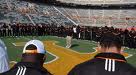
prayer before playingMany people like to say that Sunday football is becoming the new Sunday worship service. I hope this is not true, but I can report there is lots of praying going on in the NFL!  Last Sunday, on one channel at the start of the game, they showed a team taking a minute to pray before they went on the field. At the end of the Redskins-Lions Game, they showed the Lion’s Coach speaking with his team.  He said, “Let’s take a minute to pray and then let’s go back out on the field and greet the fans who have stayed to celebrate.”

Praying for the Big Game

It is not so unusual to see athletes praying and I have noticed many teams do pray together before a game. I was struck however with how comfortable coaches, athletes, and the TV cameras are with showing so many expressions of prayer and faith. A little later in the day, I saw an interview with Jim Caldwell, the new head coach of the Indianapolis Colts. He was asked to tell people something about himself because he is unknown to many people. The first thing he said was “I am a Christian.”  It seems to me that Coach Caldwell is also an evangelizer—on the job—in the community—and at home.

Proudly and Boldly

So, tired of football, I watched The Amazing Race, which pits 12 team in a race around the world.  In the first segment, when each team introduces themselves, a couple began their introduction by saying “We’re Christians.” The skeptic in me thinks there is a good chance that the producers of the Amazing Race chose to edit the introduction to suit their purpose in building a story line.  If you’re a fan of this show, you know it can get annoying as the producers create or suggest tensions between teams who are quite different from one another. That said it is refreshing to hear people speak proudly and boldly of their faith and how it shapes the way they look at life.

 I feel the need to say that I don’t typically spend so much time watching TV but by the end of the day I was thinking how often do I begin an introduction of myself with “I am a Catholic” or how many times have I heard others begin with sharing to what faith they belong.

It Begins at Being Christian

 My impression is that for people like Coach Caldwell “Christian” is their starting point, and that the rest of who they are is understood in light of what it means to be a Christian. It reminds me of the story of Perpetua, one of the early Christian martyrs. In a conversation with her father, who was suggesting she not publicly call herself a Christian, so as to avoid persecution she replies; “Father,” said I, “Do you see…this vessel lying, a pitcher or whatsoever it may be?” And he said, “I see it.” And I said to him, “Can it be called by any other name than that which it is?” And he answered, “No.” “So can I call myself nought other than that which I am, a Christian”

 If you begin an introduction with “I am A Catholic,” will it then shape the rest of what you say?

What are You Longing For? Guess What? It’s God!

Just below is a wonderful new reflection from Fr. Robert Barron. In it he ponders the growing secularism of the day. In many ways, especially in Europe, faith has been almost completely kicked to the curb. Questions about who is God…Who am I in relationship to him….what is the meaning and destiny of my life…..Questions like these have been suppressed; dismissed as irrelevant.

But here’s the problem: We are wired for God! We have within us an infinite longing, an unlimited desire for completion and fulfillment. God has written his name on our hearts and we simply cannot be happy without his ultimate presence and place in our heart. Oh, I know, many claim they can, but in the end we all know its a lie. This world simply does not satisfy us. It is limited and our desire is unlimited. Sooner or later we confront the absurdity of the world’s claim to be cure for what ails us. Go ahead, get it all: power money, sex, popularity, possessions, even people. I promise you it won’t be enough. And even if you do get it all, then you die, end of story.

In the end, we are made for God. The modern world may have kicked God to the curb but the absurdity of that becomes more and more evident as we descend further into addiction, lust, unhappiness, stress, suicide, you name it. You may say “We have always had these.”  Yes, but the doses are so much higher today. For all our creature comforts, (and we have many), we seem less happy, less content, less fulfilled, more stressed out more suicidal, more addicted, more divorced or never married, more  than those who went before us without all the comforts we “enjoy.”

Living without God is painful. We are wired for God. All those longings, yearnings, the sighing with you? It’s about God:

  • Our hearts were made for thee Oh Lord and they will not rest till they rest in thee.”  (St. Augustine Confessions Book 1 Chapter 1)
  • Come,” says my heart, “seek God’s face”; your face, LORD, do I seek! (Ps 27:8)

An Heroic Life

  • For all things work together for good  
  • unto them that love God  and are called
  • according to His purpose
  • (Rom 8:28 )

Every now and then we hear of the concept of a “life not worth living.” Some people seem to have so many challenges. Sometimes these are known before birth. Maybe it’s Down Syndrome, maybe limbs are missing, perhaps other defects are evident in the sonograms. In such cases some people start to think of abortion. Later in life if tragedy strikes some think of  euthanasia, and suicide.

But it is an amazing truth that often God raises up before us those who are severely challenged but still love their life. Here is the story of a man who lives heroically, despite having no limbs. How is it possible you might say? Well, behold the Man: