My wife has a wonderful devotion to the Blessed Virgin. As a convert to the faith, she often credits the Mother of God with drawing her closer to her Son, Jesus Christ. As part of her devotion, she almost always wears a Miraculous Medal given to her as a gift when she was received into the Catholic Church. For Lent, she asked me to say the prayer on the Medal daily and to think of her while I pray it.
I am victorious!
As we were watching the Olympics recently, we enjoyed witnessing the joy on an athlete’s face when they put the medal around their necks symbolizing their respective victories.
Brothers and sisters, Our Lady’s Miraculous Medal symbolizes victory as well. It symbolizes a victory over sin and death. And unlike an Olympic medal, it is available to anyone who seeks victory over death through Jesus Christ. Also, unlike Olympic medals, the glory of this victory will never fade but only increase. If you have one, put it on. If not, buy one. Few things say, “I believe in Christ!” like a Miraculous Medal.
Take your place on the medal stand!
Let God and your faith in His Only Son, Jesus Christ, put you on the platform and place the ultimate gold medal around your neck!
“O Mary, conceived without sin, pray for us who have recourse to thee.”
Driving to work, a shiny new black corvette pulled up beside me. It was not the car that caught my attention but the license plate. The plate read “Godjoy.” I think Godjoy captures the spirit of Lent. Lent is the penitential season and hopefully we have found the right rhythm for our prayer, fasting and alsmgiving. We are sinners who forget at times that we have been saved and when we forget that we fall back into our old ways.
The faces of the saved
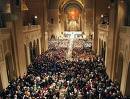
The past two Sundays there was lots of Godjoy in the Archdiocese as we celebrated the Rite of Election and the Call to Conitnuing Conversion. Gathered in the huge upper church of the National Shrine of the Immaculate Conception were 1,192 people who are seeking to become Catholics or to complete the sacraments of initiation. 1,192 faces with smiles of pure Godjoy. Together, with their sponsors they filled the Shrine and in the presence of Archbishop Wuerl and the auxiliary bishops of Washington, the sponsors announced these catechumens and candidates ready to receive the sacraments to initiation at Easter.
Sorrowful Joy
Another expression of Godjoy during Lent is found in the music of African-American Spirituals. Sometimes described as songs of sorrowful joy, they capture the spirit of Lent. Even in the misery of slavery and oppression, African-Americans, like the Israelites before them found a joy in knowing God has not abandoned them and only God will save them. Their song becomes the song of all sons and daughters of God.
God comes looking for us
At the Rite of Election, one Spiritual we sang is called Somebody’s Knockin at Your Door and it captures the Godjoy of the Spirituals and of Lent. We are not sinners with nowhere to turn, and the very act of turning is not our initiative but the spirit of God within us calling us back to our deepest joy-right relationship with God. Take a moment to listen.
Almost no one in the Church would claim today that we have done a good job of handing on the faith to our children. Depending on how we reckon it we have lost two or three generations to an ignorance and inability to articulate the faith. Even the most basic teachings are unknown to the young.
A few years back I was talking to Catholic sixth graders about Adam and Eve and it became clear to me that they had little idea of who Adam and Eve were except that they were “in the Bible or something.” That was it. I collected all the glossy page religion books and instituted a “back to basics” curriculum at every grade level. We started with creation and the fall of man and used the Biblical narrative along with memorized questions and answers and culminated the year with a “religion bee” wherein the children were expected to demonstrate their mastery of the material for prizes. The kids did well and they whooped their parents. The following year we instituted a parallel program for the parents. While their kids were in Sunday school class the parents were being instructed in the same material by yours truly.
I am no expert in pedagogy (educational theory) but it seems rather clear to me that we seriously lack in two major areas of catechetical instruction: discipline and content. Pretty devastating gaps it would seem! Not much is left over except self-esteem and slogans like “God loves you.”
In terms of content, it seems we have made improvements. The publication of the Catechism of the Catholic Church, and stricter standards that our Catechetical materials conform to it, has been the single greatest reform. Our materials are more orthodox, and the content is more substantial than the darkest years of the 1970s and 80s. Several good series have been published as well which have good content and are visually pleasing as well. I will not mention them by name since this is a blog of the Archdiocese and it is not appropriate for me to single them out. (It seems to me that you are free to speak of series you like in the comments since the Archdiocese does not endorse every comment that appears here). So I think content is improving.
But content is not enough. Academic discipline is also required. All the best material and visually beautiful as well cannot alone help children master the faith. Stronger and more rigorous academic discipline must be reasserted in the catechetical process. There are a number of elements of this academic discipline that I would like to mention and perhaps you will add more.
Repetition – There is an old Latin saying: Repetitio mater studiorum (repetition is the mother of studies). Learning requires a lot of repetition for it to sink in and become second nature. One of the major flaws in the current catechetical process in most parishes and Catholic Schools is the way the curriculum is divided up. In second grade we talk about Holy Communion and Confession (but never again). The fourth graders are talking about Commandments – but never again. In fifth grade we talk about the Church (history and structure) – but never again. The sixth graders are talking about the life of Jesus – but never again. And so forth. The catechetical process is compartmentalized and doesn’t always seem to build on mastery of what came before. To discuss things but once hardly seems effective, especially if the material does not build on what came before. Back in public school, at least in my day, mathematics did a great job of a kind of spiral curriculum which combines repetition with increasing mastery as new material was introduced. First we learned numbers. Then we used numbers to count. Then we used numbers and counting to go backward and forward by adding and subtracting them. Then we used numbers and counting and adding and subtracting to learn multiples and divisions. Then we used numbers and functions to realize that whole numbers can be fractioned and that numbers could have negative values and we learned how to count in fractions and to add and subtract them, multiply and divide them. And the material continued to build and the mastery of what went before was not left behind but folded into the new material and was used in an upward spiral. It is true that faith is not so simple as Math but the narrative of the faith does build in a spiral way. From God to creation to fall to promise of salvation to paschal mystery, to the life of grace by the sacraments to ultimate restoration with God forever in the paradise of heaven. These basic elements must be reviewed over and over in an ascending spiral that respects human development at its various stages. But just talking about creation and the fall in the early grades and not at all later is bound to lead to a forgetful and confused student. If the wound of original sin and the loss of a relationship with God is forgotten, how will redemption make sense? No wonder it all seems “irrelevant” to many of them.
Memorization –mastery of material is almost impossible without good old fashioned memorization. We just have to know things like the seven Sacraments, the Ten Commandments, the seven deadly sins, the basic prayers, the seven gifts of the Holy Spirit. Further, basic definitions like grace, redemption, Mortal and venial sin, incarnation, etc have to be memorized and understood. Answers to basic questions like why God made me, who were our first parents, what is the Church, who were the prophets etc. Answers like these need to be committed to memory. Without these basic building blocks being committed to memory very little building is going to go on. These basic memorized things are like hooks on which many other things hang. Without the hooks, everything falls flat. Early in school I memorized my ABCs and then many words and how they are spelled. So much depended upon my simply committing these basics to memory. The same was true with my multiplication tables. My parents and teachers were clear, just memorize them! Do the work now and everything else will be easier and make sense as you go. I struggled but I got it and I have never lost them. Give me any two numbers between 1 and 12 and I’ll give you their product instantly. Memorizing those tables opened a whole world for me and simplified life enormously. Why should the faith be any different? In memorizing and knowing the seven deadly sins I am greatly assisted in examining my conscience, grasping the deeper drives of sin in my life, understanding and anticipating the moves of the world, the devil and the flesh, and helping others understand the negative drives in their life. It all starts with simply memorizing and grasping basic concepts.
Time – Most people spend barely an hour a week trying to master their faith. This is not enough. Mastery of any discipline requires something more than one hour a week. We cannot expect magic. If we only ask kids to spend an hour week with no homework or expectations in between, we should not expect any mastery of the material. Another time related problem is that catechetical instructions in parishes are not year-round. Most Protestant Churches I know would never think of cancelling Sunday School for the summer. They attach the same priority to Sunday School that we attach to mass. Sunday School is every Sunday almost without fail. In the Catholic Church we call the whole thing off from May through mid September. And every single three day weekend also seems to get lumped in as well. In many parishes the children have religious instruction only half the weeks of the year when summers, holidays and snow days are subtracted out. In my parish we are gradually increasing the coverage with the goal of making Sunday School year round.
Accountability– at some point we need to expect young people to demonstrate mastery of the material. Things like tests, religion bees, presentations etc. should be used. Why should children take religious education seriously if they will never have to render an account for what they have done or failed to do? Things like religion bees can be fun and challenging. Rewards can be offered. Religious “It’s Academic, or Trivial pursuit formats can be fun but serious ways of assessing mastery of the material. Things like this and tests also impose certain deadlines for mastery of the material. Deadlines are really lifelines since they awaken urgency and discipline. In the end both student and teachers must be accountable. Accountability must be returned to the catechetical process.
Resourcefulness – In school I could not learn everything. But one of the disciplines I learned was how to find answers. I remember trooping off the school library and being taught the Dewey Decimal System and how to use a card catalogue. We were introduced to encyclopedias, journals, and later in College, to abstracts. Today things are easier with the Internet but we sill have to teach young people how to find answers. Sites like newadvent.org ; The EWTN Libraries; and the Bishops Website and many others are places where answers can be found. In the end, one of the best fruits of my education was how to be resourceful.
OK. That’s enough from me. How say you? You will surely have some thoughts to add to this discussion on Catechesis, particularly in terms of content and discipline. Especially helpful are things you have found to work. What further disciplines would you add to the list? We can all stipulate we’ve done a poor job in the Church of late. Content and resources are improving but what of discipline?
This video is a good commentary on the problem of content which I did not develop as fully here. Msgr. in the video does mention a Catechetical series. Again I must issue a disclaimer that posting this video does not amount to an official endorsement of the series. I am not empowered to make such endorsements on the part of the Archdiocese. But the video is a good reflection on the need for content as well as technique and discipline. (Hat tip to Patrick Madrid for the video)
There is a song about the sadness of moral relativism in an unusual place: “The Greatest Hits of the Monkees.” Some who are old enough may remember growing up with the songs of the Monkees. I confess their song “Only Shades of Gray” was not one I remember well from those days. But it is a fascinating song about moral relativism. Some think it’s just a song about growing up. But to most it speaks of a time when things were more certain and compares it to these more modern times when it seems everything is disputed and up for grabs, no more black and white, only shades of gray. It is all the more poignant that the song was written in the turbulent 60s and perhaps represented the anxiety generated by those times when just about everything was being thrown overboard.
Now I know that it is wrong to point any particular age as the “golden age.” Scripture itself warns against this: Do not say: How is it that former times were better than these? For it is not in wisdom that you speak this (Ecclesiastes 7:10). I am also aware that not everyone feels the same about the “good old days.” For some they were not all that good. We should not forget the terrible wars of the early half of the 20th Century. Further, I serve in a parish that is predominantly African American and for many of my parishioners previous days featured “Jim Crow” laws, disenfranchisement, lynching and enforced segregation.
And yet, it remains also true that some fifty years ago we had a much wider consensus on basic moral teachings and appropriate behaviors. Pre-marital sex was considered gravely wrong and guarded against. Remember chaperons and separate dormitory facilities? Easy divorce and remarriage was considered wrong. Abortion was illegal, it never even entered our minds to give children contraceptives. There was also strong consensus against homosexual activity. Families were larger and most were intact. There was also a general appreciation of the role of faith and prayer in American life. I could go on but perhaps this is enough.
Here too I can hear the objections: “We might have had those standards but we didn’t live them well….Things went on behind the scenes, families weren’t perfect, many kids still had sex etc. etc….” But I will respond by saying, At least we had those standards and saw them as truths to be respected. It is an extreme measure, a kind of nihilism, to say that since we do not live up to our standards perfectly we should not have them at all.
And I also know we were more wrong about some things in the past. We were more racist and less open to legitimate diversity, less concerned about pollution. But here too it is extreme to say that because we were wrong about some things in the past the whole thing should be thrown out. Why not keep the best and purify what is needed?
So here we are today, is a radically relativistic time where there is less and less agreement about the most basic of moral issues. And, without a common basis for discussion, such as Natural Law, or the Judeo-Christian worldview we are left to a battle of wills, an increasing power struggle where the one who shouts the loudest, has the most money, wins an election or has the most access wins, at least for the moment. Reason and principles increasingly do not transcend political, economic and social distinctions. There are fewer and fewer shared values that every one agrees on no matter what their party or background. Whatever our struggles of the past, we used to agree on more. Many of those certainties have been replaced by a wide presumption that everything is just shades of gray.
Listen to the song. Don’t forget my disclaimers. I do not propose a simplistic old=good; new=bad scenario. I just write to provoke thought. Please feel free to comment. I couldn’t find a good video of the Monkees performing the song (I think copyright may be involved) so I have included a group that sings it a lot like the Monkees did. First the words, then the video.
Lent is rightfully associated with sacrifice and self-denial. It is intended to remind us of the sacrifice Christ made for us and for our sins. It is a time for us as Christians to repent and reconcile ourselves with God. Part of that tradition is to deny ourselves a convenience or two in the hope of growing closer to God.
What are you ‘giving up’ for Lent?
I will do exactly that for the next few weeks. However, when someone asks, “What are you giving up for lent?” I proudly respond – “Nothing! I am letting go of a thing or two but, I am not giving up anything. Rather, I am gaining faith and growing closer to God!”
Gaining spiritual fulfillment
The point of letting go of a favorite food, hobby or other material indulgence is to remind us that we can be plenty happy without those things. Letting go of such things leaves room for spiritual fulfillment. And spiritual fulfillment can be much longer lasting.
When I eliminate watching TV during dinner (my personal Lenten ‘sacrifice’), I gain the opportunity to have a meaningful conversation with my wife. And such a conversation is spiritually fulfilling. When I let go of a favorite dessert, I gain an appetite for something healthy. When I let go of almost any extraneous material desire, the void is filled with a greater love for Christ.
Letting go
Lent is a wonderful time of the year. I don’t have to “give up” a thing. Rather, I “let go” of some things and what I gain in return is a Divine bargain. I would love to hear what you are “letting go” and what you hope to gain in return. Happy Lent everyone!
I want to propose to you that God’s love really IS unconditional. However it should be stated from the onset that there are some problems presented by the assertion that God’s love is unconditional. For while there are plenty of texts from Scripture that teach that God’s love and grace are unmerited, there is no real text that presents a “slam-dunk” assertion that God’s love is unconditional. There are even some texts that seem to teach that God’s love is conditional. For example:
Whoever has my commands and obeys them, he is the one who loves me. He who loves me will be loved by my Father, and I too will love him and show myself to him. (Jn 14:21)
I, the LORD your God, am a jealous God, punishing the children for the sin of the fathers to the third and fourth generation of those who hate me, but showing love to a thousand {generations} of those who love me and keep my commandments. (Ex 20:5-6)
The Father himself loves you because you have loved me and have believed that I came from God (John 16:27).
If anyone acknowledges that Jesus is the Son of God, God lives in him and he in God. And so we know and rely on the love God has for us. (1 John 4:15-16)
So most of these texts imply that God’s love for us is based on certain conditions. For example, whether we love his Son, or whether we keep his commandments. But while these texts are puzzling, they are not necessarily devastating to the notion that God loves us unconditionally. This is because it is possible for God to love us unconditionally from his side of the equation. And yet, from our side of the equation it may still be necessary that some conditions be fulfilled before we can receive this love unconditionally offered.
Consider the following example. Let’s say I walk up to you and you are carrying two large boxes filled with books you value. I am holding two other boxes filled with cash amounting to $50 million in large bills. I offer these boxes to you freely, without charge. No strings attached. My offer to you is unconditional. Take them, they are yours. So, my offer is unconditional. However, from your perspective there is a condition. You must first put down the boxes filled with books you value and then take up the boxes filled with money that I offer. Hence there is a condition you must meet to receive my unconditional offer. MY offer is unconditional but you must overcome an obstacle. Your full arms must be emptied. The condition is not on my side but on yours. Hence, the quotes above which seem to place conditions on God’s love my only be conditions from our side of the equation. God can love us unconditionally and offer his love for free. But in order for us to receive and experience that love it may be necessary for us to empty our arms from sin, from worldly attachments and the like. We cannot carry both sets of boxes. We cannot serve God and Mammon. So it is possible to argue that God’s love IS unconditional even as we accept texts like those above which declare that something in us must change for us to truly receive this unconditional offer of God.
You see, at just the right time, when we were still powerless, Christ died for the ungodly. Very rarely will anyone die for a righteous man, though for a good man someone might possibly dare to die. But God demonstrates his own love for us in this: While we were still sinners, Christ died for us. (Rom 5:6-8)
For he chose us in him before the creation of the world to be holy and blameless in his sight. In love he predestined us to be adopted as his sons through Jesus Christ, in accordance with his pleasure and will— to the praise of his glorious grace, which he has freely given us in the Beloved. (Eph 1:4-6)
for God’s gifts and his call are irrevocable. (Rom 11:-29)
I would further like to propose to you that God’s love never fails. I will go so far as to say that even the souls in hell are loved by God. How could they continue to exist if He did not love them, sustatin them and provide for them? God loves because God IS love and that is what Love does, it loves. We may fail to be able to experience or accept that love, and that inability may at some time become permanent for us. But God never stops loving. How could he? God does not merely have love, He IS love. And love cannot NOT LOVE for it pertains to love that it love. God has not stopped loving the souls in Hell. How could He? They surely refused to empty their arms to receive his embrace but God’s love for them has never been withdrawn. How could God not be love?
There was a man who had two sons (cf Luke 15). And one of those sons sinned horribly against him but then returned with repentance and received the embrace of his Father’s love. The other son was resentful and refused to enter the celebration with his Father and his brother. And the Father pleaded with him to enter the celebration and, I suspect, offered him too the embrace of love. Did the son enter the celebration? We do not know for the biblical story ends. But not really. For you and I finish it with our lives. The Father offers us the embrace of his love in the glory of the heavenly celebration. Will you and I enter the wedding feast or will we stay outside brooding and resentful. The Father’s offer is unconditional. But for you and me, from our side of the equation, there is a condition. We must enter to receive the unconditional offer. What is your answer to the Father’s pleading? Will you enter? Finish the story
I have posted this video before. it does a beautiful job of depicting God’s plaintive and loving call that echoes down through time: “Adam Where are You?!” It presents well the great drama of God’s love and our choice. The video concludes with God saying, “Won’t you come in from the darkness now before it’s time to finally close the door?!” What will you answer?
There’s an old Gospel song tradition that speaks of the Christian life as a ride on the “Gospel Train.” But the Gospel Train not always and easy ride with perfect scenery. But you gotta get your ticket for the Gospel Train and stay aboard. The train sometimes passes through difficult terrain and life’s temptations. But just stay on board! Jesus too on his way to glory faced trials, hatred, and even temptation (yet without sin).
Today the Gospel Train pulls into “Temptation Station” and we are asked to consider life’s temptations. The three temptations faced by Jesus are surely on wide display in our own times. What are these temptations?
Pleasure– The devil (I intentionally do not capitalize his name not because I deny that satan is a person but why give him the honor of capitalizing his name?) encourages Jesus to turn stones into bread. After having fasted, the thought of bread is surely a strong temptation. In effect the devil tells Jesus to “scratch where it itches,” to indulge his desire, to simply give in to what his body craves. We too have many desires and we too are told by the devil in many ways to scratch where it itches. Perhaps no generation before has faced temptation in this area so strongly as we. We live in a consumer culture that is well skilled at eliciting and satisfying our every desire. All day long advertisements reach into our mind to excite desire and to advise that we MUST fulfill our every desire and wish. If something is out of stock or unavailable in exactly the form we want we are indignant. “Why should I have to wait? Why can’t I have it in that color?” and so forth. The advertiser’s basic message is “You can have it all!” This is a lie of course but it is told so frequently that we feel entitled to just about everything. Some of our biggest cultural problems are problems of over-indulgence. We are a culture that struggles with obesity, addiction, sexual misconduct, greed, and an over-stimulation that robs us of an attention span and causes boredom to be a significant issue for many who are too used to the frantic pace of a video game or action movie. We have done well in turning stones to bread. To all this Jesus rebukes the devil by saying, “Man does not live on bread alone.” In other words there are things that are just more important and bread and circuses, than creature comforts and indulgence. Elsewhere Jesus says, “A man’s life does not consist in the abundance of his possessions.” (Lk 12:15). I have written on this in another post: The Most Important Things in Life Aren’t Things
Popularity– Taking Jesus up a high mountain the devil shows him all the nations and people of the earth and promises them to him if Jesus but bow down and worship the devil. This is a temptation to power but also to popularity for the devil promises him not only sovereignty but also glory. Since most of us are not likely to attain to sovereignty, and since temptation is only strong in those matters that seem possible for us, I will focus on popularity. Here too we face a lot of this in life. One of the deeper wounds in our soul is the extreme need that most of us have to be liked, popular, well thought of, respected, and to fit in. We dread being laughed at, scorned or ridiculed. We cannot stand the thought of feeling minimized in any way. For many people the desire for popularity is so strong that they’ll do darn near anything to attain it. It starts in youth when peer pressure “causes” young people to do lots of stupid stuff. They will join gangs, get tattoos, piercings, wear silly clothes. Many a young lady desperate to have a boyfriend and thus feel loved and/or impress her friends, will sleep with boys or do other inappropriate things to gain that “love.” As we get older we might be willing to bear false witness, make compromises etc to advance our career, lie to impress others, spend money we don’t have to buy things we don’t really need to impress people we don’t really like, be silent when we should speak out for what is right and so forth. All of this is a way of bowing before the devil since we are, in effect, willing even to sin in order to fit in, advance, or be popular. Here Jesus says, You shall worship the Lord, your God, and him alone shall you serve. The real solution to this terrible temptation to popularity is to fear the Lord. When we fear God we need fear no one else. If I can kneel before God, I can stand before any man. If God is the only one we need to please, then we don’t have to run around trying to please everyone else. Here too I have written on this matter elsewhere: What Does It Mean To Fear the Lord?
Presumption– Finally (for now) the devil encourages Jesus to test God’s love for him by casting himself off the highest wall of the Temple Mount. Does not scripture say that God will rescue him? The devil quotes Psalm 91: With their hands they will support you, lest you dash your foot against a stone. In our time the sin of presumption is epidemic. Many people think that they can go one behaving sinfully, recklessly, and wantonly and that they will never face punishment. “God is love!” they boldly say, “He would never send anyone to hell or punish!” In saying this they reject literally thousands of verses of Scripture that say otherwise. But they have refashioned God, and worship this idol. “God does not care if I go to Church,” they boldly declare, “He does not care if I live with my girlfriend.” The list continues to grow. The attitude is that no matter what I do God will save me. It is boldly presumptive to speak and think like this. It is true that Hell and punishments are difficult teachings to fully comprehend and square with God’s patience and mercy. Nevertheless God teaches it and we need to stop pretending that it really isn’t for real. This is presumption. I have written elsewhere on the topic of Hell and why it makes sense in the context of a God who loves and respects us: Hell Has to Be. Jesus rebukes satan by quoting Deuteronomy: You shall not put the Lord, your God, to the test. We ought to be very careful about presumption for it is widespread today. This does not mean we have to retreat into fear and scrupulosity. God loves us and is rich in mercy, but we cannot willfully go on calling “no big deal” what God calls sin and takes seriously. Hence we should be sober about sin and call on the Lord’s mercy rather than doubt we really need it and just presume God doesn’t mind etc.
Our train is leaving the station soon. It is to be hoped that you and I have benefited from this brief stop and have stored up provisions for the journey ahead such as: insight, resolve, appreciation, understanding, determination and hope. The journey ahead is scenic but also difficult and temptations are a reality. But as the Old Gospel Song says: The Gospel train’s a’comin’, I hear it just at hand. I hear the car wheel rumblin’ And rollin’ thro’ the land. Then Get on board, Children, Get on board, there’s room for many a more!
Required fasting is almost non-existent in the Catholic Church today. Even the two days where fasting is required for those over 18 and under 60, it is really a mitigated fast of two small “snack-like” meals and one regular sized meal (no snacks in between now!). Not really a fast at all. A truer fast (going without food for the whole day) is practiced by some today as a personal discipline and it is laudable if a person is able.
Yet, even the mitigated fast is “hard” for many as are most bodily disciplines in our soft western world. We may think we just have to learn to be “tougher” and, by the power of our own flesh pull it off. I have no doubt that simple will power can in fact pull off a fast, especially the mitigated one. But even a non-believer can diet and fast. What we must seek is true fasting, spiritual fasting that is far richer than merely abstaining from food.
In today’s Gospel Jesus gives an important key to true spiritual fasting. Let’s read:
The disciples of John [the Baptist] approached Jesus and said, “Why do we and the Pharisees fast much, but your disciples do not fast?” Jesus answered them, “Can the wedding guests mourn as long as the bridegroom is with them? The days will come when the bridegroom is taken away from them, and then they will fast.” (Matt 9:14-15)
Notice the pattern. First comes the (wedding) feast, then comes the fast. What does this mean? Well, consider the wedding feasts of Jesus’ time. They often went on for several days, even a week. During this time there was food, feasting, family, fellowship, and did I mention food? Lots of it, with wine too! It was a time of satiation. But eventually this time of feasting ended and by that time, people were filled. They’d had enough food for a while and now fasting of a sort made sense, it happened naturally without a lot of effort. What does this teach us and why does Jesus use this image regarding fasting?
Simply put, if you want to have the capacity to fast spiritually and truly you have to experience the wedding feast of the Lamb of God. In this great wedding feast which we are to experience through prayer, scripture and especially the Liturgy we are to be filled with Christ. We are to encounter him and feast abundantly on his Word, his Body and Blood and to rejoice with him exceedingly. And when this happens we are authentically equipped to fast.
At some point the “groom is taken” from us. That is to say, the Mass ends and we’re back to dealing with the world and its demands. Or perhaps we enter a penitential season, or perhaps we go through a difficult time where God seems distant or we struggle with temptation. Now a fast of sorts is before us. But we are able to do so and are spiritually equipped to do it since we have been to the Wedding feast and feasted with the groom. Having done this the world and its charms mean less. We are filled with Christ now and we simply need less of the world. This is true fasting.
But let me ask you, Have you met Christ and been to the wedding feast with him? One of the sad realities in parish life and in the Church is that there are many people who have never really met Jesus Christ. They have heard about him and know about him, but they’ve never really encountered him powerfully in prayer or the Mass. They are faithful to be sure. They are sacramentalized but unevangelized. They know about Jesus, but they don’t know him. The liturgy to them can be, and often is, lifeless, a ritual to be endured rather than an encounter with Jesus Christ. Instead of being at a wedding feast, the Mass is more like a visit to the doctor’s office. The majority of the Mass for them is a “waiting room” experience. Finally, up to get the medicine (Holy Communion) which is great because now it means the Mass is almost over! Personal prayer isn’t much better. Another ritual, say some prayers, and be done with it. God is really more of a stranger and fasting is just another rule to follow more out of obedience to avoid punishment than out of love which seeks purification.
The disciples of John seem to have been of this sort. They were tough and self-disciplined. They knew how to fast! But it was a fasting of the flesh not the spirit. The only way to truly fast in a spiritual way is to have been to the wedding feast and feasted with the Jesus the great bridegroom of the Church. Then having been filled with every good adn perfect gift true fasting can begin.
And what is true fasting? It is a fasting that no longer needs what the world offers in large amounts. We need less of the world for we have found a better prize: Jesus and his Kingdom. Who needs all that food, booze, power, money, baubles, bangles and beads? In the words of an old song: “I’d rather have Jesus than silver and gold. You may have all this world! Just give me Jesus! “
We can only say this if we have really met the Lord and been satisfied by him. Only then can true fasting ensue. As you my expect, meeting Jesus is more than an event. It is a gradual and deepening awareness of him and his power in my life and in the liturgy. Make sure you don’t miss the wedding feast for it is the key to the truest fasting of all.