Faith has to Become Flesh

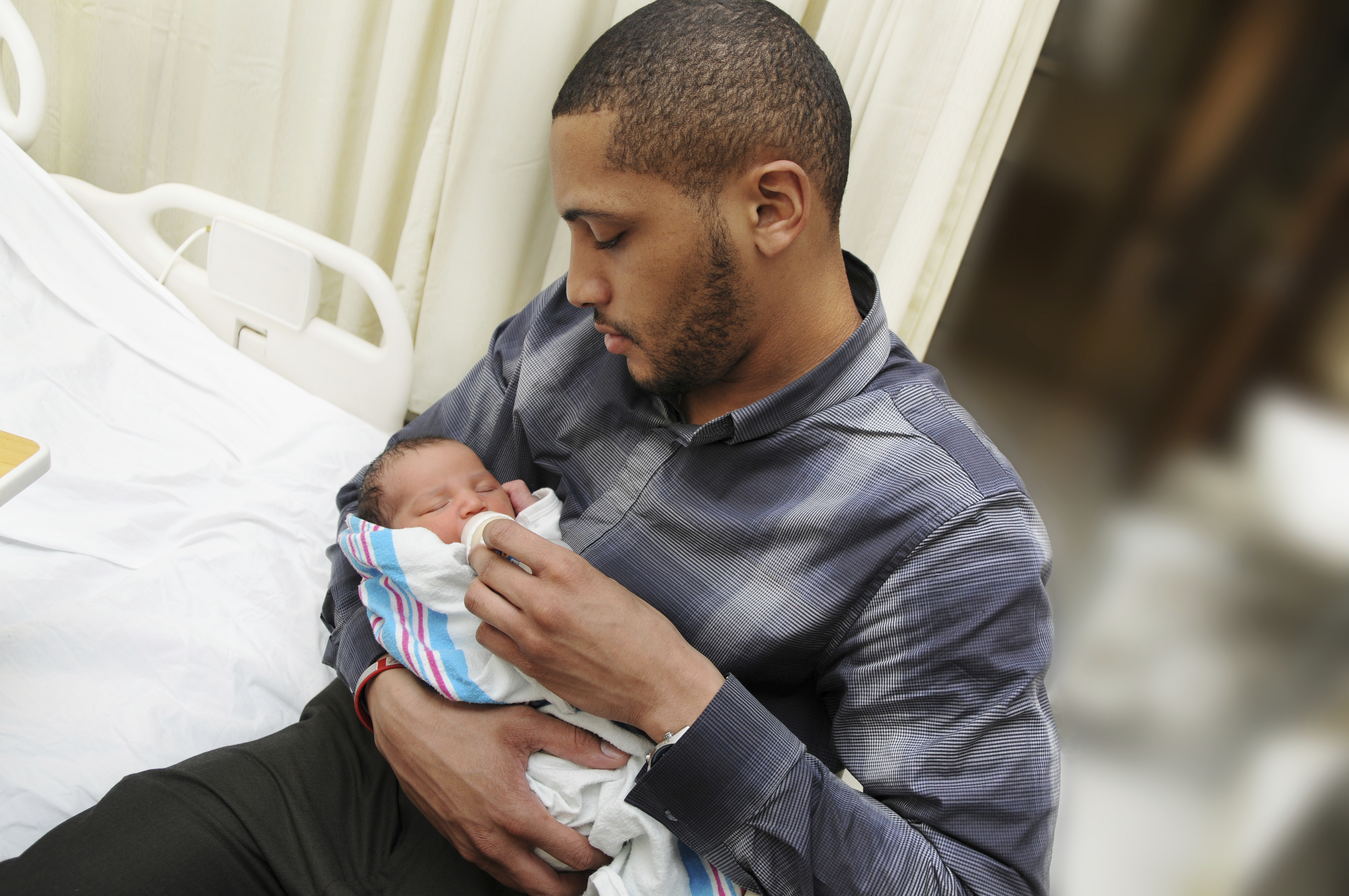
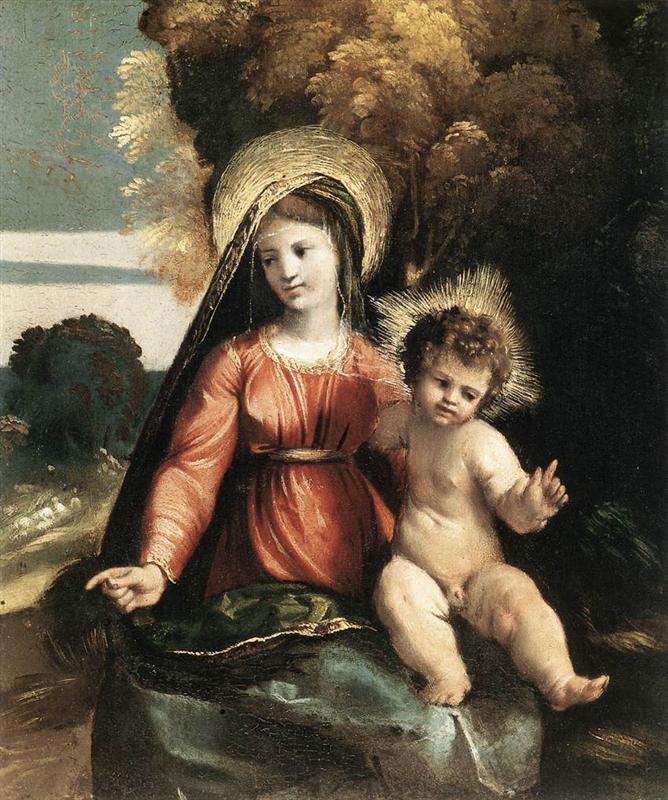
010913-2In yesterday’s post we pondered the insistence of the Johannine scriptures on the fact that Christ Jesus came in the flesh, was incarnate. To the deny the incarnation is a serious heresy that not only misunderstands Jesus, but misunderstands the nature of the faith as well. For if Jesus came in the flesh, if the Word become flesh, then so also must our faith be fleshly. We cannot reduce it to mere ideas. Those ideas, and all doctrine must bear real fruit in our lives that extends to the created and material word, to actual deeds in space and time. Our faith has to become flesh.

At Christmas we celebrated the fact of the Word Becoming Flesh. God’s love for us is not just some theory or idea. It is a flesh and blood reality that can actually be seen, heard and touched. But the challenge of the Christmas season is for us to allow the same thing to happen to our faith. So again, The Word of God and our faith cannot simply remain on the pages of a book or the recesses of our intellect. They have to become flesh in our life. Our faith has to leap off the pages of the Bible and Catechism and become flesh in the very way we live our lives, the decisions we make, the very way we use our body, mind, intellect and will.

Consider a passage from the liturgy of the Christmas Octave from the First Letter of John. I would like to produce an excerpt and then make a few comments.

The way we may be sure that we know Jesus is to keep his commandments. Whoever says, “I know him,” but does not keep his commandments is a liar, and the truth is not in him. But whoever keeps his word, the love of God is truly perfected in him. This is the way we may know that we are in union with him: whoever claims to abide in him ought to walk just as he walked. (1 John 2:3ff)

  1. Faith is incarnational – Note first of all what a practical man John is. Faith is not an abstraction, it is not about theories and words on a page. It is not about slogans. It is about a transformed life, it is about the actual love of God and his Commandments. It is about the actual love of of my neighbor. True faith is incarnational, it takes on flesh in my very “body-person.” Remember, we human beings are not pure spirit, we are not intellect and will only, we are also flesh and blood. And what we are cannot remain merely immaterial. What we most are must be reflected in our bodies, what we actually, physically do as well. Too many people often repeat the phrase, “I’ll be with you in spirit.” Perhaps an occasional absence is understandable but after a while the phrase rings hollow. Actually showing up and actually doing what we say is an essential demonstration of our sincerity. We are body persons and our faith must have a physical, flesh and blood dimension. Our faith is to be reflected in our actual behavior and the physical conduct of our life.
  2. A sure sign – John says that The way we may be sure that we know Jesus is to keep his commandments. Now be careful of the logic here. The keeping of the commandments is not the cause of faith, it is the fruit of it. It is not the cause of love, it is the fruit of it. Note this too, in the Scriptures, to “know” is always more than a mere intellectual knowing. To “know” in the Scriptures means, “deep intimate personal experience of the thing or person known.” It is one thing to know about God, it is another thing to “know the Lord.” So, what John is saying here is that to be sure we authentically have deep intimate personal experience of God is to observe the fact that this changes the way we live. An authentic faith, an authentic knowing of the Lord will change our actual behavior in such a way that we keep the commandments as a fruit of that authentic faith and relationship with the Lord. It means that our faith becomes flesh in us. It changes the way we live and move and have our being. For a human being who is a body-person faith cannot be an abstraction, it has to become flesh and blood if it is authentic. John also uses the image of walking: This is the way we may know that we are in union with him: whoever claims to abide in him ought to walk just as he walked. Now walking is a very physical thing. It is also a very symbolic thing. The very place we take our body is both physical and indicative of what we value, what we think.
  3. Liar? – John goes on to say Whoever says, “I know him,” but does not keep his commandments is a liar. John uses strong language here. Either we believe and keep the commandments or we fail to keep the commandments and thus lie about knowing the Lord. But all of us struggle to keep the commandments fully! John seems so “all or nothing.” But his math is clear. To know the Lord fully, is never to sin (cf 1 John 3:9). To know him imperfectly is still to experience sin. Hence, the more we know him (remember the definition of know from above!) the less we sin. If we still sin it is a sign that we do not know him enough. It is not really John who speaks too absolutely. It is really we who do so. We say, “I have faith, I am a believer, I love the Lord, I know the the Lord!” We speak so absolutely. Perhaps we could better say, I am growing in faith, I am striving to be a better believer, I’m learning to love and know the Lord better and better. Otherwise we risk lying. Faith is something we grow in. Many Protestants have a bad habit of reducing faith to an event such as answering an altar call, or accepting the Lord as “personal Lord and savior.” But we Catholics do it too. Many think all they have to do is be baptized but they never attend Mass faithfully later. Others claim to be “loyal” even “devout” Catholics but they dissent from important Church teachings. Faith is about more than membership. It is about the way we walk, the decisions we actually make. Without this harmony between faith and our actual walk we live a lie. We lie to ourselves and to others. Bottom line: Come to know the Lord more an more perfectly and, if this knowing is real knowing, we will grow in holiness, keep the commandments be of the mind of Christ. We will walk just as Jesus walked.
  4. Uh Oh! Is this salvation by works? Of course not. The keeping of the commandments is not the cause of saving and real faith it is the result of it. The keeping of the commandments is the necessary evidence of saving faith but it does not cause us to be saved, it only indicates that the Lord is saving us from sin and its effects. But here too certain Protestants have a nasty habit of dividing faith and works. The cry went up in the 16th Century by the Protestants that we are saved by faith “alone.” Careful. Faith is never alone. It always brings effects with it. Our big brains can get in the way here and we think that just because we can distinguish or divide something in our mind we can divide it in reality. This is arrogant and silly. Consider for a moment a candle flame. Now the flame has two qualities: heat and light. In our mind we can separate the two but not in reality. I could never take a knife and divide the heat of the flame and the light. They are so together as to be one reality. Yes, heat and light in a candle flame are separate theoretically but they are always together in reality. This is how it is with faith and works. We are not saved by works but as John here teaches to know the Lord is always accompanied by the evidence of keeping the commandments and walking as Jesus did.

Faith is real. It is incarnational. The Word became flesh and dwelt among us, really and physically. So too our own faith must become flesh in us, really, physically in our actual behavior in our very body-person.

I put this video together with a lesser known carol (composed by Richard Proulx). The translation is as follows:

  • Verbum Caro Factum Est (The Word was made flesh)
  • Habitavit in Nobis (And dwelt among us)
  • Alleluia
  • Notum fecti Dominus (The Lord has made known)
  • Salutare suum (His Salvation)
  • Alleluia
  • Prope invocavit me: (Near is he who calls me: )
  • Frater meus est tu!”” (“You are my brother!”)
  • Alleluia

Living on the Dark Side of the Cartesian Divide. A Reflection on the Gnosticism of our Times

010713There is a line in the first letter of John (read on the Monday of this week), a line that proves of critical important to many difficulties today with heresy, unbelief and moral decay. The line says:

Beloved, do not trust every spirit but test the spirits to see whether they belong to God, because many false prophets have gone out into the world. This is how you can know the Spirit of God: every spirit that acknowledges Jesus Christ come in the flesh belongs to God, and every spirit that does not acknowledge Jesus does not belong to God. This is the spirit of the antichrist... (1 John 4:1-3)

John also writes in the second Letter:

Many deceivers, who do not acknowledge Jesus Christ as coming in the flesh, have gone out into the world. Any such person is the deceiver and the antichrist. 2 John 1:7

One of those fundamental principles at the heart of the Johannine scriptures is that the Word become flesh. Jesus actually came in the flesh, we could touch our God. The true faith is incarnational. In Jesus Christ, God takes up the physical order, Justice, Truth springs up from the earth (cf Ps 85:11). God actually becomes man. The love of God and his salvation are tangible, and real, not merely ideals, wishes, or hopes, but real and tangible. Faith is about reality. This is John and the Holy Spirit’s insistence, and it is adamantly expressed that we not let this true slip from our understanding even for a moment.

For there are, and have been, many Gnostic and neo-gnostic tendencies down through the centuries which seek to reduce faith merely to intellectualism, to ideas or opinions, and to remove things from the world of reality. Thus St. John and the Church have had to insist over and over that Jesus is real, that faith is real, and is about real, tangible, even material things.

When Jesus came among us, He was not content merely to speak of ideas. He did not simply advance ethical theories or set forth merely philosophical notions. He also spoke to actual human behaviors, not merely speaking of them, but actually living them, and modeling them in the flesh. He demands for his followers not mere intellectual affirmations, but an actual walking in his truth, using our very bodies, and living his teaching. We are to renounce unnecessary possessions, actually feed the poor, confess him with our lips, reverence human sexuality through chaste living, accept suffering, even embraced it, for the sake of the kingdom, and so forth.

Yes, faith is about real things, about actual concrete behaviors that involve not only what we think, but actually how we physically move our body through  the created order, how we interact with the physical order, and with one another.

Jesus also took up and made use of the physical and created order in his saving mission. Obviously he took it up in the incarnation, but he also referenced creation in many of his parables, pointing to the lilies of the field, to the sparrow. He made paste with saliva and mud, anointed with oil, change water to wine, laid hands on the bodies of countless individuals in healing, took bread and wine and change it to the body and blood. He took up The wood of the cross, lay down his body in suffering and death, and raised it up again on the third day. Then He took his body, yes his physical body with him to heaven and sat down at the right hand of the Father.

Yet despite this radical physicality seen in the Gospel and the work of God, there remains a persistent tendency on the part of many to reduce the faith by removing it from the physical and temporal order rendering it a merely ethical notion, an intellectualism, or a set of ideas, and even mere opinion. Faith rooted in daily reality, and with measurable parameters, is set aside, and sophistry takes place. Never mind what a person does, all that seems to matter to many us what they think about it, or what their intentions are.

Gnostic tendencies have existed in every stage, but were most severe in the early centuries among heretical groups, only to resurface in recent centuries, especially since the so-called enlightenment where human reason is exulted unreasonably.

The Protestant revolt took up the rationalism of those “enlightenment” times and brought the first great blow to the house of faith by rendering the Sacraments mere symbols,  no longer the touch of God. No longer for them does baptism actually save us by washing away our sins, for many of them it only symbolizes faith. Holy Communion for most of them was no longer the actual Body, Blood, Soul and Divinity of Jesus Christ, but only a symbol of him,  something that evokes thoughts and memories what he said and did. For the Protestant groups, most of the other Sacraments simply fell away. No longer was it necessary to lay hands on the sick, to lay hands on to ordain or bless. All such things were unnecessary, even abhorrent to many Protestants who took up enlightenment rationalism, and reduced faith to intellectualism,  ideas, and words on the page.

Along with the Sacraments, many of the Enlightenment-era Protestants banished most beauty in the churches with iconoclastic tendencies. No longer should creation in the pigmented paints, beautiful stained glass, precious metals, candles incense and so forth be raised up to the glory of God. This too is far too incarnational for the the “purity” of the rationalist mind. Stark white-washed churches were exulted,  and the feast of the senses common in Catholicism was frowned upon. Faith that was “purified” of all this incarnational “excess” and was to exist only in one’s mind and heart.

The use of the body to worship in Protestantism was also largely banished. Kneeling, sitting, standing, signs of the cross, vestments,  all of this was banished. Afterall what did the body have to do with it? It was in the mind, and in the heart that one worshiped God. Why bend the knee when it sufficed to bow in one’s heart?

And thus, there was a great retreat from the bodily aspect of the incarnation.

We should be clear, that not all Protestant denominations equally indulged iconoclastic and rationalistic tendencies in this aftermath of the enlightenment. There remained many great artistic and musical accomplishments within the Protestant realm, to include architecture.  But the general pattern is clear to some extent in all the denominations founded by men after the “Enlightenment.” Worship and faith moved more into the mind, and world of ideas and away from the created, tangible and physical realities of this world.

Many other moral troubles of our day also bespeak a Gnostic, anti-incarnational tendency. For example the exultation of intention over actual behavior. Never mind what a person actually does. The only morally significant matter is what they intend, that they mean well.

Yet another tendency is the word-smithing of our day. It’s not abortion, it’s choice. It is not contraception, it is reproductive choice. I’m not religious, but I’m spiritual. They’re not fornicating, they’re cohabiting, it’s not an act of sodomy it is “gay” etc. The more vague, vapid and non-descriptive the word the better. Abstractions and generalities replace clearer and reality based descriptions.

Here then is a brief tour of the Gnosticism of our times. We can see why St. John and the Holy Spirit were so passionate to warn against any false teachers who denied the incarnation, call them not only false teachers, but “antichrist.” We live on the ever darker side of the Cartesian divide, living in our minds, denying that creation or our bodies are revelation or have anything to say to us.

Of course this is antichrist, it is a slap in the face of God who made all things and established the created by his Word, the Logos. And since all things were made through Christ, the Logos, then all creation has a “logike” (a logic) that is clearly perceived in what God has made. To go on denying this is “illogical” is “anti-logical” is contrary to the Logos, the Word through whom God created and sustains all things. Contrary to the Logos is just another way of saying, “antichrist.”

(One paradox to all this is the flourishing o the material (physical) sciences in our times. I have written more on this paradox here: Cartesian Anxiety)

But why do YOU go to Mass? A Reminder of the critical importance of rendering personal testimony in evangelization.

010613Some decades ago the argument from authority was often invoked as we answered some question about the faith. It was often considered sufficient merely invoke the existence of a rule. And thus, to my nagging question, “Why should I have to go to mass?” my parents would often answer, “Because it’s a rule!” Other variations of the answer would be, “Because the Church says so,” or, “Because it’s in the Ten Commandments.”

Never mind that there might actually be reasons that there was a rule, or a commandment. It was considered enough in those old days simply to say, “It is a rule.”

If, to some degree, it was sufficient back in those days to merely invoke authority, it is now, for better or worse, no longer the case today that it is enough simply to do so. It is true that there is a rule that we must attend Mass. For as the Catechism says,

This practice of the Christian assembly dates from the beginnings of the apostolic age. The Letter to the Hebrews reminds the faithful “not to neglect to meet together, as is the habit of some, but to encourage one another.”…the faithful are obliged to participate in the Eucharist on days of obligation, unless excused for a serious reason (for example, illness, the care of infants) or dispensed by their own pastor. Those who deliberately fail in this obligation commit a grave sin. (CCC 2178, 2181)

And the Ten Commandments say,

Remember the Sabbath day by keeping it holy…. the seventh day is a Sabbath of rest, a day of sacred assembly. (Ex 20:18; Lev 23:3)

and Jesus says in John 6:53,

Jesus said to them, “I tell you the truth, unless you eat the flesh of the Son of Man and drink his blood, you have no life in you.

As so it is clear, there is a Rule that we attend Mass. But it also remains true that the reasons the Church, the Lord, and Law all say this. For indeed, something is true not nearly because the Church or the Lord, or the Bible say so. But rather, the Lord, the Bible and the Church say so because it is true.

And from this perspective, perhaps it is a good thing that merely arguing from authority, or arguing from the existence of rules and Commandments, is not enough. We live in times where the reasons, and the logic behind such rules is often insisted upon.

Perhaps it is not unreasonable for those to whom we speak to demand such proof. For, as Scripture puts it, Always be prepared to give an answer to everyone who asks you to give the reason for the hope that you have. But do this with gentleness and respect (1 Peter 3:15). And thus it is good that we be able to give reasons for the things we teach, and the practices we rightfully insist upon. As never before, we are required not simply to say what we teach, but why.

So alright, parents, you rightfully should teach your children that they must go to Mass on Sunday, and also to pray, prepare for and receive Sacraments, and to belong to a believing community we call Parish, to insist that they ought to read Scripture know the Faith. Yes, it is right that a parent to teach their children these things. So alright you say to your children you must go to Mass on Sunday.

But but why do YOU go?

Notice that this question, does not ask merely for reasons to go to Mass, but asks for YOUR reasons. Why do you go, what is your personal testimony? For, frankly, it is not enough for us to give merely catechetical or apologetical reasons. Our children, as never before, need to have very personal testimony from their parents about the transformative power of faith in Jesus Christ. It’s time to testify, that is, to give her a personal testimony/ Yes, as never before, our children need to hear from us, parents, priests, catechists, parishioners.

So. why do you go to mass? Is there something you get out of it? How have you been blessed, and what are the fruits and effects having gone to Mass faithfully for many years? What effects have the Sacraments, prayer, liturgy in the Mass had on you?

Again, do not overlook personal quality that we must be invited to supply this testimony. Quoting the Saints and the teachings of the Church is indeed good and proper, but it is not enough. There comes a point in every Christian life when we who are mature in the faith need to testify: That what the Scriptures announce and the Church teaches is true. And I personally know it to be true because, in the laboratory of my own life, I have both tested and verified the truth of what is taught, and come to know personally that is true.

Therefore, the question remains, Why do YOU go to Mass?

Let me, as a priest, announce my own testimony. I want to say that since I was 24 years of age, when I entered the seminary, I have gone to Mass every day. I have both studied, and heard proclaimed, God’s Word every day. I have gathered with God’s people in the celebration of the sacred liturgy every day, and every Sunday. I pray every day for an hour, I pray the Liturgy of the Hours, and go to Confession once a week. I have lived in fellowship with other believers, gathering with them for prayer, and have experienced the both silent and vocal testimony of their faith and their experience that God is real, and God is good.

And I want to say, that as a result of all of this, I am a changed man. I have seen sins put to death, and new virtues come alive. I have a new mind, I think different thoughts, my priorities are different, and are better. I am more discerning, and my understanding of the meaning and purpose of my life is deeper. I have overcome terrible anxieties, and fears, and now I live in confidence, hope and joy. My life is not pain-free, or trouble-free, but I understand these troubles in a new way, seeing them as moments for growth, and grace. I am less negative, more positive and hopeful.

I could go on… But let me say this, I give God all the glory. It is his grace that transforms me. And I will say, He has done this primarily through the liturgy, through the holy Mass. He has accomplished this through the Sacraments, especially Holy Communion and Confession. These have been like medicine to me. And remaining faithful to God and to all of his sacraments, his Word and to the fellowship with the Church, I have been utterly transformed by Him and am being transformed more perfectly day by day.

I go to Mass, because through it, the Lord is changing me, is healing me, is transforming me. I have come to personally understand what the Lord means, that if we do not eat his Flesh and drink his Blood, we have no life in us. Without the Sacrament of his Body and Blood, my life would be so diminished, nothing compared to what it is now, in effect dead. It is only by the grace of God, his Word, his Sacraments, Prayer, and fellowship in the Church, that I have any life at all.

Of course we need to go to Mass on Sunday, of course! Without it I would be as dead as a diabetic without insulin, as starved man without food. I go to Mass, because through it the Lord saves me, feeds me, heals me. I have been privileged to walk with the same community of faith for the better part of 20 years. And in those years, in moments of crisis that arose, they have sung to me, prayed for me, witnessed to me, and shared Communion with me, summoning me to faith and reminding me the trouble don’t last always.

Where would I be without the Lord’s Church, without the Mass all the Sacraments, without the Word of God? At best, I would be nowhere, or it worst, is a very dark place.

Thus, I go to Mass receive the Sacraments, pray and keep fellowship, read and study God’s Word because it changes and transforms me. In no way do I see these as tedious rituals. No indeed, these are transformative realities, encounters with the living and healing Jesus Christ, to whom be all glory and thanksgiving.

Why do YOU go to Mass? What is your testimony. It is not enough today (if it ever was) to invoke rules. We have to say why, and we have to testify to it in a very personal way. Why do you go to Mass? Tell somebody!

A Walk with the Wise: A meditation on the Feast of Epiphany

010513

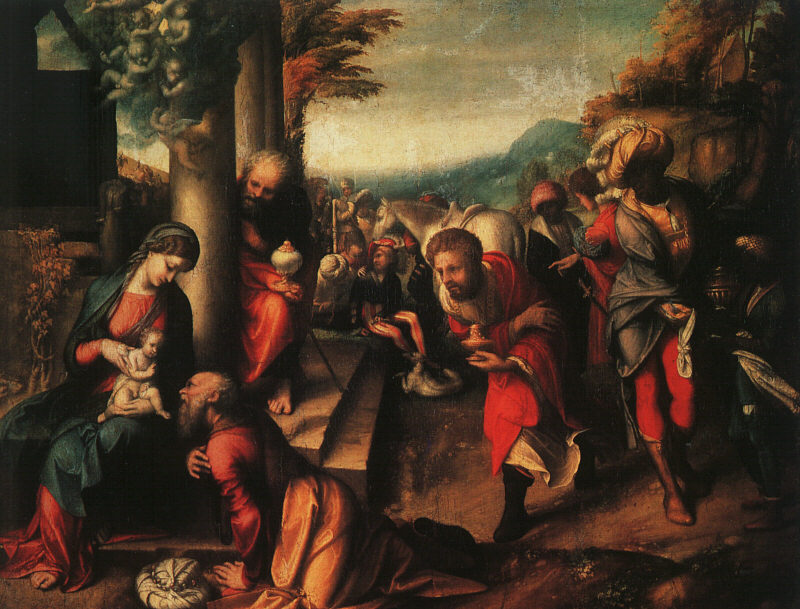
There are so many wonderful details in the Epiphany story: the call of the Gentiles, the nations, and their enthusiastic response, the significance of the star they see, and the gifts they bring, the dramatic interaction with Herod and their ultimate rejection of him in favor Christ.

In this meditation I would like especially to follow these wise men in their journey of faith. We can observe how they journey in stages from the light of a star, to the bright and glorious Light of Jesus Christ. And, of course to authentically encounter the Lord is to experience conversion. All the elements of this story serve ultimately to cause them to “return to their country by another route.” Let’s look at the stages of their journey to Jesus, let’s walk the way of the wise men.

Stage 1. CALL – The text says – When Jesus was born in Bethlehem of Judea, in the days of King Herod, behold, magi from the east arrived in Jerusalem, saying, “Where is the newborn king of the Jews? We saw his star at its rising and have come to do him homage.” – Notice first the identity of these individuals. They are called Magi, (μάγοι, (magoi) in Greek) and they are from the East.

Exactly what “Magi” are is debated. Perhaps they are wise men, perhaps they are ancient astronomers. We often think of them as Kings though the text does not call them that. It also seems Herod would have been far more anxious had they been actual potentates from an Eastern Kingdom. In our imagination we often think of them as Kings since Psalm 72, read in today’s Mass, speaks of “Kings” coming from the East bearing gifts of gold and frankincense. However, for the record, the text in today’s gospel does not call them kings, but “magi.”

Yet, here is their key identity: they are Gentiles and they have been called. Up to this point in the Christmas story, only Jews had found their way to Bethlehem. But now the Gentiles come. This detail cannot be overlooked, for it is clear that the gospel is going out to all the world.

St. Paul rejoices in this fact in today’s second reading as he says: that the Gentiles are coheirs, members of the same body, and co-partners in the promise in Christ Jesus through the gospel (Eph 3:6). Most of us are not Jewish by ancestry, and hence we ought to rejoice for in the call of these Magi is prefigured our call.

And notice that God calls them through something in the natural world. In this case a star. God uses something in creation to call out to them.

We do well to wonder what is the star that God used to call us? Perhaps it was Scripture, but more usually, it is first someone God has used to reach us, a parent, a family member, a friend, a priest, religious sister, or devoted lay person. Who are the stars in your life by whom God called you?

God can also use inanimate creation like he did for these Magi. Perhaps it was a beautiful Church, a painting or a song. By someone or something God calls. He puts a star in our sky. These wise men, these Magi, follow the call of God and begin their journey to Jesus.

Stage 2. CONSTANCY – Upon their arrival in Jerusalem the Magi find a rather confusing and perhaps discouraging situation. The reigning King, Herod, knows nothing of the birth of this new King. It must have seemed probable to them that the newborn King would be related to the current King, so his surprise may have confused them. But Herod seems more than surprised, he seems threatened and agitated.

Even more puzzling, he calls religious leaders to further inform him of this King. They open the sacred writings and the Magi hear of a promised King. Ah! So the birth of this king has religious significance! How interesting!

But, these religious leaders seem unenthusiastic of the newborn King and after giving the location of his birth seem to make no effort to follow the Magi. There is no rejoicing, no summoning of the people that a longed for king had finally been born. Not even further inquiry!

So the wicked (e.g. Herod and his court), are wakeful, and the saints are sleepy. How odd this must have seemed to the Magi. Perhaps it occurred to them to suspend their search. After all, the actual king knew nothing of this birth, and those who did, seemed little interested.

Ah, but praise the Lord they persevere in their search. They do not give up!

Thanks be to God too, that many today have found their way to Christ despite the fact that parents, clergy and others, who should have led them joyfully to Jesus, were either asleep, or ignorant or just plain lazy. I am often amazed at some of the conversion stories I have heard, people who found their way to Christ and his Church, despite some pretty discouraging obstacles like poor religious upbringing, scandalous clergy and bad example. God sometimes allows our faith and call to be tested but Those who persevere to the end will be saved (Matt 24:13).

Stage 3. CONFESSION OF FAITH – The text says, After their audience with the king they set out. And behold, the star that they had seen at its rising preceded them, until it came and stopped over the place where the child was. They were overjoyed at seeing the star, and on entering the house they saw the child with Mary his mother. They prostrated themselves and did him homage. – With what little information they have they set out and continue to follow the call of God through the star.

Note that they enter a “house.” We often think of the Magi as coming that same Christmas night to the cave or stable but it seems not. Mary (Joseph) and Jesus are found now in a house. It would seem that decent lodging has now been found. Has it been days since the birth? Perhaps even longer, but we are likely dealing with a different day than Christmas Day.

Notice too that they “prostrate” themselves before Jesus. The Greek word is προσεκύνησαν (prosekunēsan) which means more literally “to fall down in worship” or “give adoration.” The verb is used 12 times in the New Testament and it is clear each time that religious worship is the purpose of the prostration.

This is no mere homage or a sign of respect to an earthly King, this is religious worship. This is a confession of faith. So our Magi manifest faith!

But is it a real faith, or just a perfunctory observance? It’s not enough to answer an altar call, or to get baptized. Faith is never alone. It is a transformative relationship with Jesus Christ. So lets look for the effects of a real and saving faith.

Stage 4. COST There is a cost to discipleship. The magi are moved to give three symbolic gifts that show some of what true faith includes. And they are costly gifts.

Gold is a symbol of all our possessions. In laying this gift before Jesus they and we are saying, “I acknowledge that everything I have is yours. I put all my resources and wealth under your authority and will use them only according to your will.” A conversion that has not reached the wallet is not complete.

Frankincense. is the gift of worship, for in the Bible incense is a symbol of prayer and worship (eg. psalm 141). In laying down this gift we promise to pray and worship God all the days of our life. To be in his holy house each Sunday and render him the praise and worship he is due. To listen to his word and to consent to be fed the Eucharist by him. To worship him worthily by frequent confession and to praise him at all times. And they give

Myrrh – a strange gift for an infant. Myrrh is usually understood as burial ointment. Surely this prefigures Jesus’ death but it also symbolizes our own. In laying this gift before Jesus we are saying, my life is yours. I want to die so that you may live your life in me. May you increase and may I decrease. Use me and my life as you will. So here are gifts that are highly symbolic.

The magi manifest more than a little homage to Jesus. They are showing forth the fruits of saving faith. And if we can give these gifts so too are we.

Stage 5. CONVERSION – The text says, And having been warned in a dream not to return to Herod, they departed for their country by another way.

Here then is essential evidence for faith: conversion. It is not enough to get happy in Church, we have to obey. Hence, these wise men are walking differently now. They are not going home by the same way they came. They’ve changed direction, they’ve turned around (conversio). They are now willing to walk the straight and narrow path that leads to life rather than the wide road that leads to damnation. They are going to obey Christ. They are going to exhibit what St. Paul calls the “obedience of faith” (Rom 1:5; 16:26). They have not just engaged in a possibly perfunctory worship, they are showing signs of a true and saving faith. They are not just calling Jesus “Lord, Lord!” They are doing what he tells them (cf Luke 6:46).

So there it is. Through careful stages the Lord has brought the Gentiles (this means you) to conversion. He called. They remained constant, confessed him to be Lord, accepted the cost of discipleship and manifested conversion. Have you? Have I?

Walk in the ways of the Wise men! Wise men still seek him. Even wiser ones listen to him and obey. Are we willing to go back to our country by another route? Is on-going conversion part of our journey home to heaven? If Epiphany means “manifestation” how is our faith manifest in our deeds and conversion?

I have it on the best of authority that as the wise men went home by another route they were singing a Gospel song: “It’s a highway to heaven! None can walk up there but the pure in heart. I walking up the King’s Highway. If you’re not walking start while I’m talking. There’ll be a blessing you’ll be possessing, walking up the King’s Highway. “

An apologia for Jibberish, or is it gibberish?

010413On of my problems on the blog is that I often “commit typos.” That is to say, I am lousy at proof reading my own material. A number of you send me little corregida, for which I am grateful. I do read over what I have wrote, but I read right past my errors and don see them at all. Yet this phenomenon is common in that when reading we often adjust see right past some of the most glaring of errors.

Consider the following passage:

I cdnuolt blveiee taht I cluod aulaclty uesdnatnrd waht I was rdanieg. The phaonmneal pweor of the hmuan mnid. Aoccdrnig to a rscheearch at Cmabrigde Uinervtisy, it deosn’t mttaer in waht oredr the ltteers in a wrod are, the olny iprmoatnt tihng is taht the frist and lsat ltteer be in the rghit pclae. The rset can be a taotl mses and you can sitll raed it wouthit a porbelm. Tihs is bcuseae the huamn mnid deos not raed ervey lteter by istlef, but the wrod as a wlohe. Amzanig huh? Yaeh, and I awlyas thought slpeling was ipmorantt.

Did you get all that? I’ll bet you did, just fine. I don’t think I missed a point, every word made perfect sense to me, grammatical and lexical nightmare that it was. The nonsense makes perfect sense. But allow this little exercise to explain to you that what I write makes perfect sense to me, even if it crosses your eyes.

An interesting computer thing happened when typing this post too, my spell checker just plain gave up. After the first five or so misspelled word, it just stopped underlining in red. Proof that if you tell a lie long enough, even spell checker will believe you.

And yet I want to remind you that for God, nothing unavenged will remain. My only concern, does this include blog edits? Does God permit alternate spellings and doe she grade on a curve? Will I spend time in purgatory for my unforced editing errors? Please consider praying for me when I die. In the meantime, keep those edits coming.

Here is my favorite jibberish (or is it gibberish) interview.

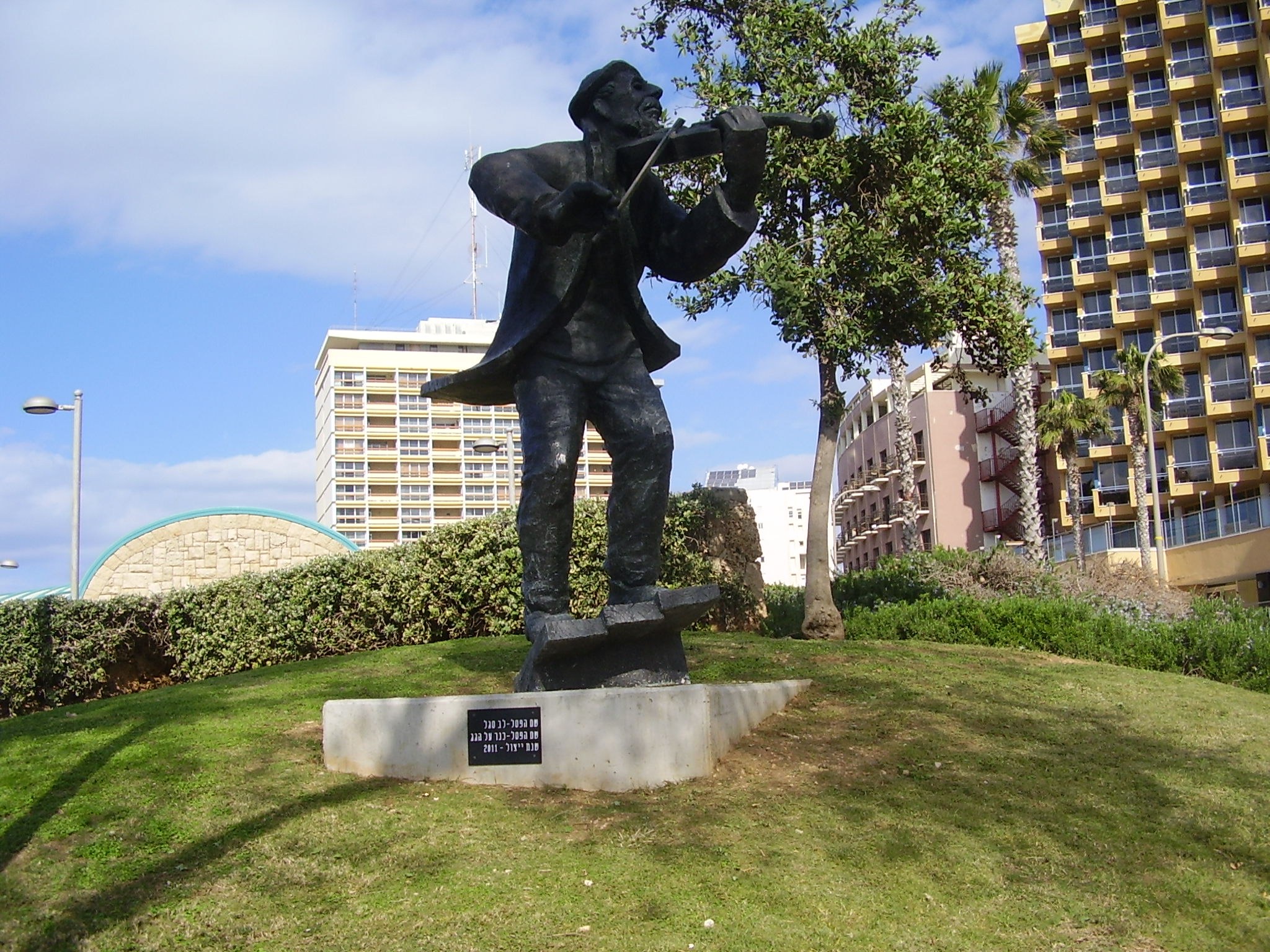
“Without our traditions our lives would be as shaky as a Fiddler on the Roof.”A Meditation on the Loss and Recovery of Tradition.

“PikiWiki Israel 17388 Fiddler on the Roof in Netanya” by צילום:ד”ר אבישי טייכר. Licensed under CC BY 2.5 via Wikimedia Commons

When I was a young man, a teenager really, I did the usual crazy stuff of the early, 70s, long hair, bell bottoms, wide ties, crazy plaids, shirt open at least least three buttons, and of course, rock-n-roll.

But, through it all I had this love for older things. I think it had something to do with my Grandmother, Nana, whom I loved with great affection. Often she lamented the loss of the old things and old ways. She missed the Latin Mass, she missed when manners were better, when people remembered how to dress well, when things were more certain, when, (as Archie and Edith put it, Girls were girls and men were men). She also missed when things were built sturdy and plastic was all but unknown.

Somehow her love for older things, and older ways took hold in me, even as I indulged the silly seventies. My parents’ generation born in the late 20s and 30s, and even more so those born after the War, were something of an iconoclastic generation: “Out with the old, in with the new…New and improved.”

I remember my mother often wanting to get rid of some old thing. I often volunteered to remove it, and would then hide it in the attic. Old silver, silverware, Tiffany lamps, statues, trunks etc, began to fill our attic. In addition, I loved old buildings and hated the glass boxes that were being built in the 70s. I remembered the old churches of my childhood in Chicago that “looked like churches” and lamented the “ugly modern church” of my 70s suburb. And even though I liked rock music, when I went to Church I couldn’t stand the “hippie music” of the 60s that predominated in the 70s parishes: Kum-by-yah, Sons of God. Such dreadful lyrics all on stapled mimeographed papers: Here we are, all together now, gathered round the table of the Lord, Eat his Body! Drink his blood! and we’ll sing a song of love, Allelu, Allelu, Allelu, Allelu-i-a!

My Grandmother often said how she missed the beautiful old songs, the incense, the veils, priests in cassocks, and so many other things. She somehow had my ear. I was sympathetic, hiding antiques from both my parents home and from the church too, as they were cast aside. I looked for a day when the sanity would return, and such cast-offs were once again valued.

And that day has largely come. Much of the iconoclasm of the 50s- through the mid 80s has given way, and many older things are once again appreciated. As I took some things out of the attic in the early 90s, my mother strangely appreciated them again. Other family members took some of the silver, etc. My Chalice, (photo, upper right), was an old cast off I had restored. Statues began to return to church, some of the old hymns have returned, and the Latin Mass, relegated to the cellar, has been dusted off and is now appreciated again by many, mostly younger Catholics. I have also had the good fortune of helping to restore two old Church’s to their former glory, and to undo some of the iconoclasm from which they suffered. I even wear my cassock quite often.

For the record, I do not mind some more modern churches, some of them have a handsome simplicity. But nothing irks me more than to see a beautiful older Church made to look like 1985, all white-washed and stripped bare. Thankfully, I think that terrible era is largely ending.

But we have been through a time of it in the Church to be sure. Perhaps some things had to go “into the attic” for a time, in order that they could be taken down again, and appreciated anew. But whatever the reasons for the iconoclasm, especially of the 1960s, I sense we are now recovering a balance. A balance that does not reject the new, but still appreciates the old; a balance that nods to a hermeneutic of continuity, of which the Pope speaks, rather than a rupture and radical discontinuity with the past; a balance of which Jesus says, Therefore every scribe who has become a disciple of the kingdom of heaven is like a head of a household, who brings out of his treasure things new and old (Matt 13:52).

Many look back and wonder at the great rupture and cultural tsunami we have endured in the West. We wonder how, and why. There are of course countless reasons, but I would like to single out just one: forgetfulness.

Traditions set up and endure for a reason. Fundamentally they simplify life by giving structure, boundaries and expectations. People know more easily how to navigate in the realm of tradition. But one sign that a tradition is in danger, is when people come to forget its purpose, when people forget where it came from or why we observe it, when people forget what it means or symbolizes.

I wonder if I were to get in my time machine and go back to 1940 in this parish and ask people some questions: Why do women wear hats and veils and men do not cover their heads? Why do we kneel to receive communion? Why is the Mass in Latin? Why does the priest face toward the altar? Why are all these things done this way? I suspect I would get an answer something to the effect: “I dunno, we just do it that way. Why don’t you ask the priest?”

In other words, I wonder if the first stage of losing a tradition is when it no longer makes conscious sense to people? That is, when when it is no longer clear to them why we do what we do,  other than to say, “That’s just what we do.”

At some point when we are dealing with tradition we run the risk that they become wooden and rote, and we start sifting through the ashes of an old fire that has largely gone out. Unless we fan into flames the gifts of God’s love (cf 2 Tim 1:6) our love and appreciation of these things grows cold, and their beauty tarnishes. And then, some one says of something, “What’s this?” And we say, “What?! that old thing?!” And thus the suggestion to “get rid of it” receives a cursory nod, “Sure, that’s fine, get rid of it”

But the process begins with forgetfulness. And forgetfulness leads to a lack of understanding which then gives way to a lack of appreciation. And all this culminates with an almost gleeful dismissal of things old and now tarnished traditions which once sustained and framed our lives.

To be sure, some things need to fall away and perhaps there is place and time to lose things for a while, only to rediscover them. But what we have experienced in the last 60 years has been more than this sort of natural process. It has been a rupture, and radical discontinuity that has shaken many of our foundations, Church and family especially.

Therefore we do well to “remember” many of our traditions. The word “remember” suggests a process of putting the pieces back together again, a process of collecting some precious things that have been severed from the body and making them once again a “member” of the Body, the Church, and of our families. Remembering many of our lost traditions, even as we establish some new ones, is an important way of ensuring continuity with our past heritage and members.

Tradition is the “democracy of the dead” wherein our ancestors get a say in what we do. Tradition is a way to “re-member” the Church, to honor the ways and practices of the ancients that my grandmother recalled with fondness and a sense of loss. And it was a loss, but a loss I pray we are beginning to remedy, as we remember the best of the past and recover our traditions.

I thought of all of this as I watched this video from Fiddler on the Roof. This was written at a time when the sweeping changes of the last 60 years were already underway. And this song “Tradition!” while it tips a hat at tradition, ultimately ridicules it by implying that tradition is the kind of thing that essentially keeps men in charge, women down, and forces children into arranged and unhappy marriages.

At a key moment in the song Tevye is describing a tradition of the prayer tassels and says, You may ask, how did this tradition Got Started? And then after a pause he says, I don’t know! But it’s a tradition! The first sign that a tradition is in trouble is forgetfulness.

But the musical (written in 1964) pretty well captures the iconoclastic attitudes emerging at the time that were cynical of tradition in a general sort of way. Despite that cynicism Tevye rightly notes what we have come to discover only too well:

“Without our traditions our lives would be as shaky as a Fiddler on the Roof.”

</p>

A Day in the Life of the Church: A Meditation on How the Lord Still walks this Earth in His Mystical Body

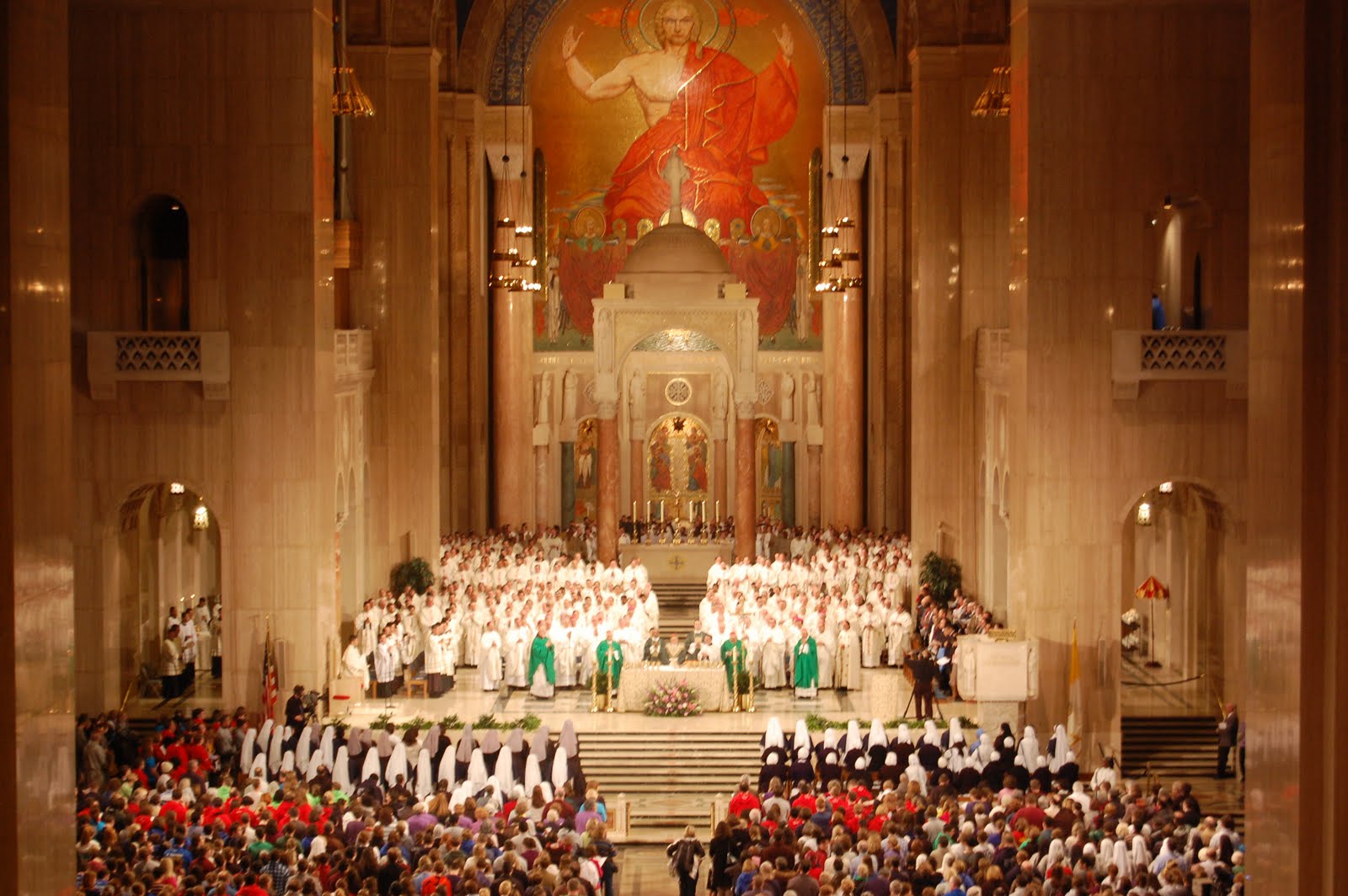
logo impact-2014® copyMany Catholics seldom think past their own parish when the consider the Church. And yet the Catholic World is huge and quite vibrant:

  1. 1.2 Billion Catholics in the World.
  2. 412,236 Priests
  3. 721,935 Religious Sisters
  4. 221,055 Parishes
  5. 92,847 Catholic Elementary Schools with 31 million students.
  6. 43,591 Catholic Secondary Schools with 17 Million Students [*]
  7. 117,000 health care facilities, including hospitals, clinics, orphanages,” as well as “18,000 pharmacies and 512 centers” for the care of those with leprosy, all comprising 26% of the total of  the world’s health care facilities. [*]

There is probably never a moment during the day in which Mass is not being celebrated somewhere on this planet, where the Liturgy of the Hours is not being celebrated. At every moment, Catholic school bells ringing, the poor and sick attended to by the Church, confessions being heard, counsel being given.

I am mindful of the words of an old hymn: The sun that bids us rest is waking, our brethren ‘neath the western sky.

Scripture also comes to mind

  1. Go into all the world and preach the good news to all creation (Mk 16:15)
  2. But you will receive power when the Holy Spirit comes on you; and you will be my witnesses in Jerusalem, and in all Judea and Samaria, and to the ends of the earth. (Acts 1:8)
  3. Their voice has gone out into all the earth, their words to the ends of the world. (Rom 10:18)
  4. My name will be great among the nations, from the rising to the setting of the sun. In every place incense and pure offerings will be brought to my name, because my name will be great among the nations,” says the LORD Almighty. (Mal 1:11)
  5. Like your name, O God, your praise reaches to the ends of the earth; your right hand is filled with righteousness. (Psalm 48:10)
  6. In that day you will say: “Give thanks to the LORD, call on his name; make known among the nations what he has done, and proclaim that his name is exalted. Sing to the LORD, for he has done glorious things; let this be known to all the world. (Is 12:4-5)
  7. I am about to come and gather all nations and tongues, and they will come and see my glory. (Is 66:18)
  8. And many others.

Yes, the Lord has done a glorious thing. It is so common to hear the failings of the Church and of her apparent irrelevancy to the modern Western World. And she remains, by God’s grace, strong, vital and worldwide. What a marvelous thing the Lord has done.

And if perhaps the worldwide picture overwhelms, consider even the life in one diocese in this country. My cousin John Clem alerted me to the video below, from the Archdiocese of St. Louis. It pictures the life of the Church in just one Archdiocese. As the clock in the video ticks by there is not a moment where the Church is not teeming with life, by God’s grace. The video beings in the early hours of the night where religious are praying the hours and shelters and crisis centers are up and running. As the morning dawns Masses are celebrated, parishes and school come to life, hospitals and clinics hum with activity. And as evening comes, more prayer, parish meetings and and the settling in of people in shelters. And in the late hours of the night an Archbishop prays for his people. One day in an Archdiocese.

Here in the Archdiocese of Washington, we did something similar in written form, a document called Catholic Impact. In its forty pages a similar story is told of a local Church, and Archdiocese,  that teems with life.

There are surely struggles in the Church about which we must be sober today. But too easily we focus on the negative, on what is wrong, and we look right past a lot of what is right, what is good, life giving, healing, vivid and true. Let this video and book remind us of that.

The Lord continues to do a marvelous work in his mystical Body, the Church.

Thinking About Thinking – A Reflection on some of the Modern Pitfalls and Logical Fallacies that Hinder Us

A lot of breakdown in modern communication comes down to logical fallacies and cognitive distortions that have us talking past each other. Perhaps, as the new year draws near, we might spend a little time reflecting and “thinking about our thinking.”

All of us fall into these traps. I have spoken before on the blog of the problem of “all or nothing thinking” and also our tendency today to take everything personally, to be thin-skinned. Perhaps some of the following reflections on the nature of our knowledge and how we both argue and reason, may also be instructive, since, as a group, we tend today to be very polemical, ideological and not always well reasoned in our thinking. Indeed, careful reasoning is NOT an obvious gift that most in these times exhibit.

Neither do most of us properly understand the limits or range of argumentation and so we tend to live in times where many “absolutize” what they argue and/or demand unreasonable “proof” for what others say. Frankly, the kinds of absolute proof many demand today is not possible in most realms of knowledge, including the many aspects of even the physical sciences, as we shall see. But this does not means we therefore know nothing, but only that we know within a range of stronger and weaker certitude based on a number of factors.

What is set forth here and tomorrow,  is not intended to be exhaustive. Indeed, anyone who has ever studied the branch of philosophy known as “Logic” will know that some of the structures of logic, and especially of “formal logical fallacies” are mind bending in their complexity and often ask us to hold many things constant (a difficult thing to do) while we discuss in great minutia some specific syllogism or point. There are, frankly, dozens of logical fallacies that can be distinguished, but many are very arcane, sensible only to the very erudite (of whom I am not one). Hence I will spare reader here the deepest distinctions and only discuss a few more common problems.

A logical fallacy is, fundamentally, an error in reasoning. Some logical fallacies are more common than others.

Most broadly we can distinguish between formal and informal fallacies. This is because there are two types of argument: deductive and inductive.

Deductive arguments are supposed to be water-tight. For a deductive argument to be a valid, it must be impossible for both its premises to be true, and its conclusion to be false. The truth of the premises establishes the truth of the conclusion.

The classic example of deductive argumentation is:

1 All men are mortal.
2 Socrates is a man.
Therefore:
3 Socrates is mortal.

It is simply not possible that both 1 and 2 are true but 3 is false, so this argument is deductively valid.

Any deductive argument must meet this high standard or it commits a logical error, and so, technically, is fallacious.

Now to be sure, not all our arguments can meet this high standard of deductive reasoning since not every premise can be as firm as “all men are mortal.” This includes many arguments that we would usually accept as good arguments, arguments that make their conclusions highly probable, but, they are not absolutely certain. Thus an argument that claims the high standard of deductive reasoning, but cannot meet its high standards is said to commit a “formal fallacy”. This does not mean that the argument is without any merit, only that it claims too much for itself.

Why is this important? Because, in an age of skepticism we need to rediscover that our demand for pure deductive reasoning is often itself “unreasonable.” We often set an impossibly high standard, namely, that all things must be absolutely certain for me, every argument absolutely airtight, and purely deductive. But the problem with this is that it does not often pertain to us, mere mortals, to have such a command of facts in order to have such certainty. In demanding a certainty or evidence that is absolute, we are usually being unrealistic, for such absolute certainty is rare in our human condition.

Thus we moderns too easily tend to reject all evidence that is not what we consider absolute. Yet, though not absolute, it IS good evidence. And we also tend to invalidity anoint certain types of evidence (especially the physical sciences) with a certainty they do not actually have. For indeed, even the physical sciences make many assumptions and hold theories that are not 100% certain. And scientists DO hold metaphysical assumptions (e.g. that reality is intelligible) which are not unassailable.

Thus in our insistence for “absolute proof” and pure deductive reasoning, we often produce a cynicism in ourselves that closes a great deal of the world of experience off to us. For the fact is, most of what we see and experience admits of mystery and uncertainty.

On account of this attitude, many today reject faith which asks us to walk “by faith and not by sight.” The evidence of faith is supplied in trusting the authority of God who reveals. And yet, to be honest, most of what we know rests on what we learn from trustworthy sources and test in the laboratory of our life.

And so, if we are honest, pure certainty and the rarefied world of deductive reasoning is not the usual human condition. We do well to admit that faith is a valid strategy, as is moving forward without 100% certainty,  and that even “pure science” contains a lot of theories, hypotheses, hunches and even guesses, not to mention pure mysteries and a plethora of unknowns.

More on this issue here: Faith and Certitude by Fr. Thomas Dubay

And that leads us to inductive arguments which do not propose to be as rigorous as deductive argumentation. But note, they are STILL good arguments, and often the only argumentation available to us in many matters. A good inductive argument lends support to its conclusions and sets forth good reasons for them. But even when the premises of an inductive argument are solid and true, it does not necessarily mean with 100% certainty that its conclusions are true. That the argument is a good one and that its premises are true, only establishes that its conclusion is likely or probably true.

Again, let us be clear, inductive arguments, which involve most of the reasoning we must undertake, do not assert and cannot claim the 100% certainty of deductive arguments. This is because they often use premises or assert conclusions that are not self evident, but only likely and probable. Thus the terms most often used to distinguish good and bad inductive arguments are “strong” and “weak” rather than certain or “proved.”

An example of a strong inductive argument would be:

1 Every day until now the law of gravity has held.
Therefore:
2 The law of gravity will hold tomorrow.

Note that this argument is very strong but not absolutely certain. Nevertheless most of us would act with confidence on its premise and conclusion and even make plans of a significant nature based on it. And this is case with most knowledge we have, which is not usually pure deduction, but involves a lot of inductive reasoning and argumentation.

Now, that said, we are not thus cast into a world of absolute uncertainty. There ARE standards for inductive arguments that must be met. And arguments that fail to meet the standards required of inductive arguments are said to commit fallacies, technically termed “informal fallacies” (since we are not in the realm of deductive reasoning with its absolute standards).

It is these “informal fallacies” that I would like to turn our attention in tomorrow’s post. As stated above, there are many logical fallacies that exist and have been well described. Some are more common that others, and some are more clear and egregious than others, but all of them have impact on what we may term critical thinking.

For today let this suffice. But tomorrow we can turn our attention to some (not all) of the fallacies that more often occur. As we shall see, since arguments consist of premises, inferences, and conclusions, some arguments fall short since the premises don’t give adequate support for the conclusion drawn and thus are termed fallacious. The most common fallacies center on matters of relevance, ambiguity, or presumption:

  1. Fallacies regarding relevance rely on premises that aren’t relevant to the truth of the conclusion.
  2. Fallacies regarding ambiguity make use of equivocation, “straw man” arguments, or play around with the plain meaning of words in a way that is erroneous or misleads.
  3. Fallacies regarding presumption rely on false premises, and so fail to establish their conclusion. For example, arguments rooted in false dilemmas, false dichotomies or circular arguments.

Learning a little about the nature of argumentation and reasoning can help us to avoid some of the more common modern pitfalls that shut communication down. Further it can help us avoid the extremes of either insisting on too much certainty or of falling into the other extreme of relativism. Most human knowledge exists on a continuum with absolute and deductive certitude being relatively rare, as is total ignorance and absolute uncertainty at the other end. Most of our knowledge and argumentation may be said to fall in a middle range of things we know strongly or weakly, with great confidence or lesser confidence.

Accepting this middle ground can go a long way to open true discussion and mutual respect, wherein we neither demand unreasonable or absolute proof, but neither do we dismiss necessary standards in setting forth inductive and reasoned arguments.

More on this tomorrow (actually January Wed, 2nd yo be more precise).

Without proper balance a lot of modern argumentation looks and sounds a lot like this song: