One of my favorite composers is Antonio Vivaldi (1678-1741). While I love his secular pieces (such as The Four Seasons), I am especially fond of his Church music. It is so light, bright, and tuneful! Vivaldi loved to go up and down the musical scale, varying the theme a half step at a time.
Ah, Vivaldi, he’s right up there with Handel, Bach, and Mozart! I consider him to be an especially Catholic treasure given his large body of sacred Latin liturgical music.
Here are just a few things I’d like to share about Vivaldi, things you may or may not know:
1. Vivaldi was a Catholic priest. He was ordained in Venice in 1703, at the age of 25. However, it would seem that the active priesthood did not suit him. Within a year, he asked to be excused from the daily celebration of Mass due to a “tightness of the chest,” which he complained of his entire life. Most scholars think that this is a reference to asthma, although there may have been other causes, including heart-related matters. But a deeper reason may lie in the fact the Vivaldi was pressured to become a priest. In those days, often the only way a poor family had to ensure the free schooling of a son was to send him to a seminary. Music seems to have been Vivaldi’s passion. Some biographies of him relate that he would sometimes leave the altar in mid-Mass to go into the sacristy to write down a musical idea that had just come to him!
2. Vivaldi spent most of his musical career working in an orphanage (mostly, though not exclusively, one for girls). While this may seem an odd and unfruitful place for a composer, it actually was not. The Ospedale della Pietà, where he worked for many years, was one of four well-endowed orphanages in Venice. Most of the children were the illegitimate offspring of Venetian noblemen who fathered them in the course of their (sadly common) dalliances. The noblemen funded orphanages to care for these children of theirs. In Venice, these homes developed a reputation for fine music, all performed by girls. The girls were trained in music from their earliest years and concerts were a way for the orphanages to raise money. At the Ospedale della Pietà, some of the girls remained well into adulthood, continuing to perform there. The video below depicts what such a setting was like, and shows how Vivaldi would give performances, secular and liturgical, with “his ladies.”
3. Not all found Vivaldi’s music as outstanding as many of us do today. Carlo Goldoni, an Italian playwright of the time, described Vivaldi as “… this priest, an excellent violinist but a mediocre composer …” But Vivaldi also had fans and patrons, and he earned a decent living selling copies of his many concertos, operas, and Church works.
4. In 1720 Vivaldi began living with a woman, Anna Giraud. To be fair, though, he always maintained that she was with him as a housekeeper and a friend. Furthermore, her sister also shared the house with them. Vivaldi trained Anna to sing and she had an excellent reputation as a singer. Vivaldi stayed with her until his death. Were they more than friends? It’s hard to say, but why not take Vivaldi at his word?
5. Vivaldi’s works all but disappeared after his death in 1741 and were not heard regularly or known widely again until the 1950s! In this sense he was an “opaque luminary.” (This expression refers to a person who shines brightly in his own time but is largely forgotten after death.) From his death until 1950, the name Antonio Vivaldi was largely unknown.
6. Vivaldi’s works began to come back to light beginning in 1926. It was at this time that the Salesian Fathers, wishing to sell a large number of old volumes in their archive, invited Dr. Alberto Gentili, professor of music history at the National Library of Turin, to assess their value. Many of the 97 volumes in the archive contained Vivaldi manuscripts. And thus Vivaldi music reappeared on the landscape. Although the Second World War slowed the process of compiling and collecting the full library of Vivaldi music from other sources, the hunt was on! In 1951, concertgoers in England were among the first to hear this newly rediscovered baroque master. Since then, Vivaldi has assumed his place alongside Bach and Handel, and is considered by most to be their equal. With them, he paved the way to Mozart.
7. Vivaldi died in 1741 at the age of 63. The cause was said to be “internal fire,” probably another reference to the asthma that plagued him all his life.
Yes, Vivaldi, the gift of his music is great!
The video below depicts the way in which Vivaldi’s Church music was likely performed. It shows how Vivaldi probably gave performances, secular and liturgical, with “his ladies.” Note that both the orchestra and the choir contain only women. This particular performance takes place in the Church of the Pietà in Venice, which was Vivaldi’s church and is attached to the Ospedale della Pietà. This is the movement from the now-famous Gloria in D. The text is Domine fili unigenite, Jesu Christe. Most of us who have sung this piece are used to it being in an SATB (soprano, alto, tenor, bass) arrangement, but for historical accuracy it is performed here exclusively by women. Notice the beautiful candles, too!
Over the years I have attempted to trace the philosophical disaster of our modern world. Certainly the fundamental roots can be traced back to the breakdown of the medieval synthesis, the rise of nominalism, and the doubts of Descartes. These introduced a disconnect from reality. Descartes introduced a radical doubt in anything seen or experienced, and this disconnects us from reality. If we pull up roots from reality and the revelation of creation, we live increasingly within our mind and out of touch with reality.
Welcome to the modern, post-Cartesian age, a strange landscape in which reality and stubborn facts aren’t considered too important. (N.B. To me, it is a strange paradox of modern times that we idolize the physical sciences; I have written more on that topic here: On the Cartesian Anxiety of our Times.)
Two of the most extreme examples of the disconnect from reality in our times are the celebration of homosexual activity and so-called transgenderism. If a “cultural Neanderthal” like me suggests that the design of the body speaks against homosexual acts by a simple consideration that the biology of sexuality is violated, I am greeted with responses ranging from blank stares to indignation (“What does the body have to do with it? It’s what I think and feel that matters!”) And thus the disconnect from reality and the retreat into the mind and psyche is complete.
How did we get here?
A few years ago, we priests of the Archdiocese of Washington attended our annual professional day. In reviewing my notes from that conference, I was once again inspired and instructed by the teaching of Msgr. Brian Bransfield, who was then the Associate General Secretary of the United States Conference of Catholic Bishops. He presented a brief, cogent description of the stages of our collective journey out of reality and into the self-defined world of personal opinion and the mind. It was really an aside within a much longer talk, but I am always appreciative of those who can see and describe the stages of our current malaise.
Allow me to quote from Msgr. Bransfield and then supply some commentary of my own. Please direct any criticism at me, not him, since I am merely excerpting from a larger talk (and context is important).
Here is the excerpt I’d like to discuss:
We can trace the fragmentation of the last four hundred years in steps:
To establish clear certainty in his search for knowledge, Descartes set up a dualism between the material and spiritual.
And in the dualism [he] introduced a separation in which he set man’s internal mind in opposition to external reality.
[Next, he] … elevated the mind (the thinking subject) and reduced the external, objective world of concrete reality.
Man’s understanding of himself and the world has been in a downward spiral ever since. Only the mind and what the mind says is reality, is real.
[And] thus there is … a collapse between the mind and reality. And in the collapse, reality loses.
[And so] reality becomes a mere label (nominalism). The child in the womb is not called a child; it is labeled something else. A refugee seeking asylum is not called a person, but is labeled undocumented.
[So] the mind now “creates” rather than conforms to reality.
Relativism is born; the thinking subject is … autonomous. Notice that word: “autonomous.”
And [thus] the ultimate absurdity is enthroned: nihilism, nothing—not as a privation but as a positive reality. There is nothing, no relation between reality (be it the child in the womb, the prisoner on death row, or the immigrant on the border) and our conscience. There is no communion between reality and the mind.
Let’s look at each point in detail. Msgr. Bransfield’s description is in bold, black italics while my meager commentary is in plain red text.
We can trace the fragmentation of the last four hundred years in steps:
Notice the use of the word fragmentation. If we live in our heads rather than in reality, then there is very little to unite us with one another. If what I think constitutes my reality, and if the same is true for you, then we are fragmented rather than united because there is nothing outside ourselves to unite us. Each of us is living in his own little world, not in a shared experience called reality.
To establish clear certainty in his search for knowledge, Descartes set up a dualism between the material and spiritual.
This began the disconnect between the actual world and what we think. Descartes entertained or struggled with radical doubt; he could not be sure that there was really anything “out there,” that is, outside his own mind. The only thing he knew for sure was that he existed, because he was a thinking agent. (This was the source of the memorable “Cogito ergo sum” (I think therefore I am)). That is all that was certain for Descartes; everything else might have been a dream or deception.
Thus the wall of separation between the thinking mind and reality was introduced.
By the way, radical doubt, though an intriguing theory and one we have all wrestled with a bit, is wholly useless at the end of the day. One cannot possibly live by it. Such folks sit on chairs that may or may not be there and avoid walking into walls that may or may not be there. But of course they are there. The doubters ignore the overwhelming evidence of reality in theory, but must navigate it in actuality. Their theory of radical doubt is useless and they violate it at every moment.
But useless though it is, the theory has proven quite intoxicating to the decaying West, which loves its dualisms and prefers conflict to synthesis.
And in the dualism [he] introduced a separation in which he set man’s internal mind in opposition to external reality
And thus begins the retreat out of reality and into our minds. We start to live up in our heads and think something is so just because we think it to be so.
[Next, he] … elevated the mind (the thinking subject) and reduced the external, objective world of concrete reality.
What we think becomes more important that what actually is. Thought, opinion, and feeling trump reality. Many people today do not even sense the need to check what they think against the facts. They don’t believe it’s necessary because thinking it makes it so.
Today we often hear phrases such as “That may true for you, but it’s not true for me.” Or (more humorously) “Don’t confuse me with the facts; my mind is made up!” And thus what we think trumps reality. We actually start to believe that statements like “Truth is relative” are real arguments (they are not). It’s really just lazy “living up in our head” and a stubborn refusal to engage reality.
Man’s understanding of himself and the world have been in a downward spiral ever since. Only the mind and what the mind says is reality, is real.
This partly explains the shredding of tradition and the iconoclastic tendencies of the modern age. Who cares what the ancients said or thought? If you and I (who are contemporaries) can’t even agree on what is real, and if all that matters is what I think, then why should what I care what you think, let alone what someone who lived centuries ago thought? If we all just live up in our heads rather than in reality, then what do I have in common with you let alone with The Founding Fathers, St. Thomas, or Jesus for that matter. All that matters is what I think; everything else goes in the shredder.
[And] thus there is … a collapse between the mind and reality. And in the collapse, reality loses. Exactly!
[And so] reality becomes a mere label (nominalism). The child in the womb is not called a child; it is labeled something else. A refugee seeking asylum is not called a person, but is labeled undocumented.
And thus the modern battle over terminology: pro-abortion or pro-choice, baby or fetus, fornication or cohabitation, homosexual or gay, redefining marriage or marriage freedom, refugee or “undocumented” (or even worse, “illegal alien”).
So much hinges on terminology, semantics, euphemisms, and redefinition; thought overrules reality. If we can influence thought, then reality doesn’t matter. Never mind that a baby has been dismembered alive, this is all about “choice” and “reproductive freedom.” And “sodomy” is such an unpleasant reality; let’s just call it “gay love.” And men can call themselves women and we are supposed to say, “Isn’t that nice.”
It’s as if we suppose that our terminology and thoughts can somehow change reality. They cannot. But in this post-Cartesian fog we’re in, that is exactly what we suppose. Away with reality; all that matters is what I think!
[So] the mind now “creates” rather than conforms to reality.
Yes, or so we think.
Relativism is born; the thinking subject is … autonomous. Notice that word: “autonomous.”
And here is where things begin to get scary. Reality is what I say it is. No one gets to tell me what to do or what to think; I should answer to no one.
As Pope Benedict warned, while this attitude marches under the banners of tolerance and freedom, the ultimate result is tyranny.
This is because if you and I cannot agree on something outside ourselves to which each of us is bound (e.g., reality) and to which we must answer, then we cannot appeal to that. Instead we must resort to the use of power to enact our view. Raw power—be it political, economic, or merely the power of popular opinion—is now used to impose agendas. Appeals to reason, common sense, justice, religious values, and even to constitutional parameters are becoming increasingly difficult.
In the video below, Fr. Robert Barron laments that we can’t even have a decent argument anymore since we seem to agree on so little; we just end up talking past one another. The final result is the use of raw power. Reality is what I think; I am autonomous. If you don’t agree with me, at first I will first ignore you. If that doesn’t work, I will work to marginalize you, to eliminate your influence. And if necessary, I will destroy you.
Welcome to the dark side of the Cartesian divide.
[And thus] the ultimate absurdity is enthroned: nihilism, nothing—not as a privation but as a positive reality. There is nothing, no relation between reality (be it the child in the womb, the prisoner on death row, or the immigrant on the border) and our conscience. There is no communion between reality and the mind.
Yes, today we witness the exaltation of nothing, the outright celebration that “nothing is true.” Indeed, we live in self-congratulatory times where many, if not most, applaud their nihilism as being “open-minded,” “tolerant,” “humanitarian,” and so forth.
But as Msgr. Bransfield points out, all this really does is to sever communion. There is nothing humanitarian about it because there is no real communion between human beings possible when I just live in my own head. Further, there is nothing to be tolerant of because there is nothing out there (outside what I think) to tolerate. And there is absolutely nothing open-minded in any of it, because it is the ultimate in close-mindedness to say, “Reality is what I think it is, and that settles it.” For the modern post-Cartesian, tolerance is “your right to agree with me.” Being open-minded means you agree with me. And humanitarianism is only what I say it is.
So here we are in a post-Cartesian malaise, with the vast majority of us living up inside our own heads. In this climate the Church must keep shouting reality.
It is dark now and it will likely get darker. But reality has a funny way of reasserting itself. Our little collective experiment in unreality will necessarily run its course. Let us pray that our reintroduction to reality will not be too harsh. But I am afraid that it will be.
The eradication of poverty is an oft-stated goal of the modern, liberal West. President Lyndon Baines Johnson’s pronouncement of a “war on poverty” so imprinted this notion in the Western mind that it has become almost axiomatic. It is now a fundamental pillar in the thinking of almost every person (and organization) in the Western world, from the religious pew-sitter concerned for the poor to the most secular humanist bent on a utopian vision. Poverty is a great enemy that must be stamped out!
The only problem is that this is contrary to the Gospel! It is no surprise, therefore, that even after decades of Western “do-goodism,” barely a dent has been made in the percentage of people living in poverty. In fact, some statistics show that the percentage in poverty has increased. But why should we expect great fruitfulness in something that opposes God?
I can see the look of shock on your face right now; you may even be embarrassed that I have written this. I’d like to share a quote with you from Robert Cardinal Sarah, which makes an important distinction that we need to recover. While what he says may also shock you, I encourage you to read it carefully and thoughtfully; the distinction he makes is critical. Not only does the Gospel depend on it, but cultures and individual lives do as well. For indeed, in the name of eradicating poverty some of the worst of Western arrogance has been displayed. It is an arrogance that does not even recognize that it can become willing to the destroy the poor themselves as well as what and whom they love all in the name of this “noble” goal.
Cardinal Robert Sarah is no neophyte in this discussion. He grew up in an impoverished region of Africa and later headed the Roman dicastery, Cor unum, a charitable arm of the Holy See. The extensive passage below is an abbreviated version of the Cardinal’s response to the following questions posed by his interviewer, Nicholas Diat:
How would you describe the nature of Cor unum, the dicastery to which you devoted several years of your life, in its fight against all sorts of poverty? Furthermore, why do you speak so often about the close relation between God and the poor?
In his reply, the Cardinal is reacting somewhat to Mr. Diat’s description of Cor unum’s work as “fight[ing] against all sorts of poverty.” The Cardinal’s response is nothing short of stunning. Please read it carefully and consider obtaining the book so as to able to read the unabridged remarks as well.
The Gospel is not a slogan. The same goes for our activity to relieve people’s suffering … [it is a matter] of working humbly and having a deep respect for the poor. For example, I remember being disgusted when I heard the advertising slogan of a Catholic charitable organization, which was almost insulting to the poor: “Let us fight for zero poverty” … Not one saint … ever dared to speak that way about poverty and poor people.
Jesus himself had no pretention of this sort. This slogan respects neither the Gospel nor Christ. Ever since the Old Testament, God has been with the poor; and Sacred Scripture unceasingly acclaims “the poor of Yahweh.” …
Poverty is a biblical value confirmed by Christ, who emphatically exclaims, “Blessed are the poor in spirit, for theirs is the Kingdom of heaven” (Mt 5:3). … The poor person is someone who knows that, by himself, he cannot live. He needs God and other people in order to be, flourish and grow. On the contrary, rich people expect nothing of anyone. They can provide for their needs without calling either on their neighbors or on God. In this sense wealth can lead to great sadness and true human loneliness or to terrible spiritual poverty. If in order to eat and care for himself, a man must turn to someone else, this necessarily results in a great enlargement of his heart. This is why the poor are closest to God and live in great solidarity with one another; they draw from this divine source the ability to be attentive to others.
The Church must not fight against poverty but, rather, wage a battle against destitution, especially material and spiritual destitution. … [so that all] might have the minimum they require in order to live. …
But we do not have the right to confuse destitution and poverty, because in so doing we would seriously be going against the Gospel. Recall what Christ told us: “The poor you will have always with you …” (Jn 12:8). Those who want to eradicate poverty make the Son of God a liar. …
[In his yearly Lenten message in 2014, Pope Francis] espoused what St. Francis [of Assisi] called “Lady Poverty.” … St. Francis of Assisi wanted to be poor because Christ chose poverty. If he calls poverty a royal virtue, it is because it shone brilliantly in the life of Jesus … and in the life of his mother, Mary of Nazareth. …
Similarly, I often think about the vow of poverty taken by religious … [they] do so in order to be as close as possible to Christ. The Son [of God] wanted us to be poor in order to show us the best path by which we can return to God. …
The Son of God loves the poor; others intend to eradicate them. What a lying, unrealistic, almost tyrannical utopia! I always marvel when Gaudium et Spes declares, “The spirit of poverty and charity is the glory and witness of the Church of Christ” (GS 88).
We must be precise in our choice of words. The language of the UN and its agencies, who want to suppress poverty, which they confuse with destitution, is not that of the Church of Christ. The Son of God did not come to speak to the poor in ideological slogans! The Church must banish these slogans from her language. For they have stupefied and destroyed peoples who were trying to remain free in conscience (Cardinal Sarah, God or Nothing: A Conversation in Faith with Nicholas Diat, pp. 140-142).
Perhaps stunned himself, Mr. Diat follows up with the following question: “Are you not afraid of being misunderstood in employing this sort of distinction?”
The Cardinal replies,
It is a lack of charity to shut one’s eyes. It is a lack of charity to remain silent in the face of confusing words and slogans! … If you read the Latin text of Gaudium et Spes carefully you will immediately notice this distinction (Ibid, p. 143).
This is a powerful insight and it reveals the deep flaw in Western “anti-poverty” programs. Christ asks us to love the poor and imitate the best of what they are, not eliminate them and disregard the simplicity and trust that they can often exemplify. But we in the West, imbued with our materialistic notions and mesmerized by the comfort and control that wealth can temporarily buy, denigrate what the Gospels praises and seek to eradicate it.
So unreflective are we in this matter that some will even justify the most awful things in the name of eradicating poverty. Many programs (U.S.-sponsored and U.N.-sponsored) with this goal advocate for contraception, abortion, and/or euthanasia. Some have even sought to compel these sorts of things as a precondition for receiving aid. Some seek to impose certain aspects of Western thinking, something that has been labeled an attempt at “ideological colonization.” Many of us in the “First World” often speak of the “Third World” in a way that at best is patronizing and at worst exhibits a thinly veiled contempt.
While it is true that certain economic and political systems best support Western lifestyles, there is more to life than material abundance. With our own culture, families, and common sense collapsing around us, it seems odd that we so easily consider our way of life superior; that we see our relationship to the poor and to poorer countries as one in which we have all the answers and they should just listen to us.
The word “arrogance” comes to mind. We too easily assume, without even asking, that we know what is best; we presume that poor people in every part of the world want what we have (materially) and that they don’t perceive the awful price we have paid in order to get it.
We must recover a respect for the world’s poor, who have much to teach us. Even if they are not materially without troubles, they often possess many things we have lost: simplicity, family and tribal (communal) life, reciprocity, proper interdependence (as opposed to radical individualism), trust, a slower life, and a less-stressful life.
Further, we must not forget that the Lord counseled poverty (Lk 18:22), declared the poor blessed (Lk 6:20), lived simply Himself having “nowhere to lay his head” (Mt 8:20), lived among the working poor, and warned of the pernicious quality of wealth (Lk 16:13). God hears the cry of the poor and Mother Mary taught us of a great reversal that is coming, when the mighty and powerful will be cast down and poor and lowly raised up (Lk 1:52). Jesus taught us that many who are now last will be first in the kingdom of Heaven (Mat 19:30). In this life, the poor will sometimes need us. In the next life, on Judgment Day, we are going to need them to welcome us into eternal dwellings (Luke 16:9).
I really cannot say it better than did the good Cardinal, so I will not attempt to do so. We must surely work to alleviate the destitution that often comes in times of famine, war, or natural disaster. But destitution and poverty are not the same thing. Overlooking this distinction can be deadly for the poor we claim to serve and for their cultures, and can result in the worst forms of ideological colonization and secular utopianism.
The Catholic Church does not fit into anyone’s little political box. We are too big and ancient for that. And we serve a higher master. Our teachings predate current political categories and will surely postdate them as political lines continue to shift back and forth. The world, its nations, and political realities come and go, and still, here we are.
We have been called both the “Republican Party at prayer” and the “Democratic Party at prayer,” but we are neither. We are the Body of Christ at prayer. As such, we share his fate. The four political factions among the Jews of Jesus’ day (Herodians, Sadducees, Pharisees, and Zealots), who disagreed about essentially everything, all agreed that Jesus must go. Even the Romans concurred! Emblematically, Jesus was crucified outside the city gates; the polis (the city) could not contain him either. The Letter to the Hebrews advises, Therefore Jesus also, that He might sanctify the people through His own blood, suffered outside the gate. So, let us go out to Him outside the camp, bearing His reproach (Heb 13:12-13).
So here we are, outsiders in a land we too easily call home. We are American citizens to be sure, but our true citizenship is in Heaven (Phil 3:20). As a Church we cannot simply conform to an “R” or “D” vision of the world. We certainly stand conscientiously opposed to abortion, the redefinition of marriage, the forced funding of contraceptives, euthanasia, and any erosion of religious liberty. But we oppose these and other related life- and family-related issues as Catholics.
Another critical moral issue that tests our soul as a nation is that of immigration. Here, too, the challenge for every Catholic is to approach the issue as a believer.
My own views on this matter have been shaped by over thirty years of daily Scripture reading in the Divine Office and Holy Mass. There are numerous texts (frankly, an avalanche of them) that command us to care for the sojourners, foreigners, and aliens among us. Over and over again the theme comes up. It is a steady drumbeat: hospitality and care are to be shown the foreigners among us. Here are just a few of the more than one hundred texts that command this:
When a stranger sojourns with you in your land, you shall not do him wrong. You shall treat the stranger who sojourns with you as the native among you, and you shall love him as yourself, for you were strangers in the land of Egypt: I am the Lord your God (Lev 19:33-34).
You shall not wrong a sojourner or oppress him, for you were sojourners in the land of Egypt (Ex 22:21).
Then I will draw near to you for judgment. I will be a swift witness against the sorcerers, against the adulterers, against those who swear falsely, against those who oppress the hired worker in his wages, the widow and the fatherless, against those who thrust aside the sojourner, and do not fear me, says the Lord of hosts (Mal 3:5).
I was a stranger and you welcomed me … (Mat 25:35)
He executes justice for the fatherless and the widow, and loves the sojourner, giving him food and clothing. Love the sojourner, therefore, for you were sojourners in the land of Egypt (Dt 10:18-19).
Give counsel; grant justice; make your shade like night at the height of noon; shelter the outcasts; do not reveal the fugitive; let the outcasts of Moab sojourn among you; be a shelter to them from the destroyer (Is 16:3).
There are many other texts commanding us in this manner or reminding us of our own needs in the past and exhorting us to deal with strangers among us respectfully and with care.
The amount of ink expended on this topic in the Scriptures is overwhelming. It is just not possible for me as a Catholic Christian who insists that we take Scripture seriously in other matters to simply say, “Well, this is just a bunch of old-fashioned thinking that we can ignore.”
However we work to secure our borders and craft reasonable immigration laws, we cannot simply suppress the overwhelming voice of God, who commands of us a stance of welcome, openness, and care for those who are among us.
The Catechism of the Catholic Church seeks to strike a balance between the need of a nation to protect its borders and reasonably manage immigration with the command to welcome and care for others:
The more prosperous nations are obliged, to the extent they are able, to welcome the foreigner in search of the security and the means of livelihood which he cannot find in his country of origin. Public authorities should see to it that the natural right is respected that places a guest under the protection of those who receive him.
Political authorities, for the sake of the common good for which they are responsible, may make the exercise of the right to immigrate subject to various juridical conditions, especially with regard to the immigrants’ duties toward their country of adoption. Immigrants are obliged to respect with gratitude the material and spiritual heritage of the country that receives them, to obey its laws, and to assist in carrying civic burdens (Catechism 2241).
By any assessment, the current system in this country is broken. Our laws are chaotic, selectively enforced, and have created a dangerous situation for immigrant and countryman alike. Fear and suspicion dominate; there has been a sad increase in nativist anger that is unbecoming a nation of immigrants with a Judeo-Christian heritage. Laws surely existed in previous decades, but there were fewer of them and they were far less confusing.
I am not a political genius or a policy wonk who has the perfect solution. But Catholics ought to approach this issue as Catholics, deeply rooted in Scripture and in our established teachings that summon us to welcome and assist others to contribute to our great land. We have suffered much from nativist sentiments in the past. We are and always have been an immigrant Church in America. We have a proud history of coming here, making a positive difference, and helping others to do so. Our parishes have always been centers of both familiar culture and of acclimation to our country.
In our charity we ought to be very hesitant to demonize the majority of immigrants as scofflaws and criminals. Even those who are currently without legal papers have most often come here to escape from desperate conditions of poverty and/or injustice. Some originally arrived legally but have since had their status expire and now cannot reasonably return.
As a priest, I know the personal stories of many immigrants; they are typically complex and often tragic. Almost no one leaves his country and his relatives behind on a whim, just to go and live in a foreign land. They often risk their lives and endure substantial hardship in order to come here because they are so desperate and see so few alternatives.
Are there criminals and opportunists among them? Yes. The same can be said about my own Irish and German immigrant ancestors. But most of my relatives were decent, hard-working people who wanted to survive—and to contribute as well. I have found nothing different about the vast majority of today’s immigrants. And these days, their children often speak English, even if some of the first generation struggle to master it.
We are Catholics and as such we need to think about this issue as Catholics. Our Scriptures and our teachings are unambiguous. The human rights of the immigrants, sojourners, and strangers among us are to be respected. We also need to help them to respect our laws and traditions. We can and should enrich one another.
I fully expect a lot of pushback on a post like this. You are free to comment, but I ask a couple of things: First, don’t address me, address your fellow readers. Second, don’t just say why I am wrong or naïve, etc.; say what you think and why.
Before you press “Submit Reply” (and take your math test J) please take a moment and at least glance at the long list of Scriptures in the link above. Consider whether or not your remarks take sufficient note of what God teaches us. In the end, it matters little what you or I think; or whether the Church teaches this as dogma, doctrine, or discipline; or whether it is taught fallibly or infallibly. The question is this: What does God think and how would He have me speak of and respond to this profoundly significant human issue?
Catholics don’t fit into anyone’s neat little box. We’re too big, too old, too diverse, and I pray too much like Jesus (who didn’t fit in anyone’s box either).
There was a movie that came out in 1999 called Blast from The Past. The movie begins in the early 1960s at the height of the Cuban Missile Crisis. An eccentric man and his pregnant wife have built an elaborate fallout shelter underground in their backyard. It is no ordinary bomb shelter, but a large, well-stocked one that has many amenities, including the ability to grow food and raise fish.
When a plane crashes nearby, they think that the country is under attack and that an atomic bomb has hit. They run into the shelter and lock it behind them, setting the automatic locks not to open for 35 years when the radiation will have dissipated.
During this time the wife gives birth to their son, Adam, whom they raise in the shelter. Adam receives the usual education one would expect for the time, with a strong emphasis on reading, writing, arithmetic, and history. He also obtains a liberal arts college education from his father, who had been a professor. This education included learning Latin, Greek, French, and German. Adam also learns the social skills of that time such as basic manners, the proper treatment of a lady, ballroom dancing, and the meaning of life. He is also raised to reverence God.
In a way the family was frozen in time and preserved the value of the early 1960s. The film does not present that era as being flawless: the mother has a bit of a drinking problem and the father is rather eccentric and xenophobic.
Suddenly it is 1997 and the locks open. The family makes its first excursion out into the world since the bomb (supposedly) went off. The father expects to find that those who survived will show the effects of radiation poisoning and that the world will manifest many signs of the destruction the bomb surely wrought. So they go forth from the shelter cautiously.
Now, you and I know that no atomic bomb did go off. Or did it?
As they emerge from the bomb shelter, they see that their once quaint neighborhood has become a red-light district. They see shocking things: not only prostitutes and adult book stores, but also drug addicts, trash-filled streets, and signs of grave disorder. People are coarse in their behavior. The family runs back into the shelter, concluding that things are even worse than they had expected. They send their son Adam out to get provisions and possibly find a wife (if he can locate a woman who has been less affected by the “radiation”). Then they will once again throw the locks on the shelter and wait for things to improve on the outside before venturing out again, lest they be poisoned by it all. In the following scene, Adam emerges from the shelter and encounters a drug addict who thinks Adam is God. Adam proceeds farther and sees things and people outside for the first time.
As Adam goes forth, he discovers that beyond the red-light district there are other less-devastated areas, but he still struggles with what he experiences. Families seem to be in disarray; people are coarse, cynical, and use God’s name in vain. The technology amazes him, but so do simple things like rain, the open sky, and the ocean. In this scene he is troubled by some modern cultural trends, but then is overwhelmed with awe upon seeing the ocean for the first time:
As the movie progresses, it becomes quite clear that much has been lost. Adam is head and shoulders above the modern people who surround him. He is kind, respectful, polite, and innocent in his interpretation of the world. He is much better educated than those around him as well, having amassed quite an encyclopedic knowledge in comparison. In the following scene, two things are illustrated: Adam’s superior education and his coming to grips with modern technology. How can a computer (a giant thing in his world) be inside a house?
And Adam can dance, really dance! It’s not the gyrating that is common on modern dance floors but 1940s swing, flawlessly executed, which is natural to him due to the daily training he received from his parents. Here is a dance scene showing that although dancing was a little risqué even back then, it still required training and talent. Pardon some of the language in this clip, but remember that the coarsening of culture is what is on display here.
Adam is befriended by a young lady named Eve and her brother. At first they think Adam to be strange and naive but come to discover that he has much to teach them. In this scene, they ponder something he has taught them about graciousness, kindness, and the blessing of strong family ties.
This movie is well worth seeing. Unlike me, it is not “preachy.”It gently suggests to us that we have lost some important things in the past 50 years or so: things like kindness, optimism, the value of traditional education, and the importance of parents teaching and raising their children. In many ways the movie intimates that we have become coarse and cynical—even vulgar. Family ties have often been severed and our culture has melted down to a more base level. Education is less thorough and broad. Simple things like learning to dance have been lost.
As I have already said, the early 1960s was not a perfect time. Many troublesome cultural trends were already well underway. These do not go unreported in the movie. But still the point remains: some things of great value have been lost. The family entered the shelter at the end of an era; when they emerge they step out of the past and are bewildered by what they find. Technology is impressive, but people seem lost and cynical. The world is hostile and disordered. Adam brings with him out of the shelter some healing balm, some of the best virtues of the past to remind us all that we have lost some important things along the way.
A bomb did go off—not an atomic bomb, but an even more devastating, cultural one. Rebuilding will take time.
My blog is usually posted in the evening at about 21:00 (9:00 PM) U.S. Eastern Time. But in Sydney, Australia, it is 1:00 in the afternoon of the following day. As I prepare for bed, they are eating lunch on a day that has not even begun for me. And proceeding farther west from there, in the Philippines and Japan the afternoon is winding down and the workday is coming to an end!
Time. What could be simpler than for me to look at the clock and say that it is 9:00 PM on Wednesday, February 17th? But on the other hand, what could be more mysterious? Time is a human reckoning of a mysterious passage.
And yet the mystery is also beautiful. At any given time, some people are asleep in the night, while others are at midday. There is a wonderful verse in an old English hymn that says,
The sun that bids us rest is waking Our brethren ‘neath the western sky, And hour by hour fresh lips are making Thy wondrous doings heard on high.
Here are two other beautiful verses from the same hymn:
We thank Thee that thy Church unsleeping, While earth rolls onward into light, Through all the world her watch is keeping, And rests not now by day or night.
As o’er each continent and island, The dawn leads on another day, The voice of prayer is never silent, nor dies the strain of praise away.
Magnificent lines! The hymn contains a beautiful and poetic description of the Church: always praising, always sighing, always at worship. Although some are asleep, the praises continue. One of the Psalms says, Let the name of the Lord be praised, both now and forevermore. From the rising of the sun to the going down of the same, the name of the Lord is to be praised. The Lord is exalted over all the nations (Psalm 113:2-4). The praises never end, for the sun is always rising somewhere even as it is setting somewhere else.
Malachi, prophesying the glory of the Mass celebrated worldwide says, My name will be great among the nations, from the rising to the setting of the sun. In every place incense and pure offerings will be brought to my name, because my name will be great among the nations,” says the LORD Almighty (Mal 1:11). At any given time, Mass is surely being offered somewhere on this earth. The Liturgy of the Hours, too, always uttering forth from the lips of the faithful somewhere. Yes, in the mystery of time, this planet of ours is a place of perpetual praise. And our praises join the perpetual praises of Heaven, for as the Liturgy proclaims (in the words of the new translation), And so, Angels and Archangels, with Thrones and Dominions, and with all the host and Powers of heaven, as we sing the hymn of your glory, without end we acclaim: Holy, Holy, Holy Lord God of hosts …
Yes, the mystery of time and our praises caught up in the ever moving sweep of time. What St. Paul says to us as individuals is fulfilled by the worldwide Church. His advice is so simple and yet so profound. St. Paul says, Pray always (1 Thess 5:17).
Here is a rendition of the entirety of the hymn (The Day Thou Gavest, Lord, is Ended) that was quoted above. The complete lyrics are available here: The Day Thou Gavest.
Some years ago in a previous parish assignment (St. Thomas More, in Washington D.C.) I was accustomed to taking a Friday afternoon walk in order to focus on my Sunday homily. At the beginning of the walk I’d often stop by the house of an elderly parishioner, Ms. Lillian, and give her Communion. Her mind was beginning to fail and it was difficult for her to get to Church.
In mild weather she would often be out on the front porch in her wheelchair. As approached she’d say, “Oh Father, it must be Sunday!” “No, Lillian,” I’d usually reply, “It’s actually Friday.” And then she’d usually respond, “Oh, I’m sorry to hear that.”
When I answered her I was thinking of the calendar, but she was long past worrying about what day the world said it was. And so, Friday after Friday, she’d keep asking me if it was Sunday. It was Friday, but she kept looking for Sunday. “Is it Sunday, Father?” “No, Ms. Lillian, today is Friday.”
The world has a popular saying, “Thank God, it’s Friday.” But in the Church, especially among the African-Americans whom I serve, there is an older expression: “It may be Friday, but Sunday’s coming.” It is a thoroughly biblical context in which Friday represents our sufferings, our personal “Good Fridays,” while Sunday represents our rising from the dead, our joy, and the fulfillment of our hopes.
When Ms. Lillian saw her priest she thought of Sunday; she thought of Jesus and Holy Communion. So, in a way, for her it was Sunday, if only for a moment. To be sure, Lillian was in the “Friday” of her life. She suffered from many of the crippling effects of old age: dementia, arthritis, weakness, poor hearing, and eyesight problems. “I’s gotten so ooooold, Father,” she’d say. Yes, Friday had surely come for Lillian.
At her funeral I could think of no better way to begin the Homily than by saying, “It’s Sunday Ms. Lillian; it’s Sunday.” And the congregation nodded. Some just hummed, while others said, “Thank you, Jesus.” Lillian had gone to Jesus and Sunday had come. Surely she, like all of us, needed some of the cleansing purgation through which the Lord wipes away the tears of all who have died (cf Rev 21:4) and lifts the burdens of our sorrows, regrets, and sins for the last time. For those who die in the Lord, die in the care of the Lord. The souls of the just are in the hand of God (Wis 3:1).
Yes, it’s Sunday, glorious Sunday, for all those who trust in the Lord. The Fridays of life will come, but if we trust in Him, Sunday will surely follow.
“Oh, Father! It must be Sunday!” ”Yes, Ms. Lillian, it is surely Sunday.”
I thought of Ms. Lillian when I watched this video. I hope you’ll enjoy a little wisdom from the “Black Church.” Good preaching, good reminders, powerful video.
The video below humorously illustrates a biblical principle of our hidden faults. We all have sins and behaviors that are apparent to others but of which we are unaware. And there are even deeper faults of which no one is aware except God Himself, who sees our innermost heart. Consider some of the following quotes:
By [your ordinances] your servant warned; in keeping them there is great reward. But who can discern his errors? From my hidden faults acquit me, O Lord. Keep your servant also from willful sins; may they not rule over me (Psalm 19:11-13).
You have set our iniquities before you, our secret sins in the light of your presence (Psalm 90:8).
For God will bring every deed into judgment, including every hidden thing, whether it is good or evil (Eccl 12:14).
Mind you, I have nothing on my conscience, but I do not stand thereby acquitted. It is the Lord who judges me (1 Cor 4:4).
The sins of some men are conspicuous, going before them to judgment, but the sins of others appear only later (1 Tim 5:24).
Call no man happy before he dies, for by how he ends, a man is known (Sirach 11:28).
Yes, some of our sins are obvious to us and we rightly work on them. But lest we sin through pride, we should always recall that we have sins and faults that are hidden from us. Others may see them, or perhaps only God.
At the end of the day, we’re all going to need a lot of grace and mercy!
Enjoy the commercial below that illustrates this fact well. And I hope you appreciate this little bit of humor; it’s been a tough week on the blog!

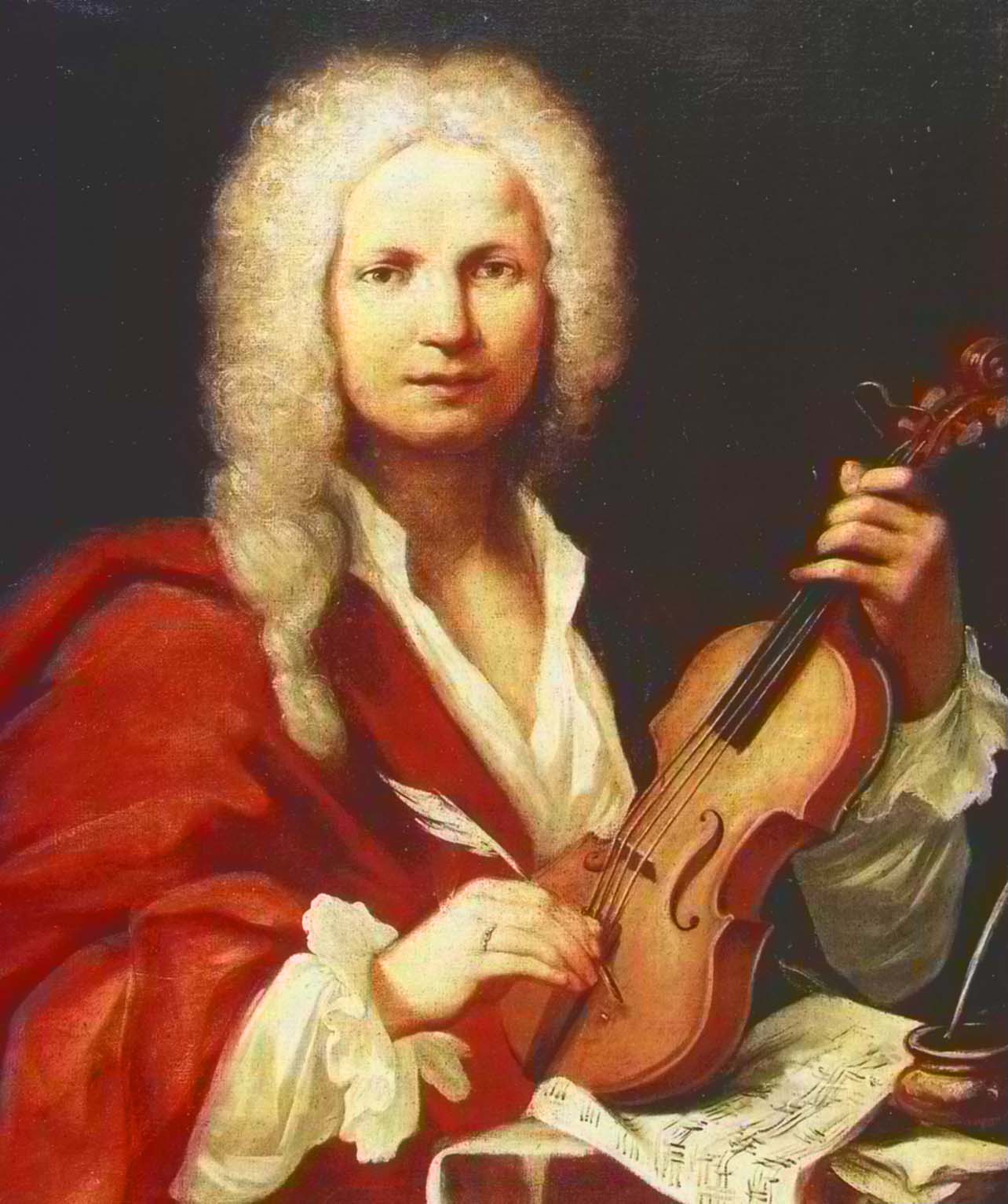 One of my favorite composers is Antonio Vivaldi (1678-1741). While I love his secular pieces (such as The Four Seasons), I am especially fond of his Church music. It is so light, bright, and tuneful! Vivaldi loved to go up and down the musical scale, varying the theme a half step at a time.