Why Holy Days and the Sanctoral Cycle Are Important

Astronomical clock in Czech capital PragueIn last Sunday’s Mass we read from the eighth chapter of the Book of Nehemiah. I posted a lengthy commentary on it last week (On the Wonder of the Word of God). In today’s post I would like to ponder a rather surprising emphasis of that text. Let’s start with a little background.

In a stunning reversal for the Jewish people, the Babylonians invaded Jerusalem and destroyed not only the city, but the Temple as well! Prophet after prophet had warned the people of the Northern Kingdom of Israel and Judah that if they did not repent, God would permit punishments to come upon them in the form of destruction and exile. Those warnings were not heeded. The Northern Kingdom was destroyed in 721 B.C. and the end came for the Southern Kingdom of Judah in 587 B.C. The Temple of God lay in ruins and the survivors of the war were led captive into exile in Babylon. As they went they sang this song:

By the waters of Babylon,
there we sat down and wept,
when we remembered Zion.
On the willows
there
we hung up our lyres.
For there our captors
required of us songs,
and our tormentors, mirth, saying,
“Sing us one of the songs of Zion!”

How shall we sing the Lord’s song
in a foreign land?
If I forget you, O Jerusalem,
let my right hand wither!
Let my tongue stick to the roof of my mouth,
if I do not remember you,
if I do not set Jerusalem
above my highest joy!
(Psalm 137:1-6)

After 80 years the Lord lifted this exile by permitting Cyrus and the Persians to defeat the Babylonians. Not only did Cyrus allow the Jews to return to their land, he even offered monetary aid for the rebuilding of the city wall and the Temple.

Nehemiah chapter 8, from which we read last Sunday, describes a gathering of the refugees who had returned at which there was a reading from Scripture that convicted them of their sin, explained the exile, and set forth blessings. The passage that seems to have been read was from the Book of Deuteronomy. Apparently this book had been neglected by the Jews in the decades prior to exile. Their forgetfulness of it proved fateful, for in it was described the blessings of keeping the law and the terrible curses that would befall those rejecting it. Among the consequences of rejecting the law were destruction and exile.

Standing there that bright morning at the water gate listening to the book being read to them, the people began to weep uncontrollably (Neh 8:9). They realized that they and their fathers could have avoided all the ensuing death and pain had they but heeded God’s Word.

But then comes the surprising focus of the second half of the chapter. Surely there were many infractions of the Law that they and their forbearers had committed: false worship, idolatry, sins against the truth, sexual sins, injustice to the poor, theft, greed, and murder. But none of these many was the focus of the summons to repentance that follows in Nehemiah 8:13ff. Rather, the focus was on a certain feast day that they had failed to celebrate.

Not celebrating a feast day? Really? Of all the sins to focus on; failing to celebrate a feast day? Yes.

The feast that they had been neglecting was the Feast of Booths (or the Feast of Tabernacles). It was a feast that commemorated their time in the desert and the giving of the Law by Moses.

Certainly it was an important feast; in a way it symbolized the whole Law. To our modern minds, though, the neglect of a feast hardly seems worth mentioning when compared to some of the other sins listed above that we human beings routinely commit.

So what’s going on here? Why are feast days important? 

Most of us moderns do not pay much attention to sanctoral cycle that makes up the Church’s calendar. On this calendar are the feasts of saints as well as feasts that commemorate God’s saving acts: Christmas, Easter, Pentecost, Corpus Christi, the Annunciation, and so forth. To us these seem to be mere commemorations of events in the distant past; we do not use them to mark the passage of time. But the feasts of the Lord and His saints have value in our lives.

Prior to modern chronographic devices, people measured time by what God set forth: the sun, the moon, and the stars in their courses. But the feasts of the Lord that were also integral to their sense of time. Passover was an important feast, but so were many others: Pentecost, Tabernacles, the Day of Atonement, Rosh Hashanah, and especially the weekly Sabbath. God was the clock of the ancients.

This pattern continued into Christendom, when Sundays were cherished and feast days framed the year: Advent, Christmas, Epiphany, Lent, Easter, Pentecost, and the great feasts of the saints: Peter and Paul, John the Baptist, Joseph, Mother Mary, and many local saints. Indeed many words have come into our vocabulary that describe the Catholic Calendar: “Christmas” comes from Christ + mass. “Carnival” comes from the Latin carnis (meat) + vale (farewell) and signifies the great feast at which the last of the meat and fat were used up before Lent; Mardi Gras (Fat Tuesday) has a similar origin. “Holiday” comes from Holy Day.

With secularization these feasts have vanished into the background altogether. Holy Days were replaced by the secular mispronunciation “holidays” and became largely secular in focus. Today, Labor Day and Memorial Day mark the bookends of people’s summer more so than do the Feasts of the Sacred Heart (first Friday in June) and the Assumption (August 15). Christmas and Easter are still there, but they feature candy canes and Santa Claus, eggs and a bunny—not Jesus.

What does celebrating feast and Holy Days say? What it says is this:

God, you are central in our lives. We tell time by what you have done. Every week begins on Sunday in your house. In all the feasts we remember your saving works of the past and permit those acts to be present to us. We give you thanks for what you have done; we remember and we praise you. We celebrate your place in our life and we frame our lives around what you have done in our time and in our history. We love you, Lord, and not only do we celebrate what you have done, we celebrate you; we gather to praise you in your holy house and give you glory every Sunday and feast day. You are part of our lives, you are integral to them. We make room for you at our tables and on our calendar. You are ever before us. We also praise you for what you have done in the lives of the saints and we celebrate their lives, too. Our lives intersect with your salvation history. We tell time by you and what you have done.

So feasts are important. And while restoring a lost feast day might not occur to us as the first thing to do based on the call to repentance in Nehemiah 8, perhaps now its symbolic meaning can shine more brightly.

What about us? It surely didn’t help that the bishops removed most of the feast days as days of obligation. But frankly, most Catholics had lost any sense that they were feasts at all, referring to them merely as “holy days of obligation.” Instead of being feasts that framed our lives and interpreted them, they became things that interfered with our lives. Instead of looking forward to Church feasts as days to celebrate, many found them more to be cursed for the obligation they imposed. We have become very busy—too busy for God. We are all in a big hurry; there’s not even any time to celebrate. God has been shoved to the margins in our culture. We tell time by artificial devices. Gone are the feasts. Gone from our hearts is the God to whom the feasts referred. Even the sun, moon, and stars are largely absent from our lives as we stare into our little devices.

In response to this forgetfulness of God, to this moving of Him to the margins, God sends this instruction through Nehemiah:

“This day is holy to the Lord your God; do not mourn or weep”—for all the people wept as they heard the words of the Law. Then he said to them, “Go your way. Eat the fat and drink sweet wine and send portions to anyone who has nothing ready, for this day is holy to our Lord. And do not be grieved, for the joy of the Lord is your strength” (Neh 8:9-10).

The text goes on to explain the reason for this instruction: it was the restoration of a lost feast.

[For] they found it written in the Law that the Lord had commanded by Moses that the people of Israel should dwell in booths during the feast of the seventh month … for from the days of Jeshua the son of Nun to that day the people of Israel had not done so. “Go out to the hills and bring branches of olive, wild olive, myrtle, palm, and other leafy trees to make booths, as it is written.” So the people went out and brought them and made booths for themselves, each on his roof, and in their courts … And all the assembly of those who had returned from the captivity made booths and lived in the booths … And there was very great rejoicing. … They kept the feast seven days, and on the eighth day there was a solemn assembly, according to the rule (Neh 8:14-19).

What feasts have we forgotten? What does that forgetfulness symbolize? Are we really so happy to be freed of the “burden” of keeping festival with the Lord? The people of the ancient world worked hard, probably a lot harder than we do. But they knew how to stop, rest, and enjoy the festivals of the Lord.

Our faith used to frame our lives, our culture, our calendar, and our whole sense of time.

Wherever the Catholic sun doth shine,
There’s always laughter and good red wine.
At least I’ve always found it so.
Benedicamus Domino!
-Hilaire Belloc

What good is life without feasts? We have lost our way in the bland, secular calendar of Monday holidays and having relegated God to the periphery. What joys and hopeful reminders we have lost!

To every Christian and to the Church seeking rebuild a darkened culture comes this instruction, this admonition from Nehemiah 8 to remember the feasts of the Lord:

This day is holy to the Lord your God … do not be grieved, for the joy of the Lord must be your strength! … And there was very great rejoicing.


Late Have I Loved You – On the Delay of Marriage in Our Culture and the Flawed Notions That Underlie It

In football, if the offense takes more than thirty seconds between plays, they are penalized for “delay of game.” The result is lost yardage; they are now farther away from the goal line. The delay thus brings loss; progress toward the goal is hindered; victory becomes less likely, not more. I’m sure the offense would always like a little more time in the huddle in order to ensure that everyone knows exactly what to do. But there comes a moment when they must break out of the huddle and execute the play even if more time would have been ideal.

This also happens in “real life.” Deliberations have their place, but delay can be costly and can actually set us back from our goals. Life keeps moving forward even when we don’t feel prepared or completely certain of the outcome.

Related to this is an old saying, “If something is worth doing well, it’s worth doing poorly.” The point is not that we should plan to do something poorly, but rather that if it’s worth doing it’s worth doing, even if we wish we could have more time to plan/control better. One might have envisioned a nice cookout with steaks on the grill, but due to time constraints and limited funds it ends up being hot dogs and hamburgers. But it was still worth doing, and a nice time was had by all.

With this in mind, I’d like to discuss an increasingly large problem in our culture: the delay of marriage by young people. Many today are in their thirties by the time they marry. There are many reasons for this that are beyond the young adults themselves, but the bottom line is that delayed marriage is not indicative of a healthy culture. Marriage and family are the foundation of a healthy culture, and the lack of this anchor causes many to drift into unhealthy and counterproductive attitudes and behaviors. This “delay of game” brings penalties, both personal and societal, that cause us to “lose yardage” and make victory less likely.

Marrying and raising children within a family is demonstrably better for men and women than remaining single. Those in traditional marriages are on average healthier, happier, more affluent, and mature more quickly. It is also better for the culture when young people get married. Getting married and having children help men and women to become more responsible, more mature, and to make better decisions that are less wasteful and selfish. It helps them to think of others, and to learn to settle down into more stable, frugal, generous lives. All of this is good for culture and society.

A recent article by Dennis Prager in National Review speaks to the flawed thinking that has given rise to the delay of marriage. He does not deny, nor do I, that young adults today face many personal and cultural obstacles. But he also thinks that the obstacles are often overstated, and that it is time for all of us to work more at facilitating earlier marriages by encouraging young adults to be more intent on this goal.

I have presented Prager’s remarks in bold, black italics; my remarks are in plain, red text.

The statement “I’m not ready to get married” … said by more and more Americans between the ages of 21 and 40 (and some who are older than that) … usually qualifies as both meaningless and untrue. … So, here’s a truth that young Americans need to hear: Most people become “ready to get married” when they get married. Throughout history most people got married at a much younger age than people today. They were hardly “ready.” They got married because society and/or their religion expected them to. And then, once married, they tended to rise to the occasion.

Here is the opening salvo: it is always be possible to be more ready to do something. But the trap is that when you can always be more ready, you’re never quite ready enough.

For me, there is nothing like a deadline to help me accomplish a task. But the expectation in our culture today that young people should marry is so weak that few sense any urgency or “deadline” until they are well into their thirties. And it’s usually more the women than the men feel it. The biological starts to loom large for a woman when she hits her mid-thirties, but for a man it doesn’t. Thus there is little to no expectation that binds men and women equally to set about the task of looking for a spouse and getting married.

At one time we thought it was the most natural thing in the world for men and women to want to marry each other; apparently that is no longer the case.

A promiscuous culture has taken away one very central lure of marriage: approved access to sexual intimacy. Further, there is the notion that a marriage is supposed to be a perfect union and that the ideal mate must be found. Add to this the ordinary fear that getting married has always provoked.

I remember as a boy being up on the high diving board at the local pool. Standing up there on my own looking down at the water so far below caused me to freeze up. A few things “unfroze” me: someone coming up the ladder behind me, my friends down below encouraging me, and everyone else expecting me to go ahead and make the dive and chiding me for my delay. I felt unprepared, but off the board I went. I “got ready” by just doing it.

… at least two bad things happen the longer you wait to get “ready” to be married. One is that, if you are a woman, the number of quality single men declines. … as Susan Patton, a Princeton graduate, wrote … “Find a husband on campus before you graduate … You will never again be surrounded by this concentration of men who are worthy of you.”

In a big pool there are lots of fish; in a smaller pool, fewer fish.

The other bad thing that happens when people wait until they are “ready” to get married is that they often end up waiting longer and longer. After a certain point, being single becomes the norm and the thought of marrying becomes less, not more, appealing. So over time you can actually become less “ready” to get married.

Yes, we are very invested in the familiar, even if it has hardships. Further, it gets harder to change as we age. Those who are older are less willing and able to adjust to the changes that marriage brings.

And one more thing: If you’re 25 and not ready … [saying] “I’m not ready to get married” means “I’m not ready to stop being preoccupied with myself,” or, to put it as directly as possible, “I’m not ready to grow up.”

You may think Prager unkind here. And perhaps he generalizes a bit too much. But let’s admit that we live in a narcissistic culture, one in which most people take a long time to grow up and some never do.

I would argue that our whole culture is fixated on teenage issues. We are titillated by and immature about sex; we demand rights but refuse responsibility; we rebel against authority; we act like “know-it-alls”; we are forever crying about how unfair things are and how mean some people can be. This is teenage stuff, but our culture seems stuck in this mode.

Having been brought up on a steady diet of this sort, young adults (understandably) are going to have a harder time breaking free of narcissism and immaturity. But recognizing the problems is a first step toward getting better and getting ready.

People didn’t marry in the past only because they fell in love. And people can fall in love and don’t marry—as happens frequently today. People married because it was a primary societal value. People understood that it was better for society and for the vast majority of its members that as many individuals as possible commit to someone and take care of that person.

I would only add here that in the past people married in order to survive. They had children to survive. There was no Social Security and no retirement plans. Your children were your Social Security.

I do not argue for a dismantling of the whole Social Security system or of retirement plans, but I do argue that they have had unintended effects: the government has increasingly taken on a role that families once filled. People used to take care of those in their family, and this respected the principle of subsidiarity. Today, this has responsibility has been shifted to an impersonal government body. The “welfare system” (personal and corporate) has created an unhealthy dependence on government. This has the dual effect of reducing the perceived need for family ties and interfering with them when they do exist.

The argument [is invalid] that the older people are when they marry, the less likely they are to divorce. … The latest data are that those who marry in their early thirties are more likely to divorce than those who marry in their late twenties.

People may be more mature in their thirties but they are also more settled in their ways and more accustomed to the single life.

And then there is the economic argument. Many single men, for example, say they are not ready to get married because they don’t have the income … In fact, marriage may be the best way to increase one’s income. Men’s income rises after marriage. They have less time to waste, and someone to help support—two spurs to hard work and ambition, not to mention that most employers prefer men who are married. And can’t two people live on less money than they would need if they lived each on his or her own, paying for two apartments?

Frankly there is just more to work for when one is married. And combined resources, financial and otherwise, lead to a more “diversified portfolio.”

In addition to economic benefits, the vast majority of human beings do better when they have someone to come home to, someone to care for, and someone to care for them. And, no matter how much feminists and other progressives deny it, children do best when raised by a married couple.

This is just plain common sense.

Throughout history, and in every society, people married not when they were “ready” to marry but when they reached marriageable age and were expected to assume adult responsibilities.

Yep! And we err by not insisting on these things. People at every stage of life need a little pressure to encourage them to make beneficial moves.

The “greatest generation,” which lived through the depression and fought in WWII, did indeed make enormous sacrifices. But it would seem that they failed to pass on to their children the notion of duty and sacrifice. The baby boom generation thus ended up self-absorbed and under-disciplined. They threw a miserable revolution in the late 1960s. The tsunami-like devastation wrought by this revolution afflicts us to this day and has a lot to do with the demise of marriage, family, and (healthy) disciplined sexuality in the culture.

Finally, this [situation] reflects another negative trend in society—that of people being guided by feelings rather than by standards or obligations. In life, behavior shapes feelings. Act happy, you’ll become happy. Act like you’re single, you’ll remain single. Act like you’re ready for marriage, you’ll become ready for marriage. Do it, in other words. Then you’ll be “ready.”

Yes, other things being equal, this is true. Now please, don’t treat this as an absolute and consequently reject it. Understand that it is a general principle. There are times when other factors are involved; the correlation is not 100%. But I know (as I think you do) that when I do right and I do good, I “feel” better.

Finally, a disclaimer: I have written a lot on this blog about issues related to the delay of marriage, to the vocation, and so forth. And whenever I do, I find that some readers take articles like this one very personally and get offended. This piece is a commentary on cultural trends, not on your personal life. There are always going to be specific, individual factors that affect the outcome in a particular situation; those cannot reasonably be included in wide-ranging column addressed to thousands. If you are in your thirties and unmarried, there may be good reason for that. But this article is not about you; it is about an overall trend that is not healthy for a culture. Young adults today are not wholly to blame for marrying later in life. The adults in their lives, and institutions like schools and the Church, also bear some responsibility. These negative effects flowed from what we have done and what we have failed to do, individually and collectively. This is about all of us. I pray that this disclaimer will avoid the posting of angry and bitter responses in the comments section that bespeak readers who take personally what is not meant personally.

On the Demise of the True Love of Friends in an Age of Lost Innocence

One of the casualties of the sexual revolution has been the love that is friendship.

The Greek language has several different words for love. The love between friends is phileo, and is different from eros (physical, sensual love), storge (family love), and agape (selfless, sacrificial, unconditional love of God or another). Modern English sadly lacks such distinctions. However, in the past we were pretty well able navigate the different types of love and not read inaccurate motivations into them.

But in this hypersexualized world our capacity to distinguish among them has largely been lost and “love” between two human beings is simply presumed to mean erotic attraction.

Consider the awkward moment that might well be generated if one man were to say of another “I love that guy!” Or if a man says to another as he punches him on the shoulder, “Love you, man!” Even two (blood) brothers are almost forbidden to say to each other “I love you.” These once-common expressions from men might today create an awkward moment at best, perhaps arousing suspicions of homosexuality or unwanted advances.

Women also suffer. Consider the following incident, related by Denise C. McAllister in a recent piece in The Federalist.

Bye, I love you!” I said as I hung up the phone. My 15-year-old daughter was in the car at the time and asked who I was talking to. “My friend, Leslie, from Texas.” “A woman?” she said. “That’s just weird, mom.” I laughed. “No it’s not. She’s my friend and I do love her very much. Why shouldn’t I tell her that?” My daughter just shook her head and said, “It’s kinda gay, don’t you think?”

“No, it’s not gay … I have friends who captivate me with their beauty and intelligence. I tell them so. I tell them I think they’re beautiful and amazing. It’s nothing sexual. It’s phileo.”

“What’s phileo?” she asked. “It’s friendship love,” I explained. “It’s passionate, but not like erotic love. It’s wonderful and stimulating. It’s probably the best kind of love when you really experience it, but so few of us do.” She shook her head again. “Mom, you’re weird.”

Ms. McAllister goes on to lament,

I guess I am kind of weird. I confess: I’m very passionate about my friends. But am I the abnormal one, or is there something wrong with our society? My daughter isn’t unusual, and her response was pretty typical. Many people have that reaction to women who are passionate about their friends—and even more so for men!

Instead of friendship being noble, nonromantic, and normal, it has become the exception … [Friendship love is] a kind of love we desperately need in our lives—passionate, nonsexual love.

Anthony Esolen, writing in his book Defending Marriage, expresses the same concern regarding the demise of the love of friendship, but focuses more on its impact on men. Esolen begins by recalling the love of friendship between David and Jonathan in the Bible:

Your love to me was finer than the love of women,” laments David in a public song, when he learns of the death of his friend Jonathan.

Observing that such language (quite common, normal, and non-homosexual in the past) today shocks people, Esolen then ponders,

How have we come to this pass? For corrupted language has driven out the natural. We no longer have words to describe these friendships, or even conceive of them …

Friendship and the signs upon which it most subsist are in a bad way … The sexual revolution has nearly killed male friendship … beyond drinking and watching sports. (pp. 65-66)

He goes on to describe the mechanism by which hypersexualizing and “celebrating” aberrant sexual behavior has led to a loss of innocence. Once-innocent words and behaviors are now charged with meanings that are far from innocent; suspicion is everywhere. Esolen writes,

The bad behavior condoned is [now] suspected everywhere … At the same time, the defiant promotion of homosexuality makes the natural and once powerful friendships among boys [and men] virtually impossible (p. 69).

Thus the libertine views meant to “free” a small minority of men to openly celebrate disordered sexual passions, restricts most other men and hinders their ability to even speak of the love of friendship let alone develop deep (non-sexual) male friendships. If they do develop such friendships, the result is often awkward and leads to many untoward suspicions. It is largely the same with women now as well.

Esolen proposes the following analogy:

Imagine a world where the taboo [of incest] has been broken, and is loudly and defiantly celebrated. [Now imagine] your wife’s unmarried brother [putting] his hand on your daughter shoulder … [or] a father hugging his teenaged daughter … That gesture, once innocent, now means something (p. 63).

In a hypersexualized world, nothing is innocent. Denise McAllister makes the same point in her article and also adds some other causes:

The problem with our modern culture is friendship has been corrupted. C.S Lewis says it began with the age of sentimentality and romanticism … with its return to nature and exaltation of sentiment, instinct, and the “dark gods in the blood.” … A culture riding the wave of passion abandoned phileo for eros, and the effects on society have been devastating in ways people don’t begin to understand …

Puritanism and Victorian sensibilities have also played a role in friendship’s decline. Puritanism put a damper on passions as if they are the seat of evil within the soul … This tight control on feelings seeped into our culture, worsened by Victorian aloofness … Posture, decorum, and propriety put space even in the most intimate associations …

The sexual revolution, [is] a reaction to America’s puritanical attitudes. Everything became about sex, and this sexualization of our culture has become more intense over time. Just look at advertising … Everything is about sex. We’re saturated with it.

The effect of these two warring attitudes—Puritanism and sexualization—has had a distorting effect on friendship. On the one hand, people don’t feel free to show emotions. On the other, when they do, those feelings are sexualized. The more friendship is misunderstood and ignored, the more people will identify as homosexual and bisexual.

The more we condition our perceptions in a sexual way and the more children are exposed to sex even before they develop meaningful friendships, the less likely they will be able to separate healthy nonsexual feelings from sexual ones. Sex will become the defining feature of all their feelings. Eros will have slain phileo (op. cit.).

Anthony Esolen agrees. While not excluding the issue among women his chapter focused more on men and he concludes:

On three Greek bonds of love all cultures depend: the love between man and woman in marriage; the love between a mother and her child; and the camaraderie among men, a bond that used to be strong enough to move mountains; the first two have suffered greatly; the third has almost ceased to exist (op. cit.).

The demise of friendship is serious; it has deprived many of us of one of the more essential ingredients for life. Friends are not the same as acquaintances. True friends know almost everything about each other. Friendship involves deep sharing, loyalty, honesty, and commitment.

The ancient philosophers often spoke of the love of friendship as being deeper and greater than romantic love. Romantic love (a love that our culture overemphasizes in relation to marriage) is rife with tension, elevated feelings, and quick resentments. It is complex to say the least. Friendship is often less tense, more honest, and less easily offended. Friends can often be powerfully truthful in ways that romantic lovers cannot. The ancient philosophers had some of this in mind when they spoke of the love of friendship in a very elevated way:

  1. Seneca said, “Friendship always benefits; love sometimes injures.”
  2. Euripides said, “Life has no blessing like a prudent friend.”
  3. Plautus said, “Nothing but heaven itself is better than a friend who is really a friend.”
  4. And speaking of the piercing truth of true friendship, Plutarch said, “I don’t need a friend who changes when I change and who nods when I nod; my shadow does that much better.”

Scripture praises friendship in places too numerous to mention, but here are just a few:

  1. Oil and perfume make the heart glad, So a man’s counsel is sweet to his friend (Prov 27:9).
  2. A friend loves at all times, And a brother is born for adversity (Prov 17:17).
  3. A man of many acquaintances may be ruined, but there is a friend who sticks closer than a brother (Prov 18:24).
  4. Let those who are acquaintances to you be many, but one in a thousand your confidant … Faithful friends are a sturdy shelter; whoever finds one finds a treasure. Faithful friends are beyond price, no amount can balance their worth. Faithful friends are life-saving medicine; those who fear God will find them. Those who fear the Lord enjoy stable friendship (Sir 6:6, 14-17).

Do not underestimate the need to reestablish in our culture a healthy notion of friendship and the love of friends. As Anthony Esolen points out, strong, healthy, loyal friendships are a pillar of culture. Yet the demise of friendship and friendship love (phileo) is well-advanced today.

Some may object, saying, “That’s not true; I have lots of friends.” Perhaps you are an exception. But be clear that an acquaintance is not the same as a friend. A friend knows almost everything about you. A friend is someone with whom you can be yourself. A friend is able to affect the very core of your life through consolation and rebuke alike.

The loss of friendship and of our ability to speak openly of loving our friends is yet another way that the sexual revolution has wreaked havoc on us. Waving the banner of freedom, the revolution has actually eclipsed our freedom. By sexualizing almost everything, the revolution has sullied the innocence necessary to pursue rich, deep, satisfying non-sexual relationships.

Love is not a word that should be equated with sex. There were once many relationships that people spoke freely of as involving deep love and appreciation that had nothing to do with sex. In fact, the thought of sex even entering the minds of such friends would have been shocking and rejected with confusion or even revulsion.

We are not more free after the sexual revolution; we are less free. Expressing tenderness between friends and speaking of love between friends were both once possible with little or no fear of misunderstanding. In today’s hypersexualized world, they are met with cynicism and suspicion.

Here’s to friendship and the love of friendship, properly understood! Oh, how we miss you!

Hyperstimulation Is an Increasing Evil Whose Influence We Must Combat

blog11-11We live in an age of such overstimulation that it would be unimaginable to people even a mere hundred years ago. In fact, it is probably more accurate to say we are not simply overstimulated, we are hyperstimulated. The number and kind of diversions available to us and imposed upon us are almost too numerous to mention. Silence and quietude are as unknown to us as is real darkness. We are enveloped in such sea of light that we are no longer able to behold the stars at night.

And the artificial lights of our time do not simply illumine, they move and flicker as well. Television and computer screens flicker at an incredibly high rate. It is a rule of thumb with television producers that the angle of the picture should change at least every eight seconds, and preferably more frequently. Many, if not most, of our movies present action at a dizzying pace. Chase scenes, violent outbursts, and explosions are regular fare. 24-hour news channels, not content to have simply the picture of the story being presented, also have stock tickers and headlines running across the bottom of the screen. Children love to play video games that feature graphics moving at a frantic pace, and often involving violent and jerky motions. Thus, even our recreation is often mentally draining, involving hyperstimulation of both the eyes and the ears.

Background noise permeates even our “quiet” moments. Sometimes here in the big city, in the wake of a heavy snowstorm, an eerie silence descends; the usual din of traffic is peculiarly absent. On the afternoon of September 11, 2001, after the terrorist attacks on this country, I went outside and noticed a very strange silence. The constant sound of airplanes above was gone; all air-traffic had been grounded. I never realized just how much noise they produce until then.

Many people have never really known true silence. Some complain that they are incapable of sleeping without something playing in the background such as the radio, the television, or some other noise-producing device. Throughout our day, cell phones ring and blink away; emails, text messages, tweets, and all sorts of other fun, interruptive stimuli bombard us.

Our overall pace is frantic. With modern communication and transportation, unreasonable expectations of our availability quickly crush in on us. We are often expected to participate in conference calls in the morning and then by afternoon be forty miles away at some other meeting or activity. With modern communication cutting across time zones, it is not uncommon for people to be up in the middle of the night attending to business matters on the other side of the world.

In these and many other ways, our lives are harried, distracted, and not just overstimulated, but hyperstimulated. It is a kind of death by a thousand cuts.

All of this leads to many unhealthy and unholy behavioral issues. I’d like to distinguish three main areas: distractions, doldrums, and debasement.

I. Distractions – One of the clearest signs that we are hyperstimulated is our short attention spans. After a steady diet of video games and other fast-paced diversions, many, if not most, children find it very difficult to sit in a classroom and endure a more normal human pace. They fidget, their minds wander, and they seek in many ways to create the stimulation that seems normal to them.

Having been trained by television and the Internet to simply change the channel or click on something else when their interest diminishes, kids just tune out when they feel bored by what the teacher is saying—something that happens very quickly for many of them.

Attention Deficit Hyperactivity Disorder (ADHD), not just among children but also adults, is the new normal. Sadly, many children are medicated for what is often merely a short attention span caused by hyperstimulation. But since the idea of unplugging and drawing back from excessive stimulation seems unrealistic or even unreasonable, many children are simply put on medication. While there may in fact be authentic cases of ADHD, it doesn’t take too much analysis to see that many, if not most, cases are more environmental than organic in cause.

II. Doldrums – Another result of hyperstimulation is boredom. When one is hyperstimulated, ordinary human activities and a normal human pace seem dull and uninteresting. Simple things like engaging in conversation, taking a walk, going to an art gallery, listening to a talk, enjoying a good meal, or reading a book become almost unendurable.

This leads to a great poverty of soul, since many of the finer things of life must be savored rather than devoured. They require dedication and patience and cannot simply be reduced to quick sound bites.

To overcome boredom, many engage in quick and crass diversions which, even if not evil in themselves, are often shallow, unenriching, and do not feed our higher nature. Such activities also tend to reinforce the hyperstimulation that fuels them.

Boredom, or even the fear of boredom, has deprived many people of the things that were once considered the best things in life: family, fellowship, art, literature, and deeper personal relationships, not to mention prayer and communion with God. To the hyperstimulated only one word comes to mind when these things are mentioned: BORING!

III. Debasement – Another major and modern issue is that our entertainment and pursuits of pleasure become increasingly extreme and often debased. Hyperstimulation begets a kind of addiction to extremes. Ordinary dramas and adventure movies from fifty years ago seem awfully slow-paced to people today. With new cinematic techniques and special effects, the demand for shocking realism becomes ever more extreme. Violence becomes more raw, and themes must be ever stranger in order to keep our attention.

The pornography explosion of the last seventy years is another sad illustration of this. Those who are caught up in the tragic descent into Internet pornography often need to look at strange and even horribly debased images of human sexuality in order to get the stimulation they seek. Never satisfied, they look voraciously for images that are ever more lewd and unnatural. Their hyperstimulated lust increasingly knows no limits.

On a wider cultural level, other strange behaviors become daily fair. Activities once considered crude and shameful are now paraded about and celebrated by those who crave ever-baser levels of stimulation. Any normal person from a mere fifty years ago would scarcely believe how ugly, crude, lewd, and debased our culture has become.

G.K. Chesterton well described the modern trend in his book The Everlasting Man:

The effect of this staleness (boredom) is the same everywhere; it is seen in all the drug taking and drinking and every form of the tendency to increase the dose. Men seek stranger sins or more startling obscenities as stimulants to their jaded sense … They try to stab their nerves to life … They are walking in their sleep and trying to wake themselves up with nightmares (The Everlasting Man, p. 291).

Yes, welcome to the increasingly horrifying world of the extreme, unusual, immodest, and just plain strange. Welcome to so-called “body art” (tattooing), body piercing, tongue-splitting, and any number of other self-destructive body alterations, along with crude and destructive behaviors. The carnival sideshow seems to have gone mainstream.

So much of it just comes back to being hyperstimulated and thereby wanting to flee to the strange and unusual as a way to stay entertained and, frankly, awake. What is merely interesting is no longer enough; it must be shocking, edgy, extreme, and usually just plain awful in order to attract attention.

It may be difficult to do, but it’s good to try to slow down a bit to the pace of normal human life, the way God intended it. We can start by turning off the television and the radio more often. Perhaps we can spend a little less time on the Internet (except for this blog, of course). Maybe we can rediscover some old pleasures like walking, talking, and dining (an image for the kingdom of God from the road to Emmaus). Perhaps we might actually consider sitting down with people and having a real conversation, maybe gathering the family together for meals. Perhaps it involves learning to say no a little more. Maybe it involves recognizing that there are diminishing returns that come from overscheduling our children in extracurricular activities, and that it is good to let them just be home sometimes to rest and spend time with the family.

Whatever it is, you and the Lord decide. But hyperstimulation is an increasing evil of which we should be aware. We do well to discover it, name it, learn its moves, and then combat its increasing power in our lives.

On Blaming Others, as Seen in a Humorous Video

in the CourtroomWe live in a litigious culture, especially here in America, where we think of most things in terms of the law and legislation. If there is a problem, one of our first thoughts is to have lawmakers or judges craft a solution.

This is also true with assessing blame for things. Not long ago, perhaps fifty years or so, we were more accepting of the fact that accidents sometimes happen, and that they are the fallout of many factors, including the involvement of human beings in the situation. I use the word “fallout” deliberately, since the word “accident” comes from the Latin accidens, meaning “that which ‘falls alongside’ of something.” Many unfortunate events have complex origins, a kind of witch’s brew or perfect storm of factors that come together. For example, an accident at a processing plant might involve a combination of human error, improper maintenance, lax safety precautions, poor training, a sleepy employee, a rush order, etc. It is almost never just one thing.

In the absence of malice or extreme negligence, we were once more willing to admit that sometimes accidents just happen and that we should concentrate on improving the situation. Today the more frequent response is to look for someone (hopefully someone with deep pockets) to blame so that lawsuits can be brought.

Further, there was more acceptance of so-called “acts of God” such as storms and earthquakes. These, too, were things we chalked up to unfortunate circumstances, which we all had to expect and factor in. For example, if it snowed everyone was expected to use caution by walking more carefully, discerning whether work or other activities should be cancelled, and generally factoring in the presence of snow and ice. Today, however, if someone slips and falls on my sidewalk it is assumed to be my fault for not shoveling it well enough. Even if I made some effort to clear it, if I didn’t achieve a perfect surface I might be sued.

I remember one bitter cold morning when an angry parishioner pointed to ice in the parking lot and said, “Look at your parking lot; it’s covered with ice!” I responded to her with some mirth, “I swear I didn’t do it!” She smiled, realizing that we all too often look for someone to blame. Sometimes ice just can’t reasonably be removed in time or even at all. So we all need to adjust and proceed with caution.

Today we frequently look for someone to blame; we expect comfort and a sort of perfection without any difficulties or dangers. Life is a little more complex than that.

In this post, I do not propose to find the definitive answer as to what should be punished/fined and what should be chalked up to unfortunate circumstances. This is more of a light-hearted reflection that occurred to me as I watched this video, which I hope you will enjoy.

An Image of Grace in a Paul Simon Song

gospel musicI’ve got my Gospel glasses on and my holy hearing aids in; I’m seeing and hearing God in strange places. There are several Paul Simon songs that bring holy thoughts to me, even if he didn’t mean them that way. One them is this one (followed by my commentary):

When I was a little boy,
and the devil would call my name
I’d say, “Now who do … who do you think you’re fooling?”

I’m a consecrated boy

Singer in a Sunday choir

Refrain: Oh, my mama loves me, she loves me
She get down on her knees and hug me
Oh, she loves me like a rock
She rock me like the rock of ages
And she loves me
She love me, love me, love me, love me

When I was grown to be a man
and the devil would call my name
I’d say, “Now who do … who you think you’re fooling?”

I’m a consummated man
I can snatch a little purity

Refrain: My mama loves me, she loves me
She get down on her knees and hug me
Oh, she loves me like a rock
She rock me like the rock of ages
And loves me
She love me, love me, love me, love me

And if I was President
and the congress call my name
I’d say, “Now who do … who you think you’re fooling?”

I’ve got the presidential seal
I’m up on the presidential podium

Refrain: My mama loves me, she loves me
She get down on her knees and hug me
And she loves me like a rock
She rock me like the rock of ages
And love me
She love me, love me, love me, love me

Here’s my commentary, wearing my Gospel glasses and with my holy hearing aids in:

When I was a little boy, and the devil would call my name. We live in a fallen world, governed by a fallen angel, with fallen natures. And even the youngest find that these thrice-fallen forces reach them. Scriptures are clear in saying that the devil is prowling through the world like a roaring lion seeking souls to devour. We are to resist him, solid in our faith (cf 1 Peter 5:8).

I’d say, “Now who do … who you think you’re fooling?” There is a power within the soul to refuse Satan’s voice. Where does this power come from? It comes first from our freedom, from our will. It also comes from the voice of our conscience, the voice of God that echoes in the depths of our soul saying, This is the way walk in it (Is 30:21). Even the youngest children know basic right and wrong. It is not hard to appeal to them to understand what they’ve done wrong. But because of the weakness of our human nature, our inclination to selfishness, and our tendency to justify sin, we need additional help.

I’m a consecrated boy; singer in a Sunday choir. This describes a young man who has been consecrated in Baptism and is walking within the life and sacraments of the Church. The Sacrament of Baptism and the life of the Church give us additional insight to understand that the voice of the devil is seeking to deceive us. But human soul and intellect—illumined by the consecration of Baptism, the other sacraments of the Church, and strengthened by the fellowship of the Church —further strengthen us to be able to say to the devil,

“Who do you think you’re you fooling? I’ve been consecrated and I’m living my life in the light of God’s truth as expressed in the Church. I see your darkness for what it is and I’m not fooled. It is error; it is deception. It is darkness, not the light! I am no fool because, consecrated in baptism, the wisdom of God has reached me.”

Oh, my mama loves me, she loves me. She get down on her knees and hug me, oh she loves me like a rock. She rocks me like the rock of ages, and loves me. She loves me, loves me, loves me, loves me. And this “mama” is Mother Church, who loves us as a mother. She is our mother because we have come forth from her womb, the baptismal font, having been conceived by the chaste union with her beloved spouse, Jesus.

She is Mother Church, Christ’s bride, and oh, how she loves us! Down on her knees in prayer for us, she reaches out and embraces us. Yes, she loves us!

It will be noted, that the word “love” occurs seven times in the song’s refrain. Mother Church loves us sevenfold. Is it the seven sacraments? Is it the seven gifts of the Holy Spirit? Is it the seven corporal works of mercy? Is it the seven spiritual works of mercy? Yes, and more besides! It is love in all its perfection.

And in her sevenfold, prayerful love that embraces us, she loves us like a rock. This is the rock of Peter upon whom Christ, the rock of ages, builds His Church.

When I was grown to be a man – All of us are called to the maturity of Christ.

  • We [must] all attain to the unity of the faith and of the knowledge of the Son of God, to mature manhood, to the measure of the stature of the fullness of Christ. So may we no longer be children, tossed to and fro by the waves and carried about by every wind of erroneous doctrine, by human cunning, by craftiness in deceitful schemes (Eph 4:13-14).
  • Brothers and sisters, stop thinking like children. In regard to evil be infants, but in your thinking be adults (1 Cor 14:20).

Our Mother Church raises us to be mature in the fullness of Christ’s truth.

And the devil would call my name – Still the devil calls. He does not give up, hence we must remain ever-vigilant. So the song still says, “… who do you think you’re fooling?”

I’m a consummated man. Yes, we are called to full maturity in Christ, as stated above.

I can snatch a little purity. The strength to resist the devil comes from the maturity and purity that come to us in our walk with Christ and by the ministry of His Bride and our Mother, the Church. The purity and maturity of our faith help us to see even more deeply how the devil tries to fool us. Then we can reject him in strength, and with certainty and clarity.

Oh, my mama loves me, she loves me. Yes, she does! The Church just keeps on loving us. Sadly, many walk away from the Church in young adulthood. For those who come to maturity in Christ, the ever-stronger devil requires an even stronger capacity on our part to say, “Who do you think you’re fooling?” This comes through our maturity, wrought in us by our Mother, the Church. She raises us up in the faith to be strong and mature, teaches us the Word of God, bestows His sacraments, and gives us Holy Teaching. Thank you, Mother Church, for loving me like a rock!

The last verse gets a little strange and must be interpreted allegorically, not politically.

And if I was President – In other words, even if I should rise to the highest worldly power, even should I become a great leader.

And the congress call my name – While to modern American ears this refers to the people gathered in Washington, D.C. (the U.S. Congress), the word “congress” itself comes from two Latin roots: con (with) and gradi (go or walk). “Congress” means “coming or being together with,” or more literally, “going with.”

Scripture often warns of those who gather against us, telling us that they are often gathered by Satan himself. Jesus warns of the “synagogue of Satan” (Rev 3:9; 2:9). “Synagogue” is just the Hebrew word that means gathering or “congress.”  The Book of Psalms also warns of those who gather against us:

Rise up Lord against the rage of my enemies. Awake, my God; decree justice. Let the assembled peoples (Synagogus) gather around you, while you sit enthroned over them on high. Let the Lord judge these people (Psalm 7:7-8).

The devil often calls our name through pressure groups, through our desire to be popular, or through those who are together against us tempting us to do wrong. And thus this verse reminds me that even should I rise to the highest places, with many gathered about me pressuring me to do wrong or trying to intimidate me, yet still will I say to the devil, “Who do you think you’re fooling?”

I got the presidential seal. In other words, I have the highest seal, the seal of the Holy Spirit!

I’m up on the presidential podium. That is, I have the highest office, the office of prophet. I am one who speaks for God by this office! And despite the hatred of the world that comes to me from proclaiming God’s Word, and despite the gathering of my enemies all around me, yet still will I proclaim God’s Word as God’s prophet!

And through whatever hatred comes from those who gather against me, my mama loves me, she loves me like a rock. Yes, I have the love of my Mother, the Church, and my Lord, Jesus Christ, who is my rock, my fortress, and my deliverer.

You may say, “Well, this is all a bit much. And your interpretation is surely far from what the lyricist probably ever intended.” That’s fair enough, but with my Gospel glasses on, I see Christ everywhere. With my holy hearing aids in, I hear Jesus all the time.


A Simple Directive from God in Times Like These

A silhouette of a young Christian woman is bowing her head in prayer, and desperation outside during sunset.

Beginning in 721 B.C., after repeated warnings from the prophets, terrible waves of destruction came on the Jewish people. The Assyrians invaded and conquered the ten northern tribes of Israel. The survivors were exiled and in a certain sense were not heard from again. (They are often called the “Ten lost tribes of Israel.”)

Small, feeble attempts at reform in the south for Judah and the Levites were mostly unsuccessful. Again, despite repeated warnings from the prophets, 587 B.C. was witness to another wave of destruction: the Babylonians invaded and destroyed Jerusalem. The city lay in ruins, the temple burned and looted. The survivors were exiled in Babylon and for eighty years the Promised Land lay in ruins.

How could this be? Why would God allow His people to be conquered? Worse yet, how could He allow the temple to be destroyed?

But He did. God does not care about buildings and land. He cares about the temple of our soul and a harvest of justice.

Even though His people were severely pruned and waiting for a spring of new growth, God did not forsake them utterly; He nurtured a remnant in Babylon. Through His prophets, God taught them to remain faithful and to await the day of liberation that would surely come.

We do well to look at a repentance text, a simple and humble text with very few moving parts. Why? Because many of us, especially the older of us, remember a once-flourishing Church that had enormous numbers and was influential in the culture. Back then over 80% of Catholics attended Mass every Sunday. Our schools and churches were packed and the faithful were generally respectful of Church teaching. Poor laborers and immigrants built glorious monuments to the faith along with schools, universities, hospitals, and orphanages. While we ought not to idealize those times, it is hard to argue that they did not produce a remarkable legacy of buildings, institutions, and large Catholic families.

But a cultural earthquake in the West shook us vigorously and many were lost to us. Today only 20-25% of Catholics attend Mass regularly. Once-packed churches have closed or been merged with others. Schools and seminaries have been shuttered and a flock that was once largely obedient has been infested with dissenting voices up to some of the highest levels. Birthrates have plummeted, liturgy has widely degraded, and catechesis seems ineffective against a secular juggernaut. Even those who have tried to stay faithful feel lost, weak, and discouraged.

It is not 587 B.C. by a longshot, but we cannot help but see some similarities. It may be good to recall this simple, humble text summoning all to repentance and encouraging the faithful remnant to stay true:

If my people, which are called by my name, shall humble themselves, and pray, and seek my face, and turn from their wicked ways; then will I hear from heaven, and will forgive their sin, and will heal their land (2 Chron. 7:14).

Well, what do you think? Is this really so complicated? The Lord seeks a humble, broken people who seek Him and His truth. Are you among them? Be careful, the Lord is not seeking a people who are proud and who denounce others; He had that in the Pharisees. What if changing others were not my primary task? What if repenting more deeply of my own sins were my focus? What if humbling myself were to come before finding fault in others? What if turning from my own sins were what would get God’s attention and bring healing on this land?

It’s pretty hard to change the world, but when it comes to my own life I stand a chance to be able to affect my acreage and claim it back for God.

King Jesus is listening all day long to hear a humble sinner pray. Too often we assess the problems in others, in the rival political party, in secularism, in culture. All of these areas certainly need help, but when do we ever get around to following what God asks of us: that we humble ourselves, pray, seek His face, and repent of our sinful ways?

I don’t know how or even if our land will be healed. Better cultures and empires than ours have fallen. But empires and cultures consist of individuals, and among us God seeks those who will humble themselves, seek His face, and turn from their sinful ways. Why not me? Why not you? Why complicate things? It is easier to wear slippers than to carpet the whole of the earth. What is God asking you to do to change this Hell-bound, sin-soaked world? Why not do it? What if the change of the whole world were to begin with you and me?

Restoring Greater Reverence to Sick Calls: Some Considerations

sick-callsIn my Parish, I work with the men of the Holy Name Society and the women of the Sodality to ensure that the numerous sick are visited regularly. I try to visit each of the sick members of my parish at least once per quarter to ensure that they have had Confession and the Anointing of the Sick. But since I do not have an assistant priest, as a general rule I must depend on the men and women of these organizations to bring Holy Communion to the sick on a more frequent basis.

We met as a group some time ago and had an interesting discussion about a concern voiced by many: that of a lack of reverence. When they arrive at the home of the sick individual, it is not uncommon to find a television blaring, and that the person to whom they are bringing Holy Communion has not been prepared by others to receive the Eucharist. Often, the extraordinary minister must ask that the television be turned down and that others prayerfully participate. I, too, upon visiting many of the sick encounter similar issues: loud televisions, other family members who do not understand the sacredness of the moment, and a generally difficult setting in which to pray or reflect.

I do not blame either the sick or their family members for this situation. I blame myself and my fellow clergy, many (though not all) of whom have failed to teach or explain to parishioners and family members (some of whom are not Catholic) the proper protocol in this matter.

I explained to the extraordinary ministers that we must re-catechize and teach on this matter. It will take time, but little by little perhaps we can make progress toward restoring a greater reverence to sick calls. Sick calls have become very informal over the past forty years. When the liturgy underwent sweeping changes in the 1970s, many things were dropped (though we were not directed to drop them) that we are now rediscovering to be of importance.

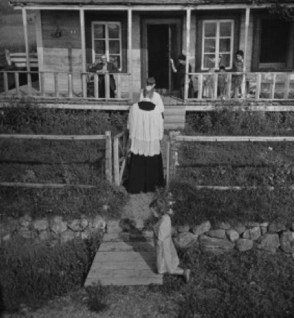
In the “old days,” the visit of the priest to bring Holy Communion and/or Anointing of the Sick was a matter of some formality. Most homes had a “Sick Call Set” on hand that included things like a crucifix, candles, a cloth, cotton, and a bowl of water. If the priest were on First Friday rounds he might even be escorted by a server with a lit candle. At other times, a family member might greet the priest at the door with a candle and escort the priest to the room where the sick person was. Family members usually stood by quietly while the priest administered the Sacraments. If the priest did talk with the sick person or the family, it was usually very brief. Since He had the Blessed Sacrament with him, casual talking was kept to a minimum. As he left, if he still had the Blessed Sacrament, he was again escorted by a family member with a candle.

Now what is described in the paragraph above did vary based on location and circumstances. First Friday Holy Communions were more formal than others. On the other hand, emergencies might cause the exclusion of some of the formalities. And there were also ethnic differences. Other factors (e.g., the catholicity of other family members and how devout each family was) were also taken into account. But what I described above was the usual practice, give or take a few details.

In recent times, though, most of these details have fallen away. As with so many things in our culture, we have become very casual, very informal with sick calls. But it may be beneficial for us to rediscover some of the older practices in order to restore greater reverence. I would like to suggest a few matters of protocol for your reflection. I will begin with a few disclaimers and then offer some suggestions.

Disclaimers:

  1. Not everything in the list that follows is possible or even advisable in every situation. Sometimes sick calls are hastily arranged due to emergencies, and preparing a sick call altar might mean time away from a distressed or dying relative. Sometimes in nursing homes all the implements are not available or even allowed. For example, many nursing homes do not permit the burning of candles. Hence, prudential judgment should be used to determine what is necessary, possible, or even advisable.
  2. Family situations may also affect the preparation of the sick call altar and other protocols. There may be no one in the home healthy enough to assemble the implements. There may be family members who are non-Catholic and choose not to participate in the rites and preparations.
  3. Not all the implements mentioned above are necessary for every sick call. Sometimes there will not be anointing. If that is the case, then a fair number of the items are not necessary. Even if there is an anointing, not every item may be required.
  4. What follows are recommendations only, not absolute requirements. The hope is to instill some thoughtfulness as to the reverence due to the occasion of a sick call. Reverence is not a pure science. Externals can and do help, but ultimately it is our internal disposition that is most important.
  5. Regarding these recommendations, take what you like and leave the rest. Add to them and distinguish as you wish. Discussion with your parish priest is also helpful.

Recommendations:

    1. Consider preparing the place where the sacraments will be celebrated. If possible and necessary, tidy up a bit.
    2. Consider preparing a sick call table or altar. Most commonly such a table includes at least a candle, and preferably a crucifix and two candles. A small glass of water is helpful since a sick person can sometimes have trouble swallowing the host. A spoon can be useful if the person has a hard time sitting up to drink the water. A napkin of some sort can help if the person spills any water when drinking. If the priest is going to anoint the sick person, it may be useful to have some cotton balls for him to wipe his fingers. If he does use them, though, they should later be burned. Bread and lemons can be used to help the priest to purify his fingers after anointing, but they are rarely necessary and should not be supplied unless the priest asks for them ahead of time.
    3. Sick call sets containing many of these items are available through Catholic catalogues (for example, HERE).
    4. If possible and advisable, have the sick person awake and aware that the sacraments are about to be celebrated.
    5. Be sure that when the priest, deacon, or extraordinary minister arrives, the television, radio, etc. are turned off and that other unnecessary conversations and activities in the house are ended.
    6. In the past, it was customary for someone to meet the priest at the door with a candle. This was done out of reverence for the Blessed Sacrament. This can still be done today and is a wonderful way to teach others of the sacredness of the moment.
    7. It is preferable to have all the members of the household prayerfully aware of what is taking place. If the room is large enough, they can all be encouraged to pray along. It may be necessary for some brief privacy while the priest hears confession, but otherwise, members of the household can and should join in prayer. It is certainly inappropriate for loud conversations to be taking place in the next room, for children to be playing video games, and for unnecessary activities to be taking place. Even non-Catholics should be respectful of the sacred rites. Usually just a word of invitation/encouragement is all that is needed.
    8. It is best for the priest, deacon, or extraordinary minister to celebrate the rites without delay. Surely a greeting is appropriate, but long conversations prior to the reception of sacraments is inadvisable. After the celebration of the sacraments, longer conversations may take place. Sometimes the priest, deacon, or extraordinary minister has other stops to make and thus is still carrying the Blessed Sacrament. In such a case it is not wrong to have a conversation with the sick person as an act of charity, but one ought to balance the fact of the presence of the Blessed Sacrament and the need for conversation with prudence and reverence. Staying for lunch and lengthy, chatty visits are discouraged in such cases.
    9. Reverential prayer and celebration of the rites is also necessary for those who bring Holy Communion.
    10. Those who bring Holy Communion to the sick should go immediately to them and not make stops along the way there. While transporting the Blessed Sacrament it is best to drive in silence, pray, or listen to religious music rather than secular radio.

So those are some of my recommendations. Remember that all of these are not possible all of the time. The recommendations are made in the hope of provoking thought and discussion about reverence in sick calls. They are made more as gentle reminders than polemical pronouncements. I do not assume that any one intends to be irreverent. It is just that we have become very casual these days and reminders seem opportune. I invite you to chime in with your additions and/or critiques in the comment section.