This brief video, a Christmas commercial by Canadian Tire, needs little commentary from me. It reminds us that the most important things at Christmas aren’t things at all.
The Most Important Things at Christmas


Blog of the Archdiocese of Washington
This brief video, a Christmas commercial by Canadian Tire, needs little commentary from me. It reminds us that the most important things at Christmas aren’t things at all.

Christmas is a beautiful time of the year for most of us, most of the time. But it can be a very painful time of year for some, especially those who have experienced recent loss or who (for various reasons) have fewer family options. Yes, Christmas can be the best of times or the loneliest of times, the most wonderful time of the year or the most painful.
The video below reminds us that this can be a time to reach out to others who have a hard time experiencing Christmas. Perhaps it is a relative or friend who has recently lost a spouse and who will be alone for the first time this Christmas. Perhaps it is someone who is left out because his family is far away. Perhaps it is someone who is just shy or even a little antisocial, but whose pain can be seen underneath that reticence or grouchiness. I know that I have some sick parishioners who need a special visit this week.
There are always those who need to be included, those who, for various reasons, feel excluded.
This video features a hare and a bear who are fast friends. Unfortunately, the bear always misses Christmas because he is in hibernation. Something inside the hare tells him that Christmas will not be Christmas without his friend, without the bear being able to experience the joy of Christmas. It occurs to the hare that there is a particular gift that would help his friend to enjoy Christmas, even if only for a moment. And so he gives the gift, which you will see at the end of the video.
I leave it to you to watch the touching conclusion and to ask yourself who the bear is in your life. Who is it that you need to reach out to this Christmas season? For me it was an old family friend with whom I had lost touch during this past year and whose mind is beginning to fade with age. She was good to my father in his dying process and so I sought her out and we had a nice talk.
How about you? Who is that someone in your life who needs some special attention this Christmas and New Year? Christ will surely be pleased if you give the gift of love.
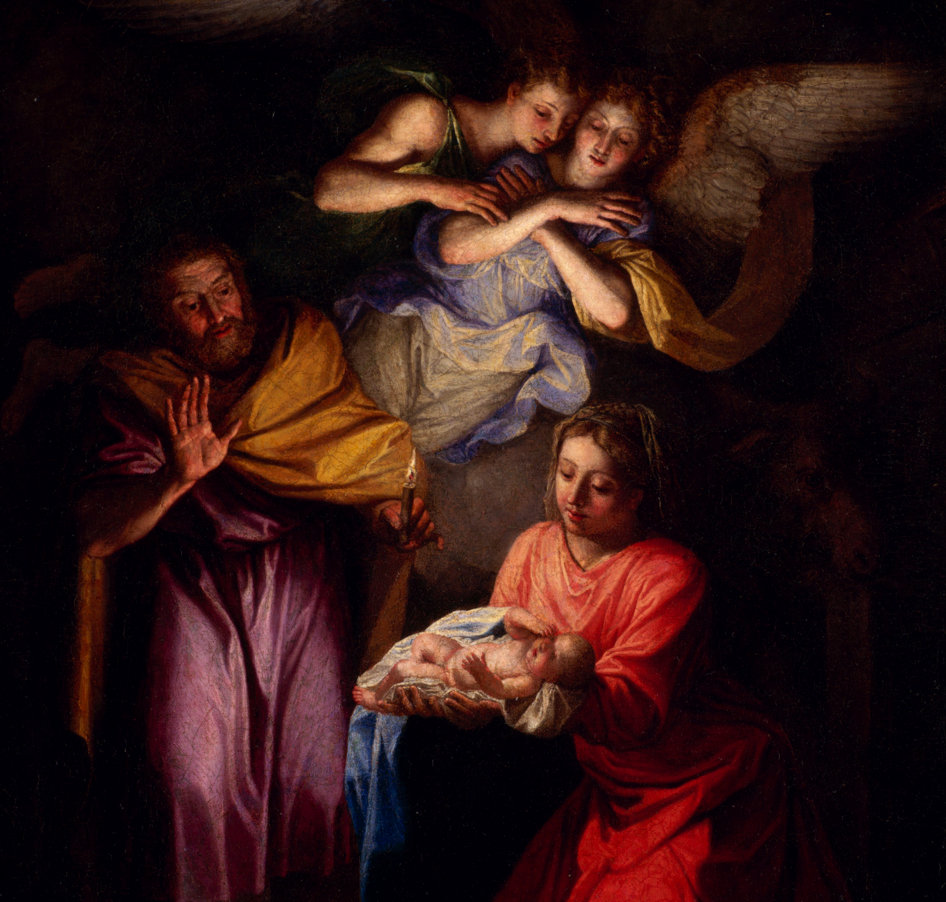 In the ancient Church and up until rather recently, one genuflected at the two references to the Incarnation during the Mass: during the Creed and in the Last Gospel (John 1). Why was this done? It was explained to me that the mystery of the Incarnation is so deep, one can only fall in silent reverence.
There are many paradoxes and seeming impossibilities in the Incarnation. They cannot be fully solved, so they claim our reverence. We genuflected in the past, and today we bow today at the mention of the Incarnation in the creed for it is a deep mystery.
As we continue to celebrate Christmas I would like to list some of the paradoxes of Christmas. I want to say as little about them as possible—just enough to make the paradox clear. This paucity of words (not common with me) is in reverence to the mystery and also to invite your reflection.
Each of these is meant to be a meditation on the great mystery of the Incarnation. Please chime in with your additions to this list!
A paradox is something that defies intuition or challenges the common way of thinking. It unsettles us or startles us into thinking more deeply. The word paradox comes from the Greek para (beside, off to the side, or above) and dokein (to think or to seem). Hence a paradox is something “off to the side” of the usual way of seeing or thinking about things. If you’re going to relate to God you’re going to deal with a lot of paradox, because God’s ways and His thinking often defy those of humans. God is not irrational but He often acts in ways that do not conform to worldly expectations.
This Christmas, consider these paradoxes and learn from them. Remember, though, that mysteries are to be lived more so than solved. Reverence is a more proper response to mystery than is excessive curiosity. Here, more is learned in silence than by many words.

The video below is a Coca-Cola commercial from several years ago that takes up the Christmas theme of the star of Christmas.
Let us review the impact that the star of Christmas had on the wise men, the Magi.
Yes, no one encounters Jesus Christ and goes away unchanged. A blind man went away able to see, the deaf to hear, the lame to walk. The hungry went away satisfied, the ignorant instructed, the guilty forgiven, sinners converted.
The call of the nations to change and to new life began with a star. The light of the star opens the way to the Light of World, Jesus. The star of my life is Jesus.
In the commercial below we see Santa (a name that means “Holy One”) sending forth a star, one that touches them and radiates a light that transforms them.
Yes, there is something about that star that changes everyone who looks at it. They become more forgiving, more gracious, more aware of others, more connected to others, more loving. The light of the star, and the light of the world, is Jesus. His light is meant to have that same effect and more besides.
In the background of the commercial an old Elvis song plays: “Wise men say only fools rush in. But I can’t help falling in love with you. Shall I stay, would it be a sin? If I can’t help falling in love with you.”
Of course the love that is symbolized by the star is not the romantic love of the song but the brotherly and agape love that Christ gives. Like the Magi who found Christ by the star, no one sees the star of Jesus and encounters Him and then goes away unchanged. Indeed, if we authentically encounter Christ, we are equipped to love, just as the people in this commercial are. We are equipped to forgive, to bring healing, to help others find strength and glory in the truth, and to come to full maturity in Christ. A person who knows Jesus and has encountered Him cannot help loving others, not in some merely sentimental way, but with a strong and vigorous love rooted in the truth. This is the same love that Jesus has for us all.
At the end of the commercial there is an admonition in Spanish that translates as follows: “Give the world the best of you.” The best of me is Jesus.
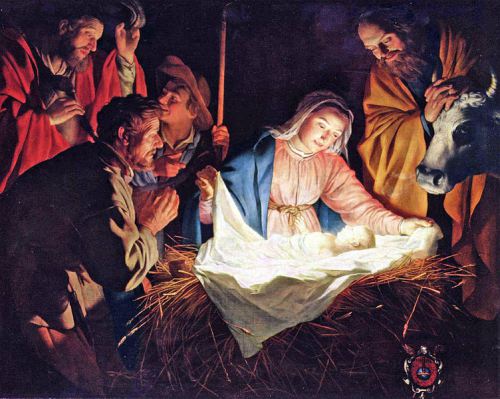
In this reflection, perhaps we can consider but one line in the Gospel which both challenges our love, and is a sign of God’s humble and abiding love for us: For there was no room for them in the Inn.
I. The Cold – There is a knock at midnight. Joseph, speaking on behalf of both Mary and Jesus (who is in her womb still), seeks entrance to the homes and lodgings of those in Bethlehem. And even though the Jewish people placed a great deal of emphasis on the duty of hospitality to strangers, the answer repeatedly given is that there is “No room here.” Mary’s obviously advanced pregnancy seems to make little difference.
This was indeed a cold night, not so much in terms of the air temperature, but in terms of the hearts of the people. Even at the local inn (and surely someone could make room for a pregnant woman!), there was “No room.”
Yes, it was a cold night! The only warmth would be found among the animals of that town. An old Latin antiphon for Christmas says, O magnum mysterium et admirabile sacramentum, un animalia viderent Dominum natum iacentem in praesepio. (O great mystery and stunning sacrament, that animals would see the newborn Lord lying in a feedbox. Here, warmth will be found: among the animals. It is sometimes said that man can be brutish. But the reality is that we can sink even lower than the beasts, doing things to ourselves and one other that even animals do not.
Scripture says,
The ox knows his master, the donkey his owner’s manger, but Israel does not know me, my people do not understand….They have forsaken the LORD; they have spurned the Holy One of Israel and turned their backs on him (Isaiah 1:3-4).
He was in the world, and though the world was made through him, the world did not recognize him. He came to that which was his own, but his own did not receive him (John 1:10-11).
There was a knock at midnight; the animals received Him and gave warmth. His own people, knowing Him not, received Him not. And into this midnight darkness and cold, the light and warmth of God’s love will shine forth. The people who walk in darkness have seen a great light; upon those who dwelt in the land of gloom a light has shone (Is 9:1).
II. The Condescension – Surely God must stoop low to come down from lightsome Heaven to our war-torn, dark, cold world. And He stoops to the lowest place, to be born not in a palace or even a comfortable home, but a manger. For God will defeat Satan’s pride with humility. And all who will find Him this fateful night must also stoop.
This stooping by God is illustrated even in the very topography of this night. The towns of the Holy Land were built on the tops of the tall hills (something almost never done here in America). This was done so as to leave the fertile valleys open for agriculture. Bethlehem was perched on the higher land and the shepherd’s fields lay below. The streets of Bethlehem were steep and built on tiers or levels. Thus, the back lot of many homes and buildings dropped steeply down and beneath the buildings. And then beneath the buildings they hollowed out caves where animals and tools were kept.
It was there, down underneath, where Joseph and Mary sought hasty shelter. For it was a cold and dark midnight and Mary’s time had come. God stooped with them to be born, among the animals and agricultural implements, in the damp cave underneath some house or inn.
Those who will find our God, they too must stoop low. Even to this day, when one visits Bethlehem to see the place of Jesus’ birth, one must first enter the Church through what is called the “Door of Humility.” For security reasons, this door was built to be only about four feet high. So one must stoop greatly to enter the church. Yes, we must stoop to find our God. The actual site of the birth is at the other end of the basilica, under the altar area. Here again, more stooping is required. One must descend a steep staircase and go through another low, narrow door and into the cave. To touch the very spot, one must kneel and reach forward, into a yet-narrower part of the cave. Here Jesus Christ was born of the Virgin Mary, says the inscription. And the only way to get there is to stoop.
Yes, our God stoops. He stoops to the lowest place. And to find Him and be with Him we, too, must be willing to stoop. God hates pride; He just can’t stand it. He sees what it does to us. He comes to break its back, not by overpowering it, or with clubs and swords, but with humility. Darkness does not defeat darkness; only light can do that. Hate does not defeat hate; only love can do that. Pride does not defeat pride; only humility can do that. And so God stoops.
Tonight God calls us with this same humility. He could have ridden down from Heaven on a lightning bolt and stunned us into fearful submission. Instead, He goes to the lowest place. He comes quietly, peacefully, without threat—as an infant. But even in this lowly way, He is still calling.
And so there is a knock at midnight. Scripture says, Behold, I stand at the door and knock. If anyone hears my voice and opens the door, I will come in to him and eat with him, and he with me (Rev 3:20). There is an old song with the following lyrics: “Somebody’s knocking at your door! Oh, Sinner, why don’t you answer?”
And this leads us to the final point.
III. The Crucial thing – When human history is complete and the last books are written, one of the saddest lines in all of that history will be simply the line, For there was no room for them in the Inn. No room … no room. How strange and sad for this world that God simply doesn’t fit! He doesn’t fit with our agendas, into our schedules, or among our priorities. There’s no room. He just doesn’t fit.
Scripture says,
He came to that which was his own, but his own did not receive him (Jn 1:11).
But that same passage goes on to add,
Yet to all who did receive him, to those who believe in his name, he gave the power to become children of God (John 1:12).
The most crucial decision in and factor of your life is whether or not there is room in your heart. Will you answer the knock at midnight? Some of you who are in this church tonight come only at Christmas. But throughout the rest of the year there is just no room for Jesus. There’s no time for Mass. There’s no time to fulfill the last thing He asked: Do this in memory of me. I beg you to reconsider and make room in your heart for Christ on His terms: Unless you eat the flesh of the Son of Man and drink his Blood, you have no life in you (Jn 6:53).
Yes, what about us? Is there room for Jesus in the “inn” of our hearts? If there is, then Jesus comes bearing many gifts. Tonight is a night of gifts. There is a knock at this very midnight. It sounds like Jesus! Oh, Sinner, why don’t you answer? Somebody’s knocking at your door.
Make room for Jesus. Every year He comes knocking. He stoops low and invites us to find Him in the lowly places of this world, in the lowly places of our own lives. What are the things in your life that may be crowding Him out? What obstacles and preoccupations leave little or no room for Jesus? What keeps you from recognizing Him and opening the door wide when He comes?
If you’ve already opened the door to Him for many years now, praise God! Then ask the Lord to help you open it wider. For it remains true for many of us that even though we’ve invited Jesus in, His accommodations are poor: perhaps the couch or floor of our life.
Make room for Jesus. Make more and more room for Him, in the “inn” of your soul. I promise you that what Scripture says is true: Yet to all who did receive him, to those who believe in his name, he gave the power to become children of God (John 1:12).
If you will receive the gift of Him tonight and make greater room for Him in your heart, I promise you total victory and transformation in Christ Jesus. There will come to you the increasing gift of transformation into the very likeness of God. For tonight is a night of gifts and Jesus stoops low to give us a priceless gift: the power to become children of God.
It’s midnight. There’s a knock at the door. Oh, sinner, why don’t you answer?
Regarding this video … I know, I know. Yet still there is much to ponder.
Christmas is a beautiful time of the year for most of us, most of the time. But it is also true that Christmas can be a very painful time of year for some, especially those who have experienced recent loss or who, for various reasons, have fewer family options at Christmas. Yes, Christmas can be the best of times, and the loneliest of times, the most wonderful time of the year, or the most painful.
The video below reminds us that Christmas can also be a time to reach out to others who have a hard time experiencing Christmas. Perhaps it is a relative or friend who has lost a spouse this past year and this will be the first Christmas alone. Perhaps it is some one who is left out because they are military and family are far away. Perhaps it is some one who is shy and even a little anti-social, but somewhere under all their grouchiness we see their pain and know that they need some outreach at Christmas.
Whatever the situation, there are always those who need to be included, who for various reasons feel excluded.
In the video, a hare, i.e. a rabbit, is friends with a bear who always misses Christmas because of hibernation. But something in the hare says that Christmas will not be Christmas without his friend, and without his friend being able to experience the joy of Christmas. It occurs to the hare that a particular gift will help the bear enjoy Christmas, if even for a moment. And so, he gives the gift, which you will see at the end of the video.
I leave it to you to see the touching conclusion and to ask who the bear is in your life that you need to reach out to in this season of Christmas. For me it was an old family friend that I had lost touch with this year, and whose mind is beginning to fade with age. But she had been good to my father in his dying process, and so I sought her out and had a nice talk.
How about you? Who is that someone that needs some special outreach this Christmas. Christ will surely be pleased if you give the gift of love.
Many are shocked to walk into daily Mass on December 26 and instead of hearing more of the “Baby Jesus” we are confronted with Martyrdom, “The Feast of Stephen” is ancient on the Church’s calendar. More ancient than the Christmas cycle and hence it was not removed to another time.
Bu the martyrdom does not stop there. We are in the midst of the Christmas Octave, an Octave filled with blood as we shall see.
What is an Octave? But first, there may be some of you who wonder what is meant by and “Octave.” An Octave is a period of eight days wherein a feast of the Church is celebrated for that whole period as though it were all the same day. In the modern liturgical calendar we only observe two octaves explicitly: Christmas and Easter.
During the week following Christmas many of the prayers speak of each day as though it were still Christmas. For example some of the prayers and antiphons say, “Today is born our savior, Christ the Lord.” A purist might say, but it is NOT today that he is born, it was back on Saturday the 25th that he was born. But, in certain sense this IS still Christmas day. Christmas Day is one long day of eight days from Saturday the 25th to Saturday January 1st.
It is the same with Easter where for one whole week we announce: “This is the day the Lord has made…”
Why eight days? Some say it is a reference to the eighth day on which Christ rose. I know, you thought it was the third day. But it was also the eighth day! For God made the world in seven days, resting on the seventh (Sabbath or Saturday). But Christ rose on the 8th day (Sunday). So resurrection morning is both the third day AND the eighth day! Others say the practice of the octave goes to Jewish times where some of the feasts (e.g. Dedication and Tabernacles (Booths)) were celebrated over 8 days.
In the old calendar there were more Octaves such as: Epiphany, Pentecost, All Saints, Immaculate Conception, Ascension Sacred Heart and others). Not all of these were privileged Octaves in which no other feasts could be celebrated. Easter and Pentecost were really the only two that blocked out all other feasts entirely. Others, like the Christmas Octave, allowed the celebration of other feasts but still referred to the feast of the octave as well.
So here we are in the Christmas Octave and, in a strong sense it is thus still Christmas Day. TODAY is born our savior Christ the Lord. This feast is so important that we stretch its observance a completed week and into the eighth day.
Bloody Octave – But one of the striking things about the Christmas octave is its bloodiness. It is one of the bloodiest weeks of the Church’s years. Thus, on December 26th, when we have hardly digested our Christmas dinner, we celebrate the Feast of St. Stephen, the Martyr who was stoned to death. On December 28th we celebrate the Feast of the Holy Innocents, the young and infant boys who were murdered by Herod seeking to kill Christ. On December 29th we celebrate the feast of St. Thomas Becket who was murdered in Canterbury Cathedral. Even St. (King) Wenceslaus of whom we happily sing “on the Feast of Stephen” was brutally killed by his brother.
Why all this blood, why this martyrdom? It is almost as though the red poinsettias that we put out in festive Christmas spirit look back to us in testimony. For it is clear that Jesus came to this world, ultimately to die. His crib (likely of wood) in which he was laid, arms and feet bound by swaddling clothes, points inevitably to the wood of his cross where, once again, his arms and legs were bound by nails and, after dying, he was wrapped tightly in a linen shroud.
The blood of the Christmas octave also reminds us that many of us too will share in Christ’s lot. This world hated Christ and had “no room for him.” Neither does this world have room for true Christians and the blood of martyrs stretches down through the centuries in testimony to the world’s hatred for authentic disciples of Christ and the truth they propose.
From this bloody octave the words of Christ ring out: If you belonged to the world, it would love you as its own. As it is, you do not belong to the world, but I have chosen you out of the world. That is why the world hates you (Jn 15:19). The martyrs of the Christmas Octave say, Amen.
And even St. John the Apostle, whose feast also occurs in the Octave (Dec 27), also says Amen. For, though he did not suffer martyrdom he proclaimed his Amen also from his prison cell on Patmos: I, John, your brother and companion in the suffering and kingdom and patient endurance that are ours in Jesus, was on the island of Patmos because of the word of God and the testimony of Jesus (Rev 1:9).
Victory – But all these martyrs and sufferers (St. Stephen, St. John, the Holy Innocents, St. Thomas Becket, and St Wenceslaus) proclaim too the victory that is theirs with Jesus Christ who also said, In the world ye shall have tribulation: but be of good cheer; I have overcome the world (Jn 16:33). And again, Do not be afraid of what you are about to suffer. I tell you, the devil will put some of you in prison to test you, and you will suffer persecution for ten days. Be faithful, even to the point of death, and I will give you life as your victor’s crown. (Rev 2:10) Yes, Lord, the Spirit and the Bride say, Amen.
Did I wish you a merry Christmas?
There is a Scripture reading proclaimed at the Christmas Liturgy that usually gets overlooked. And yet it should elicit considerable reflection since it is proclaimed at the Christmas Midnight Mass, one of the Church’s most prominent Liturgies. It is from the Letter to Titus in the Second Chapter. I would like to reproduce it in full and then give some commentary following.
The grace of God has appeared, saving all
and training us to reject godless ways and worldly desires
and to live temperately, justly, and devoutly in this age,
as we await the blessed hope,
the appearance of the glory of our great God
and savior Jesus Christ,
who gave himself for us to deliver us from all lawlessness
and to cleanse for himself a people as his own, eager to do what is good. Titus 2:11-14
So, Here are gifts by which our savior saves us. There are many gifts he offers us but the fundamental gift he offers us is the gift of a new life, a reformed and restored heart and mind, eager to do what is right. This is his gift to us this Christmas and every day.