We all cling to certain things. Perhaps there is a sentimental attachment, or perhaps we think we might need some thing one day; even though that day never comes. Much of this is harmless. But certain attachments actually have negative impacts, hindering us from what we need to do.
For example, we cling to an old car that frequently breaks down, or to an old wound that keeps us from relating to others in a healthy way free from past trauma. Consider the following commercial where a surgeon is hindered in his work by an attachment. While it is cartoonish in its example, it does speak to attachments of the past that hinder our performance today.
https://vimeo.com/206149445
Other attachments make us so fearful of losing a thing or relationship that they render us incapable of perceiving far greater matters and threats. For example we can be so attached to social media that we do not see our own real family and children straying into serious sin. Or, we remain so fixated and infatuated on a relationship that we do not see how that person is using and corrupting us. More widely we are so fixed on the world that is passing away that we are unprepared for the end of all things that is rushing toward us. Consider the following video that shows a man so fixated on an old toy that he cannot see the avalanche rushing toward him.
https://youtu.be/aE-_NkQfAgs
Still other attachments simply blind us from seeing the world around us as it really is. Usually these are attachments to political philosophies and other viewpoints that refuse to see beyond these worldly ways of thinking. We can become downright dangerous if we do not learn to see that some of these views are wrong or at least in need of distinctions and qualifications. This commercial illustrates the danger of reusing to even consider things beyond our familiar and preferred viewpoints.
Enjoy these short videos on attachments and preferences.
There are some today who speak of annulment as “just another name for a Catholic divorce.” However, this is not correct. An annulment (more technically described as a “Declaration of Nullity”) is a recognition by the Church, based on evidence, that what may in fact have seemed to be a marriage, was not due to some intrinsic flaw at the time the vows we exchanged. A marriage may have been a civil marriage entered into in good faith by one or both of the parties, but something essential was lacking in the intentions or understanding of one or both parties that made the marriage invalid that a true marriage never existed in religious terms. Thus there is nothing to divorce, since no marriage exists. “Divorce” is a term of civil law and the Lord explicitly teaches that he will not be bound by the decision of some civil judge. (see Malachi 2:16 ; Matthew 19:1-12, among others). However, not every couple who goes through a marriage ceremony does so validly and that is the key matter in question in the process of annulment, “Was this marriage validly celebrated?” It is actually our Lord Jesus himself who makes this point at the the very moment he teaches against divorce. Lets look at what he teaches.
The Biblical Root of Annulments. The Lord says this in regard to marriage: “What God has joined together, let no one divide (Mat 19:6). On the face of it, divorce and any sort of annulment is forbidden would seem forbidden by this. But actually the text serves as a basis for the Church’s allowance of annulment under certain circumstances. The text says What GOD has joined together cannot be divided.
Now just because two people stand before a Justice of the Peace, or a minister or even a priest and swear vows, does not mean that what they do is a work of God. There have to be some standards that the Church insists on for us to acknowledge that what they do is “of God.”
There are a number of impediments that can render what they do ipso facto invalid. Things such as prior marriage, consanguinity (too close in the blood lines), minor status (too young), incapacity for the marriage act, and lying or failing to disclose important information to the future spouse. There are others as well. Further, it is widely held that when one or both parties are compelled to enter the marriage or that they display a grave lack of due discretion on account of immaturity or poor formation, that such marriages are null on these grounds. All these are ways that the Church, using her power to bind and loose, comes to a determination that what appeared to be a marriage externally was not in fact so based on evidence. Put more scripturally, the putative marriage was not “what God has joined together.”
You may ask, “Who is the Church to make such a determination?” I answer that, “She is in fact the one to whom the Lord entrusted, through the ministry of Peter and the Bishops the power to bind and loose (Mt 18:18) and to speak in His name (Lk 10:16).
Annulments are not Divorces– As noted, a decree of nullity from the Church is a recognition, based on the evidence given, that a marriage in the Catholic and Biblical sense of the word never existed. Since a person has not in fact been joined by God they are free to marry in the future. In such a case a person does not violate our Lord’s declaration that one who divorces their spouse and marries another commits adultery (cf Matt 19:9).
There are some who wonder: Are we giving too many annulments? While it is clear that the Church has some pretty clear canonical norms regarding marriage, like any norms they have to be interpreted and applied. Certain American practices and norms have evolved over the last forty years that some question as being too permissive and thus no longer respectful of the binding nature of marital vows. I am not without my concerns that we may give too many annulments but there is nothing intrinsically flawed with the Church teaching here, concern is directed only to the prudential application of the norms.
Annulment cases vary greatly. Often it isn’t as crass as somebody coming in and saying, “Well I got rid of my first wife and have got me another I want to marry, let’s get the paperwork going Father.” It is usually far more poignant than that.
Perhaps someone married early, before they were really very serious about the faith and they married someone who abused them. Now, years later after the divorce they have found someone who is able to support them in their faith. Perhaps they met them right in the parish. Should a marriage that was in young and foolish years and lasted all of six months preclude them from entering a supportive union that looks very promising?
Another more common scenario is often the case where in a person shows up at RCIA who has recently found the Catholic faith and wants to enter it. However, they were married 15 years ago in a Protestant Church to their current spouse who had been married before. Now, mind you, their current marriage is strong and they have both been drawn to the Catholic Faith. They have four kids as well. What is a priest to do? Well I can tell you that this priest will help the one who needs an annulment to get it. I can tell you a lot of cases come to the Church this way. It’s hard and perhaps even unjust to say to someone like this that there is nothing the Church can do for them, they will never qualify for sacraments. No, we just don’t do that, we take them through the process for annulment and see if there can be evidence that the first marriage was null.
Perhaps too another person shows up at the door, A long lost Catholic who has been away 30 years. During that time he or she did some pretty stupid stuff including getting married and divorced, sometimes more than once. Now they show up at my door in a current marriage that seems strong and helpful and which includes children. The person is in desperate need of confession and Holy Communion. What is a pastor to do? He takes them through the process of annulment to get them access to those sacraments if possible.
So there it is. There are very grave pastoral issues on both sides. The current instinct of the Church, given the poisonous quality of the culture toward marriage is to be more willing to presume there were problems.
If you are in a second marriage, please consider contacting your parish priest. Don’t presume you’re unwanted, or can never receive the sacraments. The tribunal process isn’t that difficult and the Church stands ready to assist you.
Last week on the blog we discussed the rise of vocal, extreme secularism, as exemplified by New York Governor Andrew Cuomo (here). Extreme secularism is not merely a worldly attitude devoid of God, it is a position that actively denies that faith, prayer, and/or religious expression play a role worthy of recognition. Militant secularists go further, seeking to remove any religious practice or mention of God from the public square.
This past week we saw another example of this extreme secularism in remarks made by Bill de Blasio, Mayor of New York City. Asked why state/city COVID-19 protocols have been almost completely ignored and unenforced during recent protests in NYC (and across the nation), Catholic News Agency reports:
New York City Mayor Bill de Blasio said Tuesday that ongoing protests in the city merit exceptions to coronavirus regulations, while religious services do not. The mayor’s remarks have drawn criticism from New York’s archdiocese.
“When you see a nation, an entire nation, simultaneously grappling with an extraordinary crisis seeded in 400 years of American racism, I’m sorry, that is not the same question as the understandably aggrieved store owner or the devout religious person who wants to go back to services,” de Blasio said at a June 2nd press conference, while defending his policy of allowing mass protests while continuing to restrict religious gatherings during the coronavirus pandemic.
… New York has been under a strict stay-at-home order starting March 22nd, and it is only in the early stages of reopening public spaces. New Yorkers are being instructed to “wear a mask and maintain 6 feet distance in public.”
Back on March 27 the Mayor warned that if the religious services continued, he said, “our enforcement agents” would shut them down, and he threatened fines and even permanent closure of houses of worship for further disobedience of the order. He threatened future religious gatherings with mass arrests.
Meanwhile, protesters have gathered nightly by the thousands across the city to demonstrate against racism and police brutality following the May 25th death of George Floyd in police custody.
… On Thursday, the mayor announced that restaurants in the city will shortly be allowed to serve patrons outdoors.
“New York’s restaurants are part of what make us the greatest city in the world. They’ve taken a hit in our fight against COVID-19—and there’s no recovery without them,” de Blasio stated. Churches are not slated to fully reopen until stage four of the state’s reopening program, along with schools, theaters, and entertainment venues [CNA June 4th 2020].
So, here is the situation: Protesters get waivers, but those who want to attend religious services are told to wait, even if we state that we will follow the state/city guidelines on social distancing, disinfection of surfaces, etc. This raises several questions and brings me to make a few observations.
If protesters are permitted to violate state/city regulations that just a week ago were called essential for public health during an emergency unprecedented in our lifetimes, were those guidelines really that critical after all? How does this engender respect for the seriousness of emergency measures?
This is especially the case for New York City, which has been an epicenter for the virus. They had even stricter guidelines there than we have here in Washington, D.C. One would think that Mayor de Blasio would be particularly adamant about enforcing these critical measures. We were told that hundreds of thousands of additional deaths would occur if we did not observe the state/city regulations. Are we to conclude, from a health perspective, that the restrictions were not really that necessary and that health experts and/or government officials knew this? How else can the abandonment of the regulations be explained?
I believe that the Mayor is correct in stating that the cancer of racism has existed for 400 years (in fact, I think longer). However, this feeds off a deeper wound going back much farther: Original Sin. This grievous wound has left behind in us a tendency toward sin; toward selfishness, hostility, unchastity, and greed. Racism emerges from this cauldron of simmering sin. Religious teaching, the sacraments, and prayer are focused on healing the wound of original sin and its effects. Peaceful protest has its place, but so does prayer. It is shortsighted to think we can heal a visible wound like racism while ignoring its underlying causes. We do not simply have a lapse of justice in racism; we have deep, festering wounds that require prayer and repentance.
I would ask Mayor de Blasio to consider how much more fierce, angry, unjust, and unkind our world has become since we have denigrated prayer, marginalized God, and banished biblical teaching from the public square. No age is perfect, but we are clearly in one of the darkest periods in a long, long time.
In a display of further shortsightedness—and, I would argue, to heap further contempt on religious practice—Mayor de Blasio then waxed eloquent on the need to reopen the restaurants of New York very soon. He said, “New York’s restaurants are part of what make us the greatest city in the world. They’ve taken a hit in our fight against COVID-19—and there’s no recovery without them.”
Churches, on the other hand, are not slated to fully reopen until the final phase of the state’s reopening plan, along with schools, theaters, and entertainment venues. In New York State churches will reopen sooner, but not, it seems in the City.
This is how he views religious people. We are not what makes NYC great, nor are we essential to its recovery—but restaurants are. We are lumped in with entertainment, theater, and perhaps a little education.
So, welcome to the world of extreme secularism. The Church is irrelevant. Protests—even if they bring along those who loot, burn, and destroy—are an essential element of the secular world, so important that they override the health norms we were told one week ago would lead to the deaths of hundreds of thousands if ignored. Yet religious gatherings, even following strict guidelines, are both dangerous and irrelevant at the same time.
The masks are off. There is no mincing of words, just a dismissal of and contempt for all things religious.
Not all public officials have succumbed to this mentality, do not take my critique here to be a critique of all public officials, but there is an extreme secularism growing that has no room for religious practice of any sort and ascribes no value to it.
We have been here before. In the Office of Readings for Friday’s Feast of St. Boniface there is an exhortation from a man who endured the fury of unbelieving leaders in his day:
The ancient fathers showed us how we should carry out our duty: Clement, Cornelius and many others in the city of Rome, Cyprian at Carthage, Athanasius at Alexandria. They all lived under emperors who were pagans; they all steered Christ’s ship—or rather his most dear spouse, the Church. This they did by teaching and defending her, by their labors and sufferings, even to the shedding of blood.
… Since this is the case, and since the truth can be assaulted but never defeated or falsified. … Let us stand fast in what is right and prepare our souls for trial. Let us wait upon God’s strengthening aid and say to him: O Lord, you have been our refuge in all generations ….
Let us continue the fight on the day of the Lord. The days of anguish and of tribulation have overtaken us; if God so wills, let us die for the holy laws of our fathers, so that we may deserve to obtain an eternal inheritance with them.
Let us be neither dogs that do not bark nor silent onlookers nor paid servants who run away before the wolf. Instead let us be careful shepherds watching over Christ’s flock. Let us preach the whole of God’s plan to the powerful and to the humble, to rich and to poor, to men of every rank and age, as far as God gives us the strength, in season and out of season, as Saint Gregory writes in his book of Pastoral Instruction (From a letter by Saint Boniface, bishop and martyr (Ep. 78: MGH, Epistolae, 3, 352-354).
There is an old spiritual that says, “My God is so high you can’t get over Him. He’s so low you can’t get under Him. He’s so wide you can’t get around Him. You must come in, by and through the Lamb.”
It’s not a bad way of saying that God is “other.” He is beyond what human words can describe, beyond what human thoughts can conjure. On the Feast of the Most Holy Trinity we do well to remember that we are pondering a mystery that cannot fit in our minds.
A mystery, though, is not something wholly unknown. In the Christian tradition, the word “mystery” refers to (among other things) something that is partially revealed, something much more of which remains hidden. As we ponder the Trinity, consider that although there are some things we can know by revelation, much more is beyond our understanding.
Let’s ponder the Trinity by exploring it, seeing how it is exhibited in Scripture, and observing how we, who are made in God’s image, experience it.
I. The Teaching on the Trinity Explored –
Perhaps we do best to begin by quoting the Catechism, which says, The Trinity is One. We do not confess three Gods, but one God in three persons: [Father, Son, and Holy Spirit] … The divine persons do not share the one divinity among themselves but each of them is God, whole and entire (Catechism, 253).
There is one God and each of the three persons of the Trinity possesses the one divine nature fully. The Father is God; He is not one-third of God. Likewise, the Son, Jesus, is God; He is not one-third of God. And the Holy Spirit is God, not merely one-third of God.
It is our human experience that if there is only one of something, and someone possesses it fully, then there is nothing left for anyone else. Yet mysteriously, each of the three persons of the Trinity fully possesses the one and only divine nature while remaining a distinct person.
One of the great masterpieces of the Latin Liturgy is the preface for Trinity Sunday. It compactly and clearly sets forth the Christian teaching on the Trinity. The following translation of the Latin is my own:
It is truly fitting and just, right and helpful unto salvation that we should always and everywhere give thanks to you O Holy Lord, Father almighty and eternal God: who, with your only begotten Son and the Holy Spirit are one God, one Lord: not in the oneness of a single person, but in a Trinity of one substance. For that which we believe from your revelation concerning your glory, we acknowledge of your Son and the Holy Spirit without difference or distinction. Thus, in the confession of the true and eternal Godhead there is adored a distinctness of persons, a oneness in essence, and an equality in majesty, whom the angels and archangels, the Cherubim also and the Seraphim, do not cease to daily cry out with one voice saying, Holy, Holy, Holy …
Wow! It’s a careful and clear masterpiece, but one that baffles the mind. So deep is this mystery that we had to “invent” a paradoxical word to summarize it: Triune (or Trinity). Triune literally means “three-one” (tri + unus), and “Trinity” is a conflation of “Tri-unity,” meaning the “three-oneness” of God.
If all of this baffles you, good! If you were to say that you fully understood all this, I would have to say you were likely a heretic. The teaching on the Trinity, while not contrary to reason per se, does transcend it and it is surely beyond human understanding.
Here is a final image before we leave our exploration stage. The picture at the upper right is from an experiment I remember doing when I was in high school. We took three projectors, each of which projected a circle: one red, one green, and one blue (the three primary colors). At the intersection of the three circles the color white appeared. Mysteriously, the three primary colors are present in the color white, but only one shows forth. The analogy is not perfect (no analogy is or it wouldn’t be an analogy) for Father, Son, and Spirit do not “blend” to make God, but it does manifest a mysterious “three-oneness” of the color white. Somehow in the one, three are present. (By the way, this experiment only works with light; don’t try it with paint!)
II. The Teaching on the Trinity Exhibited – Scripture also presents images of the Trinity. Interestingly enough, most of the ones I want to present here are from the Old Testament.
As a disclaimer, I’d like to point out that Scripture scholars debate the meaning of these texts; that’s what they get paid the big bucks to do. I am reading these texts as a New Testament Christian and seeing in them a doctrine that later became clear. I am not getting into a time machine and trying to understand them as a Jew from the 8th century B.C. might have. Why should I? That’s not what I am. I am reading these texts as a Christian in the light of the New Testament, as I have a perfect right to do. You, of course, are free to decide whether you think these texts really are images or hints of the Trinity. Here they are:
1. Then God said, “Let us make man in our image, after our likeness …” (Gen 1:26)
God speaks of himself in the plural: “Let us … our …” Some claim that this is just an instance of the “royal we” being used. Perhaps, but I see an image of the Trinity. There is one (“God said”) but there is also a plural (us, our). Right at the very beginning in Genesis there is already a hint that God is not all by himself, but rather is in a communion of love.
2. Elohim
In the passage above, the word used for God is אֱלֹהִ֔ים (Elohim). It is interesting to note that this word is in the plural form. From a grammatical standpoint, Elohim actually means “Gods,” but the Jewish people understood the sense of the word to be singular. This is a much debated point, however. You can read more about it from a Jewish perspective here: Elohim as Plural yet Singular.
(We have certain words like this in English, words that are plural in form but singular in meaning such as news, mathematics, and acoustics.) My point here is not to try to understand it as a Jew from the 8th century B.C. or even as a present day Jew. Rather, I am observing with interest that one of the main words for God in the Old Testament is plural yet singular, singular yet plural. God is one yet three. I say this as a Christian observing this about one of the main titles of God, and I see an image of the Trinity.
3. And the LORD appeared to [Abram] by the oaks of Mamre, as he sat at the door of his tent in the heat of the day. He lifted up his eyes and looked, and behold, three men stood in front of him. When he saw them, he ran from the tent door to meet them, and bowed himself to the earth, and said, “My Lord, if I have found favor in your sight, do not pass by your servant. Let a little water be brought, and wash your feet, and rest yourselves under the tree, while I fetch a morsel of bread, that you may refresh yourselves, and after that you may pass on—since you have come to your servant.” So they said, “Do as you have said” (Gen 18:1-5).
From a purely grammatical standpoint this is a very difficult passage because it switches back and forth between singular and plural references. The Lord (singular) appears to Abram, yet Abram sees three men (some have said that this is just God and two angels, but I think it is the Trinity). Then when Abram addresses “them” he says, “My Lord” (singular). The tortured grammar continues as Abram suggests that the Lord (singular) rest “yourselves” (plural) under the tree. The same thing happens in the next sentence, in which Abram wants to fetch bread so that you may refresh “yourselves” (plural). In the end, the Lord (singular) answers, but it is rendered as “So they said.” Plural, singular … which is it? Both. God is one and God is three. For me as a Christian, this is a picture of the Trinity. Because the reality of God cannot be reduced to mere words, this is a grammatically difficult passage, but I can “see” what is going on: God is one and God is three; He is singular and He is plural.
4. Having come down in a cloud, the Lord stood with Moses there and proclaimed his Name, “Lord.” Thus the Lord passed before him and cried out, “The Lord, the Lord, a merciful and gracious God, slow to anger and rich in kindness and fidelity” (Exodus 34:5).
When God announces His name, He does so in a threefold way: Lord! … The Lord, the Lord. There is implicit a threefold introduction or announcement of God. Is it a coincidence or is it significant? You decide.
5. In the year that King Uzziah died I saw the Lord sitting upon a throne, high and lifted up; and his train filled the temple. Above him stood the Seraphim; each had six wings: with two he covered his face, and with two he covered his feet, and with two he flew. And one called to another and said: “Holy, holy, holy is the Lord of hosts; the whole earth is full of his glory” (Is 6:1-3).
God is Holy, Holy, and yet again, Holy. Some say that this is just a Jewish way of saying “very Holy,” but as Christian I see more. I see a reference to each of the three persons of the Trinity. Perfect praise here requires three “holys.” Why? Omni Trinum Perfectum (all things are perfect in threes). But why? As a Christian, I see the angels praising each of the three persons of the Trinity. God is three (Holy, holy, holy …) and yet God is one (holy is the Lord …). There are three declarations of the word “Holy.” Is it a coincidence or is it significant? You decide.
6. Here are three (of many) references to the Trinity in the New Testament:
Jesus says, The Father and I are one (Jn 10:30).
Jesus also says, To have seen me is to have seen the Father (Jn 14:9).
Have you ever noticed that in the baptismal formula, Jesus uses “bad” grammar? He says, Baptize them in the name (not names (plural)) of the Father and of the Son and of the Holy Spirit (Matt 28:19). God is one (name) and God is three (Father, Son, and Holy Spirit).
Thus Scripture exhibits the teaching of the Trinity, going back even to the beginning.
III. The Teaching of the Trinity Experienced – We who are made in the image and likeness of God ought to experience something of the mystery of the Trinity within us, and sure enough, we do.
It is clear that we are all distinct individuals. I am not you; you are not I. Yet it is also true that we are made for communion. We humans cannot exist apart from one another. Obviously we depend on our parents, through whom God made us, but even beyond that we need one another for completion.
Despite what the Paul Simon song says, no man is a rock or an island. There is no such thing as a self-made man. Even the private business owner needs customers, suppliers, shippers, and other middlemen. He uses roads he did not build, has electricity supplied to him over lines he did not string, and speaks a language to his customers that he did not create. Further, the product he makes was likely the result of technologies and processes he did not invent. The list could go on and on.
We are individual, but we are social. We are one, but we are linked to many. Clearly we do not possess the kind of unity that God does, but the “three-oneness” of God echoes in us. We are one, yet we are many.
We have entered into perilous times where our interdependence and communal influence are under-appreciated. The attitude that prevails today is a rather extreme individualism: “I can do as I please.” There is a reduced sense of how our individual choices affect the community, Church, or nation. That I am an individual is true, but it is also true that I live in communion with others and must respect that dimension of who I am. I exist not only for me, but for others. What I do affects others, for good or ill.
The attitude that it’s none of my business what others do needs some attention. Privacy and discretion have important places in our life, but so does concern for what others think and do, the choices they make, and the effects that such things have on others. A common moral and religious vision is an important thing to cultivate. It is ultimately quite important what others think and do. We should care about fundamental things like respect for life, love, care for the poor, education, marriage, and family. Indeed, marriage and family are fundamental to community, nation, and the Church. I am one, but I am also in communion with others and they with me.
Finally, there is a rather remarkable conclusion that some have drawn: the best image of God in us is not a man alone or a woman alone, but rather a man and a woman together in the lasting and fruitful relationship we call marriage. When God said, “Let us make man in our image” (Genesis 1:26), the text goes on to say, “Male and female he created them” (Genesis 1:27). God then says to them, “Be fruitful and multiply” (Gen 1:28). So the image of God (as He sets it forth most perfectly) is the married and fruitful couple.
We must be careful to understand that what humans manifest sexually, God manifests spiritually, for God is neither male nor female in His essence. We may say that the First Person loves the Second Person and the Second Person loves the First Person. So real is that love that it bears fruit in the Third Person. In this way the married couple images God, for the husband and wife love each other and their love bears fruit in their children (See, USCCB, “Marriage: Love and Life in the Divine Plan”).
So today, as we extol the great mystery of the Trinity, we look not merely outward and upward so as to understand, but also inward to discover that mystery at work in us, who are made in the image and likeness of God.
In ancient Greek mythology the dog Cerberus guarded the entrance to Hades (the misty and gloomy underworld, the abode of the dead), permitting anyone to enter but none to leave. Cerberus is usually depicted as a three headed dog and some have tried to link this to his seeing the past, present and future. Cerberus’ name comes to us in a Latinized version from the Greek, where he was called Κέρβερος (Kerberos).
Now, when you and I think of dogs, we think of “man’s best friend.” But, in the ancient world dogs were usually thought of as wild animals that ran in packs and scavenged at the edge of town. They were not as domesticated as today. And Cerberus incorporates not only the fearsome qualities of a wild dog, but was also said to have a mane, not of hair, but of live snakes! He was said to eat only live meat and was the offspring of Echidna, a half-woman, half-snake, and Typhon, a fire-breathing giant. Not the most pleasant of “dogs” to be sure.
You get the picture and it ain’t pretty. In Greek mythology he welcomed you to Hades when you died and made sure you did not leave.
Cerberus redivivus? – There is so much that ails our culture today. But I thought of Cerberus today in a conversation where we pondered the deepest threats to our well-being as a nation and culture. Many will be quick to point to the destruction of the family, sexual confusion, racism, and other things as the most serious threats. But these things feed off of deeper and broader issues. With the devouring and fearsome three-headed dog Cerberus lets consider the triple threat facing our culture today, threats that create a significant challenge for the Church in preaching the Gospel: Secularism, Materialism, and Individualism.
1. Secularism –The word “secular” comes from the Latin Saecula which is translated as “world” but can also be understood to refer to the “age” or “times” in which we live. What secularism does to pay excessive concern to the things of this world and to the times which we live. It does this in exclusion to values and virtues of heaven and the Kingdom of God. The preoccupation with the things of this world, crowds out any concern for the things of heaven.
Hostility – And it is not merely a matter of preoccupation, but, often, of outright hostility to things outside the “saecula” (world or age). Spiritual matters are often dismissed by the worldly as irrelevant, naïve, hostile and divisive. Secularism is an attitude that demands all our attention be devoted to the world and its priorities.
Backwards – The attitude of secularism also causes many who adopt it to tuck their faith under worldly priorities and views. In this climate many are far more passionate and dedicated to their politics than their faith. The faith is “tucked under” political views and made to conform to them. It should be the opposite, that political views would be subordinate to the faith. The Gospel should trump our politics, our world view, our opinions and all worldly influences. Faith should be the doorkeeper. Everything should be seen in the light of faith. But secularism reverses all this and demands to trump the truths of faith.
Secularism is the error wherein I insist that the faith should give way when it opposes some worldly way of thinking, or some worldly priority. If faith gets in the way of career, guess which gives? If faith forbids me from doing what I please and what the world affirms, guess which gives way? The spirit of the world often sees the truths of faith as unreasonable, unrealistic, and demands that they give way, either by compromise or a complete setting aside of faith.
As people of faith, it should be the world and its values that are on trial. But secularism in us puts the faith on trial and demands it conform to worldly thinking and priorities.
Secularism also increasingly demands that faith be privatized. It is to have no place in the public square of ideas or values. If Karl Marx said it, fine. But if Jesus said it, it has to go. Every other interest group can claim a place in the public square, in the public schools, etc. But the Christian faith has no place. Yes, God has to go. Secularism in its “purest” form demands a faith-free, God-free, world. Jesus promised that the world would hate us as it hated him. This remains true and secularism describes the rising tendency for the world to get its way.
Here is the first head of Cerberus welcoming our culture to the abode of the dead. For, to make this world our priority and let it over-rule our faith, is to board a ship doomed to sink with no life boats on board. With secularism, our fascination and loyalty is primarily to the world, and this amounts to arranging deck-chairs on the Titanic. If the world is really all that matters then we are the most pitiable of men for everything we value is doomed and already passing away. Cerberus beckons.
2. Materialism – Most people think of materialism as the tendency to acquire and need lots of material things. It includes this, but true materialism is far deeper. In effect, materialism is the error that insists that physical matter is the only thing that is real, or existent. Materialism holds that only those things which can be measured on scale, seen in a microscope, or empirically experienced (through the five senses), are real. The modern error of Scientism flows from this which insists that nothing outside the world of the physical sciences exists or is real. (More on that HERE).
In effect, materialism says that matter is all that “matters.” The spiritual is either non-existent or irrelevant to the materialist. This of course leads to the tendency to acquire things and neglect the spiritual. If matter is all that really matters then we will tend to want large amounts of it. Bigger houses, more things, creature comforts, are all amassed in order to give meaning and satisfaction to me.
In the end it is a cruel joke however since; All things are wearisome, more than one can say. The eye never has enough of seeing, nor the ear its fill of hearing (Eccles 1:7). And again, Whoever loves money never has enough; whoever loves wealth is never satisfied with their income. [It] is meaningless….. The sleep of a laborer is sweet, whether they eat little or much, but as for the rich, their abundance permits them no sleep. (Eccles 5:10-12) But never mind, the materialist will still insist it is the only thing real or the only thing relevant.
The error of materialism is ultimately tied up in thinking that matter is all that exists and that man, a creature of matter and spirit, can be satisfied only with matter. Materialism denies a whole world of moral and spiritual realities that are meant to nourish the human person: goodness, beauty, truth, justice, equity, transcendence, truth courage, feelings, attitudes, angels and God. These are ultimately spiritual realities. They may have physical manifestations, to some extent, but they are not physical. Justice does not walk through the door and take a seat in the front row. Transcendence does not step out for a stroll, give a speech or shake hands with beauty. Such things are not merely material.
To deny the spiritual is to already be dying for the form of this world is passing away. To deny the spiritual is to have little to live for other than today, for tomorrow is uncertain and one step closer to death. The second head of Cerberus is materialism. He beckons us and draws our culture to live already in Hades, the abode, the culture of death.
3. Individualism – The error of individualism exalts the individual over and above all notions of the common good, and our need to responsibility live in communion with God and others. Individualism exalts the view of the individual at the expense of the received wisdom of tradition. Individualism demands autonomy without proper regard to rights and needs of others. It minimizes duties toward others and maximizes personal prerogatives and privileges. It also tends to deny a balanced notion of dependence on others for human formation and the need to accept correction and instruction. Individualism also results in a weakening of the Church, schools and other institutions by neglecting our duty to take part in and, support them, crucial as they are to the flourishing of the human family. Just as we could not enter this world without God and our parents, so neither can we live fully in isolation from God and others.
Personal freedom and autonomy have their place and should not be usurped by government or other collectives. But freedom today is often misunderstood as the ability to do whatever I please, instead of the ability, the power, to do what is good. Freedom is not absolute and should not be detached from respect for the rights and good of others.
Excessive and mistaken notions of freedom have caused great harm in our culture and it is often children who suffer the most. Sexual promiscuity, easy divorce, abortion, substance abuse and so forth are an abuse of freedom and cause harm to children, and to the wider society that must often seek to repair the damage caused by irresponsible behavior.
Individualism also makes us feel immune from the sins of the past and how they affect us now. There is such a thing as collective guilt and the Scriptures mention this over and over. For example: O, Lord…we have sinned and done wrong. We have acted wickedly and rebelled. We have turned away from Your commandments and ordinances. We have not listened to Your servants the prophets, who spoke in Your name to our kings, leaders, and fathers, and to all the people of the land….All Israel has transgressed Your law and turned away, refusing to obey Your voice; so the oath and the curse written in the Law of Moses the servant of God has been poured out on us, because we have sinned against You. You have carried out the words spoken against us and against our rulers by bringing upon us a great disaster. (Daniel 9:5-12 selected) Or again, as Jesus warns: Because of this, I am sending you prophets and wise men and teachers. Some of them you will kill and crucify, and others you will flog in your synagogues and persecute in town after town. And so upon you will come all the righteous blood shed on earth, from the blood of righteous Abel to the blood of Zechariah son of Berechiah, whom you murdered between the temple and the altar. Truly I tell you, all these things will come upon this generation. (Matt 23:34-36). Texts like these mean that we bear both the blessing of our ancestors and also the effects of their sins, like it or not, and there comes a time when nations and peoples must together repent of and lament the sins of their past.
Individualism is the third head of Cerberus. By it he beckons us to Hades, the culture of death, since by it, he breaks down the ties that give life. So pervasive is individualism today that over 40% of people surveyed think marriage is passé. The result is death: contraception, low birthrates, abortion, and the children who are born are increasingly raised in the problematic settings of broken homes, daycare and poor discipline.
Recall, finally that Cereberus “welcomes” us Hades. He lets you enter but won’t let you leave. And here are his three heads. And what is Hades? It is the abode of the dead. And through these three threats, we increasingly find ourselves in the abode of the dead. Pope John Paul II often described, with concern, the Western World as a “Culture of Death.” Essentially what this means is that, in our culture we increasingly sees death as a solution to problems. If the child is inconvenient or “defective,” abort. If the old person is suffering and using lots of resources, euthanize. If there is injustice, use violent means such as war to restore it. If there is a serious criminal, kill him. If we want to do research, kill embryos. That others should die to make my life more pleasant, safe, or viable, fine! And so forth.
There are good things in our culture and some hopeful trends, among the young especially. We have discussed those here too. But allow today’s blog as a figure of what ails us. When we can name the demons they have less power over us.
Here is a classic motet by William Byrd wherein Israel laments the destruction brought on her by her sins:
Be not angry, O Lord, still, neither remember our iniquity for ever. Behold, see, we beseech thee, we are all thy people. The holy cities are a wilderness. Sion is a wilderness, Jerusalem a desolation.
In the first reading for the Memorial of Mary Mother of the Church (from Genesis) the Lord asks two important questions that speak to the core of many of our problems. Let’s look at each question in turn.
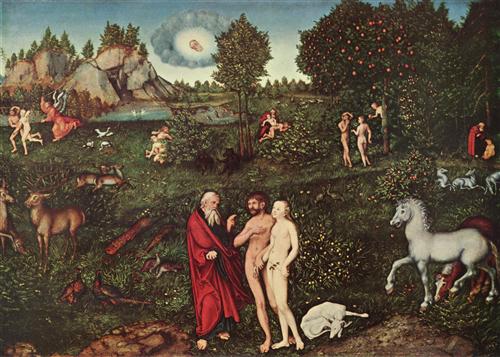
I. “Adam, where are you?” – God’s first question has almost the quality of a plaintive cry. Because Adam is the head of his household, when God calls Adam He is also seeking Eve.
Of course, God knows where Adam and Eve are. He is really saying, “Adam, Eve: your heart has been hidden from me. What has happened? Where are you going with your life?” This is a crucial question for all of us who are so easily wayward and dull of heart: Where are you?
It is almost as if Adam and Eve had a place in God’s heart and suddenly are absent from that place. Noticing it at once, God seeks them as a shepherd looks for lost sheep.
It is interesting that He is seeking them, not pursuing them. There is nothing here to imply an angry Father, bent on punishment and venting His anger, pursuing those who have done wrong. No, this is a soulful cry.
God is not unaware of what has happened or where they are. The question is deeper: Where is your heart?
We are asked this same question: Where is our heart? On what are our desires focused? Where are we and where are we going? It is much like what Jesus asked Peter: “Do you love me?” How will we answer?
II. “Who told you that you were naked?” – We do well to understand that the nakedness here is about more than a lack of clothes (which they didn’t even need moments ago). It more fully refers to the experience of feeling exposed, vulnerable, inadequate, and unduly humiliated before God and others.
God asks us this question, too: “Who told you that you were naked?” In other words, who told you that were wretched and inadequate such that you need to hide from me? I never told you that. Clearly, Satan has bedeviled you and lied to you.
Here are some further things for many of us: “Who told you that you are ugly, that others are better than you, that you do not measure up, that others are laughing at you, that your inadequacies are all that others see? I did not tell you this. They are not the source of your dignity, I am.”
It is a terrible thing to sin, but it is even worse to then lose all hope, to despair, and to feel incapable of emerging from the nakedness of humiliation. Judas despaired of his sin in this way and refused to live with his nakedness and exposure to humiliation. In contrast, Peter waited for the Lord, lived with his sorrow, and then experienced His forgiveness at the lakeside (Jn 21:15ff).
Let the Lord ask you: “Who told you that you were naked?” What does nakedness mean in your life?
Remember, the Lord did not forsake Adam and Eve. He prepares their salvation (as we shall see) and meanwhile He clothed them: The Lord God made garments of skin for Adam and his wife and clothed them (Gen 3:21). Later, Jesus clothed us in righteousness (Rev 19:8).
Whatever your sins, never forget that God still seeks you and that he stills sees your dignity as his son or daughter. Satan wants to taunt you and make you feel naked and fearful. That is not the Father’s voice seeks you in your darkest hours and offers healing and grace. He does not deny or make light of sin, but offers grace and mercy.
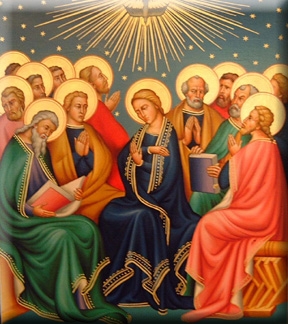
What a wondrous and challenging feast we celebrate at Pentecost! A feast like this challenges us because it puts to the lie a lazy, sleepy, hidden, and tepid Christian life. The Lord Jesus said to the apostles, I have come to cast a fire on the earth (Luke 12:49). This is a feast about fire, a transformative, refining, purifying fire that the Lord wants to kindle in us. It is a necessary fire, for as the Lord first judged the world by fire, the present heavens and the earth are reserved for fire. Because it is going to be the fire next time, we need the tongues of Pentecost fire to fall on us to set us on fire and bring us up to the temperature of glory.
The readings today speak to us of the Holy Spirit in three ways: the portraits of the Spirit, the proclamation of the Spirit, and the propagation by the Spirit.
I. The Portraits of the Spirit– The reading today speaks of the Holy Spirit using two images: rushing wind and tongues of fire. These two images recall Psalm 50, which says, Our God comes, he does not keep silence, before him is a devouring fire, round about him a mighty tempest.
Rushing Wind – Notice how the text from Acts opens: When the time for Pentecost was fulfilled, they were all in one place together. And suddenly there came from the sky a noise like a strong driving wind, and it filled the entire house in which they were.
This text brings us to the very root meaning of the word “spirit.” Spirit refers to breath. This is preserved in the word “respiration,” which is the act of breathing. So, the Spirit of God is the breath of God, the Ruah Adonai (the Spirit, the breath of God).
Genesis 1:2 speaks of this, saying, the Spirit of God was moving over the face of the waters. Genesis 2:7 speaks even more remarkably of something God did only for man (not the animals): then the LORD God formed man of dust from the ground and breathed into his nostrils the breath of life; and man became a living soul.
So, the very Spirit of God was breathed into Adam, but he lost this gift and died spiritually when he sinned.
Thus, we see in this passage from Acts an amazing and wonderful resuscitation of the human person as these first Christians experience the rushing wind of God’s Spirit breathing spiritual life back into them. God does C.P.R. and brings humanity, dead in sin, back to life! The Holy Spirit comes to dwell in us once again as in a temple (cf 1 Cor 3:16). It has been said that Christmas is the feast of God with us, Good Friday is the Feast of God for us, but Pentecost is the Feast of God in us.
Tongues of Fire – The text from Acts then says, Then there appeared to them tongues as of fire, which parted and came to rest on each one of them.
The Bible often speaks of God as fire or in fiery terms: Moses saw Him as a burning bush. God led the people out of Egypt through the desert as a pillar of fire. Moses went up onto a fiery Mt. Sinai where God was. Psalm 97 says,
The LORD reigns; let the earth rejoice; let the many coastlands be glad! Clouds and thick darkness are round about him; righteousness and justice are the foundation of his throne. Fire goes before him, and burns up his adversaries round about. His lightnings lighten the world; the earth sees and trembles. The mountains melt like wax before the LORD, before the Lord of all the earth. The heavens proclaim his righteousness; and all the peoples behold his glory (Psalm 97).
Scriptures also call God a Holy fire, a consuming fire (cf Heb 12:29) and a refining fire (cf Is. 48:10; Jer 9:7; Zec 13:9; Mal 3:3).
So it is that our God, who is a Holy Fire, comes to dwell in us through His Holy Spirit. As a Holy Fire, He refines us by burning away our sins and purifying us. As Job once said, But he knows the way that I take; when he has tested me, I will come forth as gold (Job 23:10).
God is also preparing us for judgment, for if He is a Holy Fire, then who may endure the day of His coming or of going to Him? What can endure the presence of Fire Himself? Only that which is already fire. Thus, we must be set afire by God’s love.
So, in the coming of the Holy Spirit, God sets us on fire to make us a kind of fire. In so doing, He purifies us and prepares us to meet Him one day, to meet Him who is a Holy Fire.
II. The Proclamation of the Spirit – You will notice that the Spirit came on them like “tongues” of fire. The reference to tongues is no accident, for the Holy Spirit moves them to speak and ultimately to witness. The text says, And they were all filled with the Holy Spirit and began to speak in different tongues, as the Spirit enabled them to proclaim. Now there were devout Jews from every nation under heaven staying in Jerusalem. At this sound, they gathered in a large crowd, but they were confused because each one heard them speaking in his own language. They were astounded, and in amazement they asked, “Are not all these people who are speaking Galileans? Then how does each of us hear them in his native language? We are Parthians, Medes, and Elamites, inhabitants of Mesopotamia, Judea and Cappadocia, Pontus and Asia, Phrygia and Pamphylia, Egypt and the districts of Libya near Cyrene, as well as travelers from Rome, both Jews and converts to Judaism, Cretans and Arabs, yet we hear them speaking in our own tongues of the mighty acts of God.”
So, behold how the Holy Spirit moves them to proclaim, not just within the safety of the upper room, but also in holy boldness before the crowds that have gathered.
Notice the transformation! Moments ago, these were frightened men huddled together in secrecy behind locked doors. Now, they go forth to the crowds and proclaim Christ boldly. They have gone from fear to faith, from cowardice to courage, from terror to testimony!
What about us? Too many Christians are silent, overcome by fear. Perhaps they fear being called names or being unpopular. Perhaps they are anxious about being laughed at or resisted, or of being asked questions they don’t feel capable of answering. Some Christians gather in the “upper room” of the parish and are active—even leaders—but once outside the safe confines of the “upper room” they slip into what I call “secret agent” mode.
Well, the Holy Spirit wants to change that. To the degree that we have really met Jesus Christ and experienced His Holy Spirit, we are less able to keep silent. An old gospel song says, “I thought I wasn’t gonna testify, but I couldn’t keep it to myself, what the Lord has done for me.” The Holy Spirit, if authentically received, wants to give us zeal and joy, to burn away our fear so that testifying and witnessing come naturally to us.
Note also how the Spirit “translates” for the Apostles. The people in the crowd spoke different languages, yet each heard Peter and the others in his own language. The Spirit, therefore, assists not only us but also those who hear us. My testimony is not dependent on my eloquence alone but also on the grace of the Holy Spirit, who casts out deafness and opens hearts. Every Christian should remember this. Some of our most doubt-filled encounters with others can still bear great fruit on account of the work of the Holy Spirit, who “translates” for us and overcomes obstacles we might think insurmountable.
III. The Propagation by the Spirit – In the great commission, the Lord said, Go, therefore, and make disciples of all nations, baptizing them in the name of the Father, and of the Son, and of the Holy Spirit, teaching them to observe all that I have commanded you. And behold, I am with you always, until the end of the age (Matt 28:19ff). He also said, I have come to cast a fire on the earth and How I wish the blaze were already ignited (Luke 12:49).
How is the Lord going to do this?
Perhaps a picture will help to illustrate. My parish church is dedicated to the Holy Spirit under the title “Holy Comforter.” Above the high altar is the following Latin inscription: Spiritus Domini, replevit orbem terrarum (The Spirit of the Lord, filled the orb of the earth). (See the photo above of our high altar.)
The walls of my parish church answer the question. The clerestory walls are painted Spanish red, and upon this great canvas are also painted the stories of the lives of twenty saints, surrounding us like a great cloud of witnesses (cf Heb 12:1). (See also the video below.) Over the head of every saint is a tongue of fire.
This is how the Spirit of the Lord fills the earth. It is not via “magic fairy dust.” It is in the fiery transformation of every Christian going forth to bring warmth and light to a cold, dark world. This is how the Lord casts fire upon the earth. This is how the Spirit of the Lord fills the orb of the earth—in the lives of saints (and in your life)!
In the end, the great commission (Matt 28) is our first and most important job. No matter what else we do, we are to do this. Parishes do not deserve to exist if they do not do this. As individual Christians, we are a disgrace and not worthy of the name if we fail to win souls for Jesus Christ. The Spirit of the Lord is going to fill the orb of the earth but only through us. The spread of the gospel has been placed in your hands. It’s scary, isn’t it!
In my short time on this planet, I have seen it. Parishes that were once big and booming (and, frankly, sometimes arrogant) are now in decline; some are near closure. It happens to the best if they do not evangelize, if they do not accomplish “job one.” The Lord wants to light a fire. Why not become fire? Let the Spirit propagate the Church through you. (Yes, I am talking to you.)
Enjoy the feast of Pentecost, but don’t forget that the basic image is very challenging, for it means getting out of the “upper room,” opening the doors, and proclaiming Christ to the world. Let the Holy Spirit light a fire in you. Then you can’t help but spread light and heat to a dark, cold world.
Let the evangelization of the whole world begin with you.
The video below features details from the clerestory of my parish, Holy Comforter in Washington, D.C. Notice the tongue of fire above each saint. The paintings show how the Spirit of the Lord fills the orb of the earth through the lives of the saints (and through you, too). It is not magic; it is grace, working in your life, through your gifts and your relationships, so that the Lord will reach each soul. The witnesses on the walls of my Church say, “You are the way that He will fill the earth and set it on fire.” Let the blaze be ignited in you!
The song accompanying the video says, “We are surrounded by a great cloud of witnesses, looking on, encouraging us to do the will of the Lord. Let us stand worthy and be faithful to God’s call … We must not grow weary …!”
Back in April, Governor Andrew Cuomo of New York excluded the possibility that God had anything to do with the dropping numbers of COVID-19 in New York State (emphasis mine):
During a press conference on April 13, New York Gov. Andrew Cuomo contended that God has nothing to do with the notable decrease in COVID-19 cases across the state.
“The number is down because we brought the number down,” he told reporters. “God did not do that. Faith did not do that. Destiny did not do that.”
“A lot of pain and suffering did that,” Cuomo, a professing Catholic, continued. “That’s how it works. It’s math.”
… In recent days, the number of hospitalizations and fatalities from the virus have decreased significantly, suggesting that New York City has crested “the curve” and is now on the downhill path to recovery.
Cuomo credits the slowing of the spread to “our actions,” … “Our behavior has stopped the spread of the virus,” he said. “God did not stop the spread of the virus. And what we do, how we act, will dictate how that virus spreads.” [*]
The Governor, of course, does not consider the possibility that there is an intermediate view: that human decisions may have interacted with or have been aided by God’s grace. His protestations seem to show irritation with the notion that God could have anything at all to do with the results or with assisting our actions. “Nothing” is a strong and absolute word. In using it, he demonstrates the fierce secularism of our age, which seeks to exclude God/faith from any role or participation in public conversations or during times of crisis. This secularism bespeaks more of fear than it does of a rational, principled position. Why the need to exclude other views or to denounce them in such absolute terms?
Consider another story circulating recently, regarding the strong decline in Italy’s COVID-19 rates, as reported at ChurchPOP:
Recent data for COVID19 in Italy shows [sic] a drop in new daily cases and deaths after Pope Francis prayed for the world during his Urbi et Orbi Eucharistic blessing on March 27.
Italy took extreme measures throughout the past couple of months to prevent the spread of COVID19. The country enforced a two-month lockdown, which suspended public Masses, closed schools, restaurants, shops, etc. …
Along with these measures to slow the spread, Pope Francis prayed for the world in a special Eucharistic blessing in St. Peter’s Square. The live televised prayer and blessing aired on March 27.
Following that date, the rate of new daily deaths and cases dropped in Italy. [**]
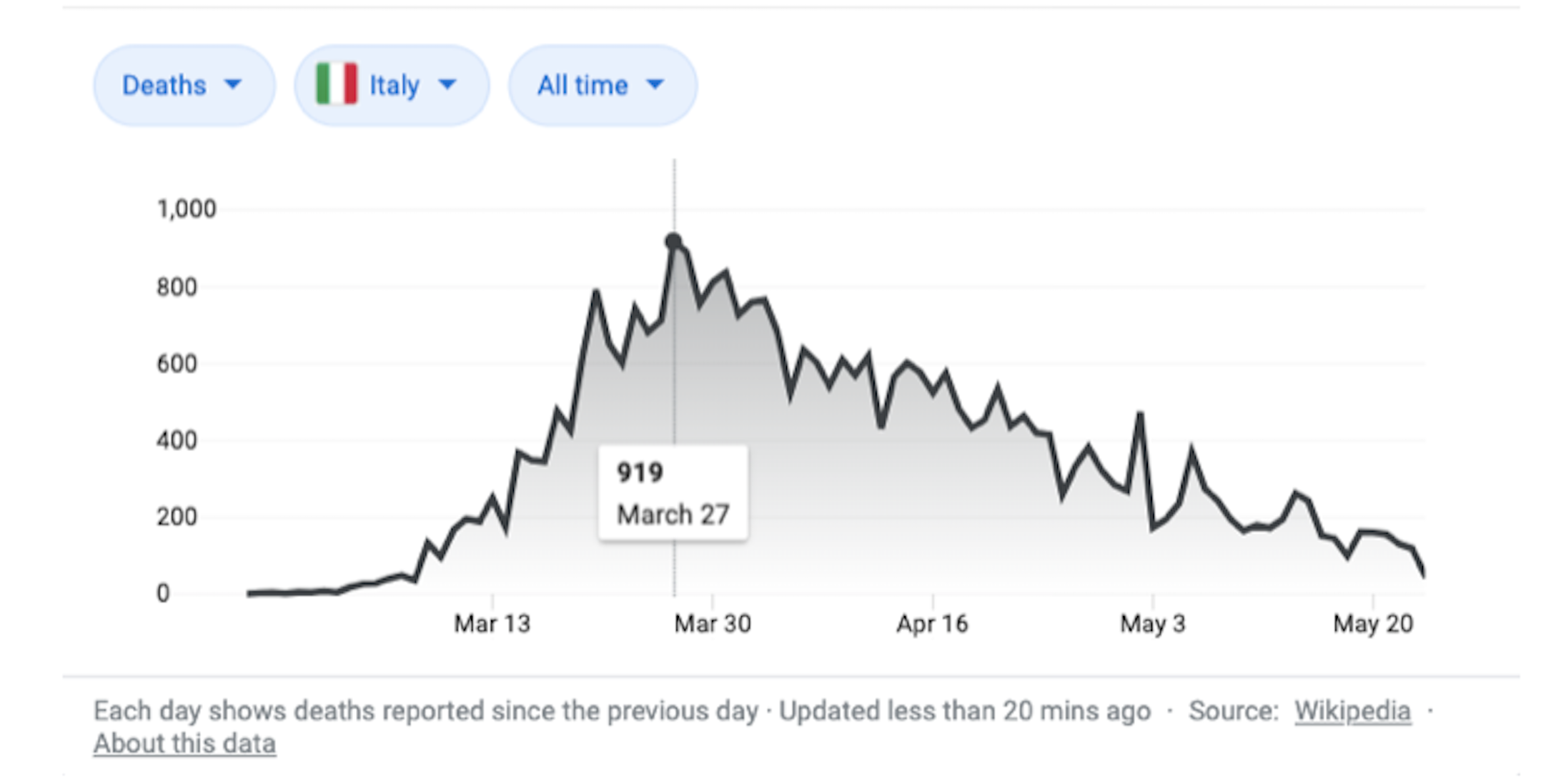
ChurchPOP also supplied the following graph from Wikipedia:
What do you think? The graph shows a steady drop the day following Pope Francis’ Urbi et Orbi Eucharistic Blessing. Is it a coincidence? Is it the result of prayer? Surely the drop was also fostered by human activities such as staying at home, the shuttering of many businesses, and the cessation of certain activities. However, these mitigations were going on before the Pope’s blessing as well.
While we cannot know for certain whether prayer played any role in the drop, as a man of faith I choose to believe that the Pope, along with all of us who prayed, did contribute.I respect that some will reject this outright, but to those I would like address these questions:
What are your reasons for rejecting the possibility that God and prayer could have played a role?
What is your evidence that it is not possible?
Your view is that prayer and God had no impact; mine is that there might well have been. Consider that although I advance the possibility that prayer had an impact, I also point to human activity as critically important. I am also willing to admit the possibilitythat prayer played no role, even if I doubt it. Your view, however, categorically denies that God or prayer could have played a role. Which view do you think is more open-minded and why?
Religious people are often accused of being dogmatic, but in this case are you not in fact being dogmatic?
As I pointed out above, Governor Cuomo represents what I term the fierce or militant secularist viewpoint.This perspective does not simply proposesecular, material causes as the complete explanation for events; it does not simply reject religious interpretations of events or religious views on moral issues; it actively opposessuch views and seeks to remove them from any public consideration. Religious and spiritual truths as well as faith-based explanations are to have no place in public discourse. Some with this stance resort to ridicule rather than reasoned debate. Some also seek to erect legal barriers to keep such views contained within the walls of churches, synagogues, and mosques. We religious are not simply wrong or laughable; we are dangerous because our view is that there are limits to human power and freedom. In crediting God, we undermine their agenda and the programs they set forth. For example, if people think that prayer might help, maybe they won’t be as diligent in following the norms set forth by public health officials. In fact, my experience is that believers have overwhelmingly followed the guidelines/directives issued by the Centers for Disease Control and Prevention (CDC) and public officials.
The vast majority of believers do not think of prayer as “magic”that absolves us of the responsibility to act on our own and our neighbors’ behalf. St. Augustine once said, “God, who made you without you, will not save you without you.” We are not simpletons. We know that prayer and action go together.
I realize that correlation is not causation, but there is a long chain of anecdotal evidence in human history that collective public prayer can be correlated with the ending of plagues and famines. The graph above may be further evidence. Human experience over centuries and across civilizations confirms the common human sense that prayer and asking God to intervene and send grace helps.
To Governor Cuomo and others like him I ask:Why be so dismissive of prayer and of God’s role in history? What do you have to lose by allowing others to praise God and give Him the glory? The vast majority of us aren’t the snake handlers you seem to think we are.
Governor Cuomo, one day you will face God and—like all of us—be judged. I pray for you as I do for myself. I hope that you will then come to know what prayer actually did and what a danger it is to fail to pray and give to God the glory.