We do well to further examine a quality of Christ’s kingship mentioned in yesterday’s sermon notes, namely that he is a “concealed” King. In the gospel, both the saved and condemned are surprised and wonder when they encountered Jesus at all, whether as hungry, thirsty, naked, a stranger, sick or in prison. He replies, Truly I tell you, whatever you did for one of the least of these brothers of mine, you did for me.’ (Matt 25:41). So, although concealed, Jesus says he was, quite present in those who were in such need.
To examine and further understand the concealment of Jesus, consider another gospel passage. In the afternoon of the resurrection, two disciples are on the road to Emmaus and, as they journey and discuss the events of passiontide, Jesus joins them but they do not recognize him. Along the way he sets their hearts afire ass he explains the Scriptures. Having reached the house where they were going he entered the house and, as the text says,
While He was reclining at the table with them, He took bread, said the blessing and broke it, and gave it to them. Then their eyes were opened and they recognized Jesus— and He disappeared from their sight. (Luke 24:30-31)
So, even as they recognized Jesus who had been concealed or hid from their earthly eyes, he vanishes from their sight. It is as if to say to them and us, “You will no longer see me in the way to which you are accustomed. Now you will see me in the Sacraments, in the Sacred Liturgy and wherever two or three are gathered in my name.”
Our usual way of seeing, at least in the physical sense is that light rays reach our retina and are somehow decoded by the brain. Jesus teaches we will not see him in this way. Rather we must learn to encounter him at the Holy Liturgy as he enters, clothed in priestly garments, blesses us, speaks a word to us, and feeds us with his very Body and Blood. We must learn to hear his voice in the Scriptures proclaimed and when he speaks to us and ministers to us in the Sacraments: This is my Body….this is my Blood…. I baptize you in the Name of the Father and of the Son, and of the Holy Spirit… I absolve you from your sins… and so forth. It is Christ concealed in the person of the priest and under various signs whom we encounter.
And though he is concealed from earthly eyes, he expects us to recognize him by the eyes of the faith. St Thomas Aquinas wrote:
I devoutly adore you, hidden deity, Who are truly hidden beneath these appearances. My whole heart submits to You, And in contemplating You, it surrenders itself completely.
Sight, touch, taste are all deceived in their judgment of you, But hearing suffices firmly to believe. I believe all that the Son of God has spoken; There is nothing truer than this word of Truth.
On the cross only the divinity was hidden, But here the humanity is also hidden Yet believing and confessing both, I ask for what the penitent thief ask (Adoro Te Devote vv. 1-3)
Again, though concealed from physical or earthly eyes Jesus expects us to recognize him here nonetheless. St Paul says, “for we walk by faith, not by sight.” (2 Cor 5:7). We also read: “Now faith is the substance of things hoped for, the evidence of things not seen.” (Heb 11:1). And thus, though concealed, we are expected to find Christ in the Holy Liturgy and the Sacraments.
In the Gospel from this past Sunday Jesus teaches much the same thing. Though concealed from our earthly eyes, he expects us to recognize his presence in the needy, the poor, the sick and the suffering. To consistently fail to give care to the needy is a damnable sin. Not only do we sin by failing them, we also sin by failing to recognize Christ in them. Both groups, those on the right and those on the left are surprised that it was Christ himself they served or failed to serve. But the teaching of this gospel is that, henceforth, we are expected to recognize him. Though he is concealed in some sense, it cannot be that way for us. With the eyes of faith we are required to understand that it is He who we are also seeing. Thus, St. John admonishes us, For if a person does not love his brother, whom he has seen, then he cannot love God, whom he has not seen. (1 John 4:20)
The readings for this Feast of Christ the King evoke three images of Christ as King. All of them are to some extent paradoxical because they emphasize things we don’t usually associate with kings. They also tell us that we have already met King Jesus even if we don’t realize it. Let’s look at these three images of our Lord Jesus Christ, King of all Creation:
I. Caring King – The first reading, from Ezekiel 34, speaks of the Lord as a shepherd who cares for His flock. Here are some of the lines that summarize His care: I myself will look after and tend my sheep … I will rescue them from every place where they were scattered when it was cloudy and dark … I myself will give them rest … The lost I will seek out … The strayed I will bring back … The injured I will bind up. The sick I will heal.
In the modern world we don’t typically think of kings and heads of state in such a caring role. Most world leaders are inaccessible to us, existing behind many layers of security and staff. Even bishops of larger dioceses are hard to reach personally.
Jesus, however, is a King who is more present to us than we are to ourselves. An old revival hymn says, “Jesus is on the Main Line … call him up and tell him what you want.” Another song says, “God is just one prayer away.”
In the ancient world it was much more comment to speak of a caring king. Most kings had more immediate contact with their subjects. Many had certain days on which their subjects could line up to talk to them. It is said that St. Athanasius ran up to the emperor on his horse one day, grabbed the reins, and proceeded to debate a theological point with him.
Until relatively recently, even U.S. Presidents had office hours. It is said that on Tuesdays Abraham Lincoln received visitors from among the citizenry who sought to speak to him of their concerns. They would line up at the door without formal appointments and he’d listen to them one by one. As our culture has become more violent and public figures have become more widely recognized and vulnerable, leaders have receded into sealed, bulletproof, and figuratively soundproof worlds, hearing little from “ordinary people.”
The idea of a king who cares for his people personally is somewhat paradoxical to us today, but Jesus does care for His people.
I want to testify that I do indeed have a caring King, Jesus. He’s been good to me. He has led me, rescued me, purified me, fed me, instructed me, and graced me; He died for me.
I also want to testify that He was being good to me even when I didn’t think He was being good to me. Scripture says, All things work together for good to them who love and trust the Lord (Rom 8:28). Notice that not just the “good things” work for my benefit but even the bad things. God sometimes permits some “stuff” to happen because it will bless us in the end. Even if you’re suffering, don’t give up on God. Some of His gifts sometimes come in strange packages. St Paul says, For this affliction is producing for us a weight of glory beyond compare (2 Cor 4:17).
Did you notice the last line in the passage from Ezekiel? But the sleek and the strong I will destroy, shepherding them rightly. Yes, even at those times when I needed to be humbled (to have my pride destroyed) the Lord was shepherding me rightly. There was a time in my life when I was sleeker and stronger, but the Lord let me experience some humiliation, destroying me as it were, and giving me humility. I even see this humiliation physically, for I was once slim and now I am overweight. It is humbling to be fat, especially when people scold me; they seem to think it is easy to lose weight. But God will humble them too, perhaps in other ways. God hates pride; He just can’t stand it. This is because He knows how deadly it is to us.
Yes, God is a caring King. Some of His ways are paradoxical. Do not reduce the noun “care” merely to meaning “that which comforts and consoles.” It can be that, but not always! Sometimes the “caring” thing to do is to rebuke, warn, or even punish. God never ceases to care for us. I’m a witness. He’s been good to me. Even when I didn’t think He was being good to me, He was being good to me.
Finally note that Jesus exercises this care through his Body, the Church. This means all of us, not just clergy. Parents, elders, youngsters, and all area summoned to share the faith, to console and care, find the lost and straying, and correct the sinner. We are Christ’s voice, his heart, his hands.
II. Conquering King – Today’s second reading speaks Jesus’ victory over all things, saying that He has been raised from the dead, the first fruits of those who have fallen asleep; that He has reversed what Adam did; that He is the first fruits, then each one in proper order will also rise. It says that He will hand the kingdom over to God his Father when he has destroyed every sovereignty and every authority and power and that he must reign until he has put all his enemies under his feet, the last enemy to be destroyed being death.
Here, too, there is a great paradox. As Hebrews says, In putting everything under him, God left nothing that is not subject to him. Yet at present we do not see everything subject to him. But we see Jesus, who was made a little lower than the angels, now crowned with glory and honor because he suffered death (Heb 2:8-10).
So while at times it seems that evil triumphs, God is working. One by one, He is putting all His enemies under His feet. One day, even death itself will be destroyed. The paradox of the cross shouts to us that God conquers, not by brutality and cruel strength, but by love, forgiveness, and mercy—things the world dismisses as weak.
Here, too, I want to say that God is a conquering King in my life. He has destroyed the power of many sins and diminished the strength of others on the way to their ultimate destruction. I have seen sins put down and under His feet as He cleanses the temple of my soul. He has conquered so much of my pride. I am seeing lust, greed, anger, sloth, envy, and fear on the ropes. One by one, He is diminishing their power and replacing them with greater love, compassion, kindness, purity, love for the truth, prayerfulness, courage, trust, and eagerness to do good and to win souls.
Thank you, Lord, for being a conquering King in my life.
Unlike worldly kings, this conquering King does not force us to be His subjects and live in His kingdom. Earthly kings conquer regions and force peoples under their rule by might. But Jesus is a King who respects our freedom to decide whether to have Him as our King and to accept the virtues of His kingdom—or not. Hence, Hell is not so much a place of punishment as it is a place for those who refuse, those who say no to Christ and His kingdom. This King, though all-powerful, does not force His kingship and laws. He offers them to all and allows each of us to decide.
III. Concealed King – The Gospel teaches us that Christ will come again to judge the living and the dead. In this second coming we will discover that we have known Him all along, though in a paradoxical way. As Christ comes and takes His seat and all are summoned to Him, we are going to have a strange sense that we’ve met Him before—and He will confirm that.
For indeed, we have met His Majesty and He is the strangest King of all. He is a King who is hungry, thirsty, sick, lonely, a foreigner, in prison, and a stranger. The list He gives should not be seen as exhaustive, for He is in the needy, whether rich or poor. He is in the discouraged loved one who cannot find a job; He is in our children, who need to be taught and encouraged; He is in the co-worker who just lost his wife; he is in the patient who was diagnosed with cancer; He is in the lost family member who needs instruction and to be drawn back to the Sacraments. He is even in you, in your struggles and needs.
Yes, we have met this King every day. And He is not merely saying that these people have some moral union with Him. He is saying, mystically, that He is each one of them. And when we cared for them, we were not simply doing something ethical; we were serving and caring for Him: “You did it for me.”
What a strange King! We usually picture kings in palaces, far removed from trouble, but this King is naked, poor, hungry, and thirsty. We walk past Him every day.
To those who have cared for Him in His poor, He says that He will never forget what they have done. The poor may not be able to repay us, but King Jesus will repay us a millionfold. On the day of our judgment we will look at Jesus and say, “I know you! I recognize you!” And He will say, “I know you, too.” Come, inherit the kingdom prepared for you from the foundation of the world.”
We should not view this judgment scene as containing the only standards by which we are to be judged, for numerous other passages lay out other standards such as having faith, being willing to carry our cross, living in purity, forgiving others, and loving our enemy. But this passage does remind us that we are not to neglect the corporal works of mercy.
Yes, Jesus our King is the strangest one you will ever meet: a caring and close King, a conquering King who never forces, a King who is hungry and thirsty, a King who reigns from the cross, a King who dies so that we don’t have to, a King who washes our feet, a King who comes to serve rather than to be served. He is a King, all right, one who rules with love, not force. He’s the strangest King you’ve ever met, and you meet Him every day: in the Eucharist, in the poor, in His Word, in your heart, in the events of your day, and in your very self.
I’ve often been impressed by the ability of old African-American spirituals to treat serious subjects in a clear, memorable, and almost joyful way. This is true even of weighty matters like sin and judgment. During early November we are focused on the four last things (death, judgment, Heaven, and hell) and November is also Black Catholic History Month. So, this seems like a good time to look at some of the creative lines from different spirituals that articulate these topics.
It can be very helpful to the preacher, teacher, and parent in recovering an ethos of coming judgment, but in a way that is almost playfully bright while at the same time deeply soulful.
In a certain sense, the spirituals are unimpeachable, even by hypersensitive post-moderns who seek to shame preachers for announcing sterner biblical themes. Most of the spirituals were written by slaves, who creatively worked biblical themes into these songs that helped accompany both their work and their worship.
The spirituals were written in the cauldron of great suffering. If any people might be excused from thinking that the Lord would exempt them from judgment day, it was surely the enslaved in the deep South. If any people might be excused from crying out for vengeance, it was they. Yet the spirituals are almost entirely devoid of condemning language; enslaved blacks sang in ways that looked also to their own sins and the need to be prepared. If they were prepared, God, who knew their trouble, would help them steal away to Jesus. They did not see themselves as exempt from the need to be ready.
If they, who worked hard in the cotton fields and endured the horrors of slavery, thought these texts applied to them, how much more do they apply to us, who recline on our couches and speak of our freedom to do as we please?
Here are some lines from a few of the many spirituals that speak to judgment and the last things:
I would not be a sinner, I’ll tell you the reason why. I’m afraid my Lord might call my name and I wouldn’t be ready to die.
Some go to Church for to sing and shout, before six months they’s all turned out!
Everybody talkin’ ’bout heaven ain’t a goin’ there, Oh my Lord!
Where shall I be when the first trumpet sounds? Oh where shall I be when it sounds so loud, when it sounds so loud as to wake up the dead? Oh where shall I be when it sounds? How will it be with my poor soul, Oh where shall I be?
Better watch my brother how you walk on the cross! Your foot might slip and your soul get lost!
God gave Noah the rainbow sign, no more water but the fire next time!
Old Satan wears a hypocrite’s shoe, If you don’t watch he’ll slip it on you!
Noah, Noah let me come in! The doors are fastened and the windows pinned! fastened an’ de winders pinned Noah said, “Ya lost your track Can’t plow straight! you keep a-lookin’ back!
Knock at the window knock at the door Callin’ brother Noah Can’t you take more? No said Noah cause you’re full of sin! God has the key you can’t get in!
Well I went to the rock to hide my face The rock cried out, no hiding place There’s no hiding place down here Oh the rock cried I’m burnin’ too! I wanna go to heaven just as much as you!
Oh sinner man better repent! Oh you’d better repent for God’s gonna call you to judgment There’s no hiding place down there!
No signal for another train To follow in this line Oh sinner you’re forever lost When once you’re left behind. She’s nearing now the station Oh, sinner don’t be vain But come and get your ticket Be ready for that train!
Sinner please don’t let this harvest pass And die and lose your soul at last.
My Lord, what a morning
When the stars begin to fall You’ll hear the trumpet sound, to wake the nations underground Looking to my God’s right hand, When the stars begin to fall
You’ll hear the sinner moan,
When the stars begin to fall You’ll hear the Christian shout, Oh, when the stars begin to fall!
Most of these songs are deeply scriptural and make serious appeals to the human soul, but they do so in a way that is creative. They get you tapping your foot and invite you to a joyful consideration of the need to repent before it’s too late. Others are more soulful, even mournful, in their pentatonic scale.
Given all the reluctance to discuss the four last things (death, judgment, Heaven, and Hell), songs like these may help to reopen the door to necessary conversations between preacher and congregation, parents and children. They are a valuable resource.
I’d like to conclude with a creative spiritual about the last judgment. Note that it is rich in biblical references. It is joyful—a real toe-tapper—and makes a serious point along with a wish.
In That Great Getting’ Up Mornin’ Fare You Well
I’m gonna tell ya ’bout da comin’ of da judgment Dere’s a better day a comin’, Fare thee well, fare thee well!
Chorus: In dat great gettin’ up mornin’, Fare thee well, fare thee well In dat great gettin’ up mornin’, Fare thee well, fare thee well
Oh preacher fold yo’ bible, For dat last souls converted, Fare thee well, fare thee well
Blow yo’ trumpet Gabriel, Lord, how loud shall I blow it? Blow it right and calm and easy,
Do not alarm all my people, Tell dem all come to da judgment, Fare thee well, fare thee well!
Do you see dem coffins burstin’, do you see dem folks is risin’ Do you see dat fork of lightnin’, Do you hear dat rumblin’ thunder? Fare thee well, fare thee well!
Do you see dem stars a fallin’, Do you see da world on fire? Fare thee well, fare thee well
Do you see dem Saints is risin’, Fare thee well, fare thee well See ’em marchin’ home for heaven, Fare thee well, fare thee well
Oh! Fare thee well poor sinners, fare thee well, fare thee well Fare thee well poor sinners, fare thee well, fare thee well!
The Gospel from Wednesday’s Mass (Wed. of the 33rd Week – Luke 19:11-27) is known as the “Parable of the Ten Gold Coins.” It has an ending so shocking that, when I read it at Mass some years ago, a young child said audibly to her mother, “Wow, that’s mean!”
I’d like to look at it and ponder its shocking ending.
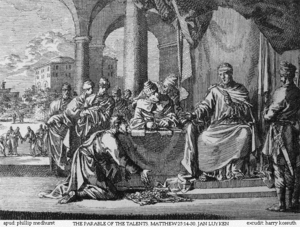
Today’s parable is like Matthew’s “Parable of the Talents,” but with some significant differences. In today’s parable, ten people each receive one gold coin. We only hear the reports of three of them (as in the Matthean account): two who show a profit and one who shows none.
Another difference is the interweaving of another parable (let’s call it the “Parable of the Rejected King”) within the story. Here is a shortened version, including the shocking ending:
A nobleman went off to a distant country to obtain the kingship for himself and then to return. His fellow citizens, however, despised him and sent a delegation after him to announce, “We do not want this man to be our king.” But when he returned after obtaining the kingship … [he said] “Now as for those enemies of mine who did not want me as their king, bring them here and slay them before me” (Luke 19:12,14, 27-28).
In analyzing a text like this I must say that I was disappointed at the silence of most commentaries with respect to this ending. The shocking phrase “slay them before me” goes largely unremarked.
The Church Fathers seem to say little about it. I was, however, able to find two references in St. Thomas Aquinas’s Catena Aurea. St. Augustine said of this verse, Whereby He describes the ungodliness of the Jews who refused to be converted to Him. Theophilus wrote, Whom he will deliver to death, casting them into the outer fire. But even in this world they were most miserably slain by the Roman army.
Hence both Fathers take the verse at face value, even declaring it historically fulfilled in the destruction of Jerusalem in 70 A.D. Josephus indicated in his work that 1.2 million Jews were killed in that dreadful war.
Historically fulfilled or not, Jesus’s triumphal and vengeful tone still puzzles me. If this verse does refer to the destruction of 70 A.D., then how do we account for Jesus’s tone here when just a few verses later He wept over Jerusalem?
As Jesus approached Jerusalem and saw the city, he wept over it and said, “If you, even you, had only known on this day what would bring you peace—but now it is hidden from your eyes. The days will come upon you when your enemies will build an embankment against you and encircle you and hem you in on every side. They will dash you to the ground, you and the children within your walls. They will not leave one stone on another, because you did not recognize the time of God’s coming to you” (Lk 19:41-44).
Certainly a variety of emotions can sweep over even the God-man Jesus, but let me also suggest some other contextual and cultural considerations that frame Jesus’s startling and “mean” words (Now as for those enemies of mine who did not want me as their king, bring them here and slay them before me).
1. Jesus was speaking in the prophetic tradition – Prophets often spoke this way, using startling and often biting imagery and characterizations. Though many today try to “tame” Jesus, the real Jesus spoke vividly, in the prophetic tradition. He often used shocking and paradoxical images. He spoke bluntly, as prophets do, calling his hostile interlocutors hypocrites, vipers, children of the devil, whitewashed tombs, evil, foolish, blind guides, and sons of those who murdered the prophets. He warned them that they would be sentenced to Hell unless they repented; He laid them out for their inconsistency and hardness of heart. This is the way prophets speak.
In speaking in this “mean” way, Jesus was firmly in the tradition of the prophets, who spoke similarly. Thus, in understanding these harsh words of Jesus’s, we cannot overlook the prophetic context. His words, which seem to us to be angry and even vengeful, were expected in the prophetic tradition from which He spoke; they were intentionally shocking. Their purpose was to provoke a response.
Prophets used hyperbole and shock to convey and frame their call to repentance. And while we ought not to simply dismiss Jesus’s words as exaggeration, we should not fail to see them in the traditional context of prophetic speech.
Hence Jesus’s words were not evidence of vengeance in His heart, but rather a prophecy directed at those who refused to repent: they will die in their sins. Indeed, their refusal to reconcile with God and their neighbors (in this case the Romans) led to a terrible war during which they were slain.
2. The Jewish culture and language often used hyperbole – Even beyond the prophetic tradition, the ancient Jews often used all-or-nothing language in their speech. Although I am no Hebrew scholar, I have been taught that the Hebrew language contains far fewer comparative words (e.g., more, less, greatest, fewest) than does English (and many other languages). If an ancient Jew were asked if he liked chocolate or vanilla ice cream more, he might reply, “I like chocolate and I hate vanilla.” By this he really meant “I like chocolate more than I like vanilla.” When Jesus said elsewhere that we must love Him and hate our parents, spouse, and children (e.g., Lk 14:26), He did not mean that we should hate them vengefully. Rather, this was a Jewish way of saying that we must love Him more.
This background explains the ancient Jewish tendency to use hyperbole. It is not that they did not comprehend nuances; they just did not speak in that manner, instead allowing the context to supply that “hate” did not mean literal hate.
This linguistic background helps to explain how the more extremist elements of prophetic language take shape.
We ought to be careful, however, not to simply dismiss things as hyperbole. We who speak English may love that our language allows for greater nuance, but sometimes we are so nuanced in our speech that we say very little. At some point we must say either yes or no; we must be with God or against Him. In the end (even if Purgatory intervenes) there is only Heaven or Hell.
The ancient Jewish way of speaking in a rather all-or-nothing manner was not primitiveper se. It has a refreshing and honest way of insisting that we decide for or against God, that we decide what is right and just.
Thus, though Jesus’s words were harsh they did make an important point. For either we choose God and live, or we choose sin and die spiritually. For the wages of sin is death, but the gift of God is eternal life in Christ Jesus our Lord (Romans 6:23).
3. Jesus was speaking to hardened sinners – The audience here is important as well. As Jesus drew near to Jerusalem, He was entering hostile territory. The sinners and unbelievers He encountered were very rigid and had hardened their hearts against Him. Hence, Jesus’s words must be understood as strong medicine.
One can imagine a doctor saying to a stubborn patient, “If you don’t change your ways, you’ll die soon and I’ll see you at your funeral.” While some may consider this to be poor “bedside manner,” there are some patients for whom such language is both necessary and appropriate.
Because Jesus was dealing with hardened sinners, He spoke bluntly. They were headed for death and Hell and He told them so.
Perhaps we, who live in these “dainty” times, who are so easily offended and so afraid of giving offense, could learn from such an approach. There are some who need to hear from priests, parents, and others, “If you do not change your ways, I do not see how you can avoid being sentenced to Hell.”
4. A final thought—a theory really—that some have advanced – According to this theory, Jesus was referring to an actual historical incident and using it to disabuse His listeners of their fond thoughts of a new king. After the death of Herod the Great, his son Archelaus went to Rome to request the title of king. A group of Jews also appeared before Caesar Augustus, opposing Archelaus’s request. Although not given the title of king, Archelaus was made ruler over Judea and Samaria; he later had those Jews who opposed him killed.
Kings are often despots – Because many Jews thought that the Messiah (when he came) would be a king, some were hoping that Jesus was traveling to Jerusalem in order to take up the role of an earthly king. According to this theory, because the people were pining for a king, Jesus used this fearsome parable as a reminder that earthly kings are usually despotic. Jesus was thus trying to disabuse them of the idea that He or anyone else should be their earthly king.
While this theory has a lot to recommend it, especially historical precedent, it seems unlikely that the Gospel text would use such an historically localized event to make the point. Jesus was not just speaking to the people of that time and place; He is also speaking to us. Even if this explanation has partial historical context, the meaning needs to be extended beyond one ancient incident.
Well, there you have it. I am interested in your thoughts. Because the commentaries I consulted seemed rather silent on this, I am hoping that some of you have read commentaries worth sharing. Likewise, perhaps you know of some other quotes of the Fathers that I was unable to find.
Is Jesus being mean here? No. Is He being blunt and painfully clear? Yes. And frankly, some of us need it. In these thin-skinned times we may bristle at such talk, but that’s our problem. Honesty and a clear diagnosis are far more important than our precious feelings.
In the video below, a comedy routine from Mad TV shows how many modern notions were non-existent even just fifty years ago. In the sketch, a pregnant mother drinks a martini and smokes a cigarette; children ride bikes without wearing helmets. Of course, like a lot of comedy, the topic is taken to excess for effect.
Nevertheless, most of us who are older grew up in a “dangerous” world and managed to survive. You’ve probably seen lists like this one:
I survived:
drinking from a garden hose,
breathing second-hand smoke,
running in the misty cloud when the DDT spray truck went by,
playing with toy guns,
being spanked,
paddling in school,
praying in school,
lead paint,
not wearing a seatbelt,
not wearing a bike helmet,
playing in asphalt playgrounds with metal monkey bars and swings,
not every kid making the team,
not everyone receiving an award.
I can personally attest to the item about running in the cloud of spray behind the DDT truck. The cloud had a sweet, pungent order; we were told it wasn’t harmful and sure enough, none of us ever got sick from it. At left is a picture of mine to prove that I’m not lying! It was a little bit like the smell of newly mimeographed paper as the teacher handed it out—a strange but pleasant odor. DDT was banned in the 1970s and scientists still debate whether the lives lost (to mosquito-borne diseases) as a result of banning it outweighed the gains made by a purer environment. I leave that debate to them, but for the record, I am a survivor!
The spiritual point I would like to make is one of moderation. I am not recommending that pregnant women drink or smoke. I am not saying that children should stop wearing bike helmets or that seatbelts are unimportant. Rather, I caution against prioritizing safety concerns to the degree that we become too fearful. Life involves risks, and there is no such thing as complete safety.
I lived through many of the things on the list above and depicted in the sketch. In order to live we must take certain risks. A life too obsessed with dangers and too constrained by artificially imposed limits can smother and restrict. Some of the modern preoccupation with safety and for a life without any rebukes or challenges comes from a desire for excessive comfort and reassurance.
Comedy like that depicted in the video below is funny because while over the top, it also has many elements of truth.
The past few Sundays have featured the November theme of the Four Last Things: Death, Judgment, Heaven, and Hell. In today’s Gospel we are reminded that we will one day have to account for our use of the gifts and resources that God has given us.
But today’s readings do more than that; they also set forth a virtue that helps us to use God’s gifts well. That virtue is the fear of the Lord. It is a foundational disposition of the wise, but not the foolish. Scripture says, The fear of the Lord is the beginning of wisdom (Prov 9:10).
In today’s first reading contains this nugget:Charm is deceitful, beauty is fleeting, but the woman who fears the Lord is to be praised (Prov 31:30). Today’s Psalm says, Blessed are you who fear the Lord (Psalm 128:1).
“Fear” of the Lord can be understood in two ways: perfect fear and imperfect fear. Both are important. Imperfect fear (which most of us begin with and still need from time to time) is the fear of punishment and the loss of Heaven. Jesus often appeals to this sort of fear in His preaching; He vividly warns of the punishments that come to impenitent sinners, both here in this world and ultimately in Hell. While imperfect, this kind of fear is necessary—especially for the spiritually immature (and all of us have our areas of immaturity). It is somewhat like a young child who needs punishment and/or the threat thereof in order to learn discipline and the consequences of bad behavior. As the child matures, we can begin to appeal to his reason and his love for others in order to encourage good behavior. Good preaching and teaching should not wholly neglect the appeal to imperfect fear because congregations have people at many different stages. Jesus did not neglect this kind of appeal and neither should we.
However, just as we hope to be able to appeal to higher motives as our children mature, so as we grow in the spiritual life do we hope to move toward a more perfect “fear” of the Lord. This more mature fear is not a cringing, servile one. Rather, fearing the Lord is holding Him in awe, revering Him, having a deep love and appreciation for Him as the source of all that we are and all that we have. Because we love God and He is Abba to us, we fear offending Him by sin, or severing our relationship with Him by refusing His grace. Out of love, reverence, and a sense of awe, we fear giving any offense to Him, who is Holy, God, and deserving of all our love.
With this background, we can look to a deeper teaching in today’s Gospel. On one level, the teaching is clear: We will all have to account for our use of the talents and resources God has given us. On a deeper level, we are taught of the importance of attaining to a mature fear of the Lord as the essential way of bearing the fruit that will be sought. There is a danger in remaining only in imperfect fear (which has its place and time in our life) because we risk developing resentment and avoidance if we refuse to grow toward a more perfect fear.
Let’s look at it with this perspective in mind and discover the differences of each kind of fear.
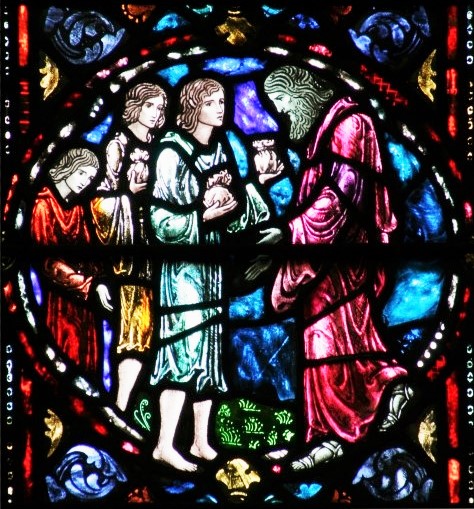
A man going on a journey called in his servants and entrusted his possessions to them. To one he gave five talents; to another, two; to a third, one—to each according to his ability. Then he went away. Immediately the one who received five talents went and traded with them and made another five. Likewise, the one who received two made another two. But the man who received one went off and dug a hole in the ground and buried his master’s money.
Three men are given resources to use. Two succeed; one fails. Why? Ultimately it is the difference between holy fear, love, and confidence on the one hand, and unholy fear and resentment on the other.
Consider the plan of the first two men (the ones who succeed):
Receive Riches– One gets five talents; the other, two—each according to his ability. While the “inequity” may offend modern sensibilities, note the explanation in the passage itself: the men had different abilities. Before getting outraged, consider this: what business owner would not give more resources to an outstanding employee than to a mediocre one? The fact is, God blesses some more abundantly than others due to their good use of gifts. Later in the Gospel, we receive this fundamental rule: We must prove faithful in a few things to be ruler over many (Matt 25:23).
Risk Reinvestment– Something in these two men makes them feel free enough to risk reinvesting the money: It is likely their relationship with the master. They view him as a reasonable man, one who would applaud their industriousness. Though they are taking a risk, they believe that even if there were to be losses, they will not be dealt with unmercifully. They seem to experience the freedom and courage to step out and make use of the talents entrusted to them. Notice that the text says they “immediately” went out and traded. They are eager to work for their master and take the risks on his behalf in order to please him.
Render a Report – Upon the master’s return the men seem somewhat joyful as they report, “Master, you gave me five (two) talents. See, I have made five (two) more.” There is an enthusiasm for the opportunity they were given and a joy for the harvest.
Rise in the Ranks– The men’s presumptions of the master’s fairness and reasonability are affirmed in his response: “Well done, my good and faithful servant. Since you were faithful in small matters, I will give you great responsibilities. Come, share your master’s joy.” We see that the master is joyful and wants to share his joy with his servants. Further, he is willing to give them greater access to share in his blessings and joy based on their openness to trusting him and their showing themselves to be trustworthy.
The two successful servants see the owner of the riches as a man with whom they can deal. They have a healthy respect for him but not an immature fear. They receive the funds gladly and with gratitude go to work, motivated and enthusiastic about the opportunity they have been given.
Allow the posture of these two servants to be a portrait of a holy and more perfect fear of the Lord. With this sort of holy fear, we love God and are enthusiastic to work for Him, realizing that He shares His blessings and is both reasonable and generous. Confident of His mercy (though not presuming it), we go to work in His vineyard. Although there are risks and temptations in the vineyard, if we do fail or fall, we do not make light of our sin but rather repent of it and are confident of God’s mercy. A mature fear of the Lord does not box us in or paralyze us. It does remind of our boundaries and keeps us away from truly dangerous things that erode our talents, but because we love God we respect His boundaries joyfully, knowing that He protects us from “unsafe investments.” Within the designated boundaries, there is both room to maneuver and safety from the thickets of sin. Mature fear of the Lord is joyful and encouraging, not cringing or hiding from Him. Choose the fear of the Lord.
The servant who fails follows a different plan, one by which he
is Fruitless– for he buries the treasure
is Furious – for he says, I knew you were a demanding person, harvesting where you did not plant and gathering where you did not scatter, so out of fear I went off and buried your talent in the ground. He considers the owner a hard man. He also sees him as unjust because he has others do his planting, etc. The man sees his work as slavery, unlike the other servants who see it as an opportunity. Notice, too, this subtlety: The man refers to the talent he was given as “your talent.” In contrast, the other men say, “You gave me five (two) talents.” These men see themselves as stewards whereas the third man sees himself as a slave.
is Fearful – for he says that he buried it out of fear. In this case, we see a cringing and servile fear, and immature and imperfect fear of the Lord. This is distinct from the more mature fear of the Lord, toward which we must move to bear fruit. Note that it is his image of the master that drives his fear.
Forfeits – It is clear that he wants nothing to do with his master. In effect, the master says this to him: “Fine, if you don’t want to deal with me you don’t have to. I will take your talent and given it to the one with ten. If you do not wish to be in my presence or deal with me then consider yourself dismissed.”
The failed servant gives way to anger and resentment; he indulges his immature fears that the owner is out to get him, that the deck is stacked against him. He is not grateful for the opportunity he was given. Notice that these thoughts lead to his actions; but are his thoughts true and unassailable? It is clear that the other two men do not see the master in this way. We see through the reaction of the master to the behavior of the first two servants that he is in fact reasonable, decent, just, and joyful. The failed servant’s thoughts were not accurate. Rather than believing everything he thinks, the failed servant should test those thoughts against reality.
To fear the Lord more perfectly is to hold him awe, to rejoice in His power and wisdom, to accept His authority as saving and helpful. In this way we yield an abundant harvest with His gifts.
Now look, if imperfect fear is all you have, go with it! Sadly, many people today in this secular culture conduct their lives as though they will never have to account for it; they go on sinning, scoffing at the idea that they should have any fear of a judgment day. They are going to be surprised and unprepared for what they will face.
So, even if you have an imperfect fear of the Lord, rooted in punishment, don’t cast it away! To grow, though, seek a more perfect fear, rooted in love and awe of God’s majesty and goodness. If we remain in an imperfect fear that does not seek to grow in love, we risk falling into resentment and aversion and will not bear the fruits that the Lord seeks for us. This call for growth is what the Lord means here:
There is no fear in love, but perfect love casts out fear. For fear has to do with punishment, and he who fears is not perfected in love (1 Jn 4:18).
The fear counseled against here is not the perfect and mature fear of the Lord referred to elsewhere in Scripture. Rather it is the immature fear, rooted merely in the fear of punishment. We are counseled to grow out of this imperfect fear through deepening love of God.
The deeper teaching here is this: grow in love; mature in your fear of the Lord and reap the abundant riches of a faithful servant and child of God.
One of the more common concerns that young adults express to me is the difficulty in meeting and dating. Once adulthood is reached, of course, the purpose of dating is to look for a spouse. Hence, their problem is a problem for all of us because marriage and family are central to the life of the Church as well as the foundation of our culture and nation.
When I was a young priest, more than thirty years ago, I had numerous weddings to celebrate, and most of the couples were in their early twenties. Today, I have far fewer weddings, and the average age seems to be early thirties. In 1990 there 326,079 weddings in Catholic parishes. Last year there were 137,885, a 58% drop.
While there are many practical reasons for the delay of marriage (college debt, longer time spent in college, the rise of the virtual world, etc.) we must consider that we who are older aren’t doing much to help them to “pair up.”
In the video below, an older couple notices that a young man and woman live next to each other but are seemingly lost in their own worlds. Through a series of mysterious mailings, they get them to meet. The old expression calls this “pairing them up.”
Adults used to take a more active role in getting their children to meet potential spouses. My parents’ families knew each other before my parents married and had helped make the introduction. In our parish, we often sponsored dances and other youth and young adult activities. Far fewer colleges were co-ed in those days, and so the faculty was much more intentional about sponsoring activities between the women’s and men’s colleges. Frankly, there was an expectation that young people should get married soon after high school or college was completed. It was “time to settle down.”
Every now and then, as a priest, I try to make introductions between young adults. At other times I try to coach them into introducing themselves. I also advise many of them to work through other friends to meet someone. I tell them that when I was young I remember asking a friend if he thought his sister might go to the junior prom with me. He laid the groundwork, found out that she had some interest, and set up the occasion for me to ask her. I met my college sweetheart when a friend told me, “She likes you and wants you to ask her out!” I was surprised because she was so pretty; I would never have had the nerve to ask her out on my own. I gladly took the hint and asked her that very evening.
At any rate, we older folks need to do a better job of pairing ‘em up. Elders, families, Church leaders, friends—they all have a role to play; we used to do it more frequently. See if this video gives you any ideas.
The Gospel for Tuesday of the 32nd Week of the year records Jesus as saying:
Who among you would say to your servant who has just come in from plowing or tending sheep in the field, “Come here immediately and take your place at table”? Would he not rather say to him, “Prepare something for me to eat. Put on your apron and wait on me while I eat and drink. You may eat and drink when I am finished”? Is he grateful to that servant because he did what was commanded? So should it be with you. When you have done all you have been commanded, say, “We are unprofitable servants; we have done what we were obliged to do” (Luke 17:6-10).
This teaching of the Lord’s can irritate us and even seem hurtful if we misunderstand grace and seek to understand this text by the flesh (i.e. our sin nature). Our flesh is self-centered and thinks we deserve praise and good things from God in return for the good things we do. The flesh expects—even demands—rewards, but God can never be indebted to us, never. Our good works are not our gift to God; they are His gift to us.
All our works of charity and faith, for which our flesh wants credit, are God’s work and His gift. This is made clear in this passage from the Letter to the Ephesians:
For by grace you have been saved through faith; and this is not your own doing, it is the gift of God– not because of works, lest any man should boast. For we are his workmanship, created in Christ Jesus for good works, which God prepared beforehand, that we should walk in them (Eph 2:8-10).
If I think that I did something deserving of praise and reward, I am thinking in terms of the flesh, not the Spirit. When I have done something good all I can really do is to say, “Thank you” to God. His grace alone permitted me to do it. God may speak elsewhere of rewarding us, but that is His business. He is not indebted to us in any way. When we have done everything we ought, our one disposition should be gratitude. We are useless servants in the sense that we can do nothing without God’s grace. We can only do what He enables us to do.
That said, it is clear that work is a pillar of faith. The text from today’s Gospel and the text from Ephesians above both make clear that work is something God has for us. So faith by itself, if it has no works, is dead (James 2:17). Likewise, Jesus says, “It was not you who chose me. It was I who chose you that you should go and bear fruit that will last” (Jn 15:16). Yes, work is a fundamental of faith.