One of the more common concerns that young adults express to me is the difficulty in meeting and dating. Once adulthood is reached, of course, the purpose of dating is to look for a spouse. Hence, their problem is a problem for all of us because marriage and family are central to the life of the Church as well as the foundation of our culture and nation.
When I was a young priest, more than thirty years ago, I had numerous weddings to celebrate, and most of the couples were in their early twenties. Today, I have far fewer weddings, and the average age seems to be early thirties. In 1990 there 326,079 weddings in Catholic parishes. Last year there were 137,885, a 58% drop.
While there are many practical reasons for the delay of marriage (college debt, longer time spent in college, the rise of the virtual world, etc.) we must consider that we who are older aren’t doing much to help them to “pair up.”
In the video below, an older couple notices that a young man and woman live next to each other but are seemingly lost in their own worlds. Through a series of mysterious mailings, they get them to meet. The old expression calls this “pairing them up.”
Adults used to take a more active role in getting their children to meet potential spouses. My parents’ families knew each other before my parents married and had helped make the introduction. In our parish, we often sponsored dances and other youth and young adult activities. Far fewer colleges were co-ed in those days, and so the faculty was much more intentional about sponsoring activities between the women’s and men’s colleges. Frankly, there was an expectation that young people should get married soon after high school or college was completed. It was “time to settle down.”
Every now and then, as a priest, I try to make introductions between young adults. At other times I try to coach them into introducing themselves. I also advise many of them to work through other friends to meet someone. I tell them that when I was young I remember asking a friend if he thought his sister might go to the junior prom with me. He laid the groundwork, found out that she had some interest, and set up the occasion for me to ask her. I met my college sweetheart when a friend told me, “She likes you and wants you to ask her out!” I was surprised because she was so pretty; I would never have had the nerve to ask her out on my own. I gladly took the hint and asked her that very evening.
At any rate, we older folks need to do a better job of pairing ‘em up. Elders, families, Church leaders, friends—they all have a role to play; we used to do it more frequently. See if this video gives you any ideas.
The Gospel for Tuesday of the 32nd Week of the year records Jesus as saying:
Who among you would say to your servant who has just come in from plowing or tending sheep in the field, “Come here immediately and take your place at table”? Would he not rather say to him, “Prepare something for me to eat. Put on your apron and wait on me while I eat and drink. You may eat and drink when I am finished”? Is he grateful to that servant because he did what was commanded? So should it be with you. When you have done all you have been commanded, say, “We are unprofitable servants; we have done what we were obliged to do” (Luke 17:6-10).
This teaching of the Lord’s can irritate us and even seem hurtful if we misunderstand grace and seek to understand this text by the flesh (i.e. our sin nature). Our flesh is self-centered and thinks we deserve praise and good things from God in return for the good things we do. The flesh expects—even demands—rewards, but God can never be indebted to us, never. Our good works are not our gift to God; they are His gift to us.
All our works of charity and faith, for which our flesh wants credit, are God’s work and His gift. This is made clear in this passage from the Letter to the Ephesians:
For by grace you have been saved through faith; and this is not your own doing, it is the gift of God– not because of works, lest any man should boast. For we are his workmanship, created in Christ Jesus for good works, which God prepared beforehand, that we should walk in them (Eph 2:8-10).
If I think that I did something deserving of praise and reward, I am thinking in terms of the flesh, not the Spirit. When I have done something good all I can really do is to say, “Thank you” to God. His grace alone permitted me to do it. God may speak elsewhere of rewarding us, but that is His business. He is not indebted to us in any way. When we have done everything we ought, our one disposition should be gratitude. We are useless servants in the sense that we can do nothing without God’s grace. We can only do what He enables us to do.
That said, it is clear that work is a pillar of faith. The text from today’s Gospel and the text from Ephesians above both make clear that work is something God has for us. So faith by itself, if it has no works, is dead (James 2:17). Likewise, Jesus says, “It was not you who chose me. It was I who chose you that you should go and bear fruit that will last” (Jn 15:16). Yes, work is a fundamental of faith.
The Gospel this Sunday presents a number of practical principles of preparation. As always the Lord has a way of teaching us in a very memorable way. Let’s look at four principles taught in the Parable of the Wise and Foolish Virgins. In the end we will find that the Lord turns the tables on us.
I. Procure your Provisions – The text says, The kingdom of heaven will be like ten virgins who took their lamps and went out to meet the bridegroom. Five of them were foolish and five were wise. The foolish ones, when taking their lamps, brought no oil with them, but the wise brought flasks of oil with their lamps.
In looking at this text we see that humanity is divided into the wise the foolish. We generally live in times that like to deemphasize distinctions. While there are times when they truly do not matter, today’s Gospel does not depict one of those times. To be wise is to be richly rooted in God and in what He offers: His love, wisdom, grace, mercy, truth, vision, and priorities—His very life.
If one lacks these things is not merely a matter of unfortunate poverty or bad luck, for they are offered richly and freely to all by God.
Lacking these things shows one to be a fool. Many proceed through this life considering themselves very smart, and they may be smart in science, or finance, or business, or sports; but being smart is not the same as being wise. One can be very smart yet still a fool. One may climb the ladder of success, but if it is leaning up against the wrong wall it will lead only to ruin. The wise, whether smart or simple, know God and are recipients of His gifts. The foolish deny Him or His gifts, whether explicitly through conscious resistance or implicitly through lukewarmness and lip service.
In this parable, the wise virgins bring extra oil. They have procured their provisions.
What is this oil? The Fathers of the Church had many answers. Some said it was love, others wisdom or holy deeds. We need not limit it to any one thing, though. The oil is the love of God, the Wisdom of God. It is God Himself. It is all God’s treasures of Scripture, the Sacraments, prayer, the Church, and the liturgy; it is joy, mercy, forgiveness, peace, and the gift of holiness. The wise virgins have stocked up on God’s abundant gifts. They have richly availed themselves of God’s goodness and plentiful graces.
The foolish virgins are not wholly lacking in God’s gifts, for no human being made in the likeness of God is, but they have endowed themselves sufficiently to see the night of this life through. They are careless and lazy. Perhaps carrying extra oil is too much trouble, just as going to Mass, praying, and reading Scripture are too much trouble for “the foolish” today.
What about you? Are you wise or foolish? Put another way, are you procuring your provisions? Are you availing yourself of the oil of God’s good gifts or do you have other “more important” things to do?
The first principle of proper preparation is to procure your provisions.
II. Prepare Personally – The text says, The foolish ones said to the wise, “Give us some of your oil, for our lamps are going out.” But the wise ones replied, “No, for there may not be enough for us and you. Go instead to the merchants and buy some for yourselves.”
At first the answer of the wise virgins surprises us. Shouldn’t they share? Isn’t that what we would expect Jesus to say?
But there are some things you can’t lend and some things you can’t borrow. You can’t borrow someone else’s relationship with God. You can’t borrow holiness, or mercy, or love, or wisdom. You can’t borrow someone else’s prayer life. You have to have your own.
As a priest, I get lots of requests, sometimes for money, sometimes to use the Church for a funeral. I often inquire, “Was the deceased a parishioner here?” So often the answer is, “Well, no, but his grandmother was,” or “his second cousin used to be.” Now I’ll celebrate the funeral Mass, no matter, but the answer is “No, he wasn’t.” The fact that his Grandmother or his second cousin attended Mass here has nothing to do with it. None of that will profit him before God; none of that adds even a drop of oil to his lamp. You can’t borrow your grandmother’s holiness; you have to have your own.
Hence we must personally prepare to meet God. We must come to know Him and to love Him. We must be open to receiving the gifts He offers: prayer, Scripture, the liturgy, the sacraments, the moral life, a new mind and heart.
What about us? Do we have our own oil, or are we just talking about what a great person our grandmother was? An old gospel hymn says, “Yes, I know Jesus for myself.” Do we? Another old gospel hymn says, “My mother taught me how to pray. So if I die and my soul be lost, it’s nobody’s fault but mine.”
The second principle of proper preparation is to prepare personally.
III. Persevere in Preparations – The text says, At midnight, there was a cry, Behold the bridegroom! Come out to meet him! … and those who were ready went into the wedding feast with him. Then the door was locked.
This is an important reminder we must persevere in our walk until the end. The groom did not come until midnight and the foolish virgins could not hold out to the end.
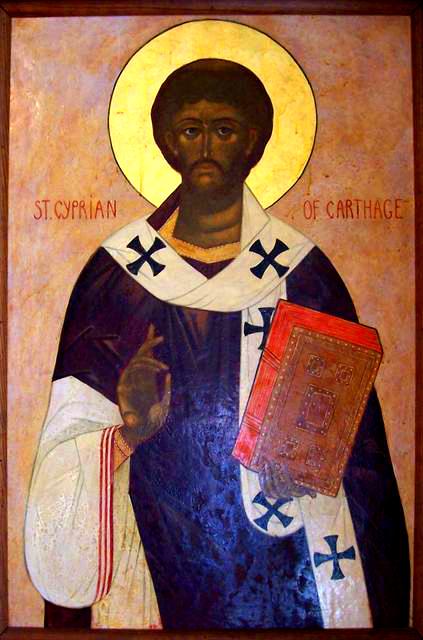
I cannot tell you, how often people tell me things like this: “I used to be an altar boy.” “I used to go to your church.” “I went to St Cyprian’s School” “I’m old St Cyprian’s. Our family goes way back; my Grandfather helped build the place!” I think I’m supposed to be impressed, but instead I ask, “Where are you today?” Usually they aren’t anywhere at all. If so I often respond with something like this: “You’re telling me that you used to have your lamp trimmed and burning, but it sounds like you’ve run out of oil. Watch out, the Day is drawing nigh!”
The point is that only those who were ready with their lamps trimmed and burning when the groom arrived were allowed to entered the wedding with him. After that, the door was barred. We must be faithful unto the end. Jesus says, He who perseveres to the end will be saved (Matt 24:13). Scripture also says, Call no man blessed till he die. For it is by his end that a man is known (Sirach 11:28).
Persevere. It’s wonderful that you read the entire Bible when you were in high school, but where are you today? Where will you be at midnight?
The third principle of proper preparation is to persevere in your preparations.
IV. Procrastination is Perilous – The text says, While [the five foolish virgins] went off to buy [the oil], the bridegroom came … those who were ready went into the wedding feast with him. Then the door was locked. Afterwards the other virgins came and said, “Lord, Lord, open the door for us!” But he said in reply, “Amen, I say to you, I do not know you.” Therefore, stay awake, for you know neither the day nor the hour.
In the end, our wisdom goes with us or our foolishness catches us. The foolish virgins scrambled at the end to get what they needed, but it was too late. The door was barred.
One physical explanation for this detail may be found in the fact that houses of the ancient world were often rather small, but backed out onto a closed courtyard. Hence, when all the guests had arrived, the doors of these small houses were close and the furniture moved up against the walls and the door to make room as the celebration began. To move everything to open the door was problematic, and it was rude to ask for this.
It was just too late for them. Yes, procrastination is perilous.
Two things call for our special attention:
First, there are the words of the Lord, “I do not know you.” The Greek word here is οἶδα (oida) which bespeaks a kind of intellectual knowing. It may surprise us to hear the omniscient Lord say that He does not know them. Perhaps we can understand the word as meaning that He does not “recognize” them as guests; they are not on the guest list. Or, to use another metaphor, they are not among the sheep of His flock. Later in this same chapter of Matthew Jesus will speak of dividing the sheep from the goats. Hence there is a judgment issued here: I do not recognize you as one of my flock; the door cannot be opened; it is too late. But how did it get to be so late and what does it mean that the door is barred?
This leads us to the second point that demands our attention. It is said that the foolish virgins are knocking on the door, or at least calling out, asking for entrance.
But this precisely backward. It is not we who knock, but the Lord. It is He who bids us to open and we who must answer. Jesus says, Here I am! I stand at the door and knock. If anyone hears my voice and opens the door, I will come in and eat with him, and he with me (Rev 3:20). It is the Lord who calls, It was I who chose you (Jn 15:16).
The way to heaven is not through some door “up there.” It is through the door down here, the door that we must open, the door of our heart. The Lord is knocking now. Procrastination is peril; it is foolishness. Now and every day, we must answer the knock. The choice is ours. Yes, the door to Heaven is opened from the inside of our heart. It is we who ultimately determine our destiny. At the judgment, the Lord merely ratifies our decision.
The Lord wants to know us, to recognize us as His own. That is why He knocks and knocks. Will you answer?
Be careful, the fourth principle of proper preparation realizing that procrastination is perilous. There comes a day when the door is forever closed. Remember, the door is your heart. Answer! Open!
Words can change meaning over time—sometimes dramatically. For example, “manufactured” originally meant “handmade” (manu (hand) + facere (make)). The word “decimate” used to mean “to reduce by a tenth” (decem = ten); now people usually use it mean “to wipe out completely.” The list of examples could go on and on. Yes, words do change meaning over time.
One word that has changed meaning dramatically over time is “nice.” Today it is an overused word that usually means pleasant, kind, or easygoing: “Stop fighting and be nice now!”
But the adjective “nice” once meant anything but nice in the modern sense. Rather, it was a derogatory word used to describe a person as something of a fool.
The word “nice” comes from the Latinnescius, meaning “ignorant, unaware” (ne (not) + scire (know)). The Old French word “nice” (12th century) also came from this Latin root and meant “careless, clumsy, weak, simple, foolish, or stupid.”
In the 13th century, “nice” meant “foolish, stupid, or senseless.” In the 14th century, the word started to morph into meaning “fussy.” In the 15th century it meant “dainty, delicate.” By the 18th century it shifted to meaning “agreeable, delightful.” And by the 19th century it had acquired its current connotation of “kind and thoughtful.”
The word “nice” has certainly had a tortured history!
Given its older meaning of “ignorant, stupid, or foolish,” it is not surprising that the word “nice” is used only twice in the Douay-Rheims Bible, (which was published in the 16th Century) and in both cases the word is used pejoratively:
“The man that is nice among you, and very delicate, shall envy his own brother, and his wife, that lieth in his bosom,” [Deuteronomy 28:54]”
But to pursue brevity of speech, and to avoid nice declarations of things, is to be granted to him that maketh an abridgment.”[2 Machabees 2:32]
In the first quote “nice” is likened to an effeminate or dainty man. In the second quote brevity is commended to avoid “nice” (unkowning, erroneous or stupid) speech. So “nice” was not a nice word in the 16th Century.
Today the word can have a meaning that is properly praiseworthy and is basically a synonym for “good.” For example, one might comment, “That was a nice distinction you made.” Or, observing a sporting event, one might say, “That was a nice move!”
However, I am also convinced that the word “nice” is beginning to return to its less noble meanings. This takes place when it is used in a reductionist manner that seeks to simplify the entire moral life to being “nice.” Here, nice is used in the sense of being pleasant and agreeable. To the modern world, in which “pseudo-tolerance” is one of the only “virtues” left, being nice is about the only commandment left. It seems that much will be forgiven a person just so long as he is “nice.” And little will be accepted from a person who is not thought of as “nice.”
I suppose niceness has its place, but being nice is too akin to being harmless, to being someone who introduces no tension and is most often agreeable. As such, a nice person is not so far away from being a pushover, one who is easily manipulated, silenced, and pressured into tacit approval. And thus “nice” begins to move backward into its older meanings: dainty, agreeable, weak, simple, and even further back into weak, simple, unaware, and ignorant.
The pressure to “be nice” easily translates into pressure to put a dumb grin on your face and pretend that things are great even when they’re not. And to the degree that we succumb to this pressure, we allow those who seek to shame us if we aren’t nice get to watch with glee as we walk around with s dumb grin. And they get to think of us, “What an ignorant fool. What a useful idiot.” And thus “nice” takes up its original meaning.
We follow a Lord who was anything but a harmless hippie, or a kind pushover. He introduced tension, was a sign of contradiction, and was opposed by many because he didn’t always say and do pleasant things. Not everything he said was “nice.” He often used strong words: hypocrites, brood of vipers, whitewashed tombs, murderers of the prophets, and evildoers. He warned of judgment and Hell. He spoke in parables about burning cities, doom, destruction, wailing and grinding of teeth, and of seeing enemies slain. These are not kind words, but they are loving words, because they seek to shock us unto conversion. They speak to us of our true state if we remain rebels. Jesus certainly didn’t end up nailed to cross by being nice in any sense of the word.
In the end, “nice” is a weird word. Its meaning has shifted so many times as to be practically without a stable meaning. Today it has further degraded and increasingly returned to its original meaning. Those who insist on the importance of being “nice” usually mean it for you, but not for themselves. They want to have you walk around with a silly grin on your face, being foolishly pleasant, while they laugh behind your back.
To be sure, being “nice” in its best modern sense has its place. We surely should not go around acting like a grouch all day. But just as being nice has its place, so does being insistent, bold, and uncompromising.
On this Feast of All Souls, I want to reflect on Purgatory as the necessary result of a promise. Many people think of Purgatory primarily in terms of punishment, but it is also important to consider it in terms of promise, purity, and perfection. Some of our deceased brethren are having the promises made to them perfected in Purgatory. In the month of November we are especially committed to praying for them and we know by faith that our prayers are of benefit to them.
What is the promise that points to Purgatory? Simply stated, Jesus made the promise in Matthew 5:48: You, therefore, must be perfect as your Heavenly Father is perfect. In this promise is an astonishing declaration of our dignity. We are to share in the very nature and perfection of God. This is our dignity: we are called to reflect and possess the very glory and perfection of God.
St. Catherine of Siena was gifted by the Lord to see a heavenly soul in the state of grace. Her account of it is related in her Dialogue, and is summarized in the Sunday School Teacher’s Explanation of the Baltimore Catechism:
The Soul in the State of Grace– Catherine of Siena was permitted by God to see the beauty of a soul in the state of grace. It was so beautiful that she could not look on it; the brightness of that soul dazzled her. Blessed Raymond, her confessor, asked her to describe to him, as far as she was able, the beauty of the soul she had seen. St. Catherine thought of the sweet light of that morning, and of the beautiful colors of the rainbow, but that soul was far more beautiful. She remembered the dazzling beams of the noonday sun, but the light which beamed from that soul was far brighter. She thought of the pure whiteness of the lily and of the fresh snow, but that is only an earthly whiteness. The soul she had seen was bright with the whiteness of Heaven, such as there is not to be found on earth. ” My father,” she answered. “I cannot find anything in this world that can give you the smallest idea of what I have seen. Oh, if you could but see the beauty of a soul in the state of grace, you would sacrifice your life a thousand times for its salvation. I asked the angel who was with me what had made that soul so beautiful, and he answered me, “It is the image and likeness of God in that soul, and the Divine Grace which made it so beautiful.” [1].
Yes, this is our dignity and final destiny if we are faithful to God.
So, I ask you, “Are you there yet?” God has made you a promise. But what if that promise has not yet been fulfilled and you were to die today, without the divine perfection you have been promised having been completed? I can only speak for myself and say that if I were to die today, though I am not aware of any mortal sin, I also know that I am not perfect. I am not even close to being humanly perfect, let alone having the perfection of our heavenly Father!
But Jesus made me a promise: You must be perfect as the heavenly Father is perfect. And the last time I checked, Jesus is a promise keeper! St. Paul says, May God who has begun a good work in you bring it to completion (Phil 1:6). Hence, if I were to die today, Jesus would need to complete a work that He has begun in me. By God’s grace, I have come a mighty long way. But I also have a long way to go. God is very holy and His perfection is beyond imagining.
Yes, there are many things in us that need purging: sin, attachment to sin, clinging to worldly things, and those rough edges to our personality. Likewise most of us carry with us hurts, regrets, sorrows, and disappointments. We cannot take any of this with us to Heaven. If we did, it wouldn’t be Heaven. So the Lord, who is faithful to His promise, will purge all of this from us. The Book of Revelation speaks of Jesus ministering to the dead in that he will wipe every tear from their eyes (Rev 21:4). 1 Corinthians 3:13-15 speaks of us as passing through fire in order that our works be tested so that what is good may be purified and what is worldly may be burned away. And Job said, But he knows the way that I take; and when he has tested me, I will come forth as pure gold (Job 23:10).
Purgatory has to be—gold, pure gold; refined, perfect, pure gold. Purgatory has to be, if God’s promises are to hold.
Catholic theology has always taken seriously God’s promise that we would actually be perfect as the Father is perfect. The righteousness is Jesus’ righteousness, but it actually transforms us and changes us completely in the way that St. Catherine describes. It is a real righteousness, not merely imputed, not merely declared of us by inference. It is not an alien justice, but a personal justice by the grace of God.
Esse quam videri – Purgatory makes sense because the perfection promised to us is real: esse quam videri (to be rather than to seem). We must actually be purged of the last vestiges of imperfection, worldliness, sin, and sorrow. Having been made perfect by the grace of God, we are able to enter Heaven, of which Scripture says, Nothing impure will ever enter it (Rev 21:27). And again, you have approached Mount Zion and the city of the living God, the heavenly Jerusalem, and countless angels in festal gathering, and the assembly of the firstborn enrolled in heaven, and God the judge of all, and the souls of the just made perfect (Heb 12:22-23).
How could it be anything less? Indeed, the souls of the just made perfect. How could it be anything less if Jesus died to accomplish it for us? Purgatory makes sense based on Jesus’ promise and on the power of His blood to accomplish complete and total perfection for us. This is our dignity; this is our destiny. Purgatory is about promises, not mere punishment. There’s an old Gospel hymn that I referenced in yesterday’s blog for the Feast of All Saints that says, “O Lord I’m running, trying to make a hundred. Ninety-nine and a half won’t do!”
That’s right, ninety-nine and a half won’t do. Nothing less than a hundred is possible because we have Jesus’ promise and the wonderful working power of the precious Blood of the Lamb. For most, if not all of us, Purgatory has to be.
Today is the Feast of All Saints. Some saints of the Church have a particular day on the calendar associated with them and are commonly recognized by name. Many more, though not as familiar to us, are still known by God and have been caught up with Him to glory. Today is their day, the day of the countless multitude who have made it home to glory by God’s grace and by their “Amen” to the gracious call of God. Let’s consider these saints under three headings, based on today’s readings.
Their Privileged Place: The first reading today, from Revelation, speaks to us of saints: from every nation, race, people, and tongue. They stood before the throne and before the Lamb, wearing white robes and holding palm branches in their hands. They cry out in a loud voice, “Salvation comes from our God, who is seated on the throne, and from the Lamb.”…They prostrated themselves before the throne, worshiped God, and exclaimed, “Amen. Blessing and glory, wisdom and thanksgiving, honor, power, and might be to our God forever and ever. Amen.”
Note how liturgical the description is.In fact, the most common way that Heaven is described is in liturgical imagery. The liturgy is a kind of dress rehearsal for Heaven. To those who claim that Mass “boring,” this description can be challenging.
Indeed, many people today have rather egocentric notions of Heaven.Heaven is a place where Iwill be happy, where Iwill see myfamily, where Iwill take leisure. Iwill have mymansion; Iwill no longer get sick; Ican play all the golf I want. Heaven is a “better place,” but this better place is generally understood in personal terms; it’s a kind of designer Heaven. But Heaven is what it is, not what we want or conceive it to be.
At the heart of the real Heaven is being with God,looking upon His glorious face and thereby having all our inexpressible longings satisfied. In Heaven, the saints behold the glorious face of God and rejoice. It is their joy to praise Him and to rejoice in His truth, goodness, and beauty.
Note, too, the sense of communion of the saints with both God and one another.The biblical portraits are of a multitude, a vast crowd. The biblical way to understand the multitudes in Heaven is not to envision physical crowding but rather deep communion. In other words, the Communion of Saints is not just a bunch of people standing around chatting.
St. Paul teaches, So we, who are many, are one body in Christ, and individually members, one of another(Rom 12:5). Although we experience this imperfectly here on earth, we will experience it perfectly in Heaven. As members of one another, we will have profound communion, knowing and being known in a deep and rich way. Your memories, gifts, and insights will be mine and mine will be yours. There will be profound understanding and appreciation, a rich love, and sense of how we all complete one another and are one in Christ.
Imagine the glory of billions of new thoughts, stories, and insights that will come from being perfectly members of Christand of one another. Imagine the peace that will come from understanding and being understood. This is deep, satisfying, wonderful communion—not crowds of strangers.
St. Augustine had in mind the wonderful satisfaction of this deep communion with Godand one another in Christ when he described Heaven as Unus Christus amans seipsum (One Christ loving Himself). This is not some selfish Christ turned in on Himself. This is Christ, the Head, in deep communion with all the members of His body. This is all the members in Christ experiencing deep, mystical communion with Him and one another, all swept up into the life of the Trinity. Again, as St. Paul says, and you are Christ’s, and Christ is God’s(1 Cor 3:23).
TheirPrize of Perfection: The second reading, from the First Letter of John, says, Beloved, we are God’s children now; what we shall be has not yet been revealed. We do know that when it is revealed we shall be like him, for we shall see him as he is.
We cannot even imagine the glory of the saints in Heaven. Our Heavenly Father once told St. Catherine that if she were ever to see a saint in his or her transformed heavenly glory, she would fall down and worship because she would think she was looking at God Himself.
This is our future, if we are faithful. We will reflect the glory of God and be transformed by the look of love and glory. Just one look, and oh, the glory we will reflect, God’s very own glory!
I gotta make a hundred; ninety-nine and a half won’t do. When God is through with you and me, oh, the glory!
The Picture to Ponder: The Gospel today (the Matthean beatitudes) sets forth a portrait of sanctity. The beatitudes are the description of the transformed human person; they describe what happens to us as Jesus begins to live His life in us through the Holy Spirit.
This picture is not one that merely waits for Heaven; it is one that is true of us even now as we grow into the likeness of Christ.
I have written more on the beatitudes hereand here. For the purpose of today’s feast, we need to acknowledge that a beatitude isnot something we do but rather something we receive. A beatitude declares an objective reality as the result of a divine act.
The present indicative mood of the beatitudes should be taken seriously. They should not be interpreted as imperatives of exhortation, as though Jesus were saying, “Start being meek and thenGod will bless you.” Rather, He is saying that when the transformative power of the cross brings about in us a greater meekness, poverty of spirit, and so forth, we will experience that we are being blessed.
Beatitude is a work of God and results when we yield to His saving work in us. We are blessed when we accept and submit to the work that God alone can do. With this understanding, we see the beatitudes not as a prescription of what we must do per se, but as a description of a human being whom Jesus Christ is transforming into a saint! And this transformation is a growing, stable, deep, and serene beatitude and holiness.
Therefore, today’s feast of all saints does not merely point to the completed saints in Heaven, but to us who would be saints, not just someday in the future but beginning now and in increasing degree.
At the end there will be saints and ain’ts. Which do you choose? As for me, ninety-nine and a half won’t do. I gotta make a hundred.
There is an old saying, “Stop telling God how big your storm is and start telling the storm how big your God is.” In other words, we often need to shift our focus, building up our trust and confidence. Because we are so wired for fear, we tend to overestimate the power and shrewdness of demons, or of our enemies, or of whatever it is we fear. At the same time, we tend to underestimate the power of God, the power of our own resources, the strength that God gives us, and the perduring quality of what is good and true.
As we head into what is certain to be a difficult and contentious week (weeks?) ahead we need to draw close to God and trust him, whatever the outcome. There are clearly high stakes in this election but God is not overcome. Whether in verdant pastures he leads us, or through the Valley of the Shadow of Death, the point is that he leads us.
Whatever our current conflicts, they are caught up into a bigger conflict where we all have a common enemy: satan. St Paul speaks to this in a reading from Thursday of the this 30th Week of the year:
Draw your strength from the Lord and from his mighty power. Put on the armor of God so that you may be able to stand firm against the tactics of the Devil. For our struggle is not with flesh and blood but with the principalities, with the powers, with the cosmic rulers of this present darkness,with the evil spirits in the high places. (Eph 6:10-11)
Yes there is a cosmic battle that gives birth to our worldly ones. Our truest and common enemy is not one another one another, “flesh and blood” as Paul writes, but it is Satan and his minions. Sadly we allow them to divide us and so a battle rages now in our culture, full of wrath and loud shouting.
In the stormy days to come, of our own making and also of Satan’s making, stay very close to God. Be also encouraged by a remarkable passage in the Second Book of Kings that draws back the curtain for a moment and shows us a world we seldom see. The passage centers on the prophet Elisha and the King of Syria’s attempt to capture and kill him. Elisha is not worried, but his young assistant (or servant) is quite dismayed by the approaching Syrian army:
When the servant of the man of God rose early in the morning and went out, behold, an army with horses and chariots was all around the city. And the servant said, “Alas, my master! What shall we do?” He said, “Do not be afraid, for those who are with us are more than those who are with them.” Then Elisha prayed and said, “O Lord, please open his eyes that he may see.” So the Lord opened the eyes of the young man, and he saw: And behold, the mountain was full of horses and chariots of fire all around Elisha (2 Kings 6:15-17).
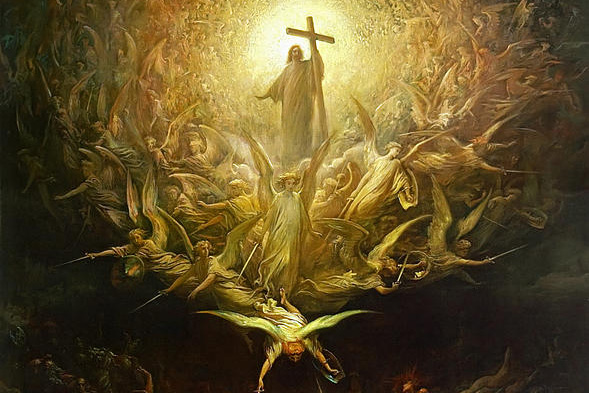
Yes, for just a moment the mystical curtain is drawn back, and the young servant of Elisha sees that we are not alone in this battle. Indeed, myriad angels, saints, and God Himself engage the battle for us. Elisha reminds us, Those who are with us are more than those who are with them. God’s power far surpasses whatever foolishness of the devil is making the rounds. At times, the city seems surrounded (as Elisha’s servant saw), but Elisha isn’t worried because he sees something else, something far greater and more glorious; he knows where to focus.
To be sure, there is a battle to be fought, but we do not fight it alone. There are a multitude of angels and saints and behold, chariots of fire round about. Lord open our eyes that we may see and understand that we are not alone. Give us the courage to engage the battle with the sword of your word, of your truth! Fix our focus on You, not on the storms of life.
This song in the video below says,
When the oceans rise and thunders roar
I will soar with you above the storm
Father you are king over the flood
I will be still and know you are God
Find rest my soul
In Christ alone
Know his power
In quietness and trust
The first reading from Wednesday’s Feast of Simon and Jude presents a key feature of the apostolic mission of the Church; it also provides an interesting word study. Here are the key verses:
You are no longer strangers and sojourners, but you are fellow citizens with the holy ones and members of the household of God, built upon the foundation of the Apostles and prophets, with Christ Jesus himself as the capstone (Ephesians 2:19-20).
The highlight of this passage is bringing people out of the status of strangers and sojourners and into the household of God, the Church. There are two Greek words that merit some of attention, and one of them paints a kind of picture of the work of every parish.
The Greek word translated as “strangers” is ξένοι (xenoi). Its primary meaning is “foreigners,” people from somewhere else. It is the root of the English word “xenophobic,” which refers to a fear of foreigners. For our purposes in this verse, the word just refers to those from far away. The word paints a picture of the catholicity of the Church, which is to include people from all nations, both near and far. The mission of the Church is unto all the nations so as by faith and Baptism to get them into the Church, which is the household of God.
The Greek word translated as “sojourners” is πάροικοι (paroikoi). While this translation is not inaccurate, it misses the subtleties of the Greek. There are two Greet roots: pará (close or beside) and oíkos (house). So, it means someone living close by. This is where the English words parochial and parish come from.
Thus, the Greek presents a kind of picture of what a parish is. It is a Church with people living nearby. Parishes have boundaries and the pastor and people are responsible for all the people inside their boundaries: all the people, not just the Catholics! So, the job of the parish (parochia in Latin) is to care for and evangelize all the people living nearby, all those inside its boundaries. The mission of a parish is, to use St. Paul’s image, to get those living nearby into the Household of God (the Church).
This, then, is the apostolic mission of the Church: to bring people from near and far into the Household of God, which is the Church solidly standing on the foundation of the Apostles with Christ as the great cornerstone or keystone on which all lean. These two Greek words present a kind of word picture that can assist us in perceiving our mission near and far!