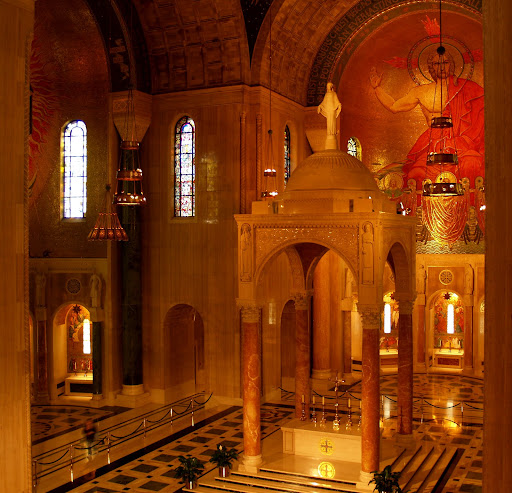
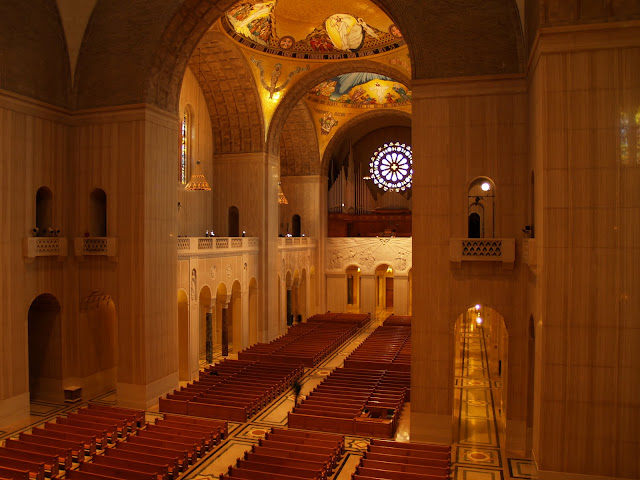
On Friday I was permitted to go up into the Clerestory level of the Basilica of the National Shrine of the Immaculate Conception here in Washington. I brought my camera and took some unique photos of the Basilica. I am posting a few of them here but you can see the rest of what I took here: Clerestory Views. I think they turned out pretty well considering that very few lights were on in the Basilica. I had to open the lens wide and give lengthy exposure to each shot but in the end I think they turned out well. Thanks to TJ Dhanagom and Msgr. Rossi for the privilege of ascending to the clerestory.
I’ll admit that I struggle with the concept of “civility.” I keep it as a very firm rule for myself. I try to be clear but also charitable in what I say. I also try to avoid “ad hominem attacks” which are attacks on the person rather than the argument. I also try to avoid assigning motive when the motive is not clear to me.
But I also admit that there is a great deal of variability in what people consider civil discourse. In some cultures there is a greater tolerance for anger. I remember dating an Italian girl for a brief time back in college. I remember being at her house and how she and her mother could really go at it with a heated debate (usually in Italian – Mama Mia!). But no sooner had they very intensely argued over some particular, say of preparing the meal, than they were just fine, as if nothing had happened. Angry discourse was more “normal” for them. Even in this country there are regional differences about civility. In New York and Boston, edgy comments and passionate interruptive debate are common. But in the upper midwest and parts of the deep south conversation is more gentle and reserved. At the time of Jesus angry discourse was apparently quite “normal” for Jesus himself engages in a lot of it, even calling them names like, “Hypocrites.” “Brood of Vipers,” “Liars,” “Wicked” etc. Yet, the same scriptures that record these facts about Jesus teach that he never sinned. Hence, at that time such terms were not considered sinful to utter and must not have been since I am a firm believer that Jesus never sinned. Jesus even engaged in prophetic actions like overturning the tables in the temple courts. No one said he’d done wrong, they just wondered where he got the authority to do this (cf Mark 11:28). In that culture prophets did things like this. No one liked it, but just like our culture tolerates some degree of civil disobedience, even reveres it, Jesus’ culture expected things like this from prophets. Now be careful here. I am not saying it is OK for us to talk like this because Jesus did. We do not live then, we live now and in our culture such dialogue is almost never acceptable. There ARE cultural norms we have to respect to remain in the realm of Charity.
So there seems to be a lot of variability in the concept of civility and civil discourse. In general our culture seems to prefer a gentler style of discourse, with the regional variability I have already mentioned taken into consideration. But we have recently been through a very tough Healthcare debate (battle?) in which the discourse went beyond what many think was civil. Over at the USCCB blog is a posting which raises concerns about it. I would like to excerpt it here and add some of my own comments in RED. And as always I’d like to know what you think. (You can read the complete and uninterrupted USCCB Blog post here: USCCB Media Blog) Meanwhile here are my excerpts and comments.
The heat in the aftermath of passage of health care reform reveals the depth of feeling among those for and against the landmark bill that affects all Americans. Such heat, however, cannot justify the verbal and physical violence that has ensued.
If we needed health care because of the crisis affecting the sick, especially the weakest among us, we need even more a move toward civility, if not for our own betterment then at least for the betterment of our children.
Politics has become a kind of blood sport. News junkies over the weekend heard reports of crowds shouting racist remarks and individuals spitting at African American lawmakers, including John Lewis, who suffered violence years ago when he marched for Civil Rights. Surely he – and all of us – has a right to expect that that chapter of despicable, racist violence long over. This event is not verified or recorded in any of the video from that day. At best it is a story that is going around that we can only hope is untrue. It is reported that Congressman John Lewis did mention hearing some slurs but did not clearly indicate if they were racial slurs or what. Further it is not certain how many, if any, engaged in this behavior. Was it one, many, etc. It is not certain. If it did happen it is reprehensible. But likely it involved just one or a few. I do think we have made a lot of progress in this area and that such behavior is not tolerable in our society. The vast majority of those who were against the bill would surely and adamantly agree that any such behavior in this regard was unacceptable. John Lewis is surely a hero of the Civil Rights Movement. What ever variability there may be in how people size up civility, racial slurs and spitting are beyond any one’s tolerance.
We’ve seen reports of homes and offices of lawmakers vandalized and heard of death threats. Anonymous messages are being left on voicemails – I even got one from a nun, for goodness sake. If that isn’t proof that we’ve gone astray I don’t know what is.Yes, and for the record this happened on both sides of the debate. Congressman Stupak, interviewed on NBC news indicated receiving threats from pro-choice people when he was holding out due to abortion funding. After the vote the threats switched to the pro-life side! Alas, here too we can only hope that those who make such threats are in the vast minority. It is true however that threats of this nature are a regular part of the lives of public figures, not just politicians, but also media personalities, movie and sports figures, and others.
The wonderfully unedited Web may share some blame as it gives free reign to those who say whatever suits their strategic purpose, truthful or not. Their presentations – usually anonymous – underscore a significant failing of the Web, lack of editors and accountability.Ah and here is where it comes home my friends. What is said here has a lot of truth. The anonymous quality of many who participate can lead to much higher levels of unkindness and inaccuracy. If no one know who I am I can say just about anything. In general our discourse at this blog has been civil but we have had our moments. The impersonal quality of a lot of the communication can lead to a kind of forgetfulness that a real person, or person is on the ther side of the screen. Further, writing does not always allow the nuance of the spoken word and personal interaction where tone of voice and facial expression can often supply clarifying data that one is speaking ironically, or facetiously, or just in good fun. True we do have our “emoticons” like 🙂 and 😉 and LOL! that help but we have to be very careful when we write to remember that much data is lost when the word is only written. Accuracy is also a bit of a problem when the writer is anonymous for they are less concerned with their reputation and will more likely say inaccurate things that they would otherwise have to verify. Hence our reserve to speak about things we are not sure of is diminished.
The intolerance and incivility did not begin with legislation passed Sunday night. It is not unrelated to the divisions that exist in our country and, sadly, even in our church. Yes, how we Catholics speak to each other needs further reflection. It has been my experience that most Catholics are far more passionate about their politics that their faith. This is sad but it also affects the way we speak to one another. We often use political terminology such as right/left; conservative/liberal which may not well apply to the Church settings. I fielded a lot of remarks in the past week accusing the Bishops of being lap dogs for the GOP etc. But I guarantee you when it comes to immigration reform or capital punishment, that others accuse them of being “lap dogs” for the Democrats. What if they were neither? What if they were Catholic and trying to articualte Catholic principles in a polarized world? What seems to happen is that we take a lot of our politics into the Church with us. To be sure there are some very serious divisions in the Church that need often frank discussion and cannot reduce to a “Can’t we all just get along” mentality. Finding the balance is not always easy.
It starts with how we view others – as enemies rather than as fellow travelers on the journey of life. It includes whether or not we’re willing to give another the benefit of the doubt, accepting that their intentions are good, even if their goals differ from ours. It involves accepting the fact that each of us is a child of God and precious to Him and our brother or sister. – Well said.
Last Tuesday, March 23, Cardinal Francis George, president of the United States Conference of Catholic Bishops, noted the bishops’ disappointment that the health reform legislation did not include all they sought….Even in disappointment, the bishops were civil and generous. Their position is worth emulating.
[There is] a maxim attributed to St. Augustine, “In essentials, unity, in non-essentials diversity, in all things charity.” In all things charity surely is the message we all need today. It’s not a bad start to Holy Week.
So, there it is. How exactly to define civility in every instance is not always clear. An old answer to these hard to define things is “I know when I see it.” So perhaps it is more art than science to define civility But it is clearly getting edged out, to be sure. In an era when shared values and reverence for a shared and immutable truth have been largely jettisoned what we end up with is power struggle. Such a scenario is usually ugly.
In the Black Community where I minister there is an expression, “Now don’t go and make me lose my religion!” What it usually means is that we can get so wrapped up in our anger and frustration that we cast off charity, which is the highest call of our faith. We need to check ourselves occasionally. In a world increasingly hostile, where do we stand? It may be true that, as we discussed above, there are some cultural differences when it comes to what is acceptable in discourse. But in the end charity and civility cannot be wholly cast aside. Say what you mean, mean what you say, but don’t say it mean. And whatever you do make sure you don’t lose your religion! 🙂
Here is a video I have posted before showing the “angry” style of Jesus culture. He is no wilting flower here nor are his listeners shy about expressing their opinion. Our culture is not generally very accepting of such discourse.
Some people say that if they could see they would believe. But seeing is not believing, seeing is only seeing. Scripture says Faith is the realization of what is hoped for and evidence of things not seen (Hebrews 11:1). It also says Although you have not seen him you love him; even though you do not see him now yet believe in him (1 Peter 1:8). It is true that Jesus says to Thomas, You believe in me Thomas becuase you have seen me, but blessed are those who have not seen and yet have believed. Yet as both St. Gregory (Homilia26) and St. Thomas Aquinas (II, IIae 1.4) point out, Thomas saw one thing and believed another. He saw the man which required no faith, but confessed Jesus to be Lord and God which required faith and cannot be “seen.” So again, as Scripture says, We walk by faith and not by sight (2 Cor 5:7)
And yet many people often say, if only I could have been alive and have seen Jesus workmiracles, I would believe more. Maybe, maybe not, because seeing is only seeing. Seeing even impossible things doesn’t necessarily make a person believe. Consider the video just below. What you will see in it will look impossible. And yet it is happening before your very eyes. I have been to live magic shows and seen the same thing. People seem to vanish into thin air or instantly change appearance. Is it a miracle or just some fancy illusion? Most people, even upon seeing what looks like it can only be a miracle, usually conclude that it is a trick or that there is “some way they do that.”
Now remove these magicians in the video and go with me back in time as Jesus works a miracle. Presume for a moment that you’ve never met Jesus or heard of him. Yet watch him cast out blindness or enable a paralyzed man to walk. Is it a miracle, or is it a clever trick? Should you really believe his claims to be from God and to be God based on these wonderful works? Has Jesus staged this well or is he really the Son of God? You see? It still takes faith doesn’t it? Simply seeing miracles isn’t enough. You just can’t substitute for faith, it is an absolute requirement to accept who Jesus is. Miracles can help but seeing is not believing, it’s only seeing. In the end you have to decide: fancy trick or real miracle? Son of God or just a skilled illusionist?
Remember too, Jesus did not work miracles to “cause” faith but to confirm it. When faith was lacking Jesus did not work miracles. For example it is said of him when he was in Nazareth, He could work no miracles there except to cure a few sick, so much did their lack of faith disturb him. (Mk 6:5). Further, Jesus would often inquire of a person’s faith or draw it out before working a miracle (eg. Mat 9:28; Jn 11:26; Mat 15:27; Matt 8:10; inter al.) In the end miracles are not the cause of faith, they are the result of it. Likewise, seeing is not the cause of faith but does result from it to some extent. We see many things by faith.
Watch this video and see what look like realmiracles before your very eyes. But pay attention to what your mind does and how quickly you can dismiss the visual evidence. You do not conclude that these people are gods because of what they do. Seeing even fantastic things just isn’t enough. In this case they likely are not miracles, just very well done illusions. But many saw Jesus work wonders which really were miracles and it was not enough. In the end you have to have faith. In other words, some people think if only God would work miracles in their life, they could believe. But miracles alone cannot bring faith because seeing is not believing it is only seeing.
Cumulative evidence can bring us to accept God’s existence as a reasonable proposition but only faith can really lead us to believe all that God has said. Pray for the gift of faith and you will see miracles, and more!
We are in the heart of Lent but for one day we step back into the Christmas cycle. It is nine months before Christmas and today we celebrate the true feast of the Incarnation. December 25 is the Lord’s birth but today is His incarnation as he is conceived in his Mother’s womb. TODAY the Word becomes flesh.
This needs to be emphasized in an age of abortion where some in our culture deny explicitly or implicitly that human life begins at conception. You are aware that a new translation of the Mass will soon come to us in the English speaking world. It is long needed and treasures of the faith kept hidden for long decades (except for those know Latin) will become visible again.
Among the most egregious errors of the current English version is in the Creed which erroneously indicates that Jesus became man at his birth, rather than his conception. Here is what the current version says:
For us men and our salvation He came down from heaven: by the power of the Holy Spirit, He was born of the Virgin Mary , and became man.
Notice that the text says he became man when he was born. As a poor translation of the Latin text it is irritating enough but to have this mistranslation exist when abortion is thought a legal right is a complete disaster. The Latin text does not say that Jesus became man at his birth (celebrated December 25), but rather at His incarnation (celebrated March 25). Here is what the the Latin text says:
Qui propter nos homines et propter nostram salutem descendit de caelis. Et incarnatus est de Spiritu Sancto ex Maria Virgine, et homo factus est.
The New Translation which will be implemented in a little over a year renders it correctly in the following way:
For us men and for our salvation he came down from heaven, and by the Holy Spirit was incarnate of the Virgin Mary, and became man.
I for one am grateful for the accuracy. The whole translation is going to take some getting used to but it will be of great benefit to see our Holy Faith, so beautifully articulated in the Latin text, properly translated and conveyed at last. Since 1970 the text has been really little better than a paraphrase and so much is lost. This mistranslation of the Creed is but one of ten thousand examples where the current translation is woefully inaccurate and/or incomplete. But surely the mistranslated Creed is most egregious for the reasons stated.
A final thought on this section of the Creed – The Bow. The Congregation is instructed to bow at the words: and by the Holy Spirit was incarnate of the Virgin Mary, and became man. This is in recognition of the great mystery that the incarnation is. How can God, whom the very heavens cannot contain dwell in the womb of the Virgin Mary? How can the infinite become an infant? It is a mystery too great and so we bow in reverence. In the Traditional Latin Mass the practice is to kneel at these words. Such was the practice until about 1970 when it was replaced by a bow. Personally I think we Americans are terrible at bows and would be happy if the genuflection returned. In other cultures bowing is graceful and natural. For most of us here it is awkward and usually lacks proportional and graceful movement. But bow we are told and bow we should. One ought to fold the hands and bow at the waist. Think of your waist as the hinge, not the neck and shoulders which should not move in proportion to the shoulders. The bow is a reverent acknowledgment of the mystery of the Incarnation we celebrate today. Interestingly enough there are still two days in the year when we still kneel at the words of the incarnation. We kneel and pause at these words on Christmas and today, March 25, The Feast of the Annunciation. Otherwise we bow, as gracefully as possible 🙂
I am curious if you bow at these words in the Creed and if it is common in your parish. Does your clergy bow, do they teach others to do so? Just asking!
It is tragic to me as a Catholic priest that many parents bring their children to baptism but nothing else and think all the while that they have done all that they should. Almost as though baptism was no more than a flu shot: Take it and forget it. As you might imagine I am very firm in my pre-baptismal catechesis to rebuke such a notion.
Baptism is the beginning, not the end: Let me ask you, is it enough to give birth to a child and think your work is over? Hah!…It has just begun! We cannot simply bring children to birth, we have to feed, cloth, teach and care for them for years. It is the same with baptism, we cannot simply think that bringing them to new life in baptism is all that is required. These children need to be taught about God and prayer, nourished on the Eucharist, bathed in confession, strengthened in confirmation, fed every Sunday at God’s altar, brought to maturity in Christ. Real faith is not about a half-hour ritual many years ago. It begins there but it does not end there. The work for a Catholic parent has just begun. It is a work that is costly and cannot simply be reduced to a half-hour baptismal ceremony.
And if you’re a baptized Catholic don’t tell me that just getting baptized is all it took. If you get born and never eat your life is doomed. If you get born and never grow, learn to walk and talk, never reach maturity, something is terribly wrong. Likewise, if you get baptized and never grow, never feed on the Eucharist, never learn of Jesus Christ and begin to speak of him, something is seriously wrong. You can’t reduce your faith to a simple half-hour ceremony, as though it were simply a flu shot. Real faith costs something, it demands change and effort from us. We have to die, so that Christ can live in us. This is costly.
The Protestant Version- Once Saved Always Saved: Some of the Protestants (but not all!) have a strange and quite unbiblical notion called “Once saved, always saved.” That is, once you get saved, you can never lose that salvation no matter what. Well, I don’t have time to tell you all the biblical texts that such a notion violates but really, tell me if that makes any sense at all. We all know that we can make commitments and sadly walk away from them. But here too, on display is the nation that faith costs nothing more than walking up in a service and saying the “sinners prayer” or some little ritual. No indeed, faith is more costly than that, we are called to give our life to Jesus.
We do not get our faith “on sale.” The kind of work Jesus has to do in our life is not inexpensive or minor. It cost Jesus his life, and, I’ve got news for you, it will cost you your life too. It’s not some simple ritual, not like a simple flu shot. The Catholic Theology of baptism is that we die with Christ and rise with him to new life. Did you hear that? We die. Truth be told, we all have a lot of things to die to: sin, ego, possessions, popularity, greed, resentments, hatred, sensuality and on and on. Give your heart to Jesus but realize, it’s not just some sort of inexpensive, harmless ritual. To embrace our baptism is to die to this world and all its pomp and glory, to die to our ego and all its exaggerated needs.
Watch this video, if you dare, it’s not for the lukewarm. The speaker is a Southern Baptist, Paul Washer. He is rebuking his fellow Baptists some of whom think God’s grace is cheap and can be reduced to a simple altar call or to a “Once saved always saved” notion. But we Catholics do it too. Some of us think all we need are a few rituals and an occasional prayer. But the sacraments are more than this, they are not mere rituals, they are meant to be transformative realities. Sacraments cost Jesus everything, and, if you are serious about them, they will cost you too, and effect a radical transformation that isn’t always easy and costs us something. Faith and the sacraments are more than a flu shot.
The first reading from today’s Mass is an extraordinary moral tale from the Book of Daniel. It is the story of Susanna. The full passage (which is quite lengthy) can be found here: Daniel 13:1-62. Interestingly it is missing from Protestant Bibles which use a truncated version of the Book of Daniel.
It features the story of a beautiful young woman, Susanna, married to a man named Joakim. One day as she is bathing in a private garden two older men who have hidden themselves there out of lust try to seduce Susanna who rebuffs their brazen overture. They threaten to falsely accuse her of having committed adultery with a young man in garden if she does not give way to their desires. She still refuses and they follow through on their threatened lie. They further demand that she should be stoned. Things look bleak for Susanna until Daniel comes to the rescue and, through crafty interrogation, exposes their lie for what it is. The story is a small masterpiece. If you have never read it, you should. In the course of its engaging tale it gives us a kind of anatomy lesson of sin. It is good to consider the teachings here
Anatomy Lesson One: The Cardinal or Deadly Sins lead to other sins– The story powerfully shows how lust, one of the seven cardinal, (a.k.a. capital, or deadly) sins leads to numerous other sins. This is the nature of the seven deadly sins and explains why they are often called Cardinal Sins. In Latin “cardines” means “hinge”. Hence, the seven deadly sins are like hinges on which many other sins “swing.” In this story the deadly sin of lust leads to immodest inquiry, violation of privacy, attempted seduction, unjust accusation, exploitation, lies, oppression, and even to attempted murder. King David too had given way to lust and it led to lies, and ultimately to the murder of Uriah the Hittite by David in which David involved not only himself but his generals. This is what the seven deadly sins do, they lead inexorably to other sins.
Anatomy Lesson Two: The Sequential Sources of Sin. In a remarkable description the story describes a threefold source from which their sins spring forth. The text says: They suppressed their consciences; they would not allow their eyes to look to heaven, and did not keep in mind just judgments. (Daniel 13:9). I’d like to take a look at each of these three sources from which sin springs.
They suppressed their consciences– What is the conscience? The Catechism defines it thus: For Man has in his heart a law inscribed by God, This is his conscience, there he is alone with God whose voice echoes in his depths… (Catechism of the Catholic Church(CCC) # 1776). So in effect the conscience is the voice of God within us. God has written his Law in the hearts of every human person. Thus, in terms of basic right and wrong, we know what we are doing. There may be certain higher matters of the Law that the conscience must be taught (eg. the following of certain rituals or feasts days etc.). But in terms of fundamental moral norms, we have a basic and innate grasp of what is right and wrong. Deep down inside we know what we are doing. We see and salute virtues like bravery, self-control, and generosity. We also know that things like murder of the innocent, promiscuity, theft, destruction of reputations etc are wrong. For all the excuses we like to make, deep down inside we know what we are doing, and we know that we know. I have written substantially about conscience elsewhere (HERE). But notice that it says that they suppressed their consciences. Even though we know something is wrong we often want to do it anyway. One of the first things our wily minds will do is to try and suppress our conscience. To suppress something is to put it down by force, to inhibit or to try and exclude something from awareness or consciousness. The usual way of doing this is through rationalizations and sophistry. We invent any number of thoughts, lies and distortions to try and reassure us that something is really OK that deep down inside we know isn’t OK. We accumulate false teachers and teachings to assist in this suppression of the truth that our conscience witnesses to. St. Paul wrote to Timothy: For the time will come when men will not put up with sound doctrine. Instead, to suit their own desires, they will gather around them a great number of teachers to say what their itching ears want to hear. They will turn their ears away from the truth and turn aside to myths. (2 Tim 4:1-3). It is quite and effort to suppress one’s own conscience and I would argue that we cannot ever do it completely. In fact the whole attempt to suppress the conscience is quite an effort and it is very fragile. This helps explain the anger and hostility of many in the world toward the Church. Deep down they know we are right and often, just the slightest appeal to the conscience to awaken its voice, causes quite an eruption of fear and anger. So here is the first stage in the anatomy of a sin: the suppression of the conscience. In order to act wickedly and not face deep psychological pain of significant guilt these men in the story first suppress their conscience in order to shut off the source of that pain. Step one is underway.
they would not allow their eyes to look to heaven– In order to sustain the fictions, stinking thinking, rationalizations, and sophistry necessary to suppress the conscience it is necessary for one to distance himself from the very source of conscience, God himself. One way to do this is to drift away from God though neglect of prayer, worship, study of the Word of God and association with the Church which speaks for God. Drifting away may become more severe as times goes on and the refusal to repent becomes deeper. Drifting soon becomes absence and absence often becomes outright hostility to anything religious or biblical. Another way that some avert their eyes from heaven is to redefine God. The revealed God of Scripture is replaced by a designer God who does not care about this thing or that. “God doesn’t care if I go to church, or shack up with my girlfriend etc.” On being shown scripture quite contrary to their distorted notions of God they simply respond that Paul had hangups, or that the Bible was written in primitive times. But the cumulative effect is that they are no longer looking to heaven or to God, but rather to a fake God, a false kingdom, an idol. Either way, the purpose is for the individual to isolate and insulate themselves from God and what he reveals. This makes it easier to maintain the rather exhausting effort of suppressing their conscience. So for these men step two in engaged and it further supports the suppression of conscience necessary to commit sin without the pain of guilt.
and did not keep in mind just judgments– Finally lets throw in a little presumption which dismisses any consequences for evil acts. This of course is one of THE sins of our current age. This final stage is meant to eliminate the salutary fear that should accompany evil acts. The sinner at this stage has had some success in alleviating the psychic pain of guilt and even a lot of the fear that used to accompany sin when the voice of conscience was less layered over and muted. But still some fear remains so now an attack is made on any notion of consequences. Perhaps the sinner exaggerates the mercy and patience of God to the exclusion of God’s holiness which sin cannot endure. Perhaps he denies the reality of hell which God clearly teaches. Perhaps he denies that God exists at all and holds that there is no judgment to be faced. However he does it, he must push back the fear the punishment and/or judgment.
Then, having suppressed the voice of God to the extent he can and having removed himself from heaven’s influence, and denied that anything of negative consequence will come, he is free to sin gravely. It is as though he has taken a number of stiff drinks and anesthetized himself sufficiently to proceed without pain.
But guess what, it’s still there deep down inside. The voice of conscience remains. Under all the layers of stinking thinking and attempts to insulate oneself from the true God, deep down the sinner still knows what he is doing is wrong. Even the slightest thing to prick his conscience causes increasing unease. Anger, projection, name-calling, ridiculing of anyone or anything awaken his conscience will increasing be resorted to. Sin is in full bloom now and repentance seems increasingly difficult or unlikely. Only great prayers and fasting by others for him will likely spring him loose from the deep moral sleep he is currently in. Pray for the conversion of sinners.
Well, since this post has been a little heavy it might be good to end on a lighter note:
I have commented little on the healthcare debate in DC since the focus of this blog is meant to be Church life and culture not partisan politics. And yet, the USCCB had asked us to stand against the bill due to its legal wording that permitted the Federal funding of abortion. Abortion is a moral issue, not political one and I feel free to comment on that.
A man who hours ago had my admiration for his principled stance against the funding of abortion was Congressman Bart Stupak. He and the a number of other pro-life Democrats stood courageously against the bill on the grounds that it funded abortion.
Today Mr. Stupak and the principled stance of other pro-life democrats gave way to political pressure. Mr Stupak et al. were given a political fig leaf and they took it. Mr Stupak has to know that the executive order of the President carries no weight because it cannot over-rule the Law that is going into effect upon the President’s signature. Both Democrat and Republican leaders I saw interviewed fully admit this. The Healthcare Bill, when signed into law permits Federal funding of Abortion. Anyone denied such funding on the the basis of an executive order can sue and will win because the law is clear and an executive order cannot set aside the law.
The reassurances that Mr. Stupak declares the executive order gives are without merit. He must know better than this. A fig leaf could not take away Adam and Eve’s shame. And the same remains true here as well: no fig leaf of some executive order can take away the shame of voting to fund abortion. It is shameful.
I am interested in your understanding of this deal and if you think that the reassurances of Mr. Stupak are with or without merit. Since this is not a political blog I am grateful if you can avoid partisan jabs and comments that are more political than focused on the issue of abortion and how it relates to this bill.
In this video Congressman Stupak defends his decision
Update: Statement by Richard Doerflingerof the USCCB:
We’ve consulted with legal experts on the specific idea of resolving the abortion funding problems in the Senate bill through executive order. We know Members have been looking into this in good faith, in the hope of limiting the damage done by abortion provisions in the bill. We believe, however, that it would not be fair to withhold what our conclusion was, as it may help members in assessing the options before them:
“One proposal to address the serious problem in the Senate health care bill on abortion funding, specifically the direct appropriating of new funds that bypass the Hyde amendment, is to have the President issue an executive order against using these funds for abortion. Unfortunately, this proposal does not begin to address the problem, which arises from decades of federal appellate rulings that apply the principles of Roe v. Wade to federal health legislation. According to these rulings, such health legislation creates a statutory requirement for abortion funding, unless Congress clearly forbids such funding. That is why the Hyde amendment was needed in 1976, to stop Medicaid from funding 300,000 abortions a year. The statutory mandate construed by the courts would override any executive order or regulation. This is the unanimous view of our legal advisors and of the experts we have consulted on abortion jurisprudence. Only a change in the law enacted by Congress, not an executive order, can begin to address this very serious problem in the legislation.”
Richard Doerflinger
U.S. Conference of Catholic Bishops
Let’s say you have a choice to take one of two airplanes to take to a distant city, lets call it “Heavenly City.” The one plane (Church Airlines) gets there 100% of the time. The other plane (Alsoran Airlines) gets there sometimes, but other times it is in disrepair, or it lands in the wrong city, or at still other times it crashes. OK, which plane are you going to take?
Now I am not going to tell you that only Church Airline riders get to Heavenly City. A few people on the other plane do sometimes get there, but its a pretty uncertain ride. At least with Church Airlines the plane is certain to get there: it won’t crash, get lost or fail to take off. So, choose your airline! But remember that Church Airlines has a 100 % record, Alsoran Airlines can make no such claim. When it comes to flying even 99 1/2 won’t do, gotta make a 100!
The simple fact is that the world and other inferior brands might not get you there. Untested spiritualities and the latest trends won’t cut it. Only Jesus and the Catholic Church he founded are up to the job 100% of the time. Now be careful though. You have to stay on the plane for the whole journey. Don’t get off at a connecting city (such as Sin City) or any such thing. Stay the course to Heavenly City. The Catholic Church alone (aka Church airlines) is 100% reliable by Jesus’ own promise. It’s a pretty good reason to get on board before the door closes and walkway swings back. There is a mid-flight meal, (called the Eucharist), and an in-flight movie, “The Greatest Story Ever Told (aka the Scriptures) included in the price of your ticket which is, by the way, free.
The Church is Indefectible- There are very few certainties in this world about anything but one thing is for sure: The Church will prevail, the Church will be here to infallibly lead us to the end of days. “How arrogant!” you might say. And yet, I did say it. Why? Not because of any human guarantee, but based rather on the firm promise of Jesus himself:
The place is Ceasarea Phillipi and Jesus is speaking to Simon Peter who had just confessed him to be the Christ and the Son of the Living God. Now Jesus speaks and says, You are Peter (Rock), and upon this rock I will build my church,and the gates of hell shall not prevail against it. (Matt 16:18) The Church will surely be hated, attacked and persecuted but Hell will never prevail, never defeat the Church Jesus founded. Now I want to emphasize that this power of the Church to endure to the end is no human power. It is not based on brilliant or perfect human leaders. It is based solely on Jesus’ promise. So it is not arrogant to make this claim, it is simply biblical and a matter of faith in Jesus.
This prevailing power of the Church means that the Church will be here to the end. Count on it since Jesus promised it. This is what is meant by the “indefectibility” of Church.
The Church is Infallible – Christ promise also means that the Church cannot mislead us or teach falsely in a matter of faith and morals. This is what is meant by the “infallibility” of the Church in matters of faith and morals definitively taught. Here is the way the catechism puts it.
In order to preserve the Church in the purity of the faith handed on by the apostles, Christ who is the Truth willed to confer on her a share in his own infallibility…It is this Magisterium’s task to preserve God’s people from deviations and defections and to guarantee them the objective possibility of professing the true faith without error. Thus, the pastoral duty of the Magisterium is aimed at seeing to it that the People of God abides in the truth that liberates. To fulfill this service, Christ endowed the Church’s shepherds with the charism of infallibility in matters of faith and morals. The exercise of this charism takes several forms: “The Roman Pontiff, head of the college of bishops, enjoys this infallibility in virtue of his office, when, as supreme pastor and teacher of all the faithful – who confirms his brethren in the faith he proclaims by a definitive act a doctrine pertaining to faith or morals. The infallibility promised to the Church is also present in the body of bishops when, together with Peter’s successor, they exercise the supreme Magisterium, above all in an Ecumenical Council. (Catechism of the Catholic Church 889-891)
Now some object to this claim of the infallibility of the Church. But reason with me for a minute. Jesus promised that the gates of Hell could not prevail against the Church. But if the Church could formally teach error about faith and morals, and if the Church could mislead people about what was necessary for their eternal salvation, then it would be a fact that the gates of Hell HAD prevailed. But since Jesus promised it could never happen, then, by God’s grace, the Church is protected from formally teaching falsely on matters of faith and morals. Do you trust Jesus and believe his word? Then the Church is unsinkable and infallible regarding faith and morals.
There are many other gifts given to the Church and Fr. Barron speak of them here:


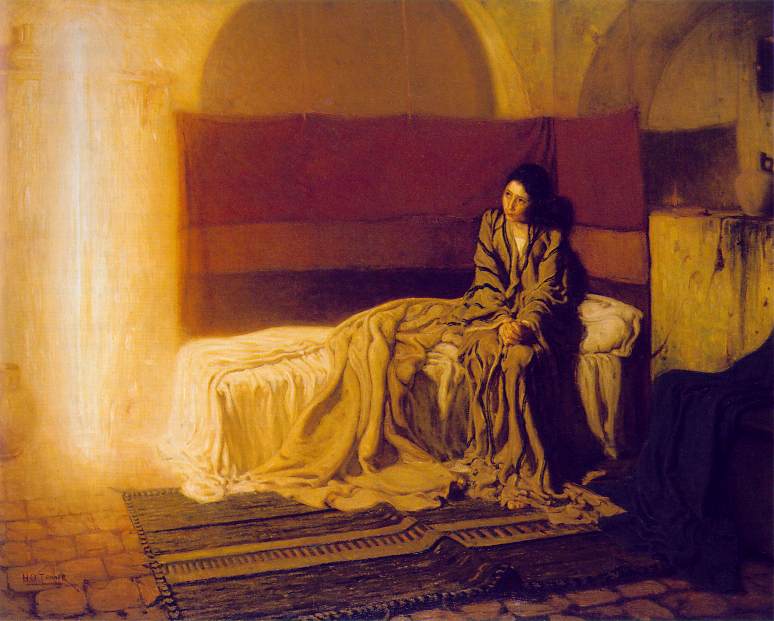 We are in the heart of Lent but for one day we step back into the Christmas cycle. It is nine months before Christmas and today we celebrate the true feast of the Incarnation. December 25 is the Lord’s birth but today is His incarnation as he is conceived in his Mother’s womb. TODAY the Word becomes flesh.