Some years ago I read a humorous but poignant story about public prayer at a school graduation. It took place during the time when tide had just begun to turn against religious displays etc. in the public square, somewhere in the late 1980s. Up until that time prayer by a local minister, priest or rabbi was part of graduation, almost without exception. We certainly had it at my public high school graduation in 1979.
–
But by the early 1980s the ACLU and other organizations began to insist that prayer of any sort at a public gathering was wrong and violated the (so-called) “separation of Church and State,” (a phrase that does NOT occur in the US Constitution). And here is where the story picks up:
–
The class valedictorian of a local Virginia high school (I forget which) was a committed Christian, and also something of a class clown. He was told that, under no circumstances was he to invite his classmates to pray or to mention God in a prayerful way and that, if he did, the microphone would be turned down. Annoyed but not without plans, he “conspired” with five of his classmates to edge prayer into the talk in a creative way. He went to the podium, looked at the crowd, looked at his notes, and looked up again. The atmosphere was tense for others had heard of the forbidding of prayer, and the community was quite divided. Would he do it? Suddenly, he sniffed, as if to sneeze. “Ah……Ah…..Ah Chooo!” came the loud and rather staged sneeze. At once, five of his classmates rose to their feet and said loudly together: “God Bless you!” And the valedictorian said, “Amen!” Yes, there was prayer at graduation that year, and most of the crowd rose to their feet in tribute to the brief but powerful prayer that had been forbidden.
–
Last week the priests of our Archdiocese gathered to study the slow, but steady erosion of religious liberty in our American culture. We were presented with a broad range of incidents, court decisions, and examples from the medical world which painted the picture for us. Cardinal Wuerl well summarized the day in saying, We take for granted our religious freedom, but today it is under substantive while subtle challenge….We are in the midst of a sea change. We are being told that religion has no place in the marketplace, in the public forum.
–
It is one thing to request that the State, in its official capacity, refrain from sponsoring sectarian prayer. But it is another to tell believers that they are not allowed to make religious expression, refer to God, or pray in any sort of public way. Further, religious exemptions, traditionally granted in matters where moral matters and State policy collide, are gradually being removed, never included, or interpreted so strictly that they can never apply. Catholic institutions are gradually being pressured to provide contraceptives in medical plans, cooperate in adoptions to gay couples, or single parents, provide spousal benefits to gay couples, and indirectly cooperate in providing abortion coverage by not being able to opt out of plans that provide such coverage.
–
But as the Cardinal points out, much of the erosion of religious liberty is subtle, carried out in incremental ways, hidden in the deep details of legislation, and strict interpretations of various judges. It requires the Church and other religious organizations to fight on multiple fronts in a wearying number of, often arcane but significant, legal minutia. At some level, the erosion of religious liberty is happening simply due to the repeated quality of the multiple legal maneuvers. The Church and other religious entities may win an individual battle in one case, only to have to face multiple appeals and similar battles in other jurisdictions. Keeping the faithful organized and alert, and having the legal resources in place to meet every challenge is difficult and this is part of the erosive technique.
–
Consider the following story from the Washington Examiner Op-Ed page reported and commented on by Ken Klukowski:
Like most high schools, Medina Valley Independent School District allows the class valedictorian to deliver a graduation address. This year’s valedictorian, Angela Hildenbrand, is a Bible-believing Christian. Many knew that Angela would give thanks to God for blessing her work as a student, and that she might offer a prayer. Alleging that hearing a prayer would cause serious and irreparable harm, one of Barry Lynn’s lawyers at Americans United for the Separation of Church and State (AUSCS) filed suit for the agnostic family. A federal judge….issued an order that no prayers could be offered, and also that Angela could not utter certain words in her speech, including the phrase “bow your heads” or the specific words “prayer” or “amen.”
In other words, suppose Angela said, “As long as students have to take final exams, there will be prayer in schools. Can I hear an ‘amen’?” She would have violated the judge’s order twice, and could be thrown in jail.
The reality is, the judge’s order, not a prayer Angela might offer in her speech, violated the First Amendment. In 1992, the Supreme Court (wrongly) held 5-4 that high school graduation prayers violated the First Amendment Establishment Clause. Even then, though, the court’s holding was merely that a school could not organize the prayer or invite a clergyman to lead the prayer. In that moment, the clergyman is speaking for the government.
In this case, a student is given the stage not specifically to pray, but to speak about her values and priorities and to thank whomever she wishes for helping her succeed in school. Because she’s a private citizen (not a government agent), her speech is protected by the First Amendment Free Speech Clause. For government (including a judge) to censor her private speech is unconstitutional.
On June 4, the Fifth Circuit federal appeals court granted an emergency motion to reverse the district judge. So Angela’s speech proceeded as planned, including the now-controversial word “amen.” But don’t get your hopes up that sanity is making a comeback. [Story from the Washington Examiner]
So here, in the end, religious liberty won the day. So did free speech. But these sorts of suits and legal motions are increasingly widespread and the legal landscape is often shifting. And it is this steady, drip, drip, drip that is helping to erode religious liberty, and free speech related to religion.
The article rightly points out, the public school district is not officially mandating or even arranging for prayer to take place. What AUSCS argues is that the mere public mention of God by a private citizen of faith should be forbidden, that a religious person, asked to speak to a public gathering, cannot indicate that God was part of her success, or give public thanks and acknowledgment to God. It is indeed sad that any judge would agree with this, but increasingly this is the case. This case was won on appeal, but not every similar case has won or will be won in the future.
It is essential that we remain vigilant in matters such as these. It is the wish of some to exclude Christians, indeed all believers, from the public marketplace of ideas. There are increasing numbers of strident secularists who insist that the only legal place for religious expression, be inside a church building, or on church-owned property. This is not right or Constitutional:
Congress shall make no law respecting an establishment of a religion or the free exercise thereof: or abridging the freedom of speech, or of the press; or the right of the people peaceably to assemble, and petition the Government for a redress of grievances. (First Amendment of the U.S. Constitution).
Christians and other religious individuals have no less a right to free speech, to assemble peaceably, or petition the government than any other group, or individual. Yet it is increasingly argued by many that, simply the fact that a religious perspective is involved, should exclude religious people altogether from having a place in the public setting. And thus we have the strange reality that in public schools, our children can be exposed to almost any philosophy, some of them aberrant and little supported by the general populace. Yet, even to refer to the Bible as an historical factor in this nation’s history is considered forbidden and may trigger a lawsuit. Condoms are freely distributed in most schools but the mere presence of a Bible is often greeted with hostility from school administrators.
There are legitimate debates to be had about the limits of interaction between the religious institutions and the State, about when and how citizens acting in a state sponsored role can speak of, or reference, religious matters. But no private citizen, such as Angela Hildenbrand, reference above should have their right to speech abridged by the government in the manner attempted by the judge. Christians have every right that other citizens do to speak to their values publicly, and seek to influence the public discussion.
We need to be alert in these matters and stay thirsty for justice.
We have had numerous discussions here on the blog on the interrelationship of faith and the physical sciences. We live in a time of reductionist thinking wherein many reduce reality to the physically measurable. Theology and other disciplines such as philosophy, psychology, even history according to some, cannot be a part of what we know. Some go even further to deny absolutely the existence of anything beyond matter. Here are things emblematic of our times: reductionist, materialist, and a kind of idolatry of the merely physical sciences.
Indeed the very word “science” has come to mean for many, merely the physical sciences. But, traditionally, theology and philosophy were (and still are, according to many) considered to be sciences. They are sciences for they follow a method, or methods, they include peer review and are subjected to the laboratory of human experience and tested by time. Of their nature they do not usually include physical measurements, for they engage what is largely beyond the physically measurable. But until recently they were included among the sciences and had a pride of place in university settings.
And while many derisively dismiss philosophy and theology as sciences, the fact is they they do deal with what we all experience on a daily basis. For there are many non material things that humans beings actually and really experience that require study and explanation, synthesis, and discernment.
I was recently given a link to an article by my brother, John, which describes our modern tendencies and problems with reductionism, materialism and scientism. It is by Dr. Jeff Mirus over at Catholicculture.org. I want to present excerpts of a much longer article he wrote and make some comments of my own. Dr. Mirus’ original text is in black, bold, italic. My comments are in red, plain text. The full article is here: The Hammer and the Nail
[O]ne of the great problems we face in understanding human dignity is that by the materialistic, empirical or purely scientific account, both our self-understanding and our freedom are illusions. These terms require some explanation, and the explanation will reveal a tremendous blind spot in our culture’s view of knowledge.
The term materialistic is plain enough. If we insist that there is nothing in the wide world but matter, then we have to admit something that will risk our sanity, namely that it is only an illusion that we can somehow stand outside ourselves and reflect on our being (intellect) or that we can direct our lives according to freely made choices (will). These things [according to materialism] must be illusions because they are abilities which transcend what matter can produce. But to accept this is to deny our own perception of ourselves.
In other words, it is our experience, that we have a spiritual aspect about ourselves. We can consider things which are non-material and concepts such as justice, love, mercy, sincerity, beauty, moral rectitude, and so forth. Further we have a sense of “I,” that “I” exist, a capacity of introspection and a well defined understanding that I am distinct from things and others around me. Yet again, there are longings for things beyond the physical world such as unity, acceptance, transcendence, fulfillment, and that ultimate sense of meaning beyond who we simply are, here and now. Clearly, as a theologian I attribute these human longings as pointing to the ultimate longing for God. But, even to the unbeliever, the spiritual insights and thoughts of the human person are empirically evident. These insights are “empirical” in the sense that they rooted in real and actual experience, what we truly experience within our very self. They are also things we are able to verify as existing in other human beings.
For the materialist, these sorts of experiences, these empirical data, must be treated either as an illusion (as our author suggests) or as emanations of brain chemistry not yet fully understood. There is the modern reductionist tendency to explain everything based on physical causation. I remember years ago an a secular and materialist attempt to explain the rather peculiar human experience of consciousness. The author titled his work: The Origin of Consciousness in the Breakdown of the Bicameral Mind [1] A reductionist and materialist theory, to be sure!
But the point is that we all experience these sorts of non physical things in our psyche and, as our author goes on to develop, there is a rather twisted and contorted attempt to either dismiss such experiences as of any account or to redefine “empirical” are referring only to physical matter.
In our culture, empiricism is closely tied to what is physically measurable. But spiritual things are, by definition, immeasurable. Therefore, a [modern] empirical account of reality omits the spiritual, and a culture which comes to believe that the only possible solid knowledge is empirical knowledge necessarily either ignores the spiritual or denies it altogether.
Again, it is the MODERN notion that empirical equals physically measurable. For it is clear that very real things are not always physically measurable. For example, we cannot physically measure the degree to which we love someone, long for something, experience sorrow over some situation etc. Yet, these are real, and in a very real way, they are empirical, for they are observable, or shall we say, something we all clearly experience.
Some may argue for brain mapping etc. but here too is a reductionist attempt to reduce non-physical things to the purely physical. For even if there is an aspect of the brain, or central nervous system that is engaged by these human experiences, the answer as to why these non-material aspects are experienced by us, remains something that science is ill-equipped to explain. Justice is not a material thing, it does not go out for a walk or sit down to breakfast. Neither do longing, acceptance, serenity or humor go out to beach together for vacation. These things are real, but they are not material.
This brings us to the idea of a purely scientific account of man, in the modern sense of science, meaning not simply a branch of knowledge, but knowledge acquired by an experimental or empirical method. The scientific approach to knowledge is not wrong in itself, but it is only one approach, and it is necessarily partial. [Exactly, we are not anti-science, to be so would be foolish. But we do accept that science has limits].
Sadly, the modern world suffers from a dearth of other approaches. In particular, it suffers from the absence of a different sort of science, a different approach to knowledge, the approach of theology. Because of the materialistic and empirical biases of our culture, theology is no longer taken seriously as a branch of human knowledge. What was once considered the queen of the sciences, has been gradually eliminated from higher education. This gives rise to a very curious phenomenon: Whenever one branch of study is consistently absent, other branches of study will encroach upon its territory. [Pay attention, what follows is very important].
In his brilliant work The Idea of a University, Cardinal Blessed John Henry Newman argues that, as a university is by definition devoted to the full range of disciplines or branches of knowledge, it is a mistake and a distortion to exclude theology. Every branch of knowledge, Newman rightly notes, is tempered and improved by all the other branches, [YES!] as each branch has its own tools and methods, and each learns a certain care and modesty in its conclusions, [YES!] more accurately discerning their application and scope, in relation to what is discovered by other tools and instruments in other regions of investigation. Thus, when one branch of knowledge is left out or, worse, barred from the university or from “sophisticated” discourse generally, others encroach upon its domain, reaching conclusions which are unwarranted and, indeed, unattainable by their own proper methods.
And herein lie a lot of modern problems and distortions. We have become well aware of how science encroaches on faith in recent years. Science cannot prove or disprove the existence of God per se, that is not its field. And yet, in our times scientists make claims that God does not exist. But their statements are not scientific statements when they speak like this. They are making theological and philosophical claims, for physical science, by definition cannot measure the non-physical or render scientifically based conclusion on the existence or non-existence of the spiritual. Most scientists are not trained in the disciplines of theology and philosophy and are are no more qualified to opine on such matters than “some dude” at the local bar. Yet, as our author goes on to observe:
Thus, on every side, we find well-known scientists, lionized by our cultural elites, writing briefs for atheism, pronouncing that evolutionary biology proves the non-existence of God. [Exactly. But of course biology cannot prove the non-existence of a spiritual being].
And to be fair, some on the religious side have tried to exclude too many aspects of physical science, which has a legitimate and necessary role in human knowledge. In the last century, an often fundamentalist hostility to science has been evident among some Christians who see the Scriptures especially, as a scientific account of creation, rather than a theological account which, while having scientific aspects, also uses analogy, metaphor, poetry and speaks in a general, rather than a consistently specific manner. Further, they see Scripture as a “sole source” of revealed truth. From the Catholic point of view, God’s “Book of Scripture” does not contradict His “Book of Creation.” Both are revelation, and both speak truth to us, and the truth does not ultimately contradict itself. While there are certain scientific theories that at times come into apparent conflict with Scripture or dogmatic theology, and must be rejected or distinguished, this does not mean that science itself is wrong as a discipline. Neither does it mean that on-going discussions cannot help both disciplines (theology and physical science) to come to a deeper understanding of the one truth. The fact is, I generally find that a lot of scientific discoveries confirm my faith and encourage a sense of wonder and awe. If grace builds on nature, as we teach, then understanding nature is of benefit to us spiritually.
Physical Science too benefits from theology and philosophy by acknowledging that many of its processes of deduction and method are descended from theological and philosophical methodology. Philosophy especially is able to help science reveal possible flaws in reasoning, and also help science to stay within its own defined scope. And that scope is the material, the physical world. But physical science does well to maintain humility and to accept that that there may be things beyond its scope which it is not able to render an account of, one way or the other. If not, the physical sciences fall into the error of scientism. Scientism is the error which reduces everything to matter and insists that nothing exists outside the system which physical science can measure, a conclusion that can, in no way, be proved, scientifically.
In the end, perhaps the problem is best expressed in a very popular aphorism: When your only tool is a hammer, everything begins to look like a nail. The only trouble is, everything is not a nail. The human person perceives that instinctively, but in our culture we lack the tools to explicate the momentous truths which follow from such an irreducible fact.
Yes, I am convinced that this is going to have to be our way back. Basic human experience. And that experience, if we are honest, shouts to us the existence of the spiritual and the transcendent.
Even physical science rests on the mystic and metaphysical notion that reality is “intelligible.” For intelligibility bespeaks meaning and asks questions about purpose, direction and points, ultimately outside the physical (to the metaphysical) to the question, why? Intelligibility presumes also the great mystery of a questioning soul. For why do we seek to understand at all? The animals, who are physically very like us, do not seem to ask such questions or probe deeper relations. Intelligibility also presumes that there is actual meaning and purpose to be found. Still further it presumes that “I” exist at all, to discern it, and that my mind is not engaged by illusions and shadows. Why does anything exist at all and what does it mean to exist? How do we define it and by what means do we discover it?
These are deeper questions than they may seem. Reality has a mystical dimension that artists, poetics, writers, philosophers and theologians have pondered for centuries, long before there ever was a scientific method, (developed, by the way, in the largely Catholic and Christian universities of the West, and respectful of the Judeo-Christian insights of natural law and the Wisdom tradition).
We have to continue to engage the modern world in the understanding that things run deeper and more wonderfully than we can physically describe. Deep down most people know and experience this truth. Life has more meaning than just the physical. A beloved spouse is not just another body, they are a person with all the mystery that entails. A kiss is not just two lips meeting, it is two souls sharing the breath of mystical life. A house is not just a physical structure, it is a home with all the non-material meaning that includes. My longings are not just the firing of brain synapses and serotonin, but the sigh of my soul for completion and fulfillment, for something infinite, for something (some ONE) other, for God.
Dr. Mirus is right, life is more than a nail and we need more than a hammer to understand it. Deep down we know this, and this is where we must engage the modern person. We ought to remain respectful of physical science and the wonders it has offered us, yet we must also demand more: a deeper vision that respects the full human experience. There’s more to life.
Please pardon a little science humor and accept my full admission that we also have some real geeks in theology too!
In more dioceses than not, the Feast of the Ascension is celebrated this weekend. The liturgist in me regrets the move, but here we are any way. So let’s ascend with the Lord, three days late!
This marvelous feast is not merely about something that took place two thousand years ago. For, though Christ our head has ascended, we the members of his body are ascending with him. Since he was ascended, we too have ascended. In my own life, as a Christian, I am brought higher every year by the Lord who is drawing me up with him. This is not some mere slogan, but something I am actually experiencing. An old song says, I was sinking deep in sin, far from the peaceful shore. Very deeply stained with sin, sinking to rise no more. But he master of the sea, heard my despairing cry. And from the waters lifted me. Now safe am I. Love Lifted me, When nothing else could help. Love lifted me!
Yes, the feast of the Lord’s Ascension is our feast too, if we are faithful. Let’s look at it from three perspectives.
I. The Fact of the Ascension. – The readings today describe a wondrous event that the Apostles witnessed. The Lord, by his own power is taken to heaven. In so doing he opens a path for us too. The gates of paradise swing open again: Lift up your heads, O gates! and be lifted up, O ancient doors! that the King of glory may come in! (Psalm 24:7). In Christ, man returns to God. Consider three things about the Ascension:
A. The Reality – Imagine the glory of this moment. Scripture says, As they were looking on, he was lifted up and cloud took him from their sight….they were looking intently in the sky as he was going (Acts 1:9). So impressive was the sight that the angels had to beckon them to get along to Jerusalem as the Lord had said, Men of Galilee,” they said, “why do you stand here looking into the sky? This same Jesus, who has been taken from you into heaven, will come back in the same way you have seen him go into heaven (Acts 1:11). Yes, it was glorious. Jesus had once said as a summons to faith, What if you were to see the Son of Man ascending to where he was before? (John 6:62). He had also encouraged them saying: Truly, truly, I say to you, you will see heaven opened, and the angels of God ascending and descending upon the Son of man (John 1:51) So here is a glorious reality, and a fulfillment of what Jesus had said.
B. The Rescue – In the Ascension, it does not seem that the Lord entered heaven alone. As we have remarked, in his mystical body we also ascend with him. But consider too this remarkable text that affirms that: Therefore it is said, “When he ascended on high he led a host of captives, and he gave gifts to men. In saying, “He ascended,” what does it mean but that he had also descended into the lower parts of the earth? He who descended is he who also ascended far above all the heavens, that he might fill all things (Eph 4:8ff). Yes, the Lord had earlier, just after his death, descended to Sheol and awakened the dead and preached the gospel to them (cf 1 Peter 4:6). And now, for those he had justified, came the moment ascend with Jesus as a “host,” as an army of former captives, now set free. Behold the great procession that enters behind Christ through the now opened gates of heaven: Adam and Eve, Noah, Abraham, Sarah, Isaac Jacob, Rachel, Judith, Deborah, David, Samuel, Isaiah, Jeremiah, Ezekiel, Malachi, John the Baptist….and one day you! Yes this is a great rescue. Adam and his descendants have not simply been restored to some paradisical garden, they have entered heaven.
C. The Rejoicing – Consider how, this once captive train, sings exultantly as they follow Christ upward to heaven. The liturgy today puts before us a likely song they sang: God mounts his throne to shouts of Joy! The Lord amid trumpet blasts. All you peoples clap your hands, shout to God with cries of gladness, for the Lord the most high, the awesome is the great king over all the earth. God reigns over the nations, God sits upon his holy throne (Psalm 47:6-7). I also have it on the best of authority that they were singing an old gospel song: I’m so glad, Jesus lifted me! Yes I also have it on the best of authority that they were even singing an old Motown song: Your love is lifting me higher, than I’ve ever been lifted before!
Yes, Here are some glorious facets of the Ascension.
II. The Fellowship of the Ascension – We have already remarked that, when Christ ascends, we ascend. Why and how? Scripture says, Now you are the body of Christ and individually members of it (1 Cor 12:27). It also says, All of us who were baptized into Christ Jesus were baptized into his death. By baptism we were buried together with him so that Just as Christ was raised from the dead by the glory of God the Father, we too might live a new and glorious life. For if we have been united with him by likeness to his death we shall be united with him by likeness to his resurrection (Rom 6:3ff). So, when Christ died we died. When Christ rose, we rose. When He ascends, we ascend.
But you may say, he is in glory, but I am still here, how is it that I am ascended or ascending? Consider a humorous example about our physical bodies. When I get on an elevator and punch the button for the top floor, the crown of my head gets there before the soles of my feet. But the whole body will get there unless some strange loss of integrity or tragic dismemberment takes place. So in an analogous way it is with Jesus’ Jesus mystical body. In Christ our head we are already in glory. Some members of his body have already gotten there. We who come later will get there too, provided we stay a member of the Body. Yes we are already ascended in Christ our head. We are already enthroned in glory with him, if we hold fast and stay a member of his Body. This is the fellowship of the Ascension.
III. The Fruitfulness of the Ascension – Jesus does not return to heaven to abandon us. He is more present to us than we are to ourselves. He is with us always to the end of the age (cf Matt 28:20). But in Ascending, without abandoning us, he goes to procure so very important things. Consider four of them:
A. Holy Ghost power – Jesus teaches very clearly that he is ascending in order to send us the Holy Spirit: Nevertheless I tell you the truth: it is to your advantage that I go away, for if I do not go away, the Counselor will not come to you; but if I go, I will send him to you (Jn 16:7ff) He also says, These things I have spoken to you, while I am still with you. But the Counselor, the Holy Spirit, whom the Father will send in my name, he will teach you all things, and bring to your remembrance all that I have said to you (Jn 14:25ff). And yet again, I still have many things to say to you, but you cannot bear them now. When the Spirit of truth comes, he will guide you into all the truth, for he will not speak on his own authority, but whatever he hears he will speak, and he will declare to you the things that are to come (Jn 16:13-14). So the Lord goes, that he might, with the Father, send the Holy Spirit to live within us as in a temple. In this way, and through the Eucharist, he will dwell with us even more intimately than when he walked this earth.
B. Harvest – Jesus says, And I, if I be lifted up from the earth, will draw all men unto me (John 12:32). While the immediate context of this verse is the crucifixion, the wonder of John’s gospel is that is that he often intends double meanings. Clearly Christ’s glorification is his crucifixion, but it also includes his resurrection and ascension. So, from his place in glory, Christ is drawing all people to himself. He is also bestowing grace on us from his Father’s right hand to be his co-workers in the harvest: But you shall receive power when the Holy Spirit has come upon you; and you shall be my witnesses in Jerusalem and in all Judea and Samaria and to the end of the earth (Acts 1:8). Yes, from his place in glory, Christ is bringing in a great harvest, as he said in Scripture: Do you not say, ‘Four months more and then the harvest’? I tell you, open your eyes and look at the fields! They are ripe for harvest. Even now the reaper draws his wages, even now he harvests the crop for eternal life, so that the sower and the reaper may be glad together. Thus the saying ‘One sows and another reaps’ is true. I sent you to reap what you have not worked for. Others have done the hard work, and you have reaped the benefits of their labor.” (Jn 4:35-38). Harvest! And it is the Lord’s work from heaven in which we participate.
C. Help – At the Father’s right hand Jesus intercedes for us. Scripture says, Consequently he is able, for all time, to save those who draw near to God through him, since he lives always to make intercession for them (Heb 7:25). The Lord links his ascension to an unleashing of special power: Amen, amen, I say to you, he who believes in me will also do the works that I do; and greater works than these will he do, because I go to the Father. Whatever you ask in my name, I will do it, that the Father may be glorified in the Son (Jn 14:12).
It is true, we must not understand asking in the name of Jesus as a mere incantation, for to ask in his Name means to ask in accord with his will. And yet, we must come to experience the power of Jesus to draw us up to great and wondrous things in his sight. Despite the mystery of iniquity all about us, we trust that Christ is conquering, even in the puzzling and apparent victories of this world’s rebellion. We read, In putting everything under him, God left nothing that is not subject to him. Though, at present we do not see everything subject to him, yet we see Jesus, who was made a little lower than the angels, now crowned with glory and honor….so that by his death he might destroy him who holds the power of death—that is, the devil— and free those who all their lives were held in slavery by their fear of death (Heb 2:8-9; 14-15). Thus, from heaven we have the help of the Lord’s grace which, if we will accept it, is an ever present help unto our salvation.
D. Habitation – Simply put, Jesus indicates that in going to heaven he is preparing a place for us: In my Father’s house are many mansions: if it were not so, I would have told you. I go to prepare a place for you. 3 And if I go and prepare a place for you, I will come again, and receive you unto myself; that where I am, there ye may be also (Jn 14:2ff) Yes, indeed, He has the blueprints out, and a hard hat on. He is overseeing the construction of a mansion for each of us that we may dwell with him, the Father and the Spirit forever.
Here then are the ways that Christ, by his love is lifting us higher, than we’ve ever been lifted before. Yes, love lifted me, when nothing else could help, Love lifted me.
One of the great and stately hymns of the Protestant musical heritage is “Abide With Me.” I love to play it at the organ, its rich chordal progression, and counterpoint in the pedal, create a very moving experience. The words too are a minor masterpiece that are a prayer of one approaching death with faith.
The author, Henry Francis Lyte (1793-1847) was an Anglican pastor in Devonshire England, for 23 years. In 1844, Three years before his death Lyte was diagnosed with Tuberculosis. Despite this, he continued to work hard and was known to say, “It is better to wear out, than to rust out.” But his physical condition continued to deteriorate, until finally on September 4, 1847, at 54 years of age, he stood in his pulpit to deliver his farewell message. It is said, He was so weak that he almost crawled to the pulpit.
Later that day he retired to his room and wrote the words to this hymn: Abide With Me, as he meditated on the death he knew would soon approach. Advised by doctors to leave the cold, damp, coastal weather of England, he left for the Mediterranean. He died en route. A fellow clergyman who was with Henry during his final hours reported that Henry’s last words were: “Peace! Joy!”
Abide With Me was set to music by William H. Monk (1823-1889), and was played at Henry Lyte’s funeral service.
I have, when the situation was right, shared this him with the dying. Not all have fully accepted that they are dying, but for those who have reached the stage of acceptance, and when death seems certain, this hymn is very powerful, personal and poignant. It is a deeply personal prayer to the Lord to shepherd me through the valley of death and across chilly Jordan into the Promised Land of Heaven. As Catholics we can also see how it points to Jesus’ abiding presence in the sacraments and the liturgies celebrated for the dying.
The hymn opens with the approach of death described as the deepening darkness of eventide. At some point nothing, and no one in this secular world can help any longer. Only the Lord can help shepherd us through the valley of the shadow of death. And so the plea goes up: Abide with me.
Abide with me; fast falls the eventide;
The darkness deepens; Lord with me abide.
When other helpers fail and comforts flee,
Help of the helpless, O abide with me.
The second verse poetically describes life as a “little day.” For in the end, how brief and how swift this life passes. And as it passes, all earth’s glories and joys seem so little. I have seen the dying with that look in their eye as they look through and beyond me. They see something and someone greater now.
As my Father lay dying and could barely talk in his final days he said, “I just want to be with God.” It was his way of saying, “Abide Lord with me!”
The third verse too begs of the Lord, not a mere passing word, but an abiding, a lasting presence, filled with patience, familial love and a mercy that stoops to raise us up to joys unending
Swift to its close ebbs out life’s little day;
Earth’s joys grow dim; its glories pass away;
Change and decay in all around I see;
O Thou who changest not, abide with me.
Not a brief glance, I beg a passing word;
But as Thou dwell with Thy disciples, Lord,
Familiar, condescending, patient, free.
Come not to sojourn, but abide with me.
The fourth and fifth verses amount to a plea for mercy based on God’s constant mercy of the past. It is not unlike the mercy verses of the Dies Irae which say: Think, kind Jesus my salvation, caused thy wondrous incarnation, Leave me not to reprobation! Faint and weary Thou hast sought me, On the cross of suffering bought me; Shall such grace be vainly brought me? Through the sinful Mary shriven and the dying thief forgiven, thou to me a hope has given! But here Lyte makes the basis even more personal as he appeals to the Lord mercy for him in the past.
Come not in terrors, as the King of kings,
But kind and good, with healing in Thy wings,
Tears for all woes, a heart for every plea—
Come, Friend of sinners, and thus bide with me.
Thou on my head in early youth didst smile;
And, though rebellious and perverse meanwhile,
Thou hast not left me, oft as I left Thee,
On to the close, O Lord, abide with me.
The sixth verse calls to mind that at death’s approach some temptations increase. Perhaps it is despair, perhaps it is anger at God, perhaps we suffer unwillingly or with resentment, perhaps there is the tendency to be impatient with those who seek to help or console.
Here are some of the reasons we anoint the sick and dying. Surely we pray for healing, but we also seek, by the Lord’s mercy to stave off the effects of illness that can draw us into temptation.
We also pray that one will courageously face death and, by facing it, see in it no sting, but only victory in the Lord.
It is the abiding presence of Lord that is communicated to the soul in the anointing: Through this holy anointing, may the Lord, in his love and mercy, heal you with the grace of the Holy Spirit. Yes, for the dying: may the Lord abide with you in these last and difficult moments.
Holy Communion too, for those physically able to receive it also brings the Lord’s abiding presence. And so the hymn beautifully says:
I need Thy presence every passing hour.
What but Thy grace can foil the tempter’s power?
Who, like Thyself, my guide and stay can be?
Through cloud and sunshine, Lord, abide with me.
I fear no foe, with Thee at hand to bless;
Ills have no weight, and tears no bitterness.
Where is death’s sting? Where, grave, thy victory?
I triumph still, if Thou abide with me.
Yes, here is the cross. But it is the tree of victory, for it is the key that unlocks heaven. And soon it’s “Friday” gives way, after the passage through judgement and purgatory, to an eternal Sunday for those who die with faith. Only the cross of Jesus can perfect us and bring forth the endless day of glory where we will abide for ever with God.
Hold Thou Thy cross before my closing eyes;
Shine through the gloom and point me to the skies.
Heaven’s morning breaks, and earth’s vain shadows flee;
In life, in death, O Lord, abide with me.
In the modern age we have tended to reduce the notion of hypocrisy to duplicity. The modern notion is that a hypocrite is someone who says one thing but does another, a person who is two-faced, who is inconsistent or phony. Jesus’ teaching on Hypocrisy does not exclude this notion but is far richer.
The Biblical understanding enunciated by Jesus is rooted in the original meaning of the Greek word hypokritḗs which means “stage actor.” At one level it is easy to see how this word has come to mean some one who is phony. In other words what they claim to be they really are not, they are just acting a role. But when no one is looking (i.e. the audience is gone) they revert to their true self, which is some one quite different. But Jesus in his teaching here develops the understanding far more richly that shows how sad and poignant hypocrisy is, what its origin is and how it can be overcome.
Hypocrisy defined – In Matthew 6, Jesus takes up the problem of hypocrisy. In effect he describes hypocrisy as the sad state of a person who reduces himself to being an actor on a stage, because he does not know God the Father. There are many people who live their life in a desperate search for human approval and applause. They discern their dignity and worth, not from God (who is, in effect, a stranger to them), but from what other human beings think of them. They are willing to adapt themselves often in dramatic ways to win approval. They are willing to play many roles and wear many masks to give the audience what they want. They are like actors on a stage who seek applause or perhaps laughter and approval. Notice the way Jesus describes the heart of hypocrisy:
Jesus said to his disciples: “Take care not to perform righteous deeds in order that people may see them;….The Lord goes on to say that they blow a trumpet so that others will see them giving alms, they pray ostentatiously so that others may see they are praying, and they alter their appearance so that others may see they are fasting.
The heart of hypocrisy – Thus, the goal of such a person is to be seen. They are on stage and seek to ingratiate themselves to the audience, and win applause. Hence they engage in some action “in order that people may see them.” It is clear that this is ultimately very sad. A lonely actor on a stage performing whatever role is required in order to win approval from the current audience. Their inner core or deepest self is repressed and replaced by the demands of others. This is the true heart of and description of hypocrisy.
Many take this desperate need for approval from others to very self destructive extremes. Many young people, due to peer pressure, will engage in dangerous and unhealthy practices to win approval. Some will drop out of school, join gangs and commit crimes. Others will drink heavily or use drugs. Still others will tattoo and pierce their bodies, engage in sexual activity before marriage, and do many risky things. The need for approval is often the deep drive that underlies this desperate behavior. But like actors on a stage seeking applause, they rush to fill these rolls, and hope for the applause and acceptance. Adults too will often compromise core principles in order to fit in and be liked, gain promotions, or earn access. Christians will hide their faith, playing the role of a secular modern in order to win approval. Some will act deceitfully to please a boss, others will gossip or engage in any number of sinful behaviors to ingratiate themselves to a group.
It is also clear that our modern notion of hypocrisy as duplicity, while incomplete, is not wrong either. Why does the hypocrite act inconsistently, often in a duplicitous manner? Because the audience changes and he must change with it. So to one group he will say, “Yes” and to another group he will say, “No.” Since the goal of the hypocrite (actor) is to be seen and win approval, the answer must change if the group does. Hence he will morph, hide his true thoughts, or outright lie to gain the approval. He no longer has a core, his identity is outside of himself in what ever the audience requires in order to grant him approval.
Why does this happen to a person? Here too Jesus is rather clear. This happens to a person who does not know God the Father. The great tragedy of many lives is that they do not know the Father. They may know ABOUT God, but they do not personally know God or his love for them. God is at best a benevolent stranger who runs the universe, but he is in some remote heaven, and the interaction that many have with him is vague and abstract. God exists but he is on the periphery of life. In effect he is a stranger.
Notice the remedy that Jesus assigns for each example of hypocrisy he cites:
Your heavenly Father, who sees in secret will repay you for giving alms….Your heavenly Father who sees in secret will repay you for praying…..Your heavenly Father who sees what is hidden will repay you for your fasting.
In other words the goal in life, and the remedy for hypocrisy, is that it be enough that Your heavenly Father sees what you do. Now of course, as long as God the Father remains a distant and aloof figure, what he sees never WILL be enough. But to the degree that we begin to experience God the Father’s love for us, his providence and his good will toward us, then we become less concerned with what others think. We begin to come down off the stage and be less concerned for the approval of men and more focused on and then satisfied with the approval of God.
Notice too the intimacy that Jesus points too. He is “Your heavenly Father.” He is not merely the “Deity.” He is not merely God up in heaven. He is not even merely the Father. He is “YOUR heavenly Father.” He is the one who created you, sustains you, provides for and loves you.
Journeying away from Hypocrisy – To the degree that this becomes real for us and is more than words on the page of a book or inferential knowledge base only on what others have said, to the degree that this is a real experience for us, we start to climb off the stage. We are less the actor (the hypocrite) and more the authentic self God has created us to be. We begin to loose our obsession with what others think of us. We are less desperate for their approval. It is not that we become sociopaths caring not one whit what others think. We still groom ourselves etc but we are not obsessed with the good opinion of others. It is enough that we know our heavenly Father and his love for us.
Hence, hypocrisy, at least as Jesus teaches it here, is a richer concept than we often think of today. To this sad and poingnant problem, Jesus addresses a very powerful and personal solution of knowing “your heavenly Father” and expereincing his love for you. Thank you Lord Jesus!
We have discussed here before the population implosion taking place in most parts of Europe. Approximately 2.1 Children per woman are needed to maintain the population of a given country or ethnic group. In most of Europe, the birthrate hovers well below 2, often as low as 1.3 in some Eastern European countries. In effect these cultures are aborting and contracepting themselves out of existence.
As populations shrink, so do economies and so does the ability to provide basic services, and staff the engine of production. Some countries rely on large numbers of immigrants to fill the gaps. But these immigrants do not often share the faith and culture of the people they are gradually replacing. The result is a dying European culture. We have certainly discussed these matters extensively here before. (e.g. HERE)
Now comes the news from AP- that proposed legislation in Russia would seek to severely curtail abortion to stem the tide of eroding populations. Here is the brief article.
MOSCOW (AP) — Russia‘s Orthodox Church teamed with Conservative parliamentarians Monday to push legislation that would radically restrict abortions in a nation struggling to cope with one of the world’s lowest birthrates.
The legislation would ban free abortions at government-run clinics and prohibit the sale of the morning-after pill without a prescription, said Yelena Mizulina, who heads a parliamentary committee on families, women and children.
She added that abortion for a married woman would also require the permission of her spouse, while teenage girls would need their parents’ consent. If the legislation is passed, a week’s waiting period would also be introduced so women could consider their decision to terminate their pregnancy, Mizulina said.
Mirabile visu, mirabale auditu! (Wondrous to see! Wondrous to hear!)
Clearly, more will be necessary to stem the tide than this, but it is a recognition of the fact that abortion (and I would add, contraception) have devastated Western Cultures (including Eastern Europe). Any culture that either celebrates them or is too permissive of them will ultimately suffer from a kind of implosion.
For, it would seem that many today consider children too much trouble, too expensive, or too impacting our their lifestyle. Many prefer expensive and large homes, along with many expensive creature comforts. They prefer these to children. When this becomes a cultural trend, that culture is doomed.
Some will argue that the cost of living is too high today to have more than one or two children. While economic questions have a considerable complexity, it must also be admitted that we have chosen rather elaborate and expensive lifestyles. There are many things that we could and would do without, if we valued children more.
Now, faced with serious threats to their on-going viability as a country and a culture, the Russians are considering how to limit abortion, which has been legal there since the 1920s!
Let’s pray that other countries will wake up, including our own to the fact that we cannot go on killing our children, or preventing their existence and expect to thrive. France has begun to turn things around, it’s birth rate is edging back up toward 2.0. Perhaps other countries will also turn back the tide on abortion and contraception, and come to see that if we do not love life, we tend to die.
It is no secret that our culture as a whole is descending into an ever-deeper sexual confusion. Recently two examples of this were in the news.
In the first article which I summarize here, a Canadian couple have chosen to raise (impose upon?) their child a “genderless” upbringing. For now, they have refused to tell any of their family or friends the sex of their child, whom they call “Storm,” and groom and dress the infant child ambiguously.
I would like to provide excerpts of a much longer article here and comment as we go. As usual, the article is in bold, black italics. My comments are in plain red text. The full article is here: Parents Keep Baby’s Gender Secret
Jayme Poisson
STAFF REPORTER
“So it’s a boy, right?” a neighbor calls out as Kathy Witterick walks by, her four month old baby, Storm, strapped to her chest in a carrier.
Witterick and her husband, David Stocker, are raising a genderless baby. (Pet peeve: “Gender” was traditionally a word that referred to grammar, as in the subclass of a noun (male, female and neuter) in Latin and in the romance languages.”Sex” was the traditional word that referred to the sub classification of human beings as either male or female. I am willing to admit that language (which does change) is undergoing a change here. But perhaps too, it is no coincidence that, as we increasingly loose a proper sense of our humanity, that we would take up the word “gender” to refer to our sexuality. For gender in language is somewhat of an arbitrary assignment to words which have, not only a male and female sub class, but also, a third “neuter class). While there’s nothing ambiguous about Storm’s genitalia, they aren’t telling anyone whether their third child is a boy or a girl.
“If you really want to get to know someone, you don’t ask what’s between their legs,” says Stocker. (And here is one of the great errors of the modern age, a kind of Gnostic or Manichean dualism, if you will. Sexuality is much more than genitalia. The whole body, and the whole soul, is male or female. The body is not some arbitrary container or machine in which I live. My body and my soul are one. The body expresses the soul, the soul is the form of the body. It is not just my body that is male. I am male. As a human person my body and soul, though distinguishable, are one. Thus my body is a revelation of who I am at the deepest level. The child’s father (am I allowed to use that term?) has an anthropology that no Christian can accept, it is an ancient heresy (dualism) fought by the Church 18 Centuries ago, and also in more recent times. Gnostic dualism tried to separate the soul and the body).
Friends said they were imposing their political and ideological values on a newborn. Most of all, people said they were setting their kids up for a life of bullying in a world that can be cruel to outsiders. Witterick and Stocker [the parents] believe they are giving their children the freedom to choose who they want to be, unconstrained by social norms about males and females. Some say their choice is alienating. (Their friends are right. This is a terrible thing to do to the child, not only for social reasons, but also for deeply personal reasons. They are messing with this child’s psyche. For nature (and I would add, nature’s God) has supplied this child with a sex, and pretending this is insignificant, is unnatural, and thus unhealthy, for the child. Sex (or “gender” as they say), is not something we choose. It is something that is given. It is, quite simply, who and what we are).
Stocker, 39, and Witterick, 38, believe kids can make meaningful decisions for themselves from a very early age. “What we noticed is that parents make so many choices for their children. It’s obnoxious,” says Stocker. (I wonder if they will allow their kid to take up smoking, swallow broken glass, or join a right-wing political movement? The fact is, children need to be raised. They are in no position to make most decisions for themselves at an early age. Children need to be formed and educated according to what is right and proper. (Sadly, these parents seem in no position to do that anyway). Parents need to be parents. They need to show their children what is the way and how to navigate, both reality, and the social order. It is possible for a parent to micromanage a child in some matters, but these parents are over correcting for the possibility.
Further, though they claim to be giving their kid “freedom,” it is just as arguable that they are imposing their confused agenda on their children. To say that “gender” is up for grabs, is not a neutral position, it is a viewpoint; a (perverse) doctrine they are imposing on their child. So, though they like to claim that they are on some sort of (perverse) high ground, the fact is, they are imposing an agenda upon their children. So perhaps the truer conclusion is that they are being parents, just bad parents).
The moment a child’s sex is announced, so begins the parade of pink and barrage of blue. Tutus and toy trucks aren’t far behind. The couple says it only intensifies with age. (Shame on us! We are all so evil. Imagine, recognizing a child for what he or she is, how could we be so pushy?).
“In fact, in not telling the gender of my precious baby, I am saying to the world, ‘Please can you just let Storm discover for him/herself what s (he) wants to be?!.” Witterick writes in an email.(Again, we don’t decide what sex we are going to be. The body is a revelation from nature (and, I would argue, from nature’s God) of who the person IS. Sex change operations, and other forms of pretending, do not change what we are. They simply reveal deep-seated confusion and psychological disorder.
Christian anthropology insists that the body is revelation. We learn about ourselves from our bodies. They will often tell us when we are under stress, when we are being gluttonous, how old we are, etc. It is true, the body is not the only revelation of who we are, but it IS revelation, it does not lie. It cannot simply be ignored or set aside because of some form of stinking thinking, or delusional notion, that all that matters is what I think. The body is a reminder of a little thing called “reality” to which we must answer and square our thinking by. More on this below).
Stocker teaches at City View Alternative, a tiny school west of Dufferin Grove Park, with four teachers and about 60 Grade 7 and 8 students whose lessons are framed by social-justice issues around class, race and gender…. The family traveled [recently] through the mountains of Mexico, speaking with the Zapatistas, a revolutionary group who shun mainstream politics as corrupt and demand greater indigenous rights. In 1994, about 150 people died in violent clashes with the Mexican military, but the leftist movement has been largely peaceful since. Last year, they spent two weeks in Cuba, living with local families and learning about the revolution. (I wonder what the indigenous people would think of this couple’s absurd notions? I would think that most indigenous people are more in touch with reality, basic nature, and “real-world” living than this Canadian couple, lost in a post-Cartesian fog. My guess is that as they observe this sort of thing from the “corrupted West” a word comes to their mind: “Loco.” Not sure about the Cubans and how much they’ve been “westernized.”
Witterick has worked in violence prevention, giving workshops to teachers. These days, she volunteers, offering breastfeeding support. At the moment, she is a full-time mom. (Glad that mom is a full time mom, but in this case, I wish the kids had other influences).
Witterick practices unschooling, an offshoot of home-schooling centered on the belief that learning should be driven by a child’s curiosity. There are no report cards, no textbooks and no tests. For unschoolers, learning is about exploring and asking questions, “not something that happens by rote from 9 a.m. to 3 p.m. weekdays in a building with a group of same-age people, planned, implemented and assessed by someone else,” says Witterick. The fringe movement is growing. An unschooling conference in Toronto drew dozens of families last fall. (These poor kids, these poor, poor kids. Not only are they being heavily influenced by sexual confusion, but they are being wholly unprepared for life. Life does occur on our own little schedule, or indulge our moments of curiosity. Life does have tests, and we are accountable for what we do. Tests, and report cards are good training for life. Textbooks, though not perfect, do at least provide a reasonably common curriculum written by some one other than these confused parents. These poor kids, what a mess. I am not against home schooling, but the picture is, that these kids are being really isolated from the real world by parents who refuse to engage reality).
Jazz — [the oldest boy] soft-spoken, with a slight frame and curious brown eyes — keeps his hair long, preferring to wear it in three braids, two in the front and one in the back, even though both his parents have close-cropped hair. His favourite colour is pink, although his parents don’t own a piece of pink clothing between them. He loves to paint his fingernails and wears a sparkly pink stud in one ear, despite the fact his parents wear no nail polish or jewelry. Kio [his brother] keeps his curly blond hair just below his chin. The 2-year-old loves purple, although he’s happiest in any kind of pyjama pants.“As a result, Jazz and now Kio are almost exclusively assumed to be girls,” says Stocker, adding he and Witterick don’t out them. (Sigh…)
On a recent trip to Hamilton, Jazz was out of earshot when family friend Denise Hansen overheard two little girls at the park say they didn’t want to play with a “girl-boy.” (Now, of course, the parents and their supporters will calls these girls unenlightened, harsh, mean spirited etc. But the fact is, these boys are (understandably) confused, and their (created) confusion unsettles people. But as is usually the case in these matters, those who engage in disordered and troubling behavior, demand all the sensitivity, and show none. As per usual they are preferring an “in-your face” approach that demands acceptance and tolerance, while at the same time showing none for us, who are understandably troubled by deeply disordered notions that fly in the face of reality).
Dr. Ken Zucker, considered a world expert on gender identityand head of the gender identity service for children at Toronto’s Centre for Addiction and Mental Health, calls this a “social experiment of nurture.” When asked what psychological harm, if any, could come from keeping the sex of a child secret, Zucker said: “One will find out.”OK, Doctor, you have used an important word here: “experiment.” Since when did we get the notion that performing experiments on children is just fine? And do you, Doctor, parents, and supporters of the parents, really think its OK to just “find out” if any harm will come to the children? Is it right for parents to perform “social experiments” on their children in regard to the deepest aspects of who they are?
What if a certain group of parents decided that sleep was over-rated and 8 hours of sleep was an undesirable and socially imposed rule that had to go? And what if they decided to impose an “experiment” on their children by depriving them of sleep and indoctrinating them with the notion that what their body was clearly saying (“I want to sleep”) could and should be ignored? How about another experiment where we just let kids eat what they want, or bathe when and if they please? Maybe we could also refuse potty training since toilets are “social constructs.” It wouldn’t take long for the authorities to intervene in cases like this. But when it comes to sexual confusion, a politically correct and protected deviancy, we are all just supposed to step back and admire an “experiment” while three children descend into utter confusion).
The broader question, he says, is how much influence parents have on their kids. If [some] lean toward nature, Zucker puts more emphasis on nurture. Even when parents don’t make a choice, that’s still a choice, and one that can impact the children. Well Dr. Z you’ve spoken the truth here: the parents non-choice is, in fact, a choice. And their “non-choice choice” will have “impact” on their children, I would estimate the impact at about 65 mph, head on.
Well there it is, in all its tragic gloom. And, as the lights go out in Western culture this sort of thing is going to become more common.
At the heart of the problem in the Western world has been the full flower of the Cartesian error. Rene Descartes, back in the 16th Century, adopted a radical skepticism wherein he did not trust that the reality around him was real or even existed. All he could “trust” was that he doubted and quipped, “I think, therefore I am.” And thus began in the Western World, a slow but steady retreat away from reality, and into the mind. Little by little we have pulled up roots from the real, the actual and natural world around us, and turned in on ourselves. Increasingly all that matters is what I think. When one points to the actual, the real world, to facts of nature, and so forth, the modern world is increasingly unimpressed or runs to find an anomaly and pretend it’s normative. In the end for the modern westerner, All that matters is what I think. And as for what you think, well that’s just your opinion, what you think. There is no common, no shared reality, just what I think, that is all that matters.
When it comes to many of the moral issues of the day, the actual, physical, aspects of the matter are increasingly ignored and everything becomes an abstraction. Abortion is not the physical dismemberment of a human baby, it is a “choice” or just a political “issue.” When one points out that homosexual activity violates the clear design of the human body (for the man is clearly for the woman and the woman for the man, not the man for the man or the woman for the woman), one is greeted with puzzlement, as if to say, “What does the body have to do with it?” For the modern age, our bodies apparently have nothing to say to us. That promiscuity of any sort brings disease doesn’t seem to register with modern man. Most today do not conclude, on account of STDs and AIDS that perhaps our bodies are telling us something. Rather the only conclusion is that the government needs to supply more condoms and antibiotics and do more research so that we can go on ignoring our bodies and indulge our passions.
It is clear that we are retreating into our minds and away from the physical realities that are before us. Reality is cast aside. We owe no debt to the “is-ness” of things. All that matters is what we think. Rene Descartes’ retreat into the mind has come full flower and it is an ugly flower.
But for the Church and the Biblical moral tradition, natural law is an essential component of understanding what is right and wrong. The body is a revelation to us from nature, and for the Church, the body is also a revelation from God. Our bodies and the natural world around us have essential and critical things to teach us, and we owe a debt to reality that is actually before us. To simply ignore the body in discussion of sexuality is unthinkable from a Natural Law perspective, and from a Biblical perspective. The body speaks truth to us, and reveals to us what is right. When we retreat from reality by rationalizations and intellectualizing, or simply by ignoring it, we suppress the truth it reveals.
At the heart of the Church teaching and or her Natural Law Tradition is a confidence that we can know reality and trust what it tells us. To ignore reality, to ignore the revelation of the natural world, and the body is, pure and simple, to suppress the truth. The Letter to the Romans speaks with great sobriety about this problem:
For since the creation of the world God’s invisible qualities—his eternal power and divine nature—have been clearly seen, being understood from what has been made, so that men are without excuse. For although they knew God, they neither glorified him as God nor gave thanks to him, but their thinking became futile and their senseless minds were darkened. Although they claimed to be wise, they became fools….Therefore God gave them over in the sinful desires of their hearts to sexual impurity for the degrading of their bodies with one another. They exchanged the truth of God for a lie, and worshiped and served created things rather than the Creator—who is forever praised. Amen. Because of this, God gave them over to shameful lusts. Even their women exchanged natural relations for unnatural ones. In the same way the men also abandoned natural relations with women and were inflamed with lust for one another. Men committed indecent acts with other men, and received in their bodies the due penalty for their perversion. (Romans 1:21-27)
In suppressing the truth about God and what can be known from nature, our senseless Western minds have become darkened. As the Scripture points out, one of the most obvious symptoms of this is sexual confusion: promiscuity, contraception, and homosexual activity, all involve a turning away from what the body teaches us about sexuality. Sex is pleasurable to be sure, but that pleasure is obviously oriented to pro-creation. The bodily aspect of sexuality is clearly unitive but it is also procreative. We cannot simply set aside the procreative dimension of sexuality without doing violence to what the body reveals.
And, as we descend deeper into sexual confusion it would now seem that we have come to a place where some cannot even decide what it means to be male or female. How can anyone be so confused? And the yet Scriptures say plainly how. Just suppress the truth, by ignoring God and what he reveals in creation, and the downward slide begins. Before long, there is utter debasement, confusion and, at least collectively speaking, our senseless minds are darkened.
As the lights go out, the Church cannot simply curse the darkness. We must light a candles of Revelation and Natural Law. We must hold them high. And as we do so, the world will curse us, for light is obnoxious to those accustomed to darkness. But gradually, the light can be adjusted to again.
The following video is another example of the sexual confusion being pushed on others. In this case it is indoctrination in the public schools of California which insists that one can “choose” to be a boy, a girl or “both.” The “instructor,” as he points to his heart and head says, “Gender identity is about what’s in here, and up here.” It is pure Gnostic dualism, and a Cartesian retreat into the mind, and away from reality. All that matters is what I think. What is outside, “doesn’t matter.”
Memorial Day, for many, means the beginning of Summer. To others, it is a day off to shop. But, as I am sure you really know Memorial Day is a day to honor those who have died in the service of this country.
The word “memorial” comes from the Latin Memorare which is in an imperative meaning: “Remember!” So, Memorial Day is “Remember! Day.”
This is a day to remember that there are men and women who have died so that you and I could live with greater security, justice and peace. May these fallen soldiers rest in Peace. We owe them a debt of gratitude and our prayers.
In a secondary sense we can also honor those today who currently serve in the military since they have placed their lives on the line for our security and peace.We will have a second opportunity to thank those who still live on Veterans Day.
God bless them all, and may the dead rest in peace.
The Love of one’s country (Patriotism) is related to the fourth commandment. The Catechism teaches:
It is the duty of citizens to contribute to the good of society in a spirit of truth, justice, solidarity and freedom. The love and service of one’s country follow from the the duty of gratitude and belong to the order of charity. (CCC # 2239)
The Lord himself makes it plain: No one has greater love than this, to lay down one’s life for one’s friends. (John 15:13).
My Cousin, John Clem, has blogged on how his parish celebrated Memorial Day by remembering the cost, the high cost, of war in human terms: HERE: Eyes Wide Open
Never forget the price others have paid for our freedom. Pray for our fallen soldiers of every generation and their families. Perhaps you might use this video as a way to meditate on the sacrifices they made. Here the text of the song “Mansions of the Lord” and the video follows:
To fallen soldiers let us sing,
Where no rockets fly nor bullets wing,
Our broken brothers let us bring
To the Mansions of the Lord
No more weeping,
No more fight,
No prayers pleading through the night,
Just Divine embrace,
Eternal light,
In the Mansions of the Lord
Where no mothers cry
And no children weep,
We shall stand and guard
Though the angels sleep,
Oh, through the ages safely keep
The Mansions of the Lord

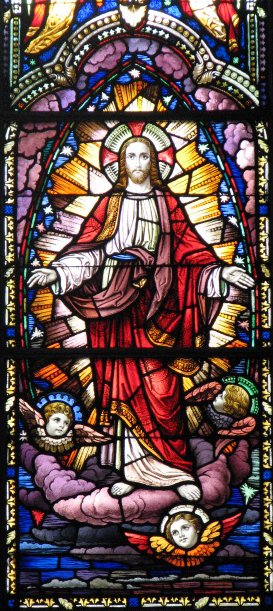 In more dioceses than not, the Feast of the Ascension is celebrated this weekend. The liturgist in me regrets the move, but here we are any way. So let’s ascend with the Lord, three days late!
 We have discussed here before the population implosion taking place in most parts of Europe. Approximately 2.1 Children per woman are needed to maintain the population of a given country or ethnic group. In most of Europe, the birthrate hovers well below 2, often as low as 1.3 in some Eastern European countries. In effect these cultures are aborting and contracepting themselves out of existence.