On Angels and Demons

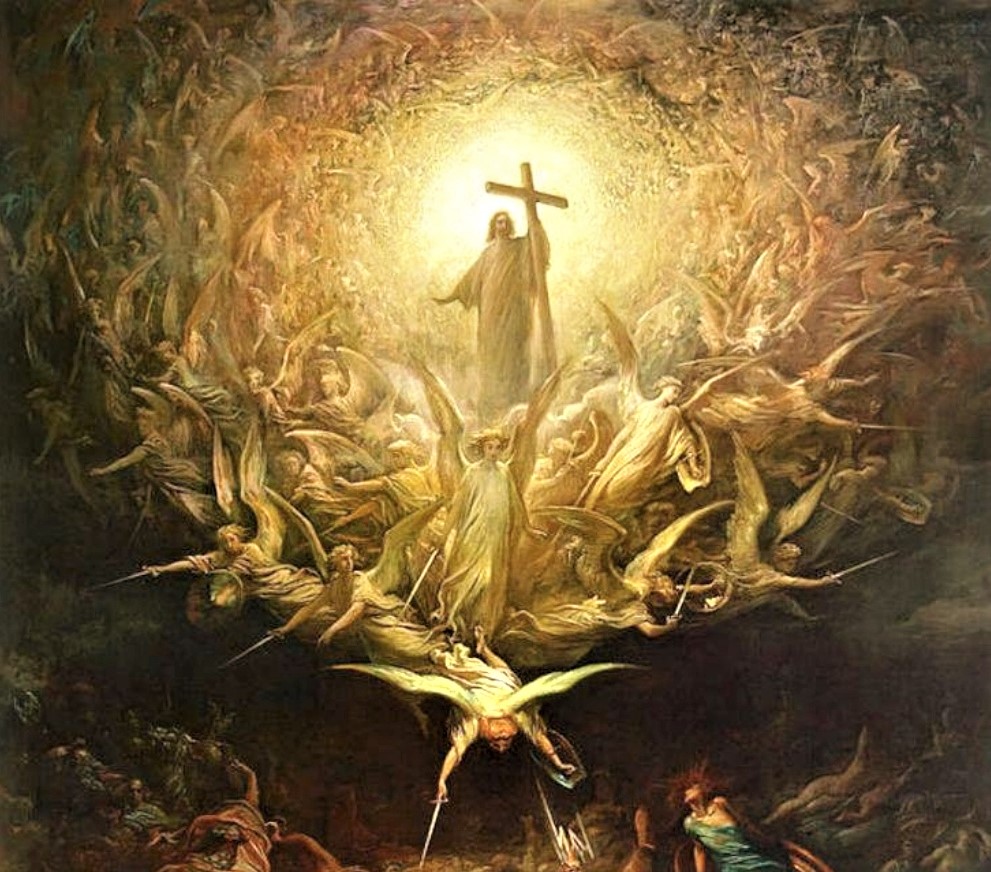
I have been doing a project for the St. Michael Center for Spiritual Renewal.  In this case it was to make two videos on Angels and Demons. The videos needed to be close to thirty minutes, and thus I had to leave a lot of material out. However, five years ago I presented three lectures of 90 minutes each that permitted me to expand and offer more information. In case it can be helpful to you I am offering the two videos I just completed along with links to the talks and some written material I have produced here on the blog over the years.

Lectures:

Angels and Demons, Lecture 1

Angels and Demons, Lecture 2

Angels and Demons, Lecture 3

And here is a compendium of articles I have written here over the years:

Articles on Angels: Click Here

Articles on Demons and related matters Click Here

The Cross Is a Fruit-Bearing Tree – A Homily for the Second Sunday of Lent

The Second Sunday of Lent always features the Transfiguration. The first reason for this is that the trek up Mt. Tabor was one of the stops Jesus made with Peter, James, and John on His final journey to Jerusalem. It is commonly held that He did this to prepare His apostles for the difficult days ahead. There’s a line from an old spiritual that says, “Sometimes I’m up, sometimes I’m down, sometimes I’m almost to the ground … but see what the end shall be.” That is what the Lord is doing here: He is showing us what the end shall be. There is a cross to get through, but there is glory on the other side.

There also seems a purpose in placing this account here in that it helps describe the pattern of the Christian life, which is the Paschal mystery. We are always dying and rising with Christ in repeated cycles as we journey to an eternal Easter (cf 2 Cor4:10). This passage shows the pattern of the cross in the climb, the rising, and in the glory of the mountaintop; then it is back down the mountain again only to climb another one (Golgotha) and through it find another glory (Easter Sunday). Yes, this is the pattern of the Christian life: the Paschal mystery. Let’s look a little closer at three aspects of today’s Gospel passage.

The Purpose of Trials Jesus took Peter, John, and James and went up the mountain to pray.

We often pass over the fact that they had to climb the mountain, no easy task. Anyone who has been to Mt. Tabor knows just what a high mountain it is. The climb to the top is almost 2000 feet and steep as well. It would have taken the better part of a day and probably had its dangers. Looking down from the top is like looking from an airplane window out on the Jezreel Valley (a.k.a. Megiddo or Armageddon).

So, here is a symbol of the cross and of struggle. The climb was up the rough side of the mountain; it was exhausting, difficult, and tested their strength.

I have it on the best of authority that as they climbed they were singing gospel songs like these: “I’m comin’ up on the rough side of the mountain, and I’m doin’ my best to carry on!” and “My soul looks back and wonders how I got over!” and “We are climbing Jacob’s ladder; every round goes higher, higher.”

This climb is like our life. We have often had to climb, to endure, to have our strength tested. Perhaps it was the climb of earning a college degree. Maybe it was the climb of raising children or building a career. What do you have that you really value that did not come at the price of a steep climb, of effort, of struggle?

Most of us know that though the climb is difficult there is glory at the top if we but persevere. Life’s difficulties are often the prelude to success and greater strength.

Though we might wish that life had no struggles, the Lord intends a climb for us, for only the cross leads to true glory. Where would we be without some of the crosses in our life? Let’s ponder some of the purposes of problems in our life.

God uses problems to DIRECT us. Sometimes God must light a fire under you to get you moving. Problems often point us in new directions and motivate us to change. Is God trying to get your attention? Sometimes it takes a painful situation to make us change our ways. Proverbs 20:30 says, Blows and wounds cleanse away evil, and beatings purge the inner most being. An old gospel song speaks of the need for suffering to keep us focused on God: “Now the way may not be too easy, but you never said it would be. ’Cause when our way gets a little too easy, you know we tend to stray from thee.” It’s sad but true: God sometimes needs to use problems to direct our steps toward Him.

God uses problems to INSPECT us. People are like tea bags: if you want to know what’s inside them, just put ’em in hot water! Has God ever tested your faith with a problem? What do problems reveal about you? Our problems have a way of helping to see what we’re really made of. Through trials, I have discovered many strengths I never knew I had. There is a test in every testimony. Trials have a way of purifying and strengthening our faith as well as inspecting it to see whether it is genuine. In this you greatly rejoice, though now for a little while you may have had to suffer grief in all kinds of trials. These trials are only to test your faith, to see whether or not it is strong and pure (1 Peter 1:6).

God uses problems to CORRECT us. Some lessons we seem to learn only through pain and failure. When you were a child your parents told you not to touch the hot stove, but you probably really learned by getting burned. Sometimes we only realize the value of something (e.g., health, a relationship) by losing it. Scripture says, It was good for me to be afflicted so that I might learn your decrees (Psalm 119:71-72), Before I was afflicted, I strayed. But now I keep you word (Psalm 119:67).

God uses problems to PROTECT us. A problem can be a blessing in disguise if it prevents you from being harmed by something more serious. A man was fired for refusing to do something unethical that his boss had asked him to do. His unemployment was a problem for him and his family, but it saved him from being sent to prison a year later when management’s actions were discovered. In Genesis, Joseph says to his brothers, You intended to harm me, but God intended it for good to accomplish what is now being done, the saving of many lives (Genesis 50:20).

God uses problems to PERFECT us. Problems, when responded to correctly, are character-building. God is far more interested in your character than your comfort. Scripture says, We can rejoice, too, when we run into problems and trials, for we know that they are good for us they help us learn to be patient. And patience develops strength of character in us and helps us trust God more each time we use it until finally our hope and faith are strong and steady (Romans 5:3), and You are being tested as fire tests gold and purifies it and your faith is far more precious to God than mere gold; so if your faith remains strong after being tried in the fiery trials, it will bring you much praise and glory and honor on the day of his return (1 Peter 1:7).

So, the climb symbolizes the cross, but after the cross comes the glory.

The Productiveness of TrialsWhile he was praying his face changed in appearance and his clothing became dazzling white. And behold, two men were conversing with him, Moses and Elijah, who appeared in glory and spoke of his exodus that he was going to accomplish in Jerusalem. Peter and his companions had been overcome by sleep, but becoming fully awake, they saw his glory and the two men standing with him. As they were about to part from him, Peter said to Jesus, “Master, it is good that we are here; let us make three tents, one for you, one for Moses, and one for Elijah.” But he did not know what he was saying. While he was still speaking, a cloud came and cast a shadow over them, and they became frightened when they entered the cloud. Then from the cloud came a voice that said, “This is my chosen Son; listen to him.”

All the climbing has been worth it. Now comes the fruit of all that hard work! The Lord gives them a glimpse of glory. They get to see the glory that Jesus has always had with the Father. He is dazzlingly bright. A similar vision from the Book of Revelation gives us more detail:

I turned around to see the voice that was speaking to me. And when I turned, I saw seven golden lampstands, and among the lampstands was someone like a son of man, dressed in a robe reaching down to his feet and with a golden sash around his chest. The hair on his head was white like wool, as white as snow, and his eyes were like blazing fire. His feet were like bronze glowing in a furnace, and his voice was like the sound of rushing waters. In his right hand he held seven stars … His face was like the sun shining in all its brilliance. When I saw him, I fell at his feet as though dead. Then he placed his right hand on me and said, “Do not be afraid. I am the First and the Last. I am the Living One; I was dead, and now look, I am alive for ever and ever! And I hold the keys of death and Hades (Rev 1:12-17).

Yes, all the climbing has paid off. Now comes the glory, the life, the reward for endurance and struggle. Are you enjoying any of the fruits of your crosses now? If we have carried our crosses in faith, they have made us stronger and more confident. Some of us have discovered gifts, abilities, and endurance we never knew we had. Our crosses have brought us life!

The other night I went over to the church and played the pipe organ. It was most enjoyable, but it was the fruit of years of hard work.

Not only have my own crosses brought me life, but the crosses of others have done the same for me. I live and work in buildings that others scrimped, saved, labored to be able to erect. I have a faith that martyrs died to hand on to me and that missionaries journeyed long distances to proclaim. See, trials do produce!

St. Paul says that this momentary affliction is producing for us a weight of glory beyond all compare (2 Cor 4:14). In Romans he says, For I consider that the sufferings of this present time are not worth comparing with the glory that is to be revealed to us (Rom 8:18).

An old gospel song says, “By and by, when the morning comes, and all the saints of God are gathered home, we’ll tell the story of how we’ve overcome. And we’ll understand it better, by and by.”

So, the glory comes after the climb. This is the life that comes from the cross. This is the Paschal mystery: Always carrying about in ourselves the dying of Christ so also that the life of Christ may be manifest in us (2 Cor 4:10).

The Pattern of TrialsAfter the voice had spoken, Jesus was found alone. They fell silent and did not at that time tell anyone what they had seen.

Notice that although Peter wants to stay, Jesus makes it clear that they must go down the mountain and then walk a very dark valley to another hill: Golgotha. For now, the pattern must repeat. The cross has led to glory, but more crosses are needed before final glory. An old spiritual says, “We are climbing Jacob’s ladder … every round goes higher, higher, soldiers of the cross!”

Yes, this is our life: Always carrying about in ourselves the dying of Christ so also that the life of Christ may be manifest in us (2 Cor 4:10).

There are difficult days ahead for Jesus and the apostles, but the crosses lead to a final and lasting glory. This is our life, too: the Paschal mystery, the pattern and rhythm of our life.

Here is a rendition of the song “We Are Climbing Jacob’s Ladder.” The lyrics say that “every round goes higher, higher.” One can picture a spiral staircase as each round is pitched higher and higher musically. This is the pattern of our life: we die with Christ so as to live with Him, and each time we come back around to the cross or glory, we are one round higher and one level closer to final glory.


Ash Wednesday Catholics: What Are they Saying to Us?

Reflecting on last week’s Ash Wednesday Masses it is possible to observe an unusual and puzzling sight. On this day, almost every priest looks out into a congregation that is barely recognizable. To be sure there are many familiar faces of those who regularly attend. But almost half (!) or more of the congregation is populated by faces unknown. Have tour busses unloaded their riders from distant lands? Is this the holiday season where many are here visiting family? No, this is Ash Wednesday, a most peculiar day. Even days before, the phones start ringing and rather urgent voices on the other end ask, “When will ashes be given?” One might almost think that ashes were necessary for salvation. Sadly, to none of the Sacraments is such urgency attached, even among the more faithful. Baptisms, confessions, marriages and Mass itself are often delayed, or even wholly omitted. But come Ash Wednesday there is an urgent and laser-like focus exhibited by large numbers of otherwise disinterested Catholics, it seems like many are majoring in the minors. 

We may lament this, but what can we learn from this? Somehow, even if unwittingly, the Church has powerfully connected with a large segment of otherwise non-practicing Catholics as well as the unchurched. Ashes are awesome! Really? It’s pretty humbling isn’t it? The usual Catholic attempts to seem positive and “relevant” such as trendy music and positive “welcoming” themes are often found wanting. But then, these ashes, which break all the “rules” and theories of modern evangelization powerfully connect with the very folks we are trying to reach. Maybe we have things to learn! 

Consider that the message of Ash Wednesday and the imposing of ashes is not one of our more joyous and positive messages. The fundamental message of this sacramental is, “You are going to die.” Sure we use a little poetry to say it: “Remember you are dust and unto dust you shall return.” But, its fundamental message is still the same: “You are going to die.” Even if one uses the alternate formula, “Repent and believe the Gospel”, repent is not one of our more cheerful or “welcoming” messages. People are not piling into Church to hear John 3:16 (God so loved the world…) and take some valuable or lasting token like a holy card or religious medal. They are lining up to have dirty ashes smeared on their forehead and to hear that they are going to die and need to repent before it’s too late. The Prophet Joel and St. Paul issue urgent warnings that we should weep and fast on account of our sins, that we must repent and be reconciled to God. 

This is hardly what most modern evangelizers tout as the way to reach souls. But souls line up for it every year. Granted, many are not convicted enough to come again until next year, but the point is that the one time they DO come is on a day that breaks almost every precept of the  “welcoming community” message at the heart of modern Church out-reach. 

Why is this and what can we learn? In answering this I do not have vast polling data on which to rely. I have only anecdotal data from years of talking to Ash Wednesday Catholics and from hearing what others have discovered in their conversations. So, take what you like from my thoughts and leave the rest. Here then are a few thoughts. 

Belonging seems to be deeper than membership or practice. 

Many have left the formal practice of the faith and active membership. Some have angry differences with the Church, other have simply drifted or are indifferent. But, when it comes time to answer a survey question of their religious identity, they still check “Catholic.” Ash Wednesday somehow taps into this belonging and identity. It is a day, through the wearing of ashes or the participation in a well known rite that many of these Catholics say, “I still belong….These are my roots…I may not be a “good” Catholic, but Catholic I am.” In some sense, one might leave the Church but the Church never really leaves them; something is still there nudging them not to forget. To a lesser degree Palm Sunday serves a similar purpose and that little piece of palm leaf displayed in the home, usually on or near the crucifix gives voice to Mother Church’s tug on our heart. Though it, some Catholics say, “Through I am distant, I still belong.” In places like Mexico and the U.S., some Hispanics have gone to the Evangelical denominations, but the image of Our Lady of Guadalupe is still prominent in their homes. It is as if to say, “You can take the Man out of the Church, but you can’t take the Church out of the Man.” 

Yes, belonging has deep roots, and somehow, people ritually express a kind of “forget me not” to the Church. Clearly we want to offer them more, but at least there is still some connection, some homing beacon that reminds us and them that they “still belong.”

A serious and sober message carries weight. 

Though the message associated with the imposition of ashes is not a cheerful one, it does carry weight; it is something to take seriously and something which commands respect. Hence the Church is attractive when she preaches and teaches in a way that is substantial and respectable. Most people know that not everything is right in their lives and the message of Ash Wednesday resonates with this instinct. Most people, in seeking a doctor, want one who takes disease seriously and is willing to have an honest conversation about what must be done. Even if they are not ready or willing to follow all of his or her advice, they ultimately want the truth and will not respect a doctor who is not serious or engages in mere flattery. To a significant degree we have lost a sense of this in the Church. 

As noted above, there has been a tendency in the past fifty years to “lighten up.” Great emphasis is put on “positive themes” such as God’s mercy and goodness, but little emphasis on repentance, which is the key that unlocks that mercy. There is almost a pathological avoidance of controversial moral teachings or more “negative” themes such as death, judgment, heaven and hell. No one should ever be upset and the fear of consequences should not be elicited. Parishes should be welcoming and non-judgmental, homilies encouraging and uplifting, sacrifices and reparation for sin and the demands of discipleship are soft-pedaled. And of course, “God is Love,” but that “love” is more often presented as a soft kindness, rather a strong love that seeks to set things right and bring us to the healing of holiness. Affirmation too often eclipses transformation. As for the liturgy, it is often not often celebrated in a way that says something profound and healing is taking place here. And while some think this is the necessary approach today to win converts, our churches have been steadily emptying through this period of “Catholic Lite.” 

Further, such a pastoral strategy does not elicit the respect and reverence necessary if the Church is going to preach the Gospel with authority.  And though many modern liturgists fear that negative themes will repulse modern man, Ash Wednesday calls such fears into question. So too Palm Sunday whose theme is the Passion. The Palm Sunday Gospel is long and intense; the suffering due to our sins is made quite clear. Yet attendance is also very good, in some places, even better than Easter or Christmas. 

So here are some things to learn in terms of Evangelization. These observations are not intended in an absolute sense. Balance is needed where the bad news of sin, death and our need to repent are blended with the good news of mercy, healing and salvation. There is an old saying, “If you don’t know the bad news, the good news is no news.” Collectively we have been too averse to presenting the bad news. But as Ash Wednesday and Palm Sunday show, many of the unchurched are willing to hear it and fundamentally know it is true. The bad news also highlights how wonderful the good news is. 

It is also clear that, whatever respect Ash Wednesday and Palm Sunday command, it is not enough. Only rarely do attendees at an Ash Wednesday Mass experience the conversion that helps the Church seal the deal. Looking to the future we do well to ponder how we might make use of evangelical moments such as Ash Wednesday, Palm Sunday, as well as funerals, weddings and baptisms. Many unchurched are encountered in such moments and simply preaching light-heartedly may need to be balanced with sober calls for repentance and a decision to walk with the Lord in the Church and in the Sacred Liturgy. 

Warnings have their place and as Ash Wednesday shows, such messages are not as unappealing as many in the Church think. If we want Ash Wednesday Catholics to become All Sunday Catholics, maybe we can learn to build on what brings them in the first place and be less anxious to echo the opening words of Jesus’ public ministry, “Repent and Believe the Gospel!”

Cross or Couch – A Homily for the First Sunday of Lent

In this desert scene, the Lord Jesus faces down three fundamental areas of temptation, all of which have one thing in common: they seek to substitute a couch for the cross.

In a way, the devil has one argument: “Why the cross?” His question is a rhetorical one. He wants you to blame God for the cross, and in your anger, to reject Him as some sort of despot.

Well, pay attention, Church! The cross comes from the fact that you and I, ratifying Adam and Eve’s choice, have rejected the tree of life in favor of the tree that brought death. We, along with the devil, may wish to wince at the cross and scornfully blame God for it, but in the end the cross was our choice.

If you think that you have never chosen the tree of death and that God is “unfair,” then prove to me that you have never sinned. Only if you can do that will I accept that you have never chosen the Tree of the Knowledge of Good and Evil over the Tree of Life and that you deserve something better than the cross. Only then will I accept that you have never insisted on “knowing” evil as well as good.

If you can’t, then you’ve made the same self-destructive, absurd choice that the rest of us have. It is not God that is cruel but we who are wicked and are to blame for the presence of the cross. The cross comes not from God but from us. We ought to stop blaming God for evil, suffering, and the cross, and instead look in the mirror. The glory of this gospel is that the Lord Jesus came into this twisted world of our making and endured its full absurdity for our sake. If there is evil in this world, it is our choice, not God’s.

Have we finished blaming God? Are we ready to focus on our own issues? If so then let’s look at some areas of temptation that the devil can exploit because we indulge them. Let’s also see the answer that the Lord Jesus has for these temptations; for He, though tempted, never yielded.

Pleasures and Passions – The devil encourages Jesus to turn stones into bread. After such a long fast, the thought of bread is surely a strong temptation. In effect, the devil tells Jesus to “scratch where it itches,” to indulge His desire, to give in to what His body craves.

We, too, have many desires and are told by the devil in many ways to “scratch where it itches.” Perhaps no generation before has faced such strong temptation. We live in a consumer culture that is highly skilled at eliciting and then satisfying our every desire. All day long, we are bombarded with advertisements that arouse desire and then advise us that we simply must fulfill those desires. If something is out of stock or unavailable in exactly the way we want at the instant we want it, we are indignant. Why should I have to wait? Why can’t I have it in that color? The advertiser’s basic message is that you can have it all. This is a lie, of course, but it is told so frequently that we feel entitled to just about everything.

Some of our biggest cultural problems are ones stemming from overindulgence. We are a culture that struggles with obesity, addiction, sexual misconduct, and greed. We experience overstimulation that robs us of a reasonable attention span; boredom is a significant issue for many who are too used to the frantic pace of video games and action movies. We have done well in turning stones into bread.

Jesus rebukes the devil, saying, Man does not live on bread alone. In other words, there are things that are just more important than bread and circuses, than creature comforts and indulgence. Elsewhere Jesus says, A man’s life does not consist in the abundance of his possessions (Lk 12:15). I have written further on this in another post: The Most Important Things in Life Aren’t Things.

Popularity and Power – Taking Jesus up a high mountain, the devil shows Him all the nations and people of the earth and promises them to Him if Jesus will but bow down and worship him. This is a temptation to both power and popularity; the devil promises Jesus not only sovereignty but glory.

Because most of us are not likely to become sovereigns and because temptation is only strong in those matters that seem remotely possible for us, I will focus instead on popularity—something we deal with regularly in this life. One of the deeper wounds in our soul is the extreme need that most of us have to be liked, to be popular, to be respected, and to fit in. We dread being laughed at, scorned, or ridiculed. We cannot stand the thought of feeling minimized in any way.

For many people the desire for popularity is so strong that they’ll do almost anything to attain it. It usually starts in youth, when peer pressure “causes” young people to do many foolish things. They may join gangs, get tattoos, pierce their bodies, and/or wear outlandish clothes. Many a young lady, desperate to have a boyfriend (and thus feel loved and/or impress her friends), will sleep with boys or do other inappropriate things in order to gain that “love.” As we get older, we might be tempted to bear false witness, to make “compromises” to advance our career, to lie to impress others, to spend money we don’t have to buy things we don’t really need, and/or to try to impress people whom we don’t even like. Likewise, we may be tempted to be silent when we should speak out for what is right.

All of this is a way of bowing before the devil, because it demonstrates that we are willing to sin in order to fit in, to advance, or to be popular. Jesus says, You shall worship the Lord, your God, and him alone shall you serve.

The real solution to this terrible temptation of popularity is to fear the Lord. When we fear God, we need fear no one else. If I can kneel before God I can stand before any man. If God is the only one we need to please, then we don’t have to expend effort trying to please anyone else. I have written more on this matter elsewhere: What Does It Mean to Fear the Lord?.

Presumption and Pride – Finally (for now) the devil encourages Jesus to test God’s love for Him by casting Himself off the highest wall of the Temple Mount. Does not Scripture say that God will rescue Him? The devil quotes Psalm 91: With their hands they will support you, lest you dash your foot against a stone. In our time the sin of presumption is epidemic.

Many people think that they can go one behaving sinfully, recklessly, and wantonly and that they will never face punishment. “God is love,” they boldly say. “He would never send people to Hell or punish them!” In saying this, they reject literally thousands of verses of Scripture that say otherwise; they have refashioned God and worship a man-made idol. “God doesn’t care whether I go to Church,” they claim. “He doesn’t mind if I live with my girlfriend.” The list of things God “doesn’t mind” continues to grow.

The attitude seems to be that no matter what I do, God will save me. It is presumptuous to speak or think like this. Hell and punishment are surely difficult teachings to fully comprehend and to reconcile with God’s patience and mercy, but He teaches of them and therefore we need to stop pretending He doesn’t.

I have written elsewhere on the topic of Hell and why it makes sense in the context of a God who loves and respects us: Hell Has to Be.

A mitigated form of presumption is procrastination, wherein we constantly put our return to the Lord out of our mind. About this tendency it is said,

There were three demons summoned by Satan as to their plan to entrap as many human beings as possible. The first demon announced that he would tell them there is no God. But Satan wasn’t too impressed. “You’ll get a few, but not many and even those atheists are mostly lying and know deep down inside that someone greater than they made them and all things.” The second demon said he would tell them there is no devil. But Satan said, “That won’t work, most of them have already met me and know my power.” Finally, the third demon said, “I will not tell them there is no God or no devil, I will simply tell them there is no hurry!” And Satan smiled an ugly grin and said, “You’re the man!”

Jesus rebukes the devil by quoting Deuteronomy: You shall not put the Lord, your God, to the test. We ought to be very careful about presumption, for it is widespread today.

This does not mean that we have to retreat into fear and scrupulosity. God loves us and is rich in mercy, but we cannot willfully go on calling “no big deal” what He calls sin. We should be sober about sin and call on the Lord’s mercy rather than doubting that we that really need it or just presuming that He doesn’t mind.

The journey of our lives has its beauties but is also difficult and temptation is a reality, but as an old gospel song says, “The gospel train’s comin’, I hear it just at hand. I hear the car wheel rumblin’ and rollin’ thro’ the land. Get on board little children, get on board. There’s room for many more!”


Lenten Assignment: Be Grateful!

True gratitude is a grace, or gift, from God. It proceeds from a humble and transformed heart. We do not render thanks merely because it is polite or expected, or because God commands it but because it flows naturally from a profound experience of gratitude. The “command” of Scripture to give thanks is not a moral cliché but a truth and a description of what flows from a transformed heart.

We should seek from God the powerful transformation of our intellect and our heart so that we become deeply aware of the remarkable gift that is everything we have. As this awareness deepens so does our gratitude and joy at the “magnificent munificence” of our God. Everything—literally everything—is a gift from Him. Consider the following reflection from St. Gregory Nazianzen:

Recognize to whom you owe the fact that you exist, that you breathe, that you understand, that you are wise, and, above all, that you know God and hope for the kingdom of heaven and the vision of glory, now darkly as in a mirror but then with greater fullness and purity. You have been made a son of God, coheir with Christ. Where did you get all this, and from whom?

Let me turn to what is of less importance: the visible world around us. What benefactor has enabled you to look out upon the beauty of the sky, the sun in its course, the circle of the moon, the countless number of stars, with the harmony and order that are theirs, like the music of a harp? Who has blessed you with rain, with the art of husbandry, with different kinds of food, with the arts, with houses, with laws, with states, with a life of humanity and culture, with friendship and the easy familiarity of kinship?

Who has given you dominion over animals, those that are tame and those that provide you with food? Who has made you lord and master of everything on earth? In short, who has endowed you with all that makes man superior to all other living creatures?

Is it not God who asks you now in your turn to show yourself generous above all other creatures and for the sake of all other creatures?(From a sermon by Saint Gregory of Nazianzen, bishop. Oratio 14, De Pauperum amore, 23-25: PG 35, 887-890.)

Yes, we have so much for which we should be grateful!God holds together every fiber of our being: every cell and every part of every cell, every molecule and every part of every molecule, every atom and every part of every atom. He facilitates every function of our body: every beat of our heart, every movement of our body, the functioning of every organ. God sustains every intricate detail of the world in which we live: the ideal orbit of our planet such that we neither boil nor freeze; the magnetic shield that protects Earth from harmful solar radiation; every intricate process of our planet, solar system, galaxy, and universe. All of this, including us, is sustained by God and provided for by Him. The depth, height, length, and width of what God does is simply astonishing—and He does it all free of charge. Pondering such goodness and providence helps us to be more grateful. Yes, allis gift.

There are some gifts of God that don’t seem like gifts at all:losses, tragedies, and natural disasters. In such moments it is easy to feel that He has forsaken us; gratitude is probably the last thing on our mind. Even here, Scripture bids us to look more closely: And we know that all things work together for the good of those who love God and who have been called according to his purpose (Romans 8:28). We don’t always know how, but even in difficult moments God is making a way unto something good. He is paving a path unto glory, even if through the cross. Jesus has said to us, But I will see you again and you will rejoice, and no one will take away your joy. On that day you will have no more questions to ask me (Jn 16:22-23). Yes, even in our difficulties we are more than conquerors (Rm 8:37) because the Lord can write straight with crooked lines and make a way out of no way. Yes, allis gift!

It is hard to overestimate the role that gratitude plays in good mental, emotional, and spiritual health.Grateful people are different: more joyful, generous, kind, patient, serene, and confident. All of this comes from the fact that gratitude makes present to us the provident goodness of God. Acknowledging how good God has been to us helps us to become more trusting and less anxious. Because of this we have the confidence to be more generous; there is no need to hoard things because we know that God will take care of us. Yes, through gratitude we are freed from many anxious cares and given a serene and stable joy; we are equipped to be so much more patient and generous.

Ultimately, gratitude is a gift to be received from God. We ought to ask for it humbly. We can dispose ourselves to it by reflecting on things such as those discussed above, but ultimately gratitude comes from a humble, contrite, and transformed heart. True gratitude is a grace, a gift, that comes from a heart deeply moved, astonished, and aware of the fact that God is so very good. Allis gift!

Bite Your Tongue! A Homily for the 8th Sunday of the Year

The first reading this Sunday reminds us that our speech discloses our character:

When a sieve is shaken, the husks appear; so do one’s faults when one speaks. The fruit of a tree shows the care it has had; so too does one’s speech disclose the bent of one’s mind.

Praise no one before he speaks,
for it is then that people are tested
(Sirach 27:4-7).

What we say reveals a great deal about us—more than we imagine. Speech is among our greatest gifts, yet self-mastery in speech is among the rarest. Some of the most common sins we commit are related to speech: gossip, idle chatter, lies, exaggeration, harsh attack, and uncharitable remarks. With our tongue we can spew hatred, incite fear, spread misinformation, tempt, discourage, promote error, and ruin reputations. With a gift capable of bringing such good, we can surely cause great harm!

The Letter of James says this:

We all stumble in many ways. Anyone who is never at fault in what he says is perfect, able to keep his whole body in check. When we put bits into the mouths of horses to make them obey us, and thus we can turn the whole animal. Or take ships as an example. Although they are so large and are driven by strong winds, they are steered by a very small rudder wherever the pilot wants to go. Likewise, the tongue is a small part of the body, but it makes great boasts.

Consider how a great forest is set on fire by a small spark. The tongue also is a fire, a world of evil among the parts of the body. It corrupts the whole body, sets the whole course of one’s life on fire, and is itself set on fire by hell.

All kinds of animals, birds, reptiles and sea creatures are being tamed and have been tamed by mankind, but no human being can tame the tongue. It is a restless evil, full of deadly poison. With the tongue we praise our Lord and Father, and with it we curse human beings, who have been made in God’s likeness. Out of the same mouth come praise and cursing. My brothers and sisters, this should not be (Jam 3:2-10).

Although one may conquer any sin by God’s grace, those associated with speech are among the hardest to overcome. Sometimes it seems as if our speech is being controlled by a separate, baser part of our brain. We can be halfway through saying something before realizing how foolish and sinful we are being. Scripture speaks artistically of the sinful tongue.

Here are some common sins of the tongue:

The Lying Tongue – speaking falsehoods with the intention of misleading others.

  • The LORD detests lying lips, but he delights in people who are trustworthy (Prov 12:22).
  • A false witness will not go unpunished, and one who utters lies will not escape (Prov 19:5).
  • Not every story should you believe (Sir 19:14).

The Backbiting Tongue – talking about others behind their backs, injuring their reputations through detraction.

  • A man’s tongue can be his downfall. Be not called a detractor; use not your tongue for calumny (Sir 5:13-16).
  • Never repeat gossip, and you will not be reviled. … Let anything you hear die within you … (Sir 19:5).

The Indiscreet Tongue – spreading confidential, unnecessary, or hurtful information about others.

  • He that goes about as a tale-bearer reveals secrets, therefore keep no company with such a one (Prov 20:19).
  • A gossip betrays a confidence; so avoid a man who talks too much (Prov 20:19).
  • He who repeats an evil report has no sense. Never repeat gossip… Let anything you hear die within you; be assured it will not make you burst. But when a fool hears something, he is in labor, like a woman giving birth to a child … (Sir 19:5, 14).
  • Thou shalt not go up and down as a tale-bearer among thy people (Lev 19:16).

The Flattering Tongue – exaggerating the good qualities of others in order to ingratiate ourselves to them.

  • May the Lord silence all flattering lips and every boastful tongue (Ps 12:4).
  • Wounds from a friend can be trusted, but an enemy multiplies kisses (Prov 27:6).

The Proud Tongue – speaking boastfully or in an overly certain way.

There is a saying that a proud tongue comes with two closed ears. Those of proud tongue are not easily corrected and do not qualify or distinguish their remarks as they should.

  • May the Lord silence all flattering lips and every boastful tongue, Those who say, “By our tongues we will prevail; when our lips speak, who can lord it over us?” (Ps 12:4-5)
  • An evil man is trapped by his rebellious speech, but a righteous man escapes from trouble (Prov 12:13).
  • The prudent man does not make a show of his knowledge, but fools broadcast their foolishness (Prov 12:23).

The Overused Tongue – saying too much, which usually ushers in sin by its excess.

  • A fool’s voice [comes] along with a multitude of words (Ecc 5:2).
  • When words are many, sin is inevitable, but he who restrains his lips is wise (Prov 10:19).

The Rash Tongue – speaking before one should, often without having all the information.

  • Be not rash with your mouth, and let not your heart be hasty to utter anything before God (Ecc 5:1).
  • Be swift to hear, but slow to answer. If you have the knowledge, answer your neighbor; if not, put your hand over your mouth (Sir 5:13).
  • Even a fool is thought wise if he keeps silent, and discerning if he holds his tongue (Prov 17:28).

The Quarrelsome Tongue – speaking in an overly opinionated way, attacking others personally, and/or provoking unnecessary division.

  • Fools’ words get them into constant quarrels; they are asking for a beating (Prov 18:6).
  • A fool finds no pleasure in understanding but delights in airing his own opinions (Prov 18:2).
  • Drive out the mocker, and out goes strife; quarrels and insults are ended (Prov 22:10).

The Cursing Tongue – wishing harm upon others, often that they be damned.

  • He loved to pronounce a curse—may it come back on him. He found no pleasure in blessing—may it be far from him (Ps 109:17).
  • Whoever curses his father or mother, his lamp will be extinguished in deepest darkness (Prov 20:20).

The Piercing Tongue – speaking unnecessarily harshly or severely.

  • The heart of the righteous weighs its answers, but the mouth of the wicked gushes evil (Prov 15:28).
  • Some people make cutting remarks, but the words of the wise bring healing (Prov 12:18).
  • Do not rebuke an older man harshly, but exhort him as if he were your father. Treat younger men as brothers, older women as mothers, and younger women as sisters, with absolute purity (1 Tim 5:1-2).

The Silent Tongue – failing to speak up when we ought to warn people of sin, call them to the Kingdom, and announce the truth of Jesus Christ.

In our age, the triumph of evil and poor behavior has been facilitated by our silence. As prophets, we are called to speak God’s Word.

  • Proclaim the message; persist in it in season and out of season; rebuke, correct, and encourage with great patience and teaching (2 Tim 4:2).
  • Israel’s watchmen are blind; they are all ignorant, they are all dumb dogs, they cannot bark (Is 56:10).

Yes, our speech is riddled with what it should not have and lacking in what it should. How wretched is our condition! Well, James did say, Anyone who is never at fault in what he says is perfect. Indeed, if anyone masters his tongue, he is a spiritual superman!

Set a guard over my mouth, O LORD; keep watch over the door of my lips (Ps 141:3).

Yes, help me, Lord. Keep your arm around my shoulder and your hand over my mouth! Put your Word in my heart so that when I do speak, it’s really you speaking.

https://youtu.be/OGC4JnXzn1o


Celebrating African American History Month Through the Spirituals Part 3

During the month of February to celebrate African American History Month  we focus on the ‘Spirituals’ and the impact they have on  lives and faith. In this post we look to the theme of READINESS.

One of the great qualities of the African-American Spirituals is to treat serious subjects in a clear, memorable, and almost joyful way. This is true even of very weighty matters like sin and readiness for judgment day. They cover the judgment, but in a way that is playfully bright while at the same time deeply soulful.

Let us remember that Spirituals were written in the cauldron of great suffering. If any people might be excused from thinking that the Lord would exempt them from judgment day, it is surely the enslaved in the deep South. And yet the Spirituals are almost wholly devoid of self-righteousness. Enslaved blacks sang in ways that looked also to their own sins and need to be prepared. If they were prepared, God, who knew their trouble, would help them to steal away to Jesus. They did not see themselves as exempt from the need to be ready.

So let’s sample some of these lines from numerous spirituals that speak to judgment. Some of these first quotes occur in many of the Spirituals:

I would not be a sinner, I’ll tell you the reason why. I’m afraid my Lord might call my name and I wouldn’t be ready to die. 

Some go to Church for to sing and shout, before six months they’s all turned out!

Better watch my brother how you walk on the cross! Your foot might slip and your soul get lost!

God gave Noah the rainbow sign, no more water but the fire next time!

Old Satan wears a hypocrite’s shoe, If you don’t watch he’ll slip it on you!

Knock at the window knock at the door, Callin’ brother Noah, can you take more?! No said Noah cause you’re full of sin! God’s got the key you can’t get in!

Oh sinner man better repent! Oh you’d better repent for God’s gonna call you to judgment There’s No hiding place down there!

Sinner please don’t let this harvest pass And die and lose your soul at last.

The words as one can see are memorable and poetic; they are playful and piercing. Other memorable songs of readiness and judgment are some of the following:

My Lord, what a morning, When the stars begin to fall. You’ll hear the trumpet sound, to wake the nations underground Looking to my God’s right hand, When the stars begin to fall. You’ll hear the sinner moan, When the stars begin to fall. You’ll hear the Christian shout, when the stars begin to fall!

No signal for another train, to follow in this line. Oh sinner you’re forever lost. when once you’re left behind, she’s nearing now the station, oh, sinner don’t be vain, but come and get your ticket and be ready for that train!

Nobody’s fault but mine. So if I die and my soul be lost, it’s nobody’s fault but mine. My mother taught me how to pray, so if I die and my soul be lost, it’s nobody’s fault but mine.

Well I went to the rock to hide my face, the rock cried out, no hiding place, Oh the Rock cried I’m burnin too! I wanna go to heaven just as much as you. Dere’s no hiding place down there.

Michael row the boat ashore, Alleluia. The River Jordan is chilly and cold, chills the body but not the soul. The river is deep and the river is wide, milk and honey on the other side! Michael row the boat ashore, Alleluia.

Most of these songs are deeply scriptural and make serious appeals to the human soul, but they do so in a way that is creative. They get you tapping your foot and invite you to a joyful consideration of the need to repent before it’s too late. Others are more soulful, even mournful, in their pentatonic scale. Given all the reluctance to discuss the four last things (death, judgment, Heaven, and Hell), songs like these may help to reopen the door to necessary conversations between preacher and congregation, parents and children. They are a valuable masterpieces and the great treasure for the Church and for the world.

Note too, some of these Spirituals had a double meaning we should not ignore. The Gospel Train surely referred to the journey to heaven, but it too many it was also code for the Underground Railroad. Michael Row the Boat ashore speaks also the journey to the other side but it also images crossing the river from slave states to the free North.

We cannot conclude this reflection on readiness Spirituals without reference to one of the greatest and most spirited of them all: In Dat Great Gettin’ Up Morning. It is a tour de force of the last Day when the trumpet blows and the dead rise. It is joyful—a real toetapper—and makes a serious point along with a wish:

In That Great Gettin’ Up Mornin Fare You Well!” I’m Gonna tell ya ’bout da comin’ of da judgment! Der’s a better day a comin’, Fare you well, fare you well! Chorus: In dat great gettin’ up mornin’, Fare you well, fare you well In dat great gettin’ up mornin’, Fare you well, fare you well Oh preacher fold yo’ bible, For dat last souls converted, Fare you well, fare you well Blow yo’ trumpet Gabriel, Lord, how loud shall I blow it? Blow it right and calm and easy, Do not alarm all my people, Tell dem all come to da judgment, Fare you well, fare you well! Do you see dem coffins burstin, do you see dem folks is risin’ Do you see dat fork of lightenin’, Do you hear dat rumblin’ thunder ?!? Fare you well, fare you well! Do you see dem stars a fallin’, Do you see da world on fire?!? Fare you well, fare you well Do you see dem Saints is risin’, Fare you well, fare you well See ’em marchin’ home for heaven, Fare you well, fare you well Oh! Fare you well po’r sinners, fare you well, fare you well Fare you well po’r sinners, fare you well, fare you well! 

Thank God for the Spirituals, and thank those he inspired to craft them!


Celebrating African American History Month Through the Spirituals Part Two

This is the second in a series of four postings on African American Spirituals. 

In this second article on the Spirituals lets review of some of the general history of the Spirituals and then, we look to the theme of HOPE. 

The Spirituals of the African-American tradition, sometimes called the “Negro spirituals” are songs created by enslaved Africans in the decades prior to the Civil War. They do not have individual composers, but emerged from the whole community. They were passed orally from person to person and improvised as suited the singers. They were crafted in the fields where the slaves would sing to pass the day and ease the often tedious work of planting, tending and harvesting the crops. Some were simple work songs that were sung in a call and response style. Over the years, the slaves and their descendants adopted Christianity, the religion of their masters, and they began to include religious themes into their field songs. They re-shaped it into a deeply personal way of dealing with the oppression of their enslavement. These songs, became known as spirituals and reflected the slaves’ expression of their faith. The songs told stories, from Genesis to Revelation: Adam and Eve in the Garden, Moses and the Red Sea. They sang of the battle of Jericho, Ezekiel seeing a wheel, Mary, Jesus, the blind man seeing, God troubling the water, and yes, the Devil, as one to avoid!

Some of the best known spirituals include: “Sometimes I Feel Like a Motherless Child,” “Nobody Knows The Trouble I’ve Seen”, “Steal Away,” “Swing Low, Sweet Chariot,” “Go Down, Moses,” “He’s Got the Whole World in His Hand,” “Every Time I Feel the Spirit,” “Let Us Break Bread Together on Our Knees,” and “Wade in the Water.”

The Spirituals have great authority since they were written in the cauldron of great suffering. If any people might be excused from thinking that the Lord had forsaken them or, that they would be exempt from judgment day, it was surely the enslaved in the Deep South. If any people might be excused from crying out for vengeance, it was those enslaved in the South. And yet the spirituals are almost wholly devoid of condemning language. Enslaved blacks sang in ways that looked also to their own sins and need to be prepared. If they were prepared, God, who knew their trouble, would help them to steal away to Jesus. They did not see themselves as exempt from the need to be ready and to persevere in the faith. In the years following Slavery, these songs were collected and given choral form that included elaborate harmonies and swift rhythms. The spirituals are wonderfully creative and contain a wisdom that comes from suffering and a hope that comes from faith in God’s promises. The African American Spirituals are a national treasure and gift to the Church of immeasurable value.

Now we turn to the theme of Hope.

There is an old story told of a young slave girl who lamented to her mom, “Mama, all the White folks got shoes, why don’t we?” Her mother replied, “Oh, we got shoes alright. See,

I got shoes, you got shoes, and all God’s children got shoes! When we get to heaven gonna put on our shoes and go walk all over God’s heaven.

And then Mama said “Remember child,” Everybody talkin’ ‘bout heaven ain’t a goin’ there.”

(NOTE: Click on the songs in blue text for links to the internet to hear versions of these Spirituals).

So, songs and sayings like these got taken into the field by the slaves and became the foundation of the Spirituals. In the midst of great injustice and oppression with no end in sight, one can become depressed and angry. The message of the Spirituals drew on biblical stories and themes of life to convey the hope of ultimate victory in Jesus and the reward for faith. They were a kind of “Balm in Gilead to heal the wounded soul.” The oppressed looked beyond this valley of tears to heaven where joys unspeakable and glories untold awaited the faithful Christian. One spiritual says,

I am a poor pilgrim of sorrow, I’m tossed in this wide world alone. No hope I have for tomorrow, but I’ve started to make heaven my home. Yes, sometimes I am tossed and driven, Lord, Sometimes I don’t know where to roam. But I’ve heard of a city called heaven and I’ve started to make it my home.”

Another spiritual asked God to hold them tight, they sang:

“Rocka my soul in the bosom of Abraham, Oh, rocka my soul!”

Yet, another spiritual reminded the slaves of God’s deliverance in previous days:

“Didn’t my Lord deliver Daniel? Then why not every man?”

Meanwhile, as another spiritual exhorts:

“Ain’t gonna let nobody turn me round, marchin’ up to freedom land.”

That’s because

“I promised the Lord that I would hold out, until my change comes! Yes, He said he’d meet me in Galilee.”

Meanwhile we’d better:

Walk together Children, there’s a great camp meeting in the Promised Land!

These songs gave hope in the midst of great sorrow and oppressive slavery. And this hope was not only in heaven after death, it was now as well. Many of the songs had double meanings. The city called heaven that I am “trying to make my home” was also code for the North where freedom could be found. “Marchin’ up to freedom land” could mean heaven but it could also mean the land of freedom up north. The slaves knew that not every blessing  had to wait for heaven. God is in the blessing business right now. The spirituals sought to give courage to fellow slaves to forsake fear and look for opportunities to lay hold of their God-given freedom.