The Only Hope is Holiness: A Meditation on What it will take to Restore our Culture

093014There has been a tendency for traditional Catholics to hitch their wagons to the Republican Party specifically, and to conservative politics in general. It is demonstrably true that the stated platform of the Republican Party has been more aligned with Catholic teaching on a number of critical issues: abortion, religious liberty, the definition of marriage, euthanasia, school choice, parental notification, etc. And while it is true that some other issues as stated in the Catechism (opposition to the death penalty, immigration reform, care for the poor, etc.) align with Democratic views, most traditional Catholics point out that these issues are either not doctrinally absolute, or are matters about which reasonable people can differ in terms of implementation.

But though it is demonstrably true that the Republican platform hews closely to Catholic teaching on many life and family issues, it is also demonstrably true that there has been an alarming and consistent decline in cultural adherence to Catholic, biblical, and traditional teaching in these matters. And this decline has occurred despite significant periods of Republican ascendency in the past 60 years. There have been many Republican presidents during the years since the cultural revolution of 1968. And there have been periods of significant Republican control of Congress as well, especially since 1994. At best, traditional values held their own during these periods. But it is hard to argue that Republican or conservative majorities reversed the rising tide of abortion and euthanasia, reduced the levels of fornication,  diminished the number of divorces, or curtailed support for same-sex unions.

What are we to learn from this? A thoughtful article by Yuval Levin over at First Things offers some insights. I am generally less optimistic than he, but I would like to share what I think are some of his better reflections. The full article is here: A Pessimistic Case for Hope. I have added my own remarks below in red text.

Yuval Levin, who is at the Ethics and Public Policy Center and is editor of National Affairs writes,

Ten years ago this fall, it seemed for a moment like social conservatives might be ascendant in our politics. Immediately after the 2004 election, some analysts on the right and left alike said George W. Bush’s reelection signaled a rising tide of “values voters” who would yield an enduring nationwide advantage for Republicans on social issues … Many social conservatives now look wistfully upon that moment and see in the decade that followed … a sorry decline. Both politics and the culture now seem increasingly hostile to social conservatism, and religious believers in the public square are fighting for even minimal tolerance. The tide appears to have turned decisively

So here is well described the tendency over the past thirty years to seek to advance traditional cultural values through political connections. This is not intrinsically wrong and has many historical precedents. For many decades the Catholic Church unofficially aligned with the Democratic Party in order to advance Catholic social teaching related to civil rights, labor conditions, wages, benefits, etc. As those issues waned and labor unions become powerful (and all too often corrupt), attention shifted to moral issues in the wake of the sexual and cultural revolution.

The “legalization” of abortion in 1973 did not immediately cause a political realignment. But by the early 1980s the parties largely landed on different sides of the issue. Catholics increasingly found allies among Republicans regarding abortion and other family and life issues that were emerging in the wake of the Roe v. Wade decision and the 60s revolution.

However, unlike the unofficial “partnership” with the Democratic Party during the heady days of labor victories and the Civil Rights movement, the alliance with Republicans has produced only limited victories and little more than a slowing of the erosion of the values related to family, faith, and life. And thus Levin notes here the general pessimism that pervades traditional ranks today. He continues,

But today’s cultural conservatives exhibit the wrong sort of pessimism about all this. They are too pessimistic about their cultural and political prospects because they are not pessimistic enough about the limits of human nature. A clearer sense of those limits should help us see not only why traditionalism never triumphs in the liberal society but also why progressivism can never suffice …

Ah! Here is an interesting reference to our fallen human condition. At the end of the day, government cannot remedy our fallen tendency to be obtuse, rebellious, greedy, and licentious. It is really more the role of culture and the presence of a strong, prophetic, organized, and effective Church that must, by God’s grace, work to remedy the worst of the ills we face. The notion of a large government role in creating a just society is too easily a form of utopianism.

Perhaps it is true that government, through laws and policies, can reinforce good behavior and punish bad or destructive behavior. But if the culture is really heading south (as it is), that culture will ultimately infect the very government some wish to engage as an ally. Why are there so many wicked, corrupt, and confused leaders in the civic arena? Why are even the better among civic leaders often weak and ineffective in boldly addressing the cultural decline? Why do conservative judges, on whom so many have placed high hopes, so often disappoint? Because, at the end of the day, these are the sorts of leaders (and people) our culture produces: deceived, often unscrupulous, weak, uncertain, ineffective, and easily swayed.

Sadly, the malaise has often reached the Church as well. For while the Church still teaches infallibly on faith and morals, and while her doctrine and Scripture provide a sure light, this guarantee does not extend to all her human leaders, who are also products of a confused, compromised, and darkened culture. Clear and courageous teachers and leaders among the clergy (as well as among parents) are becoming harder and harder to find, and all too often they disappoint.

What then are concerned and traditional Catholics to do? Levin offers the following:

[Traditionalists] should live out their faiths and their ways in the world, confident that their instruction and example will make that world better and that people will be drawn to the spark … And it means that traditionalists must be committed to the preservation of spaces for private life that are protected from the perverse shortsightedness of politics.

In other words, it means that we are going to have to persist in our fight to keep government out of our families and our Church. Increasingly intrusive government involvement needs to be seen for the danger that it is. Levin continues,

We should be intensely engaged in the struggle for the soul of our society—knowing we can expect no ultimate victory from politics, but also that we are by no means destined to defeat, and that by persisting in the struggle we make room for another generation to rise and thrive and seek to embody the good.

Many years ago, Venerable Fulton Sheen remarked that we have tried every means to change the world but one: holiness. Government cannot save us; only God can save us. And God works through grace and the transformation of world—one soul at a time. It is easier to put on slippers than to carpet the whole of the earth. So, it is time to cover our feet with the Gospel of Truth.

Holiness cannot remain an abstraction. It is time for traditional Catholic men and women to get married and stay married, to have larger families and raise them in the fear of the Lord. It is time to stop being greedy and selling our soul for the trinkets of the world, so that we can’t “afford” children. It’s time to pray and fast. It’s time for Eucharistic Adoration, and the Rosary, and the Chaplet of Divine Mercy. It’s time to stop fornicating, remaining silent about the sinfulness of homosexual acts, and making light of any form of sinful rebellion. It’s time to dress modestly and live differently, visibly, in a world that has become increasingly coarse, immodest, and cynical. It’s time to heroically care for the poor and not just think the government should do what we ought to do. And we must bring the poor to the gospel, not just attend to their physical needs as yet another social service agency. It’s time for clergy and parents to be more courageous and clear.

It is time to live differently. Our only real hope is holiness; only then can we be real leaven that will raise our culture out of the mess in which we are currently mired.

Therefore gird up your minds, be sober, set your hope fully upon the grace that is coming to you at the revelation of Jesus Christ. As obedient children, do not be conformed to the passions of your former ignorance, but as he who called you is holy, be holy yourselves in all your conduct; … [Thus purifying your souls by your obedience to the truth for a sincere love of the brethren, love one another earnestly from the heart (1 Peter 1:13ff).


Here is a video that celebrates virtue:

The Magnificent Mystery of Art and the Glory of the Human Soul

092914One of the more common modern themes is that the human person is really nothing more than a smart ape or an above-average animal. To this I must reply, “Nonsense!”

It is true that we have many similarities to primates and, really, to all mammals. But the similarities stop there.

At the level of the soul the differences could not be greater! Animals do not compose symphonies; they do not write great works of literature or create magnificent art. They do not build cities or form bicameral legislatures.  They do not pass laws or even ponder right and wrong. They do not punish crime or reward virtue. They have no museums or libraries to collect their great works. They do not invent telescopes to look to the stars; they have not been to the moon and back or even wish to go there. They do not speak or sing, not because they lack a larynx, but because they have nothing to say, nothing to sing joyfully or to lament. They may suffer physical pain but they do not cry out in anguish, “Why?” They do not have cemeteries or religious rites. They may form packs to hunt but they do not form brotherhoods to assist the widows of dead members. They do not send their children to school to learn and they do not desire something greater for them. They do not ponder the Pythagorean theorem and its relationship to music theory. They do not build hospitals, theaters, or sports arenas.  They do not hold contests or celebrate weddings. They do not debate rights or justice or have courts. They do not have armies or go to war.

The gulf between animals and humans is enormous. Clearly the existence of the human soul, and more specifically that aspect of the soul called the spirit, is evident in abundance in the chasm between man and even the highest primates. Our lives and experiences are wholly different from theirs.

Consider art, specifically the fine art of painting.  I cannot draw or paint, yet I have always marveled at how some can take an empty canvas and bring it to life with color, form, depth, and shadow. And, little by little, from the painter’s brush and from his or her soul a picture emerges. So, too, with sculpting. A mere block of marble, with each blow of the sculptor’s tools, comes to resemble the form of a human being or some other reality in nature.

Some years ago there was a painter on PBS (Bob Ross) who would, over the course of half an hour, paint a picture and describe what he was doing as he went along. I watched that show almost every week for a number of years. And though I watched him, saw what he did, and even heard him describe the techniques, I never ceased to be amazed by the mystery before me. How did he do it? He described his method and technique, but there was some deeper mystery at work, a power of the soul, a gift. He claimed that we all have it. But I am more inclined to think that some have the ability to paint or sculpt as a special gift.

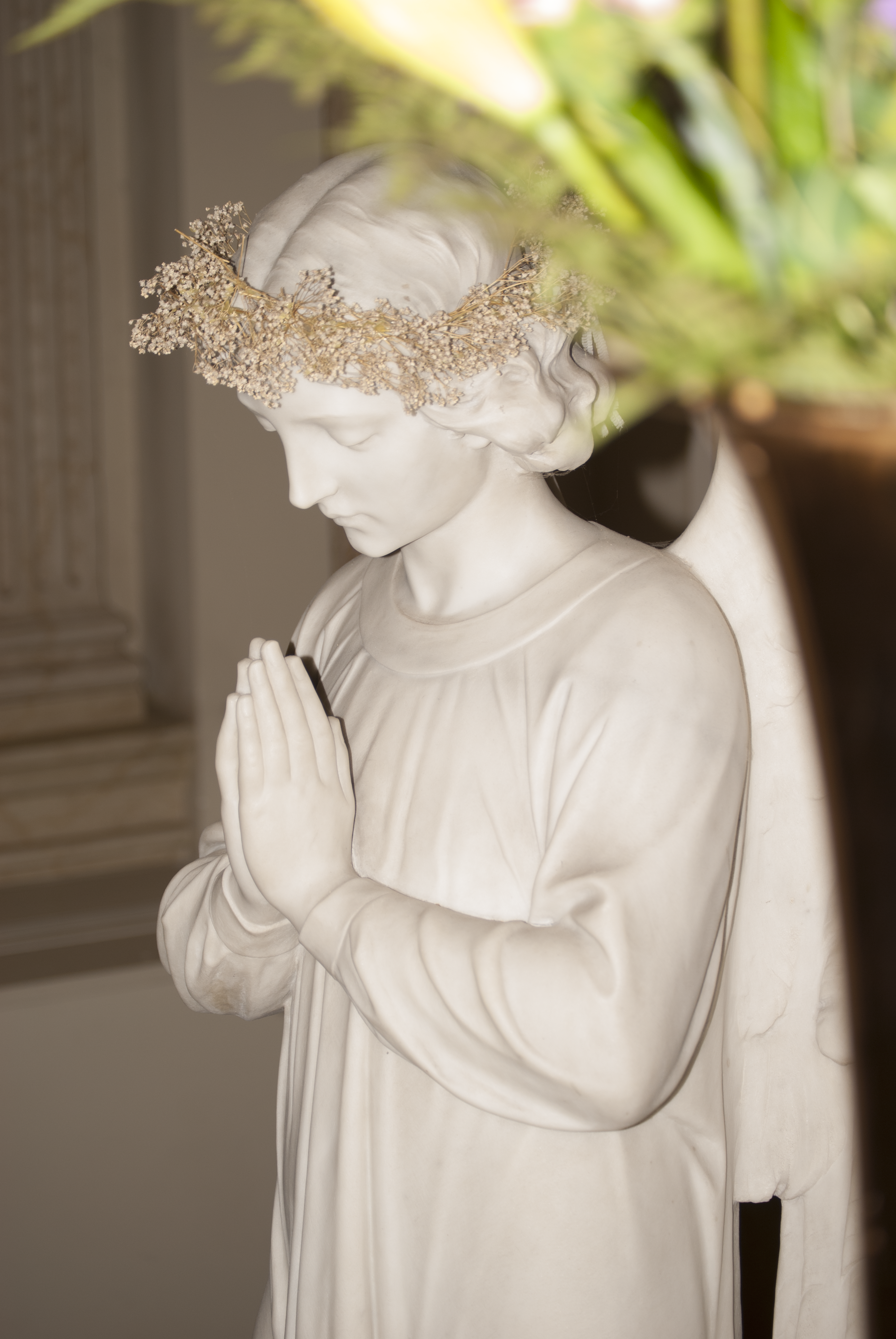
Michelangelo famously said, “Every block of stone has a statue inside it and it is the task of the sculptor to discover it.” He also said, “I saw the angel in the marble and carved until I set him free.” Yes, but how does he see it? How does he set it free? Indeed, another great mystery and faculty of the human soul of some.

As with music, the art of painting and sculpting seems a unique capacity of the human soul. As I pointed out, animals do not draw; they do not sculpt; they do not even appreciate art. It is a special gift to the human person to be captivated by beauty, and for that beauty, once seen and experienced, to emerge from the soul in expressive praise. There are special glories and unique gifts given only to the human person, mysterious gifts to be sure. It is caught up in our desire for what is good, true, and beautiful; caught up in our soul’s ultimate longing for God.

Perhaps Michelangelo should have the last word: “Every beauty which is seen here by persons of perception resembles more than anything else that celestial source from which we all are come.”

Here’s a video of a painter at work on a speed painting. Be sure to watch all the way through to the surprise ending.

David Garibaldi: Jesus Painting from Thriving Churches on Vimeo.


Here’s a video of Bob Ross from the Joy of Painting show I mentioned above. In this brief passage, Bob teaches us to paint a mountain and imparts a little philosophy as well.


And finally, this video shows the remarkable transformation of a block of marble to the image of a human face.

Do Not be Deceived! A Meditation on a Constant Theme of Scripture

092814A very common word in the New Testament is “deceived.” In English we tend to think of this word as referring to someone who has been tricked or fooled. And thus the emphasis is on intellectual terms. The Greek and Latin roots, however, have an almost physical dimension to them.

The Latin roots for “deceived” or “deception” are de- (from) + capere (to take or carry away). The Greek word in the New Testament that is translated as “deceived”  is πλανάομαι (planaomai) and means more literally “to be carried off” or “to be led astray.”

Thus, those who are deceived are those who have been carried off or carried away by false teachings, trends, or the ways of this world.

Perhaps another biblical image relating to this is the one in which St. Peter speaks of “your adversary the devil [who] prowls around like a roaring lion, seeking some one to devour” (1 Peter 5:8).  One can almost see in one’s imagination a lion with his limp and dying prey hanging from his mouth as he carries it off. And thus one who has been deceived is like one who has been stalked, attacked, and stunned or killed, and is being carried off in the mouth of the lion (Satan).


This is deception; this is what it means to be deceived, to be stalked and through various means grasped, stunned, and carried off as prey. 

Over and over again Scripture warns us not to be deceived, that is, not to become prey for Satan, for demons, and for all those who consort with him to capture us and carry us off. A plain warning comes in the Letter to the Hebrews: 

Jesus Christ is the same yesterday and today and for ever. Do not be led away by diverse and strange teachings (Heb 13:8-9).

Another text warns that there are many who wish to deceive us and their teachings are called the doctrines of demons:

Now the Spirit expressly says that in later times some will depart from the faith by giving heed to deceitful spirits and the doctrines of demons, through the hypocrisy of liars whose consciences are seared (1 Ti 4:1–2 ).

Indeed, this is a common human problem, especially today. There are many plausible liars going about today who seek to confuse, to stun, and to carry off faithful Catholics. They do this with hypocrisy. To say that something is done with hypocrisy means literally that it is done by “actors,” since hypocrite in Greek means “actor.” In a more extended sense it means that when we say something with hypocrisy we are being insincere.  These plausible liars, as actors, are well skilled at being pleasing, at appearing pleasant, reasonable, sophisticated, and “free.” But this is an act. They are in bondage to the sins they seek to glorify. The scriptural text here says that their consciences are seared; that is, they are branded, burned, and hypnotized by the sins they commit. They are not smart; they are lost and confused. They are to be prayed for, but not listened to.

Many of them are very good actors, playing the role of plausible liars. Some have many letters after their name (PhD, D.D., M.D., etc.). Some have advanced degrees and high positions in academia or in the media. Some of them teach in Catholic institutions; some even wear Roman collars. Most of them achieve their plausibility by appealing to innocuous themes such as tolerance, patience, kindness, and that most vacuous and currently ill-defined idea called “love.” Surely tolerance, patience, kindness, and love all have their places. And being agreeable, pleasant, soft-spoken, and reasonable in tone are all good things in and of themselves. But they can also become a cloak for a false plausibility and are, as the text above says, the “hypocrisy of liars.” In other words, these people are actors; they play the role of tolerant and enlightened experts but in reality are desperately trying to justify sinful behavior and quiet their seared (though still  troubled) consciences.

And thus Scripture warns us not to be deceived, not to be carried off, not to be carried away by plausible liars who say exactly the opposite of what God’s Word says, who call good or “no big deal” what God calls sin.  Thus, with their distorted understanding of tolerance and love they promote and even celebrate acts of sodomy, fornication, abortion, and euthanasia. They promote religious syncretism and construct a fake Jesus and a designer God through their “God-within” movements and their statements that “I’m spiritual but not religious.” They substitute their own doctrines for the revealed ones of Scripture. If they reference Scripture at all it is only to declare that it does not say what it plainly does say.

Regarding all these erroneous stances and appeals, Scripture announces again and again, do not be deceived; do not be carried away; do not be carried off. Here are just a few of the texts that warn us:

  1. Rom 16:17-21 I appeal to you, brethren, to take note of those who create dissensions and difficulties, in opposition to the doctrine which you have been taught; avoid them. 18 For such persons do not serve our Lord Christ, but their own appetites, and by fair and flattering words they deceive the hearts of the simple-minded. 19 For while your obedience is known to all, so that I rejoice over you, I would have you wise as to what is good and guileless as to what is evil; 20 then the God of peace will soon crush Satan under your feet. The grace of our Lord Jesus Christ be with you.
  2. 1 Cor 3:18–21 Let no one deceive himself. If any one among you thinks that he is wise in this age, let him become a fool that he may become wise. 19 For the wisdom of this world is folly with God. For it is written, “He catches the wise in their craftiness,” 20 and again, “The Lord knows that the thoughts of the wise are futile.” 21 So let no one boast of men.
  3. 1 Cor 6:9–10 Do you not know that the unrighteous will not inherit the kingdom of God? Do not be deceived; neither fornicators, nor idolaters, nor adulterers, nor homosexual offenders, 10 nor thieves, nor the greedy, nor drunkards, nor revilers, nor robbers will inherit the kingdom of God.
  4. 1 Cor 15:33–34 Do not be deceived: “Bad company ruins good morals.” 34 Come to your right mind, and sin no more. For some have no knowledge of God. I say this to your shame.
  5. 2 Cor 11:3–4 But I am afraid that as the serpent deceived Eve by his cunning, your thoughts will be led astray from a sincere and pure devotion to Christ. 4 For if someone comes and preaches another Jesus than the one we preached, or if you receive a different spirit from the one you received, or if you accept a different gospel from the one you accepted, you submit to it readily enough.
  6. Gal 6:7–8 Do not be deceived; God is not mocked, for whatever a man sows, that he will also reap. 8 For he who sows to his own flesh will from the flesh reap corruption; but he who sows to the Spirit will from the Spirit reap eternal life.
  7. Eph 5:5–8 Be sure of this, that no fornicator or impure man, or one who is covetous (that is, an idolater), has any inheritance in the kingdom of Christ and of God. 6 Let no one deceive you with empty words, for it is because of these things that the wrath of God comes upon the sons of disobedience.
  8. 2 Ti 3:12–13 Indeed all who desire to live a godly life in Christ Jesus will be persecuted, 13 while evil men and impostors will go on from bad to worse, deceivers and deceived.
  9. 1 Jn 2:24–27 If what you heard from the beginning abides in you, then you will abide in the Son and in the Father. 25 And this is what he has promised us, eternal life. 26 I write this to you about those who would deceive you.
  10. 1 Jn 3:7–9 Little children, let no one deceive you. He who does right is righteous, as he is righteous. 8 He who commits sin is of the devil; for the devil has sinned from the beginning. The reason the Son of God appeared was to destroy the works of the devil.
  11. 2 Jn 7–10 For many deceivers have gone out into the world, men who will not acknowledge the coming of Jesus Christ in the flesh; such a one is the deceiver and the antichrist. 8 Look to yourselves, that you may not lose what you have worked for, but may win a full reward. 9 Anyone who goes ahead and does not abide in the doctrine of Christ does not have God; he who abides in the doctrine has both the Father and the Son. 10 If any one comes to you and does not bring this doctrine, do not receive him.

Other texts warn us against deceiving ourselves. For at times we entertain lies and thereby allow ourselves to be entrapped by Satan and carried off by our own deceit.

  1. Jas 1:22 But be doers of the word, and not hearers only, deceiving yourselves.
  2. Jas 1:26–27 If any one thinks he is religious, and does not bridle his tongue but deceives his heart, this man’s religion is vain. 27 Religion that is pure and undefiled before God and the Father is this: to visit orphans and widows in their affliction, and to keep oneself unstained from the world.
  3. 1 Jn 1:8 If we say we have no sin, we deceive ourselves, and the truth is not in us.

And here are some texts that tell us who is really behind all deception:

  1. Rev 12:9 And the great dragon was thrown down, that ancient serpent, who is called the Devil and Satan, the deceiver of the whole world—he was thrown down to the earth, and his angels were thrown down with him.
  2. Rev 19:20 And the beast was captured, and with it the false prophet who in its presence had worked the signs by which he deceived those who had received the mark of the beast and those who worshiped its image. These two were thrown alive into the lake of fire that burns with sulphur.
  3. Rev 20:1–10 Then I saw an angel coming down from heaven, holding in his hand the key of the bottomless pit and a great chain. 2 And he seized the dragon, that ancient serpent, who is the Devil and Satan, and bound him for a thousand years, 3 and threw him into the pit, and shut it and sealed it over him, that he should deceive the nations no more, till the thousand years were ended. After that he must be loosed for a little while …7 And when the thousand years are ended, Satan will be loosed from his prison 8 and will come out to deceive the nations which are at the four corners of the earth … but fire came down from heaven and consumed them, 10 and the devil who had deceived them was thrown into the lake of fire and sulphur where the beast and the false prophet were, and they will be tormented day and night for ever and ever.

OK, clear enough? Do not be deceived; do not be carried away or carried off by errors or by the sinful lies of this present evil age. As St. Paul says elsewhere, Test everything; hold fast what is good, abstain from every form of evil (1 Thess 5:21-22). Yes, square everything with the Word of God in Sacred Scripture and Sacred Tradition. Know the catechism; know your faith. Know the true Lord, the real Jesus of Scripture (not the fake Jesus of convenience). Test everything, everything by these standards. Do not be deceived.

For the preacher, the teacher and the parent comes this instruction from St. Paul:

I charge you in the presence of God and of Christ Jesus who is to judge the living and the dead, and by his appearing and his kingdom: 2 preach the word, be urgent in season and out of season, convince, rebuke, and exhort, be unfailing in patience and in teaching. 3 For the time is coming when people will not endure sound teaching, but having itching ears they will accumulate for themselves teachers to suit their own likings, 4 and will turn away from listening to the truth and wander into myths. 5 As for you, always be steady, endure suffering, do the work of an evangelist, fulfil your ministry. (2 Tim 4:1-6)

Here is an allegory on the rejection of truth and the complete ruin the rejection brings:

Pitfalls of the Pious – A Sermon for the 26th Sunday of the Year

092714In understanding this Gospel, we cannot overlook the audience Jesus was addressing. The text begins, Jesus said to the chief priests and elders of the people. In effect, Jesus was addressing the religious leaders and the religiously observant of His day. He calls to their attention at least three things, three common sins or pitfalls of the pious, if you will: lost connections, leaping to conclusions, and lip service.

Let’s look at each of these in turn, remembering that though they are not exclusive to the religiously observant, they are considered in that context. Let’s also learn how they are particularly problematic when it comes to our mandate to hand on the faith through evangelization.

I. Lost Connections – The text says, A man had two sons. Now the text will go on to describe these two sons as very different and yet also quite similar. The man, of course, is God, and we are all His children. And though very different, we all have the same Father and we all have sin. A man had two sons, which is another way of saying that the sons had one Father. Yes, we all have a connection with another that we cannot deny, regardless of our differences. We will look more at the differences between the two sons as we go on, but for now, consider merely this fact: a man (God) had two sons.

Why emphasize this? Because it is too easy for us to seek to sever the link we have with one another, to effect a kind of divorce from people we fear or do not like. For example, on the way to Mass we may drive past tough parts of town and see drug dealers, gangs of young men loitering in front of liquor stores, prostitutes, and other outwardly troubled and rebellious people. And it is too easy to be cynical and say, “Some people’s children!” or “Look at that; how awful.” Or we may simply ignore them. Yet in all this we fail to recall that these are our brothers, our sisters. It is so easy to dismiss them, to write them off, to strive to distance ourselves from them. But God has a question for us: “Where is your brother?” (Gen 4:9)

Yes, there are many whom we may be tempted to try to disown if we’re not careful. Perhaps they are of a different political party, a different economic class, or a different race.  Maybe they are just people we don’t like. We divide, but God unites. A man had two sons, and yes they are different but he is father to them both; he loves both of them. He speaks to them both and calls them his sons.

In terms of evangelization, it will be noted that Jesus has sent us to all the nations. No longer are Israel and the Gentiles to be separated, with the one considered the chosen people and the other not. And hence the Church is catholic, is universal; she seeks to unite all. For a man had two sons, but the two sons have one father. In seeking to evangelize, has it ever occurred to you that the least likely member of your family could be the one God most wants you to reach? Be careful of lost connections, for souls can be lost that way.

II. Leaping to Conclusions – A second “sin of the pious” is leaping to the conclusion that someone is irredeemably lost, writing someone off. Many of the Scribes and Pharisees, the religiously observant of their day, had done just this with a large segment of the population. Rather than going out and working among the people to preach the Word and teach observance of the Law, many of them simply called the crowds “sinners” and dismissed them as lost. In fact they were shocked that Jesus “welcomed sinners and ate with them” (e.g., Lk 15:2). In effect, Jesus says to them, “Not so fast. Don’t leap to conclusions and write anyone off. Sick people need a doctor and I have come to be their divine physician and to heal many of them.”

Thus Jesus, in today’s parable, speaks of a sinner who repents: [The Father] came to the first and said, “Son, go out and work in the vineyard today.” He said in reply, “I will not,” but afterwards changed his mind and went.

The point is that we just don’t know and we should be very careful not to just write people off, even those who seem locked in very serious and sinful patterns, or who seem hostile to God. The example of St. Paul should certainly give us hope as should that of St. Augustine. In fact, St. Augustine wrote well on the fact that we just don’t know how things will turn out, that we should pray for everyone, writing no one off:

For what man can judge rightly concerning another? Our whole daily life is filled with rash judgments. He of whom we had despaired is converted suddenly and becomes very good. He from whom we had expected a great deal fails and becomes very bad. Neither our fear nor our hope is certain. What any man is today, that man scarcely know. Still in some way he does know. What he will be tomorrow however, he does not know (Sermo 46, 25).

Scripture also says, The oppressed often rise to a throne, and some that none would consider, wear a crown. The exalted often fall into utter disgrace; … Call no man happy before his death, for by how he ends, a man is known (Sirach 11:28-29).

I knew a man (now deceased) who told me his story, the story of how he was raised in the Church, got all his Sacraments, went to Church regularly, and was a God-fearing man. But in his early 40s he descended into alcoholism, began to be unfaithful to his wife, stopped going to Church, and was dismissive of God. Were you or I to have seen him at that time, we might easily have concluded that the situation looked bad. But somewhere in his early 60s (he knows not how, except that someone was praying for him), he pulled out of his rebellion and re-entered the vineyard. He sought help for his drinking problem and reconciled with his wife and children. Daily mass, weekly confession, daily rosary, and Stations of the Cross. Yes, when he returned, he really returned. But he said to me that he had done a lot of sinning and now it was time to do a lot of praying, “making up for lost time,” as he put it. He died a penitent in the bosom of the Church.

You just never know. Don’t write anyone off. Nothing stabs evangelization in the heart more than the presumption by many of us that someone is an unlikely candidate for conversion. Keep praying and keep working. Jesus tells us of a son who told his father to “buzz off,” but later repented and went into the vineyard. Pray, hope, and work; you just never know. Don’t give up.

And don’t think anyone is a finished work and a permanent member of the vineyard. Indeed, pray, hope, and work—for your own salvation and that of others, even those who seem well within the vineyard. For here, too, you and I know many stories of former parishioners, even parish leaders who later drifted away. St Paul spoke of how he had a kind of sober vigilance, even regarding his own salvation: But I discipline my body and keep it under control, lest after preaching to others I myself should be disqualified (1 Cor 9:27).

III. Lip Service – The text says, The man came to the other son and gave the same order. He said in reply, “Yes, sir,” but did not go.

So consider the second son. He appears to be respectful to his father. When told to go into the vineyard he respectfully tells his father that he will do so. He would not dream of cursing his father or addressing him in any strident way. In terms of all God’s children, you might say he was religiously observant, outwardly respectful, a decent sort of person.

But in the end, he does not get around to going to the vineyard. Whatever his reasons, his obedience to his father was only superficial. His behavior is emblematic of a great danger exhibited by some of the religiously observant: the danger of just giving God “lip service.” Yes, we will praise the Lord, sing a hymn, shout “Hallelujah,” and say “Amen”—all on Sunday. But on Monday, will we obey and go to the vineyard of obedience, of forgiveness of those who have wronged us, of generosity to the poor, of chastity, of compassion, of love for our spouse and children, of speaking the truth in love, of evangelization and being God’s prophets? Will we go to the vineyard? Or is it all just so much lip service we’re paying to God?

And the greatest sadness of all is that it is our very religious observance (a good and commanded thing to be sure) that often blinds us to our broader disobedience. For it is too easy and too common for religiously observant persons to reduce the faith merely to rituals and, once the rituals are observed, check off the “God-box.” In effect these people are saying or thinking, “OK, I’ve gone to Mass, paid my tithes, said a few Amens, and praised the Lord by singing. Now I’m done.” The God-box is checked. Yes, with our lips we have praised God on Sunday. But do we go to the vineyard on Monday?

And “lip service Christians” are a terrible witness and a real blow to evangelization because people can spot the hypocrisy a mile away. How on earth can we ever hope to win souls for Christ if they just see us going through the motions, checking off the God-box but living lives that are unreformed and untransformed? Our greatest witness has got to be a life that is being changed by Jesus Christ; a life that manifests the biblical principles of love, justice, and charity; a life that demonstrates a biblical understanding of sexuality; a life that exhibits the biblical priorities of forgiveness, mercy, and generosity; a life lived with a renewed mind and heart.

Now none of us do this perfectly, but pray that God’s transformative power is at work in us and that people notice it. Nothing is more destructive to evangelization than lip service Christians, who give the outward appearance of obedience and religiosity but who everyone knows are really phony. And nothing is more helpful to evangelizing our children, family members and friends than Christians who display lives that are being transformed and made joyful, serene, and holy.

All of this leads to this message: “God can use anything, but He shouldn’t have to.” In other words, though none of us is a perfect disciple, God can work through us anyway. But, frankly, God shouldn’t have to do this.

So in today’s Gospel Jesus points out three powerful obstacles to His grace flowing through us to others: lost connections, leaping to conclusions, and lip service. All of these things lessen our effectiveness as disciples, prophets, and evangelizers sent out to make disciples of all the nations. Yes, God can use anything, but he shouldn’t have to.

Drawing above: Two sons, by Davis

The video below features the text of another parable of Jesus’ that speaks of a king who gave a banquet for his son and then summoned the invited guests to come because all was ready. Here, too, we must enter the banquet. As the sons, we are called to enter the vineyard to work. Will you go? How about your sons and daughters; will they be at Mass this weekend?

Don’t Burn Food for Fuel – As Seen on National Geographic

092614
“Cornheap” by en:User:Pratheepps. Licensed under CC BY-SA 2.5 via Wikimedia Commons.

At the risk of inviting all the usual charges of being politically incorrect, I once again put before you the strange practice of burning food for fuel. The video at the bottom of the post details some of the human costs associated with the increasing use of corn, grains, and other crops for fuel.

There is a tendency for environmentalists of our time to think very narrowly about their issues. It is a praiseworthy thing to seek to reduce pollutants and other things that have negative environmental impacts. The Catechism summons us to good stewardship of the earth, the environment, and our natural resources.

However, the human cost of significant changes (to include higher taxes, the elimination of certain technologies altogether, and other things) should be part of the equation. This is especially true in terms of how it affects the developing world. Yet in my experience, the human cost is almost never presented honestly.

Whatever good intentions environmentalists have, the planet, the climate, and the environment seem to be the overwhelming focus of their concern, at least for the most radical of them. And if human beings are considered at all, we are collectively just a big problem: there are too many of us, we do lots of bad stuff, and it seems that the earth would be better off without us.

So here’s an edgy video, from the National Geographic video site, no less! For the record, let me say again that it is a bad idea to burn food for fuel. And if the video below is correct, it’s going to get worse unless we have an honest conversation and come to some consensus that burning food for fuel IS bad.

Stay tuned; this issue is bound to heat up. I pray that common sense will prevail over what is most certainly a bad idea, one which will harm the poor disproportionally.

I know that I normally use my Friday blog for more light-hearted fare, but this video is what popped up in my video queue today. I’m glad to see the concerns are spreading.

God Has Put the Timeless into our Hearts – A Meditation on a Saying from Ecclesiastes

092514In the Book of Ecclesiastes from today’s Mass, something is said that is quite powerful if we meditate upon it.

I have considered the task that God has appointed for the sons of men to be busied about. He has made everything appropriate to its time, and has put the timeless into their hearts, without man’s ever discovering, from beginning to end, the work which God has done (Eccles 3:10-11).

Somewhere in our hearts is something that the world cannot, and did not give us. It is something that is nowhere evident in the world, and yet, though not perceiving it, we still know it. This passage from Ecclesiastes calls it “the timeless.” We also often refer to it as eternity, or even infinity.

But where did this come from? The world is finite. Time on earth is serial. Things have a beginning, a middle, and an end. We do not experience anything here of the timeless. Rather, everything is governed by the steady, unrelenting ticking of the clock. Things begin and end. Every verb we speak is time-based, rooted at some point in time but never able to break free of it. Everything is rooted in chronological time. But somewhere in our hearts we can grasp the timeless. It is hard to put into words for we know it at a very deep level. But, we do know it.

The experience of “forever” does not exist in this world, but it is there in our mind and heart. There is no way to engage in time travel here in this world. Yet instinctively we know that somehow we can. Science fiction and fantasy often feature going back to the past or forward into the future. The world could not possibly teach us this for we are locked into the present and have never actually traveled in time. But somehow we know we can do it.

Eternity comes from the Greek word “aeon,” which means the fullness of time. It is not just a long time, it is all time: past, present, and future all at once. Look at the dot in the center of your watch and notice how 10am may be in the past, 6pm in the future, and 2pm now, but at the center dot they are all really the same. This is aeon; this is eternity, the fullness of time; this is a picture of timelessness.

Where did we get it? The world cannot give it, for the world does not have it. The world is finite, limited; it is time-bound, not timeless. Where did we get it?

Maybe it’s from God.

This song speaks of another aspect of time that the Greeks called “kairos” which is that experience of the fittingness of certain things to certain times. Chronos is the Greek for “clock time” but kairos grasps that other mysterious dimension of time that somehow we know when “the time is right.”

Couragio! A brief refutation of our cultural fear of being against things

092414One of the critiques that many make of the Church is that we are sometimes known more for what we are against than what we are for. This critique, and fear, exists even within the Church. A similar critique is made of God’s law, wherein some wonder, “Why are the Ten Commandments generally worded as negatives: ‘Thou Shalt not …’ ?”

It is a fact that, at least in modern culture, many prefer to say what they are for rather than what they are against. Somehow, being “positive” is valued over being “negative.” Thus, even in the tragic conflict over abortion, both sides declare that they are “pro” something, either life or “choice.” I am certainly “pro-life,” but as to the matter in question, I am anti-abortion. But most of us who do any media work are strongly cautioned to avoid the prefix “anti-” altogether.

In fact, even when a group gathers to denounce something (e.g., war, poverty, or taxes) the participants are called “protesters” (a word that refers to those who stand up for or witness to something) rather than “contesters” (a word that refers to those who stand or witness against something). Frankly, “contester” more accurately describes what is going on in a “protest.” If I am protesting higher taxes, I am against the idea, not for (“pro-“)  it.  But we are funny this way, and very sensitive about it. We don’t like to be perceived as being against things.

And of course this is problematic for a preacher of the Gospel, who needs to engage a culture that is increasingly heading to some very dark and sinful places. At some point we simply have to be willing to say that we are foursquare against many things and endure the “terrible” charges that we are “negative,” even if our overall goal is to affirm something that is better than the practice we are against. Thus we are against abortion because we are for life and the potential and dignity of the unborn. We are against fornication, pornography, adultery, and homosexual acts because we are for chastity and God’s vision for sexuality. We are against euthanasia because we are for the wisdom of the Cross and the glory that our life brings to God. We are against greed because we love the poor and think our excess should be shared with them in appropriate ways.

But at the end of the day, we DO have to be willing to say that we are against certain things. We will not always have the luxury of being able to give elaborate speeches that attempt to show how we are really “for” something else and therefore are not bad people or sour-faced “downers.” Our ego needs to be a little stronger so that we do not feel the need to always seem nice, pleasant, positive, and affirming. These all have their place, but they can also be pernicious enemies of the truth.

And this leads us back to the Ten Commandments, wherein eight of the ten unapologetically use the formulation “You shall not …” God is not all that worried that He might be perceived as being “against” something—and neither should we be.

But there is another reason for the negative formulation that is worth exploring as well. Simply put, it is often easier to say what something is not, than to describe what it is. The commandments are depicting love, but if I ask you to wholly and completely define love you’re going to have a difficult time, since love is so comprehensive and multifaceted.

Thus, if you ask me, “What does it mean to love God?” I could go on for pages and pages trying to describe it and its implications and I would barely scratch the surface. Alternatively, however, I could say, “Well, to love God is to stay faithful to Him by not sleeping with other gods or giving them my love and worship. To love God means that I will not disrespect His precious name, but will honor it for its precious dignity and for the sign of intimacy it is. To love God means that I will not fail to spend time with Him on Sunday and enjoy His blessings.

If you ask me “What does it mean to love my neighbor?” I am going to have a hard time saying all that it means. But surely I can say that if I love my neighbor I will not kill him; I won’t use her sexually; I won’t steal from or lie to him; I won’t covet her; I won’t greedily seek to possess what he has.

And thus God begins by telling us essentially what love is not, and then enriches the “shall nots” with examples that help to fulfill the vision. Thus “not killing” is more than merely not taking a life. It is letting go of all the things that lead to murder such as hatred, bitterness, mercilessness, ridicule, extreme competitiveness, and so forth. The “shall nots” lead to positive implications and a summons to freedom wherein one is set free from anger, hatred, bitterness, fear, and so forth.

This is essentially what Jesus does in the Sermon on the Mount, His great moral treatise in which He speaks of fulfilling the law. To fulfill the law means to fill it full, to consider all the implications of the commandments and precepts.

It is also what I try to do in my new bookThe Ten Commandments, wherein each commandment, though precise in its formulation, is seen in its richer implications. Pardon the shameless plug, but this blog post has its origins in a radio interview I did today with Matt Swaim on the Sonrise Morning Show. I go on the show about every two weeks, but today Matt was kind enough to interview me about my book.

The bottom line though has to be this: we need to expose the lie (or at least the fear) in our culture that being against things is always a bad thing. We need to have the courage to admit and even to be bold in saying that we oppose things. This, of course, does ultimately mean that we are also for some other thing. But even if we cannot fully proclaim all that we are for, which admittedly is hard to do, it is necessary to say what we oppose.

Couragio!

As for this video, I happened upon it as I was looking for the song “Signs” (Sign, sign, everywhere a sign …), a “protest” song against rules that was so typical of the rebellious ’70s. I found it, but it also has this humorous collection of strange signs. So enjoy the funny signs even though the song is emblematic of today’s “be nice,” and “don’t have any rules” mentality.

A man with one watch knows what time it is; a man with two watches is never quite sure. A Meditation on following only one Shepherd.

092314-pope-1In the Gospel of Matthew, Jesus says, To what shall I compare the people of this generation? What are they like? They are like children who sit in the marketplace and call to one another, ‘We played the flute for you, but you did not dance. We sang a dirge, but you did not weep.’ He goes on to remark that the people thought John the Baptist was crazy because he did not eat or drink, yet when Jesus both ate and drank they called Him a glutton and a drunkard. (see Matt 11:16-19).

Indeed, this world has many contradictory and bewildering standards.

One of the great human struggles is to become free from being defined by others, from being so much under the world’s judgment that we lack any personal conviction or deep, stable, and serene core.

An old African proverb says “If I don’t know who I am, anyone can name me.”

Somewhere in the midst of the world’s demands for conformity to its ephemeral standards, each of us must come to know the man or woman that God created us to be.

This does not mean, particularly in youth, that we do not seek guidance from people (especially elders) whom we trust. But in the end, there must be that very private journey with God that every human person makes. It is the journey to discover one’s true self, as God gently reveals.

It is to this deep truth that Jesus refers in the gospel referenced above. The world cannot be our measure. Too often its standards are passing, foolish, and highly inconsistent. To hearken to its cacophonous voice is a sure invitation to high anxiety and deep inner conflict.

There is a saying, A man with one watch knows what time it is; a man with two watches is never quite sure.

Jesus, too, warns, “No one can serve two masters.” But, sadly, most of us try. And frankly, it is not merely two masters but two hundred.

Not so with Jesus.

Jesus resisted and even defied most of the ways in which people tried to define him. He was the Messiah, but He would not be the Messiah in any way they understood. He would not ride in on a war horse and usher in a bloodbath. He would not follow a career of conquest. He would die as a suffering servant. Neither would He simply be reduced to being the Bread King (Jn 6:15) or the medical miracle worker (Mk 1:38). Jesus was sure to hit the road and move on to the next town before He would let others label him as such. He came to bear witness to the truth and to save us, not so much from economic calamity, health problems, or political enemies, but rather from our very selves, from our own sinfulness.

No, Jesus would not be defined by this world. He was free from its grip; it had no power over Him. And to  that same freedom the Lord ultimately summons us.

To be sure, this personal journey with the Lord, this journey to discover our true self, is not an invitation to hideous idiosyncrasies and sociopathic behavior. Holiness may in fact, and often does, startle this world. But it is not unnecessarily disruptive; it is not simply “weird.” Discovering our true self leads to serenity, a peace that this world cannot give, but also a peace that it cannot deny.

So, a man with one watch knows what time it is, but a man with two watches is never quite sure.

Whom are you watching? What time is it in your life? Is it a time of teenage conformity and capitulation to peer pressure? Or is it a time of serene and mature self understanding, rooted in the Father?