We ought to ask the Lord to inspire us with a holy hatred of sin. There is a kind of inverse relationship that we ought to seek: if we love the truth staunchly we will detest sin and lies more fully. It is impossible to love the truth vigorously without also detesting error. Similarly, as we grow in the love of God, we grow in the love of holiness, for God is holy.
As our love for Him deepens, we become increasingly averse to all that is unholy. We begin to detest anything that would separate us from the beautiful, loving holiness of God. As we learn to love the light and become accustomed to it, the darkness becomes unfathomable to us. We cannot see into its depths at all.
But sadly many of us, though we were made for the light (with retinas attuned to bright days and easily lost in the dark), do just fine in the dark. Imagine you are in a well-lit room, when suddenly the lights go out. Because you have become accustomed to the light, the room seems pitch black at first; you feel disoriented and confused. But in a moment or two, you begin to become accustomed to the dark. You can start to make out a few things, and then more and more. After a while you can even navigate around pretty well in the darkness. This scenario parallels the spiritual situation with truth and holiness as compared to lies and sin. And while the ability to become accustomed to the darkness is a good thing in the physical world, it is a terrible thing to happen to us spiritually.
Spiritual darkness is something to which we should never become accustomed. We should not want to be able to navigate the darkness. We should detest the darkness, dreading it with a holy fear that makes us quickly seek the light again.
Woe to us who are willing to live in the twilight, appreciating the light of God’s truth, but not so much that we detest the darkness and find it unfathomable. Too many of us Christians are willing and able to navigate the darkness and do not have a proper fear of it. We are not shocked by sin, as when the lights first go out in a room. Instead of quickly seeking to restore the light, we settle down in the darkness and learn to navigate in the shadows. Once we are used to the dark, things become increasingly silhouetted in a way that they were not when the lights first went out.
And thus our love for the light diminishes; we no longer hate it or are shocked by it. We begin to navigate its shadows just fine. Slowly, we, who were made to walk in the light, become content and able to exist like weasels and groundhogs, who are quite able to navigate the darkness.
Once used to the dark, or at least to the twilight, even we who are to be children of the light can be heard to say that the undiluted light of God’s truth is too harsh, too revealing of painful things, too intolerant, and so forth. And when we speak like this, it is certain that the darkness has us in its grips and that we prefer its shadows to the glory and clarity of the light.
What a disgrace! In John’s Gospel, Jesus warns of the battle against our love of darkness: This is the verdict: Light has come into the world, but people loved darkness instead of light because their deeds were evil. Everyone who does evil hates the light, and will not come into the light for fear that their deeds will be exposed. But whoever lives by the truth comes into the light, so that it may be seen plainly that what they have done has been done in the sight of God (Jn 3:19-21).
Indeed, pray for a hatred of sin, for a fear of being lost in its darkness. May we never learn to navigate its twilight, but ever stumble about in it crying out again for the light. May the darkness be detestable to us and may its ways and depths be unfathomable to us.
Yes, pray for a hatred of sin. Pray for shock at its darkness. Pray for an inability to accustom yourself to its lifeless shadows. Pray to be crippled by it, unable to move about in it or compromise with its shadows. Pray for a deep fear of it. Pray for the ability to cry out for light and only light.
When I was a child I feared the dark and would call out for my parents. But do I now? Do you?
Pray for a deep hatred of sin, a sadness for it. Pray for the zeal to flee its first shadows. Please do not click away from this blog until you have done so.
Jesus light of the world, please help me to fear and detest the darkness. Help me to love the light and be shocked and disoriented by the darkness. May I never be able to navigate its shadows or find the twilight a happy medium. Only the light of you, pure, dear Lord, only light. May all else depress, disorient, and cause me to despise it without compromise. In Jesus’ name, Amen!
St Paul writes to the Philippians of the glory that our currently lowly bodies will one day enjoy:
He will change our lowly body to conform with his glorified Body by the power that enables him also to bring all things into subjection to himself (Phil 3:19).
I once spoke with an older woman who wasn’t all that pleased to hear that her body was going to rise and be joined again to her soul. “Oh, Father, you don’t mean this old decrepit body, do you? If this body has to rise I’m hoping for an improved model!”
Yes! I think most of us can relate to the desire that our lowly bodies be improved. And they will surely be. Notice how the passage above says that these lowly, sometimes weak, diseased, and often overweight bodies will be changed and will reflect the glory of the resurrected body of Jesus. Yes, this old general issue clunker that I’m currently experiencing is going to be upgraded to a luxury model. We’re headed for first class!
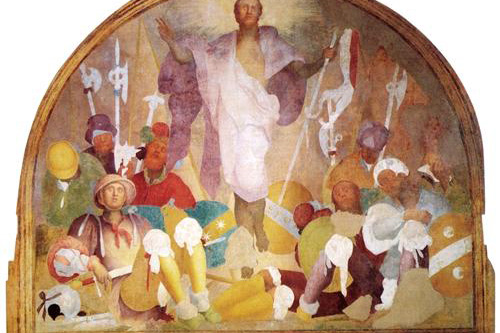
In this time of Easter and resurrection, we ought to consider for a moment what Scripture and Tradition have to say about what our resurrected bodies will be like.
An important starting point in discussing this matter is a little humility. The fact is, a lot of what we are going to say here is speculation. But, it is not wild speculation. It is rooted in Scripture to be sure. However, Scripture is describing things that are somewhat mysterious and difficult to reduce to words. Further, Scripture does not always elaborate; where we might wish for more details, often none are given. Sometimes, too, we infer qualities of the resurrected body based on scriptural texts whose main purpose is not to describe the resurrected body. Rather, their purpose is to set forth the fact of the resurrection of Jesus. For example, Jesus appears and disappears at will in a room though the doors are locked. The point of the text is to tell us that He appeared, not necessarily to say that the resurrected body has something we have come to call “agility” (see below). Hence the text does not elaborate on this point and we are left to infer things about Jesus’ resurrected body and then apply them to our own. This is not wrong, for Paul says that our resurrected bodies will have qualities that conform to Jesus’ resurrected body. But the point is that the biblical texts do not elaborate on this or other qualities in a detailed manner. So we are left to speculate and make inferences.
St. John the Apostle expresses some of the humility we should bring to this discussion:
Beloved, now we are children of God, and it has not appeared as yet what we will be like. But we know that when He appears, we will be like Him, because we will see Him just as He is (1 John 3:2).
I do not interpret John to mean that we know nothing, for if he did he would be negating other Scriptures. Rather, I think he is saying that we do not fully grasp the meaning of what we are discussing, and that much of it is mysterious. Although something is known and revealed, much more is unknown and far beyond what we have yet experienced.
With the need for humility in mind, let’s consider some of what we might be able to say of the qualities of a resurrected body. Perhaps it is well that we start with the most thorough passage in the New Testament on this subject and then list the traditional seven qualities of a resurrected body.
St. Paul writes of the resurrected body in First Corinthians 15,
But someone will ask, “How are the dead raised? With what kind of body will they come?” How foolish! What you sow does not come to life unless it dies. When you sow, you do not plant the body that will be, but just a seed, perhaps of wheat or of something else. But God gives it a body as he has determined, and to each kind of seed he gives its own body. … The splendor of the heavenly bodies is one kind, and the splendor of the earthly bodies is another. … The body that is sown is perishable, it is raised imperishable; it is sown in dishonor, it is raised in glory; it is sown in weakness, it is raised in power; it is sown a natural body, it is raised a spiritual body. If there is a natural body, there is also a spiritual body. So it is written: “The first man Adam became a living being”; the last Adam, a life-giving spirit. The spiritual did not come first, but the natural, and after that the spiritual. The first man was of the dust of the earth; the second man is of heaven. As was the earthly man, so are those who are of the earth; and as is the heavenly man, so also are those who are of heaven. And just as we have borne the image of the earthly man, so shall we bear the image of the heavenly man. … Listen, I tell you a mystery: We will not all sleep, but we will all be changed—in a flash, in the twinkling of an eye, at the last trumpet. For the trumpet will sound, the dead will be raised imperishable, and we will be changed. For the perishable must clothe itself with the imperishable, and the mortal with immortality. When the perishable has been clothed with the imperishable, and the mortal with immortality, then the saying that is written will come true: “Death has been swallowed up in victory.” “Where, O death, is your victory? Where, O death, is your sting?”(1 Cor 15:35-55 selectae).
Using this and other passages, we can distinguish seven traditional qualities of a resurrected body. Here we will allow our source to be the Summa Theologica of St. Thomas Aquinas. You can click on each quality (underlined) to read more online at New Advent.
1. Identity – Essentially, this means that the very same body that falls in death will rise to be glorified. We cannot claim that we will get a different body, but rather that our current body will rise and be glorified. St. Thomas says, For we cannot call it resurrection unless the soul return to the same body, since resurrection is a second rising, and the same thing rises that falls: wherefore resurrection regards the body which after death falls rather than the soul which after death lives. And consequently if it be not the same body which the soul resumes, it will not be a resurrection, but rather the assuming of a new body (Summa Suppl. 79.1).
This does not mean that the body will necessarily be identical in every way. As St. Paul says above, our current body is like a seed. A seed does not have all the qualities of a mature plant, but it does have all these qualities in seed form. So, too, our current body is linked to our resurrected body causally and essentially, though not all of the qualities of the resurrected body are currently operative. Again, the Summa states, A comparison does not apply to every particular, but to some. For in the sowing of grain, the grain sown and the grain that is born thereof are neither identical, nor of the same condition, since it was first sown without a husk, yet is born with one: and the body will rise again identically the same, but of a different condition, since it was mortal and will rise in immortality (Summa Suppl. 79.1).
Scripture attests that the same body that dies will also rise. Job said, And after my flesh has been destroyed, yet in my flesh I will see God; I myself will see him with my own eyes—I, and not another (Job 19:26-27). And to the Apostles, shocked at His resurrection, Jesus said, Look at my hands and my feet. It is I myself! Touch me and see; a ghost does not have flesh and bones, as you see I have (Luke 24:39).
There is continuity because the same body rises. But there is also development and the shining forth of a new glory and new capabilities that our bodies do not currently enjoy.
2. Integrity – We will retain all of the parts of our current bodies. This means every physical part of our body, even the less noble parts like intestines. In the gospel, Jesus ate even after His resurrection. He ate fish before them (Luke 24:43). He ate with the disciples in Emmaus (Luke 24:30). He ate breakfast with them at the lakeshore (Jn 21:12). Hence it follows that even the less noble parts of our body will rise, because eating and digestion are still functions of a resurrected body. St. Thomas argues (rightly, I think) that food will not be necessary to the resurrected body (Summa Suppl. 81.4). But it is clearly possible to eat, for Christ demonstrates it.
St. Thomas reasons that every aspect of our bodies will rise, since the soul is the form of the body. That is, the body has the faculties it has due to some aspect of the soul. The soul has something to say and hence the body has the capacity to talk, write, and engage in other forms of communication. The soul has the capacity to do detailed work and hence the body has complex faculties such as nimble fingers, arms, and so forth to carry out this work. The body is apt for the capacities of the soul, imperfectly at present, but then even more perfectly (cf Summa Suppl. 80.1).
At some level, it seems we must suspend our speculation and keep it within limits. The Summa goes into matters that I think are highly speculative. You can click on the blue word “integrity” above to read these speculations. Personally, I think we should refrain from asking such questions as whether hair and nails will grow, what bodily fluids will still be necessary, or whether latrines will be needed in Heaven. We just have to stop at a certain point and say that we have no reason to know these things and it is purely speculative to discuss them. The bottom line is that the body shall rise, whole and complete. Its functions will be perfected and perfectly apt for the soul in a way beyond what they are now. But as to the intimate details, we ought to realize that humilty is the best posture.
3. Quality – What about age? Our bodies will be youthful and will retain our original sex. Note that “youthful” does not necessarily mean between 18 and 22! In the Philippians text that began this post, Paul says that our glorified bodies will be conformed to Christ’s glorified body. When Jesus’ body rose, He was approximately 33 years old. Elsewhere, St. Paul exhorts Christians to persevere: Until we all meet into the unity of faith, and of the knowledge of the Son of God, unto a perfect man, unto the measure of the age of the fulness of Christ (Eph 4:13). Hence it would seem that Christ’s resurrected body is the “perfect” age.
St Augustine also speculates that Christ rose again of a youthful age … about thirty years. Therefore, others also will rise again of a youthful age (cf De Civ. Dei xxii).
St. Thomas further notes, Man will rise again without any defect of human nature, because as God founded human nature without a defect, even so will He restore it without defect. Now human nature has a twofold defect. First, because it has not yet attained to its ultimate perfection. Secondly, because it has already gone back from its ultimate perfection. The first defect is found in children, the second in the aged: and consequently in each of these human nature will be brought by the resurrection to the state of its ultimate perfection which is in the youthful age, at which the movement of growth terminates, and from which the movement of decrease begins (Summa Suppl. 81.1).
Further, since sex is part of human perfection, each of us will rise according to the sex he or she is now. It would seem that other qualities such as height and hair color will also be retained, since this diversity is part of man’s perfection.
Here, too, we have to realize that merely picturing Jesus as a 33-year-old man is not sufficient. All the resurrection appearances make it clear that His appearance was somehow changed, though recognizable, and this is a mystery. Further, the heavenly description of Jesus is far from simple to decode in matters of age and appearance:
… and among the lampstands was someone “like a son of man,” dressed in a robe reaching down to his feet and with a golden sash around his chest. His head and hair were white like wool, as white as snow, and his eyes were like blazing fire. His feet were like bronze glowing in a furnace, and his voice was like the sound of rushing waters. In his right hand he held seven stars, and out of his mouth came a sharp double-edged sword. His face was like the sun shining in all its brilliance (Rev 1:12-18).
Hence we must avoid oversimplification when it comes to speaking of how our resurrected bodies will appear. We cannot simply project current human realities into Heaven and think we understand what a resurrected body will look like in terms of age, stature, and other physical qualities. The physical qualities are there, but they are transposed to a higher level.
4. Impassability– We will be immune from death and pain. Scripture states this clearly: The dead will be raised imperishable, and we will be changed. For the perishable must clothe itself with the imperishable, and the mortal with immortality (1 Cor 15:52-53). And again, He will wipe every tear from their eyes. There will be no more death or mourning or crying or pain, for the old order of things has passed away (Rev 21:4). St. Thomas goes on at some length and you can click on the word “impassibility” to read more.
5. Subtlety – Our bodies will be free from the things that restrain them now. Subtlety refers to the capacity of the resurrected body to be completely conformed to the capacities of the soul. St. Thomas says of this quality, The term “subtlety” has been transferred to those bodies which are most perfectly subject to their form, and are most fully perfected thereby. … For just as a subtle thing is said to be penetrative, for the reason that it reaches to the inmost part of a thing, so is an intellect said to be subtle because it reaches to the insight of the intrinsic principles and the hidden natural properties of a thing. In like manner a person is said to have subtle sight, because he is able to perceive by sight things of the smallest size: and the same applies to the other senses. Accordingly people have differed by ascribing subtlety to the glorified bodies in different ways (Summa Suppl. 83.1).
In other words, the body is perfected because the soul is. And the body is now fully conformed to the soul. Currently, in my lowly body, I may wish to be able to go to Vienna in a few moments to hear an opera, but my body cannot pull that off. My body is not able to instantly be somewhere else on the planet. I have to take time and exert effort in order to get there. Jesus, however, could appear and disappear in a room despite closed doors. Before His resurrection, He had to take long physical journeys; now He can simply be where He wants immediately (cf John 19:20, 26). This quality is very closely related to agility, which we consider next.
6. Agility – We will have complete freedom of movement. Our souls will direct our bodies without hindrance. St. Thomas says, The glorified body will be altogether subject to the glorified soul, so that not only will there be nothing in it to resist the will of the spirit. … from the glorified soul there will flow into the body a certain perfection, whereby it will become adapted to that subjection: … Now the soul is united to body not only as its form, but also as its mover; and in both ways the glorified body must be most perfectly subject to the glorified soul. We have already referred to Jesus’ ability, in His glorified body, to be anywhere immediately, without regard to locked doors or other hindrances. Consider, too, these description of the agility of the resurrected body:
As they [on the road to Emmaus] talked and discussed these things with each other, Jesus himself came up and walked along with them (Luke 24:15).
Then their eyes were opened and they recognized Jesus, and he disappeared from their sight (Luke 24:31).
While they were still talking about this, Jesus himself stood among them and said to them, “Peace be with you” (Luke 24:36).
7. Clarity – The glory of our souls will be visible in our bodies. We will be beautiful and radiant. It is written in the Scriptures, The just shall shine as the sun in the kingdom of their Father (Matthew 13:43). And again, The just shall shine, and shall run to and fro like sparks among the reeds (Wisdom 3:7). And again, The body in sown in dishonor, it shall rise in glory (1 Cor 15:43).
So, rejoice! The Lord is going to take these lowly bodies of ours and change them to conform with His own body. You’re going to upgrade to an improved model to be sure. And in your glorified body you won’t have to take all this time to read a post like this; you’ll just know it. This is a long post, so I’m also posting it in PDF form here: What Will Our Resurrected Bodies Be Like.
Recently I preached a retreat for a good number of women here in our Archdiocese. I based the retreat on the Book of Ruth, a beautiful love story that is a kind of allegory for Christ and the Church. More specifically it is an allegory of the individual’s salvation by Christ and in relationship to Him.
The detailed background to the text is too lengthy to go into here, but a few points will help. The story features three main characters: Boaz, Ruth, and Naomi. Boaz is clearly a picture (or “type”) of Christ. He is born and lives in Bethlehem; he ultimately acts as Ruth’s “kinsman-redeemer” by rescuing her from poverty and paying the price to cancel her debt. This of course is just what Christ does for us: He redeems us by His blood, canceling our poverty and debt. Ruth is a picture of the individual soul in need of Christ’s redemption and mercy. Naomi plays several roles in the book, but in the passage we will consider here she is a picture of the Church; she advises Ruth in what to do and draws her to Boaz (Christ), her redeemer.
Consider the following text and then let us see how Naomi symbolizes the Church.
Naomi said to Ruth, “Is not Boaz … a kinsman of ours? Tonight he will be winnowing barley on the threshing floor. Wash and perfume yourself, and put on your best clothes. Then go down to the threshing floor, but don’t let him know you are there until he has finished eating and drinking. When he lies down, note the place where he is lying. Then go and uncover his feet and lie down. He will tell you what to do.” “I will do whatever you say,” Ruth answered (Ruth 3:2-5).
The advice that Naomi gives is quite in line with the instruction that our Mother the Church gives us. For in our poverty and under the debt of our sin, we are exhorted by the Church to seek our “Boaz,” who is Christ. Note the advice given by Naomi and consider how it sounds so like our Mother the Church. Namoi advises,
1. Be Firmly Convinced – Naomi says, Is not Boaz … a kinsman of ours? Tonight he will be winnowing barley on the threshing floor. Ruth knows her poverty, her pain, and her debt. Naomi does too, and she exhorts Ruth to seek Boaz, for he is near and can help. Boaz is wealthy and thus has the power to save her, to draw her out of her overwhelming poverty. He has the capacity, unlike any other, to cancel Ruth’s debt. She is to seek him at the threshing floor where he is preparing and providing the bread that will sustain her. She must go, firmly convinced that Boaz will love her and save her.
And so, too, does the Church exhort us, Seek the LORD while he may be found; call on him while he is near (Is. 55:6). Yes, there is one among us, a near kinsman, who is not ashamed to call us his brethren (Heb 2:11). His name is Jesus and He, as God, has the power to save and cancel our debt. Cast your cares on him, for he cares for you (1 Peter 5:7). Jesus is at the threshing floor of His Church, preparing a banquet for you in the sight of your foe (Psalm 23:5). The grain He is winnowing is the Eucharistic Bread of His own flesh. “Yes,” says the Church, “Come to Jesus, firmly convinced of His love and power to save.”
2. Be Freshly Cleansed – Next, Naomi simply says, “Wash.” In other words, the first step in finding help from Boaz is to be washed, to be freshly cleansed.
So, too, does the Church draw us to Christ with the exhortation, “Wash.” That is, Repent and be baptized, every one of you, in the name of Jesus Christ for the forgiveness of your sins. And you will receive the gift of the Holy Spirit (Acts 2:38). Yes, the love of God will be poured forth on us and the cancellation of our debt will take place as we are cleansed of our sins.
Here are some other texts wherein the Church, our Naomi, our Mother, exhorts us to be washed:
(James 4:8) Come near to God and he will come near to you. Wash your hands, you sinners, and purify your hearts, you double-minded.
(2 Cor 7:1) Since we have these promises, dear friends, let us purify ourselves from everything that contaminates body and spirit, perfecting holiness out of reverence for God.
(Is 1:15) Wash and make yourselves clean.
(Is 52:11) Depart, depart, go out from there! Touch no unclean thing! Come out from it and be pure, you who carry the vessels of the LORD.
(Acts 22:16) And now what are you waiting for? Get up, be baptized and wash your sins away, calling on his name.
(Heb 10:22) Let us draw near to God with a sincere heart in full assurance of faith, having our hearts sprinkled to cleanse us from a guilty conscience and having our bodies washed with pure water.
3. Be Fragrantly Consecrated – Namoi says to Ruth, “and perfume yourself.” In other words, make yourself nice to be near. Come with an aroma that is sweet and pure.
So, too, does the Church, our Naomi, exhort us to to be fragrantly consecrated. The fragrance we are called to is that of a holy life, which we receive in baptism. Like a sweet incense or perfume should our life in God be. Consider some of the following texts that the Church gives us:
(Eph 5:2) Live a life of love, just as Christ loved us and gave himself up for us as a fragrant offering and sacrifice to God.
(2 Cor 2:15) For we are to God the aroma of Christ among those who are being saved and those who are perishing.
(Song 4:12) [The groom (Christ) speaks to his beloved] You are a garden locked up, my sister, my bride; you are a spring enclosed, a sealed fountain. Your plants are an orchard of pomegranates with choice fruits, with henna and nard, nard and saffron, calamus and cinnamon, with every kind of incense tree, with myrrh and aloes and all the finest spices.
(Ex 30: 7) Aaron must burn fragrant incense on the altar every morning when he tends the lamps.
4. Be Fitly Clothed – Naomi says to Ruth, “and put on your best clothes.”
Here, too, does our Mother the Church advise us to be fitly clothed. For a Christian, to be fitly clothed is to be adorned in the righteousness that comes to us in Christ by Baptism. In the baptismal liturgy, the Church says to the newly baptized of the white garment that he or she wears, You have become a new creation and have clothed yourself in Christ. Receive this baptismal garment, and bring it unstained to the Judgment seat of our Lord Jesus Christ, that you may have everlasting life.
In other words, be fitly clothed. Wear well the garment of righteousness that Christ died to give you. Scripture, too, speaks of the garment in which we are to be fitly clothed:
(Is 61:10) I delight greatly in the LORD; my soul rejoices in my God. For he has clothed me with garments of salvation and arrayed me in a robe of righteousness, as a bridegroom adorns his head like a priest, and as a bride adorns herself with her jewels.
(Rev 19:7) Let us rejoice and exult and give him the glory, for the marriage of the Lamb has come, and his Bride has made herself ready; it was granted her to be clothed with fine linen, bright and pure”—for the fine linen is the righteous deeds of the saints.
5. Be Fully Committed – Naomi says, Then go down to the threshing floor, … until he has finished eating and drinking. When he lies down, note the place where he is lying. Then go and uncover his feet and lie down.
In other words, Ruth, place yourself at the feet of your redeemer. This action of Ruth’s was a way of saying to Boaz, “I put myself under your protection; I am fully committed to you.”
And so, too, the Church bids us to do the same: go to the threshing floor, to that place where the threshed and winnowed bread becomes the Eucharist.
Beneath or near every Catholic altar is the Cross, and on that Cross are the uncovered feet of Jesus Christ.
The most sacred place on earth is at the feet of Jesus Christ. At that place, at that altar, beneath the uncovered feet of Christ, the Church, our Naomi, bids us gather each Sunday. The Church says just what Naomi said, “Place yourself at the feet of your Redeemer.”
6. Be Faithfully Compliant – Naomi says to Ruth, confidently and succinctly, He will tell you what to do.
And here, too, the voice of the Church echoes what Mother Mary said long ago regarding her Son: Do whatever he tells you (Jn 2:5). How can our Naomi, the Church, say anything less or anything else? The Church has one message: do whatever Christ, your redeemer, tells you.
So Naomi is a picture of the Church, Boaz a picture of Christ, and Ruth a picture of the soul in need of salvation.
How does the story end? I’m tempted to to tell you to read it for yourself, but since Boaz is a picture of Christ you already knows how it ends. Ruth, firmly convinced, freshly cleansed, fragrantly consecrated, and fitly clothed, fully commits herself to Boaz and is at his feet. Boaz, who saw and loved Ruth before she ever saw or loved him (cf Ruth 2:5), arises and takes her as his bride, paying off all her debt and giving her a new life. Sound familiar? It is the story of salvation, if we have eyes to see it.
The word “admonish” comes from the Latin verb monere meaning to warn, advise, or alert someone to a threat or danger. As such, its purpose is the good of another; it is an act of love and concern. To admonish the sinner is not to belittle or humiliate him, but rather to alert him to the danger of a sinful course of action. It is rooted in love, not pride. And thus St. Thomas enumerates fraternal correction among the acts of charity.
In our culture, sadly, admonishing the sinner has fallen out of favor for numerous reasons. Philosophically and sociologically, many have relegated much of morality to the realm of private opinion. Admonishing is seen by many as an attempt by the admonisher to impose his or her values on others, or as some sort of unfair or arbitrary judgment.
From a psychological standpoint, we live in times of heightened sensitivity, times in which many take critiques of their behavior very personally and have difficulty distinguishing between concerns for behavior and disrespect for the person. The emergence of identity politics has done a lot to further this blurring of distinctions.
If one voices concerns about single motherhood, it is often declared that this is giving personal offense to the poor, minority groups, women, etc. Never mind that many grave social ills come from children not living in a home with both their father and mother. Today, any critique of this obviously problematic behavior is taken very personally by many.
The same is largely true with abortion. Those who warn against it are often said to offend women.
And we need hardly describe the anger and outrage generated when one admonishes against homosexual behavior. So deep is identity politics with this behavior that in some countries it is illegal to speak of homosexual acts as sinful let alone admonish those who engage in or approve of them.
These are only the more obvious examples of a problem that has become deeply rooted in our culture. People do not like being corrected (and probably never have), but today they often take correction very, very personally. Over at The Divine Mercy site Dr. Robert Stackpole observes: The problem is that we live in a society dominated by people who have not made any real psychological or moral progress since they reached adolescence. Thus, they stumble through life with an adolescent understanding of love. To be “loved,” to them, means to be affirmed in everything they want to do…
Still, the obligation remains for us believers both to admonish sinners and to accept admonishment ourselves. We must remember that the goal is not to tell others how terrible they are; this is, after all, a work of mercy. Neither is the goal to win an argument or to feel superior. Rather, the goal is to win the sinner back from a destructive path, to announce the forgiveness of sins available to all who repent. The goal is salvation. As such, to admonish sinners is to call lovingly to those in danger and draw them back from the edge of the abyss.
Admonishing the sinner is not simply a nice thing to get around to if we have time. It is an essential work of grace and love, and it is commanded of us. Here are some relevant passages from Scripture:
Jesus said, “If your brother sins against you, go and tell him his fault, between you and him alone. If he listens to you, you have gained your brother. But if he does not listen, take one or two others along with you, that every word may be confirmed by the evidence of two or three witnesses. If he refuses to listen to them, tell it to the church; and if he refuses to listen even to the church, let him be to you as a Gentile and a tax collector. Truly, I say to you, whatever you bind on earth shall be bound in heaven, and whatever you loose on earth shall be loosed in heaven”(Matt 18:15-18). Jesus instructs us to speak to a sinning brother or sister and summon him or her to repentance. If private rebuke does not work, others who are trustworthy should be summoned to the task (assuming the matter is serious). Finally, the Church should be informed. If the person will not listen even to the Church, then he or she should be excommunicated (treated as a tax collector or Gentile). Hence in serious matters, excommunication should be considered as a kind of “medicine” that will inform the sinner of the gravity of the situation. Sadly, this medicine is seldom used today even though Jesus clearly prescribes it (at least in serious matters).
Brethren, if a man is overtaken in any sin, you who are spiritual should recall him in a spirit of gentleness. Look to yourself, lest you too be tempted. Bear one another’s burdens, and so fulfill the law of Christ (Gal 6:1-2). Notice that we are called to recognize when a person has been overtaken by sin and to correct him. Note, too, that the text cautions us to do so in a spirit of gentleness; otherwise we may sin in the very process of correcting the sinner. Perhaps we are prideful or unnecessarily harsh in our words of correction; this is no way to correct; gentle and humble, but clear, seems to be the instruction here. It also seems that patience is called for, since we must bear the burdens of one another’s sin. We bear this burden in two ways. First, we accept the fact that others have imperfections and faults that trouble us. Second, we bear the obligation of helping others to know their sin and to repent.
My brethren, if any one among you wanders from the truth and someone brings him back, let him know that whoever brings back a sinner from the error of his way will save his soul from death and will cover a multitude of sins (James 5:19). The text is ambiguous as to whose soul is actually saved, but that is good, since it seems that both the corrected and the corrector are beneficiaries of well-executed fraternal correction.
You shall not hate your brother in your heart: you shall in any case rebuke your neighbor, and not suffer sin upon him (Lev 19:17). The text instructs us that to refuse to correct a sinning neighbor is a form of hatred. Instead, we are instructed to love our neighbors by not wanting sin to overtake them.
If any one refuses to obey what we say in this letter, note that man, and have nothing to do with him, that he may be ashamed. Do not look on him as an enemy, but warn him as a brother (2 Thess 3:14). Notice again that the medicine of rebuke, even to the point of refusing fellowship, is commanded (in serious matters). But note, too, that even a sinner does not lose his dignity; he is still to be regarded as a brother, not an enemy.
A similar text (2 Thess 3:6) says, We instruct you, brethren, in the name of our Lord Jesus Christ, to shun any brother who walks in a disorderly way and not according to the tradition they received from us.
Let the word of Christ dwell in you richly, teach and admonish one another in all wisdom (Col 3:16). Again, to admonish means to warn. Hence, if the word of Christ is rich within us, we will warn when that becomes necessary.
A similar text (2 Tim 3:16) says, All scripture is inspired by God and profitable for teaching, for reproof, for correction, and for training in righteousness, that the man of God may be complete, equipped for every good work. Reproof and correction is thus part of what is necessary to equip us for every good work.
And we exhort you, brethren, admonish the unruly, encourage the fainthearted, help the weak, be patient with them all(1 Thess 5:14). Here, fraternal correction is described as admonishing, encouraging, and helpful. We are also exhorted to patience in these works.
It is actually reported that there is immorality among you, and of a kind that is not found even among pagans; for a man is living with his father’s wife. And you are arrogant! Ought you not rather to mourn? Let him who has done this be removed from among you. For though absent in body I am present in spirit, and as if present, I have already pronounced judgment in the name of the Lord Jesus on the man who has done such a thing. When you are assembled, and my spirit is present, with the power of our Lord Jesus, you are to deliver this man to Satan for the destruction of the flesh, that his spirit may be saved in the day of the Lord Jesus. Your boasting is not good. Do you not know that a little leaven leavens the whole lump? Cleanse out the old leaven that you may be a new lump, as you really are unleavened. … I wrote to you in my letter not to associate with immoral men; not at all meaning the immoral of this world, or the greedy and robbers, or idolaters, since then you would need to go out of the world. But rather I wrote to you not to associate with any one who bears the name of brother if he is guilty of immorality or greed, or is an idolater, reviler, drunkard, or robber not even to eat with such a one. For what have I to do with judging outsiders? Is it not those inside the church whom you are to judge? God judges those outside. Drive out the wicked person from among you. So the Holy Spirit, speaking through Paul, commands that we “judge” the evildoer. In this case the matter is very serious (incest). Notice that the text says he should be excommunicated (handed over to Satan). Here, too, the purpose is medicinal. It is hoped that Satan will “beat him up” enough that he will come to his senses and repent before the day of judgment. It is also medicinal in the sense that the community is protected from bad example, scandal, and the presence of evil. The text also requires us to be able to size people up. There are immoral and unrepentant people with whom it is harmful for us to associate. We are instructed to discern this and not keep friendly company with people who can mislead us or tempt us to sin. This requires a judgment on our part. Some judgments are required of us.
With all this in mind, how can we say we love others if we see them running toward the edge of a moral and eschatological cliff and fail to cry out in warning? And why do we fail to cry out? Usually because we want our own lives to be more pleasant; we cannot bear the backlash that sometimes comes when we warn people who do not want to be warned. But if we yield to this fear, we are showing that we love ourselves too much and do not love God and others enough. I want to take this opportunity to say how grateful I am to my parents and others who endured my backtalk, admonishing me anyway.
Lord, give me the courage and humility to admonish sinners and the grace to do it in love. As well, help me to have the courage and humility to accept correction myself, and grant me the grace to see it as an act of love, even if it is not always artfully done.
Every now and then a word just catches your ear. Several times in a day it jumps out at you and you’re tempted to say, “There it is again!”
A few days ago it was the word “consider,” a very ordinary word. Or is it? Why did it suddenly strike me so?
With my knowledge of Latin, it occurred to me that “consider” has something to do with the stars, for the Latin word sidera means “stars” or “heavenly bodies.” How interesting! I have used the word for about fifty years now and that had never crossed my mind. But as sometimes happens I was too busy to check it out right away and moved on to other things, the insight forgotten.
But then yesterday, while working on another article I am currently writing, I referred to Paul’s Letter to the Romans, and there it was again:
You must consider yourselves dead to sin but alive for God in Christ Jesus (Rom 6:11).
“Okay Lord, I got the message. You want me to consider the word ‘consider.’ There’s something mystical and spiritual about it isn’t there, Lord?” The Lord didn’t need to answer me. After prayer I spent some time checking out my hypothesis.
Sure enough, the word “consider” comes from the Latin root words cum and sidera meaning literally “with the stars.”
The dictionary provides the following meanings for the word consider: to think about carefully, to think of especially with regard to taking some action, to take into account, to regard or treat in an attentive or kindly way, to gaze on steadily or reflectively, to come to regard.
And all these meanings are true enough.
But the root meaning, referring to the stars, brings the word so much more alive. My definition would include this notion: to reflect on as if pondering the stars, to gaze as if with wonder and awe, to think carefully and reflectively as when looking up and out at the night sky.
Yes, to look up and out, billions of miles out into the vastness of space with over 100 billion galaxies and untold numbers of stars in each. Yes, to “consider” in its literal root is to base our thoughts in the perspective of the stars. This fills us with wonder and awe, reminds us of the extravagance of God’s love, and humbles us by the sheer vastness of all the things that God has done. It is to see by the light of God’s glory and His expansive love. To consider is to think in a way that sees the present moment as caught up in something far more vast and ancient than the mere here and now. It is to experience this moment, this place and time, as part of something more vast and ancient than we can imagine.
And thus in St. Paul’s admonitionyou must consider yourselves dead to sin but alive for God in Christ Jesus, we are being invited to grasp that God’s mercy and love are bigger than any sin we may have committed. We are summoned to look beyond the present moment and to behold with wonder and awe the perfection that God has already accomplished.
And as we see and behold that reality, we start to live out of it now. As we cast our thoughts out among the stars, as we think cum sidera, we look outward and upward from the present reality to the glory waiting for us in Heaven. And, as St Paul exhorts, making this “consideration” helps that reality begin to break in to the present moment and become ever more real to us and for us.
As it breaks in, sins begin to be put to death and virtues to come alive. Our life begins to change as we see beyond the present moment, in which there may be weakness and pain, to the victory that is ours and is so much bigger that this mere moment. And thus we become alive to God in Christ Jesus.
All this from one word. Consider: to reflect as if pondering the stars, to gaze as if with wonder and awe, to think carefully and reflectively as when one looks up and out at the night sky.
Yes, words are wonderful and many of them are mystical. Think about it: the stars get you to look up and out, to gaze beyond with wonder and awe, to consider.
It’s not a bad thing to do when seeking perspective or pondering paths, when searching for answers, for meaning, for God.
The gospel for this Sunday speaks to the necessity of becoming witnesses of the resurrection of Jesus. It begins with the necessary foundation of the proclamation of the Church: “The Lord is risen indeed, he has appeared to Simon!” This solemn declaration of the Church forms the doctrinal certitude of the resurrection. On this foundation of the truth, the personal witness of every Catholic must be built. In this gospel we see how the Lord confirms His resurrection through the teaching authority of the Church, confirms the Apostles in the truth of it, clarifies their faith, and then commissions them to be witnesses. Let’s see how the Lord does this in four steps.
I. The Certainty of the Resurrection – And [the disciples from Emmaus] rose that same hour and returned to Jerusalem. And they found the eleven and those who were with them gathered together, saying, “The Lord has risen indeed, and has appeared to Simon!” Then they told what had happened on the road, and how he was known to them in the breaking of the bread.
In the early hours of the first Easter Sunday, the news began to circulate that Jesus was alive and had been seen. These reports were at first disbelieved or at least doubted by the Apostles. They dismissed various reports from both women and men. Several women, including Mary Magdalene, had seen Jesus alive. St. John had seen the empty tomb and had “believed.” And though Luke does not mention it here, Mark records that when the disciples returning from Emmaus first sent word they had seen Jesus, they too were at first disbelieved (Mk 16:13). But suddenly that evening, as we pick up the story, there is a change, a declaration by the Apostles that the Lord “has truly risen!”
So what causes this to change? It would seem that after the early evening report from the disciples returning from Emmaus, Peter slipped away, perhaps for a walk. According to both Paul (1 Cor 15:5) and Luke (Lk 24:34) the risen Lord then appeared to Peter privately, prior to making Himself known to any of the other Apostles. Peter reports Jesus’ appearance to the others and it is at this point that the resurrection moves from being doubted to being the official declaration of the community, the Church. The official declaration is worded as follows: The Lord has truly risen, he has appeared to Simon!”(Luke 24:34)
But did the women’s and the laymen’s declarations mean nothing? Of course not. Indeed, the Lord upbraids the Apostles later for being so reluctant to accept the testimony of the others (Mk 16:14). He calls them “hard of heart” for this reluctance, especially given that He had said He would rise on the third day. Even to this day the Lord often presents apparitions of Mary, the saints, or Himself to the faithful. The clergy must carefully discern such actions, not quickly believing or disbelieving them. No apparition or devotion (e.g., the Divine Mercy Chaplet) can become official teaching of the Universal Church until the Church, in union with Peter’s successor, rules it worthy of belief.
This is even more the case with a dogma like the resurrection. It becomes an official teaching when proclaimed so by Peter and his successors. Pope Benedict, writing as Joseph Ratzinger, sees an ecclesiological dimension to Peter’s special role in causing the resurrection to go from being merely attested to being “true indeed.”
… This indication of names [Cephas and then the Twelve], … reveals the very foundation of the Church’s faith. On the one hand “the Twelve” remain the actual foundation stone of the Church, the permanent point of reference. On the other hand, the special task given to Peter is underlined here. … Peter’s special witnessing role is confirmation of his commission to be the rock on which the Church is built. … So the resurrection account flows naturally into ecclesiology. … and it shapes the nascent Church [Jesus of Nzareth Vol 2., pp. 259-260].
So the resurrection is now officially declared by the Church; it is certain and true. Faith is a way of knowing. Our faith in the Church as stated in the Creed (I believe in one, holy, catholic and apostolic Church) leads us to the certain knowledge of the resurrection by the Church’s dogmatic declaration: The Lord has truly risen, he has appeared to Simon!”(Luke 24:34)
But even though the faith is a communal and official declaration of the Church through the College of Apostles with Peter as its head, it cannot remain simply this. Faith has to reach every member on a very personal level. It is not enough for you or me to say, “Peter says …,” or “The Church says …,” or “Scripture says …,” or “My mother says …” We must also be able to add our own voice to the witness of the Church: “Jesus is risen; it is true! What the Church has always taught, I, too, have experienced. All her teachings and doctrines, all that the Lord has taught and revealed is true because in the laboratory of my own life I have tested them and found them to be true!”
And thus we must stay with these disciples in their journey to experience personally the proclamation of the Church: “The Lord is truly risen, he has appeared to Simon!”
Let’s observe their journey and ours unfold in the next three steps.
II. The Contact with the Resurrection – While they were still speaking about this, he stood in their midst and said to them, “Peace be with you.” But they were startled and terrified and thought that they were seeing a ghost.
The truth, if we will lay hold of it, is consoling and freeing. Jesus, in the truth of His resurrected glory, stands before them and says, “Shalom,” peace. And while the truth does liberate and bring peace, a journey is usually necessary to realize and accept this. Before we can receive the gift of truth, we must often accept the conflict that it introduces into our life.
As we all know, the truth can startle and even upset; it can break conventions and challenge what we know and think. And thus here, too, the Apostles are at first startled. It is one thing to hear and accept that the Lord is risen, that He has appeared to Peter; but it is another thing to be personally confronted with the truth.
It is one thing for them to believe with the Church and say, “The Lord is truly risen, he has appeared to Simon!” But it is another thing for them to personally experience this. It breaks through everything they have ever known. Their belief is no longer abstract; it is no longer merely communal. Now they are personally in contact with the reality of it.
So, too, for us on our journey to deeper faith. It is a faith declared by the Church, but a faith that we must come to know and experience personally. And thanks be to God that the Lord is willing to help us to do so. For He does not simply shatter our notions. Rather, He helps us to “connect the dots” between His truth and what we already know. Let’s see how.
III. The Clarification of the Resurrection – Then he said to them, “Why are you troubled? And why do questions arise in your hearts? Look at my hands and my feet, that it is I myself. Touch me and see, because a ghost does not have flesh and bones as you can see I have.” And as he said this, he showed them his hands and his feet. While they were still incredulous for joy and were amazed, he asked them, “Have you anything here to eat?” They gave him a piece of baked fish; he took it and ate it in front of them. He said to them, “These are my words that I spoke to you while I was still with you, that everything written about me in the law of Moses and in the prophets and psalms must be fulfilled.” Then he opened their minds to understand the Scriptures.
Yes, the truth can often startle us; it can challenge what we know and think. For this reason some avoid it or resist it, at least initially.
But the Lord in His mercy often sends us assurances. He helps us to “connect the dots” between what challenges us and what we already know, between what is new and what is ancient and attested to. Truth has a unity; greater truths build on lesser ones. God prepares us in stages for the full truth. Jesus once said to the Apostles, I have many more things to say to you, but you cannot bear them now. But when He, the Spirit of truth, comes, He will guide you into all the truth (Jn 16:12-13).
And thus in this gospel the Lord sets forth a kind of continuity and clarification for them. Through various methods He shows them that though gloriously risen and transformed, He who stands before them now is also the same Jesus who walked with them days before. He shows them His hands and side to indicate that He was indeed the one they saw crucified. He bids them to touch Him and see that He is not a ghost. He eats to console them and to show them that He still has fellowship with them among the living; He is no shimmering apparition from another realm. Finally He opens their minds to the understanding of Scripture, so that they may know that all that happened is not some radical break with or tearing up of God’s plan. Rather, it is a fulfillment of all that was written, all that was prophesied. What seems new and different is in fact in line with, in continuity with, all that has gone before. This is the new Passover that opens the way to the true, more glorious and eternal Promised Land of Heaven. This is not failure; it is fulfillment. This is not rejection of the Old Covenant; it is the ratification of it and the transposition of it to a higher and more glorious level than ever before. Moses gave them Manna, but Jesus gives Himself as the true bread from Heaven. Moses gave them water, but Jesus changed water into wine and wine into His saving blood. The blood of the Passover lamb staved off a death that would later come, but the Blood of the True Lamb cancels the second death of Hell.
This is clarification. Jesus is helping them to “connect the dots” between what they have known and this startling new reality: that He has overcome torture and death. It is really He, though as the resurrection accounts indicate, He is transformed. He has not merely taken up His former life; He has elevated it to a new and mysterious level. He has a humanity that is not only risen from the dead, but is glorified. His Lordship and glory shows through as never before. He can appear and disappear at will and is able, it would seem, to alter his appearance.
So here is a truth that we must journey to: Jesus is not a mere Rabbi or ethical teacher from the ancient world; He is the Lord. He is our brother and yet also our Lord. He raised our humanity from the dead but glorified it as well. He lives at a new level. And we who are baptized into His death also rise with Him to a new and higher life (Rom 6:4). Therefore, if anyone is in Christ, he is a new creation. The old has passed away; behold, the new has come (2 Cor 5:17).
In our journey to what is new, the Lord does not destroy what is behind, what He has done. He takes it up, fulfills it, and elevates it. His truth builds, and while what is new challenges us, it does not destroy or cancel our reason or what we have already come to know as true (if in fact it was true).
It is for us to cooperate with His grace and personally lay hold of the truth declared by the Church. The Lord does this in a way that respects our intellect and our sense of the faith. And thus our conflicts are gradually overcome; our faith is deepened and though communal, also becomes more personal. Now we are ready to become witnesses to the Church’s unchanging declaration, “The Lord is risen indeed, he has appeared to Simon!” and every other teaching that flows from this.
IV. Commissioning – And he said to them, “Thus it is written that the Christ would suffer and rise from the dead on the third day and that repentance, for the forgiveness of sins, would be preached in his name to all the nations, beginning from Jerusalem. You are witnesses of these things.”
What is a witness? Well, it is not someone who merely repeats formulas or narratives of what others have seen and heard. A witness is one who testifies to what he or she has seen and heard. And thus the Apostles, having contacted personally the certain truth of the resurrection proclaimed by the Church, and having it clarified for them, are now ready to go forth as witnesses. Bishops, priests, deacons, catechists, and parents have to move beyond merely repeating formulas, precious and necessary thought they are (please do not go out and invent your own religion!). That Jesus is risen from the dead is certain and true because the Church solemnly proclaims it: “He is risen indeed, he has appeared to Simon!”
But next must come that moment when we allow the Lord to stand before us and affirm what He proclaims through the Church. And having this contact, we must allow Him to clarify it and then commission us to go forth as His witnesses. As witnesses, we can and must say, “The Church says, He is risen. The Scriptures say, He is risen. And I say to you, He is risen.” You are witnesses of these things.
For most people, the word virtual has come to mean the Internet or the computer world, as in “occurring or existing primarily online.” But the word virtual has an original meaning that is actually quite descriptive of a modern problem.
Prior to its application to the computer world, the word virtual meant “being something in effect, though not actually or expressly being such.” In other words, if something is virtual it has aspects of the real thing but is not the real thing. In the sentence “The man is a virtual goldmine of knowledge on the subject,” one would be silly to look for a physical gold mine or to think that he is either gold or a mine or both. There is no actual, no physical goldmine. Rather, the man’s knowledge has aspects of a goldmine (value, worth, depth) but he is not an actual goldmine.
The adverb “virtually” means “for the most part, almost.” In other words, it is close to the thing but is not the thing or quality described. So in the sentence “The man was so exhausted he was virtually dead,” he is not, of course, actually dead but rather shares some of the qualities of the dead (unmoving, unconscious, lying down). But he is not dead.
So virtual means “almost, like, or similar,” but NOT “is.” The virtual is not the full reality. It is lacking in existence and other important qualities of the actual reality.
And this is a very important truth to recall in today’s “virtual” world of the Internet. Many people are substituting too much of the virtual for the actual. Many spend more time interacting with Facebook friends than physically interacting with actual family members and friends. Many people digest large quantities of virtual Internet life and only small amounts of real life. In an actual meeting with real people present, many will have their heads down looking at their phones only vaguely present in the real meeting (see photo above right).
I have noticed some tourists here in D.C. so buried in their phones (perhaps looking up information about a particular monument) that they spend little time looking at the monument itself. Some fiddle so much to get the picture just right that they miss experiencing the actual moment. A picture is not real (it is virtual, it shares aspects of the real thing but is not that thing). We spend a LOT of time with our eyes focused on a virtual world and often neglect the real world around us.
Yes many today interact more “virtually” than really. As a result, old fashioned things like meeting new people, dating, marriage, and just getting together with friends have declined.
Another problem with the virtual world is that it is, most often, self-defined. We select our favorite sites and bookmark them. We set up Facebook filters, RSS feeds, twitter feeds, iPod playlists, and the like. In effect we create our own little virtual world containing only the things we want to see. Meanwhile the real world with all its diversity, its mixture of more and less desirable things, is increasingly neglected. Our world becomes smaller and our personal formation more stilted.
Even more so, our patience at listening and being a “captive audience” has declined. We increasingly demand that everything should appeal to us quickly. And if it doesn’t we should be able to click on a new bookmark, change the channel, or skip to the next song in the shuffle. But the real world is not quite so accommodating. Patiently listening and working with what “is” seems more and more onerous as we start to prefer the virtual to the real.
Allow the following video to make the point. Enjoy a humorous look at our obsession with the virtual while the real passes us by.
During daily Mass we are currently reading through chapter six of John’s Gospel. There is of course a glorious focus on the Lord’s true presence in the Most Blessed Sacrament.
However, there is also another important teaching given at a critical moment in chapter six that is important for us to lay hold of today. It is a call to recover a greater awareness of the importance of the spiritual works of mercy. I will list what they are in a moment, but for now consider that despite living in rather secular times, the corporal works of mercy are still widely appreciated and accepted as both necessary and virtuous. There is little dispute today that we should feed the hungry, give drink to the thirsty, clothe the naked, shelter the homeless, visit the sick, visit the imprisoned, or bury the dead (the seven corporal works of mercy).
There are at times disputes about how this should best be accomplished, whether by large government, private charities, and/or personal works. There is also disagreement about how exactly each work should be understood. For example, some think that taking care of the dying can include euthanasia. And we have recently discussed on the blog some odd practices related to burying the (cremated) dead.
However the overall point remains: I cannot think of a single individual I know of, religious or not, who thinks that the corporal works of mercy can or should be neglected if within our power to accomplish. This is a great tribute to Christian culture and one of the few of its pillars that remain in the post-Christian West.
But it is a different matter today with the spiritual works of mercy. Even in the Church they are seldom mentioned. Very few even reasonably catechized Catholics could list all seven of them and many might not even be able to come up with more than one or two. For the record, the spiritual works of mercy are these:
Admonish the sinner
Instruct the ignorant
Counsel the doubtful
Comfort the sorrowful
Bear wrongs patiently
Forgive all injuries
Pray for the living and the dead
Here is a great gap in the thinking of many. We tend to reduce charity to caring for people’s bodies, forgetting the needs of their souls. Indeed this oversight often proves self-defeating, since many of the corporal works of mercy become necessary because of defects of the soul. Some (not all) are imprisoned, poor, hungry, thirsty, naked, and so forth as a result of deep spiritual issues in their lives or in the wider culture. Yet so easily we overlook these spiritual issues.
One might excuse the secular, materialistic world for this oversight, but for us who are believers there’s really no excuse. Sadly, we often consider that our care for the poor has been accomplished by having provided clothing, shelter, or food. It is astonishing that we almost never even ask them to come to church or to listen to a sermon. In the old days at the old gospel mission downtown, or the Salvation Army soup kitchen, or the Catholic cafeteria and shelter, the poor who filed in were often expected to listen to a sermon, receive some Christian instruction, and surely to pray before the distribution of the meal or before bed at the shelter. This is rarely true today and most Catholic outreaches to the poor are almost indistinguishable from those of the government or nonbelievers. I pray you know of exceptions and will inform me of them, but the general pattern is very secular and corporal in its focus.
Do the poor not have souls, which also need care? Do they never need encouragement and instruction or rebuke and correction? Why is this so seldom included in our outreach to the poor? It is difficult to say, but we seem to have taken to imitating the practices of government agencies rather than our own tradition.
We think we are done when we have handed out the Christmas baskets. But where will most of the poor, whom we have blessed with this food and these toys, be going to church for the Christmas feast? Most of them, I can tell you from experience, are not going anywhere; they don’t belong to any church. And this is often part of the problem. Quite simply, many of them are disconnected from the wider community including the Church. Resources in times of crisis and longer-term solutions like jobs and personal reform usually arise from relationships that are healthy and encouraging of virtue, thrift, industry, and other good habits. Being part of the Church community can connect the poor to material resources as well as to people who will help them grow in personal accountability. The fact that so many of the poor are in broken families and live in dysfunctional neighborhoods makes their membership in a (hopefully) healthy church community even more critical.
And yet we who should be part of their lives and should invite them to become part of ours seem content merely to hand them the Christmas basket, say “Merry Christmas,” and go on our way. This is not really so different from what I do for our alley cats as I place food on the back porch. But these are human beings with souls! Where is the invitation? Where is the care for their souls? Where are the spiritual works of mercy that should anchor our corporal works of mercy?
Now of course it is not merely the poor who are in need of the spiritual works of mercy. All of us are blind beggars before God. It is even more important, then, that the spiritual works of mercy be more widely known and actively practiced, since the need for them is universal. Further, though one’s body may suffer for lack of provisions, one’s soul may be lost for all eternity for want of the spiritual works. Hence the need is not only wider but deeper, and eternal in its consequences.
So, what ever happened to the spiritual works of mercy?
This leads us to a critical moment in John 6. Jesus has just fed the multitudes by multiplying the loaves and fishes, a miraculous corporal work of mercy! But of course prior to this he had taught them at great length. Let’s just say that Jesus had them listen to a sermon before the food was distributed, just as in the old days at the Catholic shelter or the gospel mission.
That evening Jesus withdrew and sent the disciples in a boat across the Sea of Galilee. Some in the crowd seemed to like the idea of a free meal wanted still more. Here is where we pick up the story:
So when the crowd saw that Jesus was not there, nor his disciples, they themselves got into the boats and went to Capernaum, seeking Jesus. When they found him on the other side of the sea, they said to him, “Rabbi, when did you come here?” Jesus answered them, “Amen, Amen, I say to you, you are seeking me, not because you saw signs, but because you ate your fill of the loaves.Do not work for the food that perishes, but for the food that endures to eternal life, which the Son of Man will give to you. For on him God the Father has set his seal”(Jn 6:24-27).
In other words, Jesus admonishes them (and us) not to be concerned only about food for the belly but also food for the soul (i.e., Himself in the Eucharist), which He really wants to give us so that we make it to eternal life. But as you may recall, the people persist in asking for the merely natural, belly-filling bread. “Give us this bread always … like Moses once did,” they cry out. Almost in exasperation Jesus says, “I am the Bread of Life!” (John 6:35)
You can see that there is in them a dismissal of the needs of the soul and an emphasis on the needs of the body. The corporal works of mercy are all they seem to care about, less so the spiritual works. They prefer the food that perishes to the food that nourishes unto eternal life.
Thus the Lord admonishes them and us:Do not work for the food that perishes, but for the food that endures to eternal life, which the Son of Man will give to you (John 6:27).
And so the question remains, “What ever happened to the spiritual works of mercy?” Why do we esteem the corporal more than the spiritual works of mercy? How does Jesus’ admonishment apply to you and me, to the Church, and to the world?
Should we practice the corporal works of mercy? Certainly! But we ought not neglect the spiritual works of mercy, as we so often do. If we neglect them, the rebuke of the Lord is on us just as it was on the people at the lakeside.
Over the next few weeks I would like to focus a bit more on the spiritual works of mercy through occasional blog posts until I have covered all seven. As believers, we ought to be more spiritual than we are without neglecting the corporal.


 We ought to ask the Lord to inspire us with a holy hatred of sin. There is a kind of inverse relationship that we ought to seek: if we love the truth staunchly we will detest sin and lies more fully. It is impossible to love the truth vigorously without also detesting error. Similarly, as we grow in the love of God, we grow in the love of holiness, for God is holy.