What Attachments Are and What They Are Not

070214For most of us, attachments to this world are THE struggle that most hinders our spiritual growth. 80% of the spiritual life is a battle about desire and the fundamental question, “What do you want most, the world and its pleasures, or God and his Kingdom?” So easily this world gets its hooks into us and we become attached to it. It is hard to break free from inordinate desires.

But what are attachments, and what are they not? Are there ways we can distinguish attachments from ordinary and proper desires? What are the signs that we are too attached to someone or something? To address questions like these, I want to turn to a great teacher of mine in matters spiritual, Fr. Thomas Dubay. Father died a few years ago, but he left us a great legacy of teaching through his books, audio recordings, and programs at EWTN. In addressing these questions, I would like to summarize what he teaches in his spiritual classic, Fire Within, in which he expounds on the teachings of St. Teresa of Avila and St. John of the Cross.

The following excerpts are from pages 133-135 of Fr. Dubay’s book. Father’s teaching is shown in bold, black italics. My remarks are presented in plain, red text. You may wish to read only the excerpts from Fr. Dubay’s text to begin with, and then only read my commentary if you want some elaboration.

I. WHAT ATTACHMENT IS NOT:  Sometimes it is easier to say what a thing is not than what it is. Fr. Dubay disabuses us of some wrongful and sometimes puritanical notions that are neither biblical nor Catholic, since they reject as bad what God has made as good and as a blessing. Scripture says, God created [things] to be received with thanksgiving by those who believe and who know the truth. For everything God created is good, and nothing is to be rejected if it is received with thanksgiving (1 Tim 4:3-4).

  1. First of all, attachment is not the experiencing of pleasure in things, not even keen, intense pleasure. The complete avoidance of pleasure is neither possible nor advisable in human life … There is no doubt that the pleasures of the five senses easily lead to a selfish clinging to them for their own sakes, but nonetheless, the pleasures themselves are not blameworthy. God made them, and they are good.

The remarks here are very balanced. Of itself, taking pleasure in what God has made is a kind of thanksgiving and surely an appreciation of what God has created and given.

Yet, due to our fallen nature, we must be cautious that our experience of pleasure, like all our passions, does not become unruly, improperly directed, or take on a life of its own. If we are not mindful, pleasures can divert our attention from the Giver (and His purpose) to the gift alone.

Consider that a husband properly enjoys intense pleasure in his intimate experiences with his wife. Correctly understood, he can hardly fail to enjoy this, other things being equal. But these intimate moments have a meaning beyond themselves. They summon him to greater intimacy, appreciation, and love for his wife and ultimately for the God who created her. Further, these moments draw him to share his love and appreciation through an openness to the fruit this love will bear in his children.

Hence, the gift of intimacy is wonderful and to be enjoyed to the fullest, but it is not an end in itself. When it becomes its own end and exists in our mind only for its own sake, we are on the way to attachment and idolatry.

  1. Nor is possessing or using things an attachment to them. We must all make use of things in this world to accomplish what God has given us to do. God is surely pleased to equip us with what we need to do His will, to build the Kingdom, and to be of help to others.
  2. Nor is being attracted, even mightily attracted, to a beautiful object or person an unhealthy attachment. As a matter of fact, we should be drawn to the splendors of creation, for that is a compliment to the supreme Artist. Saints were and are strongly attracted to the glories of the divine handiwork and especially to holy men and women, the pinnacles of visible creation.

A gift we should pray for is the gift of wonder and awe, wherein we appreciate and are joyful in God’s glory displayed not only in the greatest and most visible things, but also in the smallest and most hidden. We are also summoned to a deep love of, appreciation for, and attraction to the beauty, humor, and even quirkiness displayed in one another.

But here, too, these things are meant to point to God; they are not ends in themselves. It sometimes happens that we fail to connect the dots, as St. Augustine classically describes here: “Late have I loved you, O Beauty, so ancient, and yet so new! Too late did I love You! For behold, You were within, and I without, and there did I seek You; I, unlovely, rushed heedlessly among the things of beauty You made. You were with me, but I was not with You. Those things kept me far from You, which, unless they were in You, would not exist” (Confessions 10.27).

So, once again, to be attracted by beauty is, of itself, good. But it is not an end; it is a sign pointing to the even greater beauty of God and His higher gifts.

II. WHAT ATTACHMENT IS:  St. John of the Cross [observes] that if anyone is serious about loving God totally, he must willingly entertain no self-centered pursuit of finite things sought for themselves, that is, devoid of honest direction to God, our sole end and purpose. St. Paul makes exactly the same point when he tells the Corinthians that whatever they eat or drink, or whatever else they do they are to do all for the glory of God … (1 Cor 10:31)

St John of the Cross explicitly states that he is speaking of voluntary desires and not natural ones‚ for the latter are little or no hindrance to advanced prayer as long as the will does not intervene with a selfish clinging. By natural desires the saint has in mind, for example, a felt need for water when we are thirsty, for food when hungry, for rest when fatigued. There is no necessary disorder in experiencing these needs … to eradicate these natural inclinations and to mortify them entirely is impossible in this life.

Of course even natural desires can become unruly and exaggerated to the point that we seek to overly satisfy them and they become ends in themselves. Fr. Dubay makes this point later on. St. Paul also lamented that there were some whose god was their belly and who had their mind set only on worldly things (cf Phil 3:19).

[More problematic and] especially damaging to normal development are what John calls, “habitual appetites,” that is, repeated and willed clingings to things less than God for their own sake. And here we come to some critical distinctions.

[W]e may ask when a desire becomes inordinate and therefore harmful. I would offer three clear signs.

  1. The first is that the activity or thing is diverted from the purpose God intends for it. This is very common today with sex and with many matters related to the body.
  2. The second sign is excess in use. As soon as we go too far in eating, drinking, recreating, speaking, or working, we show that there is something disordered in our activity. We cannot honestly direct to the glory of God what is in excess of what He wills. Hence, a person who buys more clothes than needed is attached to clothing. One who overeats is clinging selfishly to food.

Yes, beer, for example, is a sign that God loves us and wants us to be happy. A couple of beers is gratitude; ten beers is a betrayal. God gives in abundance to be sure, but He does so more that we can share with the needy and the poor than that we should cling to it selfishly as though it existed as its own end.

Sharing spreads God’s glory. As St Paul says, “All this is for your benefit, so that the grace that is reaching more and more people may cause thanksgiving to overflow to the glory of God” (2 Cor 4:15). And later he says, “You will be made rich in every way so that you can be generous on every occasion, and through us your generosity will result in thanksgiving to God” (2 Cor 9:11). Thus the abundance of God is directed to the spreading of His glory and to the widening of thanksgiving, not as an end in itself, that we should hoard it. God’s gifts point back to Himself.

  1. The third sign of attachment is making means into ends. We have one sole purpose in life: the ultimate, enthralling vision of the Trinity in glory, in our risen body. Everything else is meant in the divine plan to bring us and others to this final embrace with Beauty and Love … As soon as honesty requires us to admit that this eating or that travel, this television viewing or that purchase is not directly or indirectly aimed at Father, Son, and Spirit, we have made ourselves into an idol. We are clearly clinging to something created for our own self-centered sake.

This is often the hardest of the three to discern, but I think the heart of the difference between a thing becoming an end rather than a means, is the question of gratitude. How consciously grateful are we to God for the things and pleasures we enjoy? Do they intensify our gratitude or do they merely distract us from thinking about God?

Further, do they help me in my journey upward to God or do they merely root me more deeply in this passing world?

Another (scary) question is, “How easily could I give this up if I discovered that it was hindering me from God or that God no longer wanted it in my life?” This is hard because we really enjoy certain things. But the key question is not that we enjoy them, but whether they lead us to God. And we must be honest about this, avoiding both puritanical notions and self-justifying ones.

Here, too, an important thing to seek from God is not merely the strength to give up things (with a sour face and a bad attitude) but that through His grace we actually begin to prefer good things in moderation to distracting things in excess. If we let God go to work, the good begins to crowd out the bad in an incremental, growing way.

[Therefore:] an attachment is a willed seeking of something finite for its own sake. It is an unreal pursuit, an illusory desire. Nothing exists except for the sake of God who made all things for Himself. Any other use is a distortion.

Some Hard Spiritual Truths That Will Set You Free – A Meditation on a Teaching by St. John of the Cross

Johncross5I am in Avila today, meditating on the great teachings of St. Teresa of Avila and St. John of the Cross. The following is a re-post of a blog I wrote two years ago:

In this post I would like to ponder some hard spiritual truths that will set us free.

In calling them “hard truths,” I mean that they are not the usual cozy bromides that many seek. They speak bluntly about the more irksome and difficult realities we confront. But, if we come to accept them, they have a strange way of bringing serenity by getting us focused on the right things instead of chasing after false dreams.

A person can spend his whole life being resentful that life isn’t perfect, forgetting all the while that we are all in exile. We are making a difficult journey to a life in which, one day, every sorrow and difficultly will be removed and death and sorrow will be no more—but not now.

There is a kind of unexpected serenity in living in the world as it is rather than resenting it for not being the way we want it to be. For now, the journey is hard and we have to be sober about our obtuse desires and destructive tendencies. That is why there is value in calling these insights “hard truths that will set us free.”

In the very opening section of his Spiritual Canticle, St. John of the Cross lays out a presumed worldview that the spiritually mature ought to have attained. And because he presumes it of his reader, he states it only briefly.

We who live in times not known for spiritual maturity ought to slow down for a moment and ponder these truths, which are not only poorly understood but even actively resisted by many today who call themselves wise and spiritually mature.

Remember now, these are hard truths. Many today wish to bypass the harder teachings of God. Thus we do well to pay special attention to St. John, a spiritual master deeply immersed in Scripture, as a remedy for the soft excesses of our times.

Let’s first look at the quote from St. John and then examine his points. With the following preamble of sorts, St. John begins his Spiritual Canticle:

The soul … has grown aware of her obligations and observed that life is short (Job 14:5), the path leading to eternal life constricted (Mt. 7:14), the just one scarcely saved (1 Pet. 4:18), the things of the world vain and deceitful (Eccles. 1:2), that all comes to an end and fails like falling water (2 Sam. 14:14), and that the time is uncertain, the accounting strict, perdition very easy, and salvation very difficult. She knows on the other hand of her immense indebtedness to God for having created her solely for Himself, and that for this she owes Him the service of her whole life; and because He redeemed her solely for Himself she owes Him every response of love. She knows, too, of the thousand other benefits by which she has been obligated to God from before the time of her birth, and that a good part of her life has vanished, that she must render an account of everything—of the beginning of her life as well as the later part—unto the last penny (Mt. 5:25) when God will search Jerusalem with lighted candles (Zeph. 1:12), and that it is already late—and the day far spent (Lk. 24:29)—to remedy so much evil and harm. She feels on the other hand that God is angry and hidden because she desired to forget Him so in the midst of creatures, Touched with dread and interior sorrow of heart over so much loss and danger, renouncing all things, leaving aside all business, and not delaying a day or an hour, with desires and sighs pouring from her heart, wounded now with the love for God, she begins to call her Beloved …

Let’s examine these hard but freeing spiritual insights one by one. My commentary is in red.

The soul has grown aware of her obligations and observed

  1. that life is short (Job 14:5)

More than in any other age, we today entertain the illusion that death can easily be postponed; it cannot. We are not guaranteed the next beat of our heart, let alone tomorrow! It is true that with advances in medical science sudden death is not as common today. But too easily this leads us to entertain the notion that we can cheat death; we cannot.

Life is short and we do not get to choose when we will die. Both my mother and sister died suddenly, swept away in an instant. They never got to say goodbye. You do not know if you will even finish reading this sentence before death summons you.

This is wisdom. It is a hard truth that gives us an important perspective. Life is short and you don’t have any way of knowing how short.

What are you doing to get ready to meet God? What do you get worked up about? What are you not concerned about? Are your priorities rooted in the truth that life is short? Or are you waging bets in a foolish game in which the house (death and this world) always wins on its terms and not yours?

There is a strange serenity and freedom in realizing that life is short. We do not get as worked up about passing things and become more invested in lasting things and the things to come.

  1. [that] the path leading to eternal life [is] constricted (Mt. 7:14)

Another illusion we entertain today is that salvation is a cinch, a done deal. The heresy of our time is a belief in an almost-universal salvation, which denies the consistently repeated biblical teaching that declares, Enter by the narrow gate. For the gate is wide and the way is easy that leads to destruction, and those who enter by it are many. For the gate is narrow and the way is hard that leads to life, and those who find it are few (Matt 7:13-14 inter al).

In parable after parable, warning after warning, Jesus speaks with sober admonition about the reality of Hell and the finality of judgment. No one loves you more than Jesus does, and no one warned you more about Hell and Judgment than He did.

Salvation is not easy; it is hard. Jesus said this; I did not. He did not say this because God is mean but because we are stubborn, obtuse, and prefer darkness to light. We need to sober up about our stubbornness and our tendency to prefer “other arrangements” to what God offers and teaches. In the end, God will respect our choice. The day will come when our choice for or against the Kingdom and its values will be sealed forever.

This is a hard saying but it sets us free from the awful sin of presumption, a sin against hope. It instills in us a proper focus on the work that is necessary to root us in God. Accepting this hard truth will make you more serious about your spiritual life and aware of the need for prayer, the Sacraments, Scripture, and the Church. It will help you to have more well-ordered priorities, ones that are less obsessed with the passing and more rooted in the eternal. It will make you more evangelical and urgent to save souls. It will turn you to Jesus and away from Belial.

  1. [that] the just one [is] scarcely saved (1 Pet. 4:18)

This is a further truth that sets aside modern errors about an almost-universal salvation. The fuller context of the quote is this: For it is time for judgment to begin with God’s household; and if it begins with us, what will the outcome be for those who do not obey the gospel of God? And, “If it is hard for the righteous to be saved, what will become of the ungodly and the sinner?” (1 Peter 4:17-18)

And yet despite this and many other quotes and teachings like it, we go one presuming that almost everyone will go to Heaven. We set aside God’s Word for human error and wishful thinking. We substitute human assurances for God’s warnings. We elevate ourselves over St. Paul, who said that we should work out our salvation in fear and trembling (Phil 2:12) and spoke of disciplining himself, lest, after preaching to others, he should be lost (1 Cor 9:27). Are we really better and more enlightened that Jesus? Than Paul? Than Peter?

Salvation is hard. This is not meant to panic us, but it is meant to sober us to the need for prayer, the Sacraments, Scripture and the Church. Without these medicines we don’t stand a chance. And we must persevere to the end.

This hard truth sets us free from illusion and sends us running to the Lord, who alone can save us. Smug presumption roots us in the world. Godly fear and sober awareness of our stubborn and unrepentant hearts send us to Jesus, freeing us.

  1. [that] the things of the world [are] vain and deceitful (Eccles. 1:2)

Such a freeing truth! First, that the things of this world are vain. That is to say, they are empty, passing, and vapid. We so highly value power, popularity, and worldly glories. But they are gone in a moment. Who was Miss America in 1974? Who won the Heisman Trophy in that same year? And if you do know, do you really care? Does it really matter? It’s empty show, glitter, fool’s gold; yet we spend billions and watch this stuff forever.

And though we should fight for justice, for the sake of the kingdom, even here the Scriptures counsel some perspective: I have seen a wicked, ruthless man, spreading himself like a green laurel tree. But he passed away, and behold, he was no more; though I sought him, he could not be found. (Ps 37:35-36).

And how deceitful is this passing world! The main deceit of this world is to say, “I am what you exist for. I am what matters. I am what satisfies.” These are lies and deceptions on all fronts. The form of this world is passing away; it cannot fulfill our infinite desires. Our hearts were made for God and only being with Him one day will satisfy us.

Yet so easily do we listen to the world’s seduction and lies! Too often we want to be lied to. We prefer to chase illusions and indulge vanity and deceit.

How freeing this truth is! We learn to make use of what we need and begin to lose our obsession with vain and passing things and with our insatiable desire for more. Yes, perhaps you can survive without that granite countertop.

This is a very freeing truth if we can accept its hard reality. And becoming more free, a deeper serenity finds us.

  1. that all comes to an end and fails like falling water (2 Sam. 14:14)

The world is passing away. It can’t secure your future. The world’s cruel lie that it can fulfill you is on display in every graveyard. So much for the world’s empty promise: “You can have it all!” Yes, and then you die.

Meditate on death frequently. Indeed, the Church bids us to rehearse our death every night in prayer by reciting the Nunc Dimittis.

Scripture says, For here we have no lasting city, but we seek the city that is to come (Heb 13:14). Do you have your sights fixed where true joys are? Or are you like Lot’s wife?

Let this truth free you to have the proper perspective. Since, then, you have been raised with Christ, set your hearts on things above, where Christ is, seated at the right hand of God (Col 3:1).

  1. that the time is uncertain

You have plans for tomorrow? Great, so do I. The only problem is that tomorrow is not promised or certain. Neither is the next beat of your heart. This is another hard but freeing truth.

  1. [that] the accounting [is] strict

Jesus warns, But I tell you that everyone will have to give account on the day of judgment for every empty word they have spoken (Matt 12:36). St. Paul says, He will bring to light what is hidden in darkness and will expose the motives of the heart (1 Cor 4:5). And he adds, So we make it our goal to please him, whether we are at home in the body or away from it. For we must all appear before the judgment seat of Christ, so that each of us may receive what is due us for the things done while in the body, whether good or bad (2 Cor 5:9-10). And James chillingly says, So speak and so act as those who are to be judged by the law of liberty. For judgment will be merciless to one who has shown no mercy (James 2:12-13). What James says is particularly chilling because so many today are without mercy.

If God judges us with the same strict justice we often dish out to others, we don’t stand a chance. The accounting will be strict anyway, so don’t pile on unnecessary severity and wrath toward others. This is another freeing truth that helps us take heed of the coming judgment.

  1. [that] perdition [is] very easy

I wonder why he might have repeated this. I just wonder!

  1. [that] salvation [is] very difficult

And look, he repeated this, too! I wonder why. Maybe repetition is the mother of studies.

  1. [that we are often and strangely ungrateful and unmoved] She knows on the other hand of her immense indebtedness to God for having created her solely for Himself, and that for this she owes Him the service of her whole life; and because He redeemed her solely for Himself she owes Him every response of love. She knows, too, of the thousand other benefits by which she has been obligated to God from before the time of her birth, and that a good part of her life has vanished

This is a sober truth that calls us to remember. What does it mean to remember? It means to have present in your mind and heart what the Lord has done for you so that you are grateful and different.

We live so many years and so many hours of each day in ingratitude. We get all worked up and resentful about the smallest setbacks, while almost completely ignoring the trillions of blessings we receive each day.

Our ingratitude is obnoxiously massive because of the easy manner in which we mindlessly receive and discount our incredibly numerous blessings, while magnifying every suffering, setback, and trial. We spend so much of our life in the “complaint department.” We are often stingy with even a simple “Thank you, Lord, for all your obvious and hidden blessings. Thank you, Lord, for creating, sustaining, and loving me to the end, and for inviting me to know, love, and serve you.”

  1. that she must render an account of everythingof the beginning of her life as well as the later partunto the last penny (Mt. 5:25) when God will search Jerusalem with lighted candles (Zeph. 1:12)

Did he repeat himself again? Now why do you suppose he does that? You don’t think he considers us stubborn, do you?

  1. [that] it is already lateand the day far spent (Lk. 24:29)to remedy so much evil and harm Repetitio mater studiorum.
  2. [that the unrepentant will experience the wrath to come] She feels on the other hand that God is angry and hidden because she desired to forget Him so in the midst of creatures

The wrath of God is really in us, not in God. It is our experience of discomfort before the holiness of God. It is like being accustomed to a dark room and suddenly being brought into the bright afternoon sunlight. We protest and claim that the light is harsh. But the light is not harsh. We are incapable of tolerating the light due to our preference for and acclimation to the darkness. In the same way, God is not “mad.” He is not moody or harsh. He is God and God does not change.

St. John teaches here the hard but freeing truth that God is holy; no one is going to walk into His presence unprepared. If we prefer the world and its creatures to the Creator, we thereby prefer the darkness and cannot tolerate the light. Heaven is simply not possible for those who prefer the darkness. And thus Jesus says, And this is the judgment: the light has come into the world, and people loved the darkness rather than the light because their works were evil (John 3:19). That’s right, this occurs just three verses after the famous and oft-quoted John 3:16.

And while the sinful soul may “feel” that God is angry and is hiding Himself, the problem is in the sinful soul, not God.

The freedom of this hard saying comes in reminding us and urging us to get ready to meet God. God is not going to change; He can’t change. So we must change, and by His grace, become the light of His holiness.

  1. [that we need to call on the Savior] Touched with dread and interior sorrow of heart over so much loss and danger, renouncing all things, leaving aside all business, and not delaying a day or an hour, with desires and sighs pouring from her heart, wounded now with the love for God, she begins to call her Beloved.

Here is the real point of all of these hard truths: to make us love our Savior more, to learn to depend on Him and run to Him as fast as we can. Only when we know the hard truths are we really going to get all that serious.

After all, who is it that goes to the doctor? Is it the one who thinks he doesn’t have cancer (even though he does)? Or is it the one who knows he’s got it bad and that ain’t good?

Sadly, the answer is not clear enough to us in modern times, times in which, even within the Church, there are so many who don’t want to discuss any of the hard truths we need to lay hold of before we can get serious.

A steady diet of “God loves you and all is well no matter what” has emptied our pews. Why? Well, who goes to the spiritual hospital if all he hears is that nothing is wrong and that his salvation is secure, almost no matter what?

The good news of the Gospel has little impact when the bad news is no longer understood. What does salvation mean if there is no sin and nothing to be saved from? Now of course the bad news should not be preached without pointing to the good news. The point is that both are needed.

Thus, St. John’s hard truths are not meant to discourage. They are meant to sober us and send us running to the doctor.

Now look, you’ve got it bad and that ain’t good. But the good news is, there’s a doctor in the house. Run to Him now; He’s calling you!

What is the Wrath of God? A Study of a Common Biblical Theme

In Tuesday’s reading at daily Mass (Tuesday of the 28th Week) there was a reference to the wrath of God: The wrath of God is indeed being revealed from heaven against every impiety and wickedness of those who suppress the truth (Romans 1:18). St. Paul goes on to set forth a host of social ills that result from the suppression of the truth, including the approval of homosexual acts, as evidence of a darkened intellect and debased mind (Rom 1:28).

But what is God’s wrath? It is spoken of often in Scripture and is a subject we must treat carefully. On the one hand we cannot simply dismiss the concept as contradictory to the fact that God is love, but neither can we deny God’s wrath as unfit in terms of His love.

It seems worthwhile to consider some aspects of the very complicated reality of the wrath of God. There is not enough space to cover the whole topic in this post, but the comment section will stay open, as always, for your continued additions and subtractions. What are some ways that we can explain and understand the wrath of God? Let me propose a few.

The wrath of God is not merely an Old Testament concept. It is mentioned quite frequently in the New Testament as well. For example, consider the following New Testament passages:

  1. Jesus said, “Whoever believes in the Son has eternal life, but whoever rejects the Son will not see life, for God’s wrath remains on him” (John 3:36).
  2. The wrath of God is being revealed from heaven against all the godlessness and wickedness of men who suppress the truth by their wickedness (Rom 1:18).
  3. Do not take revenge, my friends, but leave room for God’s wrath, for it is written, “It is mine to avenge; I will repay,” says the Lord (Rom 12:19).
  4. Let no one deceive you with empty words, for because of such things [e.g., sexual immorality] God’s wrath comes on those who are disobedient (Eph 5:6).
  5. For God did not appoint us to suffer wrath but to receive salvation through our Lord Jesus Christ (1 Thess 5:9).
  6. The angel swung his sickle on the earth, gathered its grapes and threw them into the great winepress of God’s wrath (Rev 14:19).

There are at least a dozen other New Testament texts I cite, but allow these to suffice. So it is clear that the “wrath of God” is not some ancient or primitive concept with which the New Testament has dispensed. And notice, too, that the wrath of God is not something reserved simply for the end of the world. It is also spoken of as something already operative in certain people.

So again, what is God’s wrath and how can we reconcile it with His love?  Consider some of the following images or explanations of God’s wrath. None of them alone explains it, but considered together, an overall understanding may emerge.

  1. Image: God’s wrath is His passion to set things right. We see this image of God’s wrath right at the beginning in Genesis, when God cursed Satan and uttered the protoevangelium (the first good news): I will make you and the woman enemies … one of her seed will crush your head while you strike at his heel” (Genesis 3:15). God is clearly angered at what sin has done to Adam and Eve and continues to have anger whenever He beholds sin and injustice. He has a passion for our holiness. God wants what is best for us. He is angered by what hinders us. Surely all sins provoke His wrath, but there are five that especially cry out to Heaven: willful murder (Gen. 4:10); the sin of the Sodomites (Gen. 18:20; 19:13); the cry of the people oppressed (Ex. 3:7-10); the cry of the foreigner, the widow, and the orphan (Ex. 20:20-22); and injustice to the wage earner (Deut. 24:14-5; Jas. 5:4) (cf Catechism of the Catholic Church # 1867). In terms of sin, injustice, and anything that hinders the possibility of salvation, God has a wrathful indignation and a passion to set things right. This is part of His love for us. God’s wrath may be manifested through punishment, by disturbing our conscience, or simply by allowing us to experience the consequences of our sin and injustice.
  2. Clarification: God’s wrath is not like our anger. In saying that God is angry we ought to be careful to understand that however God experiences anger (or any passion), it is not tainted by sin. God is not angry the way we are. When we get angry we often experience an out-of-control quality; our temper flares and we often say and do things that are excessive, if not sinful. It cannot pertain to God to have temper tantrums or to “fly off the handle,” to combine anger with an unreasonable lashing out. The way God experiences anger is not something we can fully understand but it is surely a sovereign and serene act of His will, not an out-of-control emotion.
  3. Clarification: God is not moody. God does not have good days and bad days, good moods and bad ones. Scripture seems clear enough on this subject when it indicates that God does not change. Consider this from the Book of James: Every good and perfect gift comes from above, from the Father of lights, in whom there is no variableness or shadow of turning (James 1:17). The fact that God shows wrath does not mean that He has suddenly had enough or that His temper has flared, or that His mood has soured. God is. He does not change. As Scripture says, He is not variable. And this leads us to the next image.
  4. Image: The primary location of God’s wrath is not within God; it is in us. Perhaps the best definition I have heard of God’s wrath is this: God’s wrath is our experience of the total incompatibility of our sinful state before the Holiness of God. Sin and God’s holiness just don’t mix. They can’t keep company. Consider fire and water. They do not mix; they cannot coexist in the same spot. Bring them together and you can hear the conflict. Think of water spilled on a hot stove; hear the sizzling and popping; see the steam rising as the water flees away. If, on the other hand, there is a lot of water, the fire is overwhelmed and extinguished. But the point is that they cannot coexist. They will conflict and one will win. This is wrath: the complete incompatibility of two things. It is this way between sin and God’s utter holiness. We must be purified before we can enter the presence of God otherwise we could never tolerate His glory. We would wail and grind our teeth and turn away in horror. The wrath is the conflict between our sin and God’s holiness. God cannot and will not change, so we must be changed, otherwise we experience wrath. But notice that the experience is in us primarily and not in God; He does not change. He is holy and serene; He is love. If we experience His wrath, it is on account of us, not Him. Consider the next image.
  5. Image: It is we who change, not God, and this causes wrath to be experienced or not. Consider the following example. On the ceiling of my bedroom is a light with a 100-watt light bulb. At night before bed, I delight in the light; I am accustomed to it. But then at bedtime I turn off the light and go to sleep. When I wake up it is still dark (at least in the winter), so I turn on the light. Ugh! Grrr! Now the light is too bright and I curse it! Now, mind you, the light has not changed one bit. It is still the same 100-watt bulb it was hours earlier. The light is the same; it is I who have changed. But do you know what I do? I blame the light and say, “That light is too harsh!” But the light is not harsh; it is just the same as it was when I was happy with it. Because I have changed I experience its wrath, but the wrath is really in me. Consider the experience of the ancient family of man with God. Adam and Eve walked with God in the cool of the evening when the dew collected on the grass (cf Gen 3:8). They had a warm friendship with Him and did not fear His presence. After sinning, they hid. Had God changed? He had not, but they had, and they now experienced him very differently. Fast forward to another theophany. God had come to Mt. Sinai. As He descended, the people were terrified, for there were peals of thunder, flashes of lightning, clouds, and the loud blast of a trumpet. The people told Moses, “You speak to us, but let not God speak, else we will die!” (Ex 20:19) God, too, warned Moses that the people could not get too close lest His wrath be vented upon them (Ex 19:20-25). Now, again, had God changed? No, he had not. He was the same God who walked with them in the cool of the evening in a most intimate way. It was we who had changed. We had lost the holiness without which no one can see the Lord (Heb 12:14). The same God, unchanged though He was, now seemed frightening and wrathful.
  6. What, then, shall we do? If we can allow the image of fire to remain before us we may well find a hopeful sign in God’s providence. Since God is a holy fire, a consuming fire (cf Heb 12:26; Is 33:14), how can we possibly come into His presence? How can we avoid the wrath that would destroy us? Well, what is the only thing that survives in the presence of fire? Fire itself! So it looks as if we’d better become fire if we want to see God. And thus it was that God sent tongues of fire upon the Apostles and upon us at our Confirmation. God wants to set you and me on fire with the Holy Spirit and in holiness. God wants to bring us up to the temperature of glory so that we can stand in His presence.See, I will send my messenger, who will prepare the way before me. Then suddenly the Lord you are seeking will come to his temple; the messenger of the covenant, whom you desire, will come,” says the LORD Almighty.  But who can endure the day of his coming? Who can stand when he appears? For he will be like a refiner’s fire or a launderer’s soap. He will sit as a refiner and purifier of silver; he will purify the Levites and refine them like gold and silver. Then the LORD will have men who will bring offerings in righteousness, and the offerings of Judah and Jerusalem will be acceptable to the LORD, as in days gone by, as in former years (Mal 3:1-4). And indeed Jesus has now come: For you have turned to God from idols to serve the living and true God, and to wait for his Son from heaven, whom he raised from the dead—Jesus, who rescues us from the coming wrath (1 Thess 1:10-11).

So there is a “wrath of God.” As I have tried to show, it is more in us than it is in God. But I will not say to you that there is no wrath in God. Scripture is clear in indicating that wrath does pertain to God’s inner life. What exactly it is and how God experiences it is mysterious to us. We can say to some extent what it is not (as we did above), but we cannot really say what it is exactly. But far richer is the meditation that the wrath of God is essentially within us. It is our experience of the incompatibility of sin before God. We must be washed clean in the Blood of the Lamb and purified. Most of us will need purification in Purgatory, too. But if we let the Lord perform His saving work, we are saved from His wrath, for we are made holy and set on fire with God’s love. And fire never fears the presence of fire. God is love, but He will not change. So it is that love must change us.

One of the greatest cinematic depictions of the wrath of God occurred in the movie Raiders of the Lost Ark. The Nazis sinfully think they can open the Ark of the Covenant and endure the presence of God. What they get is wrath, for sin cannot endure the reality of God’s presence. “Enjoy” this clip:


Our Lady of Fatima – Her Prophecies and Warnings Remain as Essential as Ever!

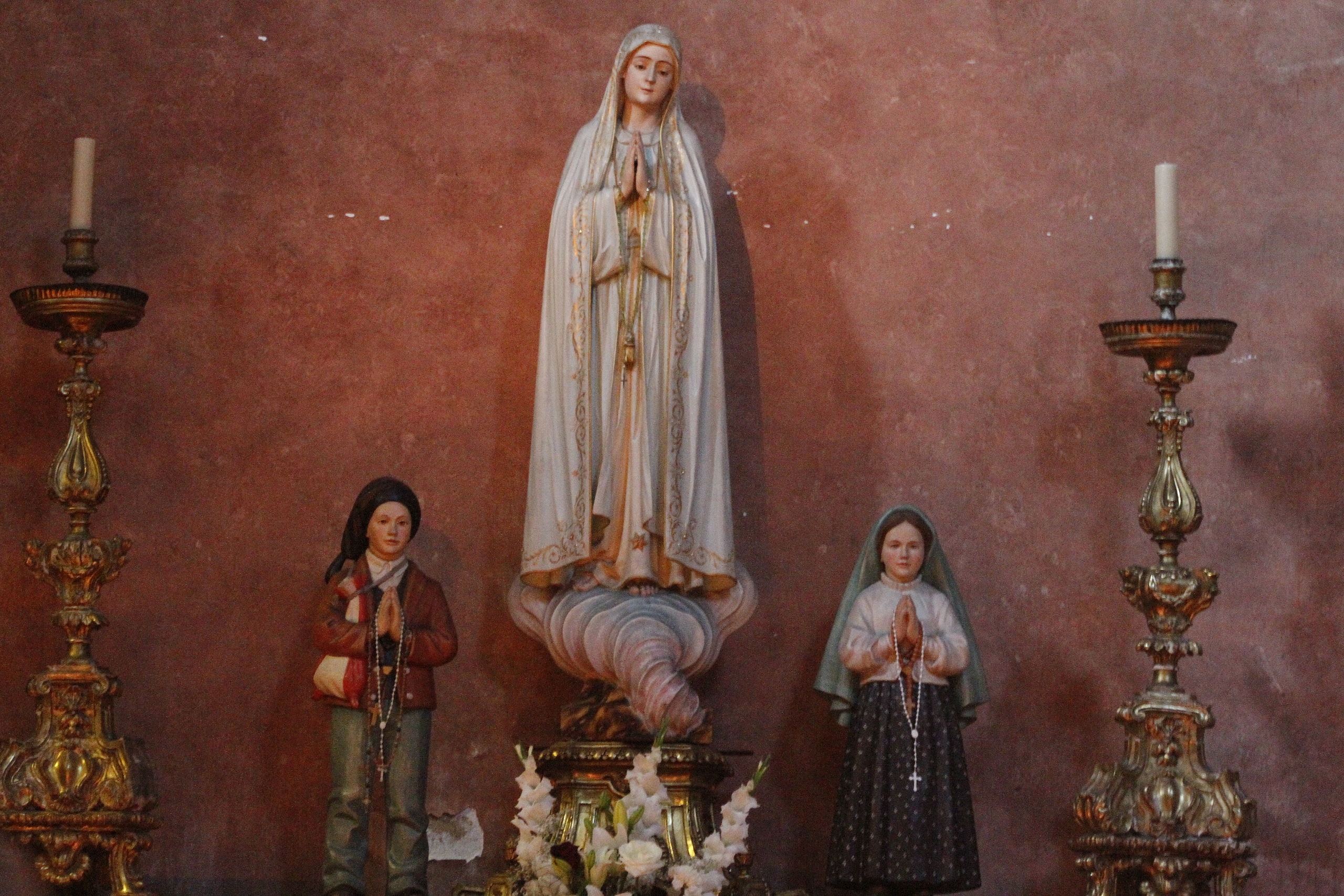
fatimaThis week on October 13 and 14th I am in Fatima. Such a profound apparition occurred there, and so accurately prophetic of our times!

Our Lady’s warnings of the consequences if we did not pray and convert have proven to be sadly accurate. She warned of another, more terrible war (World War II). She spoke of great lights in the sky that would serve as a final warning before the terrible war. (They appeared all over Europe just before Hitler invaded Poland, in the form of a stunning display of the Aurora Borealis.) She said that Russia would spread her errors, that the Church would have much to suffer, and she warned of a pope who would be struck down.

A final and belated prophecy from Fatima seems to have come in the form of a letter written by Sister Lucia to Cardinal Carlo Caffara. He had written to her asking for her prayers as he had been commissioned by Pope John Paul II to establish the Pontifical Institute for the Studies on Marriage and the Family. The year was 1981. According to Cardinal Caffara, she wrote back with the following:

[T]he final battle between the Lord and the reign of Satan will be about marriage and the family. Don’t be afraid, she added, because anyone who operates for the sanctity of marriage and the family will always be contended and opposed in every way, because this is the decisive issue. And then she concluded: however, Our Lady has already crushed its head. [*]

Thus, from Fatima comes one accurate prophecy after another. Here we are today, locked in a terrible battle over the most basic units of any civilization: families and the marriages that form them. Fatima, the great prophecy of our time and a summons to sobriety and prayer!

Something else that has always intrigued me about Fatima is the name of the town itself. Fatima is a town bearing the name of the daughter of Mohammed; this is so stunning! Why of all places would Mary appear there? Is it just coincidence? If you think so, you have not pondered that everything about the apparition of Fatima is prophetic.

The great Archbishop Fulton Sheen, in his book The World’s First Love, reflected on its significance and posed a few questions. Please note that the book was written in 1952 and therefore some of the spellings are not the modern ones. Here are some excerpts:

The Koran, which is the Bible of the Moslems, has many passages concerning the Blessed Virgin. First of all, the Koran believes in her Immaculate Conception, and also, in her Virgin Birth … The Koran also has verses on the Annunciation, Visitation, and Nativity. Angels are pictured as accompanying the Blessed Mother and saying, Oh Mary, God has chosen you and purified you, and elected you above all the women of the earth. In the 19th chapter of the Koran there are 41 verses on Jesus and Mary. There is such a strong defense of the virginity of Mary here that the Koran in the fourth book, attributes the condemnation of the Jews to their monstrous calumny against the Virgin Mary.

Mary, then, is for the Moslems the true Sayyida, or Lady. The only possible serious rival to her in their creed would be Fatima, the daughter of Mohammed himself. But after the death of Fatima, Mohammed wrote: Thou shalt be the most blessed of women in Paradise, after Mary. In a variant of the text Fatima is made to say; I surpass all the women, except Mary.

This brings us to our second point; namely, why the Blessed Mother, in this 20th Century should have revealed herself in the significant little village of Fatima, so that to all future generations she would be known as “Our Lady of Fatima.” Since nothing ever happens out of Heaven except with a finesse of all details, I believe that the Blessed Virgin chose to be known as “Our Lady of Fatima” as pledge and a sign of hope to the Moslem people, and as an assurance that they, who show her so much respect, will one day accept her divine Son too.

Evidence to support these views is found in the historical fact that the Moslems occupied Portugal for centuries. At the time when they were finally driven out, the last Moslem chief had a beautiful daughter by the name of Fatima. A Catholic boy fell in love with her, and for him she not only stayed behind when the Moslems left, but even embraced the Faith. The young husband was so much in love with her that he changed the name of the town where he lived to Fatima. Thus the very place where our Lady appeared in 1917 bears a historical connection to Fatima, the daughter of Mohammed.

Missionaries, in the future will, more and more, see that their apostolate among the Moslems will be successful in the measure that they preach Our Lady of Fatima. Mary is the advent of Christ, bringing Christ to the people before Christ himself is born. In any apologetic endeavor, it is always best to start with that which the people already accept. Because the Moslems have devotion to Mary, our missionaries should be satisfied merely to expand and develop that devotion, with the full realization that our Blessed Lady will carry the Moslems the rest of the way to her divine Son. She is forever a “traitor,” in the sense that she will not accept any devotion for herself, bit will always bring anyone who is devoted to her to her divine Son.

A beautiful reflection by Archbishop Sheen and one we can surely hope will come to pass! Relations are much tenser between Christians and Muslims today than in 1952. But Fatima is the apparition that just keeps prophesying.

It is nothing less than astonishing that Mary should appear in a town with the name of Fatima. Surely this is no mere coincidence. As Sheen points out, Heaven does nothing without purpose. It is very clear to me that we are not to pass over this detail. “Our Lady of Fatima” has a different ring to it when we consider that Fatima is more than a place; Fatima is the daughter of Muhammad and the greatest woman in Islam. “Our Lady of Fatima” sounds and feels so different when it is heard in this context of person rather than place. It is hugely significant.

It seems clear that Mary will play an important role in the years ahead as the Muslim/Christian conflict likely grows sharper. Perhaps, as Sheen notes, she will be the bridge that connects two vastly different cultures; the common mother who keeps her children talking. Right now this connection seems little pursued, even (as far as I can tell) by the Vatican.

The Guadalupe connection – I wonder, too, if the history of Our Lady of Guadalupe presents some historical parallels to our current struggle with the Muslim world. In the early 16th Century in Mexico, missionaries had made only meager progress in bringing the Aztec people to Christ. This was a combination of the sometimes rude and cruel treatment of the indigenous people by the Spanish soldiers, and also of the fearful superstition surrounding the Aztec gods. The people were locked in with the fear that unless they fed these gods with horrific human sacrifices, their greatest god, the sun, would no longer shine.

Into this fearful and suspicious setting entered Mother Mary. The miraculous image she left in 1531 was richly symbolic. Her face is that of a mother: gentle and compassionate, unlike the appearance of the frightening Aztec gods, who wore fierce masks. Her features seem to be both Aztec and European, two cultures combined in kindness and peace. Her attitude is one of humble prayer, so she is clearly not a god(dess). She is a merciful mother who consoles and prays for us. She is to be honored but not adored. The black band around her waist means that she is with child and offers Jesus to the people. Her message is about Him. The sun was the greatest of the Aztec gods, so by standing in front of it, Mary shows that she is greater than even their greatest god. To the Aztecs, the moon represented the god of darkness and death. That Mary is standing on the moon is a sign that these powers, too, are defeated by the Son she bears.

Mary brought the breakthrough. Within ten years, over twelve million Mexicans came to Christ and entered the Catholic Church.

This history is paralleled in many ways today in the current tensions with the Muslim World. In many Muslim lands today, conversions are few. Part of the reason for this is a strong aversion to the Western culture from which Catholicism comes. Many Muslims also hold grievances due to alleged American and Western “mistreatment.” Finally, a large factor is fear. In many parts of the Muslim world, leaving the Muslim faith is likely to get one killed. So, it is a combination of a wide cultural gulf, grievances, and fear that keep conversions low. All of this is not unlike the situation in 16th century Mexico.

Is Mary key to this? It took Mary to bridge all these similar gaps between the Aztecs and the Christian missionaries. Might Mary also be that bridge today when similar gaps divide people? Time will tell, but one of her greatest modern titles is “Our Lady of Fatima.” And then there is the crescent moon, upon which Mary stands in the image of Guadalupe. In modern times the crescent moon is the symbol of Islam. By God’s grace, and with love and humility, Mother Mary of Guadalupe was victorious in overcoming the false religion of the Aztecs.

Might this crescent moon on which Our Lady of Guadalupe stands also point to our times and the crescent moon of Islam? Might it indicate that her victories, by God’s grace, are not at an end? Perhaps we can hope that what our Lady of Guadalupe was to the Aztec people of Mexico, Our Lady of Fatima will be to the Muslim people of the world.

As always, I invite your comments and answers to my questions.

Here is “Immaculate Mary,” sung in Arabic:

Men Are More Disinclined to Marry Than Ever – A Reflection on a Serious Problem

A 2012 report on men and marriage by the Pew Research Center shows statistically what many of us have noticed anecdotally: men are finding marriage less desirable than in the past and are now marrying later, if at all.

In today’s post I want to present some excerpts from a hard-hitting article that appeared at Lifesite News in 2013, commenting on the Pew study. The full article can be read here: Men Giving Up on Marriage.

As usual, I present the text from the original article in bold, black italics, while my own poor commentary is in plain red text.

Fewer young men in the US want to get married than ever. … The number of young adult men saying that having a successful marriage is one of the most important things dropped from 35 percent to 29 percent [since 1997].

The latest census data showed “barely half” of all adults in the United States are currently married, a “record low.” Since 1960, the number of married adults has decreased from 72 percent to 51 [percent] today and the number of new marriages in the U.S. declined by five percent between 2009 and 2010.

Moreover, the median age at first marriage continues to rise, with women getting married the first time at 26.5 years and men at 28.7 [years]. The declines in marriage are “most dramatic” among young adults. Just 20 percent of those aged 18 to 29 are married, compared with 59 percent in 1960.

In my mere 26 years of priesthood, I have seen the number of weddings I perform each year decrease from 35 to 5, and the average age of engaged couples increase from 24 to 31. These are startling changes, and they largely match those experienced by other priests with whom I have discussed the matter.

29 percent of young adult men desiring marriage is an amazingly low figure. The article notes that the things that once motivated men to marry in the past are largely in eclipse now. Men once enjoyed the esteem they garnered by marrying, and were motivated by the challenge of being breadwinners. Getting married was once a proper and approved way of attaining status, and legitimately enjoying sexual intimacy. It was part of the passage to manhood.

But today, many (if not most) women don’t need (or don’t think they need) men to provide for them economically. It’s goodbye to any notion of the esteem of being a provider.

Further, in an age of promiscuity, most men don’t need marriage to open the door to sexual encounters. Only a few “old-fashioned” Catholic priests and traditionalist Catholics raise any eyebrows at men’s “playing the field.” And women as a group (with certain notable exceptions) seem less insistent on expecting men to connect sexual intimacy and marriage.

Add to this the financial bondage introduced by the racket that college education has become. Many young people graduate from college with six-figure debt. And when undergraduate degrees no longer open doors, advanced degrees became necessary, bringing on even more debt.

And finally, add one more thing: pornography. It is more available than ever before. And though it is theoretically more privately accessible than previously, I would point out that there is nothing private about the Internet; Internet service providers know every site you have ever visited.

Sadly, many young men honestly admit that they prefer pornography to real women. Pornography doesn’t talk back or have preferences or moods. Real relationships are complex and require navigation and negotiation. Pornography, it would seem, is a narcissistic paradise. Click through to your current preference; it’s all about you and what you want. And at the end, the object of your fantasy disappears and does not have issues or attitudes with which you must deal.

The overall image is of a cauldron, filled with a witch’s brew or a satanic stew. That men and women marry at all today is increasingly miraculous. I always make a point of congratulating and thanking engaged couples that get to my rectory door for beating the odds and having the gumption to swim upstream.

Pew’s findings have caught the attention of one US writer who maintains that feminism, deeply entrenched in every segment of the culture, has created an environment in which young men find it more beneficial to simply opt out of [marriage] entirely

Suzanne Venker [in her] article, “The War on Men,” … points out that for the first time in U.S. history, the number of women in the workforce has surpassed the number of men, while more women than men are acquiring university degrees. …

With feminism pushing them out of their traditional role of breadwinner, protector, and provider—and divorce laws increasingly creating a dangerously precarious financial prospect for the men cut loose from marriage—men are simply no longer finding any benefit in it. …

“When I ask [men] why, the answer is always the same: women aren’t women anymore.” Feminism, which teaches women to think of men as the enemy, has made women “angry” and “defensive, though often unknowingly.” 

“Men are tired,” Venker wrote. “Tired of being told there’s something fundamentally wrong with them. Tired of being told that if women aren’t happy, it’s men’s fault.”

Most men I know perceive that they are often considered by the wider culture as deficient, even depraved. The “men are stupid” commercials and sitcoms abound. Men are often presented as buffoons, who need women and children to “set them straight” on the simplest of things.

Schools, dominated by feminist ideology, have made a pathology of the normal behavior of boys, which includes competition and roughhousing. They seek to feminize boys, going even so far as to encourage medication for them. Most of these boys merely have the spit and vinegar that was once considered normal, needing to be curbed somewhat rather than suppressed with drugs.

It is little wonder that fewer young men make it to college and are falling behind young women in almost every category. Being told (even indirectly) on a regular basis that you are fundamentally flawed has a significant effect over time.

The article says that feminism has emboldened many women to direct suspicious anger toward men and generally presume that they have bad or evil motives. But it has also caused a lot of men to draw back from the healthy confidence that once bolstered them to go out and seek a wife and to take a leadership role in the community, the Church, and the family.

A feminist culture in effect shames these desires as being “patriarchal.”

This is a situation that should not be celebrated by feminists, Venker says. “It’s the women who lose. Not only are they saddled with the consequences of sex … The fact is, women need men’s linear career goals … in order to live the balanced life they seek.”

Yes, in the end it’s usually the biology that kicks in. Truth be told, men and women are meant to be complementary not competitive. Our very body bespeaks a difference that requires the opposite sex to complement it. The design of women’s bodies speaks to bearing children and nurturing them.

A woman who wants to have and raise children well needs time and flexibility. The 9-to-5 career world does not facilitate that. Thus her husband complements her need by taking up the linear and less-flexible career world, leaving her freer to nurture the children.

This used to be obvious to us. But ideology is often disinterested in the obvious. It may be true that we were once too restrictive, limiting certain jobs and careers to men. But for most women, the freedom to work has become the duty to work, even in the childbearing years. It’s a raw deal for everyone: women, men, and especially children.

The bottom line is, it’s never good for anyone, or for civilization as a whole, when huge numbers opt out of or find no access to our most fundamental building block: the traditional family. We must save traditional marriage if we stand any chance of saving our dying civilization.

For further reading, consider Men and Marriage by George Guilder and Eggs are Expensive, Sperm is Cheap by Greg Krehbiel.

What Does Heaven Cost? A Meditation on the Gospel for the 28th Sunday of the Year

Today’s gospel reading invites us to wrestle with fundamental, essential, and focal questions, “What does heaven cost?” and “Am I willing to pay it?”

I. Problematic Pondering – A man asks Jesus, “Good teacher, what must I do to inherit eternal life?

Though his question is a good one, it is problematic because he couches it in terms of his own personal power and achievement. He wonders what he himself must do to attain eternal life.

The problem is, none of us has the holiness, the spiritual wealth, or the power to attain Heaven based merely on what we do. The kind of righteousness we need can come only from God. The misguided question of the rich man betrays two common misunderstandings that people bring to the question of salvation and the need for redemption.

The first misunderstanding is rooted in a minimizing of how serious our condition is. We tend to think that we’re basically in good shape; perhaps we have a few flaws, but basically we mean well and are decent people. We suspect that a few sacraments, occasional prayers, and some spiritual push-ups will be sufficient. But any look to the Crucifix will belie our tendency to minimize. If it took the horrible death of the Son of God to rescue me, then my condition must be worse than I, with my darkened intellect, think.

Jesus once told the parable of a man who owed a huge debt—10,000 talents (cf Mt 18:24). The amount is so large as to be almost unimaginable. This man represents us. No man with such a debt is going to be able to work a little overtime or get a part-time job to pay it off. 10,000 talents is beyond the national debt. Do you get the point? We’re in trouble; we have absolutely no ability to rescue ourselves.

A second misunderstanding is that we tend to intellectualize and minimize what the law of God actually requires. Asking, “What must I do?” rather than “What must I become?” bespeaks a law-based approach that wants a manageable list of things to do in order to be saved, rather than an open-ended relationship with God. “Okay, so I’m not supposed to kill anyone. No problem, I don’t like the sight of blood anyway. I’ve got this commandment down!” But this thinking minimizes the commandment and what it is wholeheartedly asking of us. This point will be developed more fully below.

These two misunderstandings seem to undergird the problematic nature of the rich man’s question. In order to engage the man further, Jesus in effect plays along with the premise. And this leads us to the second point.

II. Playful Prescription – Jesus decides to engage the man’s premise, saying to him, You know the commandments: You shall not kill; you shall not commit adultery; you shall not steal; you shall not bear false witness; you shall not defraud; honor your father and your mother.

Jesus is being playful here in the sense that He continues with the flawed premise of the man: that he can attain to Heaven by something he does.

It is interesting to ponder why Jesus quotes only the Second Table of the Law, the part pertaining to our love of neighbor, omitting reference to the First Table of the Law, the commandments pertaining to the love of God. Perhaps it is because the Lord recognizes that the man does love God, for he is seeking the Kingdom of Heaven and how to enter into it. Thus, the Lord focuses on the Second Table of the Law, which is in evidence in this man’s life, at least in this interaction with the Lord. Further, as Scripture says elsewhere, “How can you say you love God whom you do not see, if you do not love your neighbor whom you do see?” (1 John 4:20).  Hence, the Second Table of the Law, fleshes out the First Table of the Law.

Now, mind you, the Lord is not affirming here that the keeping of the commandments can save us or justify us. Even if we consider ourselves blameless, Scripture says, the just man sins seven times a day (Prov 24:16). We can affirm with Isaiah that, I am a man of unclean lips, and I live among a people of unclean lips (Is 6:5). And we must say with Paul, I do not nullify the grace of God, for if righteousness comes through the Law, then Christ died for no purpose (Gal 2:21).

While it is true that the law gives us a necessary and clear frame of reference for what pleases God, its summons “Be holy, for I the Lord your God am holy” (Lev 19:22) is not attainable through mere human effort unaided by grace. Jesus makes it clear that when God says “Be holy” He does not have in mind any mere human holiness, for Jesus says, “Be perfect, as your Heavenly Father is perfect” (Matthew 5:48).

Thus Jesus is drawing out the problematic premise of the man. But as we next see, the rich man doesn’t take the hint.

III. Perceived Perfection – Strangely—and humorously to our mind—the man boldly says, Teacher, all of these I have observed from my youth.

Notice that his perfection is perceived; simply noting it in himself does not mean he actually has it in himself. Having heard Jesus quote the Second Table of the Law, he announces that he has observed all of these from his youth!

To be fair, his self-analysis was not uncommon for a Jewish man of his time. The Jewish people had a great reverence for the Law, a beautiful thing in itself. But they tended to understand it a fairly legalistic and perfunctory sense.

For example, in a conversation with Jesus, a scribe of the law asks Him, “And who is my neighbor:” (LK 10:29) It’s as if he is saying, “If I have to love my neighbor, and I acknowledge my duty to do so, how can I define ‘neighbor’ so that this is manageable?” In other words, I recognize that I have limits. If justice comes to the law, then the law must have limits, defined in such a way that the keeping of the law remains within my power.

Jesus sets aside such thinking in the Sermon on the Mount, (Matt 5-7), in which He calls for the law to be observed not in a minimalistic sense, but in a way that fills it to the full. Jesus says that it is not enough not to kill; we must also reject anything that ultimately leads to killing or wishing people were dead. The commandment not to kill requires not only that we not take life, but also that we banish from our heart and mind, by God’s grace, hateful anger, retribution, and revenge. The commandment not to commit adultery requires not merely that we avoid breaking our marital vows, but also that, by God’s grace, we banish from our heart and mind any lustful, impure, and unrighteous sexual thoughts.

Hence, the commandments and precepts of the law cannot, and should not, be understood in a minimalistic way. Jesus sets aside the usual manner of the people of His day to reduce the law to something manageable and then declare that they have kept it. God seeks more than perfunctory observance. His grace desires to accomplish within us wholehearted observance. We need grace in order to be saved, in order to qualify for anything that God calls holy.

So Jesus sets aside the rich man’s claims of righteousness and is now is ready to address the question, “What does Heaven cost?”

IV.  Pricey Prescription – Yes, what does Heaven cost? The answer is, everything! Jesus, looking at the man with love, says to him, You are lacking in one thing. Go, sell what you have, and give to the poor and you will have treasure in heaven; then come, follow me.

Ultimately, what Heaven costs is to leave this world and everything in it, to go and possess God and Heaven. To have Heaven, we must set aside this world; not only its life, but its pomp, its ephemeral glories, and its passing pleasures. You want heaven? Then you gotta leave here!

And though we know this, we often live in a way that seeks to postpone the inevitable and to ignore the joke that this world is ultimately playing on us. The world says, “You can have it all!” Yes, and then you die and lose everything. But we like to postpone facing that. We like to pretend that perhaps it ain’t necessarily so. We’re like the gambler who goes to the casino thinking he will be the exception to the general rule. But in the end, the house always wins. You can’t cheat life; whatever we have when we die, whatever we claim to have won, we lose.

In the end, there is only one way to attain the things of lasting value. Only what you do for Christ will last. The Lord says “Store up for yourselves treasure in heaven, that neither rust nor moths can corrode, nor thieves break in and steal” (Lk 12:33).

The Lord says that being generous to the needy and poor is a way of storing up treasure in Heaven. Sadly, most of us aren’t buying that, thinking that clinging to our “treasure” here is a way of keeping it. It isn’t. Whatever we have here is slipping through our fingers like so much sand. The only way to keep it unto life eternal is to give it away to the needy, to the poor, and to allow it to advance the kingdom of Heaven and its values.

Otherwise, wealth is not only not helpful it is actually harmful. There are many texts in the Scriptures that speak of the danger and the harm of wealth, how it compromises our souls and endangers our salvation:

1. Mk 10:23-25 “Jesus looked around and said to his disciples, “How hard it is for the rich to enter the kingdom of God!” The disciples were amazed at his words. But Jesus said again, “Children, how hard it is to enter the kingdom of God! It is easier for a camel to go through the eye of a needle than for a rich man to enter the kingdom of God.”

2. 1 Tim 6:7 “for we brought nothing into the world, and we cannot take anything out of the world; 8 but if we have food and clothing, with these we shall be content. But those who desire to be rich fall into temptation, into a snare, into many senseless and hurtful desires that plunge men into ruin and destruction. For the love of money is the root of all evils; it is through this craving that some have wandered away from the faith and pierced their hearts with many pangs.

3. Luke 16:13 “No servant can serve two masters. Either he will hate the one and love the other, or he will be devoted to the one and despise the other. You cannot serve both God and money.

4. Luke 6:24-25 “But woe to you who are rich, for you have already received your comfort. Woe to you who are well fed now, for you will go hungry. Woe to you who laugh now, for you will mourn and weep.”

5. Mat 19:30 “But many that are first will be last, and the last first.”

6. James 2:5 “Listen, my beloved brethren. Has not God chosen those who are poor in the world to be rich in faith and heirs of the kingdom which he has promised to those who love him?”

Thus, while the Lord’s claim that Heaven costs everything bewilders us, we cannot fail to see that it is true and that the world’s claims on us are rooted in a lie, in false declarations that somehow we can be secure in the passing glories the world. Yes, and then you die—end of glory. But because we like the lie, we entertain it. But in the end, we give everything back, because it was never ours to begin with, it only seemed that way.

How foolish we are, how blind! And speaking of blindness, note that the Lord looked at the man with love, yet the man went away sad. That look of love from the Lord never reached his soul. If it had, the result would surely have been different.

And this leads us to the final point.

V. Powerful Possibility – So shocking is this teaching that even the apostles, who had in fact left everything to follow the Lord, are shocked by it. They see, and are in touch with, how deep this wound is in the human heart, how deep our delusion that the world and its goods can satisfy us. They see and know how strong and numerous are the hooks that this world has in us. Thus, they cry out, “Then who can be saved?” And Jesus responds, For man it is impossible, but not for God. All things are possible for God.”

Thus, in the end, salvation must be God’s work. He alone can take these tortured hearts of ours, so rooted in passing things, and make them willing to forsake all things for the kingdom of Heaven.  Only God can take our disordered love and direct it to its proper end: the love rooted in God and the things awaiting us in Heaven. Only God can remove our obsession with the Titanic and place us squarely in the Noah’s Ark that is the Church, the Barque of Peter.

Yes, God can give us a new heart, a properly ordered heart, a heart that desires first and foremost God’s love, a heart that can say, “You, O Lord, are enough,” a heart that can say, “I gratefully receive, Lord, what you give me, and I covet nothing more. Thank you, Lord. It is enough. You are enough.

Don’t miss the look of love that Jesus gave the young man, the look that He gives you. In the end only a greater love, God’s love received, can replace the disordered love we have for this world.

St. Augustine says, Such, O my soul, are the miseries that attend on riches. They are gained with toil and kept with fear. They are enjoyed with danger, and lost with grief. It is hard to be saved if we have them; and impossible if we love them; and scarcely can we have them, but that we shall love them inordinately. Teach us, O Lord, this difficult lesson: to manage conscientiously the goods we possess and not covetously desire more than you give to us (Letter 203).

I prayed, and prudence was given me;
I pleaded, and the spirit of wisdom came to me.
I preferred her to scepter and throne,
and deemed riches nothing in comparison with her,
nor did I liken any priceless gem to her;
because all gold, in view of her, is a little sand,
and before her, silver is to be accounted mire.
Beyond health and comeliness I loved her,
and I chose to have her rather than the light,
because the splendor of her never yields to sleep.
Yet all good things together came to me in her company,
and countless riches at her hands (Wisdom 7:7-1).

Love, It’s What God Does – As Seen in a Commercial

blog10-9I’ve been enjoying the Geico “It’s what you do” commercials (in the less than one hour of television I watch each day). They remind me of a sort of syllogism I’ve used to explain why God’s loves us: God is love. When love is what you are, love is what you do. Therefore, God loves.

Why does God love us? Because God is love and that is what love does: it loves.

God does not love us because we are good or we deserve it; He loves because he is love.

Enjoy these “It’s what you do” commercials. They illustrate an old truth, agere sequitur esse (action follows being; what one does follows from what one is).

Genesis and Genre – A Brief Consideration of the Need to Understand Literary Form

blog10-8The Bible has within its pages many literary forms: history, poetry, prayer, prose, theology, liturgical instruction, cosmology, genealogy, philosophy, parable, moral tale, and so forth. How exactly to read its pages and understand them is often a matter of understanding the genre.

The word genre comes directly from the French word meaning “kind” or “sort.” Further back, it stems from the Latin word genus and the Greek word genos (γένος). Genre is the term for a category of literature, art, or culture (e.g., music) based on a set of stylistic criteria.

Now someone might ask me, “Do you read the Bible literally?” That’s like someone asking, “Do you interpret the library literally?” I would respond by saying that it depends on what section I’m in. If I’m in the science or history section, I might well read a book there literally. But if I’m in the poetry, fiction, or children’s storybook section, I would not likely read a book there literally. In those sections I would understand that stories and images are being used to make a point rather than merely to present facts.

We know how to exercise some sophistication when it comes to the library, but many seem to lose this perspective when it comes to the Bible. Often we can fail to distinguish literary forms and thus try to force a book or passage to be what it is not.

In reading the Book of Genesis, especially the early chapters, many fail to appreciate the different literary forms. They want the creation stories to be science or exact history when in fact they are more poetic and theological than scientific. The stories advance the real and true point that God alone created everything there is out of nothing, and did so in an intentional and systematic way in which He was involved at every stage. This is the sacred and theological truth set forth by the Genesis accounts.

The text does not propose to be in the form of a science textbook. Consider, for example, the accounting of the “days” of creation. Although light is created on the first day, the Sun and Moon are not created until the fourth day. So what does it mean to speak of a “day” when the very sun by which we define the length of the day does not even exist yet? Further, the notion of light apart from the Sun, is a somewhat abstract concept.

If someone asks me if I read the account of creation literally I ask them, “Which one?” This usually leads to a puzzled look. But the fact is, Genesis sets forth two accounts of creation that are very different.

  1. In the first account (Gen 1:1-2:4) we see a period of seven days. First there is the creation of light, then the sky and the ocean, then vegetation, then the Sun and the Moon, then fishes and birds, then the animals, and finally Adam and Eve.
  2. The second account of creation (Gen 2:4-25) does not mention a time frame. It begins with the creation of Adam, then the planting of a garden, then the creation of animals, and then the creation of Eve.

Hence, we have two very distinct versions of creation. In no way can they be harmonized, yet neither are they in absolute conflict. Each describes the same event, but from a different angle and with a different level of focus on detail. Neither account alone contains all the details. But together, they contain all God wants us to know about the creation of the cosmos.

If asked to describe the visit I made to the Holy Land I could start at the beginning and give a day-by-day account, or I could choose to start at the end and work backward. Or instead of responding chronologically, I could just present some highlights. I could also describe the trip according to themes (e.g., Old Testament sites and New Testament sites). I might select the method of presentation depending on the particular audience. Each of my responses would be true and yet they are all different. My response would depend on my purpose and the audience to whom I am presenting.

So then a little sophistication is required in dealing with the accounts of creation. If we take a literal and rigid notion of history, we can err by trying to make Genesis what it is not. It does not conform to the modern genre of historical writing, which tends to be comprehensive and strictly chronological. These Genesis accounts are quite willing to speak to us of creation poetically and selectively, even reversing the timeline. This is because their purpose is not to give us a blow-by-blow account of precisely how God created everything. Exact times and dates are not the point. The point is that God is the purposeful, sole, and sovereign Creator. God, who is present and active at every stage, is the point. Another important point is the dignity of the human person. The first account accomplishes this by making man the culmination of the creation story; he is created on the seventh day. The second account makes this point, but by beginning with man and having everything formed around him and for him.

The Catechism of the Catholic Church says of these accounts,

Among all the Scriptural texts about creation, the first three chapters of Genesis occupy a unique place. From a literary standpoint these texts may have had diverse sources. The inspired authors have placed them at the beginning of Scripture to express in their solemn language the truths of creation—its origin and its end in God, its order and goodness, the vocation of man, and finally the drama of sin and the hope of salvation. Read in the light of Christ, within the unity of Sacred Scripture and in the living Tradition of the Church, these texts remain the principal source for catechesis on the mysteries of the “beginning”: creation, fall, and promise of salvation (CCC  # 289).

This all leads to an interesting question that I was asked recently by a parishioner: “How did Adam and Eve’s kids have kids?” The questioner seemed to imply that since only Cain and Abel were mentioned (no females) there couldn’t have been other kids. In other words, the premise seemed to be that Genesis represents an exact and fully inclusive history, like modern history texts. Since only Cain and Abel were mentioned, then only Cain and Abel existed. But this premise is flawed; Genesis is not meant to be a complete, seamless, chronological account. Just because daughters were not mentioned does not mean that they did not exist. Genesis 4:17 does mention the wife of Cain. Other women are mentioned in the genealogy that is in Genesis 4. (Note the problem of incest is too long to be addressed here and will be the subject of another post. It is wrapped up in the question of monogenism/polygenism.)

The fact is, Genesis does not propose to give us all the details or to answer all of our questions. Something is left to the reader: a sophistication that recognizes that Genesis is historical yet not written in the form of modern history texts. We cannot expect all the details and must presume the presence of other children (especially daughters born to Adam and Eve).

So, in the end, there must be some sophistication used in understanding of Scripture. Genesis is neither a scientific account nor was it written in the way of a modern history text. It does speak of historical facts, but in a selective and poetic manner. Accepting this distinction is critical, lest we go down all sorts of rabbit holes, expecting Genesis to provide a complete and seamless account that it does not propose to give in the first place.