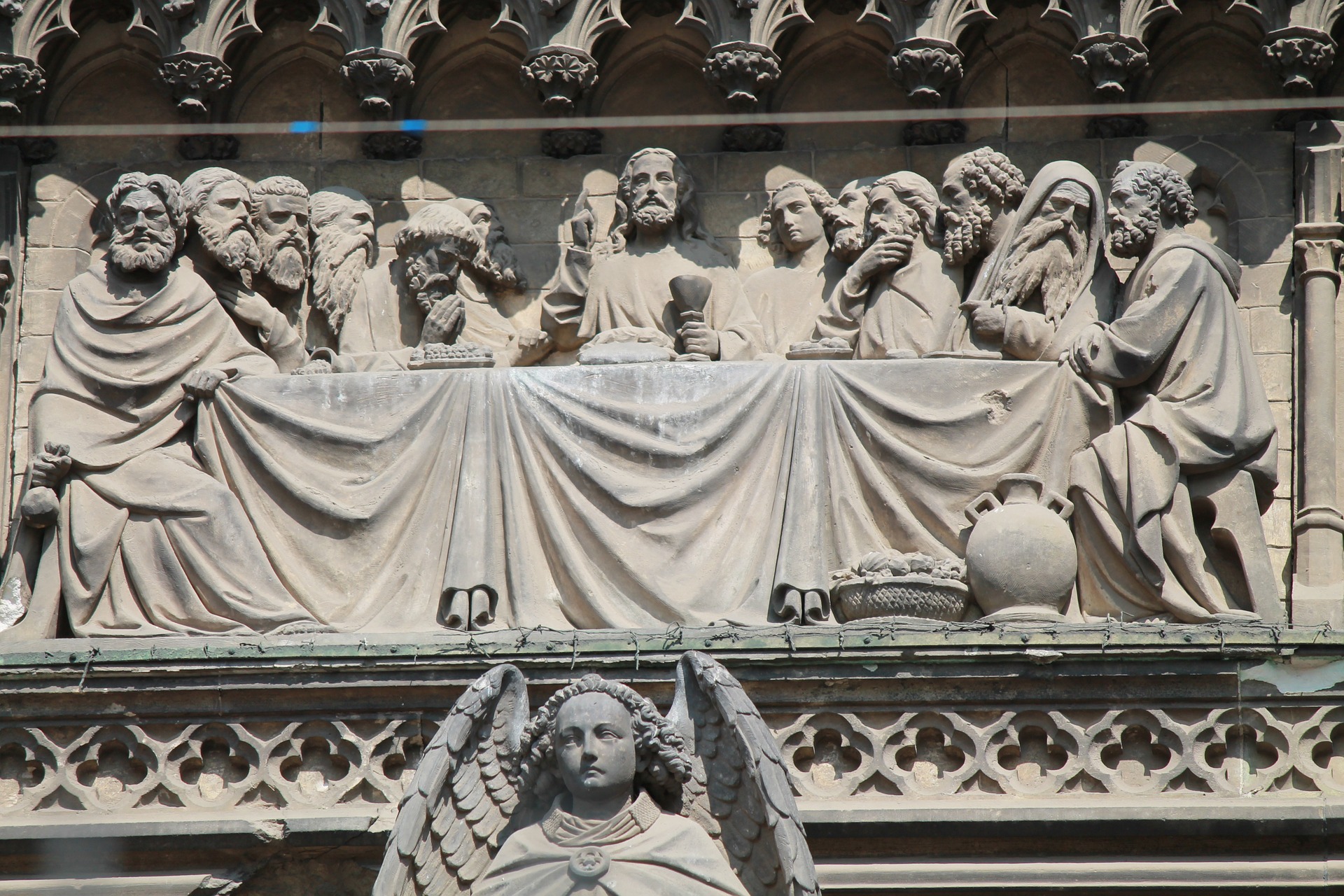
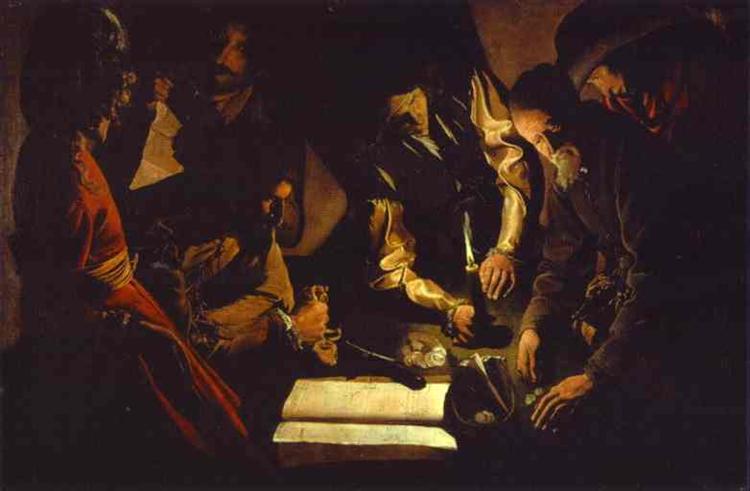
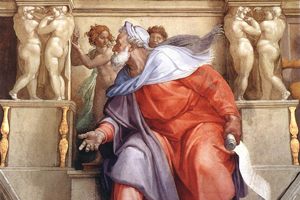
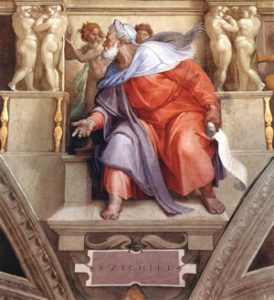
Today’s reading from daily Mass (Tuesday of the 19th Week of the Year) features an unusual image and a seemingly “dark delight.”
It was then I saw a hand stretched out to me, in which was a written scroll which he unrolled before me. It was covered with writing front and back, and written on it was: Lamentation and wailing and woe! He said to me: Son of man, eat what is before you; eat this scroll, then go, speak to the house of Israel. So I opened my mouth and he gave me the scroll to eat. … I ate it, and it was as sweet as honey in my mouth (Ezekiel 2:10-3:3).
The reference to eating a scroll is likely allegorical. The direction to eat the scroll of God’s Word probably came while Ezekiel was in a prophetic state, a state of ecstasy during which prophets often received their message. But whether allegorical or literal, the point is that Ezekiel and all of us must allow the Word of God to enter us deeply and become part of our very substance. The Word of God needs to “stick to our ribs” (as I find ordinary food does so easily in my advancing age)!
But there remains a kind of “dark delight” for us to consider. The scroll Ezekiel ingests was said to consist of lamentation, wailing, and woe, yet Ezekiel says it was sweet to the taste.
Was Ezekiel delighting in the looming destruction of Jerusalem? Why would lamentation, wailing, and woe be sweet to the taste? Was Ezekiel delighting in the darkness? Was there an unholy vengeance at play here? What could be sweet about woe?
Perhaps an analogy will help us to understand what tasted “sweet” to Ezekiel. Consider a man with cancer. Because surgery is painful and costly, the first treatments attempted involve chemotherapy or radiation. Over time, it becomes increasingly clear that surgery will be required. The decision is to operate is made and a date is set. It is major surgery and thus will require a lengthy recovery period and significant physical therapy. As the date approaches, though the man laments the need for surgery and the likely pain to follow, a strange peace comes over him, even an eagerness to be done with it. Though lamentation, wailing, and woe are at hand, beyond that there will be healing. Thus with a kind of sweet joy, he experiences a strange relief as the surgery day arrives. He says to himself, in effect, “Bring it on! Let’s get this over and done with. I’m sick and tired of being sick and tired. It’s time for this cancer to go, despite the cost.”
Perhaps this was Ezekiel’s experience of the sweetness of even a hard prophecy that would not only harm what and whom he loved, but would also afflict him with exile and the pain of loss. This had become necessary because the people were unrepentant and the injustices growing ever worse. Over and over again Ezekiel was told that the people were stubborn, that they did not listen, that their foreheads were brass and their necks were iron. Now it was time to lance the boil, to do the only thing left to bring about the needed healing and change. Yes, it was a lamentation and a woe, but it was necessary and the time had come. There was a “sweetness” in knowing that God would deal with the spiritual cancer accordingly and that injustice and sin were going to be dealt with.
Thus, it was not a “dark delight,” for the delight was not in the darkness or the pain itself, but in the end of injustice and sin. The sweetness was in the restoration of at least some sanity, health, and the beauty of truth.
Some of us who comment on the current condition of our culture and warn of coming judgment are accused of this sort of “dark delight.” Some have written me off, saying that they think that I want this to happen, that I want to see us all destroyed.
While I can’t speak for everyone who comments on the current state, I can say that I would prefer a quick and remarkable repentance that will save the nation and culture I love. I also know that lamentation and woe will make my own life much harder, even downright awful. My only “delight” in a chastisement is the healing that might follow for the generations to come. But I pray that I want what God wants. If patient waiting is His will then so be it. If dramatic chastisement (as in Ezekiel’s day) is His will then so be it. Do what you need to do, Lord.
I understand that some will see this as vindictive and even unpatriotic. Jesus and St. Stephen, who spoke of the coming destruction of the Temple, were also thought by some to “want” the destruction and even to be plotting to bring it about. Jesus wept over ancient Jerusalem and her coming destruction. He preferred her repentance but knew that it would not come (Jn 11:35). Thus, for Jesus (and surely for Stephen, too) there was no dark delight, but rather a gut-wrenching lament; they both ultimately paid dearly. I ask only for a heart made ever purer, a heart that weeps for sin (my own and that of all), a heart that seeks only the happiness and wholeness that comes from God’s vision for us.
There been much tension regarding the Mass as both a meal and a sacrifice. A necessary corrective was introduced in the past twenty years to rectify the overly strong emphasis, heavily advanced during the 1970s and 1980s, on the Mass as a meal. The purpose of the corrective was to bring back needed balance with the root of the Mass: the cross and the overall paschal mystery.
While we cannot dismiss the idea of the Mass as a meal, we must understand what sort of meal it is. When most people today hear the word “meal,” they do not think of a holy banquet or wedding feast, but more of an informal meal. And informality in American culture has become very informal indeed! We rarely dress up anymore; formal banquets, black-tie dinners, and the like are rare.
Thus our understanding of the Mass as a meal is colored by our culture’s informal definition, which is not intended in the Church’s understanding of the Mass. Permit, then, some of the following correctives:
I. The Mass is a meal, but it is no ordinary meal. The Mass is a sacred meal or banquet (Sacrum Convivium) and also the great Wedding Feast of the Lamb, for which one should be properly clothed (see Rev 19:6-9; Matt 22:12-13). This meal is not an informal one; it is a great banquet that should be esteemed and for which one should be prepared.
There are many people today who emphasize the “table fellowship” that Jesus had with sinners. They argue the Eucharist should be open to all, Catholic or not, saint or (even the worst) sinner. It is true that Jesus was often found at the table with sinners, where He ate with them.
But the Last Supper, at which the Eucharist was first given, was not just any meal; it was a Passover meal. The Passover meal was not an open one; it was a family meal and one rooted in the Jewish faith. People were instructed to celebrate this meal with their own families. And while several smaller or poorer families could come together for the meal, that was the exception rather than the norm.
Hence, the Last Supper is not to be compared to the open “table fellowship” Jesus had with sinners. Only the Apostles were formally gathered for the Last Supper.
So, to the extent that we can speak of the Mass as a meal, it is not an ordinary one with a “come-one, come-all” and/or “come as you are” mentality. It is not informal. It is a sacred meal that should be received worthily, celebrated with reverence, and which is integrally linked to the sacrifice of Jesus Christ on the cross.
Joseph Cardinal Ratzinger wrote substantially on this topic back in the late 1990s, and I presented and reflected on his writings here: Worthy Reception.
II. The Mass is not a reenactment of the Last Supper. It surely includes aspects of the Last Supper (most crucially the words of Institution of the Blessed Sacrament of the Eucharist).
But these aspects of the Last Supper are summarized and referenced, not reenacted. If it were truly a reenactment, then when the priest says that Jesus gave thanks, blessed and broke the bread, and gave it to them saying, “This is my body …”, he should send the host around immediately. And then when he takes the chalice and utters the words of consecration, he should tell all the people to drink from it immediately.
A literal reenactment might also require that we all recline on the floor on our left elbows at low, U-shaped tables. The Last Supper was not served at a modern, American-looking table, or even at one as Da Vinci imagined it. And perhaps the priest should recite the lengthy, priestly prayer of Jesus at the Last Supper, as recorded in John’s Gospel. Maybe a foot-washing should take place at every Mass. But even if we don’t absolutize the notion of reenactment, the point remains that the Mass is not a re-staging of the Last Supper.
Even at the Last Supper, in giving us the words of consecration Jesus points beyond the Last Supper itself. He says of the Bread, “This is my Body, which will be given up for you.” Thus He points beyond the meal to the cross. He says of the wine in the chalice, “This is the cup of my Blood, the Blood of the new and eternal Covenant, which will be shed for you and for many …” Here, too, He points beyond the meal itself to the cross.
Hence, while the connection of the Mass to the Last Supper is clear, it is not the only or even most important connection. The meal itself points to the sacrifice of Christ on the cross. And since at Communion we receive a living Lord (not a piece of dead flesh), the Mass also points to the resurrection.
III. When the priest speaks the words of Consecration at Mass, he is not addressing the congregation. This is another common point of confusion today. Not only is the Mass not a mere reenactment of the Last Supper, even when the priest speaks the words of Consecration at Mass, he is not addressing the congregation. These words, like all the words of the Eucharistic prayer, are directed to the Heavenly Father. They serve as a kind of basis and context for our sacrifice. When saying these words, the priest is speaking in the person of Christ and indicating that this act of our worship, as members of the Body of Christ, is united to the once-for-all, perfect sacrifice of Jesus on the Cross.
The essential point is that the words are directed to the Father. For a priest to gaze intently at the congregation and/or show the bread dramatically as he says the words of Consecration is to send the wrong signal, because it is not the people who are being addressed.
In the rubrics, the priest is directed to bow a little (parum se inclinat) as he says the words. He is not to be like an actor on a stage reenacting the Last Supper with all sorts of gestures and engagement of the faithful as if they were the Apostles. He is to bow as he speaks to the heavenly Father of what Jesus did and said in the institution of the Eucharist.
To reiterate, the entire Eucharistic Prayer is addressed to the Heavenly Father. Thus we are not “pretending” or reenacting the meal that was the Last Supper.
IV. What most makes the Mass a meal is the food that we receive.The food we receive is Jesus the Lord, who feeds us with His Body and Blood, Soul and Divinity. O sacrum convivium in quo Christus sumitur! (O Sacred Banquet in which Christ is received!) It is not necessary or even essential to engage in theatrics or to insist that the altar look like a simple, modern meal table (though noble simplicity has its place).
Thus the Mass is truly a meal as well as a sacrifice. But we must understand that the meaning of the word “meal” in the context of the Mass is distinct from some of our modern notions. It is a formal, sacred, exclusive meal for those of the household of faith who are in a state of grace. Proper attire and formality should be balanced with noble simplicity. And although the Last Supper is surely integral to the Mass, it is not merely reenacted; it is taken up in its essence (not merely in its external aspects), which points to the cross.
The Gospel for today’s Mass (Monday of the 19th Week) is likely confusing to anyone who hears it proclaimed in the U.S., because the New American Bible Revised Edition (NABRE) (which is used for our lectionary) makes a strange, and I would argue inaccurate, translation of the Greek. Here is the passage in question (the crucial section is presented in bold italics):
When they came to Capernaum, the collectors of the temple tax approached Peter and said, “Doesn’t your teacher pay the temple tax?”“Yes,” he said. When he came into the house, before he had time to speak, Jesus asked him, “What is your opinion, Simon? From whom do the kings of the earth take tolls or census tax? From their subjects or from foreigners?” 26 When he said, “From foreigners,” Jesus said to him, “Then the subjects are exempt. 27 But that we may not offend them, go to the sea, drop in a hook, and take the first fish that comes up. Open its mouth and you will find a coin worth twice the temple tax. Give that to them for me and for you” (Matthew 17:24-27).
The NABRE translation makes little or no sense; kings do in fact collect taxes from their “subjects.” Their subjects are not exempt from taxes, tolls, or censuses.
In contrast, the Greek text is clear and does make sense. It speaks not of subjects and foreigners, but of sons and strangers. The Greek text is straightforward:
ἀπὸ τῶν υἱῶν αὐτῶν ἢ ἀπὸ τῶν ἀλλοτρίων
apo ton huion auton e apo ton allotrion
from the sons of them or from the strangers?
The Greek word huion means sons or descendants by birth (or possibly by adoption); it refers to people sharing the same nature as their father. The Greek text is referring to people who are of the family or household of a king.
These sons (or members of the king’s family) are distinguished from allotrion, which are those who belong to another person, to the family of another. By extension, they are foreigners or strangers.
So, I find the NABRE’s translation of huion as “subjects” to be strange. I consulted 25 other English translations of this passage and not one of them renders the word as “subjects.” They all render it as either “sons” or “children.”
Whatever textual critics may wish to advance by way of textual variants, “sons” is needed in English to render the text intelligible.
With the translation of “sons,” the meaning of the passage becomes clear. Jesus is pointing out to Peter that kings do not tax their own children. Therefore, Jesus is exempt from the temple tax because God is His Father; Jesus, as Son, is exempt from the temple tax. However, to giving scandal or stirring up a big debate, He instructs Peter to pay the tax (and tells him how to obtain the money to pay it.)
The tax in question is the didrachma, a two-drachma silver coin; it was the annual tax levied to pay for the upkeep of the temple. The tax represented about half a day’s wages for a laborer and affected all male Jews aged twenty and over, both at home and abroad. However, certain Jewish officials, especially the higher ranking priests, were exempt due to their position.
It is a charming Gospel: Peter is told to pull out the first fish he sees, and in its mouth he will find the money necessary to pay the tax. What a wonderful story! It is a quiet miracle to affirm Peter’s faith in Jesus’ divinity and Sonship, without confronting others who were not ready to hear or believe this. The Father does exempt Jesus from the tax and supplies the money to pay it; the tax officials are spared a conflict because they are not yet ready to render an act of faith in Jesus’ divinity.
God is merciful and prepares us for belief. Having granted the gift of faith, He sends confirmations to strengthen our faith little by little. He draws us in gently and clearly.
In the Gospel for this weekend (Luke 12:32-40) the Lord Jesus presents a “recipe for readiness.” He gives it to us so that we can lay hold of His offer that we not be afraid. He is not simply saying, “Be not afraid.” He is explaining how we can battle fear by being ready.
Frequently, Christians today are uncertain about what is necessary in order to be ready to meet God. Many also make light of the Day of Judgment, considering it all but certain that most of humanity will be saved.
Jesus does not adopt this position. In fact, He teaches the opposite. He consistently warns of the need to be ready for our judgment. Jesus does not counsel a foolish fearlessness rooted in the deception that all or even most will be saved. Rather, He counsels a fearlessness based on solid preparation for the Day of Judgment. Jesus tells us to do at least five things in order to be ready and therefore not afraid.
If we do not make these sorts of preparations, Jesus warns that He will come when we least expect and take away all that we (wrongly) call our own. Jesus says elsewhere, But watch yourselves lest your hearts be weighed down with dissipation and drunkenness and cares of this life, and that day come upon you suddenly like a trap (Lk 21:34). The apostolic tradition says this of the unprepared: disaster will fall on them as suddenly as a pregnant woman’s labor pains begin. And there will be no escape (1 Thess 5:3).
Thus, while Jesus begins by saying that we ought not to fear (for the Father wants to grant us His Kingdom), He also warns that being free of fear is contingent upon embracing and following a plan that He (Jesus) sets forth for our life.
Let’s look at this plan and see how we can forsake fear by becoming and remaining ready. Jesus gives us five specific things to do that will help to ready us for the time when the Lord calls us. It is not an exhaustive list, for no single passage of Scripture is the whole of Scripture, but these are some very practical and specific things to reflect on and do.
I. Reassess your wealth. Jesus says, Do not be afraid any longer, little flock, for your Father is pleased to give you the kingdom. Sell your belongings and give alms. Provide money bags for yourselves that do not wear out, an inexhaustible treasure in heaven that no thief can reach nor moth destroy. For where your treasure is, there also will your heart be. In this passage, the Lord is giving us a triple teaching on wealth. He says that we ought to do these three things:
Forgo Fear. In the end, it is fear that makes us greedy and worldly. We grab up the things of this world because we are terrified of not having enough for tomorrow. But what if we could receive the gift to trust God more and to know and experience that He will give us our daily bread? He has given us the Kingdom, why not everything else? He may not give us everything we want, but we can learn to trust that He will give us what we really need. Seek ye first the Kingdom of God and His righteousness and all these other things will be given unto to you (Matt 6:21). If we can just allow God to diminish our fear, we will be surprised at how easy it is for us to be generous with what we have and not hoard it.
Forward your Fortune. When we are generous to the needy and poor, we store up treasure for ourselves in Heaven. Treasure is not stored in Heaven by way of a rocket ship or hot-air balloon. It is stored there by generously distributing our wealth to others in wise and creative ways. I discussed this more fully in my homily last week (Instructions on Income). While it may not be appropriate for us to sell everything and go sleep on a park bench, the Lord is surely telling us to be less attached to and passionate about money and possessions, for they root us in this world. And where our treasure is, there also will our heart be.
Fix your focus. Our focus is wrong and worldly because most of us have our treasure here in this world. But once we become less fearful and more generous, our obsession with worldly treasure subsides and our joy in heavenly treasure grows. This fixes our broken focus and puts our heart where our treasure really is and ought to be: in Heaven with God. So simplify; be less rooted in this world; come to experience that your greatest treasure is God and the things waiting for you in Heaven.
Reassess your wealth. What is it and where is it? That will tell you a lot about your heart, too.
II. Ready yourself to work. The Lord says “Gird your loins,” which is the ancient equivalent of “roll up your sleeves.” The Lord has work for us to do and wants us to get to it.
Surely the Lord has more than a worldly career in mind. He has in mind things like growing in holiness, pursuing justice, and raising children in godly fear. The Lord wants us to work in His Kingdom. We must commit to prayer, Sunday worship, the reception of the sacraments, obedience, and holiness.
The Lord has particular work for each of us based on our gifts. Some are good teachers; others work well with senior citizens; still others are good entrepreneurs and can provide employment for others at a just wage. Some are skilled at medicine and the care of the sick; others are called to priesthood and the religious life. Some are called to suffer and to offer that suffering for the salvation of souls. Some serve in strength, others do so in weakness; but all are called to serve, to work.
So work with what the Lord gave you to advance His Kingdom. Part of being ready means doing your work.
III. Read the Word. The Lord says, light your lamps.
On one level, the phrase “light your lamps” is simply a symbol for readiness (e.g., the Wise and Foolish Virgins in Matt. 25:1-13).
But in another sense, a lamp is also a symbol for Scripture. For example, You Word, O Lord, is a lamp unto my feet and a light unto my path (Ps 119:105). Or again, We possess the prophetic message that is altogether reliable. You will do well to be attentive to it, as to a lamp shining in a dark place, until day dawns and the morning star rises in your hearts (2 Peter 1:19).
So here we can also understand that the Lord is teaching us that an essential part of being ready is being rooted and immersed in the Scriptures and the Teachings of the Church. That makes sense, of course. There is just too much stinking thinking in this increasingly secular world, a world that is hostile to the faith. How can we think that our mind is going to be anything but sullied if we are not reading Scripture every day? How will our minds be sober and clear if we are inebriated by the world?
Clearly, being ready means reading Scripture each day and basing our life on it.
IV. Remain watchful. The Lord says, And be like servants who await their master’s return from a wedding, ready to open immediately when he comes and knocks. … Be sure of this: if the master of the house had known the hour when the thief was coming, he would not have let his house be broken into. You also must be prepared, for at an hour you do not expect, the Son of Man will come.
There are different ways to watch and wait. There is the passive watching and waiting that we may do when waiting for a bus: we just sit there and look down the street. But there is another kind of waiting that is more active. Consider the watchfulness of a waiter: He is actively waiting and watching. He observes what is needed now and notes what will be needed soon, moving to supply what is or will be necessary.
There is also an eager sort of waiting intended here much like that of a child on Christmas Eve. The child does not wait in dread for the coming of “Santa Claus” but in eager expectation.
And so it is that watchful and eager waiting are what the Lord has in mind here. It is like that active waiting we do when we have invited a guest to our home. We know that his arrival is imminent and so we joyfully prepare and place all in order.
To set our house in order is to sweep clean our soul of sin and all unrighteousness (by God’s grace) and to remove all the clutter of worldliness from our life. Regular confession, daily repentance, simplifying our lives, and freeing ourselves from worldly attachments declutters the house of our soul.
Have you prepared the home of your soul for the Lord’s arrival? If not, the Lord says that you may experience Him as you would a thief. Now the Lord is not really a thief, for everything belongs to Him. But if we have not renounced our worldliness and greed, if we have not rid ourselves of attachments to this world, then the Lord will come and take back what is His. He will seem like a thief because we (wrongly) think it is ours.
It’s never a good idea to call God, the Lord and owner of all, a thief. Bad move!
V. Reflect on your reward.The Lord says, Blessed are those servants whom the master finds vigilant on his arrival. Amen, I say to you, he will gird himself, have them recline at table, and proceed to wait on them. And should he come in the second or third watch and find them prepared in this way, blessed are those servants.
The Lord is clear that He has a reward for those who are found ready!
It is prefigured in the banquet of the Eucharist, in which the Lord prepares a meal and feeds us. The Lord says, Behold, I stand at the door and knock. If anyone hears my voice and opens the door, I will come in to him and eat with him, and he with me (Rev 3:20). And again, And I confer a kingdom on you, just as my Father has conferred one on me, that you may eat and drink at my table in my kingdom (Luke 22:30). Food is so quickly bought and scarfed down today, but in the ancient world one of the most pleasant things to anticipate was a long, hearty meal enjoyed in the company of good friends and family.
The Lord offers us the magnificent blessing of Heaven, where we will be with Him and those whom we love forever in unspeakable joy and peace.
Do you meditate often on Heaven and long for its rewards? One of the stranger aspects of the modern world is that, even among believers, there is so little talk of Heaven. And while it is not a place any of us have ever been (so it’s hard to fully understand what it will be like), we should reflect often on the joy that awaits us there.
Part of being ready to go home to the Lord is to long for that day to come. When we want to do something, we prepare for it eagerly; we are motivated and we make sacrifices. We will more naturally do whatever is necessary.
So here are five elements constituting a recipe for readiness. Better set your house in order ’cause He may be coming soon!
Voice recognition software has a long way to go. Every now and then I foolishly assume that dictating some text into my phone will save me some time, but invariably it takes me so long to correct the result that I might as well have typed it to begin with!
I wonder if God doesn’t sometimes “feel” that way about us as we consistently misinterpret His word. We seem to hear what we want to hear; we ignore certain words such as “not” in “thou shalt not.”
Kids often have trouble accurately repeating the words that they hear. I have heard many “adaptations” of the Act of Contrition from them over the years. Here’s an example, containing some of the common mistakes I’ve heard from “out of the mouths of babes”:
O my God, I am partly sorry for having defended thee, and I contest all my sins not only because of the plains of hell, but most of all because they defend thee, my God, who aren’t worthy of all my love. I firmly revolve with the help of disgrace to contest my sins, amend my life and live as I would.
I remember as a child wondering why we called the Holy Spirit a parakeet (instead of the paraclete), and thinking that the Our Father said, “give us this stay our daily bread.” Kids are like that. They hear, but not always accurately; sometimes it takes years to correct the errors. I still hear some adults say that on Good Friday the clergy are prostate on the floor, instead of prostrate.
Enjoy this video, which pokes fun at voice recognition software. Recognize that we also commit some laughable errors in speech and hearing. Thank goodness God knows what we’re saying!
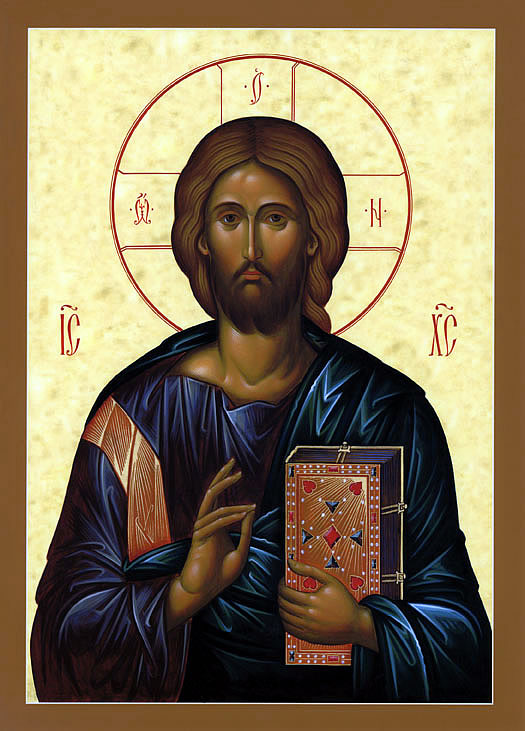
I have a large icon of Christ in my room (see photo at right). What icons from the Eastern tradition do best is to capture “the look.” No matter where I move in the room, Christ is looking right at me. His look is intense, though not severe. In the Eastern spirituality, icons are windows into Heaven. Hence, this icon is no mere portrait that reminds one of Christ, it is an image that mediates His presence. When I look upon Him, I experience that He knows me. It is a knowing and comprehensive look.
Particularly in Mark’s Gospel, there is great emphasis on the eyes and the look of Jesus. A frequent expression in that Gospel is “And looking at them He said ….” Such a phrase (or a similar one) occurs more than 25 times in Mark’s Gospel.
Looking on Christ and allowing Him to look on you is a powerful moment of conversion. Jesus Himself said, For my Father’s will is that everyone who looks to the Son and believes in him shall have eternal life, and I will raise him up at the last day” (Jn 6:40).
And the First Letter of John says, What we shall later be has not yet been revealed. We do know that when it is revealed we shall be like him, for we shall see him as he is (1 Jn 3:2).
There is just something within us that seeks the face of God and desires that look of love that alone can heal and perfect us. I often think of this verse from Scripture when I am at Eucharistic Adoration: Look! There he stands behind our wall, gazing through the windows, peering through the lattice. (Song 2:9). Yes, I long to see the Lord. Scripture also speaks of His longing to “see” us.
Here are some passages from Scripture that remind us to seek the face of the Lord and to look to Him:
Seek the LORD and his strength; seek his presence continually! (1 Chron 16:11)
If my people, who are called by my name, will humble themselves and pray and seek my face and turn from their wicked ways, then will I hear from heaven and will forgive their sin and will heal their land (2 Chron 7:14).
You have said, “Seek my face.” My heart says to you, “Your face, LORD, do I seek” (Ps 27:8).
Look to the LORD and his strength; seek his face always (Ps 105:4).
I [the Lord] will return again to my place, until they acknowledge their guilt and seek my face, and in their distress earnestly seek me (Hosea 5:15).
Everyone who looks to the Son and believes in him shall have eternal life, and I will raise him up at the last day (John 6:40).
He who loves me will be loved by my Father, and I too will love him and show myself to him (John 14:21).
Blessed are the pure in heart, for they will see God (Matt 5:8).
Now we see but a poor reflection as in a mirror; then we shall see face to face (1 Cor 13:12).
For God, who said, “Let light shine out of darkness,” made his light shine in our hearts to give us the light of the knowledge of the glory of God in the face of Christ (2 Cor 4:6).
An old song says, “We shall behold Him,Face to face in all of His glory …. The angel will sound, the shout of His coming, And the sleeping shall rise, from their slumbering place. And those remaining shall be changed in a moment. And we shall behold Him, then face to face.”
Allow Christ to look on you.
This video is a wonderful collection of many of the looks of Jesus and the reaction of the people following those looks. Pay special attention. The video also features a lot of “looks” that come from us. Notice how people look upon Jesus and how they react as they do so. Look for the “looks” in this video. The final looks are especially moving.
What is life? It seems the simplest and most basic reality, but it is hard to define in a way that is satisfying. One philosopher I know defined it as “ordered energy.” But does that really advance the understanding of the mystery we call life?
Consider an example: I have in one hand a small rock, and in my other, an acorn. They are similar in both shape and color. Now I place each of them in the ground and water them. The small rock just sits there; even a thousand years of water and sunshine would do nothing to change it. But in the case of the acorn, the water is able to reach a mysterious spark of life within it and fuel its mysterious power. The life takes the water in and springs forth. Soon enough, it thrusts through the soil and over time becomes a mighty oak.
What is this secret, mysterious force we call life? Yes, it is ordered energy, but it is so much more than that.
When we say that someone dies, what has really changed?
I remember when my father died. After watching him struggle through weeks of labored breathing and agitation, it was eerie to see him lying so still; he was peaceful for the first time in weeks. His body was still warm, but he was gone. He was a giant in my life. The man through whom God gave me life lay still and silent. His life, his soul, his life-giving principle, his “ordered energy” was gone. No amount of words could fully describe the reality before me. On the surface, nothing appeared so very different. Surely he would stir in a moment and speak to me! He did not. The something mysterious we call life was gone. We can say that he died or that his life ended, but mere words do not explain, they only describe; they are empty sounds before so great a mystery.
I have also seen many of my pets die. One moment there is life and movement, the next a great stillness as the something we call life has departed. What is that mysterious force?
I don’t know.
On my street there are two elm trees. One is luxuriant and full of leaves. The other is dead; it bears no green leaves and its branches are brittle. Something is gone from it, but is that something called life?
I don’t know.
We speak often of that great mystery called life, but a word is not reality; it is just a word. The word “life” cannot really tell us what life is. Saying that something is alive is more to tell us that it is not dead, nor is it inanimate.
Many decades before his death, my father talked to me about the mystery of life. He told me that when he was about ten years old, a powerful thought occurred to him: “I exist.” So stunned was he that he said he stayed very quiet for the next three days, just being silent in the face of a mystery too great for him to fathom. I have had similar moments of reverential silence, when I ponder consciousness and self-awareness, or when I think about the fact that I am thinking.
It is altogether too much. Simple or even complex definitions cannot ultimately provide satisfaction.
The secularism of our time seeks to suppress such matters because they are about meaning, not just about physical things that can be touched and measured. The mysterious reality we call life does not weigh anything. It cannot be seen as it arrives or departs. Its effects can be seen, but “it” cannot be seen. We cannot say of life, “Look, there it is!” or “There it goes!” It is certainly real and it affects physical things profoundly. But of itself, it seems more metaphysical than physical and defies simple categorization.
The secularism of our time would hurry us past questions such as “What is life?” Neither would it have us dwell on other questions of meaning that the physical sciences cannot speak to, such as:
What is my life all about?
What is the ultimate destiny of all things?
Why is there something rather than nothing?
“No, no,” say secularism, atheism, and scientism. “Hurry along now; there is nothing to see here.”
But pardon me if I am not content with being hurried along and if I insist that suppressing such questions does great damage to individuals and cultures as a whole. Without appreciation for imponderable mysteries, there is little reverence. Indeed, too few ask the question “What is life?” And even fewer accept the imponderable quality of such a question.
What is life? It is a mystery too deep for words. Silent reverence, please, before so great a mystery.
These are some of the lyrics of a song written by Steve Green, a contemporary Christian singer:
God and God alone, created all these things we call our own;
from the mighty to the small, the glory in them all;
Is God’s and God’s alone.
God and God alone reveals the truth of all we call unknown;
And the best and worst of man can’t change the Master’s plan;
It’s God’s and God’s alone.

 Today’s reading from daily Mass (Tuesday of the 19th Week of the Year) features an unusual image and a seemingly “dark delight.”