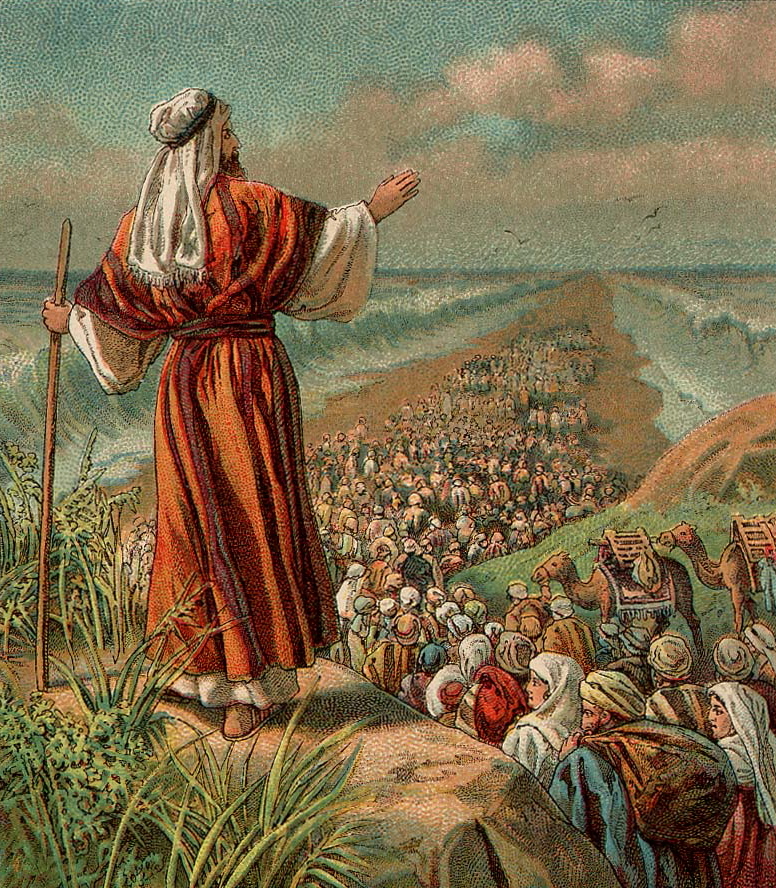
In daily Masses this week we are reading largely from the Book of Exodus, specifically the familiar story of the parting of the Red Sea by God, working through Moses. Unfortunately, Tuesday’s Feast of the St. James, good though it is, interrupts the story and we miss the critical passage in which the water is parted and the people of Israel escape through the sea, dry-shod.
Let’s review the passage:
Then Moses stretched out his hand over the sea, and the LORD drove the sea back by a strong east wind all night and made the sea dry land, and the waters were divided. And the people of Israel went into the midst of the sea on dry ground, the waters being a wall to them on their right hand and on their left (Exodus 14:21-22).
When a story is so familiar to us it is easy to overlook the details. Note that the sea is standing up like a wall on both sides. Though the height is not mentioned, let’s just imagine that the walls of water are thirty feet high.
Imagine the courage of the people entering into the midst of sea while the water is being miraculously held back! If you saw walls of water like that, would you have ventured out into the middle? While it may have “helped” that they had an army pursing them from behind, do not minimize the fear they must have felt and the courage and trust it took for them to go forward in faith.
St. Paul would later say that the passage through the Red Sea is an image of baptism: They were all baptized into Moses (1 Cor 10:2). Note how faith and baptism are joined. Though the Sacrament of Baptism confers the theological virtue of faith, there is (at least in adult baptism) a kind of prevenient faith wherein one is prompted to trust God and what He has revealed. In receiving people into the faith, I have been amazed by the courage shown by many of them. There have been those who faced the dismay of and even persecution by their family members. Others overcame personal obstacles, doubts, and uncertainties. They stepped forth in faith and went through the waters.
Even after baptism, all of us are asked to continue living its implications. The increasing scorn and derision of our faith and the teachings of our Lord by the world may seem like walls of water that we must, in trust, ignore. We must continue in the renewal of our baptismal promises and journey through to the other side. We must also journey, trusting the Lord’s promise to deliver us from the pursuing army of the prince of this world.
Yes, living our baptism requires courage.
You might object to my calling the people of Israel courageous, saying that the Egyptian army also pushed forward into the middle of the parted walls of water. Yes, but their doing so was not the result of courage. Rather, it was the excess of courage we call rashness, folly, or foolhardiness. Why? Because they did not have the promises of God. It is virtuous to step out in faith, trusting the promises of God, but prideful to go forth trusting in one’s own strength. The prideful cannot stand before God, only the humble can.
The Egyptians pursued and went in after them into the midst of the sea, all Pharaoh’s horses, his chariots, and his horsemen. And in the morning watch the LORD in the pillar of fire and of cloud looked down on the Egyptian forces and cast a glance and threw the Egyptian forces into a panic, clogging their chariot wheels so that they drove heavily. And the Egyptians said, “Let us flee from before Israel, for the LORD fights for them against the Egyptians” (Exodus 14:23-25).
Faith delivers. Pride brings only destruction. A simple glance from the Lord destroys pride and all its foolish dreams.
We live in difficult times for the Church; from many sectors the very legitimate cry for reform goes up frequently. Beyond the sexual abuse scandal there are also deep concerns regarding the uncertain trumpet of Catholic preaching, lukewarm and nominal Catholics, an overall lack of self-discipline among Catholics, and a lack of disciplining by the bishops and clergy of those Catholics (lay and clergy) who cause scandal. The list of concerns is long, and in general I have been sympathetic on this blog to the need for reform and greater zeal in the Church.
The Gospel this Sunday, however, featuring the Parable of the Wheat and Tares, cautions against overzealousness in the attempt to root out sin and sinners from the Church. The Lord’s warning to the farmhands who wanted to tear out the weeds was that they might harm the wheat as well. He wants them to wait until the harvest. There will come a day of reckoning, but it is not now.
This does not mean that we are never to take notice of sin or to rebuke a sinner. There is certainly the need for discipline in the Church; other texts call for it as well. But today’s Gospel is meant to warn against a scouring that is too thorough, a puritanical clean sweep that overrules God’s patience and seeks to turn the Church from a hospital for sinners into a germ-free (and hence people-free) zone.
We are going to need to depend on God’s patience and mercy if any of us are to stand a chance. People who summon the wrath of God upon (other) sinners may end up destroying themselves as well. We all have a journey to make from being an “ain’t” to being a saint.
Let’s allow today’s Gospel to give us some guidance in finding the right balance between the summons to reform and the summons to patience. The guidance comes in four steps.
I. WAKE UP.Jesus proposed another parable to the crowds, saying: “The kingdom of heaven may be likened to a man who sowed good seed in his field. While everyone was asleep his enemy came and sowed weeds all through the wheat, and then went off.”
Notice that everyone was sleeping when the enemy sowed weeds. It is a great mystery as to why God allowed Satan to do this in the first place, but there is far less mystery as to why Satan has been so successful in our times. The weeds are numerous and are vigorously growing. Part of the reason for this is that we in the Church have been sleeping while Satan has been steadily sowing his weeds among us.
Don’t just blame the Church leadership (although we certainly share plenty of the blame). Many throughout the Church have been in a deep moral slumber. Too many Catholics will watch anything, listen to anything, and expose themselves to anything. We just “go with the flow,” living unreflective, sleepy lives. We also allow our children to be exposed to almost anything. Too many parents don’t know enough about what their children are doing: what they watch, what they listen to, where they are surfing on the Internet, and who their friends are. We rarely think of God or His plan for our lives. On the whole, our priorities are more worldly than spiritual. We are not awake and wary of sin and its incursions; we are not outraged. We take little action other than to shrug. We seem to be more concerned with fitting in than in living as a sign of contradiction to the ways of the world.
Church leadership, too, has been inwardly focused. While the culture was melting down beginning in the late 1960s, we were tuning guitars, moving the furniture in the sanctuaries, debating about Church authority, engaging in gender wars, and having seemingly endless internal squabbles about every facet of Church life. I do not deny that there were right and wrong answers in these debates and that rebellious trends had to be addressed, but while all this was going on Satan was sowing seeds and we lost the culture.
We are just now emerging from 50 years in a cocoon to find a world gone mad. We who lead the Church (clergy and lay) have to admit that this happened on our watch.
It is long past time to wake up to the reality that Satan has been working while we’ve been bickering and singing songs to ourselves.
Blaming one side of the Church or the other, faulting this kind of liturgy or that, is not very helpful because the focus is still inward.
It’s time to wake up and go out. There is work to be done in reclaiming the culture for Christ and in re-proposing the Gospel to a world that has lost it.
Step one in finding a balance between the need for reform and the need for patience is to wake up.
II. WISE UP.When the crop grew and bore fruit, the weeds appeared as well. The slaves of the householder came to him and said, “Master, did you not sow good seed in your field? Where have the weeds come from?” He answered, “An enemy has done this.”
Part of the sobriety we have to regain is the understanding that we have an enemy who hates us—Satan. He is responsible for much of the spiritual, moral, and even physical ruin we see around us. We have been dismissive of his presence for far too long, as though he were a fairy tale. While we cannot blame everything on him, for we connive with him and also suffer from weakness of the flesh and susceptibility to the bad influence of the world, Satan is real; he is an enemy and he hates us. He hates our children. He hates the Church. He hates anything and anyone holy or even on the path to holiness.
We have to wise up and ask the Lord for an anointing. We need not utterly fear the devil, but we do need to understand that he is at work. We need to learn his moves, designs, tactics, and tools. Once we can recognize him, we need the grace to rebuke him at every turn.
Now be careful here. To wise up means to learn and understand Satan’s tactics, but it does not mean to imitate them in retaliation. Upon waking up and wising up, some want to go right to battle—but in worldly ways. The Lord often proposes paradoxical tactics that are rooted in the wisdom of the cross, not the world. Wising up to Satan and his tactics does not typically mean to engage in a full frontal assault. Often the Lord counsels humility to battle against pride, love to conquer hate, and accepted weakness to overcome strength.
To wise up means to come to the wisdom of the cross, not the world. The Lord is not nearly as warlike in His response to His enemy as some reformers propose to be. It is fine to be appropriately zealous for reform and to want to usher in change rapidly, but be very careful what wisdom you are appealing to. Scripture says, Do not deceive yourselves. If any one of you thinks he is wise by the standards of this age, he should become a “fool” so that he may become wise. For the wisdom of this world is foolishness in God’s sight (1 Cor 3:19-20).
Step two in a finding a balance between the need for reform and the need for patience is to wise up.
III. WAIT UP. His slaves said to him, “Do you want us to go and pull them up?” He replied, “No, if you pull up the weeds you might uproot the wheat along with them. Let them grow together until harvest …”
We have already laid the groundwork for the Lord’s rebuke to these overly zealous reformers. Today in the Church we are well aware of the need for reform; so is the Lord. He says, clearly, an enemy has done this. Yet to those who want to go through the Church rooting out every sinner, ne’er-do-well, and bad theologian (and there are many), and who call for a severe clampdown by bishops across the board, the Lord presents a balancing notion.
There is need for discipline in the Church and even for punitive measures from time to time. The Lord himself proposes excommunication in certain instances (e.g., Matt 18:17); St Paul does, too (e.g., 1 Cor 5:5). Yet these texts need to be balanced by texts such as today’s Gospel. Fraternal correction is an essential work of charity but it must be conducted with patience and love.
The Lord is patient. In today’s Gospel, He directs us to be prepared to wait, and to not be overly anxious to pull out weeds lest we harm the wheat. Remarkably, the Lord says, let them grow together. Notice that now is the time to grow; the harvest comes later. In certain (rare) instances the harm may be so egregious that the Church must act to remove the sinner or to discipline him or her more severely, but there is also a place for waiting and allowing the wheat and tares to grow together. After all, sinners may repent; the Lord wants to give people the time they need to do that. Scripture says, God’s patience is directed to our salvation (2 Peter 3:9).
So while there is sometimes a need for strong discipline in the Church, there is also this directive to balance such notions. Leave it be; wait. Place this in the hands of God. Give the sinner time to repent. Keep working and praying for that but do not act precipitously.
We have had many discussions here on the blog about whether and how bishops should discipline Catholic politicians who, by their bad example and reprehensible voting patterns, undermine the Gospel and even cost lives through their support of abortion and euthanasia.
While I am sympathetic to the need for them to be disciplined, it remains a judgment for the bishop to make as to who, how, and when.
There are Scriptures that balance one another. In the end, we cannot simply make a one-size-fits-all norm. There are prudential aspects to the decision and the Lord Himself speaks to different situations in different ways.
In today’s Gospel the Lord says that we should wait. Generally, this is good advice to follow. After all, how do we know that we don’t or won’t need more time? Before we ask God to lower the boom on sinners we ought to remember that we are going to need His patience and mercy too. Scripture says, The measure that you measure to others will be measured back to you (Matt 7:2; Luke 6:38). Be very careful before summoning God’s wrath, for who may endure the Day of his coming? (Mal 3:2)
Step three in a finding a balance between the need for reform and the need for patience is to “wait up” and balance zeal with patience.
IV. WASH UP.Then at harvest time I will say to the harvesters, “First collect the weeds and tie them in bundles for burning; but gather the wheat into my barn.”
So you see there is a harvest. Those who have sinned or led others to sin, and have not repented, are going to have to answer to the Lord for it.
The Lord is no pushover; He does not make light of sin. In telling us to wait, He does not mean to say that judgment will never come, but His general advice is to leave it to Him. To us He says, in effect, “As for you, wash up, get ready, and help others to get ready as well. Judgment day is surely coming and every knee will bend to me; everyone will have to render an account.”
That’s it. Wash up! You’re either going to be a saint or an “ain’t.” For now, the wheat and tares grow together. But later the tares and all the weeds will be gathered and cast into the fire.
Step four in a finding a balance between the need for reform and the need for patience is to “wash up,” to get ready.
So here’s the balance: God is patient, but there is ultimately a harvest. By God’s grace we have to get ready for it. To the overly zealous God says, “Wait,” but to the complacent He says, “Wake up, wise up, and wash up.”
Here is a great exposition on this Gospel by Fr. Francis Martin. Don’t miss it!
The commercial below from 1949 seems astonishing to us today. We often look back on the days when just about everyone smoked and wonder how we could have been so foolish as to fill our lungs with smoke. That a commercial should actually feature doctors smoking and report that they prefer a particular brand of cigarette (filter-less at that) seems unbelievable.
It took decades to dispel the image of cigarette smoking as glamorous. It took just as long to put to the lie the notion that filling our lungs with toxic smoke wasn’t as unhealthy as, deep down, we suspected it to be.
Am I wrong to hope that we will one day look back on abortion and contraception in this way? Perhaps we will wonder how women could ever have been convinced to swallow pills that would drastically alter their endocrine system, that we ever thought there would be no ill health effects from such a measure.
Even more, I hope for the day when we will be utterly dumbfounded that the legal murder of babies in the womb was ever considered “good,” or a “right,” or labeled “healthcare.”
Call me a dreamer, but I will continue to hope and work for the day when we will be even more astonished at our hardness and obtuseness with respect to abortion and contraception than we are by this old commercial promoting smoking.
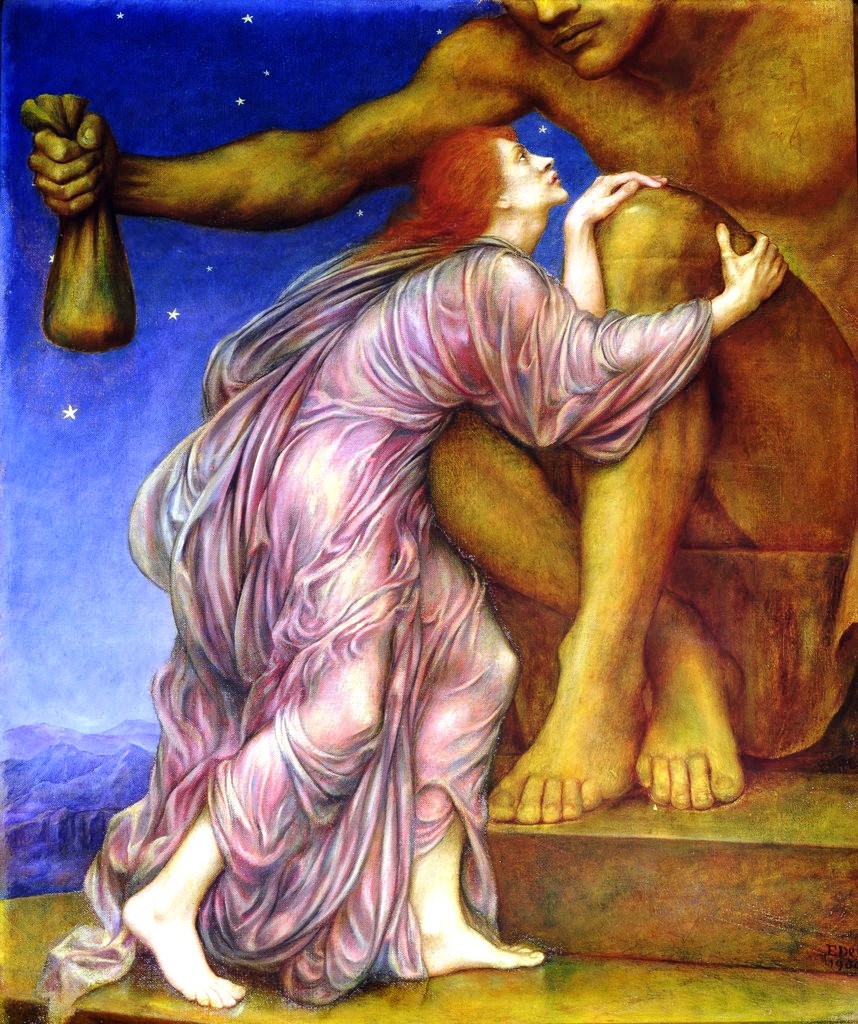
One of the more underreported sins is greed. It is easy to conclude that greed is something manifested by “that other person,” who has more than I do. Yes, that rich guy over there, the one who earns a dollar more per hour than I do; he’s greedy, but I’m not.
But honestly, does any one of us ever come to a point in our life when we say, “I earn more than enough money. I’ll just give the rest away”? Not on your life!
Almost never would such a thought even occur to the average person. Instead, most of us respond to a pay increase, for example, by expanding our lifestyle and continuing to complain that we don’t have enough. At some point, we ought to admit that we do cross over into greed.
What is greed? It is the insatiable desire for more. It is a deep drive in us that, no matter how much we have, makes us think that it’s not enough. We still want more, and if we get more we want more still. This is the experience of greed.
Familiar though this sounds, too few of us are willing to consider that greed is really a problem for us. Greed is always something that other guy has.
Of course it doesn’t help that we live in a culture of consumption, which constantly tells us that we don’t have enough. Commercials tell us that the car we’re driving isn’t as good as this other car we could be driving. And so even though we have a perfectly good car, one with four wheels, a working engine, and probably even air conditioning, it still it isn’t good enough. So it is with almost every other product or amenity that is sold to us on a daily basis. The clever marketing experts of Madison Avenue are great at making us feel deprived. As a result, it almost never occurs to most of us that we may have crossed the line into greed. Despite having even six- and seven-figure incomes, many still feel that they don’t have enough.
This is all the more reason that we should spend some time reflecting on the nature of greed. Greed is a deep drive of sin, one of the deadly sins, and it brings with it a kind of blindness that causes us to mistake mere wants for true needs. As we entertain this illusion, there’s very little to prompt us to consider that we actually have more than enough. There’s very little to cause me to say, “Gee, I’ve gotten greedy” or to work toward curbing this insatiable desire for more.
No, it’s the other guy who’s greedy; I’m not. It’s a problem that those nasty rich and powerful people have. Never mind that I’m pretty darned rich myself, living in a home with running water, air conditioning, and maybe even luxuries like granite countertops and widescreen TVs.
When was the last time you heard a sermon on greed? If you did, it was probably the priest talking about some abstract group of people (not those present, of course) who probably also hold the “wrong” political opinions, etc. Yes, greed is always someone else’s problem.
When do I honestly look at myselfand wonder if I am greedy? When do I ever conclude that I have more than enough and need to be more generous with what has become excessive in my life? When do I ever apply the old precept that if I have two coats, one of them belongs to the poor? I do understand that it’s good to have something laid up for a rainy day, but do I ever ask myself if I’m really trusting in God or just in my rainy day fund? When do I ever wonder if I’ve crossed the line into greed?
I realize that some of you who read this post will find it disturbing. So do I. These are uncomfortable questions.
Let me assure you that I do not write this post from a political perspective. I do not want the government mandating how much I can or should earn, and how much I can or should give away. I am referring to a very personal moral assessment that we all should make.
I also do not write as an economist. I realize that market-based economies are complex and that there is nothing intrinsically wrong with meeting people’s needs with products and services. I am also aware that markets supply jobs. But still, I must insist that we all ask ourselves some personal questions about limits. We cannot simply conclude that greed is the other guy’s problem.
Greed is one of the seven deadly sins; we ought to take it more seriously than many of us do. Somewhere there’s room for most of us to reflect on one of the most underreported sins: greed.
In this week’s Office of Readings comes a crucial question from Elijah. It came at a time of widespread apostasy among the Jewish people. Elijah summoned a multitude to Mt. Carmel in the far north of Israel:
Elijah appealed to all the people and said, “How long will you straddle the issue? If the Lord is God, follow him; if Baal, follow him.” The people, however, did not answer him (1 Kings 18:21).
The Baals were the gods of the Canaanites. It had become expedient and popular to worship them because the ruling political leaders, the apostate King Ahab and his wicked wife Jezebel, had set forth the worship of the Baals by erecting altars and sacred columns. All who wished their life to go well and to have access to the levers of prosperity were surely “encouraged” to comply. Jezebel funded hundreds of prophets of Baal and the goddess Asherah. She also had many of the prophets of Israel killed and forced others into hiding. Through a policy of favoritism and fear, the true faith was being suppressed and false ideologies were being promoted.
At a critical moment Elijah thus asked his question. In effect he told them that they needed to decide whether to serve the Lord God out of courageous fidelity or the Baals out of cowardly fear.
We, too, must decide. In our times, the true faith has been undermined in the hearts of many by plausible liars, cultural war, and political correctness. Those who strive to hold to the true faith are called hateful, bigoted, and intolerant. A legal framework is growing that seeks to compel compliance to the moral revolution and abandonment of the biblical worldview. Social pressures are at work as well, seeking to force compliance through political correctness, through suppression of speech and ideas, and through the influence of music, cinema, and art.
The same question must be asked of us:
How long will you straddle the issue? If the Lord is God, follow him (whatever the cost). If Baal is your god, follow him! If you prefer what is popular, trendy, politically correct, and safe, go for it. But understand that if you do so, your decision is increasingly for Baal, not the Lord. In a culture that insists you celebrate fornication, homosexual acts, transgenderism, abortion, euthanasia, and all sorts of intemperance, realize that your decision to comply amounts to a choice for Baal.
Some claim that they are not really making a fundamental choice against God and for the modern Baals. Rather, they prefer to think that they are being “tolerant,” that they are pleasant moderates seeking to build bridges and keep the faith “mainstream.”
Today the lines are starkly drawn. The choices required of us are clear. The ancient maxim has never been more true: tertium non datur (no third way is given). Jesus says, You cannot serve God and mammon (Mat 6:24). James adds, Adulterers! Do you not realize that a friendship with the world is enmity at God? (James 4:4) Elijah’s question cannot be watered down. There are two sides in the moral battle of our times: choose a side.
In Elijah’s time, the people did not want to answer. The text says that they just stood there, silent. But silence does not make the question or the choice go away. Indeed, prolonged silence to so fundamental a question becomes an answer in itself. Silence and fence-sitting are not valid answers when the lines are so clearly drawn.
To the fence-sitters is directed this warning in the form of an old story:
A man once refused to take sides in the critical and disputed matters of his day, nobly declaring that he was tolerant of all views. Taking his seat on the fence he congratulated himself for his moderation and openness; others did too. One day the devil came and said, “Come along now, you’re with me.” The man protested, “I don’t belong to you. I’m on the fence!” The devil simply replied: “Oh, but you do belong to me. I own the fence.”
“How long will you straddle the issue? If the Lord is God, follow him; if Baal, follow him.”
One of the many troublesome aspects of the modern age is the demise of friendship. While the terms “friend” and “friendship” might be bandied about rather easily today, they do not usually mean friendship in its deeper and original sense. Rather, we use the terms to refer to acquaintances rather than friends. True friendship has a depth, history, and stability. It involves some sort of commonality of life and a deeper knowledge of the other.
Fr. Reginald Garrigou-Lagrange, drawing on the Thomistic tradition, has this to say about friendship:
Every true friendship, St Thomas tells us, implies three qualities: it is first of all the love of benevolence. By which a man wishes good to another as to himself … [Further] Every true friendship presupposes the love of mutual benevolence, for it is not sufficient that it exist on the part of one person only …. Lastly … friendship requires a community of life (convivere). It implies that people know each other, love each other, live together, spiritually at least, by the exchange of most secret thoughts and feelings. Friendship thus conceived tends to a very close union of thought, feeling, willing, prayer, and action (Garrigou-Lagrange, The Three Ages of the Spiritual Life, Vol II, pp. 188-189 Tan Publications).
Notice the emphasis on sharing private thoughts and feelings, as well as the close union of thoughts, feelings, actions, prayers, and wills. True friendship involves more than the knowledge of acquaintances.
A director of a clinic for the treatment of psychological matters once recounted that as he conducted entrance interviews for those beginning an inpatient treatment program, he would ask them how many friends they had. He would often receive expressive answers such as “Oh, I have lots of friends!” Their answers indicated that they did not really understand what he meant. So he would rephrase the question: “How many people do you share deeply with? How many people on this planet know almost everything about you? How many know that you’re here at this treatment program and why? Did any of them help to get you here?” Questions like these tended to generate blank stares.
Fewer and fewer people have relationships of this deeper nature. True friendships, with all the qualities described above, are increasingly rare in our culture today.
There are many reasons for this.
People today are quite mobile. It is not unusual for people to move several times during their lifetime. Fewer and fewer people grow up, live, and die in the same town, and even those who do have long roots in a certain community will tell you how dramatically it has changed over the years.
Our daily activity takes us far and wide. Because of the automobile, trains, and especially planes, many people no longer limit their activities to their home town or places nearby. They may commute a couple of hours each day and be involved in activities far away from their neighborhood churches, schools, doctors, and hospitals. They may not even frequent the neighborhood shopping centers. It seems there is little opportunity or need to interact with people who live close by.
The pace of life today is rapid. We all seem to be in a big hurry to get somewhere else. The idea of lingering over a cup of coffee seems rare. The few times we do take our time to converse and such things, it is usually in loud bars where communication is actually quite difficult. And if perchance we are in a setting where we are in the presence of others for a lengthy period (e.g., a subway, train, or plane) most people are focused on their cell phones. We seem more interested in information about people far away, many of whom we have never even met.
None of these factors helps in the development of deep, lasting friendships. Most people in our lives are merely acquaintances. We know very little about most of the people we interact with, even those we encounter on a daily basis. Even family relationships are often shallow. Long dinners or extended conversations are rare as family members run off to practices, meetings, shopping, and work.
The lack of deep friendships in the true sense of the word causes many issues. True friends help form our personalities, completing what we lack. True friends rebuke sins and other troublesome quirks we can develop. True friends encourage and enrich us. Without true friends we remain incomplete. Without the necessary rebuke that friends can give, we can suffer from pride and other egotistical character defects.
Scripture both commends friendship and warns against regarding mere acquaintances as friends.
Woe to the solitary man! For if he should fall, he has no one to lift him up (Ecclesiastes 4:11).
Let your acquaintances be many, but your advisers one in a thousand (Sirach 6:5-6).
A faithful friend is a sure shelter, whoever finds one has found a rare treasure. A faithful friend is something beyond price, there is no measuring his worth. A faithful friend is the elixir of life, and those who fear the Lord will find one. Whoever fears the Lord makes true friends, for as a man is, so is his friend (Sirach 6:14-17).
Faithful are the wounds of a friend, But deceitful are the kisses of an enemy (Prov 27:6)
A true friend loves at all times, And a brother is born for adversity (Prov 17:17).
A man of too many friends comes to ruin, But there is a friend who sticks closer than a brother (Prov 18:24).
Better is a neighbor who is near than a brother who is far away (Prov 27:10).
Therefore, our friends should not necessarily be numerous. We ought to be selective in what we share and with whom. All the more reason, then, that we should have close friends with whom we share almost everything.
Do you have close friends?
Are there people who know almost everything about you?
Are there people who can rebuke you, correct you, or summon you to humility?
Are there people about whom you know almost everything and whom you can rebuke with love for their own good?
Is there anyone who looks to you for advice, and who can turn to you for necessary encouragement?
Is there anyone whom you love and esteem for his or her own sake, not merely for what you can get?
Is there anyone whom you are not anxious to impress, to whom you can speak the truth, and who will speak to you truthfully?
Is there anyone who would care enough about you to be present with you in great adversity?
Is there anyone whom you would gladly assist in his or her time of need?
If so, who? Please consider naming your true friends in your heart.
I pray that you do have true friends, but true friendship is rare in this changing, hurried, and polemic culture. Consider well the need for true friends, for deep friendships that are stable and lasting. We all need true friends.
What has happened to friendship in our culture? How do you see it?
This song is a rather good description of true friendship.
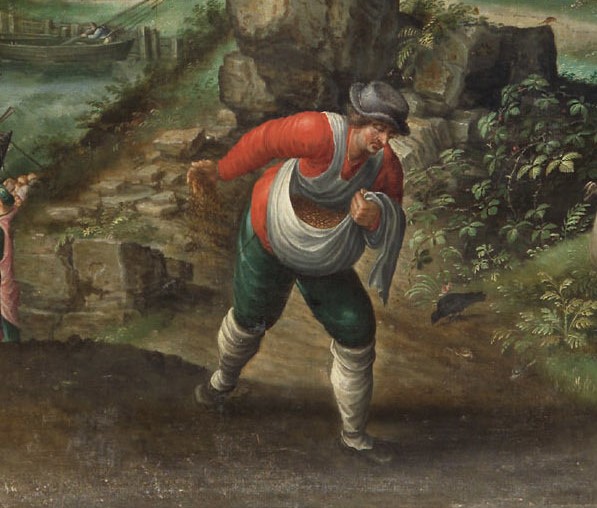
At Sunday Mass we heard the parable of the sower. Afterward, someone asked me the following question: “Since the sower is the Son of Man, Jesus Himself, why would He, who knows everything ahead of time, sow seed He knew would not bear fruit?”
First, let’s review the text:
A sower went out to sow. And as he sowed, some seed fell on the path, and birds came and ate it up. Some fell on rocky ground, where it had little soil. It sprang up at once because the soil was not deep, and when the sun rose it was scorched, and it withered for lack of roots. Some seed fell among thorns, and the thorns grew up and choked it. But some seed fell on rich soil, and produced fruit, a hundred or sixty or thirtyfold. Whoever has ears ought to hear” (Matt 13:1-9).
So why would God waste any seed on rocky ground, thin soil, or the path?
Perhaps we can only propose some possible “answers.” I use quotes around the word because we are in fact touching on some mysteries and can only speculate. Here are some possibilities:
I. God is extravagant.It is not just seed He scatters liberally; it is everything. There are billions of stars in billions of galaxies, most of them seemingly devoid of life as we understand it. Between these billions of galaxies are huge amounts of what appears to be empty space. On this planet, where just one species of bird would do, there are thousands. Likewise, there are vast numbers of different sorts of insects, mammals, fish, and trees. “Extravagant” barely covers it! The word “extravagant” means “going or wandering beyond.” God has gone vastly beyond anything we can imagine, but He is love and love is extravagant. The image of Him sowing seed in an almost careless way is thus consistent with the usual way of God.
Thus God’s extravagant love is illustrated by His sowing the seed of His word everywhere. Love does not say, “What is the least I can do?” It says, “What more can I do?” Love does not say, “I will give only if I get something back.” If a man loves a woman, he does not look for the cheapest gift to give her on her birthday. Rather, he looks for an extravagant gift. God is love and He is extravagant.
II. God loves and offers the seed of His Word even to those who will reject Him.Remember, as Jesus goes on to explain, the soil that fails to receive the Word is a symbol of those who allow riches, worldly preoccupation, persecution, and the demands of the Word to draw them away from God. Even knowing this, God still loves them. He still wills their existence. Scripture says elsewhere, But I tell you, Love your enemies and pray for those who persecute you, that you may be sons of your Father in heaven. He causes his sun to rise on the evil and the good, and sends rain on the righteous and the unrighteous (Matt 5:44-45).
Yes, God loves even those who will ultimately reject Him. Despite knowing this ahead of time, He will not say, “You cannot have my word; I refuse to provide you sufficient grace.” No, He scatters that seed even though He knows it will not bear the fruit He wishes. Further, He continues to send the sun and rain even on those who will reject Him.
This parable shows forth God’s unfailing love. He sows seed even knowing it will not bear the fruit He wants. He wills the existence of all, even those who He knows will reject Him.
III. God is just. Were the Lord to take back the seed that fell in unfruitful places, one could argue that He withdrew His grace and that people were lost as a result. In other words, one could claim that God manipulated the process by withdrawing every possible grace. But God, in justice, calls everyone and offers everyone sufficient grace for them to come to faith and salvation.
IV. God respects our freedom. The various places the seed falls is indicative of human freedom more so than illustrative of God’s intent. God freely offers the grace of His word, but we must freely receive it into the soil of our life. Some of us insist on having stony hearts or immersing ourselves in the cares of the world. God will offer the seed, respecting our freedom to be receptive or refusing. Were He to condition His offer and blessings on us offering the right kind of soil, one could reasonably argue that he was pressuring us or manipulating our freedom.
V. God wants us to persevere, to sow faithfully rather than merely harvesting. Sometimes we can become discouraged when it seems that our work has borne little fruit. The temptation is to give up. There’s an old saying, “God calls us to be faithful, not successful.” In other words, it is up to us to be the means through which the Lord sows the seed of His Word. By God’s grace, the Word is in our hands, but the harvest is not.
This parable teaches us that not all the seed we sow will bear fruit. In fact, much of it will not.
The simple mandate is that we preach the Word. Go unto all the nations and make disciples. St. Paul would later say to Timothy, Preach the Word; be prepared in season and out of season; correct, rebuke and encourage—with great patience and careful instruction (2 Tim 4:2). In other words, sometimes the gospel is accepted; sometimes it is rejected. Preach it anyway. Sometimes the gospel is popular, sometimes not. Preach it anyway. Sometimes the gospel is in season; sometimes it is out of season. Preach it anyway. Sow the seed; don’t give up.
Discharge your duty! St. Paul goes on to remark, sadly, For the time will come when people will not put up with sound doctrine. Instead, to suit their own desires, they will gather around them a great number of teachers to say what their itching ears want to hear. They will turn their ears away from the truth and turn aside to myths. But you, keep your head in all situations, endure hardship, do the work of an evangelist, discharge all the duties of your ministry (2 Tim 4:3-5). Once again the message is the same: preach anyway; sow the seed of the Word; persevere; do not give up; do not be discouraged. Discharge your duty and be willing to endure hardship; just preach! Some of the seed will yield a rich harvest, some will not; preach anyway.
So, permit these “answers.” God sows seed He knows will bear no fruit because He is extravagant, because He loves and wills the existence even of those He knows will reject Him, because of His justice, because He respects our freedom, and because He wants to teach us to persevere regardless of the outcome.
Saints often say daring and even “dangerous” things. They are able to do this because their listeners and readers take for granted their orthodoxy and holiness. As a result, they are able to use hyperbole or speak with bold flourishes that a lesser person would be unable to carry off.
Consider, for example, that St. Athanasius once wrote, For the Son of God became man so that we might become God (De inc. 54, 3). Of itself, this sort of talk is dangerous; man cannot be God nor become a god. However, no one would presume that the paragon of orthodoxy, the author of the Athanasian Creed, the one who almost single-handedly saved the bishops from the Arian heresy, was himself guilty of heresy. Instead, his words were understood in the poetic and colorful way he intended them. Clearly we are “divinized” only in a qualified and subordinate sense. Only by our membership in the Body of Christ do we participate in His divine nature. St. Thomas Aquinas reflected on Athanasius’ daring declaration: The only begotten Son of God, wanting to make us sharers in his divinity, assumed our nature, so that he, made man, might make men gods (Opusc. 57, 1-4).
Yes, saints say daring things. Today I’d like to reflect on a saying by St. Bonaventure. First, though, let’s consider a certain idiom he used, drawn from biblical times.
In Scripture there is an “absolute” way of speaking that many of us moderns misconstrue. For example, Jesus says (quoting Hosea 6:6), For I desire mercy not sacrifice (Matt 9:13). To those untrained in Jewish and biblical idioms, the meaning would seem to be, “Skip all the sacrifice; God just wants you to be nice.” However, that misses the point of the idiom, which more accurately means this: “Practice mercy without neglecting sacrifice, for sacrifice is in service of mercy.” All of our rituals point somewhere and have the goal of drawing us to greater charity for God and neighbor. Caritas suprema lex (Charity is the highest law). Although charity is the highest law, that does not mean it is the only one. The basic Jewish and biblical idiom goes like this:
“I desire A, not B.”
This means that A is the goal, not B. However, B is not to be neglected because it as a means or a way to A (the goal).
With all this in mind, let’s consider a teaching from St. Bonaventure, who wrote something very daring—even dangerous. Because he is a saint, we must grant him the liberty that we would not give to lesser men. As a saint he ponders truth and is thoroughly reputable. In his sanctity, his thoughts go where words no longer “work.” In a sense, he must explode our categories lest we become locked in them and forget that God is greater than words or human thoughts can express.
St. Bonaventure wrote of a kind of “passover” we must make wherein we must pass from the world of words, categories, images, pictures, and preconceived notions; to God, who is mystically beyond all that. It is a moment when the “ology” (words) of our theology must step aside for the Theos (God) of our Theology. As you read this quote, remember the cautions and context we have just reviewed, especially regarding the “I desire A, not B” idiom.
For [our] passover to be perfect, we must suspend all the operations of the mind and we must transform the peak of our affections, directing them to God alone. This is a sacred mystical experience. It cannot be comprehended by anyone unless he surrenders himself to it; nor can he surrender himself to it unless he longs for it; nor can he long for it unless the Holy Spirit … inflame his innermost soul ….
If you ask how such things can occur, seek the answer in God’s grace, not in doctrine; in the longing of the will, not in the understanding; in the sighs of prayer, not in research; seek the bridegroom not the teacher; God and not man; darkness not daylight; and look not to the light but rather to the raging fire that carries the soul to God with intense fervor and glowing love. The fire is God [From The Journey of the Mind to God, by Saint Bonaventure, bishop (Cap. 7, 1.2.4.6: Opera omnia 5, 312-313)].
Unschooled readers will cringe at the apparent dichotomies: grace not doctrine, longing not understanding, sighs not research, bridegroom not teacher, darkness not daylight.
But this is why we studied the idiom beforehand. “I desire A, not B” means that B serves A, not that B is of no value. Thus, doctrine leads to and serves grace. Our teachings point to heights where words no longer suffice. Our understanding and intellect inspire the will to desire Him whom our minds could never fully contain or comprehend. Although the Lord is the great teacher and rabbi, no bride calls her husband “teacher,” or “doctor.” She calls him her beloved; the heart grasps things the mind knows not.
Thus our goal is not doctrine (precious and necessary though that this). Our goal is Him to whom the doctrine rightly points. Doctrine is the roadmap, not the destination. Follow the map! It is foolish to try to invent your own religion. Yes, follow the map! But remember, the map is not the goal; it is not the destination. God is the goal and desired destination, and He cannot be reduced to our words or categories.
The great theologian Bonaventure knew the limits of theology. Theology makes the introductions and sets the foundation, but there comes a moment for silence and a dark night of the senses and even the intellect. Now the heart and the fiery light of God’s Holy Spirit must do His work. He will not overrule doctrine but build upon and transcend it.
St. Peter speaks to this same process:
We also have the message of the prophets, which has been confirmed beyond doubt. And you will do well to pay attention to this message, as to a lamp shining in a dark place, until the day dawns and the morning star rises in your hearts (2 Peter 1:18-19).
Yes, the prophets and the teachings must be attended to; they are like a lamp shining in a dark place. But there comes a moment when those teachings are confirmed and a greater light dawns, the Morning Star rises in our hearts. The truth of doctrine gives way to the Truth Himself, who is also the Way and the Light.
Listen to Bonaventure; listen to Peter. The Creed is essential. Memorize it and don’t you dare go off and invent your own religion! But there comes a moment when the creed steps aside and, pointing to God, says, “He is the one of whom I speak. Go to Him and sit silently at His feet.”

 In daily Masses this week we are reading largely from the Book of Exodus, specifically the familiar story of the parting of the Red Sea by God, working through Moses. Unfortunately, Tuesday’s Feast of the St. James, good though it is, interrupts the story and we miss the critical passage in which the water is parted and the people of Israel escape through the sea, dry-shod.







.jpg)