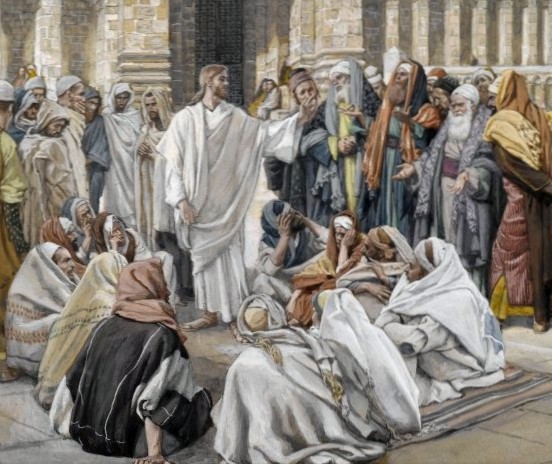
_-_James_Tissot.jpg) There was an expression common among the rabbis of Jesus’ time, wherein one rabbi would ask another a question, and request that the answer be given while “standing on one foot.” This is a way of saying, be brief in your answer.
There was an expression common among the rabbis of Jesus’ time, wherein one rabbi would ask another a question, and request that the answer be given while “standing on one foot.” This is a way of saying, be brief in your answer.
That idea may be behind the question that is raised in today’s Gospel by the scholar of law, who asks, “Teacher, which commandment in the law is the greatest?”
The text says that he asks this question of Jesus in order to “test” Him. In effect, he says to Jesus, “All right, let’s get right to the point. You’re talking about a lot of new things, but what is the greatest commandment?”
For this reflection, though, let’s just set aside the background hostilities and allow Jesus to recite the law, standing on one foot. In responding, Jesus recites the traditional Jewish Shema:
שְׁמַע יִשְׂרָאֵל יְהוָה אֱלֹהֵינוּ יְהוָה אֶחָד. Šĕmaʿ Yisĕrāʾel Ădōnāy Ĕlōhênû Ădōnāy eḥād. Hear, O Israel, the Lord is our God, the Lord is One.
The fuller text recited by Jesus is from Deuteronomy:
Hear, O Israel: The Lord our God, the Lord is one. Love the Lord your God with all your heart and with all your soul and with all your strength. These commandments that I give you today are to be upon your hearts (Deut 6:4-6).
Jesus then adds, also in common Rabbinic tradition, And the second is like it, love your neighbor as yourself. The whole law and the prophets depend on these two commandments.
That’s it—the whole law, standing on one foot. The first table of the law (the first three commandments): love the Lord your God. The second table of the law (commandments 4-10): love your neighbor.
There is value in noting several aspects of this summary:
- The Leadership of Love – Jesus says that the whole law and the prophets depend on the command to love God and your neighbor. Love comes first and is the foundation, the power of the law. Jesus says elsewhere, “If you love me, you will keep my commandments” (John 14:15). In other words, it is love that enables us to keep the law. When we want to do something, then the doing is both joyful and in some sense effortless. Love changes our desires so that we want what God wants and we keep His law not because we have to but because we want to.
- The Layers of Love – The text says we should love God with our heart, our soul and our mind. These layers of our existence encompass the whole of the interior person. Thus:
- Mind – Through love we come to a new mind, that is, a new way of thinking.
- Heart – Through love we receive a new heart; our desires are reformed and conformed to God.
- Soul – Through love we receive a new soul. We begin to live a whole new life because the soul is the life-giving principle of the body.
- The Lavishness of Love – Note the use of little word all. We love the Lord with all our heart, all our mind, and all our soul. When we love, we are not minimalists; we are lavish. Our response to God is wholehearted, not perfunctory. Love does not ask, What is the least I can do? Love asks, What more can I do?
It is said that Rabbi Hillel (110 B.C. – 10 A.D.), being even briefer, said of the second table of the law, “Do not do unto others that which you would hate done unto yourself … all the rest is commentary.”
We like to make it more complicated, but it really isn’t. If elaboration is required, consider the Ten Commandments, understood and expressed in the light of love:
- I love no other gods. If I really love God, should I need separate laws that tell me that I ought not to put other gods, whether things or people, ahead of Him? No! I want to be faithful and would never dream of being unfaithful by “sleeping with other gods” of any kind.
- I love His name. I do not need rules that forbid me from using God’s name hatefully or in vain and empty ways. I love His name; hearing it lights up my heart with love.
- I love to praise Him. If I love God, I do not need to be compelled by law or fear to come to Mass on Sunday and worship Him. I want to worship Him and praise His name.
- I love my family, Church, and country. If this is so, then I do not need to be told to revere those who have lawful authority in those places. I love my family; I am willing to honor, revere, and pray for them. I also love my Church and willingly love her leaders and pray for them. I follow the teaching of the Church with joy, trusting that I am hearing the voice of the Lord, who teaches me through the Church. I love my country and pray for our leaders, that God may uphold and guide them. I willingly follow all just laws and work for unity based in truth and for the common good.
- I love my neighbors. If so, why would I want to kill them, whether physically, emotionally, or spiritually? If I love others, I revere their life and act in ways that build them up, encouraging them and helping them to have a richer, more abundant life rooted in the truth. I would never act recklessly to endanger any of them because I love them.
- I love human life. If I love my neighbors, why would I tempt them or exploit them sexually? If I love the human family, why would I endanger it by treating lightly the great sacredness of human sexuality by which God calls us into existence? Why would I want to look at pornography or laugh at crude jokes that demean something so sacred? If I love others, why would I want to gratify myself at their expense?
- I love others by respecting what is rightfully theirs. If I love others, why would I wish to steal from them, to harm or endanger what belongs to them, or to deprive them of what is rightfully theirs? Why would I be unjust to others by refusing them just wages? Why would I be unjust to the poor by refusing to help them when it is within my ability to do so? If I have two coats one of them justly belongs to the poor. If I love others why would I steal or act unjustly? I want to help them and am glad when they are blessed. I respect what they rightfully have and share in their joy.
- I speak the truth in love. Why would I lie to those whom I love? Why would I seek to harm their reputations or gossip about them? Why would I pass on hurtful things that I don’t even know to be true? Why would I fail to share with them the truth in love? Love rejoices in the truth; why would I lie or suppress the truth?
- I rejoice in the good fortune of others. If I love others why would I seek to possess what they have or resent them for what they do have? I love them and am happy for them. Perhaps their blessings mean that I too will be blessed.
- I reverence the families of others. Why would I ever seek to harm the marriage or family of another or resent the gift he has in his spouse and family? I am happy for his blessings. I am happy that my friend has a loving wife and well-behaved children. Out of love, I seek to encourage him to rejoice in his gifts!
So it all comes down to love. Love rejoices in God. Love wants whatever God wants. Love rejoices in others and wants what is best for them.
Love is the key, but many of us struggle to love. God can give us a new heart, one that starts loving Him, fully and freely; one that has a deep love—even affection—for everyone. God will do that for us if we want it.
I will give you a new heart and put a new spirit in you; I will remove from you your heart of stone and give you a heart of flesh. And I will put my Spirit in you and move you to follow my decrees and be careful to keep my laws (Ez 36:26-27).
A thousand questions and doubts may come to mind when we are called to love. Even when we love, we cannot always say yes. Love sometimes must say no; love cannot approve of everything. Love must sometimes correct and reprove. In the end, people know whether you love them or not and they know whether you love God or not. If people know of your love for them and experience it, it is possible for them to receive even the difficult and challenging things you say. Yes, all these doubts and questions are answered by love.
Now I ought to stop, because if Jesus gives the “standing on one foot,” then the preacher must be brief as well. You and I like to complicate things and ask a lot of questions, but the answer is simple enough: love. Yes, all the rest is mere commentary.
This song reminds us that to love God is, first of all, to experience powerfully His love for us. One day it will finally dawn on us that the Lord died for us.