The first reading from Mass for Tuesday of the First Week of the Year is from the Letter to the Hebrews. It sets forth the total victory of Christ and that the Father has subjected all things to Christ. Yet the text also shows how the outworking of this subjugation is paradoxical.
Note first the declaration of all things being subject to Jesus Christ:
In “subjecting” all things to him,he left nothing not “subject to him” (Hebrews 2:8b).
“All things” is a pretty substantial category. Yes, everything is subject to Him: the wicked and powerful men of this earth as well as demons. This, of course, brings to mind a question that is addressed in the very next sentence:
Yet at present we do not see “all things subject to him,” … (Hebrews 2:8c)
The text notes we do not currently see all things subjected to Christ; this implies that our inability to see does not mean that all things are not subject to Him! The fact that a blind man cannot see the sun does not mean that the sun is not there. The defect is not in the sun or in reality; it is in the man. So too for us, who do not see that all things are subject to Christ.
Scripture is a prophetic declaration of reality. In effect, it says to us, “This is what is really going on regardless of what you think. You should conform your thinking to this prophetic declaration of reality from God Himself.”
So, then, although we might not see that all things are subject to Christ, we are challenged to permit God to help us perceive this. This is accomplished by instruction in His word, so that we see and interpret things rightly and in conformity with the prophetic declaration of reality contained in Scripture.
The next verses show forth the paradox of Christ’s triumph:
… but we do see Jesus “crowned with glory and honor”because he suffered death …. For it was fitting that he, for whom and through whom all things exist, in bringing many children to glory, should make the leader to their salvation perfect through suffering (Heb 2:10).
Here, simply put, is the paradox of the cross. It is by the cross that Christ conquers both Satan and our pride. Dr. Martin Luther King, Jr. noted that darkness cannot drive out darkness; only light can do that; and hatred cannot drive out hatred; only love can do that. Continuing in that vein, I would add that pride cannot drive out pride; only humility can do that. Christ does not conquer by having more pride than Satan or than us. He does not conquer by becoming an even worse version of His enemy. No, He conquers through humility, obedience, and suffering. Because of this, He has been exalted by the Father and given a name above every other name, so that at the name of Jesus every knee should bend, whether in Heaven, on earth, or under the earth (See Phil 2:10). The text from Hebrews says that because Christ suffered, we now see Him crowned with glory and honor.
This is the paradox for us as well. As Jesus was crowned because of His humble suffering, we too will have the victory because of our suffering.
We tend to think that “all things being subject to” Christ means that all suffering and wickedness are eradicated—not so. As Christ attained to the highest places in this way of the cross, so will we who follow Him. Suffering is not a sign of defeat but the very path to victory! The devil loses at his own game.
Scripture says elsewhere,
For our light and momentary affliction is producing for us an eternal glory that is far beyond comparison. (2 Cor 4:17).
All things work together for good to them that love the Lord and are called according to his purposes (Rom 8:28).
The more suffering Satan inflicts, the more ground he loses.
This, then, is how all things are subject to Christ: even sufferings that seem antithetical to His sovereignty are part of His plan to give us greater glory. Even when Satan does his worst to the believer he loses. The more he attacks, the greater our glory in Christ if we persevere. It all backfires for Satan. He loses and God is always sovereign. God can make a way out of no way, write straight with crooked lines, and do anything but fail.
All things, even our sufferings, are subject to Christ.
This week in daily Mass, we are reading from The Letter to the Hebrews, one of the most underappreciated books of the New Testament. It has long been one of my favorites from which to teach; in it we are summoned to faith in Jesus, our Savior and Great High Priest.
The opening lines in the Latin Vulgate are exquisite, particularly to those who can read and recite Latin well.
Multifáriam, multísque modis, olim Deus lóquens pátribus in prophétis. Novíssime, diébus istis locútus est nobis in Fílio. (In many and varied ways, God once spoke to our fathers through the prophets. In these last days, he has spoken to us through the Son.)
Though many doubt that St. Paul wrote Hebrews, I believe he did; it is here that we best see his priestly identity as an apostle, his deep knowledge of the Temple rituals and how they pointed to Christ and are perfected by Him.
The Letter to the Hebrews does not begin with the usual epistolary greetings and salutations, though it does end with them. Throughout, the text “sounds” more like a sermon. The audience of the letter is clearly Jewish Christians; the writer is exhorting them not to fall back on Jewish rituals, which cannot save, but rather to cling ever more closely to Christ, who alone is savior and Lord.
Hebrews was surely written before the destruction of Jerusalem and the Temple in 70 A.D. (References to the Temple speak of sacrifices as still going on there.) It occurs to me that the context of Hebrews is that of the years from 65-70 A.D., a time during which wars and rumors of wars were growing. Indeed, the tragic Jewish war began in 66 A.D. The Romans had had more than enough of Jewish Messianism and uprisings. It was a horrible, bloody war that cost the lives of more than one million Jews. During this period, Jewish nationalism was on the rise, likely even among those who had become Christians.
Politics has a strong pull, and it is in this context that the author addresses his audience. In effect, his position is that they should not return to what cannot save merely out of some sense of loyalty to a doomed nation. Jesus had prophesied the tragic destruction of Jerusalem in the Mount Olivet discourse recorded in the Synoptic Gospels (Matthew 24 and 25, Mark 13, and Luke 21). With the war clouds gathering, this was the time to cling to Him ever more!
What follows is a quick summary of the exhortation in the Letter to the Hebrews. (In most cases I have not cited chapter and verse below because I pulled from many parts at once.)
Jesus is Lord: Particularly in the first three chapters of Hebrews, the author reminds his audience of the glory of Christ.
Jesus Christ is the radiance of God’s glory and the exact representation of His nature, upholding all things by His powerful word. Having provided purification for sins, He now sits at the right hand of the Majesty on high. Christ is far superior to the angels, as the name He has inherited is excellent beyond theirs. To which of the angels did God ever say, “You are My Son; today I have become Your Father,” or “I will be His Father, and He will be My Son”? When God brings His firstborn into the world, He says: “Let all God’s angels worship Him.”
Yes, God has subjected all things to Him, leaving nothing outside of His control. Christ is crowned with glory and honor because He suffered death so that by the grace of God He might taste death for everyone, bringing many sons to glory. By His death Christ destroyed him who holds the power of death—that is, the devil—and freed those were held in slavery by the fear of death.
Jesus is the True High Priest:The author of the Letter to the Hebrews then goes on to describe how Jesus has a true priesthood, greater than that of the priests in the Temple.
Jesus has been counted worthy of greater glory than Moses. He is the great high priest who has passed through the heavens, entering the inner sanctuary behind the curtain. Jesus has entered on our behalf. He has become a high priest forever in the order of Melchizedek. Indeed, God the Father says of Jesus His Son, “You are a priest forever in the order of Melchizedek.”
If perfection could have been attained through the Levitical priesthood, why would there have been a need for another priest to appear, one in the order of Melchizedek and not in the order of Aaron?
Jesus is the Perfection that was Promised: The Letter to the Hebrews is essentially an exhortation not to leave the perfect to go back to the imperfect. The Temple and what takes place there is now no more than a movie set filled with actors playing their roles. Jesus is the true and perfect High Priest, who enters into the true and actual Holy of Holies. The Temple rituals merely point to what Jesus actually does:
Jesus is the true High Priest, who sat down at the right hand of the throne of the Majesty in Heaven and who ministers in the sanctuary and true tabernacle set up by the Lord, not man. He entered the greater and more perfect tabernacle, not made by hands (that is, not of this creation).
Because every high priest is appointed to offer both gifts and sacrifices, it was necessary for this One also to have something to offer. He did not enter by the blood of goats and calves, but He entered the Most Holy Place once for all by His own blood, thus securing eternal redemption. If the blood of goats and bulls and the ashes of a heifer sprinkled on those who are ceremonially unclean sanctify them so that their bodies are clean, how much more will the blood of Christ, who through the eternal Spirit offered Himself unblemished to God, purify our consciences from works of death so that we may serve the living God?
Jesus has established the New Covenant in His Blood: The author exhorts his audience not to return to the Old Covenant from the New Covenant. To this he adds this warning:
By speaking of a new covenant, He has made the first one obsolete, and what is obsolete and aging will soon disappear (Heb 8:13).
Anyone who rejected the Law of Moses died without mercy on the testimony of two or three witnesses. How much more severely do you think one deserves to be punished who has trampled on the Son of God, profaned the blood of the covenant that sanctified Him, and insulted the Spirit of grace?
Do not throw away your confidence; it holds a great reward. You need to persevere, so that after you have done God’s will, you will receive what He has promised.
What is the meaning of this letter for us who read it so long after the Jewish war of 70 A.D? It is simply this:
We are easily mesmerized by politics and cultural movements, exhibiting more loyalty to them that to our Savior and Lord, Jesus Christ. Distracted by modern ideas and urgencies, we forsake the message of Christ. We’ll salute Christ, but only if His message agrees with our views and priorities. The Letter to the Hebrews tell us not to give our heart to what cannot save, not to return to the obsessions of a worldly kingdom of darkness now that we have been summoned to the Kingdom of Light.
Jesus deserves your highest loyalty; He alone can save you. Put not your trust in princes and in mortal men in whom there is not help (Psalm 146:3-4). If we forsake Christ for something lesser, do we not treat lightly His blood, which sanctified us, and insult the spirit of grace? Are you worthy of Jesus Christ or are you just worthy of a political party or some popular ideologies of this passing world?
It snowed yesterday in Washington, D.C. It wasn’t anything epic, just a decent six-incher.
There were drawbacks, of course: Mass attendance was poor, and I had to get up early to shovel a path to the doors. (Thank you, Lord, for the helpers you sent!) Despite the inconvenience, snow incites wonder and awe in me.
I realize that not everyone likes snow, but it is an amazing work of God. He takes a barren winter landscape and creates it anew. I can almost hear Him saying, “Behold, I make all things new!”
We often walk past the glory of God hardly noticing the gifts He provides every day. Tonight and tomorrow I don’t want to miss winter’s white gown. Maybe—just maybe—God can get a few of us here on the East Coast to stop for a moment, rest, and behold His glory.
Having to cancel a few plans because of the weather can provide a wonderful opportunity to become reacquainted with our family and even with our very self. Just looking out the window and marveling at the snow as it falls with hypnotic and calming steadiness can be a prayer—if we think of God who sends it. Wherever you are, don’t walk through life and miss the glory of God!
In the Book of Sirach there is a beautiful and poetic description of God and the majestic work He creates even in the “dead” of winter. Enjoy this excerpt from Sirach and reflect spiritually on the glory of God in winter.
A word from God drives on the north wind.
He scatters frost like so much salt;
It shines like blossoms on the thornbush.
Cold northern blasts he sends that turn the ponds to lumps of ice.
He freezes over every body of water,
And clothes each pool with a coat of mail.
He sprinkles the snow like fluttering birds.
Its shining whiteness blinds the eyes,
The mind is baffled by its steady fall.
(Sirach 43, selected verses)
The video below brings back childhood memories of the joy and wonder of snow; I hope you enjoy it as much as I did.
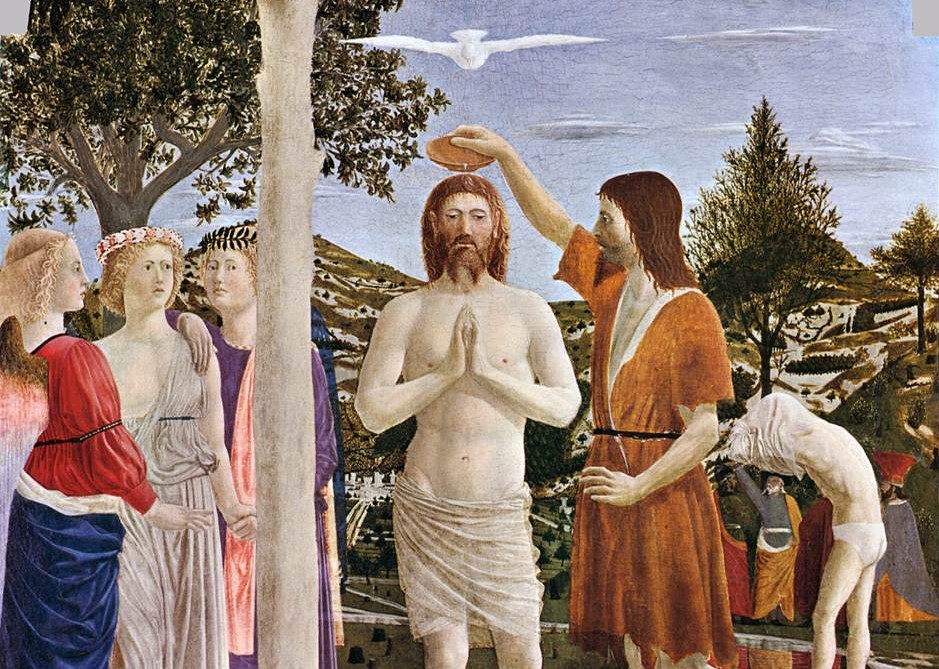
This Sunday’s Feast of the Baptism of the Lord is a time to reflect on not only the Lord’s Baptism but our own. In an extended sense, when Christ is baptized, so are we, for we are members of His Body. As Christ enters the water, He makes holy the water that will baptize us. He enters the water and we follow. In these waters, He acquires gifts to give us.
Let’s examine the Gospel in three stages.
The Fraternity of Baptism – The text says, After all the people had been baptized and Jesus also had been baptized …
Luke mentions Jesus’ Baptism in passing, in the middle of a sentence. Perhaps he, like many of us, is puzzled as to why Jesus would request baptism. John’s baptism of repentance presumes the presence of sin, but the scriptures are clear that Jesus had no sin.
For we have not a high priest who is unable to sympathize with our weaknesses, but one who in every respect has been tempted as we are, yet without sin (Heb 4:15).
You know that he appeared to take away sins, and in him there is no sin (1 John 3:5).
Even though He never sinned, Jesus identifies with sinners. As He comes to the bank of the river, He has no ego concerns. He is not embarrassed or ashamed that some might think Him a sinner (though He was not). He accepts the humiliation of being seen in the company of sinners. Jesus freely enters the waters knowing that anyone who does not know Him will count Him among the sinners.
Consider how amazing this is. Scripture says, He is not ashamed to call us his Brethren (Heb 2:11). Elsewhere it says, God made him who had no sin to be sin for us, so that in him we might become the righteousness of God (2 Cor 5:21).
Jesus ate with sinners, something many of the religious leaders found scandalous. This man welcomes sinners and eats with them (Lk 15:2). Jesus was known as a friend of sinners. He had pity on the woman caught in adultery. He allowed a sinful woman to touch Him and anoint His feet. He cast out demons and fought for sinners. He suffered and died for sinners in a manner reserved for the worst of criminals. He was crucified between two thieves and was assigned a grave among the wicked (Is 53).
Praise God, Jesus is not ashamed to be found in our presence and to share a brotherhood with us. There is a great shedding of His glory in doing this. Scripture says, [Jesus], being in very nature God, did not consider equality with God something to be grasped, but made himself nothing, taking the very nature of a servant, being made in human likeness. And being found in appearance as a man, he humbled himself (Phil 1:3).
The Foreshadowing of our Baptism – In accepting baptism, Jesus does not enter the water alone. He takes us with Him, for we are members of His Body. As the Head of the Body, He goes where the members will follow. St. Maximus says,
I understand the mystery as this. The column of fire went before the sons of Israel through the Red Sea so that they could follow on their brave journey; the column went first through the waters to prepare a path for those who followed … But Christ the Lord does all these things: in the column of fire He went through the sea before the sons of Israel; so now in the column of his body he goes through baptism before the Christian people … At the time of the Exodus the column … made a pathway through the waters; now it strengthens the footsteps of faith in the bath of baptism (de sancta Epiphania 1.3).
So what God promised in the Old Testament by way of prefigurement, He now fulfills in Christ. They were delivered from the slavery of Egypt as the column led them through the waters. More wonderfully, we are delivered from the slavery to sin as the column of Christ’s Body leads us through the waters of baptism. God’s righteousness is His fidelity to His promises. In His Baptism and all it signifies (His death and resurrection), Jesus has come to fulfill all righteousness, and thus fulfills the promises made by God at the Red Sea and throughout the Old Testament.
The Four Gifts of Baptism – The text says, heaven was opened and the Holy Spirit descended upon him in bodily form like a dove. And a voice came from heaven, “You are my beloved Son; with you I am well pleased.”
Scripture says, we are members of Christ’s body (Eph 5:30). Thus, when Jesus goes into the water, we go with Him. In going there, He acquires four gifts on our behalf:
Access – The heavens are opened. The heavens and paradise were closed to us after Original Sin, but at Jesus’ Baptism, they are opened. Jesus acquires this gift for us. At our Baptism, the heavens open for us and we have access to the Father and to the heavenly places. Scripture says, Therefore, since we are justified by faith, we have peace with God through our Lord Jesus Christ. Through him we have obtained access to this grace in which we stand (Romans 5:1). Scripture also says, For through Jesus we have access in one Spirit to the Father. So then you are no longer strangers and sojourners, but you are fellow citizens with the saints and members of the household of God (Eph 2:17).
Anointing –The Spirit of God descends on him like a dove. Here, too, Jesus acquires the gift of the Holy Spirit for us. At our Baptism we are not just washed of sins, but we also become temples of the Holy Spirit. After our Baptism we are anointed with chrism, signifying the presence of the Holy Spirit. For adults, this happens at Confirmation, but even for infants there is an anointing at Baptism to recognize that the Spirit of God dwells in the baptized as in a temple. Scripture says, Do you not know that you are God’s temple and that God’s Spirit dwells in you? (1 Cor 3:16)
Acknowledgment – You are my beloved Son. Jesus receives this acknowledgment from His Father for the faith of those who heard it and to acquire this gift for us. In our own Baptism we become the children of God. Because we become members of Christ’s Body, we now have the status of sons of God. On the day of your Baptism, the heavenly Father acknowledges you as His own dear child. Scripture says, You are all sons of God through faith in Christ Jesus, for all of you who were baptized into Christ have clothed yourselves with Christ (Gal 3:26).
Approval – With you I am well pleased. Jesus had always pleased His Father, but now He acquires this gift for us as well. Our own Baptism gives us sanctifying grace, the grace to be holy and pleasing to God. Scripture says, Blessed be the God and Father of our Lord Jesus Christ, who has blessed us in Christ with every spiritual blessing in the heavens, as he chose us in him, before the foundation of the world, to be holy and blameless in his sight (Eph 1:1-3).
Thus, at His Baptism Christ acquires these gifts for us so that we can receive them at our own Baptism. Consider well the glorious gift of your Baptism. If you don’t know the date, find out. It should be a day as highly celebrated as your birthday. Christ was baptized for our sake, not His own. All these gifts had always been His. In His Baptism, Jesus fulfilled God’s righteousness by going into the water to get them for you. It’s all right to say, “Hallelujah!”
The commercial below illustrates an important principle about side effects. When faced with a problem, we often wish for an easy cure, one without any personal costs or side effects. However, in general, the bigger the problem, the more drastic the cure and the larger the side effects.
In my experiences with deliverance ministry and pastoral counseling, I have found that many people are desperate for a solution. They are hoping without hope that a few prayers will drive away the demons or problems and everything will be fine again.
Most people want relief, not healing — but healing is hard work and true deliverance often requires making significant changes. Some of the uncomfortable “side effects” can be having to confront past sins and traumas. Relief is cheap but often temporary. Healing is costly, but it brings about more lasting effects.
Enjoy this zany commercial. I got a particular kick out of the ending, when the pets reap a bountiful harvest as a side effect of the family’s unusual stress reduction technique.
In the secular world, a “mystery” is something that baffles or eludes understanding, something that lies undisclosed. And the usual attitude of the world toward mystery is to solve it, get to the bottom of, or uncover it. Mysteries must be overcome! The riddle, or “who-done-it” must be solved!
In the Christian and especially the Catholic world, “mystery” is something a bit different. Here, mystery refers to the fact that there are hidden dimensions in things, people, and situations that extend beyond their visible, physical dimensions.
One of the best definitions I have read of “mystery” is by the theologian and philosopher John Le Croix. Fr. Francis Martin introduced it to me some years ago in one of his recorded conferences. Le Croix says,
Mystery is that which opens temporality and gives it depth. It introduces a vertical dimension and makes of it a time of revelation, of unveiling.
Fr. Martin’s classic example of this to his students is the following:
Suppose you and I are at a party, and Smith comes in the door and goes straightaway to Jones and warmly shakes his hand with both of his hands. And I say, “Wow, look at that.” Puzzled, you ask, “What’s the big deal, they shook hands. So what?” And then I tell you, “Smith and Jones have been enemies for thirty years.”
And thus there is a hidden and richer meaning than meets the eye. This is mystery, something hidden, something that is accessible to those who know and are initiated into the mystery and come to grasp some dimension of it; it is the deeper reality of things.
In terms of faith there is also a higher meaning to mystery. Le Croix added the following to the definition above: It [mystery] introduces a vertical dimension, and makes of it a time of revelation, of unveiling.
Hence we come to appreciate something of God in all He does and has made. Creation is not just dumbly there. It has a deeper meaning and reality. It reveals its Creator and the glory of Him who made it. The heavens declare the glory of God; the skies proclaim the work of his hands (Psalm 19:1).
In the book of Sirach, after a long list of the marvels of creation, is this magnificent line: Beyond these, many things lie hid; only a few of God’s works have we seen (Sirach 43:34).
Indeed, there is a sacramentality to all creation. Nothing is simply and dumbly itself; it points beyond and above, to Him who made it. The physical is but a manifestation of something and Someone higher.
In the reductionist world in which we live, such thinking is increasingly lost. Thus we poke and prod in order to “solve” the mysteries before us. And when have largely discovered something’s physical properties we think we have exhausted its meaning. We have not. In a disenchanted age, we need to rediscover the glory of enchantment, of mystery. There is more than meets the eye. Things are deeper, richer, and higher than we can ever fully imagine.
Scripture, which is a prophetic interpretation of reality, starts us on our great journey by initiating us into many of the mysteries of God and His creation. But even Scripture does not exhaust the mystery of all things; it merely sets us on the journey ever deeper, ever higher. Mysteries unfold; they are not crudely solved.
For the Christian, then, mystery is not something to be solved or overcome so much as to be savored and reverenced. To every person we know and everything we encounter goes up the cry, O magnum et admirabile mysterium (O great and wondrous mystery)! Now you’re becoming a mystic.
Note: This is the second of a two-part series. Part one is available here.
At its root, anthropology considers what human beings are and how they have interacted with one another and the world around them over time. While many think of anthropology as a secular study of cultures from ancient to modern day, I propose that there is also a Christian anthropology, one that considers who and what the human person is based on God’s revelation in His word and through our bodies. Indeed, our body is a revelation from God, and by and through it He teaches us.
This essay (consisting of both today’s and yesterday’s posts) is not a complete discourse on the topic. Rather, I selected certain teachings rooted in Scripture and the nature of our bodies that apply particularly well to moral issues of our day. In yesterday’s post we considered a few basic points; today we conclude with a few more.
Each human being exists because of a sovereign, loving act of God.
It is a biological fact that a unique human being comes into existence at the moment of conception. The DNA in that single-cell embryo contains all the instructions needed for it to develop, over the next twenty years or so, into an adult.
However, Scripture indicates that although we come to exist at a specific moment in time, God has always known and loved us: The word of the Lord came to me saying, ‘Before I formed you in the womb I knew you’ (Jer 1:4-5). Scripture also praises God saying, For You formed my inmost being; You knit me together in my mother’s womb. I will praise You, for I am fearfully and wonderfully made (Psalm 139:13-14). Hence, each of us is specifically intended by God.
This makes every human life sacred. No form of unjust killing can be justified under any circumstances. Each of us is the result not merely of biological processes or human decisions but a sovereign, loving act of God. Our lives come from God and belong to Him. Therefore, abortion, murder, and suicide (including physician-assisted) are grave evils that we must combat. Even capital punishment must be opposed except in rare cases.
Our body is not our own.
A common assertion today is we can do whatever we like with “our own body.” However, Scripture reminds us, You are not your own; you were bought at a price. Therefore, glorify God with your body (1 Cor 6:19-20). Yes, Jesus redeemed us; He purchased our salvation at the price of His own blood and His own life!
Hence, our bodies are not tools to simply use as we please. Neither are they canvases on which to display tattoos, cuttings, piercings, and the like. We are not to degrade them by using them for excessive or illicit pleasures or to lure others into sin. I do not wish to divert this post into a debate about tattooing and piercing. While such things are not wholly excluded by Church law or Scripture, anything that deliberately, dramatically alters the appearance of the body we received from God is surely problematic. (The nearly permanent quality of such alterations is also concerning.) Such excesses are far too common today, at least in the U.S.
Because our bodies belong to God, we should ask ourselves, “Is God pleased with the way I regard, treat, and make use of the body He has given me?”
There is a nuptial meaning to the body.
We do not exist by ourselves nor only for ourselves. We are contingent beings and, as such, depend on our parents for our existence. Although we exist for our own sake and thus have intrinsic worth, we also exist for others. Our very body speaks to the most fundamental relationships of marriage and family. Simply put, there is a part of our body that is for another. The male and female reproductive organs are designed for each other. This is biologically evident, though sadly some have lost their way and refuse to acknowledge it.
The denial of the purpose of our body’s reproductive organs is manifest in the approval of homosexual practices that “close the sexual act to the gift of life [and] do not proceed from a genuine affective and sexual complementarity” (CCC # 2357). It is also manifest in certain heterosexual practices that close the sexual act to the fruit of life and/or use the sexual organs in disordered ways, ways in which they were not intended to be used.
To restate, there is a nuptial meaning to the body. Our body says to us, “I am for another.” Most of humanity realizes this truth through monogamous marriage. A man leaves his father and mother, seeks a wife, clings to her, and the two become one flesh (cf Gen 2:24). Thus, through the husband and wife, completing and complementing each other, a new member of the human family is created. This is the most common realization of the nuptial meaning of the body.
For priests and for religious brothers and sisters who live celibate lives, the nuptial meaning of the body is realized in a spiritual but real way. Religious sisters are espoused to the Lord, the bridegroom of their souls. Priests and religious brothers take up a spousal relationship with the Church, the bride of their souls. Priests and brothers are not bachelors nor are sisters “single women.” No, each lives in a spousal relationship.
What about members of the laity who never marry? Here, I would argue, a distinction must be made. Because there is a nuptial meaning to the body, there is no vocation to the single life per se. However, those who are currently single (including those who may remain that way permanently), may by that state be available to serve the Lord and the Church or community in a more substantial way. For such individuals, the nuptial meaning of the body is expressed through that vocational service.
Marriage has its structure because children both need and deserve the stable presence of their father and mother in their lives.
God did not design marriage arbitrarily. He set it forth as one man for one woman till death do them part, bearing fruit in their children (see Genesis 2:24-25). He did this because that is what is necessary and best for children. Marriage by its nature is oriented to having children. The Lord’s first command to Adam and Eve was, Be fruitful and multiply, fill the earth and subdue it (Gen 1:28).
Obviously, there must be a father and a mother for a child to exist at all, but beyond the conception of children there is the necessary work of raising them. Children need to have their parents reliably present in their everyday lives so that they can depend on them and trust them. Further, a child needs a father to learn the masculine genius of being human and a mother to learn the feminine genius of being human. This is necessary for the proper and best human formation—psychologically, spiritually, and emotionally. Even an unbeliever should be able to see this. The structure of marriage is not an arbitrary arrangement by God for us to toy with at will.
Sadly, we have done just that. We casually separate what God has joined. God intends for children to be conceived in the sexual union of a husband and wife pledged to each other for life. Having sex and having children are inextricably linked to Holy Matrimony, yet today we have largely separated them. As a result of minimizing the relationship between sex and marriage, there are many marriages without children (by choice) and many children without parents married to each other. We do this through sins and misbehavior such as fornication, adultery, divorce and “remarriage.” The current practice of refusing to favor a married heterosexual couple over a single mother, a single father, or a same-sex couple when placing a child for adoption also severs what God has joined. As a result of all these things, fewer than half of children today grow up in a traditional family.
While children might lose their mother or father through death, to intentionally subject them to anything other than being raised by their own parents is a grave injustice.
The common objection to this teaching is this: “Are you saying that a single mother, a single father, or a homosexual couple cannot raise a child just as well as a married (heterosexual) couple?” The answer is, “Yes, that is exactly what we are saying,” for all the reasons stated above. Some will respond with horror stories that occurred with this or that traditional couple, but atypical occurrences do not alter general norms, and “hard cases make bad law.”
God intends sex, marriage, and children to go together. Having sex naturally leads to having children; this is biologically demonstrable.
Sex, intimacy, and procreation belong together and should not be separated.
Contraception, the artificial prevention of conception that naturally results from human sexual intercourse, is an attempt to sever the connection between sexual relations and having children. Even if not every act of sexual intercourse can result in a child, the bodily truth is that sexual intercourse is directed toward having children. That sex is also pleasurable and may be a sign of love and intimacy does not set aside this point. God joins pleasures to the things that are most necessary for us so that we do not neglect them. For example, the purpose of eating food is to nourish the body. It is also true that eating is pleasurable and sharing meals promotes camaraderie. This does not, however, mean that the primary purpose of food is something other than bodily nourishment. God joins pleasure to food because eating is necessary for our survival, thus they are to be together, not separated.
As an analogy, consider a person who was not particularly interested in the nutritional aspect of food, but rather just liked the pleasure of eating and/or keeping company at feasts. As a result, he would eat and drink to excess, vomit it all up, and then return for more. We all wince at such a horror. This is because eating has a purpose that is being trampled upon in favor of lesser aspects. The proper end, bodily nourishment, is subverted when a person eats to excess and merely for pleasure.
This is precisely what contraception does when it severs the relationship between sex, intimacy, and procreation. We would be similarly aghast at a couple who had sex without any love between them, merely for the purpose of making babies for profit (e.g. selling them for adoption or for use as laborers). This makes the same point: sex, intimacy, and procreation belong together and should not be divided as separate pursuits. Every child deserves to be the fruit of the intimacy and shared love of a stably married father and mother.
Contraception facilitates the violation of the norm Let no one separate what God his joined (see Matt 19:6). The legalization of contraception in the U.S. has led to the explosion of promiscuity and all of the accompanying woes, including sexually transmitted diseases, teenage parents, children raised in single-parent households, and the horror of abortion, which has become the “contraception of last resort.” All of this has gravely harmed or even killed millions of children. Some argue that it is perfectly fine to separate the procreative dimension of sex from its pleasure or its promotion of intimacy, but in separating what God has joined we have reaped a harvest of misery and death. Contraception promotes the exaltation of the pleasure and intimacy of sexual intercourse unmoored from its purpose: the serious business of having and then raising children within a stable marriage. The worship of pleasure and intimacy unmoored from their purpose has led to the unbridled lust we see today.
There will always be more to say about Christian anthropology, but allow the points made in today’s and yesterday’s posts to paint the bigger picture: God has set forth an understanding of the human person both in Scripture and through our very body and soul. We do well to take heed of what He teaches.
Anthropology is, most simply, the science or study of human beings through time and space. Different specialties focus on the analysis of biological/physiological characteristics and the examination of societies/cultures. In the religious sense, anthropology deals with the origin, nature, and destiny of human beings.
In our times there are many moral issues emerging from viewpoints that diverge widely from our given nature, both physical and spiritual. Numerous false notions (e.g., “transgenderism”) have arisen that either disregard or even deny physical data. Other errors involve ignoring the clear evidence of humans’ spiritual nature, which so distinguishes us from animals.
A Christian/biblical anthropology, however, sees the created order—and the human body in particular—as revelatory. The body is not just accidentally or incidentally present. No, the body is a revelation because through it, God speaks to us of who and what we are and what we ought to do. To this revelatory quality of the body God adds His own words in Scripture, leading to the emergence of a Christian anthropology.
In this essay I would like to review certain aspects of this Christian anthropology. This is by no means a complete or systematic treatise. Rather, it touches on certain key points that address modern errors. The order of these observations is not a perfect progression, but I have tried to progress from basic to more complex points.
We are the union of a body and a spiritual soul.
We are not merely our body nor are we merely our soul. We are the union of the two. Gnostic and dualistic anthropologies seek to divide body and soul or to indicate that a person is only his body or only his soul. Although we can distinguish body and soul intellectually, in reality they are so together as to be one. It is much like the flame from a candle. Although one can distinguish the light of the flame from its heat, one cannot put the heat over here and the light over there. They are so together as to be one. It is like this with our body and soul.
What is the soul?
On one level the soul is the animating principle of any living thing. Hence, even plants and animals have souls. The soul is related to the mysterious principle we call life. Although we casually use words like “life,” “death,” “living,” and “dead,” life is a mysterious reality. Imagine that in one hand I hold and acorn and in the other a stone. From a great distance they may even look alike. However, the acorn has the mysterious spark we call life while the stone does not. If I plant each in the ground and water the area, the acorn responds: first a shoot emerges and eventually a mighty oak tree. In contrast, the rock will do nothing no matter how long I wait; it does not have the mysterious spark called life. Neither does it have the animating principle we call the soul.
If the mysterious quality called life is taken away, the plant, animal, or human “dies.” Because the life that organized him/her/it is gone, the body or what is left falls into disorganization and decay. The force we call “life” and what we call the “soul,” are deeply mysterious.
What makes the human soul unique?
The human soul is different from that of animals and/or plants in that it is a spiritual soul. Scripture says of man, In the image of God He created them (Gen 1:27). It also says, Then the LORD God formed man from the dust of the ground and breathed the breath of life into [Adam’s] nostrils, and the man became a living being (Gen 2:7). To no other creatures are such attributions made. To say that we have a spiritual soul, that we have the breath of God within us and are made in His image, is to say that we have intellect and free will. It is our dignity to unite two orders of creation, the material and the spiritual, in our one person. Angels are pure spirit. Animals, though possessed of a soul (an animating principle), have no spirit and are thus material. Humans, however, unite the spiritual and the material. This is our glory and it is the central reason why our body will rise one day, gloriously transformed, and be restored to our spirit.
Sadly, there is a tendency today to equate humans with animals. Some say that humans are merely smart apes and that there are other creatures (e.g., dolphins) just as intelligent as we are. This is demonstrably false. You will know something by its fruits; you can see a cause by its effects. Humans are vastly different from all the other animals, even the highest primates, and this is evident in the effects we produce. While our bodies resemble other animals (especially mammals) in many ways, the similarity ends there. If the animals are just like us, where are their cities and farms? Where are their universities, libraries, and museums? Where is their art, their literature? Where are their legislatures where they pass laws or their courts where they hold one another accountable? Have they traveled to the moon and back? Have they learned and then handed on their knowledge to later generations? Where is their technological progress—or any progress at all, for that matter? Why are animals really no different than they were thousands of years ago?
Clearly there is a vast difference between human beings and other animals. This can be seen in the way we live and what we do, and in what they do not do.
Morally speaking, reducing humans to the state of animals not only robs us of our dignity but also our freedom, because it says that we are merely at the whim of instinct.
A common error today regarding the unity of body and spiritual soul is claiming that one is not one’s body but rather only one’s thoughts and feelings.
This is common among proponents of transgender and/or homosexual ideology. A certain man might say, “I am actually a woman.” A normally observant person would likely retort, “No, your body indicates that you are a man.” Yet, in transgender ideology, that observation is dismissed by saying, in effect, “I am not my body. My body has nothing to do with what or who I really am. I am my thoughts and feelings.” This amounts to a denial that our bodies are revelatory.
In homosexual ideology a similar error is encountered. A biological assessment makes it clear that the male and female reproductive organs are designed for each other. Further, an exit is not an entrance. Here, too, they dismiss the body as being of no relevance. This is pure Gnostic dualism: the body is of no account; one is only spirit, only thoughts and feelings. In such a world, what matters are intentions and thoughts; what the body teaches or indicates is of little account. This is an error because it dismisses the reality that the body presents to us.
The opposing but equally untrue claim is that one is only one’s body.
This is materialism and it denies the existence of soul. In this view, a person is merely a collection of chemicals and interactions between them. We only do what the chemicals and nerves “tell us” to do. We have no spirit and thus no free will. Because human behavior is said to be merely the result of physical interactions over which we have no control, there is no such thing as right or wrong. The absurdity of such a claim can be illustrated in this way:
Materialist: “You are just matter, a mere bag of chemicals.”
Believer: “I think that is dead wrong and an unfounded claim.”
(The materialist then becomes angry at the believer’s refusal to accept his claim.)
Believer: “Why are you angry? I am just a bag of chemicals and my behavior is just the result of the random firing of synapses. I am only saying and doing what those forces are making me say and do. Hence, I am not a responsible agent and your anger is unfounded.”
Obviously, the notion of right and wrong and of being accountable for our actions only makes sense if we have a spiritual soul that is able to rise above the effects of chemical reactions or nerve impulses.
We come in (only) two kinds.
In the creation of the human person, God says, So God created man in His own image; in the image of God He created him; male and female He created them (Gen 1:27). There are not dozens of different sexes/genders, as some assert. In fact, until recently, the word “gender” was used almost exclusively as a grammatical term (in some languages, nouns, adjectives, verbs, and/or pronouns have a gender) while the word “sex” referred to the classification of organisms as either male or female. (If you doubt me, look in a dictionary that was published any time prior to the last ten years or so.)
Yes, we are either male or female, and it is God who designates this and creates it. Our bodies reveal to us our sex, as designated by God. There is no need for a lengthy study of this matter; it is quite evident from a simple look at the body.
Some object that there are people born with both genitalia or who are ambiguously equipped, but the existence of such abnormalities does not indicate that there is a third (or fourth or more) sex. It does not follow that every anomaly indicates a different kind of human being. For example, some babies are born missing an arm; from this we do not conclude that there are two different sorts of human beings, those with two arms and those with one.
Therefore, given God’s teaching that we are either male or female, any acceptance of “transgender” ideology is inimical to Christian anthropology. It rejects what God has revealed to us in our bodies and what He teaches us in His written word. We must refute claims that there are more than two sexes/genders and insist that people accept the reality of what God has done. There is no such thing as a female “trapped in a male body” or vice versa. Neither can one “transition” so as to “be” the opposite sex. No matter how many surgeries one endures or how many hormones one takes, no matter what sort of clothing one wears, one’s sex cannot be changed. It is written in every cell of the body. One does not simply declare one’s sex nor can one change it. No, each person must humbly accept his or her sex from God, who is Creator and Lord.
In tomorrow’s post we will look at some other principles of Christian anthropology and relate them to errors of our day.