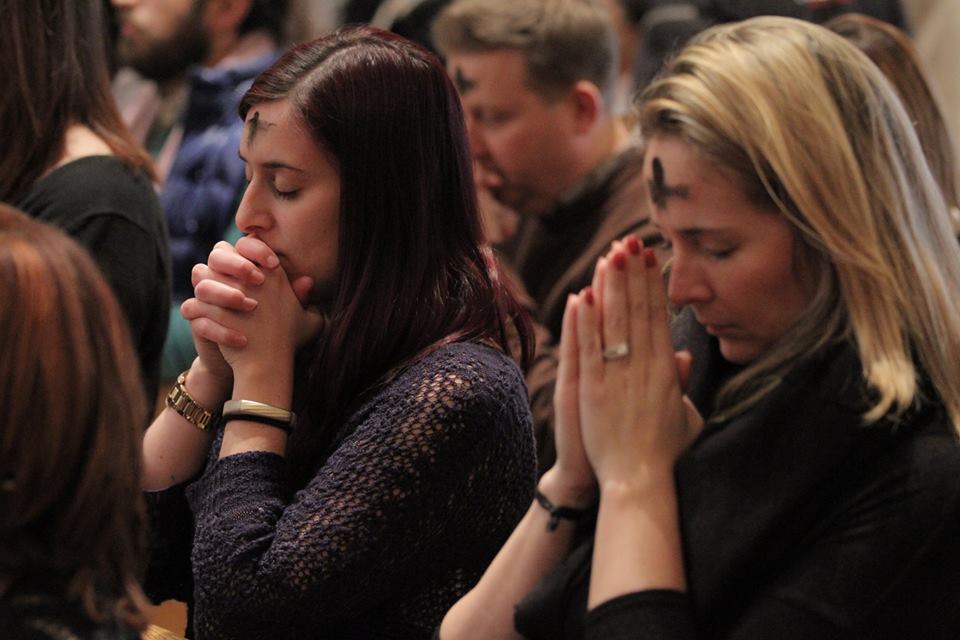
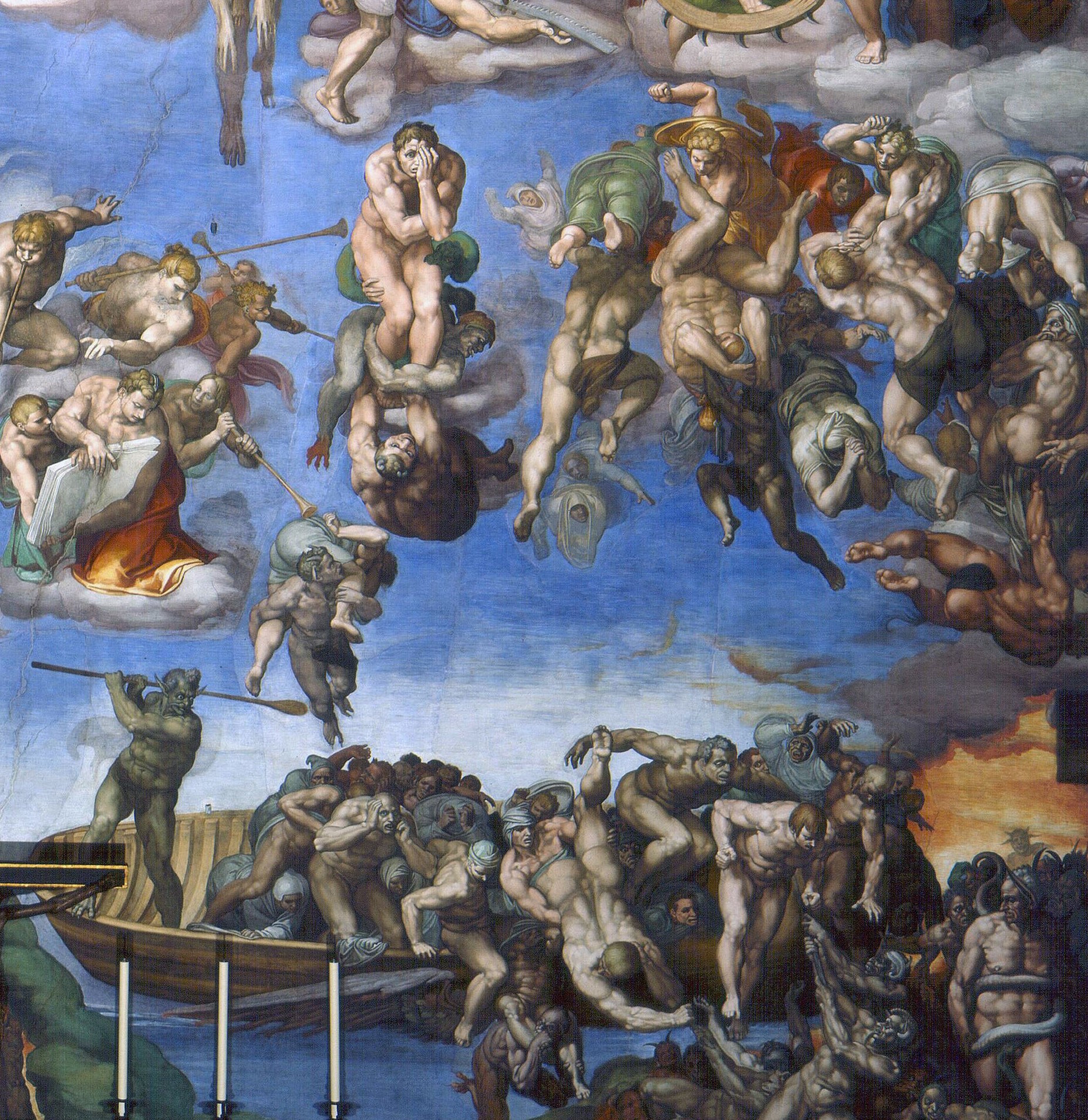
A brief observation of the first two days in Lent reveals militaristic, even violent imagery in the battle against sin and the unruly passions of the flesh. The Collect (opening prayer) of Ash Wednesday provides an image of troops mustering for battle:
Grant, O Lord, that we may begin with holy fasting this campaign of Christian service,
so that, as we take up battle against spiritual evils, we may be armed with weapons of self-restraint.
Through our Lord Jesus Christ, your Son,
who lives and reigns with you in the unity of the Holy Spirit, one God, for ever and ever.
“Battle,” “weapons,” and “armed” all clearly have military connotations, but so does the phrase “campaign of Christian service” if we look at the Latin text: praesidia miltiae Christianae. The service or action (praesidia) is one of Christian battle or militancy (militiae). This refers to the Church Militant—the Church here on earth—waging war against sin and the kingdom of darkness.
Thus the opening prayer on Ash Wednesday announced and summoned us to a battle that is engaged by the Church with special intensity during Lent.
The Gospel for Thursday after Ash Wednesday also has a battle theme. Jesus says,
If anyone wishes to come after me, he must deny himself and take up his cross daily and follow me.
For whoever wishes to save his life will lose it, but whoever loses his life for my sake will save it (Luke 9:23-25).
The battle theme is particularly apparent if one looks at the Greek text. The word translated as “lose” in English does not capture the vigor of the Greek word ἀπόλλυμι (apollumi). Apollumi comes from the root apó, meaning away from, with the intensifier ollymi, “to destroy.” Thus apollumi means to fully destroy, cutting off entirely. It implies permanent or absolute destruction.
So when Jesus says we must “lose” our life, it is really far stronger than the English translation captures. Losing our life involves a kind of violent overthrow of our worldly notions and the deep drives of sin. We must lose. That is, we must see utterly destroyed and cut off all things worldly, fleshly, and of the devil. This is war and it is going to involve more than a mumbled, half-hearted prayer on our part. Scripture says, In your struggle against sin, you have not yet resisted to the point of shedding your blood (Heb 12:4).
So behold the militaristic imagery as Lent begins. To arms!
The idea of such a battle might overwhelm us if we thought it must all be done in one day. Jesus says that we should take up our cross daily. Our daily cross is vital to our success. It’s not our weekly cross, or our monthly cross, or our yearly cross. We ought to do each day what we should do. If we put off or postpone the daily cross, the problems pile up. A monthly cross can seem overwhelming, and a yearly cross might seem impossible. Everyday discipline is crucial. Soon enough, the daily discipline becomes virtue; it becomes a good habit that one accomplishes fairly easily. To take up our cross daily is to endure short-term pain for long-term gain.
The battle is engaged! Fight it daily. Fight it with the Lord. Understand that it is battle, but in Jesus (and only in Jesus) the victory is won. Stay on the winning side and fight daily to the end.
As a boy, I remember wondering why so many people liked to rush to Church to get ashes smudged on their foreheads. Frankly, I had some revulsion at the idea. I didn’t like it at all and would secretly rub them off when no one was looking. Today, though I’ll admit I still don’t like it too much, I behave myself and don’t rub them off!
I pray that this doesn’t seem impious, but I still marvel at how many people pack into the church to get ashes on their foreheads. Sadder still, some who come don’t seem to want Holy Communion nearly as much. In fact, in some of the parishes where I served in the past, significant numbers walked out the door after receiving ashes and did not even stay for Communion.
Of course most people who come to Mass are faithful and have their priorities straight, but it still interests me how large the numbers are for something that seems to me so unappealing and challenging.
Indeed, the sign of ashes is quite challenging if understand what it really means. We are saying some pretty powerful stuff and making some extensive promises of a sort.
What do ashes signify? Perhaps a brief tour of Scripture is in order:
Humility – Job said, “You [Oh Lord] asked, ‘Who is this that obscures my counsel without knowledge?’ Surely I spoke of things I did not understand, things too wonderful for me to know. You said, ‘Listen now, and I will speak; I will question you, and you shall answer me.’ My ears had heard of you but now my eyes have seen you. Therefore, I despise myself and repent in dust and ashes” (Job 42:3-6).
Notice that Job does not merely repent in a general sense. Rather, having encountered God, he realizes that God is God, and that he, Jacob, is a creature, mere dust and ashes in the presence of God, who is being itself, who is all in all. Yes, Jacob is a son in the presence of a Father; he is not God’s equal that he might question Him or put Him on trial.
Hence in this case the ashes represent not only repentance but humility as well. The Church’s liturgy echoes this theme of humility in quoting Gen 3:19: “Remember, you are dust and unto dust you shall return” as the ashes are placed on the individual’s forehead.
A reminder of death and a call to wisdom – After Adam sinned, God told him, By the sweat of your brow you shall eat bread, till you return to the ground, for out of it you were taken; for you are dust, and to dust you shall return (Gen 3:19).
As he imposes the ashes, the priest usually recites some form of this passage. And memorable though it is, consider an even blunter form: “You are going to die.”
This is a salient and sobering reminder that we often get worked up and anxious about passing things, while at the same time being unmindful of the certain and most important thing, for which we really must be ready. We tend to maximize the minimum and minimize the maximum. Sadly, like the man in one of the Lord’s parables, we can amass worldly things and forget the final things. To him the Lord said, “You fool! This very night your soul is required of you; and now who will own what you have prepared?” So is the man who stores up treasure for himself, and is not rich toward God. (Luke 12:21-22).
Thus, to consider our final end is wise; to fail to do so is foolishness defined.
Ashes are a sacramental that points to the Sacrament – The Old Testament declared, You shall gather up the ashes of the heifer and put them in a ceremonially clean place outside the camp. They shall be kept by the Israelite community for use in the water of cleansing; it is for purification from sin … For the unclean person, put some ashes from the burned purification offering into a jar and pour fresh water over them. Then a man who is ceremonially clean is to take some hyssop, dip it in the water and sprinkle the tent and all the furnishings and the people who were there (Numbers 19:9, 17).
This text shows ashes obtained from a burned sin offering and mixed with sprinkled water as a cleansing ritual. In the Old Testament, this ritual could not actually take away sin (cf Heb 9:9-13), but it did provide for ritual purity. It also symbolized repentance and a desire to be free from sin.
In the same way, ashes on Ash Wednesday (mixed with holy water) cannot take away sin. They are a sacramental, not a sacrament.
To receive ashes on Ash Wednesday and then not go to confession some time during Lent is really to miss the point. If one really desires to repent and to be cleansed and free of sin, then from the sacramental of ashes one goes to the Sacrament of Confession. Otherwise the ritual of Ash Wednesday is pointless.
A sign of a true change – Scripture says, When the news [of Nineveh’s possible destruction in forty days] reached the king of Nineveh, he rose from his throne, took off his royal robes, covered himself with sackcloth and sat down in the dust (Jonah 3:6).
Here, too, repentance is symbolized, but the symbol alone is not enough—actual repentance is required. The king does not just “get ashes”; he issues a decree calling for fasting, prayer, and true reform: Do not let any man or beast, herd or flock, taste anything; do not let them eat or drink. But let man and beast be covered with sackcloth. Let everyone call urgently on God. Let them give up their evil ways and their violence. Who knows? God may yet relent and with compassion turn from his fierce anger so that we will not perish (Jonah 3:7-9).
Hence another option for the priest to say as he applies the ashes is, “Turn away from sin and be faithful to the Gospel.”
It is not enough to get a sooty forehead. True repentance is called for, an actual intent to change. Otherwise the ashes are a false sign.
A summons to faith and a new mind – Jesus said, Woe to you, Korazin! Woe to you, Bethsaida! If the miracles that were performed in you had been performed in Tyre and Sidon, they would have repented long ago in sackcloth and ashes (Matt 11:21).
Jesus rebukes ancient towns for their lack of faith. It is good to recall that the Greek word translated here as “repented” is μετενόησαν (metenoesan), which more literally means “to come to a new mind or way of thinking.”
There are many ways that we think about things that are more of the world than of God. Our ongoing challenge is to come to a new mind and to think more as God thinks. This is only possible by His grace, working through Scripture and Church teaching.
It is significant that the ashes are smeared on the forehead or sprinkled on the head—we are called to a faith that transforms our mind. We are called to be transformed by the renewal of our minds (Romans 12:2).
Hence yet another option for the priest is to say, “Repent and believe the Good News” as he imposes the ashes.
How real are your ashes? Do you intend the things described above as you go forth? Or is it just a ritual, something to do because it’s “sorta neat”? Pray and reflect on the deeper meaning of the ashes.
Many groups have a tendency to use words that make sense to their members but are unintelligible to outsiders. I have sometimes had to decode “Church-speak” for recent converts.
For example, one time I proudly announced, “RCIA classes will begin next week, so if you know anyone who is interested in attending please fill out an information card on the table just outside the sacristy door.” I thought I’d been perfectly clear, but then a new member approached me after Mass to inquire about the availability of classes to become Catholic and when they would begin. Wondering if she’d forgotten the announcement I reminded her what I had said about RCIA classes. She looked at me blankly. “Oh,” I said, “Let me explain what I mean by RCIA.” After I did so, I mentioned that she could pick up a flyer over by the sacristy door. Again I got a blank stare, followed by the question “What’s a sacristy?” Did I dare tell her that the classes would be held in the rectory?
I’ve had a similar reaction when announcing CCD classes. One angry parent called me to protest that she had been told by the DRE (more Church-speak) that her daughter could not make her First Holy Communion unless she started attending CCD. The mother, the non-Catholic wife of a less-than-practicing Catholic husband, had no idea what CCD meant and why it should be required in order for her daughter to receive Holy Communion. She had never connected the term CCD with Sunday school or any form of religious instruction.
Over my years as a priest I have become more and more aware that although I use what I would call ordinary terms of traditional Catholicism, given the poor catechesis (another Church word, meaning religious training, by the way) of so many, the meaning of what I am saying is lost. For example, I have discovered that some Catholics think that “mortal sin” refers only to killing someone. Even the expression “grave sin” is nebulous to many; they know it isn’t good, but aren’t really sure what it means. “Venial sin” is even less understood!
Other words such as covenant, matrimony, incarnation, transubstantiation, liturgy, oration, epistle, gospel, Collect, Sanctus, chalice, paten, alb, Holy Orders, theological, missal, Monsignor, and Eucharistic, while meaningful to many in the Church, are often only vaguely understood by others in the Church, not to mention the unchurched (is that another Church word?).
Once at daily Mass I was preaching based on a reading from the First Letter of John and was attempting to make the point that our faith is “incarnational.” I noticed vacant looks out in the pews. And so I asked the small group gathered that day if anyone knew what “incarnational” meant; no one did. I went on to explain that it meant that the Word of God had to become flesh in us; it had to become real in the way we live our lives. To me, the word “incarnational” captured the concept perfectly, but most of the people didn’t even really know for sure what “incarnation” meant, let alone “incarnational.”
Ah, Church-speak!
During my years in the seminary the art of Church-speak seemed to rise to new levels. I remember that many of my professors, while railing against the use of Latin in the liturgy, had a strange fascination with Greek-based terminology. Mass was out, Eucharist was in. “Going to mass” was out, “confecting the synaxis” was in. Canon was out, “anamnesis” and “anaphora” were in. Communion was out, koinonia was in. Mystagogia, catechumenate, mysterion, epikaia, protoevangelion, hapax legomenon, epiklesis, synderesis, eschatology, Parousia, and apakatastasis were all in. These are necessary words, I suppose, but surely opaque to most parishioners. Church-speak indeed, or should I say ekklesia-legomenon.
Ah, Church-speak! Here is an online list of many other Church words for your edification (and amusement): Church words defined
At any rate, I have learned to be a little more careful when speaking so as to avoid too much Church-speak, too many insider terms, too many older terms, without carefully explaining them. I think we can and should learn many of them, but we should not assume that most people know them.
The great and Venerable Archbishop Fulton Sheen once said that he discovered early on that he often got credit for being learned when in fact he was merely being obscure. And for any who knew him in his later years, especially through his television show, he was always very careful to explain Church teaching in a way that made it accessible to the masses. It’s good advice for all of us: a little less of the CCD and RCIA jargon and little more of the clear “religious instruction” can help others to decode our Church-speak.
I would not argue that we should “dumb down” our vocabulary, for indeed it is a precious patrimony in many cases. But we need to do more explaining rather than merely presuming that most people will know what some of our terms mean.
This video has a lot of gibberish in it, but it illustrates how we can sound at times if we’re not careful!
The first reading this Sunday reminds us that our speech discloses our character:
When a sieve is shaken, the husks appear; so do one’s faults when one speaks. The fruit of a tree shows the care it has had; so too does one’s speech disclose the bent of one’s mind.
Praise no one before he speaks,
for it is then that people are tested (Sirach 27:4-7).
What we say reveals a great deal about us—more than we imagine. Speech is among our greatest gifts, yet self-mastery in speech is among the rarest. Some of the most common sins we commit are related to speech: gossip, idle chatter, lies, exaggeration, harsh attack, and uncharitable remarks. With our tongue we can spew hatred, incite fear, spread misinformation, tempt, discourage, promote error, and ruin reputations. With a gift capable of bringing such good, we can surely cause great harm!
The Letter of James says this:
We all stumble in many ways. Anyone who is never at fault in what he says is perfect, able to keep his whole body in check. When we put bits into the mouths of horses to make them obey us, and thus we can turn the whole animal. Or take ships as an example. Although they are so large and are driven by strong winds, they are steered by a very small rudder wherever the pilot wants to go. Likewise, the tongue is a small part of the body, but it makes great boasts.
Consider how a great forest is set on fire by a small spark. The tongue also is a fire, a world of evil among the parts of the body. It corrupts the whole body, sets the whole course of one’s life on fire, and is itself set on fire by hell.
All kinds of animals, birds, reptiles and sea creatures are being tamed and have been tamed by mankind, but no human being can tame the tongue. It is a restless evil, full of deadly poison. With the tongue we praise our Lord and Father, and with it we curse human beings, who have been made in God’s likeness. Out of the same mouth come praise and cursing. My brothers and sisters, this should not be (Jam 3:2-10).
Although one may conquer any sin by God’s grace, those associated with speech are among the hardest to overcome. Sometimes it seems as if our speech is being controlled by a separate, baser part of our brain. We can be halfway through saying something before realizing how foolish and sinful we are being. Scripture speaks artistically of the sinful tongue.
Here are some common sins of the tongue:
The Lying Tongue – speaking falsehoods with the intention of misleading others.
The LORD detests lying lips, but he delights in people who are trustworthy (Prov 12:22).
A false witness will not go unpunished, and one who utters lies will not escape (Prov 19:5).
Not every story should you believe (Sir 19:14).
The Backbiting Tongue – talking about others behind their backs, injuring their reputations through detraction.
A man’s tongue can be his downfall. Be not called a detractor; use not your tongue for calumny (Sir 5:13-16).
Never repeat gossip, and you will not be reviled. … Let anything you hear die within you … (Sir 19:5).
The Indiscreet Tongue – spreading confidential, unnecessary, or hurtful information about others.
He that goes about as a tale-bearer reveals secrets, therefore keep no company with such a one (Prov 20:19).
A gossip betrays a confidence; so avoid a man who talks too much (Prov 20:19).
He who repeats an evil report has no sense. Never repeat gossip… Let anything you hear die within you; be assured it will not make you burst. But when a fool hears something, he is in labor, like a woman giving birth to a child … (Sir 19:5, 14).
Thou shalt not go up and down as a tale-bearer among thy people (Lev 19:16).
The Flattering Tongue– exaggerating the good qualities of others in order to ingratiate ourselves to them.
May the Lord silence all flattering lips and every boastful tongue (Ps 12:4).
Wounds from a friend can be trusted, but an enemy multiplies kisses (Prov 27:6).
The Proud Tongue – speaking boastfully or in an overly certain way.
There is a saying that a proud tongue comes with two closed ears. Those of proud tongue are not easily corrected and do not qualify or distinguish their remarks as they should.
May the Lord silence all flattering lips and every boastful tongue, Those who say, “By our tongues we will prevail; when our lips speak, who can lord it over us?” (Ps 12:4-5)
An evil man is trapped by his rebellious speech, but a righteous man escapes from trouble (Prov 12:13).
The prudent man does not make a show of his knowledge, but fools broadcast their foolishness (Prov 12:23).
The Overused Tongue – saying too much, which usually ushers in sin by its excess.
A fool’s voice [comes] along with a multitude of words (Ecc 5:2).
When words are many, sin is inevitable, but he who restrains his lips is wise (Prov 10:19).
The Rash Tongue – speaking before one should, often without having all the information.
Be not rash with your mouth, and let not your heart be hasty to utter anything before God (Ecc 5:1).
Be swift to hear, but slow to answer. If you have the knowledge, answer your neighbor; if not, put your hand over your mouth (Sir 5:13).
Even a fool is thought wise if he keeps silent, and discerning if he holds his tongue (Prov 17:28).
The Quarrelsome Tongue – speaking in an overly opinionated way, attacking others personally, and/or provoking unnecessary division.
Fools’ words get them into constant quarrels; they are asking for a beating (Prov 18:6).
A fool finds no pleasure in understanding but delights in airing his own opinions (Prov 18:2).
Drive out the mocker, and out goes strife; quarrels and insults are ended (Prov 22:10).
The Cursing Tongue – wishing harm upon others, often that they be damned.
He loved to pronounce a curse—may it come back on him. He found no pleasure in blessing—may it be far from him (Ps 109:17).
Whoever curses his father or mother, his lamp will be extinguished in deepest darkness (Prov 20:20).
The Piercing Tongue – speaking unnecessarily harshly or severely.
The heart of the righteous weighs its answers, but the mouth of the wicked gushes evil (Prov 15:28).
Some people make cutting remarks, but the words of the wise bring healing (Prov 12:18).
Do not rebuke an older man harshly, but exhort him as if he were your father. Treat younger men as brothers, older women as mothers, and younger women as sisters, with absolute purity (1 Tim 5:1-2).
The Silent Tongue – failing to speak up when we ought to warn people of sin, call them to the Kingdom, and announce the truth of Jesus Christ.
In our age, the triumph of evil and poor behavior has been facilitated by our silence. As prophets, we are called to speak God’s Word.
Proclaim the message; persist in it in season and out of season; rebuke, correct, and encourage with great patience and teaching (2 Tim 4:2).
Israel’s watchmen are blind; they are all ignorant, they are all dumb dogs, they cannot bark (Is 56:10).
Yes, our speech is riddled with what it should not have and lacking in what it should. How wretched is our condition! Well, James did say, Anyone who is never at fault in what he says is perfect. Indeed, if anyone masters his tongue, he is a spiritual superman!
Set a guard over my mouth, O LORD; keep watch over the door of my lips (Ps 141:3).
Yes, help me, Lord. Keep your arm around my shoulder and your hand over my mouth! Put your Word in my heart so that when I do speak, it’s really you speaking.
The video below is of a performance of the traditional African-American spiritual “Children Go Where I Send Thee.”
It is a “cumulative song” in that each verse builds on the prior one (like “The 12 Days of Christmas”). The children’s choir in my parish recently sang it to great effect.
Although there are many variations in the verses, the ones below are the most clearly biblical and liturgical. There is a catechetical purpose to the spiritual, and it presents basic teachings in a memorable way:
Children go where I send Thee. How shall I send thee? I’m gonna send thee one by one One for the little bitty baby born by the Virgin Mary Born in Bethlehem!
Children go where I send Thee. How shall I send thee? I’m gonna send thee two by two Two for Paul and Silas One for the little bitty baby born by the Virgin Mary Born in Bethlehem!
Children go where I send Thee . . . Three for the Hebrew children Two for Paul and Silas One for the little bitty baby . . .
Children go where I send Thee . . . Four for the four that knock on the door (Four Evangelists) . . .
Children go where I send Thee . . . Five for the bread they did divide . . .
Children go where I send Thee . . . Six for the days when the world was fixed . . .
Children go where I send Thee . . . Seven for the seven that lead to Heaven (Seven Sacraments) . . .
Children go where I send Thee . . . Eight for the eight that the flood couldn’t take . . .
Children go where I send Thee . . . Nine for the angel choirs divine . . .
Children go where I send Thee . . . Ten for the Ten Commandments . . .
Children go where I send Thee . . . Eleven for them who saw him ascend . . .
Children go where I send Thee . . . Twelve for the Twelve Apostles . . .
The Gospel from Thursday’s daily Mass featured one of Jesus’ lesser-known teachings:
Everyone will be salted with fire. Salt is good, but if salt becomes insipid, with what will you restore its flavor? Keep salt in yourselves and you will have peace with one another (Mark 9:49-50).
Let’s begin with a few observations about salt in those times.
Salt was valuable. Some people were even paid with salt (which is where we get the word “salary”).
Salt was connected with healing and purity. Saltwater was applied to infections and wounds (it helps heal afflictions of the skin). Newborn babies were washed with saltwater.
Salt was connected with preservation. In the years before refrigeration, salt was one of the most common ways of preserving meat and fish.
Salt was connected with flavor. Salt adds spice to life; it brings out the flavor in food.
Salt was an image for wisdom. Gregory the Great said, “Now by salt is denoted the word of wisdom. Let him therefore who strives to speak wisely, fear greatly” (Pastoral Rule 4.12).
Salt was connected with worship and covenant. Scripture says, Season all your grain offerings with salt. Do not leave the salt of the covenant of your God out of your grain offerings; add salt to all your offerings (Lev 2:13). So, the use of salt was ordered first for the meal offerings, and afterwards for “all” offerings, including the “burnt offering.”
Scripture speaks elsewhere of a “covenant of salt.” For example, Don’t you know that the LORD, the God of Israel, has given the kingship of Israel to David and his descendants forever by a covenant of salt? (2 Chron 13:5) The covenant of salt refers to the imperishable and irrevocable quality of the engagement made between the two parties to the covenant.
The use of salt to signify and ratify what was sacred was widespread. There is a Latin saying attributed to Pliny the Elder (and Virgil, too), Nulla sacra conficiuntur sine mola salsa (Sacred things are not made without salted meal).
To apply the image of salt to the Christian life, we should see that the Christian is charged with purifying, sanctifying, and preserving this wounded and decaying world by being salt to it. The Christian is called to bring flavor to life in a world that is so often filled with despair and meaninglessness.
With that background, let’s turn to an analysis of Jesus’ words from the Gospel of Mark.
1. Everyone will be salted with fire. Two images of salt and fire come together here, but the result is the same: purification. We have already seen how salt purifies. Fire does the same thing through the refining process. Precious metals come from the ground admixed with iron and many other metals. Subjecting them to fire purifies the gold or silver, separating it from the iron and other metals.
Both salt and fire purify by burning, each in its own way. Hence the Lord marvelously brings those two images together, telling us that we will all be “salted with fire.”
Indeed, it must be so. We must all be purified. Scripture says of Heaven, nothing impure will ever enter it (Rev 21:27). St. Paul speaks of purgatorial fire as effecting whatever purification has not taken place here on earth:
If anyone builds on this foundation [of Christ] using gold, silver, costly stones, wood, hay or straw, their work will be shown for what it is, because the Day will bring it to light. It will be revealed with fire, and the fire will test the quality of each person’s work. If what has been built survives, the builder will receive a reward. If it is burned up, the builder will suffer loss but yet will be saved—yet as one escaping through the flames (1 Cor 3:15-15).
The Book of Malachi also reminds us of our need to be purified, to be “salted with fire.”
But who can endure the day of his coming? Who can stand when he appears? For he will be like a refiner’s fire or a launderer’s soap. He will sit as a refiner and purifier of silver; he will purify the Levites and refine them like gold and silver (Mal 3:2-3).
Yes, we must all be salted with fire. We must be purified, both here, and if necessary (as it likely will be), in Purgatory.
2. Salt is good, but if salt becomes insipid, with what will you restore its flavor?In other words, we must let the salt of God’s grace have its effect or else we, who are to be salt for others, become flat, tasteless, and good for nothing but to be thrown out and trampled underfoot (cf Matt 5:13).
If the salt will not be salt, there is no substitute for it. Jesus asks rhetorically, if salt becomes insipid, with what will you restore its flavor? There is no substitute for Christians. If we will not be light, then the world will be in darkness. If we will not be salt, then the world will not be purified, preserved, or have anything good or tasty about it at all. The decay of Western culture has happened on our watch, when we collectively decided to stop being salt and light.
3. Keep salt in yourselves and you will have peace with one another.In other words, allow the salt, the purification, to have its effect. Only if we do this will we have peace with one another.
Our divisions and lack of peace are caused by our sins. Thus, to accept the purification of being salted with fire is our only true hope for peace. When the Lord burns away my envy, I no longer resent your gifts; I rejoice in them and come to appreciate that I need you to complete me. In this way there is peace. When the Lord burns away my jealousy and greed and helps me to be grateful for what I have, I no longer desire to take what is rightly yours nor do I resent you for having it. In this way there is peace. When the Lord burns away my bitter memories of past hurts and gives me the grace to forgive, an enormous amount of poison goes out of my soul and I am equipped to love and to be kind, generous, and patient. In this way there is peace.
Yes, allowing ourselves to be salted with fire is a source of peace for us. And while we may resist the pain of fire and salt, just as with any stinging medicine we must learn that although it is painful it is good for us. Yes, it brings peace; it ushers in shalom.
There is a verse from the Letter to the Hebrews that deserves attention because it is a more common problem than many imagine:
See to it, brothers, that none of you has an unbelieving heart that turns away from the living God. But exhort one another daily, as long as it is called today, so that none of you may be hardened by sin’s deceitfulness (Heb 3:12-13).
When most of us read a text like this, we think only of obvious and dark cases. For example, someone’s tendency to lash out at others leads him to increasing violence and cruelty, or someone’s desire for possessions leads him to increasing stinginess and unkindness, or someone’s lust leads him to sexually promiscuity that is more and more debased and perverse. However, there are less egregious versions of what this text describes that can lead even religiously observant Catholics to become hardened by sin’s deceitfulness.
An example of this is the outright, almost categorical denial of the doctrine of Hell by a large number of Catholics, even ones who attend Mass faithfully each week. Although Jesus taught it consistently, many today firmly resist the biblical teaching that many people are in significant danger of going to Hell.
It can be argued that 21 of the 38 parables have as their theme the warning of impending judgment in which some are judged unable or unwilling to enter the Kingdom of Heaven. For example, there are sheep and goats; wheat and tares; those on the right and those on the left; wise virgins and foolish ones; those who accept the invitation to the wedding and those who refuse; those properly dressed and those who are not; those who are told, “Come, blessed of my Father” and those who are told, “Depart from me.” This is not the place for me to give a full teaching on these doctrines. (I have posted in more depth on these topics previously: here and here and here.)
Many today, even among the religiously observant, do not take these consistent teachings seriously. “God wouldn’t do that because He is love and compassion,” they say. “There aren’t many people in Hell, except maybe Hitler.” Most people are quite “hardened” in this “deceitful” view, to use the language from Hebrews. Even when presented with verse after verse from Scripture—most directly from Jesus’ mouth—many still stubbornly persist in rejecting what is clearly taught, saying: “Yeah, I know, but He didn’t really mean it. He won’t really do that.”
To illustrate, some years ago a woman confronted me after Mass objecting to my sermon, which included a warning about Hell for those who refuse to repent. (The Gospel for that Sunday included Jesus’ sad warning that the road to Hell was wide with many on it, while the road to salvation was narrow and only a few were walking its way and would find salvation). She said to me, “I didn’t hear the Jesus I know in your sermon about Hell today.” I replied, “But ma’am, I was quoting Jesus!” She did not miss a beat, saying, “Oh, please! We know He never really said that.” This reply indicates a hardening by the deceit of sin on several levels: she rejects the revealed Word of God in favor of her own views, she rejects the doctrine and warnings of Hell itself, and she remakes the Lord so that He conforms to her notions and can be worthy of her credence and worship. (We used to call this last thing “idolatry.”)
Listen again to the words from Hebrews:See to it, brothers, that none of you has an unbelieving heart … so that none of you may be hardened by sin’s deceitfulness. This refers to more than just wicked behaviors. Sometimes the hardness is a refusal to believe revealed doctrines or to accept the Lord’s serious warnings. A world hardened by the deceit of sin will not accept that there are lasting consequences for the refusal to repent. Many have allowed themselves to be influenced by it, setting aside God’s Word in favor of human ideas and preferences.
Beware of this tendency, which is so common today. Study the doctrines. Read the warnings of the Lord in Scripture. Ask questions about things that puzzle or trouble you; pray for insight—but do not be misled into sinfully and stubbornly rejecting what is revealed.
Rely not on your strength in following the desires of your heart. Say not, “Who can prevail against me?” for the LORD will exact the punishment. Say not, “I have sinned, yet what has befallen me?” for the LORD bides his time. Of forgiveness be not overconfident, adding sin upon sin. Say not, “Great is his mercy; my many sins he will forgive.” For mercy and anger alike are with him; upon the wicked alights his wrath. Delay not your conversion to the LORD, put it not off from day to day; For suddenly his wrath flames forth; at the time of vengeance, you will be destroyed. Rely not upon deceitful wealth, for it will be no help on the day of wrath (Sirach 5:1-10).
The Lord says these things because He loves us. He does not want us to be lost. In the end, though, God respects our freedom to say no to what He is offering. He knows how we are made and how stubborn we can be. He knows that the values of Heaven (particularly love of our enemies, forgiveness of those who have wronged us, and chastity) are not pleasing to many people. The Lord will not force us to live values like these, but they are what Heaven is about. Thus, He warns us to let Him instill a desire in us for what He offers so that we will desire the Heaven He describes. Listen to Him; He warns us in love so that He can take our heart of stone and give us a true heart to desire the Heaven He is offering.
Do not be hardened by deceitful teachings rooted in this world of sin!
At daily Mass this week (7th week of the year) we are reading from the Book of Sirach. God inspired Jesus ben Sirach to pen advice so beautiful and wise that the early Church used it to instruct catechumens in their first year. Consider the following passage:
My son, when you come to serve the LORD, stand in justice and fear, prepare yourself for trials. Be sincere of heart and steadfast, incline your ear and receive the word of understanding, undisturbed in time of adversity. Wait on God, with patience, cling to him, forsake him not; thus will you be wise in all your ways.
Accept whatever befalls you, when sorrowful, be steadfast, and in crushing misfortune be patient; For in fire gold and silver are tested, and worthy people in the crucible of humiliation. Trust God and God will help you; trust in him, and he will direct your way; keep his fear and grow old therein.
You who fear the LORD, wait for his mercy, turn not away lest you fall. You who fear the LORD, trust him, and your reward will not be lost. You who fear the LORD, hope for good things, for lasting joy and mercy. You who fear the LORD, love him, and your hearts will be enlightened. Study the generations long past and understand; has anyone hoped in the LORD and been disappointed? Has anyone persevered in his commandments and been forsaken? Has anyone called upon him and been rebuffed? Compassionate and merciful is the LORD; he forgives sins, he saves in time of trouble and he is a protector to all who seek him in truth (Sirach 2:1-11).
We can see in this text a prudent description of reality along with some remedies and rewards. Let’s ponder them.
The Reality
The text speaks plainly of the things that befall God’s people: trials, adversity, sorry, crushing misfortune, and humiliation. Therefore, we are not exempt from the cross but deeply associated with it. We have been crucified with Christ and to the world. There will be times of joy and victory to be sure, but this world is not our ultimate home. Satan is the prince of this world and God mysteriously allows him significant influence and power—for a time.
This world, then, is a place of trial and testing for us. It is a crucible, an exile, a valley of tears. Worldly victories are not promised, but heavenly ones are, provided we persevere to the end. Jesus said, In the world you will have tribulation. But take courage! I have overcome the world (Jn 16:33). To the Church at Smyrna He said, Do not fear what you are about to suffer. Look, the devil is about to throw some of you into prison to test you, and you will suffer tribulation for ten days. Be faithful even unto death, and I will give you the crown of life (Rev 2:10).
This is our reality. The world has joys and God grants many blessings and consolation, but on the whole, this life is a time of testing and significant pain.
The Remedies
The text goes on to set forth certain requirements, admonitions, and remedies. Let’s look at some of them.
Stand in justice and fear. We must do what is right out of a holy reverence for and obedience to God; this will secure our inheritance in the heavenly kingdom. Without the holy fear of God, we will fear the world and its punishments. If you’re going to fear something, it might as well be the God who loves you! The world’s blows are only temporary; God’s promises are eternal. We must be actively engaged in doing and trumpeting what is right rather than passively sitting in resignation. Stand! Do your work, revere God, and prefer His favor to the trinkets this world offers.
Be steadfast. The world constantly bombards us with what is new, trendy, and flashy. Do not be mesmerized. Stand firm, stably rooted in the time-tested wisdom of God; it has lasted millennia for a reason. When difficulties come, remember that “troubles don’t last always.” You may weep for a night, but joy will come with the morning light. Stand firm; do not be easily moved.
Incline your ear to the Word. Be deeply rooted in the Word of God. Let it dwell within you richly. The Word of God is a prophetic declaration of reality. It tells us what is really going on and what shall ultimately be. Savor God’s word; let it become the very substance of your thoughts. Our minds are going to be polluted if we immerse ourselves in so much filth and error. The mind is like a sponge. If you put a sponge in dirty water, it is going to come out dirty. How do you clean a dirty sponge? By plunging it into clean water, wringing it out, putting it back into the clean water, and then wringing it out again. The Word of God is that clean water for us, for our mind. If we are going to make it through this world of error, confusion, and misplaced priorities, we need the steady, cleansing influence of God’s Word. Put on your gospel glasses and see the world through them!
Be undisturbed. Do not be drawn in to the turmoil of the world. If we are rooted in God’s Word and have our heart fixed on Him, then even if there are storms on the surface of our life, deep within is a serenity that the world did not give and thus cannot take away.
Be Patient. The word patience is rooted in the Latin word patior (I suffer). Thus, patience is the capacity or willingness to suffer in the moment for the sake of some greater good. Patience is rooted in the perspective that comes from faith. We may have to suffer for a time, but those sufferings will produce a harvest of virtue and many other good fruits.
Cling to the Lord. Run to the Lord. Hold to His unchanging hand. Pray every day and always keep Him on your mind. This is essential lest we lose our perspective.
Accept what befalls you. The word accept is rooted in the Latin word coeptare (to carry). To accept something is thus to pick it up and carry it for a time. Acceptance does not mean approval; neither does it mean resignation. It simply means being willing to carry what the Lord asks. We might rather that things be different. We might pray that the burden lessens or goes away, but for now, we must be willing to take up this or that cross and carry it for a while. Acceptance is a virtuous middle ground between delight and despair. To accept is to trust God and the truth that He asks this of me for now.
Turn not away. When the road gets difficult it is easy to become angry at God or to look for an easy way out. Doing what is easy today, however, often serves merely to postpone troubles to tomorrow. Do not turn aside from the Lord. He knows what is best; we do not. Trust Him. Keep following Him, and do not turn away.
Hope. Hope is more than a vague wish that things get better; it is the confident expectation that God will provide me with the blessings necessary to get me home, that He will help me to attain eternal life. Therefore, hope points to and empowers fortitude and courage.
Love the Lord. Pray earnestly for the gift of a tender and deep love for God. Love lightens every load and disposes us to want what our beloved wants. A deep, tender, and grateful love for God helps us to endure and to run joyfully toward our goal of being happy with Him forever.
The Rewards
If we do these things, the Lord promises rewards, both here in this world and most perfectly in Heaven, where joys unspeakable and glories untold await us. The text from Sirach speaks of present and future rewards: thus will you be wise in all your ways. A worthy people are helped and directed by God through their trust in Him. Lasting joy and the fruits of mercy will be ours. Our hearts and minds will be enlightened. We will not be disappointed, but will be saved, protected, and always with the Lord.