In the Gospel reading from Thursday, the Lord teaches the need to persist in prayer.
Ask and it will be given to you; seek and you will find; knock and the door will be opened to you. For everyone who asks, receives; and the one who seeks, finds; and to the one who knocks, the door will be opened (Matt 7:7-8).
Seeking and knocking indicate persistence. While we might look for something briefly and then give up if we don’t find it, seeking implies an ongoing, perhaps lengthy search. Similarly, we don’t usually knock by softly tapping a door just once and then leaving if there’s no answer; we rap sharply a few times, and if no one comes forth we’ll usually try a few more times.
So, the Lord uses images of repetition for prayer. Indeed, the very word “repetition” comes from Latin roots denoting vigorous, repeated asking (re (again) + petere (to ask, beseech, or even to attack, go at, or strive for)).
Repetition, by its nature, is often vigorous and even pestering. Jesus teaches this concept in the parable about the persistent widow:
Then Jesus told them a parable about their need to pray at all times and not lose heart: “In a certain town there was a judge who neither feared God nor respected men. And there was a widow in that town who kept appealing to him, ‘Give me justice against my adversary.’ For a while he refused, but later he said to himself, ‘Even though I do not fear God or respect men, yet because this widow keeps pestering me, I will give her justice. Then she will stop wearing me out with her perpetual requests.’” And the Lord said, “Listen to the words of the unjust judge. Will not God bring about justice for His elect who cry out to Him day and night? Will He continue to defer their help? I tell you, He will promptly carry out justice on their behalf. Nevertheless, when the Son of Man comes, will He find faith on earth?” (Luke 18:1-8)
This is a funny parable! In effect, though, Jesus says that we should pray and not lose heart, that we should call out to God day and night. He is teaching us to pray in such a way that we wear the Father out!
Here’s another passage in which Jesus teaches persistence:
Then Jesus said to them, “Suppose one of you goes to his friend at midnight and says, ‘Friend, lend me three loaves of bread, because a friend of mine has come to me on a journey, and I have nothing to set before him.’ And the one inside answers, ‘Do not bother me. My door is already shut, and my children are with me in bed. I cannot get up to give you anything.’ I tell you, even though he will not get up to provide for him because of his friendship, yet because of the man’s persistence, he will get up and give him as much as he needs (Luke 11:5-8).
There are other examples, such as the Syrophoenician woman who kept asking Jesus to heal her daughter despite being ignored and even rebuked (Matt 15:20-24), and the blind man at Jericho who kept crying out to Jesus despite being told by the crowd to be quiet (Luke 18:39).
Ponder well this teaching and learn to persist in prayer. Pray to God in such a way as to wear Him out. Yes, pester God a bit. The Lord himself teaches us this. God is neither deaf nor grouchy, but for reasons of His own He wants us to be persistent in our prayers. There may come a time when we are able to discern that His answer to our request is no, but until that is clear, keep knocking, keep seeking; rinse and repeat. Wear God out!
In the Gospel for today’s Mass (Thursday of the First Week of Lent) Jesus says,
If you then, who are wicked, know how to give good gifts to your children, how much more will the Father in heaven give the Holy Spirit to those who ask him? (Lk 11:13)
I received an e-mail once, regarding this verse:
“This line bugs me. I think I know the larger point that Jesus makes here, and/or perhaps it’s poorly translated, but it seems a bit harsh for Jesus to refer to mankind as ‘wicked’. Wicked? That’s tough stuff! But perhaps, to Jesus, we are evil.”
So what is going on here? Why does Jesus call us wicked?
First let’s make sure that the translation from the Greek is a good one. The Greek expression used is πονηροὶ ὑπάρχοντες (poneroi hyparchontes). Poneroi is defined “bad, of a bad nature or condition,” but it is also defined as “full of labors, annoyances, hardships.” Hyparchontes is defined as “from the very beginning” or “being inherently.”
Thus, the translation “you who are wicked” is likely accurate. However, there is a sort of sympathy contained in it as well, implying that this wickedness comes from the fact that we have inherited a fallen nature that is weighed down with the labors and hardships that come from living in this fallen world, this “paradise lost.”
What do the commentaries say? It is interesting that in the seven modern commentaries I consulted, not one of them mentions this expression. However, some of the ancient Fathers did:
Cyril of Alexandria wrote, When he says, “You who are evil” he means, “You whose mind is capable of being influenced by evil and not uniformly inclined to good like the God of all” (Commentary on Luke, Homily 79).
In one of his homilies, Bede had this to say:Any human mortal, weak and still burdened with sinful flesh, does not refuse to give the good things which he possesses, although they are earthly and weak, to the children whom he loves (Homilies on the Gospel 2.14).
Elsewhere, Bede is quoted as follows:He calls the lovers of the world evil, who give those things which they judge good according to their sense, which are also good in their nature, and are useful to aid imperfect life. Hence he adds, “[They] know how to give good gifts to [their] children.” The Apostles even, who by the merit of their election had exceeded the goodness of mankind in general, are said to be evil in comparison with Divine goodness, since nothing is of itself good but God alone (Quoted in the Catena Aurea at Lk 11:13).
Athanasius said,Now unless the Holy Spirit were of the substance of God, Who alone is good, He would by no means be called good, since our Lord [Jesus] refused to be called good, inasmuch as He was made man (Quoted in the Catena Aurea at Luke 11:13).
What, then, can we draw from the fact that the Lord calls us “wicked”?
Jesus seems to be speaking by comparison or degree. He may not mean that we are evil in an absolute sense, rather that we are evil in comparison to God, who is absolute good. The Hebrew and Aramaic languages have fewer comparative words, so the ancient Jews would often use absolute categories to set forth comparison or degree. For example, elsewhere Jesus tells us that we must hate our father, mother, children, and even our very self and that we must love Him (e.g., Luke 14:26). This does not mean that we are to literally despise our family and others. It means that we are to love Jesus more than we love them. Because of the paucity of comparative words available, the ancient Jews used a lot of what we would consider to be hyperbole. In modern English we might say, “If you, then, who are not nearly as holy as God and are prone to sin, know how to give good gifts to your children, how much more will God, who is absolutely good and not prone to sin, give the Holy Spirit to those who ask Him?”
However, we ought to be careful not to discount Jewish hyperbole and simply rewrite the words; the point of the hyperbole cannot be completely set aside. Created things may share in God’s goodness, but God alone is absolutely good. So good is He, in fact, that everything else is practically evil in comparison. The hyperbole places the emphasis of God’s absolute goodness. We have no goodness apart from God’s goodness. If we do share in God’s goodness, it is infinitesimal in comparison. Hence, as Bede said, The Apostles even, who by the merit of their election had exceeded the goodness of mankind in general, are said to be evil in comparison with Divine goodness, since nothing is of itself good but God alone.
Even Jesus refused the title “good” for Himselfin terms of His humanity. The Gospel of Mark contains the following dialogue: As Jesus started on his way, a man ran up to him and fell on his knees before him. “Good teacher,” he asked, “what must I do to inherit eternal life?” “Why do you call me good?” Jesus answered. “No one is good except God alone (Mk 10:17-18). As God, Jesus is good—absolute good. One could also argue that in His sinless humanity, Jesus is also good; but Jesus, presuming the man merely regarded Him as ordinarily human, rebukes him and declares that God alone is good.
In the end, it’s time for us to eat some humble pie. Jesus probably does not mean we are absolutely evil and have nothing good in us, but God alone is absolutely good. He is so good that we can barely be thought of as anything but evil in the face of His immense goodness. Humble pie doesn’t have much sugar in it, does it!
In the Gospel for Wednesday (Wednesday of the First Week of Lent) the Lord says, This generation is an evil generation; it seeks a sign, but no sign will be given it, except the sign of Jonah (Lk 11:30). What is the sign of Jonah? Does it apply today?
The Gospels of Matthew and Luke present two signs of Jonah, one of which particularly concerns us here.
First Sign: In the Gospel of Matthew, Jesus invokes Jonah in a twofold way: For as Jonah was three days and three nights in the belly of the whale, so the Son of Man will be three days and three nights in the heart of the earth (Matt 12:40). In this image, Jonah’s descent into the belly of the whale is a sign of the Lord’s descent to Sheol. For the sake of brevity, I would like to set aside this first sign and go on to discuss the second sign of Jonah. (Matthew’s Gospel sets this second sign forth in essentially the same way as does the Lucan version.)
Second Sign: In the Lucan version, read at today’s Mass, the mention of the whale is omitted and only this second sign is declared: This generation is an evil generation; it seeks a sign, but no sign will be given it, except the sign of Jonah. Just as Jonah became a sign to the Ninevites, so will the Son of Man be to this generation. At the judgment the queen of the south will rise with the men of this generation and she will condemn them, because she came from the ends of the earth to hear the wisdom of Solomon, and there is something greater than Solomon here. At the judgment the men of Nineveh will arise with this generation and condemn it, because at the preaching of Jonah they repented, and there is something greater than Jonah here (Luke 11:29-32).
But what exactly is this (second) sign of Jonah? On one level, the text seems to spell it out rather clearly. Jonah had gone to the Ninevites with this message: Forty days more and Nineveh shall be destroyed (Jonah 3:3). In response, the Ninevites (led by their King) repented, fasted, and prayed. Seeing their actions, God relented and did not destroy them. So on one level the sign of Jonah is the message “Repent or die.” Just as the Ninevites heard Jonah’s warning, put faith in it, and were spared, so the people of Jesus’ time should put faith in His warning to repent and believe the Good News. If they do not, they will meet with great disaster.
What would cause this disaster? The description of the sign of Jonah taps into the historical context of Jonah’s ministry, but applied to the people of Jesus’ time it has a polemical tone. Let’s consider why.
When Jonah was told to go to Nineveh, he resisted. He must have thought that it was a no-win situation for him: either they would rebuff his prophecy (and likely kill him) or they would heed his message and grow stronger. (Nineveh was the capital of Assyria, the mortal enemy of Israel, and Jonah had no interest in seeing them strengthened.)
When Jonah made his announcement of imminent destruction, Assyria did repent, and in their strength they would become a rod in God’s hand to punish Israel. Isaiah the Prophet had well described Israel’s crimes and said that punishment would surely come upon her from Assyria. God would use Assyria to humble and punish His people, Israel. Here is a key passage in which Assyria is described in this way: … Assyria, the rod of my anger, in whose hand is the club of my wrath! I send him against a godless nation, I dispatch him against a people who anger me, to seize loot and snatch plunder, and to trample them down like mud in the streets (Isaiah 10:5-6).
Here, then, is a deeper meaning of the sign of Jonah: if Israel will not repent, then God will take their power and strength and give it to a foreign land that knows Him not. These foreigners will shame and humiliate Israel, inflicting God’s punishment on them.
This is humiliating to Israel on two levels. First, a pagan country would repent while God’s own people would not. Second, they are conquered by a foreign and unbelieving people. The destruction by Assyria was a devastating blow to the Northern Kingdom of Israel and resulted in the loss of the ten tribes living there. Only Judah and the Levites were left in the South as a remnant.
Let’s apply this understanding of the sign of Jonah, first to Jesus’ time and then to our own.
In Jesus’ time the sign of Jonah meant that if Israel would not repent and accept the Gospel, God would take it from them and give it to the Gentiles. Jesus says elsewhere to his fellow Jews, Therefore I tell you that the kingdom of God will be taken away from you and given to a people who will produce its fruit (Matt 21:43). Just as ancient Israel’s refusal to repent led to its destruction by the Assyrians, so Israel’s refusal to repent in Jesus’ time would mean destruction by the Romans (in 70 A.D.). This was prophesied by Jesus in the Mount Olivet discourse (Matthew 24:1-25:46, Mark 13:1-37, and Luke 21:5-36). According to Josephus, more than a million Jews were lost in this horrible war.
In our time, I suggest that the sign of Jonah may be active. I know that this may be controversial, but it seems to me that many Christians and Catholics in the decadent West have stopped loving life. Birth rates have dropped dramatically and are well below replacement level. We are on our way to aborting and contracepting ourselves right out of existence. God has loosed judgment on us in the form of the sign of Jonah. He seems to be saying this to us: “Fine, if you do not love life and are not zealous for the faith I have given you, then disaster is upon you. Others in this world still do appreciate larger families and are zealous for their faith. And even if they (like the Assyrians of old) are not Christian, I will use them to humble and punish you. They will grow and increase while you decrease. Perhaps when you are punished by a people who do not respect your religious liberty, you will repent and begin to love life.”
In the European Union today, the birth rate is about 1.6 children per woman. Globally, Muslim women average 2.9 children. Do the math and realize that Europe as we have known it is coming to an end. In the United States the birth rate is 1.8 children per woman. In general, the Catholic world in the West is in decline, both in terms of our birth rates and our zeal for the faith. We are surely being diminished by our culture of death and decadent sloth.
Is it the sign of Jonah upon us today in the decadent West? You decide.
There is perhaps no greater benefit to mental health than gratitude. Grateful people are different. They are more joyful, for gratitude is a form of joy. They are more generous, kind, patient, forgiving, confident, and trusting.
Gratitude is a discipline of the mind wherein we commit to counting our blessings every day and expressing thanks to God. Our blessings are countless and our burdens, though real, are far fewer and of a passing nature. Consider the following meditation from St. Gregory of Nazianzen:
What benefactor has enabled you to look out upon the beauty of the sky, the sun in its course, the circle of the moon, the countless number of stars, with the harmony and order that are theirs, like the music of a harp? Who has blessed you with rain, with the art of husbandry, with different kinds of food, with the arts, with houses, with laws, with states, with a life of humanity and culture, with friendship and the easy familiarity of kinship?
Who has given you dominion over animals, those that are tame and those that provide you with food? Who has made you lord and master of everything on earth? In short, who has endowed you with all that makes man superior to all other living creatures? (Oratio 14, De Pauperum amore, 23-25)
Indeed, it is God who gives all this and so much more, things seen and unseen, known and unknown.
Our flesh is wired for negativity and looks about warily for threats. But we are not debtors to the flesh to live according to its promptings (Romans 8:12). Thus, in obedience to our spirit, we must cultivate gratitude rooted in wonder and awe at what God has done and continues to do for us. If we do not, we easily become fearful and stingy; our mental and emotional health quickly deteriorates.
When was the last time you really counted your blessings? When was the last time you looked about in wonder and awe and just sighed, saying, “Thank you, Lord; you have done so much for me that I cannot tell it all”?
Among the struggles that many face in their spiritual lives is one in which we at times feel angry with God. While the sources of this anger can be varied, they tend to be focused in three areas: the existence of evil and injustice in the world (which God seems to permit), God’s seeming delay in answering our prayers, or some personal setback or trial in our life..
The knowledge that God can prevent bad thingsoften leads to the expectation that he should. And then when such expectations are not met, resentment, disappointment, or anger can follow.
Sometimes our anger at God is obvious to us. At other times, however, it can manifest itself more subtly: depression, spiritual sadness, avoidance of God and spiritual things, loss of hope, or a reduction in asking things of God in prayer. Sometimes, too, we like to minimize our anger by saying that we are merely “disappointed,” or “frustrated.”
But the reality is that at times we are angry with God, sometimes very angry. What to do about this anger?
God Himself seems to say over and over again in the Scriptures that He wants us to talk to Him about it, to tell Him that we are angry, and to pray out of this reality in our life.
God actually models this in the Scriptures. The book of Psalms is the great prayer book that God gave to Israel. In the Psalms is enshrined every sort of human experience and emotion: joy, exultation, hope, gratitude, dejection, hatred, despair, and anger—yes, even anger at God. God Himself, through the Holy Spirit, authors the very prayers of the Psalms. He tells us, in effect, that every human emotion is the stuff of prayer. He models for us how to pray out of our experiences, not only of joy and gratitude, but also of despair and anger. God says that whatever you’re going through should be the focus of your prayer.
Thus, God tells us that even if we are angry with Him, we should speak to Him about it. And He does not ask us to mince words, to minimize our emotions, or even to speak politely.
One of the most common expressions of anger toward God in the Scriptures appear in what might be called the “usquequo verses.” The Latin word usquequo is most literally translated “how long?” And thus, in the Psalms and in other verses of Scripture, will often come the question, “How long, O Lord?”
While the adverb usquequo can simply be part of a straightforward question such as “How long until lunch?” it is usually used in rhetorical fashion, such as when one asks “How long?” in a plaintive and exasperated tone, as in “How much longer?” It’s as if to say, “O Lord, why do you let this awful situation go on? Where are you?” Thus, the word bespeaks not only disappointment, but also a certain feeling of injustice that God would care so little about us that He would allow such terrible things to go on for so long.
God knows that we sometimes feel this way. And even if our intellect can supply some possible reasons that God would allow bad things to go on, or that He is not entirely to blame for the mess that we’re in, still it is clear that our feelings often are not satisfied with any rational explanation. And we simply cry out, “How long, O Lord?
God knows this about us. He knows that we are feeling like this and wants us to talk to Him directly about it, to articulate it, and to pray out of this experience.
Here are some representative passages from Scripture:
Psalm 13:1-2How long, Lord? Will you forget me forever? How long will you hide your face from me? How long must I wrestle with my thoughts and day after day have sorrow in my heart? How long will my enemy triumph over me?
Psalm 6:3-6My soul is in deep anguish. How long, Lord, how long? Turn, Lord, and deliver me, save me because of your unfailing love. Among the dead no one proclaims your name. Who praises you from the grave? I am worn out from my groaning.
Psalm 10:1-2Why, Lord, do you stand far off? Why do you hide yourself in times of trouble? In his arrogance, the wicked man hunts down the weak, who are caught in the schemes he devises.
Psalm 35:17How long, Lord, will you look on? Rescue me from their ravages, my precious life from these lions.
Psalm 44:24Awake, Lord! Why do you sleep? Rouse yourself! Do not reject us forever. Why do you hide your face and forget our misery and oppression?
Psalm 89:46How long, Lord? Will you hide yourself forever? How long will your wrath burn like fire? Remember how fleeting is my life. For what futility you have created all humanity! Lord, where is your former great love, which in your faithfulness you swore to David?
Psalm 79:5-7How long, Lord? Will you be angry forever? How long will your jealousy burn like fire? Pour out your wrath on the nations that do not acknowledge you, on the kingdoms that do not call on your name; for they have devoured Jacob and devastated his homeland.
Psalm 74:10-11How long will the enemy mock you, God? Will the foe revile your name forever? Why do you hold back your hand, your right hand?
Psalm 94:2-3Rise up, Judge of the earth; pay back to the proud what they deserve. How long, Lord, will the wicked, how long will the wicked be jubilant?
Lam 5:20Why do you always forget us? Why do you forsake us so long?
Habakkuk 1:1-4How long, Lord, must I call for help, but you do not listen? Or cry out to you, “Violence!” but you do not save? Why do you make me look at injustice? Why do you tolerate wrongdoing? Destruction and violence are before me; there is strife, and conflict abounds. Therefore, the law is paralyzed, and justice never prevails. The wicked hem in the righteous, so that justice is perverted.
Job 7:18-19Will you never look away from me, or let me alone even for an instant? If I have sinned, what have I done to you, you who see everything we do? Why have you made me your target? Have I become a burden to you? Why do you not pardon my offenses and forgive my sins? For I will soon lie down in the dust; you will search for me, but I will be no more.
Thus we see modeled for us that God wants us to say what we are feeling, to give voice to our anger. Why is this? First of all, He already knows that we are angry. He doesn’t want our prayer to be suppressed, pretentious, or phony. If anger is the “elephant in the living room,” let’s admit it rather than trying to pretend it’s not there. Second, expressing our emotions aloud often helps to vent them or at least to reduce their power over us. Suppressed feelings often become depression if they are not given respect and a voice.
The biblical texts also model a kind of Jewish insight and practice known as “taking up a rib” (pronounced “reeb”) wherein one argues, complains, contends, strives, or pleads a case with God. Even early on in Scripture we see Abraham and Moses in (sometimes tense) negotiations with God (e.g., Genesis 18:16ff, Exodus 3, Numbers 14:10ff). And thus the psalms and similar texts model a kind of “rib” wherein one asks God to deliver on His promises and expresses exasperation at His apparent delay in doing so. God the Holy Spirit models and encourages this sort of prayer by including it in the inspired text.
Mysteriously, God does not often answer the “Why?” that is implicit in our groans. But He is most willing to hear them. And sometimes it is our very groans that yield the desired relief. Scripture says, I love the Lord, for he heard my voice; he heard my cry, my appeal. He turned his ear to me, and thus, I will call on him as long as I live (Ps 116:1-2). Those who sow with tears will reap with songs of joy (Psalm 126:5). St. Augustine said, More things are wrought in prayer by sighs and tears, than by many words (Ltr to Proba, 2).
Our groans and soulful protests do reach God’s ears.
At other times when we protest suffering or evil, God gives a Job-like answer (cfJob 38 ff), in which He reminds us of our inability to see the whole picture. His answer is a kind of “non-answer,” in which He reminds us that our minds are very small.
Nevertheless, the point is that God instructs us to ask, to protest, “How long?” This instruction is a sign of His understanding—even respect—for our anger and exasperation.
It is interesting to note that God oftentimes takes up the complaint “How long?” Himself! It ought not to surprise us that God is at times “exasperated” with us. In a kind of anthropomorphic turning of the tables, He sometimes laments, “How long?” Here are some of those texts:
Psalm 82:1God presides in the great assembly; he renders judgment among the gods: “How long will you defend the unjust and show partiality to the wicked?”
Jer 4:21-22How long must I see the battle standard and hear the sound of the trumpet? My people are fools; they do not know me. They are senseless children; they have no understanding. They are skilled in doing evil; they know not how to do good.
Jer 23:26-28I have heard what the prophets say who prophesy lies in my name. They say, “I had a dream! I had a dream!” How long will this continue in the hearts of these lying prophets, who prophesy the delusions of their own minds? They think the dreams they tell one another will make my people forget my name …
Matt 17:17Jesus replied, “Unbelieving and perverse generation, how long must I stay with you? How long shall I put up with you?”
So it would seem that God is willing to admit into prayer both our anger and His. Where there is love there is also bound to be some anger, for when we love, things matter. God would rather have us speak openly and honestly of our anger toward Him. He also often reveals His anger toward us. Vituperative anger, name calling, and cursing are in no way commended, only honest airing of the fact of our anger and the basis for it.
There is an old saying, “No tension, no change.” The simple fact is that God allows some tension in our lives and in our relationship with Him. One reason for this is that tension helps to keep our attention and evokes change. In instructing us to cry out, “How long, O Lord?” He invites us to take up the energy and tension of our anger and make it the “stuff” of our prayer. In so doing, our prayer is more honest, and it soars on the wings of passion. It keeps us engaged and energized; it fuels a kind of insistence and perseverance in our prayer.
Within proper bounds, and with humility presumed, anger in prayer has a proper place. God Himself both prescribes it and models it for us in the Book of Psalms as well as in other texts. Be angry, but sin not (Eph 4:26).
The video below is a wonderful musical setting of Henri Desmarets’ (1661-1741) Usquequo Domine. It is rather long, so you might want to play it in the background.
The translation of Psalm 13 sung here is as follows:
How long O Lord will thou forget me, must thy look still be turned away from me? Each day brings a fresh load of care, fresh misery to my heart; must I be ever the sport of my enemies? Look upon me, O Lord my God, and listen to me; give light to these eyes, before they close in death; do not let my enemies claim the mastery, my persecutors triumph over my fall! I cast myself on thy mercy; soon may this heart boast of redress granted, sing in praise of the Lord, my benefactor.
There’s an old gospel song tradition that speaks of the Christian life as a ride on the “gospel train.” The gospel train is not always an easy ride with perfect scenery, but you’ve gotta get your ticket and stay on board.
Mysteriously, the train sometimes passes through difficult terrain, but just stay on board! On His way to glory, Jesus faced trials, hatred, and even temptation (yet without sinning).
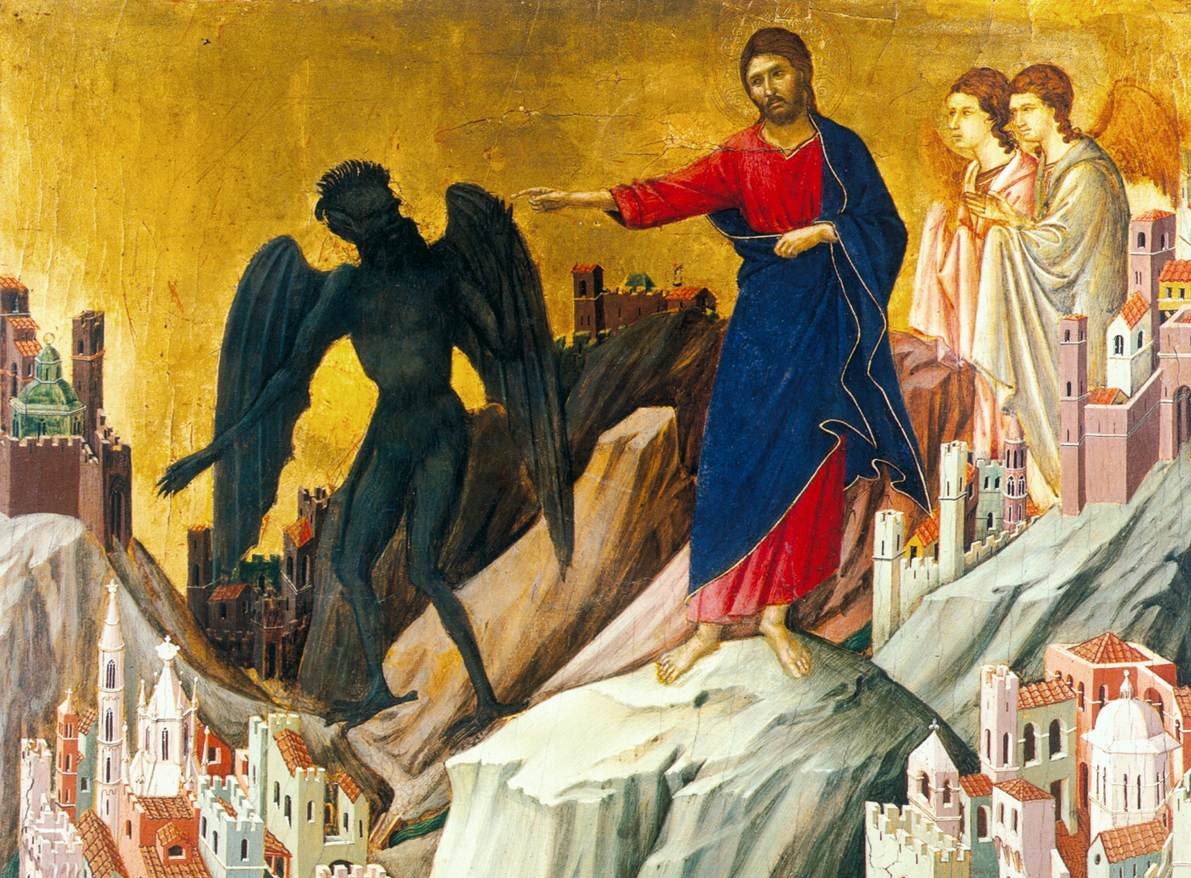
Today the gospel train pulls into “Temptation Station” and we are asked to consider some of life’s temptations. The three temptations faced by Jesus are surely on wide display in our own times. What are these temptations and how do we resist them?
In this desert scene, the Lord Jesus faces down three fundamental areas of temptation, all of which have one thing in common: they seek to substitute a couch for the cross.
In a way, the devil has one argument: “Why the cross?” His question is a rhetorical one. He wants you to blame God for the cross, and in your anger, to reject Him as some sort of despot.
Well, pay attention, Church! The cross comes from the fact that you and I, ratifying Adam and Eve’s choice, have rejected the tree of life in favor of the tree that brought death. We, along with the devil, may wish to wince at the cross and scornfully blame God for it, but in the end the cross was our choice.
If you think that you have never chosen the tree of death and that God is “unfair,” then prove to me that you have never sinned. Only if you can do that will I accept that you have never chosen the Tree of the Knowledge of Good and Evil over the Tree of Life and that you deserve something better than the cross. Only then will I accept that you have never insisted on “knowing” evil as well as good.
If you can’t, then you’ve made the same self-destructive, absurd choice that the rest of us have. It is not God that is cruel but we who are wicked and are to blame for the presence of the cross. The cross comes not from God but from us. We ought to stop blaming God for evil, suffering, and the cross, and instead look in the mirror. The glory of this gospel is that the Lord Jesus came into this twisted world of our making and endured its full absurdity for our sake. If there is evil in this world, it is our choice, not God’s.
Have we finished blaming God? Are we ready to focus on our own issues? If so then let’s look at some areas of temptation that the devil can exploit because we indulge them. Let’s also see the answer that the Lord Jesus has for these temptations; for He, though tempted, never yielded.
Pleasures and Passions – The devil encourages Jesus to turn stones into bread. After such a long fast, the thought of bread is surely a strong temptation. In effect, the devil tells Jesus to “scratch where it itches,” to indulge His desire, to give in to what His body craves.
We, too, have many desires and are told by the devil in many ways to “scratch where it itches.” Perhaps no generation before has faced such strong temptation. We live in a consumer culture that is highly skilled at eliciting and then satisfying our every desire. All day long, we are bombarded with advertisements that arouse desire and then advise us that we simply must fulfill those desires. If something is out of stock or unavailable in exactly the way we want at the instant we want it, we are indignant. Why should I have to wait? Why can’t I have it in that color? The advertiser’s basic message is that you can have it all. This is a lie, of course, but it is told so frequently that we feel entitled to just about everything.
Some of our biggest cultural problems are ones stemming from overindulgence. We are a culture that struggles with obesity, addiction, sexual misconduct, and greed. We experience overstimulation that robs us of a reasonable attention span; boredom is a significant issue for many who are too used to the frantic pace of video games and action movies. We have done well in turning stones into bread.
Jesus rebukes the devil, saying, Man does not live on bread alone. In other words, there are things that are just more important than bread and circuses, than creature comforts and indulgence. Elsewhere Jesus says, A man’s life does not consist in the abundance of his possessions (Lk 12:15). I have written further on this in another post: The Most Important Things in Life Aren’t Things.
Popularity and Power– Taking Jesus up a high mountain, the devil shows Him all the nations and people of the earth and promises them to Him if Jesus will but bow down and worship him. This is a temptation to both power and popularity; the devil promises Jesus not only sovereignty but glory.
Because most of us are not likely to become sovereigns and because temptation is only strong in those matters that seem remotely possible for us, I will focus instead on popularity—something we deal with regularly in this life. One of the deeper wounds in our soul is the extreme need that most of us have to be liked, to be popular, to be respected, and to fit in. We dread being laughed at, scorned, or ridiculed. We cannot stand the thought of feeling minimized in any way.
For many people the desire for popularity is so strong that they’ll do almost anything to attain it. It usually starts in youth, when peer pressure “causes” young people to do many foolish things. They may join gangs, get tattoos, pierce their bodies, and/or wear outlandish clothes. Many a young lady, desperate to have a boyfriend (and thus feel loved and/or impress her friends), will sleep with boys or do other inappropriate things in order to gain that “love.” As we get older, we might be tempted to bear false witness, to make “compromises” to advance our career, to lie to impress others, to spend money we don’t have to buy things we don’t really need, and/or to try to impress people whom we don’t even like. Likewise, we may be tempted to be silent when we should speak out for what is right.
All of this is a way of bowing before the devil, because it demonstrates that we are willing to sin in order to fit in, to advance, or to be popular. Jesus says, You shall worship the Lord, your God, and him alone shall you serve.
The real solution to this terrible temptation of popularity is to fear the Lord. When we fear God, we need fear no one else. If I can kneel before God I can stand before any man. If God is the only one we need to please, then we don’t have to expend effort trying to please anyone else. I have written more on this matter elsewhere: What Does It Mean to Fear the Lord?.
Presumption and Pride – Finally (for now) the devil encourages Jesus to test God’s love for Him by casting Himself off the highest wall of the Temple Mount. Does not Scripture say that God will rescue Him? The devil quotes Psalm 91: With their hands they will support you, lest you dash your foot against a stone. In our time the sin of presumption is epidemic.
Many people think that they can go one behaving sinfully, recklessly, and wantonly and that they will never face punishment. “God is love,” they boldly say. “He would never send people to Hell or punish them!” In saying this, they reject literally thousands of verses of Scripture that say otherwise; they have refashioned God and worship a man-made idol. “God doesn’t care whether I go to Church,” they claim. “He doesn’t mind if I live with my girlfriend.” The list of things God “doesn’t mind” continues to grow.
The attitude seems to be that no matter what I do, God will save me. It is presumptuous to speak or think like this. Hell and punishment are surely difficult teachings to fully comprehend and to reconcile with God’s patience and mercy, but He teaches of them and therefore we need to stop pretending He doesn’t.
I have written elsewhere on the topic of Hell and why it makes sense in the context of a God who loves and respects us: Hell Has to Be.
A mitigated form of presumption is procrastination, wherein we constantly put our return to the Lord out of our mind. About this tendency it is said,
There were three demons summoned by Satan as to their plan to entrap as many human beings as possible. The first demon announced that he would tell them there is no God. But Satan wasn’t too impressed. “You’ll get a few, but not many and even those atheists are mostly lying and know deep down inside that someone greater than they made them and all things.” The second demon said he would tell them there is no devil. But Satan said, “That won’t work, most of them have already met me and know my power.” Finally, the third demon said, “I will not tell them there is no God or no devil, I will simply tell them there is no hurry!” And Satan smiled an ugly grin and said, “You’re the man!”
Jesus rebukes the devil by quoting Deuteronomy:You shall not put the Lord, your God, to the test. We ought to be very careful about presumption, for it is widespread today.
This does not mean that we have to retreat into fear and scrupulosity. God loves us and is rich in mercy, but we cannot willfully go on calling “no big deal” what He calls sin. We should be sober about sin and call on the Lord’s mercy rather than doubting that we that really need it or just presuming that He doesn’t mind.
The train is leaving the station soon. I hope that we’ve all benefited from this brief stop and have stored up provisions for the journey ahead: insight, resolve, appreciation, understanding, determination, and hope.
The journey ahead is scenic but difficult and temptation is a reality, but as an old gospel song says, “The gospel train’s comin’, I hear it just at hand. I hear the car wheel rumblin’ and rollin’ thro’ the land. Get on board little children, get on board. There’s room for many more!”
The video below is an advertisement for the “depth control” feature in a smartphone camera. It enables the production of an image in which the essential part is emphasized by blurring the background.
We must learn to exhibit similar “depth control” in our own life. Indeed, much goes on in the background or far away. Life has many complexities; we need to decide where we should focus our attention, time, and energy. This is especially important in this age of non-stop communication and constant interruption. The 24/7 news features many stories about far away places or issues over which we have little control. We need to practice depth control by understanding what is ours and focusing on what we can personally do.
There may be a lot of foolishness in government or out in Hollywood, but I personally can’t do much about it. I can, however, work on my own life and speak the truth to people I know and love. I may not be able to fix politicians or celebrities, but I can work on fixing myself and helping those closest to me to do the same.
Simply shaking our heads and saying that the world is awful is not a solution. Depth control comes with knowing what part of the awful world has been assigned to me and my influence. We must focus there and leave the rest to God and those to whom he assigns pieces of it.
There are many references to “the flesh” in the New Testament, especially in the letters of St. Paul. The phrase is confusing to those who think it synonymous with the physical body. While Scripture many times uses the word “flesh” to refer to the physical body, when it is preceded by the definite article, it usually means something more. Only rarely does the biblical phrase “the flesh” (ἡ σὰρξ (he sarx), in Greek) refer only to the physical body (e.g., John 6:53, Phil 3:2, 1 John 4:2).
What, then, is meant by the term “the flesh”? Most plainly, it refers to the part of us that is alienated from God. It is the rebellious, unruly, and obstinate part of our inner self that is always operative. It is the part of us that does not want to be told what to do. It is stubborn, refuses correction, and does not want to have anything to do with God. It bristles at limits and rules. It recoils at anything that might cause one to be diminished or something less than the center of the universe. The flesh hates to be under authority or to yield to anything other than its own wishes and desires. It often wants something simply because it is forbidden. The Protestants often call the flesh our “sin nature,” which is not a bad definition. In Catholic tradition the flesh is where concupiscence sets up shop. Concupiscence refers to the strong inclination to sin that is within us as a result of the wound of original sin. If you do not think that your flesh is strong, just try to pray for five minutes and see how quickly your mind wants to think of anything but God. Just try to fast or be less selfish and watch how your flesh goes to war.
The flesh is in direct conflict with the spirit. The “spirit” here refers not to the Holy Spirit but to the human spirit. The (human) spirit is the part of us that is open to God, that desires Him and is drawn to Him. It is the part of us that is attracted by goodness, beauty, and truth; the part that yearns for completion in God; the part that longs to see His face. Without the spirit we would be totally turned in on ourselves and consumed by the flesh. Thank goodness our spirit, assisted by the Holy Spirit, draws us to desire what is best, upright, and helpful.
Let’s examine a few texts that reference “the flesh” and in so doing, learn more of its ways. This will help us to be on our guard, and by God’s grace to rebuke it and learn not to feed it.
The flesh does not grasp spiritual teachings. [Jesus said,] The Spirit gives life; the flesh counts for nothing. The words I have spoken to you are spirit and they are life (John 6:63).
Having heard Jesus’ teaching on the Eucharist, most of His listeners ridiculed it and will no longer take Him seriously. Jesus indicates that their hostility to the teaching is of the flesh. The flesh demands that everything be obvious to it on its own terms. The flesh demands to see physical proof for everything. It demands that it be able to “see” using its own power, and if it cannot see based on its own limited view it simply rejects spiritual truth out of hand. In effect, the flesh refuses to believe at all because what it really demands is something that will “force” it to accept something. Absolute proof takes things out of the realm of faith and trust. Faith is no longer necessary when something is absolutely proven and plainly visible to the eyes.
The flesh is not willing to depend on anyone or anything outside its own power or control. For it is we who are the circumcision, we who worship by the Spirit of God, who glory in Christ Jesus, and who put no confidence in the flesh—though I myself have reasons for such confidence. If anyone else thinks he has reasons to put confidence in the flesh, I have more: circumcised on the eighth day, of the people of Israel, of the tribe of Benjamin, a Hebrew of Hebrews; in regard to the law, a Pharisee; as for zeal, persecuting the church; as for legalistic righteousness, faultless. … I [now] consider this rubbish, that I may gain Christ and be found in him, not having a righteousness of my own that comes from the law, but that which is through faith in Christ (Phil 3:3-9 selected).
The flesh wants to be in control rather than to have to trust in God. Hence, it sets up its own observance, under its own control, and when it has met its own demands it declares itself to be righteous. Because the flesh hates being told what to do, it takes God’s law and makes it “manageable” based on its own terms. For example, if I’m supposed to love, let me limit it to my family or countrymen; I’m “allowed” to hate my enemy. Jesus says that we must love our enemy. The flesh recoils at this because unless the law is manageable and within the power of the flesh to accomplish it, the law cannot be controlled. The flesh trusts only in its own power. The Pharisees were “self-righteous.” That is to say, they believed in a righteousness that they themselves brought about through the power of their own flesh. The law and flesh cannot save, however; only Jesus Christ can save. The flesh refuses this and wants to control the outcome based on its own power and terms.
The flesh hates to be told what to do. For when we were controlled by the flesh, the sinful passions aroused by the law were at work in our bodies, so that we bore fruit for death (Rom 7:5).
The disobedience and rebelliousness of the flesh roots us in sinful behavior and a prideful attitude. The prideful attitude of the flesh is even more dangerous than the sins that flow from the flesh because pride precludes instruction in holiness and possible repentance that lead to life. The flesh does not like to be told what to do, so it rejects the testimony of the Church, the scriptures, and the conscience. Notice that according to this passage the very existence of God’s law arouses the passions of the flesh. The fact that something is forbidden makes the flesh want it all the more! This strong inclination to sin is in the flesh and comes from pride and from indignation at “being told what to do.” The flesh refuses God’s law and sets up its own rules. Yes, the flesh will not be told what to do.
Flesh is as flesh does.Those who live according to the flesh have their minds set on what the flesh desires; but those who live in accordance with the spirit have their minds set on what the spirit desires. The concern of the flesh is death, but the concern of the spirit is life and peace (Rom 8:5-6),
The flesh is intent on things of this world, on gratifying its own passions and desires. On account of the flesh, we are concerned primarily with ourselves and seek to be at the center. The flesh is turned primarily inward. St Augustine describes the human person in the flesh as incurvatus in se (turned in upon himself). The spirit is that part of us that looks outward toward God and opens us to the truth and holiness that God offers. Ultimately, the flesh is focused on death, for it is concerned with what is passing away: the body and the world. The human spirit is focused on life, for it focuses on God, who is life and light.
The flesh is intrinsically hostile to God. – The mind of the flesh is hostile to God. It does not submit to God’s law, nor can it do so. Those controlled by the flesh cannot please God (Rom 8:7-8).
The flesh is hostile to God because it is pridefully hostile to any one more important than itself. Further, the flesh does not like being told what to do. Hence, it despises authority or anyone who tries to tell it what to do. It cannot please God because it does not want to.
The flesh abuses freedom.You, my brothers, were called to be free. But do not use your freedom to indulge the flesh; rather, serve one another in love (Gal 5:13).
The flesh turns God-given freedom into licentiousness, demanding freedom without limits. Because the flesh does not like to be told what to do, it demands to be able to do whatever it wants. In effect, the flesh says, “I will do what I want to do, and I will decide if it is right or wrong.” This is licentiousness and it is an abuse of freedom. It results in indulgence and, paradoxically, leads to a slavery to the senses and the passions.
The flesh demands to be fed. So I say, live by the Spirit, and you will not gratify the desires of the flesh. For the flesh desires what is contrary to the Spirit, and the Spirit what is contrary to the sinful nature. They are in conflict with each other, so that you do not do what you want. (Gal 5:16-17).
Within the human person is this deep conflict between the flesh and the spirit. We must not be mistaken; the flesh is in us and it is strong. It has declared war on our spirit and on the Holy Spirit of God. When the spirit tries to obey, the flesh resists and tries to sabotage its best aspirations. We must be sober about this conflict and understand that this is why we often do not do what we know is right. The flesh must die and the spirit come more alive. What you feed, grows. If we feed the flesh it will grow. If we feed the spirit it will grow. What are you feeding? Are you sober about the power of the flesh? Do you feed your spirit well through God’s Word, Holy Communion, prayer, and the healing power of Confession? What are you feeding?
The flesh fuels sin. The acts of the flesh are obvious: sexual immorality, impurity and debauchery; idolatry and witchcraft; hatred, discord, jealousy, fits of rage, selfish ambition, dissensions, factions and envy; drunkenness, orgies, and the like. I warn you, as I did before, that those who live like this will not inherit the kingdom of God (Gal 5:19-210).
This catalogue of sins that flow from the flesh is not exhaustive but is representative of the offensive and obnoxious behaviors that arise from it. Be sober about the flesh; it produces ugly children.
So here is a portrait of “the flesh.” It is ugly. You may say I’m exaggerating, that the flesh is not really that bad—I’m not. Just look at the news and you can see what the flesh is up to. You may, by God’s grace, have seen a diminishment in the power of the flesh in your life. That is ultimately what God can and will do for us. He will put the flesh to death in us and bring alive our spirit by the power of his Holy Spirit.
The first step is to appreciate what the flesh is and understand its moves. The second is to bring this understanding to God through repentance. Step three is (by God’s grace) to stop feeding the flesh and start feeding the spirit with prayer, Scripture, Church teaching, Holy Communion, and Confession. The last step is to repeat the first three steps for the rest of our lives! God will cause the flesh to die and the spirit to live, by His grace at work in us through Jesus Christ.