“Just a Little While Longer…” – A Meditation on the Brevity and Urgency of Life

There is a passage in John 16 that is unusual for its repetition. This past Sunday it was the assigned Gospel in the Extraordinary Form of the Roman Rite. The expression “in a little while” is repeated seven times in the brief passage. Its repetition is almost to the point of being annoying, such that the reader is tempted to say, “All right, already. I get it!” Obviously, John, Jesus, and the Holy Spirit want to drill this point into us.

Let’s look at the whole passage:

Jesus went on to say, “In a little while you will see me no more, and then after a little while you will see me.” At this, some of his disciples said to one another, “What does he mean by saying, ‘In a little while you will see me no more, and then after a little while you will see me,’ and ‘Because I am going to the Father’?” They kept asking, “What does he mean by ‘a little while’? We don’t understand what he is saying.” Jesus saw that they wanted to ask him about this, so he said to them, “Are you asking one another what I meant when I said, ‘In a little while you will see me no more, and then after a little while you will see me’? Very truly I tell you, you will weep and mourn while the world rejoices. You will grieve, but your grief will turn to joy. A woman giving birth to a child has pain because her time has come; but when her baby is born she forgets the anguish because of her joy that a child is born into the world. So, with you: Now is your time of grief, but I will see you again and you will rejoice, and no one will take away your joy (John 16:16-22).

Do you get it? A little while! This text is a perfect illustration of the old expression repetitio mater studiorum (repetition is the mother of studies). We’re supposed to lay hold of this because it clearly was significant to the Lord.

The Greek word translated here as “a little while” is even more evocative of brevity. It is μικρὸν (mikron) which, at least in its English connotation, speaks of something very little.

Contextually, the Lord seems to be referring to the brief time between His death and His resurrection. Indeed, that time was brief. He was trying to prepare His disciples (in the hope?) that they might not lose faith and would be able to endure His passion. However, it seems that these and other words promising His resurrection “in a little while” (on the third day) had no real impact on them. All but John fled in fear, and all of them were astonished and incredulous at the resurrection when it first broke in to their reality.

In a more extended and pastoral context, the words of Jesus are also intended for us. He wants us to grasp that “in a little while” we will see Him.

This is a very important perspective for us to gain: life is short! This truth is both consoling and challenging.

It is consoling because whatever pain we are going through, we are going through it; if we are faithful, it is not our destination. Whatever the current difficulties, they will be over “in a little while.” An old African-American spiritual says, “Hold on just a little longer, everything’s gonna be all right.” Another says, “Trouble don’t last always.” As most of us who are a bit older know, life passes quickly—so very quickly. Whatever our troubles, they will be over in a little while. If we have been faithful, eternity dawns with far great glories than the trouble we have endured for just “a little while.”

We ought to expect that life here will be a little uncomfortable. We live in a paradise lost. We live in a fallen world, governed by a fallen angel, and we have fallen natures. We who are baptized now live in this world as strangers and aliens. We’re just passing through a world with strange customs and a strange language. We’re living out of a suitcase and have all the discomforts of travel. In a little while, though, we get to go home—if we but hold on to God’s unchanging hand.

Scripture speaks often of this aspect.

    • In all this you greatly rejoice, though now for a little while you may have had to suffer grief in all kinds of trials. These have come so that the proven genuineness of your faith—of greater worth than gold, which perishes even though refined by fire—may result in praise, glory and honor when Jesus Christ is revealed (1 Peter 1:6-7).
    • Therefore, we do not lose heart. Though outwardly we are wasting away, yet inwardly we are being renewed day by day. For our light and momentary troubles are achieving for us an eternal glory that far outweighs them all. So, we fix our eyes not on what is seen, but on what is unseen, since what is seen is temporary, but what is unseen is eternal (2 Cor 4:16-18).

We ought to be consoled by this perspective that whatever difficulties we’re currently going through will be over in a little while if we stay faithful. Meanwhile it is producing and storing up glory for you.

It is also challenging to consider the “little while” of this life. Simply put, you are going to die, and you don’t get to say when. You are not promised even the next beat of your heart. Tomorrow is not promised, so you’d better choose the Lord today. Do not delay your conversion to the Lord.

Life passes so very swiftly. I’ve been a priest for nearly 30 years now. Wow, how did that happen? I feel like I just got out of high school! Scripture says,

    • Our life is over like a sigh. Our span is seventy years, or eighty for those who are strong. And most of these are emptiness and pain. They pass swiftly, and we are gone (Ps 90:9-11).
    • But as for man, he is like the grass, of the flower of the field. The wind blows, and he is gone and his place never sees him again (Ps 103:15-16).
    • Remember your Creator—before the silver cord is severed, and the golden bowl is broken; before the pitcher is shattered at the spring, and the wheel broken at the well, and the dust returns to the ground it came from, and the spirit returns to God who gave it (Eccles 12: finis).

Yes, life passes quickly. For most of us, the memory of our existence will linger but a generation here on earth.

Here comes the challenge: Life is short—prepare for judgment. Scripture says,

    • It is appointed unto men once to die, and after this the judgment (Heb 9:27).
    • For we must all appear before the judgment seat of Christ, so that each of us may receive what is due us for the things done while in the body, whether good or bad (2 Cor 5:10).
    • Nothing in all creation is hidden from God’s sight. Everything is uncovered and laid bare before the eyes of him to whom we must give account (Heb 4:13).

Jesus also warns,

    • Be on guard! Be alert! You do not know when that time will come. It’s like a man going away: He leaves his house and puts his servants in charge, each with their assigned task, and tells the one at the door to keep watch. “Therefore, keep watch because you do not know when the owner of the house will come back—whether in the evening, or at midnight, or when the rooster crows, or at dawn. If he comes suddenly, do not let him find you sleeping! What I say to you, I say to everyone: ‘Watch!’” (Mark 13:33-37)
    • I am coming SOON; hold fast what you have, so that no one may seize your crown…. Behold, I am coming SOON, bringing my recompense, to repay everyone for what he has done (Rev 3:11; 22:12).

Yes, life is short, and in a little while we must report to the judgment seat of Christ for a very honest conversation. Prepare confidently, with faith but not presumption—which is a denial of the faith. The Lord has said that we must be sober, awake, and ready. In just a little while the moment will come. You will die, and you don’t get to say when. Get ready.

There it is, perspective. The consolation is that the troubles of this life pass in “a little while.” The challenge is to be ready, for in just a little while our time here is up and the question is called.

In a little while!

He who testifies to these things says, “Surely I am coming SOON.” Amen. Come, Lord Jesus! (Rev 22:20)

Cross-posted at the Catholic Standard: “Just a Little While Longer…” – A Meditation on the Brevity and Urgency of Life

A Word of Encouragement for Discouraged Cultural Warriors

It is, on occasion, discouraging to live in times like these. This appears to be the end of an era, at least in the West. Our culture used to be called Christian or Judeo-Christian. It was not sin-free by any means—there was still greed and there were various forms of oppressive justice—but Christ and the Scriptures were the basis for a consensus on fundamental moral norms. It is hard to argue that our sense of justice enshrined in law over the centuries does not have Christianity in large part to thank for this. Further, our vision that God created the world and imbued it with logic and laws that reason could discern opened the way to the natural sciences and elevated philosophy, the arts, and literature. The establishment by the Catholic Church of the great monasteries and universities helped advance and institutionalize all of this.

Ancient Europe was like a young bride with her Husband, Christ. The Modern West is more like an angry divorcée with little memory of what her Groom has done for her and a raw contempt for His vision. Preferring the darkness, many see the light of the true Christ as harsh and intrusive.

Yes, these are difficult days, and true Christians are often discouraged. Just when it seems our culture cannot become more confused and rebellious, we seem to stoop to a new low.

A reminder of the resilience of truth comes to us in the Office of Readings during this 6th Week of Easter. Evil and error have their day, or even their era, but the Word of the Lord remains forever. In Tuesday’s Office we read this passage:

I have seen the wicked triumphant,
towering like a cedar of Lebanon.
I passed by again; he was gone.
I searched; he was nowhere to be found.

See the just man, mark the upright,
for the peaceful man a future lies in store,
but sinners shall all be destroyed.
No future lies in store for the wicked.

Then wait for the Lord; keep to his way.
It is he who will free you from the wicked,
raise you up to possess the land
and see the wicked destroyed
(Psalm 37:35-40).

This truth of the passing of error and the perdurance of truth is verified by history. In the age of the Church, empires and nations, fashions and fads, errors and heresies—all have come and gone—and yet here we are, still, preaching the gospel. The Church has outlasted all her enemies; we have read the funeral rites over many who swore they would destroy us. Psalm 37 says it plainly: “No future lies in store for the wicked.” We are told simply to “wait for the Lord; keep to his way.”

In the Book of Hebrews, we read,

When God subjected all things to Christ, He left nothing outside of his control. Yet at present we do not see everything subject to him (Heb 2:8).

Even though we do not see it, the truth is that nothing is outside of the Lord’s control. How could it be? Even the darkest day of Christianity we call Good Friday. Why? Because even on that day of seeming disaster, when the assembled Church shrank to one apostle and four women, Jesus worked His greatest work. He made a way out of no way and in dying destroyed the power of death. He conquered pride by humility and disobedience by obedience. Satan fell right into the Lord’s trap; while he was running victory laps around the cross, Jesus entered his trophy room in Sheol and turned the place out.

Thus, although we do not always see all things subject to Christ, be assured that they are. He is Lord. Satan rages, but mostly because he knows his time is short. He is the “prince of this world,” but this world is passing away.

In the same Office of Readings for Tuesday of this week, we are admonished in this way:

Have no love for the world, nor the things that the world affords. If anyone loves the world, the Father’s love has no place in him, for nothing that the world affords comes from the Father. Carnal allurements, enticements for the eye, the life of empty show—all these are from the world. And the world with its seductions is passing away, but the man who does God’s will endures forever (1 John 2:14-17).

That’s right, “trouble don’t last always.” We may not live to see the passing of these current evils, but they will. The truth will out. Neither be fearful of the world nor fawning over its passing powers and glory, for it is passing. Whoever does the will of the Lord endures forever.

The world and those enamored of its evils laugh at and scorn us now, but if they do not repent, they are going to be very surprised. We must pray and work for the conversion of all, including ourselves, but do not be discouraged. God’s Word is clear: evil and error are passing, but the Word of the Lord endures forever.

Cross-posted at the Catholic Standard: A Word of Encouragement for Discouraged Cultural Warriors

Recent Pro-Life Laws Are Encouraging, but Is There Danger Ahead?

There is a “sorting” going on among the states of our nation on the issue of abortion. States are lining up on one side or the other as they did long ago around the Mason-Dixon line on the issue of slavery. In those times it was a divide that was largely between northern and southern states; today the split is between red (conservative) and blue (liberal) states.

The pro-abortion position has steadily become more radical: recent demands are for abortion with essentially no restriction right up to the moment of birth. The opening salvo in the escalating battle was fired earlier this year in New York, when Democrat Governor Andrew Cuomo signed the euphemistically named Reproductive Health Act into law, thereby enacting the most radical abortion legislation in the country—not coincidentally on the anniversary of the 1973 Roe v. Wade decision. In New York a woman may now legally abort her child even as he or she is about to be born!

Bills similar to the one in New York have advanced through legislative chambers in New Mexico, Rhode Island, and Vermont. So far this year, lawmakers in 13 left-leaning states have introduced bills to further protect access to abortion.

At the same time, legislators in conservative states have moved to pass laws limiting the so-called right to abortion. Earlier this month in Alabama, Republican Governor Kay Ivey signed into law the Alabama Human Life Protection Act, which bans abortion in nearly all cases. Efforts in Georgia, Kentucky, Missouri, Mississippi, and Ohio were a little less comprehensive, aiming instead to pass so-called “heartbeat bills” that effectively prohibit abortion beyond eight weeks of pregnancy. Utah and Arkansas voted to restrict abortion to the period before the middle of the second trimester. Other states permit abortion only until the fetus reaches viability, typically held to be 24 to 28 weeks of gestation.

Many analysts interpret the spate of state legislation to protect (or even increase) access to abortion as a response to the appointment of Brett Kavanaugh to the Supreme Court of the United States (SCOTUS). Indeed, after signing New York’s Reproductive Health Act, Governor Cuomo said, “we are sending the clear message that regardless of what happens in Washington, women in New York will always have the fundamental right to control their own body[sic]” [*].

I am heartened to see many states moving to implement more substantial limits on abortion. Simply put, abortion is the taking of an innocent human life, and I cannot see any circumstances (including rape or incest) in which the direct killing of the innocent should be legal, let alone celebrated as a “right.” Even though rape and incest are despicable crimes, the child conceived as a result did nothing wrong and should not be put to death. There are some rare cases in which efforts to save the life of the mother result in the death of her unborn child, but such a death is indirect and unintentional. Actions to save the life of the mother may be permitted even if they are likely to cause the baby to die, provided they are directed at saving the mother and not at killing the child.

There are two fundamentally different approaches to bringing about the end of legal abortion in the U.S. First, there is the incremental erosion method, by which the period during which an abortion may legally be obtained without restriction is shortened (e.g., via heartbeat bills that seek to reduce the unfettered access to abortion during the first trimester) or the restrictions on abortions during later months of pregnancy are increased.

The second approach is to challenge Roe v. Wade directly by enacting legislation outlawing abortion with few if any exceptions. This seems to be the tack taken in Alabama. Its Human Life Protection Act does not have an exception for either rape or incest; abortion is not permitted even prior to the first detectable fetal heartbeat. The only exception provided for is when the life of the mother is gravely endangered. For us purists, the Alabama law is a dream come true. We believe that what is wrong is wrong and that we should not compromise with evil. Some have called Alabama’s new law extremist, but this is somewhat ironic coming from those who do not think it extreme to dismember a living child in the womb.

Even if one believes (as I do) that the Alabama law is not extreme, there remains the prudential question of which method is likely to be more effective? It’s possible that some of the most liberal Supreme Court justices would relish ruling on the Alabama law, seeing it as an opportunity to reaffirm the Roe v. Wade decision.

A key factor in any SCOTUS ruling on abortion will be Associate Justice Brett Kavanaugh (and to a lesser degree Associate Justice Neil Gorsuch and Chief Justice John Roberts). I don’t think Kavanaugh is as conservative as either his supporters or detractors imagine, though others disagree (see here). Roberts’ positions have been unpredictable of late, and Gorsuch and Kavanaugh have each sided with the liberal wing of the Court on several occasions. Court watchers observe that the liberals on the Supreme Court (Associate Justices Ginsburg, Sotomayor, Kagan, and Breyer) vote together far more frequently than do the conservatives (Associate Justices Thomas, Alito, Gorsuch, and Kavanaugh) [**]. Roberts is known more as a slightly-right-of-center moderate, and his decisions lately have been particularly unpredictable.

Therefore, a showdown in the Supreme Court over the Alabama Human Life Protection Act has some people (including me) worried. If a current federal lawsuit to block implementation of the law succeeds, should Alabama continue to appeal all the way to the Supreme Court, or would it be better to forward to SCOTUS  a “heartbeat bill” that attempts to erode Roe v. Wade? I am not a legal expert, nor do I follow the courts closely, so I don’t know the best way to proceed. I am just a dedicated pro-lifer who wants to end, somehow, legal abortion in this country. I believe there are prudential judgments to be made in determining the best path to take.

Prudence is often misunderstood as mere caution or as hesitancy to act. While prudence does sometimes dictate caution, and hasty action is seldom prudent, there are times when it is prudent to act quickly and decisively. Sometimes a carefully planned, gradual approach is best but at others a quick denunciation or correction is in order. St. Thomas Aquinas said,It belongs to prudence chiefly to direct something to a right end; and this is not done aright unless both the end be good, and the means good and suitable” (Summa Theologica II, IIae 49.7, respondeo). Prudence, then, is the virtue that determines the best way forward and then commands the will to execute that approach.

Some of you readers do have legal and political backgrounds, so I ask for your opinions in this matter. Perhaps a few focal questions can guide us:

    • Do you think the Alabama Human Life Protection Act would be upheld by SCOTUS?
    • If you think the Alabama Human Life Protection Act would be struck down by SCOTUS, do you believe such a decision would make things worse by reaffirming Roe v. Wade as “settled law”?
    • Do you think battling Roe v. Wade using the “erosion method” (via heartbeat bills and the like) is the better approach, or is it just a cop out?
    • Do you think that rape and incest exceptions should be included in any laws for the sake of expediency even if, like me, you oppose them in principle?
    • Is there a group of national pro-life leaders and legal experts guiding the appeal process in all these different cases or is each state on its own?
    • Do you think SCOTUS likely to take multiple cases (i.e., rule on abortion-related laws from several states) or just one?
    • Is there good reason to be anxious about upcoming abortion-related case(s) before SCOTUS?
    • Can you envision any other scenarios that could play out when it comes to SCOTUS and the states?

I pose all these questions sincerely; they are in no way meant to be rhetorical. I do not know what the best approach is in the current climate. Part of what drives my concern is my fear that a strong reaffirmation of Roe v. Wade by SCOTUS would make future progress more difficult.

I would be most grateful if you would use the comments section to let me know what you think, particularly if you have expertise in this area. Please also pray for a change of hearts and an end to abortion in this world!

Cross-posted at the Catholic Standard: Recent Pro-Life Laws Are Encouraging, but Is There Danger Ahead?

Happiness is an Inside Job, As Seen in Scripture

In the first reading for Tuesday’s daily Mass there is a description of a remarkable event in the lives of Paul and Silas. Even more remarkable than the event itself is their reaction to it. Let’s pick up the story told in Acts:

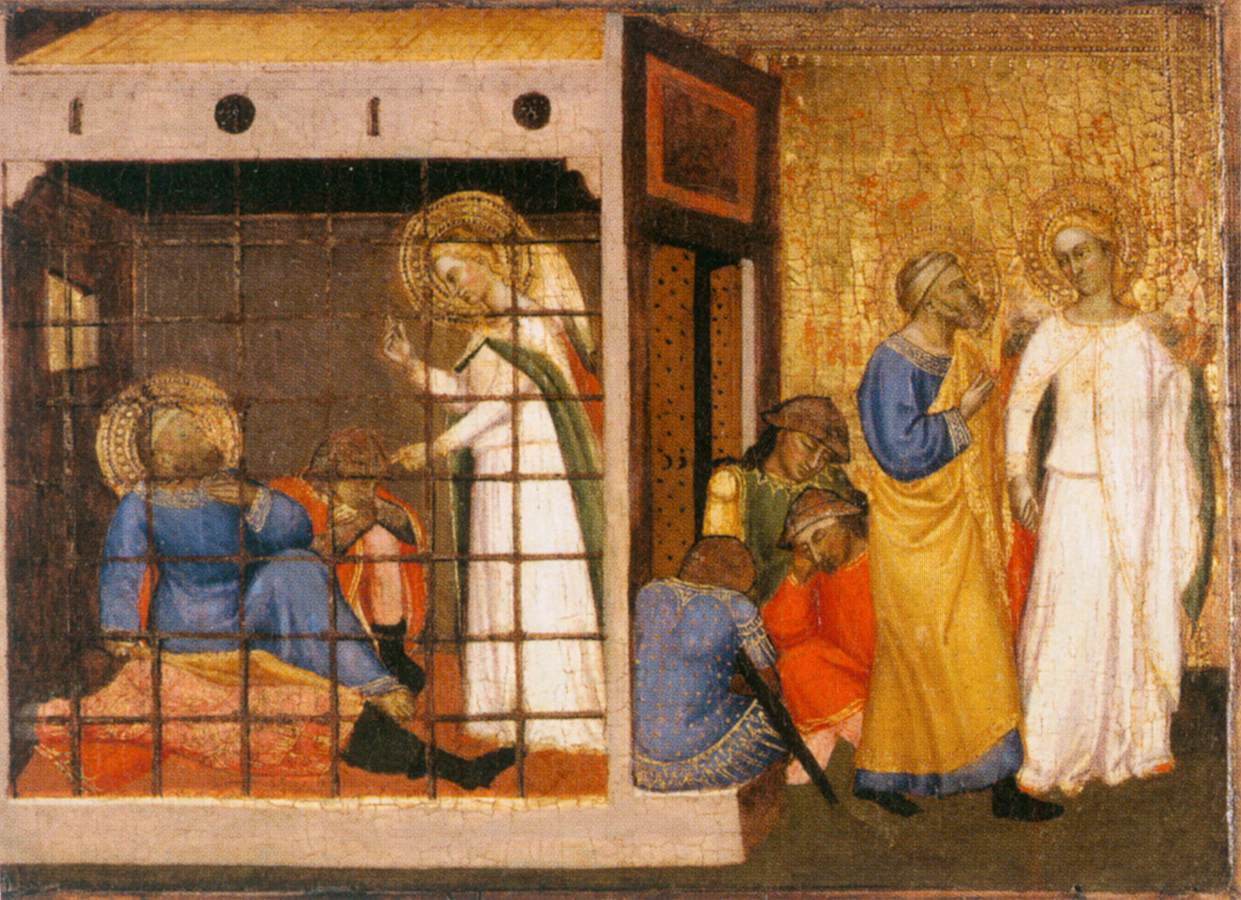
The crowd in Philippi joined in the attack on Paul and Silas, and the magistrates had them stripped and ordered them to be beaten with rods. After inflicting many blows on them, they threw them into prison and instructed the jailer to guard them securely. When he received these instructions, he put them in the innermost cell and secured their feet to a stake (Acts 16:22-25).

It is easy to read this passage and underestimate the severity of what happened. The two were beaten with rods. Such beatings varied in intensity, but because the jailer is later described as having to bathe their wounds, we can reasonably conclude that it was severe. Beatings like this one led to deep bruises and external bleeding, and often caused such things as internal bleeding, broken ribs, and trauma to internal organs.

After this severe beating, likely bloody and in extreme pain, Paul and Silas were bound by leg shackles and cast into the deepest and darkest cell of the prison. The cell likely contained rats and vermin and any water was likely contaminated with human waste.

All this would be enough to lead most people into despair and self-pity. Yet what do we find?

About midnight Paul and Silas were praying and singing hymns to God, and the other prisoners were listening to them (Acts 16:26).

Despite a terrible beating, severe pain, and horrible conditions, they were singing and praising God loudly enough for the other prisoners to hear.

Here is a remarkable teaching: happiness is an inside job. Paul and Silas, despite every physical discomfort, had a joy that could not be repressed or taken away. Their connection to God could not be severed.

Too often, we root our happiness in external matters such as money, esteem, and creature comforts. Yet many who have these things in abundance are still unhappy, while many who lack them are happy. Happiness goes deeper than external matters. There is a joy we can have that the world didn’t give and therefore cannot take away.

There are moments of sorrow and tension in every life, including mine, but deep down there is a stable serenity the Lord has given me for which I am overwhelmingly grateful. I have come to discover that deep inner place of peace, joy, and contentment—and it is largely unaffected by external factors.

There is a Greek word, μακάριοι (makarioi), which describes a kind of stable happiness or blessed state. The pagan Greeks used it to refer to the happiness of the gods, which was unaffected by worldly matters. Jesus takes up the verb form of the word in the beatitudes: Blessed are the poor in spirit, for the Kingdom of Heaven is theirs. In other words, stably blessed and happy are those who have their treasure in Heaven rather than in this passing and unstable world.

We should seek the gift of inner and stable happiness, the gift to be like Paul and Silas, the gift to bless the Lord at all times and in all circumstances. This, of course, is the “normal Christian life.” As Scripture says,

I will bless the LORD at all times: his praise shall continually be in my mouth (Psalm 34:1).

Paul himself says,

Though outwardly we are wasting away, yet inwardly we are being renewed day by day. For our light and momentary troubles are achieving for us an eternal glory that far outweighs them all. So we fix our eyes not on what is seen, but on what is unseen. For what is seen is temporary, but what is unseen is eternal (2 Cor 4:16-18).

Rejoice in the Lord always. I will say it again: Rejoice! (Phil 4:4).

Yes, the normal Christian life is one of joy that is largely unaffected by external events, joy that is accessible even in moments of sorrow, joy in which a consolation, difficult to describe, is always at work.

There are two final things to note in this passage, both of which show how Paul’s and Silas’ joy and confident disposition affected others. There is a saying, when I get better, others get better too. In other words, everyone affects those around him.

The first thing to note is the liberating power. The text says,

There was suddenly such a severe earthquake that the foundations of the jail shook; all the doors flew open, and the chains of all were pulled loose (Acts 16:27).

It is the role of the Christian to exude a joy and a confidence that liberates others from the prison cells of despair, sin, and depression.

Do people see you as a person of hope? Does your joy liberate and give confidence?

Second, note how the love manifested by Paul and Silas moves the jailer to repentance and conversion. The text says,

When the jailer woke up and saw the prison doors wide open, he drew his sword and was about to kill himself, thinking that the prisoners had escaped. But Paul shouted out in a loud voice, “Do no harm to yourself; we are all here.”

Consider that the jailer may well have been involved in beating Paul and Silas. The average person might be happy to see the jailer try to kill himself. Paul, however, calls out to try to save him, even at the risk of being imprisoned again. So moved is the jailer by this love and faith that he seeks immediate conversion. How has your love and reverence for life won the hearts of others?

Yes, happiness is an inside job. Here is a gift to be sought from God: an inner transformation and peace that is stable and largely unaffected by external things. What a gift this is to us, and to others around us, for when I get better, others get better, too!

https://youtu.be/8npoNOkXgb0

Cross-posted at the Catholic Standard: Happiness is an Inside Job, As Seen in Scripture

America, I Gave My Best to You – A Reflection on the Virtue of Patriotism

Love of one’s country, patriotism, is related to the fourth commandment. The Catechism of the Catholic Church teaches,

It is the duty of citizens to contribute to the good of society in a spirit of truth, justice, solidarity and freedom. The love and service of one’s country follow from the duty of gratitude and belong to the order of charity (CCC #2239).

Much of this is reflected in a beautiful song written for the Ken Burns series “The War.” It is called “American Anthem.” The lyrics are touching and moving. The central themes are just what the Catechism teaches: gratitude and the serving of the common good. Let’s explore some of the themes of this song on this Memorial Day of 2019.

The song begins in this way:

All we’ve been given
By those who came before
The dream of a nation
Where freedom would endure
The work and prayers
Of centuries
Have brought us to this day

We begin with gratitude. The works and prayers of centuries have brought us to this day. Each day we wake up in a land of beauty and plenty. We live in freedom because others died to win it and protect it. We drive on roads that others paved, make use of an electrical grid that others created and built. We depend on technologies that others developed. The Constitution, our legal system, civil society, the Church and her time-tested teachings—all these things and many more we have received from the hard work and ingenuity of others. Every day I am blessed to be able to walk into a beautiful church built by others.

Those who came before us were not sinless, but they exhibited bravery, virtue, perseverance, and patience in carefully setting forth a nation and a commonwealth that we often carelessly take for granted. When I ponder these things, I am overcome with gratitude.

The song also speaks of the dream of a nation in which freedom would endure. Today, many interpret freedom as the license to do whatever one pleases, but true freedom is the ability to obey God, live virtuously, and benefit from the fruits of that behavior: freedom from excess and the slavery to sin. It is only in this freedom, a freedom from self-absorption, that one can leave the sort of legacy of which the song next speaks:

What shall be our legacy?
What will our children say?
Let them say of me
I was one who believed
In sharing the blessings
I received
Let me know in my heart
When my days are through
America
America
I gave my best to you

Remember that America is not merely a nation-state or a legal entity—it is our patria, our homeland, from which we get the word “patriotism.” There is both a fatherly and motherly image we can derive from our country, America. We are sprung from its loins and nurtured in its womb. We have shared in its freely bestowed resources, taken our meals from its rich soils, and learned from the best of its teachings and traditions.

Thus, patriotism is a beautiful virtue linked to the fourth commandment “Honor thy father and thy mother.” Sadly, some people today dismiss the virtue of patriotism, calling it “nationalism” and portraying it as evidence of xenophobia. That some have exhibited extremes of patriotism does not remove the truth that patriotism is a virtue and is both commended to us and commanded of us. From it we derive a requirement to do our part to protect, preserve, and contribute to the common good. We are to leave a legacy that others will recognize, that we carried our share of the burden, that we did our very best for the land and people we are called to love.

Each generation from the plains
To distant shore
with the gifts they were given
Were determined
To leave more
Battles fought together
Acts of conscience fought alone
These are the seeds
From which America has grown

It is perhaps enough to simply do no harm or merely hand on what we received, but love is expansive. It leads us leave to our descendants more than we received. It is the American and human spirit to build on what is received, to bring things to greater perfection and beauty.

As the song mentions, we often do this by working together, but sometimes we must take up the lonely and often-despised role of the prophet summoning the nation to greater justice and holiness. Both traditions are needed. Many of us have had to raise our voices in protest at the straying of our land from its biblical roots, but this has been and is done out of love for our people and land, so that we attain to a greater and more perfect union.

For those who think
They have nothing to share
Who fear in their hearts
There is no hero there
Know each quiet act
Of dignity is
That which fortifies
The soul of a nation
That never die
s

Heroism is a highly visible virtue, but it is also the quiet, hidden acts of love and prayer that fortify the nation. Only if these daily acts are never dying can the soul of a nation hope to survive. It is the bigger and smaller things together that win the day: getting married and staying married, living virtuous lives, teaching our children well, working hard each day, contributing to the common good, forgiving yet also insisting, being patient yet also persistent. St. Augustine said, “A little thing is just a little thing, but to be faithful in a little thing is a great thing” (De Doctrina Christiana, IV,35).

On this Memorial Day, for us and all who love our Church and our land, may this be so:

Let them say of me
I was one who believed
In sharing the blessings
I received
Let me know in my heart
When my days are through
America
America
I gave my best to you

America
America
I gave my best to you.

Cross-posted at the Catholic Standard: America, I Gave My Best to You – A Reflection on the Virtue of Patriotism

Four Gifts of Grace – A Homily for the 6th Sunday of Easter

The Gospel for Sunday has a number of “sayings” of the Lord Jesus, which together amount to a kind of litany of love. It is a setting forth of the gifts that He, by His grace, is accomplishing and will accomplish in us. Let’s consider the wonderful gifts of grace.

I. PowerJesus said to His disciples, “Whoever loves me will keep my word.”

Here is a fundamental theology of grace: keeping the commandments and mandates of the Lord’s Word is the fruit of His love, not the cause of it. The Lord says that if you love Him, the keeping of the commandments is sure to follow. Note that we do not initiate this love, God does. Scripture says, We love because he first Loved us (1 John 4:19).

No one can give what he does not have, and no one can possess what he has not received. God is the author and initiator of love. Love always starts with Him. The Lord is not setting up some sort of loyalty test here, as if He were saying, “If you love me, prove it by keeping my commandments.” That is not the gospel! The gospel is that God loved us before we were ever born, before we could do anything to merit His love. He loved us when we were dead in our sins, and He took the initiative to love us even when we hated Him and crucified Him.

If we will accept this love, it will enable us to love God with the same love with which He loves us. With His love in us, we will begin to love what He loves and whom He loves. We will love holiness, forgiveness, mercy, justice, compassion, chastity, and generosity. We will love our brethren—even our enemies. Why? Because God loves them. When His love is in our heart, so is His love for them.

Do you understand this? Love enables us to keep His Word, to live it and to love it. When I was young, I dated a girl who liked square dancing. At the time, I thought square dancing was silly, but my love for her meant that I started to love what she loved; I came to love her family, too. If we let love have its way, it changes our heart and our desires.

If you let love have its way you will keep the commandments. The keeping of the commandments is the fruit of love, not its cause. Love is the power of grace at work in us to love what and whom God loves. Jesus says, If you love me, you will keep my commandments (John 14:15).

II. Presence – [Jesus says,] and my Father will love him, and we will come to him and make our dwelling with him.

One of Jesus’ great desires was to restore us to unity with the Father. Jesus was crazy about His Father and earnestly desired to have us know Him and love Him more deeply.

If we will but accept the Father’s love and His shalom, offered through Jesus, we will have a tender and joyful relationship with our Abba, our Father. Jesus often described His Father almost as doting. He is like a shepherd who leaves the 99 in search of the one. He is like a woman who loses a coin, sweeps diligently to find it, and then celebrates by throwing a party more costly than the coin itself. He is like a father whose son effectively tells him to “drop dead,” but who, when the son finally returns, runs out to meet him and has a feast in celebration.

Do you grasp this? The Father loves you and Jesus has reconciled you to Him. Now run to Him; run to Abba, God. If you take one step, He’ll take two, and then He’ll start running to embrace you!

This is the gospel message: Jesus Christ has reconciled us to the Father at the Father’s own request. The Father loves you. Now run to Him and watch Him run to you. He does not want distance; He wants intimate presence, love, and embrace.

III. Perfection – [Jesus says,] I have told you this while I am with you. The Advocate, the Holy Spirit, whom the Father will send in my name, will teach you everything and remind you of all that I told you.

We all know that the Christian journey is not accomplished in an instant. Rather, we make this journey with God, the Holy Spirit, who teaches us and makes us mindful of all that Jesus has done for us and taught us. Little by little, we are given a new mind, a new heart, a new walk, and a new and better life. May God who has begun a good work in bring it to perfection (cf Phil 1:6).

If we are open to Him, He is faithful, and He will do it. The process may be slow, but that is only because we have foreheads of brass and necks of iron (cf Is 48:4). God is faithful and patient. I am a witness; if He can change me, He can change you. He has promised to do so, and He will.

We will be transformed by the renewal of our mind (cf Rom 12:2), for the Holy Spirit will bring to our mind all that the Lord is and all that He taught. Let the Lord change your mind and heart. If He does that, the rest will follow. Sow a thought, reap a deed; sow a deed, reap a habit; sow a habit, reap a character; sow a character, reap a destiny—and it all begins with the mind.

One of the gifts of grace is the renewing of our mind, and it leads to total transformation.

IV. Peace – [Jesus says,] Peace I leave with you; my peace I give to you. Not as the world gives do I give it to you. Do not let your hearts be troubled or afraid. You heard me tell you, “I am going away, and I will come back to you.” If you loved me, you would rejoice that I am going to the Father; for the Father is greater than I. And now I have told you this before it happens, so that when it happens you may believe.

What is the gift of peace? Peace is shalom; it is more than the absence of conflict. It is the presence in the relationship of everything that should be there. Peace is the experience that everything is all right.

For us, peace is access once again to the Father. It is being able once again to walk with Him in love, in and through Jesus Christ. We don’t just walk with Him in some earthly garden paradise, as Adam and Eve did. Rather, we walk with Him in Heaven. In Jesus we are seated with the Father in honor at His right hand.

So, what does it mean when the same Jesus who said, “The Father and I are One” (Jn 10:30), also says, “The Father is greater than I” (Jn 14:28)?

Theologically, we can distinguish two ways of understanding this text. Many theologians emphasize that Jesus is referring to His human nature when he says, “The Father is greater than I.” As God, He is equal to His Father, but as man, He is less than His Father. Other theologians remind us that, even in terms of His divinity, the Father has a certain greatness as the source in the Trinity. All the members of the Trinity are co-eternal, co-equal, and equally divine, but the Father is the Principium Deitatis (the Principle of the Deity). The Father eternally begets the Son, the Son is eternally begotten, and the Holy Spirit proceeds from them both. Because Jesus proceeds from the Father from all eternity, He is in effect saying, “I delight that the Father is the principle of my being, even though I have no origin.”

Devotionally, Jesus is saying that He always does what pleases His Father. Jesus loves His Father. He’s crazy about Him. He’s always talking about Him and pointing to Him. By calling the Father greater, He in effect says, “I look to my Father for everything. I do what I see Him doing (Jn 5:19) and what I know pleases Him (Jn 5:30). His will and mine are one. What I will to do proceeds from Him. I do what I know accords with His will.”

This is the source of our peace. With Jesus, we love the Father and always do what pleases Him. Jesus “goes to the Father,” but He takes us with Him, for we are members of His mystical Body. In Jesus, we enter the holy of holies and sit next to the Father in love and intimacy.

Here, then, are some important gifts of grace. It is up to us to lay hold of them and to live out of them. The Lord promises them to us, so they are ours. If at times they seem distant, reach out and take back what the devil stole from you. These are gifts of the Lord’s resurrected grace.

This song that speaks of peace and presence, not to mention power:

Cross-posted at the Catholic Standard: Four Gifts of Grace – A Homily for the 6th Sunday of Easter

If It’s Too Quiet to Sleep, Maybe We Have a Problem

I am surprised at how many people tell me that they cannot fall asleep without the television or radio on in the background. This is surely a sign of being overstimulated. Spiritually, it creates a condition wherein we can barely hear the still, small voice of God. In Kings, we read,

Elijah heard, “Go out, and stand on the mountain before the Lord.” And behold, the Lord passed by, and a great and strong wind tore into the mountains and broke the rocks in pieces before the Lord, but the Lord was not in the wind; and after the wind an earthquake, but the Lord was not in the earthquake; and after the earthquake a fire, but the Lord was not in the fire; and after the fire a still, small voice. So it was, when Elijah heard it, that he wrapped his face in his mantle and went out and stood in the entrance of the cave. Suddenly a voice came to him, and said, “What are you doing here, Elijah?” (1 Kings 19:11-13)

Samuel also heard the whisper of God in the night:

For the third time, the LORD called to Samuel. He got up, went to Eli, and said, “Here I am, for you have called me.” Then Eli realized that it was the LORD who was calling the boy. “Go and lie down,” he said to Samuel, “and if He calls you, say, ‘Speak, LORD, for Your servant is listening.’” So Samuel went and lay down in his place. Then the LORD came and stood there, calling as before, “Samuel! Samuel!” And Samuel answered, “Speak, for Your servant is listening” (1 Sam 3:8-10).

The voice of the Lord can be lost in clamorous times. Many of us need to re-accustom ourselves to silence. We sometimes think to abstain from meat or wine, but do we ever consider abstaining from noise? Is not unplugging from the world for a time a sacrifice that might please God and bless us at the same time?

Psalm 74 says,

Arise, O God, and defend your cause!
Remember how the senseless revile you all the day.
Do not forget the clamor of your foes,
the daily, increasing uproar of your foes
.

Yes, Lord, from clamorous discord and distracting noise deliver us. Help us to find increasing joy in periods of holy silence. Our enemy, the devil, shouts and drones on. Lead us, O Lord, to quieter places; let us hear Your voice.

This commercial shows various people being lulled to sleep by the droning background noise from their smartphones.

https://youtu.be/rifsM9WCwII

Cross-posted at the Catholic Standard: If It’s Too Quiet to Sleep, Maybe We Have a Problem

Stages of Persecution

There are many ongoing attempts to erode religious liberty in the United States. In California, a bill has been introduced that would, in certain situations, compel priests to break the confessional seal (I would go to jail before I’d do that). The “Equality Act” (passed by the House of Representatives earlier this month and currently before the Senate) would add sexual orientation and the fanciful notion of “gender identity” to the set of characteristics currently protected by the Civil Rights Act (race, color, religion, sex, and national origin). In April, the 3rd U.S. Circuit Court of Appeals upheld the City of Philadelphia’s right to cease placing children into foster care through the Archdiocese of Philadelphia’s Catholic Social Services because the agency will not place children with same-sex couples.

With these and other similar situations in mind, we do well to review the stages of persecution. The term “stages” is particularly important in the U.S. because it is rare for a previously respected segment of the population to become reviled overnight. The typical process is that the descent progresses in stages that grow in intensity. In this way, the Catholic Church, once an esteemed institution in America (along with other Christian denominations), has become increasingly marginalized and now even hated by many. It may help us to consider the five stages of persecution because it seems that things are going to get more difficult for the Church in the years ahead.

I. Stereotyping the targeted group – To stereotype means to apply an overly simplistic belief about a group of people to each individual person in that class.

As the 1960s and 1970s progressed, Christians were often caricatured as Bible-thumpers, simpletons, haters of science, and hypocrites; they were frequently labeled self-righteous, old-fashioned, and backwards.

Catholics in particular were also accused of having neurotic feelings of guilt and a hatred of or aversion to sexuality. We were denounced as a sexist institution and called authoritarian, stuck in the past, and hung up on restrictive rules.

According to the stereotype, Catholics and Bible-believing Christians are a sad, angry, boring, backward, repressed lot. To many who accept the stereotype, we are a laughable—even tragic—group caught in a superstitious past, incapable of throwing off the “shackles” of faith.

As with any large group, individual Christians and Catholics may manifest some negative traits, but indiscriminately presuming the characteristics of a few to be common to all is unjust.

To be sure, not everyone engages in this stereotyping, and even among those who do the degree varies, but the climate created by its presence sets the foundation for the next stage of persecution.

II. Vilifying the targeted group for alleged crimes or misconduct

As the stereotyping grew in intensity, Catholics and Christians who did not go along with the cultural revolution were described as closed-minded, harmful to human dignity and freedom, intolerant, hateful, bigoted, unfair, homophobic, and/or reactionary—basically, bad people.

The history of the Church is also described myopically as little more than a litany of bad and repressive behavior: going on crusades, conducting inquisitions, and hating Galileo and all science. Never mind that there might be a little more to our history: founding universities and hospitals, patronizing the arts, and preaching a gospel that brought order and civilization to the divided and barbaric times that followed the fall of the Roman Empire. Our critics won’t hear any of that, or if they do will give the credit to anyone or anything except the Church and our faith.

All of this has the effect of creating a self-righteous indignation toward believers and of making anti-Catholic and anti-Christian attitudes a permissible bigotry.

III. Marginalizing the targeted group’s role in society

Having established the (false) premise that the Church and the faith are bad—even harmful to human dignity and freedom—the next stage is to relegate the role of the Church in society to the periphery.

To many in our secularized culture, religion is seen as something that must go. Perhaps we will be allowed to sing our hymns and preach our sermons within the four walls of our churches, but the faith must be banished from the public square.

It has become increasingly unacceptable and intolerable that anyone should mention God, pray in public, or in any way bring the Christian faith to bear on matters of public policy. Nativity sets must go; out with Christmas trees. There have even been some public schools that forbade the use of the colors red and green during the “Holiday Season”!

Do not even think about mentioning Jesus or thanking Him in your graduation speech; you may be forbidden to do so under penalty of law. You may talk about Madonna the singer but not the Madonna.

In contrast, the Gay-Straight Alliance club at the local high school is welcome to pass out rainbow-colored condoms to the students. Muslims strangely get a pass but not Christians. No Bibles or Christian-themed pamphlets had better see the light of day anywhere in the school building—separation of Church and State, you know.

IV. Criminalizing the targeted group or its works

Recent attempts to compel us to violate our teachings and consciences are noted above, but there have been many other times we have had to go to court to fight for our right to practice our faith openly. An increasing amount of litigation is being directed against the Church and other Christians for daring to live out our faith.

Some jurisdictions have sought to compel Catholic hospitals and pro-life clinics to provide information about and/or referrals to abortion clinics or to supply “emergency contraception” (i.e., the abortifacient known as the morning-after pill). In 2009, the State of Connecticut sought to regulate the structure, organization, and administration of Catholic parishes. A number of Christian students in various states have suffered legal injunctions when it was discovered that they planned to mention God and/or Jesus in their graduation addresses. (More details can be found here.)

A good number of those involved in these clashes feel quite righteous and justified in their efforts to remove the practice of the faith from the public square.

Many of these attempts to criminalize the faith have been successfully rebuffed in the courts, but the number and frequency of the lawsuits and the time and cost involved in fighting them impose a huge burden. It is clear that attempts to criminalize Christian behavior pose a growing threat to religious liberty.

V. Persecuting the targeted group outright

If current trends continue, Christians, especially religious leaders, may face fines and/or incarceration.

In Canada and in parts of Europe, Catholic clergy have been arrested and charged with “hate crimes” for preaching Catholic doctrine on homosexual activity.

In our country there are greater protections for free speech, but there has been a steady erosion of religious freedom; some have had to spend long periods in court defending basic religious liberty. The trajectory points to suffering, lawsuits, fines, and ultimately prison.

Unlikely, you say? Alarmist? Well, stages one through four seem to be firmly in place. One may wish to “whistle past the graveyard,” but it looks to me as if we’re headed for stage five.

Maybe a heavy post could use the accompaniment of a lighthearted video. This animated retelling of Acts 16 is so bad it’s good!

Cross-posted at the Catholic Standard: Stages of Persecution