
The Love of the Law and the Law of Love – A Homily for the 22nd Sunday of the Year

The LawToday’s readings teach a proper understanding of the Law and its relationship to our hearts. The readings go a long way toward addressing the false dichotomy that many set up between love and law, as though the two were opposed; they are not. For if we love God, we want what He wants and love what He loves. And the Law goes a long way toward describing what God wants and loves. Indeed, the Law is letting love have its way.

God is Love and His Law (no matter how averse we are to “rules”) is ultimately an expression of His love. In all of the readings today God asks (even as He commands it) that we let love have its way. Let’s look at four teachings on the relationship of Law to God, who is Love.

I. The PROTECTION of the Law – Note that the text from today’s first reading frames the Law, and the obedient hearing of it, in terms of a promise of God, seeing the Law as a doorway to the loving blessings and promises of God. The text says, Moses said to the people: “Now, Israel, hear the statutes and decrees which I am teaching you to observe, that you may live, and may enter in and take possession of the land which the LORD, the God of your fathers, is giving you.”

So the Law comes with a promise. It is the basis of life and the doorway to the further blessings of the land. Many today see God’s Law as prison walls, as a limitation on our freedom to “do as we please.” But the walls are not prison walls; they are defending walls.

Every ancient city had walls, not to imprison its citizens, but to protect them from the enemy. Within the walls there was security and the promise of protection. Outside the walls lurked danger; there were no promises of safety.

It is like this with God’s Laws. For those who keep them, they are a great source of protection and also contain the promise of ultimate victory. But outside this protective wall there is every danger and no promise of victory.

In his famous book Orthodoxy, G.K. Chesterton wrote,

Catholic doctrine and discipline may be walls; but they are the walls of a playground … We might fancy some children playing on the flat grassy top of some tall island in the sea. So long as there was a wall round the cliff’s edge they could fling themselves into every frantic game and make the place the noisiest of nurseries. But the walls were knocked down, leaving the naked peril of the precipice. They did not fall over; but when their friends returned to them they were all huddled in terror in the center of the island; and their song had ceased. [1]

God didn’t give the Law to take away our fun, but that we might find life and happiness. The devil, of course, is a liar; he tells us that we’ll be happier if we sin, that God is limiting our freedom by hemming us in with His Law. But sin does not make us free. Jesus says, Truly, truly, I say to you, every one who commits sin is a slave to sin (John 8:34). Indeed, how much suffering and pain would vanish if we all just kept the commandments? Most of our wounds are self-inflicted, by insisting on journeying outside the walls of God’s loving and protecting commandments.

Moses reminds us that our decision for or against the Law brings either blessing or curse:

See, I set before you today life and prosperity, death and destruction. For I command you today to love the LORD your God, to walk in his ways, and to keep his commands, decrees and laws; then you will live and increase, and the LORD your God will bless you in the land you are entering to possess. But if your heart turns away and you are not obedient, and if you are drawn away to bow down to other gods and worship them, I declare to you this day that you will certainly be destroyed. You will not live long in the land you are crossing the Jordan to enter and possess. This day I call heaven and earth as witnesses against you that I have set before you life and death, blessings and curses. Now choose life, so that you and your children may live and that you may love the LORD your God, listen to his voice, and hold fast to him. For the LORD is your life, and he will give you many years in the land he swore to give to your fathers, Abraham, Isaac and Jacob (Deut 30:15-20).

II. The PRECISION of the Law – Regarding the Law of God, Moses says, In your observance of the commandments of the LORD, your God, which I enjoin upon you, you shall not add to what I command you nor subtract from it.

Here we might the Law to be like a set of directions to a destination. If you give me directions to get to your house, I am probably not going to get there if I only follow half of the directions. The compliance must be complete to bring me to the right place. And so we are directed the follow the Law of God wholly. Scripture says elsewhere,

  • Instruct me O Lord, in the way of your statutes, that I may exactly observe them (Ps 119:33).
  • I intend in my heart to fulfill your statutes always to the letter. I have no love for half-hearted men, my love is for your law (Ps 119:112-113).
  • For whoever keeps the whole law and yet stumbles at just one point is guilty of breaking all of it (James 2:10).

Here we must see God as a healer who is not exacting and precise for His sake, but for ours. Imagine a man who goes to a doctor with two broken legs and the doctor says, “We’re gonna aim for 50% here. I’ll set one leg but leave the other one broken. But don’t worry about the broken leg; that’s why God gave you two!” We would surely hold such a doctor in contempt. God, who is our healer, points to full health, not crippled or partial health.

When Jesus says, You, therefore, must be perfect, as your heavenly Father is perfect (Matt 5:48), He is indicating the kind of healing He offers. And St. Paul adds, [God who] began a good work in you will carry it on to completion until the day of Christ Jesus (Phil 1:6).

Thus the precision of the Law is taught to indicate the healing power of God’s law with grace.

III. The PRIORITY of the Law – In today’s gospel, Jesus rebukes the Scribes and Pharisees saying, “[You] teach as doctrines human precepts. You disregard God’s commandment but cling to human tradition.”

Now, as then, many set aside the priority of God’s Law in favor of human thinking. Politics has become a pernicious influence in this regard. Many Catholics of both parties are more passionate about their political views than about God’s teachings as revealed through Scripture and Church teaching. And if there is a conflict between what God teaches and the political party view, guess which gives way and which gets unexamined allegiance?

Be it questions of abortion, immigration, or same-sex “marriage,” all too easily Catholics will turn a deaf ear to what God teaches, never rebuking their own party when correction is needed, and even cheering as their political leaders champion positions contrary to God’s Law. Too many Catholics place political priorities and popularity, human traditions and agenda, over God’s Law.

The Lord Jesus goes on to say, Well did Isaiah prophesy about you hypocrites, as it is written: This people honors me with their lips, but their hearts are far from me; in vain do they worship me. He says elsewhere, [you] make void the word of God through your tradition which you hand on. And many such things you do (Mk 7:13).

Be very careful; the pernicious effects of partisan political thinking, worldviews, and mere cultural preferences have caused too many Catholics to cease to be the leaven, the prophetic voice they are supposed to be in this world. All of the political parties, most worldviews, and many cultural trends need purification. A Catholic must be a Catholic before he is a Democrat, a Republican, or a Libertarian; before he is a fan of a Hollywood star or musician; before he touts the latest trend or raves about the most recent bestselling book. None of these things usually stand blameless before God, and the unquestioning, unqualified, and silent allegiance from Catholics and other Christians toward such worldly things is a huge problem today. We are too easily compromised and have often elevated human teachings and movements above God’s Law.

To all of this, the Lord gives rebuke and reminds us that His Law must the standard by which every other thing is judged. A Christian should see everything by the Light of God’s Law, exposing error and evil, approving goodness and truth wherever they are found. Nothing has priority over what God teaches.

In the end it is a question of what and whom we love more: God and His Law, or this world and its ways of sin and compromise.

IV. The PLACE of the Law – The Lord goes on to indicate that our fundamental problem can be that the Law of God is not in our heart. He warns that the heart, since it is the locus of human decision and action, must be the place of His Law for us. The Lord says, Hear me, all of you, and understand. Nothing that enters one from outside can defile that person; but the things that come out from within are what defile. From within people, from their hearts, come evil thoughts, unchastity, theft, murder, adultery, greed, malice, deceit, licentiousness, envy, blasphemy, arrogance, folly. All these evils come from within and they defile.

Hence there is the need to have God’s law in our heart. It is not enough to have a cursory and intellectual awareness of God’s Law. The Law must drop the 15 inches from the intellect to the heart.

And what is the human heart? While there ambiguities in the biblical text distinguishing mind and heart, this much is clear: the heart is the deepest part of the human person, the place where we are alone with our thoughts and deliberations. The heart is the place where we discern, ponder, and ultimately decide. The heart is “where we live.” It is in this deepest part of ourselves that the Law of God must find a home.

Jesus makes it clear that it is from the deep heart of the individual that come forth the behaviors that determine our character and our destiny. It is here that the Law of God must find a home. And it will only find a deep home here through prayer and meditation; through the careful, persistent, and thoughtful reading of God’s revealed truth, coupled with gratitude and love of God.

It is no mistake that the summary of God’s Law is simply, “Love the Lord the your God with all your heart and your neighbor as your very self.” For it is only love that unlocks the door of our heart. And in loving God we begin to love what and whom He loves. To love God is to love His Law. Scripture says,

  • My soul is consumed with longing for your laws at all times (Ps 119:20).
  • Your statutes are my delight; they are my counselors (Ps 119:24 24).
  • The law from your mouth is more precious to me than thousands of pieces of silver and gold (Ps 119:72).
  • For I love your commands more than gold, however fine (Ps 119:127).
  • I open my mouth and sigh, longing for your commands (Ps 119:131).

Yes, in the end, the Law comes from Love, the God of Love, who is Love. And thus it is love that unlocks the Law, love that makes us realize that the Law is a gift of God’s love. He gives us His law in order to protect us, precisely guide us, and heal us. Thus He asks us to make His Law a wholehearted priority.

Love the Law and come to experience the Love that the Law is.

This song says,

We need to hear from you
We need a word from you
If we don’t hear from you
What will we do?
Wanting you more each day
Show us your perfect way
There is no other way
That we can live

Destruction is now is now in view
Seems the world has forgotten all about you
Children are crying and people are dying
They’re lost without you, so lost without you
But you said if we seek
Lord if we seek your face
And turn from our wicked, our wicked ways
You promised to heal our land
Father you can!


Faith or Famine – A Homily for the 19th Sunday of the Year

Blog 8-8-2015

08082015

The gospel today amounts to a summons to faith by Jesus. In particular, He is summoning us to faith in Him and in the truth He proclaims about His presence in the Holy Eucharist. Last week’s gospel ended with Jesus declaring that He is the bread that has come down from Heaven. Today’s gospel opens with the Jewish listeners grumbling about Jesus’ claim to have come from Heaven. Throughout the gospel, Jesus stands firm in His call to faith. He teaches them about the necessity of faith, its origins, and its fruits. Let’s learn of what the Lord teaches us in four stages.

I. The Focus of Faith – The gospel opens with the grumbling of the crowds, since Jesus claims to have come from Heaven: The Jews murmured about Jesus because he said, “I am the bread that came down from heaven,” and they said, “Is this not Jesus, the son of Joseph? Do we not know his father and mother? Then how can he say, ‘I have come down from heaven’?”

Their lack of faith is a scandal. It also shifts our focus to the need for faith and yet how difficult it is to have faith. Both the scandal and the difficulty are illustrated in the background to the crowd’s lack of faith.

First, recall that Jesus had just fed over 20,000 people with five loaves and two fishes, and there were still 12 baskets full of leftovers. It was this very miracle that caused many of them to follow Him when He went to the other side of the lake. All the miracles Jesus worked were meant to summon people to faith and to provide evidence for the truth of His words. Jesus said elsewhere, … for the works which the Father has granted me to accomplish, these very works which I am doing, bear me witness that the Father has sent me (John 5:36).

Thus their lack of faith, their grumbling and murmuring, was scandalous. The multiplication of the loaves and fishes was not the first miracle he had worked, nor would it be the last. Recall that he had also

changed water into wine, healed lepers, healed the centurion’s servant, cast out numerous demons, healed the lame, healed the woman with the hemorrhage, raised Jairus’ daughter, cast out blindness in numerous individuals (one of them blind since birth), cured the man with a withered hand, walked on the water, calmed storms at sea, fed 4000, fed 5000, healed the deaf and mute, caused miraculous catches of fish, raised the widow’s son, and raised Lazarus.

So the question is, what are they (we) going to focus on? What Jesus does, or where he’s from? It seems clear that they are more focused on His human origins: where He is from and who His human kin are.

Similarly, many today seem focused on the human dimensions of the Church, or the foibles of believers, or even on their own personal struggles. How many put their focus on what God is doing, or on the many daily miracles of simple existence, or on the many ways that even defeats become victories?

Where your focus? On mere human things? But what if the focus is on God, and that God is worthy? Is faith your focus? We can see why Jesus focuses on faith, because, frankly, we are a hard case and our faith needs to grow.

II. The Font of Faith – Noting their lack of faith, Jesus rebukes them in these words: Stop murmuring among yourselves. No one can come to me unless the Father who sent me draws him, and I will raise him on the last day. It is written in the prophets: They shall all be taught by God. Everyone who listens to my Father and learns from him comes to me.

Jesus here teaches two things: that our faith in Him comes from the Father, and that we are a hard case.

First, Jesus teaches that His Father is the source of our faith in Him. Scripture elsewhere teaches this truth.

  1. For by grace are ye saved through faith; and that not of yourselves: it is the gift of God (Eph 2:8).
  2. This is my beloved son, listen to him (Matt 3:17).
  3. But the testimony which I have is greater than that of John; for the works which the Father has granted me to accomplish, these very works which I am doing, bear me witness that the Father has sent me. 37 And the Father who sent me has himself borne witness to me (John 5:36).
  4. I bear witness to myself, and the Father who sent me bears witness to me (John 8:18).

Here, then, is the central work of the Father: to save us by drawing us to faith in His Son, whom He sent to redeem the world.

But Jesus also teaches that this work of God generally involves dealing with considerable resistance on our part. And this fact is evident in the wording that Jesus uses, namely, that the Father must “draw” us to the Son. The Greek word here is ἑλκύσῃ (helkuse), which means to drag, draw, pull, or persuade; it always implies some kind of resistance from what is being drawn or dragged. For example, this is also the word used in John 21:6 when describing drawing a heavily laden net to shore.

Thus Jesus points to their (our) stubbornness in coming to faith. We are stubborn and stiff-necked, so the Father has to exert effort in order to draw—yes, even drag—us to Jesus.

Yes, we’re a hard case and we have to be “drug.”  Someone once said,

I had a drug problem when I was young: I was drug to church on Sunday morning. I was drug to church for weddings and funerals. I was drug to family reunions and community socials no matter the weather. I was drug by my ears when I was disrespectful to adults. I was also drug to the woodshed when I disobeyed my parents, told a lie, brought home a bad report card, did not speak with respect, or spoke ill of the teacher or the preacher. Or if I didn’t put forth my best effort in everything that was asked of me. I was drug to the kitchen sink to have my mouth washed out with soap if I uttered a profane four-letter word. I was drug out to pull weeds in mom’s garden and flower beds and to do my chores. I was drug to the homes of family, friends, and neighbors to help out some poor soul who had no one to mow the yard, repair the clothesline, or chop some firewood. And if my mother had ever known that I took a single dime as a tip for this kindness, she would have drug me back to the wood shed. Those drugs are still in my veins and they affect my behavior in everything I do, say, and think. They are stronger than cocaine, crack, or heroin, and if today’s children had this kind of drug problem, America might be a better place today.

III. The Functioning and Fruit of Faith – Jesus goes on to teach about how faith functions and what its fruit is: Amen, amen, I say to you, whoever believes has eternal life.

First, as regards the functioning of faith, the Greek text is more clear than our English translation. The Greek word here for “believes” is πιστεύων (pisteuon), a present, active participle. This construction signifies an ongoing action and is better translated as “He who goes on believing …” or “He who is believing …”

The danger is that we reduce faith to an event or to an act. Thus, some say that they answered an altar call, others point to their baptism. Good. But what is going on now, today? What is prescribed here by the Lord is lasting, ongoing faith. It is a lasting faith because faith is more than an event; it is an ongoing reality. It is more than something you have; it is something you do, daily. It involves leaning on and trusting in God. It is basing our whole life on His Word, the daily obedience of faith.

Scripture says elsewhere of this ongoing necessity for faith,

  1. But you must hold fast to faith, be firmly grounded and steadfast in it. Unshaken in the hope promised you by the gospel you have heard (Col 1:21ff).
  2. Brethren I want to remind you of the gospel I preached to you, which you received and in which you stand firm. You are being saved by it at this very moment provided you hold fast to it as I preached it to you. Otherwise you have believed in vain (1 Cor 15:1).
  3. He who perseveres to the end will be saved (Matt 24:13).

Jesus, having taught of the ongoing quality of faith, also speaks of its fruit, which is “eternal life.” Here, too, we have to move beyond reductionist notions of what is meant by eternal life.

The Christian use of the word “eternal” does not refer only to the length of life but also to its fullness. The Greek word here that is translated as “eternal” is αἰώνιος (aionios–where we get the English word Aeon). And aiṓnios, according the Greek lexicon of Scripture, does not focus on the future per se, but rather on the quality of the age. 

Note, too, that the Greek word translated here as “has” is ἔχει (echei) and is a present, indicative, active verb. Thus, it does not refer only to something that we will have, but something that we now have. So believers live in “eternal life” right now, experiencing this quality of God’s life now, as a present possession. And while we do not now enjoy it fully, as we will in Heaven, we do have it now and it is growing within us.

Thus, Jesus teaches that the believer enjoys the fullness of life, even now, in a growing way, day by day. One day we, too, will enjoy the fullness of life, to the top, in Heaven.

Here then is Jesus’ teaching on the functioning of faith (its ongoing quality) and the fruit of faith (eternal life, i.e., the fullness of life).

IV. The Food of Faith – Having set forth the necessity of faith, Jesus now prepares to turn up the heat a bit and test their faith. Not only has he come from Heaven, but He is Bread that they must eat; and the bread is His flesh. He says to them, Your ancestors ate the manna in the desert, but they died, but this is the bread that comes down from heaven so that one may eat it and not die. I am the living bread that came down from heaven; whoever eats this bread will live forever; and the bread that I will give is my flesh for the life of the world.

Now this final verse points to next week’s Gospel, in which this concept will be developed more fully and graphically. But in effect, having warned them of the necessity of faith, Jesus now points to one of His most essential teachings: the Holy Eucharist, the Sacrament of His Body and Blood.

Without faith, they (we) can neither grasp nor accept this teaching. And, as we shall see next week, most of them turned away from Him and would no longer follow Him, because they could not accept what He was saying. They did not have the faith to trust Him in this matter; they scoffed and left Him. We will discuss this more fully next week as John 6 continues to unfold for us.

But for now let the Lord ask you, “Do you have faith to believe what I teach you on this?” Perhaps we can say, with the centurion, “I do believe; help my unbelief.” Or we can join with the Apostles, who said, “Increase our faith!” Or we can say with St. Thomas Aquinas,

Visus, tactus, gustus in te fallitur (sight, touch, and taste, in thee fail)
Sed auditu solo tuto creditur. (But only the hearing is safely believed.)
Credo quidquid dixit Dei Filius; (I believe whatever the Son of God says.)
Nil hoc verbo veritátis verius. (Nothing is more true than this word of truth.)

But in the end, either we will have faith or we will be famished. Either we will have the faith to approach the Lord’s table or we will go unfed. Jesus says later, Unless you eat the flesh of the Son of Man and drink his Blood, you have no life in you (John 6:53). In other words, we starve spiritually without the faith that brings us to God’s table.

Behold how few come to the Lord’s table in these times, in these days which so lack in faith. It is estimated that only 27% of American Catholics today go to Mass. If we have faith in the Eucharist, how can we stay away? We cannot. To the degree that we believe, we will not miss a Sunday Mass; our devotion to the Lord will increase daily and our experience of the fullness of life (eternal life) will grow.

It’s either faith or famine. Do you believe?

Come Over Here Where the Feast of the Lord is Going On – A Homily for the 18th Sunday of the Year

marks-of-the-Church-0717

All of the readings in today’s Mass speak of human desire. The Israelites in the desert are hungry, so are the people by the lakeside with Jesus. And in the Epistle, St. Paul warns of corrupted desires. In all of the readings, God teaches us that our desires are ultimately directed to Him, who alone can truly satisfy us. Why is this? Because our desires are infinite, and no finite world can satisfy them.

Let’s look at what the Lord teaches by focusing especially on the Gospel, but also including insights from the other readings. There are three basic parts to the teaching on desire. The notes that follow are more extensive than I could preach in a Mass. They are really more in the form of an extended Bible Study on this passage.

I. THE HUNGER OF DESIRE – Today’s gospel begins where last week’s left off. To refresh your memory, Jesus had multiplied the loaves and fishes and satisfied the crowd with abundant food, but then slipped away and headed across the lake to Capernaum. Today’s text begins, When the crowd saw that neither Jesus nor his disciples were there, they themselves got into boats and came to Capernaum looking for Jesus.

Thus we begin by simply noting the hunger of the people. Allow hunger here to represent all of our desires. Desires, of themselves, are good and God-given. It is the people’s hunger, their desire, that makes them seek Jesus. Further, their desire is very deep and strong; they are willing to journey a significant distance to find Jesus.

As such, desire has something important to teach us. It is easy to see that our desired motivate us. But we should also recognize that they are infinite, unlimited. For no matter how much we get, we always want more. We may experience some momentary satisfaction with certain things like food, but it doesn’t last long. Taken together, our desires are limitless.

This limitless, infinite quality demonstrates God’s existence, for a finite world cannot give what it doesn’t have, namely, infinite longing. Thus, our infinite longings point to God and must come from Him. Our hearts, with all their infinite longings, teach us that we were made for God and will not find rest apart from Him.

Purification is needed. The journey of the people around the lake to find Jesus is good in itself, but as we shall see, their hunger needs purification and a more proper focus. They do not seek Jesus as God, but rather as the “bread king.” They seek mere bread, mere food for their stomachs. But the Lord wants to teach them that all their desires really point higher. And that leads us to the second movement of today’s gospel.

II. THE HEALING OF DESIRE – As we have already noted, desire is good and God-given. But, in our fallen condition, our desires are often unruly, and our darkened minds often misinterpret what our desire is really telling us.

Desires are unruly because we desire many things out of proportion to what we need, and to what is right and good.

Our minds are darkened in that we consistently turn to the finite world in a futile attempt for satisfaction, and, when it fails, we keep thinking that more and more of the finite world will satisfy our infinite longing. This is futile and is the sign of a confused and darkened mind, because the world cannot possibly satisfy us.  More on this in a moment.

For now, Jesus must work with these bread-seekers (us) and help them to realize that their desire for bread is about much more than mere food; it is about God. He is the Lord whom they really seek. Let’s observe how He works to heal their desires.

A. The Doctor is in The text says, And when they found him across the sea they said to him, “Rabbi, when did you get here?Their question is somewhat gratuitous, since they know exactly when He got there; they are simply trying to strike up a conversation in order to get more bread. As we shall see, Jesus calls them on it. But note this much: they are looking for Jesus and they do call him “Rabbi.” Both these facts are good. Their desire, though imperfectly experienced, has brought them to Jesus, who, as Lord, can now teach them (and us) about what their longing is really telling them. The doctor is in.

B. The Diagnosis The text says, Jesus answered them and said, “Amen, amen, I say to you, you are looking for me not because you saw signs but because you ate the loaves and were filled.” In other words, “You are not looking for me because you saw signs and want to believe in me, but because you want your bellies filled.”

And this is our essential problem: we focus on our lower desires, our bodily needs, neglecting our higher, spiritual desires. We have a deep, infinite longing for God, for His love, goodness, beauty, and truth. But instead of seeking these things, we think another hamburger will do the trick. Or if not that, a new car, a new house, a new job, more money, more sex, more power, or more popularity. We think that if we just get enough of all this “stuff” we’ll finally be happy. But we will not; it’s a lie. A finite world cannot possibly satisfy our infinite longing.

In the second reading from today’s Mass, St. Paul warns, I declare and testify in the Lord that you must no longer live as the Gentiles do, in the futility of their minds … that you should put away the old self of your former way of life, corrupted through deceitful desires, and be renewed in the spirit of your minds (Eph. 4:17, 20-23).

Note St. Paul’s use of the word “futility.” The Greek word is ματαιότης (mataiotes), here meaning unreality, purposelessness, ineffectiveness, a kind of aimlessness due to a lack of purpose or any meaningful end, nonsense because it is transitory and not enduring.

In other words, it is exactly what the Lord is getting at in telling them that their desires are messed up. It is the sign of a darkened mind to pile up finite, earthly goods in a futile attempt to satisfy infinite desires.

St. Paul goes on to say that some of our desires are deceitful. They are so because they bewitch us into thinking that our life is about them, and that if we attend to them only, we will be happy. We will not; this is a deception. Simply getting more food, sex, drink, houses, money, power, etc. will not cut it. These are finite things, while our desires are ultimately infinite.

Thus the doctor, along with his assistant, St. Paul, has made the diagnosis: You and I are seeking bread (not evil in itself) when we should also be seeking Him who is the True Bread of Life. They say to us, in effect, “You seek the consolations of God, but not the God of all consolation. You want good things, but do not seek the giver of every good and perfect gift.”

So we have our diagnosis. Our desires are our out of whack and/or our darkened minds misinterpret the message that our lower desires are really giving us. Next come the directives.

C. The Directives – The Lord gives three essential directives:

1. Fix your focus – Jesus says, Do not work for food that perishes but for the food that endures for eternal life, which the Son of Man will give you. The point is that we should attend more to things that endure unto life eternal than to the passing things of this world.

Most of us do just the opposite. The passing world and its demands get all our attention and things like prayer, scripture, sacraments, building our relationship with the Lord, learning His will, and obeying His will, all get short shrift. We attend to “the man” and tell God to “take a number.” It’s kind of dumb, really.

The passing world, a sinking ship, gets all our attention. Calling on the one who can rescue us and learning His saving directives and following them gets little attention. Instead we “rearrange the deck chairs on the Titanic,” indulge ourselves on the “lido deck,” and get angry that we don’t have a first class cabin.

The Lord says, “Hey! Fix your focus! That ship is going down. What will you do then? Why obsess about that stuff? Turn to me and listen carefully; I alone can save you.” Fix your focus: worry less about things that perish and focus more on the things that last and can save.

2. Firm Up your Faith – Jesus goes on to say, For on him the Father, God, has set his seal.” So they said to him, “What can we do to accomplish the works of God?” Jesus answered and said to them, “This is the work of God, that you believe in the one he sent.”

Okay, so the ship is going down; the world is perishing. So how do we get saved from it? The answer is faith.

But faith here must be understood as more than just answering a mere altar call or the recitation of a creed. And surely it is more than “lip service.” Faith here is understood as being in a life-giving, transformative relationship with Jesus Christ.

Real faith puts us into a relationship with the Lord that changes the way we walk, that gives us a new mind and heart, new priorities, indeed, a whole new self. To be in a relationship with Christ, through faith, is to be changed by Him. And it is this change, this obedience of faith, this transformation that saves us and gets us ready to meet God.

So the Lord says, “Come to me and firm up your faith.”

3. Find your Food – But as the discussion with them continues, they show themselves to be a stubborn lot.  They say, What sign can you do, that we may see and believe in you? What can you do? Our ancestors ate manna in the desert, as it is written: He gave them bread from heaven to eat.”

In effect they are still back to demanding bread. It’s as if to say, “Sure, fine, all that higher stuff is fine, but I want bread for my belly. So give me that and then we’ll talk about all that higher stuff and that bread that endures and does not perish. If you want me to have faith, first give me bread for my belly.”

They’re still more interested in the stuff of a sinking ship.

 So Jesus says to them, “Amen, amen, I say to you, it was not Moses who gave the bread from heaven; my Father gives you the true bread from heaven. For the bread of God is that which comes down from heaven and gives life to the world. And in saying this, Jesus is saying, in effect, “Don’t you see that the ancient bread in the wilderness was about GOD? It was not merely food to fill their bellies; it was food to draw them to deeper and saving faith. It was food to strengthen them for the journey to the Promised Land. And so it must be for you: that you understand that even your lower desires are ultimately about God. If mere grain is your food, you are doomed, for food perishes and you along with it. But if God himself is your food, now you can be saved, for I, the Lord and the Bread that endures, will draw you with me to eternal life.”

And in these ways the Lord seeks to heal their desires. But now comes the main point.

III. THE HEART OF DESIRE So they said to him, “Sir, give us this bread always.” Jesus said to them, “I am the bread of life; whoever comes to me will never hunger, and whoever believes in me will never thirst.

And thus we see that the Lord now makes it plain: I AM your food. I AM the fulfillment of all your desires. I AM the only one who can really fulfill your infinite longings, for I AM the Lord and I AM infinite. Yes, I AM your true bread.

So what does the Lord mean in saying we will never again hunger or thirst? To some extent we must see that Jesus is employing an ancient “Jewish way of speaking,” which looks to the end of things and adopts them as now fully present. There is no time to fully develop this here and describe how it is used elsewhere, but in short, it is the capacity to see things as “already but not yet,” and to begin to live out of the “already” in the here and now.

Thus Jesus is saying, in more modern terms, “To the degree that you enter into a life- changing and transformative life with me, and to the degree that I become your bread, that I become that which satisfies you, your desires will come more and more into line and you will find them being satisfied more and more with each passing day. You will find in your life a satisfaction that a new iWatch could never give, that money, power, sex, possessions, and all other passing goods could never give. And one day, this satisfaction will be full and never pass away when you are with me in heaven.”

Of this I am a witness, for with each passing day in my life of faith with the Lord, I can truly say that I am more and more satisfied. The things of this passing world are of less interest to me and the things of God and Heaven are increasingly the apple of my eye. I have a ways to go, but the Lord has been good to me and His promises are true, for I have tested them in the laboratory of my own life.

The old song is increasingly mine, which says, “I heard my mother say, Give me Jesus. You may have all this world, just give me Jesus.”

In the gospel in the weeks ahead, the Lord Jesus will develop how He is bread for us in more than a metaphorical way. Rather, He is our True Bread in the Eucharist and the Bread He will give is His flesh for the life of the world. Yes, His Body and Blood are our saving food for the journey to the Promised Land.

I am mindful of an old gospel hymn that I’d like to give a Catholic spin. For I have it on the best of authority that when Jesus was speaking to the crowd in today’s gospel, He started to tap his toe and sing this song:

What Are Your Five Loaves and Two Fishes? A Homily for the 17th Sunday of the Year

blog7-24We have in today’s gospel the very familiar miracle of the loaves and the fishes. One is tempted to say, “Oh, that one …” and then tune out. But the gospel today contains a personal appeal from the Lord’s lips to your (my) ears: “Where can we buy enough food for them to eat?”

Immediately, objections begin to pop up in our minds. But let’s be still and allow the Lord to instruct us by applying this Gospel in three stages.

I would like to apply this gospel in such a way as to illustrate our need to evangelize the culture in which we currently live. It is an immense task, one that can overwhelm us, and yet the Lord still bids us to get busy and join him in feeding the multitudes.

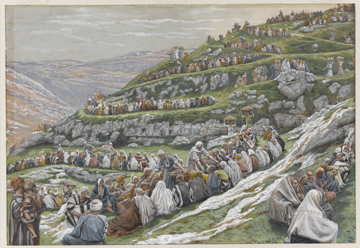
I. THE IMAGE THAT IS EXTOLLED – The text says, Jesus went up on the mountain and there he sat down with his disciples. The Jewish feast of Passover was near. Jesus raised his eyes and saw that a large crowd was coming to him.

The text says that Jesus saw a large crowd. I wonder if we do? Generally today when we think of the Church, we think of declining numbers. This is because we tend to think in terms of the number of members. In contrast, Jesus thinks in terms of those who need to be reached. And, as we know well, the number of those who need to be reached IS large! So while it seems clear to us that the gospel is currently “out of season,” we must never forget that everyone is precious to the Lord; He wants to reach all and feed them with His grace, mercy, truth, and love.

So, the image that is extolled is that of need, not of believers and non-believers. Is this how you and I see the world? Jesus sees all the world as a vineyard, as a mission field. He sees all as hungry, no matter how obstinate they are. It is a sad fact that many reject the food we in the Church offer; many even deny that they are hungry. But they are hungry and Jesus is about to ask our help in feeding them. Thus, while we may see opponents to the faith, this text lifts up an image that is rooted in the universal human problem of hunger, physical and spiritual.

II. THE INSUFFICIENCY THAT IS EXPRESSED – The text says, “Where can we buy enough food for them to eat?” Jesus said this to test Philip, because he himself knew what he was going to do. Philip answered him, “Two hundred days’ wages worth of food would not be enough for each of them to have a little.” One of his disciples, Andrew, the brother of Simon Peter, said to him, “There is a boy here who has five barley loaves and two fishes; but what good are these for so many?”

There is a human tendency to feel overwhelmed.  This is understandable since the task of evangelizing and feeding the world is daunting to say the least.

Yet note that they are NOT without any resources. It may seem insufficient, but it is not nothing.

And so it is for us who may feel overwhelmed by the cultural meltdown taking place before our very eyes. It seems that every number we want to go down is going up, and every number we want to go up is going down. The cultural war seems to be occurring on multiple fronts: family, marriage, sexuality, life issues, religious freedom, schools, church attendance, the rise of secularism and atheism, and the lack of personal responsibility and self-control.

The list could go on and on. It is not difficult to demonstrate that the disrepair in our culture is enormous. The task of evangelizing our culture may seem far more difficult than coming up with two hundred days’ wages.

But note that Jesus says, “Where can WE” get enough to solve the problem. For it is not only up to us, mere mortals, to resolve the grave issues of our day. The Lord asks us to work with Him. Now, it would seem, we have a fighting chance!

III. THE IMMENSITY THAT IS  EXPERIENCEDJesus said, “Have the people recline.” Now there was a great deal of grass in that place. So the men reclined, about five thousand in number. Then Jesus took the loaves, gave thanks, and distributed them to those who were reclining, and also as much of the fish as they wanted. When they had had their fill, he said to his disciples,” Gather the fragments left over, so that nothing will be wasted.” So they collected them, and filled twelve wicker baskets with fragments from the five barley loaves.

By now this story is so familiar that we are not shocked by the outcome. But no matter how many times we hear it, we still do not really accept its astonishing truth.

  • I can do all things in God who strengthens me (Phil 4:13).
  • All things are possible to him who believes (Mk 9:23).
  • For man it is impossible, but not with God, for all things are possible with God (Mk 10:27).
  • Now he who supplies seed to the sower and bread for food will also supply and increase your store of seed and will enlarge the harvest of your righteousness (2 Cor 9:10).

We all know that this world is in an increasingly bad state. The problems seem overwhelming and our resources seem so limited to turn back the tide. What will we ever do with only five loaves and two fishes?

Jesus says, “Bring them to me.”

A journey of a thousand miles begins with just one step. The conversion of the whole world begins with me. As I look the huge problems before me, I (this means you) assess my loaves and fishes:

  • I work on my own conversion. A holier world has to start with me. If I get holier, the world gets holier.
  • I look to the poor I can serve, maybe with money, maybe by using my talents to tutor or counsel, maybe just by giving of my time to listen.
  • I pick up the phone and call a family member who I know is hurting.
  • I love my spouse and my children.
  • I spend time raising my children to know the Lord and to seek His kingdom.
  • I exhort the weak in my own family. With love, I rebuke sin and encourage righteousness.
  • If I am a priest or religious, I faithfully live my vocation and heroically call others to Christ by teaching and proclaiming the gospel without compromise.
  • If I am young, I seek to prepare myself devoutly for a vocation to marriage, the priesthood, or religious life.
  • If I am older, I seek to manifest wisdom and to provide a good example to the young.
  • If I am elderly, I seek to prepare myself for death devoutly and to display the desire for Heaven.
  • I pray for this world and attend Mass faithfully, begging God’s mercy on this sin-soaked world.

It is too easy to lament the condition of the world and, like the Apostles, to feel overwhelmed. Jesus says, “Just bring me what you have and let’s get started.” The conversion of the whole world will begin with me, with my meager loaves and fishes.

Jesus will surely multiply them; He will not fail. Already there is renewal evident in the Church, through a faithful remnant willing to bring their loaves and fishes (some of the things mentioned above and more besides). They are bringing them to Jesus and He is multiplying them. Renewal is happening; signs of spring are evident in the Church.

There is an old saying that it is easier to wear slippers than to carpet the whole of the earth. Indeed it is. If it is a converted world that you want, start with yourself. Bring your loaves and fishes to Jesus; bring your slippers and let’s get started.  It begins with me.

This song says,

If I can help somebody, as I pass along,
If I can cheer somebody, with a word or song,
If I can show somebody, how they’re traveling wrong,
Then my living shall not be in vain.

If I can do my duty, as a good man ought,
If I can bring back beauty, to a world up wrought,
If I can spread love’s message, as the Master taught,
Then my living shall not be in vain.

Four Teachings on Personal Prayer – A Homily for the 16th Sunday of the Year

blog0718The gospel today speaks to us of the priority of personal prayer. You may recall that in last week’s gospel, Jesus sent them out two by two to proclaim the Kingdom. Now they return, eager to report the progress and the graces they encountered.

But as Jesus listens, he urges them (perhaps because they are overjoyed) to come aside and rest awhile, for they have labored long. In so doing, Jesus also teaches us about prayer. Let’s consider four teachings on prayer that are evident in today’s gospel.

I. The Practice of Praise-filled Prayer – The text opens with the disciples gathering with Jesus and joyfully recounting all they experienced on their missionary journey. In a similar text in Luke (10:17), the disciples return filled with joy and rejoice that demons are subject to them (in the power of Jesus).

Thus, the first instinct of the disciples is joyful gratitude before the Lord.

Is your prayer filled with praise and thanksgiving? Are you grateful to God for all He has done? Do you tell God what is happening in your life and give Him thanks for all He has enabled you to do?

Too many people think of prayer only in relation to petition. But praise is also an essential component of prayer. When Jesus began his instruction on prayer, He said, When you pray, say, ‘Our Father, who art in heaven hallowed be thy name’ (Mat 6:9). In other words, “Father your name is holy; you are a great God, a wonderful God; you can do all things and I praise you! Thank you Father; your name is holy and you are holy.”

So praise the Lord. Thank Him for what He is doing and tell Him everything you are experiencing. Scripture says that we were made for the praise of his glory (Eph. 1:16). So praise the Lord in your prayer. Don’t know how? Take a psalm of praise; pray or sing the Gloria from Mass; sing or recite a hymn, but praise Him!

II. The Peace of Personal Prayer – Jesus invites the disciples to come away by themselves to a quiet place and rest for a while. Most people don’t think of their personal prayer as a privileged invitation from the Lord, nor do they think of it as rest.

Yet, consider that the Lord invites us to come aside and spend personal and private time with Him. Most people would relish personal attention from a celebrity or famous person. Why not from the Lord? An old song says, “What a privilege to carry everything to God in prayer.”

Note the description of this time as “rest.” Most people think of prayer more as a task than as a time of rest. Yet to pray is to rest, to withdraw from this world for a brief time and enjoy the presence of the Lord. Scripture says, For thus the Lord GOD, the Holy One of Israel, has said, “In repentance and rest you will be saved. In quietness and trust is your strength” (Is 30:15).

And old hymn says,

Sweet hour of prayer! Sweet hour of prayer!
That calls me from a world of care,
And bids me at my Father’s throne
Make all my wants and wishes known.
In seasons of distress and grief,
My soul has often found relief,
And oft escaped the tempter’s snare,
By thy return, sweet hour of prayer!

Learn to think of prayer as quiet time, as rest with the Lord, when He soothes, strengthens, refreshes, and blesses us.

III. The Primacy of Prioritized Prayer – The text tells us that people were coming and going in great numbers seeking the attention of the Lord and the Apostles; they could not even get a moment to eat!

Now there is no doubt that the people had critical needs. They needed to be taught, healed, fed, and cared for in many ways. And yet even in the face of this, Jesus said, in effect, “We have to get away from all this for a while.” He directed the disciples to go off in the boat to a deserted place.

Indeed, one of the few places they could “get away” was out on the water. So out they went, where the crowds could not follow them. They were alone and quiet for just a brief while.

Jesus made prayer a priority. Scripture says of Him, But Jesus often withdrew to lonely places and prayed (Luke 5:16). Scripture also speaks of Him rising early to pray (Mk 1:35), praying late into the night (Mt 14:23), praying all night long (Lk 6:12), and praying in the mountains (Matt 14:23) and other deserted places. Yes, Jesus made prayer a priority.

Understanding prayer as rest helps us to understand why prayer must be a priority in our lives. If we are going to engage in the work to which God has called us, we need to be replenished and refreshed daily by spending time with the Lord.

If we were to engage in physical work without ever stopping to rest, we would collapse. The spiritual life has a similar law. Resting with God in prayer fills us with His presence, grace, and strength so that we can be equipped, empowered, and enabled unto the tasks that He has given us.

No one can give or share what he does not have. And if we aren’t praying and experiencing God’s presence, how can we share it? To share grace, we must first receive it. To speak the Word, we must first receive it. To witness to the Lord, we have to know Him.

Jesus often had to hide in order to pray. Sometimes the only quiet place He could find was out on the lake. But Jesus did make time for prayer, and He invites the Apostles and us to do the same, not only despite the busyness of life, but because of it.

A Story: A priest friend of mine said that he once gave spiritual direction to a religious sister back in the 70s. At that time, it was common for people to say “my work is my prayer.” When this priest inquired of the good sister’s prayer life she answered, “Oh, I’m too busy to pray, but that’s OK, my work is my prayer; that’s my spirituality.” And he replied, “Sister, if you’re not praying, you don’t have a spirituality.” He got her to start praying for one hour a day. Some years later, he ran into her at the airport. By now, she had moved on to become a major superior in her order. “How are you doing, Mother,” he asked. “Oh,” she replied, “I am very busy!” He cringed, but then she added, “I’m so busy these days that I have to spend two hours a day praying!”

Now there’s a smart woman! When we’re being foolish we say, “I’m too busy to pray.” When we’re being smart we say, “I’m so busy that I need to pray more.”

Jesus made prayer a priority. Prayer is the rest that strengthens us for the task; it is the refreshment that gives us new vigor and zeal.

IV. The Power of Pious Prayer – The text says that after Jesus spent this time alone with the Apostles on the boat, they reached the other shore. And sure enough, the crowd was there waiting for them. But Jesus and the Apostles had been refreshed and were now well-rested. Jesus, refreshed and renewed, saw the vast crowd and began to teach them at great length.

Prayer has that effect. In drawing close to God, who is love, we are better equipped to love others. Jesus, though He never lacked love for them, models this renewal for us. The text says that upon seeing the crowd, His heart was moved with pity for them.

An aside – The Greek word used is σπλαγχνίζομαι (splagchnizomai), which means “to be moved with compassion.” The English word “pity” often carries with it a condescending tone. But what happens here is that Jesus sees them, loves them, and has compassion for their state. The religious leaders in Jerusalem have largely abandoned them, considering them “the great unwashed.” But Jesus loves them and teaches them at great length.

For us, it often takes many years and lots of prayer to equip our hearts in this way. One of the signs that grace and prayer are having their effect is that our love for others, even for the multitudes, grows deeper, more compassionate, more patient, and more merciful. This takes great prayer and long hours of sitting at the Lord’s feet and learning from Him.

But here is the power that prayer bestows: we should be more fully equipped for our mission, more zealous, and more loving. The rest afforded by prayer rejuvenates our better nature and helps it to grow.

So here are four teachings on prayer. Jesus found time to pray; He made prayer a priority. How about you?

Five Fundamental Freedoms for the Christian Evangelizer

UntitledOne of the great obstacles to effectively evangelizing is that most Christians lack the requisite freedom and simplicity of life to carry forth the task consistently and coherently. In today’s gospel, the Lord offers some counsel on what is required to evangelize effectively.

As we read a gospel like this, it is tempting to think that it speaks only of specialists such as missionaries, religious, priests, or deacons. But such a presumption forgets that everyone is called to evangelize: clergy to people, parents to children, elders to youngsters, siblings to siblings, friends to friends, neighbors to neighbors.

Thus this gospel is for all of us, and it summons us to a greater freedom that will equip, empower, and enable us to evangelize more effectively. Let’s look at the Lord’s counsels.

I. The Freedom of SUMMONS – The text says Jesus summoned the Twelve and began to send them out two by two and gave them authority over unclean spirits.

It may not be immediately obvious how a summons is freeing, but consider that, to the extent that we know we are called to do something by someone in authority, we are often more courageous and diligent in doing it, even if it is hard. A commanding officer may have to ask his troops to engage in a difficult battle, but because he knows that his own commanders have ordered it and that it is part of a wider strategy, he tries to rally his troops. He speaks not only with his own authority but that of others, and thus he is courageous and his words have weight. And even if his troops protest or seem unenthusiastic, he remains strong because he knows his duty and that he is doing what is right.

Yes, being under a summons is freeing and empowering. And so for us, if we know that the Lord has summoned us and sent us to evangelize (and he surely has (cf Matt 28:19)) we can go forth with courage to rally God’s people and summon them to the Lord’s team. And even when people react poorly we need not be discouraged, for we know we are under the orders of God Himself and that what we speak is right.

As a priest, I am often called upon to speak on topics that some do not want to hear. And yet, to the degree that I know I have called to speak it, I do so with courage, knowing that when the Lord and His Church bid me to address something, I speak not only with my own authority but with that of God. Some may grumble that they don’t want to hear me talk about money, abortion, religious liberty, or homosexual or heterosexual sin. Yet to the degree that I know I AM called to speak on these things, I still do so and do so with courage. Yes, I am summoned. I am compelled to preach. Woe to me if I do not preach the gospel! … for God has given me this sacred trust (1 Cor 9:17).

Do you know that you have been summoned? Have you experienced this call? Do you see it as a mandate, as something you have been summoned to do? Priests and deacons need to recognize our call to preach the Word of God unambiguously. We are under orders from the Lord. As Scripture says, In the presence of God and of Christ Jesus, who will judge the living and the dead, I give you this charge: Preach the Word; be prepared in season and out of season; correct, rebuke and encourage–with great patience and careful instruction (2 Tim 4:1-2). But honestly, can any of you who are parents and grandparents not see that you are called to the same for your children? And who of us here can say that any but perhaps the youngest are exempt from the summons to preach, to declare the Word of God?

Knowing and experiencing that you have been summoned is freeing! 

II. The Freedom of SIMPLICITY – The text says, He instructed them to take nothing for the journey but a walking stick— no food, no sack, no money in their belts. They were, however, to wear sandals but not a second tunic.

One the most fundamental reasons that people do not evangelize is that we have way too much baggage. What kind of baggage? Consider that our lives are

  1. CLUTTERED – We have too much stuff. And stuff needs attention, maintenance, and money; it takes up space and ties us down. We also have the baggage and clutter of too many commitments. We’re overscheduled and overbooked. We have many wrongful priorities such that we spend too much time worrying about things that don’t matter all that much in the end. And what does matter gets put on hold. Reading Bible stories to your kids? No time for that; we’ve got to get to soccer practice!  Yes, our lives are cluttered with the excess baggage of too many distractions. And what is a “dis-traction?” It is something that gets you off track and makes you lose traction in what really matters.
  2. COMPLEX – Most of our lives are so cluttered and choked with excess baggage we don’t even know where to begin to simply it. We don’t know how to break the cycle, how to say no. So we end up carrying all this stuff and are quite enslaved to its demands.
  3. COMPROMISED – All this extra baggage weighs us down and entangles us with the world. Thus, our values are not the values of the gospel. Instead, we are tied down to the world, loyal to it, and invested in its thinking and its ways.

We need to be free to preach the Gospel and to evangelize. So the Lord says, simplify! Too much obsession with money, food, clothes, boxes of stuff, popularity, and fitting in will hinder you.

Think of a runner in a race. He does one thing only and carries nothing extra that would weigh him down. Travelers, too, do not take their whole house with them, only what is necessary. And, in terms of this world, we are just traveling through.

Most of us just have too much stuff. Because of this, we are tied to this world and lack the kind of freedom necessary to witness prophetically to what is beyond this passing world. Ask the Lord to help you gently but persistently simplify your life so that it increasingly becomes about the one thing necessary.

III. The Freedom of STABILITY – The text says, He said to them, “Wherever you enter a house, stay there until you leave.”

Stability is the freedom to accept what is and to work with it rather than to be constantly looking for something better. It is the freedom to bloom where you are planted, and to use what God actually gives rather waiting for something better.

There’s a real freedom to staying put and developing the deeper relationships that are usually necessary for evangelization to be effective and lasting.

One of the bigger problems with handing on the faith today is that there is very little stability in families, communities, and parishes. When things and people are passing and ephemeral, how can values rooted in lasting things be inculcated?

Preaching the gospel often depends on well-founded relationships, patience, perseverance, and taking the long view of life. Running here and there and living life only on the surface will not cut it. Shallow soil does not sustain taller growth. Only deep roots can do that.

Ask for the freedom to stay put and to be less anxious about the possibility that there may be a better job, a better community, a better deal out there somewhere. There is value in being grateful for what you have and working with that, in setting down deep roots and lasting relationships. This is the deeper and richer soil in which evangelization can happen.

IV. The Freedom of SURETY – The text says, Whatever place does not welcome you or listen to you, leave there and shake the dust off your feet in testimony against them.

Here is one of the greatest freedoms of all: the gift to be free of our obsession with being liked, approved of, and popular. Too often we are overly concerned with being popular. We care too much about what others think of us, at the expense of the truth of the gospel.

In effect, Jesus implies here that rejection will surely happen and when it does, shake it off, let it pass over you. Speak the truth and don’t worry about rejection, expect it! This is a very great freedom.

Too many parents are desperate to have their children like and accept them. They avoid discipline and difficult teachings. It is necessary to be free of this “need.” The Lord can give that to you.

We are not speaking here of becoming sociopaths, caring not one whit what others think. This is not an invitation to be impolite, or to fail to groom ourselves and be presentable. Rather, it is an invitation to be free of our obsession with popularity so that we can shake off the rejection of the gospel that we will inevitably experience. And again, the Lord can give that to us.

V. The Freedom of SUBSTANCE – The text says, So they went off and preached repentance. The Twelve drove out many demons, and they anointed with oil many who were sick and cured them.

There is freedom in knowing what to say and what to do. And this freedom flows from the SUBSTANCE. For we do not preach ourselves, but Christ Crucified. This is freeing, for we cannot be compelled to change or adapt the message that has already been set for us. There is a freedom in sticking to the message proclaimed once and for all. The world demands compromise, that certain passages of Scripture be modified. But we, who in no way can do this, are free of such compulsion.

Only those who are enslaved to the times and the mentality of this world can be so compelled. But to the degree that we know we are summoned, sent, and given the substance of what to preach, we are free to announce, and free from coercion to compromise.

And substance was “repentance.” As we have noted before, the Greek word μετανοῶσιν (metanoosin) means more than simply to clean up one’s behavior. It means “to come to a new mind,” or “to change one’s thinking.” Hence the evangelizer seeks to appeal to the whole person. It is not only a person’s behavior that is important; it is also how he thinks and what is taking place in the deepest part of his soul.

The Lord seeks to heal the whole person from the inside out. Thus the Apostles and those of us free enough to be true evangelizers are not seeking merely to inform but to transform.

And note how the text describes them as driving out demons and curing the sick. Is this merely some exotic ability of the early Apostles? No. We, too, by this proclamation, drive out the demons of sadness, meaninglessness, ignorance, misplaced priorities, atheism, agnosticism, worldliness, materialism, and so forth. We also bring healing and peace for those accept the power of the Word of God into their lives. These healings are very real. I know them in my own life and have seen them in the lives of others.

Are you free enough to evangelize, to preach the gospel, and to bring healing and peace to others? Are you free enough to be a means of God’s transformative Word?

A Bad Day in the Pulpit for Jesus? A Homily for the 14th Sunday of the Year

blog 070415The gospel today portrays the Lord Jesus as preacher and prophet. But as we shall see, even the greatest preacher in the world, Jesus, can find His powerful and precious words falling lifeless on the rock hard surface of many a soul. Yes, even His words can meet with resistance and hostility, indifference and ridicule. Indeed, the gospel today shows forth the ruinous result of rejection.

My homily notes begin with the red text below. However, I’d first like to provide some background reflections that may be helpful.

We sometimes think that if Catholic priests were better preachers, all would be well. But that is only half the battle, for the Catholic faithful must also have ears to hear and hearts that are open and eager to receive the truth. A well known preacher and fine Protestant teacher, William Barclay, has this to say:

There can be no preaching in the wrong atmosphere. Our churches would be different places if congregations would only remember that they preach far more than half the sermon. In an atmosphere of expectancy, the poorest effort can catch fire. In an atmosphere of critical coldness or bland indifference the most spirit-packed utterance can fall lifeless to the earth (Commentary on Mark, P. 140).

Yes, of this I am a witness. I have preached before congregations that were expectant and supportive, and watched my feeble words catch fire. I have also preached in settings where “I couldn’t hear nobody pray!” And oh, the difference!

I have been blessed to serve most of my priesthood in African-American parishes and there is a deep appreciation that the preaching moment is a shared one, with shared responsibilities. The congregation does not consider itself a passive recipient of the Word, but rather an active sharer in the proclamation.

There is an air of expectancy in the Church as the faithful gather and listen and begin to sing and pray. This air of expectancy is sometimes called “the hum.” During the reading of the Word and the sermon there are nods, hands may go up, a foot may stomp, and an acclamation or two pock the air: Amen! … Yes, Lord! … Go on now! … Take your time! … Make it plain, preacher! … You don’t need to tell me! Ha!, My, my my!

And as a preacher, I too can call for help: Are you praying with me Church? … Somebody ought to say, Amen! …. Come on, Church! … Can I get a witness? … Kinda quiet in here today … Amen?! Yes, together we craft the message, as inspired by the Holy Spirit. And while it belongs to the priest to craft the content, it belongs to the congregation to affirm the truth and acknowledge the Spirit through prayerful attention and support.

How precious and necessary is the preaching task. But as today’s gospel affirms, the preaching task is more than just the preacher. Before looking at the text itself, here are a few more insights about both preacher and congregation from Pope (Saint) Gregory the Great.

First, on the obligation of the preacher and the solemnity of his task:

Pastors who lack foresight, hesitate to say openly what is right because they fear losing the favor of men. As the voice of truth tells us, such leaders are not zealous pastors who protect their flocks, rather they are like mercenaries who flee by taking refuge in silence when the wolf appears.

The Lord reproaches them through the prophet: They are dumb dogs that cannot bark. On another occasion he complains: You did not advance against the foe or set up a wall in front of the house of Israel, so that you might stand fast in battle on the day of the Lord. To advance against the foe involves a bold resistance to the powers of this world in defense of the flock. To stand fast in battle on the day of the Lord means to oppose the wicked enemy out of love for what is right.

When a pastor has been afraid to assert what is right, has he not turned his back and fled by remaining silent? Whereas if he intervenes on behalf of the flock, he sets up a wall against the enemy in front of the house of Israel. … [But] they [who] are afraid to reproach men for their faults … thereby lull the evildoer with an empty promise of safety. Because [such preachers] fear reproach, they keep silent and fail to point out the sinner’s wrongdoing.

The word of reproach is a key that unlocks a door, because reproach reveals a fault of which the evildoer is himself often unaware. That is why Paul says of the bishop: He must be able to encourage men in sound doctrine and refute those who oppose it. For the same reason God tells us through Malachi: The lips of the priest are to preserve knowledge, and men shall look to him for the law, for he is the messenger of the Lord of hosts. Finally, that is also the reason why the Lord warns us through Isaiah: Cry out and be not still; raise your voice in a trumpet call.

Anyone ordained a priest undertakes the task of preaching, so that with a loud cry he may go on ahead of the terrible judge who follows. If, then, a priest does not know how to preach, what kind of cry can such a dumb herald utter? It was to bring this home that the Holy Spirit descended in the form of tongues on the first pastors, for he causes those whom he has filled, to speak out spontaneously [Gregory the Great, Pastoral Guide].

Second, on the reason for poor preaching:

Beloved brothers, consider what has been said: Pray the Lord of the harvest to send labourers into his harvest. Pray for us so that we may have the strength to work on your behalf, that our tongue may not grow weary of exhortation, and that after we have accepted the office of preaching, our silence may not condemn us before the just judge.

For frequently the preacher’s tongue is bound fast on account of his own wickedness; while on the other hand it sometimes happens that because of the people’s sins, the word of preaching is withdrawn from those who preside over the assembly.

With reference to the wickedness of the preacher, the psalmist says: But God asks the sinner: Why do you recite my commandments? And with reference to the latter, the Lord tells Ezekiel: I will make your tongue cleave to the roof of your mouth, so that you shall be dumb and unable to reprove them, for they are a rebellious house. He clearly means this: the word of preaching will be taken away from you because as long as this people irritates me by their deeds, they are unworthy to hear the exhortation of truth.

It is not easy to know for whose sinfulness the preacher’s word is withheld, but it is indisputable that the shepherd’s silence while often injurious to himself will always harm his flock [Ibid].

Note well, then, the shared responsibility of the preacher and the people. And let these texts serve as a worthy background to what is now to come in today’s gospel, which we can see in three stages.

I. Real Rejoicing – The text says, Jesus departed from there and came to his native place, accompanied by his disciples. When the sabbath came he began to teach in the synagogue, and many who heard him were astonished. They said, “Where did this man get all this? What kind of wisdom has been given him? What mighty deeds are wrought by his hands!”

Thus, the initial reaction of Jesus’ hometown crowd is positive. They are filled with amazement and joy. And the text sets forth two sources of their joy:

1. His wise words – Many who heard him were astonished. They said, “Where did this man get all this? What kind of wisdom has been given him?” Yes, what a blessing it must have been to hear Jesus preach. And boy, could Jesus preach! Scripture says of His preaching,

And when Jesus finished these sayings, the crowds were astonished at his teaching, for he taught them as one who had authority, and not as their scribes (Mat 7:28).
Sent to arrest him the temple guard returned empty handed saying: No one ever spoke like that man (Jn 7:46).
And all spoke well of him, and wondered at the gracious words which proceeded out of his mouth (Luke 4:22).
And the common people heard him gladly (Mark 12:37).

2. His wonderful works – They also say, “What mighty deeds are wrought by his hands!” Yes, Jesus had worked many miracles up to this point. He had

cast out demons,
turned water to wine,
raised up paralytics,
cured the man with a withered hand,
cast out blindness,
healed deafness,
multiplied loaves and fishes,
calmed storms, and
raised up Jairus’ daughter from the dead.

And so we see that the initial reaction to Jesus preaching is good. Their remarks and rejoicing are a sign that the Spirit is working and prompting them to belief.

Yet as we shall see, things are about to turn sour. For it remains a sad but prevailing truth that the word of God can fall on the rocky soil of some hearts, where it springs up but soon withers because the soil is so shallow. Or the Word of the Lord can be sown on the paths of some hearts where the birds of the sky come and carry it off. Or the Word of the Lord can fall on divided hearts, where the thorns of worldliness and the anxieties of the world choke it off. And yes, sometimes it falls on good soil, where it yields thirty, sixty, or a hundred fold (cf Matt 13:1-9). Sadly, things are heading south.

II. Rude Rejection – The text says, [But some began to say] Is he not the carpenter, the son of Mary, and the brother of James and Joses and Judas and Simon? And are not his sisters here with us?” And they took offense at him.

Notice how sudden their change is. There is an old spiritual that says, “Some go to church for to sing and shout, before six months they’s all turned out!”

They harden their hearts. Yes, the tide mysteriously and suddenly turns against Jesus. Sin has set in and hearts have hardened; the joy has been jettisoned. Though the Holy Spirit prompts them to faith and to call Jesus, “Lord,” they harden their hearts. It is a grim and tragic sin.

They also exhibit a kind of prejudice or unjust discrimination, dismissing Jesus as a mere carpenter and a hometown boy. It is an odd kind of thing that the poor and oppressed sometimes take up the voice of the oppressor. And thus these simple people from a small town of only 300 take up the voice of the Jerusalemites, who regarded Galileans as “poor backwoods clowns” and as unlettered people. Yes, Jesus’ own townsfolk take up the voice of the oppressor and say to Him, in effect, “Stay in your place. You have no business being smart, talented, wise, or great. You’re just one of us and should amount to nothing.” It is the same sort of tragic rebuke that sometimes takes place among minority students who excel in school. Some of their fellow minority students accuse them of “going white.” Tragic and sick. And likewise for Jesus; they ignore His words and His works, focusing instead on appearances and background.

They also exhibit the sin of envy. Envy is sadness or anger at the goodness or excellence of another person because we take it as diminishing our own. The text says here, And they took offense at him. St. Augustine called envy THE diabolical sin. This is because it seeks not to posses the good of another (as jealousy does), but rather to destroy what is good in others so that the destroyer can look better.

The result of these sins was that Nazareth was NOT a place where excellence was known, even among its own! Indeed, John 1:46 records Nathanael saying of Nazareth, “Nazareth! Can anything good come from there?” It would seem that even the townsfolk of that place would agree. (But Philip, who surrendered his prejudice, said to Nathanael, “Come and see.”)

But an even more awful result of these sins ensues.

III. Ruinous Result – The text says, Jesus said to them, “A prophet is not without honor except in his native place and among his own kin and in his own house.” SO HE WAS NOT ABLE to perform any mighty deed there, apart from curing a few sick people by laying hands on them. He was amazed at their lack of faith.

So as we see, because they judge Him to be nothing, they get nothing. They have blocked their blessings.

Jesus says, He who receives a prophet because he is a prophet shall receive a prophet’s reward, and he who receives a righteous man because he is a righteous man shall receive a righteous man’s reward (Mat 10:41). But they will get nothing. When we banish or discredit God, we should not expect to see many of His works. These things come only from faith.

Miracles are the result of faith, not the cause of it. Thus the text says, So [Jesus] was NOT ABLE to perform any mighty deed there … He was amazed at their lack of faith.

There are some things that even God can’t do, not because He has no power but because He respects our choices. Pay attention. The Lord is offering us salvation and the Kingdom of Heaven. And either we reach out to take it or we don’t. But the choice is ours. If we take it, He’ll go to work. But if we refuse, He respects our freedom and will “not be able” to perform any mighty deeds.

And what a ruinous result for Nazareth and all who reject the prophetic utterances of our Lord and His saving help. Scripture says,

I am the LORD your God, who brought you up out of the land of Egypt. Open your mouth wide, and I will fill it. “But my people did not listen to my voice; Israel would have none of me.  So I gave them over to their stubborn hearts, to follow their own counsels. O that my people would listen to me, that Israel would walk in my ways! I would soon subdue their enemies, and turn my hand against their foes. Those who hate the LORD would cringe toward him, and their fate would last for ever. I would feed you with the finest of the wheat, and with honey from the rock I would satisfy you” (Psalm 81:10-16).

Either we accept God’s word and yield to its healing and saving power or we can expect little or nothing but ultimate ruin. It is as if we were in a raging stream heading toward the falls and almost certain death. But then a hand is stretched out to save us, the hand of Jesus. Mysteriously, we reject that hand and ridicule its power. And the ruinous result of our hideous and foolish rejection is our death. The text says, He was amazed at their lack of faith.

Pay attention! God is preaching the Word to you every Sunday, every day in fact. Will you heed and be healed? Will you receive and be rescued? Or will you reject and be ruined? Will the Lord be able to do mighty deeds for you? Or will He be amazed at your lack of faith? The choice is yours; it is all yours.

And what of our nation, once steeped in the Word of God? The Founding Fathers once wove Scripture freely into their discourse. But in recent decades a hostile secularism has insisted on marginalizing all references to God and scoffing at biblical morality. They talk “tolerance” yet file lawsuits against those who would transgress and speak of God, display a nativity, or call something a sin. There is no room here to recite statistics that show our blessings ebbing away, but it is clear that as our families disintegrate, a nation that once led the world in almost every respect is now well back in the pack and fading fast. To forsake the preaching of Christ though His Scripture and Church is to forfeit blessings. He can work no miracles here because of our lack of faith.

Even Jesus can have a bad day in the pulpit. But it is not really His bad day; it is ours. If we sinfully reject the Word of God, it is we who will forfeit blessings and miracles because of our lack of faith.

My Soul Looks Back and Wonders How I Got Over – A Homily for the 12th Sunday of the Year

Lightening Storm
Lightening StormThe gospel today is something of a storm journal, a kind of picture of the Christian life as we journey through a stormy world against winds contrary to the gospel. There are distinctive stages, beginning with the call of Jesus to cross to the other shore. But as we cross there are surely storms and difficulties that assail us. No matter, the charge to have and keep making the crossing remains the same. Let’s look in more detail at the stages of this gospel and see how the disciples get over to the other shore with Jesus.
I. It begins with the CALL of Jesus: Let us go across to the other side. This is not merely a call to cross an ancient lake 2,000 years ago. This summons echoes down to us individually today, as the call to journey to the other shore, to Heaven.
Such crossings are not uncommon in the Scriptures. The Jewish nation crossed the Red Sea, which God parted for them. They set out as pursued slaves, crossed over, and reached the other shore to enjoy the glorious freedom of the Children of God.  And then, too, they crossed the River Jordan to enter the promised land, which is a symbol of entering Heaven. Having made that crossing, they received their inheritance.
A lot of the old spirituals contain references to crossing to the other side as symbolic of the journey to Heaven:

Michael, row the boat a-shore Hallelujah!
Then you’ll hear the trumpet blow Hallelujah!

Jordan’s river is deep and wide,
Meet my mother on the other side.

Jordan’s river is chilly and cold.
Chills the body, but not the soul.

Allow this call of Jesus, Let us go across to the other side, to be your summons to follow Him to Heaven. The disciples boarded a wooden boat to get to the other side. We cross to Heaven by the wood of the cross.

Listen to Jesus’ call and then set out! Heaven lies ahead, just over on the other shore!

II. Then comes the COMMENCEMENT: And leaving the crowd, they took Jesus with them in the boat, just as he wasIt is one thing to be called by Jesus to cross to the other shore. It is another thing to respond and set out with Him. And thus the second stage of this gospel depicts the required response: that one set out, or commence the journey.
Note three things that are said here about the commencement of the journey: they renounce, they receive and they respect.
A.  They Renounce – The text says they “leave the crowd.” We are called to renounce the world, the flesh, and the devil. In our Baptism we renounced the devil and by extension the world, of which he is prince. Scripture says, You adulterous people! Do you not know that friendship with the world is enmity with God? Therefore whoever wishes to be a friend of the world makes himself an enemy of God (James 4:3-4). Jesus says, No one can serve two masters; for either he will hate the one and love the other, or he will be devoted to one and despise the other. You cannot serve God and wealth (Mat 6:24). And yet again, I have chosen you out of the world, therefore the world hates you (Jn 15:19).
Therefore the text says that they “leave the crowd.” They forsake the wide, popular road that leads to destruction and go out on the narrow way of the cross that leads to the other shore. You cannot have both Jesus and the world; you must choose. You cannot have the crowd and its values. Jesus warns, Woe to you when all speak well of you (Lk 6:26). We must be ready to leave the crowd, forsake popular ideas, and embrace the “foolishness” of the cross.
B. They Receive – The text says that they “took Jesus with them in the boat.” That is, they receive Jesus into the “boat” that is their life. They agree to journey with Him, not the world. They let Him pilot their ship. In the baptismal liturgy not only do we renounce Satan and the pomps of the world, we also accept Christ and profess our belief in God—Father, Son, and Spirit—and in the Church, which is Christ’s Body. Now Jesus enters the “boat” of our life and leads us in the crossing to the other shore. Jesus’ command is simple, “Follow me” (Jn 12:26; Lk 9:59; Mk 2:14; Mat 9:9; et alibi).
C. They respect – The text says that they “took Jesus with them in the boat, just as he was.” Even in the Greek, this text is a bit complex. What does it mean that they took Jesus in the boat “just as he was”? Many think that the text is trying to indicate that Jesus was in fact already in the boat. Thus a possible understanding is that they took Jesus with them in the boat because in fact he was already aboard.
Perhaps, but for our purposes here, let’s take the text less literally: to accept Jesus into our life just as He is means to place no conditions on His admittance. It is to accept the real Jesus, not some fake or refashioned Jesus. The real Jesus is complex. He sets impossible demands but then forgives the worst of sinners, He is kind and understanding one moment, but stern and refusing of any excuses the next. He consoles and challenges, affirms and unsettles.
Many today have attempted to remake Jesus into a kind of “harmless hippie” who told pleasant stories and went around blessing everyone. And while it is true that He blessed many, He was a stumbling block for others. Jesus was a master preacher and storyteller but He also warned in those stories that some were sheep and some were goats, some were wise and some were foolish, some were at the feast and others were cast out into the darkness, some heard “Come blessed of my Father” and others heard “I know you not, depart from me you evildoers.” And elsewhere Jesus warned, Unless you come to believe that I AM, you will die in your sins (Jn 8:24). So Jesus is complex and we must learn to accept Him into our lives “just as he is.” St. Paul lamented, For if someone comes and preaches another Jesus than the one we preached … you put up with it well enough (2 Cor 11:4). Learn of the real Jesus and accept Him just as He is.
So having taken Jesus into the boat, they commence the journey to the other shore. But the journey is not always smooth, for the waters of this world are choppy and the winds are contrary.
III. For indeed, next comes the CONCERN: And a great storm of wind arose, and the waves beat into the boat, so that the boat was already filling. Here they are, the inevitable storms of life that will test and purify our faith. Such aspects of life often trouble us greatly.
Why does God permit such things? Why do they last so long? Why does God, who could instantly solve all things, allow trouble to go on?
He has His reasons, most of which are mysterious. However we can surely understand some of the ways in which trouble helps to purify and strengthen us. When we are in trouble we discover gifts we didn’t know we had; we gain wisdom; we learn detachment and humility. In living our questions we deepen our search and grow to appreciate the answers and the truth more. Trouble often brings maturity and helps us to hone our skills. No tension, no change. Trouble is also tied up in the freedom God allows His children. Some abuse their freedom and cause harm.
So we can get a small glimpse of why God permits trouble. Yet much is still mysterious.
Some people even notice that storms in their life increase rather than decrease after they begin to follow Christ! Well, take that as a compliment. Maybe there was a time in your life when you were traveling in a similar direction to Satan and so barely noticed him on the periphery. And then you turned around and ran right into him. Do not despair; you are still going in the right direction and Satan doesn’t like it.
Indeed another reason that those who set out on a voyage to cross the sea often encounter more storms than the “land-lovers” who stay back in mediocrity is that, frankly, there are more storms at sea.  The “sea” here is a symbol of the way of the cross as opposed to the wide road that leads to destruction (cf Mat 7:13). The way of the cross is bound to have special troubles, but the cross, though not comfortable, is necessary. Jesus says, If you were of the world, the world would love you as its own. But since you are not of the world, for I have called you out of the world, therefore the world hates you (Jn 15:19). So again, take storms like these as a compliment, a sign you have set out with Christ across the deeper waters.
And thus this storm at sea is a picture of our life in this storm-tossed world. An old hymn says,
When the storms of live are raging stand by me.
When the world is tossing me like a ship upon the sea,
Thou who rulest wind and water, stand by me.
IV. But note the CALM of Jesus that brings peace to the others: But he was in the stern, asleep on the cushion; and they woke him and said to him, “Teacher, do you not care if we perish?” And he awoke and rebuked the wind, and said to the sea, “Peace! Be still!” And the wind ceased, and there was a great calm.
In life it seldom helps to be in a panic. If you want to bring peace, you have to be at peace. Jesus is not unaware of the storm, but He is not alarmed by it. He is able to sleep through it just fine. In life, two people can be involved in the same incident and yet have very different experiences.
Some years ago I was out walking with a friend when a large dog, a Golden Labrador, came lumbering toward us. I had grown up with dogs and thus could tell the difference between a dog moving aggressively and one approaching benignly seeking merely to establish contact. But my friend had not grown up with dogs and in fact had been bitten by one as a youngster. Each of us looked at the dog approaching us. We saw the same scene but reacted to it very differently. My friend was afraid, while I was delighted. He reacted angrily and defensively. I put my hand out and greeted the dog, patting it on the head and letting it smell my hand. With my experience, I was able to bring peace to the situation. An agitated reaction might well have provoked the dog to turn aggressive.
And so we see something similar here in the boat. Jesus is able to sleep peacefully in the storm, but the disciples are panicked. Jesus knows His Father; He also knows the end of the story. Do you? Have you not read that for those who love and trust in the Lord all things work together for good? (cf Rom 8:28) Why are we so afraid? Storms will come and storms will go, but if we love God we will be saved, even if we die to this world.
If you have this peace, you too will calm storms. Peaceful people have an effect on others around them. We cannot give what we do not have. Ask the Lord for a heart that is at peace, not just for your own sake but for that of others. Because He is at peace, Jesus can rebuke the storm. How about you?
V. Finally, note the CHARGE:  “Why are you afraid? Have you no faith?” And they were filled with awe, and said to one another, “Who then is this, that even wind and sea obey him?”
And thus it is that the Lord charges them to grow in faith so as to be at peace and to bring peace to others. How do we lay hold of this peace? By growing in our experience and in our wonder and awe at what the Lord can do, and by learning to trust that God is bigger than our storms and concerns. We also learn that some of the storms are actually to our benefit; they help to strengthen us, even speeding our journey along.
Faith is a way of knowing. And thus we who grow in it are less terrified of storms. We have come to experience how God delivers us and strengthens us, often in paradoxical ways, and that none of the things of this world can destroy us if we have faith.
In my own life I have made this part of the journey to greater faith. I used to be very anxious about many things. Today I am seldom anxious because I have learned by faith and experience that God is working His purposes out. Most of the things I was anxious about in the past turned out fine, or at the very least OK. And even the stunning blows contained secret gifts, hidden at the time, only to be revealed later. This is the knowing of faith, that brings calm in the storms of life.
So our charge is to have faith.
Here, then, is a quick sketch of our life as disciples. We hear the CALL of the Lord to set out. We COMMENCE our journey with Him. Whatever the CONCERNs or storms, we learn the CALM of Jesus and let it reach us by the CHARGE of faith.