Posts Tagged ‘Pope Benedict’

Pope Pics

I dunno why, It just looks funny to see the Pope on the Phone:

media-30576-6

 Suggested caption: “No! Really this is the Pope! I really mean it! Please deliver three pizzas, extra cheese and Italian Sausage… No really! I am not kidding.  This is me!”

_____________________________________________________________

Also: Trying on a New Miter?  r791794886

Suggested Caption: In a suprising and bold move the Pope shows off the new “Mini Miter” to the world.

Church Needs a Change of Mentality

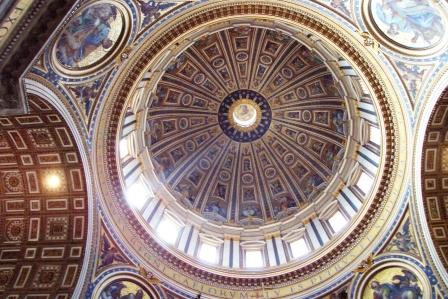
Dome of Saint PetersUsually, when you see this headline, what follows is a story about a person or group who is unhappy with the church and wants it to change–now! So, it might surprise you to learn that these are the words of Pope Benedict XVI. Needless to say,I was interested in reading more and was really pleased to see that what he is talking about is a deeper understanding of the co-responsibilityof clergy and laity for parish life and for the work of evangelization.

His remarks are an adress he gave at the Pastoral Convention of the Diocese of Rome on May 26. Here is the link to the full text of the speech. http://www.vatican.va/holy_father/benedict_xvi/speeches/2009/may/documents/hf_ben-xvi_spe_20090526_convegno-diocesi-rm_en.html

Co-responsibility of the laity

Pope Benedict points out that many of the baptized “do not feel part of the church community and live on its margins, only coming to parishes…to recieve religious services.” He beleives this is so for two reasons. Firstly, he calls for renewed efforts in formation and a clearer understadning of what it means to be the People on God in the Body of Christ. Secondly, he speaks directly to the clergy and reminds them that “the laity can no longer be viewed as ‘collaborators’ of the clergy but truly recognized as ‘co-responsible,’ committed laity.”   You can hear in this an echo of St. Paul who spoke of co-wokers in the vineyard.

Become actively co-responsible

Pope Benedict XVI is presenting a terrific challenge for clergy and laity to take full responsibility for the evangelizing mission of our parishes.  This is a timely challenge because this is the time of year that our parishes are looking for people to share their gifts with the body of Christ. Parishes need catechists, bible study leaders, ushers, lectors, and volunteers for all the services the parish offers to parishioners and to the community.  One of the easiest ways to make your parish feel like a community is to get involved in a ministry or group.

Proclaiming Christ

Pope Benedict’s vision for our parishes is that we strive to restore life to small groups within the parish. He dreams that our parishes be centers where “it is possible to experience faith, to put charity into practice and to organize hope.” He ends his talk by saying that the “future of Christianity and the Church of Rome also depends on the commitment and witness of each one of us.” 

A Holy Father Teaches His Children

The video below is a beautiful depiction of Pope Benedict answering the question of a seven year old child. The child ponders how Jesus can really be present in Holy Communion when we cannot see him.

This is a perfect question for all of us to ponder as we are reading the great treatise on Holy Communion from John 6 these past Sundays at Mass.

The Pope’s answer is both charming and understandable even for a child. It is also a profound reminder that knowing is more than seeing. We know and experience many things that we cannot see.

This brief video presents much for us to ponder and is so simple a child can understand it. Enjoy the Holy Father, as a father, teaching his children.

Benedict XVI: Pope and Apostle

04-21-POPE-FAREWELLThe word “Apostle” means one who is sent. Clearly, Jesus sent the Apostles forth with the great commission that they make disciples of all the nations. Most of our Bishops who have succeeded the apostles have a specific territory (or diocese) for which they are responsible. But the Pope is Apostle and bishop to all the world, pretty big territory…hugh? In recent decades both Pope John Paul II and Benedict the XVI have truly manifested that they are sent. They have gone forth to the ends of the earth, they have been sent by God to make disciples of all nations.

I thought of this recently when I was listening to a Johnny Cash song: “I’ve Been Everywhere” and it occurred to me to reduce my thoughts to a video. Enjoy this video and the song too!

It also occurs to me to link you to this video refelcting on the life of the Pope. It is long but you might wish to play it if you have the time. It is quite good.

Commentary on Caritas in Vertitate by Fr. Barron

caritasinveritateI’ve read a lot of commentary on the Pope’s latest encyclical Cartitas in Vertitate. Much of the commentary admits that this is a “hard” Encyclical. It is hard for two reasons. First, its style is dense, very theological, very nuanced, quite technical in places. It requires something of an expansive background and history of  the social teachings of the Church. It is also hard for many because it runs against the grains of the political views of many. To be sure, there are things hard to swallow for both the politically conservative as well as the politically liberal. When we confront the often intractable social problems and issues of our day politics is very much in the mix. How best to solve them, big government solutions, marketplace and private sector initiatives? There is strident social  and political disagreement among reasonable people.

All this makes Veritate in Caritate a “hard” encyclical. Fr. Robert Barron has a video commentary on the letter below. As always he is a master and taking complicated teaching and distilling from it lots of good “take away” stuff. This video is longer than his average, it is close to 9 minutes. If you don’t have time to see it all I direct you especially to the last three minutes wherein he deals with the “hard” aspects of this encyclical. What about the “World Government” notions in the letter and why does this letter seem so oddly “non-Ratzinger” in its style?

Picturesque Papa

I have updated my video on Pictures of the Pope. As you know he is a very photogenic man and this little video I put together has some of the more humorous pictures I have seen of Him. Enjoy a 1 minute diversion:

The Teaching in the Title: Caritas in Vertitate

cinvThe Pope’s New Encyclical is entitled Caritas in Veritate. Simply translated, Cartias in Veritate means “Love (or Charity) in Truth”. But what the title really sets forth is a teaching that Love and Truth need each other for there to be balance.

Consider charity or love without reference to the truth. Too easily it becomes soft and affirms what should not be affirmed. Charity without truth can easily enable bad behavior. By this it can, though with good intentions, further enslave people in self-destructive behaviors. Charity without truth can lead others into error and sin by failing to correct. Charity without truth can rob others of their dignity through a kind of “soft bigotry” of low expectations. This kind of charity is patronizing and presumes that the poor and needy cannot be expected to attain higher goals, so it simply moves the goal posts. Charity without truth can rob others of the discipline they need to discover self-mastery. Without the truth Charity, or love,  is soft and can become downright poisonous.  Charity (or love) needs reference to the truth to be true charity, true love.

But Consider truth without charity. Without Charity, or love, the truth too easily becomes a club to swing at others, merely an argument to be won. Without Charity the truth can seem harsh and demanding, something to be avoided and feared. Without Charity the truth can seem unattainable. Without Charity, people usually lack the self-esteem necessary to even consider they could live the truth. When I was a child I needed my parents reassurance that I was able to do what was right and true. Without that love and encouragement the truth could seem crushing and impossible.

So there it is, a title, but more than a title, a teaching.

Familiar???? By the way Washingtonians, this title should seem familiar to you. The Late Archbishop of this Archdiocese James Cardinal Hickey had this for his motto: Veritatem in Caritate (Truth in Charity).

The Pope and the President

obama_hope_pope1Below is some remarkable “raw footage” of the President’s visit at the Vatican yesterday (July 10) First a brief article:

VATICAN CITY (Reuters) – U.S. President Barack Obama arrived at the Vatican on Friday for his first meeting with Pope Benedict and what the White House says will be frank discussions on issues they agree and disagree on.

Obama arrived at the Vatican under tight security from the central city of L’Aquila, where he participated in the G8 summit. Much of the area around the Vatican was blocked off and cell phone coverage was jammed as his motorcade passed.

Obama was driven up to the San Damaso courtyard at the base of the apostolic palace where he was greeted by an honor guard of the Swiss Guard in full regalia Michelle Obama and their children Malia and Sasha were given a private tour of St Peter’s Basilica and the Sistine Chapel.

So what did the Pope say? Among other things he delivered a strong pro-life message to the President. Here is an excerpt from John Allen’s Article:

Pope Benedict XVI today used his first-ever meeting with President Barack Obama to deliver a strong pro-life message, even pointedly offering President Obama a copy of a recent Vatican document on bioethics. In effect, Benedict made clear that he backs the American bishops in their challenge to President Obama over matters like abortion and embryonic stem cell research.


Is the Pope A Democrat?

destauranimams121007It is not unusual for people who read encyclicals from a political viewpoint or to read a political viewpoint in to them.  Such is surely the case with the latest Encyclical by Pope Benedict Caritas in Veritate.  Clearly, it touches on the the much debated issue of social justice. While Church teaching in this matter isn’t all that complicated, the method of implementing it is debated. Should the poor be cared for by expansive Government programs, or by initiatives based more in the private sector? How are private property rights balanced with the universal destination of all goods? And so forth.

Some in the media see Caritas in Veritate as largely an affirmation of what we Americans would call Democratic (Party) social policies.  Some lament this fact, others celebrate it. But honestly do you really think the Pope means to speak in such simple categories? As with most encyclicals the Pope (especially this one) speaks with careful nuance and balance which is often missed by the sound byte oriented media. The Pope is speaking from Catholic Social Teaching which has a trajectory and history well removed from American Politics. We need to be careful not to over simplify the Pope here.

Just to show how two authors (both conservative) come away with different impressions look at the following two quotes.

There is also rather more in the encyclical about the redistribution of wealth than about wealth-creation — a sure sign of Justice and Peace default positions at work. And another Justice and Peace favorite — the creation of a “world political authority” to ensure integral human development — is revisited, with no more insight into how such an authority would operate….It is one of the enduring mysteries of the Catholic Church why the Roman Curia places such faith in this fantasy of a “world public authority,” given the Holy See’s experience in battling for life, religious freedom, and elementary decency at the United Nations. …. The incoherence of the Justice and Peace sections of the new encyclical is so deep, and the language in some cases so impenetrable, that what the defenders of Populorum Progresio may think to be a new sounding of the trumpet is far more like the warbling of an untuned piccolo. George Weigel In National Review Online

To be fair, Weigel also finds thing to praise in the new Encyclical. Yet still it is clear that he struggles with what he sees as a big Government solution.

But now consider another reflection from the Catholic League that takes away a rather different notion from the Encyclical:

The best way to serve the poor, according to the pope, is not to create bureaucratic monstrosities that cripple the dignity of the indigent. “By considering reciprocity as the heart of what it is to be a human being, [the principle of] subsidiarity is the most effective antidote against any form of all-encompassing welfare state.” Similarly, the pope admonishes us not to promote “paternalist social assistance that is demeaning to those in need.” In other words, the tried and failed, dependency-inducing welfare programs that mark the social policy prescriptions of the poverty industry are seen by the pope as a disaster. Not exactly what those who work for HHS want to hear. Statement by the Catholic League for Religious and Civil Rights

So here is the point. Be careful about simply accepting what one author or group says about how to understand this encyclical. It is carefully written and nunaced, based in a long tradition of Catholic Social teaching which cannot be said simply to affirm one or another political party here in the USA. Our is not the world the Pope lives in nor is it the template with which he thinks. We cannot reduce Papal teaching merely to American political categories. The Pope is Catholic

The Year of the Priest

hoc-est-enimI have thought I might slowly post highlights of Pope Benedict’s Letter Proclaiming a Year For Priests and make a few comments of my own.

Reflecting on the Holy Priesthood, Pope Benedict draws highly from the writings of St. John Vianney who 150th Birthday is being celebrated this year too:

Here the teaching and example of Saint John Mary Vianney can serve as a significant point of reference for us all. The Curé of Ars was quite humble, yet as a priest he was conscious of being an immense gift to his people: “A good shepherd, a pastor after God’s heart, is the greatest treasure which the good Lord can grant to a parish, and one of the most precious gifts of divine mercy”.[3] He spoke of the priesthood as if incapable of fathoming the grandeur of the gift and task entrusted to a human creature: “O, how great is the priest! … If he realized what he is, he would die… God obeys him: he utters a few words and the Lord descends from heaven at his voice, to be contained within a small host…”  Explaining to his parishioners the importance of the sacraments, he would say: “Without the Sacrament of Holy Orders, we would not have the Lord. Who put him there in that tabernacle? The priest. Who welcomed your soul at the beginning of your life? The priest. Who feeds your soul and gives it strength for its journey? The priest. Who will prepare it to appear before God, bathing it one last time in the blood of Jesus Christ? The priest, always the priest. And if this soul should happen to die [as a result of mortal sin], who will raise it up, who will restore its calm and peace? Again, the priest… After God, the priest is everything! … Only in heaven will he fully realize what he is”. These words, welling up from the priestly heart of the holy pastor, might sound excessive. Yet they reveal the high esteem in which he held the sacrament of the priesthood. He seemed overwhelmed by a boundless sense of responsibility: “What use would be a house filled with gold, were there no one to open its door? The priest holds the key to the treasures of heaven: it is he who opens the door: he is the steward of the good Lord; the administrator of his goods … .

The words of St. John Vianney DO seem “excessive” by today’s standards. We tend to be a bit more cautious and sober in our speaking today. Today is my 20th Anniversary of Ordination to priesthood and I hardly think of God “obeying” me as I speak the words of consecration. And yet God does “obey” not for my sake but for the sake of his people. I have often thought, if I gave a good sermon, or taught effectively, or just saw anything go really well in my priestly activity it was not so much for my sake or my glory, but for God’s people and God’s glory. I have learned to ask that I preach and teach well and administer the sacraments effectively simply because God’s people deserve the very best. In the end I hope it is not God who obeys me but I who obey God and get out of the way so he can take over. Perhaps what St. John Vianney really refers to is a kind of subordinate obeying that God does. He inspires the Priest to ask for what he [Christ] wants, and in the end it is one Christ and one will, one obedience.

I want to show you a movie clip. I am no big fan of Hollywood, for lots of reasons. But I must say, it was a Hollywood movie that played a role in my discovery of a vocation to the priesthood. I went to this movie with my college girlfriend who also sang in Church Choir with me back in 1981.  So here I sat in the theater with my girl and suddenly, in Dolby stereo rang out a choir singing the Kyrie from Viadonna’s  Missa L’Hora Passa. And the camera panned into a scene from a solemn high mass in Latin (the movie was set in the 1940s). Robert DiNiro was the priest and he played the role of the priest perfectly. But strangely it was in a Hollywood movie that I first saw close up the dignity of the priest celebrant as he carefully pronounced the words of consecration. Yes I know it was an actor, but I saw for the first time displayed the power of what a real priest can do. I also beheld a liturgy beautifully celebrated which I must say, sadly, was not the usual case in my suburban parish church of the time. Well, I didn’t tell my girlfriend that evening, but for the first time the priesthood seemed attractive, from a movie, a Hollywood movie. I didn’t think of being a priest yet, but I had never thought of a priest as anything special before that night. Now I did.  Here is the clip of what I saw and heard in 1981 (From the Movie True Confessions).