The Fire Next Time – A Homily for Pentecost

052315What a wondrous and challenging feast we celebrate at Pentecost! A feast like this challenges us because it puts to the lie a lazy, sleepy, hidden, and tepid Christian life. The Lord Jesus said to the Apostles and still says to us, “I have come to cast a fire on the earth!” (Luke 12:49) This is a feast about fire—about a transformative, refining, and purifying fire that the Lord wants to kindle in us and in this world. It is about a necessary fire, for as the Lord first judged the world by fire, the present heavens and the earth are reserved for the fire. Since it is going to be the fire next time, we need the tongues of Pentecost fire to fall on us to set us on fire and bring us up to the temperature of glory.

The readings today speak to us of the Holy Spirit in three ways: the portraits of the Spirit, the proclamation of the Spirit, and the propagation by the Spirit. Let’s look at all three.

I. The Portraits of the Spirit – The First Reading today (Acts 2:1-11) speaks of the Holy Spirit using two images: rushing wind and tongues of fire. These two images recall Psalm 50, which says, Our God comes, he does not keep silence, before him is a devouring fire, round about him a mighty tempest (Psalm 50:3).

Rushing Wind – Notice how the text from Acts opens: When the time for Pentecost was fulfilled, they were all in one place together. And suddenly there came from the sky a noise like a strong driving wind, and it filled the entire house in which they were.

This text brings us to the very root meaning of the word “spirit.” For “spirit” refers to “breath,” and we have preserved this meaning in our word “respiration,” which means breathing. So the Spirit of God is the breath of God, the Ruah Adonai (the Spirit, the breath of God).

Genesis 1:2 speaks of this, saying, the Spirit of God was moving over the face of the waters. And Genesis 2:7 speaks even more remarkably of something God did only for man, not for the animals: then the LORD God formed man of dust from the ground, and breathed into his nostrils the breath of life; and man became a living soul.

So the very Spirit of God was breathed into Adam! But as we know, Adam lost this gift and died spiritually when he sinned.

Thus we see in this passage from Acts an amazing and wonderful resuscitation of the human person, as these first Christians (120 in all) experience the rushing wind of God’s Spirit breathing spiritual life back into them. God does CPR and brings humanity, dead in sin, back to life! The Holy Spirit comes to dwell in us once again as in a temple (cf 1 Cor 3:16). It has been said that Christmas is the Feast of God with us, Good Friday is the Feast of God for us, but Pentecost is the Feast of God in us.

Tongues of Fire – The text from Acts says, Then there appeared to them tongues as of fire, which parted and came to rest on each one of them.

The Bible often speaks of God as fire, or in fiery terms. Moses saw God as a burning bush. God led the people out of Egypt through the desert as a pillar of fire. Moses went up onto a fiery Mt. Sinai where God was. Psalm 97 says, The LORD reigns; let the earth rejoice; let the many coastlands be glad! Clouds and thick darkness are round about him; righteousness and justice are the foundation of his throne. Fire goes before him and burns up his adversaries round about. His lightning lights up the world; the earth sees and trembles. The mountains melt like wax before the LORD, before the Lord of all the earth. The heavens proclaim his righteousness; and all the peoples behold his glory (Ps 97:1-6). Scriptures call God a Holy fire, a consuming fire (cf Heb 12:29), and a refining fire (cf Is. 48:10, Jer 9:7, Zec 13:9, Mal 3:3).

And so it is that our God, who is a Holy Fire, comes to dwell in us through His Holy Spirit. And as a Holy Fire, He refines us by burning away our sins and purifying us. As Job once said, But he knows the way that I take; when he has tested me, I will come forth as gold (Job 23:10).

And He is also preparing us for judgment, for if God is a Holy Fire, then who may endure the day of His coming or of our going to Him? What can endure the presence of Fire Himself? Only that which is already fire. Thus we must be set afire by God’s love.

So in the coming of the Holy Spirit, God sets us on fire to make us a kind of fire. In so doing, He purifies us and prepares us to meet Him, who is a Holy Fire.

II. The Proclamation of the Spirit – You will notice that the Spirit came upon them like “tongues” of fire. The reference to tongues is no mere accident. For notice how the Holy Spirit moves them to speak and ultimately to witness. The text says, And they were all filled with the Holy Spirit and began to speak in different tongues, as the Spirit enabled them to proclaim. Now there were devout Jews from every nation under heaven staying in Jerusalem. At this sound, they gathered in a large crowd, but they were confused because each one heard them speaking in his own language. They were astounded, and in amazement they asked, “Are not all these people who are speaking Galileans? Then how does each of us hear them in his native language? We are Parthians, Medes, and Elamites, inhabitants of Mesopotamia, Judea and Cappadocia, Pontus and Asia, Phrygia and Pamphylia, Egypt and the districts of Libya near Cyrene, as well as travelers from Rome, both Jews and converts to Judaism, Cretans and Arabs, yet we hear them speaking in our own tongues of the mighty acts of God.”

So behold how the Holy Spirit moves them to proclaim, not just within the safety of the upper room, but also in holy boldness before the crowds who have gathered.

Notice the transformation! Moments ago these were frightened men who gathered only in secrecy, behind locked doors. They were huddled together in fear. But now they go forth to the crowds and proclaim Christ boldly. They have gone from fear to faith, from cowardice to courage, from terror to testimony!

And how about us? Too many Christians are silent, dominated by fear. Perhaps they fear being called names or not being popular. Perhaps they are anxious about being laughed at, or resisted, or of being asked questions they don’t feel capable of answering. Some Christians are able to gather in the “upper room” of the parish and be active, even be leaders. But once outside the “upper room” they slip into “undercover mode.” They become “secret agent” Christians.

Well the Holy Spirit wants to change that, and to the degree that we have really met Jesus Christ and experienced His Holy Spirit, we are less “able” to keep silent. An old gospel song says, “I thought I wasn’t gonna testify, but I couldn’t keep it to myself, what the Lord has done for me.” The Holy Spirit, if authentically received, wants to give us zeal and joy, and burn away our fear so that testifying and witnessing are natural to us.

Note also how the Spirit “translates” for the Apostles, for the crowd before them spoke different languages yet each heard Peter and the others in his own language. The Spirit, therefore, assists not only us but also those who hear us. My testimony is not dependent only on my own eloquence but also on the grace of the Holy Spirit, who casts out deafness and opens hearts. Every Christian should remember this. Some of our most doubtful encounters with others can still bear great fruit on account of the work of the Holy Spirit, who “translates” for us and overcomes many obstacles that we might think insurmountable.

III. The Propagation by the Spirit – In the Great Commission, the Lord said, Go, therefore, and make disciples of all nations, baptizing them in the name of the Father, and of the Son, and of the Holy Spirit, teaching them to observe all that I have commanded you. And behold, I am with you always, until the end of the age (Matt 28:19ff). He also said, I have come to cast a fire on the earth and How I wish the blaze were already ignited (Luke 12:49).

But how is the Lord going to do this?

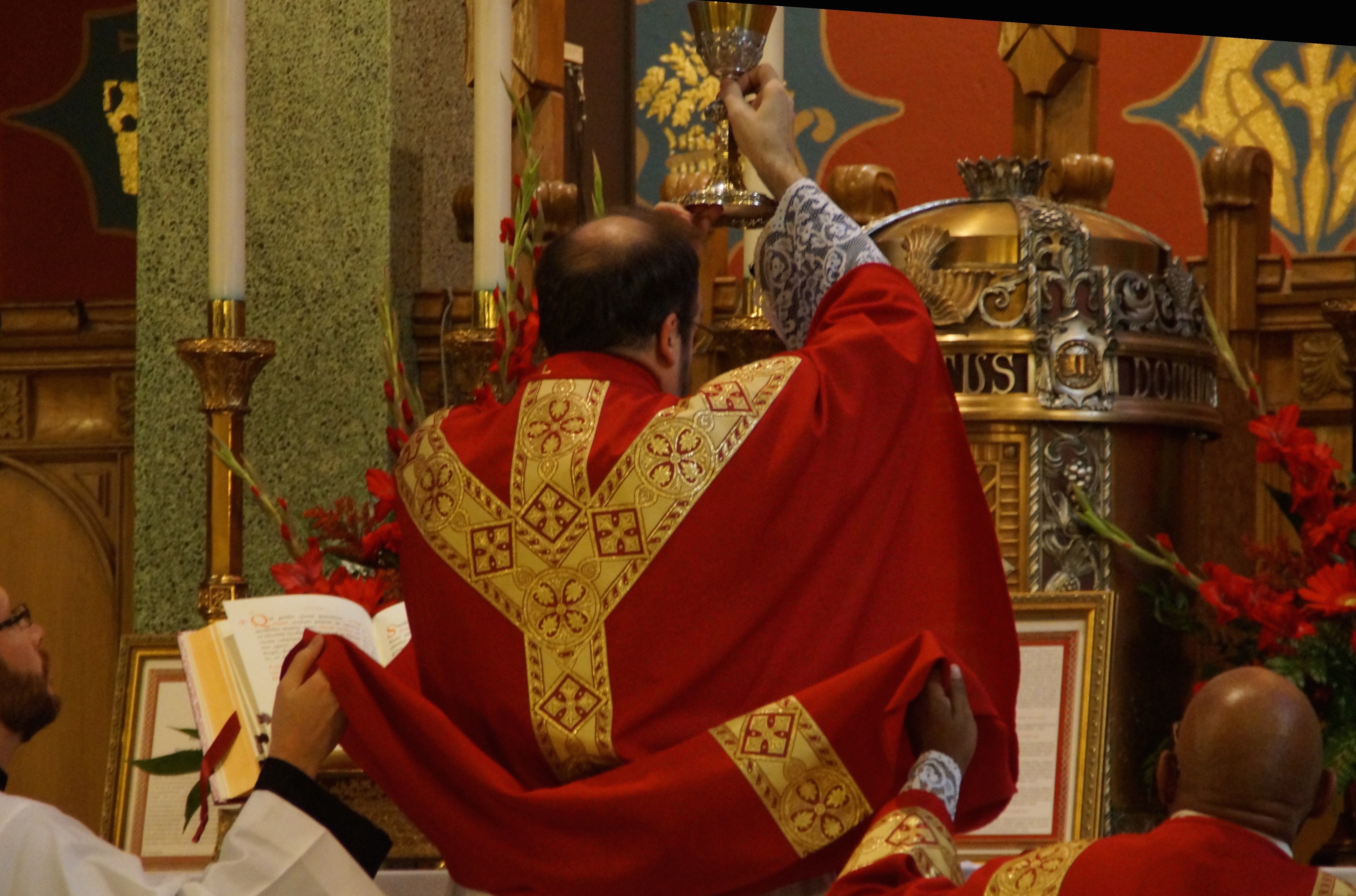
Perhaps a picture will help. My parish church is dedicated to the Holy Spirit under the title Holy Comforter. Above the high altar is the Latin inscription Spiritus Domini, replevit orbem terrarum (The Spirit of the Lord, filled the orb of the earth). (See photo, above right, of our high altar.)

The walls of my parish Church answer the question. The clerestory walls are painted Spanish Red and upon this great canvas are also painted depictions of the lives of 20 saints, surrounding us like a great cloud of witnesses (cf Heb 12:1). (See also the video below.) And above the head of every saint is a tongue of fire.

THIS is how the Spirit of the Lord fills the earth. It is not “magic fairy dust”; it is in the fiery transformation of every Christian, going forth into the world to bring light and warmth to a dark and cold world. THIS is how the Lord casts fire on earth; THIS is how the Spirit of the Lord fills the orb of the earth: in the lives of saints, and, if you are prepared to accept it, in YOU.

In the end, the Great Commission (Matt 28) is “standing order number one.” No matter what else we do, we are supposed to do this. Parishes do not deserve to exist if they do not do this. We as individual Christians are a disgrace, and not worthy of the name, if we fail to win souls for Jesus Christ. The Spirit of the Lord is going to fill the orb of the earth, but only through us. The spread of the Gospel has been placed in your hands—scary, isn’t it?

Beginning two years ago, my own parish, after a year of training, stepped out into our neighborhood and went from door to door as well as into the local park. We announced Jesus Christ and invited people to discover Him in our parish and in the Sacraments. We were in the local park and the market just last week doing “sidewalk evangelization.”

Before we count even a single convert, this is already a success, because we are obeying Jesus Christ, who said, simply, “Go! Go make disciples.” And, truth be told, we ARE seeing the results in my parish. Our Sunday attendance has grown from about 450 to 520, roughly a 15% increase. We are growing, and our attendance—while average for a downtown city parish—is going in the right direction. God never fails. God is faithful.

Spread the news: it works if you work it, so work it because God is worth it. Go make disciples. Ignore what the pollsters tell you about a declining Church and let the Lord cast a fire on the earth through you! Fires have a way of spreading! Why not start one today? The Spirit of God will not disappoint.

I know this: my parish has a future because we are obeying Jesus Christ; we are making disciples. How about you and yours? If parishes do not obey they do not deserve to exist, and they can expect to close one day no matter how big they may be today. I, in my short 50+ years on this planet, have seen it: parishes once big, booming, and (frankly) arrogant are now declining and some are even near closure. It happens to the best if they do not evangelize, if they do not accomplish “job one.” The Lord wants to light a fire. Why not become totally fire? Let the Spirit propagate the Church through you. (I am not talking to the person next to you; I am talking to you.)

Happy Feast of Pentecost! But don’t forget that the basic image is very challenging, for it means getting out of the “upper room,” opening the doors, and proclaiming Christ to the world. Let the Holy Spirit light a fire in you and then you can’t help but spread light and heat to a cold and dark world.

Let the evangelization of the whole world begin with you.

This video features details from the clerestory (upper window level) of my parish of Holy Comforter here in D.C. Notice the tongue of fire above each saint. The paintings show how the Spirit of the Lord fills the orb of the earth (see photo above) through the lives of the saints (this means you, too). It is not magic; it is by grace working in your life, through your gifts and your relationships, that the Lord will reach each soul. The witnesses on the walls of my Church say, “You are the way He will fill the earth and set it on fire.” Let the blaze be ignited in you!

The song says, “We are surrounded by a great cloud of witnesses, looking on, encouraging us to do the will of the Lord. Let us stand worthy, and be faithful to God’s call … We must not grow weary!”

Here is another video I put together that has scenes from the Pentecost Mass in the Extraordinary Form celebrated here last year. This year we will celebrate a Mass of the Octave Mass next  Saturday at 10:00 am. The video is set to the music of Palestrina’s Dum Complerentur which was sung at the Mass. I like this musical version since it is sung in dance time. The Latin text to the motet is below the video along with its English Translation.

Dum complerentur dies Pentecostes,
erant omnes pariter dicentes, alleluia,
et subito factus est sonus de coelo, alleluia,
tamquam spiritus vehementis,
et replevit totam domum, alleluia.

When the Day of Pentecost had fully come,
they were all with one accord in one place, saying, alleluia.
And suddenly there came a sound from heaven, alleluia,
as of a rushing mighty wind,
and it filled the whole house
where they were sitting, alleluia.
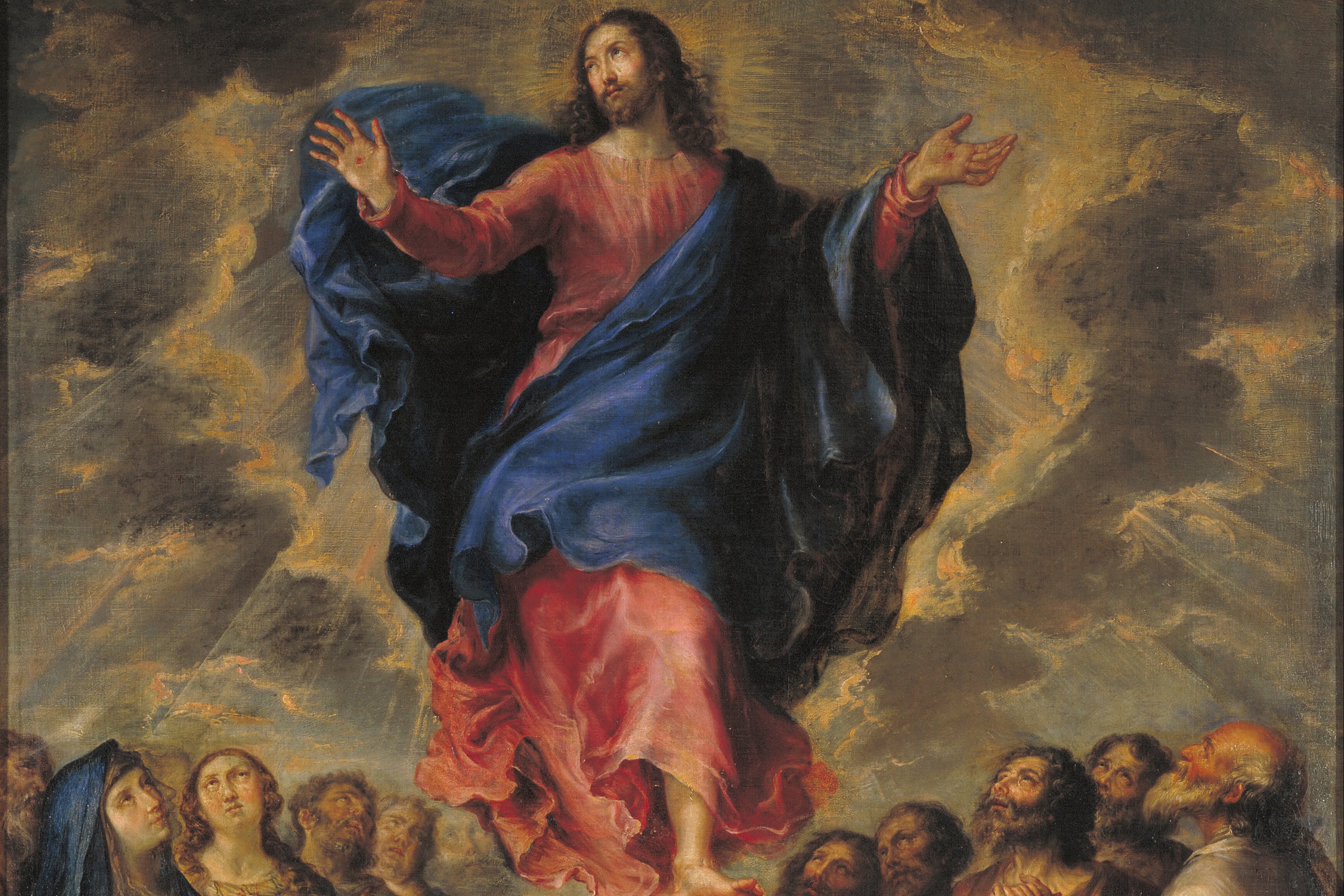
Love Lifted Me – A Homily for Ascension

In more dioceses than not, the Feast of the Ascension is celebrated this weekend. The liturgist in me regrets the move, but here we are any way. So let’s ascend with the Lord, three days late!
This marvelous feast is not merely about something that took place two thousand years ago. For though Christ our head has ascended, we the members of his body are ascending with him. Since he was ascended, we too have ascended. In my own life as a Christian, I am brought higher every year by the Lord, who is drawing me up with Him. This is not some mere slogan, but something I am actually experiencing. An old song says, I was sinking deep in sin, far from the peaceful shore. Very deeply stained with sin, sinking to rise no more. But the master of the sea, heard my despairing cry. And from the waters lifted me. Now safe am I. Love Lifted me, When nothing else could help. Love lifted me!

Yes, the feast of the Lord’s Ascension is our feast too, if we are faithful. Let’s look at it from three perspectives.

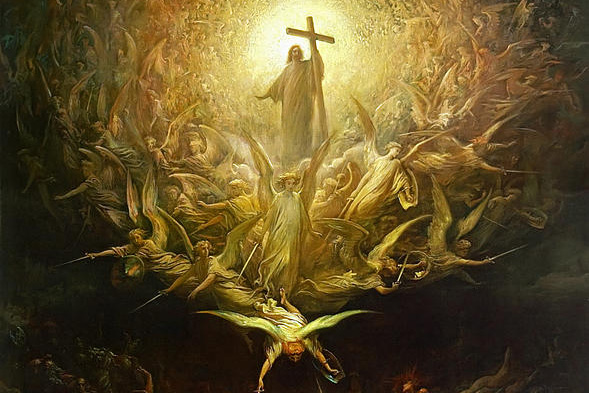
I. The Fact of the Ascension. – The readings today describe a wondrous event that the Apostles witnessed. The Lord, by his own power, is taken to heaven. In so doing He opens a path for us, too. The gates of paradise swing open again: Lift up your heads, O gates! and be lifted up, O ancient doors! that the King of glory may come in! (Psalm 24:7). In Christ, man returns to God. Consider three things about the Ascension:

A. The Reality Imagine the glory of this moment. Scripture says, As they were looking on, he was lifted up and cloud took him from their sight … they were looking intently in the sky as he was going (Acts 1:9). So impressive was the sight that the angels had to beckon them to get along to Jerusalem as the Lord had said, “Men of Galilee,” they said, “why do you stand here looking into the sky? This same Jesus, who has been taken from you into heaven, will come back in the same way you have seen him go into heaven” (Acts 1:11). Yes, it was glorious. Jesus had once said as a summons to faith, What if you were to see the Son of Man ascending to where he was before? (John 6:62). He had also encouraged them saying, Truly, truly, I say to you, you will see heaven opened, and the angels of God ascending and descending upon the Son of man (John 1:51). So here is a glorious reality and a fulfillment of what Jesus had said.

B. The Rescue In the Ascension, it does not seem that the Lord entered Heaven alone. As we have remarked, in His mystical body we also ascend with Him. But consider too this remarkable text that affirms that: Therefore it is said, When he ascended on high he led a host of captives, and he gave gifts to men. In saying, “He ascended,” what does it mean but that he had also descended into the lower parts of the earth? He who descended is he who also ascended far above all the heavens, that he might fill all things (Eph 4:8ff). Yes, the Lord had earlier, just after his death, descended to Sheol and awakened the dead and preached the gospel to them (cf 1 Peter 4:6). And now for those He had justified came the moment to ascend, with Jesus as a “host,” as an army of former captives now set free. Behold the great procession that enters behind Christ through the now opened gates of Heaven: Adam and Eve, Noah, Abraham, Sarah, Isaac, Jacob, Rachel, Judith, Deborah, David, Samuel, Isaiah, Jeremiah, Ezekiel, Malachi, John the Baptist, … and one day, you! Yes this is a great rescue. Adam and his descendants have not simply been restored to some paradisiacal garden; they have entered Heaven.

C. The Rejoicing Consider how this once captive train sings exultantly as they follow Christ upward to Heaven. The liturgy today puts before us a likely song they sang: God mounts his throne to shouts of Joy! The Lord amid trumpet blasts. All you peoples clap your hands, shout to God with cries of gladness, for the Lord the most high, the awesome is the great king over all the earth. God reigns over the nations, God sits upon his holy throne (Psalm 47:6-7). I also have it on the best of authority that they were singing an old gospel song: I’m so glad Jesus lifted me! Yes I also have it on the best of authority that they were even singing an old Motown song: Your love is lifting me higher than I’ve ever been lifted before!

Yes, here are some glorious facets of the Ascension.

II. The Fellowship of the Ascension – We have already remarked that, when Christ ascends, we ascend. Why and how? Scripture says, Now you are the body of Christ and individually members of it (1 Cor 12:27). It also says, All of us who were baptized into Christ Jesus were baptized into his death. By baptism we were buried together with him so that just as Christ was raised from the dead by the glory of God the Father, we too might live a new and glorious life. For if we have been united with him by likeness to his death we shall be united with him by likeness to his resurrection (Rom 6:3ff). So when Christ died, we died. When Christ rose, we rose. When He ascends, we ascend.

But, you may say, He is in glory while I am still here. How is it that I am ascended or ascending? Consider a humorous example using our physical bodies. When I get on an elevator and punch the button for the top floor, the top of my head gets there before the soles of my feet. But the whole body will get there unless some strange loss of integrity or tragic dismemberment takes place. In an analogous way, so it is with Jesus’ mystical body. In Christ, our Head, we are already in glory. Some members of His Body have already gotten there. We who come later will get there too, provided we remain members of His Body. Yes we are already ascended in Christ, our Head. We are already enthroned in glory with Him, if we hold fast and stay a member of his Body. This is the fellowship of the Ascension.

III. The Fruitfulness of the Ascension – Jesus does not return to Heaven to abandon us. He is more present to us than we are to ourselves. He is with us always to the end of the age (cf Matt 28:20). But in ascending, without abandoning us, He goes to procure some very important things. Consider four of them:

A. Holy Ghost power Jesus teaches very clearly that He is ascending in order to send us the Holy Spirit. Nevertheless I tell you the truth: it is to your advantage that I go away, for if I do not go away, the Counselor will not come to you; but if I go, I will send him to you (Jn 16:7ff). He also says, These things I have spoken to you, while I am still with you. But the Counselor, the Holy Spirit, whom the Father will send in my name, he will teach you all things, and bring to your remembrance all that I have said to you (Jn 14:25ff). And yet again, I still have many things to say to you, but you cannot bear them now. When the Spirit of truth comes, he will guide you into all the truth, for he will not speak on his own authority, but whatever he hears he will speak, and he will declare to you the things that are to come (Jn 16:13-14). So the Lord goes in order that He might, with the Father, send the Holy Spirit to live within us as in a temple. In this way, and through the Eucharist, He will dwell with us even more intimately than when He walked this earth.

B. Harvest Jesus says, And I, if I be lifted up from the earth, will draw all men unto me (John 12:32). While the immediate context of this verse is the crucifixion, the wonder of John’s gospel is that he often intends double meanings. Clearly Christ’s glorification is His crucifixion, but it also includes His resurrection and ascension. So, from His place in glory, Christ is drawing all people to Himself. He is also bestowing grace on us from His Father’s right hand to be His co-workers in the harvest: But you shall receive power when the Holy Spirit has come upon you; and you shall be my witnesses in Jerusalem and in all Judea and Samaria and to the end of the earth (Acts 1:8). Yes, from His place in glory, Christ is bringing in a great harvest, as he said in Scripture: “Do you not say, ‘Four months more and then the harvest’? I tell you, open your eyes and look at the fields! They are ripe for harvest. Even now the reaper draws his wages, even now he harvests the crop for eternal life, so that the sower and the reaper may be glad together. Thus the saying ‘One sows and another reaps’ is true. I sent you to reap what you have not worked for. Others have done the hard work, and you have reaped the benefits of their labor” (Jn 4:35-38). Harvest! And it is the Lord’s work from Heaven in which we participate.

C. Help At the Father’s right hand Jesus intercedes for us. Scripture says, Consequently he is able, for all time, to save those who draw near to God through him, since he lives always to make intercession for them (Heb 7:25). The Lord links his ascension to an unleashing of special power: Amen, amen, I say to you, he who believes in me will also do the works that I do; and greater works than these will he do, because I go to the Father. Whatever you ask in my name, I will do it, that the Father may be glorified in the Son (Jn 14:12).

It is true, we must not understand asking in the name of Jesus as a mere incantation, for to ask in His name means to ask in accord with His will. And yet we must come to experience the power of Jesus to draw us up to great and wondrous things in His sight. Despite the mystery of iniquity all about us, we trust that Christ is conquering, even in the puzzling and apparent victories of this world’s rebellion. We read, In putting everything under him, God left nothing that is not subject to him. Though, at present we do not see everything subject to him, yet we see Jesus, who was made a little lower than the angels, now crowned with glory and honor … so that by his death he might destroy him who holds the power of death—that is, the devil— and free those who all their lives were held in slavery by their fear of death (Heb 2:8-9; 14-15). Thus, from Heaven we have the help of the Lord’s grace which, if we will accept it, is an ever-present help unto our salvation.

D. Habitation Simply put, Jesus indicates that in going to Heaven He is preparing a place for us: In my Father’s house are many mansions: if it were not so, I would have told you. I go to prepare a place for you. And if I go and prepare a place for you, I will come again, and receive you unto myself; that where I am, there ye may be also (Jn 14:2ff). Yes, indeed. He has the blueprints out, and the hard hat on. He is overseeing the construction of a mansion for each of us that we may dwell with Him, the Father, and the Spirit forever.

Here then are the ways that Christ, by His love, is lifting us higher than we’ve ever been lifted before. Yes, love lifted me when nothing else could help; love lifted me.

Here’s a modernized version:

Will the Real January 1st Please Stand Up? A Homily for New Year’s Day

123114This feast day of January 1st is a very complex tapestry, both culturally and liturgically. Perhaps we can use the second reading by St. Paul to the Galatians as a way to weave through some of the many details. We can look at it in three parts.

I. The chronology of our celebration – The text from St. Paul’s letter to the Galatians says, When the fullness of time had come …

Most people in the wider culture and in the Church are going about today saying, “Happy New Year!” And rightfully so, for it is the beginning of the new year. But most people think of New Year’s Day in almost wholly secular terms. Sadly, it is best known for excessive drinking and rather loud parties.

Yet it is a mistake to see New Year’s Day simply as a secular holiday. St. Paul reminds us, in speaking of “the fullness of time,” that all time and all ages belong to God.

It is not simply 2015; it is 2015 Anno Domini (A.D.). Even the most secular and unbelieving of people in the Western world locate their place in time in relation to Jesus Christ. It is 2014 years since the birth of Christ. Every time we write the date on a check or at the top of the letter, every time we see the date at the top of the newspaper or on our computer screen, that number, 2015, points back to Christ. He is the Lord of history. Jesus sets the date; He is the clock we go by. All time belongs to Him.

Jesus says in the book of Revelation,I am the Alpha and the Omega, the first and the last, The beginning and the end. He who is, and who was, and who is to come” (Revelation 22:13).

If it is true that 2015 references the birth of Christ, the question arises as to why Christmas Day is not also New Year’s Day. But this actually makes a lot of sense if we understand liturgical and spiritual sensibilities.

In the Church, and stretching back into Jewish times, it was customary to celebrate the high feasts of faith over the period of a week. In Christian tradition this came to be known as the “octave.”  Though we think of a week as seven days, it does not take long to consider that we celebrated Christmas last week on Thursday. Now this week we celebrate New Year’s Day on Thursday, and Thursday to Thursday inclusive is eight days.

Thursday, January 1, 2015 is the eighth day of Christmas. In the Christian tradition the octave is considered really as one long day that lasts eight days. Therefore, Thursday, January 1, 2015 completes Christmas day; Christmas day is fulfilled. Or as St. Paul says, the “fullness of time” in terms of Christmas day has come. And thus the calendars flip from one year to the next. Now, at the end of Christmas day, our calendars go from 2014 to 2015 A.D.

The rest of the secular world has largely moved on already, barely thinking of Christmas anymore. As I walk in my neighborhood, I see the strange spectacle of Christmas trees already set out at the curb waiting to be picked up by the recycling trucks. Yes, for many in our hurried world, Christmas is over. But we in the Church continue to celebrate the great Christmas feast and cycle. Having completed the octave, we move on to Epiphany week.

Thus, this New Year, we contemplate the “fullness of time.” The passage of another year reminds us of the magnificent truth that to God all time, past, present, and future, is equally present. He holds all things together in Himself. He is the same yesterday, today, tomorrow, and forever. And whenever He acts, He always acts in our time, out of the fullness of time. This is a very deep mystery and we should ponder in silence the mystery that for God, all things ARE. He is not waiting for things to happen. For Him, everything is accomplished. I will write more on this in tomorrow’s blog.

II. The content of our celebration – St. Paul goes on to say, God sent forth his son born of a woman. And with this statement we are again reminded that we are still in the Christmas cycle.

We’ve already discussed the concept of the eighth day, of the octave. And while it is New Year’s Day, there is also a complex tapestry of religious meanings to this day as well.

As we’ve already seen, it is still Christmas day, the eighth day of the one long day that we call Christmas Day.

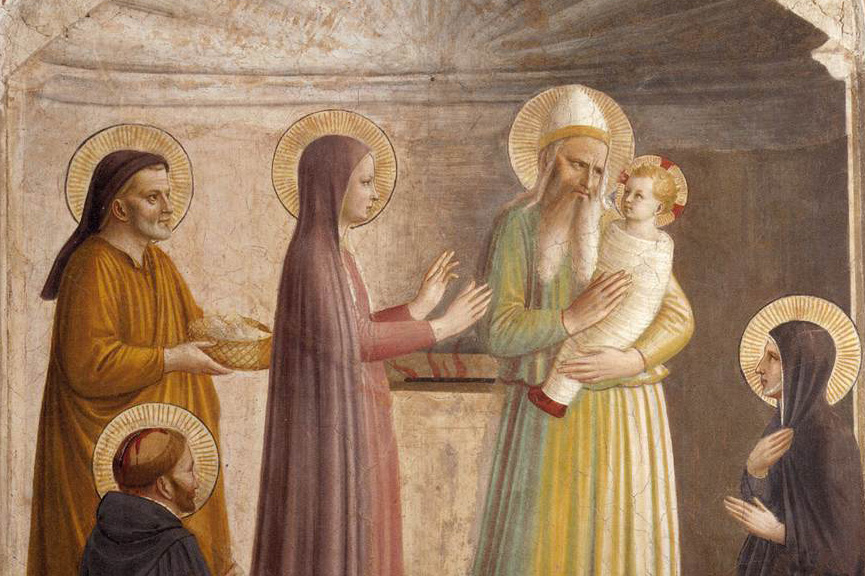
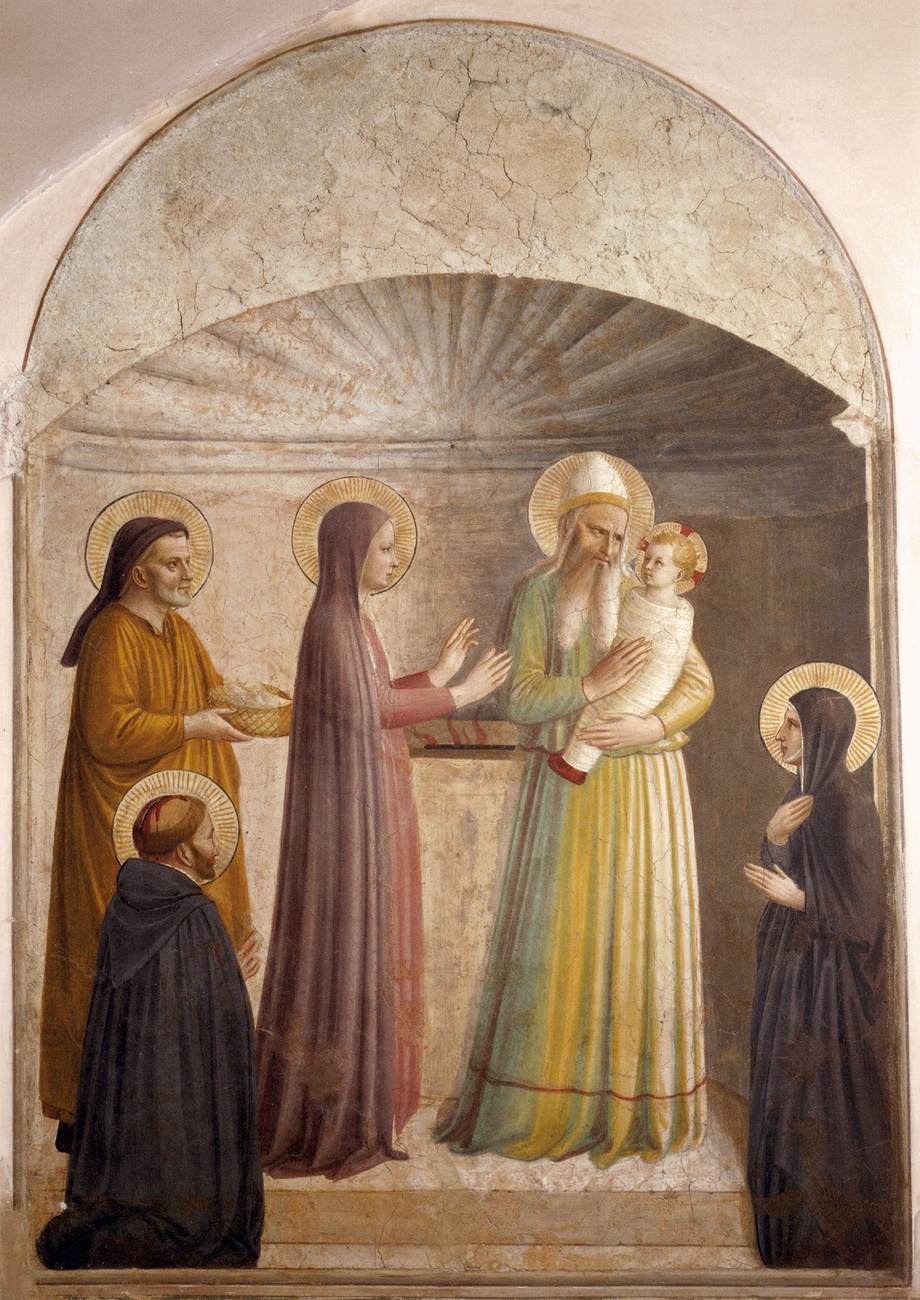
Historically, this is also the day of Christ’s circumcision. And for a long period in Church history that was the name given to this feast day, “The Circumcision of the Lord.” As I have written previously, I personally regret the loss of this feast, at least in terms of its title.

This is the day when Joseph and Mary brought Christ to be circumcised. In this, Jesus as man and also as God reverences the covenant He has made with His people. It is a beautiful truth that God seeks relationship with His people. And in this covenantal act of the circumcision is the moving truth that, as the Letter to the Hebrews puts it, Jesus is not ashamed to call us His brothers (Heb 2:11).

There is here the first shedding of blood by Jesus. It is also a sign of His love for us.

Another truth about the content of this feast is the Holy Name of Jesus. For not only was a Jewish boy circumcised on the eighth day, but he was also given his name, and all hear that name for the first time.

The name, Jesus, means “God saves.” And indeed this most Holy Name of Jesus, when used in reverence, has saving power. We are baptized in His Holy Name along with that of the Father and the Holy Spirit. And all of our prayers conclude with His Holy Name. Scripture says of His great and holy name,

Therefore God exalted him to the highest place and gave him the name that is above every name, that at the name of Jesus every knee should bow, in heaven and on earth and under the earth, and every tongue acknowledge that Jesus Christ is Lord, to the glory of God the Father (Phil 2: 9-11).

And yet another identity and content of this feast day is shown in its current, formal title, “The Solemnity of Mary Mother of God.” This title replaced the title of the Feast of the Circumcision back in 1970. However, it is the most ancient title for this feast day. Again, you can read more on this issue in a previous blog post.

We note in the reading that Paul says that God sent forth his Son, born of a woman. Jesus is the eternal Son of the Father; He is God from God, Light from Light, True God from True God. Jesus is God, and since Mary gives birth to Jesus, Mary is the Mother of God, because Jesus is not two different persons.

Mary did not just give birth to part of Jesus, she gives birth to Jesus. And thus the title “Mother of God” speaks to us as much about Jesus as it does about Mary. It is a title that she has because of the Church’s insistence that Jesus cannot be divided up into two different people. We cannot say that Mary gives birth to one Jesus but not “the other one.” There is only one Jesus, though He has two natures, human and divine.

And thus, on this feast of Christmas, on this eighth day of Christmas, we are reminded and solemnly taught that Jesus is human and also divine. In taking a human nature to Himself from his mother Mary, He remains one person. God has sent forth his son born of woman.

III. The consolation of our celebration – St. Paul goes on to say, Born under the law to ransom those under the law so that we might receive adoption as sons. As proof that you are sons, God sent the Spirit of his Son in our hearts crying out Abba, Father! So you are no longer a slave,  but a son, and, if a son, also an heir through God.

Note three things about this text:

A. Our Adoption – We have already noted that on the eighth day Jesus is circumcised and enters into the Covenant,  into the Law. In the Incarnation He joins the human family; in the Covenant He joins our family of faith. He will fulfill the old Covenant and inaugurate the new one. And by this New Covenant, by baptism into Him, we become members of His Body and thereby become adopted as sons.

We become sons in the Son. When God the Father looks to His Son, loving His Son, he is also looking at us and loving us, for we are in Christ Jesus, members of His Body through baptism. God is now our Father, not in some allegorical sense, but in a very real sense. We are in Jesus and therefore God really is our Father.

B. Our Acclamation – St. Paul says that the proof of our sonship is the movement of the Holy Spirit in us that cries out Abba! In Aramaic and Hebrew, Abba is the family term for father. It is not baby talk, like “Dada.” But just as most adults called their father “Dad” or some other endearment rather than “father,” so it is that Abba is the family term for father. It would be a daring thing for us to call God “Dad” unless we were permitted to do so, and instructed to do so by Christ.

St. Paul speaks of this word as proof that we are sons. In so doing, he emphasizes that it is not merely the saying of the word that he refers to. Even a parrot can be taught to say the word. Rather, St. Paul is referring to what the word represents: an inner movement of the Holy Spirit wherein we experience a deep affection for God the Father. By our adoption, our baptism into Christ, by our reception of the Holy Spirit, we love the Father! We develop a deep affection for Him and dread offending Him. By this gift of the Spirit, God is my Father whom I deeply love!

C. Our advancement – Notice that St. Paul then speaks of how we have moved from being a slave to being a son, an heir. In Jesus, we are not just any son, we are the only Son of the Father. And as Jesus has a kingdom from His Father, we too inherit it with Him! As sons in the Son, we are heirs with Jesus to the Kingdom!  Jesus speaks of His disciples as one day reigning with Him: And I confer on you a kingdom, just as my Father conferred one on me (Lk 22:29). In Jesus, all Heaven will be ours and we will reign with Christ forever. This is not our doing, not our glory; it is Christ’s doing and His glory in which we share.

And thus we have a very rich tapestry on this New Year’s Day, this feast of the Octave of Christmas, this Feast of the Circumcision of the Lord, this Feast of the Holy Name of Jesus, this Feast of Mary the Mother of God. And also we are given this feast wherein the glory of Christ is held before us and we who are  members of His body are told of the gifts that we receive by His Holy Incarnation and His Passion, Death, and Resurrection.

It’s not a bad way to start the new year: reminded of God’s incredible love for us, of His rich blessings and promises.

I Hear Music in the Air! – A Homily for Christmas

122414The mysteries of Christmas are many. Among them is the mystery of the music heard that night. The angels shouted the great declaration, “Glory to God in the Highest,” and creation takes it up as a song. But why this music? Is it merely window dressing, or does it disclose a mystery to us? Is it merely for us, or do the angels also have need of the declaration?

As always with the things of God, there are realities far deeper than most of us imagine. But tonight’s Christmas feast weaves together, among many other mysteries, those of music and descent, and points up to music and ascent.

You see, over my head I hear music in the air. There must be a God somewhere. And the Lord descends to one song so that we might ascend to a new song in a new place: in the highest heavens. Let’s see how.

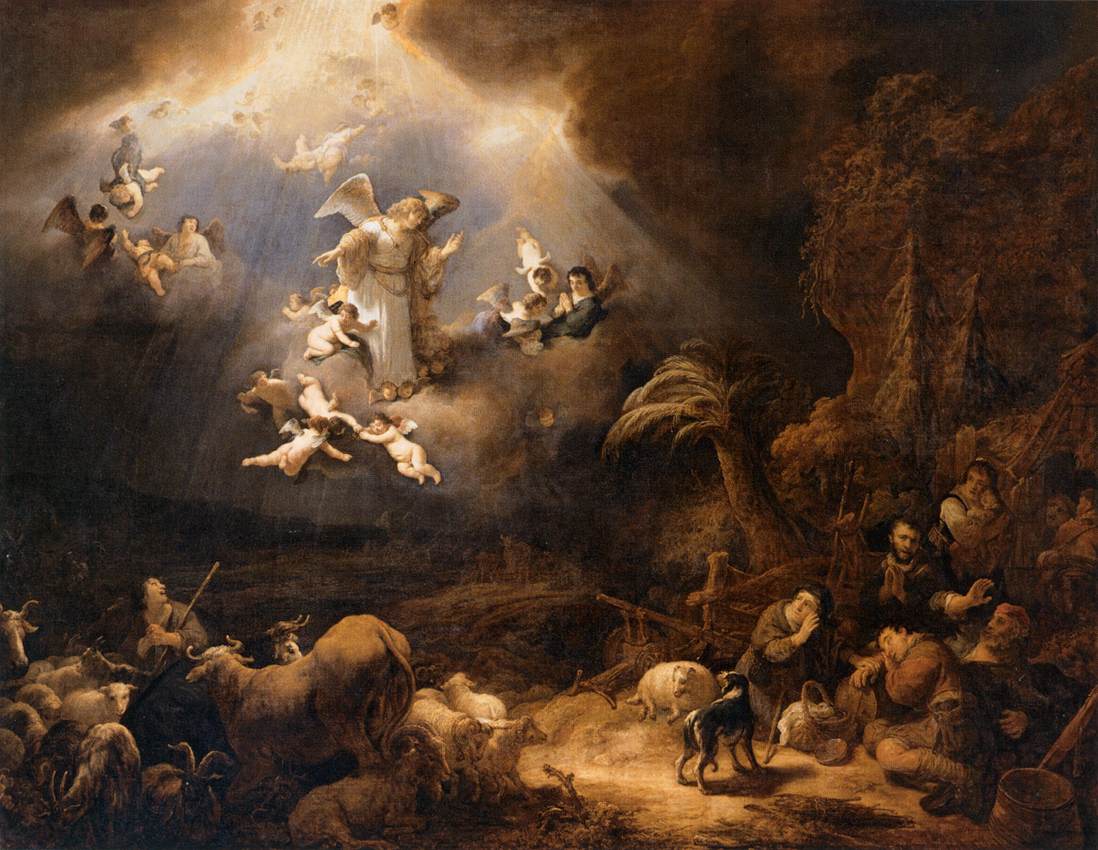
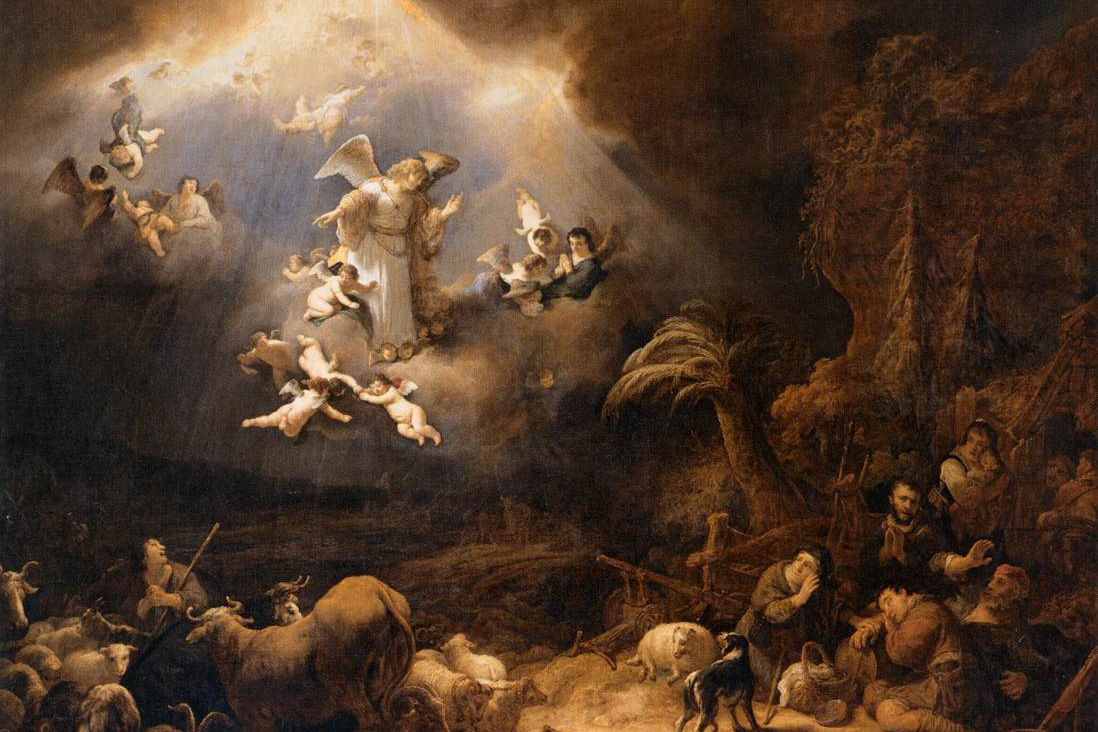
I. Divine Condescension – The text says, Now there were shepherds in that region living in the fields and keeping the night watch over their flock. The angel of the Lord appeared to them and the glory of the Lord shone around them, and they were struck with great fear. The angel said to them, “Do not be afraid; for behold, I proclaim to you good news of great joy that will be for all the people. For today in the city of David a savior has been born for you who is Christ and Lord. And this will be a sign for you: you will find an infant wrapped in swaddling clothes and lying in a manger (Lk 2:8-12).

We look first to the divine descent of Jesus. Note that Jesus, who is called Savior, the Anointed One, and Lord, is said to be found wrapped in swaddling clothes and lying in a feed box, a trough from which animals are fed.

What sort of King and Lord is this? It is almost a divine comedy. Imagine the shepherds quaking in fear at the presence of an awesome angel. And then the angel tells them that they will find the Christ lying in a feed box, in a stable somewhere nearby. One can almost image one shepherd saying to another in a sort of whisper, “Did that angel say ‘feeding trough’?” And then the other nervous shepherd whispers back, “Yeah, that’s what he said.” It is comedic because it is so anti-climactic.

Indeed, there is a remarkable divine condescension here! The Lord did not merely descend from Heaven to earth. He descended to one of the lowest places on the earth, to a stinking cave, among animals, and has for His bed a feeding trough meant for animals.

And though Bethlehem was called the “City of David” it was hardly fit for a King. It was then, and is now, a run-down, dusty, ramshackle, poor town.

So here is the King of the Universe born, not in a stately palace, but in a stinking pen; not in a cozy cradle, but in a messy manger.

Yet God speaks eloquently in this poverty and condescension. Here is the Bread of Life, in a town called Bethlehem (House of Bread), lying in a feed trough. In His littleness and poverty He is approachable and calls to the poor.

But do not miss the radical nature of this descent! So radical was it, that this very thing is said in tradition to be the reason that one-third of the angels rebelled, turning against God and falling to the earth as demons (fallen angels). In both Jewish apocryphal writings as well as the writings of the Fathers of the Church, Lucifer, one of the highest ranking angels and among the seraphim, recoiled at the idea that God would choose to join Himself to His physical creation. Man was a mere mud doll to Lucifer, something and someone so far beneath him as to merit no real attention. The thought of God becoming flesh caused Lucifer to rebel, and he took a third of the angels with him in rebellion against so absurd a plan: God as mud doll, taking on human flesh and being joined to mere material creation. It was unbecoming, beneath the dignity of the spiritual world!

Condescension was unthinkable to Lucifer’s pride and he fell, refusing to accept such an absurd notion. Ever since that time, he and the fallen angels with him have envied the human person whom God was pleased to indwell, and by this envy have sought to destroy our truest dignity: an indwelling relationship with God.

Why this condescension? He condescends today to one song in order that we may ascend one day with Him to a new place and sing a new song. To what song does He descend and to what song will we ascend? Let’s read on.

II. Dancing Choirs –  The text says, And suddenly there was a multitude of the heavenly host with the angel, praising God and saying, “Glory to God in the highest and on earth peace to those on whom his favor rests.”

But the angels who did not fall had rejoiced in God’s plan and longed for its day! Thus on this day, as the Lord is manifest to the world, the highest angels who descended with Christ at the Annunciation now send word through and to the lower ranks of angels and a great heavenly throng makes the declaration, Glory to God in the Highest, and on Earth Peace! The great hymn that is sung (or more literally, declared) is not just for the human family; according to the Fathers of the Church it is also a signal to the lower ranking angels from the higher ranking angels. All Heaven has revealed to it the mystery hidden for ages and generations but now made manifest to his holy ones (Col 1:26). A mystery, a wisdom which is hidden, which God ordained before the world, unto our glory (1 Cor 2:7). …The things which have now been announced to you by those who preached the good news to you through the Holy Spirit sent from heaven, things into which angels long to look (1 Peter 1:12).

Perhaps a little background will help understand the dance of the choirs and the communication that takes place.

The inner life of the Trinity, according to sacred tradition and the teaching of the Fathers, is not a mere static vision of the three persons for one another. The inner of the live of the Trinity is a movement of love. The Father loves the Son; the Son loves the Father; the Holy Spirit processes between them in this great movement which the Greek Fathers call the divine perichoresis, a kind of dance of love.

And the angels are arranged around God in ranks or choirs somewhat like concentric circles.  And they, too, take up the dance of love, passing love and revelation from God through each rank or choir and back again. Yes, here is the great dance, the perichoresis of God’s inner love radiating out to angels, down through the ranks to us, and from us back through them to God.

The nine choirs (ranks) of angels are divided into three tiers, or triads, each with specific concerns:

  1. The Highest Tier: Seraphim, Cherubim, and Thrones, who concern themselves with contemplating the glory of God. It is the six-winged seraphim who sing the Sanctus, “Holy, Holy, Holy Lord, God of Hosts” (Isaiah 6:3).
  2. The Middle Tier: Dominations, Virtues, and Powers, who are known as the “angels of creation” because they concern themselves with the ordering of the cosmos and the causes of things.
  3. The Lower Tier: Principalities, Archangels, and Angels, who concern themselves with the minute ordering of the universe and with specific causes, including the welfare of people. Each human being, each church, and each country has a guardian angel.

Thus, the “Gloria in Excelsis” is a declaration of praise not just overheard and taken up by humanity; it is not just a hymn of praise, it is a dance and a passing of information down the chain of angelic choirs. The highest choirs of angels have descended with the Word made Flesh, Jesus, since it is their role to surround Him with perpetual adoration.

The Church Father, Origen, has the higher angels say,

“If he has put on mortal flesh, How can we remain, doing nothing!? Come Angels, let us descend from heaven!” That is why [Scripture says] there was a multitude of the heavenly Hosts praising and glorifying God when Christ was born. Everything is filled with angels! (Hom in Ex. 1:7)

And now at Jesus’ birth, the Seraphim, Cherubim, and Thrones signal the lower angels: “This is He, who is Lord of all Creation; He who is ever to be adored and glorified.” The lower angels take up the information and cry out, “Glory to God in the Highest.”

Another Church Father, Pseudo-Dionysius, says of this great heavenly hymn that is declared,

The highest order composed of Seraphim, Cherubim, and Thrones, and which is closest of all, by reason of its dignity, to the secret sanctuary of God [instructs]  the second order, composed of Dominations, Virtues and Powers. This order in turn reveals the mysteries to the lower tier of angels the Principalities, Archangels and Angels who are set in charge of the human hierarchies (Hier Ceol. 9,2).

And thus the great “Gloria in Excelsis Deo” resounds in the heavens, not just on the earth. The angels are given the good news along with us! An ancient hymn from the Liturgy of St. James says of this moment,

  • Rank on rank the host of heaven
  • spreads its vanguard on the way,
  • as the Light of light descendeth
  • from the realms of endless day,
  • that the powers of hell may vanish
  • as the shadows clear away.
  •  
  • At his feet the six-winged seraph,
  • cherubim, with sleepless eye,
  • veil their faces to the presence,
  • as with ceaseless voice they cry,
  • “Alleluia, alleluia,
  • Alleluia, Lord most high!”

And to us on earth comes the call to hear the music, the great hymn of praise and instruction, and to respond with our souls!

I have it on the best of authority that as the shepherds heard the great song of the angels, one of them said, Over my head I hear music in the air. There must be a God somewhere!

All of creation echoed that night with the song of the angels communicating this truth to one another and to us.

Angels we have heard on high
Sweetly singing o’er the plains,
And the mountains in reply
Echo back the joyous strains
Gloria!

The animals, too, lifted their eyes heavenward, and one was said to say,

Said the little lamb to the shepherd boy,
do you hear what I hear
Ringing through the sky, shepherd boy,
do you hear what I hear
A song, a song, high above the trees
With a voice as big as the sea
With a voice as big as the sea!

But why all this music at the divine descent? Because the music (Gloria in Excelsis) and the descent are related and meant to signal and lead us higher. Christ descends to one song in order to lead us to an even nobler and higher song,

III Destiny of the Christian – The Psalm says, Sing to the LORD a new song, sing to the LORD, all you lands. Sing to the LORD; bless his name (Ps 96:1-2).

So again, this music (Gloria in Excelsis) and the descent are related and meant to signal and lead us higher. Christ descends to one song in order to lead us to an even nobler and higher song, a song sung in the highest heavens! And without this descent and this first song, the second song and our ascent are impossible. Christ descends to the song of the lower heavens so that we, by His saving grace, may ascend to the place and song of the higher heavens.

And what is this new song and place? Isaiah heard the music and saw the place:

I saw the Lord sitting upon a throne, high and lifted up; and his train filled the temple. 2 Above him stood the seraphim; each had six wings: with two he covered his face, and with two he covered his feet, and with two he flew. 3 And one called to another and said: “Holy, holy, holy is the Lord of hosts; the whole earth is full of his glory.” 4 And the foundations of the thresholds shook at the voice of him who called, and the house was filled with smoke. 5 And I said: “Woe is me! For I am lost; for I am a man of unclean lips, and I dwell in the midst of a people of unclean lips; for my eyes have seen the King, the Lord of hosts!”  6 Then flew one of the seraphim to me, having in his hand a burning coal which he had taken with tongs from the altar. 7 And he touched my mouth, and said: “Behold, this has touched your lips; your guilt is taken away, and your sin forgiven”  (Isaiah 6:1-8).

Here is a our new song, a higher song, one sung only in the highest Heaven before the throne of God, one sung only by the redeemed: Holy, Holy, Holy Lord God of Hosts! At every Mass, our High Priest, Jesus, speaking through His ministerial priest says, Lift up your hearts! We reply that we have them lifted up to the Lord. In other words we are told to come up higher, to come into the Holy of Holies in Heaven, to come before the throne and sing the hymn of the highest in Heaven.

Our ascent to this highest place is made possible only by the Lord’s descent to the lowest places here: the manger, the Cross, and Sheol. In the early Church, only the baptized could sing the Sanctus at Mass. The unbaptized were not allowed to attend. The catechumens, though permitted to sing the hymn of the lower heavens (The Gloria), were dismissed prior to the singing of the Sanctus, the song of the higher heavens. Only when we are caught up higher by grace can we hear and join the Sanctus. And one day it will be fully our song when God, who descended, says to us, “Come up higher.” And then, by Him who descended, we will ascend and sing a new song to the Lord!

Over my head I hear music in the air. There must be a God somewhere. And the Lord descends to one song so that we might ascend to a new song in a new place, in the highest heavens. May HE, who descends to the manger today, cause you to ascend to the highest heavens to sing that new song.

See What the End Shall Be – A Homily for the 4th Sunday of Advent

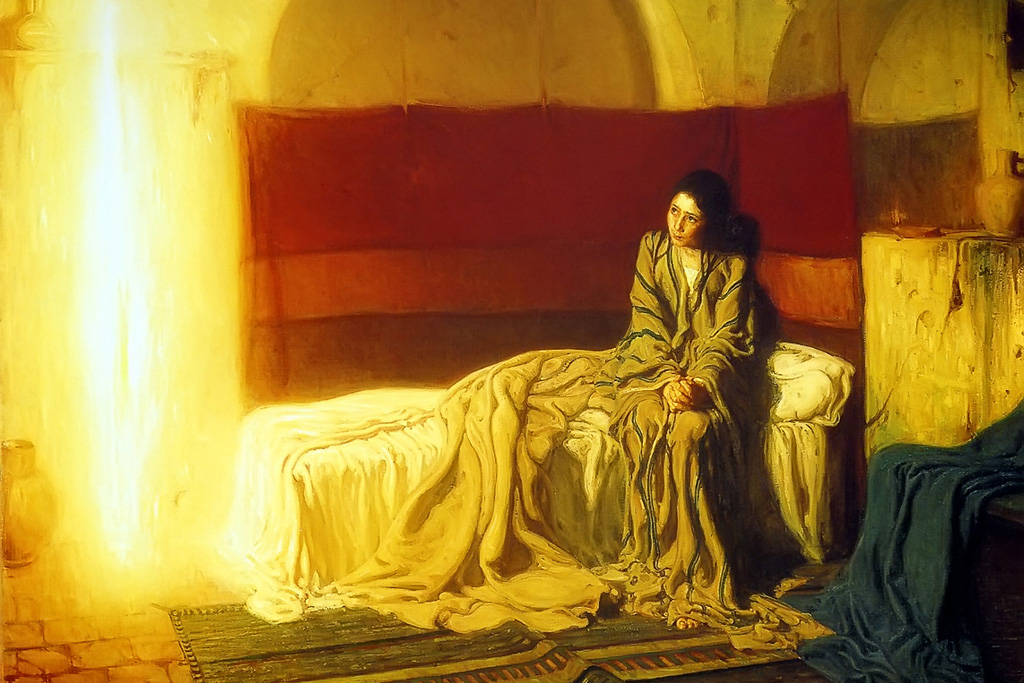
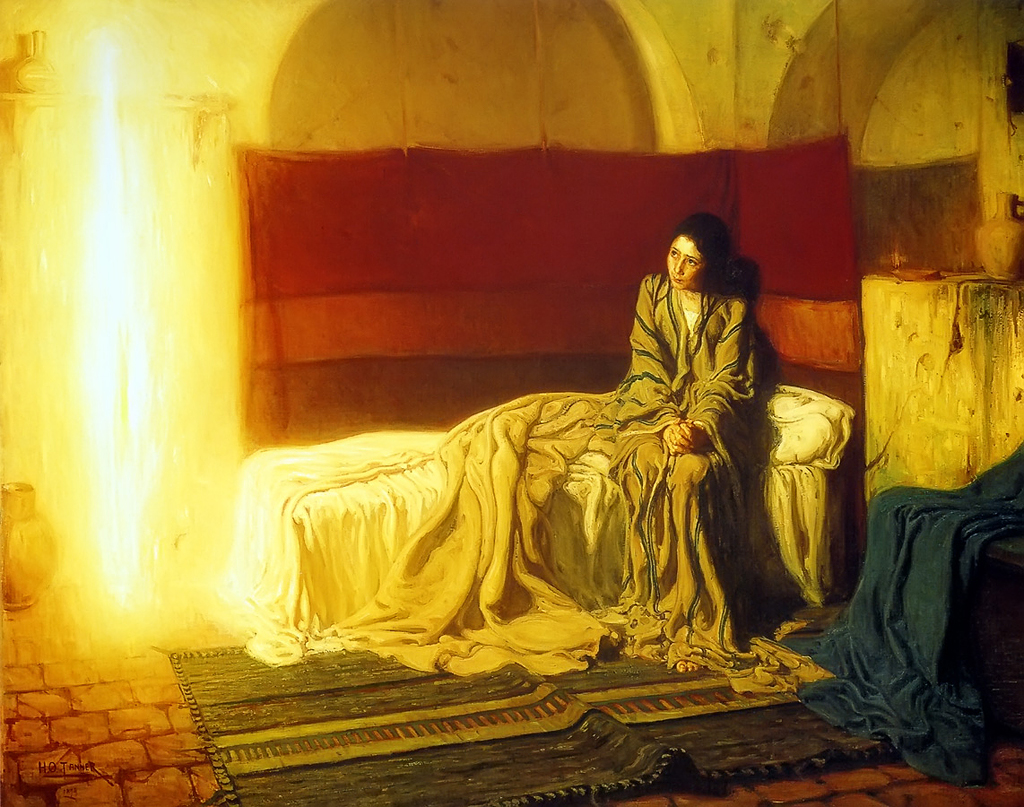
The Annunciation by Henry Ossawa Tanner 1896In today’s Gospel we step back nine months to March 25th, the feast of the Annunciation, an event all but hidden, but which changed the world.

God, whose focal presence had departed the Temple just prior to the Babylonian invasion (cf Ez 10:18) and the loss of the Ark of the Covenant, now returns to the Ark of Mary’s womb. The glorious presence of God returns now to His people in an obscure town of fewer than three hundred, a town so small that no road led to it.

We are reading here of a pivotal moment in the history of mankind. God not only returns to His people but becomes one with them in the Incarnation.

And at this moment we do well to consider four aspects of this pivotal moment. As we do so, we consider not only Mary’s glories but ours as well (in a subordinate yet real way). For Mary is the perfect disciple and typifies in a most excellent way the glories that God also wishes to bestow on us, in perhaps a different but still substantial way. Let’s look at four aspects of this Gospel.

I. The RESPECT of God – The text says, The angel Gabriel was sent from God to a town of Galilee called Nazareth. To a virgin betrothed to a man name Joseph and the virgin’s name was Mary … Mary said “Behold I am the Handmaid of the Lord, May it be done to me according to your word.

Note that God asks of Mary her cooperation. Although the Angel Gabriel’s words are not in the form of a question, it is clear from Mary’s response that she considers this to be a request from God. She says yes, and thus understands it as a request, not merely a statement of what shall be.

In this regard we see an important indicator of the respect of God for her freedom. Surely He has prepared her and equipped her with every good grace to say yes, but in the end, her freely offered yes is significant, and something that God looks for and respects. Otherwise, why bother to send an angel at all? Why come through Mary at all? Why not simply appear suddenly as a full-grown man and start to work? As it is, God wills to come through Mary (cf Gen 3:15) and seeks her yes in the place of Eve’s no.

And this respect for Mary’s freely offered yes is also a respect God extends to us. Indeed we can see here how God’s respect is in direct contrast to the behavior of the devil, who provokes, shouts, and intrudes. Through cultural noise, etc., he tempts and provokes us. In contrast, God whispers and respectfully invites. He does not force a decision on us, but rather summons us in love and patiently awaits our answer.

In Scripture we read of Jesus, Behold, I stand at the door and knock; if any one hears my voice and opens the door, I will come in to him and eat with him, and he with me (Rev 3:20). Hence, though all powerful and able to coerce, God does not do so; He does not act violently or impose His will. He respects the freedom He Himself gave us and invites us to cooperate in His plan for us.

Mary (and we) are thus respected by God in terms of our freedom, and God “needs” us to open the door for Him to go to work.

II. The REGARD of God – Note in the text the great love, appreciation, and regard God extended to Mary through the angel. The text says, Hail, Full of grace! The Lord is with you … Do not be afraid Mary. You have found favor with God ...

As the great and glorious Angel Gabriel (and every angel is glorious) comes to Mary, he must still, in an astonishing way, acknowledge Mary’s beauty, holiness, and perfection by God’s grace. Imagine an all-glorious archangel rendering a kind of debt of praise to a mere human being! And in speaking this way he is speaking for God, of the deep love, appreciation, and regard that God has for Mary, His greatest human work.

Indeed, we should never forget the love and deep regard God has for Mary and also for us. Mary is surely God’s masterpiece. But she is also the result of His grace and work. She is sinless, “full of grace,” for, being filled with grace, there is no room in her for sin.

The Angel Gabriel speaks to her dignity and perfection in the greeting Χαιρε κεχαριτωμενη (Chaire, Kecharitomene – Hail, full of grace). Kecharitomene (full of grace) is a perfect, passive participle indicating an action completed (perfected) in the past but operative now as well. Thus Gabriel salutes her not by her name, “Mary,” but by a sort of new name: “Hail, she who was perfectly graced and is so now!” Thus she had been freed of all sin in the past for she is perfectly, fully graced, and she is so now as Gabriel greets her and regards respectfully the work of God in her.

In a less perfect (but still true) way, God also loves us and loves in us the perfection we will one day attain by His grace and mercy. A couple of texts come to mind:

I have loved you with an everlasting love; I have drawn you with loving kindness (Jer 31:3).

Fear not, for I have redeemed you; I have summoned you by name; you are mine. For I am the LORD, your God, the Holy One of Israel, your Savior … you are precious and honored in my sight, and … I love you (Isaiah 43:1-3).

We are not good, and therefore God loves us. God loves us and therefore we are good, if we accept His love. Mary was, by a singular grace, wholly open to God’s love and perfection. And if we are faithful, each of us, too, will one day become the man or woman God has always intended us to be.

God thus shows great regard for Mary (through Gabriel) and He also knows the glory we will one day share.

III. The RIDDLE in the middle – There remains the mysterious question of Mary: “How will this be since I do not know man?” Had she been thinking in strictly biological terms she would have known the obvious answer to the question: she and Joseph would conceive. But her question seems to imply she had other notions about her future than regular marital relations.

Some hold that the question is not really Mary’s question, but rather is rhetorically placed here by Luke so that the angel can inform us, the readers, that God alone is the true Father of the Son. But such a notion seems more likely concocted by nervous moderns in an attempt to solve the mystery. Reducing a pivotal question like this to a mere literary device seems unbecoming.

Catholic tradition surely sees evidence here of the doctrine of Mary’s perpetual virginity. To be sure, many other questions are raised by this resolution. Why would two people get married and then live as virgins? Were such arrangements common at that time? (It would seem not.) And so forth.

In the end, Mary’s question seems to point to some expectation on her part that she would “not know man” in some sense, going forward. But at any level, we are not going to be able to completely satisfy our curiosity in this matter, and ultimately it is none of our business.

One thing is sure: the Church teaches, without ambiguity, that Mary remained ever-virgin. It seems a reasonable conclusion that Mary’s question indicates that she was clear on this. But there remains also a mystery that we must respect.

In this case, Protestants and others who deny her lasting virginity have some thinking to do. For Mary’s question is not meaningless or naïve. It is a true question, with a true context, that ought to be respected as at least pointing to her virginity, even if it alone does not alone prove it.

IV. The REASSURANCE of God – Mary is in the presence of an archangel. This alone is frightening enough. But it is also true that her world is shifting quite dramatically. Hence, her natural fear and anxiety is understandable. Thus the Archangel Gabriel gives a number of reassurances to Mary: Do not be afraid Mary, For you have found favor with God … Behold you will conceive in your womb and bear a son and you shall name him Jesus. He will be great and will be called the Son of the most high, and the Lord God will give him the throne of David his father, and he will rule over the house of Jacob forever, and of his Kingdom there will be no end

In effect, St. Gabriel is saying to her that, however the details unfold, in the end there will be total victory, for she is to bear a Son who is the Son of the most High God, and who will have a kingdom that will never end or be conquered. Hence, whatever her concerns, this all leads to victory.

Mary will need this reassurance for there ARE some difficult days ahead: the crisis of homelessness at Jesus’ birth, the flight to Egypt, Simeon’s prophecy that a sword would pierce her heart, and the actual thrusting of that sword at the foot of the Cross. This knowledge of ultimate victory is an important reassurance for her to hold close and not forget.

So, too, for us. For we, too, have some difficult valleys to cross, some arduous hills to climb. We must constantly keep in mind the end of the story: Jesus is already the victor. Even if we might think we are losing, in the end, total victory belongs to Jesus, and to us if we stay with Him. The end of the story is already declared: Jesus wins, overwhelmingly, and all His enemies are placed under His feet (e.g., Rev 20-22; 1 Cor 15:25-26; John 16:33 inter al).

Consider this magnificent passage from Isaiah:

I am God there is no other. At the beginning I foretell the outcome; in advance, things not yet done. I say that my plan shall stand. I accomplish my every purpose. Yes, I have spoken, I will accomplish it; I have planned it and I will do it. Listen to me you fainthearted, you who seem far from the victory of justice: I am bringing on my justice, it is not far off, my salvation shall not tarry; I will put salvation within Zion, and give my glory to Israel (Isaiah 46:12ff).

If we were to memorize and internalize this passage, so many of our fears and anxieties would flee, our trust would build, and we would live victorious lives. It may at times seem that evil has the upper hand. Evil may have its day, but God has the ultimate victory. No matter how dark it may seem, God has already won, only the news has not yet leaked out.

But on our hearts this truth and reassurance must be emblazoned. For, like Mary, we have difficult days in our future. All the more reason God’s reassurance is essential for us. It got Mary through the Cross and it will get us through our trials.

Hence, we have here a pivotal moment in history. God’s presence returns to the human family. And it all happens so quietly in Nazareth, a town of 300, a town so small that there was not even a road that went to it. Quietly, but clearly and powerfully, God has thrust the first blow at Satan’s realm. Victory is sure.

Painting above: Annunciation, by H. Tanner

I have it on the best authority that Mary sang this song after the angel left: “Done made my vow to the Lord and I never will turn back, I will go, I shall go to see what the end shall be.”

It occurs to me that Mary, at this time, was not much older than the young ladies in this choir.

Sweet, Beautiful, Soul-Saving Joy – A Homily for the 3rd Sunday of Advent

121314This Sunday is traditionally called Gaudete Sunday based on the Introit for the day: Gaudete in Domino semper, iterum dico, Gaudete (from Philippians 4:4 Rejoice in the Lord always, again I say, Rejoice). This theme is developed most fully in today’s readings in 1 Thessalonians 5:16ff. It, too, begins with the salutation and imperative, “rejoice always!”

Let’s take a closer look at that reading and what is meant by the admonition to “rejoice.”

The text begins, Rejoice always. The Greek word properly translated here as “rejoice” is χαίρετε (chairete). However, more is intended here than to merely rouse ourselves to some sort of the emotional state of joy or happiness. You may note the root word “charis” in “chariete,” and charis refers to grace. Hence chairete means, properly, to delight joyfully in and BY God’s grace, to experience God’s favor (grace), to be conscious of and glad for His grace.

Since it is a work of grace, the gift of this sort of joy is more fully understood as a serene, confident, and stable joy, a joy not rooted merely in the passing moods of our fallen human state.

The text continues further to identify three basic ways that our joy can become both stable and deeply rooted in our personality and psyche. In effect, the text does not merely instruct us to rejoice always, but tells us how this can be done. Let’s look at these three ways.

I. PERSEVERANCE IN PRAISE – The text says, Pray without ceasing. In all circumstances give thanks, for this is the will of God for you in Christ Jesus. Do not quench the Spirit. Hence we see the first three foundations for rejoicing always. Let’s take them a little out of order.

A. Grateful – In all circumstances give thanks – Thanksgiving is an important discipline that trains our mind to focus on reality. For it so happens that we tend to be negative, perhaps due to our fallen nature. The reality is that every day ten trillion things go right and only a few things go wrong. Now you may think that ten trillion is an exaggeration, but it is not. Consider all the things that have to go right with every cell in your body. Add to that all the many things and factors on this earth, indeed in the whole universe, that must be perfectly balanced in order for you and me to even be here at all, alive and flourishing. Ten trillion is not an exaggeration.

However, if we are not careful, we are going to focus on the five or six things that went wrong today. And, mind you, some of them may feel serious at times (although usually they are not). Nevertheless, even the truly serious mishaps cannot negate the reality of the ten trillion things that have gone right.

Thanksgiving disciplines our mind to focus on the bigger reality of our countless blessings. Even some of the mishaps of a day can actually be blessings in disguise.

Hence we are told to give thanks in all circumstances. Daily thanksgiving disciplines our mind to focus on the astonishing number of blessings. What you feed grows, so if the negative is fed, it will grow. But, if the positive is fed, it will grow and become an important basis of stable joy in our life. Give thanks in all circumstances.

B. Prayerful – Pray without ceasing Here, too, is a discipline of the mind. Paul does not mean to say that we should stay in a chapel all day. He means that we should lay hold of the normal Christian life, which is to be living in conscious contact with God at every moment of our day. To the degree that we are consciously aware of God’s presence and in a dialogue of love with Him all day, our joy is deeper and becomes more stable.  Thus we are able, by this ongoing sense of His presence, to “rejoice always.”

C. Spirit-filled – Do not quench the Spirit That such gifts (ongoing prayer and thanksgiving) are “God’s will for us,” means that God wants to give us these gifts. Hence we should not quench the Spirit, which bids us to seek these things. Rather, we should heed His promptings and seek these gifts, even pester God for them. Too often we quench the Spirit by not taking seriously the promises He offers us in Christ Jesus. We are not convinced that the Spirit can give us a whole new life and deepen our prayer and gratitude, so we don’t even ask. We also quench the Spirit by cluttering our lives with endless distractions, never sitting still long enough to listen to the small, still voice of God. But if we fan into flame the gifts of God’s love, God the Holy Spirit will kindle a fire in us that will never die away. And as the gifts of His love, including deeper prayer and constant thankfulness, take hold, our joy deepens and we can “rejoice always.”

II. PERSPECTIVE THROUGH PROPHECY – The text says, Do not despise prophetic utterances. Test everything; retain what is good.

In the first place, “prophetic utterances” refers to Scripture itself. Scripture is a prophetic interpretation of reality. It describes the world as it truly is and sets forth a clear vision. It is an antidote to the muddled and murky suppositions of worldly thinking that, at best, grope in the darkness, and at worst, are deceitful and erroneous. We ought not despise God’s Word in any way, but should accept it wholeheartedly. To the degree that we do so, we are assured of the ultimate victory of God, His truth, and His Kingdom. Our own victory is also set forth in the paschal mystery of God’s Word, wherein every cross, faithfully carried, produces for us a weight of glory beyond all compare (cf 2 Cor 4:17). This vision, this prophetic interpretation of reality, produces in us a serene joy that allows us to “rejoice always.”

“Prophetic utterances” also refers to the teachings of the Church, the words of the Fathers of the Church, and the teachings of the saints down through the ages. There is a great deposit of faith that has been carefully collected and lovingly handed down from apostolic times. The dogmas and doctrines of the faith are like the precious fragments gathered up by the Apostles at the multiplication of the loaves and fishes. For the Lord had told them that nothing was to go to waste. And so we, too, ought to seek out every instruction prophetically uttered by Mother Church, allowing nothing to fall to the ground.

The Fathers and saints, too, have left us wondrous testimony that we should neither despise nor ignore. They, along with the Church, utter wisdom and announce victory to every believer. In the laboratory of their own lives, they have tested the Word of God and found it to be true. Added to this number are many trustworthy people in our own time who teach us the Word of God. They include our parents, priests, religious, and holy men and women who have inspired us. And to the degree that we will let the Church and the saints teach us, along with trustworthy souls of our own time, to the degree that we do not despise these prophetic utterances, the foundation of our joy becomes more sure and we can rejoice always.

III. PROGRESS TOWARD PERFECTION – The text says, Refrain from every kind of evil. May the God of peace make you perfectly holy and may you entirely, spirit, soul, and body, be preserved blameless for the coming of our Lord Jesus Christ. The one who calls you is faithful, and he will also accomplish it.

The greatest source of sorrow in our life, the biggest killer of joy, is our sin. To the degree that we indulge it, our joy is sapped. But to the extent that we allow the Lord to deliver us from sin and make us more and more holy, our joy becomes deeper and more lasting. The words “holy” and “whole” are not far removed from each other. And to the degree that we become more whole, more perfected, more free from sin, more holy and blameless, our joy becomes deeper and we can increasingly “rejoice always.” God will do this for us if we are willing and if we ask Him.

Thus we see that the mandate, the exhortation, to “rejoice always” is far more than a command to whip ourselves up to an emotional high. Rather, it is a stable and serene joy rooted in prayerful gratitude, a mind transformed by God’s truth and a growing holiness. Allow the promise of the Lord to be fulfilled in you. For He has said,

Now remain in my love. If you obey my commands, you will remain in my love, just as I have obeyed my Father’s commands and remain in his love. I have told you this so that my joy may be in you and that your joy may be complete (Jn 15:9-11).

This song says, “Joy, Joy, God’s great joy! Joy, Joy, down in my soul. Sweet, beautiful soul-saving joy. Oh Joy! Joy in my soul!”

And this songs says, “The King shall rejoice in thy strength O Lord! Exceeding glad shall He be.”

The Fire Next Time – A Homily for the Second Sunday of Advent

120814An old spiritual says, God gave Noah the rainbow sign, No more water, but the fire next time. The second reading in today’s Mass speaks to us of the “fire next time” and again reminds us of the need to be ready for the coming of the Lord. In this homily, I will focus on that second reading, wherein St. Peter reminds us of the passing that will come for us all, sooner or later. And since Advent is a time to prepare through prayer and repentance, we do well to heed this sacred teaching and warning, echoed by St. John the Baptist as well, of whom the Gospel today says, A voice of one crying out in the desert: “Prepare the way of the Lord, make straight his paths.” John the Baptist appeared in the desert proclaiming a baptism of repentance for the forgiveness of sins (Mk 1:2-3).

Note four aspects of the second reading:

I. The PATIENCE that is PURPOSEFUL – The text says, Do not ignore this one fact, beloved, that with the Lord one day is like a thousand years and a thousand years like one day. The Lord does not delay his promise, as some regard “delay,” but he is patient with you, not wishing that any should perish but that all should come to repentance.

Though the Lord seems long-delayed in coming (2000+ years!), the text tells us that this delay is so that as many of us as possible can be saved.

But notice that the text says that God wants us to come to repentance. So God’s patience should not be seen as an excuse for presumption, but, rather, a time for repentance. This is no time to say, “Later.” This is a time to be serious about repenting and about preparing to meet the Lord.

Note, too, that the Greek word here translated as repentance is μετάνοιαν (metanoian), referring not just to better behavior, but also to a new mind. For our transformation is not merely external, but also internal. When what we think changes, so does our behavior. When our thinking is conformed to God’s revealed truth, our priorities, feelings, desires, and decisions all begin to change as well. Conversion and repentance are the result of being a changed and transformed human being with a new mind.

II. The PASSING that is PERILOUS – The text says, But the day of the Lord will come like a thief, and then the heavens will pass away with a mighty roar and the elements will be dissolved by fire, and the earth and everything done on it will be found out.

In effect, the text says that God’s gonna set this world on fire one of these days. And when he comes it will be

Sudden – For the text says that the Day of the Lord will come like a thief.

This image is quite a consistent with the image Jesus used for the Day of Judgment as well. But the image should not be true for those of us who wait and watch. St. Paul says, But you, brothers, are not in darkness so that this day should surprise you like a thief … So then, let us not be like others, who are asleep, but let us be alert and self-controlled (1 Thess 5:4,6).

Further, the image of God as a thief is also not appropriate for us if we realize that all we have and all we are belongs to God. For those who are worldly and who claim authority over themselves and their things, God is a thief who comes suddenly and in a hidden way. He overtakes their perceived ownership and possession and puts an end to it. To them He seems a thief as He “steals” what they consider theirs. They are badly misled.

But for us who watch and are prepared (pray God), the Lord comes not to take but to give. He comes to bestow and reward as we inherit His Kingdom.

Shocking – For the text speaks of the roaring heavens and of fire that overwhelms, and by it, all will be dissolved with fire.

Now here, too, the image, though shocking, should not alarm us if we are already on fire. At Pentecost, as well as at our individual baptism and confirmation, the Lord lit a fire within us in order to set us on fire, in order to  bring us up to the temperature of glory. Thus, for those in the Lord, the “weather” on that day will seem just fine.

The prophet Malachi speaks of the twofold experience of the Day of the Lord in this way: “Surely the day is coming; it will burn like a furnace. All the arrogant and every evildoer will be stubble, and that day that is coming will set them on fire,” says the Lord Almighty. “Not a root or a branch will be left to them. But for you who revere my name, the sun of righteousness will rise with healing in its wings. Notice therefore, that for some the Day is burning with wrathful heat, but for the Just, it is a sunny day wherein the Sun (Son) of righteousness will bring warmth and healing (Mal 4:1-3).

An old spiritual refers to this verse sayingGod gave Noah the rainbow sign, no water but the fire next time. Thus God wants to get us ready by setting us on fire with His love and grace. If God is a Holy Fire then we must become fire ourselves in order to endure the day of His coming.

Showing – For the text says that all things will be revealed.

So it would seem that this fire burns away the masks many people wear, leaving them to be seen for what they really are. The Lord says, But I tell you that men will have to give account on the day of judgment for every careless word they have spoken (Matt 12:36). And again He says, There is nothing concealed that will not be disclosed, or hidden that will not be made known. What you have said in the dark will be heard in the daylight, and what you have whispered in the ear in the inner rooms will be proclaimed from the roofs (Lk 12:2-3).

Now even the just may wince at this, for all of us have a past and most would prefer that the past stay in the past. But I have sometimes seen, when I have visited 12-Step meetings, how many will recount vividly what they did when they were drinking. And they seem to do so with little shame and much laughter, for they share it with those who understand, those who have also been set free from the source of the problem. Perhaps, for the just, on that disclosing Day it will be like that.

But for those who are among the unrepentant, imagine the embarrassment and fear as their secrets, sins, and injustices are disclosed to those who are also unforgiving and unmerciful. A bad scene, really.

III. The PRESCRIPTION that is PROCLAIMED – The text says, Since everything is to be dissolved in this way, what sort of persons ought you to be, conducting yourselves in holiness and devotion, waiting for and hastening the coming of the day of God, because of which the heavens will be dissolved in flames and the elements melted by fire … Therefore, beloved, since you await these things, be eager to be found without spot or blemish before him, at peace.

The text asks rhetorically, “What sort of persons ought you to be?” In a word, the answer is “fiery.” God has lit a fire within us to purify and refine us. Hence, on that day when the Lord will judge by fire, we will pass through. And though some final purifications (purgation) may take place, the fact that the fire has been kindled in us and has already been fanned into a flame, will mean purification, not destruction.

St Paul describes the just as going through the purgatorial fire that leads to purification rather than destruction in HellIf any man builds on this foundation using gold, silver, costly stones, wood, hay or straw, his work will be shown for what it is, because the Day will bring it to light. It will be revealed with fire, and the fire will test the quality of each man’s work. If what he has built survives, he will receive his reward. If it is burned up, he will suffer loss; he himself will be saved, but only as one escaping through the flames (1 Cor 3:12-15).

So the prescription for us is to let God set us afire now so as to purify us, making us more holy and devout. The fire now of His Holy Spirit is the only thing that can truly prepare us  and permit us to endure the day of His coming and be spared the “wrath to come” (cf 1 Thess 1:10; Matt 3:7; Romans 5:9; 1 Thess 5:9) when God will judge the world and everything in it by fire.

IV. The PERFECTION that is PROMISED – The text says, But according to his promise we await new heavens and a new earth in which righteousness dwells.

This text presents the possibility that the created world will not so much be destroyed as purified by this fiery judgment of God. While the text may also signify a total destruction of all that now is and a replacement of it by new heavens and earth, it is also argued that the created world will instead be renewed rather than destroyed and replaced. This view would correspond with other texts (e.g., Isaiah 11 and Romans 8). For the creation was subjected to frustration, not by its own choice, but by the will of the one who subjected it, in hope that the creation itself will be liberated from its bondage to decay and brought into the glorious freedom of the children of God (Rom 8:20-21).

Whatever the answer to the debate, the bottom line is that the new (or renewed) world will be a heaven wedded to earth in which the full righteousness of God will be manifest. Further, we will be without spot or blemish and will be at peace. Yes, God’s gonna set this world on fire one of these days, hallelujah! And God’s fire purifies that which is holy, and burns away all that is lacking or unholy. God will restore all things in Christ!

The Dies Irae was originally written for the Second Sunday of Advent:

God and God Alone: A Homily for the 29th Sunday of the Year

101814The Gospel today contains lots of interesting juxtapositions: hatred for Jesus but grudging respect for him,  real questions versus rhetorical ones, politics and faith, duties to Caesar and duties to God. The word  “juxtaposition” is from the Latin juxta (meaning “near”) and positio (meaning “place or position”). Hence juxtaposition is the placing of two things near to each other in order to see how they are similar and yet different.  In English, usually a juxtaposition emphasizes differences more than similarities.

Let’s look at these one by one, spending the most time on the juxtaposition of our duties toward God and toward “Caesar.” The essential lesson in all these juxtapositions is that God will not be reduced to fit into our little categories. He is God, not man.

I. The Plotting of the Peculiar Partners  The Gospel begins by describing an extremely unlikely set of “bedfellows.” The text says, The Pharisees went off and plotted how they might entrap Jesus in speech.  They sent their disciples to him, with the Herodians. A very unlikely set of allies here. The Pharisees hated the Herodians. It was a combination of political and racial hatred, just about as poisonous as you could get in the ancient world. Yet they both agreed that this Jesus fellow had to go.

Here is an important teaching: if you’re going to be a true Christian the world will hate you. Too many Christians think some segment of the world will agree to live in peace with us and so we strive to forge allegiances with it. In the modern American scene, some think that the Republicans or the Democrats are natural allies for us. As we will discuss later, we really don’t fit well into either party or into any worldly “club.”

Catholicism is an “equal-opportunity offender” if it is proclaimed in its unabridged form. Issue by issue we may appeal to one political party or another. But taken as a whole we’re a nuisance: pro-life, traditional family values, immigrants’ rights, affordable housing, anti-capital punishment. But in the end, we both please and annoy at the same time. Which is another way of saying we don’t fit into the world’s categories and everyone has some reason to hate us.

Welcome to Jesus’ world where even the Herodians and Pharisees, who seem to agree on nothing, do agree to hate Jesus.

II. The Praise that is (really) a Perilous Provocation – In their opening remarks to Jesus, His enemies give him grudging respect.  But they do so not to actually praise Him but rather to provoke Him. They say, Teacher, we know that you are a truthful man and that you teach the way of God in accordance with the truth. And you are not concerned with anyone’s opinion, for you do not regard a person’s status. Tell us, then, what is your opinion Is it lawful to pay the census tax to Caesar or not? 

But this praise is largely a pretext and is used to provoke. In effect, they think they can they can force a definition on Jesus: “You’re the Man … You’re the prophet … You’re the answer man … You’re the only one around here who tells the truth no matter what.” Now none of these things are false and they bespeak a grudging respect for Jesus.

But they are only using this to draw Jesus into a worldly debate well below his “pay grade.” They want Jesus to take sides in a stupid human debate over politics and worldly power. They want him to get arrested and killed over something not worth dying for.

Prophets die for the truth revealed by God not for who the “big cheese” should be in human affairs or who human beings think are the best. They want Jesus to opine as if He were some sort of talking head on TV rather than the prophet and Lord that He is. A question of this sort is not worthy of Jesus’ attention. Ask this of the local senator or mayor but leave God out of human political distinctions and camps; do not expect Him to take sides. He is beyond our distinctions and will not be confined by party lines, national boundaries, or political philosophies.

We may well debate that certain systems better reflect the Kingdom than others, but in the end, God cannot be reduced to being a Republican, a Democrat, or for that matter an American. He is God and He transcends our endless debates and camps. He is not a talking head; He is God.

Generally speaking, rhetorical questions are statements or arguments posed in the form of a question. If I say to you, “Are you crazy?” I am not really looking for an answer.  Though I have spoken in the form of a question, I am really making a statement: “You ARE crazy.”  This is what takes place in today’s gospel. The questioners already have their own opinions and they are not about to change based on any answer Jesus would give. They don’t really want an answer per se. They just want something to use against Him.

If He says, “Yes, pay the taxes,” that is politically incorrect and will make Him unpopular with the crowds. If He says “No, don’t pay the taxes,” He will be arrested and likely executed.

In the end, Jesus calls them what they are: hypocrites, a Greek word meaning “actor.” And that is what they are. This whole thing is an act. No real answer is sought, just a showdown. This is not about discovering the truth; it is about setting a trap.

But Jesus will have none of it. He will not be reduced to human distinctions and categories. The truth He proclaims transcends the passing political order and struggles for human power. He will not be drawn into declaring one side or the other better. Rather, He will apply the ruler of truth evenly to all.

He is reality in the face of rhetoric, perfection in the face of politics, Divinity in the face of division.

III. The Protesting of their Pretext and Pretense – Knowing their malice, Jesus said, “Why are you testing me, you hypocrites?   Not every one who engages us is truly looking for an answer or for the truth. We cannot always know things, but Jesus surely could. Often, when one is engaged in a discussion about the truth of the Gospel, one discovers that authentic dialogue is not actually taking place and thus it is permissible for us to merely proclaim the truth firmly, clearly, and with due charity, and end the conversation. Jesus thus called them on their pretense and authoritatively announced the principle with a goal to ending the conversation and sending them away to think.

IV. The Pointed Proclamation of the Principle of Jesus says, simply, and in a way that transcends worldly “all-or-nothing” scenarios, Then repay to Caesar what belongs to Caesar and to God what belongs to God.

This of course generates the wish for elaboration. But in our demands for more detail, we too often seek to conceal the fact that we really know the answer. And we also betray the need of the flesh to specify everything so as to control and limit its impact.

But if a list is demanded we might include some of the following things we ought to “pay” to Caesar (i.e., in our scenario to pay to our country or locale):

  1. Obey all just laws.
  2. Pay legally assessed taxes.
  3. Pray for our country and its leaders.
  4. Participate in the common defense based on our abilities and state in life.
  5. Take an active and informed part in the political process.
  6. Engage in movements of necessary and ongoing reform.
  7. Contribute to the common good through work (domestic or market-based) and through the sharing of our abilities and talents.
  8. Maintain strong family ties, and raise disciplined children well prepared to contribute to the common good and the good order of society.
  9. Encourage patriotic love of our country.
  10. Strive for unity and love rooted in Truth.

And we might include some of the following in what we owe to God:

  1. Adoration, love, and gratitude
  2. Obedience to His Word and Law
  3. Worship
  4. Repentance
  5. Support of His Church by attendance at sacred worship, financial support, and sharing of our gifts and talents
  6. Proclamation of his Word both verbally and by witness
  7. Devoted reception of the Sacraments
  8. Raising our children in His truth and in reverence of Him
  9. Evangelization (making disciples)
  10. Preparing for death and judgment through a holy and reverent sojourn here on earth

A glance at these lists reveals, however, that there is overlap, and one would expect this with God. For He defies many of our human categories and distinctions. In effect, we see a setting forth of the great commandment of Love: that we should love the Lord our God with all our soul, strength, and mind, and our neighbor as ourself (e.g., Matt 22:37). For while God is not Caesar and Caesar is not God, love unites both categories.

Hence we see that to love our country is to love our neighbor. To work for, support, and be involved in the common good is to love our neighbor. And to love our neighbor, whom we see, is to begin to love God, whom we do not see. Further, to seek to reform our land, secure justice, and ensure unity rooted in truth, is to help usher in the Kingdom of God. Yet again, to be rooted in God’s law, walk in His truth, and raise our children as strong and disciplined disciples of the Lord is to bless this country. To obey God and to walk in sobriety, love, and self-discipline is to render not only to God but also to be good citizens.

However, it must be clear that God is and must be our supreme love. And So Jesus is not setting forth a mere equivalence here. It remains a sad fact that this world is often at odds with God. And thus we who would be his disciples must often accept the fact that we will be seen by this world as though we are aliens from another planet. As we have already set forth, neither Jesus nor we should expect to fit precisely into any worldly category or club. We will be an equal-opportunity irritant to any large group.  If you are going to be a faithful Catholic then expect to be an outsider, an outlier, and an outcast.

Rendering to God comes first. But too many people today are more passionate about their politics than their faith. They tuck their faith under their politics and world view. They are more inclined to agree with their party than with the Church or even the Scriptures. And if you try to tell them that, they’ll say you’re violating Church/State barriers (a phrase not in the Constitution, by the way), or that since something is not infallibly defined (as they determine it) they are free to entirely ignore the teaching of the bishops, the Pope, and/or the Catechism on any number of matters.

Hence the question goes up: is God really first? Is His Word really the foundation of our thoughts and views? Or are we just playing games? Loving this world and working for the common good are not at odds with our love for God. But submitting to worldly categories and human divisions and permitting them to drive our views IS most often opposed to God, who will not simply be conformed to human political movements.

God has set forth the Catholic Church to speak for Him but He has not anointed any political movement or worldly organization to speak as such. No Catholic ought to surrender to artificial and passing distinctions, or to organizations, or should permit worldly allegiances to trump what the Scriptures and the Church clearly proclaim. Sadly, today many do, and in such ways seem far more willing to render to some version of “Caesar” than to first render obedience and allegiance to God and to the Church, which speaks for Him. The Church is an object of faith; a political party is not. Render to God what is God’s.

This song says, God and God alone is fit to take the universe’s throne: