

Having a Diversity of Friendships

business_diversity_469779This is a second excerpt from Dr. Katherine Yohe’s lecture at the Office of Young Adult Ministry’s Relationship Speaker and Discussion Series. The first may be found here: What is Christian Friendship?

Occasionally I have read authors who have stressed similarity as part of their definitions of friendship (namely, Cicero and Aristotle). If two people are very similar, friendships can form quicker and are easier to maintain. The very ease of these friendships make them a great gift in our lives. But Christians can still be friends when such natural similarities are lacking.

I was recently reading Tom Rath’s book, Vital Friendships, where the author argued that we should never expect any one friend, including a spouse, to meet all our needs. Rather, we should look to build many friendships with people having different temperaments, perspectives, abilities, and talents. For example, some friends will be better at encouraging and motivating us, others at challenging us and opening our minds to see things differently, and others at working along side us. These friendships take longer to form, but can be very enriching as we explore new areas of study, have our assumptions challenged, gain new insights, and enjoy new types of music, art, movies, or food.

St. Paul’s description of the Body of Christ points in a similar direction. While friends in Christ need to have some things in common – such as their commitment to Christ and Christian morals and values – there is plenty of room for diversity. The Spirit unites people of different incomes, places in the social strata, cultures, nationalities, and ages. The Spirit gives different gifts to different members so that together they make up the full body of Christ (Rom. 12:1-8). St. Catherine of Sienna even thought that God gave different people different chief virtues so that we would we need to be in relationship with each other in order to develop all the virtues.

Because Christian friendships are soldered together in the Spirit, anything we do to draw closer to God will in turn strengthen our friendships. Pray for strength, wisdom, and patience. Study Scripture to learn the character of Christ and how he related to his friends. Make use of sacramental graces to unite with Christ and be transformed by Him. The more our friendships are formed by the Spirit, the more these friendships will help us unite even more deeply with God who is Love.

What virtue in one of your friends do you most want to develop? How can your friendship support this development?
Benedict XVI: Pope and Apostle

The word “Apostle” means one who is sent. Clearly, Jesus sent the Apostles forth with the great commission that they make disciples of all the nations. Most of our Bishops who have succeeded the apostles have a specific territory (or diocese) for which they are responsible. But the Pope is Apostle and bishop to all the world, pretty big territory…hugh? In recent decades both Pope John Paul II and Benedict the XVI have truly manifested that they are sent. They have gone forth to the ends of the earth, they have been sent by God to make disciples of all nations.

I thought of this recently when I was listening to a Johnny Cash song: “I’ve Been Everywhere” and it occurred to me to reduce my thoughts to a video. Enjoy this video and the song too!

It also occurs to me to link you to this video refelcting on the life of the Pope. It is long but you might wish to play it if you have the time. It is quite good.

Rediscovering the Presence of God

The times in which we live are often described as “secular.”  This word comes from the Latin “saecula” meaning “world.” Hence our modern age is quite worldly. We may think it has always been so but such is not the case. To be sure, it IS the human condition to be a little preoccupied with ourselves. But previous times have featured a much more religious focus than our own. The Middle Ages were especially known for way in which faith permeated the culture and daily experience. The Rose window to the right presents a typically Medieval Notion: Christ (the Lamb of God) at the center and everything surrounding Him. In those days the holidays were the HOLYdays and one’s understanding of the calendar and the time of year centered around the Church’s calendar of saints and feasts. It wasn’t Winter it was advent, and then Christmastide. Even the word Christmas was ChristMASS. Halloween was the “Een (evening before) all Hallows (All Saints Day). Three times every day the Church bells rang the “Angelus” calling Catholics to a moment of prayer in honor of the incarnation. The Bells also rang summoning Catholics to Mass and vespers. In a previous article in this blog (By Their Buildings You Will Know Them) it was noted that even the architecture of the Middle Ages placed a large church at the center of every town: Those days were not perfect days but they were more spiritual and the Christians everywhere were constantly reminded of the presence of God by the culture in which they lived. Seldom so today. Many people today almost never hear of God on a day to day basis.  

But the truth is, God is everywhere. He indwells his creation and sustains every aspect of it. The Scriptures say that Jesus hold all creation together in himself (Col 1:17). Most people think of creation as a sort of machine or closed system in which we live. But that is not the case. Creation is a revelation of and experience of God’s love and providence. Not one leaf falls to the ground without God leading it there. Not one hair of our head is unknown and provided for by God. We are enveloped by God, caught up into his presence.

It is especially sad for young people today. Some of us who are a bit older remember a time when God was more recognized. I remember that we prayed every day in my PUBLIC school until I was in 6th grade. I remember my 4th grade teacher often reminding me when I got out of line: “God is Watching!” I remember when Christmas (not “winter holidays”)  in School was actually celebrated and that we sang religious songs even in public school well into my High School years. I remember our public high school choir singing “O Come All Ye Faithful” and many songs with religious subjects. Can you imagine a public school choir singing today “O let us adore Him, Christ the Lord”  ?  Gone are the days.

But we need to teach and help our young people get in touch with God’s presence.  The culture today will seldom help them. Deacon Curtis in the post below has encouraged us to return to “public displays of affection” for God along with other things such as grace at meals. It is essential, as our world becomes even more secular,  to intentionally “put”  God in our day. There is a website  LIFE AFTER SUNDAY that is dedicated to assisting in this very thing. I recommend it to your attention.

Here too is a video for young people reminding them that God is near, not far. It’s a toe-tapper with a message:

The sign of the cross and other”public displays of affection”

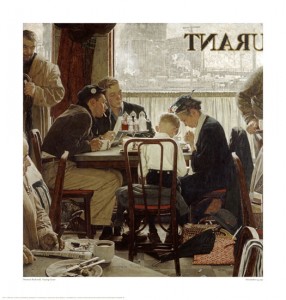
saying-grace

The greatest commandment

Christ said that the greatest commandment is, “You shall love the Lord, your God, with all your heart, all your soul and all your mind.” (Matthew 22:36)  One of the ways we express our love for anyone or anything is with public displays of affection.

Examples of Catholic public displays of affection

As Catholics, our church’s tradition has been blessed with several ways for others to know we are disciples of Christ. The crucifix, the image of the suffering Christ, is decidedly Catholic.  Hanging it in our home or in our office is a public display of affection for God. Certainly our honoring of Mary, the Mother of God, in our prayer life, our jewelry and even for some of us, body art, is a visible sign of our discipleship in Christ. In ecumenical groups, others know that we are Catholic Christians because we visibly remind ourselves, and others, of our common baptism through the sign of the cross.

We have greetings that are in common – “The Lord be with you – And also with you.” We can go almost anywhere in the world and know that we are among fellow Catholics through our public displays of affection for God and his only son, Jesus Christ.

Don’t be afraid, be proud

I submit to you that Catholics have built into our religious culture a strong desire to let everyone know that we are disciples of Christ. But at times, we suppress that part of our religious culture. And this is a shame. It is the shared traditions that I described above that invite us to love one another.

How many of us say grace regularly at home yet, feel self-conscience about praying at a restaurant? And if we pray, do we omit a visible sign of the cross for fear of drawing attention to ourselves? If so, why?
We are taught by polite society that public displays of affection are at times inappropriate. But, I submit to you that a public display of affection for our God and for our fellow Christians is always appropriate!

How else will people know that we are disciples of Christ!  They will know us by our love and affection for God!

Faith as a”Drug Problem”

In the Gospel for this Sunday’s Mass Jesus says: “No one can come to me unless the Father who sent me, draws him.” (John 6:44)  Now the Greek word here is Helkuein which means “to draw or to drag”  and the word always implies some sort of resitance. In a way Jesus more than implies that all of us who do believe offered some resistance and the Father had to drag us along! “Oh, not me!” you might say, “I have been a believer since my youth!” Well, get used to it, all of us are a “hard case” to God. Truth is, our flesh (our carnal “sin-nature”) does not want to believe, does not want to be told what to do. God, working through others has to drag us along. It is true, some of us are harder cases than others but all of us are still in the category “hard case.” We can be very stubborn, willful, and stiff necked. We can also rationalize very easily and convince ourselves that sin is no big deal and even not sin at all.

Yes, indeed we have to be dragged along by God and our carnal nature resists. So, if you’ve come to Jesus, thank the Father, he had to drag you and me here! And, like wandering sheep, he often has to go out and drag us back. “No one can come to me,” says Jesus, “Unless the Father draws (drags!) him.”  Again, if you have faith, thank the Father! You might say we have a “drug problem.” The problem is that we have to be “drug along” at every stage of our lives.   

There is an old Internet standard you may have read elsewhere that reflects this need to be “drug”

I had a drug problem when I was young: I was drug to church on Sunday morning. I was drug to church for weddings and funerals. I was drug to family reunions and community socials no matter the weather. I was drug by my ears when I was disrespectful to adults. I was also drug to the woodshed when I disobeyed my parents, told a lie, brought home a bad report card, did not speak with respect, spoke ill of the teacher or the preacher. Or if I didn’t put forth my best effort in everything that was asked of me. I was drug to the kitchen sink to have my mouth washed out with soap if I uttered a profane four letter word. I was drug out to pull weeds in mom’s garden and flower beds and to do my chores. I was drug to the homes of family, friends, and neighbors to help out some poor soul who had no one to mow the yard, repair the clothesline or chop some fire wood. And if my mother had ever known that I took a single dime as a tip for this kindness, she would have drug me back to the wood shed. Those drugs are still in my veins; and they affect my behavior in everything I do, say, and think. They are stronger than cocaine, crack, or heroin, and if today’s children had this kind of drug problem, America might be a better place today.

Here is the Video for this Sunday’s Gospel from the movie, The Gospel of John available at Amazon:


Here’s recorded homily from today in mp3 format: Sermon for 19th Sunday: Our “Drug” Problem In the Sermon at the end I quote a gospel song by Kurt Carr which is here:

What is Christian Friendship?

From time to time, we invite guest bloggers to share their wisdom with us, and today I would like to present Dr. Katherine Yohe who earned her PhD in Historical Theology from the Catholic University of America. On July 19th 2009, she gave a lecture for the Office of Young Adult Ministry’s Relationship Speaker and Discussion Series. The following is an excerpt from that presentation.

Christian friendships are relationships of mutual affection and service, with in-depth conversations, enlivened by the Holy Spirit.

Mutual
While other forms of love can be one sided, friendships are not friendships unless they are seen as such by both parties. We cannot be someone’s friend if he or she do not consider us a friend in turn. Jesus called friends those who, in turn, were friendly toward him such as Lazarus, John, and the disciples at the last supper. However, we can desire a friendship, reach out in friendship, and offer friendship before there is a return of friendship. Jesus offered friendship, it seems, to everyone. For example, who is he talking about when he says: “Greater love has no one than he lay down his life for his friends”? (John 15:13) Who was he laying down his life for? Everyone!

Affection
Affection does not referring to signs of affection per se – such as big hugs – but rather to a movement of the heart that radiates through the eyes and says “I am glad to be with you” or “I enjoy being in your presence.” Can you imagine what the gaze of Jesus must have looked like? Or think of times in your own life: What has Jesus’ love felt like during those graced moments when we have encountered Him? Christ’s love is affectionate; it isn’t mechanical. It isn’t “I’ll be nice to this person because I have to.” Rather it has a warmth, a joy, a delight in being with the other – taking time to walk, eat, and even spend eternity with that person.

Service
Friendship goes beyond the emotional component to service. Good friends do not want to just be together, they want to do things for each other. Jesus served his friends in both little and big ways. He washed their feet, he cooked breakfast for them by the Sea of Galilee, and he died for them.

In-depth Conversations
These are conversations which reveal one’s interior life. Jesus spent a lot of time talking with his friends about who he is, how he prays and understands the Scriptures, what his plans are for the world, and how they can participate in this work. At the last supper he says, “I shall not call you servants any longer, because I servant does not know his master’s business,  I call you friends because I have made know to you everything I have learned from my Father.” (John 15:15)

Enlivened by the Holy Spirit
As Saint Augustine states, addressing God, “For friendship cannot be true unless You solder it together among those who cleave to one another by love ‘poured forth into our hearts by the Holy Spirit’” (Confessions 4.7, quoting Romans 5:5) Thus the love that Christian friends have for each other is inspired, moved, empowered, by the very love of God flowing through each of them. Just as the Father and Son are united in the love that is the Holy Spirit, so to do Christian friends love one another with the Spirit’s love.

What can you do today to strengthen your Christian friendships?

Sharing your faith in common conversations


“I am blessed and highly favored!”

I have a very close friend who is very friendly and outgoing. She is often the first to say hello to a stranger and greets all who come into her presence with a smile and maybe even a hug. However, she gets easily frustrated by what she calls, “mediocre Christian responses” to her greetings. I have learned to share in this frustration because its source should be obvious.  However, it is subtle and hidden.

Here is an example of a mediocre Christian response: When asked, “How are you doing today?” it is common for us to reply, “I am OK” or “hanging in there.” That is a mediocre Christian response. If we are made in the image and likeness of God, then we have to be doing better than “OK.” The Evangelist Matthew tells us that God cares even for the sparrow and therefore, he is deeply concerned for us. (Matthew 10:29). So, we have to be doing better than “Hanging in there.”

My close friend is so deeply bothered by these mediocre Christian responses that she refuses to give any herself. In fact, when asked, “How are you doing?’ she most often says, “Blessed and highly favored!” Even if she is having a bad day, she is blessed and highly favored by God and does not mind saying so.

Last fall during a homily, I challenged members of my parish to avoid mediocre Christian responses. I challenged them to respond to a greeting from each other and even those outside of church with a proclamation of God’s goodness and love. When asked, “How’s it going?” try saying something like, “God loves me, so it’s going great.” I challenged my brothers and sisters to do this because, I had already given this a try and I found, it really works. I tried it at my school. I tried it with my family and neighbors. I even tried it in the grocery store at the check-out counter. Each and every time, my answer was received with a least a smile if not a reciprocal affirmation of faith.

Even at the end of a conversation, rather than saying “good-bye” or “see you later”  we said, “God bless!” To date, no one has reported a negative response. No one got offended and no one rejected our good will. In fact, we often get a sincere, heart felt “Thank you” or “God bless you too!”

Brothers and sisters, Christ is everywhere and it is our calling to bring His presence and His grace to the attention of others. I challenge you, just as I challenged my parish, to avoid mediocre Christian responses and to remind yourself and others that you are indeed, “Blessed and highly favored!”

See you later – I mean – God Bless!

The Martyrs of the Early Church – Proof of the Power of the Cross

Some were burned alive, others thrown to wild beasts. Some had their skin flayed off. One had her breasts cut off, another, her eyes gouged out. Some were beheaded, others thrust through with swords. These are the Martyrs and great heroes of the early Church. They suffered much and gained everything. Their death was like seed that caused the Church to grow by God’s grace. New life comes from the Cross. Jesus proved it and the martyrs demonstrate it. The more the world hates and kills us the stronger we become. After almost every widespread persecution the Church grows more numerous and more intense. It is the words of Jesus Christ that foretold this: “And I, when I be lifted up from the earth (i..e on the Cross) will draw all people unto me.” (Jn 12:32). Where ever the Church is persecuted, Christ is still lifted up on the Cross in his mystical Body. Sure enough, in this way he draws even more unto him.

So many of us have it easy compared to the martyrs. They were willing to suffer death for the faith, many of us cannot even bear to be unpopular for it. Pray for courage from the intercession of the martyrs. It seems it will become increasingly necessary in the years ahead.


I put this video together to commemorate the Early Martyrs, especially those listed in the Roman Canon. Along with the pictures is a hymn to the Martyrs,  Monteverdi’s setting of Deus Tuorum Militum. Here is the translation:


Deus tuorum militum                          O God, thou who art the portion
Sors et corona, praemium                 the crown and the reward of thy soldiers,
Laudes canentes Martyris                 absolve from the chains of sin, those
Absolve nexu criminis                       singing the praises of thy martyr.

Poenas cucurrit fortiter                     Bravely he/she ran the way of torture,
Et sustulit viriliter                                and suffered courageously,
Fundensque pro te sanguinem        and shedding his/her blood for thee,
Aeterna dona possidet.                      (now) possesses eternal gifts.

Laus et perennis gloria                      Praise and continual  glory  be
Deo Patri et Filio                                   to God the Father and Son,
Sancto simul Paraclito                       likewise the Holy Spirit
In sempiterna saecula. Amen         unto eternal ages. Ame
n