Rediscovering the Conscience – We Know What We Are Doing

It is common to hear today, even among some clergy, that people really don’t know any better when it comes to moral teaching. Since they have not been properly taught they cannot be expected to understand important moral concepts nor should be held very accountable for the poor moral decisions they might make. I don’t agree and think that this sort of thinking amount to a denial of the existence of the conscience. It is my experience that deep down inside, most people know exactly what they are doing. It is true that the voice of one’s conscience can either be intentionally suppressed or that competing voices can vie for our attention. But, still, under all the layers of denial, suppression, and contrary voices that may occur, we know well the basics of right and wrong. Some examples from pastoral experience:

  1. I have sat in the parlor during marriage preparation with couples that are either co-habiting or fornicating. And despite all the stinking thinking of the world that such behavior is fine, despite whatever attempts they may have made to tell themselves it really OK, despite trying not to think about it, despite all attempts to call it something else….Despite it all,  when I speak frankly with them about it, they know what they are doing and they know it’s wrong. They know.
  2. I have walked the streets of Southeast and talked with the “boys in the hood.”  And when in conversation I  tell them they ought to stop selling and using and stealing and worse and get themselves into God’s house, they too know what they are doing, they know it is wrong and that they ought to get to God’s house. They know!
  3. I have become quite convinced that a lot of the intense anger directed against the Church whenever we speak against abortion, euthanasia, premarital sex, homosexual activity and homosexual marriage, etc, I am convinced that a lot of that anger is that,  deep down inside,  they know that these things are wrong and that what we are saying is true. Attempts to suppress our conscience are not usually all that successful and when someone endangers the zone of insulation we attempt to erect, we can easily get mad. But deep down inside we know the Church and the Scriptures are right. We know.
  4. Some people attempt to surround themselves with teachers and experts who will “tickle their ears” with false teaching and unsound doctrine. But deep down inside, they know better. They know.

We who teach and try hand on the faith need to rediscover the fact of the conscience and never loose heart when we teach and appeal. We are ultimately appealing to things people already know. This is so at least in terms of basic and fundamental morality. There may be certain advanced topics that require informed discourse, but as to the basics, they are written in their hearts. All the protesting and anger are not necessarily signs that we have failed at all. It may be just the opposite. We may have struck more than a nerve, we may have touched the conscience. Don’t lose heart.

And to those who read this blog who may be at odds with one or many Church teachings, please understand that we are appealing to your conscience. It is the dignity of every human person to know the truth. I may at times elicit your anger or surely your disagreements but I will not give up. I presume the presence of your conscience and I appeal to it. It will not write you off as hopeless. I am glad you come here and read even if it is to spar with me. I do not claim that I never suppress or ignore my conscience either. We are all in this mess together. But that is precisely why I so treasure Church teaching and the Scriptures and seek to share them here. It keeps me honest and appeals to what I already know, deep down inside, the truth which God wrote in my heart.

A  few basic teachings on conscience may help since, as I have stated, I think a lot of us have neglected to meditate much on the existence of the conscience and what it really is. Here are a few teachings from Scripture and the Catechism

  1. What is the Conscience and where does it come from? Does everyone have it? – For Man has in his heart a law inscribed by God, This is his conscience, there he is alone with God whose voice echoes in his depths… (Catechism of the Catholic Church(CCC) # 1776) Notice therefore that “conscience” is the innate sense of the law of God in each one of us. The conscience exists because God has written his law in everyone’s heart. His voice echoes in our soul.  It is there and we cannot ultimately deny it or silence it,  though many do try.
  2. Scripture too affirms the fundamental presence of conscience and the Law of God within every individual. For example:
    1. When the Gentiles, who do not have the law, do by nature things required by the law, they are a law for themselves, even though they do not have the law, since they show that the requirements of the law are written on their hearts, their consciences bearing witness, and their thoughts now accusing, or at times even defending them (Romans 2:14-15).
    2. By the open statement of the truth we would commend ourselves to every one’s conscience in the sight of God. (2 Cor 4:2)
  3. We must  listen carefully to our conscience for its voice can lose its proper influence if we do not take time to listen – It is important for every person to be sufficiently present to himself in order to hear and follow the voice of his conscience. This requirement of interiority is all the more necessary as life often distracts us from any reflection, self examination or introspection. (CCC # 1779) Ignoring the voice of our conscience does not mean it goes completely away. There can be many things that tweak our conscience and stir us to hear its voice. Some react well to these reminders, others with anger. But the point of the catechism is that our conscience should not have to be tweaked or awakened, we should be in touch with it at all times by living a reflective life.
  4. Conscience must be formed and reinforced– It is true that we have a basic and innate sense of right and wrong and that God has written his law in our hearts. But the Catechism also reminds us that, due to sin,  we must also be open to having our conscience formed and its judgments refined: Though human reason is, strictly speaking, truly capable by its own natural power and light of attaining to a true and certain knowledge of the one personal God…and of the natural law written in our hearts by the Creator; yet there are many obstacles which prevent reason from the effective and fruitful use of this inborn faculty…The human mind…is hampered in the attaining of such truths, not only by the impact of the senses and the imagination, but also by disordered appetites which are the consequences of original sin. So it happens that men in such matters easily persuade themselves that what they would not like to be true is false or at least doubtful. That is why man stands in need of being enlightened by God’s revelation about…religious and moral truths…so that they can be known by all men with ease, with firm certainty and with no admixture of error (CCC #s 37-38). Notice that the catechism does not speak of the conscience as being removed but rather that the intellect, influenced by sin and disordered appetites,  tries to persuade us of other ways of thinking. Hence we attempt either to suppress the truth, or at least consider it doubtful and open to alternative interpretation. This is why we stand in need of the Scriptures and the teaching of the Church to help us overcome our tendency to suppress and confuse the truth.
  5. What then should the pastor, catechist, teacher, parent and evangelizer do? Speak the truth in love. Speak it with confidence, knowing that every person has to dignity of having a conscience and that even when that conscience has been suppressed or ignored, it can be reached. St. Paul gave good advice to Timothy in this regard: In the presence of God and of Christ Jesus, who will judge the living and the dead, and in view of his appearing and his kingdom, I give you this charge: Preach the Word; in season and out of season; correct, rebuke and encourage—with great patience and careful instruction. For the time will come when men will not put up with sound doctrine. Instead, to suit their own desires, they will gather around them a great number of teachers to say what their itching ears want to hear. They will turn their ears away from the truth and turn aside to myths. But you, keep your head in all situations, endure hardship, do the work of an evangelist, discharge all the duties of your ministry. (2 Timothy 4:1-5)

In this video, Lady Macbeth can no longer suppress her conscience, incessantly she sleepwalks and washes her hands: “Out! Out! Damned spot!” But the bloodstains remain visible to her, her conscience can no longer be suppressed.
Faithful in Little Things

One of my favorite quotes from St. Augustine  is not all that well known. Here it is in Latin and then my own translation:

  • Quod Minimum, minimum est,
  • Sed in minimo fidelem esse,
  • magnum est.
  • St. Augustine – De Doctrina Christiana, IV,35
  • What is a little thing,  is (just) a little thing.
  • But to be faithful in a little thing
  • is a great thing.

I first saw this quote on the frontispiece of a book by Adrian Fortescue et al. describing the intricate details of celebrating the Old Latin Mass. That form of the Mass has an enormous amount of detail to learn. Things like how exactly to hold the hands, when and how to bow, what tone of voice to use, what fingers should be used to pick up the host, and on and on. Some might see these details as overwhelming and picky. But as the quote above states and  Fortescue apparently wanted us to think, love is often shown in reverence for the little things.

It’s so easy to become lazy, even about sacred things like saying Mass. I often have to remind myself about little things like the condition of my shoes. Are my vestments clean? How about the altar linens, are they properly cared for? Do I bow and pause at Mass when I should. How is my tone of voice? Do I walk reverently in the sanctuary? Am I careful to pronounce the sacred words of the liturgy with care and a prayerful spirit? Some my find such questions tedious and borderline scrupulous. But when you love, little things are often important.

Married couples may also struggle to remember the little things that show love. A kind remark, a simple thank you. Flowers brought home for no particular reason. A simple look. The gift of listening attentively. Cleaning up after yourself in the kitchen. Just a simple reassurance, “I’m glad I married you” or “You’re a great Father to our children.”  Maybe it’s just a quick phone call from or to work saying, “I love you and was thinking about you.”

Just little things. But to be faithful in little things is a great thing. A Gospel comes to mind:

Well done, good and faithful servant! You have been faithful with a few things; I will put you in charge of many things. Come and share your master’s happiness!  (Matt 25:21)

And Again:

Whoever can be trusted with very little can also be trusted with much, and whoever is dishonest with very little will also be dishonest with much. (Luke 16:10).

Little things? Who cares!? God does. Little things are great things to those who love.

This song says, “You must be faithful over a few things to be ruler over many things. Be thou faithful unto death and God will give you a crown of life.” It ends in a rousing chorus: “Well done good and faithful servant, well done!”

Church-State Partnerships

socratic school

Church-State Partnerships

If your family and friends are at all like my family and friends, you probably talked a lot about the state dinner party-crashers at the White House. That story certainly provides a welcome diversion to some of the other headlines over the last couple of weeks. If you have been following our blog, you know that the Catholic Church has been in the headlines quite a bit. Nationally, as we contribute to the health care debate and locally as we oppose the legislation to legalize same-sex marriage and more recently in stories as about the possible closure of some of our Catholic schools. We will come back to these stories in future blogs because in one way or another they are part of a very important debate in which we–the laity– need to listen and participate. At issue is the nature of partnerships between church and state. The more common language is the presence of   faith based initiatives and public funding.

Indeed, in the United Sates we have a long and proud history of partnerships between church and state in the field of education, health care and social service; our many great Catholic Universities, the Young Men Christian Association(YMCA), The Salvation Army are just a few “faith based initiatives” that are part of the fabric of  public life.

It Begins with Matthew 25

For Christians, we are obliged through our discipleship to care for those in need. In Matthew 25, a follower of Jesus’ asks, “Lord, when did we see you hungry?” Jesus tells us that in the face of our neighbor, we see his face. As Catholics, we have been enormously creative in founding and sustaining programs that address people’s physical and spiritual needs. We welcome opportunities to work with–as Gaudium et Spes puts it– “all people of good will.” To this end we see our involvement in civil society as a service provider and not a political power.

Service Providers

In the health care debate, we have a seat at the table, because we are the single largest private provider of health care in the country.  We have a particular competence but as the Catechism of the Catholic Church teaches “our commission and competence is not to be confused in any way with the political community.” The church wades into the debate when the dignity of the human person is at risk or when a voice of moral judgment related to the fundamental rights of men and women is at stake (CCC, 2445-2446).

Thankfully, it seems to be the minority voice that is suggesting that faith based organizations cease taking public funds and entering into partnerships with the government to provide services. The Pew Forum on Religion and Public Life recently conducted a poll to see how the general public feels about some of these church-state questions. The whole study can be found at http://pewforum.org/newassets/images/reports/faithbased09/faithbased09.pdf.

Here are some of the most interesting findings:

  •  Currently 69% of Americans say they favor allowing churches and other houses of worship, along with other organizations, to apply for government funding
  •  37% think that religious organizations can do the best job serving the needy when asked “generally, whether religious organizations, non-religious organizations or the government can do the best job providing services for the needy.”
  •  74% say that religious organizations that receive government funds should not be able to hire only people who share their religious beliefs

This indicates there is strong support for the idea of partnerships. What this particular study does not address and what is critical to the ongoing discussion is what happens when civil legislation and the belief of the religious organization clash. How do both state and church balance the Constitutional separation of church and state with the Constitutional right to the free expression of religion? One example, as indicated in the study is that faith based organizations do not discriminate on the basis of faith when hiring employees. Another example is that faith based organizations provide social services to anyone who is in need, not just members of their faith. However, in other cases the issue of religious liberty is far more complex, particularly as society experiences less and less universal agreement on certain moral principles.

What is religious liberty?

In his recent editorial that ran in the Washington Post, Archbishop Wuerl asked  that the church not be forced to compromise deeply held religious beliefs and teachings in order to continue serving those in need in partnership with the city. The larger question that needs to be reflected upon, studied and debated in a serious way is how to balance the right of faith based organizations who wants to enter into service partnerships with governmental organizations but not be forced to violate their beliefs by adhering to legislation that is contrary to the teaching of their faith. Do faith based organizations have the right to seek exemptions and protection from civil legislation that is contrary to the teaching of the faith?

I have found myself saying again and again to friends that we have a responsibility to be active in this very important debate. As hard as it is sometimes to see another headline that presents the church in a negative light or to enter into a discussion that will be heated, we must be witnesses to the Good News in season and out of season as St. Paul likes to say.

Justice for the One And for the Many

 Perhaps you’ve read that something horrible happened in Washington State early Sunday Morning. Here is a brief press release:
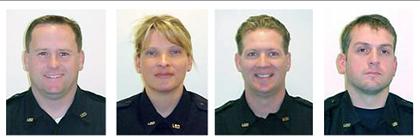
PARKLAND, WA (KPLU)A gunman killed four police officers at a Parkland area coffee shop Sunday morning. A massive manhunt is underway in Pierce County to find the shooter. The shooting happened at 8:15 a.m. at Forza Coffee on Steele Street South, near McChord Air Force Base. The four officers were with the Lakewood Police Department. They have been identified as Sergeant Mark Renninger and Officers Ronald Owens, Tina Griswold, and Greg Richards. The four were in full uniform, wearing bullet-proof vests. They were working on their laptops, beginning their day shifts, when the gunman entered the coffee shop and shot them at close range.
Police are seeking Maurice Clemmons, age 37, in connection with this case. Though there is little doubt that he is the killer, even if he is not it is still stunning that a man like this is walking our streets. Here is a brief summary of his criminal record:
  1. Sentenced to 5 years for robbery in Pulaski County, Aug. 3, 1989.
  2. Sentenced to 8 years for burglary, theft and probation revocation in Pulaski County, Sept. 9, 1989
  3. Sentenced to an indeterminate amount for aggravated robbery and theft in Pulaski County, Nov. 15, 1989
  4. Sentenced to 20 years each for burglary and theft of property in Pulaski County, Feb. 23, 1990.
  5. Sentenced to 6 years for firearm possession in Pulaski County, Nov. 19, 1990.
  6. Some sentences were concurrent and some consecutive. But the total effect of all these sentences was a sentence of 108 years.
  7. On May 3, 2000, Gov. Mike Huckabee commuted Clemmons’ sentence to 47 years, 5 months and 19 days, which made him eligible for parole that day. The Parole Board granted his parole July 13, 2000. He was released Aug. 1, 2000.
  8. Clemmons then returned to prison for a July 13, 2001 conviction for robbery in Ouachita County, for which he received a 10-year sentence. He was paroled March 18, 2004.
  9. In May of 2009 Clemmons punched a sheriff’s deputy in the face, according to court records. The Officer was responding to a domestic violence call. As part of that incident, he was charged with seven counts of assault and malicious mischief.
  10. Most recently Clemmons had been in jail in Pierce County for the past several months on a pending charge of second-degree rape of a child. He was released from custody just six days ago, even though he was facing  at seven additional felony charges in Washington state. Clemmons posted $15,000 Bond for release.

So there you have it, 13 felony convictions, including aggravated robbery and theft, third-degree assault, and second-degree rape of a child.

Even should he be found not connected with this horrible murder, there are many questions. What is Maurice Clemmons doing walking the streets? How could Governor Huckabee have paroled him? How did he obtain release from prison so shortly after offending again in 2001? Yet again he evaded serious assault charges and, most grievous of all, he was released from custody after raping a child! Can it really be true that $15,000 is all it takes to walk free after raping a child? Should Maurice Clemmons be walking our streets? Surely not.

So, What does this have to do with a Catholic blog? Simply this. I want to raise with you a consideration of  justice  and well ordered love. In considering questions of justice it has been most common in the past 40 years to have the emphasis fall on the rights and needs of the individual. There is clearly a place for such considerations. Justice cannot always be merely what the majority thinks. But neither can the common good be wholly set aside. This is especially true in matters of public safety. The record above shows that a very dangerous man is currently walking our streets. This is neither just nor is it sensible.  We may all want to show some leniency from time to time. Severe justice for first time offenders may not always be warranted. But there comes a time when greater charity and justice has to be shown to the public and the common good must outweigh any personal charity we may wish to extend.

The current record of our Criminal Justice System is that we simply do not seem to have the will to keep even very dangerous criminals locked up. They walk away from lengthy sentences after very short times. They usually offend again and we still let them go early from subsequent sentences. In the popular mind social justice is usually equated with the rights of prisoners. But true social justice cannot forget the common good and must weigh it in the balance with prisoner rights.

The Catechism of the Catholic Church has this to say:

Legitimate defense can be not only a right but a grave duty for one who is responsible for the lives of others. The defense of the common good requires that an unjust aggressor be rendered unable to cause harm. ….The efforts of the state to curb the spread of behavior harmful to people’s rights and to the basic rules of civil society correspond to the requirement of safeguarding the common good. Legitimate public authority has the right and duty to inflict punishment proportionate to the gravity of the offense. Punishment has the primary aim of redressing the disorder introduced by the offense. When it is willingly accepted by the guilty party, it assumes the value of expiation. Punishment then, in addition to defending public order and protecting people’s safety, has a medicinal purpose: as far as possible, it must contribute to the correction of the guilty party. (CCC # 2265-2266)

It is therefore clear that we do not detain and/or punish to exact revenge. Rather we do so for a twofold purpose: to protect the common good by ending the disorder caused by wrongdoers. And, secondly for the medicinal purpose of correcting the guilty party insofar as possible.

Somewhere it seems we have lost balance. Too often the common good is neglected, even wholly set aside in decisions related to criminal justice. Public authority must discover anew its grave duty to the common good and particularly to the lives of others. Good intentions are not enough. Real people get harmed and killed when we get the balance wrong. Ask the families of the four police officers killed. Ask the many people who were held up at gun point by Mr. Clemmons. Ask the child who was raped by him.

From 2000-2007 I was pastor in a very rough part of town here in DC. We just called it the “hood.” Every week there were shootings. At least once a month a murder took place on our streets. Two of the murders took place right on Church grounds, one during the school day when our school was in session. In every case, the perpetrators of these murders had rap sheets a mile long: armed robbery, car theft, selling and possession, attempted murder, actual murder. But they walked our streets. Arrested on very serious charges they were out in days. When trial finally came, sometimes years later,  they had already offended in other ways. When sentence was passed they served only tiny portions of their sentence and were back out. Nothing, it seemed, would cause a re-evaluation of this revolving door “justice.” And in the hood we lived with fear we should have had. We experienced crime we shouldn’t have.

The common good is not some abstraction. It is about real people. We cannot simply toss the rights of prisoners and accused to the winds. But neither can we simply disregard the common good.  The murder of these fine police officers is just as much a matter of justice as poor prison conditions or overly severe sentencing guidelines. True justice is about balance. Individual rights? Yes. The Common Good? Yes again.

Pray for these brave officers and their families: Sergeant Mark Renninger and Officers Ronald Owens, Tina Griswold, and Greg Richards. Requiescant in Pace.

officersx-wide-community

*
*

Whither the Church?

As a Catholic and a priest I remain quite stunned at the decline in Mass attendance during my lifetime. When I was a little child I remember jam packed Masses, get there early or stand. In those days of the early to mid sixties if you put up four walls Catholics would fill them. There were waiting lists for the parochial School, lots of Religious Sisters, and there was not just an associate pastor or curate, there was a first, second, third and fourth curate. Long lines for confession on Saturdays were common then too.

But this is largely gone. Yes there are still some  large parishes in suburban areas but even they used to be a lot bigger. Weekly Mass attendance has gone from 80% to less than 30% Vocations are beginning to rebound but the usual experience is empty convents and largely empty rectories. An Associate Pastor is unknown in many parishes and in some parts of the country even a resident pastor is often missing.

There is no other way to describe this than “stunning.”  And I can hear all the usual arguments about why swimming in my brain. We abandoned tradition! No! Say others, we are not progressive enough!…..There are too many rules!  No,  say others our problem is that we abandoned all the rules!….I could go on. Everyone has their human explanations and there are lots of disagreements about them.

But what might God be doing or allowing? Now I know I am on difficult ground in attempting to ponder this question. But please be sure, I am merely pondering it, not proposing a complete answer. But I have often asked the Lord, “What’s up with the Church?….What has happened Lord?” I do not claim a bolt from heaven came in answer but just a gradual and increasing awareness that what we are experiencing is not really new. There does seem to be a Biblical precedent that in the past God has frequently seen fit to thin his ranks, to prune and purify his people. In the Old Testament as well as the New there seems to be a kind of remnant theology at work. That is to say, of the many followers of God, many if not most fall away and only a small remnant remain to begin again. Perhaps some examples from Scripture will help:

  1. There were Twelve Tribes in Israel. But ten of them were lost in the Assyrian Conquest of the northern kingdom of Israel in 721 BC. The Prophets had warned the Northern Kingdom of its wickedness but a refusal to repent brought the destruction promised. Those who did not die in the war were deported and disappeared by assimilating into the peoples around then. They are known as the Ten Lost tribes of Israel. Only a remnant, the Tribes of Judah and Levi survived in the Southern Kingdom of Judah.
  2. Judah too grew wicked and prophets warned of destruction. The Babylonians destroyed Judah, and Jerusalem with it,  in 587 BC They deported the survivors to Babylon. Eighty years later the Persians conquered the Babylonians and allowed the Jewish people to return to the Promised Land. But only a remnant went, most chose to stay in the Diaspora, preferring Babylon to the Land promised by God.
  3. Gideon had an army of 30,000 and faced the Midianites who had 60,000. But said to him, “Your Army is too large. Tell the cowards to go home.” So Gideon dismissed any of the soldiers who didn’t think they were up for this battle. 20,000 left. Now with only 10,000 God said to Gideon, “Your army is still too large, lest you think you would win this battle on your own.” So God had Gideon observe the men at the stream as they drank water. Some drank leisurely and others lapped up the water like dogs! “That’s your army,”  said the Lord, “300 men and I will be with you.”  Gideon won that day with three hundred men whom the Lord had chosen. God thinned his ranks, and chose only a remnant as his true soldiers. (cf Judges 6 & 7)
  4. Jesus too didn’t seem to trust big crowds. Some of his most difficult sayings come when there is a big crowd. In fact, anytime you see a mention of a large crowd in the Gospels, fasten your seat belt because I can guarantee you that a hard saying is coming!  Once when there was a large crowd, Jesus taught against divorce (Matt 5 & 19, Mark 10). Another time spoke to crowds and declared that no one could be his disciple unless they renounced their possessions took up a cross and followed (e.g. Luke 14). Yet another time Jesus taught on the Eucharist and many left him and would no longer walk in his company (Jn 6).

These are just a few examples of remnant theology in the Scriptures. There are many more. I would like to quote one last one from Zechariah because it also gets to the root of what God may be doing in our times, if my hunch is right. First the quote:

“Awake, O sword, against my shepherd,  against the man who is close to me!”  declares the LORD Almighty. “Strike the shepherd, and the sheep will be scattered, and I will turn my hand against the little ones.  In the whole land,” declares the LORD, “two-thirds will be struck down and perish; yet one-third will be left in it.  This third I will bring into the fire;  I will refine them like silver  and test them like gold.  They will call on my name  and I will answer them; I will say, ‘They are my people,’  and they will say, ‘The LORD is our God.‘ ”  (Zech 13:6-9)

A stunning passage to be sure. But it also show the purpose of God thinning his ranks. There is something very mysterious as to why God allows many to stray and yet it is true  that we are free to stay or go. There seem to be times in the History of the Church and Israel that God allows many to depart, even “causes” them to depart as this passage describes it. It is a hard mystery to stomach. But I suppose I understand one aspect of it. It is currently pruning time here in the Northeast. My mighty rose bushes, eight feet tall have been pruned to one foot off the ground. And I had it done on purpose. But if my roses are to thrive next year and be beautiful, the prunings have to be done. The roses do not understand what I do, but I know of what I do. It is necessary, though painful. And God too knows of what he does and we cannot fathom it any more than my rosebushes fathom me. But he does it. And the 1/3 who remain in this passage must also be purified, refined as in fire. But when it is done:  pure gold. Those who remain and accept purification will call on God’s name. They will be a people, a Church after his own heart.

To me it has become clear that the Lord is pruning his Church. He is preparing us for spring. And we do in fact have a difficult winter we are enduring. But we’re being purified, cleansed. These are tough days for the Church but I already see signs of a great springtime ahead. There are many wonderful lay movements and growth areas in the Church. I am very impressed with the calibre of men entering the priesthood. These are men who love the Lord and His Church and who deeply desire to speak the truth in love. In my own Convent we have 25 young sisters of the Servants of the Lord, a wonderful new and missionary order. They too love the Lord and his Church and want to spread his gospel everywhere. Though our overall numbers of practicing Catholics are diminished, I see greater fervency in those who remain. In my own parish there are many who are devoted to prayer, bible study and praise of God. Eucharistic piety is stronger  in the Church today through adoration, daily mass. On the Internet there are many signs of excitement and zeal for the faith. Many wonderful blogs and websites are emerging to strengthen Catholics. EWTN is doing wonderful works and many Catholic Radio Stations have begun.

I could go on, but I think you get the point. God has pruned and is purifying us as Church. There are already many signs of this great work of God. I have no doubt that there are still some difficult winter days ahead before a full springtime sets in. But God never fails. He is renewing his Church and preparing us for whatever lies ahead. I realize this post will not  be without controversy. I do not propose it as the only answer to the times. Neither do I claim that fallen-away Catholics have simply been pruned as though we could know they will never return and be grafted on again. We should continue to Evangelize and seek to grow the Church by Christ’s own mandate. We cannot know when spring will set in fully and so we must step out as if it is already here.

Please remember a  blog is about discussion so feel free to comment. I do not propose this as a full answer but as a discussion starter: Add subtract, multiply but DON’T divide!  😉

Follow-up: Bishop Tobin interviewed on Kennedy Case

BishopThomasTobinIn the video below, Bishop Thomas Tobin speaks well enough for himself on the decision to advise Congressman Patrick Kennedy not to receive Holy Communion. My remarks are thus brief. I want only to call your attention to a powerful reminder given by Bishop Tobin. About mid way through the interview he states simply but clearly that if a person’s career, job or position conflicts with their faith they should leave that career, job or position. In a world that esteems such things above almost anything else, this is an earth-shaking summons: faith is more important than any worldly blessing.  This insistence comports well with what Jesus says clearly in Scripture:

No one can serve two masters. Either he will hate the one and love the other, or he will be devoted to the one and despise the other. You cannot serve both God and Money. (Matt 6:24)

Anyone who loves his father or mother more than me is not worthy of me; anyone who loves his son or daughter more than me is not worthy of me; and anyone who does not take his cross and follow me is not worthy of me. Whoever finds his life will lose it, and whoever loses his life for my sake will find it. (Matt 10:37-39)

Life in this world and faith are often in conflict and difficult choices are required of us. If Mr. Kennedy asserts (wrongly I think) that he cannot reconcile his faith in the matter of abortion to public policy, then he should choose his faith and leave the Congress. What is he first? A congressman or a Christian? It seems clear enough to me that he could remain a congressman if he simply refused to promote abortion rights and fund them. But since he (not the Church) says that as congressman he CANNOT vote pro-life, then Bishop Tobin, accepting the conflict that Kennedy insists he has, has invited him to choose.

Now the interview.

A Founding Father Gives Thanks to God

We live is an age of demanded secularism. If a religious utterance is made by the State or Government officials the cry goes up from a small minority and there are the usual platitudes about “Separation of Church and State,” a phrase that does not occur in the Constitution. It is well true that the First Amendment requires that the State shall pass no law establishing an official state religion. That same amendment requires that the State not prohibit the free exercise of religion. But this second pillar, protecting religious expression is eroding. Increasing demands are made (even in the comments of this blog)  that religious bodies (especially the Catholic Church) have no  right to attempt any influence in the legislative process. They must “stay out” of  meetings with elected officials, testifying at hearings and seeking to influence public policy decisions. But this of course limits our ability to freely exercise our faith, a major pillar of which tells us to take it to the streets, to evangelize, to be a light to the world, to testify to the truth.

Many secularists argue that the Founding Fathers wanted it this way and that a wall of separation pleased them since most of them were either irreligious or deists. But what is interesting is a all the founding Fathers spoke freely of God and included appeals to God and God’s will  in their remarks. This is true even of Thomas Jefferson. Any visit to the Jefferson Memorial will demonstrate that. A  number of  his writings and speeches are chiseled on the walls, most of them referring to God. Most of these Founding Fathers who, according to modern secularists, want this dramatic separation of Church and State, were involved in drafting the Constitution. Most secularists love to point out that God is never mentioned in the Constitution. But actually He is, specifically Jesus is mentioned. The final line of the Constitution reads thus:

Done in Convention by the Unanimous Consent of the States present the Seventeenth Day of September in the Year of our Lord one thousand seven hundred and Eighty seven and of the Independence of the United States of America the Twelfth. In Witness whereof We have hereunto subscribed our Names:

In the year of our Lord?! Oops! Where did that come from?  I guess the drafters of the Constitution never got the memo that God is unmentionable in Government documents or functions. The Lord referred to is none other than Jesus Christ for the year corresponds to the years since his birth.

Now the first Signature on  the Constitution is George Washington. Apparently he too never got the memo about keeping God and religion out of things governmental because he mentions God not a little in his writings and talks. Since it is Thanksgiving I thought I might show a decree he published declaring that the U.S. should have a Day of Thanksgiving in 1789. The document is filled with references to God.  In fact,  if you read it with some enthusiasm you’d swear you’re listening to a Baptist preacher! Read and enjoy this Declaration of the First Official Thanksgiving.   Secularist beware! This is NOT a religion free zone 🙂

 Whereas it is the duty of all nations to acknowledge the providence of Almighty God, to obey His will, to be grateful for His benefits, and humbly to implore His protection and favor; and Whereas both Houses of Congress have, by their joint committee, requested me to “recommend to the people of the United States a day of public thanksgiving and prayer, to be observed by acknowledging with grateful hearts the many and signal favors of Almighty God, especially by affording them an opportunity peaceably to establish a form of government for their safety and happiness:”

Now, therefore, I do recommend and assign Thursday, the 26th day of November next, to be devoted by the people of these States to the service of that great and glorious Being who is the beneficent author of all the good that was, that is, or that will be; that we may then all unite in rendering unto Him our sincere and humble thanks for His kind care and protection of the people of this country previous to their becoming a nation; for the signal and manifold mercies and the favorable interpositions of His providence in the course and conclusion of the late war; for the great degree of tranquility, union, and plenty which we have since enjoyed; for the peaceable and rational manner in which we have been enable to establish constitutions of government for our safety and happiness, and particularly the national one now lately instituted for the civil and religious liberty with which we are blessed, and the means we have of acquiring and diffusing useful knowledge; and, in general, for all the great and various favors which He has been pleased to confer upon us.

And also that we may then unite in most humbly offering our prayers and supplications to the great Lord and Ruler of Nations and beseech Him to pardon our national and other transgressions; to enable us all, whether in public or private stations, to perform our several and relative duties properly and punctually; to render our National Government a blessing to all the people by constantly being a Government of wise, just, and constitutional laws, discreetly and faithfully executed and obeyed; to protect and guide all sovereigns and nations (especially such as have shown kindness to us), and to bless them with good governments, peace, and concord; to promote the knowledge and practice of true religion and virtue, and the increase of science among them and us; and, generally to grant unto all mankind such a degree of temporal prosperity as He alone knows to be best. Given under my hand, at the city of New York, the 3d day of October, A.D. 1789.

George Washington, President.

You Go Mr. President!