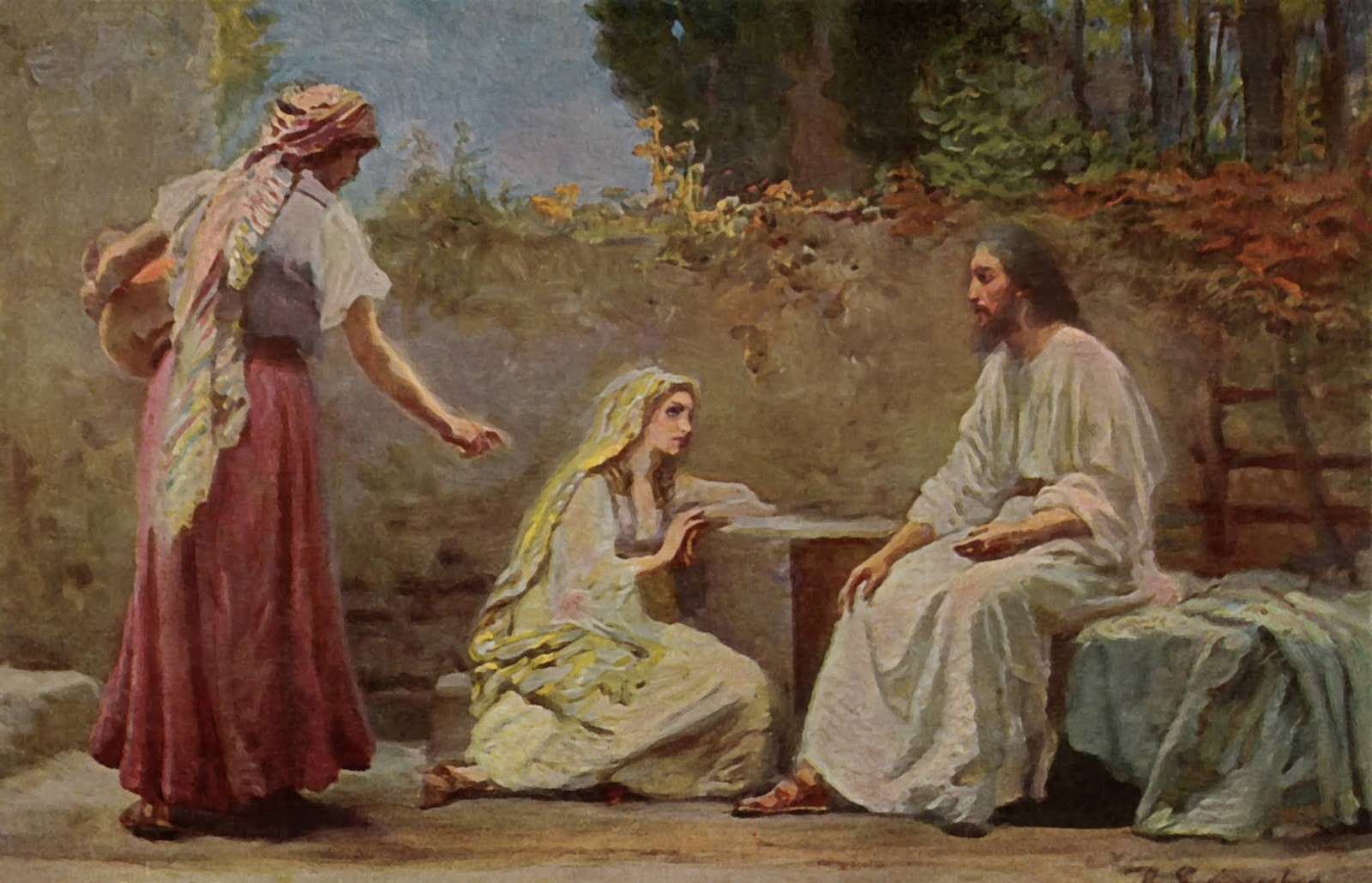
The Priority of Personal Prayer – A Meditation on the Gospel of the 16th Sunday of the Year

Today’s Gospel at Mass is the very familiar one of Martha and Mary. Martha is the anxious worker seeking to please the Lord with a good meal and hospitality. Mary sits quietly at his feet and listens. One has come to be the image of work, the other of prayer.

Misinterpreted? In my fifty-two years I have heard many a sermon that interpreted this Gospel passage as a call for a proper balance between work and prayer. Some have gone on to state that we all need a little of Martha and Mary in us and that the Church needs both Marthas and Marys.

But in the end it seems that such a conclusion misses the central point of this passage. Jesus does not conclude by saying, “Martha, Now do your thing and let Mary do hers.” He describes Mary as not only choosing the better part but also as doing the “one thing necessary.” This does not amount to a call for “proper balance” but instead underscores the radical priority and primacy of prayer. This, it would seem is the proper interpretive key for what is being taught here. Many other passages of the Scripture do set forth the need to be rich in works of charity but this is not one of them.

With that in mind let’s take a look at the details of the Lord’s teaching today on the  Priority of Personal Prayer.

I. PROMISING PRELUDE – Jesus entered a village where a woman whose name was Martha welcomed him. Our story begins by showing Martha in a very favorable light. She opens her door, her life, if you will, and welcomes Jesus. This is at the heart of faith, a welcoming of Jesus into the home of our heart and life. Surely Revelation 3:20 comes to mind here: Behold I stand at the door and knock. If any one hears my voice and opens the door I will come in and eat with him and he with me.

While we acknowledge this promising prelude we ought also to underscore the fact that the initiative is that of Jesus. The text says Jesus entered a village…. In the call of faith the initiative is always with God. It was not you who chose me, it was I who chose you (Jn 15:16) Hence, while we must welcome Him, God leads. Martha hears the Lord’s call and responds. So far so good.

What happens next isn’t exactly clear but the impression is that Martha goes right to work. There is no evidence that Jesus asked for a meal from her, large or small. The text from Revelation just quoted does suggest that the Lord seeks to dine with us, but implies that it is he who will provide the meal. Surely the Eucharistic context of our faith emphasizes that it is the Lord who feeds us with his Word and with his Body and Blood.

At any rate, Martha seems to have told the Lord to make himself comfortable and has gone off to work in preparing a meal of her own. That she later experiences it to be such a burden is evidence that her idea emerged more from her flesh than the Spirit.

II. PORTRAIT OF PRAYER She had a sister named Mary who sat beside the Lord at his feet listening to him speak. Now here is a beautiful portrait of prayer: to sit at the Lord’s feet and listen.

Many people think of prayer as something that is said. But prayer is better understood as a conversation, and conversations include listening. Vocal prayer, intercessory prayer and the like are all noble and important but the prayer of listening is too often neglected.

Prayer is not just telling God what we want, it is discovering what He wills. We have to sit humbly and listen. We must learn to listen, and listen to learn. We listen by devoutly and slowing considering scripture (lectio divina), and by pondering how God is speaking in the events and people in our life, how God is whispering in our conscience and soul.

Jesus calls this kind of prayer “the one thing necessary” as we shall see. What Mary models and Martha forgets is that we must first come (to Jesus) then go (and do what he says)….that we must first receive, before we can achieve…..that we must first be blessed before we can do our best……that we must listen before we leap into action.

III. PERTURBED and PRESUMPTUOUS Martha, burdened with much serving, came to him and said, “Lord, do you not care that my sister has left me by myself to do the serving? Tell her to help me.” – And so, sure enough Martha who is laboring in the flesh, but not likely in the Spirit and in accord with the Lord’s wishes, is now experiencing the whole thing as a burden. She blames her sister for all this but the Lord’s response will make it clear that this is not Mary’s issue.

One sign that we are not in God’s will is the experiencing of what we are doing as a burden. We are all limited and human and will experience ordinary fatigue. It is one thing to be weary in the work but it is another thing to be weary of the work.

A lot of people run off to do something they think is a good idea. And maybe it is a fine thing in itself. But they never asked God. God might have said, “Fine.” or He might have said, “Not now, but later.” Or He might have said, “Not you but some one else.” Or he might have just plain said, “No.” But instead of asking they just go off and do it and then when things don’t work out will often times blame God: “Why don’t you help me more!”

And so Martha is burdened. She first blames her sister. Then she presumes the Lord does not care about what is (to her) an obvious injustice. Then she takes presumption one step further and presumes to tell the Lord what to do: “Tell her to help me.”

This is what happens when we try to serve the Lord in the flesh. Instead of being true servants who listen to the Lord’s wishes and carry them out by his grace, we end up as angry and mildly (or not) dictatorial. She here is Martha, with her one hand on her hip and her index finger in the air 🙂 Jesus will be kind with her but firm.

IV. PRESCRIBED PRIORITY Martha, Martha, you are anxious and worried about many things. There is need of only one thing. Mary has chosen the better part and it will not be taken from her. Now don’t let the Lord have to call you by your name twice! But it is clear the Lord wants her attention and that she has stumbled on a fatal mistake that we all can too easily make. She lept before she listened.

The Lord observes and says that she is anxious about many things. Anxiety about many things comes from neglect of the one thing most necessary: to sit at the feet of the Lord and listen to him.

In life, the Lord will surely have things for us to do but they need to come from him. This is why prayer is the “one thing” necessary and the better part: because work flows from it and is subordinate to it.

Discernment is not easy but it is necessary. An awful lot of very noble ideas have floundered in the field of the flesh because they were never really brought before God and were not therefore a work of grace.

Jesus does not mean that ALL we are to do is pray. There are too many other Gospels that summon us to labor in the vineyard to say that. But what Jesus is very clear to say is that prayer and discernment have absolute priority. Otherwise expect to be anxious about many things and have little to show for it.

Scripture makes it clear that God must be the author and initiator of our works: For by grace you have been saved through faith, and this is not from you; it is the gift of God; it is not from works, so no one may boast. For we are his handiwork, created in Christ Jesus for the good works that God has prepared in advance, that we should walk in them (Eph 2:8-10).

And old prayer from the Roman Ritual also makes this plain: Actiones nostras, quaesumus Domine, aspirando praeveni et adiuvando prosequere: ut cuncta nostra oratio et operatio a te semper incipiat, et per te coepta finiatur. Per Christum Dominum nostrum (Direct we beseech Thee, O Lord, our prayers and our actions by Thy holy inspirations and carry them on by Thy gracious assistance, so that every work of ours may always begin with Thee, and through Thee be ended). Amen

This song reminds that when we really ARE working in the Lord’s will and as the fruit of prayer we love what we do and do so with joy. This song says, “I keep so busy working for the Kingdom I ain’t got time to die!”
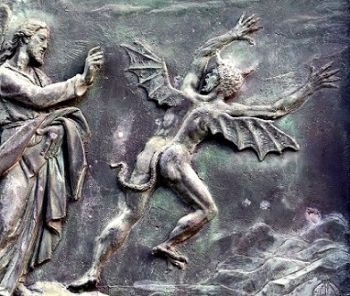
Three Characteristics of the Diabolic That Are Widely Evident Today

door panel, Pisa Baptistery

The video at the bottom of this post is of Archbishop Fulton J. Sheen. It is a fascinating excerpt from a longer presentation he did. In it, he analyzes the diabolic (anything of or relating to the Devil) from several different perspectives. Archbishop Sheen identifies three characteristics of the diabolic by examining the story of the Gerasene demoniac, which is presented in the synoptic Gospels. Here is the beginning of the story as it appears in the Gospel of Luke:

They sailed to the region of the Gerasenes, which is across the lake from Galilee. When Jesus stepped ashore, he was met by a demon-possessed man from the town. For a long time, this man had not worn clothes or lived in a house, but had lived in the tombs. When he saw Jesus, he cried out and fell at his feet, shouting at the top of his voice, “What do you want with me, Jesus, Son of the Most High God? I beg you, don’t torture me!” For Jesus had commanded the evil spirit to come out of the man. Many times it had seized him, and though he was chained hand and foot and kept under guard, he had broken his chains and had been driven by the demon into solitary places. Jesus asked him, “What is your name?” “Legion,” he replied, because many demons had gone into him (Luke 8:26-30).

Following this, Jesus drove the demon(s) out the man and into the herd of swine.

From this story, and also based on an insight from Dr. Rollo May, a psychologist of his time (the talk was given in the mid-1970s), Archbishop Sheen sets forth these three characteristics of the diabolic:

  1. Love of NudityFor a long time this man had not worn clothes.
  2. Violence… though he was chained hand and foot and kept under guard, he had broken his chains. The version of the story in Mark’s Gospel has more vivid detail: For he had often been chained hand and foot, but he tore the chains apart and broke the irons on his feet. No one was strong enough to subdue him.
  3. Division (split personalities, disjointed minds) – … many demons had gone into him. In Mark’s version, the demoniac replies, My name is Legion, for we are many (Mk 5:9). All of the versions say that the demoniac lived apart from others or in solitary places.

It does not take much effort to recognize that these three characteristics of the diabolic are alive and flourishing in the modern world, at least in the West. Let’s examine the evidence we can see all around us today:

1. Love of Nudity – This is obvious in the modern world on several levels. First, there is the widespread tendency toward immodest dress. We have discussed modesty here before on this blog, noting that the words “modesty” and “moderation” come from the word “mode,” which refers to the most commonly occurring value in a set of data. Hence, while we want to avoid oppressively puritanical notions about dress that impose heavy burdens (especially on women) and regard the body as somewhat evil, we must also critique many modern forms of dress that are at the other extreme. These “fashions” reveal more than is reasonable and are generally intended to draw attention to aspects of the body that are private and reserved for sexual union within marriage. Too many in our culture see no problem with parading about in various stages of undress, wearing clothing that seems intended to call attention to, rather than conceal, the private areas of the body. This love of disclosure and titillation is surely an aspect of the Evil One’s love of nudity.

Pornography, though nothing new in this fallen world, has surely reached epidemic proportions thanks to the Internet. Any psychotherapist, counselor, or priest will tell you that addiction to pornography is a huge problem today. Millions of Americans are viewing enormous amounts of pornography and the “industry” appears to be growing rapidly. What once required a visit to a hidden-away adult bookstore is now available in one’s home with just a click of the mouse. And the thought that browsing habits are easily discoverable matters little to the addicts of this latest form of slavery. Many are on a steep slope downward into ever-more-deviant forms of pornography. Some end up at illegal sites and before know what’s happened, the FBI is knocking on their door. Yes, Satan’s love of nudity has possessed many!

The overall sexualization of our culture also ties in to Satan’s love of nudity. We sexualize women in order to sell products. We even sexualize children. Our sitcoms feature endless immature chatter about sex. Collectively, we act like oversexed teenagers obsessed with something we don’t really understand. Yes, Satan loves nudity and everything that goes with it.

Then of course there is the utter confusion that celebrates homosexual activity. What Scripture calls gravely sinful, disordered, and contrary to nature (παρὰ φύσιν – para physin – Rom 1:26), is openly celebrated by many in our culture. Those afflicted with such desires openly and proudly identify themselves with what tempts them. Rather than lamenting the trials faced by those with such an affliction, and offering love, support, and the truth that they should live celibately (as all the unmarried are called to do), our sex-saturated culture, blinded and darkened by its own wild lust, affirms and even encourages them to indulge in what can only bring further harm to them and others. They have exchanged the truth of God for a lie … (Rom 1:25). It is no surprise that as a result of this celebration of darkness and confusion, the even more deeply confused notion of “transgenderism” has taken root.

Thus, the love of the nudity and the related obsession with (and confusion about) sex is manifest in our culture. It is surely a sign of the diabolic.

2. Violence – Collectively, have turned violence into a form of entertainment. Adventure movies and video games turn violent retribution into fun and death into a “solution.” Recent popes have warned us of the culture of death, a culture in which death is put forward as the solution to problems. Violence begins in the womb as the innocent are attacked as we defend “choice” and “rights.” The embrace of death continues to pervade the culture through contraception, gang activity, frequent recourse to war, and capital punishment. The past century was perhaps the bloodiest ever known on this planet: two world wars, hundreds of regional wars and conflicts, starvation campaigns, and genocides. Paul Johnson, in his book Modern Times estimates that over 100 million people died violently in just the first 50 years of the 20th century. With every death, Satan did his “Snoopy dance.” Satan loves violence; he loves to set fires and then watch us blame one another as we all burn.

3. Division – Satan loves to divide. Archbishop Sheen says that the word “diabolic” comes from two Greek words, dia and ballein, meaning “to tear apart.” Most literally, dia means “through” or “between” and ballein means “to throw or to cast.” Satan “casts things between us” in order to divide and distract us. Thus, we see our families, the Church, and our country divided. These divisions occur in almost every facet of our lives: race, sex, religion, politics, economics. We are divided on the basis of age, region, blue vs. red states, the coasts vs. the heartland, liturgy, music, language, and more trivialities.

Our families are broken. Divorce is rampant. Commitments of any sort are rejected as too difficult or even impossible. The Church is broken, divided into factions. Though we once we agreed on the essentials, now even appeals to shared truth are called intolerant.

Inwardly, we struggle with many divisive drives, with figurative and literal schizophrenia. We are drawn to what is good, true, and beautiful and yet at the same time to what is base, false, and evil. We know what is good, but desire what is evil; we seek love, but indulge in hate and revenge. We admire innocence but often revel in destroying it or at least in replacing it with cynicism.

Three characteristics of the diabolic: love of nudity, violence, and division. What do you think? Is the prince of this world working his agenda? Even more important, are we conniving with him? The first step in overcoming the enemy’s agenda is to recognize his tactics, name them, and then rebuke them in the name of Jesus.

Thank you, Archbishop Sheen. Your wisdom — God’s wisdom — never ages.

Pay attention to what the good archbishop has to say!

How the Liturgy is Healing Medicine for Strident Times: Reflections from Pope Benedict XVI and Leo XIV

One of the most concise and cogent descriptions of these often strident times came from Joseph Cardinal Ratzinger in 1986. It is contained in, of all places, his treatise on the theology of sacred music in a book called The Feast of Faith (Ignatius Press, 1986). His comments have been republished in a larger compendium of his works, Collected Works: Theology of the Liturgy (Ignatius Press, 2014, Vol 11).

It is hard to describe our times as anything but contentious. Loud, strident protests often predominate over reasoned discourse and thoughtful argumentation.

To be sure, every era has had, and has needed, protest and public opposition to injustice. There is a time and a place for loud protest and the use of memorable sound bites.

However, it is the predominance of loud protest and civil disobedience that stands out today. Sound bites, slogans, and simplistic “war cries” have to a large extent replaced thoughtful, reasoned discourse. Volume, power, and visually flashy techniques are prized; they are being used more and more. Such approaches too frequently produce more heat than light.

Consider, then, this remarkable analysis by Joseph Cardinal Ratzinger, written back before the Internet and social media had turned up the volume even more. Ratzinger paraphrased an insight of Gandhi’s, applied it to his analysis of our current times, and then proposed a healing remedy to restore balance:

I would like to note a beautiful saying of Mahatma Gandhi … Gandhi refers to the three habitats of the cosmos and how each of these provides its own mode of being. The fish live in the sea, and they are silent. The animals of the earth scream and shout; but the birds, whose habitat is the heavens, sing. Silence is proper to the sea, shouting to the earth and singing to the heavens. Man has a share in all three of them. He carries the depths of the sea, the burden of the earth, and the heights of the heavens in himself. And for this reason, all three properties also belong to him: silence, shouting, and singing.

Today – I would like to add – we see only the shouting is left for the man without transcendence, since he only wants to be of the earth.

The right liturgy, the liturgy of the Communion of the Saints, restores totality to him. It teaches him silence and singing again by opening him to the depths of the sea and teaching him to fly, the angels’ mode of being. It brings the song buried in him to sound once more by lifting up his heart. . . .

Right liturgy … liberates us from ordinary, everyday activity and returns to us once more the depths and the heights, silence and song … Right liturgy … sings with the angels … is silent with the expectant depths of the universe, and that is how it redeems the earth (Joseph Cardinal Ratzinger, Collected Works, Vol 11, Theology of the Liturgy, Ignatius Press, p. 460).

This is a remarkable analysis and an insightful application of liturgy and cosmology to the issues and imbalances of our day! It is in the vein of “Save the liturgy, save the world.” For indeed, only in the worship of God do we find our true selves. Only in the liturgy is our true personality formed. The human person in his glory unites the material and spiritual orders. We are capable of pregnant, expectant silence; of the joyful shout of praise and the Gospel going forth; and of the song of Heaven.

As Ratzinger pointed out, though, we too often are preoccupied with and value only one aspect: the shouting of the earthbound creatures of this world. But the liturgy – good and proper liturgy – trains us in all three and accomplishes the balance that is so often lost today. The liturgy is a training ground, not only for our heavenly destination, but also in what it means to be truly human.

Read and carefully consider Cardinal Ratzinger’s reflection. It will bless your soul; I know it has blessed mine.

To these reflections come a a more recent reflection from Pope Leo XIV

In order to combat successfully the dominance of the mass media over popular religious and moral imaginations, it is not sufficient for the Church to own its own television media or to sponsor religious films. The proper mission of the Church is to introduce people to the nature of mystery as an antidote to spectacle…..

Moreover, the Church should resist the temptation to believe that it can compete with modern mass media by turning the sacred liturgy into spectacle. Here again, church fathers such as Tertullian remind us today that visual spectacle is the domain of the saeculum, [i.e. the world] and that our proper mission is to introduce people to the nature of mystery as an antidote to spectacle. As a consequence, evangelization in the modern world must find the appropriate means for redirecting public attention away from spectacle and into mystery.  [Full text and video HERE]

Here is a song of the heavens:

Love Lightens Every Load – A Homily for the 15th Sunday of the Year

One could easily reduce this Sunday’s Gospel to trite moral advice such as this: Help people in trouble; be kind to strangers. While these are certainly good thoughts, I would argue that it is about far deeper things than human kindness or ethics. This is a Gospel about the transformative power of God’s love and our need to receive it. It is not a Gospel that can be understood as a demand of the flesh.

Let’s look at the Gospel in three stages.

I. The Radical Requirements of Love – As the Gospel opens, there is a discussion between Jesus and a scholar of the law as to a basic summation of the law. The text says, There was a scholar of the law who stood up to test him and said, “Teacher, what must I do to inherit eternal life?” Jesus said to him, “What is written in the law? How do you read it?” He said in reply, “You shall love the Lord, your God, with all your heart, with all your being, with all your strength, and with all your mind, and your neighbor as yourself.”

The scholar quotes the Shema, a summary of the law known to every Jew. Notice how often the word “all” occurs. There is a radical nature to the call of love that cannot be avoided. When it comes to love, the requirement is not to give what is reasonable, to give a little, or perhaps to give a tithe. No, the call is to give God all our heart, mind, being, and strength, and to love our neighbor as though he were our very self.

Our flesh recoils at this sort of open demand; immediately we want to qualify it and quantify it somehow. The flesh seeks refuge in law, asking, “What is the minimum I can do while still meeting the requirements?”

Love, however, is by its very nature open-ended and generous. Love is extravagant; it wants to do more. Love wants to please the beloved. A young man in love does not say to himself, “What is the cheapest gift I can get her for her birthday?” No, he will see an opportunity to show his love; he may even spend too much. Love does not think, “What is the least I can do?” Love thinks, “What more can I do?” Love is expansive and extravagant.

The flesh, that fallen and sin-soaked part of our nature, blanches at such expansive talk and brings out the lawyer in us, negotiating for lesser terms.

II. The Reductionism that Resists Love After giving the beautiful answer about love, the scholar of the law (and there is a lawyer in all of us) reverts to form and speaks out of his flesh. The text continues, But because he wished to justify himself, he said to Jesus, “And who is my neighbor?”

In other words, he wants to say, “If I have to love my neighbor, let’s make this ‘neighbor’ category as small and manageable as possible.”

Note how quickly he has retreated into a kind of fearful reaction to the broad expanse of love. His fear is likely rooted in the fact that he has reduced the Shema into a moral platitude, as if he could pull the whole thing off out of his own power. He recoils and demands more favorable terms of surrender. Because he thinks he has to do it all on his own, he tries to reduce the scope to something manageable. Perhaps he is willing to consider the people on his block to be his neighbors, but those two or three blocks away? That’s just too much.

The fearful lawyer in him has started negotiating a kind of debt relief. He seeks to narrow down this “neighbor” category. The Lord isn’t buying it; He will expand the concept even further than the Jewish notions of the day.

To be fair, there is a lawyer in all of us, always negotiating for more favorable terms. And while it is not wrong to ask for some guidance in understanding the law, we all know that the lawyer in us is trying more to evade the terms than fulfill them.

In a way each of us is like the typical teenager. Every teenager seems to be a natural-born lawyer. Give a teenager a rule and he will parse every nuance of it in order to escape its demands or water down the terms.

Some years ago, I was teaching 7th grade religion in our parish’s Catholic school. I told the kids, “Do your work … and no talking!” Within moments, a young lady started singing. Interestingly, her name was Carmen (which means song in Latin). When I rebuked her for breaking the rule, she replied, “I wasn’t talking; I was singing … and you didn’t say anything about singing.”

I remember my thoughts when I was in high school: I couldn’t break the 6th commandment (forbidding adultery) because I wasn’t married and certainly wouldn’t be intimate with a married woman since they were all “old.” Yes, the lawyer in me was at work.

This is how we are in our rebellious, fearful, and resentful flesh. Hearing a law, we go to work at once, parsing every word, examining every nuance so as to evade its intent in every way possible. If we are going to follow the law at all, we’re going to try to find a way that involves the least possible effort.

So often Catholics and other Christians talk more like lawyers than lovers: Do I have to go to confession? How often? Do I have to pray? How long? Do I have to give to the poor? How much? Why can’t I do that? It’s not so bad; besides, everyone else is doing it.

Sometimes, too, we seek to reduce holiness to perfunctory religious observance. Look, I go to Mass; I put something in the collection basket; I say my prayers. What more do you want? Perhaps we think that if we do certain ritual observances (which are good in themselves) we have bought God off and do not need to look at other matters in our life. Because I go to Mass and say a few prayers, I can put a check mark in the “God box” and don’t really need to look at my lack of forgiveness, my harsh tongue, or my lack of generosity.

This is reductionism. It is the lawyer in us at work, seeking to avoid the extravagance of love by hiding behind legal minimalism. It emerges from a kind of fear generated by the notion that we must be able to do everything on our own, by the power of our own flesh. But that’s not possible. You can’t pull it off on your own. But God can, and that is why He commands it of us.

Our fleshly notions have to die. Our spirit must come alive with the virtue of hope that relies trustingly on God’s grace to bring out a vigorous and loving response in us. Law and the flesh say, “What are the minimum requirements?” Love says, “What more can I do?” This is the gift of a loving heart that we must seek.

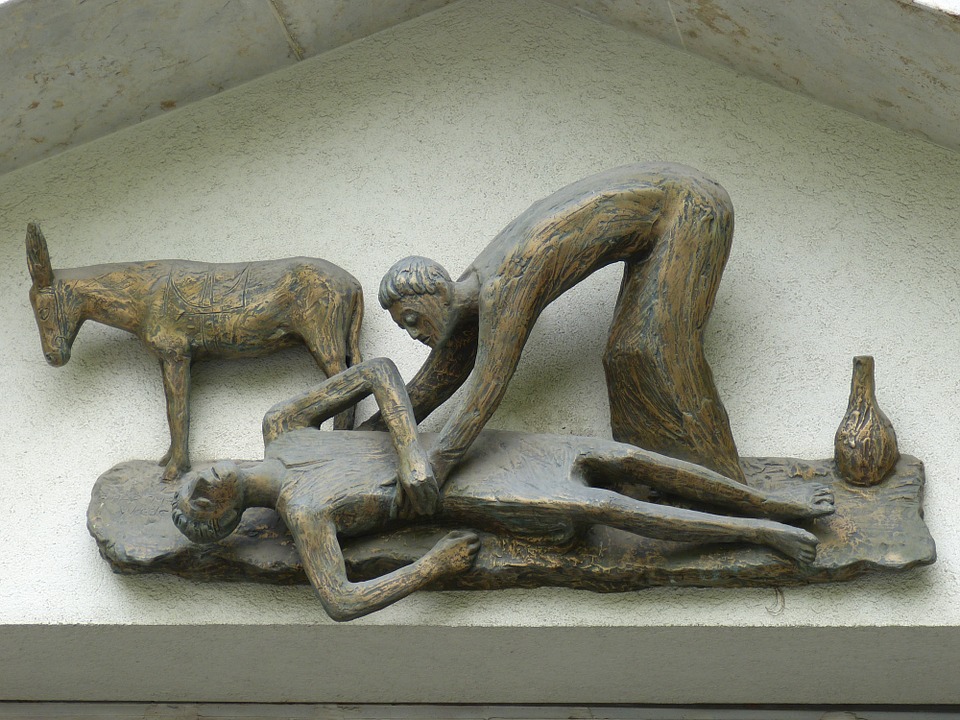
III. The Response that Reflects Love The Lord then paints a picture of what His love and grace can accomplish in someone: Jesus replied, “A man fell victim to robbers as he went down from Jerusalem to Jericho. They stripped and beat him and went off leaving him half-dead. A priest happened to be going down that road, but when he saw him, he passed by on the opposite side. Likewise, a Levite came to the place, and when he saw him, he passed by on the opposite side. But a Samaritan traveler who came upon him was moved with compassion at the sight. He approached the victim, poured oil and wine over his wounds and bandaged them. Then he lifted him up on his own animal, took him to an inn, and cared for him. The next day he took out two silver coins and gave them to the innkeeper with the instruction, ‘Take care of him. If you spend more than what I have given you, I shall repay you on my way back.’ Which of these three, in your opinion, was neighbor to the robbers’ victim?” He answered, “The one who treated him with mercy.” Jesus said to him, “Go and do likewise.”

There is a very important phrase that must not be missed, for it gives the key to the Samaritan man’s actions: “… [he] was moved with compassion ….” Note that the sentence uses the passive voice (“was moved”). That is to say, it was not so much that the Samaritan acted, but that he was acted upon.

More specifically, love and grace have moved within him and are moving him. The Greek verb used here is ἐσπλαγχνίσθη (esplagchnisthe), a third-person singular passive verb meaning “to be deeply moved” or “to be moved to compassion.” The verb is also in the aorist tense, signifying that something has happened but also that it has a kind of ongoing dimension to it.

Why is this phrase “was moved” so important? Because it indicates the power of the gift of grace. So many of our fears about what God asks and what love demands are rooted in the idea that we must accomplish them out of our own flesh—that is not the message of this Gospel. In the New Covenant, the keeping of the Law is received, not achieved. The keeping of the commandments is a work of God within us to which we yield. Keeping the commandments and fulfilling the law are the results of love, not the causes of it.

We do not know the Samaritan’s history; the Lord does not provide it to us. He is telling a story and the Samaritan is only a literary character in it.

We must clearly understand the teaching of today’s Gospel: Our receiving and experiencing of love is and must be the basis of our keeping of the law. Experiencing and receiving God’s love for us equips, empowers, and enables us to respond extravagantly as joyful lovers rather than as fearful lawyers.

Love lightens every load. When we love God and love other people, we want to do what love requires. Even if there are difficulties that must be overcome, love makes us eager to respond anyway.

When I was in the 7th grade, I found myself quite taken by a pretty girl named Shelly. I was “in love.” One day she was walking down the hall struggling to carry a pile of books to the library; I saw my chance! I jumped in and offered to carry her books. Mind you, I was skinny as a rail with no muscles at all, and those textbooks were heavy—but I was glad to do it despite the effort. Love does that; it lightens every load and makes us eager to help, even at great cost.

Perhaps it’s just a silly story of an awkward teenager, but it demonstrates what love does. It “moves” us to be generous, kind, merciful, patient, and even extravagant. We don’t do what we do because we have to, but because we want to.

The Samaritan in this story, was “moved” with and by love to overcome race, nationality, fear, and danger. He generously gave his time and money to save a fellow traveler.

Let love lift you. Let it empower you, equip you, and enable you! Go to the Lord and pray for a deeper experience of His love. Open the door of your heart and let the love of God in. Go to the foot of the cross and remember what the Lord has done for you. Let what He has done be so present in your mind and heart that you are grateful and different. Let God’s love come alive in you.

As a witness, I promise you that love lightens every load and makes us eager to keep the commandments, to help others, to forgive, to show mercy, to be patient, to be kind, and to speak the truth in love to others. Yes, I am a witness that love can and does change us. I’m not what I want to be, but I’m not what I used to be. Love has lifted me and lightened every load of mine.

Again, today’s Gospel is not mere moral advice. The main point is that we must let the Lord’s love into our heart. If we do, we will do what love does and we will do it extravagantly—not because we have to but because we want to.

The grace of love lightens every load and equips us for every good work.


Five Facts of Faith from the Life of St. Peter – A Homily for the Feast of Saints Peter and Paul

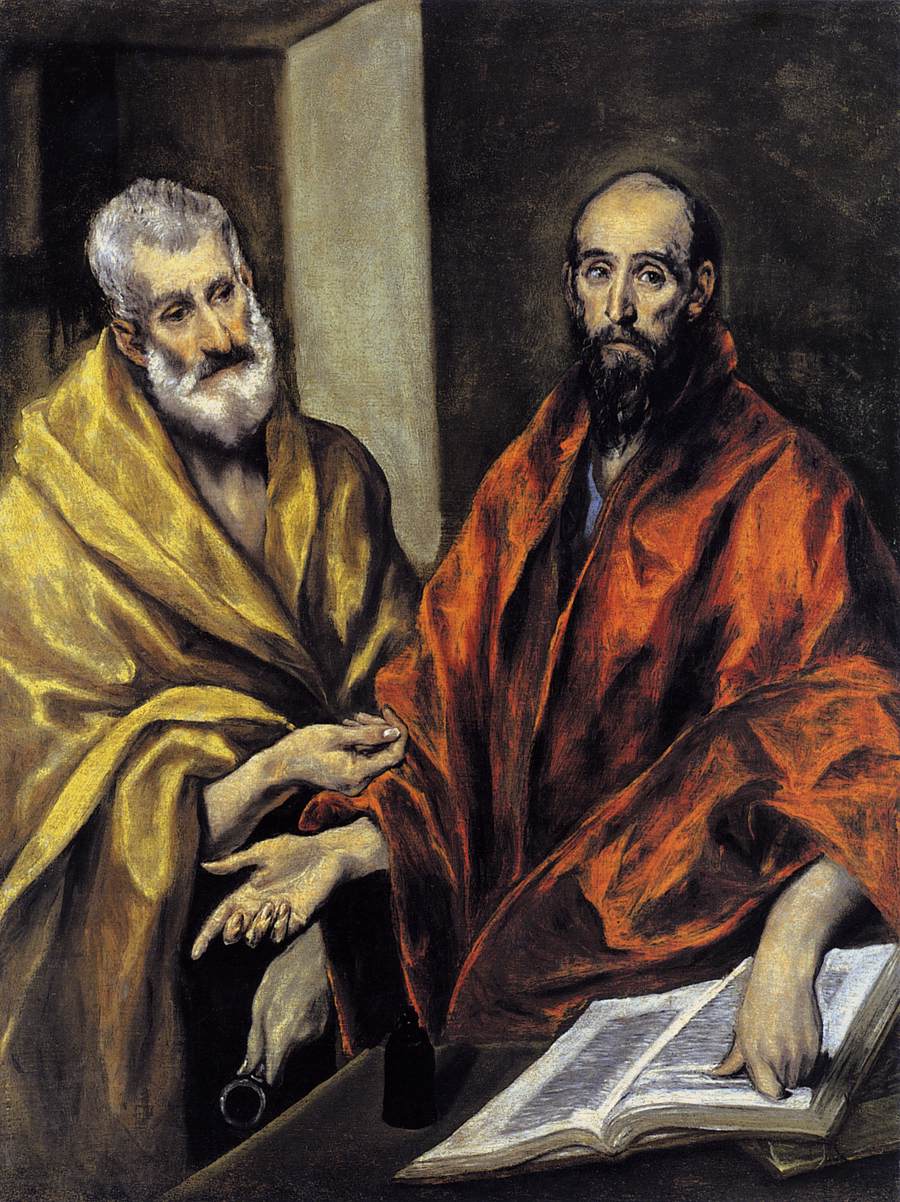
062814Today’s Feast of Saints Peter and Paul honors two fundamental pillars of the early Church. While all the Apostles form the foundation, Peter and Paul stand out very profoundly in terms of influence and work. And while some have wished to suggest division between them, the Church insists that they must been seen together; hence their feast is set forth in this way.

Indeed, those who see division between them base it on only one text from Galatians (2:11) wherein St. Paul withstood Peter so as to correct him. Peter had taught rightly concerning the inclusion of the Gentiles but, at least according to St. Paul’s report, he struggled to associate with them more freely and was fearful of the Judaizers. Yes, even popes are not beyond reproach. We argue that popes are prevented from formally teaching error in faith or morals (Peter did not teach erroneously), not that they are sinless.

Nevertheless, the same Paul had gone to visit St. Peter in order to get to know him  (Gal 1:18) and later submitted his teachings to Peter and others in Jerusalem for scrutiny  (Gal 2:1-10). And at the Council of Jerusalem, Paul and Peter were allies (Acts 15).

Thus we ought not exaggerate differences beyond the evidence. The Church today bids us to celebrate them together.

Many different approaches to the reading could be taken today. But since the chief work of the Church and the Apostles is to draw us to faith, it behooves us to look in detail at the first reading from today’s Mass and see in it a kind of roadmap to growing in faith. Peter’s story and experience were not just for him; they were for us as well. Let’s see what we can learn as we focus on five facts of faith from the story of St. Peter in today’s first reading.

I. The Persecution of Faith – Persecution is the normal state of affairs for a Christian. Not every Christian suffers equally at every stage and place in history, but Jesus spoke often about the need to be willing to endure persecution for His sake. He said, A servant is not greater than his master. If they persecuted me, they will persecute you also (Jn 15:20). He added, If you belonged to the world, it would love you as its own. As it is, you do not belong to the world, but I have chosen you out of the world. That is why the world hates you (Jn 15:19). He said elsewhere, In the world ye shall have tribulation: but be of good cheer; I have overcome the world (Jn 16:33). He also warns, Woe to you when everyone speaks well of you, for that is how their ancestors treated the false prophets (Lk 6:26).

And therefore, persecution should be expected. If it is wholly absent, we may have some soul-searching to do as to whether we are witnessing to the Faith authentically.

And so, in this passage, we should not be surprised to see how the early Church was persecuted. In this Gospel is described the persecution, driven by Herod, that breaks out in Jerusalem. In this persecution, James, (of “Peter, James, and John” fame) is killed! Peter is also rounded up and slated for death. Sitting in prison, he awaits his fate.

Note the strange excessiveness of the persecution. Peter is secured with double chains and is forced to sleep between two soldiers. And outside there are even more guards keeping watch. Wowza! Here’s a persecution that is strangely excessive and obviously rooted in no small degree of fear!

And yet as we look at persecution today, we notice something similar. There seems to be a very special hatred for Christians, especially Catholics. Note for example that in the public school system it is permissible to speak about almost anything: how to use condoms, homosexuality, and even certain religions such as Islam. But if the name of Jesus is even mentioned, or Scripture is even obliquely referenced, lawsuits are threatened and television cameras appear! What is this strange fear and hatred for Christ? Jews, Buddhists, Muslims, Zoroastrians, and even Methodists and Episcopalians do not face similar hostility!

While this animosity is somewhat mysterious, it does speak to us of the uniqueness of Jesus Christ and particularly of the Church He founded: the Catholic Church. Satan surely inspires special hatred for Jesus and His Church. So in a certain sense, we can take it as a sign of credibility—even as a compliment. Perhaps too, it is the fact that deep down, they know that what Jesus and His Church teaches is right.

The prince of this world hates Jesus, and has always inspired his followers to do so as well, whether consciously or unconsciously. Yes, persecution is a natural, expected ordeal for a Christian.

II. The Prayer of Faith – In the midst of this, we note that the Church is described as praying fervently to God. The Greek word translated here as fervent is ἐκτενῶς (ektenos),  which means “fully stretched.” It is the image of a taught rope that is invoked. Here is prayer that is stretched out, that is costly, that involves more than a brief moment or two. Here is praying that is persevering. This sort of prayer involves more than an honorable mention in the Prayers of the Faithful at Mass. Here is the sort of prayer that involves long hours. Time is invested; effort is expended; energy is invested. It is the sort of prayer that nags God until the solution is at hand.

There is an expression in the African-American community, “by and by.” It refers to the need to be patient and persevering in prayer while waiting for God to answer “by and by.” In other words, God will answer in His own time. It is for us to keep praying. And here is prayer without ceasing; it does not give way to discouragement, but just keeps on praying.

III. The Prescription of Faith –  In the midst of this fervent prayer of the Church, a hidden process begins. An angel is dispatched from Heaven, enters the jail, and comes to Peter. His instructions to Peter amount to a kind a prescription for a life of faith, and we note it in four stages:

A. Rise! – The angel says, “Get up”. Here is a call to rise from death, to rise from despairing and doubt, to stand up! Every Christian must die to sin and rise to new life, must die to slavery and despair and rise as a free and active agent, ready to walk with God.

B. Restrain – The angel then tells him to put on his belt (or cincture).  The belt (cincture) is traditionally a sign of chastity and of continence (restraint). The Christian life cannot be riddled with unchasteness or with other excesses of this world such as greed, gluttony, and other forms of intemperance. These hinder the journey; they weigh us down. And thus the instruction to tighten our belt.

C. Ready – Peter is also told to put on his sandals. Here is a symbol of readiness to make a journey. When I was a child, my mother would often signal me by saying, “Put on your shoes and get ready to go.”  And thus Christians must be ready to make the journey with their feet shod with the gospel of peace, with their shoes on and ready to set out on the great pilgrimage with Jesus to Heaven. The pilgrimage goes up over the hill of Calvary and over into glory. Put your shoes on and get ready to go!

D. Righteous – Peter is then told to put on his cloak. The robe in Scripture is often equated with righteousness. For example the book of Revelation says it was given to the bride to be clothed in fine linen. The text goes on to say that the linen robe is the righteousness of the Saints (Rev 19:8). There is also the parable of the wedding guests, one of whom was not properly clothed, and was therefore thrown out (Mat 22:11). At a Baptism, the priest points to the white garment worn by the infant and tells everyone to see in this white garment the outward sign of his or her Christian dignity, and that the child is to bring this garment unstained to the great judgment seat of Christ. Thus the instruction of the angel reminds us that every Christian is to be clothed in righteousness, and is to be careful to keep this robe, given by God, unsoiled by the things of this world.

D. Run ! – Finally, there is the command of the angel to “Follow me.” In other words, run the race of faith. Toward the end of his life, St. Paul would say, “I have fought the good fight, I have finished the race, I have kept the faith” (2 Tim 4:7).  Jesus told his disciples, simply, “Follow me.”

IV. The Procession of Faith- Following this there comes a series of instructions from the angel to Peter (and also to us). These instructions amount to a type of direction to make the procession of faith. We see three things:

A. Not easy – The text says that they passed the first guard, then a second, and finally came to an iron gate. And thus in our journey, there are obstacles and dangers. We must recall that we live in paradise lost. Life is not easy; it is hard. There are hurdles and perils. We are not called to avoid them, we are called the face them with courage. God allows these in our life in order to test us, to see if we will follow Peter’s example and move past the one guard, then the second, and then the apparently locked gate (which God opens for us). Life is not easy, but God’s grace conquers the challenge, if we only trust Him.

B. Narrow – The text here describes a narrow alley through which Peter and the angel pass. Jesus spoke of the way that leads to salvation as a narrow way (e.g., Mat 7:14). Why is this so? Because the narrow way is the cross! Most are not interested in this difficult path, the path that is steep and narrow. Most look for the broad highway through the valley, the easy way. The world still insists that we live in paradise (which Adam rejected) and that life should be easy. It is a lie; the path now is over the hill of Calvary. It is a narrow and steep path,  but it is the only true way to glory. Avoid preachers who never mention sin, who never speak of repentance, who never speak of struggles and difficulties. Avoid them;  for the tuning fork, the A440 of the Gospel is the cross. There are glories and joys in this life to be sure, but the fundamental path to Heaven and glory is through the cross. It cannot be avoided. Walk the narrow way, the way of the cross. Do not listen to the “prosperity preachers” who exaggerate one truth, excluding all others.

C. Need an angel – As soon as Peter emerges from the prison and out into the openness of freedom, the angel disappears. But until this point, he needed an angel! And so do we. Though demons are roaming and patrolling this earth, so are God’s Angels. We all have an angel assigned to us, and many other angels along the way to help us. Never forget this. We do not journey alone. For every demon, there are two angels (Rev 9:15). Stop fearing demons and call on God’s angels, trusting in God’s grace.

V. The Product of Faith –  There comes finally the product of faith wherein Peter is able to confidently assert, Now I know without a doubt that the Lord has sent his angel and rescued me (Acts 12:11). Do you know this? Or is it only true because others have said so? Do you experience God’s saving glory? Have you experienced him rescue you? How? Do you have a testimony? The normal Christian life is to know and experience that our God can and does rescue us from this hell-bound, sin-soaked world. We have a God who can make a way out of no way, and can, as St. Paul says, Rescue us from this present evil age (Gal 1:4). Do you know this? Have you experienced this? Then tell someone! It is the product of faith!

Humility in Prayer According to St. Teresa of Avila

I have written before on humility in prayer as St. Augustine sets it forth. In today’s post I look to the same topic, but this time as St. Teresa of Avila presents it in her treatise The Way of Perfection.

In setting forth her teaching, I have substantially reworked the order of her reflections. St. Teresa was able to see the “whole rose” of the topic, jumping from petal to petal without effort. I, being of a vastly inferior intellect and of far less purity of soul, must look to the individual petals in a certain order to understand. If you wish to read the passage in its original order, it is available here: St Teresa on Humility in Prayer.

Following is my presentation of her teaching as best I am able. In effect, St. Teresa summons us to trust in the Lord’s answer to our prayers rather than insisting on our own preferred outcomes and worldly measures of success.

Let’s look at her teaching in five stages. St. Teresa’s teaching is presented in italics while my remarks are shown in plain red text. The passages below are taken from the book The Way of Perfection by Saint Teresa of Avila, virgin (Obras de la gloriosa madre Sta Teresa de Jesus, Tomo 1, Madrid, 1752: 30:1-4 pp. 526-528).

The Prayer Plan Therefore, the good Jesus bids us repeat these words, this prayer for his kingdom to come in us: Hallowed be your name, your kingdom come. See how wise our Master is! Our good Jesus placed these two petitions side by side … But what do we mean when we pray for this kingdom? … It seems to me that this point deserves serious attention.

Many conceive of prayer as a time to tell God what we need. Intercessory prayer surely has its place, but it ought not to dominate. As St. Teresa reminds us and the Our Father teaches, we ought to acknowledge more consistently the holiness and wisdom of God and seek His kingdom and will in our lives.

Hence, prayer is seeking God’s will, not announcing our own. We all have our preferences in life. We would rather be healthy than ill, financially well off than destitute, in peace than at war. Our ultimate goal, though, is to trust that what God wills or allows is what is best.

Is God holy for us, or is he just a butler who should fetch what we want? Do we love the God of all consolation or merely the consolations of God? To pray, then, is to disclose our heart and seek to conform it to the Kingdom and to the will of God.

The Perfect PictureO Eternal Wisdom, between you and your Father that was enough; that was how you prayed in the garden. You expressed your desire and fear but surrendered yourself to his will.

St. Teresa points to Jesus Himself as the perfect picture. His human preference is for the cup of suffering to be taken away, but His deepest desire is to be conformed to His Father’s will:

And going a little farther he fell on his face and prayed, saying, “My Father, if it be possible, let this cup pass from me; nevertheless, not as I will, but as you will” (Matt 26:39).

We are saved by the human decision of a divine person. To be freed from suffering is appealing to Jesus, but not so appealing as to cause Him to violate His Father’s will. Nothing could do that.

Jesus is the ideal picture of prayer. His heart is perfectly united to the Father and His lesser human desire to avoid suffering is subjugated to His ultimate desire: to do whatever the Father wants. It is for us to journey toward this perfect picture. As we grow in the grace and love of God, we increasingly want what He wants, even if it is challenging, even if it leads us to martyrdom.

The Persistent Problem But as for us, my Lord, you know that we are less submissive to the will of your Father …. You see, the gift our Lord intends for us may be by far the best, but if it is not what we wanted we are quite capable of flinging it back in his face. That is the kind of people we are; ready cash is the only wealth we understand.

Nothing plainer or more accurate could be said. It is normal to have certain preferred outcomes in life and in general it is not wrong to petition God for these things, but we are often very particular about what we want and so quick to become crestfallen and resentful if we do not get what we want, when we want it, and in just the manner. In addition, our desires are too easily worldly and vain.

So often our Lord must repeat what He said to James and John: “You do not know what you are asking” (Mt 20:22). St. Paul also reminds us, For we do not know how we ought to pray, but the Spirit Himself intercedes for us with groans too deep for words. (Rom 8:26).

Thus, we must ask humbly, realizing that God knows what is best. He sees a more complete picture and understands that simply giving us what we want often leads to troublesome results. Despite our momentary disappointments, we often come to realize that some of God’s greatest gifts have been the times when he said no or gave us something other than what we sought. It is interesting, for example, that no matter how many times God warns about wealth in the Scriptures, most of us still want to be wealthy. Our desires can be obtuse and close us in on worldly and fleshly things.

Recall the words of Jesus to the crowds who wanted another free meal after He multiplied the loaves and fishes: Do not work for the food that perishes, but for the food that endures to eternal life, which the Son of Man will give to you (Jn 6:27). Jesus was speaking of the Eucharist, His very self, but they just wanted ordinary bread. They were behaving like the ancient Jews, who tired of the miraculous manna, calling it wretched (Num 21:5), and pining for the melons and leeks of their slave years in Egypt (Num 11:5).

Yes, indeed, all we understand is “ready cash,” as St Teresa observes. How we must wear God out!

The Particular PetitionMy Lord, could you not have included all in one word by saying “Father, give us whatever is good for us?” After all, to one who understands everything so perfectly, what need is there to say more?

For our prayer to grow, and our desires to be purified, a simple and filial trust of the Father is the key:

Whatever you want, O Heavenly Father, I want it too. I know it will be best. Even if my first emotional response is less than happy, I know that my truest happiness will be in whatever you will for me.

While the Lord Jesus directs us to present our needs to Him and to persevere in our prayers, it does not follow that we should give God detailed instructions. Doing so would be controlling, not trusting. It is enough to say, “Here are my needs, my concerns. I know that you will do whatever is best. Whatever you want, Lord, I will be fine knowing that you have heard and answered in your own way.

Indeed, there is no safer or better place in the world than inside the will of God. St. Teresa reminds us that humility in prayer comes finally to this: “Father give us whatever is good for us.”

Of course, whatever is good for us is that which will best lead us to Heaven. Hence, St. Teresa concludes with a vision that should always be before us.

The Palliative PerceptionOf the many joys that are found in the kingdom of heaven, the greatest seems to me to be the sense of tranquility and well-being that we shall experience when we are free from all concern for earthly things …. Loving him is the soul’s one concern. Indeed it cannot help but love him, for it knows him. Here below our love must necessarily fall short of that perfection and constancy, but even so how different it would be, how much more like that of heaven, if we really knew our Lord!

I use the word palliative here to mean healing. We must look to Heaven to see our prayers and desires healed. There is an old saying, “The end is the beginning.” If we know our destination, then every other decision we make is directed toward that destination.

For example, if I am driving from Washington, D.C. to New York City, I can freely disregard signs for roads that lead south or west, knowing that they will not help me to get there. Even if I have to wait in heavy traffic, drive through heavy storms, or pay tolls, I am not overwhelmed because I know that every mile north and east gets me closer.

In our spiritual journey, we must meditate often on our destiny. Our goal is to be with the Lord forever. Our destination is Heaven, that beautiful place beyond description or imagination, where we are at peace in the presence of our God, lost in wonder and awe, and caught up into the great trinitarian dance of love. Looking into the beautiful face of God for which our soul yearns, all our lesser and often petty desires of this world will be gone.

As St. Teresa notes, however, all this doesn’t have to wait for Heaven. Even here in this world, as we grow to know the Lord more deeply our desires become purer and our prayer more humble. Increasingly, we come to be able to say what St. Thomas Aquinas did when asked by the Lord what he wanted: Nil nisi Te, Domine, nil nisi Te (nothing but You, O Lord, nothing but You). St. Teresa adds her hearty amen.

Jesus Wants to Feed You! Corpus Christi

On the Feast of Corpus Christi, we do well to mediate on the desire of the Lord to feed His people and the shocking indifference many have to this fact. This indifference is not just on the part of those who do not come to Mass; it is also found among those in the pews, many of whom don’t seem to care that so many people no longer attend. We should recognize the passionate concern the Lord has to feed all His people—yes even your wayward spouse or child.

Let’s consider today’s Gospel in three ways.

I. Desire that is Discerned – Jesus has been teaching the crowds all day by the lake. The text says, As the day was drawing to a close, the Twelve approached him and said, “Dismiss the crowd so that they can go to the surrounding villages and farms and find lodging and provisions; for we are in a deserted place here.”

The diagnosis here is that the crowd is hungry. And this is a diagnosis of the human condition in general: we are hungry.

How are we hungry? Let us count the ways. We are a veritable sea of desires. We desire food, drink, life, health, honor, respect, popularity, intimacy, family, security, goodness, beauty, truth, serenity, justice, and so much more. Yes, we have so many desires; we are hungry. And herein lies an insight for evangelization. For Somehow amidst all this hunger, God is calling us. We are like the woman at the well, who came thirsty for the water of this world but was shown by the Lord that she actually desired Him, and that it was only He who could satisfy her.

It is sad that while every advertiser on Madison Avenue knows how to tap into people’s desire and draw forth loyalty, we Christians have so little insight. For the people of this world are more shrewd in dealing with their own kind than are the people of the light (Lk 16:8).

And thus we are like the Apostles, irritated and clueless that people have needs. In effect we say, “You are needy. Go away,” rather than “You are needy. Wow, have I got an answer for you! You want what is good, true, and beautiful? You want what satisfies? Wow, have I got a meal for you!”

So the diagnosis is clear: the crowd is hungry. Sadly, though, the Apostles in that moment were “out to lunch.” They were out of ideas. This could describe us today as well.

II. Directive for the Disciples Note that the Lord has a deep desire to feed these people. He said to them, “Give them some food yourselves.” The Apostles, of course, can only protest the impracticality of such a thing. They are staring right in the face of Jesus Christ yet think it impossible to feed this crowd. They see only five loaves and two fishes; they can’t see Jesus. They don’t know Jesus! Do you see their lack of faith? What about yours?

Yes, this is also a picture of many in the Church today, who think that nothing can possibly be done to reverse the cultural decline or bring people back to the Church. They see only our meager five loaves and two fishes and forget that we have Jesus, who is still in the business of working miracles.

Jesus will not allow all their negativity crush His desire. Yes, the Lord insists; He has a deep desire to feed them. All this foolishness about being unable to do so does not impress Him. Jesus says,

“Have them sit down in groups of about fifty.” They did so and made them all sit down. In effect, the Lord says, “Enough of all this negativity! I’m in charge here. Let’s get to work now.”

What is this about “groups of fifty”? The answer is debatable, but I believe it points to what we have come to call the “parish system.” That is, the whole world is divided up into small, manageable units (parishes) in which a pastor and his flock are responsible for ensuring that all people in that territory are invited to the wedding feast of the Lamb. The Lord desires to feed every person in every parish. He says to me and my parish, “Give them something to eat yourselves.” In other words, “Draw them to the Eucharistic table! Draw them to me!”

Yes, the Lord has a deep desire to feed us. Consider the following: What loving parents, noticing that their child had stopped eating, would not move Heaven and Earth to find out why and to get them back to eating saving food? Yes, they would go emergency rooms and doctors’ offices until their child began eating again.

Why is this not so with our Eucharistic food? Clearly the Lord deeply wants to feed us. So then why aren’t we as desirous to be sure that others, especially our children and family, are receiving the Lord?

To all this the Lords says, “Give them something to eat.” He is not talking to the person next to you; He is talking to you: “Bring them to me; give them something to eat.”

And it is so easy for us to reply, “But I have so little, just five loaves and two fishes. I’m not eloquent. I haven’t studied the faith enough. I don’t have an answer to everyone’s questions!” Still, the Lord says, “Give me what you have and then have them sit down. Work on the fifty I have assigned to you and your parish.”

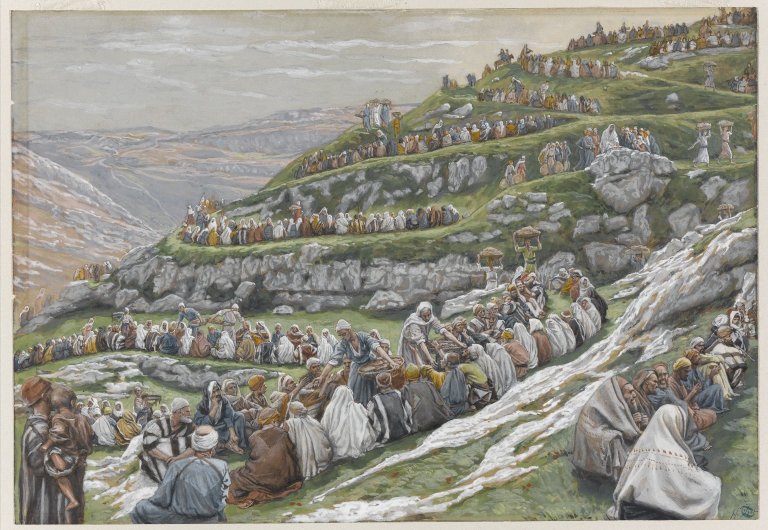
III. Determination to Deliver The text says the following of the disciples: They did so and made them all sit down. Then taking the five loaves and the two fish, and looking up to heaven, he said the blessing over them, broke them, and gave them to the disciples to set before the crowd. They all ate and were satisfied. And when the leftover fragments were picked up, they filled twelve wicker baskets.

Note well that the Lord is determined to feed these people; and He insists that His disciples help him to do it. They are expected to gather the faithful and make them sit down in groups of fifty. Then the Lord—the Lord Himself—blesses and multiplies the food. But once again, He has the disciples help. He gives the food to His apostles, but they set it before the crowd.

And this is the Church. Jesus is the Great High Priest of every Liturgy. It is He who takes our meager offerings and then multiples and transubstantiates them. But He works this ministry through His priests, and in an extended sense, through the whole Church. The Lord feeds His people, but He does so through others. It is the role of the Church to take what Jesus sets before us and then see that it is distributed to others in due season.

On the Feast of Corpus Christi, we acknowledge that the Lord feeds us through His Body and Blood, but does so through the ministry of His priests and through His Church. Do we see this as central to our mission? Is the Liturgy really at the heart of our parish life or are liturgies hurried so that we can get to our next activity on time? What is our highest priority? Is it the same priority of Jesus rooted in the deep desire he has to feed his people?

The Gospel today says that they all ate and were satisfied. Does this describe the Liturgy at your parish? Are people fed? Do they experience an abundance at the Lord’s Banquet? Or is Mass merely something to be endured, something more akin to a flu shot, which is hoped to be as quick and painless as possible?

Of course the Liturgy should be satisfying to God’s people. During the Liturgy, people should be instructed in God’s Word and then have that Word cause their hearts to catch fire with joy, inspiration, and, yes, conviction on the need for repentance. The faithful should expect and experience a great transformation on account of the Eucharist. How can someone fruitfully receive the Body of Christ and not experience great change and be satisfied?

Yet, sadly, most people put more faith in Tylenol than they do in the Eucharist. When they take Tylenol, they expect something to happen: the pain to go away or the swelling to go down. Do people expect this of the Eucharist? If not, why not?

On this Feast of Corpus Christi, please understand that the Lord wants to feed you and your loved ones. He wants to do this in order to save you and to satisfy you. Do you care about this? Is this a reality or just a ritual? Why not ask the Lord to engender within you the same desire that He has to feed others, and to make you a magnet to draw people to Him? Who are the “fifty” the Lord has put in your charge? Gather them and have them seated at Mass next Sunday.