Every Round Goes Higher, Higher. A Meditation on the Gospel for the 22nd Sunday of the Year

In today’s Gospel the Lord firmly sets before us the need for the Cross, not as an end in itself, but as the way to glory. Lets consider the Gospel in three stages.

I. The Pattern that is Announced – The text says, Jesus began to show his disciples that he must go to Jerusalem and suffer greatly from the elders, the chief priests, and the scribes, and be killed and on the third day be raised.

Note here that the Lord does not only announce the cross, he also announces the resurrection. In effect he announces the pattern of the Christian life which we have come to call the “Paschal Mystery.”

The expression, “Paschal Mystery” refers to the suffering, death, resurrection and glorification of Jesus as a whole. The word “Paschal” is related to the Hebrew for Passover. Just as the shed blood of a lamb saved the people from the angel of death and signaled their deliverance, so does Jesus’ death, his Blood, save us from death and deliver us from slavery to sin.

So he is announcing a pattern: the Cross leads somewhere, accomplishes something. It is not an end in itself, it is for a purpose, it is part of a pattern.

St. Paul articulates the pattern of the Paschal Mystery this way: We always carry around in our body the death of Jesus, so that the life of Jesus may also be revealed in our body (2 Cor 4:10). It is like an upward spiral where the cross brings blessings we enjoy. But we often circle back to the crosses God permits, and there come even greater blessings and higher capacities. Cross, growth, cross, growth, and so the pattern continues, till we reach the end, dying with Christ so as to live with him.

This is the pattern of our life. We are dying to our old self, dying to this world, dying to our sins, but rising to new life, rising to the Kingdom of God, becoming victorious over sin. The cross brings life, it is prelude to growth. We die in order to live more richly. And old spiritual says of this repeated pattern that “every round goes higher, higher.”

Do you see the pattern Jesus announces? The Lord does not announce the cross to burden us, neither does the Church. No, the cross is part of a pattern that, if accepted with faith, brings blessing, new life, and greater strength.

II. The Prevention that is Attempted – The text says, Then Peter took Jesus aside and began to rebuke him, “God forbid, Lord! No such thing shall ever happen to you.” He turned and said to Peter, “Get behind me, Satan! You are an obstacle to me. You are thinking not as God does, but as human beings do.

Notice the exact wording of Peter’s words: “No such thing shall ever happen to you.” And we ought to ask, “What such thing?” For in precluding that Jesus suffer and die, he also implicitly blocks the rising and glorification of Jesus. For Christ cannot rise, unless he dies.

Peter of course is not thinking all this through, he is not connecting the dots. But neither do we as we seek to avoid crosses for ourselves or to improperly hinder others from accepting the cross. For the cross brings glory and growth and we run the danger of depriving others of these if we rush to eliminate all the crosses, demands and difficulties of life. Perhaps we do this by enabling behaviors, perhaps we do it by spoiling children.

We also hinder our own growth by refusing to accept the crosses of self-discipline, hard work, obedience, resisting temptation, accepting suffering, consequences and limits. In rejecting the cross we also reject its fruits.

All this explains Jesus severe reaction to Peter. He goes so far as to call Peter “Satan” for it pertains to Satan to pretend to befriend us in protesting our crosses, but it is really our blessings he wants to thwart. Peter may not know what he is doing, but Satan does, and seeks to become an obstacle to Jesus’ work.

Jesus’ severe reaction is rooted in protecting our blessings.

III.  The Prescription that is Awarding – Jesus goes on to teach further on the need for and wisdom of the Cross. The text says, Then Jesus said to his disciples, “Whoever wishes to come after me must deny himself, take up his cross, and follow me. For whoever wishes to save his life will lose it, but whoever loses his life for my sake will find it. What profit would there be for one to gain the whole world and forfeit his life? Or what can one give in exchange for his life? For the Son of Man will come with his angels in his Father’s glory, and then he will repay all according to his conduct.

The heart of Jesus’ teaching here is the deep paradox that in order to find our life, we must lose it. More specifically, in order to gain heaven we must die to this world. And that dying is a process more than just an event at the end of our physical life here. Though we cling to life in this world, it is really not life at all. It is a mere spark compared to the fire of love that God offers. It is a mere note compared to the great symphony God directs.

Jesus instructs us to be willing to exchange this tiny and dying life for that which is true life. Whatever tiny blessing comes from clinging to this life and world the Lord says it is no profit at all. If you choose life in this world rather than the true life God offers, you’re nothing but a big loser.

Of course what the world’s cheap trinkets offer is immediate gratification and evasion of the Cross. We may feel relief for a moment, but our growth is stunted and the cheap little trinkets slip through our fingers. We gain the world (cheap little trinket that it is) but lose our souls. Total loss. To quote a modern expression: “FAIL!”

Jesus final world reminds us that the choice is ours, however. For the day will come when he will ratify our choice. Either we accept true life and win, or we choose the passing, dying life this world has and we lose. The choice is ours.

This songs speaks of life as a kind of spiral climb between cross and glory. The text says, “Every round goes higher, higher, soldiers of the cross.”
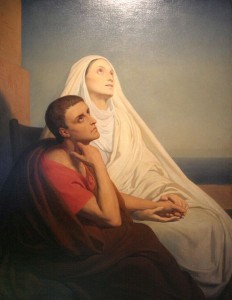
Hope for Every Family (St. Monica)

St. Monica, whose feast we celebrate today, is not only a saint. She’s also the mother of a saint, St. Augustine. So what the Church presents to us today for our veneration is a saintly family!

Some of you may be thinking, “That’s nice, but it certainly doesn’t describe my family.” That may be true. But consider this: At one time, St. Monica was an alcoholic. She had a verbally abusive, non-Christian husband who cheated on her. Her son Augustine abandoned his faith as a teenager, defiantly embraced another religion, came home from college with a live-in girlfriend, fathered a child out of wedlock with her, and then later sneaked out of the country in order to get away from Mom.

For his part, St. Augustine suffered from depression at times; he spent many years adrift as he sought meaning and purpose in life; he wasted time and money on silly and immoral entertainment; and he struggled with a sexual compulsion that filled him with shame.

Does that sound a bit more familiar? Sound a bit more like a real family. It even sound a bit like a dysfunctional family. But that’s not the entire story, which has a happy ending. Augustine eventually returned to his Christian roots and became a great bishop; Monica’s pagan husband changed his ways and became a Christian as well; and Monica recovered from alcoholism and died in the company of her son, whom she had shortly beforehand watched being baptized at the hands of another saint, St. Ambrose.

Their story, I think, should give real hope to real families who struggle with real problems: Hope that now matter how bad things may seem, there’s always the possibility for healing, conversion, reconciliation, growth, and freedom. For nothing is impossible with God!

Readings for today’s Mass: http://www.usccb.org/bible/readings/082711.cfm

Image Credit: Wikipedia Commons

Humility Lesson – An Earthquake, Now a Hurricane Evacuation For Yours Truly

I am writing this post early on a Friday, to automatically post at my usual time. I have been staying at Bethany Beach Delaware,  just north of Ocean City Maryland.

We received a mandatory evacuation order last night due to impending hurricane Irene. SO my vacation ends one day early. Alas.

This evacuation comes two days after an East Coast Earthquake that damaged the beach house where we were staying (not serious). Back in DC the earthquake damaged my parish: cracks in our newly restored frescos on the Church clerestory, and the smokestack at the school was cracked and leaning. It will have to be taken down on Friday before the high winds of the hurricane come.

Ok we’ll survive, but all this is a humility lesson. Message to humanity: you are small, the world as you know it is passing away. In fact we’re so small that we have to run when that point is made obvious. What a sight to see, all the bureaucrats and politicians, in the “most powerful city in the world” running out of buildings and standing on the street. Imagine me now, sitting in a long backup of evacuees fleeing  the beach lest we be crushed or drowned by the power of swirling winds and rain.

From space a hurricane looks so beautiful, so symmetrical. But beneath its beauty terrible destruction awaits things and people in its path.

We are small, and we are contingent. And twice this week many folks on the east coast have had to run for their life. I am mindful of the words of an old hymn:

O tell of God’s might, O sing of God’s grace,
whose robe is the light, whose canopy space,
His chariots of wrath, the deep thunderclouds form,
and dark is God’s path on the wings of the storm.

Frail children of dust, and feeble as frail,
in thee do we trust, nor find thee to fail;
thy mercies how tender, how firm to the end,
our Maker, Defender, Redeemer, and Friend
.

Yes, humility should make us turn to God who alone can be said to over power the things of this world that make us run. We may be troubled that he allows such destructive things, but his wisdom does permit them.

For our pride is the most deadly thing in our life, it is our greatest enemy. Perhaps the greatest gift God can give us is the gift of humility. Trust God, our maker, defender, redeemer and friend.

Here’s a little video I put together to recall humility

Reflections from WYD – The Vigil Miracle by Elizabeth Lent

Elizabeth Lent, junior at Notre Dame and parishioner from Little Flower takes us back to World Youth Day.  Read about her final night at WYD.

After Benedict XVI drove through the crowd in his Popemobile, we could actually see him walk on stage.  He gave an opening prayer as the youth continued its energetic cheers, again and again… “Esta es la Juventud del Papa!”  A group of youth carried a life size cross across the stage while the audience quieted in reverent anticipation of the Pope’s words.

Sitting all day under the heat of the sun, we were hoping to be blessed with shade to cool ourselves and water to quench our thirst.  As the vigil approached, threatening clouds appeared and youth murmured about the approaching rain storm in fear that it would soak our sleeping bags (lying out in our assigned sleeping zone).

Then it began to drizzle.  The crowds erupted into cheers, not relenting in their enthusiasm for God and the spirit of Catholic youth.  It continued to rain harder, and the high winds forced the Pope to take cover under the stage.  The youth cheered louder and louder; they would not give up.  We were all fighting against this act of the devil who was trying to prevent our celebration of faith, The Holy Father, and God the Father.  Well we won.  The Pope addressed the Youth, “Say a little prayer and then maybe the rain will stop.”  Hail Mary’s in all languages scattered the crowd, “…Salve Regina, Madre de Dios…  In minutes the rain had stopped.  It was a miracle.  I felt completely engulfed in God’s love.

Though the rain did start up again, this was the climax of World Youth Day.

Pope Benedict XVI prepared the exposition of the Blessed Sacrament and everyone knelt in adoration of Our Lord for some time.  It was powerful to see the juxtaposition of the Pope with the actual presence of God himself.  We had all been cheering and praising our Pope, but God our Savior is the true omnipotent being we are honoring.

The rest of the night was spectacular.  Renewed by the spirit of the youth and of Our Lord, we slept happily (though a little uncomfortably) on a sandy dirt ground among fellow believers.  Waking up to a gorgeous sunrise and Mass with the Holy Father, the experience could not have ended any better.  As a friend and I sprinted with our backpacks after the final blessing to the metro in order to catch our plane home, thoughts about what we had just witnessed were running through my head…

Wow, that was crazy.  I just saw the Pope, like with my naked eye, no big screen needed or anything.  What am I supposed to make of all this? I sure hope I make my flight… I don’t even know what to think right now, I guess I am just so overwhelmed by the amount of faithful Catholic youth out there.  And we talked to so many people who were so energetic about sharing their faith.  That one French girl was really geared up, so cool!  I am so blessed to have been able to come here, wow, thanks God.  And that rain, amazing! This will be a week I will never forget.

God bless you all and thank you so much for your prayers!

Eliz.

Prepare for the Banquet

If you knew a guest was coming to your home for dinner tonight, what would you do beforehand? I imagine you’d plan a menu, go shopping, cook, clean the house, and set the table. We’d do this because if our guests arrived and we were unprepared, we would be embarrassed, to say the least, and our guests would think we were very poor hosts.

Jesus tells us today that we need to prepare for his arrival, or more specifically, his second coming. As we heard in his parable of the wise and foolish virgins, this will be a cause of celebration for some, but a time of judgment for those who are unprepared. On the one hand, this parable is a source of hope, because it speaks of the wedding banquet of Jesus to which we’ve all been invited. At the same time, it’s also a call to repentance, conversion, and amendment of life.

Perhaps we might ask ourselves the question: If we knew that Jesus were coming today, what would we do? St. Francis of Assisi was once asked that question while he was working in a garden, and he said that if he knew that Jesus were coming, he’d continue working in his garden, because he was ready to meet him. Francis was at peace, because he was prepared. Jesus calls us to prepare today, that we might live in his peace, forever.

Readings for today’s Mass: http://www.usccb.org/bible/readings/082611.cfm

Image Credit: Carodean Road Designs via Creative Commons

Number of Converts to Catholicism Continuing to Decline – You Know What to Do

A recent report from the Center for Applied Research in the Apostolate (CARA) indicates the need for continuing sobriety among members of the Catholic Church in terms of the critical need for personal evangelization. We cannot remain unconcerned when it comes to declining numbers. More on this in minute. But first, I’d like to present excerpts from the CARA blog, written by Mark Gray. The full post can be here: Research on Catholic Replacement Matters. As always, text from the CARA post is in black, bold, italics. My remarks are plain text red.

In a previous post, we noted that infant baptisms have been declining year-to-year…generally moving in step with the overall fertility rate, which has also been falling (more so since the recession in 2008).

We have commented many times on this blog of the declining birth rate and the problem of contraception. It would seem that the judgment of God is upon us, wherein God says, in effect, “If you don’t love life, you don’t have to have it.”

But of course, having sown in the wind, we reap the whirlwind. With declining birthrates and lower Mass attendance, what do we see, but closing parishes, schools, and overall decline in vocations (thank God there’s some small recovery in this), and the shutting down of any number of various other Catholic agencies and apostolates.

It takes new lives to sustain and grow the Church and have  many ministries. We must also be serious about handing on the faith.
There is little doubt that we are in trouble on all these accounts. Due to contraception, abortion, the delay of marriage, a failure to hand on the faith, evangelize and attend Mass consistently (only 27% go on Sunday), we collectively have said to God that what he offers (life and a relationship with him rooted in faith) does not interest us. And the Lord seems to have said, “If you don’t want it, you don’t have to have it.”

Yet, of course, many, often lukewarm, Catholics still expect the Church to be there for them when it comes to having weddings, funerals and baptisms, parochial schools, food pantries and social services. So they go to knock on the rectory door of “their parish” and, surprise, it is closed. The Church is strong in her people, and when there are fewer of us, we are weaker.

In each of the past three years the number of people entering the faith (of any age) has dropped below 1 million. Since 1947, during only one other period, from 1973 to 1979, did the annual number of new U.S. Catholics number less than 1 million.

Some will be quick to blame the liturgy, others the sex abuse scandal. But CARA and other studies show little correlation to these issues.

The biggest issue is secularization. Our wider culture has become secular as never before. Back in the 1950s and before when the Church was stronger in numbers, so was the culture also more religiously observant. Most Americans were expected to have a church home and attend regularly. God was spoken of more in public settings and there was more of a sense that we were accountable, one day to God.

Secularization has swept all this aside and most Americans, Catholics included, not only consider religious observance unimportant, but even something to be dismissed and despised as many go beyond indifference to be downright hateful of religion. Many actually feel righteous as they indicate that they are “spiritual but not religious,” a rational freethinker rather than a superstitious religionist.

Straight out atheism is on the ascendancy and it has a “religious zeal” all its own. The rise of rampant even militant secularism is surely a big factor in the decline of all religious observance, not just the Catholic faith.
Further, even among Catholics who still attend and are supportive of parish life to some extent,  there are often problems with secularization. For many, the spiritual life is not their priority. Thank God they still attend Mass, but their first priorities center more around career, houses and possessions, and they are more focused on getting their children in a good college and career than handing on the faith to them.

Not only are infant baptisms in decline so are entries into the faith among children, teens, and adults. These had been steadily increasing from 1997 to 2000 and reached a historic peak of 172,581 in 2000. Then something happened….

In just one year, from 2000 to 2001, the number of these non-infant entries into the Church fell by more than 20,000 (down 12.6%). This drop predates the emergence of news of clergy sex abuse cases. In fact the number of entries into the Church increased from 2001 to 2002 when these stories emerged in the media. From 2002 the number of new non-infant entries stabilized until 2006 and 2007 where another steep decline occured.
Here again, note the cause does not seem to be what many people quickly decide it is. It does not seem to be the sex abuse crisis for the reasons stated.
Further, it is not the “new Mass” as some are quick to judge, for the fields were reasonably ripe through the 1990s and past the new Century mark, a period well endowed with the Novus Ordo Missae.

One may speculate as to what the Church’s current condition would be had we never changed  the Mass, but the sweep of secularization and many other trends seemed already underway before liturgical changes and it is hard to imagine we would have largely escaped, changes or not.

The rather sudden collapse of Catholic numbers seems to indicate we were ill-prepared to face the cultural revolution. Further, the generation that led the sexual and cultural revolution surely had large numbers of Catholics in it who went to parochial schools in 1950s, and were raised on the Latin Mass. Something was wrong in the Church long before 1970 or even 1962.

There were more than 28,000 fewer non-infant entries into the Church in 2007 than in 2005 (down 19.2%). Since then, the decline has flattened out a bit but [the decline] still continues through to the numbers for 2010. So the numbers have stabilized, but at the lower number. It would seem we now have a “new normal” and the numbers of the 1990s and before have shifted downward.
You and I will likely look to causes and solutions. And the temptation is to look outside ourselves and say the bishops ought to do something. Perhaps, but allow me to offer that the solution to this problem is no further than your very self, my very self.
What would happen to the Church tomorrow if every Church-going Catholic pledged to bring one fallen away family member or friend back to communion with the Church in the next two years? Well of course our numbers would nearly double. A few of us might not be successful, but, if we really worked at it, we’d probably come close to doubling.  And the Lord would surely be pleased and also reward our efforts.
The answer is not really so difficult, but it is hard work. Yet,  we do not need to go to a mountaintop to get the answer. The answer is staring you in the mirror: Go make disciples. If you need to, grab a partner and work on two people together. But get started. It goes without saying that you ought to have something approaching a relationship with the Lord to be a good evangelizer. More on that next week. But for now, don’t wait to be perfect just get started.

Stay Awake!

“Stay awake!” These are Jesus’ words to us in today’s gospel, and they’re very timely at this hour of the morning!* Seriously, however, Jesus spoke them so we would live in anticipation of his coming again.

But do we do this? I can’t imagine that our first thought this morning was: “Maybe Jesus will return today!” But perhaps it should be. Because if we lived in real expectation that Jesus might appear at any time, we would probably live very different lives. I say this because we so often we don’t do today the things we can put off until tomorrow.

This tendency to procrastinate affects our spiritual life. We say things like: I’ll work on getting rid of that bad habit- tomorrow. I’ll start praying more regularly- tomorrow. I’ll apologize to that person I hurt- tomorrow. I’ll become more generous with my money- tomorrow. I’ll make my confession- tomorrow. And so on and so on. What’s worse, our “tomorrow” often becomes the next day, and then the next, until whatever it is we should have done doesn’t get done at all.

But the truth is that one day there will be no tomorrow. That’s why Jesus insists that we “stay awake”- so we don’t put off until tomorrow, the things he wants us to do today.

Readings for today’s Mass: http://www.usccb.org/bible/readings/082511.cfm

Photo Credit: theogeo via Creative Commons

* homily was preached at a 7:15 a.m. Mass!

Don’t Just Try and Solve Mysteries, Live Them! A Meditation on the Majesty of Mystery –

In our modern culture we tend to use the word “mystery” differently than the Christian antiquity to which the Church is heir. We have discussed this notion on this blog before. In this brief post I’d like to review that, and add a new insight I heard recently from Fr. Francis Martin.

As we have noted before, our modern culture tends to think of a mystery as something to be solved, and the failure to resolve it is considered a negative outcome. So, in the typical mystery novel some event, usually a crime, takes place, and it is the job of our hero to uncover cause of the problem, or the perpetrator of the crime. If he does not, he is a failure.  And frankly, if word got out that, in a certain mystery movie, the mystery was not solved, there would be poor reviews and low attendance. Imagine in the series “House MD” if Dr. House routinely failed to “solve” the medical mystery. Ratings would drop rather fast.

But in the ancient Christian tradition, mystery is something to be accepted and even appreciated. Further, the attempt to solve many of the mysteries in the Christian tradition would be disrespectful, and prideful too.

Why is this so?

One reason is that the Christian understanding of mystery is slightly different that the worldly one. For the world, a mystery is something, currently hidden, that must be found and brought to light.  The Christian understanding of mystery is something that is is revealed, but much of which lies hidden.

Further, in the Christian view, some, even most, of what lies hid, ought to be respected as hidden, and appreciated rather than solved. We can surely seek to gain insight into what is hidden, but, respectfully, and we dare not say we have wholly resolved or fully comprehended everyone or everything. For, even when we think we know everything, there are still greater depths beyond our sight. Thus mystery is to be appreciated and accepted rather than solved.

Perhaps an example will help. Consider your very self. You are a mystery. There is much about you that you and others know. Your physical appearance is surely revealed. There are also aspects of you personality that you and others know. But, that said, there is much more about you that others do not see. Even many aspects of your physicality lie hid. No one sees your inner organs for example. And regarding your inner life, your thoughts, memories, drives, and so forth, much of this too lies hid. Some of these things are hidden even from you. Do you really know and fully grasp every drive within you? can you really explain every aspect yourself? No, of course not. Much of you is mysterious even to you.

Now, part of the respect that I owe you is to reverence the mystery of who you are. I cannot really say, “I have you figured out.” For that fails to respect that there are deep mysteries about you caught up in the very designs of God. To reduce you to something explainable merely by words is both disrespectful to you and prideful unto myself. I may gain insights into your personality, and you into mine, but we can never say we have one another figured out.

Hence, mystery is to be both respected and even appreciated. There is something delightfully mysterious, even quirky, about every human person. At some level we ought to grow in an appreciation that every person we know has an inner dimension, partially known to us but much of which is hidden  and gives each person a dignity and a mystique.

Another example of mystery is the Sacraments. Indeed, the Eastern Church calls them the “Mysteries.” They are mysteries because, while something is seen, much more is unseen, but very real. When a child is baptized, our earthly eyes see water poured and a kind of washing taking place. But much more, very real, lies hidden. For, in that moment the Child dies to his old life and rises to a new one, with all his sins forgiven. He becomes, in that moment, a member of the Body of Christ, he inherits the Kingdom, and becomes the Temple of the Holy Spirit. Spiritually dead, he is now alive, and the recipient of all of God’s graces. These things lie hidden from our early eyes, by they do in fact take place. We know this by faith. Thus there is a hidden, a mysterious dimension to what we see. What we physically see is not all there is, by a long shot. The mystery speaks to the interior dimension which, though hidden from physical sight, is very real.

So mystery in the Christian understanding is not something to get to the bottom of. Rather, mysteries are something to appreciate, something to reverence, something to humbly accept as real. Aspects of them are revealed to us, but much more is hidden.

That said, we are not remain wholly ignorant of the deeper dimensions of things either. As we journey with God, one of the gifts to be sought is that we penetrate deeper into the mysteries of who we are, who God is, the mystery of one another, the mystery of creation, Sacraments and Holy Scripture. As we grow spiritually, we gain insights into these mysteries, to be sure. But we can never say we have fully exhausted their meaning or “solved” them. There remain ever deeper meanings that we should reverence.

In the video that follows, Fr. Francis Martin develops how mystery is the interior dimension of something. In other words, what our eyes see, or other senses perceive does not exhaust the meaning of most things.

Fr. Martin gives the example of  a man, Smith, who walks across the room and cordially greets Jones with a warm handshake. Jones smiles and reciprocates. OK fine, two men shaking hands, so what? But what if I tell that Smith and Jones have been enemies for years? Ah! That is significant. So the handshake has an inner dimension that, knowing it, helps us to appreciate the deeper reality of that particular handshake. To the average observer, this inner dimension lay hidden. But once we begin to have more of the mystery reveled to us, we appreciate more than the surface. But we cannot say, “Ah I have fully grasped this!” For, even here, we have grasped only some of the mystery of mercy, reconciliation, grace, and the inner  lives of these two men.  For mystery has a majesty all its own and we reverence it best by appreciating its ever deeper realities, caught up, finally, in the unfathomable mystery of God himself.

This video begins with an introduction and a prayer. The section where Fr. Martin speaks on mystery begins at 2:00 minutes through 4:15 minutes. You are certainly encouraged to view the whole video. In fact, this video is part of a series Fr. Martin has done on the Gospel of John. I would strongly encourage you to podcast the series and view it or listen to it. It will bless your soul. Here is the podcast site for the whole Fr. Martin Gospel of John Series: Fr. Martin Gospel of John Series.