Who Is Jesus Christ? A Homily for the 2nd Sunday of the Year

011814As Ordinary Time (tempus per annum) opens up, the lectionary continues to “introduce” Christ to us. The Christmas cycle now done, we must ask, “Who is Jesus Christ? Who is this savior who has been born for us?”

In today’s Gospel, John the Baptist elaborates on this. John’s words are brief, but they are packed with Christological teaching. In this Gospel we learn at least five things about Jesus. We learn that He is prefigured, preexistent, preeminent, powerful, and is the presence of God. Let’s look at each one.

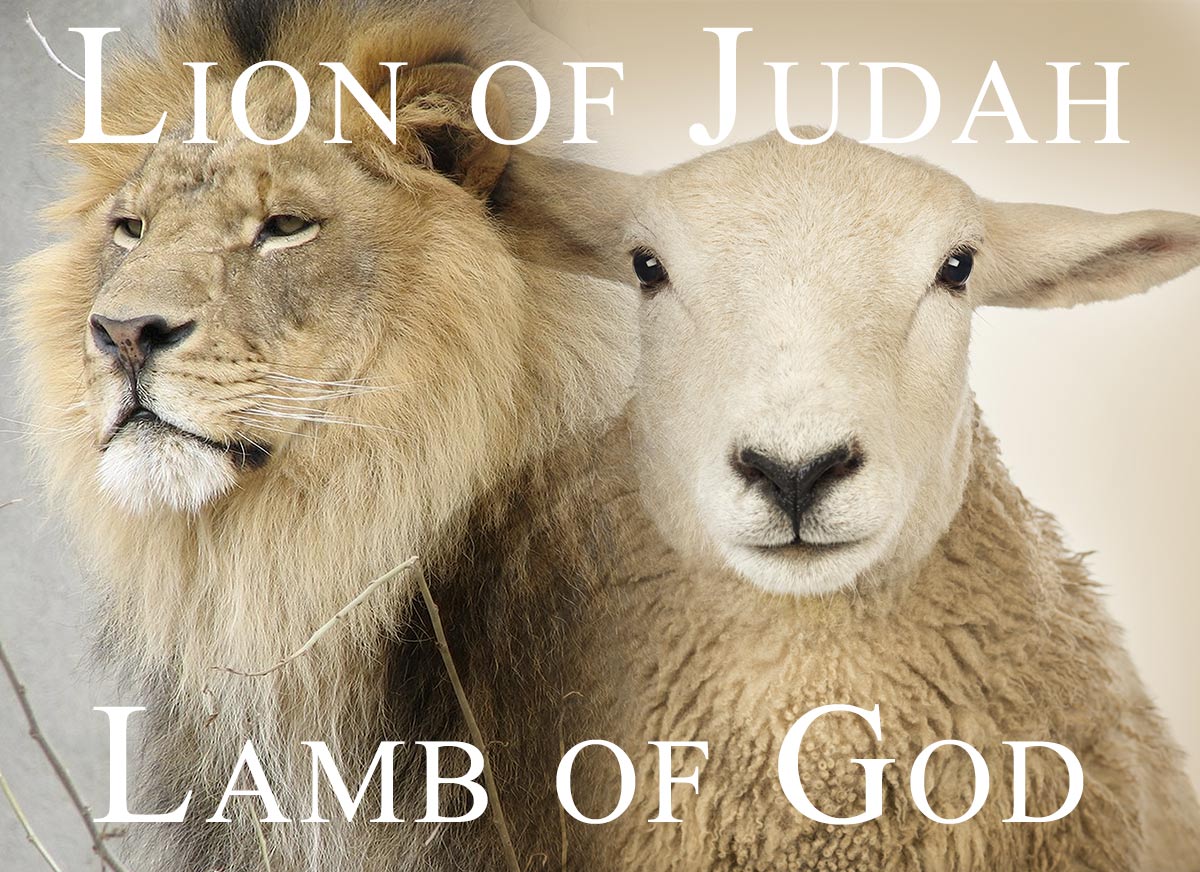
I Prefigured John the Baptist saw Jesus coming toward him and said, “Behold, the Lamb of God, who takes away the sin of the world.” Unless you know the history of this moment, it seems a little odd.

But for those who know Scripture, it is clear that John is really answering a question that was asked by Isaac some 1800 years prior to this event. Abraham had received from God a strange and terrible command: that he take his son to Mt. Moriah (present day Jerusalem) and there offer him in sacrifice.

And Abraham took the wood of the burnt offering, and laid it on Isaac his son; and he took in his hand the fire and the knife. So they went both of them together. And Isaac said to his father Abraham, “My father!” And he said, “Here am I, my son.” He said, “Behold, the fire and the wood; but where is the lamb for a burnt offering?” Abraham said, “God will provide himself the lamb for a burnt offering, my son.” So they went both of them together (Gen 22:6ff).

Do you get it? A promised son had wood laid upon his shoulder and was made to carry it up a hillside, the same hillside where Golgotha would one day be found. There, on the top of that hill he was to be laid on the wood and killed. Sound familiar? Of course Isaac is a prefigurement of Christ. Things were starting to look grim for Isaac, who got nervous and asked his father, “Where is the Lamb?” You know the rest of the story. It is true that God provided a ram caught in the thicket that day, but that ram pointed to Christ.

And so the question “Where is the Lamb?” wafted up on the breeze and was repeated down through the generations. Some five hundred years later, at the end of the period of slavery in Egypt, the blood of the lamb also protected Isaac’s descendants from death. Every Passover the question was still asked, “Where is the Lamb?” referring to the Passover lamb. Here, too, the Passover lamb was but a symbol, a prefigurement of Christ.

Now, standing on the banks of the Jordan, John the Baptist answers Isaac’s question, the question repeated down through the centuries: “Where is the Lamb?” John answers, “Behold the Lamb of God.” So the first thing we learn of Christ is that He was prefigured, here and in many other places in the Old Testament.

II Preexistent He is the one of whom I said, “A man is coming after me who ranks ahead of me because he existed before me.” Now this, too, is a strange thing for a man to say about his younger cousin. Jesus was born six months after John the Baptist, yet John says that Jesus existed before him. John is clearly teaching us here of Christ’s pre-existence. Before assuming a human nature, Jesus existed eternally with the Father.

There never was a time when Jesus the Son was not. He is eternally begotten by the Father; He existed before all ages. Scripture says the following of Him:

  • For in him all things were created, in heaven and on earth, visible and invisible, whether thrones or dominions or principalities or authorities—all things were created through him and for him. He is before all things, and in him all things hold together (Col 1:16).
  • In the beginning was the Word, and the Word was with God, and the Word was God. He was in the beginning with God; all things were made through him, and without him was not anything made that was made (John 1:1).
  • Your father Abraham rejoiced that he was to see my day; he saw it and was glad. The Jews then said to him, “You are not yet fifty years old, and you have seen Abraham?” Jesus said to them, “Truly, truly, I say to you, before Abraham was, I am” (John 8:56).

III. Preeminent I did not know him, but the reason why I came baptizing with water was that he might be made known to Israel. In effect, John is saying, “I exist for Him. My purpose is to reveal Him.” He must increase, but I must decrease (John 3:30). Jesus is greater than John or any prophet or world leader. Jesus is the Groom; John is but the best man.

IV Powerful John testified further, saying, “I saw the Spirit come down like a dove from heaven and remain upon him. I did not know him, but the one who sent me to baptize with water told me, ‘On whomever you see the Spirit come down and remain, he is the one who will baptize with the Holy Spirit.’”

The baptism of John could only announce repentance and call for it. It could not truly wash away sins; the Baptism of Jesus can.

Even more, not only does Jesus’ Baptism take away sins; it confers the Holy Spirit. In Baptism, we are given a whole new life. Sin is taken away and in its place grace upon grace is given: grace to restore us, renew us, and refashion us; grace that equips, empowers, and enables us; grace that sanctifies, gives sonship, and seals us with the Holy Spirit.

All this is in fulfillment of this passage from Ezekeiel:

I will sprinkle clean water upon you, and you shall be clean from all your uncleannesses, and from all your idols I will cleanse you. A new heart I will give you, and a new spirit I will put within you; and I will take out of your flesh the heart of stone and give you a heart of flesh. And I will put my spirit within you, and cause you to walk in my statutes and be careful to observe my ordinances (Ezekiel 36:25ff).

Scripture also says, But to all who received him, who believed in his name, he gave power to become the children of God (Jn 1:12).

V. Presence of God Now I have seen and testified that he is the Son of God. Jesus would say elsewhere, To see me is to have seen the Father; the Father and I are one (John 14:9). As the Son of God, He manifests the Father; He is the presence of God in this world. He shares fully in the one divine essence and as Son, shows us the Father. He is the presence of God among us.

So a brief passage from the Gospel of John contains five important teachings about Jesus Christ. He has existed forever. He was prefigured in the Old Testament. He has priority above and beyond anyone we know or think important. He has the power not only to save us from sin but to give us the very life of God. And as Son of God, He is God, and thus is God’s very presence among us. Jesus is not just the man from Galilee; He is very God from Heaven.
 

Basics of Christian Anthropology (part 1 of 2)

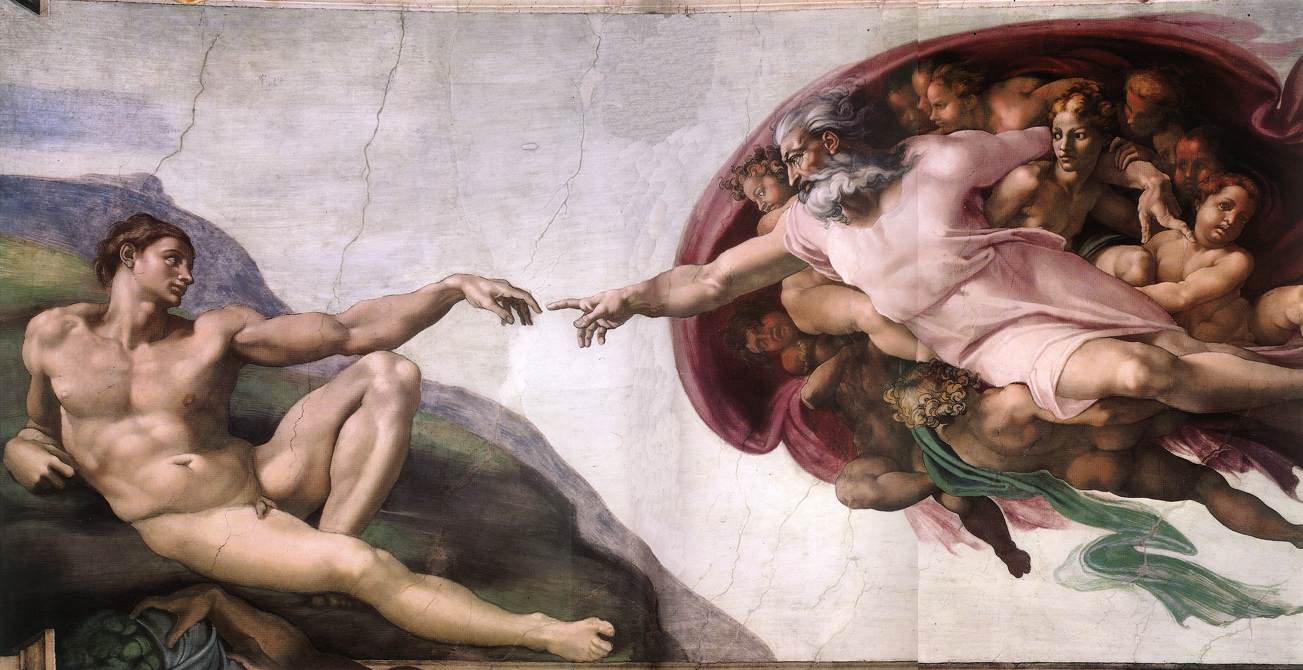
Creation of Adam – Michelangelo Buonarroti (1510)

Anthropology is, most simply, the science or study of human beings through time and space. Different specialties focus on the analysis of biological/physiological characteristics and the examination of societies/cultures. In the religious sense, anthropology deals with the origin, nature, and destiny of human beings.

In our times there are many moral issues emerging from viewpoints that diverge widely from our given nature, both physical and spiritual. Numerous false notions (e.g., “transgenderism”) have arisen that either disregard or even deny physical data. Other errors involve ignoring the clear evidence of humans’ spiritual nature, which so distinguishes us from animals.

A Christian/biblical anthropology, however, sees the created order—and the human body in particular—as revelatory. The body is not just accidentally or incidentally present. No, the body is a revelation because through it, God speaks to us of who and what we are and what we ought to do. To this revelatory quality of the body God adds His own words in Scripture, leading to the emergence of a Christian anthropology.

In this essay I would like to review certain aspects of this Christian anthropology. This is by no means a complete or systematic treatise. Rather, it touches on certain key points that address modern errors. The order of these observations is not a perfect progression, but I have tried to progress from basic to more complex points.

We are the union of a body and a spiritual soul.

We are not merely our body nor are we merely our soul. We are the union of the two. Gnostic and dualistic anthropologies seek to divide body and soul or to indicate that a person is only his body or only his soul. Although we can distinguish body and soul intellectually, in reality they are so together as to be one. It is much like the flame from a candle. Although one can distinguish the light of the flame from its heat, one cannot put the heat over here and the light over there. They are so together as to be one. It is like this with our body and soul.

What is the soul?

On one level the soul is the animating principle of any living thing. Hence, even plants and animals have souls. The soul is related to the mysterious principle we call life. Although we casually use words like “life,” “death,” “living,” and “dead,” life is a mysterious reality. Imagine that in one hand I hold and acorn and in the other a stone. From a great distance they may even look alike. However, the acorn has the mysterious spark we call life while the stone does not. If I plant each in the ground and water the area, the acorn responds: first a shoot emerges and eventually a mighty oak tree. In contrast, the rock will do nothing no matter how long I wait; it does not have the mysterious spark called life. Neither does it have the animating principle we call the soul.

If the mysterious quality called life is taken away, the plant, animal, or human “dies.” Because the life that organized him/her/it is gone, the body or what is left falls into disorganization and decay. The force we call “life” and what we call the “soul,” are deeply mysterious.

What makes the human soul unique?

The human soul is different from that of animals and/or plants in that it is a spiritual soul. Scripture says of man, In the image of God He created them (Gen 1:27). It also says, Then the LORD God formed man from the dust of the ground and breathed the breath of life into [Adam’s] nostrils, and the man became a living being (Gen 2:7). To no other creatures are such attributions made. To say that we have a spiritual soul, that we have the breath of God within us and are made in His image, is to say that we have intellect and free will. It is our dignity to unite two orders of creation, the material and the spiritual, in our one person. Angels are pure spirit. Animals, though possessed of a soul (an animating principle), have no spirit and are thus material. Humans, however, unite the spiritual and the material. This is our glory and it is the central reason why our body will rise one day, gloriously transformed, and be restored to our spirit.

Sadly, there is a tendency today to equate humans with animals. Some say that humans are merely smart apes and that there are other creatures (e.g., dolphins) just as intelligent as we are. This is demonstrably false. You will know something by its fruits; you can see a cause by its effects. Humans are vastly different from all the other animals, even the highest primates, and this is evident in the effects we produce. While our bodies resemble other animals (especially mammals) in many ways, the similarity ends there. If the animals are just like us, where are their cities and farms? Where are their universities, libraries, and museums? Where is their art, their literature? Where are their legislatures where they pass laws or their courts where they hold one another accountable? Have they traveled to the moon and back? Have they learned and then handed on their knowledge to later generations? Where is their technological progress—or any progress at all, for that matter? Why are animals really no different than they were thousands of years ago?

Clearly there is a vast difference between human beings and other animals. This can be seen in the way we live and what we do, and in what they do not do.

Morally speaking, reducing humans to the state of animals not only robs us of our dignity but also our freedom, because it says that we are merely at the whim of instinct.

A common error today regarding the unity of body and spiritual soul is claiming that one is not one’s body but rather only one’s thoughts and feelings.

This is common among proponents of transgender and/or homosexual ideology. A certain man might say, “I am actually a woman.” A normally observant person would likely retort, “No, your body indicates that you are a man.” Yet, in transgender ideology, that observation is dismissed by saying, in effect, “I am not my body. My body has nothing to do with what or who I really am. I am my thoughts and feelings.” This amounts to a denial that our bodies are revelatory.

In homosexual ideology a similar error is encountered. A biological assessment makes it clear that the male and female reproductive organs are designed for each other. Further, an exit is not an entrance. Here, too, they dismiss the body as being of no relevance. This is pure Gnostic dualism: the body is of no account; one is only spirit, only thoughts and feelings. In such a world, what matters are intentions and thoughts; what the body teaches or indicates is of little account. This is an error because it dismisses the reality that the body presents to us.

The opposing but equally untrue claim is that one is only one’s body.

This is materialism and it denies the existence of soul. In this view, a person is merely a collection of chemicals and interactions between them. We only do what the chemicals and nerves “tell us” to do. We have no spirit and thus no free will. Because human behavior is said to be merely the result of physical interactions over which we have no control, there is no such thing as right or wrong. The absurdity of such a claim can be illustrated in this way:

Materialist: “You are just matter, a mere bag of chemicals.”

Believer: “I think that is dead wrong and an unfounded claim.”

(The materialist then becomes angry at the believer’s refusal to accept his claim.)

Believer: “Why are you angry? I am just a bag of chemicals and my behavior is just the result of the random firing of synapses. I am only saying and doing what those forces are making me say and do. Hence, I am not a responsible agent and your anger is unfounded.”

Obviously, the notion of right and wrong and of being accountable for our actions only makes sense if we have a spiritual soul that is able to rise above the effects of chemical reactions or nerve impulses.

We come in (only) two kinds.

In the creation of the human person, God says, So God created man in His own image; in the image of God He created him; male and female He created them (Gen 1:27). There are not dozens of different sexes/genders, as some assert. In fact, until recently, the word “gender” was used almost exclusively as a grammatical term (in some languages, nouns, adjectives, verbs, and/or pronouns have a gender) while the word “sex” referred to the classification of organisms as either male or female. (If you doubt me, look in a dictionary that was published any time prior to the last ten years or so.)

Yes, we are either male or female, and it is God who designates this and creates it. Our bodies reveal to us our sex, as designated by God. There is no need for a lengthy study of this matter; it is quite evident from a simple look at the body.

Some object that there are people born with both genitalia or who are ambiguously equipped, but the existence of such abnormalities does not indicate that there is a third (or fourth or more) sex. It does not follow that every anomaly indicates a different kind of human being. For example, some babies are born missing an arm; from this we do not conclude that there are two different sorts of human beings, those with two arms and those with one.

Therefore, given God’s teaching that we are either male or female, any acceptance of “transgender” ideology is inimical to Christian anthropology. It rejects what God has revealed to us in our bodies and what He teaches us in His written word. We must refute claims that there are more than two sexes/genders and insist that people accept the reality of what God has done. There is no such thing as a female “trapped in a male body” or vice versa. Neither can one “transition” so as to “be” the opposite sex. No matter how many surgeries one endures or how many hormones one takes, no matter what sort of clothing one wears, one’s sex cannot be changed. It is written in every cell of the body. One does not simply declare one’s sex nor can one change it. No, each person must humbly accept his or her sex from God, who is Creator and Lord.

In tomorrow’s post we will look at some other principles of Christian anthropology and relate them to errors of our day.

Cross-posted at the Catholic Standard: Basics of Christian Anthropology (part 1 of 2)

Welcome to “Ordinary Time”

Welcome to the wearing of the green, green vestments that is. The weeks of the year outside of seasons such as Advent, Christmas, Lent, and Easter are termed “ordinary time.” It’s a rather dull-sounding description, isn’t it? “Ordinary” time, hmm …

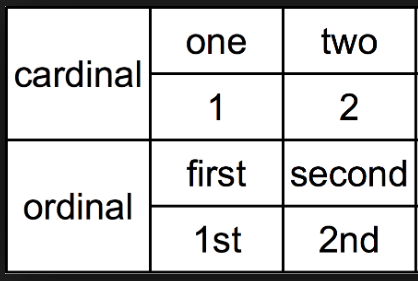
But in this case, the word “ordinary” does not refer to its typical meaning: “common, usual, or unremarkable.” Instead, it comes from the English word “ordinal” meaning “relating to a thing’s position in a series.” Some examples of ordinal numbers are “first,” “second,” and “third.” Thus ordinary time refers to weeks/Sundays that are numbered (e.g., 15th Week/Sunday in Ordinary Time).

The Latin description for this time is Tempus per annum (time through the year). Each week is merely designated as “Hebdomada # x” (Week # x).

These terms or titles seem somewhat uninspiring. This is especially the case when we consider that the old calendar (replaced in 1970, but still used in the Extraordinary Form of the Mass) numbered these Sundays and weeks in reference to Epiphany or Pentecost (e.g., Third Sunday after Epiphany, or Fourth Sunday after Pentecost). The pivotal events of Epiphany and Pentecost therefore set the tone for the following weeks e.g., “This is Third Sunday since our Lord was manifested to us,” or “This is the Fourth week since the Holy Spirit was granted to us for our mission.”

Alas, we are not likely to see the current calendar replaced any time soon, so welcome to Ordinary Time, and more specifically to the First Week of the Year!

But maybe there is some inspiration here after all. The faith is not just something reserved for extraordinary moments and seasons. It is meant to be lived in all the ordinary moments of life, too; it is meant to be lived throughout the year.

The liturgical readings and prayers of Ordinary Time emphasize discipleship. What does it mean to be a disciple of Jesus in matters involving money, time, priorities, etc.? How do we encounter the Kingdom of God and perceive it in our daily lives? What are the conditions of discipleship? How will we ultimately be judged? These are some of the themes of Ordinary Time.

So encounter God in the “ordinary,” in the time throughout the year, even when on vacation this coming summer. There is no vacation from our vocation. Do not miss what God is doing, even in the ordinary.

The Journey of Faith – A Homily for Epiphany

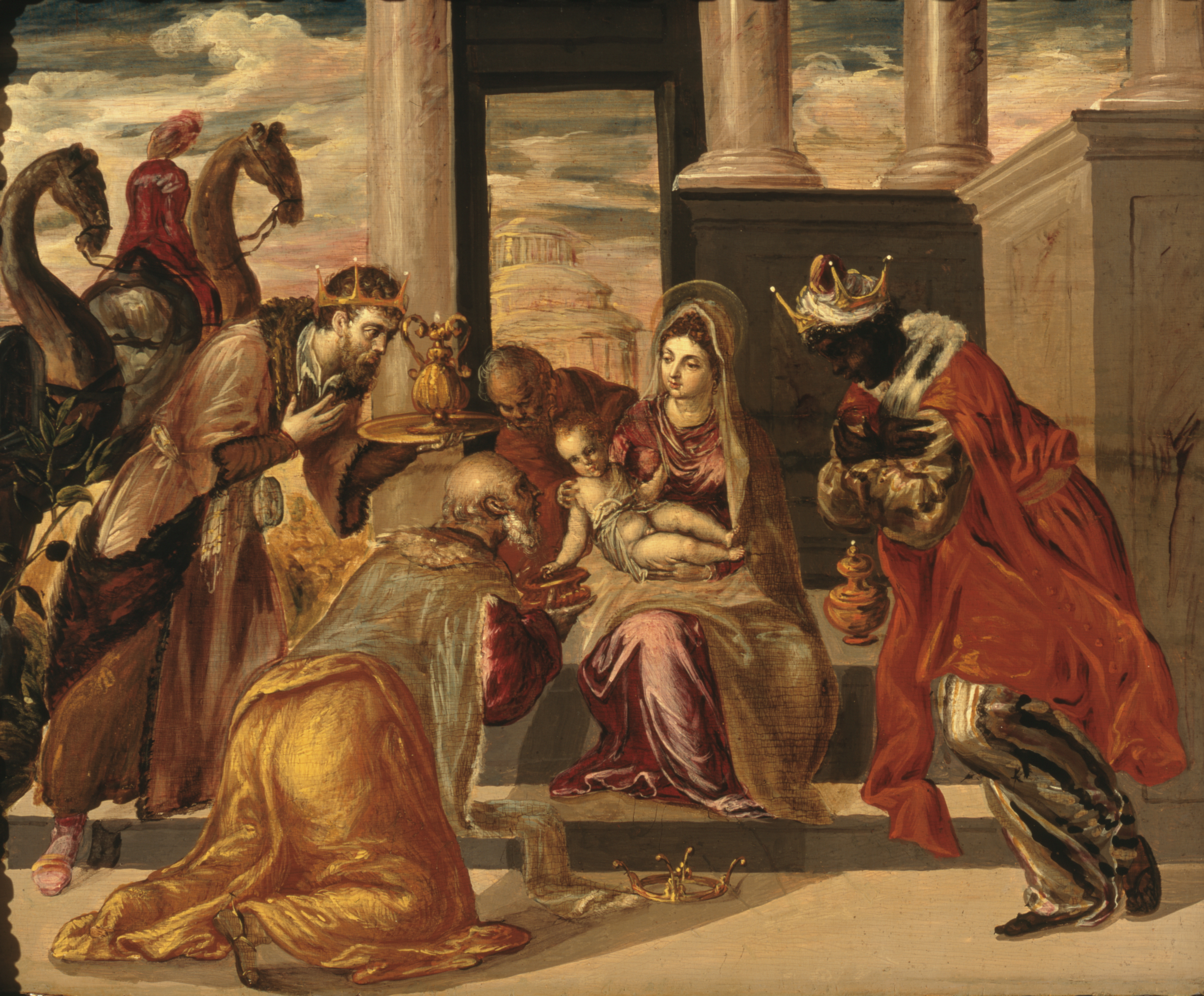
There are so many wonderful details in the Epiphany story: the call of the Gentiles, their enthusiastic response, the significance of the star they seek, the gifts they bring, the dramatic interaction with Herod, and their ultimate rejection of Herod in favor of Christ.

In this meditation, I would like to follow these Magi in their journey of faith to become “Wise Men.” As magi, they followed the faint stars, distant points of light; as wise men, they follow Jesus, who is the ever-glorious Light from Light, true God from true God.

We can observe how they journey in stages from the light of a star to the bright and glorious Light of Jesus Christ. And, of course, to authentically encounter the Lord is to experience conversion. All the elements of this story ultimately serve to cause them to “return to their country by another route.” Let’s look at the stages of their journey from being mere magi to becoming, by God’s grace, wise men.

Stage 1: The CALL that COMPLETES – The text says, When Jesus was born in Bethlehem of Judea, in the days of King Herod, behold, magi from the east arrived in Jerusalem, saying, “Where is the newborn king of the Jews? We saw his star at its rising and have come to do him homage.”

Notice the identity of these individuals: they are labeled magi (μάγοι (magoi) in Greek) and are from the East.

Exactly what “magi” are is not clear. Perhaps they are learned men; perhaps they are ancient astronomers. We often think of them as kings, though the text of this passage does not call them that. It also seems likely that Herod would have been far more anxious had they been actual potentates from an Eastern kingdom. We often think of them as kings because Psalm 72 (read in today’s Mass) speaks of kings coming from the East bearing gifts of gold and frankincense. However, for the record, the text in today’s Gospel does not call them kings, but rather “magi.”

Yet here is their key identity: they are Gentiles who have been called. Up until this point in the Christmas story, only Jews had found their way to Bethlehem. This detail cannot be overlooked, for it is clear that the Gospel is going out to all the world. This call completes the Church, which needs both Jews and Gentiles.

In today’s second reading, St. Paul rejoices in this fact, saying, the Gentiles are coheirs, members of the same body, and co-partners in the promise in Christ Jesus through the gospel (Eph 3:6). Because most of us are not Jewish by ancestry we ought to rejoice, for the call of these Magi prefigures our call.

Notice that God calls them through something in the natural world: a star. God uses something in creation to call out to them.

We do well to wonder what is the “star” that God uses to call each of us? Perhaps it is Scripture, but more typically God uses someone in our life in order to reach us: a parent, a family member, a friend, a priest, a religious sister, or a devoted lay person. Who are the stars in your life through whom God called you?

God can also use inanimate creation, as he did for these Magi. Perhaps it was a magnificent church, or a beautiful painting, or an inspirational song that reached you. Through something or someone, God calls each of us; He puts a star in our sky. These Wise Men, these Magi, followed the call of God and began their journey to Jesus.

Stage 2: The CONSTANCY that CONQUERS – Upon arriving in Jerusalem, the Magi find a rather confusing and perhaps discouraging situation. The reigning king, Herod, knows nothing of the birth of this new King. The Magi likely assumed that the newborn King would be related to the current king, so Herod’s surprise may have confused them. And Herod seems more than surprised; he seems threatened and agitated.

Even more puzzling, Herod calls in religious leaders to get further information about this new King. They open the sacred writings and the Magi hear of a promised King. Ah, so the birth of this King has religious significance! How interesting!

But these religious leaders seem unenthusiastic about the newborn King, and after providing the location of His birth, make no effort to follow the Magi. There is no rejoicing, no summoning of the people to tell them that a longed-for King has finally been born, not even further inquiry!

So the wicked (Herod and his court) are wakeful while the saints are sleepy. How odd this must have seemed to the Magi! Perhaps they even thought about abandoning their search. After all, the actual king knew nothing of this new King’s birth, and those people who did know about it seemed rather uninterested.

Ah, but praise the Lord, they persevered in their search; they did not give up!

Thanks be to God, too, that many today have found their way to Christ despite the fact that parents, clergy, and others who should have led them to Jesus were either asleep, ignorant, or just plain lazy. I am often amazed at some of the conversion stories I have heard: people who found their way to Christ and His Church despite some pretty daunting obstacles (e.g., poor religious upbringing, scandalous clergy, and poor role models). God sometimes allows our faith and call to be tested, but Those who persevere to the end will be saved (Matt 24:13).

To persevere is to open the door to wisdom, which often must be sought in spite of obstacles. This constancy is often what it takes to overcome the darkness and discouragements of the world.

Stage 3: The CONDESCENSION that CONFESSES – The text says, After their audience with the king they set out. And behold, the star that they had seen at its rising preceded them, until it came and stopped over the place where the child was. They were overjoyed at seeing the star, and on entering the house they saw the child with Mary his mother. They prostrated themselves and did him homage.

With what little information they have, the Magi set out and continue to follow the call of God through the star.

Note that they enter a “house.” We often think of the Magi as coming that same Christmas night to the cave or stable, but it seems not; Mary, Joseph, and Jesus are now in a house. Apparently they have been able to find decent lodging. Has it been days or weeks since Jesus’ birth? Regardless, it is likely not Christmas Day itself.

Notice, too, that they “prostrate” themselves before Jesus. The Greek word used is προσεκύνησαν (prosekunēsan), which means “to fall down in worship” or “to give adoration.” This word is used twelve times in the New Testament and each time it is clear that religious worship is the reason for the prostration.

This is no minor act of homage or sign of respect to an earthly king; this is religious worship. It is a confession of faith. The Magi manifest faith! The beginning of wisdom is the fear of the Lord. And these Magi are well on their way from being mere magi to being wise men!

But is their faith a real faith or just a perfunctory observance? It is not enough to answer an altar call or to get baptized. Faith is never alone; it is a transformative relationship with Jesus Christ. So let’s look for the effects of a real and saving faith.

Stage 4: The COST that COMES – There is a cost to discipleship. The Magi are moved to give three symbolic gifts that show some of what true faith includes. They are costly gifts.

Gold symbolizes all of our possessions. In laying this gift before Jesus, they and we are saying, “I acknowledge that everything I have is yours. I put all my resources and wealth under your authority and will use them only according to your will.” A conversion that has not reached the wallet is not complete.

Frankincense is a resin used in incense and symbolizes the gift of worship. In the Bible, incense is a symbol of prayer and worship (e.g., Psalm 141). In laying down this gift, we promise to pray and worship God all the days of our life, to be in His holy house each Sunday, to render Him the praise and worship He is due, to listen to His word and consent to be fed the Eucharist by Him, to worship Him worthily by frequent confession, and to praise Him at all times.

Myrrh is a strange gift for an infant; it is usually understood as a burial ointment. Surely this prefigures Jesus’ death, but it also symbolizes our own. In laying this gift before Jesus we are saying, “My life is yours. I want to die so that you may live your life in me. May you increase and may I decrease. Use me and my life as you will.”

Yes, these three gifts are highly symbolic.

The Magi manifest more than a little homage to Jesus. They are showing forth the fruits of saving faith. And if we can give these gifts, so are we.

In their holy reverence for God is wisdom in its initial stage!

Stage 5: The CONVERSION that is CLEAR – The text says, And having been warned in a dream not to return to Herod, they departed for their country by another way.

Here, then, is essential evidence for faith: conversion. It is not enough to get “happy” in Church; we have to obey. These Wise Men are walking differently now. They are not going home by the same way they came. They’ve changed direction; they’ve turned around (conversio). They are now willing to walk the straight and narrow path that leads to life rather than the wide road that leads to damnation. They are going to obey Christ. They are going to exhibit what St. Paul calls the “obedience of faith” (Rom 1:5; 16:26). They have not just engaged in perfunctory worship; they are showing signs of a true and saving faith. They are not just calling out to Jesus, “Lord, Lord!” They are doing what He tells them (cf Luke 6:46).

No longer mere magi, they are now wise men!

So there it is. Through careful stages, the Lord has brought the Gentiles (this means you and me) to conversion. He called these Magi to wisdom. They remained constant, confessed Him to be Lord, accepted the cost of discipleship, and manifested conversion. Have you? Have I?

Walk in the ways of these Wise Men! Wise men still seek Him; even wiser ones listen to and obey Him. Are we willing to go back to our country by another route? Is ongoing conversion part of our journey home to Heaven? Epiphany means “manifestation.” How is our faith made manifest in our deeds and conversion?

I have it on the best of authority that as the (now) Wise Men went home by another route, they were singing this gospel song:

It’s a highway to heaven!
None can walk up there
but the pure in heart.
I am walking up the King’s highway.
If you’re not walking,
start while I’m talking.
There’ll be a blessing
you’ll be possessing,
walking up the King’s highway.

Hail Mary Full of Grace, Punch the Devil in the Face: A Meditation on Spiritual Warfare

Some years ago I wrote a blog post, Is the Church a Cruise Ship or a Battleship? I was surprised at the amount of negative commentary I got. For example, “How dare you compare the Church to an instrument of war!” Other comments lamented recourse to any violent imagery, ever. Still others called for bans on songs such as “Onward Christian Soldiers,” “I am On the Battlefield for My Lord,” and so forth. You might say that the response from the anti-military group was “militant.” I certainly wasn’t feelin’ the love! Most of those comments I didn’t publish because I didn’t want “war” to erupt in the combox.

Of course the reference to a battleship was by way of analogy, not literal. No one is insisting that the Church should actually use sixteen inch guns against unbelievers or purveyors of sin. The battle is a spiritual one requiring spiritual weapons. This is why we call it spiritual warfare!

It is important in our times that we recover some sophistication when it comes to language and how people use it. Analogies, similes, metaphors and the like are not to be interpreted in a crudely literalistic way. Deadpan literalism usually shows a lack of sophistication and maturity needed to engage others in a real conversation about what is actually being said. It usually rejects the possibility of analogy or hyperbole and assumes bad will on the part of one’s interlocutor, looking to take offense when none is intended.

Earlier this year an article in The Atlantic made such laments and actually expressed fears of growing violence that might come from “traditional” Catholics with all their talk of “war,” and so forth.  The author claimed that the rosary was an example of  “extremist gun culture” among traditional (he calls them “rad-trad”) Catholics.   Of course the article and the author exhibited just the kind of unsophisticated deadpan literalism mentioned above and thereby exhibited a gravely deficient understanding of an ancient Catholic tradition and instinct that we call spiritual warfare. I wonder if he even talked to an actual traditional Catholic, or was he just looking for trouble? Further, how many mass shooters or violent gang shooters march under Catholic banners? None.

But as noted above, many inside the Church as well misunderstand the battle language of spiritual warfare and, as a result, are either offended or fearful about the metaphorical language used by the faithful. But this should invite investigation rather than quick rejection.

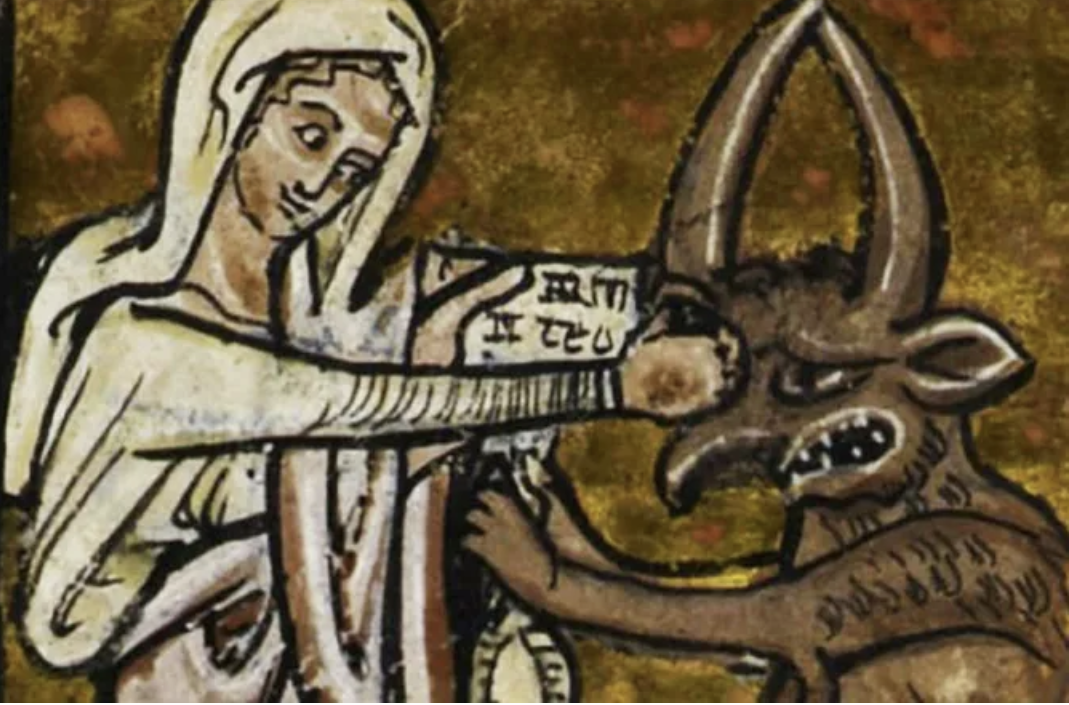
To all the hand-wringing associated with “violent imagery” I can only say, “Hail Mary, full of grace, punch the devil in the face.” In other words I don’t think apologies and changes are due when some take offense at metaphorical language the Church has used for the whole of her existence. The picture above of Mary punching the devil in the face is from the 13th Century. But the tradition of Mary and Jesus at war with the Devil is even older than that. If the use of violent imagery in the spiritual warfare against Satan and the kingdom of darkness is such a terrible thing, then God Himself never got the memo. God said in Genesis 3:15  And I will put enmity between you and the woman, and between your seed and her seed. He will crush your head while you will strike his heel. Gadzooks! Such violence!

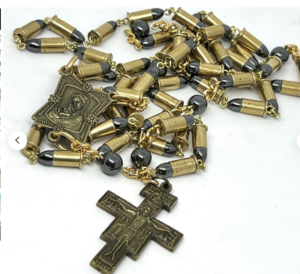
In this vein, I have recently attracted some negative attention by referring in sermons and writings of the rosary as a “fifty-round clip” to fire at the devil. Again, most people “get it,” while a small but vocal minority object to such violent imagery. I upped the ante with my recent purchase of a “bullet rosary” (see photo at left). Such a image has sparked both whimsical understanding and instant outrage among those who have seen it. One woman protested that, with all the violent shootings and killing in our land, such a rosary is reprehensible. But this weapon, and these bullets are directed against Satan. Real bullets cannot harm Satan since he has no body. But the spiritual bullets of rosary prayers, other prayers, fasting, obedience  and so forth can inflict real harm on the kingdom of darkness. These are the practices  at the heart of spiritual warfare. The message of a “bullet rosary” is that unless we are willing to wage spiritual warfare we get physical warfare. Our Lady at Fatima said “Pray the rosary every day to bring peace to the world and the end of the war.” (1st Apparition May 13, 1917) 

The Rosary is the chief weapon of our times. To exasperated souls who lament the moral condition of this world comes the answer: “Pray the Rosary.” What are you waiting for? Take up your weapon and wage war against Satan. If we will not wage spiritual warfare what we will get is physical warfare: real bullets, tanks, planes bombs and all the death toll.

To those who still fret at the warlike imagery, I can only say, Sorry, but we are at war whether you like it or not. Satan wages war against the faithful and you’d better take up your weapons too. This war waged against us by Satan is responsible for most of the casualties you see lying about you: those addicted, those who die from hatred, racism and physical violence, the sexually confused, victims of the sexual revolution, those destroyed by drinking and overeating, those lost in greed, and those lost in confusion so deep they cannot even distinguish a man from a woman.  Yes, we are at war and the victims lie all about us. And if we will not choose sides and do battle, we are not just useless, we are on the other side.

Those who want to “sit on the fence” forget that Satan owns the fence. There are only two armies on the field. Tertium non datur (no third way is given).

Take up your beads, your fifty-round clip and start shooting. Blessed be the LORD, my Rock, who trains my hands for war, my fingers for battle! (Psalm 144:1) The Church is not a clubhouse, she is a lighthouse meant to conquer the darkness. She is not a cruise ship, she is a battleship sent to despoil Satan by shooting rounds of truth snatching back souls from his lying grasp.

This is war. Fight or be conquered.


Some Brief Thoughts at the Passing of Pope Benedict

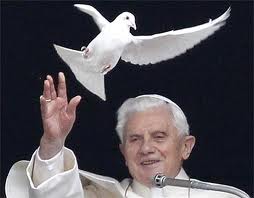
Many wonderful articles have already been published in reference to the death of Pope Emeritus Benedict. I can only affirm much of what I have read as to his scholarship, and the dignity with which he conducted the Office of the Papacy. To have such a renowned theologian as pope makes one think of Pope Gregory the Great who like Pope Benedict would have prefered the quiet of the monastery to the heavy weight of the chair of Peter.

Neither Gregory or Benedict had it easy. Tumultuous waves rocked the barque of Peter during Gregory’s time as the Roman Empire continued to crumble and the Lombards made their steady advance. Pope Benedict XVI endured the storms of the collapsing Western culture, lamenting that the lights were going out in Europe and he warned us of the “dictatorship of relativism” that we now know all too well.

Surely, if the lights were going out in the dying West, the Church must all the more be as a lighthouse in the deepening dark. I was certain that Pope Benedict was just the man the Lord could use. But Pope Benedict also sensed the wolves were near, and asked us to pray that he not flee from them. Sadly, as we know, for reasons of his own, he chose to step aside. I cannot doubt that he thought it best for the Church, but I must still lament the loss of his light in a world sinking into deeper darkness and murky confusion. It is zero-dark thirty for the Western world we once called Christendom.  And we, the Church, called to be the light of the world, are terribly divided and caught in a morass of scandal, ambiguity and confusion.

I can only ask God to receive Pope Benedict XIV into the arms of His mercy and permit his prayers for us to be like a ray of light shining past the barrier of death on a gloomy and storm-tossed world.  Permit my informal cry like a son to his father: “Papa Ratzi pray for us! And we too prayer for your repose, dear and Holy Father.”

Sometimes when you struggle to cry, humor has a role in releasing sorrow and also pent up joy. In that vein, I’d like to include a short video I put together many years ago that celebrated the photogenic quality of Pope Benedict. His face is wonderfully expressive. I hope you might enjoy a one minute diversion down memory lane as a moment too of prayer.

I also put together another video of the Pope as a pilgrim and world traveler set to Johnny Cash’s “I’ve Been Everywhere.” Enjoy a toe tapper of a song with photos showing the Pope’s far flung travels.

This Pope’s Been Everywhere! 


The Rich Tapestry of Faith On New Years Day

The feast day of January 1st is a very complex tapestry, both culturally and liturgically. Perhaps we can use the second reading by St. Paul to the Galatians as a way to weave through some of the many details. We can look at it in three parts.

I. The chronology of our celebration– The text from St. Paul’s letter to the Galatians says, When the fullness of time had come …

Most people are going about today saying, “Happy New Year!” And rightfully so, for it is the beginning of a new year; but most people think of New Year’s Day in almost wholly secular terms. Sadly, it is best known as an occasion for loud parties and excessive drinking.

It is a mistake to view New Year’s Day simply as a secular holiday. In speaking of “the fullness of time,” St. Paul reminds us that all time and all ages belong to God.

It is not simply 2023; it is 2023 Anno Domini (A.D.). Even the most unbelieving of people in the Western world denote their place in time in relation to Jesus Christ. It is 2023 years since the birth of Christ. Every time we write the date on a check or at the top of a letter, every time we see it at the top of the newspaper or on our computer screen, that number, 2023, points back to Christ. He is the Lord of history. Jesus sets the date; He is the clock by which we measure. All time belongs to Him.

Jesus says in the book of Revelation, I am the Alpha and the Omega, the first and the last, The beginning and the end. He who is, and who was, and who is to come (Rev 22:13).

If it is true that 2023 references the birth of Christ, then why is Christmas Day not also New Year’s Day? The fact that it is not actually makes a lot of sense if we understand liturgical and spiritual sensibilities.

In the Church and stretching back into ancient Jewish times, it was customary to celebrate the high feasts of faith over the period of a week. In Christian tradition this came to be known as the “octave.” Although we think of a week as comprising seven days, consider that we celebrated Christmas this past Sunday and now this week we celebrate New Year’s Day on Sunday; Sunday to Sunday, inclusive, is eight days.

Tuesday, January 1, 2023 is the eighth day of Christmas. In the Christian tradition, the octave is considered as one long “day” that lasts for eight days. Therefore, Tuesday, January 1, 2023 completes Christmas day; it is fulfilled. Or, as St. Paul says, the “fullness of time” in terms of Christmas day has come. At the end of this eight-day Christmas day, our calendar flips from 2022 to 2023 A.D.

The rest of the secular world has largely moved on already, barely thinking of Christmas anymore. As I walk in my neighborhood, I see Christmas trees already set out at the curb waiting to be picked up by the recycling trucks. Yes, for many in our hurried world, Christmas is over. We in the Church, however, continue to celebrate the great Christmas feast and cycle. Having completed the octave, we move on to Epiphany week.

This New Year’s Day we contemplate the “fullness of time.” The passage of another year reminds us of the magnificent truth that to God all time—past, present, and future—is equally present. He holds all things together in Himself. He is the same yesterday, today, tomorrow, and forever. Whenever He acts, He acts in our time, out of the fullness of time. This is a very deep mystery and we should ponder in silence the mystery that for God, all things are. He is not waiting for things to happen. For Him, everything is accomplished.

II. The content of our celebration – St. Paul goes on to say, God sent forth his son born of a woman. This statement again reminds that we are still in the Christmas cycle.

While it is New Year’s Day, there is also a complex tapestry of religious meanings to this day as well. It is still Christmas day, the eighth day of the one long day that we call Christmas.

Historically, this is also the day of Christ’s circumcision. For a long period in Church history, today was the feast of “The Circumcision of the Lord.” As I have written previously, I regret the loss of this feast, at least in terms of its title.

Today is the day when Joseph and Mary brought Christ to be circumcised. In this, Jesus as man and as God reverences the covenant He has made with His people. It is a beautiful truth that God seeks relationship with His people. In this covenantal act of the circumcision is the moving truth that Jesus is not ashamed to call us His brothers (Heb 2:11).

There is the first shedding of Jesus’ blood. It is also a sign of His love for us.

This feast day also celebrates the Most Holy Name of Jesus, for not only was a Jewish boy circumcised on the eighth day, but he was also given his name; all heard that name for the first time on that day.

The name Jesus means “God saves.” Indeed, this Most Holy Name of Jesus, when used in reverence, has saving power. We are baptized in His Holy Name along with that of the Father and the Holy Spirit, and all of our prayers conclude with His Holy Name. Scripture says this of His great and holy name:

Therefore, God exalted him to the highest place and gave him the name that is above every name, that at the name of Jesus every knee should bow, in heaven and on earth and under the earth, and every tongue acknowledge that Jesus Christ is Lord, to the glory of God the Father (Phil 2: 9-11).

Yet another meaning of today’s feast day is shown in its current, formal title: “The Solemnity of Mary, Mother of God.” This replaced the title of “The Feast of the Circumcision of the Lord” in 1970. However, it is the most ancient title for this feast day. Again, you may read more on this topic in a previous blog post.

We note in the second reading that St. Paul says that God sent forth his Son, born of a woman. Jesus is the eternal Son of the Father; He is God from God, Light from Light, True God from True God. Jesus is God, and because Mary gave birth to Him, she is the Mother of God because Jesus is not two different persons.

Mary did not just give birth to part of Jesus, she gave birth to Jesus. Thus, the title “Mother of God” speaks to us as much about Jesus as it does about Mary. She has that title because of the Church’s insistence that Jesus cannot be divided up into two different people. We cannot say that Mary gave birth to one Jesus but not to “the other one.” Although He has two natures, human and divine, there is only one Jesus.

Thus, on this feast of Christmas, on this eighth day of Christmas, we are reminded and solemnly taught that Jesus is both human and divine. In taking a human nature to Himself from His mother Mary, He remains one person. God has sent forth his son, born of woman.

III. The consolation of our celebration– St. Paul goes on to say, Born under the law to ransom those under the law so that we might receive adoption as sons. As proof that you are sons, God sent the Spirit of his Son in our hearts crying out Abba, Father! So you are no longer a slave, but a son, and, if a son, also an heir through God. Note three things about this passage:

Our Adoption– We have already noted that on the eighth day Jesus is circumcised and enters into the Covenant, into the Law. In the Incarnation, He joins the human family; in the Covenant, He joins our family of faith. He will fulfill the old Covenant and inaugurate the new one. By this New Covenant, by baptism into Him, we become members of His Body and are thereby adopted as sons.

We become sons in the Son. When God the Father looks at His Son, loving Him, He is also looking at us and loving us, for we are in Christ Jesus, members of His Body through baptism. God is now our Father, not in an allegorical sense, but in a very real sense. We are in Jesus and therefore God really is our Father.

Our Acclamation– St. Paul says that the proof of our sonship is the movement of the Holy Spirit in us that cries out Abba! In Aramaic and Hebrew, Abba is the family term for father. It is not baby talk, like “Dada.” However, just as most adults call their father “Dad” or some other endearment rather than the more formal “Father,” so Abba is used in a similar way. It would be quite a daring thing for us to call God “Dad” unless we were permitted to do so and instructed to do so by Christ.

St. Paul speaks of this word, Abba, as proof that we are sons. In so doing, he emphasizes that it is not merely the saying of the word that he refers to. Even a parrot can be taught to say the word. Rather, St. Paul is referring to what the word represents: an inner movement of the Holy Spirit wherein we experience a deep affection for God the Father. By our adoption, our baptism into Christ, by our reception of the Holy Spirit, we love the Father! We develop a deep affection for Him and dread offending Him. By this gift of the Spirit, God is our Father, whom we deeply love!

Our Advancement– Notice that St. Paul then speaks of how we have moved from being slaves to being sons, heirs. In Jesus, we are not just any son; we are the only Son of the Father. As Jesus has a kingdom from His Father, so do we as we too inherit it with Him. As sons in the Son, we are heirs with Jesus to the Kingdom!  Jesus speaks of His disciples as reigning with Him one day: And I confer on you a kingdom, just as my Father conferred one on me (Lk 22:29). In Jesus, all Heaven will be ours and we will reign with Him forever. This is not our doing, not our glory; it is Christ’s doing and His glory in which we share.

Thus we have a very rich tapestry on this New Year’s Day, this feast of the Octave of Christmas, this Feast of the Circumcision of the Lord, this Feast of the Most Holy Name of Jesus, this Feast of Mary, Mother of God. We are given this feast wherein the glory of Christ is held before us and we who are members of His Body are told of the gifts that we receive by His holy incarnation and His passion, death, and resurrection.

It’s not a bad way to start the new year: being reminded of God’s incredible love for us and of His rich blessings and promises.

On The Feast of the Holy Innocents, A Meditation on the Sins Committed Against Children

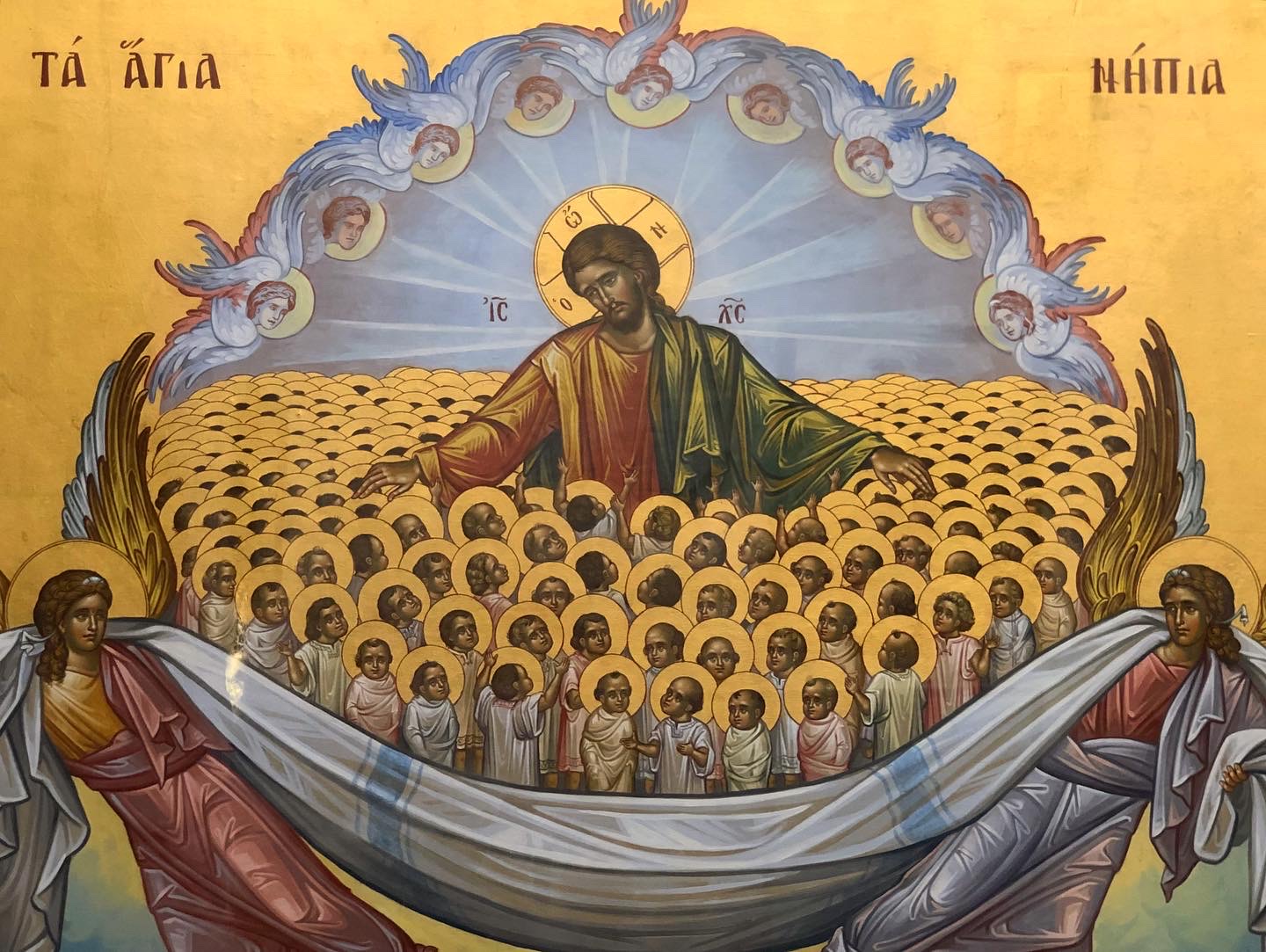
Today, we observe the feast of the Holy Innocents, a feast commemorating the young children, of even younger age who were cruelly murdered by the paranoid and crazed killer known as Herod “the Great.” So paranoid was he that others might usurp or limit his power that he killed three of his own sons, and his wife. He ruthlessly killed many others as well. As his own death drew near, according to Josephus,  Herod decreed that in order that the nation properly mourn his death, one member of each family should be killed in his honor, and thus the mourning in all Israel for him would be sincere. His last and final act as King was to rise from his death bed and sentence to death a group of Jewish zealots who had removed an Eagle he place over the entrance of the temple. They had thought the image a desecration. Having killed them, he himself died (in bed) the next day.

Herod was a cruel tyrant and a ruthless and paranoid killer. Calling him “the Great” can only be a reference to his skill in architecture and building and to his headship of the equally cruel Herodian dynasty.

Yet here Christ was born and found, in the midst of crisis and disaster. More than ever, the Christmas message is relevant. For despite our cruelty and despite the crises of this world, Christ is still to be found. He was born in one of the most crisis-torn regions of the world. He bids us to find him in just these sorts of places and times, as if to say, there is still hope: The mercies of the Lord are not exhausted, his compassion is not spent; it is renewed each morning (Lam 3:22-23).

That he was willing to be born in such circumstances is clear, and from this we see his mercy.

But  from our perspective he should not have to have been born like this. And thus our call to repentance remains. This crisis at Christmas was our human doing, our insensitivity. As Scripture says, He came unto his own, and his own received him not (Jn 1:11). That’s us the scriptures are talking about, No room in the inn.

And while Herod may be said to have acted alone, we cannot evade all responsibility, for to some extent we all participate in making and maintaining a cruel world where such ignominies routinely happen.

Children have much to suffer in this world of our collective making. And while not all of us are equally guilty of contributing to the suffering of children, none of us are wholly innocent either, if for no other reason than our silence.

      • Our culture has sinned against children by sexualizing them, robbing them of their innocence at an earlier and earlier age, and exposing them to all sorts of indoctrination and experimentation in schools. The most recent horrors center on exposing even kindergarteners to confusing sexual messages and practices related to transgenderism, homosexuality, “drag-queen story hours” and many other practices that desensitize and groom little children in sexual matters about which they need not know so far before puberty. We used to have a discretion about this; we used to protect little children from sexual matters, rightly concluding that they were too young to understand and that such matters could trouble and confuse them. Adults speaking to little children about these matters used to be considered a grave and even criminal violation.  What is wrong with so many today? And how is it legal for doctors to administer puberty blocking drugs and even perform mastectomies and genital mutilations on minors (with or without parental permission)?  Imagine the health complications in stopping puberty, a natural and essential stage of growth! How can a minor make such life-altering and often permanent decisions?  It is a sin against these children to incite sexual confusion, indulge it and even cooperate in dangerous hormonal and surgical interventions in service of a lie that one can alter their sex. All this used to be obvious to us until about five minutes ago in our culture. 

      • Next, consider that most children born today are no longer born into the lasting family units they deserve with a father and mother committed to one another till death do them part. The problems begin with fornication, which is rampant in our culture. And while most do not think of this as a sin of injustice, it is. It is so because of what it does primarily to children.
      • Many children are also conceived of fornication. Tragically most of these children who are thus conceived are outright killed by abortion. 85% of abortions are performed on unmarried women. And for all the vaunted declarations of how contraception makes every baby a wanted baby, nothing could be further from the truth. Abortion has skyrocketed with the availability of contraception. This is because the problem is not fertility, it is lust, promiscuity, fornication and adultery. And contraception fuels these problems by further enabling them. The promises associated with contraception are lies, it does the opposite of what it promises.
      • So, fornication and the contraceptive mentality (founded on lies) cause grave harm to children, beginning with death, in huge numbers. And the children, conceived of fornication who do (thankfully) survive are, nevertheless subjected to the injustice of usually being born into irregular situations. There are single mothers, some single fathers, and many other irregularities.
      • Add to this picture the large number of divorced families. And make no mistake, these shredded families cause great hardships and pain for children that include: children being shuttled back and forth between different household each week, having to meet “daddy’s new girlfriend” or mommy’s new “live-in boy-friend” and all sorts of other family chaos. Blended families also dramatically increase the likelihood of sexual and emotional abuse, since legal relationships seldom have the built-in protections of natural relationships. To be sure, not all people are divorced in the same way. Some tried to prevent it but their spouse was unwilling, etc. Still the harm caused to children remains.

All of this misbehavior, individual and cultural, harms children. Not being raised in a traditional marriage dramatically increases a child’s likelihood of suffering many other social ills, starting with poverty.

The chief cause of poverty in this country, is the single motherhood, absent fatherhood.
71% of poor families are not married.
Children of single parent homes are 2 times more likely to be arrested for juvenile crime,
2 times more likely be treated for emotional and behavioral problems,
Twice as likely to be suspended or expelled from school,
33% more likely to drop out of school,
3 times more likely to end up in jail by age 30.
50% more likely to live in poverty as adults,
And twice as likely to have a child outside of marriage themselves
. [*]

Not all of us do all these things personally and to the same degree. We should further note that abortion is complex and some women have recourse to it out of despair, others are pressured and so forth. But the point emphasized in this reflection is that all of us do contribute to the sort of culture that is increasingly poisonous and unjust to children if not downright deadly.

If nothing else, too many of (starting with clergy) are far too silent about the sins of injustice committed against children. Many remain quite silent while the bad behaviors adults pile up in our culture. Our silence is largely the product of fearing to offend other adults. Meanwhile children suffer, and the injustices pile higher, beginning with the body count of aborted babies and watered by the tears of surviving children who have had much to suffer.

Something to think about on the feast of the Holy Innocents.

I put the following video together to honor these young martyrs. The musical setting is by Michael Haydn of the hymn for the Feast of the Holy Innocents: Salvete Flores Martyrum The Latin text of this ancient hymn is quite beautiful. I produce here the Latin text followed by a fairly literal translation.

Salvete flores martyrum, – Hail Martyr Flowers
quos lucis ipso in limine – On the very threshold of the dawn (of life)
Christi insecutor sustulit – Christ’s persecutor destroyed (you)
ceu turbo nascentes rosas. – like the whirlwind does the budding roses.

Vos prima Christi victima, – You Christ’s firstfruits
grex immolatorum tener, – A flock of tender sacrificial victims
aram sub ipsam simplices – right up by the very altar
palma et coronis luditis. – now play with your palms and crowns

Iesu, tibi sit gloria, – Jesus to you be glory
qui natus es de Virgine, – who were born of the Virgin
cum Patre et almo Spiritu, – with the Father and loving Spirit
in sempiterna saecula. Amen. – unto to eternal ages. Amen.