St. Paul speaks of the longing of creation to be set free. He almost personifies creation:
For indeed, creation waits in eager expectation for the sons of God to be revealed. For the creation was subjected to frustration, not by its own choice, but by the will of the one who subjected it, in hope that the creation itself will be liberated from its bondage to decay and brought into the glorious freedom of the children of God (Romans 8:19-21).
Yes, creation itself eagerly awaits the day when God will say (in the words of an old spiritual), “Oh, Preacher, fold your Bible, for the last soul’s converted!” Then creation itself will be set free from its bondage to death and decay and will be gloriously remade into its original harmony and the life-possessing glory that was once paradise.
Isaiah takes up a similar theme we often hear in Advent”
The wolf will live with the lamb, the leopard will lie down with the goat, the calf and the lion and the yearling together; and a little child will lead them. The cow will feed with the bear, their young will lie down together, and the lion will eat straw like the ox. The infant will play near the hole of the cobra, and the young child put his hand into the viper’s nest. They will neither harm nor destroy on all my holy mountain, for the earth will be full of the knowledge of the Lord as the waters cover the sea (Isaiah 11:6-9).
Hence, when Christ from His judgment seat shall finally say, “Behold, I make all things new” (Rev 21:5), and when with John we see “a new heavens and a new earth” (Rev 21:1), I have little doubt that animals will share in that recreated and renewed kingdom where death shall be no more (Rev 21:4).
In numerous posts I have raised alarms about the anti-human dimensions of much of the environmentalist and climate change agendas. But none of this should be taken to mean that I don’t love the beautiful works of God’s creation. I love the passages above about how creation is longing and yearning.
Call me a bit sentimental but I have often thought that perhaps, in our interaction with our pets, God is giving us a glimpse of the harmony we will one day enjoy with all creation. Perhaps our pets are ambassadors for the rest of creation, a kind of early delegation sent by God to prepare the way and begin to forge the connections of the new and restored creation. Maybe they are urging us on in our task of making the number of the elect complete so that all creation can sooner receive its renewal and be restored to the glory and harmony it once had. Who knows? But I see a kind of urgency in the pets I have had over the years. They are filled with joy, enthusiasm, and the expectation of something great.
They show joyful expectation! Yes, there was a kind of joyful expectation in the dogs of my youth: running in circles around me, dashing to greet me when I arrived home, and jumping for joy when I announced a car ride or a walk. My cats have always sauntered over to meet me at the door with a meow, an arched back, and a rub up against my leg. Somehow our pets manifest the passage above: creation waits in eager expectation for the sons of God to be revealed (Romans 8:19).
While I realize that we humans often project what we want their behavior to mean, I am still fascinated by the way our pets come to “know” us and set up a kind of communication with us.
Dogs, especially, are very demonstrative, interactive, and able to make knowing responses. Cats are more subtle. My cat, Jewel, knows my patterns. She also knows how to communicate to me that she wants water, food, or just a back rub. She’s a big talker, too, meowing each time I enter the room. Sometimes I wish she could just tell me what she wanted!
Yes, this interaction with our pets is indeed mysterious. I am not suggesting that animals are on a par with humans intellectually or morally; Scripture is unambiguous that animals are given to us by God and that we are sovereign stewards over them. However, animals—especially our pets—are to be appreciated as gifts from Him. Scripture is also clear that animals will be part of the renewed creation that God will bring about when Christ comes again in glory.
They are part of the Kingdom! Without elevating pets (no matter how precious to us) to the full dignity of human beings, it is not wrong to think that they will be part of the Kingdom of God in all its restored harmony and beauty.
One day when Christ comes again, creation, now yearning, will receive the healing for which it longs.
The opening of the Book of Isaiah is provocative, especially for those of us who hold the Liturgy in high esteem, as well we should. However, it is possible for us to distort even great things like the Mass and the sacraments.
Let’s look at the reading and then draw a few teachings from it:
Hear the word of the Lord, princes of Sodom! Listen to the instruction of our God, people of Gomorrah! What care I for the number of your sacrifices? says the Lord. I have had enough of whole-burnt rams and fat of fatlings; in the blood of calves, lambs and goats I find no pleasure. When you come in to visit me, who asks these things of you? Trample my courts no more! Bring no more worthless offerings; your incense is loathsome to me. New moon and sabbath, calling of assemblies, octaves with wickedness: these I cannot bear. Your new moons and festivals I detest; they weigh me down, I tire of the load. When you spread out your hands, I close my eyes to you; Though you pray the more, I will not listen. Your hands are full of blood! Wash yourselves clean! Put away your misdeeds from before my eyes; cease doing evil; learn to do good. Make justice your aim: redress the wronged, hear the orphan’s plea, defend the widow (Is 1:10-19).
Our worship can lack integrity. That which is supposed to glorify God and bring forth in us a holy obedience can become lip service. God seeks hearts that are humble, docile, loving, and repentant. We cannot satisfy Him just by singing a few hymns, saying some prayers, or attending Mass. These things, good though they are, are meant to bring about a conversion in us that makes us more loving of both God and neighbor, less violent, more just, more merciful, more generous, and more holy. Our worship should effect change in us such that we cease doing evil, learn to do good, strive for justice, address injustice, and defend and help the poor, the unborn, the elderly, the dying, and the helpless.
An additional problem with our worship today is that God has become almost an afterthought. Much of our liturgy is self-centered, self-congratulatory, and anthropocentric (rather than theocentric). We are “the aware, gathered community celebrating itself.” While the Mass should focus on God and summon us to humility and joy before Him, too often it seems more an exercise in self-congratulation. We are very narcissistic, even in a communal setting.
God cannot be pleased with all of this. Even if our worship is rightly ordered, we are not going to buy Him off that easily. God wants an obedient heart more than sacrifice. Sacrifice without obedience is a sham.
We need God to restore our integrity and give us a new heart. We are “dis-integrated,” in the sense that pieces of our life that should be together (e.g., worship and obedience, liturgy and healing) are not. Too often our worship does just the opposite of what it should. Instead of drawing us more deeply into the love and obedience of God, it becomes the very occasion of keeping Him at a distance and seeking to placate Him with superficial gestures. This makes our worship a lie and an insult to Him. God doesn’t mince words in the passage above when He says how displeased He is.
We need God to give us a new heart, one that loves Him as well as the people and things that He loves. Only then will our worship will truly reflect the heart that God seeks: a loving, humble, and generous one.
May our worship give us a new heart and deepen our commitment to God and neighbor!
The Second reading today from St. Paul to the Romans speaks to important truths that we should know:
OUR DESTITUTION –Christ, while we were still helpless, yet died at the appointed time for the ungodly…..while we werestill sinners Christ died for us.The full reading calls us: helpless, ungodly, unjust and sinners. This was our condition before Christ. St Paul says elsewhere,“You were dead in your sins” (Eph 2:1). Psalm 14 observed that among the children of men: “they are all alike corrupt; there is none that does good, no, not one.” (Ps 14:2) And Isaiah observes that even “our righteous deeds are like a polluted garment.” (Is 64:4). Do you get it. This was our state before Jesus, and our state apart from him. We had nothing we can bring to either earn salvation or to raise ourselves from moral death. It was only the pure mercy and grace of God that could set us free. It is a pure gift of God.
OUR DELIVERANCE –How much more then, since we are now justified by his blood, will we be saved through him from the wrath. Notice that little word, “now.” Since Christ has come it is now possible for us be delivered. The text says we are “justified.” In St. Paul’s use of this word it is always more than some legal declaration, it is a relational justice. We are justified by baptism into Christ’s death and by being made a member of his Body. We enter into a life-changing transformative relationship with the Lord. The text says that Jesus accomplishes this “by his blood.” Jesus was obedient even unto death on a cross and his shed blood washes away our sins and restores us to the Father. The text adds further that we are saved from the “wrath.” The wrath is our experience of our inability to be in God’s presence in a sinful state. Jesus makes it possible for us endure the heat and light of God’s majesty!
OUR DESTINY-The text says, once reconciled, will we are saved by his life. We are called to life in the sense that Jesus’ life replaces our own. Increasingly through the work of Jesus’ saving grace our life is conformed to his. We begin to love and desire newer and better things; to Love what he loves and who he loves. We see our priorities and thoughts change. Note too that eternal life does not simply refer to the length of life, but to the fullness of life. In Jesus’ life we begin to live more fully, more richly as the days go by. One day in heaven we will experience this fully, but even now, our life begins to change.
Our Declaration –Not only that, but we also boast of God through our Lord Jesus Christ, through whom we have now received reconciliation.Notice that our boast is in what God has done for us. Scripture says elsewhere:This presupposes that we know what God has done for usand are seeing our life changed. Do you notice? Are you excited about what the Lord is doing in your life? Is there a joy and a peace within you? Are you glad to be forgiven and reconciled? Do you have a testimony to give? Do you boast of what God has done for you? Scripture says, Always be prepared to make a defense to any one who calls you to account for the hope that is in you (1 Peter 3:15) Is there a hope in you that others can notice?
Consider the testimony, the declaration of this song:
A common question arising around the time of Trinity Sunday is rooted in this passage from John’s Gospel:
If you loved me, you would be glad that I am going to the Father, for the Father is greater than I (Jn 14:28).
This is somewhat puzzling because we are taught that each Divine Person of the Blessed Trinity fully possesses the nature of God and is equally to be adored and glorified. What, then, did Jesus mean when He said, “the Father is greater than I”?
The most common (and correct) answer is that in this passage Jesus was speaking in reference to His human nature, in which He is inferior to the Father; in His divine nature He is equal to the Father. Many of the Church Fathers spoke in this way. For example,
St Augustine said, Let us acknowledge then the twofold substance of Christ, the divine, which is equal to the Father, and the human, which is inferior. But Christ is both together, not two, but one Christ: else the Godhead is a quaternity, not a Trinity. Wherefore He says, If ye loved Me, ye would rejoice, because I said, I go to the Father; for human nature should exult at being thus taken up by the Only Begotten Word, and made immortal in heaven; at earth being raised to heaven, and dust sitting incorruptible at the right hand of the Father. Who, that loves Christ, will not rejoice at this, seeing, as he doth, his own nature immortal in Christ, and hoping that He Himself will be so by Christ (Quoted in the Catena Aurea at John 14:28).
Didymus the Blind said, When he says “greater” he indicates that his divinity can be equaled to the Father, since he is of the same substance as him, but the Father is greater because the Son accepted a body…The Son’s nature is understood to be less than that of the Father inasmuch as the Son became man (Fragments on John at 14).
Hilary of Poitiers said, By the birth of the Son the Father is constituted greater … in that the Son, born of the Father, after assuming an earthly body, is taken back to the glory of the Father (On the Trinity, 9:56).
Theodoret of Cyr had Jesus speak, saying, Sometimes therefore I, [Jesus] say that I am equal to the Father, and at other times say that the Father is greater than I. I am not contradicting myself, but I am showing that I am God and a human being … If you want to know how the Father is greater than I, I was talking from the flesh, not from the person of the Divinity (Dialogue 1:56).
Thus, the first answer is clear: As God, Jesus is equal to the Father, but as Man, He is inferior to the Father.
In a qualified way, however, it is also possible to speak of a particular greatness of the Father even within the Trinity. While all three persons of the Trinity are co-eternal, co-equal, and equally divine, the Father is the Principium Deitatis (the Source in the Deity). So, although the members of the Trinity are all equal in dignity, there are processions in the Trinity. The Father is the Principium, the Son eternally proceeds from Him and is eternally begotten by Him (Jn 8:42); the Holy Spirit eternally proceeds from the Father and the Son as from one principal (Jn 15:26).
Thus, even from the perspective of His divinity it is possible for Jesus to say, “I delight that the Father is the eternal principal of my being. Even though I have no origin in time, I do eternally proceed from Him.”
The Athanasian Creed says the following regarding these processions:
The Father is made by none, neither created nor begotten. The Son is of the Father alone, neither made nor created, but begotten. The Holy Spirit is of the Father and of the Son, not made, nor created, nor begotten, but he proceeds from them.
St. Thomas Aquinas speaks poetically of the Trinity in the familiar hymn “Tantum Ergo”:
Genitori, Genitoque … Procedenti ab utroque … compar sit laudautio. (To the One Who Begets, and to the Begotten One, and to the One who proceeds from them both, be equal praise.)
So, although the Persons of the Trinity are equal, the processions within the Trinity do have an order. The Father is “greater” in the very qualified sense that He is the Principium Deitatis, the Principal of the Deity, but is co-eternal and equal in dignity to the Son and the Holy Spirit.
Devotionally, Jesus may also be speaking of the Father as greater in the sense that He always does what pleases His Father. Jesus loves His Father; He’s crazy about Him. He is always talking about Him and pointing to Him. By calling the Father “greater,” Jesus says (in effect), “I look to my Father for everything. I do what I see Him doing (Jn 5:19) and what I know pleases Him (Jn 5:30). As God, we share one will; as human, my human will and His will are one. What I will to do proceeds from Him. I do what I know accords with His will.”
There is a kind of tension in some of the imagery we use for God. On the one hand we call Him the “Unmoved Mover.” We also say that God is everywhere. If He is everywhere then there is nowhere for him to go, no need for Him to move because He is already there. Yet we also speak of “processions” in the Trinity.
St. Thomas artfully and with precision speaks of the Trinity and the two “processions” as Gentori Genitoque laus et jubilation … Procedenti abutroque compar sit laudatio (To the One who generates and to the One who is generated be praise and jubilation … To the One proceeding from them both be equal praise).
St. Thomas also points out an important difference between material procession and divine procession:
In material things, what comes forth from another is no longer in it, since it comes from it by a separation from it in essence or in space. But in God, coming forth does not arise in this way. The Son came forth eternally from the Father in such a way that the Son is still in the Father from all eternity. And so, when he is in the Father, he comes forth. And when he comes forth, he is in him, in such a way that he is always coming forth, and always in him (Commentary on John, 16:28).
So, it would seem that the Unmoved Mover, our Triune God, has processions of love within. There is a kind of dynamism of love! Of course, our feeble words fall short and our analogies are weak.
There is a beautiful Greek word used by the Church Fathers (e.g., St. John Damascene) to describe the inner life of the Trinity: perichoresis. It is a combination of two words: peri, meaning “around” and chorein, meaning “to make space.” Therefore perichoresis, literally translated, means “to make space around.” It points to the way in which someone or something makes space around itself for others or for something else.
What a picturesque word! It suggests a kind of swirling or a dance. It is close in its spelling to the Greek word for dance, choreuo, so many people refer to it as the dance of love in the Trinity. Father, Son, and Holy Spirit make room for one another; they “dance” about and “with” one another in a way that shows a mutual indwelling while still maintaining space for each person.
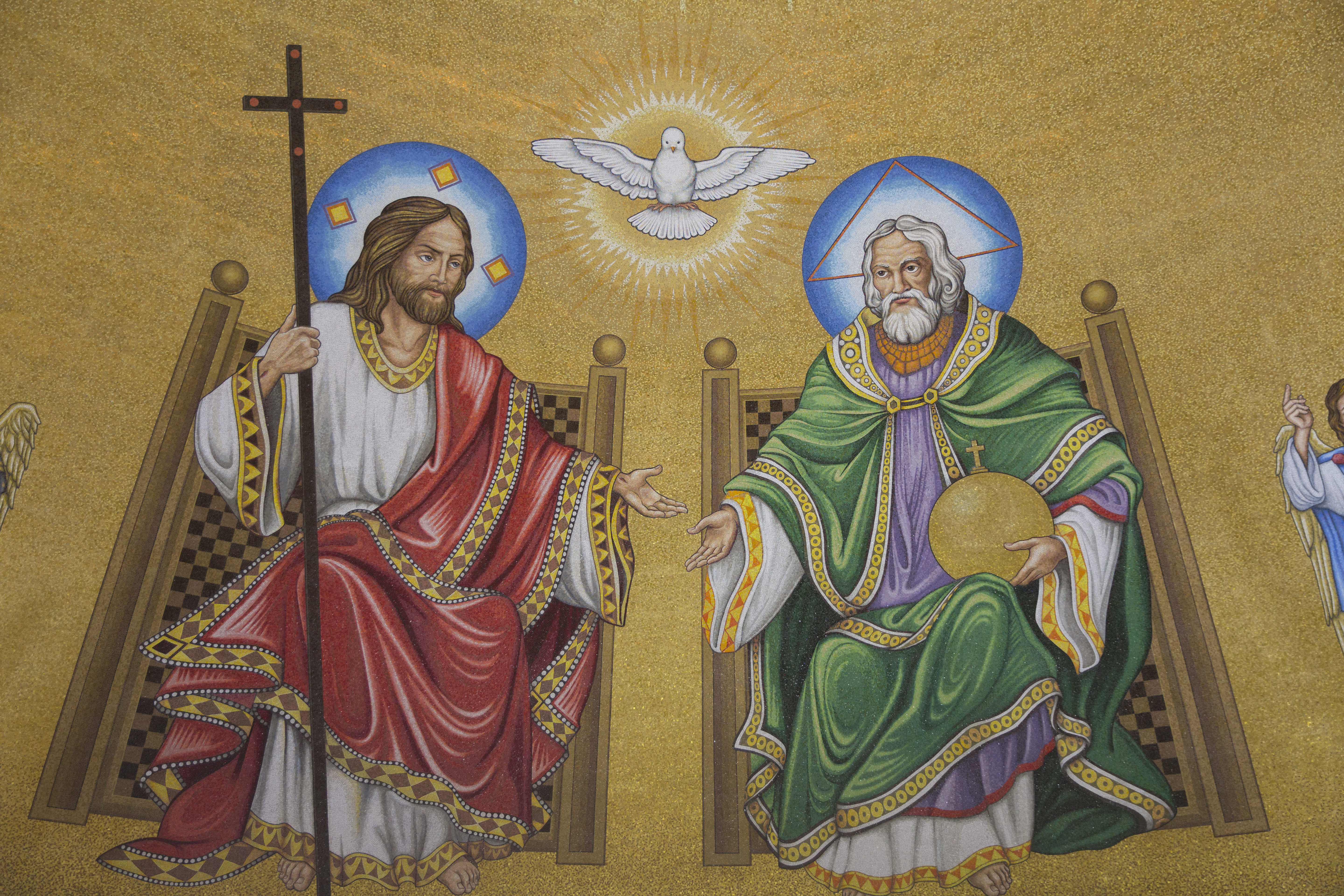
Yes, love is dynamic. There is a movement of love between the persons of the Trinity. This imagery is powerfully different than the one that most people have of the Trinity (God the Father on one throne, sitting next to His Son on another, with the Holy Spirit hovering like a dove between them). This is not wrong. Scripture speaks of thrones in Heaven and of the Father and the Son seated, but the thrones are likely more an image of authority than of inactivity.
Surely the inner life of the Trinity is more than merely being seated. It is a glorious procession of love: The Father loves the Son, the Son loves the Father, and the Holy Spirit is the love proceeding from them both. Yes, there is a great movement, a dance of love.
To this “dance” of love, Christ draws His Bride, the Church. It is our destiny and dignity to be caught up one day to the great dance of love of the Trinity. Heaven is not a static vision of God from some distance; it is a beatific vision, an experience of love that is dynamic and moving, a dance of ecstasy.
Put on your dancing shoes and get ready for the dance! Remember that to dance well we must surrender all pride and learn to dance as if no one is watching. Only the humble can really dance well, only those who can make space for the Lord and let Him lead.
I hope you will forgive the secular source, but below is an image of Christ drawing His bride to the dance.
There is an old spiritual that says, “My God is so high you can’t get over Him. He’s so low you can’t get under Him. He’s so wide you can’t get around Him. You must come in, by and through the Lamb.”
It’s not a bad way of saying that God is “other.” He is beyond what human words can describe, beyond what human thoughts can conjure. On the Feast of the Most Holy Trinity we do well to remember that we are pondering a mystery that cannot fit in our minds.
A mystery, though, is not something wholly unknown. In the Christian tradition, the word “mystery” refers to (among other things) something that is partially revealed, something much more of which remains hidden. As we ponder the Trinity, consider that although there are some things we can know by revelation, much more is beyond our understanding.
Let’s ponder the Trinity by exploring it, seeing how it is exhibited in Scripture, and observing how we, who are made in God’s image, experience it.
I. The Teaching on the Trinity Explored –
Perhaps we do best to begin by quoting the Catechism, which says, The Trinity is One. We do not confess three Gods, but one God in three persons: [Father, Son, and Holy Spirit] … The divine persons do not share the one divinity among themselves but each of them is God, whole and entire (Catechism, 253).
There is one God and each of the three persons of the Trinity possesses the one divine nature fully. The Father is God; He is not one-third of God. Likewise, the Son, Jesus, is God; He is not one-third of God. And the Holy Spirit is God, not merely one-third of God.
It is our human experience that if there is only one of something, and someone possesses it fully, then there is nothing left for anyone else. Yet mysteriously, each of the three persons of the Trinity fully possesses the one and only divine nature while remaining a distinct person.
One of the great masterpieces of the Latin Liturgy is the preface for Trinity Sunday. It compactly and clearly sets forth the Christian teaching on the Trinity. The following translation of the Latin is my own:
It is truly fitting and just, right and helpful unto salvation that we should always and everywhere give thanks to you O Holy Lord, Father almighty and eternal God: who, with your only begotten Son and the Holy Spirit are one God, one Lord: not in the oneness of a single person, but in a Trinity of one substance. For that which we believe from your revelation concerning your glory, we acknowledge of your Son and the Holy Spirit without difference or distinction. Thus, in the confession of the true and eternal Godhead there is adored a distinctness of persons, a oneness in essence, and an equality in majesty, whom the angels and archangels, the Cherubim also and the Seraphim, do not cease to daily cry out with one voice saying, Holy, Holy, Holy …
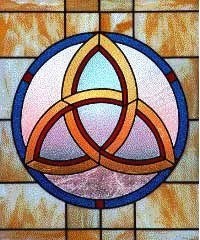
Wow! It’s a careful and clear masterpiece, but one that baffles the mind. So deep is this mystery that we had to “invent” a paradoxical word to summarize it: Triune (or Trinity). Triune literally means “three-one” (tri + unus), and “Trinity” is a conflation of “Tri-unity,” meaning the “three-oneness” of God.
If all of this baffles you, good! If you were to say that you fully understood all this, I would have to say you were likely a heretic. The teaching on the Trinity, while not contrary to reason per se, does transcend it and it is surely beyond human understanding.
Here is a final image before we leave our exploration stage. The picture at the upper right is from an experiment I remember doing when I was in high school. We took three projectors, each of which projected a circle: one red, one green, and one blue (the three primary colors). At the intersection of the three circles the color white appeared. Mysteriously, the three primary colors are present in the color white, but only one shows forth. The analogy is not perfect (no analogy is or it wouldn’t be an analogy) for Father, Son, and Spirit do not “blend” to make God, but it does manifest a mysterious “three-oneness” of the color white. Somehow in the one, three are present. (By the way, this experiment only works with light; don’t try it with paint!)
II. The Teaching on the Trinity Exhibited – Scripture also presents images of the Trinity. Interestingly enough, most of the ones I want to present here are from the Old Testament.
As a disclaimer, I’d like to point out that Scripture scholars debate the meaning of these texts; that’s what they get paid the big bucks to do. I am reading these texts as a New Testament Christian and seeing in them a doctrine that later became clear. I am not getting into a time machine and trying to understand them as a Jew from the 8th century B.C. might have. Why should I? That’s not what I am. I am reading these texts as a Christian in the light of the New Testament, as I have a perfect right to do. You, of course, are free to decide whether you think these texts really are images or hints of the Trinity. Here they are:
1. Then God said, “Let us make man in our image, after our likeness …” (Gen 1:26)
God speaks of himself in the plural: “Let us … our …” Some claim that this is just an instance of the “royal we” being used. Perhaps, but I see an image of the Trinity. There is one (“God said”) but there is also a plural (us, our). Right at the very beginning in Genesis there is already a hint that God is not all by himself, but rather is in a communion of love.
2. Elohim
In the passage above, the word used for God is אֱלֹהִ֔ים (Elohim). It is interesting to note that this word is in the plural form. From a grammatical standpoint, Elohim actually means “Gods,” but the Jewish people understood the sense of the word to be singular. This is a much debated point, however. You can read more about it from a Jewish perspective here: Elohim as Plural yet Singular.
(We have certain words like this in English, words that are plural in form but singular in meaning such as news, mathematics, and acoustics.) My point here is not to try to understand it as a Jew from the 8th century B.C. or even as a present day Jew. Rather, I am observing with interest that one of the main words for God in the Old Testament is plural yet singular, singular yet plural. God is one yet three. I say this as a Christian observing this about one of the main titles of God, and I see an image of the Trinity.
3. And the LORD appeared to [Abram] by the oaks of Mamre, as he sat at the door of his tent in the heat of the day. He lifted up his eyes and looked, and behold, three men stood in front of him. When he saw them, he ran from the tent door to meet them, and bowed himself to the earth, and said, “My Lord, if I have found favor in your sight, do not pass by your servant. Let a little water be brought, and wash your feet, and rest yourselves under the tree, while I fetch a morsel of bread, that you may refresh yourselves, and after that you may pass on—since you have come to your servant.” So they said, “Do as you have said” (Gen 18:1-5).
From a purely grammatical standpoint this is a very difficult passage because it switches back and forth between singular and plural references. The Lord (singular) appears to Abram, yet Abram sees three men (some have said that this is just God and two angels, but I think it is the Trinity). Then when Abram addresses “them” he says, “My Lord” (singular). The tortured grammar continues as Abram suggests that the Lord (singular) rest “yourselves” (plural) under the tree. The same thing happens in the next sentence, in which Abram wants to fetch bread so that you may refresh “yourselves” (plural). In the end, the Lord (singular) answers, but it is rendered as “So they said.” Plural, singular … which is it? Both. God is one and God is three. For me as a Christian, this is a picture of the Trinity. Because the reality of God cannot be reduced to mere words, this is a grammatically difficult passage, but I can “see” what is going on: God is one and God is three; He is singular and He is plural.
4. Having come down in a cloud, the Lord stood with Moses there and proclaimed his Name, “Lord.” Thus the Lord passed before him and cried out, “The Lord, the Lord, a merciful and gracious God, slow to anger and rich in kindness and fidelity” (Exodus 34:5).
When God announces His name, He does so in a threefold way: Lord! … The Lord, the Lord. There is implicit a threefold introduction or announcement of God. Is it a coincidence or is it significant? You decide.
5. In the year that King Uzziah died I saw the Lord sitting upon a throne, high and lifted up; and his train filled the temple. Above him stood the Seraphim; each had six wings: with two he covered his face, and with two he covered his feet, and with two he flew. And one called to another and said: “Holy, holy, holy is the Lord of hosts; the whole earth is full of his glory” (Is 6:1-3).
God is Holy, Holy, and yet again, Holy. Some say that this is just a Jewish way of saying “very Holy,” but as Christian I see more. I see a reference to each of the three persons of the Trinity. Perfect praise here requires three “holys.” Why? Omni Trinum Perfectum (all things are perfect in threes). But why? As a Christian, I see the angels praising each of the three persons of the Trinity. God is three (Holy, holy, holy …) and yet God is one (holy is the Lord …). There are three declarations of the word “Holy.” Is it a coincidence or is it significant? You decide.
6. Here are three (of many) references to the Trinity in the New Testament:
Jesus says, The Father and I are one (Jn 10:30).
Jesus also says, To have seen me is to have seen the Father (Jn 14:9).
Have you ever noticed that in the baptismal formula, Jesus uses “bad” grammar? He says, Baptize them in the name (not names (plural)) of the Father and of the Son and of the Holy Spirit (Matt 28:19). God is one (name) and God is three (Father, Son, and Holy Spirit).
Thus Scripture exhibits the teaching of the Trinity, going back even to the beginning.
III. The Teaching of the Trinity Experienced – We who are made in the image and likeness of God ought to experience something of the mystery of the Trinity within us, and sure enough, we do.
It is clear that we are all distinct individuals. I am not you; you are not I. Yet it is also true that we are made for communion. We humans cannot exist apart from one another. Obviously we depend on our parents, through whom God made us, but even beyond that we need one another for completion.
Despite what the Paul Simon song says, no man is a rock or an island. There is no such thing as a self-made man. Even the private business owner needs customers, suppliers, shippers, and other middlemen. He uses roads he did not build, has electricity supplied to him over lines he did not string, and speaks a language to his customers that he did not create. Further, the product he makes was likely the result of technologies and processes he did not invent. The list could go on and on.
We are individual, but we are social. We are one, but we are linked to many. Clearly we do not possess the kind of unity that God does, but the “three-oneness” of God echoes in us. We are one, yet we are many.
We have entered into perilous times where our interdependence and communal influence are under-appreciated. The attitude that prevails today is a rather extreme individualism: “I can do as I please.” There is a reduced sense of how our individual choices affect the community, Church, or nation. That I am an individual is true, but it is also true that I live in communion with others and must respect that dimension of who I am. I exist not only for me, but for others. What I do affects others, for good or ill.
The attitude that it’s none of my business what others do needs some attention. Privacy and discretion have important places in our life, but so does concern for what others think and do, the choices they make, and the effects that such things have on others. A common moral and religious vision is an important thing to cultivate. It is ultimately quite important what others think and do. We should care about fundamental things like respect for life, love, care for the poor, education, marriage, and family. Indeed, marriage and family are fundamental to community, nation, and the Church. I am one, but I am also in communion with others and they with me.
Finally, there is a rather remarkable conclusion that some have drawn: the best image of God in us is not a man alone or a woman alone, but rather a man and a woman together in the lasting and fruitful relationship we call marriage. When God said, “Let us make man in our image” (Genesis 1:26), the text goes on to say, “Male and female he created them” (Genesis 1:27). God then says to them, “Be fruitful and multiply” (Gen 1:28). So the image of God (as He sets it forth most perfectly) is the married and fruitful couple.
We must be careful to understand that what humans manifest sexually, God manifests spiritually, for God is neither male nor female in His essence. We may say that the First Person loves the Second Person and the Second Person loves the First Person. So real is that love that it bears fruit in the Third Person. In this way the married couple images God, for the husband and wife love each other and their love bears fruit in their children (See, USCCB, “Marriage: Love and Life in the Divine Plan”).
So today, as we extol the great mystery of the Trinity, we look not merely outward and upward so as to understand, but also inward to discover that mystery at work in us, who are made in the image and likeness of God.
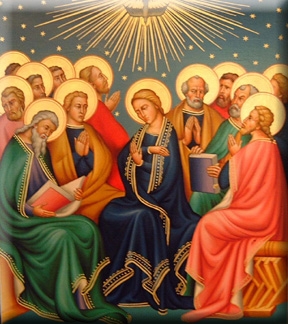
What a wondrous and challenging feast we celebrate at Pentecost! A feast like this challenges us because it puts to the lie a lazy, sleepy, hidden, and tepid Christian life. The Lord Jesus said to the apostles, I have come to cast a fire on the earth (Luke 12:49). This is a feast about fire, a transformative, refining, purifying fire that the Lord wants to kindle in us. It is a necessary fire, for as the Lord first judged the world by fire, the present heavens and the earth are reserved for fire. Because it is going to be the fire next time, we need the tongues of Pentecost fire to fall on us to set us on fire and bring us up to the temperature of glory.
The readings today speak to us of the Holy Spirit in three ways: the portraits of the Spirit, the proclamation of the Spirit, and the propagation by the Spirit.
I. The Portraits of the Spirit– The reading today speaks of the Holy Spirit using two images: rushing wind and tongues of fire. These two images recall Psalm 50, which says, Our God comes, he does not keep silence, before him is a devouring fire, round about him a mighty tempest.
Rushing Wind – Notice how the text from Acts opens: When the time for Pentecost was fulfilled, they were all in one place together. And suddenly there came from the sky a noise like a strong driving wind, and it filled the entire house in which they were.
This text brings us to the very root meaning of the word “spirit.” Spirit refers to breath. This is preserved in the word “respiration,” which is the act of breathing. So, the Spirit of God is the breath of God, the Ruah Adonai (the Spirit, the breath of God).
Genesis 1:2 speaks of this, saying, the Spirit of God was moving over the face of the waters. Genesis 2:7 speaks even more remarkably of something God did only for man (not the animals): then the LORD God formed man of dust from the ground and breathed into his nostrils the breath of life; and man became a living soul.
So, the very Spirit of God was breathed into Adam, but he lost this gift and died spiritually when he sinned.
Thus, we see in this passage from Acts an amazing and wonderful resuscitation of the human person as these first Christians experience the rushing wind of God’s Spirit breathing spiritual life back into them. God does C.P.R. and brings humanity, dead in sin, back to life! The Holy Spirit comes to dwell in us once again as in a temple (cf 1 Cor 3:16). It has been said that Christmas is the feast of God with us, Good Friday is the Feast of God for us, but Pentecost is the Feast of God in us.
Tongues of Fire – The text from Acts then says, Then there appeared to them tongues as of fire, which parted and came to rest on each one of them.
The Bible often speaks of God as fire or in fiery terms: Moses saw Him as a burning bush. God led the people out of Egypt through the desert as a pillar of fire. Moses went up onto a fiery Mt. Sinai where God was. Psalm 97 says,
The LORD reigns; let the earth rejoice; let the many coastlands be glad! Clouds and thick darkness are round about him; righteousness and justice are the foundation of his throne. Fire goes before him, and burns up his adversaries round about. His lightnings lighten the world; the earth sees and trembles. The mountains melt like wax before the LORD, before the Lord of all the earth. The heavens proclaim his righteousness; and all the peoples behold his glory (Psalm 97).
Scriptures also call God a Holy fire, a consuming fire (cf Heb 12:29) and a refining fire (cf Is. 48:10; Jer 9:7; Zec 13:9; Mal 3:3).
So it is that our God, who is a Holy Fire, comes to dwell in us through His Holy Spirit. As a Holy Fire, He refines us by burning away our sins and purifying us. As Job once said, But he knows the way that I take; when he has tested me, I will come forth as gold (Job 23:10).
God is also preparing us for judgment, for if He is a Holy Fire, then who may endure the day of His coming or of going to Him? What can endure the presence of Fire Himself? Only that which is already fire. Thus, we must be set afire by God’s love.
So, in the coming of the Holy Spirit, God sets us on fire to make us a kind of fire. In so doing, He purifies us and prepares us to meet Him one day, to meet Him who is a Holy Fire.
II. The Proclamation of the Spirit – You will notice that the Spirit came on them like “tongues” of fire. The reference to tongues is no accident, for the Holy Spirit moves them to speak and ultimately to witness. The text says, And they were all filled with the Holy Spirit and began to speak in different tongues, as the Spirit enabled them to proclaim. Now there were devout Jews from every nation under heaven staying in Jerusalem. At this sound, they gathered in a large crowd, but they were confused because each one heard them speaking in his own language. They were astounded, and in amazement they asked, “Are not all these people who are speaking Galileans? Then how does each of us hear them in his native language? We are Parthians, Medes, and Elamites, inhabitants of Mesopotamia, Judea and Cappadocia, Pontus and Asia, Phrygia and Pamphylia, Egypt and the districts of Libya near Cyrene, as well as travelers from Rome, both Jews and converts to Judaism, Cretans and Arabs, yet we hear them speaking in our own tongues of the mighty acts of God.”
So, behold how the Holy Spirit moves them to proclaim, not just within the safety of the upper room, but also in holy boldness before the crowds that have gathered.
Notice the transformation! Moments ago, these were frightened men huddled together in secrecy behind locked doors. Now, they go forth to the crowds and proclaim Christ boldly. They have gone from fear to faith, from cowardice to courage, from terror to testimony!
What about us? Too many Christians are silent, overcome by fear. Perhaps they fear being called names or being unpopular. Perhaps they are anxious about being laughed at or resisted, or of being asked questions they don’t feel capable of answering. Some Christians gather in the “upper room” of the parish and are active—even leaders—but once outside the safe confines of the “upper room” they slip into what I call “secret agent” mode.
Well, the Holy Spirit wants to change that. To the degree that we have really met Jesus Christ and experienced His Holy Spirit, we are less able to keep silent. An old gospel song says, “I thought I wasn’t gonna testify, but I couldn’t keep it to myself, what the Lord has done for me.” The Holy Spirit, if authentically received, wants to give us zeal and joy, to burn away our fear so that testifying and witnessing come naturally to us.
Note also how the Spirit “translates” for the Apostles. The people in the crowd spoke different languages, yet each heard Peter and the others in his own language. The Spirit, therefore, assists not only us but also those who hear us. My testimony is not dependent on my eloquence alone but also on the grace of the Holy Spirit, who casts out deafness and opens hearts. Every Christian should remember this. Some of our most doubt-filled encounters with others can still bear great fruit on account of the work of the Holy Spirit, who “translates” for us and overcomes obstacles we might think insurmountable.
III. The Propagation by the Spirit – In the great commission, the Lord said, Go, therefore, and make disciples of all nations, baptizing them in the name of the Father, and of the Son, and of the Holy Spirit, teaching them to observe all that I have commanded you. And behold, I am with you always, until the end of the age (Matt 28:19ff). He also said, I have come to cast a fire on the earth and How I wish the blaze were already ignited (Luke 12:49).
How is the Lord going to do this?
Perhaps a picture will help to illustrate. My parish church is dedicated to the Holy Spirit under the title “Holy Comforter.” Above the high altar is the following Latin inscription: Spiritus Domini, replevit orbem terrarum (The Spirit of the Lord, filled the orb of the earth). (See the photo above of our high altar.)
The walls of my parish church answer the question. The clerestory walls are painted Spanish red, and upon this great canvas are also painted the stories of the lives of twenty saints, surrounding us like a great cloud of witnesses (cf Heb 12:1). (See also the video below.) Over the head of every saint is a tongue of fire.
This is how the Spirit of the Lord fills the earth. It is not via “magic fairy dust.” It is in the fiery transformation of every Christian going forth to bring warmth and light to a cold, dark world. This is how the Lord casts fire upon the earth. This is how the Spirit of the Lord fills the orb of the earth—in the lives of saints (and in your life)!
In the end, the great commission (Matt 28) is our first and most important job. No matter what else we do, we are to do this. Parishes do not deserve to exist if they do not do this. As individual Christians, we are a disgrace and not worthy of the name if we fail to win souls for Jesus Christ. The Spirit of the Lord is going to fill the orb of the earth but only through us. The spread of the gospel has been placed in your hands. It’s scary, isn’t it!
In my short time on this planet, I have seen it. Parishes that were once big and booming (and, frankly, sometimes arrogant) are now in decline; some are near closure. It happens to the best if they do not evangelize, if they do not accomplish “job one.” The Lord wants to light a fire. Why not become fire? Let the Spirit propagate the Church through you. (Yes, I am talking to you.)
Enjoy the feast of Pentecost, but don’t forget that the basic image is very challenging, for it means getting out of the “upper room,” opening the doors, and proclaiming Christ to the world. Let the Holy Spirit light a fire in you. Then you can’t help but spread light and heat to a dark, cold world.
Let the evangelization of the whole world begin with you.
The video below features details from the clerestory of my parish, Holy Comforter in Washington, D.C. Notice the tongue of fire above each saint. The paintings show how the Spirit of the Lord fills the orb of the earth through the lives of the saints (and through you, too). It is not magic; it is grace, working in your life, through your gifts and your relationships, so that the Lord will reach each soul. The witnesses on the walls of my Church say, “You are the way that He will fill the earth and set it on fire.” Let the blaze be ignited in you!
The song accompanying the video says, “We are surrounded by a great cloud of witnesses, looking on, encouraging us to do the will of the Lord. Let us stand worthy and be faithful to God’s call … We must not grow weary …!”
Most of us think that vengeance is merely a vice. And, given improper intentions, or excess or misguided application, it can indeed be a sin and a vice. However, as we read in Scripture, “Vengeance is mine, says the Lord, I will repay” (Rom 12:19). Or again, as St. Thomas Aquinas notes, the scriptures assure: “Will not God avenge His elect who cry to Him day and night?” (Lk 18:7). But if vengeance is only a vice and an evil, then how can God attribute vengeance to himself. God does nothing evil. Hence in vengeance there is the possibility of virtue and that which is good. St. Thomas treats of vengeance under his treatise on Justice. Hence, vengeance is a special virtue in service of justice.
To be sure, only God is perfectly assured of using vengeance in a good way all the time. We ought to be slow to attribute vengeance as a virtue among ourselves except under very clear circumstances and proper dispositions. As usual St. Thomas does a very good job of spelling out the qualities and circumstances necessary for vengeance to be operative as a lawful and as a virtue:
Vengeance consists in the infliction of a penal evil (i.e. punishment) on one who has sinned. Accordingly, in the matter of vengeance, we must consider the mind of the avenger. For if his intention is directed chiefly to the evil of the person on whom he takes vengeance and rests there, then his vengeance is altogether unlawful: because to take pleasure in another’s evil belongs to hatred, which is contrary to the charity whereby we are bound to love all men. Nor is it an excuse that he intends the evil of one who has unjustly inflicted evil on him, as neither is a man excused for hating one that hates him: for a man may not sin against another just because the latter has already sinned against him, since this is to be overcome by evil, which was forbidden by the Apostle, who says: “Be not overcome by evil, but overcome evil by good (Romans 12:21).”
If, however, the avenger’s intention be directed chiefly to some good, to be obtained by means of the punishment of the person who has sinned (for instance that the sinner may amend, or at least that he may be restrained and others be not disturbed, that justice may be upheld, and God honored), then vengeance may be lawful, provided other due circumstances be observed. (ST II, IIae, 108.1)
And while the Scriptures quoted above generally refer vengeance to God, Thomas notes that it sometimes falls to those with authority to execute it on behalf of God:
He who takes vengeance on the wicked in keeping with his rank and position does not usurp what belongs to God but makes use of the power granted him by God. For it is written (Romans 13:4) of the earthly prince that “he is God’s minister, an avenger to execute wrath upon him that doeth evil.” If, however, a man takes vengeance outside the order of divine appointment, he usurps what is God’s and therefore sins. (Ibid, reply to first objection)
A further distinction made by St. Thomas is that it is often praiseworthy to endure injustice and wickedness directed against us personally. However, when the wrongs are directed against others and God, those with authority to use punishment or vengeance are more obligated to use it. He quotes psudeo-Chrysostom who says, “It is praiseworthy to be patient under our own wrongs, but to overlook God’s wrongs is most wicked.” (Ibid, ad obj. 2)
Perhaps it becomes clear that too many today who have authority to punish wrongdoing are unwilling to do it. And this leads to many vices proliferating in our culture. Children are widely spoiled and incorrigible. Crime is rampant in many of our cities where prosecutors refuse to punish crimes and return repeat-offenders to the streets. This leads to many grave violations against life, property and the dignity of persons. This is a defect of proper vengeance by those who have the authority and duty to execute it. St. Thomas lists to vices contrary to vengeance:
Two vices are opposed to vengeance: one by way of excess, namely, the sin of cruelty or brutality, which exceeds the measure in punishing; while the other is a vice by way of deficiency and consists in being remiss in punishing, wherefore it is written (Proverbs 13:24): “He that spareth the rod hateth his son.” But the virtue of vengeance consists in observing the due measure of vengeance with regard to all the circumstances. (ST II, IIae 108.2, ad obj 3)
In our times, cruelty and excess are not unknown, but being remiss in needed punishment is more widespread and, as noted, causes great harm by the consequent proliferation of sin. Vengeance is lawful and virtuous in so far as it tends to the prevention of evil. Clearly vengeance is a kind of forgotten virtue, indeed even a virtue often mislabeled as evil.
The problem of deficient punishment due sin, is an aspect of the general malaise regarding authority in our culture. While it is true that there is a notable resistance, even hatred of authority, it is also true that those who have authority are too reluctant to use it. Parents and teachers are reluctant, even fearful of teaching, disciplining and, where necessary punishing their children. Leaders and supervisors in the workplace are anxious in correcting employees or insisting on greater work quality, fearing legal actions, charges of racism, sexism, and many other “isms” and “phobes” in any number of increasing ways. Work productivity and excellence suffers and products and services due to others become deficient. Judges and prosecutors, as noted, have chosen in many places to ignore serious and repeated violations of law by often very dangerous individuals. Police are discouraged from enforcement and citizens are endangered.
All of this amounts to a sin against justice. It sins not only against the common good, but also brings about many violations of a personal nature against victims and also against perpetrators who, never experiencing proper correction and punishment run the strong risk of eternal damnation.
Vengeance, to be sure, is a delicate and “dangerous” virtue. Our anger and passion to avenge wrongdoing are unruly and easily excessive. However, we must reasonably engage this necessary virtue, showing patience where necessary but also a resolve to act when patience has run its course and the good of others and the justice of God requires it. God has consigned the duty to punish wrongdoing to those with the requisite authority and to do so with the good of souls in mind.