Two Pictures from Different Ages – Compare and Contrast!

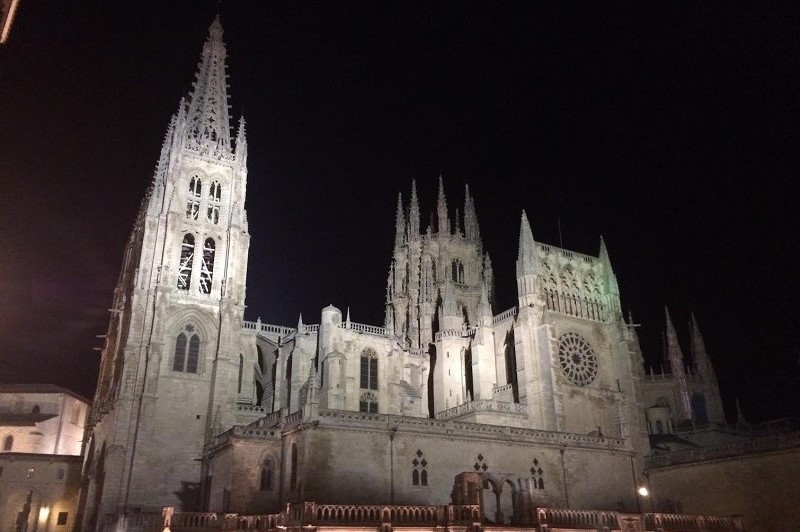
I was recently in Burgos, Spain and saw the splendid cathedral there. My first view of it came at night and I took the photo above. What a magnificent building; such proportion and symmetry! It reminds me of tall trees in a forest, majestically reaching up to the heavens. The flying buttresses supporting the soaring walls and towers showcase a great advance in building technique.

These were the skyscrapers of the Middle Ages. Such angular, geometric, and vertical beauty; almost like a forest, a fair flower of the 13th century echoing God’s creation and pointing to Him in a great work of human praise.

Two medieval phrases come to mind in the beauty of this building:

      • Beauty is id quod visum placet – Beauty is that which pleases when seen.
      • Pulchra dicuntur quae visa placent – Things that give pleasure when seen are called beautiful.

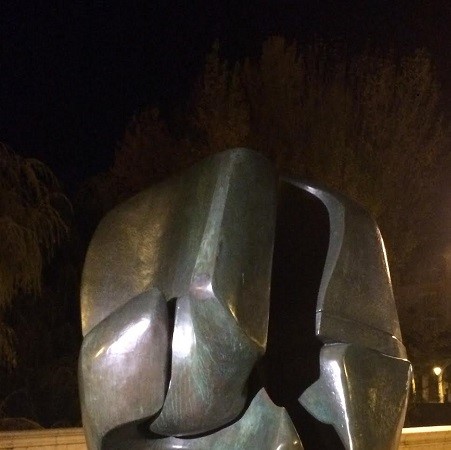
A mere thirty yards from this beautiful cathedral in the town square is something that is not beautiful in any traditional sense. I took the photo of it that is on the left. It was not uplifting and seemed to correspond to nothing in creation (unless one were to imagine a dinosaur dropping or a huge stumbling block). Like most modern abstract art, it looks more to me like someone’s nightmare. It seems to have little to say other than “Try to figure me out, you ignoramus.” Indeed, that is what I am usually called by art critics when I express dismay at these sorts of ugly blobs that clutter too many of our public squares and “art” museums.

Some disparagingly refer to the Middle Ages as the “dark ages” while referring to the current age as “enlightened.” Certainly, no age is perfect, but compare and contrast the two items in the photos here: uplifting, soaring, and inspiring; the other is dark and brooding, and its meaning is opaque. One is an uplifting building from the 13th century, the other a dark “who knows what” from the 20th century. Based on representational art, which age seems more inspiring? Which seems more enlightened? Decide for yourself, but I’ll take the 13th century!

Generally speaking, the idea at work in modern art is that it is merely the expression of the artist. We who view it are supposed to respect the artist expressing himself. This is largely a outgrowth of the subjectivism that fills our time.

The ancient idea however was that art is recta ratio factibilium (right reason in regard to things that are made). So the ancient ideal in things to be made, including art that the focus is not me, is not the artist, it is whether the art reflects conformity to the way a reasonable person can perceive the world. This does not mean that every painting must be like a photograph, or that sculpture should be an exact replica of what is. But it does mean that it has some conformity with reality that a reasonable person can perceive. So much modern art (not all) is either meaningless, or has no set meaning, it does not appeal to our reason or speak to our communal understanding of the reality about us.

Hence, St. Thomas Aquinas (also from the 13th century) spoke of beauty as consisting of integritas, consonantia, and claritas.  He writes,

For beauty includes three conditions: “integrity” or “perfection,” since those things which are impaired are by the very fact ugly; due “proportion” or “harmony”; and lastly, “brightness” or “clarity,” whence things are called beautiful which have a bright color [Summa Theologica I, 38, art 8].

In applying these criteria to art and architecture, we might consider the following:

Integritas (Integrity) – This speaks to the manner in which something echoes the beauty of what God has done. Thomas says that every created being is beautiful because God gives beauty to all created beings by a certain participation in the divine beauty. Therefore, human art and architecture are said to have integrity insofar as they participate in and point to the divine beauty of things. This need not mean an exact mimicry, but it does require at least a respectful glance to creation, holding forth some aspect of it so as to edify us with better and higher things. The cathedral pictured above points to a majestic forest as its form, its soaring stone to the mountains. Its colored glass allows the natural light to dazzle the eye and tell the stories of the Gospels. It is a sermon in glass and stone. As such, it has integrity, because it puts forth God’s glory. I’m not sure what the dark metal blob says. To what does it point? I have no idea. Because it is not integrated into the glory of creation (in any way that I can discern, at least) it does not have integrity. Rather, it seems to mock creation. If you think it is beautiful and has integrity, I invite you to explain why and how; I am at a loss to see any meaning at all in it.

Consonantia (Proportion) – This refers to the order and unity within a given thing. What God creates has a unity and purpose in its parts, which work together in an orderly fashion to direct something to its proper function or end. Thus, art and architecture intrinsically bespeak a unity and functionality, or they point to it extrinsically. They make sense of the world and respect what is given, reflecting the beauty of order, purpose, and design that God has set forth. The cathedral is beautiful because its parts act together in an orderly and harmonious way. There is balance, proportion, and symmetry. There is a recta ratio factibilium (something made according to right reason). As such, the building participates in God’s good order, and that is a beautiful thing. As for the dark metal “blob” (I don’t know what else to call it), it doesn’t seem to me to have any proportion. It is roundish, but not really. Does it have parts? Do they work together for some end? If so, what end? I cannot tell. Rather than pointing to order, it makes me think of chaos. I see no beauty echoed or pointed to.

Claritas (Clarity) – It is through clarity that we can answer the question “What is it?” with some degree of precision and understanding. Claritas also refers to the brightness or radiance of a thing. Something of God’s glory shines through; something about it gives light; something teaches us and reminds us of God—and God and light are beautiful. The gorgeous cathedral reflects the light shining on it, even at night. During the day it proclaims the glory of God by its soaring majesty, its sculptures, its windows, its order, its proportionality. It is a bright light showing forth the brightness of God and participating in it. As for the metal thing, it seems more to suck the light out of the room; it broods. I see no clarity, no brightness. I still cannot answer the question that clarity demands: “What is it?” There is no clear message. As such, it lacks beauty.

The criteria of beauty discussed here cannot be used for labeling things “beautiful” with absolute certainty, as if by applying a formula. They are more like guidelines to help us pin down some notion of beauty that is not purely subjective. Not all these criteria must be met for an object to be considered beautiful, and the presence of one does not guarantee beauty.

So again, you decide for yourself. Each of the two structures pictured above is representative of its age. Were the Dark Ages really so dark? Is ours really so enlightened? Compare and contrast!

Cross-posted at the Catholic Standard: Two Pictures from Different Ages – Compare and Contrast!
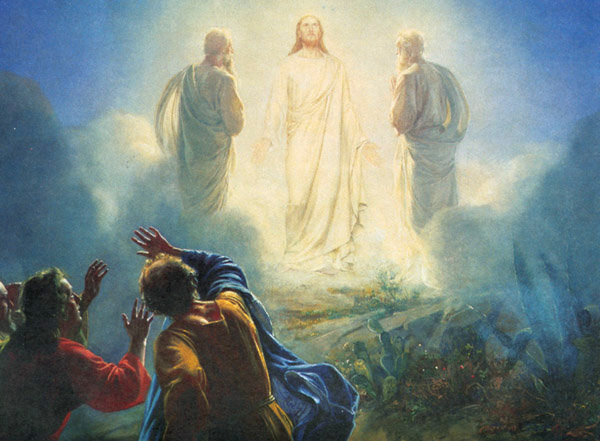
On the Feast of the Transfiguration: A Meditation on Seeing

The Feast of the Transfiguration is ultimately about vision. The Lord brought Peter, James and John up a high mountain in order that they might come to see. Even the word that describes this day bespeaks vision. It is from the Latin Transfiguratione. Trans means “across” and by extension “change”  and figura, means “shape” or “form.”  The suffix “ation” takes a verbal action and makes it a noun. Putting it all together transfiguration means a process by which Christ changed form or appearance. Christ gave them a glimpse of his true glory, he allowed them to see across (trans) to the other shore, to the true glory of Christ.

So the Feast of the Transfiguration is about vision. Have you seen the glory of Christ? Have you glimpsed God’s glory? Have you looked across to the other shore?  It is so essential for us to have this experience! Otherwise the discouragements and disappointments of life can easily overwhelm us. Only when we glimpse the glory and experience the joy of God can we truly say, by experience that our sufferings are more than worth it;  That the sufferings of this world cannot even been compared to the glory that waits (Rom 8:18);  that our momentary afflictions are producing for us a weight of eternal glory beyond compare (2 Cor 4:17).  Have you glimpsed the glory of God and Is this something you even expect to experience in your life? We ought to asked for this wondrous gift for it is essential for us.

Now of course, heavenly visions are not something we order like pizza. We can and must ask God for this vision but we must also understand that there are things God does to give us this vision, to make this vision grow and sharpen. Notice in the Gospel for today’s Mass four basic ways in which God ushers in this vision, clarifies it, grants it and helps it grow:

  1. The CLIMBJesus took Peter, John, and James and went up a mountain to pray. The other Gospels describe this as a “high” mountain. Tradition assigns Mt Tabor as the place of the Transfiguration. This is no small hill! It is indeed quite a climb to the top. I have visited there twice and, after the long drive to the top in buses with special transmissions designed for the climb, the view of the Jezreel Valley is like being up in an airplane. It probably took the four of them the better part of a day, maybe two to get to the top on foot. They must have been hardy men for such a climb. Consider too that they had to carry water and other provisions up with them. Now the point is, the vision they will experience comes only after a hard and difficult climb. It is true fact in my life and your too, I am sure, that suffering and difficulty usually gives new vision, opens new vistas, brings deeper understanding. Suffering is not something we enjoy to be sure, but it is part of the climb. There is an old Gospel song that says, “I’m coming up on the rough side of the mountain!”  The paradox announced by the song is that it is easier to climb on the rough side of the mountain. That’s where the climbing is to be had. That’s where the progress is possible. The smooth side provides little footing and is more dangerous. We like a smooth and pleasant life, but in fact, it is a more dangerous climb. Now at the top there is a vision to be had! But to get us there the Lord often has to have us climb and bring us up the rough side of the mountain. This is what it often takes to give us vision.
  2. The CLARIFICATIONWhile he was praying his face changed in appearance and his clothing became dazzling white. And behold, two men were conversing with him, Moses and Elijah, who appeared in glory and spoke of his exodus that he was going to accomplish in Jerusalem. Now I have chosen the word clarification to do double duty here. One the one had it refers to brilliant glory shining forth from Christ. Clarus in Latin means “bright” and hence clarification refers to his shining splendor. But I also use the word clarification in the more common English sense which means to make clear. Now notice that Moses and Elijah are present  and conversing with the Lord. Moses and Elijah are historical persons to be sure but they also represent the Law and the Prophets. In other words they represent Scripture. Part of what the Lord needs to do for us to give us heavenly vision is to teach us his Word. As we grow in knowledge of Scripture, our vision grows, our understanding deepens, and we see things differently. Immersion in the Scriptures disposes us for heavenly vision. Notice too how Moses and Elijah (personifying Scripture) give the vision for what Christ is about to do in his final journey to Jerusalem. The vision is of a new Exodus. Just as Moses led the ancient people out of slavery in Egypt by the Blood of the Lamb at Passover and the parted waters (baptism) of the Red Sea. So now Jesus would lead his people out (exodus) from slavery to sin by the blood of the Lamb (Jesus is the Lamb of God) and the Baptismal waters flowing from his parted and pierced side.  Do you see what Scripture does? It gives us vision. It sheds light on the meaning of our life. Scripture is our story and it shows again and again how God can make a way out of no way, that He can do any thing but fail. Do you want to see the heavens open and the glory of God be revealed? Then immerse yourself in scripture. Through Scripture God clarifies all things.
  3. The CONTEMPLATION  – Peter and his companions had been overcome by sleep, but becoming fully awake, they saw his glory and the two men standing with him. As they were about to part from him, Peter said to Jesus, “Master, it is good that we are here; let us make three tents,
    one for you, one for Moses, and one for Elijah.” But he did not know what he was saying. And now comes the vision! Through the difficult climb and suffering, and after being immersed in God’s word, God often grants us this vision. When we see his glory we become fully awake. So great is this glory that they do not know what to say! Those who have every really experienced a glimpse of God’s glory know that the experience cannot be reduced to words. It is ineffable, unsayable, unspeakable! There is an old saying: “Those who know, do not say, Those who say, do not know.” Peter is babbling at this point and thinks to build booths or tents to capture this glory. He probably had in mind the Feast of Booths wherein the Jewish people remembered the great Exodus, the time in the Desert and the giving of the Law. It was one of the great festivals of the year. And hence Peter’s suggestion is a way of saying, “Let’s celebrate this!” “Let’s extend the time in a week-long feast!”  But Peter needs to understand that this is but a brief glimpse. There are still troubles ahead and another mountain to climb (Golgotha). But for now the vision is wonderful. So to for us who are privileged to get a glimpse of glory. It does not mean we are fully in heaven yet. For us too there are other mountains to climb, valleys to cross. But oh the glimpse of glory, do not forget it. Let it sustain you in difficult times and it must have sustained Jesus in his passion.
  4. The COMMANDWhile [Peter] was still speaking, a cloud came and cast a shadow over them, and they became frightened when they entered the cloud. Then from the cloud came a voice that said,  “This is my chosen Son; listen to him.” – And now comes the great glory cloud (the shekinah) that overshadows them. This vision has been wonderful but God has more than bright lights to show them. The vision he confers gives direction as well as light. His direction is clear: “Listen to my Son.”  Not only does this instruction complete the vision but it also ensures greater visionin the future. If we obey Jesus Christ, we will see greater and greater things (Jn 1:50). If we follow him he will lead us to the light and we will see all things by it. But note this, where Jesus leads is not always easy. In order to obey the Father’s command that they listen to Jesus, they are going to have to accept Christ’s instruction that they follow him to Jerusalem and the cross. Only in this way will they see all things by the light of Easter glory.

Do you want to see? Then be willing to make the climb with Jesus. He gives vision if we climb. He gives vision if we are immersed in his Word, which is Scripture and Church Teaching. But his greatest vision lies ahead if we but take up our cross and follow him through his passion death and resurrection. Happy feast of the Transfiguration. May God grant us vision.

St. Augustine on Suffering as a Medicine

St. Paul in today’s Office of Readings (17th Week Friday) speaks of his learning to accept certain sufferings as a mysterious working of God’s providence. It put me in mind of another passage I read recently from St. Augustine.  We can ponder his teaching on suffering and its role in preserving us from something far worse.

When asked, most people identify their most serious problems as those related to their physical health or their finances; family and career are also often mentioned.

Frankly, our biggest problem is pride and all the sins that flow from it. Nothing is more serious than our sins, which can destroy us forever. Worldly problems are temporary. They can make life unpleasant or at worst kill us, but then we get to go home and meet God if we are faithful.

Therefore, to God, our most serious problem is our sin. This is well-illustrated in the Gospels, when a paralyzed man was presented to Jesus: Jesus looked at him and said, “Your sins are forgiven.” Yes, Jesus looked at a paralyzed man and saw his sin as his most serious problem and the one to be dealt with first.

We don’t think like this even when taught that we should.

Because pride and the sins that flow from it are so serious, we do well to ponder how God permits suffering in our life so as to keep us from becoming too prideful. To God, it is better that we suffer some here, learn humility, and be saved, than to remain prideful and go to Hell.

I have received gifts and blessings, but if it weren’t for some suffering and humiliation in my life, I’d be so proud I’d go right to Hell. There’s just something about suffering that can keep us humble and continually calling on God.

St. Augustine reflects on this in what is considered his greatest work, The City of God. It was occasioned by the decline of the Roman Empire and the sacking of the city of Rome by the Barbarians under Alaric in 410 A.D. Augustine wrote the work to ponder how a once-mighty empire had fallen into such decay.

There were of course many sufferings inflicted on the citizens of Rome by the Barbarians. “Sackings” are not pleasant. Some people were killed, many women were raped, grave damage was inflicted on the city, and much personal property was damaged and/or taken.

In chapter 28 of Book 1 of the City of God, Augustine ponders why God would have allowed such suffering, especially to the Christians of that city, and in particular to the Christian women of virtue who were raped.

At times, his reflections seem almost unsympathetic, but in effect St. Augustine points to humiliation and suffering as a strong but necessary medicine for pride, which is far worse than any of the ills suffered to remedy it.

St. Augustine begins by disclaiming any ability to offer a complete explanation for suffering:

If you ask me why they [the Barbarians] were allowed the liberty of committing these sins, the answer is that the providence of the Creator and Ruler of the world transcends human reckoning, and that “incomprehensible are his judgments … unsearchable his ways.

Augustine then adds (somewhat boldly) to those in Rome who suffered,

Nevertheless, carefully scrutinize your own souls and see whether you were not unduly puffed up about your virtue.

He then ponders,

They [those who suffered] may possibly have in them some latent weakness which could have swollen to overwhelming pride had they escaped this humiliation…. So violence snatched something away from them lest prosperity should endanger them.

He goes on to conclude,

But they learned humility …. And were delivered from a pride that had already overtaken them … a pride that threatened them.

What of us who have suffered? We ought not to exclude the possibility, even the likelihood, that such suffering is permitted by God in order to humble us and keep us from the far worse of pride.

We must also conclude that when God allows suffering for this purpose He also gives grace to help us avoid extreme anger or despair. St. Augustine concludes his reflection in this way:

God would never have permitted these evils if they could destroy in his saints that purity of soul which he had bestowed on them and delights to see in them.

Reflections such as these do not generally please modern ears. We do not usually like the notion that God permits suffering for some greater good. Too easily we call Him unfair and harsh for doing such a thing. We prefer to think of Him as a doting grandfather rather than the disciplining Father described in Hebrews 12:4ff.

Our dismissal of suffering as a medicine is largely because we fail to see just how serious a sin pride is. We are dismissive of the tremendous toll that sin takes on us and the extreme danger that it causes in our hearts. Hence, we reject any medicine at all, let alone any strong one. However, God will not spare us merely to please us if in so doing He would lose us.

Suffering is complex and mysterious. That God permits it cannot be explained easily, but as St. Augustine makes clear, we ought not to overlook its salutary effect through the humility it engenders.

That, in and of itself, is a very good thing; for pride is our worst enemy.

This song, translated from the Latin, says,

Sadness and anxiety
have overtaken my inmost being.
My heart is made sorrowful in mourning,
my eyes are become dim.
Woe is me, for I have sinned.

But you, Lord,
who does not forsake
those who hope in you,
comfort and help me
for your holy name’s sake,
and have mercy on me.

On The Sad End of Solomon

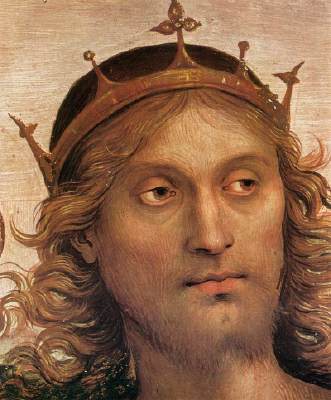
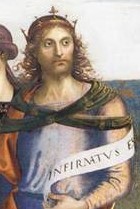
Solomon, by Pietro Perugino

The first reading at  Mass this past  week (17th Sunday cycle A) focused on the kingship of Solomon. Perhaps the high point of his life when he was given the opportunity to ask anything whatsoever from God and chose not gold or glory but wisdom. On Wednesday we read about the visit of the Queen of Sheba, complete with a description of Solomon’s court and kingdom in all its glory.

His early years presented a portrait of a man deeply rooted in God, but later in his life Solomon’s infidelity led to a divided kingdom. It is a moral tale that contains a warning for us all. Let’s review the basics of Solomon’s life and ponder the lessons to be learned.

Solomon was Israel’s third king. He was also known as Jedidiah (beloved of the Lord). His forty-year reign is regarded as Israel’s golden age, an age of prosperity and national unity. But, his reign ended disastrously: he began to oppress the people, took many wives, and introduced pagan worship.

Solomon was the second son of David and Bathsheba, but the 17th of David’s 19 sons. (David had other wives, and sons by them.) This hardly made him the most likely son to succeed his father as king. However, through the court intrigues of his mother and the support of Nathan the prophet, both of whom took advantage of David in his old age, Solomon was named king in 961 B.C. instead of his half-brother Adonijah (David’s eldest living son and presumed successor). Solomon swiftly and ruthlessly established his power over Adonijah, having him executed on a pretext. This act, along with the execution or banishment of Adonijah’s supporters in the military had repercussions throughout Solomon’s reign. It created military rivalries on the northern edge of Israel that were something of a nuisance and may explain why Solomon raised such a large army.

Despite all this, Solomon experienced a vision from God early in his reign. He was at the altar of Gibeon offering extensive sacrifices to God:

In Gibeon the LORD appeared to Solomon in a dream at night. God said, “Ask something of me and I will give it to you.” Solomon answered: “You have shown great favor to your servant, my father David, because he behaved faithfully toward you, with justice and an upright heart; and you have continued this great favor toward him, even today, seating a son of his on his throne. O LORD, my God, you have made me, your servant, King to succeed my father David; but I am a mere youth, not knowing at all how to act. I serve you in the midst of the people whom you have chosen, a people so vast that it cannot be numbered or counted. Give your servant, therefore, an understanding heart to judge your people and to distinguish right from wrong. For who is able to govern this vast people of yours?” The LORD was pleased that Solomon made this request. So God said to him: “Because you have asked for this—not for a long life for yourself, nor for riches, nor for the life of your enemies, but for understanding so that you may know what is right—I do as you requested. I give you a heart so wise and understanding that there has never been anyone like you up to now, and after you there will come no one to equal you (1 Kings 3:5-12).

The Lord did indeed grant Solomon great wisdom. 1 Kings 5:10-12 notes that his wisdom surpassed all the people of the east and Egypt, and credits Solomon with 3,000 proverbs and 1,005 songs. Many of these have come down to us in the biblical books he authored (Proverbs, Song of Songs, and Wisdom) as well as Ecclesiastes, which he may have edited. Leaders from throughout the world (most notably the Queen of Sheba) sought out Solomon for his wisdom and counsel.

Solomon was also noted as a superb statesman who had a great ability to forge trading relationships with foreign leaders. Trade expanded widely during his reign.

These foreign relationships may well have been the first sign of trouble, though, for they led him to take many wives. This was a common practice of kings in those days, despite this warning from the Book of Deuteronomy:

The king, moreover, must not acquire great numbers of horses for himself or make the people return to Egypt to get more of them, for the LORD has told you, “You are not to go back that way again.” He must not take many wives, or his heart will be led astray. He must not accumulate large amounts of silver and gold (Deut 17:16-17).

Solomon ended up breaking all three of these commands:

1.  He took many wives – Solomon took many of his wives from the surrounding pagan territories. His wives included Hittites, Maobites, Edomites, Sidonians, and Amorites. They were from nations about which the LORD had told the Israelites, “You must not intermarry with them, because they will surely turn your hearts after their gods.” Nevertheless, Solomon held fast to them in love (1 Kings 11:2). In the end he had 700 wives and 300 concubines (see 1 Kings 11:3).

This not only demonstrates his lust but also his foreign entanglements. These pagan women brought with them their pagan deities and, in the end, they negatively influenced Solomon’s own faith. At the dedication of the Temple, God warned Solomon,

But if you or your sons turn away from me and do not observe the commands and decrees I have given you and go off to serve other gods and worship them, then I will cut off Israel from the land I have given them and will reject this temple I have consecrated for my Name. Israel will then become a byword and an object of ridicule among all peoples (1 Kings 9:6-7).

Solomon failed to heed this warning and through lust, greed for trade, and fascination with things foreign and pagan, he turned away from the Lord and began to allow pagan worship, to permit pagan altars to be built in Israel, and even to build such altars himself (1 Kings 11). Of all his sins this was clearly the most egregious and according to the author of 1 Kings, was the main reason God turned his favor from Israel:

So the LORD said to Solomon, “Since this is your attitude and you have not kept my covenant and my decrees, which I commanded you, I will most certainly tear the kingdom away from you and give it to one of your subordinates. Nevertheless, for the sake of David your father, I will not do it during your lifetime. I will tear it out of the hand of your son. Yet I will not tear the whole kingdom from him, but will give him one tribe for the sake of David my servant and for the sake of Jerusalem, which I have chosen” (1 Kings 11:11-13).

2.  He accumulated gold and silver Solomon solidified a large central government that cut across tribal boundaries. He also engaged in a massive building campaign that included a large royal complex, a palace, fortifications, and the Temple. The buildings he ordered constructed were large and opulent.

The combination of a large central government, an extravagant palace life, and extensive building projects weakened the national economy through high taxes and conscripted labor. The queen of Sheba, who was fabulously wealthy herself, remarked upon visiting Solomon: Your wisdom and prosperity surpass any report of which I have heard (1 Kings 10:7).

Not only did the high taxes cause resentment, but the growing centralized government offended against the Jewish tribal system, which was more local. Increasingly, Solomon offended against subsidiarity by interfering in local affairs through his officials.

3.  He acquired great numbers of horses – This is a Jewish expression for amassing a large army. In taking the kingship away from Adonijah, Solomon had made inveterate enemies of the military commanders who had supported Adonijah. They camped in the north and often harassed Israel. Perhaps for this reason, but more likely due to pride, Solomon amassed a huge army including 12,000 horsemen and 1,400 charioteers. All this despite never going to war during his reign. Not only was a large army expensive to maintain, but it also required a draft to conscript men into service. This caused resentment among some and led to the absence of large numbers of men from their families and work.

Consequences – As God told Solomon, the result of his turning away was a divided kingdom. On the succession of Solomon’s son Rehoboam, he announced his intention to continue his father’s oppressive policies. The ten tribes in the north had had enough and the Kingdom of Israel split from Judah. The great unified Davidic Kingdom had ended and within less than 200 years Israel (in 721 B.C.) and later Judah (in 587 B.C.) were invaded and destroyed.

Of Solomon’s sad end Scripture says,

How wise you were when you were young, overflowing with instruction, like the Nile in flood! Your understanding covered the whole earth, and, like a sea, filled it with knowledge. Your fame reached distant coasts, and you were beloved for your peaceful reign…. But you abandoned yourself to women and gave them dominion over your body. You brought a stain upon your glory, shame upon your marriage bed, Wrath upon your descendants, and groaning upon your deathbed. Thus two governments came into being (Sirach 47:14-21).

The story of Solomon is a sad object lesson, a moral tale. Failing to listen to God brings destruction—and Solomon continually failed to heed God’s warnings.

What turned Solomon from the right path? Was it greed? Yes. Was it the foreign entanglements encouraged by that greed and desire for power? Yes. Was it corruption by the world that greed, foreign entanglements, and admiration of foreign ways caused? Yes. Was it lust? Yes. Was it the inappropriate relationships and marriages that the lust caused? Yes. Did Solomon come to love the world more than God? Yes. Did lust and greed cause him to make steady compromises with the world? Yes. Ever so slowly, perhaps imperceptibly at first, Solomon began to turn away from God.

Solomon’s story could be the story of any of us if we are not careful to persevere in the ways of God. Lust, greed, and fascination with the world are human problems. I have seen people who were close to the Lord drift away due to worldly preoccupations, harmful relationships, the dominance of career over vocation, and the accumulation of bad influences from the television and the Internet. Time for prayer begins to dwindle. Mass attendance decreases. Immoral behavior is excused. Ever so subtly they turn less often to God and more often to the gods of this world.

This is the road that Solomon trod. The great and wise Solomon, once close to God’s heart and preferring nothing of the world to God’s wisdom, went down that road. He died smothered in wealth, sex, and power; he died a man whose heart was turned from God.

      • Call no man happy before his death, for by how he ends, a man is known (Sirach 11:28).
      • Yet I hold this against you: You have forsaken your first love. Remember the height from which you have fallen! Repent and do the things you did at first. If you do not repent, I will come to you and remove your lampstand from its place (Rev 2:4-5).
      • But he who stands firm to the end will be saved (Matt 24:13).


Owning the Truth

If you are interested, a talk I gave a few years ago was featured recently on EWTN’s The Choices We Face. It was a talk I gave to priests and deacons in Michigan on preaching the “hard stuff.” Too many of us fear proclaiming and “owning” the truth. This must end if many souls are going to be saved. I am grateful for Ralph Martin, Peter Herbeck who have been great mentors to me over the years!

By the way, the injuries to my forehead were due to a fall I took in the airport that morning. Someone cut in front of me suddenly and I tripped over their bag. Alas, but it was a mere flesh wound; the devil is a liar.

Here’s the video:


Give Me Jesus – A Sermon for the 17th Sunday of the Year

The Gospel today asks a fundamental question: “What is it that you value most?” In other words, He’s asking us what we want most. We tend to answer questions like this the way we think we should, rather than genuinely. When we’re with the doctor (and Jesus is our doctor) our best bet is to answer honestly so that we can begin a true healing process. The fact is, we all need a heart transplant; we need a new heart, one that desires God and the things awaiting us in Heaven more so than any earthly thing.

Let’s take a look at this Gospel, which sets forth in three fundamental movements the picture and price of the Kingdom of God along with a peril that reminds us that we must make a choice.

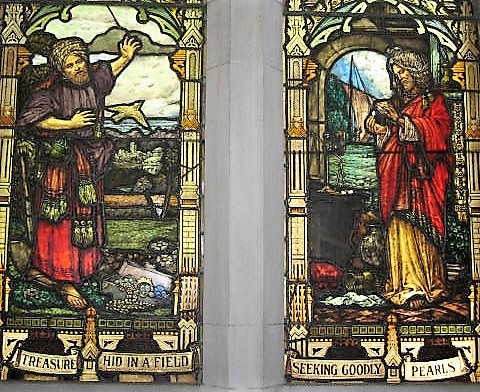
I. The Picture – The Gospel uses three images for the kingdom, two of which we will look at here (a buried treasure and a pearl), and the third of which (a net) we will examine later. Both the treasure and pearl symbols are used elsewhere in Scripture. Studying those other passages can be helpful in fine-tuning our understanding of the gift of the Kingdom, which Jesus is discussing in today’s Gospel.

Buried Treasure – The concept of treasure (buried in the case of today’s Gospel) is mentioned elsewhere by Jesus:

Do not store up for yourselves treasures on earth, where moth and rust destroy, and where thieves break in and steal. But store up for yourselves treasures in heaven, where moth and rust do not destroy, and where thieves do not break in and steal. For where your treasure is, there your heart will be also (Matt 6:19-21).

Although we tend to think of treasure as a bunch of “stuff,” the image of treasure that Jesus uses in today’s Gospel is more a symbol for the heart and for our deepest desires, because our treasure is linked to our heart. One of the greatest gifts that God offers us is the gift a new heart, one that values most what He offers: holiness and Himself. One of the most fundamental prophetic texts of the Old Testament announces what Jesus has fulfilled:

Oh, my people, I will sprinkle clean water on you, and you will be clean; I will cleanse you from all your impurities and from all your idols. I will give you a new heart and put a new spirit in you; I will remove from you your heart of stone and give you a heart of flesh. And I will put my Spirit in you and move you to follow my decrees and be careful to keep my laws (Ezekiel 36:25-27).

The great treasure of the Kingdom of God gives us a new heart, by choosing it our heart is changed. To have a new heart is to experience our desires changing. We become less focused on passing, worldly things and more interested in the lasting treasure of the Kingdom of Heaven. We begin to love what and whom God loves. We begin to love holiness, justice, chastity, goodness, righteousness, and truth. We begin to love our spouse, family, the poor, and even our enemies the way God loves them. Our heart becomes alive with joy and zeal for the Kingdom of God and an evangelical spirit impels us to speak what we know to be true.

Yes, the buried, hidden treasure of the Kingdom of God unlocks our heart, bringing new life coursing through our veins, through our very soul. In choosing this treasure we get a new heart, for where our treasure is, there also will be our heart.

A Pearl – The second image comes from the Wisdom tradition, in which holy Wisdom is likened to a pearl. Here, too, is described one of the most precious gifts of the Kingdom of God: a new mind through holy Wisdom. What is this new mind? It is one that begins to think more and more as God does, one that shares His priorities and vision, one that sees as He does; it is the mind of Christ (cf 1 Cor 2:16). With this new mind we see through and reject worldly thinking, priorities, and agendas. We come to rejoice in God’s truth and to grasp more deeply its beauty and sensibility. What a precious gift the new mind is, thinking with God and having the mind of Christ!

So here are two precious manifestations of the Kingdom of God: a new heart and a new mind, which is really another way of saying, “a whole new self.” God is offering us a new life, a new self, a complete transformation.

II. The Price – What are these offerings of the Kingdom worth and what do they ultimately cost? The answer is clear in today’s Gospel: they cost, and are worth, everything. Regarding the hidden treasure and the pearl, the text says that both men went and sold all they had for them. They were willing to forsake everything for these precious items.

Be careful not to reduce this Gospel to a moralism. Notice that these men were eager to go and sell, to forsake, everything else. They did this not so much because they had to, but because they wanted to. They wanted to pay the price and did so with eagerness because they were so enamored of the glory they had found. Here is the gift to seek from the Lord: a willing and eager heart for the Kingdom of God, so eager that we are willing to forsake anything and everything for it.

For ultimately the Kingdom of God does cost everything and we will not fully inherit it until we are fully done with this world and its claims on our heart.

The gift to seek from the Lord is not that we forsake the world with sullen faces and depressed spirits, as if we were paying taxes. No! The gift to seek is that we, like these men, be so taken by the glory of God and His kingdom that we are more than willing to set aside anything that gets in our way, that we are so eager for the things of the Kingdom that loss of the world’s intoxicating trinkets means almost nothing.

Do you see? This is the gift: a heart that appreciates the true worth of the Kingdom of God such that no price is too high. Scripture says elsewhere,

  What is more, I consider everything a loss compared to the surpassing greatness of knowing Christ Jesus my Lord, for whose sake I have lost all things. I consider them rubbish, that I may gain Christ (Phil 3:8).

  For this light momentary affliction is preparing for us an eternal weight of glory beyond all comparison (2 Cor 4:17).

  I consider that our present sufferings are not worth comparing with the glory that will be revealed in us (Rom 8:18).

  No eye has seen, no ear has heard, no mind has conceived what God has prepared for those who love him (1 Cor 2:9).

  But one thing I do: Forgetting what is behind and straining toward what is ahead, I press on toward the goal to win the prize for which God has called me heavenward in Christ Jesus (Phil 3:13-14).

Yes, the Kingdom of God is more than worth any price we must pay, and ultimately we will pay all for it. Pray for an eager and willing spirit that comes from appreciating the unsurpassed worth of the Kingdom!

III. The Peril – The final movement contains a warning about our upcoming judgment. Ultimately, we either want the Kingdom of God or we don’t. Hence the Lord speaks of a net that captures everything (referring to our summons to the judgment). Those who want the Kingdom and have accepted its value and price will be gathered in; those who do not want the Kingdom of God and do not accept its value will be cast aside.

There are clearly some who do not value the Kingdom. They may desire “heaven,” but it is one of their own making, not the real Heaven. The true Heaven is the Kingdom of God in all its fullness. The Kingdom of God includes things like forgiveness, mercy, justice, chastity, love of the poor, love of one’s enemies, and the celebration of what is good, true, and beautiful. The Kingdom of God has God, not man, at its center.

Yes, there are many who neither want nor value some or even most of these things. When the net is drawn in, our decision is made final. Though we may wish for a fairy tale ending, one in which opponents of the Kingdom suddenly love it, God quite clearly says that at the judgment one’s decision for or against the Kingdom becomes final; it is fixed forever.

An old song says, “Better choose the Lord today, for tomorrow very well might be too late.” Thus we are warned that the judgment looms and that we ought to be earnest in seeking a heart from the Lord that eagerly desires the Kingdom and appreciates its worth above all people and all things. In the end, we get what we want. Either we will have chosen the Kingdom or not.

Pray for a new heart, one that values the Kingdom of Heaven above all else. We ought to consider ourselves warned.

The Gospel today is about what we truly value, and is presented in three movements.

This song says, “You can have all this world, just give me Jesus.”

Why Would God Sow Seed He Knows Will Bear Little or No Fruit?

At Sunday Masses the past two weeks we have heard parables about seeds and sowers. In Sunday’s Gospel we pondered the mystery that God permits weeds to grow and counsels patience in too radically seeking to prevent or remove them. This demonstrates his respect for our freedom and his power to draw good even from evil and suffering. 

The week prior, we heard of seed falling on various surfaces and yielding varying results. Here too is the interaction of God’s providence and power with our freedom to prepare our soul as rich soil or not. But recently, someone asked me the following related question: “Since the sower is the Son of Man, Jesus Himself, why would He, who knows everything ahead of time, sow seed He knew would not bear fruit?”

First, let’s review the text:

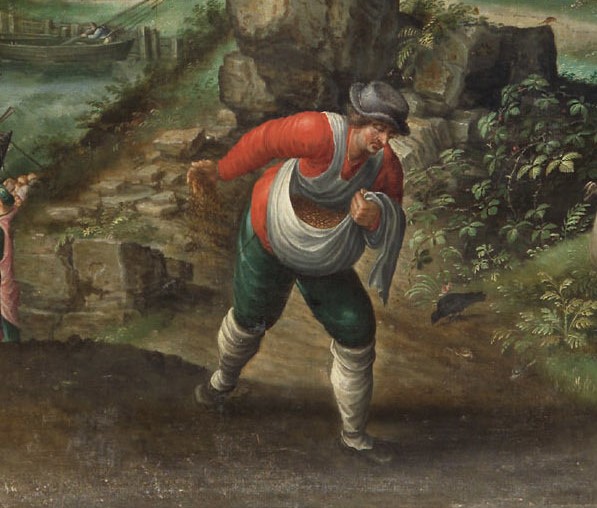
A sower went out to sow. And as he sowed, some seed fell on the path, and birds came and ate it up. Some fell on rocky ground, where it had little soil. It sprang up at once because the soil was not deep, and when the sun rose it was scorched, and it withered for lack of roots. Some seed fell among thorns, and the thorns grew up and choked it. But some seed fell on rich soil, and produced fruit, a hundred or sixty or thirtyfold. Whoever has ears ought to hear” (Matt 13:1-9).

So why would God waste any seed on rocky ground, thin soil, or the path?

Perhaps we can only propose some possible “answers.” I use quotes around the word because we are in fact touching on some mysteries and can only speculate. Here are some possibilities:

I.  God is extravagant. It is not just seed He scatters liberally; it is everything. There are billions of stars in billions of galaxies, most of them seemingly devoid of life as we understand it. Between these billions of galaxies are huge amounts of what appears to be empty space. On this planet, where just one species of bird would do, there are thousands. Likewise, there are vast numbers of different sorts of insects, mammals, fish, and trees. “Extravagant” barely covers it! The word “extravagant” means “going or wandering beyond.” God has gone vastly beyond anything we can imagine, but He is love and love is extravagant. The image of Him sowing seed in an almost careless way is thus consistent with the usual way of God.

Thus God’s extravagant love is illustrated by His sowing the seed of His word everywhere. Love does not say, “What is the least I can do?” It says, “What more can I do?” Love does not say, “I will give only if I get something back.” If a man loves a woman, he does not look for the cheapest gift to give her on her birthday. Rather, he looks for an extravagant gift. God is love and He is extravagant.

II.  God loves and offers the seed of His Word even to those who will reject Him. Remember, as Jesus goes on to explain, the soil that fails to receive the Word is a symbol of those who allow riches, worldly preoccupation, persecution, and the demands of the Word to draw them away from God. Even knowing this, God still loves them. He still wills their existence. Scripture says elsewhere, But I tell you, Love your enemies and pray for those who persecute you, that you may be sons of your Father in heaven. He causes his sun to rise on the evil and the good, and sends rain on the righteous and the unrighteous (Matt 5:44-45).

Yes, God loves even those who will ultimately reject Him. Despite knowing this ahead of time, He will not say, “You cannot have my word; I refuse to provide you sufficient grace.” No, He scatters that seed even though He knows it will not bear the fruit He wishes. Further, He continues to send the sun and rain even on those who will reject Him.

This parable shows forth God’s unfailing love. He sows seed even knowing it will not bear the fruit He wants. He wills the existence of all, even those who He knows will reject Him.

III.  God is just. Were the Lord to take back the seed that fell in unfruitful places, one could argue that He withdrew His grace and that people were lost as a result. In other words, one could claim that God manipulated the process by withdrawing every possible grace. But God, in justice, calls everyone and offers everyone sufficient grace for them to come to faith and salvation.

IV.  God respects our freedom. The various places the seed falls is indicative of human freedom more so than illustrative of God’s intent. God freely offers the grace of His word, but we must freely receive it into the soil of our life. Some of us insist on having stony hearts or immersing ourselves in the cares of the world. God will offer the seed, respecting our freedom to be receptive or refusing. Were He to condition His offer and blessings on us offering the right kind of soil, one could reasonably argue that he was pressuring us or manipulating our freedom.

V.  God wants us to persevere, to sow faithfully rather than merely harvesting. Sometimes we can become discouraged when it seems that our work has borne little fruit. The temptation is to give up. There’s an old saying, “God calls us to be faithful, not successful.” In other words, it is up to us to be the means through which the Lord sows the seed of His Word. By God’s grace, the Word is in our hands, but the harvest is not.

This parable teaches us that not all the seed we sow will bear fruit. In fact, much of it will not.

The simple mandate is that we preach the Word. Go unto all the nations and make disciples. St. Paul would later say to Timothy, Preach the Word; be prepared in season and out of season; correct, rebuke and encourage—with great patience and careful instruction (2 Tim 4:2). In other words, sometimes the gospel is accepted; sometimes it is rejected. Preach it anyway. Sometimes the gospel is popular, sometimes not. Preach it anyway. Sometimes the gospel is in season; sometimes it is out of season. Preach it anyway. Sow the seed; don’t give up.

Discharge your duty! St. Paul goes on to remark, sadly, For the time will come when people will not put up with sound doctrine. Instead, to suit their own desires, they will gather around them a great number of teachers to say what their itching ears want to hear. They will turn their ears away from the truth and turn aside to myths. But you, keep your head in all situations, endure hardship, do the work of an evangelist, discharge all the duties of your ministry (2 Tim 4:3-5). Once again the message is the same: preach anyway; sow the seed of the Word; persevere; do not give up; do not be discouraged. Discharge your duty and be willing to endure hardship; just preach! Some of the seed will yield a rich harvest, some will not; preach anyway.

So, permit these “answers.” God sows seed He knows will bear no fruit because He is extravagant, because He loves and wills the existence even of those He knows will reject Him, because of His justice, because He respects our freedom, and because He wants to teach us to persevere regardless of the outcome.

Saint or Ain’t? A Homily for the 16th Sunday of the Year

We live in difficult times for the Church; from many sectors the very legitimate cry for reform goes up frequently. Beyond the sexual abuse scandal there are also deep concerns regarding the uncertain trumpet of Catholic preaching, lukewarm and nominal Catholics, an overall lack of self-discipline among Catholics, and a lack of disciplining by the bishops and clergy of those Catholics (lay and clergy) who cause scandal. The list of concerns is long, and in general I have been sympathetic on this blog to the need for reform and greater zeal in the Church.

The Gospel this Sunday, however, featuring the Parable of the Wheat and Tares, cautions against overzealousness in the attempt to root out sin and sinners from the Church. The Lord’s warning to the farmhands who wanted to tear out the weeds was that they might harm the wheat as well. He wants them to wait until the harvest. There will come a day of reckoning, but it is not now.

This does not mean that we are never to take notice of sin or to rebuke a sinner. There is certainly the need for discipline in the Church; other texts call for it as well. But today’s Gospel is meant to warn against a scouring that is too thorough, a puritanical clean sweep that overrules God’s patience and seeks to turn the Church from a hospital for sinners into a germ-free (and hence people-free) zone.

We are going to need to depend on God’s patience and mercy if any of us are to stand a chance. People who summon the wrath of God upon (other) sinners may end up destroying themselves as well. We all have a journey to make from being an “ain’t” to being a saint.

Let’s allow today’s Gospel to give us some guidance in finding the right balance between the summons to reform and the summons to patience. The guidance comes in four steps.

I.  WAKE UP. Jesus proposed another parable to the crowds, saying: “The kingdom of heaven may be likened to a man who sowed good seed in his field. While everyone was asleep his enemy came and sowed weeds all through the wheat, and then went off.”

Notice that everyone was sleeping when the enemy sowed weeds. It is a great mystery as to why God allowed Satan to do this in the first place, but there is far less mystery as to why Satan has been so successful in our times. The weeds are numerous and are vigorously growing. Part of the reason for this is that we in the Church have been sleeping while Satan has been steadily sowing his weeds among us.

Don’t just blame the Church leadership (although we certainly share plenty of the blame). Many throughout the Church have been in a deep moral slumber. Too many Catholics will watch anything, listen to anything, and expose themselves to anything. We just “go with the flow,” living unreflective, sleepy lives. We also allow our children to be exposed to almost anything. Too many parents don’t know enough about what their children are doing: what they watch, what they listen to, where they are surfing on the Internet, and who their friends are. We rarely think of God or His plan for our lives. On the whole, our priorities are more worldly than spiritual. We are not awake and wary of sin and its incursions; we are not outraged. We take little action other than to shrug. We seem to be more concerned with fitting in than in living as a sign of contradiction to the ways of the world.

Church leadership, too, has been inwardly focused. While the culture was melting down beginning in the late 1960s, we were tuning guitars, moving the furniture in the sanctuaries, debating about Church authority, engaging in gender wars, and having seemingly endless internal squabbles about every facet of Church life. I do not deny that there were right and wrong answers in these debates and that rebellious trends had to be addressed, but while all this was going on Satan was sowing seeds and we lost the culture.

We are just now emerging from 50 years in a cocoon to find a world gone mad. We who lead the Church (clergy and lay) have to admit that this happened on our watch.

It is long past time to wake up to the reality that Satan has been working while we’ve been bickering and singing songs to ourselves.

Blaming one side of the Church or the other, faulting this kind of liturgy or that, is not very helpful because the focus is still inward.

It’s time to wake up and go out. There is work to be done in reclaiming the culture for Christ and in re-proposing the Gospel to a world that has lost it.

Step one in finding a balance between the need for reform and the need for patience is to wake up.

II.  WISE UP. When the crop grew and bore fruit, the weeds appeared as well. The slaves of the householder came to him and said, “Master, did you not sow good seed in your field? Where have the weeds come from?” He answered, “An enemy has done this.”

Part of the sobriety we have to regain is the understanding that we have an enemy who hates us—Satan. He is responsible for much of the spiritual, moral, and even physical ruin we see around us. We have been dismissive of his presence for far too long, as though he were a fairy tale. While we cannot blame everything on him, for we connive with him and also suffer from weakness of the flesh and susceptibility to the bad influence of the world, Satan is real; he is an enemy and he hates us. He hates our children. He hates the Church. He hates anything and anyone holy or even on the path to holiness.

We have to wise up and ask the Lord for an anointing. We need not utterly fear the devil, but we do need to understand that he is at work. We need to learn his moves, designs, tactics, and tools. Once we can recognize him, we need the grace to rebuke him at every turn.

Now be careful here. To wise up means to learn and understand Satan’s tactics, but it does not mean to imitate them in retaliation. Upon waking up and wising up, some want to go right to battle—but in worldly ways. The Lord often proposes paradoxical tactics that are rooted in the wisdom of the cross, not the world. Wising up to Satan and his tactics does not typically mean to engage in a full frontal assault. Often the Lord counsels humility to battle against pride, love to conquer hate, and accepted weakness to overcome strength.

To wise up means to come to the wisdom of the cross, not the world. The Lord is not nearly as warlike in His response to His enemy as some reformers propose to be. It is fine to be appropriately zealous for reform and to want to usher in change rapidly, but be very careful what wisdom you are appealing to. Scripture says, Do not deceive yourselves. If any one of you thinks he is wise by the standards of this age, he should become a “fool” so that he may become wise. For the wisdom of this world is foolishness in God’s sight (1 Cor 3:19-20).

Step two in a finding a balance between the need for reform and the need for patience is to wise up.

III.  WAIT UP. His slaves said to him, “Do you want us to go and pull them up?” He replied, “No, if you pull up the weeds you might uproot the wheat along with them. Let them grow together until harvest …”

We have already laid the groundwork for the Lord’s rebuke to these overly zealous reformers. Today in the Church we are well aware of the need for reform; so is the Lord. He says, clearly, an enemy has done this. Yet to those who want to go through the Church rooting out every sinner, ne’er-do-well, and bad theologian (and there are many), and who call for a severe clampdown by bishops across the board, the Lord presents a balancing notion.

There is need for discipline in the Church and even for punitive measures from time to time. The Lord himself proposes excommunication in certain instances (e.g., Matt 18:17); St Paul does, too (e.g., 1 Cor 5:5). Yet these texts need to be balanced by texts such as today’s Gospel. Fraternal correction is an essential work of charity but it must be conducted with patience and love.

The Lord is patient. In today’s Gospel, He directs us to be prepared to wait, and to not be overly anxious to pull out weeds lest we harm the wheat. Remarkably, the Lord says, let them grow together. Notice that now is the time to grow; the harvest comes later. In certain (rare) instances the harm may be so egregious that the Church must act to remove the sinner or to discipline him or her more severely, but there is also a place for waiting and allowing the wheat and tares to grow together. After all, sinners may repent; the Lord wants to give people the time they need to do that. Scripture says, God’s patience is directed to our salvation (2 Peter 3:9).

So while there is sometimes a need for strong discipline in the Church, there is also this directive to balance such notions. Leave it be; wait. Place this in the hands of God. Give the sinner time to repent. Keep working and praying for that but do not act precipitously.

We have had many discussions here on the blog about whether and how bishops should discipline Catholic politicians who, by their bad example and reprehensible voting patterns, undermine the Gospel and even cost lives through their support of abortion and euthanasia.

While I am sympathetic to the need for them to be disciplined, it remains a judgment for the bishop to make as to who, how, and when.

There are Scriptures that balance one another. In the end, we cannot simply make a one-size-fits-all norm. There are prudential aspects to the decision and the Lord Himself speaks to different situations in different ways.

In today’s Gospel the Lord says that we should wait. Generally, this is good advice to follow. After all, how do we know that we don’t or won’t need more time? Before we ask God to lower the boom on sinners we ought to remember that we are going to need His patience and mercy too. Scripture says, The measure that you measure to others will be measured back to you (Matt 7:2; Luke 6:38). Be very careful before summoning God’s wrath, for who may endure the Day of his coming? (Mal 3:2)

Step three in a finding a balance between the need for reform and the need for patience is to “wait up” and balance zeal with patience.

IV.  WASH UP. Then at harvest time I will say to the harvesters, “First collect the weeds and tie them in bundles for burning; but gather the wheat into my barn.”

So you see there is a harvest. Those who have sinned or led others to sin, and have not repented, are going to have to answer to the Lord for it.

The Lord is no pushover; He does not make light of sin. In telling us to wait, He does not mean to say that judgment will never come, but His general advice is to leave it to Him. To us He says, in effect, “As for you, wash up, get ready, and help others to get ready as well. Judgment day is surely coming and every knee will bend to me; everyone will have to render an account.”

That’s it. Wash up! You’re either going to be a saint or an “ain’t.” For now, the wheat and tares grow together. But later the tares and all the weeds will be gathered and cast into the fire.

Step four in a finding a balance between the need for reform and the need for patience is to “wash up,” to get ready.

So here’s the balance: God is patient, but there is ultimately a harvest. By God’s grace we have to get ready for it. To the overly zealous God says, “Wait,” but to the complacent He says, “Wake up, wise up, and wash up.”