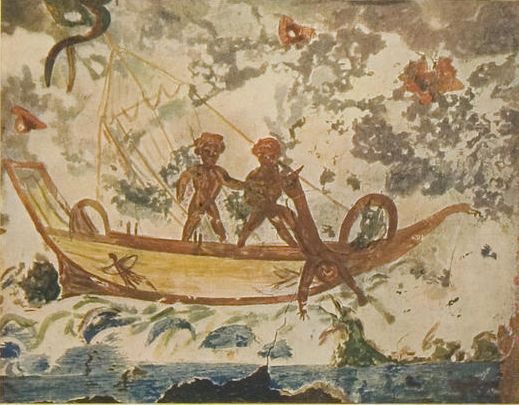
Reluctant Prophet – The Story of Jonah

Catacombs of Priscilla

Of all the prophets, Jonah is perhaps the most reluctant; his struggle with sin is not hidden. We are currently reading Jonah’s story in daily Mass. In the story we see a portrait of sin and of God’s love for sinners. Psalm 139 says, beautifully,

Whither shall I go from thy spirit? Or whither shall I flee from thy face? If I ascend into heaven, thou art there; if I descend into hell, thou art present. If I take my wings early in the morning, and dwell in the uttermost parts of the sea, Even there also shall thy hand lead me, and thy right hand shall hold me (Ps 139: 7-10).

Let’s examine the story of Jonah and allow its teachings to reach us.

I. Defiance This is the word of the LORD that came to Jonah, son of Amittai: “Set out for the great city of Nineveh, and preach against it; their wickedness has come up before me.” But Jonah made ready to flee to Tarshish away from the LORD.

To defy means to resist what one is told to do, openly and boldly. Defiance also indicates a lack of faith because it comes from the Latin “dis” (against) and “fidere” (believe). Hence Jonah is not just insubordinate; he is unbelieving and untrusting.

His scoffing and defiance likely result from hatred or excessive nationalism. Nineveh is the capital of Syria, the mortal enemy of Israel. Jonah instinctively knows that if they repent of their sinfulness they will grow stronger. Rather than trusting God, he brazenly disobeys, foolishly thinking that he can outrun God.

II. Distance He went down to Joppa, found a ship going to Tarshish, paid the fare, and went aboard to journey with them to Tarshish, away from the LORD.

Tarshish is widely held to refer to the coastline of modern-day Spain. In order to avoid going 500 miles into God’s will, Jonah runs some 1500 miles away. It’s always a longer journey when you disobey God.

Note that he also puts down good money in order to flee. Indeed, many people spend lots of money and go miles out of their way in order to be able to stay in sin. Yes, sin is usually very expensive—but many seem quite willing to pay the price.

The simplicity of holiness is often far less onerous and less costly as well. Like Jonah, though, many line up to pay the price and take the long, painful journey deeper into defiance and sin.

How much of our trouble comes from our sin? The great majority of it. So much suffering, so much expense, so much extra mileage could be avoided if we just obeyed God. The bottom line (if you’ll pardon the financial pun) is that sinful choices are usually very costly.

III. Disturbance The LORD, however, hurled a violent wind upon the sea, and in the furious tempest that arose the ship was on the point of breaking up. Then the mariners became frightened and each one cried to his god. To lighten the ship for themselves, they threw its cargo into the sea.

Jonah’s defiance sends him and others headlong into a storm that grows ever deeper. The teaching is clear: persistent and unrepentant sin brings storms, disturbances, and troubles. As our defiance deepens, the headwinds become ever stronger and the destructive forces ever more powerful.

Note that Jonah’s defiance also endangers others. This is another important lesson: in our sin, our defiance, we often bring storms not only into our own life but also into the lives of others. What we do, or fail to do, affects others.

The mariners, fearing for their lives, also lose wealth and suffer great losses (by throwing their cargo overboard) on account of Jonah’s sinfulness.

Similarly, in our own culture today a good deal of pain and loss results from the defiant, selfish, and bad behavior of many. On account of selfishness and sexual misbehavior, many families have been torn apart. There is abortion, disease, teenage pregnancy, children with no fathers, and all the grief and pain that come from broken or malformed families. It is of course the children who suffer the most pain and injustice as a result of so much bad adult behavior.

To all this pain can be added many other sufferings caused by our greed, addiction, lack of forgiveness, pride, impatience, and lack of charity. These and many other sins unleash storms that affect not only us but others around us as well.

No one is merely an individual; we are also members of the Body, members of the community, whether we want to admit it or not.

Jonah is a danger and a cause of grief to others around him. So, too, are we when we defiantly indulge sinfulness.

IV. Delirium Meanwhile, Jonah had gone down into the hold of the ship, and lay there fast asleep.

While all these storms (which he caused) are raging, Jonah is asleep. Often the last one to know or admit the damage he does is the sinner himself. Too many wander around in a kind of delirium, a moral sleep, talking about their rights and insisting that what they do is “nobody else’s business.” Yet all the while the storm winds buffet and others suffer for what they do. So easily they remain locked in self-deception and rationalizations, ignoring the damage they are inflicting upon others.

Many people today talk about “victimless sins,” actions that supposedly don’t hurt anyone. Those who are morally alert do not say such things; those who are in the darkness of delirium, in a moral slumber, say them. Meanwhile, the gales grow stronger and civilization continues to crumble. All the while, they continue to ramble on about their right to do as they please.

V. Dressing Down The captain came to him and said, “What are you doing asleep? Rise up, call upon your God! Perhaps God will be mindful of us so that we may not perish.” Then they said to one another, “Come, let us cast lots to find out on whose account we have met with this misfortune.” So they cast lots, and thus singled out Jonah. “Tell us,” they said, “what is your business? Where do you come from? What is your country, and to what people do you belong?” Jonah answered them, “I am a Hebrew, I worship the LORD, the God of heaven, who made the sea and the dry land.” Now the men were seized with great fear and said to him, “How could you do such a thing?” They knew that he was fleeing from the LORD, because he had told them.

In a remarkable turn in the story, those who are not believers in the God of Israel dress down Jonah, who is to be God’s prophet, unto repentance! It’s a pretty bad day for a prophet when those whom he is supposed to address, must turn and call him to conversion. They seem to fear God more than he does!

First there comes the pointed question, “What are you doing asleep?” Yes, what are you doing? Do you have any idea how your behavior, your sins, are affecting the rest of us? Wake up from your delusions. Stop with your self-justifying slogans and look at what’s really going on!

Next they say to him, “Pray!” In other words, get back in touch with God, from whom you’re running. If you won’t do it for your own sake, then do it for ours—but call on the Lord!

This is what every sinner, whether outside the Church or inside, needs to hear: wake up and look at what you’re doing; see how you’re affecting yourself and all of us. Turn back to God lest we all perish.

VI. Despair They asked, “What shall we do with you, that the sea may quiet down for us?” For the sea was growing more and more turbulent. Jonah said to them, “Pick me up and throw me into the sea, that it may quiet down for you; since I know it is because of me that this violent storm has come upon you.”

Jonah is now beginning to come to his senses, but not with godly sorrow, more with worldly sorrow. Godly sorrow brings repentance that leads to salvation and leaves no regret. Worldly sorrow brings death (2 Cor 7:10). Somewhat like Judas, Jonah and many other sinners do not repent to the Lord but rather are merely ashamed of themselves.

In effect, Jonah says to them, “Kill me. I do not deserve to live.” This is not repentance; it is despair.

VII. Dignity still the men rowed hard to regain the land, but they could not, for the sea grew ever more turbulent.

Surprisingly, the men are not willing to kill him, at least not as the first recourse. Despite his sin, Jonah does not lose his dignity. Even the fallen deserve our love and respect as fellow human beings. It is too easy for us to wish to destroy those who have harmed us, returning crime for crime, sin for sin.

But God would have us reach out to the sinner, to correct with love.

It is true, however, that not everyone is willing or able to be corrected. Some things must ultimately be left to God. Our first instinct should always be to respect the dignity of every person—even great sinners—and strive to bring them to the Lord with loving correction.

VIII. Deliverance Then they cried to the LORD, “We beseech you, O LORD, let us not perish for taking this man’s life; do not charge us with shedding innocent blood, for you, LORD, have done as you saw fit.” Then they took Jonah and threw him into the sea, and the sea’s raging abated. Struck with great fear of the LORD, the men offered sacrifice and made vows to him. But the LORD sent a large fish, that swallowed Jonah; and Jonah remained in the belly of the fish three days and three nights. From the belly of the fish Jonah prayed to the LORD, his God. Then the LORD commanded the fish to spew Jonah upon the shore.

In the end, the men must hand Jonah over to the Lord. Somehow, they sense His just verdict yet they fear their own judgment and ask for His mercy.

In many American courtrooms, upon the pronouncement of a death sentence, the judge says, “May God have mercy on your soul.” Even in the sad situation in which we can do little but prevent people from ever harming others, we ought to appreciate their need for God’s mercy as well as our own.

God does deliver Jonah. After his “whale” of a ride, a ride in which he must experience the full depths and acidic truth of his sinfulness, Jonah is finally delivered by God right back to the shore of Joppa where it all began.

IX. Determination Then the word of the Lord came to Jonah a second time: “Go to the great city of Nineveh and proclaim to it the message I give you.” Jonah obeyed the word of the Lord and went to Nineveh (Jonah 3:1-3).

Yes, God works with the sinner, drawing him back. He is the God of the second chance. Thank you, Lord, for your grace and mercy. He remembers our sins no more. In effect, God says to Jonah, “Now, where were we?”

God does not save us merely for our own sake, but also for the sake of others with whom our life is intertwined. Jonah will go finally to Nineveh and there proclaim a message that will be heeded by those who are so lost in sin that they do not know their right hand from their left (see Jonah 4:11). Hmm, now why does this description seem so familiar?

Here is a video of a performance of the Peccavimus (we have sinned) from the oratorio “Jonas,” by Giacomo Carissimi. It is a luscious, heartfelt piece depicting the repentance of the Ninevites. I wonder if (and hope that) the young people who sang it understood its significance for them, too.

Cross-posted at the Catholic Standard: Reluctant Prophet – The Story of Jonah

Words of Wisdom from the Carmina Burana

I was at the Kennedy Center last night with friends to hear a performance of the popular cantata Carmina Burana. It was composed by Carl Orff in the mid-1930s and consists of a collection of poems from the Middle Ages (set to music). The poems, mostly of a secular nature, were found in Benediktbeuern Abbey in Bavaria in the early 1800s.

Among the poems is Estuans interius (Seething inside), a lament on the price one pays for indulging the passions (e.g., lust, greed, gluttony). Satisfying our passions can provide temporary gratification, but eventually there is a price to be paid.

Lines from the poem are shown in bold, black italics while my comments are in plain red text.

Burning inwardly with strong anger, in my bitterness I speak to my soul; created out of matter, ashes of the earth, I am like a leaf with which the winds play.

Indulgence often leads to compulsions and addictions that lock us into a cycle of disappointment, bitterness, and self-reproach. This is seldom helpful because it robs us of the very self-regard that could motivate us to focus on our true potential and thereby improve. It is what St. Paul calls worldly sorrow, which is deadly, as opposed to Godly sorrow, which restores us to God’s care (see 2 Cor 7:10).

Left to our unrestrained passions we are blown about like a leaf in the wind.

Whereas it is proper for a wise man to place his foundations on rock, I, in my folly, am like a flowing river, never staying on the same course.

This is another image of the foolishness of intemperance. Our life meanders like a river, and we lose touch with our goal. We’re all over the map, not living as though we know where we are headed; we cannot accomplish earthly goals let alone heavenly ones.

Jesus said, Everyone then who hears these words of mine and does them will be like a wise man who built his house on the rock. And the rain fell, and the floods came, and the winds blew and beat on that house, but it did not fall, because it had been founded on the rock. And everyone who hears these words of mine and does not do them will be like a foolish man who built his house on the sand. And the rain fell, and the floods came, and the winds blew and beat against that house, and it fell, and great was the fall of it (see Mat 7:24-27).

I am borne along like a ship without a sailor, just as a wandering bird is carried along paths of air.

If we do not subject our passions to our reason, we are easily carried along by worldly forces. Scripture says,

        • Jesus Christ is the same yesterday and today and forever. Do not be carried away by all kinds of strange teachings (Hebrews 13:8-9).
        • Therefore, beloved, since you already know these things, be on your guard so that you will not be carried away by the error of the lawless and fall from your secure standing (1 Peter 3:17).
        • No longer be infants, tossed about by the waves and carried around by every wind of teaching and by the clever cunning of men in their deceitful scheming (Eph 4:14).

Though secular in source, this poem conforms to the teaching of Scripture: our passions, especially when indulged, make us susceptible to all sorts of foolishness. Our minds become darkened and we are an easy target for even the most ludicrous and deluded teachings and philosophies. Why does this happen? Because Christ is not the captain of our thoughts, and reason is not the pilot of our life; rather, our unmoored passions are at the helm, and the result is a darkened mind and increasing compulsion and addiction.

Chains do not keep me nor does a key; I seek men like myself, and I am joined with rogues.

When the passions are indulged, it becomes harder and harder to resist them. St. Augustine wrote, “For of a forward will, was a lust made; and a lust served, became custom; and custom not resisted, became necessity” (Confessions, 8.5.10).

Sinners tend to seek one another out both for comfort and validation. St. Paul warned, For the time will come when people will not put up with sound doctrine. Instead, to suit their own desires, they will gather around them a great number of teachers to say what their itching ears want to hear (2 Tim 4:3). When we are both surrounded by and validated by sinners, our passions are further excited. Over time, we keep company with a worse and worse crowd.

I go on the broad way after the manner of youth; and I entangle myself in vice, forgetful of virtue; greedy for pleasure more than for salvation, I, dead in my soul, attend to the needs of my flesh.

Of this “broad way” Jesus said, Enter through the narrow gate. For wide is the gate and broad is the way that leads to destruction, and many enter through it. But small is the gate and narrow the way that leads to salvation, and only a few find it (Mat 7:13-14). Why is the way to salvation narrow? Because it is the way of the cross and most people do not want to control their passions or say no to sin. As the poem says, most people want momentary pleasure more than eternal salvation; at some point they become so dead in mortal sin that they only attend to the needs of the flesh.

Yes, these are great words of wisdom from the Carmina Burana. Spare us, O Lord, from the slavery of intemperance!

Here is a performance of the sung version (in Latin) of the poem Estuans interius:

Cross-posted at the Catholic Standard: Words of Wisdom from the Carmina Burana

Five Fundamentals for a Firm Faith – A Homily for the 27th Sunday of the Year

The readings for this Sunday’s Mass richly describe some essential qualities of faith. There are five fundamentals that can be seen:

Wanting The apostles said to the Lord, “Increase our faith” (Luke 17:5-6).

There’s an old saying that what you want, you get. Many doubt this, thinking that they have wanted many things that they did not get. The reason for this, however, is usually because they didn’t want it enough. When we really want something (provided it is not an impossibility) we usually get it, because we have a passion for it and work at it.

Many people who say that they don’t have time to pray or to go to Mass still find time to golf and watch TV television. They find the time because they want to do these things. They don’t find time to pray or to go to Mass because they do not want to do these things enough.

When the apostles ask the Lord to increase their faith, they are asking for a deeper desire to know Him. Too often we miss a step in our prayer. We might ask the Lord to help us to pray when we really should be asking Him to give us the desire to pray. When we want to pray, we will pray. When we want to be holy, we will naturally strive for holy practices. It is about what we truly desire. Ask the Lord to help you want Him and His kingdom. Ask the Lord for a new heart that has proper wants and desires. Ask the Lord for a new mind that has the proper priorities and prefers to think about what is good, true, and beautiful. What you want, you get.

Waiting – The first reading speaks of our need to wait for the Lord’s action: How long, O LORD? I cry for help, but you do not listen! I cry out to you, “Violence!” but you do not intervene. Why do you let me see ruin; why must I look at misery? Destruction and violence are before me; there is strife, and clamorous discord. … Then the LORD answered me and said, Write down the vision clearly upon the tablets, so that one can read it readily. For the vision still has its time, presses on to fulfillment, and will not disappoint; if it delays, wait for it, it will surely come, it will not be late. The rash one has no integrity (Hab 1:2-3; 2:2-4).

Waiting is one of the great mysteries of the Christian life. It is not always clear why God makes us wait. Perhaps He is trying to strengthen our faith. Perhaps He is helping us to clarify or confirm our desires. Scripture consistently tells us that we must learn to wait for the Lord and that there are blessings for those of us who do. Here are some examples:

        • Fret not yourself; it tends only to evil … those who wait for the LORD shall possess the land (Ps 37:8).
        • Those who wait for me shall not be put to shame (Is 49:23).
        • The LORD is good to those who wait for him, to the soul that seeks him. It is good that one should wait quietly for the salvation of the LORD (Lam 3:25).
        • But they who wait for the LORD shall renew their strength, they shall mount up with wings like eagles, they shall run and not be weary, they shall walk and not faint (Is 40:31).

Waiting is a fundamental of firm faith. Gospel music is replete with waiting themes. One song says, “You can’t hurry God, you just have to wait, trust, and never doubt him, no matter how long it takes. He may not come when you want him but he’s always right on time.” Another song says, “Weeping may endure for a night, but joy will come with the morning light.” Other songs counsel that we must hold on and hold out:

        • “I promised the Lord that I would hold out, he said he’d meet me in Galilee.”
        • “Hold on just a little while longer, everything’s gonna be all right.”
        • “Keep your hand on the plow. Hold on!”
        • “Lord help me to hold out until my change comes!”

The reading from Habakkuk above warns that the rash man has no integrity. That is another way of saying that waiting is integral to the Christian life; it is a fundamental of faith. To have integrity means to have all the necessary parts that make up the whole. To lack patience, then, is to lack integrity, to lack a fundamental of the Christian faith.

Withstanding – The second reading counsels us, God did not give us a spirit of cowardice but rather of power and love and self-control. So do not be ashamed of your testimony to our Lord, nor of me, a prisoner for his sake; but bear your share of hardship for the gospel with the strength that comes from God (2 Tim 1:6-8).

This passage tells us that life has difficulties and challenges. Becoming a Christian does not necessarily make things easier. In fact, things often get harder, because we must endure the hatred and ridicule of the world. A fundamental of the Christian Faith is that being able to withstand such trials with courage.

Notice that this courage, power, and love come from God, not from us. Hence, it is grace that is being described here. This is not a moral slogan. Withstanding means that God is “standing with” us, and we with Him. Such withstanding is only possible by the relationship with God that comes by faith. In this way, we discover the power, the capacity, to withstand, to live the Christian faith courageously in a hostile world.

Working – The Gospel teaches, Who among you would say to your servant who has just come in from plowing or tending sheep in the field, “Come here immediately and take your place at table”? Would he not rather say to him, “Prepare something for me to eat. Put on your apron and wait on me while I eat and drink. You may eat and drink when I am finished”? Is he grateful to that servant because he did what was commanded? So should it be with you. When you have done all you have been commanded, say, “We are unprofitable servants; we have done what we were obliged to do” (Luke 17:6-10).

This teaching of the Lord’s can irritate us and even seem hurtful if we misunderstand grace and seek to understand this text by the flesh. Our flesh is self-centered and thinks we deserve praise and good things from God in return for the good things we do. The flesh expects—even demands—rewards, but God can never be indebted to us, never. Our good works are not our gift to God; they are His gift to us.

All our works of charity and faith, for which our flesh wants credit, are God’s work and His gift. This is made clear in this passage from the Letter to the Ephesians:

For by grace you have been saved through faith; and this is not your own doing, it is the gift of God– not because of works, lest any man should boast. For we are his workmanship, created in Christ Jesus for good works, which God prepared beforehand, that we should walk in them (Eph 2:8-10).

If I think that I did something deserving of praise and reward, I am thinking in terms of the flesh, not the Spirit. When I have done something good all I can really do is to say, “Thank you” to God. His grace alone permitted me to do it. God may speak elsewhere of rewarding us, but that is His business. He is not indebted to us in any way. When we have done everything we ought, our one disposition should be gratitude. We are useless servants in the sense that we can do nothing without God’s grace. We can only do what He enables us to do.

That said, it is clear that work is a pillar of faith. The text from today’s Gospel and the text from Ephesians above both make clear that work is something God has for us. So faith by itself, if it has no works, is dead (James 2:17). Likewise, Jesus says, “It was not you who chose me. It was I who chose you that you should go and bear fruit that will last” (Jn 15:16). Yes, work is a fundamental of faith.

Winning – We conclude with a reference back to the first reading: For the vision still has its time, it presses on to fulfillment and it will not disappoint. If it delays, wait for it, it will surely come, it will not be late (Hab 2:3).

See what the end shall be! It is true that we must want, wait, withstand, and work, but we do not do so for no reason. We have a cross to carry, but if we carry it with the Lord, we carry it to glory. There is an old gospel song with these lyrics:

Harder yet may be the fight, Right may often yield to might, Wickedness awhile may reign, Satan’s cause may seem to gain, There is a God that rules above, With hand of power and heart of love, If I am right, He’ll fight my battle, I shall have peace some day. I do not know how long ’twill be, nor what the future holds for me. But this I know, if Jesus leads me, I shall get home someday.

This is just what Habakkuk describes: we will win with Jesus. He describes a victory that is

        • Future – the vision still has its time; it presses on to fulfillment
        • Fantastic – it will not disappoint
        • Firm – it will surely come
        • Fixed – it will not be late

For all those who walk with Jesus on the way of the cross, there is victory ahead. Even here in this life we already enjoy the fruits of crosses past. Our withstanding in the past has given us strength for today. Our waiting in the past has had its fulfillment and provides the hope that our current waiting will also be fruitful. Our past work, by God’s grace, has already granted benefits to us and to others.

These are but a small foretaste of a greater glory to come, the glory that waits for us in Heaven. Yes, if we want, wait, withstand, and work, we will win! I promise it to you in the Lord Jesus Christ.

Cross-posted at the Catholic Standard: Five Fundamentals for a Firm Faith – A Homily for the 27th Sunday of the Year

Words Do Not Make Reality, As Seen in a Commercial

The situation of the man in this commercial reminds me of modern life in general. We talk a lot about freedom, but compulsiveness, addiction, and lack of self-control are more the case with the average person.

We have collectively rejected the “Ten Big Laws of God,” declaring our freedom from being told what to do. But the result has not been that we have fewer laws; rather we now have thousands of “little laws,” imposed upon us through oppressive government, by which we are told what we must do under penalty of law.

Many cultural revolutionaries have marched under the banners of freedom and tolerance, but once having gained a foothold they have tyrannically forced their agenda on others by law. The talk of tolerance and respect for differences turned out to be just that—talk.

The man in this advertisement talks a lot about how important mobility is to him, but the reality of his life is far from his self-description. In fact, he seems quite unaware of his condition. Does he not seem familiar?

Cross-posted at the Catholic Standard: Words Do Not Make Reality, As Seen in a Commercial

Adoration 2.0 – A Unique Insight from a Spiritual Master

When we think of the word “adoration,” we think of a high form of love, perhaps the highest. Theologically, we equate adoration with latria, the worship and love due to God alone. In the vernacular, to say “I adore you” is to indicate an intense and elevated form of love.

Liturgically, adoration of the Lord in the Blessed Sacrament indicates a period during which one enters into the experience of loving God and gazing upon Him in that love. The Lord, too, extends a gaze of love to us. This is beautifully stated in the Song of Songs: Behold, he is standing behind our wall, He is looking through the window, peering through the lattice (Song 2:9).

In these examples there is an intense yet resting love expressed, a love that is tender and deep, quiet and fixed.

However, the greatest act of adoration the world has ever known exhibited little of this quietude or restfulness. Indeed, one might call it quite stormy; though intense, it was certainly not restful. You might not consider it adoration at all, but consider this reflection by Fr. Reginald Garrigou-Lagrange, O.P.:

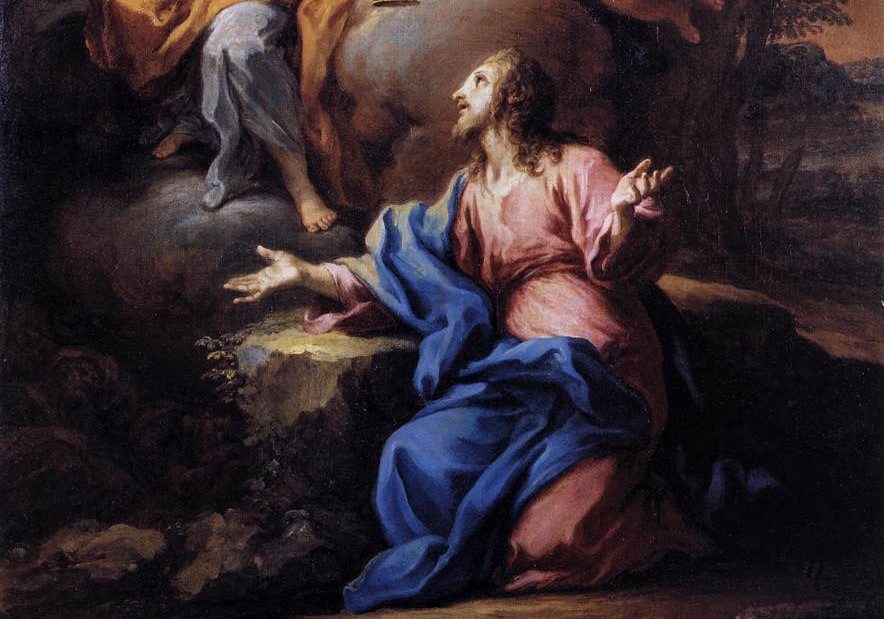
Adoration of infinite value was offered to God by Christ in Gethsemane when he prostrated himself saying, “My Father, if it be possible, let this chalice pass from me. Nevertheless, not as I will, but as though wilt.” Christ’s adoration of the Father recognized in a practical and profound manner the sovereign excellence of God … The Savior’s adoration continued on the cross (The Three Ages of the Interior Life, Vol 2, p. 251).

At the root of this most perfect act of adoration was obedience. Not only did Jesus love God, but he wanted only what His Father wanted. True adoration of God includes both a loving acknowledgment of His excellence and a submission of our will to His in loving obedience. Out of love we offer our whole life to God.

Thus, adoration is more than mere feeling, no matter how intense. It is sacrifice; it is the willing offering of one’s very self as an act of love to God, who has so loved us. No greater love is there than to lay down one’s life for God and for those we love in Him.

Is obedience and sacrifice what you and I mean when we say that we are going to Eucharistic adoration or when we say that we adore God? The most perfect act of adoration was love expressed as obedience and sacrifice.

Cross-posted at the Catholic Standard: Adoration 2.0 – A Unique Insight from a Spiritual Master

What Conscience Dreads and Prayer Dares Not Ask

The Collect (Opening Prayer) for this week’s Masses (27th Week of the Year), though directed to God, teaches us that our prayer is not always about things with which we are comfortable. It sometimes leads us to examine areas of our life in which we struggle with sin or we struggle to desire to be free of sin. Here is the prayer:

Almighty ever-living God,
who in the abundance of your kindness
surpass the merits and the desires of those who entreat you,
pour out your mercy upon us
to pardon what conscience dreads
and to give what prayer does not dare to ask.
Through our Lord Jesus Christ, your Son,
who lives and reigns with you in the unity of the Holy Spirit,
one God, forever and ever.

After asking for God’s mercy and acknowledging that He offers us more than our minds can grasp, we make the following two requests:

(1)  [May you] pardon what conscience dreads.

(2)  [May you] give what prayer does not dare to ask.

[May you] pardon what conscience dreads.

The Catechism states the following regarding our conscience:

Deep within his conscience man discovers a law which he has not laid upon himself but which he must obey. Its voice, ever calling him to love and to do what is good and to avoid evil, sounds in his heart at the right moment. For man has in his heart a law inscribed by God. His conscience is man’s most secret core and his sanctuary. There he is alone with God whose voice echoes in his depths (# 1776).

Our conscience is not merely what we think or what it pleases us to think; it is the voice of God echoing in our depths. Whatever rationalizations we use to try to suppress our conscience, the voice of God still calls us deep inside. Deep down, we know very well what we are doing, and we know when it is wrong. No matter how many “teachers” we find who will tell us what our ears want to hear, that voice is still there.

I suspect that this is why the world and its devotees are so angry at the Catholic Church—we remind them of what God says. If our teachings were merely regarded as outdated opinions, the world would not hate us; it would not be at war with us. No matter how emphatically people deny that their conscience troubles them, deep down they know better. The louder these denials, the less we should be convinced. Why are they forever insisting that the Church change her teachings? If we’re just a pathetic and outdated institution, why do they care what we teach? Because deep down they know that we are right and do not like to be reminded of it.

Our words, the words of Christ, touch something; they prick the conscience and remind people of things they know inside but would rather forget. The voice of God echoes within, convicting them and inciting within them a godly dread of sin and its ultimate consequences.

This is true for believers as well, who, though not as openly hostile, would still prefer to avoid the voice of their conscience and do not enjoy the holy dread of sin it engenders. Note that not all sorrow for sin is from God. St. Paul distinguishes godly sorrow (which draws one to God for healing) from worldly sorrow (which deflates the sinner and has him despair of God’s healing love or of being able to change). The proper dread that conscience arouse is always a call of love from God, who bids us to repent and return to Him.

Still, we avoid what conscience dreads. Who likes to experience fear or negative feelings?

However, prayer must often ask us to look honestly at the less pleasing things in our life. This prayer bids us to listen to the dread of conscience (dread of sin and of its due punishments) and to seek pardon.

[May you] give what prayer does not dare to ask.

Some argue that the translation of this clause is not a good one. The Latin used is quod oratio non praesumit. Some prefer a softer translation in which the phrase asks God to give us the things that we are not worthy of requesting, things we do not presume to ask for because it would be too bold for us to do so. Such a translation does not offend the Latin text but does seem to miss the overall context: asking God to help us to overcome personal resistance.

We have already seen how and why many of us resist what conscience dreads and would rather not hear the voice of God echoing inside, but consider that we are hesitant to ask for many things out of fear.

The classic example of this is St. Augustine’s request that God make him chaste … but not yet! Though he could see the value of chastity, Augustine enjoyed his promiscuity and was afraid to ask the Lord to take it away.

There are many things we dare not ask for because we fear actually getting them. It’s the “be careful what you wish for” attitude. For example, many are not ready to be chaste or to be more generous because they fear the changes that such things would bring. In such situations perhaps one could pray, “Lord, if I’m not chaste, at least give me the desire to be chaste,” or “Lord, if I don’t share sufficiently with the poor, at least give me the desire to do be more generous.” If we begin to desire what God is offering, we will be more chaste and more generous because we want to be. The fear of what prayer does not dare to ask abates. Then we are ready to ask God for what He really wants to give us.

The prayer is asking us to look at our resistance and fear and to pray out of that very experience rather than suppressing or denying it.

Consider well, then, the beautiful though difficult and daring invitation of this prayer. Though directed to God, it also bids us to look within and to admit our fears and our resistance.

Cross-posted at the Catholic Standard: What Conscience Dreads and Prayer Dares Not Ask

Man Is Not an Intruder in Creation

There is a fundamental precept among climate change activists and radical environmentalists that man is an interloper in the natural world. All would be pristine if it weren’t for us. There seems to be little appreciation that humans are part of creation, that we are supposed to be here, part of the interplay among living organism in which there is both giving and taking.

The role of the human person in creation is developed quite explicitly in the Bible. In the very opening pages of the Scriptures we read of Adam and Eve:

God blessed them and said to them, “Be fruitful and multiply, and fill the earth and subdue it; rule over the fish of the sea and the birds of the air and every creature that crawls upon the earth.” Then God said, “Behold, I have given you every seed-bearing plant on the face of all the earth, and every tree whose fruit contains seed. They will be yours for food” (Genesis 1:28-31).

Man is no mere observer or denizen of creation; he has the authority of a steward. The Hebrew word used in this passage is a strong one: kabash (subdue). It means to bring something into submission, to impose a kind of order. Scripture also says, Then the LORD God took the man and placed him in the Garden of Eden to cultivate and keep it (Gen 2:15).

It is remarkable that these things are said even before Original Sin. Thus, even in the paradise of Eden there is something imperfect, something undone. Man was to work with God in the ongoing work of maintaining creation and helping it reach its potential and achieve its goals.

Original Sin harmed both man and the rest of creation. God said to Adam, Cursed is the ground because of you; through toil you will eat of it all the days of your life. Both thorns and thistles it will yield for you, and you will eat the plants of the field (Gen 3:17-18). In spite of this, God reiterates the role of the human person:

And God blessed Noah and his sons and said to them, “Be fruitful and multiply and fill the earth. The fear and dread of you will fall on every living creature on the earth, every bird of the air, every creature that crawls on the ground, and all the fish of the sea. They are delivered into your hand. Everything that lives and moves will be food for you; just as I gave you the green plants, I now give you all things” (Genesis 9:1-3).

It is this sovereign stewardship that is celebrated in Preface Five for the Sundays of the year:

It is truly right and just, our duty and our salvation, always and everywhere to give you thanks, Lord, holy Father, almighty and eternal God.

For you laid the foundations of the world and have arranged for the changing of times and seasons; you have formed man in your own image and set humanity over the whole world in all its wonder, to rule in your name over all you have made and forever praise you in your mighty works, through Christ our Lord.

And so, with all the Angels, we praise you,
as in joyful celebration we acclaim: Holy, Holy, Holy …

All these texts are an answer to the modern, secular, extremist notion that reduces man to an unnatural intruder in the created world. We are not. We are meant to be here. The world was made for us by God, and we are to exercise a dominion that brings order and greater productivity to the created order by God’s grace.

In our best moments, we have done this beautifully. Advances in agricultural science have almost miraculously raised crop yields such that abundant food can be made available worldwide for billions. Forest management has permitted us to reap the benefits of trees while keeping our forests from being depleted through replanting and other measures. Fisheries, animal husbandry, wildlife management, nature conservancies, and national parks bless millions and encourage appreciation for the natural world. We have developed an amazing ability to use the raw minerals and materials of the earth to build and make wonderful things.

Further, the rise of hospitals in the early Christian era and medical study that followed in the West has driven back disease, dramatically lowered infant mortality, and relieved an enormous amount of human suffering. Modern Western economies have raised the standard of living for huge numbers of people, drawing many out of crushing poverty and subsistence living and making food and consumer goods available in rich variety.

There surely have been times when we have polluted, been wasteful, destroyed forests, and engaged in agricultural policies that contributed to crises such as the Dust Bowl of the 1930s. However, we have also learned much, especially in the modern age.

It is unjust to demonize humanity in the name of environmentalism. We are tasked by God to take the world He gave us and make good decisions about how it should be used: some land for farming, some for forests, and some for cities and other developments. It is our role to help unlock the full potential of the natural world by using its resources to make everything from medicine to food, from paint to steel, from grapes to wines and jellies.

It is important to resist accepting the premises of an increasingly radicalized movement. Man is not the enemy. Too many activists propose morally unacceptable solutions such as abortion, sterilization, and euthanasia in the name of “population control.” Other proposals include heavy-handed government intrusion to limit family size, eliminate entire industries, and ban certain fuel sources violate subsidiarity and are likely to have a disproportionate effect on the poor. Creating hysteria about climate change and warning of impending extinction is an old tactic of this movement. I have been hearing similarly dire predictions all my life, but here we still are. Believe what you want about climate change and its causes, but be careful to note what this movement has become and the dramatic, anti-human policies it has adopted.

Humanity is the crowning glory of this planet. We are not intruders into the world of nature. God made this world and put us here in it. Irresponsible stewardship is a sin, but extremist solutions are also a sin—against the dignity of the human person.

Cross-posted at the Catholic Standard: Man Is Not an Intruder in Creation

The Decline of the Church in Europe

In yesterday’s post we pondered the decline of the Catholic faith in the United States. For us, the exodus began in the late 1960s. In Europe it had begun long before. Hard figures are difficult to come by, but in most Western European countries today, it is estimated that less than 10 percent of Catholics attend Mass weekly. C.S. Lewis lamented the great collapse of the faith in Europe in writings going back to the late 1940s.

Of all C.S. Lewis’ works, a collection known as The Latin Letters, is one of the least well known. They are his correspondence, in Latin, with Rev. Fr. Don Giovanni Calabria. Part of the reason for their relative obscurity is that they were not translated into English until 1998. The full collection of these letter can be found here: The Latin Letters of C.S. Lewis.

The letters covered a variety of topics over the years, among them the decline of faith and the erosion of moral life in Europe. This was linked to the horrifying experience of two world wars, which seem to have both resulted from and further exacerbated the decline of faith there.

At Fatima in 1917, Our Lady warned,

The war [World War I] is going to end, but if people do not cease offending God, a worse one will break out during the Pontificate of Pope Pius XI. When you see a night illumined by an unknown light, know that this is the great sign given you by God that he is about to punish the world for its crimes, by means of war, famine, and persecutions of the Church and of the Holy Father (Second Secret of Fatima).

Of course, we know what happened: the repentance did not take place. Following one of the most vivid displays of the Northern lights ever recorded (Jan 25, 1938), Germany annexed Austria in March of 1938 and invaded Poland in 1939; World War II was engaged.

Most Americans today do not fully appreciate the horrifying blood bath that was the 20th century. Conservative estimates are that 200 million people died in wars or were exterminated for ideological purposes. Loss of faith was a lasting effect of a century marked by amazing invention but at the same time an almost unimaginable body count.

These letters of C.S. Lewis open a window to that mid-century period of European history. Indeed, I would call his insights stunning in many ways. Lewis argued that Europe was in a far worse state in 1950 than she was under paganism. Would that she were even pagan, for at least the pagans accepted Natural Law. Europe, having cast off the faith, was and is in a state far worse than before she had ever heard of Christ.

In the excerpts that follow, Lewis makes the case and then proffers a solution we may wish to consider in these times that are even darker. The following passages are from the English translation by Martin Moynihan. The text is shown in black, bold italics, while my comments are in plain red text.

Let’s begin with Lewis’ assessment as to how and by what stages Europe lost the faith:

But (this) did not happen without sins on our part: for that justice and that care for the poor which (most mendaciously) the Communists advertise, we in reality ought to have brought about ages ago. But far from it: we Westerners preached Christ with our lips, with our actions we brought the slavery of Mammon. We are more guilty than the infidels: for to those that know the will of God and do not do it, the greater the punishment. Now the only refuge lies in contrition and prayer. Long have we erred. In reading the history of Europe, its destructive succession of wars, of avarice, or fratricidal persecutions of Christians by Christians, of luxury, of gluttony, of pride, who could detect any but the rarest traces of the Holy Spirit? (Letter 20, Jan 7, 1953).

This is a remarkable, sobering description. In effect there grew an appalling lack of love for God, for the poor, and for one another. Greed and sloth also took their toll. To some, even Communism seemed more virtuous than this “lip-service” faith.

The wars of which Lewis writes include not only those of the 20th century but throughout the Christian era. Consider this shockingly long list of wars, most of which involved Christians killing other Christians: European Wars of the Christian Era.

To be sure, the 20th century dealt a mortal blow to Europe. These terrible things happened on the Christian watch. However, good, even wonderful, things happened during that time as well: the building of universities and hospitals, the great flowering of much that is best in Western culture. It can be argued that the faith also prevented things from being far worse. A gradual internecine lack of love also took its toll and after the bloodiest century the world has ever known, Europe woke up to a largely faithless landscape.

Next, Lewis describes the depth of our fall:

What you say about the present state of mankind is true: indeed it is even worse than you say. For they neglect not only the Law of Christ, but even the Law of Nature as known by the Pagans. For now they do not blush at adultery, treachery perjury, theft and other crimes, which I will not say Christian doctors, but the Pagans and Barbarians have themselves denounced. They err who say: “The world is turning pagan again.” Would that it were! The truth is, we are falling into a much worse state. Post-Christian man is not the same as pre-Christian man. He is as far removed as a virgin from a widow … there is a great difference between a spouse-to-come and a spouse sent away (Letter 23, March 17, 1953).

Powerful analysis indeed! The modern European (and I would argue the modern American) is in a state below paganism. At least the pagans believed in the supernatural, had some respect for Natural Law, and accepted what reality plainly teaches.

The pagan world was a virgin waiting for her groom; the modern West is an angry divorcée: cynical, angry and “so through” with Jesus. What will be the fate of the secular West? Will she die in her sins or will the miracle of a broken, humbled heart emerge? Pray! Fast!

Lewis reiterates and adds a stunning, biblically based insight:

I certainly feel that very grave dangers hang over us. This results from the great apostasy of the great part of Europe from the Christian faith. Hence, a worse state than the one we were in before we received the faith. For no one returns from Christianity to the same state he was in before Christianity, but into a worse state: the difference between a pagan and an apostate is the difference between an unmarried woman and an adulteress …. Therefore many men of our time have lost not only the supernatural light, but also the natural light which the pagans possessed (Letter 26, Sept 15, 1953).

This is a powerful reminder that leaving the faith does not simply put one back to where he was.

Jesus made a similar warning: When an evil spirit comes out of a man, it goes through arid places seeking rest and does not find it. Then it says, ‘I will return to the house I left.’ When it arrives, it finds the house swept clean and put in order. Then it goes and takes seven other spirits more wicked than itself, and they go in and live there. And the final condition of that man is worse than the first. (Luke 11:24-25). Having found the house bereft of the Holy Spirit, quite empty of true faith, Satan returns with seven more demons.

St. Peter makes the same point: For if, after they have escaped the defilement of the world through the knowledge of our Lord and Savior Jesus Christ, they are again entangled in them and overcome, the last state has become worse for them than the first (2 Peter 2:20).

Calling for hope, Lewis considers a way back:

But God who is the God of mercies, even now has not altogether cast off the human race. We must not despair. And among us are not an inconsiderable number now returning to the faith. For my part, I believe we ought to work not only at spreading the Gospel (that certainly) but also to a certain preparation for the Gospel. It is necessary to recall many to the law of nature before we talk about God. For Christ promises forgiveness of sins, but what is that to those who, since they do not know the law of nature, do not know that they have sinned? Who will take medicine unless he knows he is in the grip of a disease? Moral relativity is the enemy we have to overcome before we tackle atheism. I would almost dare to say, “First let us make the younger generation good pagans, and afterwards let us make them Christians.” (Letter 26, Sept 15, 1953).

To some extent, Popes John Paul II and Benedict XVI have said the same: we have to begin all over again. Lewis’ point goes even further by pointing out that at least the apostles found a Europe where people accepted the testimony of reality as a reliable guide, where people respected the spiritual realm.

We in the post-Cartesian and existentialist West have retreated from reality and into our minds. Reality and Natural Law are no longer common ground on which to meet. There is no accepted reality, only thoughts, opinions, views. Existentialism is everywhere! There is no objective meaning outside ourselves to which we owe allegiance. No, we live not in reality but in a world of thoughts and abstractions.

Think I’m exaggerating? Try telling a “transgender” person that sex is an unalterable reality, that the body manifests our sex. “What’s my body got to do with it? It’s what I feel that matters.” Apparently, our bodies have nothing to say to us (nor does anything else in the real world).

Our task in reintroducing the West to reality, to Natural Law, will not be easy, but C.S. Lewis thinks we need to begin there.

Lewis’ insights are powerful and thought provoking; please use the comment box to let me know what you think.

There were some in America who wondered why the Second Vatican Council was called, believing that there was no crisis that needed to be addressed. That was a uniquely American view, however, flowing from the fact that our churches, schools, seminaries, and convents were filled to overflowing. Not so in Europe, where a crisis of faith was underway, as C.S. Lewis described.

Clearly this condition has reached the Church in the U.S. At some point we could have reached over and drawn our European brethren back to the faith, but instead we chose to imitate them; now we are suffering the same consequences. Perhaps the Church in Africa can help reground us.

Meanwhile, I await a day of redemption from the Lord, when He will, perhaps miraculously, buy us back from the slavery to which we have consigned ourselves. I know only one path to follow: Preach the gospel, celebrate the sacraments with devotion, and wait for the Lord until this storm passes. With the disciples, who in fear woke the Lord during a storm, I cry out, “Save us, Lord. We are perishing!” (Matt 8:25)

Cross-posted at the Catholic Standard: The Decline of the Church in Europe