Four Qualities Manifest By The Apostles Just After Pentecost

The Apostles were dramatically changed at Pentecost and the outpouring of the Holy Spirit for mission that took place there. Prior to this, even after seeing the risen Lord, they were timid and most uncertain about what to do. Peter even went back to fishing. But after Pentecost, all this changes. They are bold, courageous and quite certain of all Jesus taught.

It is worthwhile to look back at a text that sets forth this change in the apostles with a picture of courage and holy boldness that is too little evident in many Catholics. Let’s look at the passage, which takes place just after the healing of the paralyzed man at the gate called beautiful. And then let’s reflect on four qualities that the Apostles Peter and John manifest.

Now when [the Sanhedrin] saw the boldness of Peter and John, and perceived that they were uneducated, common men, they were astonished. And they recognized that they had been with Jesus. But seeing the man who was healed standing beside them, they had nothing to say in opposition. But when they had commanded them to leave the council, they conferred with one another, saying, “What shall we do with these men? For that a notable sign has been performed through them is evident to all the inhabitants of Jerusalem, and we cannot deny it. But in order that it may spread no further among the people, let us warn them to speak no more to anyone in this name.” So they called them and charged them not to speak or teach at all in the name of Jesus. But Peter and John answered them, “Whether it is right in the sight of God to listen to you rather than to God, you must judge, for we cannot but speak of what we have seen and heard.” And when they had further threatened them, they let them go, finding no way to punish them, because of the people, for all were praising God for what had happened (Acts 4:13-21).

Their Authority The text opens with a reference to the “boldness” of Peter and John to the fact that the religious authorities are “astonished.” How could such uneducated and common men speak and act this way?

The Greek word translated here as “boldness” is Παρρησία (parresía or parrhēsía) from pás, “all” + rhēsis, meaning “a proverb or statement quoted with resolve.” In other words, parresía means to speak with confidence and exhibit strong resolve; it means to speak plainly, publicly, or effectively. It is from the root rhēsis that the term rhetoric comes. Rhetoric is the art of effective or persuasive speaking and in its more technical sense usually requires training in logic and poise.

Thus, the boldness described in this passage shows the transformation that that the resurrection and Pentecost have effected. Prior to Pentecost, the Apostles, though often zealous and willing to make sacrifices to follow Jesus, were also slow to understand and often confused. Beginning with Easter Sunday (e.g., Luke 24:32,45) and most likely throughout the forty days before ascending, the Lord instructed and formed the Apostles in the Gospel. It would take Pentecost, however, to fully quicken their minds and confirm their hearts. Jesus had said, I still have much to tell you, but you cannot yet bear to hear it. However, when the Spirit of truth comes, He will guide you into all truth (Jn 16:12-13). Elsewhere, He added, All this I have spoken to you while I am still with you. But the Advocate, the Holy Spirit, whom the Father will send in My name, will teach you all things and will remind you of everything I have told you (John 14:25-26).

Prior to Pentecost, the Apostles and disciples gathered in fear, behind locked doors. Afterwards, though, they go about with the boldness described here. The religious leaders are “astonished” and marvel that such common and unlearned men can have such a sweeping command of their topic, and such serene courage. Peter and John have healed a man who had been lame for forty years, a man they knew was lame and had seen in the temple. The religious leaders cannot explain it; further, the usual threats do not seem to have the desired effect on them.

Yes, Peter and John are bold, confident, and unafraid. They are manifesting the gift that the Lord promised when he said, On account of My name, they will deliver you to the synagogues and prisons, and they will bring you before kings and governors. This will be your opportunity to serve as witnesses. So make up your mind not to worry beforehand how to defend yourselves. For I will give you speech and wisdom that none of your adversaries will be able to resist or contradict (Luke 21:12-15).

Such a change in these men, especially Peter! It is clear that the Lord has gifted them just as He promised. Their boldness is God’s grace. May that grace reach Church leaders today, both clergy and lay. Holy boldness such as this is needed more than ever.

Their Association The text says that the Sanhedrin recognized that they had been with Jesus. What a magnificent line. While this may have meant they recalled that these men had accompanied Jesus, for the reader the expression has far more depth. Peter and John, by their transformed lives, are manifesting that they have been with Jesus. They are showing forth the fruit of a life-changing, transformative relationship with Jesus Christ. Yes, these men have been with Jesus; it is obvious!

How about you and me? Would someone be able to look at us and conclude that we have been with Jesus? Is this not a description of what should be the normal Christian life? Is your association with Jesus Christ obvious to others? It ought to be.

It is, of course, a sad reality that most Christians are content to hide out or to blend in with the culture. They are undercover Christians, secret-agent saints, and frozen chosen. There’s no real fire to attract attention, no bold proclamations or visible signs of spiritual life. Few would ever conclude that they had been with Jesus.

Where are we on the light spectrum? Is the Light of Christ in us visible (Mat 5:14)? Do we bear the brand marks of Jesus (Gal 6:17)? Do we love our enemies (Mat 5:44)? Do we shine like the stars in the midst of a twisted and depraved generation (Phil 2:15)?

Their Arresting Ability Although Saints Peter and John have been arrested, they have, in effect, turned the tables and arrested the Sanhedrin. As remarked above, Peter and John do not seem cowed by the usual threats and their arguments are not easily set aside, for they speak with sincerity and authority. Further, the crowds are amazed and the leaders themselves cannot explain how a man, known by them to have been lame for forty years, now walks and even dances!

They don’t really know what to do. They are arrested by the winsome and courageous witness before them.

True holiness can have this effect, at least in certain conditions. St. Teresa of Calcutta was like this. Though many did not share her faith, even enemies of the faith admired her. This was not because she was a people pleaser; in fact, just the opposite. She had a boldness to scold even the most powerful, but a love that could not be denied. Her reflection of the glory of Christ arrested one and all.

This is perhaps one of the rarest gifts of all, yet still one to seek, so that at least some in every age have a holiness and a goodness that is arresting in its purity.

Their Assertiveness – To be appropriately assertive is to get one’s needs met without trampling others. And what is the greatest need of any saint? To proclaim Christ and Him crucified and risen. Thus, when Peter and John are warned to stop proclaiming the name of Jesus, they assert their need and right to continue doing so. However, they do so without disrespecting the leaders before them. They do not shout, “We won’t listen to you!” They do not personally disrespect them at all. Rather, they commend themselves to the conscience of these leaders as a way of respectfully declining a command they cannot follow:

Whether it is right in the sight of God to listen to you rather than to God, you must judge, for we cannot but speak of what we have seen and heard.

In other words, they say, “Brothers, Elders, would you not agree that a man must obey God before obeying any man? Do what you must do. Make your judgments. But we must obey the Lord and speak of Jesus until our last breath.”

They are respectful but clear. They assert themselves and their mission but do not attack and trample the reputations or lawful authority of those in the community or state. They cannot cooperate in an evil directive, but they do not attack or stage an attempted overthrow of power. They stand before their opponents and look them in the eye. They will not flee or yield to fear, but neither will they become like them in arrogance and unrighteous demands.

This is a good model for us who are entering into increasingly difficult days, in which the pressures made upon us by the culture and the government may require that we refuse to cooperate with evil demands. Our goal is not to humiliate and overcome our opponents, but to convert them; and if not them then the culture around us. As St. Paul says, We do not use deception, neither do we distort the word of God. On the contrary, by setting forth the truth plainly we commend ourselves to everyone’s conscience in the sight of God (2 Cor 4:2).

So here is a model for us and a set of challenges. We are to manifest a bold and sincere confidence in the Gospel we proclaim, because we have met Jesus and are being transformed into His likeness. Indeed, we should ask and strive for that rare holiness that is arresting in its purity but also assertively announces Christ Jesus without compromise or hypocrisy.

Help us, Lord!

https://youtu.be/WzbHKuRRRuw
I Have Come to Cast A Fire on the Earth – A Homily for Pentecost Sunday

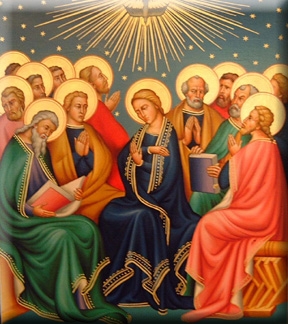
What a wondrous and challenging feast we celebrate at Pentecost! A feast like this challenges us because it puts to the lie a lazy, sleepy, hidden, and tepid Christian life. The Lord Jesus said to the apostles, I have come to cast a fire on the earth (Luke 12:49). This is a feast about fire, a transformative, refining, purifying fire that the Lord wants to kindle in us. It is a necessary fire, for as the Lord first judged the world by fire, the present heavens and the earth are reserved for fire. Because it is going to be the fire next time, we need the tongues of Pentecost fire to fall on us to set us on fire and bring us up to the temperature of glory.

The readings today speak to us of the Holy Spirit in three ways: the portraits of the Spirit, the proclamation of the Spirit, and the propagation by the Spirit.

I. The Portraits of the Spirit – The reading today speaks of the Holy Spirit using two images: rushing wind and tongues of fire. These two images recall Psalm 50, which says, Our God comes, he does not keep silence, before him is a devouring fire, round about him a mighty tempest.

Rushing Wind – Notice how the text from Acts opens: When the time for Pentecost was fulfilled, they were all in one place together. And suddenly there came from the sky a noise like a strong driving wind, and it filled the entire house in which they were.

This text brings us to the very root meaning of the word “spirit.” Spirit refers to breath. This is preserved in the word “respiration,” which is the act of breathing. So, the Spirit of God is the breath of God, the Ruah Adonai (the Spirit, the breath of God).

Genesis 1:2 speaks of this, saying, the Spirit of God was moving over the face of the waters. Genesis 2:7 speaks even more remarkably of something God did only for man (not the animals): then the LORD God formed man of dust from the ground and breathed into his nostrils the breath of life; and man became a living soul.

So, the very Spirit of God was breathed into Adam, but he lost this gift and died spiritually when he sinned.

Thus, we see in this passage from Acts an amazing and wonderful resuscitation of the human person as these first Christians experience the rushing wind of God’s Spirit breathing spiritual life back into them. God does C.P.R. and brings humanity, dead in sin, back to life! The Holy Spirit comes to dwell in us once again as in a temple (cf 1 Cor 3:16). It has been said that Christmas is the feast of God with us, Good Friday is the Feast of God for us, but Pentecost is the Feast of God in us.

Tongues of Fire – The text from Acts then says, Then there appeared to them tongues as of fire, which parted and came to rest on each one of them.

The Bible often speaks of God as fire or in fiery terms: Moses saw Him as a burning bush. God led the people out of Egypt through the desert as a pillar of fire. Moses went up onto a fiery Mt. Sinai where God was. Psalm 97 says,

The LORD reigns; let the earth rejoice; let the many coastlands be glad! Clouds and thick darkness are round about him; righteousness and justice are the foundation of his throne. Fire goes before him, and burns up his adversaries round about. His lightnings lighten the world; the earth sees and trembles. The mountains melt like wax before the LORD, before the Lord of all the earth. The heavens proclaim his righteousness; and all the peoples behold his glory (Psalm 97).

Scriptures also call God a Holy fire, a consuming fire (cf Heb 12:29) and a refining fire (cf Is. 48:10; Jer 9:7; Zec 13:9; Mal 3:3).

So it is that our God, who is a Holy Fire, comes to dwell in us through His Holy Spirit. As a Holy Fire, He refines us by burning away our sins and purifying us. As Job once said, But he knows the way that I take; when he has tested me, I will come forth as gold (Job 23:10).

God is also preparing us for judgment, for if He is a Holy Fire, then who may endure the day of His coming or of going to Him? What can endure the presence of Fire Himself? Only that which is already fire. Thus, we must be set afire by God’s love.

So, in the coming of the Holy Spirit, God sets us on fire to make us a kind of fire. In so doing, He purifies us and prepares us to meet Him one day, to meet Him who is a Holy Fire.

II. The Proclamation of the Spirit – You will notice that the Spirit came on them like “tongues” of fire. The reference to tongues is no accident, for the Holy Spirit moves them to speak and ultimately to witness. The text says, And they were all filled with the Holy Spirit and began to speak in different tongues, as the Spirit enabled them to proclaim. Now there were devout Jews from every nation under heaven staying in Jerusalem. At this sound, they gathered in a large crowd, but they were confused because each one heard them speaking in his own language. They were astounded, and in amazement they asked, “Are not all these people who are speaking Galileans? Then how does each of us hear them in his native language? We are Parthians, Medes, and Elamites, inhabitants of Mesopotamia, Judea and Cappadocia, Pontus and Asia, Phrygia and Pamphylia, Egypt and the districts of Libya near Cyrene, as well as travelers from Rome, both Jews and converts to Judaism, Cretans and Arabs, yet we hear them speaking in our own tongues of the mighty acts of God.”

So, behold how the Holy Spirit moves them to proclaim, not just within the safety of the upper room, but also in holy boldness before the crowds that have gathered.

Notice the transformation! Moments ago, these were frightened men huddled together in secrecy behind locked doors. Now, they go forth to the crowds and proclaim Christ boldly. They have gone from fear to faith, from cowardice to courage, from terror to testimony!

What about us? Too many Christians are silent, overcome by fear. Perhaps they fear being called names or being unpopular. Perhaps they are anxious about being laughed at or resisted, or of being asked questions they don’t feel capable of answering. Some Christians gather in the “upper room” of the parish and are active—even leaders—but once outside the safe confines of the “upper room” they slip into what I call “secret agent” mode.

Well, the Holy Spirit wants to change that. To the degree that we have really met Jesus Christ and experienced His Holy Spirit, we are less able to keep silent. An old gospel song says, “I thought I wasn’t gonna testify, but I couldn’t keep it to myself, what the Lord has done for me.” The Holy Spirit, if authentically received, wants to give us zeal and joy, to burn away our fear so that testifying and witnessing come naturally to us.

Note also how the Spirit “translates” for the Apostles. The people in the crowd spoke different languages, yet each heard Peter and the others in his own language. The Spirit, therefore, assists not only us but also those who hear us. My testimony is not dependent on my eloquence alone but also on the grace of the Holy Spirit, who casts out deafness and opens hearts. Every Christian should remember this. Some of our most doubt-filled encounters with others can still bear great fruit on account of the work of the Holy Spirit, who “translates” for us and overcomes obstacles we might think insurmountable.

III. The Propagation by the Spirit – In the great commission, the Lord said, Go, therefore, and make disciples of all nations, baptizing them in the name of the Father, and of the Son, and of the Holy Spirit, teaching them to observe all that I have commanded you. And behold, I am with you always, until the end of the age (Matt 28:19ff). He also said, I have come to cast a fire on the earth and How I wish the blaze were already ignited (Luke 12:49).

How is the Lord going to do this?

Perhaps a picture will help to illustrate. My parish church is dedicated to the Holy Spirit under the title “Holy Comforter.” Above the high altar is the following Latin inscription: Spiritus Domini, replevit orbem terrarum (The Spirit of the Lord, filled the orb of the earth). (See the photo above of our high altar.)

The walls of my parish church answer the question. The clerestory walls are painted Spanish red, and upon this great canvas are also painted the stories of the lives of twenty saints, surrounding us like a great cloud of witnesses (cf Heb 12:1). (See also the video below.) Over the head of every saint is a tongue of fire.

This is how the Spirit of the Lord fills the earth. It is not via “magic fairy dust.” It is in the fiery transformation of every Christian going forth to bring warmth and light to a cold, dark world. This is how the Lord casts fire upon the earth. This is how the Spirit of the Lord fills the orb of the earth—in the lives of saints (and in your life)!

In the end, the great commission (Matt 28) is our first and most important job. No matter what else we do, we are to do this. Parishes do not deserve to exist if they do not do this. As individual Christians, we are a disgrace and not worthy of the name if we fail to win souls for Jesus Christ. The Spirit of the Lord is going to fill the orb of the earth but only through us. The spread of the gospel has been placed in your hands. It’s scary, isn’t it!

In my short time on this planet, I have seen it. Parishes that were once big and booming (and, frankly, sometimes arrogant) are now in decline; some are near closure. It happens to the best if they do not evangelize, if they do not accomplish “job one.” The Lord wants to light a fire. Why not become fire? Let the Spirit propagate the Church through you. (Yes, I am talking to you.)

Enjoy the feast of Pentecost, but don’t forget that the basic image is very challenging, for it means getting out of the “upper room,” opening the doors, and proclaiming Christ to the world. Let the Holy Spirit light a fire in you. Then you can’t help but spread light and heat to a dark, cold world.

Let the evangelization of the whole world begin with you.

The video below features details from the clerestory of my parish, Holy Comforter in Washington, D.C. Notice the tongue of fire above each saint. The paintings show how the Spirit of the Lord fills the orb of the earth through the lives of the saints (and through you, too). It is not magic; it is grace, working in your life, through your gifts and your relationships, so that the Lord will reach each soul. The witnesses on the walls of my Church say, “You are the way that He will fill the earth and set it on fire.” Let the blaze be ignited in you!

The song accompanying the video says, “We are surrounded by a great cloud of witnesses, looking on, encouraging us to do the will of the Lord. Let us stand worthy and be faithful to God’s call … We must not grow weary …!”


Where is God in Difficult Times?

My latest Article at the Register explores the complex issue of suffering and evil.

https://www.ncregister.com/commentaries/why-do-bad-things-happen-to-good-people


The Role and Experience of the Angels at the Ascension

The Feast of the Ascension is often neglected today. It is tucked into a nearby Sunday, it’s role as the fortieth day, jettisoned. But even in those places that still honor it with a Thursday Solemnity, there is still a difficulty in appreciating the full glory of that day. In this post, following the Scriptures and the teaching of some of the ancient Fathers of the Church, we can investigate some of the more hidden glory of this magnificent event.

The fundamental source for these reflections is Jean Cardinal Danielou’s book The Angels and Their Mission: According to the Fathers of the Church. The references to the Fathers in this post are fully footnoted in his book, but some of the scriptural passages below represent my own additions.

We can begin with a parabolic prelude – Jesus told at least two parables that the Fathers of the Church interpret to represent the angels:

    • Then Jesus told them this parable: “What man among you, if he has a hundred sheep and loses one of them, does not leave the ninety-nine in the pasture and go after the one that is lost, until he finds it? And when he finds it, he joyfully puts it on his shoulders, comes home, and calls together his friends and neighbors to tell them, ‘Rejoice with me, for I have found my lost sheep!’ In the same way, I tell you that there will be more joy in heaven over one sinner who repents than over ninety-nine righteous ones who do not need to repent. (Luke 15:3-7)
    • Or what woman who has ten silver coins and loses one of them does not light a lamp, sweep her house, and search carefully until she finds it? And when she finds it, she calls together her friends and neighbors to say, ‘Rejoice with me, for I have found my lost coin.’ In the same way, I tell you, there is joy in the presence of God’s angels over one sinner who repents.” (Luke 15:8-10)

Gregory Nazianzus interprets this parable as Christ entering into heaven at the Ascension and, after having recovered the lost sheep and the Lost Drachma and calling together the angels to share his joy.

Indeed, there is a whole tradition, among the Fathers but going back much further into the early Church which sees the lost sheep as human beings, and flock which the Good Shepherd “leaves” in order to search for the sheep as the angels. Origen sets it forth and Methodius of Philippi writes: “We must see the ninety-nine sheep as a representation of the Powers, Principalities and Dominations whom the Head and Shepherd has left behind to go down and seek out the one lost sheep.”  Gregory of Nyssa adds: “We mankind, are the lost sheep…and have strayed from the other spiritual creates [i.e. the angels].

Hence we are given a picture of joy as Christ re-enters heaven with the lost sheep of humanity.

The Picture of the Ascension given by the Lord: Jesus prophecies his ascension in John’s Gospel as something which Nathaniel will see. The Lord’s description also shows the role of the angels

Jesus said to Nathaniel, “Do you believe just because I told you I saw you under the fig tree? You will see greater things than these.” Then He declared, “Truly, truly, I tell you, you will see heaven open and the angels of God ascending and descending on the Son of Man. (John 1:50-51)

Here then is a picture of Jesus ascending, not as a lone figure,

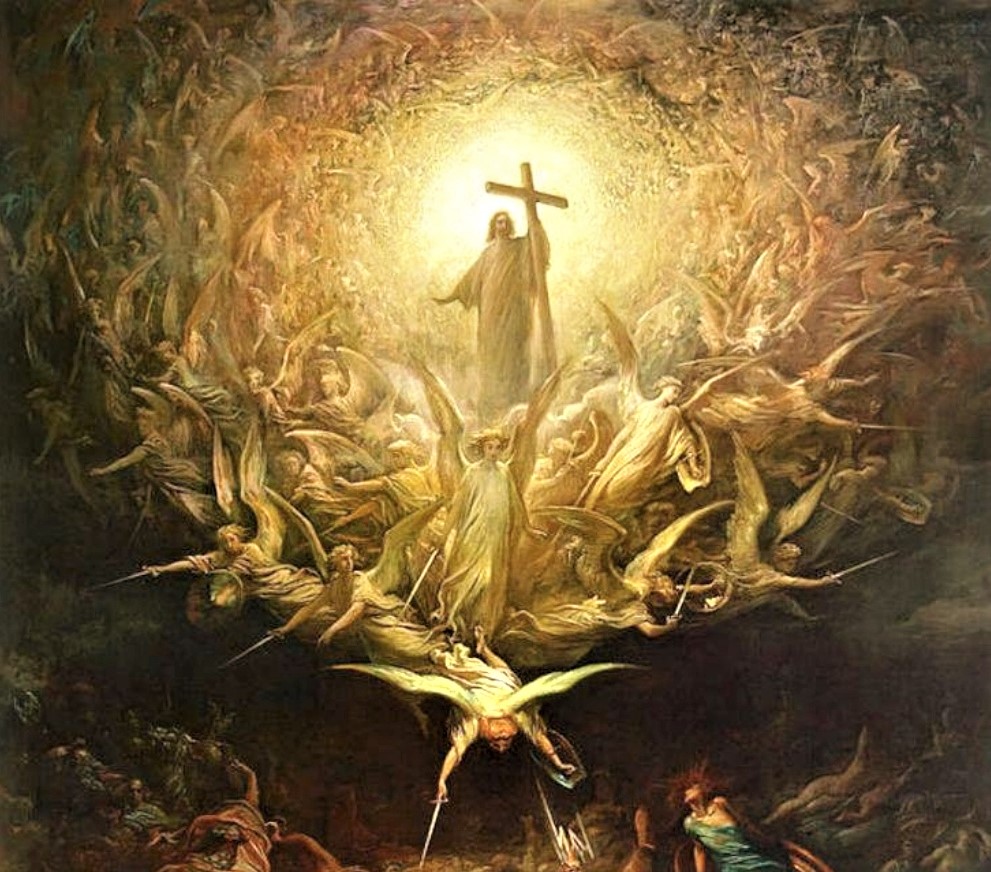
A picture from the Psalms: Church Fathers Eusebius, Chrysostom, Justin and Athanasius  say that  the virtues (i.e. angels) of heaven, seeing him begin to ascend, rise and surround him to form an escort proclaiming his ascension as they cried: Rise up eternal gates and the King of glory will enter!” Gregory of Nyssa adds, that at first the higher angels do not recognize Christ since he has put on the poor tunic of humanity and because his garments were stained with blood. And herein comes a questioning and wondering dialogue back and forth that is from Psalm 27 but which the ancient Fathers apply to the moment of the Ascension: 

The lower ranking angels who have escorted Jesus cry out to the higher ranking angles of heaven:

Lift up your heads, O gates! Be lifted up, O ancient doors, that the King of Glory may enter!

And from within the heavenly angels answer:

Who is this King of Glory?

And the escorting angels answer:

The LORD strong and mighty, the LORD mighty in battle. Lift up your heads, O gates! Be lifted up, O ancient doors, that the King of Glory may enter! (Psalm 24:7-9) 

Eusebius also cites Psalm 47 as fulfilled in the Ascension through the praises of the Angels: 

God ascends amid shouts of joy, the LORD with the sound of trumpets. Sing praises to God, sing praises; sing praises to our King, sing praises! For God is King of all the earth; sing profound praises to Him. God reigns over the nations; God is seated on His holy throne. For the shields of the earth belong to God; He is highly to be exalted. (Ps 47:5-9)

Another picture from Scripture (Isaiah 63:1-3) is applied by the Fathers to the Ascension where the angels of heaven, seeing Christ  approach, cry out:

Who is this coming from Edom, from Bozrah with crimson-stained garments? Who is this robed in splendor, marching in the greatness of His strength?

Jesus answers:

“It is I who speak in righteousness, mighty to save.”

The Angels ask:

Why are Your clothes red, and Your garments like one who treads the winepress?

Jesus answers:

“I have trodden the winepress alone, (Isaiah 63:1-3)

The exultation of our humanity In Christ’s Ascension is also a principle developed in Scripture and by the Father.  Thought the angelic nature remains superior to human nature in the order of creation, Christ’s incarnation, resurrection and ascension have exalted our humanity in his. The Book of Hebrews says,

[Jesus] has taken his seat at the right hand of the Majesty on high. So He became as far superior to the angels as the name He has inherited is excellent beyond theirs. For to which of the angels did God ever say: “You are My Son; today I have become Your Father” (Heb 1:3-4)

For it is not to angels that He has subjected the world to come, about which we are speaking. But somewhere it is testified in these words: “What is man that You are mindful of him, or the son of man that You care for him? You made him for a while lower than the angels; and now You have crowned him with glory and honor and placed everything under his feet. (Heb 2: 5-8)

These texts speak to Christ’s superiority to the Angels. As God, he was always superior to the angels but, in hypostatically uniting himself to a human nature, raising it gloriously and ascending with that glorified human nature, he has exalted us all.

St. John Chrysostom says of the Ascension: 

Today we are raised up into heaven, we who seemed unworthy even of  earth. [In Christ, and as members of his Body] We are exalted above the heavens; we arrive at the kingly throne. The [human] nature which caused the Cherubim to keep guard over paradise is seated today above the Cherubim. Was not such a glory beyond all expression? But he rose above the angels, he passed the cherubim, he went higher than the Seraphim, he bypassed the Thrones. He didn’t stop until He arrived at the very throne of God.

So, the Feast of the Ascension is our feast too. In baptism we died with Christ and rose with him to new life. In the Ascension of Christ, we also ascend. Hence, in Christ and as members of Christ’s Body through baptism, we are mystically seated with him at the Father’s right. In Christ and by his ascension our lowly nature is glorified and we hear the call “come up higher.” For now we never cease to honor the angels who by nature are superior to us and care for us. And yet, by grace alone and in Christ we have ascended with him to the highest place. On account of  which the angels marvel and sing God’s praises.

The Ascension is the counterpart of the fall in Eden, but we are not simply restored to an earthly paradise, we are taken to the heavenly one!

Is this why Satan rebelled? There is an ancient tradition that the angels where shown God’s plan and that Lucifer, a high ranking angel, recoiled at the idea of God joining himself to the mere “mud dolls” of humanity. Inspiring a rebellion he waged war in the heavens and was cast out by St. Michael and the other angels. Now he roams the earth, deeply envious of human beings and seeks to debase and destroy him. This is hinted at in Scripture in Revelation 12, but the details of the reason for Satan’s wrath are more in the realm of tradition and speculation. 

Here then are some reflections on the glorious feast of the Ascension from Scripture, and the teachings of the Fathers of the Church.

Love Lifted Me: A Homily for the Ascension of the Lord

In more dioceses than not, the Feast of the Ascension is celebrated this Sunday. The liturgist in me regrets the move from Thursday, but here we are any way. Let’s ascend with the Lord, three days late!

This marvelous feast is not merely about something that took place two thousand years ago, for though Christ our head has ascended, we the members of His body are ascending with Him. Because He was ascended, we, too, have ascended. In my own life as a Christian, I am brought higher every year by the Lord, who is drawing me up with Him. This is not some mere slogan, but something I am actually experiencing. An old song says, “I was sinking deep in sin, far from the peaceful shore. Very deeply stained with sin, sinking to rise no more. But the master of the sea, heard my despairing cry. And from the waters lifted me. Now safe am I. Love Lifted me when nothing else could help. Love lifted me!”

If we are faithful, the feast of the Lord’s Ascension is our feast, too. Let’s look at it from three perspectives.

I. The Fact of the Ascension – The readings today describe a wondrous event witnessed by the Apostles. By His own power, the Lord is taken to Heaven. In so doing, He opens a path for us, too. The gates of paradise swing open again. Lift up your heads, O gates! and be lifted up, O ancient doors! that the King of glory may come in! (Psalm 24:7) In Christ, man returns to God. Consider three things about the Ascension:

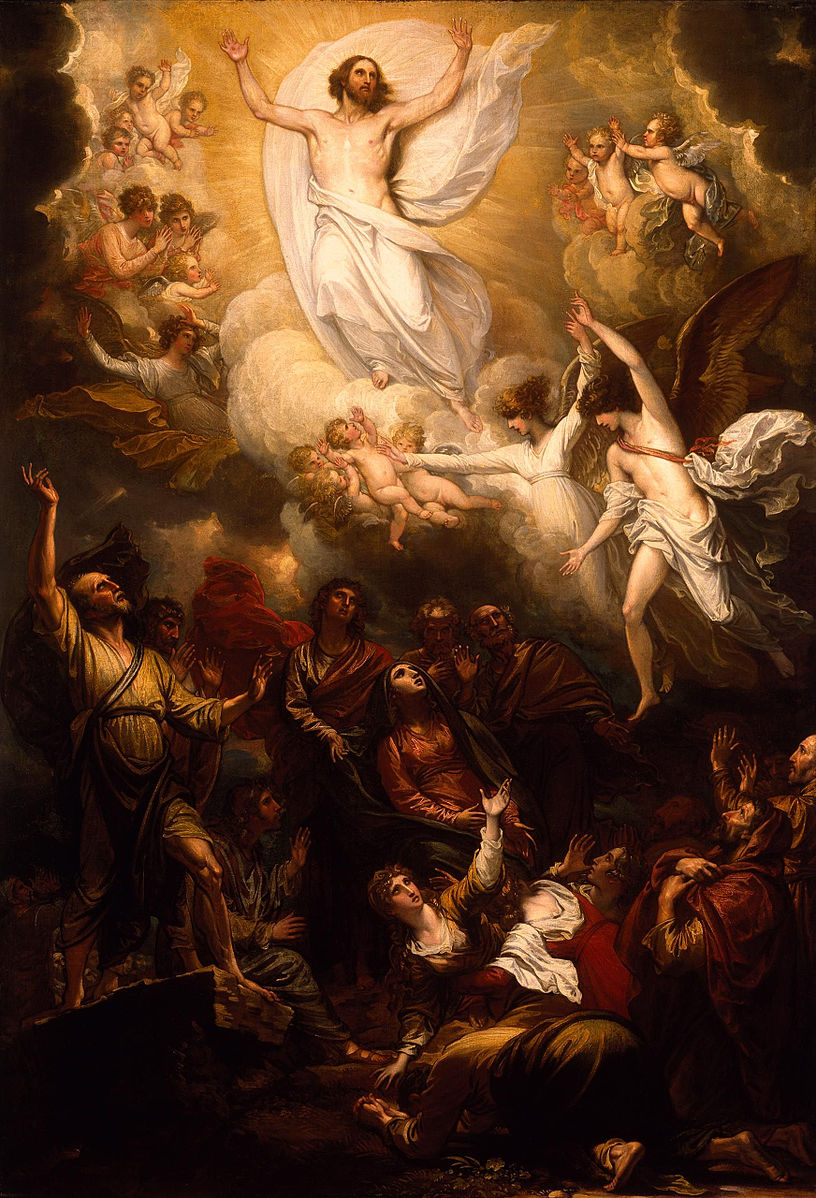
A. The Reality – Imagine the glory of this moment! Scripture says, As they were looking on, he was lifted up and cloud took him from their sight … they were looking intently in the sky as he was going (Acts 1:9). So impressive was the sight that the angels had to beckon them to get along to Jerusalem as the Lord had said, “Men of Galilee,” they said, “why do you stand here looking into the sky? This same Jesus, who has been taken from you into heaven, will come back in the same way you have seen him go into heaven” (Acts 1:11). Yes, it was glorious. Jesus had once said as a summons to faith, What if you were to see the Son of Man ascending to where he was before? (John 6:62) He had also encouraged them saying, Truly, truly, I say to you, you will see heaven opened, and the angels of God ascending and descending upon the Son of man (John 1:51). So here is a glorious reality and a fulfillment of what Jesus had said.

B.The Rescue – In the Ascension, it does not seem that the Lord entered Heaven alone. As we have remarked, in His mystical body we also ascend with Him. Consider this remarkable text that affirms that: Therefore it is said, When he ascended on high he led a host of captives, and he gave gifts to men. In saying, “He ascended,” what does it mean but that he had also descended into the lower parts of the earth? He who descended is he who also ascended far above all the heavens, that he might fill all things (Eph 4:8ff). Yes, the Lord had earlier (just after his death) descended to Sheol, awakened the dead, and preached the Gospel to them (cf 1 Peter 4:6). Now for those He had justified came the moment to ascend, with Jesus as a “host,” as an army of former captives now set free. Behold the great procession that enters behind Christ through the now-opened gates of Heaven: Adam and Eve, Noah, Abraham, Sarah, Isaac, Jacob, Rachel, Judith, Deborah, David, Samuel, Isaiah, Jeremiah, Ezekiel, Malachi, John the Baptist, … and, one day, you! Yes, this is a great rescue. Adam and his descendants have not simply been restored to some paradise-like garden; they have entered Heaven.

C.The Rejoicing – Consider how this once captive train sings exultantly as they follow Christ upward to Heaven. The liturgy today puts before us a likely song they sang: God mounts his throne to shouts of Joy! The Lord amid trumpet blasts. All you peoples clap your hands, shout to God with cries of gladness, for the Lord the most high, the awesome is the great king over all the earth. God reigns over the nations, God sits upon his holy throne (Psalm 47:6-7). I also have it on the best of authority that they were singing this old gospel song: “I’m so glad Jesus lifted me!” as well as this old Motown song: “Your love is lifting me higher than I’ve ever been lifted before!” More on this tomorrow from the Fathers of the Church.

II. The Fellowship of the Ascension – We have already remarked that, when Christ ascends, we ascend. Why and how? Scripture says, Now you are the body of Christ and individually members of it (1 Cor 12:27). It also says, All of us who were baptized into Christ Jesus were baptized into his death. By baptism we were buried together with him so that just as Christ was raised from the dead by the glory of God the Father, we too might live a new and glorious life. For if we have been united with him by likeness to his death we shall be united with him by likeness to his resurrection (Rom 6:3ff). When Christ died, we died. When Christ rose, we rose. When He ascends, we ascend.

But, you may say, He is in glory while I am still here. How is it that I am ascended or ascending? Consider a humorous example using our physical bodies. When I get on an elevator and press the button for the top floor, the top of my head gets there before the soles of my feet, but the whole body will get there unless some strange loss of integrity or tragic dismemberment takes place. In an analogous way, so it is with Jesus’ mystical body. In Christ, our Head, we are already in glory. Some members of His Body have already gotten there. We who come later will get there too, provided we remain members of His Body. Yes, we are already ascended in Christ, our Head. We are already enthroned in glory with Him, if we hold fast and stay a member of His Body. This is the fellowship of the Ascension.

III. The Fruitfulness of the Ascension – Jesus does not return to Heaven to abandon us. He is more present to us than we are to ourselves. He is with us always to the end of the age (cf Matt 28:20). In ascending, without abandoning us, He goes to procure some very important things. Consider four of them:

A. Holy Ghost power – Jesus teaches very clearly that He is ascending in order to send us the Holy Spirit. Nevertheless, I tell you the truth: it is to your advantage that I go away, for if I do not go away, the Counselor will not come to you; but if I go, I will send him to you (Jn 16:7ff). He also says, These things I have spoken to you, while I am still with you. But the Counselor, the Holy Spirit, whom the Father will send in my name, he will teach you all things, and bring to your remembrance all that I have said to you (Jn 14:25ff). I still have many things to say to you, but you cannot bear them now. When the Spirit of truth comes, he will guide you into all the truth, for he will not speak on his own authority, but whatever he hears he will speak, and he will declare to you the things that are to come (Jn 16:13-14). So the Lord goes in order that with the Father, He might send the Holy Spirit to live within us as in a temple. In this way, and through the Eucharist, He will dwell with us even more intimately than when He walked this earth.

B. Harvest – Jesus says, And I, if I be lifted up from the earth, will draw all men unto me (John 12:32). While the immediate context of this verse is the crucifixion, the wonder of John’s gospel is that he often intends double meanings. Clearly Christ’s glorification is His crucifixion, but it also includes His resurrection and ascension. So, from His place in glory, Christ is drawing all people to Himself. He is also bestowing grace on us from His Father’s right hand to be His co-workers in the harvest: But you shall receive power when the Holy Spirit has come upon you; and you shall be my witnesses in Jerusalem and in all Judea and Samaria and to the end of the earth (Acts 1:8). Yes, from His place in glory, Christ is bringing in a great harvest. As He said in Scripture, Do you not say, “Four months more and then the harvest”? I tell you, open your eyes and look at the fields! They are ripe for harvest. Even now the reaper draws his wages, even now he harvests the crop for eternal life, so that the sower and the reaper may be glad together. Thus the saying “One sows and another reaps” is true. I sent you to reap what you have not worked for. Others have done the hard work, and you have reaped the benefits of their labor (Jn 4:35-38). Harvest! It is the Lord’s work from Heaven in which we participate.

C. Help – At the Father’s right hand, Jesus intercedes for us. Scripture says, Consequently he is able, for all time, to save those who draw near to God through him, since he lives always to make intercession for them (Heb 7:25). The Lord links his ascension to an unleashing of special power: Amen, amen, I say to you, he who believes in me will also do the works that I do; and greater works than these will he do, because I go to the Father. Whatever you ask in my name, I will do it, that the Father may be glorified in the Son (Jn 14:12).

We must not understand asking in the name of Jesus as a mere incantation, for to ask in His name means to ask in accord with His will. Yet we must come to experience the power of Jesus to draw us up to great and wondrous things in His sight. Despite the mystery of iniquity all about us, we trust that Christ is conquering, even in the puzzling and apparent victories of this world’s rebellion. In putting everything under him, God left nothing that is not subject to him. Though, at present we do not see everything subject to him, yet we see Jesus, who was made a little lower than the angels, now crowned with glory and honor … so that by his death he might destroy him who holds the power of death—that is, the devil—and free those who all their lives were held in slavery by their fear of death (Heb 2:8-9; 14-15). Thus, from Heaven we have the help of the Lord’s grace which, if we will accept it, is an ever-present help unto our salvation.

D. Habitation – Jesus indicates that in going to Heaven, He is preparing a place for us: In my Father’s house are many mansions: if it were not so, I would have told you. I go to prepare a place for you. And if I go and prepare a place for you, I will come again, and receive you unto myself; that where I am, there ye may be also (Jn 14:2ff). Yes, Jesus has the blueprints out and the hard hat on. He is overseeing the construction of a mansion for each of us that we may dwell with Him, the Father, and the Spirit forever.

Here, then, are the ways that Christ, by His love, is lifting us higher than we’ve ever been lifted before. Yes, love lifted me when nothing else could help; love lifted me.

Here’s a modernized version of the hymn:


Why Did St. Paul Get Arrested at Philippi?

At daily Mass, we are reading the story of St. Paul’s arrival in Philippi and later of his arrest, beating, and imprisonment. It serves as a kind of metaphor for the radical nature of true Christianity and why it so perturbs many in this world. The Christian faith, its message, and the transformation it can effect can be very unsettling to a world that literally and figuratively “banks on” sin. Let’s consider this lesser- known story and see what it ought to mean for us if we take our Christian faith seriously and do not try to “tame” it.

Philippi was the first “European” city that Paul evangelized when he came across from Asia Minor. Arriving at the port of Philippi in Macedonia, Paul and Silas went right to work evangelizing. One of their first converts was Lydia, a wealthy woman from Thyatira who was a dealer in purple cloth; other converts followed.

Once when we were going to the place of prayer, we were met by a slave girl who had a spirit by which she predicted the future. She earned a great deal of money for her owners by fortune-telling. This girl followed Paul and the rest of us, shouting, “These men are servants of the Most High God, who are telling you the way to be saved.” She kept this up for many days. Finally, Paul became so troubled that he turned around and said to the spirit, “In the name of Jesus Christ I command you to come out of her!” At that moment the spirit left her.

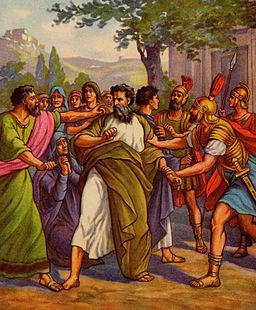
When the owners of the slave girl realized that their hope of making money was gone, they seized Paul and Silas and dragged them into the marketplace to face the authorities. They brought them before the magistrates and said, “These men are Jews, and are throwing our city into an uproar by advocating customs unlawful for us Romans to accept or practice.”

The crowd joined in the attack against Paul and Silas, and the magistrates ordered them to be stripped and beaten. After they had been severely flogged, they were thrown into prison, and the jailer was commanded to guard them carefully. Upon receiving such orders, he put them in the inner cell and fastened their feet in the stocks (Acts 16:16-24).

Note the heart of the problem: St. Paul, in setting the slave girl free of her demon has deprived her “owners” of the income they derived from her sad state. They were banking on her bad condition and profiting from her trouble. In the name and power of Jesus Christ, St. Paul sets her free. His action draws deep anger from the “owners.” He has rocked their world; he has touched their pocketbooks. They find the Christian message, for it is revolutionary, to be disconcerting, threatening, and deeply unsettling.

It is a threat not only to profit but to power. In having Paul and Silas arrested, they stir up the hatred and fear of others as well, accusing them not only of preaching some strange new religion but of advocating customs forbidden to Romans. The word translated here as “customs” is ἐθη (ethe) in Greek, and refers to “religious rites or forms of worship.” In De Legibus, ii. 8, Cicero wrote, “No person shall have any separate gods, or new ones; nor shall he privately worship any strange gods, unless they be publicly allowed.” While the Romans often overlooked the private worship of unapproved gods, publicly proclaiming new and unapproved deities was an occasion for dissension and controversy and was strictly forbidden.

Frankly, the charges against Paul and Silas are true enough. In the healing they brought about, they have hindered profit. Further, they were openly proclaiming that Jesus was Lord. To our ears that is a religious proclamation, but to Roman ears it was a provocative and revolutionary statement. It was directly contrary to their proclamation that Caesar was Lord. Yes, Paul, Silas, Luke, and the others were shaking the ground in Philippi! While they were not advocating the overthrow of any government, they were announcing a power greater than Caesar, a higher King who demanded our first loyalty.

This is not the “tame” proclamation of the faith so common today. This is not a faith that is adjusted to fit into worldly categories. This is not a faith tucked in after political, philosophical, and moral preferences. This is a faith that shakes the world and brings a revolutionary challenge to its priorities. Yes, Paul and Silas pose a serious threat.

What of us today? We have gone through a long period during which we have lived the faith quietly; it generally fit quite well into the world in which we lived. Harmony and “getting along” were highly prized. Particularly here in America, Catholics wanted to reassure the general populace that our faith in no way hindered us from being full participants in the American scene and that we could fit right in and be just like everyone else. With the election of the first Catholic president back in 1960, we could say that we had made it and had been fully accepted. Finally, we fit in.

Of course the culture was not in such disrepair in those days. There was still a fairly wide moral consensus rooted in the Judeo-Christian vision. Having finally “made it,” though, we have assumed room temperature; the fire of our distinctively Catholic culture seems to have faded away. At the same time, Western culture has also largely died. (Is that really a coincidence?)

In recent years, so-called Catholic universities and other Catholic institutions have begun caving in: giving marriage benefits to same-sex bedfellows and succumbing to the HHS mandates to provide contraceptives and abortifacients. It is sad, pathetic, wrong, and cowardly—hardly the revolutionary faith that got Paul arrested.

Now we are coming full circle. We must rediscover how revolutionary our Catholic faith truly is to this world gone mad. As we proclaim healing and an allegiance to something other than this world, however, we will become increasingly obnoxious to the world around us.

Let’s consider more thoroughly the two offenses for which Paul and Silas were beaten and imprisoned:

  1. They ate away at profit – Paul drove a terrible demon out of a slave girl, a demon that afflicted her but profited her “owners.” There is a great deal of trafficking in sin and addiction today. Terrible demons afflict many people in the areas of sexuality, drugs, and alcohol. There’s a lot of money to be made peddling pornography; sex sells. Hollywood movie producers, purveyors of contraceptives, pimps, escort services, abortionists, and even traffickers in the sex slave industry also feed at the trough. Drugs and alcohol are big money makers as well. Huge numbers of products are sold using the demon of fear that says, “You’re not pretty enough,” “You’re not healthy enough,” “You’re getting old,” “You don’t drive the right car,” “You don’t wear the right clothes.” The demons of fear, low self-esteem, and greed all work together.

What would happen if the Church were to start effectively preaching unabridged Christianity? What if we started saying, “You don’t need to be afraid of your health, your age, or what people think of you. You can find serenity in Christ so that you won’t feel you need for those drugs. You can be set free from your enslavement to sex, take authority over your passions, and discover the beauty of traditional marriage.” What if we got back in the business of driving out demons?

Well, of course the answer is that we, like Paul, would be under attack. In fact, we are under attack. We are especially hated by the sex industry and the abortionists because that that issue has so much focus these days. To them we are public enemy number one. We threaten the vision, the addiction, and the despair that fills their coffers. If we are too successful (and for now our successes are meager) their profits might dry up. Yes, we must be dealt with.

We will only be effective if we preach the unabridged faith, not a faith that is adjusted, not a faith that is subordinated to worldly priorities, not a faith that insists on being “realistic,” not a faith that apologizes to the world no matter how much we water things down. The true faith is revolutionary in the freedom it offers from sin and demons.

Paul and Silas didn’t wind up in prison by preaching a watered-down, domesticated moral vision. They unabashedly drove out a demon that was afflicting a girl; in so doing they engaged in a revolutionary threat to a world that profits handsomely from sin.

2. They threatened power – Calling Jesus “Lord” was a revolutionary threat to the incumbent power that demanded first and full loyalty. Today, many try to make Catholics fit into tidy political categories. Both Republicans and Democrats want the Church to march in lockstep with their party platform. Even many Catholics in those parties want the Church to conform. Many Catholics in fact are more loyal to their party than to the Church; they are more passionate about their political views than their faith. If there is a conflict between Church teaching and the party line, guess which one usually gives way!

In the end, the Church will not just fit into some neat political category. The true faith is too revolutionary to fit into some worldly box.

Thus there is a lot of hatred and anger directed at the Church. Republicans say we’re too liberal; Democrats say we’re too conservative. More and more we are being shown the door, kicked to the curb; our very right to religious liberty is being threatened. Religious exemptions to increasingly pernicious laws are slowly being removed and lawsuits against Catholic institutions are increasing. It will surely get worse as secular systems demand increasing loyalty. The Church must refuse to give that loyalty.

Jesus (not the federal, state or local government) is Lord. Jesus is not Republican or Democrat, conservative or liberal. He is God, and the faith He announces cannot be watered down or compromised to fit into a friendship with the world.

No domesticated Christianity will change the world. When Paul preached, the people rioted. Modern preaching too often incites only yawns and indifference.

What should we learn from St. Paul’s arrest at Philippi? That the true faith is revolutionary and threatens the world right where it hurts: in the profit and power centers. As the world becomes increasingly secular, the revolutionary aspect of the faith will become more evident.

Are you ready?

Do You Fear the Right Thing? A Meditation on the Story of Chicken Little

In the wake of the COVID-19 explosion of fear, we do well to begin reflecting on fear. Fear is a complex passion. On the one hand, there are things that we ought to fear such as grave physical and spiritual dangers. The fear of being near the edge of a cliff might well save our life. The fear of serious sin and the punishment we might experience or the offense to God (who loves us) is both appropriate and holy. Sadly, more people lack this holy fear rooted in the possible loss of what is most precious to us: our eternal life with God.

There are also things we fear that we should not, and things that we fear more than we should. These sorts of fears are usually rooted in our disordered and inordinate affections.

A disordered affection is a love for something that is sinful. We ought not to love it at all, but we do; this causes us to fear anyone or anything that interferes with accessing and enjoying what is fundamentally sinful.

An inordinate affection is a love for something that is good in itself, but the love we have for it is too great. Loving it too much causes us to fear the loss of it more than we should. Many things in this world are lawful pleasures, but we come to love them too much. We love things more than people, and both things and people more than God. This is all out of order. We are to use things, love people, and worship God. Too often, though, we use people, love things, and forget about God.

There is also the great struggle that many have called the “sin of human respect,” wherein we fear people more than we fear God and seek to please people more than to please God. When we fall prey to this, we are willing to do sinful things in order to ingratiate ourselves to other human beings, fearing and revering them more than we do God.

Fear is a necessary passion for us, but too often our fears are misplaced and inordinate. Our fears are easily manipulated by Satan and the world.

A major area for spiritual growth is knowing what and whom to fear. Apart from God we will seldom get this answer right. We are easy prey for the devil and the world to draw us into all sorts of inordinate and even foolish fears.

Because a story can often have an impact that mere discourse cannot, I would like to illustrate this teaching with a well-known children’s story.

The story is the basis for two phrases in common use. Most are familiar with them, but some have never read (or have forgotten) the story from which they come. The first is “The sky is falling!” and the second is “Chicken Little” (used as a description of a person).

Both these phrases come from the children’s story Chicken Little. It is a story that speaks to the need to be careful about what we fear and what we do not fear. For indeed, one of the traps of Satan is to get us to focus on what we ought not to fear, or on what is secondary, so that we do not focus on what we should fear, or on what is more important. Aristotle, citing Socrates, said that courage is the virtue of knowing what to fear and what not to fear.

Please take the time to read this story completely. It may seem tedious to us modern folks with limited attention spans, but its conclusion is made more powerful by the litany of details. Please share it with your children as well.

Chicken Little was in the woods one day when an acorn fell on her head.
It scared her so much she trembled all over.
She shook so hard, half her feathers fell out.
“Help! Help!” she cried. “The sky is falling! I must go tell the king!”
So she ran in great fright to tell the king.

Along the way she met Henny Penny.
“Where are you going, Chicken Little?” Henny Penny asked.

“Oh, help!” Chicken Little cried. “The sky is falling!”
“How do you know?” asked Henny Penny.
“Oh! I saw it with my own eyes, and heard it with my own ears,
and part of it fell on my head!”
“This is terrible, just terrible!” Henny Penny clucked. “We’d better run.”

So they both ran away as fast as they could. Soon they met Ducky Lucky. “Where are you going, Chicken Little and Henny Penny?” he asked.
“The sky is falling! The sky is falling! We’re going to tell the king!” they cried. “How do you know?” asked Ducky Lucky.
“I saw it with my own eyes, and heard it with my own ears, and part of it fell on my head,” Chicken Little said.
“Oh dear, oh dear!” Ducky Lucky quacked. “We’d better run!” So they all ran down the road as fast as they could.

Soon they met Goosey Loosey waddling along the roadside.
“Hello there, Chicken Little, Henny Penny, and Ducky Lucky,” called Goosey Loosey. “Where are you all going in such a hurry?”
“We’re running for our lives!” cried Chicken Little. “The sky is falling!” clucked Henny Penny. “And we’re running to tell the king!” quacked Ducky Lucky.
“How do you know the sky is falling?” asked Goosey Loosey.
“I saw it with my own eyes, and heard it with my own ears, and part of it fell on my head,” Chicken Little said. “Goodness!” squawked Goosey Loosey. “Then I’d better run with you.”

And they all ran in a great fright across a meadow. Before long they met Turkey Lurkey strutting back and forth. “Hello there, Chicken Little, Henny Penny, Ducky Lucky, and Goosey Loosey,” he called. “Where are you all going in such a hurry?” “Help! Help!” cried Chicken Little. “We’re running for our lives!” clucked Henny Penny. “The sky is falling!” quacked Ducky Lucky. “And we’re running to tell the king!” squawked Goosey Loosey.
“How do you know the sky is falling?” asked Turkey Lurkey.
“I saw it with my own eyes, and heard it with my own ears, and part of it fell on my head,” Chicken Little said. “Oh dear! I always suspected the sky would fall someday,” Turkey Lurkey gobbled. “I’d better run with you.”

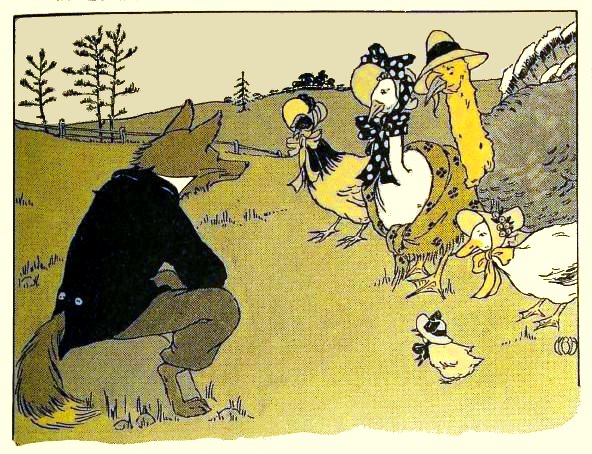
So they all ran with all their might, until they met the fox, Foxy Loxy. “Well, well,” said Foxy Loxy. “Where are you rushing on such a fine day?”
“Help! Help!” cried Chicken Little, Henny Penny, Ducky Lucky, Goosey Loosey, and Turkey Lurkey. “It’s not a fine day at all. The sky is falling, and we’re running to tell the king!” “How do you know the sky is falling?” said Foxy Loxy.
“I saw it with my own eyes, and heard it with my own ears, and part of it fell on my head,” Chicken Little said. “I see,” said Foxy Loxy. “Well then, follow me, and I’ll show you the way to the king.”

So Foxy Loxy led Chicken Little, Henny Penny, Ducky Lucky, Goosey Loosey, and Turkey Lurkey across a field and through the woods. He led them straight to his den, and they never saw the king to tell him the sky was falling.

Notice how fearing the wrong thing, and fearing it to excess, blinded them to what was more truly to be feared, what was more truly a threat. Here lies a doorway for the devil. He incites us to fear lesser things like unpopularity, loss of money, poor health, the loss of worldly trinkets, the next election, global warming, persecution, and worldly setbacks, so that we do not fear Judgment Day and the possibility of Hell.

The day of destiny is closing in, but never mind that! The sky is falling: the wrong political party is in power; the planet is overheating; the economy is about to collapse COVID-19 everywhere! You might lose your home to a storm; people might not think you are pretty enough, tall enough, or thin enough. Be afraid; be very afraid! You don’t have time to pray and ask God to get you ready for Judgment Day because you are too busy being afraid that eating food X may cause cancer, or that people may be laughing at you because of the five or ten pounds you gained last Christmas, or that the Yellowstone Caldera may blow at any time.

I will not tell you that the aforementioned concerns have no merit, only that they have less merit than what most people never think about or fear: where they are going to spend eternity. Chicken Little and her friends were easy prey for Foxy Loxy because they were obsessed with lesser things and ignored more dangerous (and obvious in this case) things like a fox!

Yes, “Foxy Loxy” has you worried about smaller and passing things. Now you are easy prey. It will take but a moment for him to lead you astray and have you for dinner!

Make sure you fear the right thing. God has a plan to simplify our lives. We are to fear Him and be sober about getting ready, with His help, for the certain-to-come Day of Judgment. If we fear Him, we don’t need to fear anyone or anything else.

Bishop Robert Barron has observed that the three tallest buildings in Chicago are insurance buildings. Fear “looms large” in our culture, but no insurance company can insure you against the only certain threat you face: Judgment Day. Only God can do that.

The sky may or may not be falling. (Personally, I doubt 80% of the media’s fearmongering.) But Judgment Day surely is looming. Foxy Loxy (Satan) is waiting for you. Will he get you? Will your fear of the Lord help you to avoid falling prey to his deceptions?


What Will Our Resurrected Bodies Be Like?

When I gave a talk recently at the Institute of Catholic Culture on the subject of the Second Coming, I was I asked to describe what our resurrected bodies will be like. Here is an article I wrote a few years back that details some aspects of our resurrected bodies:

St Paul writes to the Philippians of the glory that our currently lowly bodies will one day enjoy:

He will change our lowly body to conform with his glorified Body by the power that enables him also to bring all things into subjection to himself (Phil 3:19).

I once spoke with an older woman who wasn’t all that pleased to hear that her body was going to rise and be joined again to her soul. “Oh, Father, you don’t mean this old decrepit body, do you? If my body has to rise, I’m hoping for an improved model!”

I think most of us can relate to the desire that our current body be improved. And it surely will be. Notice that the passage above says that our lowly (weak, diseased, and often overweight) bodies will be changed and will reflect the glory of the resurrected body of Jesus. Yes, this old general issue clunker is going to be upgraded to a luxury model; I’m headed for first class.

When we recall the four last things (death, judgment, Heaven, and Hell), we ought to consider for a moment what Scripture and Tradition have to say about what our resurrected bodies will be like.

Now an important starting point in discussing this matter is a little humility. The fact is, a lot of what I am going to say here is speculation—but it is not wild speculation; it is rooted in Scripture. However, Scripture is describing things that are somewhat mysterious and difficult to reduce to words. Further, Scripture does not always provide as much detail as we might like. Sometimes we are left to infer qualities of the resurrected body based only on scriptural texts whose main purpose is something else (the resurrection of Jesus). For example, in one passage Jesus is described as appearing and disappearing at will in a room with locked doors. The point of the text is to tell us that He appeared, not necessarily to convey that the resurrected body has something we have come to call “agility” (see below). The text does not elaborate further, so we are left to note things about Jesus’ resurrected body and then apply them to our own. It is not wrong to do this, for Paul above says that our resurrected bodies will have qualities that conform to Jesus’ resurrected body. But the point is that the biblical texts do not elaborate on this or other qualities in a detailed manner and so we are left to speculate and make inferences.

St. John the Apostle expresses some of the humility we should bring to this discussion:

Beloved, now we are children of God, and it has not appeared as yet what we will be like. But We know that when He appears, we will be like Him, because we will see Him just as He is (1 John 3:2).

I do not interpret John to mean that we know nothing, for if that were the case he would negate other Scriptures. Rather, I interpret him to mean that we do not fully grasp the meaning of what we are discussing, and that much of it is mysterious. Some things are known and revealed but much more is unknown and far beyond what we have yet experienced.

With the need for humility in mind, let’s consider some of what we might be able to say of the qualities of a resurrected body. Perhaps it is well that we start with the most thorough passage in the New Testament on this subject and then list the seven traditional qualities of a resurrected body.

St. Paul writes of the resurrected body in First Corinthians:

But someone will ask, “How are the dead raised? With what kind of body will they come?” How foolish! What you sow does not come to life unless it dies. When you sow, you do not plant the body that will be, but just a seed, perhaps of wheat or of something else. But God gives it a body as he has determined, and to each kind of seed he gives its own body …. The splendor of the heavenly bodies is one kind, and the splendor of the earthly bodies is another …. The body that is sown is perishable, it is raised imperishable; it is sown in dishonor, it is raised in glory; it is sown in weakness, it is raised in power; it is sown a natural body, it is raised a spiritual body. If there is a natural body, there is also a spiritual body. So it is written: “The first man Adam became a living being”; the last Adam, a life-giving spirit. The spiritual did not come first, but the natural, and after that the spiritual. The first man was of the dust of the earth; the second man is of heaven. As was the earthly man, so are those who are of the earth; and as is the heavenly man, so also are those who are of heaven. And just as we have borne the image of the earthly man, so shall we bear the image of the heavenly man …. Listen, I tell you a mystery: We will not all sleep, but we will all be changed—in a flash, in the twinkling of an eye, at the last trumpet. For the trumpet will sound, the dead will be raised imperishable, and we will be changed. For the perishable must clothe itself with the imperishable, and the mortal with immortality. When the perishable has been clothed with the imperishable, and the mortal with immortality, then the saying that is written will come true: “Death has been swallowed up in victory.” “Where, O death, is your victory? Where, O death, is your sting?” (1 Cor 15:35-55 selectae)

Using this and other passages we can distinguish the seven traditional qualities of a resurrected body. Here we will allow our source to be St. Thomas Aquinas’ Summa Theologica. For each quality I’ve included a link to the corresponding section of the Summa.

1. Identity The very same body that falls in death will rise to be glorified; we will not get a different body. St. Thomas says, For we cannot call it resurrection unless the soul return to the same body, since resurrection is a second rising, and the same thing rises that falls: wherefore resurrection regards the body which after death falls rather than the soul which after death lives. And consequently if it be not the same body which the soul resumes, it will not be a resurrection, but rather the assuming of a new body (Suppl. Q 79.1).

This does not mean that the body will necessarily be identical in every way. As St. Paul says, our current bodies are like the seed. A seed does not have all the fully developed qualities of the mature plant, but it does have them in seed form. Similarly, our current body is linked to our resurrected body causally and essentially, though not all the qualities of the resurrected body are currently operative. St. Thomas goes on to say, A comparison does not apply to every particular, but to some. For in the sowing of grain, the grain sown and the grain that is born thereof are neither identical, nor of the same condition, since it was first sown without a husk, yet is born with one: and the body will rise again identically the same, but of a different condition, since it was mortal and will rise in immortality. (Ibid).

Scripture attests that the same body that dies will also rise. Job said, And after my flesh has been destroyed, yet in my flesh I will see God; I myself will see him with my own eyes—I, and not another (Job 19:26-27). And to the Apostles, shocked at His resurrection, Jesus said, Look at my hands and my feet. It is I myself! Touch me and see; a ghost does not have flesh and bones, as you see I have (Luke 24:39).

Hence the same body rises and so there is continuity. But there is also development and a shining forth of a new glory and of capabilities that our bodies do not currently enjoy.

2. IntegrityWe will retain all of the parts of our current bodies. This means every physical part of our body, even the less noble parts (e.g., intestines). It is clear from the Gospel that Jesus ate, even after the resurrection. He ate a fish while in their company (Luke 24:43). He also ate with the disciples in Emmaus (Luke 24:30). He ate breakfast with them at the lake shore (Jn 21:12). Hence it follows that even less noble parts of our body will rise, for eating and digestion are still functions of a resurrected body. St. Thomas argues (I think rightly) that food will not be necessary to the resurrected body (Suppl. 81.4), but it is clearly possible to eat, for Christ demonstrated it.

St. Thomas reasons that every aspect of our bodies will rise since the soul is the form of the body. That is, the body has the faculties it has due to some aspect of the soul. The soul has something to say and hence the body has the capacity to talk and write and engage in other forms of communication. The soul has the capacity to do detailed work and hence the body has complex faculties such as delicate and nimble fingers, arms and so forth, to carry out this work. Now body is thus apt for the capacities of the soul, though now imperfectly, but then even more perfectly. (cf Summa Suppl. Q. 80.1).

On some level it seems we should keep our speculation within limits. The Summa goes into matters that I think are highly speculative; you can read some of these speculations by clicking on the link above. Personally I think we should refrain from trying to ask questions such as whether hair and nails will grow or what bodily fluids will still be necessary and why. For example: Will latrines be needed in Heaven or will food be perfectly absorbed and nothing wasted? We just have to stop at a certain point and say that we just have no business knowing this sort of thing and it is purely speculative to discuss it. The bottom line is that the body shall rise, whole and complete. Its functions will be perfected and will be perfectly appropriate for the soul. But as for the intimate details, we ought to realize that humility is our best posture.

3. QualityWhat about age, gender, and other physical characteristics? Our bodies will be youthful and will retain our original gender. Youthful here does not necessarily mean 21 years old. In the Philippians text that began this post, Paul says that our glorified bodies will be conformed to Christ’s glorified body. Jesus’ body rose at the age of 30-33 years. Elsewhere, St. Paul exhorts Christians to persevere: Until we all meet into the unity of faith, and of the knowledge of the Son of God, unto a perfect man, unto the measure of the age of the fullness of Christ (Eph 4:13). Hence it would seem that Christ’s resurrected body is the perfect age.

St Augustine also speculates that because Christ rose again of youthful age (about 30), others also will rise again of a youthful age (cf De Civ. Dei xxii).

St. Thomas further notes, Man will rise again without any defect of human nature, because as God founded human nature without a defect, even so will He restore it without defect. Now human nature has a twofold defect. First, because it has not yet attained to its ultimate perfection. Secondly, because it has already gone back from its ultimate perfection. The first defect is found in children, the second in the aged: and consequently in each of these human nature will be brought by the resurrection to the state of its ultimate perfection which is in the youthful age, at which the movement of growth terminates, and from which the movement of decrease begins (Suppl. Q. 81.1).

Further, since gender is part of human perfection, all will rise according to their current gender. Other qualities such as height and hair color will also be retained, it would seem, since this diversity is part of man’s perfection.

Here, too, we have to realize that merely picturing Jesus as a 33-year-old man is not sufficient. All of the resurrection appearances make it clear that though still recognizable, His appearance was somehow changed—and this is a mystery. Further, the heavenly description of Jesus is far from simple to decode in manners of age and appearance:

and among the lampstands was someone “like a son of man,” dressed in a robe reaching down to his feet and with a golden sash around his chest. His head and hair were white like wool, as white as snow, and his eyes were like blazing fire. His feet were like bronze glowing in a furnace, and his voice was like the sound of rushing waters. In his right hand he held seven stars, and out of his mouth came a sharp double-edged sword. His face was like the sun shining in all its brilliance (Rev 1:12-18).

Hence we must avoid oversimplifications when we speak of how our resurrected bodies will appear. We cannot simply project current human realities into Heaven and think that we understand what a resurrected body will look like in terms of age, stature, and other physical qualities. Those qualities are there but they are expressed at a higher level.

4. ImpassabilityWe will be immune from death and pain. Scripture states this clearly:

The dead will be raised imperishable, and we will be changed. For the perishable must clothe itself with the imperishable, and the mortal with immortality (1 Cor 15:52-53).

He will wipe every tear from their eyes. There will be no more death’ or mourning or crying or pain, for the old order of things has passed away (Rev 21:4).

St. Thomas goes on at some length in the Summa, and you can read this by clicking on the link above.

5. SubtletyOur bodies will be free from the things that restrain them now. Subtlety refers to the capacity of the resurrected body to be completely conformed to the capacities of the soul. St. Thomas says of this quality, the term “subtlety” has been transferred to those bodies which are most perfectly subject to their form, and are most fully perfected thereby…. For just as a subtle thing is said to be penetrative, for the reason that it reaches to the inmost part of a thing, so is an intellect said to be subtle because it reaches to the insight of the intrinsic principles and the hidden natural properties of a thing. In like manner a person is said to have subtle sight, because he is able to perceive by sight things of the smallest size: and the same applies to the other senses. Accordingly, people have differed by ascribing subtlety to the glorified bodies in different ways (Suppl. Q. 83.1).

In other words, the body is perfected because the soul is perfected. The resurrected body is fully conformed to the soul. In my current lowly body, though I may wish to go to Vienna in a few moments to hear an opera, my body cannot pull that off. My current body cannot instantly be somewhere else on the planet. I have to exert effort and expend time to get there. After the resurrection, Jesus could appear and disappear in a room despite the closed doors; he could simply be where he wanted instantly. Before his resurrection he had to take long physical journeys (cf John 19:20, 26). This quality is very closely related to agility, which we consider next.

6. Agility – We will have complete freedom of movement. Our souls will direct our bodies without hindrance. St. Thomas says, The glorified body will be altogether subject to the glorified soul, so that not only will there be nothing in it to resist the will of the spirit … from the glorified soul there will flow into the body a certain perfection, whereby it will become adapted to that subjection … Now the soul is united to body not only as its form, but also as its mover; and in both ways the glorified body must be most perfectly subject to the glorified soul. We have already referred Jesus’ ability, in His glorified body, to be anywhere at once, unhindered by things such as locked doors. Consider these other description of the agility of the resurrected body:

  1. As they talked [on the road to Emmaus] and discussed these things with each other, Jesus himself came up and walked along with them (Luke 24:15).
  2. Then their eyes were opened and they recognized Jesus, and he disappeared from their sight (Luke 24:31).
  3. While they were still talking about this, Jesus himself stood among them and said to them, “Peace be with you” (Luke 24:36).

7. ClarityThe glory of our souls will be visible in our bodies. We will be beautiful and radiant. It is written in the Scriptures:

The just shall shine as the sun in the kingdom of their Father (Matthew 13:43).

The just shall shine, and shall run to and fro like sparks among the reeds (Wisdom 3:7).

The body in sown in dishonor, it shall rise in glory (1 Cor 15:43).