
Five Meanings of the Ashes We Receive Today

As a boy, I remember wondering why so many people liked to rush to Church to get ashes smudged on their foreheads. Frankly, I had some revulsion at the idea. I didn’t like it at all and would secretly rub them off when no one was looking. Today, though I’ll admit I still don’t like it too much, I behave myself and don’t rub them off!

I pray that this doesn’t seem impious, but I still marvel at how many people pack into the church to get ashes on their foreheads. Sadder still, some who come don’t seem to want Holy Communion nearly as much. In fact, in some of the parishes where I served in the past, significant numbers walked out the door after receiving ashes and did not even stay for Communion.

Of course most people who come to Mass are faithful and have their priorities straight, but it still interests me how large the numbers are for something that seems to me so unappealing and challenging.

Indeed, the sign of ashes is quite challenging if understand what it really means. We are saying some pretty powerful stuff and making some extensive promises of a sort.

What do ashes signify? Perhaps a brief tour of Scripture is in order:

Humility Job said, “You [Oh Lord] asked, ‘Who is this that obscures my counsel without knowledge?’  Surely I spoke of things I did not understand, things too wonderful for me to know. You said, ‘Listen now, and I will speak; I will question you, and you shall answer me.’ My ears had heard of you but now my eyes have seen you. Therefore, I despise myself and repent in dust and ashes” (Job 42:3-6).

Notice that Job does not merely repent in a general sense. Rather, having encountered God, he realizes that God is God, and that he, Jacob, is a creature, mere dust and ashes in the presence of God, who is being itself, who is all in all. Yes, Jacob is a son in the presence of a Father; he is not God’s equal that he might question Him or put Him on trial.

Hence in this case the ashes represent not only repentance but humility as well. The Church’s liturgy echoes this theme of humility in quoting Gen 3:19: “Remember, you are dust and unto dust you shall return” as the ashes are placed on the individual’s forehead.

A reminder of death and a call to wisdom – After Adam sinned, God told him, By the sweat of your brow you shall eat bread, till you return to the ground, for out of it you were taken; for you are dust, and to dust you shall return (Gen 3:19).

As he imposes the ashes, the priest usually recites some form of this passage. And memorable though it is, consider an even blunter form: “You are going to die.”

This is a salient and sobering reminder that we often get worked up and anxious about passing things, while at the same time being unmindful of the certain and most important thing, for which we really must be ready. We tend to maximize the minimum and minimize the maximum. Sadly, like the man in one of the Lord’s parables, we can amass worldly things and forget the final things. To him the Lord said, “You fool! This very night your soul is required of you; and now who will own what you have prepared?” So is the man who stores up treasure for himself, and is not rich toward God. (Luke 12:21-22).

Thus, to consider our final end is wise; to fail to do so is foolishness defined.

Ashes are a sacramental that points to the Sacrament – The Old Testament declared, You shall gather up the ashes of the heifer and put them in a ceremonially clean place outside the camp. They shall be kept by the Israelite community for use in the water of cleansing; it is for purification from sin … For the unclean person, put some ashes from the burned purification offering into a jar and pour fresh water over them. Then a man who is ceremonially clean is to take some hyssop, dip it in the water and sprinkle the tent and all the furnishings and the people who were there (Numbers 19:9, 17).

This text shows ashes obtained from a burned sin offering and mixed with sprinkled water as a cleansing ritual. In the Old Testament, this ritual could not actually take away sin (cf Heb 9:9-13), but it did provide for ritual purity. It also symbolized repentance and a desire to be free from sin.

In the same way, ashes on Ash Wednesday (mixed with holy water) cannot take away sin. They are a sacramental, not a sacrament.

To receive ashes on Ash Wednesday and then not go to confession some time during Lent is really to miss the point. If one really desires to repent and to be cleansed and free of sin, then from the sacramental of ashes one goes to the Sacrament of Confession. Otherwise the ritual of Ash Wednesday is pointless.

A sign of a true change – Scripture says, When the news [of Nineveh’s possible destruction in forty days] reached the king of Nineveh, he rose from his throne, took off his royal robes, covered himself with sackcloth and sat down in the dust (Jonah 3:6).

Here, too, repentance is symbolized, but the symbol alone is not enough—actual repentance is required. The king does not just “get ashes”; he issues a decree calling for fasting, prayer, and true reform: Do not let any man or beast, herd or flock, taste anything; do not let them eat or drink. But let man and beast be covered with sackcloth. Let everyone call urgently on God. Let them give up their evil ways and their violence. Who knows? God may yet relent and with compassion turn from his fierce anger so that we will not perish (Jonah 3:7-9).

Hence another option for the priest to say as he applies the ashes is, “Turn away from sin and be faithful to the Gospel.”

It is not enough to get a sooty forehead. True repentance is called for, an actual intent to change. Otherwise the ashes are a false sign.

A summons to faith and a new mind – Jesus said, Woe to you, Korazin! Woe to you, Bethsaida! If the miracles that were performed in you had been performed in Tyre and Sidon, they would have repented long ago in sackcloth and ashes (Matt 11:21).

Jesus rebukes ancient towns for their lack of faith. It is good to recall that the Greek word translated here as “repented” is μετενόησαν (metenoesan), which more literally means “to come to a new mind or way of thinking.”

There are many ways that we think about things that are more of the world than of God. Our ongoing challenge is to come to a new mind and to think more as God thinks. This is only possible by His grace, working through Scripture and Church teaching.

It is significant that the ashes are smeared on the forehead or sprinkled on the head—we are called to a faith that transforms our mind. We are called to be transformed by the renewal of our minds (Romans 12:2).

Hence yet another option for the priest is to say, “Repent and believe the Good News” as he imposes the ashes.

How real are your ashes? Do you intend the things described above as you go forth? Or is it just a ritual, something to do because it’s “sorta neat”? Pray and reflect on the deeper meaning of the ashes.
Writing Straight with Crooked Lines – A Passion Week Meditation

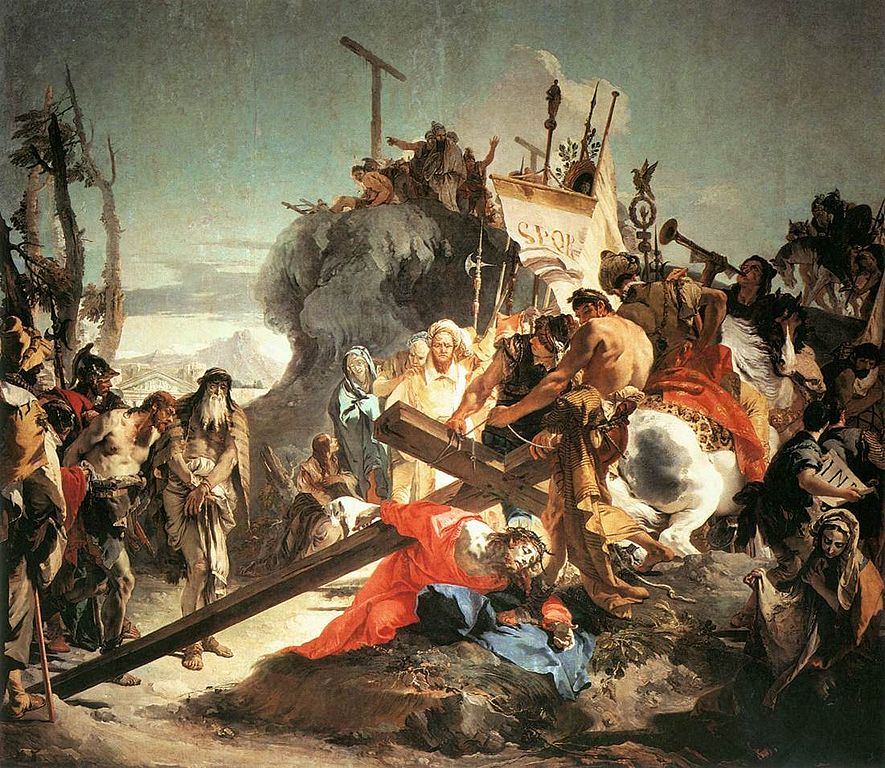
During Holy Week, we ponder the events that led to Jesus’ death and resurrection. Among the things to reflect upon is a dramatic moment in the trial before Pilate, when the people present utter a curse upon themselves.

When Pilate saw that he was getting nowhere, but that instead an uproar was starting, he took water and washed his hands in front of the crowd. “I am innocent of this man’s blood,” he said. “It is your responsibility!” And all the people answered, “His blood be on us and on our children!” (Matt 27:24-25)

Now of course the people did not intend it as a curse; they were convinced of their righteousness in the matter. Nevertheless, a curse of this sort becomes operative if they do in fact act unrighteously—which they do. Hence this is a self-imposed curse.

Care is necessary not to associate this curse merely with the Jewish people. Some have used this passage to assert that the Jewish people have suffered rightly for what “they” did to Christ, but of course the Jewish people were divided over Christ. Many followed Jesus and accepted Him as Messiah; all of the first converts were Jews. Other Jews rejected Jesus. Which group speaks for “the Jews” and which has the power to bring a curse upon the Jewish people? It seems untenable that a small group of Jews would be able to bring down a curse upon all Jews.

A better and more personal understanding of the text is that the group represents not the Jewish people per se, but the whole of humanity. For, truth be told, we have all crucified Christ. It is something we did, not some vague group of others called “they.” This self-imposed curse, “His blood be on us and on our children!” is something we have all said figuratively if not literally; we are collectively guilty of the blood of Christ.

Are we cursed or aren’t we? Consider the following passage written by Pope Benedict:

When in Matthew’s account the “whole people” say: “His blood be on us and on our children” (27:25), the Christian will remember that Jesus’ blood speaks a different language from the blood of Abel (Heb 12:24): it does not cry out for vengeance and punishment; it brings reconciliation. It is not poured out against anyone; it is poured out for many, for all. “All have sinned and fall short of the glory of God. … God put [Jesus] forward as an expiation by his blood” (Rom 3:23, 25). Just as Caiaphas’ words about the need for Jesus’ death have to be read in an entirely new light from the perspective of faith, the same applies to Matthew’s reference to blood: read in the light of faith, it means that we all stand in need of the purifying power of love which is his blood. These words are not a curse, but rather redemption, salvation. Only when understood in terms of the theology of the Last Supper and the Cross, drawn from the whole of the New Testament, does this verse from Matthew’s Gospel take on its correct meaning (Jesus of Nazareth, p. 187).

So the intended curse becomes a blessing! As the people say “His Blood be upon us and on our children!” one can almost hear God responding,

“You don’t know how right you are! For unless my Son’s blood be upon you, you have no hope. Only if His blood be upon you and your children will you ever be healed and saved. You mean these words for a curse, but I mean them for a blessing! Yes! His blood be upon you! Amen, so be it.”

And thus God writes straight with crooked lines. He makes a way out of no way; when we curse, He returns a blessing instead.

Of course this is not the only time that God acted to bring blessings out of situations in which curses were really deserved:

  1. The most obvious parallel is the story of Joseph in the Old Testament. Joseph’s brothers acted wickedly in staging his death and selling him into slavery, but that very act led to their salvation from famine. Joseph ended up in Pharaoh’s household and eventually became Prime Minister of Egypt. Interpreting Pharaoh’s dream to mean an approaching famine, Joseph ordered that surplus food be stored. This saved not only Egypt but surrounding lands as well, including Canaan. Joseph’s brothers and their families were saved by the very man they sold out. Realizing this they fell at his feet, prepared to become his slaves, but Joseph said to them, As for you, you meant evil against me, but God meant it for good, to bring it about that many people should be kept alive, as they are today (Gen 50:20). In this way, Joseph was a prefigurement of Christ. God can write straight with crooked lines and make a way out of no way.
  2. Another example is found in John’s Gospel. The passage below illustrates how, although we may mean one thing by our words, God means another. In this text, the High Priest, Caiaphas, declares that Jesus must die.

But some of them went to the Pharisees, and told them the things that Jesus had done [raising Lazarus].  The chief priests therefore, and the Pharisees, gathered a council, and said: What are we to do, for this man does many miracles? If we let him alone, all will believe in him; and the Romans will come, and take away our place and nation. But one of them, named Caiaphas, being the high priest that year, said to them: You know nothing. Neither do you consider that it is expedient for you that one man should die for the people, and that the whole nation perish not.  And this he spoke not of himself: but being the high priest of that year, he prophesied that Jesus should die for the nation. And not only for the nation, but to gather together in one the children of God, that were dispersed (John 11:46-52).

When Caiaphas spoke of it being better for Jesus to die than for the whole nation to perish, he meant it as a death sentence on Jesus, but God meant it for our salvation: Jesus should die rather than all of us be lost. Caiaphas meant it for ill but God meant it for good. Yet again, God writes straight with crooked lines; He makes a way out of no way.

So consider well this curse that turned out to be a blessing: “His blood be on us and on our children!” Never was more truth spoken, and by it we are saved.

Just a Little Talk with Jesus Makes It Right – A Homily for the Third Sunday of Lent

As we examine the Gospel for this weekend’s Mass we do well to understand that is about human desires and how the Lord reaches us through them. Prior to examining the text in detail, let’s consider a few things:

  1. What it is that really makes you happy? We desire so many things: food, water, shelter, clothing, and creature comforts. We long for affection, peace, and a sense of belonging. Sometimes we want stability and simplicity, at others we yearn for change and variety. Our hearts are a sea of desires, wishes, and longings. Today’s Gospel says that a woman went to the well to draw water. She represents each one of us and her desire for water is symbolic of all our desires.
  2. In reality, your desires are infinite. Can you remember a time when you were ever entirely satisfied, when you wanted absolutely nothing else? Even if you can recall such a time, I’ll bet it didn’t last long. That is because our desires are without limit.
  3. The well in today’s Gospel symbolizes this world. Jesus says to the woman, Everyone who drinks of this water will thirst again. The world cannot provide what we are really looking for. No matter how much it offers us, it will never suffice, for the world is finite while our desires are infinite. In this way our heart teaches us something very important about ourselves: We were not made for this world; we were made for something, someone, who is infinite, who alone can satisfy us. We were made for God.
  4. The water offered is the Holy Spirit. Jesus said elsewhere, “If any one thirst, let him come to me and drink. He who believes in me, as the scripture has said, ‘Out of his heart shall flow rivers of living water.’” Now this he said about the Spirit, which those who believed in him were to receive (Jn. 7:37-39).
  5. The Catechism of the Catholic Church has this to say about the meanings of our longings:

The desire for God is written in the human heart, because man is created by God and for God; and God never ceases to draw man to himself. Only in God will he find the truth and happiness he never stops searching for. … With his longings for the infinite and for happiness, man questions himself about God’s existence. In all this he discerns signs of his spiritual soul. The soul, the seed of eternity we bear in ourselves, irreducible to the merely material, can have its origin only in God (Catechism # 27, 33).

  1. Scripture speaks to us about our desires: Of You my heart has spoken: “Seek His face.” It is your face O Lord that I seek; hide not your face! (Psalm 27:8-9). Only in God will my soul be at rest, he is my hope, my salvation (Psalm 62:1).
  2. Augustine wrote these classic words to describe our truest longing: “Thou hast made us for Thyself, O Lord, and our hearts are restless till they rest in Thee” (Confessions 1,1).

With these in mind, let’s look at the journey that this woman makes to Jesus. Things start out rough, but in the end she discovers her heart’s truest desire. The journey is made in stages.

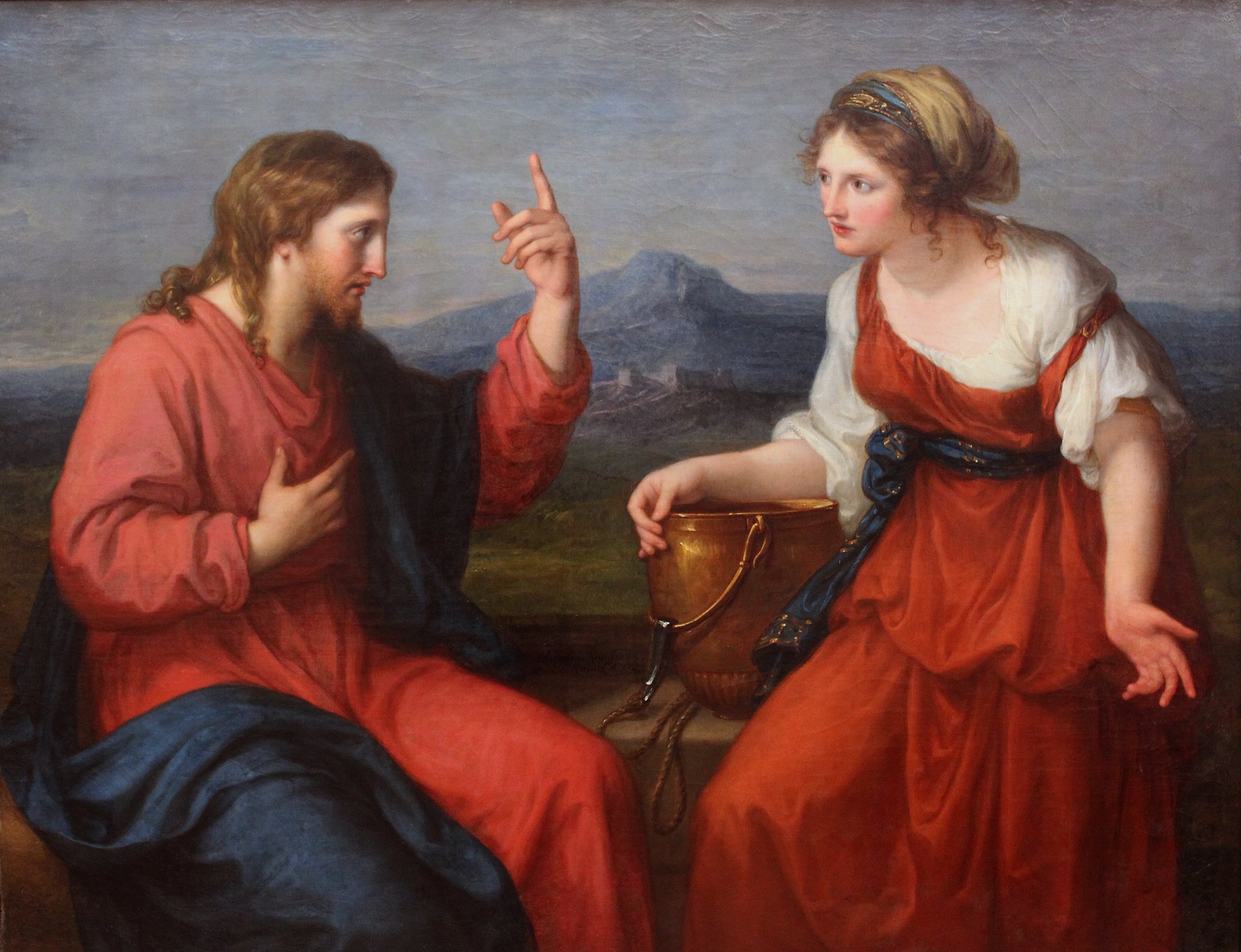
Rendezvous – Notice that Jesus is the one who takes the initiative here. As the Lord teaches elsewhere, It was not you who chose me, It was I who chose you (John 15:16). Jesus encounters a woman from Samaria at Jacob’s well. She desires water, but Jesus knows that her desire is for far more than water or in fact anything that the world gives. Her desire has brought her face to face with Jesus. It is a holy and fortunate rendezvous. Jesus begins a discussion with her about her heart’s truest longing.

Request – The discussion begins with a request. The text says, It was about noon. A woman of Samaria came to draw water. Jesus said to her, “Give me a drink.” Imagine, God asking you for anything; what a stunning thing! What can she or anyone really give God? The answer is simply this: the gift of our very self. God has put a threshold before our heart that even He will not cross unless we first say yes to Him. Jesus’ request initiates a discussion, a dialogue of two hearts. As we shall see, the woman struggles with this dialogue. To be sure, it is a delicate, even painful process for us to accept the Lord’s invitation to self-giving. Something within us makes us draw back in fear. Scripture says, It is an awesome thing to fall into the hands of living God (Heb 10:31).

Rebuke – Sure enough, she draws back with fear and anger. She says, “How can you, a Jew, ask me, a Samaritan woman, for a drink?”—For Jews use nothing in common with Samaritans. In our journey to God, we do not always trust or understand Him at first. Some are afraid to relate to God because they think they will lose their freedom or that they will have to change too much. Others loathe the commandments or fear that they cannot keep them. Still others are angry at the unexpected twists and turns of life and do not want to trust a God who doesn’t always give them what they want. The woman’s anger is not really at Jesus; it is at “the Jews,” with whom the Samaritans have a hostile relationship. This is sometimes the case with God as well. It is not always the Lord Jesus, or God the Father, whom people hate or distrust; rather, it is Christians. Some have been hurt by the Church or by Christians; others have prejudiced opinions influenced by a hostile media and world.

Repetition – Jesus repeats His offer for a relationship. He says, “If you knew the gift of God and who is saying to you, ‘Give me a drink,’ you would have asked him and he would have given you living water.” I don’t know about you, but I am mighty glad that the Lord does not merely write us off when we say no to Him. Jesus stays in the conversation and even sweetens the deal by making an offer to give her fresh, living water. The Lord does the same for us. First He gave the Law, then He gave the prophets; now He gives His Son. It just keeps getting better. First He gave water, then He changed it to wine, and then He changed it to His blood. Despite our often harsh rejection of God, He keeps the dialogue going.

Ridicule – The woman is still hostile and now even ridicules Jesus: “Sir, you do not even have a bucket and the cistern is deep; where then can you get this living water? Are you greater than our father Jacob, who gave us this cistern and drank from it himself with his children and his flocks?” To the world, the teachings of God often appear to be foolishness. People often dismiss religious faith as fanciful and unrealistic.

Reminder – Jesus now re-frames the question by reminding the woman of the obvious: Everyone who drinks this water will be thirsty again. What she is relying on can’t come through for her. The world’s water does not satisfy us; the world’s delights are transitory. They promise ultimate satisfaction, but soon we are thirsty again. The world is the gift that keeps on taking; it takes our money, loyalty, freedom, and time, while giving us only temporary—and ultimately unsatisfying pleasures—in return. It’s a bad deal. Every one who drinks from this well be thirsty again.

Re-upping the offer – Jesus says, “… but whoever drinks the water I shall give will never thirst; the water I shall give will become in him a spring of water welling up to eternal life.” Here the Lord speaks of happiness and satisfaction that he will give, that grows in us and makes us more and more alive. The “water” he offers (as noted above) is the gift of the Holy Spirit. As the Holy Spirit lives in us and transforms us, we become more and more content with what we have. As the life of God grows in us, we become more alive in God and joyful in what He is doing for us. This is what the Lord offers us: the gift of a new and transformed life, the gift to become fully alive in God. I am a witness of this. How about you?

Result – The woman has moved toward Jesus; she has warmed to His offer. She says, “Sir, give me this water, so that I may not be thirsty or have to keep coming here to draw water.” Here is the result of the Lord’s persistence. Thank God that He does not give up on us. He keeps calling, even when we say no, even when we sin; He just keeps call our name!

Requirement – Jesus wants to give this gift, but first He must help her to make room for it. For the truth is that she has unrepented sin. A cup that is filled with sand cannot be filled with water. The sand must first be emptied out and then the cup cleansed. Thus Jesus says, “Go call your husband and come back.” The woman answered and said to him, “I do not have a husband.” Jesus answered her, “You are right in saying, ‘I do not have a husband.’ For you have had five husbands, and the one you have now is not your husband. What you have said is true.” Now she does what most of us do when we are in an uncomfortable spot: she changes the subject. She attempts to engage in a discussion about where to worship. Jesus is patient and answers her, but ultimately draws her back to the subject at hand: her heart and what her desires are really all about.

Reconciliation – At this point the conversation gets private; we are not permitted to listen in. It is just between her and Jesus. But whatever it was, she is elated and will later declare, “He told me everything I ever did.” There is no sense in her tone that Jesus was merely accusatory. Rather, it would seem that Jesus helped her to understand her heart and her struggle. An old song says, “I once was lost in sin but Jesus took me in and then a little light from heaven filled my soul. He bathed my heart in love and he wrote my name above and just a little talk with Jesus made me whole.” Here, Jesus reconciles her with God and with her own self.

RejoicingThe woman left her water jar and went into the town and said to the people, “Come see a man who told me everything I have done. Could he possibly be the Christ?” They went out of the town and came to him.” Do not miss that little detail: she left her water jar. She left behind the very thing she was depending on to collect the things of the world. What is your “water jar”? What do you use to gain access to the world and to collect its offerings? For most of us, it is money. Scripture says, For the love of money is a root of all kinds of evil. Some people, eager for money, have wandered from the faith and pierced themselves with many griefs (1 Tim 6:10). At any rate, the woman is joyfully empowered to leave this enslaving water jar behind. Freed from its load, she is able to run to town and declare Jesus to others. Her joy must have been infectious, for soon enough they are following her out to meet the Lord!

This is the journey of a woman who represents each one of us. This is our journey, out of dependence, out of an enslaving attachment to the world. It is our journey unto Jesus, who alone can set us free. Here is our journey to understand that our desires are ultimately about God.

You can listen to this homily here: Just a Little Talk With Jesus.

I have it on the best of authority that as the woman joyfully journeyed back to town, she was singing this gospel song:

Why Did Jesus Die in His Thirties?

Why did Christ die in his early thirties rather than as an older man? This would have permitted Him more time to teach and to set forth His Church. St. Thomas Aquinas answered the question in the following way:

Christ willed to suffer while yet young, for three reasons. First of all, to commend the more His love by giving up His life for us when He was in His most perfect state of life. Secondly, because it was not becoming for Him to show any decay of nature nor to be subject to disease …. Thirdly, that by dying and rising at an early age Christ might exhibit beforehand in His own person the future condition of those who rise again. Hence it is written (Ephesians 4:13), “Until we all meet into the unity of faith, and of the knowledge of the Son of God, unto a perfect man, unto the measure of the age of the fullness of Christ” (Summa Theologica III, 46, 9 ad 4).

Speculations such as these strike some as purely arbitrary. Others consider the reasoning to be a post hoc justification: Christ died at the age of 33, so let’s make something up to try to explain it.

St. Thomas’ reasoning, however, is not based on wild speculation. There are premises to his reasoning.

First, there is the premise that God does nothing arbitrarily and we do well to allow even seemingly minor details in Scripture (e.g., the time of day) to teach us.

Another premise is based on the nature of perfection. Perfection can be harmed by either excess or defect. Consider the case of age: A young person may lack physical and intellectual maturity (youth being a “defect” in age), but there comes a time when age becomes problematic in the other direction as time takes its toll on the body and the mind becomes less sharp (old age being an “excess” in age). Thus, there is a period of time when one’s age is in the “perfect” range: harmed neither by excess nor defect.

In St. Thomas’ time one’s thirties was considered to be that time of perfection. This is arguably still so, though we do seem to take a lot longer to reach intellectual and emotional maturity these days.

St. Thomas notes that because Jesus died while in the prime of His life, the sacrifice was greater. His apparent lack of any disease or physical imperfections also increased His sacrifice. This is a model for us. We are to give the best of what we have to God in sacrifice; not merely our cast-offs, or things of which we might say, “This will do.” The Lord once lamented, through Malachi,

If I am a Father, then where is my honor? When you offer blind animals in sacrifice, is that not evil? And when you offer those that are lame or sick, is that not evil? Present that to your governor; will he accept you or show you favor? says the Lord of hosts (Mal 1:8).

And thus what might seem to some to be an unremarkable detail (Jesus’ age) actually provides important teachings to the sensitive soul. Christ gave His all, His best—and He did so when He was in the prime of His life. We too are summoned to increasing perfection

Three Teachings on Temptation

Sunday’s Gospel about the temptation of Jesus in the desert by Satan evokes several questions. The answers I propose are not intended to be a theological treatise, but rather a pastoral reflection.

I. Why does God permit temptation? God does not permit any evil or problem unless it can serve some greater good. In the case of temptation, He permits it because it summons us to love Him while giving us the freedom to reject or accept that call. God seeks sons and daughters who can love Him freely.

Of God’s creatures, only angels and humans possess free will. We are summoned to love, but love requires the freedom to make choices. In giving us freedom, God permits alternatives to saying “yes” to Him. These alternatives present themselves as temptations.

Temptation existed even in Eden, in paradise; and prior to that, the angels had a sweeping choice for or against God. Scripture hints that one third of them fell to the earth and are what now called demons (see Rev 12:4). Our “yes” to God must be very precious indeed, because in granting this freedom He permits that some, indeed many, choose to reject Him.

A second reason God permits temptation is that it tests and strengthens us. An old saying reminds us, “Things do by opposition grow.” Temptation is a kind of opposition we must learn to endure. In enduring, though, we become stronger. The spiritual life is like the physical life in that we grow stronger through repeated action. After lifting weights repeatedly, our physical strength increases and we can overcome increasingly more difficult physical challenges. It is the same with the spiritual life. An old gospel song says, “Yield not to temptation, for yielding is sin. Each victory will help you, some other to win.” Scripture says, Resist the devil and he will flee (James 4:7). Resisting implies ongoing effort, standing up to the devil repeatedly. It’s not a one-time battle, but an ongoing war in which each small victory makes us stronger and the devil more discouraged. As we grow stronger, the devil eventually stops wasting his time tempting us in certain areas. At times the battle may weary us, but in the long run, it strengthens us. Jesus illustrates this in his three-fold battle with Satan in the desert.

II. What are the sources of temptation? There is a tendency to attribute temptation and struggles to the devil, but tradition speaks to two additional sources: the world and the flesh. (Note that the flesh is not merely our body; it is a term that describes our rebellious tendency to sin and be prideful.) Scripture affirms these different sources, for not only are there passages in which the devil directly tempts (e.g., Adam and Eve in the Garden, Jesus in the desert), but there are ones that speak to the temptations of the world and the flesh: For all that is in the world—the desires of the flesh and the desires of the eyes and pride of life—is not from the Father but is from the world (1 John 2:16).

Frankly, many people do not need direct demonic temptation; they do a pretty good job of exposing themselves to temptation by indulging the flesh and embracing the world. The devil can pretty much leave them alone and monitor their self-destruction from a distance.

This is one reason those striving to convert and return to the Lord are often the target of demonic attacks. As long as they were traveling on the road to destruction and Hell, they barely noticed the devil, because he was walking right behind them. When they began to turn around, though, they ran right into him. While the devil can and does manipulate and influence both the flesh and the world, we do better to look first to these two sources before ascribing temptations directly to the devil himself.

The influence of the flesh and the world are more under our control and thus should be the main focus of our battle. We do well to limit our exposure to the world and to spend more time with heavenly influences such as Scripture, the liturgy, prayer, and healthy, godly relationships. We should also focus more attention on self-mastery, through frequent confession, practicing virtue, and keeping careful custody of our mind and heart. Thus we see that Jesus is in the desert engaged in deep prayer, mortifying the flesh, and stepping away from the world.

III. What is the chief weapon Jesus uses in refusing temptation and how can it help us? Temptation is ultimately about influence and the battlefield is the mind. In the story of Jesus’ temptations, he answers every sinful suggestion by the devil with Scripture.

  1. It is written: One does not live on bread alone, but on every word that comes forth from the mouth of God.
  2. Again it is written: You shall not put the Lord, your God, to the test.
  3. It is written: The Lord, your God, shall you worship and him alone shall you serve.

To every foolish and sinful thought Jesus replies, “It is written …”

Because the battle in temptation is about influence, the following question arises: What most influences you: the world, the flesh, the devil, or God?

We must actively seek to be influenced by God, by godly thoughts and godly truth.

There is an old saying, “Sin makes you stupid.” And indeed it does. Sin darkens our intellect and leads us to make convoluted justifications and rationalizations of attitudes and behaviors that any child can see are wrong and defy common sense. St. Paul describes sin-induced stupidity when writing about the people of his time who suppressed the truth about God; claiming to be wise, they became fools, and their senseless minds were darkened (see Rom 1:18-22). He also advises us, Do not be conformed to this world, but be transformed by the renewal of your mind, that by testing you may discern what is the will of God, what is good and acceptable and perfect (Rom 12:2). Nothing can so renew our minds as the very Word of God. By it we are called to see and judge all other things.

Thus, an essential antidote to temptation is to be deeply rooted in the truth of God. This does not mean merely mechanically quoting verses during an argument. Rather, it means being transformed by God’s Word and watching how it performs in our life. I have been reading Scripture every day for the last thirty years. The Word of God has changed me and has been instrumental (along with sacraments, prayer, and godly fellowship) in putting down sin and resisting the temptations that precede it. Some things that used to tempt me no longer do; other temptations that were once strong are now weaker. Still other temptations remain, but the battle is engaged! Jesus is right: the Faith and the Word of God are a strong shield to protect against the fiery darts of the world, the flesh, and the devil.

Temptation is an ongoing battle for all of us until the day we die. All the more reason to permit the Lord to teach us its causes, the way it operates, and the ways to resist it.

The Truer Purpose of Fasting

There is an interesting passage in Isaiah, in which God turns the tables on us and reminds us of the truer purpose of fasting. The key verses come in Isaiah 58, but in order to see them in context, let’s first consider the whole passage.

Thus says the Lord GOD: Cry out full-throated and unsparingly, lift up your voice like a trumpet blast; Tell my people their wickedness, and the house of Jacob their sins. They seek me day after day, and desire to know my ways, like a nation that has done what is just and not abandoned the law of their God; They ask me to declare what is due them, pleased to gain access to God. Why do we fast, and you do not see it? Afflict ourselves, and you take no note of it?

Lo, on your fast day you carry out your own pursuits, and drive all your laborers. Yes, your fast ends in quarreling and fighting, striking with wicked claw. Would that today you might fast so as to make your voice heard on high! Is this the manner of fasting I wish, of keeping a day of penance: That a man bow his head like a reed and lie in sackcloth and ashes? Do you call this a fast, a day acceptable to the LORD? This, rather, is the fasting that I wish: releasing those bound unjustly, untying the thongs of the yoke; Setting free the oppressed, breaking every yoke; Sharing your bread with the hungry, sheltering the oppressed and the homeless; Clothing the naked when you see them, and not turning your back on your own. Then your light shall break forth like the dawn, and your wound shall quickly be healed; Your vindication shall go before you, and the glory of the LORD shall be your rear guard. Then you shall call, and the LORD will answer, you shall cry for help, and he will say: Here I am! (Is 58:1-9)

At the heart of this passage is the essential complaint of God’s people: Why do we fast, and you do not see it? Afflict ourselves, and you take no note of it? In other words, why aren’t you listening to us? We’re praying, fasting, and abstaining, but we’re not getting what we ask!

God is not deaf; neither is He blind. He is not unware of what is being asked and sought. The purpose of fasting and other such mortifications is not to get God’s attention; He hears us just fine. Rather, the purpose is to get us to hear and better understand what God seeks of us. Fasting is meant to help us to pay better attention to God. Its goal is to make room for God in our busy lives.

God continues on to teach the ancient Jews and us that there is absolutely no problem with his hearing, but rather with ours. He says to them, in effect (paraphrasing His remarks from above),

Listen, you come to me as if you are just and have carefully followed my ways but it doesn’t seem as if you’ve heard a word I’ve said. There is wickedness, quarrelling, fighting, and selfish ambition among you. There is injustice and neglect of the poor and needy. You claim to be seeking my ways, but I have already told them to you repeatedly. Are you deaf? You know what I have told you. But you do not do it.

True fasting will open the ears of your memory and draw forth obedience from your hearts. I am not deaf, such that fasting will suddenly make me hear you. No, fasting does not make me hear; it helps you to hear.

So listen to what I have been teaching you. May your fasting help you to hear. May it soften your hearts to say ‘yes,’ limber your stiffened necks to obey. Fasting is for you, not for me.

The truest answer to your many prayers is already contained in what I have taught you to do. If you listen and obey it, light shall break forth for you. Your many wounds will be healed and you will experience victories over enemies and over every temptation.

If you would just listen, you would see that the answer to your prayers is already among you. Allow fasting to help you to see and hear and know that I have already answered you. Fasting will unstop your hearts and obedience will release your blessings.

And so it is that God teaches us the truer purpose of fasting. It is not to get God to hear, but to get us to hear, listen, and obey.

Do not fast and abstain in order to be heard and to get God to do your will; do so in order to hear and better do God’s will.

Here is a performance of In Jejunio et fletu (In fasting and tears), written by English composer Thomas Tallis:

The Battle Theme of Lent

A brief observation of the first two days in Lent reveals militaristic, even violent imagery in the battle against sin and the unruly passions of the flesh. The Collect (opening prayer) of Ash Wednesday provides an image of troops mustering for battle:

Grant, O Lord, that we may begin with holy fasting
this campaign of Christian service,
so that, as we take up battle against spiritual evils,
we may be armed with weapons of self-restraint.
Through our Lord Jesus Christ, your Son,
who lives and reigns with you in the unity of the Holy Spirit,
one God, for ever and ever.

“Battle,” “weapons,” and “armed” all clearly have military connotations, but so does the phrase “campaign of Christian service” if we look at the Latin text: praesidia miltiae Christianae. The service or action (praesidia) is one of Christian battle or militancy (militiae). This refers to the Church Militant, waging war against sin and the kingdom of darkness.

Thus the opening prayer on Ash Wednesday announced and summoned us to a battle that is engaged by the Church with special intensity during Lent.

The Gospel for Thursday after Ash Wednesday also has a battle theme. Jesus says,

If anyone wishes to come after me, he must deny himself
and take up his cross daily and follow me.
For whoever wishes to save his life will lose it,
but whoever loses his life for my sake will save it
(Luke 9:23-25).

The battle theme is particularly apparent if one looks at the Greek text. The word translated as “lose” in English does not capture the vigor of the Greek word ἀπόλλυμι (apollumi). Apollumi means more literally, I kill, destroy, I lose, I am perishing. It is from the Greek apó, meaning away from, with the intensifier ollymi, “to destroy.” Thus apollumi means to fully destroy, cutting off entirely. It implies permanent or absolute destruction.

So when Jesus says we must “lose” our life, it is really far stronger than the English translation captures. Losing our life involves a kind of violent overthrow of our worldly notions and the deep drives of sin. We must lose, that is, see utterly destroyed and cut off, all things worldly, fleshly, and of the devil. This is war, and it is going to involve more than a mumbled, half-hearted prayer on our part. Scripture says, In your struggle against sin, you have not yet resisted to the point of shedding your blood (Heb 12:4).

So behold the militaristic imagery as Lent begins. To arms!

The idea of such a battle might overwhelm us if we thought it must all be done in a day. Jesus says that we should take up our cross daily. Our daily cross is vital to our success. It’s not our weekly cross, or our monthly cross, or our yearly cross. We ought to do each day what we should do. If we put off or postpone the daily cross, the problem pile up. A monthly cross can seem overwhelming, and a yearly cross might seem impossible. Everyday discipline is crucial. Soon enough, the daily discipline becomes virtue; it becomes a good habit that one accomplishes fairly easily. To take up our cross daily is to endure short-term pain for long-term gain.

The battle is engaged! Fight it daily. Fight it with the Lord. Understand that it is battle, but in Jesus (and only in Jesus) the victory is won. Stay on the winning side and fight daily to the end.

Choices Have Consequences

The themes of early Lent are pretty basic. The ashes of Ash Wednesday announce the simple truth that we are going to die and subsequently face judgment. Hence we need to repent and come to believe the good news that only Jesus can save us.

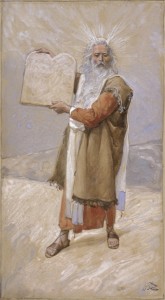
The reading for Thursday after Ash Wednesday features Moses laying out the basic reality that all of us have a choice to make:

Today I have set before you
life and prosperity, death and doom …

I call heaven and earth today to witness against you:
I have set before you life and death,
the blessing and the curse (Dt 30:15, 20).

So there is our choice: life or death, prosperity or doom. There is a Latin expression, Tertium non datur (No third way is given). We often like to think that we can take some middle path, but in the matter of the last things, there is no middle path, no third way. Either we choose God and His kingdom, and then reflect that choice in all of our smaller decisions, or we do not.

To those who think that a middle path is possible, I would say that it is the way of compromise, ambivalence, and tepidity. Walking such a path demonstrates a lack of commitment and a refusal to witness to Christ. These are not virtues that belong to God’s Kingdom; they pertain more to the kingdom of darkness. Jesus says, Let what you say be simply ‘Yes’ or ‘No’; anything more than this comes from evil (Matt 5:37). He also says, No one can serve two masters. Either you will hate the one and love the other, or you will be devoted to the one and despise the other. You cannot serve both God and money (Matt 6:24).

So we are back to a choice: for the Kingdom of Light or for the kingdom of darkness; for the world and its ways, or for God and His ways. Do we choose to gratify the flesh or nourish the spirit, to serve Satan and his agenda or to serve Christ and follow His will and plan?

You are free to choose, but you’re not free not to choose. That is to say, you must choose. If you think that you can go on simply not choosing one or the other, I’ve got news for you: not choosing is choosing the kingdom of darkness.

Many do not directly choose Satan, but rather indirectly choose him by following his ways. We are asked to choose God directly, by accepting the gift of faith and basing our life on what the He commands. Faith is not some sort of “default position” we can have by accident. Faith is the supernaturally-assisted and transformed human decision for God and all that that choice implies. Faith is a gift freely offered and one that we must freely accept; it is a choice that will not be forced on us. Through our many daily choices, we are called to reaffirm, by grace, the choice we have made for God.

So again, life is about choices: the fundamental choice of faith and all the daily choices that either affirm or deny the reality of our faith.

We live in times in which people like to demand free choice, but also like to evade the responsibilities that come with making choices. Moses goes on in the reading today to describe the fact that the choice we make for or against God will have consequences:

If you obey the commandments of the LORD, your God,
which I enjoin on you today,
loving him, and walking in his ways,
and keeping his commandments, statutes and decrees,
you will live and grow numerous,
and the LORD, your God,
will bless you in the land you are entering to occupy.
If, however, you turn away your hearts and will not listen,
but are led astray and adore and serve other gods,
I tell you now that you will certainly perish;
you will not have a long life
on the land that you are crossing the Jordan to enter and occupy (Dt 30).

Yes, choices have consequences. Even small daily choices have the cumulative effect of moving us in one direction or the other, toward God or away.

Many small choices also have a way of forming our hearts. Deeds become habits; habits become character; character becomes destiny. These choices form our hearts, establish our character, and move us into one future or another.

While sudden and dramatic conversions are possible as long as we are still living, it is more common that our hearts become more fixed over time and our fundamental character becomes less and less likely to change. As we get older, it’s harder to change because that’s what choices do to us: they move us in a certain direction, down a certain path; and the further along that path we go, the less likely we are to turn back.

Therefore, daily choices are important. It is essential to examine our conscience regularly and make frequent use of the Sacrament of Confession. Each day we ought to ask the question, “Where am I going with my life?” If we go on for too long living an unreflective life, it is easy to find ourselves deeply locked in sinful habits that become harder and harder to break. Frequent reflection is necessary and we ought not to make light of small daily decisions.

We live in times in which it is often easy to insulate ourselves from the immediate consequences of the choices we make. Medicine, technology, and social safety nets are all good things in and of themselves, but they do tend to shield us from immediate consequences, and help to cultivate the illusion that consequences can be forever evaded. They cannot.

We also live in times in which, perhaps more than ever before, the community is willing to bear the burden of poor individual choices. Again, this is not in and of itself a bad thing, but it does become an enabler of bad behavior, and fosters the illusion that consequences can be avoided forever. They cannot.

Our own culture is currently struggling under the weight of a colossal number of poor individual choices, ones that have added up to a financial, spiritual, moral, and emotional debt that we cannot pay. Sexual misconduct, divorce, cohabitation, abortion, sexually transmitted diseases, the use of hallucinogenic and addictive drugs, the casting off of discipline and parental responsibility, the rejection of faith and ancient and tested wisdom, rebellion, silence in the face of sin and injustice, greed, consumerism, factions, envy, discord, and on and on … all of this is taking a tremendous toll. The consequences are mounting and it is becoming clear that even the most basic functions of society such as raising the next generation, preserving order and stability, and ensuring the common good are gravely threatened.

And what is true collectively is also true for us as individuals. Many poor choices in small matters quickly draw us into self-destructive patterns that get more and more deeply entrenched. Without regular reflection and the reminder of penitential seasons like Lent, it is easy to lose our way. St. Augustine noted this in his Confessions, in which he described himself as being bound,

“not by another’s irons, but by my own iron will. … For in truth, lust is made out of a perverse will, and when lust is served, it becomes habit, and when habit is not resisted, it becomes necessity” (Confessions 8.5.10).

Moses’ warnings are before us as never before.

In 1917, a beautiful and holy woman (Our Lady) appeared to three little children. She explained that the horrifying war (World War I) was finally coming to an end, but also warned that if people did not turn back to her Son Jesus and start praying, an even more devastating war would ensue; Russia would spread her errors and great disaster would befall the world. Do I need to tell you what happened? Any even casual assessment of the 20th century would find it hard to conclude that it was anything but satanic in terms of its wars, death rates through violence and abortion, and in its persecution of the Church.

Life or death, prosperity or doom; what will you choose?

Choices! Consequences!

And now from heavy to humorous: