We think of distractions as coming mostly from the world around us, but is that really true? Consider the following, drawn from the stories of the early desert Fathers and monastic experience:
Sometimes there would be a rush of noisy visitors and the silence of the monastery would be shattered.This would upset the disciples; not the Abbot, who seemed just as content with the noise as with the silence.To his protesting disciples he said one day, “Silence is not the absence of sound, but the absence of self.”
The fact is, our greatest distraction is usually our very self. If this surprises us, we should probably chalk it up to pride. Why? Because what God wants us to focus on is outside and above us: in the beauty of creation, in the wonder of others, and in the magnificence of God. These are not distractions; they are often exactly what God is trying to say to us, to reveal to us.
St. Augustine described our essential problem as this: Homo incurvatus in se (man turned in on himself). In turning inward, a host of distracting questions assail us:
• I’m bored. • I’m tired. • What will I do next? • What do people think of me? • Do I fit in? • Am I handsome/pretty enough? • Have I made it? • What does this have to do with me? • What have you done for me lately? • When will it be my turn? • What about me? • Why are people upsetting me? What gives them the right?
Yes, a thousand variations of these swim through our mind, most of them rooted in pride and its ugly stepsister, vanity.
As the story above teaches, however, it is the absence of self that brings truer serenity. Indeed, of this I am a witness, for my freest, most joyful, and most focused moments come when I am most forgetful of myself:
• When I am watching a movie that grips my attention and draws me outside of myself into the plot and the moments in the lives of others, even if fictional • When I am powerfully aware of the presence of others and listening carefully to what they say. • When I am in the company of close friends, an atmosphere in which I am less concerned with seeking approval, and can just relax in the moment, enjoying whatever is happening. • In those moments of deep appreciation of the natural world, when I walk through a field and am captured by “the color purple” and am deeply moved by the beauty of God’s creation. • In moments of deep and contemplative prayer when, by a gift of God, I forget about myself and am drawn deeply into the experience of Him.
In moments like these, God takes us (who are so easily turned inward) and turns us outward and upward. The myriad distractions that come from self-preoccupation hush for a time. In this state of “self-forgetfulness”, we are almost wholly present to others, to creation, and to God. The noisy din of anxious self-concern quiets, and our world opens up and out.
The Psalms often speak of God placing us in a spacious place (e.g., Ps 18:19, 31:8, 119:45, inter al). You have set my feet in a spacious place, O Lord (Ps 31:8). There is nothing more cramped than being turned in on ourselves.
Ask the Lord to set your feet in the wide spaces, to open you outward and upward. The worst distractions are not the noises outside us, but rather the noises within us, noises that come from being too self-preoccupied. The silence that we most crave is not found in the absence of sound, but in the absence of self-preoccupation.
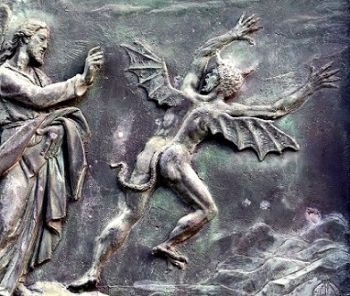
The video at the bottom of this post is of Archbishop Fulton J. Sheen. It is a fascinating excerpt from a longer presentation he did. In it, he analyzes the diabolic (anything of or relating to the Devil) from several different perspectives. Archbishop Sheen identifies three characteristics of the diabolic by examining the story of the Gerasene demoniac, which is presented in the synoptic Gospels. Here is the beginning of the story as it appears in the Gospel of Luke:
They sailed to the region of the Gerasenes, which is across the lake from Galilee. When Jesus stepped ashore, he was met by a demon-possessed man from the town. For a long time, this man had not worn clothes or lived in a house, but had lived in the tombs. When he saw Jesus, he cried out and fell at his feet, shouting at the top of his voice, “What do you want with me, Jesus, Son of the Most High God? I beg you, don’t torture me!” For Jesus had commanded the evil spirit to come out of the man. Many times it had seized him, and though he was chained hand and foot and kept under guard, he had broken his chains and had been driven by the demon into solitary places. Jesus asked him, “What is your name?” “Legion,” he replied, because many demons had gone into him (Luke 8:26-30).
Following this, Jesus drove the demon(s) out the man and into the herd of swine.
From this story, and also based on an insight from Dr. Rollo May, a psychologist of his time (the talk was given in the mid-1970s), Archbishop Sheen sets forth these three characteristics of the diabolic:
Love of Nudity – For a long time this man had not worn clothes.
Violence – … though he was chained hand and foot and kept under guard, he had broken his chains. The version of the story in Mark’s Gospel has more vivid detail: For he had often been chained hand and foot, but he tore the chains apart and broke the irons on his feet. No one was strong enough to subdue him.
Division (split personalities, disjointed minds) – … many demons had gone into him. In Mark’s version, the demoniac replies, My name is Legion, for we are many (Mk 5:9). All of the versions say that the demoniac lived apart from others or in solitary places.
It does not take much effort to recognize that these three characteristics of the diabolic are alive and flourishing in the modern world, at least in the West. Let’s examine the evidence we can see all around us today:
1. Love of Nudity – This is obvious in the modern world on several levels. First, there is the widespread tendency toward immodest dress. We have discussed modesty here before on this blog, noting that the words “modesty” and “moderation” come from the word “mode,” which refers to the most commonly occurring value in a set of data. Hence, while we want to avoid oppressively puritanical notions about dress that impose heavy burdens (especially on women) and regard the body as somewhat evil, we must also critique many modern forms of dress that are at the other extreme. These “fashions” reveal more than is reasonable and are generally intended to draw attention to aspects of the body that are private and reserved for sexual union within marriage. Too many in our culture see no problem with parading about in various stages of undress, wearing clothing that seems intended to call attention to, rather than conceal, the private areas of the body. This love of disclosure and titillation is surely an aspect of the Evil One’s love of nudity.
Pornography, though nothing new in this fallen world, has surely reached epidemic proportions thanks to the Internet. Any psychotherapist, counselor, or priest will tell you that addiction to pornography is a huge problem today. Millions of Americans are viewing enormous amounts of pornography and the “industry” appears to be growing rapidly. What once required a visit to a hidden-away adult bookstore is now available in one’s home with just a click of the mouse. And the thought that browsing habits are easily discoverable matters little to the addicts of this latest form of slavery. Many are on a steep slope downward into ever-more-deviant forms of pornography. Some end up at illegal sites and before know what’s happened, the FBI is knocking on their door. Yes, Satan’s love of nudity has possessed many!
The overall sexualization of our culture also ties in to Satan’s love of nudity. We sexualize women in order to sell products. We even sexualize children. Our sitcoms feature endless immature chatter about sex. Collectively, we act like oversexed teenagers obsessed with something we don’t really understand. Yes, Satan loves nudity and everything that goes with it.
Then of course there is the utter confusion that celebrates homosexual activity. What Scripture calls gravely sinful, disordered, and contrary to nature (παρὰ φύσιν – para physin – Rom 1:26), is openly celebrated by many in our culture. Those afflicted with such desires openly and proudly identify themselves with what tempts them. Rather than lamenting the trials faced by those with such an affliction, and offering love, support, and the truth that they should live celibately (as all the unmarried are called to do), our sex-saturated culture, blinded and darkened by its own wild lust, affirms and even encourages them to indulge in what can only bring further harm to them and others. They have exchanged the truth of God for a lie … (Rom 1:25). It is no surprise that as a result of this celebration of darkness and confusion, the even more deeply confused notion of “transgenderism” has taken root.
Thus, the love of the nudity and the related obsession with (and confusion about) sex is manifest in our culture. It is surely a sign of the diabolic.
2. Violence – Collectively, have turned violence into a form of entertainment. Adventure movies and video games turn violent retribution into fun and death into a “solution.” Recent popes have warned us of the culture of death, a culture in which death is put forward as the solution to problems. Violence begins in the womb as the innocent are attacked as we defend “choice” and “rights.” The embrace of death continues to pervade the culture through contraception, gang activity, frequent recourse to war, and capital punishment. The past century was perhaps the bloodiest ever known on this planet: two world wars, hundreds of regional wars and conflicts, starvation campaigns, and genocides. Paul Johnson, in his book Modern Times estimates that over 100 million people died violently in just the first 50 years of the 20th century. With every death, Satan did his “Snoopy dance.” Satan loves violence; he loves to set fires and then watch us blame one another as we all burn.
3. Division – Satan loves to divide. Archbishop Sheen says that the word “diabolic” comes from two Greek words, dia and ballein, meaning “to tear apart.” Most literally, dia means “through” or “between” and ballein means “to throw or to cast.” Satan “casts things between us” in order to divide and distract us. Thus, we see our families, the Church, and our country divided. These divisions occur in almost every facet of our lives: race, sex, religion, politics, economics. We are divided on the basis of age, region, blue vs. red states, the coasts vs. the heartland, liturgy, music, language, and more trivialities.
Our families are broken. Divorce is rampant. Commitments of any sort are rejected as too difficult or even impossible. The Church is broken, divided into factions. Though we once we agreed on the essentials, now even appeals to shared truth are called intolerant.
Inwardly, we struggle with many divisive drives, with figurative and literal schizophrenia. We are drawn to what is good, true, and beautiful and yet at the same time to what is base, false, and evil. We know what is good, but desire what is evil; we seek love, but indulge in hate and revenge. We admire innocence but often revel in destroying it or at least in replacing it with cynicism.
Three characteristics of the diabolic: love of nudity, violence, and division. What do you think? Is the prince of this world working his agenda? Even more important, are we conniving with him? The first step in overcoming the enemy’s agenda is to recognize his tactics, name them, and then rebuke them in the name of Jesus.
Thank you, Archbishop Sheen. Your wisdom — God’s wisdom — never ages.
Pay attention to what the good archbishop has to say!
I have received many requests to republish a post from several years ago. The following five truths from that essay are indeed hard. They rock our world and stab at the heart of some of our most cherished modern notions. If they can be accepted for the truth they convey, however, they bring great peace. These truths are not only good medicine for our collective self-absorption but they also help us to have more realistic expectations as we live out our lives in this imperfect and limited world. Study these truths well. If they irritate you a bit, good; they’re supposed to. They are meant to provoke thought and reassessment.
I did not originate the following five principles, but the commentary is my own. So thank the one to whom the Holy Spirit first spoke them and tolerate my meager commentary.
1. Life is hard. We live in times of comfort and convenience. Medicine has removed a lot of pain and suffering from our lives. Consumer goods are readily available and we have a wide array of choices. Entertainment comes in many varieties and is often inexpensive. Hard labor is something that few of us are familiar with. Obesity is common due to overconsumption and underactivity.
All of these creature comforts have led us to expect that life should always be just peachy. We become outraged at the slightest suffering, inconvenience, or delay.
Our ancestors lived lives that were far more “brutish and short,” to borrow a phrase from Thomas Hobbes. Life was a “vale of tears.” They understood that suffering was a part of life. When we suffer today, we start thinking about lawsuits and who is to blame. Suffering seems obnoxious to us and hard work unreasonable! We are angered and flung into anxiety at the mere threat of suffering.
This principle reminds us that suffering and difficulty are part of life; they should be expected. Accepting suffering does not mean we have to like it. Acceptance of the fact that life will be hard at times means that we get less angry and anxious when it is; we do not lose serenity. In fact, it brings a strange sort of peace. We are freed from unrealistic expectations that merely breed resentment. We also become more grateful for the joys we do experience.
2. Your life is not about you. If you want to make God chuckle, tell Him your plans. If you really want to give him a belly laugh, tell Him His plans! We often like to think that we should just be able to do what ever pleases us and maximizes our “self-actualization.” However, we do not decide alone what course our life will take.
In this age of “nobody tells me what to do,” it is important to remember that our true happiness comes from getting not what we want, but what God wants. Our destiny is not to follow our star; it is to follow God. True peace comes from careful discernment of God’s will for us.
It is sad how few people today ever really speak ahead of time with God about important things like careers, entering into a marriage, or pondering a large project. We just go off and do what we please, expecting God to bail us out if it doesn’t go well. You and I do not exist merely for our own whims; we have a place in God’s plan. We have greater serenity when we discern that place and humbly seek God’s will. Accepting the fact that we are not the masters of our own destiny, not the captains of our own ship, gives us greater peace. It also usually saves us a lot of mileage.
Humbly accepting that our life is not simply about us and what we want is a freeing truth. We often don’t get what we want; if we can allow life to just unfold and not demand that everything be simply the way we want it, we can be more serene and free.
3. You are not in control. Control is something of an illusion. We may have plans for tomorrow but there are many things between now and tomorrow over which we have no control. For example, we cannot even control or guarantee the next beat of our heart. I may think I have tomorrow under control, but tomorrow is not promised; it may never come.
Because we think that we control a few things, we think that we can control many things. Not really. Our attempts to control and manipulate outcomes are comical, sometimes even harmful.
Thinking that we can control things leads us to think that we must control them. This in turn leads to great anxiety and often anger as well.
We usually think that if we are in control we will be less anxious. This couldn’t be further from the truth. In fact, the more we think we can control, the more we try to control, which increases our burdens and anxiety. We end up getting angry because we discover that there many things and people we cannot control after all. This causes frustration and fear.
We would be freer and less anxious if we would simply accept the fact that there are many things—most things, in fact—over which we have no control. Our expectation of everything being under control is unrealistic. Life comes at you fast. Brooding over unpredictable and uncontrollable things amounts to bondage. Simply accepting that we are often not in control is freeing.
4. You are not that important. This one hurts. We often think that the whole world should revolve around us. We think it is only our feelings that matter and our wellbeing that is important. We are loved by God in a very particular way, but that does not change the fact that we must often yield to others who are also loved by God in a very special way.
Sometimes other people are more important than we are. We might even be called upon to give our life so that others may live. We must yield to others whose needs are more crucial than our own. The world doesn’t exist just for us and what we want.
There is great peace and freedom in coming to accept this. We are often made so anxious if we are not recognized while others are, or if our feelings and preferences are not everyone’s priority. Accepting the truth that we are not that important allows us to relax and enjoy caring about other people and celebrating their importance.
5. You are going to die. We get all worked up about what this world dishes out, but just take a walk in a cemetery. Those folks were all worked up too. Now their struggles are over. If they were faithful, they are with God; they are now experiencing that “trouble don’t last always.”
This truth also helps us to do the most important thing: get ready to meet God. So many people spend their lives clowning around and goofing off, ignoring our most urgent priority. In the end, this is freeing because we are loosed from the many excessive and often conflicting demands of the world; we can concentrate on doing the one thing necessary. Our life simplifies and we don’t take this world too seriously because we understand that it is passing away. There is great peace and freedom in coming to accept this.
So there you have them, five hard truths that will set you free. Think about them. Memorize them. Pull them out when life comes at you fast and hard with its agenda of control, self-importance, and empty promises of perfect comfort here on earth. A simple, sober, humble, and focused life brings great serenity.
One of the great battles in the spiritual life is mastering our emotions, by God’s grace. Our emotions are not evil, but they are unruly and easily manipulated by the world and the devil. Our own flesh (fallen nature) also contributes to the difficulty of self-mastery.
Yet as I have often testified, if we are faithful to the Lord and to prayer, growth in the spiritual life happens. Many of my once-unruly emotions have become more stable and are more quickly assuaged when they arise. I feel very good and confident about the progress I have made because I know it is the Lord who has accomplished it. Yes, I did my work: prayer, spiritual direction, Scripture, confession, Mass, and psychotherapy, but I know it was the Lord. For example, I remember awaking one morning and realizing that some very deep hurts from the past were gone. I couldn’t say when they had left; it seemed as though they had just evaporated. God was signaling me that it was over; they were gone, just gone. I felt a forgiveness, even a compassion, for those who had hurt me. I knew that I wasn’t the one who had accomplished this. Without God’s grace, I was prone to cling to my anger and resentments and rehash the injustices I had felt. Thankfully those feelings have never returned.
Anxiety was always the unruliest of my emotions. Beginning at ten years of age I would have crippling bouts of anxiety and panic. During these periods I could barely sleep and would obsessively ruminate over the fears that seized me. As a boy, I was terrified of various things: a house fire, someone breaking in and killing our entire family, etc. As I grew older and had more duties and responsibilities, I would have periodic attacks of extreme anxiety about assignments or about presentations/sermons I had to give.
The sporadic nature of these bouts seemed to confirm their demonic source. I could go for months, even years at a time, and be fine; suddenly, and usually for no apparent reason, I would feel an overwhelming panic or anxiety. For example, when I had been a priest for over ten years and been preaching and teaching with ease, I suddenly went through a period of grave anxiety over my Sunday sermons. I would worry all week long about the upcoming sermon.
Whether or not these were satanic attacks, the fact is that demons are opportunistic. They found doorways in my psyche and I, with the Lord, knew that deliverance prayer alone wasn’t going to be enough. The doors had to be closed. The work of grace and my cooperation with the Lord was going to have to win the day.
The heart of the battle occurred during a ten-year period, from my mid-thirties to my mid-forties. The medicines were these: prayer, spiritual direction, psychotherapy, sacraments, liturgy, the purification of the intellect (since most feelings come from thoughts), and learning by grace to trust God.
As in any battle, the victories came, but there were also setbacks and relapses. Little by little, trust triumphed over anxiety. A more stable, serene, and confident joy became my set point.
Now in my mid-fifties, I can say that the most recent ten years have been largely and increasingly victorious. I am seldom anxious about anything today. Thank you, Lord, and thank you also for all who have helped, guided, consoled, and encouraged me in my journey!
Every now and again, usually for just a moment (or no more than a day), I am reminded that I hold this treasure in an earthen vessel and that I need to stay “prayed-up”; I need to maintain the disciplines I have learned. Maybe it is a dream in the middle of the night from which I struggle to recover. Perhaps it is just a memory that seems all too real. Maybe it is the looming possibility of a new duty. Thanks be to God, though, the reminders are brief and whatever anxiety comes is manageable. I cannot tell you how grateful I am to God for this gift!
St. Catherine of Siena writes of these “reminders” in her major work, The Dialogue of Divine Providence. God the Father teaches her why He permits them:
Sometimes I resort to a pleasant “trick” with [the spiritually mature] to keep them humble …. For the sensual emotions slumber [even] in the perfect soul but they do not die. This is why, if they relax their efforts, or let the flame of holy desire grow dim, these emotions will awaken. It is essential to remain in holy fear of me …. Otherwise … the emotions seem to be asleep and it seems that they do not feel the weight of great sufferings or burdens. But then, in some tiny thing that really is nothing (that they themselves will later laugh at), their feelings are so aroused that they are stupefied. My providence does this to make them grow and go down into the valley of humility. [I do this] to give them give opportunity for merit, to keep them in the self-knowledge whence they draw true humility, to make them compassionate instead of cruel toward their neighbors so they will sympathize with them in their labors. For those who have suffered themselves are far more compassionate to the suffering than those who have not suffered
We still need pricks and blows lest in our progress we become prideful or think that something is so far in the past that we forget to be grateful for our deliverance. The point is that we should never lose heart nor think that all progress is lost when we see a simple reminder of our frailty. With God we are strong, but only with God. Salutary reminders of this are necessary and the Lord, who loves us, provides them.
We live in largely skeptical times, steeped in a relativism, in which many scoff at the idea that we can know the truth or even that there is a truth to be known. Never mind that in so doing they are in fact making a truth claim of their own! But the ability to perceive one’s own logical inconsistencies is not is not a common trait these days.
Nevertheless, despite the tenor of our times, it does not follow that we should overcorrect by declaring certainty about everything, or even most things, we know. Illusion remains a pervasive human problem. And, as we shall see, illusion is more of a moral problem than an epistemological one. The problem of illusion does not mean there is no truth to be found or known; rather, it means that the human mind, and will wounded by sin have a tendency to entertain illusion.
The word “illusion” comes from the Latinin + ludere (to play games or mock), thus “to engage in games or play.” And so illusion is, by extension, a manner in which one tries to trick another, as in optical illusions or magic tricks. But internally, illusion is our own tendency (conscious or unconscious) to play games with ourselves, to play loosely with the facts, to indulge in logical gamesmanship or even entertain outright foolishness.
We are masters at this game. We can lie to ourselves for so long that we no longer even realize that we’re doing it. Yes, our minds are very wily. So easily our greatest strength and gift—our mind—can become the source of our greatest flaws. We can rationalize some of the most awful things by cloaking them in euphemisms and explanations that obfuscate rather than elucidate. Abortion becomes “reproductive choice,” lying becomes “mental reservation,” euthanasia becomes “death with dignity,” mutilation becomes “sexual reassignment surgery,” etc.
And then there are the smaller the illusions that apply to our daily lives. Fr. Thomas Dubay described some of these as follows:
If illusion means unrealized, possibly sincere, even enthusiastic error, there is far more of it in each of our lives than we are prepared to admit. All the way from our petty vanities to suppositions about our motivations, we are subject to all sorts of misjudgments concerning the way things are. There are the illusions of exaggerated self-esteem and its opposite, a weak self-image. There are the hundreds of illusory desires of which St. Paul speaks in Ephesians 4:22, desires for things we imagine we need. There are our illusory fears of things we ought not at all to fear (“What will they think of me? How will I look?”) and the illusory non-fear of things we ought dreadfully to fear. There are the many misjudgments of what is important in life and what is trivial—and who, if he be less than a saint does not err in these judgments many times each day? (Authenticity p. 35)
But where does this tendency toward illusion come from? Although our intellects are darkened by Original Sin and the cumulative effects of personal sin, illusion is more than just an intellectual problem. The roots of illusion are much deeper, in the center of the human person. Though we may not like to admit it, careful analysis shows that illusion and our tendency to entertain error stem fundamentally from sin. Illusion is something that, to some degree, we will; we decide to engage in it as a tactic. In most cases we don’t really want to know the full story or all the facts, or else we are simply too lazy to seek the complete truth.
To illustrate that illusion is more a problem of the will than a failure of our perception, Fr. Dubay uses the following example in his essay (Authenticity, p. 36): One sees a fruit tree in the distance with round, red fruits hanging in its branches. Upon seeing this tree, one might remark to the person standing next to him, very often in a hasty way, that it is clearly an apple tree. But of course it could actually be a plum tree. Rarely will someone humbly admit or say, “It could be an apple tree, but I’m not sure, so I’ll need to get a closer look.”
Our tendency is to draw a conclusion quickly, based only on limited evidence, so that we appear to know what we’re talking about. So we say, “That is clearly an apple tree.” We may do this out of pride, or vanity (to look like Mr. Know-it-all), or simply because we’re lazy and it’s too much trouble to go get all the facts.
Of course this example features a small matter. But we take this tactic with much more significant matters as well. We will often make sweeping conclusions about other people’s motivations, significant events in the news, scientific matters, or geopolitical matters based on very little evidence or information. And then based only on this small amount of information we entertain the illusion that we quite certainly and comprehensively know what is actually going on, what everything means, and what exactly should be done (if only people would ask us). There’s an old saying, “Don’t believe everything you think.” But this doesn’t stop most of us from doing that most of the time!
Why do we do this? Some of the reasons have already been presented, but let’s list them again along with some others.
Haste (sloth) – It’s a lot easier to entertain the illusion that we know all the facts than to actually go out and find them. Certainly we have time limitations and cannot research everything completely, but that is all the more reason to resist the illusion that we know it all and to be more careful in drawing conclusions. We can and should make reasonable conclusions about the data we have, but we should also be open to receiving more information that may clarify or even challenge some of what we think we know. So it’s not a problem of the intellect per se, but of the will, influenced by sloth. We often decide to make hasty conclusions out of laziness.
Vanity – Not only do we like to entertain the illusion that we know everything, we want others to entertain it as well. Because of this we like to impress others with our perceived knowledge and are slow to admit ignorance. Here, too, entertaining this illusion is something we decide to do. Our will (and intellect) are weighed down by vainglory. Sometimes we delude ourselves unconsciously while at other times it is a more conscious effort. Seeking to perpetuate this exalted vison of ourselves we also advance other illusions and errors by sermonizing, opining, and declaring things of which we are not really all that certain. Thus one illusion begets another.
Social Ease – There is another form of sloth in which we pick up popular notions and simply parrot them. This usually wins us approval (more vainglory). We prefer to presume that popular notions are true rather than thinking things through more thoroughly and pondering whether they are true, or untrue, or perhaps need some distinctions applied. But all of this is just too much trouble; it also tends to put us out of favor with the many who would prefer that popular illusions not be challenged. And so we simply slip into the tendency to assume that popular ideas are true simply because most people think so. Behaving this way gives us a sense of social ease and helps us to feel safe even if, deep down, we know that a lot of it is illusion.
Preference for lies (fearing the truth) – The truth tends to challenge us in ways that lies do not. Illusion is often a form of simplification. The truth is usually much more complex. We prefer the simplification that illusion provides. Our fantasy world is easier to navigate (because it is of our own making) than the real world. The truth often challenges our simplified culture, addicted as it is to the sound bite. And thus we introduce all sorts of mental filters and other forms of illusion so that we can hide from the truth, water it down, or outright resist it.
Emotional satisfaction – It is generally easier (or at least more pleasing) to follow the whims of our emotions than to seek out hard facts. The truth might summon us to do something hard such as to resist what our emotions are demanding of us. Especially in this modern age, we live under the illusion that strong emotions, of themselves, convey truth. They do not necessarily do this at all. In fact, they may often be an overreaction of our psyche to the truth. Our passions and emotions have their place, but they can be very unruly and very deceptive.
We live in times in which many speak dreamily about the authority of emotions. Some will say, as if it were profound, “How can something that feels so good be wrong?” Others will claim that because some hard course of action might make someone feel sad or anxious means that that course of action should not be undertaken or insisted upon. Much of this is illusion because it exalts the lower faculties and would have them overrule (rather than be ruled by) the higher faculties such as the intellect and a properly disposed will.
Despite this, many people today prefer the dreamy illusions that emotions can supply. Moviemakers and advertisers know this well. A good tearjerker of a movie or a powerful song can confound reason and make us sympathize with the strangest causes. At the other end of the spectrum, advertisers often use fear to incite us to buy their products: you’re not pretty enough; you don’t drive the right kind of car; your hair is too gray; your life is somehow incomplete and you’re basically pathetic. Just buy our product and you’ll rise in the ranks and not be such a loser. Never mind that most of the fears incited are themselves illusions.
But that is just the point: emotionalism uses illusion to feel better even though illusion is part of the problem that drives excessive emotionalism. The solution is always more of the same: “More illusion please; the truth is mean and it hurts.”
So what is the solution? First it is essential to say that the solution is not to conclude that the truth cannot be known and that we are all somehow lost in illusion. We are equipped to know the truth and to come to love it. And because the problem is in our will more so than in our intellect, the solution is to make the decision to renounce our sinful tendency to indulge in illusion.
How do we do this? First and foremost, we love. If we learn to love God, by extension, we will learn to love His truth. When we love God we start to love the things and people He loves. We love our neighbor, but we also come to love the truth that God has set forth. We love what He loves: the truth that He has set forth in Sacred Scripture and Tradition. Out of love, we zealously seek the truth and joyfully embrace it more and more deeply.
This makes good sense because while we can be deceived, God cannot. His revealed truth is the surest and most certain source of truth. It is not admixed with error, nor is it trendy or changing. The solution to our foggy illusions is the clear light of God’s eternal and time-tested truth. And while some of us may entertain illusion even about God’s truth we cannot stay in this illusion for very long. The Lord teaches infallibly through His revealed Word, the testimony of the saints, and the Magisterium of his Church.
We suffer from illusions, but God does not. Love Him, run to Him, and listen to Him attentively as He speaks through His Word and His Body, the Church. Only this can save us from the fog of our illusions.
N.B. Many of the thoughts in this essay come from Fr. Thomas Dubay in his work Authenticity, cited above. The best thoughts in the essay are his; the inferior ones are mine.