
The Christmas Gospel from Luke provides us with many teachings. One thing that surely stands out, however, is the theme of humility. Throughout the account, God confounds our prideful expectations and insists on being found in the lowest of places.
The newborn Christ is not found where we expect Him to be nor does His birth conform to any script we would design. Right from the start, He gives us many lessons in humility and begins His saving work of healing our wound of pride. Let’s look at these lessons, each in turn in.
The first lesson in humility is our surprise, and even indignation, at the events surrounding Jesus’ birth. The text from St Luke says,
In those days, a decree went out from Caesar Augustus that the whole world should be enrolled….So, all went to be enrolled, each to his own town. And Joseph too went up from Galilee from the town of Nazareth to Judea, …Bethlehem, because he was of the house and family of David, to be enrolled with Mary, his betrothed, who was with child.
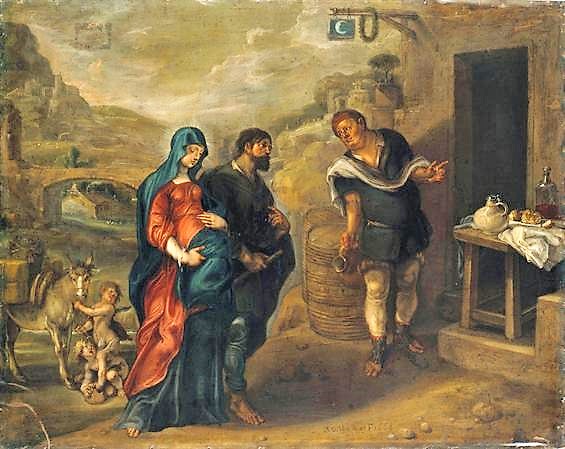
For many of us, this offends our sense of what should justly happen. Jesus, who is Lord and Savior, should be born in comfort; Mary should be surrounded by loving family and in the care of midwives. Why does God permit this emperor to interfere with the Birth of his Son. Why does he not intervene to prevent the kind of hardship and inconvenience that Joseph and Mary will endure? Imagine having to walk nearly eighty miles when Mary is nine months pregnant! Could not God have arranged something better for the Holy Family? Our indignation at this inconvenience and hardship are likely rooted in our prideful notion that we know what is best in terms of where and in what conditions the Lord should be born.
However, God’s way are not our ways. He is neither surprised nor stymied by the emperor’s decree. All this fits into His plan to get Jesus, Mary, Joseph, and all of us to the place of blessing in Bethlehem. Whatever evil the emperor intends, God intends it for good (see Genesis 50:20). The Messiah, it was prophesied, would be called a Nazarene (Matt 2:23), be born in Bethlehem (Micah 5:2), and die in Jerusalem (Lk 13:33). God is setting things in place for the blessing. See already the humility of the Lord who is willing to be inconvenienced for our sake.
The second lesson in humility is: Your life is not just about you. You and I are part of something far larger. Consider that there is a “cast of thousands” that will lead Mary, Joseph, and Jesus to be in Bethlehem, as was prophesied. The distant Caesar Augustus sends out a decree affecting millions. He wants a census taken in order to update his tax rolls. He also likely wants to measure his power. Soon enough, dozens of governors deploy thousands of troops to enforce the edict. Even in the small town of Nazareth, a town of barely 300 people, Roman troops enforced the decree. So, even the birth of the Messiah is caught up in the bigger picture of the world’s events and people by God’s own design. Their lives are also caught up in the plans of God to save billions of people now living, countless others who have lived, and still others who will live in the future. God sees the bigger picture, yet not one detail is lost to Him. So, humility! God has more in mind than our comfort and personal agendas and our vision of the way things “ought to be.” We are part of something bigger, our lives are not just about us.
The third lesson in humility is that God must get us to certain places in order to bless us. And they may be strange places, ones we would not choose. Getting us there may involve hardship for us: disappointment that our own plans have not come through, and the painful loss of places, things, and people we love. Yet, God has blessings waiting for us in strange places, involving circumstances we never imagined.
For Joseph and Mary, the procession to the place called Bethlehem involved hardship. But this procession is necessary for them and for us. Bethlehem was where the blessing would be found—there, and no other place. And the same is true for us in so many ways.
This is a paradigm for our lives. Where is your Bethlehem? Where does God need to get you in order to unlock your blessings? Are you humble and teachable enough to go there? Remain humble and don’t quickly despair when the surprises and vicissitudes of life emerge. God may be up to something. He can make a way out of no way and write straight with crooked lines.
The fourth lesson in humility is the paradox of poverty. The text from Luke says,
While they were there, the time came for her to have her child, and she gave birth to her firstborn son. She wrapped him in swaddling clothes and laid him in a manger, because there was no room for them in the inn.
Don’t miss the poverty that is manifest here—it is a chosen poverty. St. John Chrysostom said,
Surely if [the Lord] had so willed it, He might have come moving the heavens, making the earth to shake, and shooting forth His thunderbolts; but such was not the way of His going forth; His desire was not to destroy, but to save… And, to trample upon human pride from its very birth, therefore He is not only man, but a poor man, and has chosen a poor mother, who had not even a cradle where she might lay her new born Child; as it follows, and she laid him in the manger (Quoted in the Catena Aurea – Lection 2 ad Luc 2:6).
We who are worldly think that poverty is the worst thing, but it is not—pride is the worst thing. And thus the Lord teaches us from the start that greatness and blessings are not found merely in what is high, mighty, pleasant, or pleasing. Blessings are often found in unusual ways and under unexpected circumstances.
The greatest blessing ever bestowed is not found in a palace, or in Bloomingdales, or on beachfront property; He is not even found in a humble Bethlehem home. He is found in a lowly manger underneath a home, where the animals were sheltered. It is poor and smelly and He rests in a feeding trough. But there He is, in the least expected place, the lowest imaginable circumstances. In this way He confounds our pride and our values because he chooses this poverty.
Whatever its unpleasant realities, poverty brings a sort of freedom if it is embraced. The poor have less to lose and thus the world has less of a hold on them. Wealth has many spiritual risks. It is hard for the rich to inherit the Kingdom of Heaven. Wealth is too easily distracting and enslaving. And even knowing all this, we still want it. In choosing poverty, Jesus humbles our pride, greed, lust, and gluttony.
Bede, the 7th century Church Father, wrote,
He who sits at His Father’s right hand, finds no room in an inn, that He might prepare for us in His Father’s house many mansions; He is born not in His Father’s house, but [under] an inn and by the way side, because through the mystery of the incarnation He was made the way [for us back to our Father’s House] [Catena, Ibidem].
“Paradox” refers to those things that surprise and upset the normal way of thinking. Paradox always summons us to humility.
The fifth lesson in humility throws into question our overemphasis on politics and worldly power. This section of the nativity narrative serves to strongly remind us that our salvation is not to be found in the statehouse, the courthouse, or the White House. We are not to put our trust in princes. Our salvation is in Jesus, only in Jesus. Are we humble enough to admit this and stop exalting worldly power?
Note that in this Gospel, lots of “emperor words” are used to describe this newborn infant, Jesus. Yet here He is in a lowly manger!
-
-
- Emperors had heralds that preceded their arrival and summoned their subjects. The infant Jesus has the angel of the Lord to announce Him.
- Later, this heralding angel will be joined by a “host” (or army) of angels. The Emperor Augustus has his Legions, but Jesus has His army of angels.
- The angel also uses words appropriate for an emperor. He says, “I proclaim to you good news of great joy that will be for all the people.” This is how the declarations of emperors began.
- The angel uses the word “evangelion” (which means good or life-changing news). This word for “evangelize” was associated especially with an edict or announcement from the emperor and it meant that when the emperor spoke, it was a word of power and your life was changed. But what the emperors questionably claimed for their edicts is really true with Jesus! And so Luke appropriates the emperor language for Jesus.
- The emperors also claimed the titles “savior” and “lord.” The angel calls Jesus Savior (σωτὴρ – Soter) and Lord (κύριος – Kyrios), and He alone deserves these titles.
-
Here is the irony that we must humbly accept: this true Lord and Savior, this God of Armies with plenary authority, is not in some palace drinking from goblets and being fanned by slaves. He is lying in a lowly feed box, attended to by animals.
It is a divine comedy. One can almost imagine the shepherds wrinkling their noses or scratching their heads as they hear this great announcement of a King, Savior, Lord and Messiah, and then hearing that He is to be found in a stable, lying in a feeding trough.
He is King and Lord to be sure, but He is humble and comes to serve and to save. He will wash the feet of the worst sinners and die for the love of them. Humility!
Our final lesson in humility is to be amazed at the humility our Lord embraced in joining our human family and to accept that it alone is the source of our dignity. The text from Luke says,
And suddenly there was a multitude of the heavenly host with the angel, praising God and saying: “Glory to God in the highest and on earth peace to those on whom his favor rests.”
Note the praises of the angels! Who or what could ever match them? They are a multitude. They are perfected in their glory and acclaim God’s praises more gloriously than any human choir could ever hope to do.
Yet even here there is humility to consider. For the Lord has taken human nature to Himself, not an angelic one! In the order of creation, angels are far higher and more noble than we are. Their mere appearance overwhelms us and strikes fear in us. Yet to none of these did God ever say, “You are my Son. This day I have begotten you” (See Hebrews 1:5).
God humbly takes up our human nature and bestows on us an astonishing dignity that comes only from Him. It is due to His choice, not our merits. And though the angels can surely praise the Lord in far more glorious way than we, they cannot say, “One of us is God.”
And glorious though the angel’s praise is, there is a perfect praise that only we can give to God. It was beautifully expressed by the poet Christina Rossetti:
Angels and Archangels may have gathered there.
Cherubim and Seraphim thronged the air.
But only his mother in her maiden bliss
could worship the beloved with a kiss.
And thus, We have no glory to give that is even close to what the Lord deserves, but a simple kiss will do, a simple act of love. It is our lowly and sinful hearts that the Lord seeks, so as to heal and exalt them. Our palaces, honors, and titles are of no interest or value to Him. It is our humility that pleases Him most, and He desires to meet us there.
Humility!