Are you familiar with the “halo effect?” It refers to our tendency to judge a person based on only one characteristic that we find attractive or impressive. It’s as if we place a halo over their heads; they can do no wrong. We do this especially with those we think are physically attractive. We think: They’re good-looking, so surely they’re also intelligent and talented. The opposite of the halo effect is the “devil effect.” We dislike one thing about a person, or find something about them unappealing, and we write them off entirely.
I think that some of this was going on in today’s Scripture readings. In the story from Daniel, we heard of a terrible rush to judgment. The crowds were absolutely convinced that the two elders were telling the truth, because they were seen as respected and wise religious figures. And that almost got Susanna killed!
Then, in our gospel, certain Pharisees were absolutely sure that Jesus wasn’t who he claimed to be- because he didn’t fit into their pre-conceived notions. And that ultimately did get Jesus killed.
Now, the judgments you and I make don’t generally have life-and-death ramifications. However, the judgments we make do have the potential to deeply hurt others, when we judge them wrongly.
Our Lord challenges us to be aware of this, and proceed with caution. So we don’t rush to judgment; so we don’t just judge by appearances. Jesus said to his Pharisee critics: I do not judge, but when I do judge, my judgment is right, because my Father is with me.
We would do well to follow Jesus’ example- to suspend judgment, until we’re able to judge like him.
When it comes to our struggle in prayer there are some things that we need to unlearn. For too many private prayer is often a formal, even stuffy affair that drips of boredom and unnecessary formality and has lots of rules. Perhaps we learned some of our lessons too well. And yet many of the youngest children have not learned these lessons and they seem to pray with great ease. They are unassuming and will say almost anything to God. It is true that children may have a lot to learn about public and liturgical prayer, but when it comes to personal and private prayer they have much to teach us. Perhaps a parable is in order:
A young girl received her First Holy Communion and, when she returned to her pew, she was noticed by her parents to be in rather deep prayer. After Mass they asked her, “What were you praying about after your First Communion?” “Well,” she said, “I prayed for you, mommy and daddy, and my (dumb) brother too! And then I sang Jesus a song and told him my favorite ghost story.”
So informal, so conversational, so unassuming, so real. And yet it is the way little children pray. But over the years it seems we drift away from this honest simplicity and layer on lots of “shoulds and oughts.” Perhaps we over learn or over apply some of the lessons we learn about human interactions. As we grew up we gradually learned that there are certain things you’re not supposed to say. While that may be true in certain human interactions, it is less true as we pray to God. We need to stay honest and plain as we talk with God. He already knows the stuff we think we’re not suppose to say.
Honest to God! – Early in my priesthood a woman came to me and spoke quite frankly and vividly about her anger and disappointment with God who had made her suffer loss. “Have you talked to God about this?” I asked. “Oh no! Father,” she said with her hands in the air, You’re not supposed to talk to God like this.” And she smiled as these words left her mouth because she knew they were silly. I smiled too and said, “He already knows doesn’t he….” I smiled too and said, “So you know what your prayer needs to be about. Now talk to him just like you talked to me.”
Psalms says it all – The Book of Psalms is the prayerbook that God entrusted to Israel. In it is enshrined every human emotion, thought and experience. There is joy, exultation, praise and serenity. But there is also anger, fear, disappointment and even hatred. It’s all in God’s official prayer book. And thus God teaches that the whole range of experience, thought and emotion is the stuff of prayer. It is precisely these things that God wants to engage us on.
Little children seem to know this instinctively. They pray about what is going on, what interests them and they do so plainly and without a lot of formality. Even the bad stuff is out there.
I have a brief but clear memory of my prayer life as a little child. I must have been about 5 or 6 and there was a Sacred Heart statue on the dresser. I would see that statue and start talking to God in the freest way, and God would speak to me, simply and in a way a child could understand. But it was very real. And then the memory shuts off. It is just a small window into my early childhood, one of the few, and it was filled with God. Since my late 20s I have striven to find my way back to that simple and profound experience of the presence of God in prayer. So simple, yet so real. Somewhere along the line it faded. Perhaps I had over learned the lesson that there are just things you’re not supposed to say and the conversation became strained and unreal and ultimately assumed the “irrelevance” that many today claim of their prayers.
I have made a lot of progress in journey back by unlearning some of the rules I applied. Hearing little children pray has been a great help. It is the littlest ones really who seem to live in that enchanted world of the presence of God. By 5th grade it is fading fast and by 7th grade the flesh has fully manifested and a kind of spiritual dullness seems to overtake most middle school kids. But wow, can little kids pray. The Book of Psalms says ex ore infantium…from the mouth of infants and little children you have perfected praise O Lord unto the exasperation of your enemies. (Psalm 8:2).
Do a little unlearning where required in the prayer department. Though we need to teach kids about the liturgical and public prayer which has its necessary rules, they have much to show us in terms of private prayer; a prayer that is personal, unassuming, about real things and spoken with childlike simplicity and trust. Amen I say to you, unless you receive the kingdom of God like a little child you shall not enter it. (Mark 10:15).
Remember, five minutes of a prayer of honesty is better than an hour of rhetoric and fancy words we don’t really mean. Pray simply, and above all, honestly.
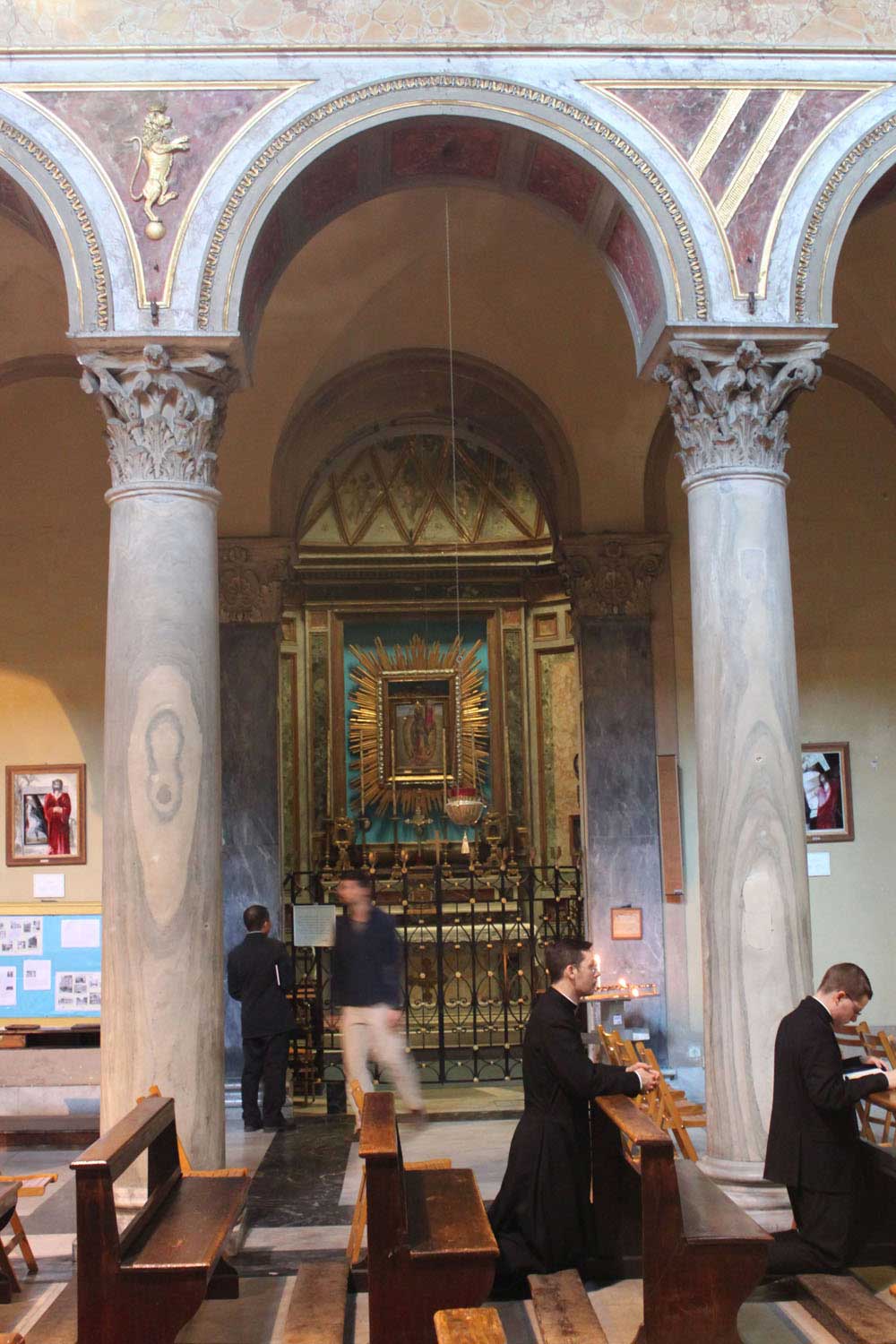
Saturday morning, pilgrims walked along the Tiber River and crossed it to reach the church of San Nicola in Carcere. This church stands over the remains of three ancient temples that stood at the edge of the Forum Holitorium, the vegetable market of the ancient city. Perhaps at some point, part of this temple complex was used as a detention site because the church built over it commemorates St. Nicholas in chains. St. Nicholas, the bishop of Myra, was brought to Rome under the persecutions of Diocletian only to be released after the Edict of Milan in 313 A.D., which granted Christianity legal status.
Today’s station church corresponds well to our Gospel in which we hear the chief priests and Pharisees ridicule some guards tasked with arresting Jesus. The guards’ defense is that Jesus spoke with authority – “never before has anyone spoken like this man.” Yet their reply is met only with ridicule from the authorities, who dismiss the guards and the crowd as naive.
In the face of ridicule
In some ways this passage holds true today. In the eyes of the broader society and culture some aspects of our faith are ridiculed especially in areas of morality. Like the guards in the passage we may feel chastised by a society that views our values as antiquated or quaint. However, through the gift of faith we hold strong to our convictions despite ridicule and, in some parts of the world, even open hostility. We strive to remain firm in our beliefs because we know their source of origin lies not only in the Church, but ultimately through her in Christ – the one who speaks with authority. He established the Church to safeguard and pass on his teachings and to expound them as necessary to face the challenges of each new generation.
This Lenten season is marked by practices aimed at converting our hearts so we may deepen our relationship with Christ. In doing so, may his teaching take deeper root in us too! May our conviction in Christ and his teachings be enriched so that we might give bold witness to our faith in this age, just as St. Nicholas was willing to bear imprisonment for this faith in his own.
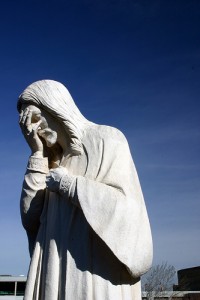
Many of you will recall the horrible bombing of the Oklahoma City federal building back in 1995. Until 9/11, this bombing was deadliest act of terrorism ever on US soil. Not far from where that building stood is St. Joseph’s Catholic Church. In its garden now stands a tall, white-robed Jesus. His back is turned to the bombing site, and his shoulder is slumped in grief. With tears streaming down his cheeks, Jesus faces a brick wall with 168 empty spaces- one space for each person who died that terrible day. Inscribed at the base of the statue are two short words: “Jesus weeps.”
This statue, and its inscription, were inspired by today’s gospel. While walking to the tomb of his dear friend Lazarus, Jesus is filled with grief, and he burst into tears. John 11:37 says, very simply, “Jesus wept.” It’s the shortest verse in the Bible, but it’s also one of the most beautiful, because in it, Jesus’ humanity and compassion so clearly shine forth.
Jesus’ tears assure us that it’s okay to be sorrowful when we lose someone we love. Sometimes, well-intentioned people may react to our grief by trying to cheer us up. They’ll say things like, “We’ll, he’s in a much better place now” or “She’s gone to be with the Lord.” We certainly hope and pray that that’s the case. But nevertheless it’s acceptable- indeed, it’s normal and even necessary!- to be sad when a loved one dies. Just think of Jesus. He can appreciate our grief because he’s experienced it himself. When we cry, Jesus cries right alongside us.
In addition to sadness, however, Jesus also experienced anger at the death of his friend. Twice, in the passage we just heard, Jesus was “perturbed and deeply troubled.” A better translation might say that he “shuddered with anger.” Jesus did this first when he saw Mary and her friends weeping. He did it again when he stood before Lazarus’ tomb. Significantly, Jesus reacts the same way on two other occasions in this gospel: Shortly after he entered Jerusalem and knew that the “hour” of his passion was now at hand; and again at the Last Supper, as he foretold Judas’ betrayal. In each of these episodes, Jesus is confronted with death- either his own, or that of Lazarus. Death, evidently, makes Jesus angry.
Jesus’ anger is not uncontrolled rage or self-pity. Instead, it’s righteous indignation against death itself. Jesus is angry because death can take people well before their time, and it leaves an aching void in the lives of those left behind. But most especially, Jesus is angry at death because it’s a consequence of sin, his greatest enemy of all.
All of this begs a question, however: If Jesus loved Lazarus so much that his death filled him with sorrow and anger, and if death is an enemy to be vanquished, why did Jesus linger for two days when he learned that Lazarus was on the verge of death? At first glace, it might appear that Jesus is heartless or cruel.
In reality, Jesus did what he did to demonstrate a point. As Jesus said to Mary, Lazarus’ sister, “I am glad for you that I was not there, so that you may believe.” Jesus knew that for Mary, and for all of us, death is a great test of faith. Whenever we face our own death or that of a loved one, we come to the realization that when we enter the grave, we do so alone. Anything we may have depended on before- friends, family, finances, reputation, accomplishments, hopes and dreams- are of no use to us when we pass through death’s door. When facing this prospect, even firm believers can be plagued with doubt and fears. It’s then we need to trust that death doesn’t have the final word, and that there truly is a God, who in his love offers us an eternal, heavenly existence beyond our wildest expectations.
However, this is precisely what Jesus wanted to demonstrate by raising Lazarus from the dead. This miracle is a sign anticipating Jesus’ resurrection, but it’s an intentional contrast, too. Lazarus was restored to a normal, earthly existence. He was resuscitated, not resurrected. Jesus brought him back to life only to die again another day. When Lazarus came shambling from his tomb, he was still wrapped in his burial cloths, reminding us that one day he’d have to be wrapped in those cloths again. But when Jesus emerged from his tomb on Easter morning, his burial shroud was left neatly in a corner- a sign that his body had been liberated forever from the bonds of death and corruption. Jesus didn’t die and rise again so that we could live forever in our present state. He came that we might enjoy a new life- a resurrection life!- a life of union with God which begins at baptism, but is perfected only after we have died. “I am the resurrection and the life,” Jesus said. “Whoever believes in me, even if he dies, will live. And everyone who lives and believes in me will never die.”
Death brings with it sorrow and anger. Jesus shows us that. But for Christians, death can also bring our faith life to completion, and Jesus shows us that too. During his final days of battling pancreatic cancer, a Cardinal wrote of receiving a hospital visit from an old friend, who was a priest. Seeing the Cardinal in extreme pain and exhausted from radiation therapy, the priest offered words of comfort about his friend’s approaching death. “It’s very simple,” he said. “People of faith, who believe that death is the transition from this life to life eternal, should see it as a friend.”
In today’s Gospel We hear the story of the raising of Lazarus from the dead. The story is a significant turning point in the ministry of Jesus for, as we shall see, it because of this incident that the Temple Leadership in Jerusalem resolves to have Jesus killed.
As is proper with all the gospel accounts we must not see this as merely an historical happening to people 2000 years ago. Rather we must recall that I am Lazarus, I am Martha and Mary. This is also the story of how Jesus is acting in my life.
Let’s look at this Gospel in stages and learn how the Lord acts to save us and raise us to new life. This gospel has six stages that describe what Jesus does to save us:
I. HE PERMITS – Sometimes there are trials in our life by God’s mysterious design to bring us to greater things. The Lord permits these trials and difficulties for various reasons. But, if we are faithful, every trial is ultimatly for our glory and the glory of God. The text says,
Now a man was ill, Lazarus from Bethany, the village of Mary and her sister Martha. Mary was the one who had anointed the Lord with perfumed oil and dried his feet with her hair; it was her brother Lazarus who was ill. So the sisters sent word to him saying, “Master, the one you love is ill.” When Jesus heard this he said, “This illness is not to end in death, but is for the glory of God, that the Son of God may be glorified through it.”
Notice therefore that Jesus does not rush to prevent the illness of Lazarus but permits it now for something greater, that God’s Glory in Jesus be manifest, and, we may add, for Lazarus’ own good and his share in God’s glory.
It is this way with us as well. We do not always understand what God is up to in our life. His ways are often mysterious, even troubling to us. But our faith teaches us that his mysterious permission of our difficulties is ultimately for our good and for our glory.
Scripture says,
Rejoice in this. You may for a time have to suffer the distress of many trials. But this so that your faith, more precious than any fire tried gold, may lead to praise, honor and glory when Jesus Christ appears. (1 Peter 1: 10)
But he knows the way that I take; when he has tested me, I will come forth as gold. (Job 23:10)
For our light and momentary troubles are producing for us an eternal glory that far outweighs them all. 18 So we fix our eyes not on what is seen, but on what is unseen, since what is seen is temporary, but what is unseen is eternal. (2 Cor 4:17-18)
An old gospel hymn says: Trials dark on every hand, and we cannot understand, all the way that God will lead us to that blessed promised land. But He guides us with his eye and we follow till be die, and we’ll understand it better, by and by. By and by, when the morning comes, and all the saints of God are gathered home, we’ll tell the story of how we’ve overcome, and we’ll understand it better by and by.
For now it is enough for us to know that God permits our struggles for a season and for a reason.
II. HE PAUSES – Here to we confront a mystery. Sometimes God says “wait.” Again, this is to prepare us for greater things than that for which we ask. The text says,
Now Jesus loved Martha and her sister and Lazarus. So when he heard that he was ill, he remained for two days in the place where he was.
Note that the text says that Jesus waits because he loved Martha and Mary and Lazarus. This of course is paradoxical since we expect love to rush to the aid of the afflicted.
Yet Scripture often counsels us to wait:
Wait on the LORD: be of good courage, and he shall strengthen thine heart: wait, I say, on the LORD. (Ps 27:14)
For thus says the Lord God, the holy one of Israel, “By waiting and by calm you shall be saved, in quiet an in trust, your strength lies. (Isaiah 30:15)
The Lord is not slow in keeping his promise, as some understand slowness. He is patient with you, not wanting anyone to perish, but everyone to come to repentance…God’s patience is directed to our salvation. (2 Pet 3:9)
Thus, somehow our waiting is tied to strengthening us, and preparing us for something greater. Ultimately we need God’s patience in order for us to come to full repentance, so it may not be wise to ask God to rush things. Yet still his delay often mystifies us, especially when the need is urgent.
Note too how Jesus’ delay here enables something even greater to take place. For, it is one thing to heal an ailing man. It is another and greater thing to raise a man who has been dead four days. To use a meal analogy, Jesus is preparing a feast. Do you want a microwave dinner or a great feast? Great feasts take longer to prepare. Jesus delays but he’s preparing something great.
For ourselves we can only ask for the grace to hold out. An old gospel song says, Lord Help me to Hold out, until my change comes. Another song says, Hold on Just a little while longer, every thing’s gonna be alright.
III.HE PAYS – Despite the design of God and his apparent delay, he is determined to bless us and save us. Jesus is determined to go and help Lazarus even though he puts himself in great danger. Notice in the follow text how the apostles are anxious about going to Judea. For, it is a fact that some there are plotting to kill Jesus. In order to help Lazarus, Jesus must put himself at great risk. The Text says:
Then after this he said to his disciples, “Let us go back to Judea.” The disciples said to him, “Rabbi, the Jews were just trying to stone you, and you want to go back there?”Jesus answered, “Are there not twelve hours in a day? If one walks during the day, he does not stumble, because he sees the light of this world. But if one walks at night, he stumbles, because the light is not in him.” He said this, and then told them, “Our friend Lazarus is asleep, but I am going to awaken him.” So the disciples said to him, “Master, if he is asleep, he will be saved.” But Jesus was talking about his death, while they thought that he meant ordinary sleep. So then Jesus said to them clearly, “Lazarus has died. And I am glad for you that I was not there, that you may believe. Let us go to him.” So Thomas, called Didymus, said to his fellow disciples, “Let us also go to die with him.“
We must never forget the cost that Jesus has paid for our healing and salvation. Scripture says, You know that you were ransomed from the futile ways inherited from your fathers, not with perishable things such as silver or gold, but with the precious blood of Christ, like that of a lamb without blemish or spot. (1 Pet 1:18).
Indeed, the apostles concerns are born out when we see that, because he raised Lazarus from the dead, the Temple leaders from that point on plot to kill Jesus (cf John 11:53). It is of course dripping with irony that they should plot to kill Jesus for raising a man from the dead. We can only thank the Lord who, for our sake endured even death on a cross and purchased our salvation by his own blood.
IV.HE PRESCRIBES – The Lord will die to save us. But there is only one way that saving love can reach us and that is through our faith. Faith opens the door to God’s blessings and it is a door we must open by God’s grace. Thus Jesus inquires into the faith of Martha and later of Mary. The text says
Martha said to Jesus, “Lord, if you had been here, my brother would not have died. But even now I know that whatever you ask of God, God will give you.” Jesus said to her, “Your brother will rise.” Martha said to him, “I know he will rise, in the resurrection on the last day.” Jesus told her, “I am the resurrection and the life; whoever believes in me, even if he dies, will live, and everyone who lives and believes in me will never die. Do you believe this?” She said to him, “Yes, Lord. I have come to believe that you are the Christ, the Son of God, the one who is coming into the world.“
Jesus prescribes faith for there is no other way. Our faith and our soul are more important to God than our bodies and creature comforts. For what good is it to gain the whole world and lose our soul? We tend to focus on physical things like our bodies, our health and our things. But God focuses on the spiritual things. And so before raising Lazarus and dispelling grief, Jesus checks the condition of Martha’s faith and elicits an act of faith: “Do you believe this?” ….Yes, Lord, I have come to believe.
Scripture connects faith to seeing and experiencing great things:
All things are possible to him who believes. Mk 9:23
If you had faith as small as a mustard seed, you could say to this mountain, ‘Move from here to there’ and it would move. Nothing would be impossible for you.” (Mt 17:20)
And he did not do many miracles there because of their lack of faith. (Matt 13:58)
When he had gone indoors, the blind men came to him, and he asked them, “Do you believe that I am able to do this?” “Yes, Lord,” they replied. Then he touched their eyes and said, “According to your faith will it be done to you” (Mat 9:28)
So Jesus has just asked you and me a question: “Do you believe this?” And how will you answer? Now be careful. I know how we should answer. But how do we really and truthfully answer?
V.HE’S PASSIONATE – Coming upon the scene Jesus is described as deeply moved, a perturbed, as weeping. The text says,
When Jesus saw her weeping and the Jews who had come with her weeping, he became perturbed and deeply troubled, and said, “Where have you laid him?” They said to him, “Sir, come and see.” And Jesus wept. So the Jews said, “See how he loved him.” But some of them said, “Could not the one who opened the eyes of the blind man have done something so that this man would not have died?” So Jesus, perturbed again, came to the tomb. It was a cave, and a stone lay across it. Jesus said, “Take away the stone.” Martha, the dead man’s sister, said to him, “Lord, by now there will be a stench; he has been dead for four days.” Jesus said to her, “Did I not tell you that if you believe you will see the glory of God?” So they took away the stone. And Jesus raised his eyes and said, “Father, I thank you for hearing me. I know that you always hear me; but because of the crowd here I have said this, that they may believe that you sent me.”
In his human heart Jesus experiences the full force of the loss and the blow that death delivers. That he weeps is something of mystery since he will raise Lazarus in moments. But for this moment Jesus enters enters and experiences grief and loss with us. It’s full force comes over him and he weeps, so much so that the bystanders say “See how much he loved him.”
But there is more going on here. The English text also describes Jesus as being perturbed. The Greek word here is Greek word ἐμβριμάομαι (embrimaomai), which means literally, to snort with anger; to have have great indignation. It is a very strong word that includes the notion of being moved to sternly admonish. What is this anger of Jesus and to who is it directed? It is hard to know exactly, but the best answer would seem to be that he is angry of death, and what sin has done. For it was by sin that suffering and death entered the world. It is almost as thought Jesus is on the front lines of the battle and has a focused anger against Satan and what he has done. For Scripture says, by the envy of the devil death entered the world. (Wisdom 2:23). And God has said, As surely as I live, declares the Sovereign LORD, I take no pleasure in the death of the wicked, but rather that they turn from their ways and live. Turn! Turn from your evil ways! Why will you die, O house of Israel?’ (Ez 33:11).
I do remember at the death of loved ones that I experienced not only sorrow but also anger. Death should NOT be. But there it is, it glares back at us, taunts and pursues us.
Yes, Jesus experiences the full range of what we do here. And out of his sorrow and anger, he is moved to act on our behalf. God’s wrath is his passion to set things right. And Jesus is about to act.
VI.HE PREVAILS – In the end Jesus always wins. And you can go to the end of the Bible and see that Jesus wins there too. You might just as well get on the winning team. He will not be overcome by Satan, even when all seems lost. God is a good God, he is a great God, he can do anything but fail. Jesus can make a way out of no way. The text says,
He cried out in a loud voice, “Lazarus, come out!” The dead man came out, tied hand and foot with burial bands, and his face was wrapped in a cloth. So Jesus said to them, “Untie him and let him go free.”
I have it on the best of authority that as Lazarus came out of the tomb he was singing a gospel song: Faithful is our God! I’m reaping the harvest God promised me, take back what devil stole from me, and I rejoice today, for I shall recover it all!
But notice something important here. Although Jesus raises Lazarus, and gives him new life, Jesus also commands the bystanders (this means you) to untie Lazarus and let him go free. So Christ raises us, but he has a work for the Church to do, to untie those he has raised in baptism and let them go free.
To have a personal relationship with Jesus is essential, but it is also essential to have a relationship to the Church. For after raising Lazarus (us) he entrusts Lazarus to the care of others. Jesus speaks to the Church, to parents, to priests, catechists, and all members of the Church and gives this standing order regarding the souls he has raised to new life: Untie them and let them go free.
We are Lazarus and were dead in our sin. But we have been raised to new life. And yet, we can still be bound by the effects of sin. And this why we need the sacraments, scripture, prayer, and other ministry of the Church through catechesis, prayer, preaching and teaching. Lazarus’ healing wasn’t a one and your done scenario and neither is ours.
We are also the bystanders – And just as we who are in need of being untied and set free, who who are also members of the Church, also have this obligation to others. Parents and elders must untie their children and let them go free by God’s grace, pastors their flocks. I too as a priest have realized how my people have helped to untie me and let me go free, how they have strengthened my faith, encouraged me, admonished me and restored me.
This is the Lord’s mandate to the Church regrading every soul he has raised: untie him and let him go free. This is the Lord’s work, but just as Jesus involved the bystanders then, he still involves the Church (which includes us).
Yes, faithful is our God. I shall recover it all.
Artwork above from the ancient mosaics at Ravenna
This is the song Lazarus sang as he came forth (I have it on the best of authority)
God gives many gifts, and one of the great gifts he has given me was the gift of our family dogs.
Scripture says little about dogs and when it does it is never flattering. Most of the references make one think of wild dogs who ran in packs. Psalm 22:16 says, “Many dogs have surrounded me, a pack of evildoers closes in upon me. Or again from Philippians 3:2, Watch out for those dogs, those evildoers. No, strangely, I cannot find one Scripture that speaks well of dogs.
And yet, they have been a great gift to me. Such loyalty, such unconditional “love.” There were times in my life when everyone was disgusted with me, even I was disgusted with me. But even on days like that my dog would still run to great me, and curl up next to me; such wonderful, “forgiving” and uncomplicated creatures.
And they have much to teach us. Likely you have seen this list, but it is always worth another read. It’s things: can learn from dogs:
Never pass up the opportunity to go for a joy ride.
Allow the experience of fresh air and the wind in your face to be pure ecstasy.
When loved ones come home, always run to greet them.
Let others know when they’ve invaded your territory.
Take naps and stretch before rising.
Run, romp, and play daily.
Eat with gusto and enthusiasm.
Be loyal.
If what you want lies buried, dig until you find it.
When someone is having a bad day, be silent, sit close by and nuzzle them gently.
Thrive on attention and let people touch you.
Avoid biting when a simple growl will do.
When you’re happy, dance around and wag your entire body.
No matter how often you’re scolded, don’t buy into the guilt thing and pout…. run right back and make friends
Delight in the simple joys of a long walk.
All simple but profound lessons, proclaimed without words, and lived with a simple integrity. Yes, dogs are very special.
Prince, our eighty pound Dalmatian was the dog of my youth. (See Picture, upper right). He had the energy and strength of a horse and commanded quite a presence in our back yard as he laid down the law with squirrels and other possible intruders. He loved to go for car rides, and when we took him for a walk, it was really he who walked us, so powerful was his gait. He also ran five miles a day with my father.
A remarkable thing about Prince was that he could smile. When we would return home, he’d run to the door, furiously waging his tail and with the cheeks of his muzzle pulled back and his head shaking back and forth. People who saw it for the first time couldn’t believe it, he was actually smiling. It seems to be a unique gift of some Dalmatians and Collies.
Prince was also quite a dreamer. He’d lay on the floor near the sofa and doze off to sleep. Soon enough his legs started moving, and he’d start huffing and even barking as he dreamed. No doubt he was in a great chase.
In his last two years he began a decline and gave me my first close lesson of age and death. Gradually, the majestic dog grew crippled and struggled to walk. I learned to give him aspirin, and that helped him for a while. But there came the days when his walking grew rare and then his kidneys failed. We knew we had to let him go.
My Father was a gifted poet (if I do say so myself), and some of his finest works were composed at the death of our dogs. It was his way of grieving their loss. Here is what he wrote of Prince as he recalled their long runs together and the sad moment when Prince had to be put down:
We were solitary, old friend, you and I.
In the sun and rain we tramped together
And walked and ran the miles;
A hundred phantoms caught you
In scent and sound;
You raced to ancient summonses
That led the pack across the wild
In joyful bound:
You tried to tell me.
I listened, but could only hear
Your barking in the wind,
And see the eager paws
Trace out your gladness in the ground.
When I returned from being gone,
You greeted me with the abandon of your kind,
In leaps and yelps and wags,
Telling me you loved me
And not knowing why,
Yet knowing that I loved you, too, And had missed you,
Even as I do now
That death’s deep slumberings
Have had their toll,
Since I held you in my arms,
And you looked at me
And said goodbye. (Charles Evans Pope, 1982)
Next came Missy, a stray who adopted us. She had been abused, and so had a timidity that was endearing even as it was troubling. She loved to look out the window of our house, and would loudly announce to any passing dogs that she worked here and that they should get on along. She too, loved car rides and to romp for hours in the yard or in the nearby field. She was a tender little dog who felt trauma when we left the house, and joy when we returned. She loved to snuggle close and really stole my parents hearts. Of her my father wrote at her death:
I thought that I saw you,
But you were gone, dear;
The yard was empty then,
The brown of your fur lost
on the green of May.
In memory’s shade
You snuggle next to me,
My little love, again. (Charles Evans Pope, 1998)
Finally there was Molly, a border collie and a dog who perfectly illustrated that happiness is an inside job. She seemed content with what ever happened. She even seemed happy when she went to the kennel to stay as my parents travelled. She was happy to go, and happy to come home. My father said that her motto was “Whatever happens, is just great for Molly.” She was just always happy, full of energy and never gave a day of trouble; the perfect dog for my parents in their old age. She outlived them both and died about a year after my father passed.
Even in death she was charmed. She had been diagnosed with liver cancer. But she never showed any pain. The day she died, she had romped about in the yard and came in to sleep in her own little bed. She died while she napped. Of her my Father wrote:
Molly Jingles,
Scamper pup,
You are down,
You are up;
Racing round
In jumps and traces
Hiding bones
In secret places,
You have really
Struck a nerve,
Chewing up
The house with verve,
You are clever
You’re a bounder,
But our very
Favorite hounder. (Charles Evans Pope, 2000)
Thank you Lord, for the gift of our pets, those special animals designated by you to be our close companions. Thank you for the gifts of Prince, and Missy and Molly. In recent years you’ve given me my cats too: Tupac, Gracie-Girl, Ellen Bayne, Jerry McGuire, Benedict, and now Jenny- June and Daniel. I don’t know if animals can love, Lord, but I sure do feel your love through them and I thank you and praise you for the quiet, simple lessons you have taught me through them. May you be praised O Lord.
The pictures in this post are my own.
Here’s a wonderful video of a very smart and helpful Jack Russell Terrier:
It’s easier for an elephant to fit into a mouse’s swimsuit, a Benedictine abbot once explained, than it is for God to fit into our ideas about him. This is an intentionally funny observation, but it’s certainly true, especially in light of today’s gospel.
The people of Jerusalem thought that they has Jesus all figured out. They were convinced that he wasn’t the Christ, because they were sure they knew where he came from! But Jesus simply shook his head and told them otherwise.
Jesus sometimes has to do the same thing with us. We create idols- caricatures of Jesus- and he has to come along and smash them. Usually, like the mouse’s swimsuit, our image of Jesus is just too small. We tend to emphasize one aspect of his person and minimize the others. For instance, we might count upon his mercy, but forget about his justice. We focus on his power, but overlook his humility. We highlight his humanity, but neglect his divinity. And vice versa.
However, whenever we think we have him in a nutshell, the real Jesus eludes us, just as he slipped away from the angry Jerusalem mob. He knows that we’re always tempted to refashion him in our own image. Thankfully, he never stops trying to re-create us in his.
Fr. Robert Barron is famous for the insight that the Bible is not a Book, it is a library of many books from different periods and using different genres. Christians sometimes get asked, “Do you read the Bible literally?” But this is like asking, “Do you read the Library literally?” Well, of course that would depend on what section I was in. If I were in the science section I might read rather literally and technically. But if I were in the poetry section I would read rather differently with an openness to allegory, hyperbole, and the like. Other interpretive modes would be operative in the history section, the computer and technical manual section, the science fiction section, philosophy, religion and so forth. When walking into a library we have enough sophistication to make distinctions as to the genre of a book, its historical period, its purpose and so forth.
In reading Scripture we need a similar sophistication. Some of the Bible is straight forward history. But other sections are poetry, saga, Biography or exhortation. Still other sections use literary techniques such as parables, analogy, simile, metaphor, hyperbole, and expressions of the day.
In order to understand and sort all this out, some knowledge of the period when the text was written is helpful. Knowing something of the people involved and their circumstances is also essential. This is the kind of sophistication we bring to any other ancient writing we might encounter.
But one of the problems many bring to scripture is the tendency to read it in a crudely literalistic and mechanistic manner that does not respect the genre and purpose of a particular part of the Bible. To be sure there are passages we do read and understand in a literalistic manner. For example, “this is my Body.” Further we accept that the Scriptures record the things that Jesus actually said and did. But where many get lost is by taking literally what are figures of speech. Now we use figures of speech all the time. For example, We might say “It’s raining cats and dogs.” or “The world is turned upside-down.” Now we know what these expressions mean and that we do not mean them in a literalistic way. And so, we need some sophistication when we read in scripture that we are to gouge our our eye, or cut off our hand. When we are told not to cast our pearls before swine, nor give what is holy to dogs. When we are told by Jesus that we must love him and hate our father and mother, son and daughter, even our very self. These were expressions of the day which have a true meaning but which require a little sophistication to properly understand.
Again, the Bible is a library, not a book and we need to take heed of what “section” we are in. That said, The Scriptures have within them an internal unity where all the many individual books announce God’s plan and sets forth the ultimate destiny of man which is caught up in God’s redeeming love.
The Catechism gives some rules when it comes to interpreting Scripture:
Be especially attentive “to the content and unity of the whole Scripture”. Different as the books which compose it may be, Scripture is a unity by reason of the unity of God’s plan, of which Christ Jesus is the center and heart, open since his Passover. (CCC # 112) It is for this reason that we read the Old Testament in light of the New. For ultimately, everything there points to Christ, and to the life of Grace he would bring forth.
Read the Scripture within “the living Tradition of the whole Church”. According to a saying of the Fathers, Sacred Scripture is written principally in the Church’s heart rather than in documents and records, for the Church carries in her Tradition the living memorial of God’s Word, and it is the Holy Spirit who gives her the spiritual interpretation of the Scripture. (CCC # 113). Scripture emerges from and is a part of the living Tradition of the Church. Hence it must be understood within that context.
Be attentive to the analogy of faith. By “analogy of faith” we mean the coherence of the truths of faith among themselves and within the whole plan of Revelation. (CCC # 114). For the truths of faith must be held in a balance. When we allow one truth to eclipse others this is heresy. Further, one text of the Scripture does not the whole bible make. Texts have to be understood with the balance of the whole, and of the faith in general. There is a danger in “proof-texting” because it often removes a certain passage from the whole of Scripture which can help to balance and nuance it. Further, proof-texting may also take a text out of the wider context of the faith as a whole which may also help to balance and nuance it.
According to an ancient tradition, one can distinguish between two senses of Scripture: the literal and the spiritual, the latter being subdivided into the allegorical, moral and anagogical senses. The profound concordance of the four senses guarantees all its richness to the living reading of Scripture in the Church. (CCC # 115)
The literal sense is the meaning conveyed by the words of Scripture and discovered by exegesis, following the rules of sound interpretation: “All other senses of Sacred Scripture are based on the literal.” (CCC # 116) Be careful here, “literal does not mean “literalistic” but, rather, what is the literary meaning of a text. That is, “What is the text actually saying.”
The spiritual sense. Thanks to the unity of God’s plan, not only the text of Scripture but also the realities and events about which it speaks can be signs. (CCC # 117) Scripture is always more than historical occurrences. It is also about you spiritual journey and mine. Scripture is not spectator sport. You and I are in the story. I am Peter, Mary, Pilate, Joseph and so forth. The events and words of scripture transcend time and have spiritual meaning now as well. The crossing of the Red Sea was more than an historical event. It is baptism, it is salvation. And so forth.
The allegorical sense. We can acquire a more profound understanding of events by recognizing their significance in Christ; thus the crossing of the Red Sea is a sign or type of Christ’s victory and also of Christian Baptism. The word allegory comes from the Greek allēgoría, meaning to speak so as to imply something other. In other words, the events and deeds of the Bible point beyond themselves to something greater and other.
The moral sense. The events reported in Scripture ought to lead us to act justly. As St. Paul says, they were written “for our instruction”.
The anagogical sense (Greek: anagoge, “leading”). We can view realities and events in terms of their eternal significance, leading us toward our true homeland: thus the Church on earth is a sign of the heavenly Jerusalem. Another example might be that the journey of the Jewish people for forty years in the desert is a sign of our pilgrimage trough the desert of this life to the Promised Land of Heaven.
A medieval couplet summarizes the significance of the four senses: The Letter speaks of deeds; Allegory to faith; The Moral how to act; Anagogy our destiny.
Here are a couple of very good videos that make rather plain the Catholic approach to Biblical interpretation. The first video is from Fr. Robert Barron and details two key Catholic interpretive principles: the importance of Genre and that Jesus Christ is the interpretive key to to understanding the whole Bible.The second video is from John Martignoni and is a very brief description of the Literal vs. Literalist interpretation.

 Are you familiar with the “halo effect?” It refers to our tendency to judge a person based on only one characteristic that we find attractive or impressive. It’s as if we place a halo over their heads; they can do no wrong. We do this especially with those we think are physically attractive. We think: They’re good-looking, so surely they’re also intelligent and talented. The opposite of the halo effect is the “devil effect.” We dislike one thing about a person, or find something about them unappealing, and we write them off entirely.
 When it comes to our struggle in prayer there are some things that we need to unlearn. For too many private prayer is often a formal, even stuffy affair that drips of boredom and unnecessary formality and has lots of rules. Perhaps we learned some of our lessons too well. And yet many of the youngest children have not learned these lessons and they seem to pray with great ease. They are unassuming and will say almost anything to God. It is true that children may have a lot to learn about public and liturgical prayer, but when it comes to personal and private prayer they have much to teach us. Perhaps a parable is in order: