
What Our Life Is Worth

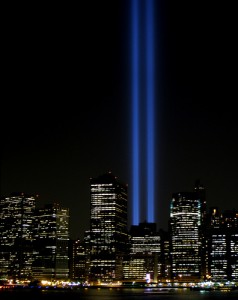
How much is one human life worth? The head of our government’s compensation fund for 9/11 victims, Kenneth Feinburg, had to wrestle with that question over 1,500 times. In his book, appropriately titled What is Life Worth?, Feinburg shares his agonizing struggle in trying to ensure that victims’ survivors received a fair compensation for their loss. The average victim’s family received $2 million dollars. But not everyone received the same amount. For instance, the amount awarded for stockbrokers was higher that that awarded to military families, because stockbrokers’ annual salaries were higher. But some military families complained, saying that their relatives would have left the military soon and taken higher-paying civilian jobs. Feinburg also heard from people whose relatives had died when the Oklahoma City federal building was bombed. But those families received nothing, as Feinburg’s government mandate restricted the fund to 9/11 victims. Feinburg ultimately concluded that the whole process was unfair. He wrote: “Don’t ask one person to act like Solomon and try to calculate the value of lives. To be judge, jury, accountant, lawyer, rabbi, et cetera, is very, very difficult.”

Just what is one life worth? That’s a good question for us to ponder today. Perhaps a person’s value is his or her net worth of assets. Yet this would mean that Donald Trump is far more valuable than Mother Teresa of Calcutta. As Catholics, would we agree with that assessment? Our faith tradition holds in high esteem those men and women who have taken voluntary vows of poverty. But if the value of their lives were based soley upon what they possessed in this world, they would be worth very little indeed.

The truth is that at our most basic, physical level, we are worth very little. The combined value of all of the chemicals and minerals found in a typical human body, 96% of which is Oxygen, Carbon, Hydrogen, and Nitrogen, is less than one, single U.S. Dollar. One dollar is pocket change to most of us; it won’t even buy a small cup of coffee at McDonald’s. Contrast that with the price of an ounce of gold, which recently topped $1000. An ounce of gold is about the size of a matchbook, and can fit comfortably in the palm of our hand. But is it worth more than we are? Maybe on the commodities market. But not in the eyes of God. If you and I want to know what we are worth to God, all we need to do is listen carefully to today’s Passion gospel, and reflect on what is recalled in this solemn liturgy.

We are reminded today that God considers us to be so valuable, that his only Son surrendered his own life, so that we might live forever. If God thought that we were cheap, expendable, or dime-a-dozen, would he have bothered? How much effort do we make to save or protect that which we think has no value? Not much. We’re generally happy to throw it away, or write it off as a loss. But God, through the suffering and death of Jesus, has shown us clearly how much our lives are worth to him. As Pope Benedict has written: “Man is worth so much to God that he himself became man in order to suffer with man…as is revealed to us in the account of Jesus’ Passion.”

Can we put a dollar amount on how much we’re worth to God? If we were to try, we’d have to put a price on Jesus’ life, since he gave his life for ours. Judas Iscariot, when he betrayed our Lord, received 30 silver pieces for Jesus’ life. But this amount was an intentional insult, as it represented the fine to be paid a slave owner by anyone who injured his slave. Nicodemus, I think, was closer to the mark. We heard how he anointed Jesus’ dead body with over a hundred pounds of costly spices, an extravagant amount fit only for a king. Yet even this, of course, comes nowhere near to representing the true value of Jesus’ life. It would be absurd, and even obscene, to try to place a monetary value on Jesus’ life. It’s much better, and far more accurate, to say simply that Jesus’ life was priceless. And if Jesus’ life is priceless, then, in a sense, the same is true of ours.

In God’s eyes, we are indeed priceless. Nevertheless, God did pay a very specific price for us. More specifically, he paid the price of our sins. Like our lives, we can’t really attach a dollar value to our sins. But that doesn’t mean that our sins aren’t costly, because they are. Sin hurts our neighbors, our families, our enemies. Sin hurts us, as it keeps us from being the people God wants us to be. And sin harms our relationship with God. We might say that our sins have bankrupted us. Bankruptcy, of course, means that we owe more than we are able to pay. In terms of our sins, bankruptcy means that there’s nothing we can do to truly make up for all the harm our sin has done. Jesus had to do it for us. He is the one who satisfied our debt; he is the one who paid the price. And the price he paid was the cross.
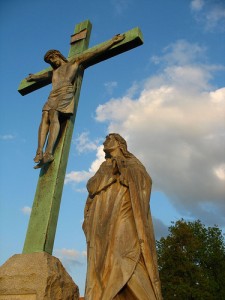
In just a matter of minutes, we will venerate the cross of Jesus. We will bow before it, praise Christ for it, adore it as it’s lifted on high, and many of us, after the liturgy, will remain behind to reverence it with a kiss. We will do this because the cross shows us how precious we are in God’s sight; it shows us, more than anything else could, how much we are valued, and loved, by God. We may not be able to place a dollar value on our lives. But because of the cross, because of this “Good Friday,” you and I know exactly what our lives are worth.

Photo credits: pnoeric, moneyblognewz, nikoretro, via Creative Commons

Is He Your King? The Trial Before Pilate

GOOD FRIDAY – All through the night Jesus has been locked in the dungeon of the high priest’s house. Early this morning he was bought before a Pilate who transferred his case to Herod. Herod sent him back to Pilate who, sometime in the mid-morning, bowed to the pressure of the Temple leadership and the crowds, and condemned Jesus to a horrible death by crucifixion. In the late morning Jesus was taken by the soldiers through the city and up the hillside of Golgotha. By noon he is nailed to the cross where he hangs in agony for some three hours. He dies around three in the afternoon. He is taken down from the cross and placed in the tomb hastily before sundown. Today is a day of prayer, fasting and abstinence. Whenever possible, Christians are urged to keep today free of work, of social engagements, of entertainment, and to devote themselves to communal prayer and worship. At noon many parishes gather for stations of the cross for recollections of the seven last words of Jesus. Many parishes also offer stations of the cross at 3pm the hour of Jesus death. In the evening, we gather quietly in our parish Churches to enter into time of prayer as we reflect on Jesus death on the cross. We also pray for the needs of the world. To acknowledge the power of the cross in our lives today, we one by one come forward to venerate the cross with a kiss. Our hunger from this day of fasting is satisfied with Holy Communion distributed at the end of this liturgy. Consider too how the apostles might have gathered that night together in fear and prayer reflecting on all that happened.

The following videos depicts Jesus and Pilate. The First is from The Passion of the Christ. What is remarkable about this clip is that when Pilate addresses Jesus in Aramaic, Jesus answers him in Latin. This is not a biblical fact, but a technique that the producer, Mel Gibson (pray for him) uses. It is something that startles Pilate and the bystanders, for it was unlikely that a Galilean would know enough Latin to hold a conversation, let alone about philosophy and theology! But it would seem to be Gibson’s (pray for him) way of illustrating that this conversation is personal, between Pilate and Jesus, for Jesus uses Pilate’s mother-tongue. Jesus speaks to Pilate in a very personal and serious way: Who do YOU think I am and what will YOU do about it?

The Second clip is from the movie The Gospel of John. It follows the Gospel of John exactly. Notice how Jesus turns the tables on Pilate. Although Jesus is on trial, he ends up putting Pilate on trial! Notice too how many times Pilate goes in and out of Praetorium (Governor’s Palace). At least four times! He is vacillating. He knows Jesus is innocent of the charges. But in the end, out of fear, he suppresses his conscience and hands Jesus over. Pilate had wanted to avoid committing to Jesus one way or the other. But he, like you and me had to make a decision. You might say he goes from vacillation to assassination!

Notice particularly the question Pilate wrestles with over Jesus’ Kingship. He asks, “Are you the King of the Jews?” But Jesus will not answer. This is a question Pilate must answer. It is a question you and I must answer. And so Jesus says, “Are you saying this on your own or have others been saying this to you?” In other words am I a King because you say so or are you just saying what others say? Only Pilate can answer if Jesus is a king. Only you and I can answer for ourselves. Is he your King?


Violence, Jesus, and the Eucharist

Imagine yourself to be Jesus on this very night, nearly two thousand years ago. You’ll soon be betrayed, arrested, and subjected to a horrifically violent death. If you knew that this was going to happen, what would you do? Many people, I think, would want to meet violence with violence. They’d try to rally the troops and start a fight. It wouldn’t have been hard for Jesus to do. Many people in Jerusalem were looking for a warrior messiah. And Jesus, by his own admission, even had angel armies at his disposal!

But Jesus did something very different. With his apostles gathered around him, Jesus insisted that they love one another as he loved them. He washed their feet and told them to be servants. And then he took broke bread and said “This is my body.” He next took wine and said, “This is my blood which will be shed for you.” In so doing, Jesus instituted the sacrament of the Holy Eucharist, an act we recall this Holy Thursday night.

Every time we celebrate the Eucharist, we remember that Jesus died a violent death. We “proclaim the death of the Lord,” as St. Paul explained in today’s second reading. However, the Eucharist also reminds us that Jesus didn’t respond to violence with more violence. At his Passion, Jesus practiced non-violence. One might say then, that the Eucharist is a sacrament of non-violence. In fact, this is exactly what Fr. Raniero Cantalamessa, the official preacher to the Papal Household, proclaimed in his Good Friday homily at St. Peter’s Basilica in 2005. He said: “The Eucharist is the sacrament of non-violence! Thanks to the Eucharist, God’s absolute “no” to violence, spoken on the cross, echoes alive down the centuries.”

But what does this mean for us, who live in a world filled with violence? What implications does our participation in the Eucharist, the sacrament of non-violence, have for the way we live our lives? Fr. Cantalamessa said, “The Eucharist is not only a mystery to consecrate, to receive, to contemplate and adore. It is also a mystery to imitate.” In other words, if the Eucharist is a sacrament of non-violence, we ourselves need to practice and promote non-violence.

For starters, we can reject the glorification of violence in the media, through popular music, graphic video games, movies, and TV. Studies reveal that by the time a typical American child reaches 18, he or she will witness on television 200,000 acts of violence, including 40,000 murders. This saturation exposure leads children to be less sensitive to the pain and suffering of others; more fearful of the world around them; and more likely to engage in aggressive or harmful ways to others. As media consumers, we need to say “no” to this sort of content.

We can also say “no” to the death penalty, as both Pope John Paul II and Pope Benedict have clearly done. Recently, the Vatican contributed a position paper to the World Congress Against the Death Penalty, in Paris. It described the death penalty as “a refusal of the right to life” and “an affront to human dignity” which contributes to a “culture of violence” and shows “a contempt for the Gospel teaching on forgiveness.” It concludes by stating that the Vatican defends “all human life from conception to natural death.”

Of course, defending human life from the moment of conception would lead us to oppose the violence of abortion. 1.31 million abortions are performed in the US each year, which equates to 24.5 percent of all pregnancies. The majority of these abortions are performed after the baby’s heart has started beating, and many babies can feel pain when being aborted. But the violence of abortion extends to the mother too, who often experiences significant physical or emotional harm.

Another threat to women is domestic violence, which includes physical, sexual, psychological, verbal, and economic abuse. Our nations’ bishops issued a statement entitled, When I Call for Help: A Pastoral Response to Domestic Violence against Women. They encourage victims not to blame themselves, think they’re being punished by God, or fear that they betray their marriage vows if they leave an abusive husband. They challenge male perpetrators to find the courage to seek help and break the cycle of violence. And they call upon the rest of us to compassionately help victims and their children, while we work and pray to stop the violence.

Other forms of violence we encounter today are torture, bullying at school, and perhaps even some forms of child discipline. It goes without saying, however, that the most destructive form of violence in our world is warfare. For a Christian, war is always a tragic last resort, to be used in defense only when all other options have been exhausted. We need to be people who seek to avoid war with every ounce of our strength, by challenging our nation’s leaders to be peacemakers, and asking the Lord to purify our hearts of any resentments or hatred which might lead us to relish war, or be indifferent to its victims. “No to war!” said Pope John Paul II. “It is always a defeat for humanity.”

To say “no” to war requires courage. When Judas and the soldiers came to arrest Jesus, Peter and other disciples drew their swords and attacked- an act of both fear and courage. But when Jesus ordered them to drop their swords, their courage vanished, and they fled into the night. Sometimes a non-violent stance takes more courage than a violent one.

That’s why we need the Eucharist, the sacrament of non-violence, so that Jesus may fill us with the courage we need to be his non-violent disciples. To quote Father Cantalamessa again, “The cry ‘This is the Lamb of God!’ which resounds at every Mass…is an invitation addressed to all believers in Christ not to let themselves be contaminated by the violence of our world, but to respond to it with the meekness and the strength of love.”

Readings for today’s Mass: http://www.usccb.org/nab/042111.shtml


My, My….What the Lord Had To Endure at the Last Supper!

One of the consistent themes of the Four Gospels is the theme of the “inept response.” Most often it applies to the 12 apostles who, when taught some important point by the Lord, demonstrate, almost right away, that they don’t get it all.

No one place in the gospels is more thick with the inept response than at the Last Supper. It was nothing short of a disaster. The ineptitude is almost comical if it weren’t so sad. If ever the Lord needed his disciples attention and understanding, it was now. But to a man, they let him down. There is squabbling, misunderstanding, argumentativeness and betrayal, all in one evening.

Indeed it was so awful that one could hardly have faulted the Lord for saying, “That’s it Father, I’ve had it with them, I’m coming straight home!” Praise God he chose to die for the likes of us.

And lest we be too critical of the twelve, we are often like them in many ways. Indeed, they are us and we are them. And the Lord loved them and us to the end.

On Holy Thursday, let’s examine the sequence of the Last Supper which pretty well illustrates why the Lord had to die for us. We will see how earnest the Lord is about this Last Supper, how he enters it with an intense love for his disciples and a desire that they (we) carefully heed what he is trying to teach them. We shall see however that they (we) show forth a disastrous inattentiveness and a terrible lack of concern for the Lord.

Here then are the movements of the Last Supper. Watch how things begin with the loving and careful attentiveness of the Lord and end with a selfish, inept and unloving response from the apostles (us?) Here is the sequence.

  1. COMING CLOUDS – Jesus knows that his hour has come. This meal will be his last meal. Judas has already conspired and been paid to hand him over. Scripture says Before the feast of Passover, Jesus knew that his hour had come. He always loved those who were his own, and now he would show them the depths of his love. The devil had already induced Judas, son of Simon the Iscariot, to hand him over. (John 13:1) Hence in the gathering storm Jesus considers his last meal which will also be the first Holy Mass. He instructs his Apostles to prepare the meal: He sent two of his disciples, and said to them, “Go into the city, and a man carrying a jar of water will meet you; follow him, and wherever he enters, say to the householder, ‘The Teacher says, Where is my guest room, where I am to eat the Passover with my disciples?’ And he will show you a large upper room furnished and ready; there prepare for us.” (Mark 14:13-15)
  2. CARING CONCERN – This last supper was obviously important to Jesus. Luke records the heartfelt words of Jesus: And he said to them, “I have earnestly desired to eat this Passover with you before I suffer; for I tell you I shall not eat again until it is fulfilled in the kingdom of God.” (Luke 22:15-16). Yes this was to be a very special moment for Jesus.
  3. COSTLY COMMUNION – Jesus, reclining at the table, will now celebrate the Holy Eucharist for the first time. But this was a costly communion. He had already lost many disciples for what he taught on the Eucharist (cf John 6:50ff). It was a costly teaching. Further, after the first consecration, as he looks into the cup he is looking at his own blood soon to be shed, and he distributes his own body soon to be handed over. Yes this is a costly communion, no mere ritual for him. Every other priest before him had offered a sacrifice distinct from himself, (usually an animal, sometimes a libation). But Jesus the great High Priest will offer himself. It is a costly communion.
  4. COLLABORATIVE CONDESCENSION – During the meal Jesus rises and then stoops to wash the disciples feet. He instructs them to see in this a model for those who would collaborate with him in any future ministry. John records it this way: He rose from the supper and took off his outer garments. He took a towel and tied it around his waist. Then he poured water into a basin, and began to wash the disciples’ feet, and to wipe them with the towel with which he was girded (John 13:5). Jesus then teaches the Disciples: Do you know what I have done for you? You call me Teacher and Lord; and you are right, for so I am. If I then, your Lord and Teacher, have washed your feet, you also ought to wash one another’s feet. For I have given you an example, that you also should do as I have done to you. (John 13:12-15). We shall see that, in moments, they will demonstrate a complete disregard for what he has just tried to teach them. Now things get bad.
  5. CALLOUS CRIME– Back at table and after having taught them that they must wash one another’s feet Jesus becomes suddenly troubled in spirit and says, I tell you the truth, one of you is going to betray me. (John 13:21). This causes a commotion among the Apostles who begin to ask “Who can it be?” As the anxiety and commotion around the table continue, Simon Peter motioned to this disciple and said, “Ask him which one he means.” Leaning back against Jesus, he asked him, “Lord, who is it?” Jesus answered, “It is the one to whom I will give this piece of bread when I have dipped it in the dish.” Then, dipping the piece of bread, he gave it to Judas Iscariot, son of Simon. As soon as Judas took the bread, Satan entered into him. “What you are about to do, do quickly,” Jesus told him (John 13:24-30).
  6. CONFOUNDING COMPETITION – But as Judas takes the morsel of bread and heads into the night, no one tries to stop him! No one rises and block the door or even utters a protest despite the fact that Jesus has clearly identified him! Why?! Luke supplies the answer: A dispute arose among them, which of them was to be regarded as the greatest. (Luke 22:24) They should be concerned about Jesus’ welfare but instead they debate about who of them is the greatest. How confounding and awful! Yet is that not our history? Too often we are far more concerned with our status and welfare than with any suffering in the Body of Christ. So much that is critical is unattended to because we are concerned with our status, position, comfort and welfare. Jesus had just taught them wash each others feet but in an inept response they end up arguing as to who was greatest. Jesus patiently reminds them and teaches: The kings of the Gentiles exercise lordship over them; and those in authority over them are called benefactors. But not so with you; rather let the greatest among you become as the youngest, and the leader as one who serves. For which is the greater, one who sits at table, or one who serves? Is it not the one who sits at table? But I am among you as one who serves. (Luke 22:25-27) Meanwhile, due their (our) egotistical ineptitude Judas has escaped far into the night.
  7. CAUSTIC CONTENTIOUSNESS – Jesus continues to teach at the Last Supper. This moment he surely wanted to impress upon them his final instruction. How he must have longed for them to listen carefully and deeply internalize what he was teaching. Instead all he gets are arguments. Both Thomas and Phillip rebuke him. John records the outrage: Jesus said Do not let your hearts be troubled. Trust in God ; trust also in me. In my Father’s house are many rooms; if it were not so, I would have told you. I am going there to prepare a place for you. And if I go and prepare a place for you, I will come back and take you to be with me that you also may be where I am. You know the way to the place where I am going.” But Thomas said to him, “Lord, we do not know where you are going; how can we know the way?” Jesus said to him, “I am the way, and the truth, and the life; no one comes to the Father, but by me. If you had known me, you would have known my Father also; henceforth you know him and have seen him. So Thomas rhetorically rebuked the Lord, in effect saying, “We have NO IDEA where you are going, when will you show us the way!” Jesus answers but Phillip will have none of this promise to see the Father and he boldly says, Lord, show us the Father, and then we shall be satisfied.” Jesus, likely saddened at all this said to him, “Have I been with you so long, and yet you do not know me, Philip? He who has seen me has seen the Father; how can you say, ‘Show us the Father’? (John 14:1-9). Hence his own apostles are being argumentative and contentious. They are caustic and seem also to rebuke the Lord. The Supper isn’t going so well!
  8. COMIC CREDIBILITY GAP – Undeterred Jesus embarks on a lengthy discourse that John records and which has come to be called the priestly prayer of Jesus. At the end of it the apostles remark, perhaps ironically, perhaps with sincerity: His disciples said, “Ah, now at last you are speaking plainly, not in any figure! Now we know that you know all things, and need none to question you; by this we believe that you came from God.”(John 16:29-30). But Jesus knows their praise is hollow and will not stand the test. There is a great credibility gap to what they say, it is almost comical. So he says: Do you now believe? The hour is coming, indeed it has come, when you will be scattered, every man to his home, and will leave me alone (John 16:31-32). Peter undeterred says, Though they all fall away because of you, I will never fall away.” Here too is another almost comic credibility gap and thus Jesus said to him, “Truly, I say to you, this very night, before the cock crows, you will deny me three times.” Still insistent Peter said to him, “Even if I must die with you, I will not deny you.” And so said all the disciples. (John 16:33-35). Well you know the story and that only John made it to the cross. Their credibility was, by this time a dark comedy.
  9. COMPASSIONATE CONSTANCY– But you also know the rest of the story. Jesus went on and died for the likes of them (us). I wonder if he had some of this Last Supper in mind when he said to the Father, “Forgive them, they know not what they do.” Almost as if to say, “They have absolutely no idea what they are doing or thinking, so have mercy on them Father.”

What a grim picture of us the Last Supper was. A disaster really. But the glory of the story and the saving grace is this, the Lord Jesus Christ went to the cross anyway. Seeing this terrible portrait of them (us) can we really doubt the Lord’s love for us?

May your Holy Thursday be blessed. Hopefully you will attend Mass and the Last Supper/First Mass will be made present to you. Never forget what Jesus endured!

No Need to Despair

What was it that motivated Judas to betray Jesus? Was he trying to force Jesus to display his divine powers against his enemies? Maybe he was resentful that he hadn’t been chosen as leader of the apostles. Or perhaps he was simply malicious and greedy. We just don’t know.

What we do know is that, when all was said and done, Judas was overwhelmed by bitter regret. He tried to return his blood money, and ended his life in suicide.

Suicide is always a tragedy. But the greater tragedy here is that Judas had lost hope. In his despair, Judas lost hope in receiving mercy from the one whose entire life conveyed hope and mercy. We can say with absolute confidence that if Judas has run to the foot of the cross and begged forgiveness, he would have received it.

In a way, Judas represents the state of many people today- people who live lives of quiet despair, shame, and fear, because they believe themselves to be unlovable and unforgivable in the eyes of God.

But such fear is a self-inflicted wound. The good news of Holy Week is that no one need despair of God’s mercy and forgiveness. Not Judas Iscariot. Not you or me.

Readings for today’s Mass:  http://www.usccb.org/nab/042011.shtml


Spy Wednesday Reflection: The Sins of the Clergy

Wednesday of Holy Week is traditionally called “Spy Wednesday” since it is this day when Judas conspired with the Temple Leadership to hand Jesus over. He would accomplish his task the evening of the next day, but today he makes arrangements to hand Jesus over and is paid.

One way to reflect on this terrible sin is to reflect that Judas was among the first priests called by Jesus. We see in the call of the Apostles the establishment of the ministerial priesthood. Jesus called these men to lead his Church and minister in his name. But one of these priests went wrong, terribly wrong, and turned against the very one he should have proclaimed.

Among the other “first priests” we also see great weaknesses evident. Peter in weakness denied Jesus, though he repented later. All the others except John fled at the time of the passion. And so here we see the “sins of the clergy” made manifest. Christ did not call perfect men. He promised to protect his Church from officially teaching error but this does not mean that there is no sin in the Church and among those who are called to lead. The story of Judas shows that even among those who were called, one went terribly wrong.

In recent years there has been much focus on the sins of Catholic Priests who went terribly wrong and sexually abused the young. The vast majority of priests have never done such things, but those who did so inflicted great harm.

There are other sins of the clergy that have nothing to do with sexuality that may also have caused great harm. Maybe it was an insensitive remark. Perhaps it was the failure of a priest to respond at a critical moment such as a hospital visit. Whatever it might be that has caused you harm or alienation, please don’t give up on God or the on the Church. If a priest or Church leader has caused you grief or to feel alienated please know that there are other priests, deacons, and lay leaders who stand ready to hear your concerns and offer healing. Let the healing begin. Ask among your Catholic family and friends for recommendations about helpful and sensitive priests or Church leaders who can listen to your concerns, address them where possible, and offer another opportunity for the Church to reach out to you with love.

On this “Spy Wednesday” pray especially for priests. We carry the treasure of our priesthood in earthen vessels. As human beings we struggle with our own issues. We have many good days and some less than stellar moments too. The vast majority of Priests are good men, though sinners, who strive to do their very best. But some among us have sinned greatly and caused harm to the Body of Christ, as did Judas. Some of us may have caused harm to you. Please accept an invitation to begin anew.

If you have stayed away through some hurt or harm caused by any leader of the Church, strive on this “Spy Wednesday” to still find Christ where he is found. Among sinners and saints too, in the Church he founded: Perfect in her beauty as the Bride of Christ but consisting of members who are still “on the way” to holiness.

As usual, after all my verbiage, a music video offers this message better than I ever could. Allow this powerful video to move you if you have ever been hurt or know someone who has.

A Persistent Knock

“Neither snow nor rain nor gloom of night,” tradition claims, will keep letter carriers from completing their rounds. To complete his mission of redemption and salvation, Jesus had to contend with much worse than that. Darkness, denial, ignorance, betrayal, cowardice, and the demonic all confronted Jesus as the Last Supper, on the eve of his passion. Yet Jesus pressed on, in spite of it all, demonstrating that his love for us, and his desire to save us, will never fail.

Jesus’ love is resolute. He would never force himself upon us, but he doesn’t keep a polite distance either. Instead, he keeps knocking at the door of our hearts. Sometimes we open our hearts to him on our own, and welcome him in. At other times, we need his help. Maybe our hearts are frozen, and Jesus needs to melt them; it could be that our hearts are broke, and Jesus needs to mend them; perhaps our hearts are made of stone, and they need replacing with Jesus’ own, sacred heart.

Regardless of the state of our heart, Jesus persists in his efforts to open its door, not to assert his power, but to share his love. Nothing will stop him! Not even death itself.

Readings for today’s Mass: http://www.usccb.org/nab/041911.shtml


When a Curse Becomes a Blessing – Only God Can Do That

Here in Holy Week we ponder the events that led to Jesus’ death and resurrection. Among the things to ponder is a dramatic moment in the trial before Pilate when the people who were present  utter a curse upon themselves. We read of it in Matthew’s Gospel:

When Pilate saw that he was getting nowhere, but that instead an uproar was starting, he took water and washed his hands in front of the crowd. “I am innocent of this man’s blood,” he said. “It is your responsibility!” And all the people answered, “His blood be on us and on our children!” (Matt 27:24-25).

Now of course the people did not intend or think of it as a curse since they were convinced of their righteousness in the matter. Nevertheless, a curse of this sort becomes operative if they do in fact act unrighteously, which they do. Hence we have here a self-imposed curse.

Some care is necessary not to associate this curse merely with the Jewish people. In the past some have used this passage to assert that the Jewish people have suffered rightly for what “they” did to Christ. But of course the Jewish people were divided over Christ. Many followed Jesus and accepted him as Messiah. All the first converts were Jews. Other Jews rejected Jesus. So, which group speaks for “the Jews” and which has the power to bring a curse upon the Jewish people? It seems untenable that a small group of Jews would be able to cause all Jews to be thus cursed.

A better and more personal understanding of the text is that the group represents not the Jewish people per se, but the whole of humanity. For, truth be told, we have all crucified Christ. It is something WE did, not merely some vague group of others called “they.” And this self imposed curse: His blood be on us and on our children!, is something we have all somehow said, we are collectively guilty of the blood of Christ.

So we are cursed! Or are we? Consider the following passage written by the Pope in his recent book, Jesus of Nazareth (Vol 2)

When in Matthew’s account the “whole people” say: “His blood be on us and on our children” (27:25), the Christian will remember that Jesus’ blood speaks a different language from the blood of Abel (Heb 12:24): it does not cry out for vengeance and punishment; it brings reconciliation. It is not poured out against anyone; it is poured out for many, for all. “All have sinned and fall short of the glory of God. . . God put [Jesus] forward as an expiation by his blood” (Rom 3:23, 25). Just as Caiaphas’ words about the need for Jesus’ death have to be read in an entirely new light from the perspective of faith, the same applies to Matthew’s reference to blood: read in the light of faith, it means that we all stand in need of the purifying power of love which is his blood. These words are not a curse, but rather redemption, salvation. Only when understood in terms of the theology of the Last Supper and the Cross, drawn from the whole of the New Testament, does this verse from Matthew’s Gospel take on its correct meaning. (Jesus of Nazareth P. 187 )

So the intended curse becomes a blessing! As the people (i.e., we) say His Blood be upon us and on our children one can almost hear God say:

You don’t know how right you are! For unless my Son’s blood be upon you, you have no hope. Only if his blood be upon you and your children will you ever be healed and saved. You mean these words for a curse, but I mean them for a blessing! Yes! His blood be upon you! Amen, so be it.

And thus God writes straight with crooked lines. He makes a way out of no way and when we curse, he returns a blessing instead.

This of course is not the only time that God has so acted to bring blessings out of things where curses are really deserved.

1. The most obvious parallel is the story of Joseph in the Old Testament. Joseph’s brothers acted wickedly in staging his death and selling him into slavery. But that very act led to their salvation from famine. For having been sold downstream Joseph end up in Pharaoh’s household and becomes Prime Minister of Egypt. Interpreting Pharaoh’s dream to mean a coming famine after a time of plenty he orders surplus food  to be stored. This saves not only Egypt, but also surrounding lands, to include Canaan. Joseph’s brothers and their families are saved by the very man they sold downstream. Realizing this they fell at his feet prepared to become his slaves. But Joseph said to them regarding their wicked act: As for you, you meant evil against me, but God meant it for good, to bring it about that many people should be kept alive, as they are today. (Gen 50:20). And so Joseph was a type (or prefigurement) of Christ. God can write straight with crooked lines and make a way out of no way.

2. Another example from scripture illustrates how, although we may mean one thing by our words, God means another. It is in John Gospel where the High Priest declares that Jesus must die. Note in this passage how he says one thing, but God means another:

But some of them went to the Pharisees, and told them the things that Jesus had done.  The chief priests therefore, and the Pharisees, gathered a council, and said: What do we, for this man does  many miracles? If we let him alone, all will believe in him; and the Romans will come, and take away our place and nation.  But one of them, named Caiphas, being the high priest that year, said to them: You know nothing.  Neither do you consider that it is expedient for you that one man should die for the people, and that the whole nation perish not.  And this he spoke not of himself: but being the high priest of that year, he prophesied that Jesus should die for the nation.  And not only for the nation, but to gather together in one the children of God, that were dispersed. (John 11:46-52)

Yes, indeed, when Caiphas spoke of it being better for Jesus to die than the whole nation perish, he meant it as a death sentence on Jesus, but God meant it for salvation. That Jesus should die rather than all of us be lost, never a truer word was spoken! Caiphas meant it for ill but God meant it for good. Yet again, God writes straight with crooked lines, he makes a way out of no way.

So consider well the curse that turned out to be a blessing: His blood be on us and on our children! Never a truer word was spoken. And by it we are saved.

This song says, What can wash away my sin? Nothing but the Blood of Jesus. What can make me whole again? Nothing but the blood of Jesus