On The Loss of The Thanksgiving Holiday…Is there anything we can do?

Many of us have rightly, lamented the steady erosion of the Thanksgiving holiday. Over the past decade or so that hideousness of people camped out, sometimes for days, in front of stores to take advantage of “Black Friday” sales grew more widespread. This next intensified to stores opening at midnight, then at 8 PM on Thanksgiving evening. And now many are just plain open all day on Thanksgiving.

Sad if you ask me, (and even if you don’t ask me) the loss of Thanksgiving is very sad. And those of us or left holding the candle, of the “old days,” ask somewhat mournfully, “Is nothing sacred anymore?” And the sober non-exaggerated answer is “No, very little, if anything, is sacred anymore.

Those of us who are a little older, remember when most Sundays were quiet days, most stores and businesses were closed, and only essential emergency personnel were expected to work. That went away in most places by the mid-70s. And Thanksgiving, Christmas Day were some of the last holdouts.

When I tell most younger people about the way Sundays used to be, many of them, even churchgoing Catholics, look somewhat puzzled even mystified: Why would things be closed? “I don’t know,” I answer, “But it was just that some of us thought some things were sacred, some days and times were just off limits for doing lesser things like buying and selling and other non-essential things.

Sundays and holidays were “set apart,” the true meaning of the word “sacred.” They were for family, for God, you just didn’t interfere with that.

Now, with the steady rise of secularism, the notion that anything is sacred, seems strange, antiquated, restrictive, even “hateful” since certain “religious” people are trying to “impose their values” on others. The libertarian leanings within me are sympathetic to those who raise concerns that laws could be passed forbidding businesses to open certain days etc.

But even if we could do that, (which we certainly can’t at this point), the concern that we might try to pass laws really misses the point. The point is, that we used to agree that certain days and times, certain things, were sacred and we carved out room, and gave reverence to them. Now we don’t.

Again to the question, “Is nothing sacred anymore?” The sad answer comes back, “No
Almost nothing.”

“Black Friday” By Powhusku from Laramie, WY, USA   Licensed under  CC BY-SA 2.0 via Wikimedia Commons
“Black Friday” By Powhusku from Laramie, WY, USA Licensed under CC BY-SA 2.0 via Wikimedia Commons

What then to do about the current state of affairs? Is there any way for us to reacquaint others with the sacred in an increasingly secular culture?

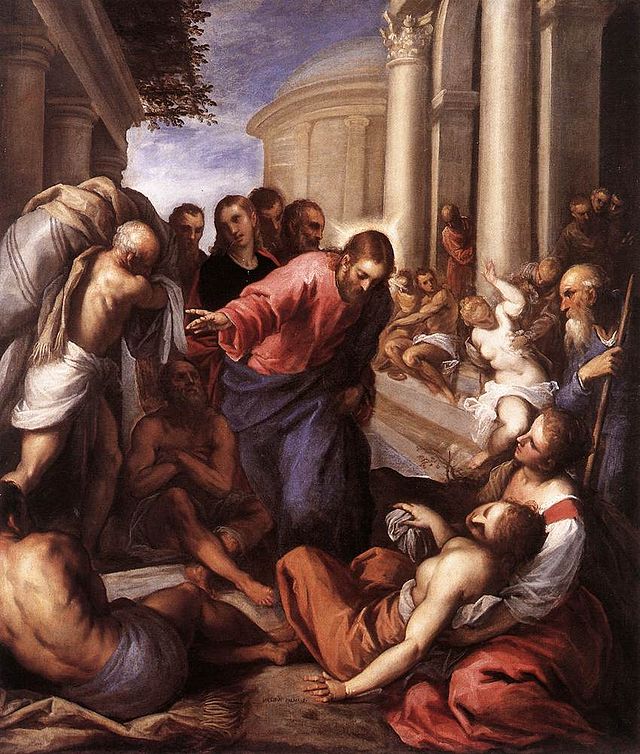
Something occurs in terms of a solution in what Jesus said to a young man from whom he cast out many demons. You are likely aware of the details of the story, but if you wish to review the whole store you can read it in Mark 5:1ff. The young man had many demons, “Legion,” for there were very many of them. Jesus drove them out, into a local herd of swine, some 2000 and number, which ran off the bluff and drowned in the lake.

What is odd, and also speaks also to the cultural conditions of our time, is that the townspeople are not grateful to Jesus. Rather they are fearful and averse to him, and ask him to leave their town immediately. Now just consider, a young man was so fiercely possessed, that even when his hands and feet were chained, he broke the chains could not be repressed in anyway. One would think that gratitude joy, and a desire for Jesus to stay would be the natural and normal response to this.

But having experienced significant financial loss, and possibly fearing that Jesus could control too much, the people are angry, and fearful, and insist that Jesus leave their town.

Now here is a paradigm for our modern culture. Increasingly, we are seeing more than a mere indifference to God or religion, but and outright aversion, even overt hostility toward faith and the teachings of Jesus. The faith established by Jesus Christ is increasingly seen as an obstacle, both to happiness and progress. Perhaps too, there is some fear that if Christianity were to be more widely embraced, many changes would be necessary; many sins would need to be faced, and repented of; and many virtues such as generosity to the poor would be more strictly required.

Now at some level, these assumptions are true. Christianity, fully embraced, with more than lip service, does lead to significant change in one’s life! But of course the mechanism of this change is not simply the dreadful, fearful following the rules, per se, but rather a transformative power wherein one sees sins put to death, and many virtues come alive.

Yet many, not appreciating this or understanding it, fear Christian influence which shines a light of truth of their sins and/or neglects.

And thus, many in our culture are insisting that Jesus and us leave town on the very next train. So, what happened at the lake side, in the land of the Gerasenes, is very much alive in our time as well.

Given the similarities, what did Jesus advise then, and what does it mean now? The young man, having been healed, begs to follow Jesus, Jesus says “No” and advises the following, which the man does:

Go home to your own people and tell them how much the Lord has done for you, and how he has had mercy on you.” So the man went away and began to tell in the Decapolis how much Jesus had done for him. And all the people were amazed.(Mark 5:19-20)

So, the solution for the hostility in this land of the Gerasenes, is to leave behind a witness to the goodness and mercy of God, who by his witness and testimony, will help bring people to their senses.

The Man becomes quite a witness, it would seem, for he went through the cities of the Decapolis, (which means the region of the ten cities), and thus he covers a good bit of territory.

And the text states the results that all who heard him were amazed. Actually, the Greek verb is a little more specific than that. ἐθαύμαζον (ethaumazon) is an imperfect, indicative, active verb.

That a verb is in the “imperfect” tense implies that it is not yet fully completed at the time it is reported to us. Thus perhaps a better translation of this verb would say that those who heard him were “becoming amazed.” In other words, witness, and evangelization, is generally not a “one and you’re done,” scenario. More is needed than one barn-burner sermon where everyone gets converted instantly. But rather, it involves staying in a conversation with people over some period of time and leading them back.

And this then is our lot, and also our solution in a culture that has lost almost any sense of the sacred, and is becoming increasingly irreligious and even hostile to the faith.

So, what are we to do? The Lord’s advice seems clear enough: Go home to your people and report to them what great things the Lord has done for you, and how He had mercy on you. In other words, tell them how he healed you; tell them what he’s done for you; show them how you have been healed; and manifest a joy to them. And while this may take time, many will begin to be amazed.

It seems clear today, we cannot simply reduce evangelization to an intellectual appeal. Doctrines and dogmas are ultimately very essential, lest we go off and invent our own new religion, a very bad and idolatrous thing to do!

But it would seem, that our first appeal is to be living witness of the transformative power of Jesus Christ in our lives. We need to be able to tell others, to manifest to them the power and the glorious majesty of Jesus Christ and the power of his cross to put sin to death and bring joy and many graces alive.

Of course, this will take time, and we will take back territory from the devil one soul at a time. But at a certain point things reach critical mass, and faith goes from small little communities to a more cultural influence. It may take a long time, and that is not without his frustrations. At times, it seems that it takes centuries to build something up, and only twenty minutes to tear it down.

But all we can do is rebuild. One day, we may rediscover the sacred, Sundays and holy days may return his days of special observance. For now, all we can do is get to work it is the Lord will bring the harvest.

This song’s text is “Gratias Agimus Tibi” (We give you thanks) from the Bach B Minor Mass.
Some thoughts to help deepen our gratitude.

112713True gratitude is a grace, or gift from God which proceeds from a humble and transformed heart. In such a case we do not render thanks merely because it is polite or expected, or because God commands it, but because it naturally flows from a profound experience of gratitude. The “command” of Scripture to give thanks is not a moralism, but a truth and description of a transformed heart.

Thus, an anointing to seek from God is a powerful transformation of our intellect and heart wherein we become deeply aware of the remarkable gift that everything we have really is. As this awareness deepens so does our gratitude and joy at the “magnificent munificence” of our God. Everything, literally everything, is a gift from God.

Permit a few thoughts on the basis for a deepening awareness of gratitude. Ultimately gratitude is a grace, but having a deeper awareness of the intellectual basis for it can help to open us more fully to this gift.

1. We are contingent beings who depend on God for our very existence. He holds together every fiber of our being: every cell, every part of a cell, every molecule, every part of a molecule, every atom, every part of an atom. God facilitates every function of our body: every beat of our heart, every organ and movement of our body. God sustains every intricate detail of this world in which we live: the perfectly designed orbit of this planet so that we do not cook or freeze, the magnetic shield around the planet that protects us from harmful aspects of solar radiation, every intricate visible and hidden process of this earth, solar system, galaxy and universe. All of this, and us, are contingent and thus sustained by God and provided for by Him. The depth, height, length and width of what God does is simply astonishing. And he does it all free of charge. As we ponder such goodness and providence we are helped to be more grateful. All is gift.

2. Every good thing you or I do is a gift from God. St. Paul says, What have you that you have not received. And if you have received, why do you glory as though you had achieved? (1 Cor 4:7). Elsewhere he writes, For it is by grace you have been saved, through faith—and this not from yourselves, it is the gift of God—not by works, so that no one can boast. For we are God’s workmanship, created in Christ Jesus to do good works, which God prepared in advance for us to do. (Eph 2:8-10). Hence even our good works are not our gift to God, they are His gift to us. And on judgment day we cannot say to God, Look what I have done, you owe me heaven; All we can say on that day is Thank You! All is gift!

3. Gifts in strange packages – There are some gifts of God that do not seem like gifts. There are sudden losses, tragedies, natural disasters and the like. In such moments we can feel forsaken by God, and gratitude is the last thing on our mind. But here too, Scripture bids us to look again: And we know that all things work together for the good of those who love God and who have been called according to his purpose. (Romans 8:28). We don’t always know how, but even in difficult moments God is making a way unto something good, something better. He is paving a path to glory, perhaps through the cross, but unto glory. For now we may have questions but Jesus has said to us: But I will see you again and you will rejoice, and no one will take away your joy. On that day you will have no more questions to ask me. (Jn 16:22-23). Yes, even in our difficulties we are more than conquerors (Rm 8:37) because the Lord can write straight with crooked lines, and make a way out of no way. All is gift!

4. Yes, all is gift. Absolutely everything is gift. Even our failures, if we are in Christ and learn from them and they teach us humility. For what shall we give thanks? Everything! All is gift!

5. There is an old saying: Justice is when you get what you deserve. Mercy is when you don’t get what you deserve. grace is when you get what you don’t deserve. I like you get asked a dozen times a day, “How are you doing?” I have trained myself to often answer, “More blessed than I deserve.” Yes, All is gift.

6. Finally, the work “Thanks” in English is unfortunately abstract. But in the Latin and the Romance Languages, the word for “thanks” is far more tied to the fact of grace and gift. In Latin one says thank you as gratias ago tibi, or simply, gratias. Now gratias is translated as “thanks” But it is really the same word as “grace” and “gift” which in Latin is rendered gratia. Hence when one receives a gift they thus exclaim: “Grace!” or “Gifts!” It is the same with Spanish: Gracias and Italian: ‘Grazie. French has a slightly different approach but also less abstract than English, when it says Thank you as Merci which is rooted in the Latin merces, meaning something that has been paid for or given freely. So all these languages vividly record the giftedness that underlies everything for which we are grateful. The English word “thanks” does not quite make the connections. About the closest we get are the words, gratitude and grateful. And again all these words (gratias, gracias, grazie, merci, gratitude) teach us that all is gift!

To be grateful is ultimately a gift to be be received from God. We ought to humbly ask for it. We can dispose our self to it by reflecting on things like that above but ultimately gratitude comes from a humble, contrite and transformed heart. Saying thank you is not a moralism. True gratitude is a grace, a gift that comes from a heart deeply moved, astonished and aware of the fact that all is gift.

A Lament On the Disappearing of Thanksgiving

My Father used to love Thanksgiving. It was for him the one one holiday that was not corrupted by silly sales, and endless machinations of marketers. It was just a time when family gathered, stores were closed and there wasn’t much the marketers could do to mess with our minds.

But as you know, the “sanctuary” of Thanksgiving, has been steadily eroded in the past ten years with the depressing and even tragic spectacle of “Black Friday.” What an awful thing it has become in recent years to see people lining up through the middle of the night to stampede into stores. Not only are there terse interactions, but also physical altercations, even a few deaths a couple years back as a stampede occurred (as I recall for some stupid doll that was the rage that year).

This year the erosion of Thanksgiving took a major chunk of territory as many stores announced that they would open on the evening of Thanksgiving. A sadly, for many shoppers who seem to suffer from some definite signs of addiction, this means Thanksgiving is all but gone since they feel compelled to stand in line for hours to be among the first to make the hideous rush into the store for some miserable gadget. It is a sad spectacle, so very sad.

I expect someone to write in her defending the practice and announcing that some very good deals are to be had. But honestly, is it worth it to see a decent holiday eroded by this? And I wonder too how standing in line for six hours to save a few bucks is really saving anything at all. For me, time is very valuable, time with family is valuable, yes time is precious. I dunno, called unsold on the “deals” that are available.

Black Friday got its name because this was the weekend when many retailers finally saw the ink on their ledgers go from red (deficit) to black (profit). But Black Friday is now earning a new reputation as it manifests the darker side our our nature.

Mind you, I am not calling for some new “law” and for government to “do something.” Marketers are free to open their establishments and people are free to shop as they please.

But I share a memory in  my Father’s honor (may he rest in peace), that, once upon a time there was a holiday in America that was uncommercialized, a holiday that was just about family, and gratitude, just about simple togetherness. Yes, once upon a time, in an America increasingly far, far away.

Thanksgiving as a Remedy for the Soul – AND – How to Add 1000 Calories to Your Thanksgiving Turkey

At the heart of thanksgiving is not just food, but also family and fellowship. And, in these busy and distracted times we don’t have enough of these. But communion with God and each other is a foretaste of heaven. On the road to Emmaus Jesus gave a poignant picture of heaven: walking, talking and dining. And though I suspect we’ll do little walking this Thanksgiving, surely talking and dining will be an important part of it for most of us.

Pushes back the Evil One – And be mindful of this, our intentional communion, our talking and dining, if done with charity, pushes back the incursion of the evil one and helps prepare us for heaven. And we also stress charity and be intentional about it. For the devil despises communion and will do what he can to destroy or limit what ever communion we seek or find among each other.

I am somehow mindful of a quote from Pope Benedict XVI:

If there were such a thing as a loneliness which could no longer be penetrated and transformed by the word of another; if a state of abandonment were to arise which was so deep that no “You” could reach into it any more, then we should have real, total loneliness and frightfulness, what theology calls “hell”. We can now define exactly what this word means: it denotes a loneliness which the word love can no longer penetrate…a night into whose solitude no voice reaches. (In Introduction to Christianity, commentary on “Descended to hell.”)

Yes, our Thanksgiving fellowship, our communion of love, is essential for us. A kind of a remedy for the soul and a protective embrace against the powers of Hell. It helps, by God’s grace, to push back the loneliness and alienation that easily envelop us today in this “communication age.” For, as we too easily discover, communication is not the same as communion. In this simple feast we are reminded that we were made for love and communion.

Allow God to work many graces in for you this thanksgiving, especially the grace to love and find deeper communion with Him and others.

On a lighter note, this T.V. commercial in the video below (from the 1950s) teaches you how to add at least a 1000 calories to your Turkey this year.

Despite the terrible dietary advice given herein, I must say this video gave me a warm memory of my father, mother and sister as I watched it. For when I was very young, my mother and sister would be in the kitchen preparing the bird, and bonding as only a mother an daughter can. And my father would be nearby sharpening the knives and preparing for his role in cutting the turkey and the roast. (Though he would never wear the silly apron seen in the ad). They are all deceased now, but I can almost see them in this look into the past;  a communion still.

On The Grace of Gratitude – A Thanksgiving Meditation

One of the dangers in presenting New Testament moral teaching is that the preacher or teacher risks reducing the Gospel to a moralism. In other words the moral truth that is proclaimed is reduced merely to another rule that I am supposed to keep out of my own flesh power. This is an incorrect notion since, for a Christian, the moral life is not achieved, it is received. The moral life is not an imposition, it is a gift from God.

In the Gospel chosen for the American Holiday of Thanksgiving we have the familiar story of the ten lepers who are healed by Jesus and only one returns to thank Him. This fact of the ingratitude of the other nine prompts an irritable response by Jesus who more than suggests that they should also have returned to give thanks. Now if we just read this Gospel on the surface we can come away merely with a moralism that we should do a better job about being thankful to God and others. Well, OK. But simply having another rule or being reminded of a rule that already exists isn’t really the Gospel, it’s just a rule or an ethic of polite society.

Where the Gospel, the Transformative Good News exists, is to receive from God a deeply grateful heart so that we do not merely say thank you, but we are actually and deeply moved with gratitude. We are not merely being polite or justly rendering a debt of obligation to say “thanks”  we actually ARE grateful from the heart. True gratitude is a grace, or gift from God which proceeds from a humble and transformed heart. In such a case we do not render thanks merely because it is polite or expected, but because it naturally flows from a profound experience of gratitude. This is the Gospel, not a moralism, but a truth of a transformed heart.

Thus, an anointing to seek from God is a powerful transformation of our intellect and heart wherein we become deeply aware of the remarkable gift that everything we have really is. As this awareness deepens so does our gratitude and joy at the “magnificent munificence” of our God. Everything, literally everything, is a gift from God.

Permit a few thoughts on the basis for a deepening  awareness of gratitude. Ultimately gratitude is a grace, but having a deeper awareness of the intellectual basis for it can help to  open us more fully to this gift.

1. We are contingent beings who depend on God for our very existence. He holds together every fiber of our being: every cell, every part of a cell, every molecule, every part of a molecule, every atom, every part of an atom. God facilitates every function of our body: every beat of our heart, every organ and movement of our body. God sustains every intricate detail of this world in which we live: the perfectly designed orbit of this planet so that we do not cook or freeze, the magnetic shield around the planet that protects us from harmful aspects of solar radiation, every intricate visible and hidden process of this earth, solar system, galaxy and universe. All of this, and us, are contingent and thus sustained by God and provided for by Him. The depth, height, length and width of what God does is simply astonishing. And he does it all free of charge. As we ponder such goodness and providence we are helped to be more grateful. All is gift.

2. Every good thing you or I do is a gift from God. St. Paul says, What have you that you have not received. And if you have received, why do you glory as though you had achieved? (1 Cor 4:7). Elsewhere he writes, For it is by grace you have been saved, through faith—and this not from yourselves, it is the gift of God—not by works, so that no one can boast. For we are God’s workmanship, created in Christ Jesus to do good works, which God prepared in advance for us to do. (Eph 2:8-10). Hence even our good works are not our gift to God, they are His gift to us. And on judgment day we cannot say to God, "Look what I have done, you owe me heaven." All we can say on that day is “Thank You!”  All is gift!

3. Gifts in strange packages – There are some gifts of God that do not seem like gifts. There are sudden losses, tragedies, natural disasters and the like. In such moments we can feel forsaken by God, and gratitude is the last thing on our mind. But here too, Scripture bids us to look again: And we know that all things work together for the good of those who love God and who have been called according to his purpose. (Romans 8:28). We don’t always know how, but even in difficult moments God is making a way unto something good, something better. He is paving a path to glory, perhaps through the cross, but unto glory. For now we may have questions but Jesus has said to us: But I will see you again and you will rejoice, and no one will take away your joy. On that day you will have no more questions to ask me. (Jn 16:22-23). Yes, even in our difficulties we are more than conquerors (Rm 8:37) because the Lord can write straight with crooked lines, and make a way out of no way. All is gift!

4. Yes, all is gift. Absolutely everything is gift. Even our failures, if we are in Christ and learn from them and they teach us humility. For what shall we give thanks? Everything! All is gift!

5. There is an old saying: Justice is when you get what you deserve. Mercy is when you don’t get what you deserve. grace is when you get what you don’t deserve. I like you get asked a dozen times a day, “How are you doing?” I have trained myself to often answer, “More blessed than I deserve.” Yes, All is gift.

6. Finally, the work  “Thanks” in English is unfortunately abstract. But in the Latin and the Romance Languages, the word for “thanks”  is far more tied to the fact of grace and gift. In Latin one says thank you as gratias ago tibi, or simply, gratias.  Now gratias is translated as “thanks” But it is really the same word as “grace” and “gift” which in Latin is rendered  gratia. Hence when one receives a gift they thus exclaim: “Grace!” or “Gifts!”  It is the same with Spanish: Gracias and Italian: ‘Grazie. French has a slightly different approach but no less abstract when it says Thank you as Merci which is rooted in the Latin merces, meaning something that has been paid for or given freely. So all these languages vividly record the giftedness that underlies everything for which we are grateful. The English word “thanks” does not quite make the connections. About the closest we get are the words, gratitude and grateful. And again all these words (gratias, gracias, grazie, merci, gratitude) teach us that all is gift!

To be grateful is ultimately a gift to be be received from God. We ought ot humbly ask for it. We can dispose our self to it by reflecting on things like that above but ultimately gratitude comes from a humble, contrite and transformed heart. Saying thank you is not a moralism. True gratitude is a grace, a gift that comes from a heart deeply moved, astonished and aware of the fact that all is gift.

40 Reasons for Coming Home – Reason # 35 – A Fitting Thanksgiving

Reason # 35 – A Fitting Thanksgiving – In the Book of Psalms the psalm writer asks, “What return can I ever make to the Lord for all the good He has done for me?” The very next verse of the psalm answers the question: “The cup of salvation I will lift up and I will call on the name of the Lord (Psalm 116:12-13). So God has already indicated the way in which he would like to be thanked.

For a Catholic this request of the Lord ought to seem pretty stright-forward when we think of the Cahlice being elevated at every Mass and we make our act of faith in the true presence of Jesus. As a proper thanksgiving  God wants us to participate in the Holy Eucharist.

As you may know, the Eucharist means, “Thanksgiving.” It is the perfect act of praise, thanksgiving and worship of the Father by Jesus. We as members of his body participate in that perfect thanksgiving every time we particiapte in Mass. We “take up the cup of salvation and call on the name of the Lord” just as God asks in Psalm 116.

So here is another reason to come home. You owe great thanks to God, you owe infinite thanks to God! How can you ever render your debt? He has told you how: take up the cup of salvation, attend Mass.