Finding that forgotten one at Christmas; that someone who needs love.

Christmas is a beautiful time of the year for most of us, most of the time. But it is also true that Christmas can be a very painful time of year for some, especially those who have experienced recent loss or who, for various reasons, have fewer family options at Christmas. Yes, Christmas can be the best of times, and the loneliest of times, the most wonderful time of the year, or the most painful.

The video below reminds us that Christmas can also be a time to reach out to others who have a hard time experiencing Christmas. Perhaps it is a relative or friend who has lost a spouse this past year and this will be the first Christmas alone. Perhaps it is some one who is left out because they are military and family are far away. Perhaps it is some one who is shy and even a little anti-social, but somewhere under all their grouchiness we see their pain and know that they need some outreach at Christmas.

Whatever the situation, there are always those who need to be included, who for various reasons feel excluded.

In the video, a hare, i.e. a rabbit, is friends with a bear who always misses Christmas because of hibernation. But something in the hare says that Christmas will not be Christmas without his friend, and without his friend being able to experience the joy of Christmas. It occurs to the hare that a particular gift will help the bear enjoy Christmas, if even for a moment. And so, he gives the gift, which you will see at the end of the video.

I leave it to you to see the touching conclusion and to ask who the bear is in your life that you need to reach out to in this season of Christmas. For me it was an old family friend that I had lost touch with this year, and whose mind is beginning to fade with age. But she had been good to my father in his dying process, and so I sought her out and had a nice talk.

How about you? Who is that someone that needs some special outreach this Christmas. Christ will surely be pleased if you give the gift of love.

The Greater Gift – As seen in a touching Christmas Commercial

There is an old saying that the greatest things in life aren’t things. Our greatest gifts are those we love, beginning with God, and extending to one another.

One of the great dangers at Christmas time (and with life in general) is that we maximize the minimum and minimize the maximum, of, as Jesus puts it, we strain out gnats and swallow camels (Matt 23:24).  He spoke this of the religiously observant of his day who meticulously followed small and technical rules about cleanliness and ritual purity,  but neglected the weightier provisions of the law: justice and mercy and faithfulness (Matt 23:22).

In other words, at Christmas we can so focus on getting things and arranging events at Christmas that we neglect or even harm those who are our greatest gift.

Consider the growing sadness that many have now largely set aside the once sacred Thanksgiving holiday where people could spend time with family and enjoy company. Why? To have the stores open so people can run from the people they love to buy things for them. The gift eclipses both the giver and the recipient. And, on top of that we potentially sin against charity by creating a climate that requires the poor and those of the lower wage, working class in our store to work on Thanksgiving.

Add to this the short tempers at shopping malls, often caused by traffic, long lines, and items out of stock and the impression is created that things are more important than people. Not all suffer from this, but it is a problem.

In the video below is a touching reminder that the truer purpose of a gift is the well-being of another and the love we can show at Christmas.

The basic scene is that two snowmen are built, a kind of husband and wife snowman family. But one has, and the other has not. Seeing his wife’s need, a snowman sets out, enduring great hardship and many obstacles, to get for his wife what she needs. The greatest gifts are those that show care for another.

The “creator” of the snowman is watching this act of love unfold through the window. At the touching end of the video, the creator is very pleased.

And so too our Creator and Lord is also watching from the window of heaven and He is pleased with our acts of mercy as well.

The greatest things in life aren’t things; they are those we love. And the greater gift this Christmas is not so much the thing we give, as the care and love we extend through gifts shared, and the shared gift of our very selves.

The Bridegroom Comes! A reflection on the Great Wedding Feast That Christmas Brings

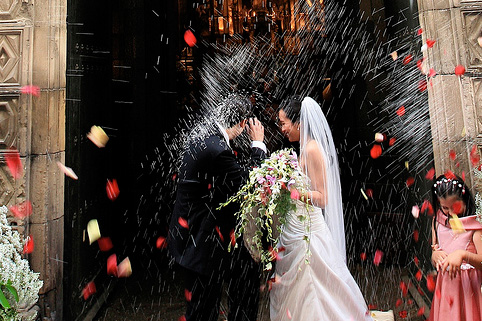
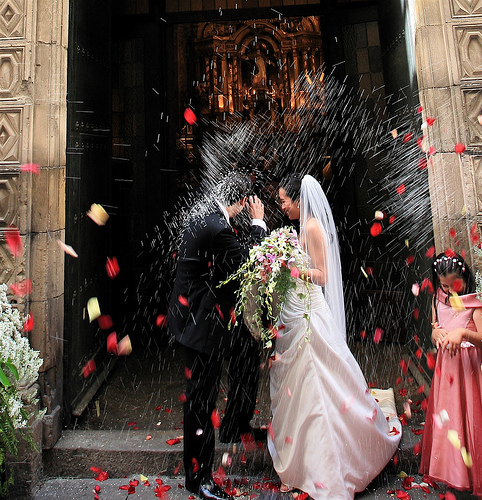
“Wedding Couple” This file is licensed under the Creative Commons Attribution-Share Alike 2.0 Generic license.

The coming of Christ at Christmas was as an infant. And thus we don’t usually think of wedding imagery related to the First coming of Jesus.  Yet, since the first coming of Christ is certainly fulfilled, we now focus more on his Second coming, of which the first coming is a sacramental reminder.

Thus, in Advent our longing and thrill are also and essentially  directed to his glorious second coming. And now Mother Church, the New Jerusalem, our Mother looks for her groom Jesus to come again all his glory:

I saw the Holy City, the new Jerusalem, coming down out of heaven from God, prepared as a bride beautifully dressed for her husband. And I heard a loud voice from the throne saying, “Now the dwelling of God is with men, and he will live with them. They will be his people, and God himself will be with them and be their God…I heard what sounded like the roar of a great multitude in heaven shouting: “Hallelujah! Salvation and glory and power belong to our God. Let us rejoice and be glad and give him glory! For the wedding of the Lamb has come, and his bride has made herself ready. Fine linen, bright and clean was given her to wear.” (Rev 21:2-3; 19:7-8)

And this longing remains until Mother Church, Christ’s beautiful bride, hears those words from him: Surge amica mea, speciosa mea et veni! (Arise, my beloved, my beautiful one and come!) (Song of Songs 2:10). Till then, her longing cannot be quenched, when he comes again, in all his radiant beauty and majesty. Till then, she longs, she looks and she waits.

Though some of her children have attained to this glory, she waits and longs till the number of her elect children are complete and she, in her fullness, will go to be with her spouse for ever in beatific glory.

One of the great Advent hymns of the Protestant tradition picks up this bridal theme and “weds” it with advent longing. This particular translation is a masterpiece of English translation (from the German). It is both biblical and artistically beautiful:

Wake, Awake with tidings thrilling;
The Watchmen all the air are filling;
Arise, Jerusalem, Arise!
Midnight strikes, no more delaying;
“The hour has come,” we hear them saying;
Where are ye all ye virgins wise?

The bridegroom comes in sight
Raise high, your torches bright!
Alleluia!
The wedding song swells loud and strong;
Go forth and join the festal throng.

Zion hears the watchman shouting;
Her heart leaps up with joy undoubting;
She stands and waits with eager eyes!
She her love from heaven descending;
Adorned with truth and grace unending;
Her light burns clear her star doth rise!

Now come our precious crown;
Lord Jesus, God’s own Son;
Hosanna!
Let us prepare to follow there
Where in thy supper we may share
.

Yes there is a great wedding feast in every liturgy, and its culmination looks to the glorious second coming of Jesus. This Christmas look to your wedding garments which the Lord gave you at baptism, a garment which, in the baptismal liturgy your were told to bring unstained to the great judgment seat of Christ. The Bridegroom comes! Let us go out to meet Christ the Lord (cf Matt 25:6)

Here is the Great Wedding Song of Advent quoted above:

Jesus and Christian Faith in the Public Square? Yes! And Proclaimed by a Military Band!

Maybe I’m just not listening to the news enough, but I haven’t heard a lot about the Christmas wars this year. These are the annual wars wherein a Christian seeks to put up some display of Christmas, be it a creche or Christmas tree, and soon various atheists or civil liberties groups lodge protests or initiate lawsuits to stop the practice; even going so far as to ban the colors red and green in public schools during the Christmas season and banishing Santa, (a secular Christmas feature but somehow tied to Christmas nonetheless).

Anyway, I haven’t heard a lot of it this year. Perhaps some of you will correct me on that.

Much to my pleasant surprise, a Facebook friend sent me the video that is below of a “flash mob” by the United States Air Force Band of which she is a member. They surprised people that the Air and Space Museum here in Washington DC with the surprise Christmas concert.

What makes the event significant to me, is that the United States Air Force Band did not simply play some secular tune like “Santa Claus is Coming to Town” or “White Christmas.” In fact, they didn’t really even play what most people think of as a Christmas song as the main piece. As you will see, and hear, the opening strains sounded by the cello are of the familiar Bach piece Jesu, Joy of Man’s Desiring. “Wow,” I thought!

Well of course, as the other instruments began to join from various parts of the museum, I figured that no words would be sung, rendering it less “offensive” to seculars.

But then, I began to see singers appear prepared to sing! “Would they dare?” I thought. As the first singers opened their mouths to sing, they did not pronounce the words, rather they hummed the melody. “Ah! that’s what they’re going to get away with it,” I thought.

But then, Lo and behold! They began to sing the words:

Jesu Joy of man’s desiring!
Holy wisdom love most bright.
Drawn by thee our Souls aspiring,
Soar to uncreated light!

Wow, a military band and choir, sponsored by the United States Government, singing of Jesus Christ, in a public museum largely funded by federal money. Wow!

And then things got even more explicit with the words of the Carol:

Joy to the world, The Lord is come!
Let earth receive her King!
Let every heart prepare Him room,
Let heaven and nature Sing!

Joy to the world, the savior reigns.
Let men their songs employ
While fields and floods, rocks hills and plains
Repeat the sounding joy.

The choir ends by singing Jesu! Jesu! Joy!

Thanks be to God! I’m glad to know that among average people, this is still acceptable and pleasing. As the camera pans the crowd I see delight, and reflective joy. Perhaps someone did walk out, maybe even to file a lawsuit, but I did not see it.

In my own parish last night, the United States Army Band came and played a Christmas concert. And here too, many of the works were sacred. At the height of the concert, the beautiful young soloist led us in singing O come all ye faithful, a song inviting us to adore Jesus. And we also sang Hark the Herald Angels Sing, glory to the newborn King! As of today, I received no threats of lawsuits and, as far as I know, neither did the Army Band. Again, I say, praise God!

And yet I know, some are in fact deeply disturbed by any affirmation of faith by the military, or any part of our government. How would I feel, they ask, if instead of singing about Jesus, the Air Force Band or the Army Band sang of Allah and trumpeted the Muslim call to prayer.

I’d like to think, that I could find room for that in my world. I admit it would be hard, because like anyone else, I’m comfortable with what is familiar, uncomfortable with what is unfamiliar. I will say, that I am neither offended or angered when I see a menorah or Hanukkah candles, or the star of David, or other Jewish things in the public square during the time of Hanukkah or other Jewish feasts.

As for things Muslim, I suppose I could get used to it, but I will say that are a few things that hinder my appreciation of things related to Islam. Certainly, among these are the great persecutions suffered by Christians throughout the world, largely at the hands of Muslims. So I admit, I would have more trouble with the celebration of things related to Islam.

That said, I know Muslims, I have even work with several Imams in matters of social policy here in Washington. I do not personally dislike Muslims that I know or see. I am not angry when I see Muslims at certain times of day on their prayer rugs. In fact, I see what they do as honorable and a good witness to others that there is a God to whom we must answer one day. Even if their understanding of God is not mine, we are certainly allies when it comes to resisting secularism and anti-theistic movements.

But I do admit I would be uncomfortable, at least at first, seeing a United States Military Band play a worship song related to Islam.

But for those who will simply excoriate me and say, “Aha! Then away with all religious traditions, it must all leave the Public Square; the government must have nothing whatsoever to do with faith including the Jewish and Christian faith.”

To them I will say that part of the heritage of this country, and the genius behind our constitutional and governmental system, is the Judeo-Christian faith. Like it or not, liberal democracies emerged from the Christian tradition. The founding fathers all referenced the Scriptures frequently, and found inspiration in them for the form of government we enjoy today.

I would therefore argue that references to the Jewish and Christian faith do have a certain pride of place in the American experience, at least at this point in our history. For United States Military Bands to play music from this tradition is qualitatively different than if they were to play something from Buddhist, Druid, or Islamic traditions.

Like it or not, the holidays, Christmas as I would call it, are times of tradition, where our religious heritage is celebrated and appreciated. This is just reality, and it is reflected on the faces that you see in the video below. People were not shocked, or horrified, or angered. The vast majority, if not all, were both pleased and moved.

Those who would wish to remove all references to this cultural heritage of the faith, or just substitute other traditions merely for the sake of diversity, seek to placate a small number who can be acknowledged at other times. And they are willing to offend the vast majority who still believe, or at least appreciate the great cultural heritage to our faith has bestowed.

So, admitting that some do not appreciate this sort of thing, and also admitting that I would not exactly be pleased to see our Christmas tradition either ended, or be crowded out with many other things for the sake of diversity, I simply asked my fellow countrymen and women who do not exactly appreciate these things to make room for us in your heart.

What a beautiful moment took place in the Air and Space Museum. Thank you USAF band!

A Meditation on the Bloody Octave of Christmas

Many are shocked to walk into daily Mass on December 26 and instead of hearing more of the “Baby Jesus” we are confronted with Martyrdom, “The Feast of Stephen” is ancient on the Church’s calendar. More ancient than the Christmas cycle and hence it was not removed to another time.

Bu the martyrdom does not stop there. We are in the midst of the Christmas Octave, an Octave filled with blood as we shall see.

What is an Octave? But first, there may be some of you who wonder what is meant by and “Octave.” An Octave is a period of eight days wherein a feast of the Church is celebrated for that whole period as though it were all the same day. In the modern liturgical calendar we only observe two octaves explicitly: Christmas and Easter.

During the week following Christmas many of the prayers speak of each day as though it were still Christmas. For example some of the prayers and antiphons say, “Today is born our savior, Christ the Lord.” A purist might say, but it is NOT today that he is born, it was back on Saturday the 25th that he was born. But, in certain sense this IS still Christmas day. Christmas Day is one long day of eight days from Saturday the 25th to Saturday January 1st.

It is the same with Easter where for one whole week we announce: “This is the day the Lord has made…”

Why eight days? Some say it is a reference to the eighth day on which Christ rose. I know, you thought it was the third day. But it was also the eighth day! For God made the world in seven days, resting on the seventh (Sabbath or Saturday). But Christ rose on the 8th day (Sunday). So resurrection morning is both the third day AND the eighth day! Others say the practice of the octave goes to Jewish times where some of the feasts (e.g. Dedication and Tabernacles (Booths)) were celebrated over 8 days.

In the old calendar there were more Octaves such as: Epiphany, Pentecost, All Saints, Immaculate Conception, Ascension Sacred Heart and others). Not all of these were privileged Octaves in which no other feasts could be celebrated. Easter and Pentecost were really the only two that blocked out all other feasts entirely. Others, like the Christmas Octave, allowed the celebration of other feasts but still referred to the feast of the octave as well.

So here we are in the Christmas Octave and, in a strong sense it is thus still Christmas Day. TODAY is born our savior Christ the Lord. This feast is so important that we stretch its observance a completed week and into the eighth day.

Bloody Octave – But one of the striking things about the Christmas octave is its bloodiness. It is one of the bloodiest weeks of the Church’s years. Thus, on December 26th, when we have hardly digested our Christmas dinner, we celebrate the Feast of St. Stephen, the Martyr who was stoned to death. On December 28th we celebrate the Feast of the Holy Innocents, the young and infant boys who were murdered by Herod seeking to kill Christ. On December 29th we celebrate the feast of St. Thomas Becket who was murdered in Canterbury Cathedral. Even St. (King) Wenceslaus of whom we happily sing “on the Feast of Stephen” was brutally killed by his brother.

Why all this blood, why this martyrdom? It is almost as though the red poinsettias that we put out in festive Christmas spirit look back to us in testimony. For it is clear that Jesus came to this world, ultimately to die. His crib (likely of wood) in which he was laid, arms and feet bound by swaddling clothes, points inevitably to the wood of his cross where, once again, his arms and legs were bound by nails and, after dying, he was wrapped tightly in a linen shroud.

The blood of the Christmas octave also reminds us that many of us too will share in Christ’s lot. This world hated Christ and had “no room for him.” Neither does this world have room for true Christians and the blood of martyrs stretches down through the centuries in testimony to the world’s hatred for authentic disciples of Christ and the truth they propose.

From this bloody octave the words of Christ ring out: If you belonged to the world, it would love you as its own. As it is, you do not belong to the world, but I have chosen you out of the world. That is why the world hates you (Jn 15:19). The martyrs of the Christmas Octave say, Amen.

And even St. John the Apostle, whose feast also occurs in the Octave (Dec 27), also says Amen. For, though he did not suffer martyrdom he proclaimed his Amen also from his prison cell on Patmos: I, John, your brother and companion in the suffering and kingdom and patient endurance that are ours in Jesus, was on the island of Patmos because of the word of God and the testimony of Jesus (Rev 1:9).

Victory – But all these martyrs and sufferers (St. Stephen, St. John, the Holy Innocents, St. Thomas Becket, and St Wenceslaus) proclaim too the victory that is theirs with Jesus Christ who also said, In the world ye shall have tribulation: but be of good cheer; I have overcome the world (Jn 16:33). And again, Do not be afraid of what you are about to suffer. I tell you, the devil will put some of you in prison to test you, and you will suffer persecution for ten days. Be faithful, even to the point of death, and I will give you life as your victor’s crown. (Rev 2:10) Yes, Lord, the Spirit and the Bride say, Amen.

Did I wish you a merry Christmas?

Why is the Christmas Feast Celebrated Largely at Night?

O Holy night! Yes, a silent night! and, it came upon a midnight clear. Christmas, it would seem, is a festival of the mid night. Jesus is born when it is dark, dark midnight. We are sure of it. And why not?

Even though we are not told the exact hour of his birth we are sure it must have been night. Scripture does say that the Shepherds who heard the glad tidings were keeping watch over their flock “by night” (cf Luke 2:9). Further the Magi sought him by the light of a star, and stars are seen at night, deep midnight. None of this is evidence that Jesus was born at 11:59 PM, but it sets our clocks for night, deep midnight.

Add to this the fact that Christmas is celebrated at the Winter solstice, the very darkest time of the year in the northern hemisphere. More specifically Christmas breaks in on the very days that the light begins its subtle return. The darkest and shortest days of the year make their impression on December 21 and 22. But by December 23 and 24 we notice a definite, but subtle trend, the days are getting longer, the light is returning! Time to celebrate the return of the light, it is going to be alright!

How fitting now, to celebrate the birth of Jesus, the true Light of the World, in a deep and dark December.  Jesus our light, kindles a light and a fire that never dies away. Indeed, in the dark hours of December, we have noticed a trend. The light is returning, the darkness is abating, the days are growing longer from here on out. It is subtle now! But it will grow. And with the return of light, we celebrate our True Light: Jesus.

But light is best appreciated in contrast. We think most, and appreciate most, the glory of light when the darkness assails. There’s just something about Christmas Eve. As the time approaches through December, and the darkness grows, we light lights. Yes, all through December as the darkness grows, we light Advent candles, more as it grows darkest! Even the secular among us string lights in dark December, in malls, on their houses, as if to say, the darkness cannot win, the light conquers!

And lights have their true glory in contrast the darkness. Who sees the stars in mid day? And who appreciates the beauty of light until they have experienced the darkness? Yes, Christmas is a feast of the light. We confront the darkness of December and declare to it: “Your deepest days are over, the light is returning.” And for us of faith, we say to a world in ever deeper darkness, “Your darkness cannot remain. It wil be overcome and replaced.”  For though darkness has its season, it is always conquered by the light.

An atheist recently scoffed at me on the com box of this blog that our day is over, the world has rejected faith… Sorry dear Atheist friend, the light always wins. On December 22, the darkness recedes, the light returns and all darkness is scattered. It seems subtle at first, but the light always returns, the darkness cannot last.

Light has a way of simply replacing the darkness. In three months the equinox (equal night and day) occurs, and in six months the summer solstice (the longest day) comes. And the darkness will once again seek to conquer. BUT IT ALWAYS LOSES. The light will return. Jesus is always born at the hour of darkness’ greatest moment. Just when the darkness is celebrating most, it’s hour is over, the light dawns again.

Yes we celebrate after sundown on December 24. Even at midnight. Christmas morning is almost an afterthought. Most pastors know, the majority of their people have come the “night” before. The darkness cannot win. Light scatters darkness, it overwhelms and replaces it. In a deep and dark December, a light comes forth, a star, shines in the heavens.

We gather, in and on a dark night. We smile. We are moved by the cry of a small infant, by whose voice the heavens were made. His little cry lights up the night. The darkness must go, the light has come, day is at hand.

Yes, we celebrate at night to bid farewell to the darkness. It cannot prevail. It is destined to be scattered by the Light far more powerful than it, a Light it must obey, a Light that overwhelms and replaces it. Farewell to darkness, the Light of the World has come.

Jesus the light of the world.

The video below is a celebration of light. As a Christmas gift to myself on December 22nd, the darkest day of the year, I took an afternoon off and went to photograph the triumph of light over darkness. I went to a Mausoleum, Yes, to a place where thousands are buried in the walls. But also in those walls are windows, glorious windows where light breaks through, and Christ shines forth. Some of the most beautiful stained glass in the city of Washington resides in that place of death and darkness. The light breaks through and it speaks of Christ.

This video is a testimony to just some of those windows (I am putting together another video of other windows to be shown later). In this place, a place of death,  a light breaks through, the light of faith, the Light of Christ. The text of the music in this video is from Taize, and it says, Christe lux mundi, qui sequitur te, habebit lumen vitae, lumen vitae (Christ, Light of the World! Who follows you has the light of life, the light of life).

As you view this video of the Life of Christ, ponder that stained glass begins as opaque sand. But when subject to, and purified by the fire, it radiates the glory of light which can now shine through it. So it is for us. Born in darkness, but purified by Christ and the Fire of the Spirit, we begin to radiate his many splendored Light shining through us, to a dark world.

The Light wins, He always wins.

On the Tender Motherhood of Mary, Mother of God and my Mother Too

As the feast of Christmas approaches some reflection on the Motherhood of Mary seems appropriate. As mother to Jesus she has carried him in her womb some nine months now, and the time approaches when she will give birth to him, will show him to the world. In this, she is not only his mother, but also his first evangelizer, holding up Christ for the world to see.

As mother to Christ she has the role of nurturing his human nature and caring for him in the most tender and intimate of ways. How magnificent and yet how human her motherhood is. Two strophes from music come to mind which illustrate the glory and the tenderness of Mary as Mother of God. The first is from a rather ancient source (the translation is my own):

Alpha et O (Alpha and Omega)
Matris in Gremio (is sitting in mommy’s lap)
–  From the Hymn In Dulci Jublio

Angels and Archangels may have gathered there;
Cherubim and Seraphim thronged the Air.
But only his mother in her maiden bliss;
Worshiped the beloved with a kiss
.
–  From the hymn “Ere the Bleak Mid Winter” by Christina Rosetti (ca 1872)

Yes, here is the mystery and the majesty of the Motherhood of Mary in all its humanness, and tender love.

And Mary is our Mother too. I am a witness of how she has helped by her prayer and intercession to nourish and care for Christ in me, drawing my infant faith in Jesus to a mature and adult faith. At an earlier time in my life when I struggled, rebellious against what I saw as an authoritarian Church and God (I was wrong), it was Mary and her tender motherhood who provided a way back for me. She, like she had done at Bethlehem and Cana, held Christ up for me to see. She clarified his role and both God and Man, Savior and Brother.

And in being a mother to me, she, who is also an image of the Church, showed also to me the Church as a tender, teaching and nourishing Mother.

Yes, Mary, Mother Mary. Mother to Jesus, and my Mother too. For she who gave birth to the head, also gave birth to the Body. I am by Baptism a member of the Body of Christ, and so she who is mother to Christ the Head, is also mother to me, a member of Christ’s body. And my love for her has deepened my love and reverence for Christ and also for the Church of which Mary is a beautiful symbol.

Blessed Isaac of Stella (Abbot) wrote this beautiful reflection:

The whole Christ and the unique Christ—the body and the head—are one: one because born of the same God in heaven, and of the same mother on earth. They are many sons, yet one Son. Head and members are one Son, yet many sons; in the same way, Mary and the Church are one mother, yet more than one mother; one virgin, yet more than one virgin.

Both [The Church and Mary] are mothers, both are virgins. Each conceives of the same Spirit, without concupiscence. Each gives birth to a child of God the Father…

In the inspired Scriptures, what is said in a universal sense of the virgin mother, the Church, is understood in an individual sense of the Virgin Mary, and what is said in a particular sense of the virgin mother Mary is rightly understood in a general sense of the virgin mother, the Church. When either is spoken of, the meaning can be understood of both, almost without qualification….

Christ dwelt for nine months in the tabernacle of Mary’s womb. He dwells until the end of the ages in the tabernacle of the Church’s faith. He will dwell for ever in the knowledge and love of each faithful soul.

From a sermon by Blessed Isaac of Stella, abbot
(Sermo 51: PL 194, 1862-1863, 1865)

Mary is more than a Christmas ornament. She is Mother of God, Mother of Jesus and therefore our mother too. Let her give you a mother’s care this Christmas. For, in giving birth to Christ the Head, she also gives birth to His Body, the Church, and that includes you and me. In nurturing and holding Christ, she also holds you and me. In singing him a lullaby she also sings to us. And, as a Cana when she urged him to work his first miracle and begin his saving work, so does she urge us also to step out and witness to the power and majesty of Jesus her Son and our Lord and Head.

Let Mary show you a mother’s love this Christmas.

Here’s a little video I put together. The words to the song begin:

I saw a Maiden sitting
and singing unto her child, a little Lording
Lu-lay lu-lay my dear son, my sweetie
Lu-lay lu-lay My dear heart
My own dear darling

Walking to Bethlehem with the Holy Family

As Christmas approaches, we might ponder the holy that the Holy Family were making a journey, not to some shopping mall, but South to Bethlehem. In the brief reflection that follows, I take liberties and combine imagination with known facts and the cultural context of the time. But in your mind’s eye see a couple setting forth from a tiny village called Nazareth, a town so small (barely 300 souls) that there was not even a road going to it, just a foot path. Perhaps they headed south for Hazor to connect with the Via Maris. We do not know for sure the route they took.

Yes, consider, that even now in this week before the birth, some 2000 years ago, they would be making this difficult journey well into Mother Mary’s ninth month of pregnancy. Mary with Jesus, resting in utero, just beneath her heart. She, with Joseph is walking some seventy miles south through very hilly terrain. These were not small hills. They were more on the scale of the Appalachian Mountains here in Eastern America. (see photo above right taking along the Via Maris near Megido)

The census has been called, and the timing could not be worse. It is certain that they will be away from home for this birth of enormous importance.

Many artists picture of her riding on a donkey. I have my doubts that this was the case. She and Joseph are among the working poor, and is doubtful they could have afforded such a costly beast of burden. I wonder too, if a woman so late in pregnancy, could really ride a donkey. It is possible that Joseph had some sort of wagon for her to ride in. But I suppose quite frankly, she probably walked.

These were hardy people, these ancient Israelites. They were used to make it to long journeys back-and-forth Along the Via Maris, or perhaps along the King’s Highway further West. Either way, lots of hills, lots of steep inclines.

Clearly, great anxiety and concerns accompany them as they headed south. There was nothing sentimental about the first Christmas, it was marked by great hardships, hardships that prefigured the cross.

Ancient travel was not just difficult, it was dangerous. Robbers and other criminals lurked along the traveled paths seeking vulnerable targets. Surely a man accompanying a pregnant woman to be a vulnerable target. And though Scripture mentions no such robbery or assault, neither Joseph or Mary knew this, setting out.

The Scriptures are silent, if any friends accompanied them. But given the dangers, it is unthinkable that people traveled these routes alone, or even in pairs. Rather, people traveled in groups for safety. Yet, it seems likely that Joseph and Mary would have struggled to keep up with the group, given Mary’s condition.

Yet another source of anxiety must have centered on lodging in Bethlehem just ahead. Those were not days of Orbitz, or easy reservations. One set out not knowing precisely the arrangements that would be had.

But onward they go. Perhaps stopping here and there to rest with the group. It was not easy. It was arid, and the terrain was rocky, and hilly. Carrying water along was critical but heavy, as were the other essentials of clothes, basic food and a cloak in which to sleep on the chilly evening. Even if the day is hot, the temperature drops rapidly in the arid climate of the Middle East. Joseph carries a walking stick, not to lean, but for defense.

Most of us moderns can barely walk a mile, even on flat terrain. But, as we have noted, these were hardy people, accustomed to hardship, and difficulty.

Spend some time praying and journeying with the Holy Family these next days. They journey for us. Walk with them, pray and ponder what lies ahead. Christ is near, even at the gates.

This video contains further reflections, some of them different from my own, but much of what we must do on these spiritual journeys is speculative.