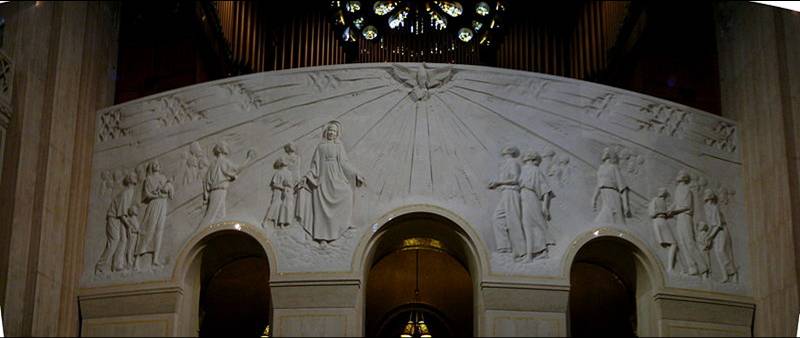
Among the Eastern Catholic Churches is the Maronite Catholic Church. It is rooted in Lebanon but its members are now all over the world. This Church is in union with Rome and the Holy Father but has its own Maronite Liturgy conducted in both the vernacular and Aramaic, the Language of Jesus himself. You can read more about the Maronite Church HEREand HERE and of its liturgy HERE.
The Following Video features the hauntingly beauty Passion hymn from the Maronite Liturgy Wa Habibi. Here is the text and translation:
Arabic Lyrics:
وا حبيبي وا حبيبي أي حال أنت فيه
من رآك فشجاك أنت أنت المفتدي
يا حبيبي أي ذنب حمل العدل بنيه
فأزادوك جراحاً ليس فيها من شفاء
حين في البستان ليلاً سجد الفادي الإلة
كانت الدنيا تصلي للذي أغنى الصلاة
شجر الزيتون يبكي و تناديه الشفاء
يا حبيبي كيف تمضي أترى ضاع الوفاء
English Translation:
My Love, My Love
What has befallen you?
Who saw you and grieved for you,
You who are righteous?
My Love, what is the sin of our times and our children?
These wounds have no cure.
Of the last line “These wounds have no cure” it is well to reflect that even in his resurrected and glorified body the wounds of Jesus still appear. This is because they are wounds of love and his love for us will never pass away or ever be “healed.”
Pray along with this video, it captures well the somber and prayerful mood of Holy Week.
Here in the Archdiocese of Washington the Maronite Rite is celebrated at Our Lady of Lebanon 7142 Alaska Rd. NW 202-829-5554
Here is another video based on the Passion of the Christ. It is a powerful though imaginary account of the the reflection of the Centurion who was ordered to crucify Christ. As the account goes on he becomes anguished in his cry: “Why Am I killing this man?!?” In the end he accepts Jesus’ request that God forgive us and the Centurion comes to faith.
Watch this video! It is long (13 minutes) but well worth the time. If you can’t watch it now, come back later in Holy Week. But watch it. It is very well done.
There is much conversation these days about a Catholic’s responsibility to live and practice his or her faith in the world. Popular culture suggests that faith be considered something private. It ought not be discussed or shared outside of a circle of family and friends. All religious traditions share a common insistence that the faith one professes shape a person’s worldview and spill over into every aspect of one’s life. Catholics are no different in this regard and in fact lay women and men by virtue of their Baptismal vocation are specifically called to bring the Gospel to the world—in our homes, our workplaces and in our communities.
Priestly
At one point in every Baptism, the priest or deacon takes the oil of chrism and anoints the child (or adult) while saying that by Baptism the person shares in the priesthood of Christ. The Catechism teaches “Baptism gives a share in the common priesthood of all believers” (CCC, 1268). What this means in a practical way is that as lay women and men our responsibility is to give witness to our faith in the way we live our lives everyday and everywhere. As priestly people, we are called to present the events of our day as an offering to God—in thanksgiving for all that he has given us. (Take a minute to look back over the day thus far, does it make a good gift?)
Prophetic
We share in Jesus’ prophetic ministry by living as witnesses to the Gospel. Having an opportunity to consider in every situation “what Jesus would do” and act accordingly. Catholics do have a unique spin on this popular saying among Christians “WWJD”. Because we believe in the living presence of Jesus among us, in the Eucharist and in one another, our bracelets should read “WIJD.” What is Jesus doing in and thorough us. Giving witness to our faith does not only mean talking about it or praying out loud in your cubicle at the office. Francis of Assisi has a wonderful saying, “Preach the Gospel at all times and if necessary use words.”
Kingly
As a people who share in the kingly mission of Jesus we are first and foremost people of hope. We have been promised eternal life as our inheritance, and so we need not fear death. In the age of the Israelites, kings were first and foremost stewards, stewards of the “treasures” God entrusted to them and stewards of God’s people who were in their care. The mandate of the steward king is to cultivate the kingdom for God, to be a partner with God in the transformation of the world in the light of the Gospel. So for Catholic men and women, particularly those with responsibility for leadership, governance, education and care of people there is direct relationship between the practice of our faith and our public life.We are always and everywhere called to participate in the building of the reign of God.
Let us keep in prayer in the coming week the 150,000 adult men and women in the United States who will join the Catholic Church at Easter and be about the work of bearing Christ to the World.
Much of the conversation on our blog so far has been propelled by and geared toward adults and young adults. But perhaps you’re the sibling, parent, aunt, uncle or grandparent of a teen and are looking to guide their journey to Christ! Someone recently shared these YouTube videos from Life Teen, and I wanted to pass them along because they show the excitement of committing to a life in Christ!
Contact your parish youth ministry to get involved. If you don’t currently belong to a parish, check out our Office of Youth Ministry website at: http://www.adw.org/youth/yth_just.asp.
Jesus said, “Let the children come to me, and do not prevent them; for the kingdom of heaven belongs to such as these.” (Matthew 19:14)
Reason # 29 – The Winning Team – OK, I’ll admit it. I cheated. I looked at the end of the book and read the end of the story. Guess what I found? Jesus wins! It’s right there in final pages, in the Book of Revelation:
The Devil who had led them astray was thrown into the pool of fire and sulfur, where the beast and the false prophet were. There they will be tormented day and night forever and ever. Next I saw a large white throne and the one who was sitting on it. The earth and the sky fled from his presence and there was no place for them. I saw the dead, the great and the lowly, standing before the throne, and scrolls were opened. Then another scroll was opened, the book of life. The dead were judged according to their deeds, by what was written in the scrolls. The sea gave up its dead; then Death and Hades gave up their dead. All the dead were judged according to their deeds. Then Death and Hades were thrown into the pool of fire. (This pool of fire is the second death. Anyone whose name was not found written in the book of life was thrown into the pool of fire. Then I saw a new heaven and a new earth. The former heaven and the former earth had passed away, and the sea was no more. I also saw the holy city, a new Jerusalem, coming down out of heaven from God, prepared as a bride adorned for her husband. I heard a loud voice from the throne saying, “Behold, God’s dwelling is with the human race. He will dwell with them and they will be his people and God himself will always be with them (as their God). He will wipe every tear from their eyes, and there shall be no more death or mourning, wailing or pain, (for) the old order has passed away.” The one who sat on the throne said, “Behold, I make all things new.”
Do you get the Picture? Jesus wins, the devil and the world and wicked loose. And Jesus unites himself to his Bride (the Church) forever. Now here’s the point, Get on the winning team!. If you could go to the race track today with tomorrow’s newspaper, you’d be a fool to bet on any other horse that the one announced as the winner in tomorrow’s newspaper. So here we are. We have tomorrow’s newspaper today. It says Jesus wins. Well then, why bet on the World or the Devil? Choose Jesus, unite yourself with his Bride the Church. The Scriptures are clear, Jesus and the Bride are the winning team. But make sure your name is in the book! You can sign up today at any Catholic Parish. Just knock on the door and say, “Sign me up for the Christian Jubilee! Write my name on the roll.” If you had once signed up but your name’s been blotted out, just go to the nearest Catholic Church and ask for the location of the confessional. So here it is, Jesus and his Church, the Bride are the winning team, the Devil and World are big time losers. Who you gonna choose?
In this week just before Holy Week we are reading from the 8th Chapter of John’s Gospel wherein Jesus enters into increasingly severe conflict with the temple leaders in Jerusalem. The conflict will ultimately end with Jesus death which we celebrate a week from this Friday.
I wonder if most Catholics today are ready for persecution. It probably doesn’t take a prophet to realize that, as the world around us goes increasingly insane and strays from God’s ways, we are more and more likely to experience persecution. The basic path seems to be this:
Biblically Based moral vision is set aside either as old fashioned or as merely “personal opinion.”
Tolerance is exulted as the only real virtue.
Insist that all behavior (except perceived intolerance) is to be tolerated.
Accuse anyone who questions newly sanctioned behaviors of being intolerant and thus worthy of increasing punishment. Call them names such as intolerant, reactionary, rigid, unkind, mean, hateful, etc. Generally incite personal dislike of those who hold to traditional biblical morality through such labeling.
Begin the process calling all perceived intolerance “hate crimes” and start exacting punishment. Start by removing tax exempt status, begin permitting lawsuits for failing to observe all forms of tolerance (Except tolerance of intolerance).
Exact more punitive measures such as jail time for those guilty of so-called “hate crime” or intolerance. Declare such people as dangerous since their “intolerance” may cause violence and thus call for their imprisonment.
As the world gets crazier such a process (which is already far along) does not seem so far-fetched. In Canada there are already clergy on trial for the “hate-crime” of opposing so-called “Gay marriage.” You can read more of that HEREand HERE. But there are several things to ponder about persecution:
Persecution is normative for the Christian. Jesus exemplifies this in his own life and also teaches: If the world hates you, realize that it hated me first. If you belonged to the world, the world would love its own; but because you do not belong to the world, and I have chosen you out of the world, the world hates you. Remember the word I spoke to you, ‘No slave is greater than his master.’ If they persecuted me, they will also persecute you. (John 15:19ff)
Hence, the fact that we are persecuted does not mean we have done anything wrong. – Too many Christians are swayed by the anger of others into thinking that they have done or said something wrong or inappropriate. While not every tactic we might use is always appropriate, our message, even if delivered with appropriate means will often anger the world. Again, this DOES NOT mean we have done anything wrong.
Refuse to accept and internalize the labels. Just because some one calls you intolerant does not mean that you are. Further we should not be required to tolerate everything. Hence it is appropriate to strongly oppose, to refused to tolerate that which we consider wrong.
Courage– Preaching and living the faith in a world gone increasingly mad will require guts and persistence. We must re-examine our intense need to be liked by everyone and approved by all and prefer nothing to God and his truth.
So, as we see Jesus in the Gospels of this week go into the fray for our sakes, we must admire his courage and pray for similar strength and virtue. Things may get difficult in the years ahead. But listen again to Jesus: In the world you will have tribulation, but take courage, I have conquered the world.” (John 16:33).
I preach on this topic at this morning’s Mass. If you’d like to hear more you can listen here: Pondering Persecution (17 Minutes)
Here too is a video clip of John 8 that depicts the increasing opposition that was mounting against Jesus. It is from the Movie The Gospel of John.
Among those who have fallen away from the practice of the faith are some who feel in some way that the Church has rejected them or disapproves of something they have done or are doing. Of those who feel this way are some who have struggled with abortion, one of the great moral issues of our day. Without doubt or compromise the Church prophetically announces that abortion is a great evil since it is the taking of innocent human life. And yet we in the Church also announce God’s mercy and compassion for all who have struggled with abortion (or any sin) and fallen. As Pope John Paul wrote in 1995 to those who have had or participated in abortion: The Church is aware of the many factors which may have influenced your decision, and does not doubt that in many cases it was a painful and even shattering decision. The wound in your heart may not yet have healed. Certainly what happened was and remains terribly wrong. But do not give in to discouragement and do not lose hope. (Evangelium Vitae, 99).
If you are a woman, or a man, who, in the aftermath of abortion, has struggled with guilt or shame. If you have a fear of rejection and so have stayed away from the Church please understand this: God has never failed to love you and neither have we. Despite the Church’s prophetic stand against abortion, we are just as adamant about mercy and forgiveness. It is the heart of the Church’s ministry to celebrate God’s healing and forgiveness. It has been my privilege as a priest to reconcile many women and men who have, at some point in the past, chosen abortion. God is rich in mercy and it is a great joy to announce, celebrate and confer that mercy.
Please know that there are priests and laity who stand ready to assist you in you in the possible and likely struggles that ensue after an abortion. Understanding, mercy and healing are offered in the Church, not only at the parish level and in confession but also through a ministry known as Project Rachel. It is a healing ministry to women and some men as well who deal with the many hurts that often emerge after an abortion. Sometimes these feelings occur immediately after the abortion, sometimes years later. Project Rachel Ministry makes referrals for one-on-one meetings with a priest especially sensitive to the needs of someone healing from abortion decisions, and also makes referrals to professional counselors, offers days of prayer and healing, and a support group. The next day of prayer and healing in English is Saturday, June 27, and the next day of prayer and healing in Spanish is Saturday, May 30. Know that you are not alone and there is healing for your soul. Project Rachel takes its name from a passage in scripture in the Book of the Prophet Jeremiah 31:15 In Ramah is heard the sound of moaning, of bitter weeping! Rachel mourns her children,she refuses to be consoled because her children are no more. Thus says the LORD: Cease your cries of mourning, wipe the tears from your eyes. The sorrow you have shown shall have its reward…There is hope for your future.
Here is the essential thought to end this post with: If you have had an abortion, the Lord loves you and so do we in the Church. If you wish to seek counseling and help, there are many ready to help you from the parish priest to trained experts and kindred souls in Project Rachel. Don’t stay away because you think you’re rejected. You are loved and your presence and gifts in the Church are needed.
Locally in Washington the phone number for Project Rachel is 301-982-2008 or 202-269-4673. The Website is here Project Rachel
The following video depicts the journeys of a few women. This is their own testimony. It may not be your exact experience, but just so you know that others have made the journey too.
This video is a little hokey, in a kind of charming way. But it gets some of the truths out about really old time religion! Enjoy this rather quirky little remake of an old classic. 😉