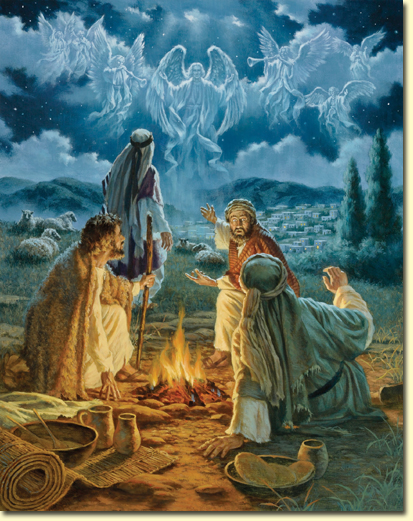
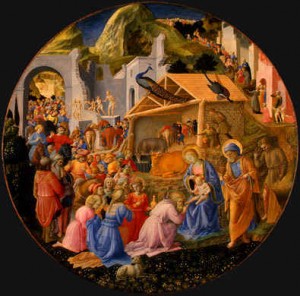
An infant – here we have show for us the humility of our God. The infinite, becomes an infant. The voice that summoned the universe into existence is now heard as the crying of an infant. The hand from which galaxies tumbled into existence now grips the finger of his mother. He who holds all creation together in himself, is now held by his mother. He who looks down on all creation now looks up from a manger. Alpha et O, matris in gremio (Alpha et Omega is sitting in Mommy’s lap). The humility of our God, who humbles himself so that we will not fear to approach. This is the first sign.
Wrapped in swaddling clothes – Women in the ancient world “swaddled” their newborn children. That is to say they wrapped them in linens that were rather tight and constricted the the movement of their arms and legs. It was thought that the newborn infant might injure himself by jerky motions of the limbs so newly freed from the tight confines of the womb. The wrappings kept such motions to a minimum for the first days after birth. The sign here of the infant Jesus being wrapped in linens in a foreshadowing of the wrapping (same verb) of his body after it was taken down from the cross. The binding of the limbs too reminds us of his limbs being nailed to a cross some thirty years later.
Lying in a manger – A manger is a feeding trough for animals. Jesus would later speak of himself as our food in John 6. He who was born in Bethlehem (a name which means House of bread) and laid in a feeding trough would one declare himself to be the Bread of Life and that his flesh was real food and his blood real drink (John 6).
Alright Christian, have you beheld the threefold sign of Christmas? Our God humbles himself for us in his birth, would die for us, and feed on with his very flesh and blood. Behold our God, Behold the Lamb of God.
Last night, I babysat my cousin’s five young children while she and her husband enjoyed a Christmas overnight downtown. Along with playing board games, taking a walk in the snow, and watching their favorite Christmas movie, we read a number of books.
One of these was “When Joy Came: The Story of the First Christmas” by Pauline Palmer Meek. I recognized the cover from the stack of Christmas books we used to have when I was little. But I don’t think I had ever actually read the book myself, so I decided to take a peek.
What a beautiful book! The vivid illustrations sweeping across each page brought the Nativity story to life in a way that it hadn’t yet for me this Christmas. I realized that, though I may have read the scripture at home or listened to the gospel at Mass, I had missed the wonder of engaging my imagination in the Nativity story.
So if you get a chance to poke around your child, cousin, niece, nephew, sister, or brother’s collection of Christmas picture books, take a moment to put yourself in the story and just imagine…
Behold, I proclaim to you good news of great joy that will be for all the people. For today in the city of David a savior has been born for you who is Messiah and Lord. And this will be a sign for you: you will find an infant wrapped in swaddling clothes and lying in a manger.” And suddenly there was a multitude of the heavenly host with the angel, praising God and saying: “Glory to God in the highest and on earth peace to those on whom his favor rests.”
Luke 2:10-14
On Christmas Eve, in the Office of the Liturgy of the Hours, the genealogy of Jesus is read from Luke 5. This passage which is difficult enough to read aloud was set to music by the contemporary Estonian composer Arvo Part, whose inspiration for many of his classical pieces comes from Gregorian chant.
It is a beautiful song that for me brings alive the unfolding of the story of salvation as seen in the mind of God. The song is called “Which was the son of.” It is a perfect reflection for the eve of Christmas.
Open Luke 5 to verse 23 and read along as the choir sings
We tend to romanticize what the birth of Jesus was like. It all seems so picturesque to us now: Bethlehem, the manger, Jesus, Mary, Joseph, cute animals, shepherds, the star, and so forth. But the fact is that the birth of Jesus was burdened with many hardships and if we look, it is not hard to see the Passion already prefigured in the birth of Jesus.
I do not write this post to burst any bubbles or simply to be contrary. But I am aware that we set up great expectations for Christmas, that it will be a wonderful, magical time. In some years those dreams come true, but in other years Christmas is difficult. Maybe it is our first Christmas without a loved one, maybe finances trouble us, perhaps we are rushed and hurried and cannot find the gift(s) we want to get for others. Christmas is seldom an “easy” time for any of us. But at some level we have to stop trying to have the perfect Christmas and come to accept the actual Christmas we have.
Christ was not found in a “perfect” Christmas by any means. The first Christmas was difficult at best. Consider the following:
What Kind of Woman is That! There were many questions likely swirling about due to the circumstances of Jesus’ conception. For Joseph they had been resolved through the message of an angel. But it is unlikely that other family members and townsfolk at Nazareth were as accepting of what had happened. Scripture is silent on these matters but the culture of that time did not easily accept that a young woman was pregnant apart from the marriage bed. There was surely tension, perhaps even some shunning of Mary, and Joseph too for he had agree to take a “woman like that” into his home. Perhaps some of them thought that Joseph too was less than innocent in the whole matter. Some of this is speculative I know but the culture of the time was quite exacting about such matters.
Terrible Travels! Just prior to Jesus’ birth Joseph and Mary receive word that they must travel to Bethlehem due to hastily called census. Mary is almost 9 months pregnant and the trip to Bethlehem is almost 80 miles. The only way to get there was on foot. The terrain in the Holy Land is mountainous. The hills around Nazareth are not little rolling hills, they are like the Appalachian Mountains in size and the terrain only gets steeper and rockier as one gets to Jerusalem and Bethlehem. Now these were hardy people and such journeys were not unknown to them. Pious Jews went as often as once a year to Jerusalem (70 Miles from Nazareth) to worship at the Temple. Nevertheless the hardships of such a journey on a woman near to giving birth cannot be underestimated. We often see pictures of Mary riding a donkey. It is unlikely that she actually did. Joseph and Mary were not destitute but they were among the working poor. It is unlikely they could have afforded a donkey for such a journey. It is possible that Joseph was able to pull a small cart upon which Mary could ride along with some of their belongings. But remember the steep hills to which we have referred. Such carts were often more trouble than they were worth. Probably they both walked.
Bethlehem was No Blessing! After a long and difficult journey of several days Joseph and Mary reached the town of Bethlehem. Now I don’t want to be unkind but let me just make it plain. Bethlehem is no cute “little town of Bethlehem.” It is a run down city set on steep hills. The terrain is rocky. And the Shepherds field was not a grassy rolling pasture. It is a very rocky, hard scrabble land. Even today after all the glory that happened there, the town is still a very poor and run down place. Due to Israeli/Palestinian conflict, the town is largely cut off economically and the poor line the streets begging you to buy olive wood trinkets from them. It is rather a sad place actually. At the time of Jesus’ birth the town was vastly over crowded due to the Census. Huge numbers who had long since left (like Joseph and Mary) had now returned for the count. On my recent trip I took pictures in Bethlehem which you can see here: Bethlehem
Born like That?!? As they enter town Mary may be experiencing her first labor pains. Joseph with great anxiety seeks a place quickly for her. Surely room could be found for a woman in labor! But no. Surely someone would understand and give their spot over to the couple! But no. Scripture gives us very little detail actually as to the place of Jesus’ birth. We are only told by Luke that Mary laid Jesus in a manger (a feed box for animals) because there was no room for them in an inn. Most moderns think of a wooden stable or barn-like structure. But it was more likely a cave beneath and behind a house where people routinely sheltered their animals. This is the likely place where Jesus was born for this is where mangers are found. Ancient tradition confirms this for the place of Jesus Birth in in the subbasement of the Church of the Nativity and, sure enough, it is a cave. But consider the awful discomfort that this must have caused. We romanticize it but let us be honest, it was damp or dusty (depending on the time of year) and it was smelly. Joseph must have been devastated that he could find nothing better for his wife and newborn Son. Luke hints at the Passion when he tells us that Mary wrapped him in swaddling clothes, using the same verb that would later be used to describe how Jesus body was wrapped in linen cloths at his burial. This was no pleasant Hallmark moment for any of the them. It was a difficult time, away from family and the comforts of home, in an unfriendly, unwelcoming and run down city, giving birth in a smelly animal pen. An old Latin song says, O magnum mysterium et admirabile sacramentum ut animalia viderunt Dominum natum, jacentem in praesepio! (O great mystery and wondrous sign that animals would see the newborn Lord lying in a feed box).
Strange Visitors! We think of numerous visitors that night but it was probably only the shepherds that first night. Now shepherds were the cowboys of their day. They tended to be a rough sort of crowd. Once again we tend to clean things up a bit. But it is sort of a strange fit that these rough and tumble cowboys of their day should be the ones summoned by the angels to be the first visitors of the Lord of Glory. The magi from the East surely came but not likely that first night for Matthew describes them as finding Jesus and Mary in a “house.” Perhaps the next day or some days later Joseph was able to find lodging and that is where the Magi found them in Bethlehem.
Flee for your Life! Not long after the birth word comes to Joseph that he must flee to Egypt at once for Herod is seeking to kill the Child. They flee into the night to make the Journey of 150 miles into Egypt.
Well I hope you can see that the first Christmas was anything but idyllic, anything but perfect, anything but comfortable. I do not deny that there is a place for sentimentality but, truth be told, our sentimentality often sets us up for disappointment. We want Christmas to be Hallmark perfect. And then Uncle Joe shows up at Christmas dinner drunk, and son Ben is away in Iraq, Mom died last June, and instead of snow, it is warm. But guess what. Jesus wasn’t found in a perfect Christmas either. If you’re looking for a perfect Christmas, Jesus is not there. He is in the imperfect one. He’s in your actual Christmas not your imagined Christmas. Find him there.
It is usually thought by most Catholics that the Evangelical “mega Churches” have lots of young adults and that many of our Catholic young adults have gone there. There is, no doubt, a great absence of young adults in most Catholic Parishes. There seems to be a quite literal and physical generation gap, the “gap” being the empty spaces in the Church that young adults would occupy. However, Eric Sammons at his blog The Divine Life (excellent Blog – Check it out!) has called attention to a very interesting article that reveals that absent young adults is a very common problem in Evangelical Churches too. The article appears in the Broken Arrow Ledger entitled “Where have the Young People Gone?” The article also reveals some Churches where young adults are increasing in number and you may be surprised where. Here are some excerpts along with my comments in RED
Two-thirds of young adults who have grown up in evangelical churches are leaving, according to Ham and Beemer. [Authors of a forthcoming book “Already Gone,” by Ken Ham and Britt Beemer, with Todd Hillard]…Information in the book is based on data collected from 20,000 phone calls and detailed surveys of 1,000 20-to-29-year-olds who used to attend evangelical churches on a regular basis but have since left them behind…..This is no small survey. Most major surveys feature much smaller sampling groups
“They (young people) have written church off as a moralistic bad guy that wants to keep them from enjoying their life…. I had this attitude when I was young too. My “lack of belief” was not a “studied atheism” but rather a more angry agnosticism. I didn’t like being told what to do. And I allowed what I wanted to do to be the basis of what I would accept. I don’t suppose that every yound adult goes through this phase but many do. In the Archdiocese we have certain forums like Theology on Tap where we try to engage young adults on important moral issues and demonstrate the credibility and sensibility of Catholic teaching. But, it is a long discussion to be had over many years. But if only we can keep them in the discussion, we may win some of them back.
Young people no longer believe in Genesis, which is the basis for Christianity, Garland said. They question everything from creation to the divinity of Christ, and for that he credits laws that require the evolution theory be taught in public school classrooms and ban instruction on Biblical creation. As I pointed out yesterday in my Blog Post I don’t think it is necessarily that they don’t believe but rather that we have failedto set the Biblical narrative forth in a compelling way because, in many cases we have stripped the plot of it’s central conflict which is the terrible reality of sin and the consequent need to be saved. I don’t think it is difficult to demonstrate to young adults that sin is a very serious matter. They have seen friends die from drug overdoes and drunk driving accidents. They know of the reality of STDs and the shallowness of most modern “substitutes” for marriage. They have experienced hurts and betrayals. They are aware of violence, poverty and injustice. I think we just have to get in the game and show them how the Scriptures and the doctrine of Original Sin go a long way toward explaining the broken down nature of the this fallen world. Our teaching is sensible if we focus in on the main problem of sin and disorder, the “problem of evil.” Without this Genesis and the whole Biblical narrative seems but a quaint and fanciful story that does not connect. And with no concept of the problem of sin and the great drama of their lives, young adults see no relevance to salvation, the necessity of prayer and sacraments. They just disconnect.
There is an exception, however. Traditional churches that are liturgical churches and smaller evangelical churches seem to be retaining their twenty-something members in greater numbers than larger and mega-churches…..Now you’d think the Catholic Church would fall into this category. But to some extent we are not reaping this harvest because most of our liturgies lack the flavor of tradition. More on this in a moment. [Rev John] Wilke said the only church he knows of that is experiencing growth in the 20-to-29-year old age group is the Greek Orthodox Church.“The Greek Orthodox Church is a liturgical church. Kids want to return to something different from what they get from the world. If we want to reach these kids again, we are going to have to return to what the early church was doing. We need to raise the bar,” he said…..There is sort of a strange rebound in some of the ancient liturgies, such as Catholic, Greek Orthodox and Episcopalian. What we would call the emerging church is something that is very appealing to that age group. Places that have a sense of order, mystery and transcendence are very appealing….I have experienced a lot of this in my discussion with some young adults who do not find the current liturgical experience of most Catholic Parishes satisfying. Many of them are turning up at the Traditional Latin Mass at I St Mary’s and other locations. I say Mass the Traditional Latin Mass once a month at St. Mary’s and find a growing and vigorous group of young adults there. For the last several years, more than half my weddings come from the Latin Mass group. Most of these young adults were dissatisfied with liturgies in their local parish which they found trendy and ephemeral. Remember, the 1960s folk music is a long time ago to them! Folk singing seems dated to many (not all) young adults. Many are discovering the riches of traditional worship that were dropped in the 1970s. Now I want to say that I do not think that the majority of young adults are asking for the Latin Mass. But what IS observable is that one area of the Church that is attracting and retaining young adults is the Traditional Latin Mass. Also, at a neighboring Parish, St. Peters on Capitol Hill, there are many young adults that turn out for Eucharistic adoration. My data is anecdotal only, but there seems to be a consistent message that many young adults are looking for more traditional forms, they are increasingly attracted by a presentation of the faith that is substantial and serious. This is also evident in the recent trend in vocations to the priesthood and religious life wherein most of the young adults who answer the call are far more traditional than they were 20 to 30 years ago. They prefer traditional forms and insist on orthodoxy. [W]here entertainment is the approach to worship. It doesn’t really satisfy. I think there is a richness in the ancient traditions that speaks at levels where contemporary music fails….[Rev. Shelby Scott agrees]: traditional liturgies and such things as incense and mystery – has become something of a strength and intrigue for the younger generation,” he said.
The Rev. John Wilke, senior pastor of Immanuel Lutheran Church,…cited one of Luther’s writings as something for church leaders to consider: “A faith that costs nothing and demands nothing is worth nothing.” “I think that is where the church is today. I get too many things in the mail from churches that say, ‘Come just the way you are, you don’t have to change,’” Wilke said. “While God loves you where you are, he expects you to change. We don’t put the fear of God in our churches, we don’t have that respect. We’ve made Jesus our homeboy. He’s not our homeboy, he’s our Saviour.”…Rev Scott agrees….that Christian worship is going through a significant change. He believes young people are looking for a doctrine that requires more of them than just showing up at church.Here too my own experience bears this out. While it is true that many young adults may still be in the “I don’t want to be told what to do” mode. I think it is also true that many young adults also move to a stage when that begins to abate and they are looking for meaning and answers. Further, I am convinced that most of the rebellious, deep down inside, are glad that some one is challenging them. Somewhere under all the layers they want to know the truth even if they are not ready to fully embrace it. When I was a teenager I was well aware when I was being patronized and I usually respected adults less who humored me and tried to “relate” to me. Frankly they looked silly try to be like a teenager. Young adults too, I suspect, know when we are watering things down in an attempt to be popular. A faith that is integral and properly demanding command more resepct in the end. We will not be taken seriously by young adults unless we ARE serious. Trendy and cheesy gimmicks will backfire in the end unless there is a serious and reasonably demanding faith that is expressed.
******
The following video was an PBS special I taped on the Latin Mass. Among the topics discussed is the appeal that many young adults find with it.
One of the most significant losses in the modern era has been the loss of the Biblical narrative in the hearts and minds of most people. Scripture is the story of the human family told by God himself. In story form He tells us how we were made and why. What happened so that things are the way they are today. Why do we have infinite longing in a finite world? Why do we struggle with sin so much? How can we be rescued from sin and death and find our hearts true satisfaction? The Biblical narrative answers these sorts of questions and more. The Biblical story or narrative, mediates reality to us in a memorable way. God, like any good Father tells us our story and asks us to tell our own children. To know our story is to understand ourselves in relation to God, the world and others.
And what a story it is! It has more of passion, conflict and drama than any great epic. It is the “greatest story ever told” but most people have lost its details and no longer know the story. Hence they are detached from the reality that the story mediates. Many are adrift in a world of little meaning, or competing “meanings” with no way to sort it all out. They have few explanations as to the most basic questions of the meaning of life, the meaning of suffering, our ultimate destiny and so forth. Without the story, life looses its meaning.
To illustrate the loss of the narrative, I was talking to Catholic seventh graders a couple of years ago and I made reference to Adam and Eve. As our discussion progressed it became evident to me that they did not really know who Adam and Eve were. They had heard the names before but couldn’t say who they really were or what they had done. About the most erudite statement that came from one of the students was from a young man in the second row who said, “Aren’t they in the Bible or something?” No other specifics emerged from the discussion. I resolved that day to scrap our compartmentalized religious programs and switch every grade level to a “back to basics” program that emphasized the Biblical narrative.
How has this loss of the narrative happened? Some argue that the Church stopped telling the story. Poor preaching, poor catechesis and pretty soon no one knows the story any more. I do not doubt there is substance to this explanation. But the explanation is still too general for it hardly seems likely that “the Church” just decided one day to stop telling the story. What seems more specifically to have happened is that we stopped telling the story effectively. And what I would like to argue is that we lost touch with the “plot” of sacred Scripture and because of this we were no longer able to tell the story in a compelling and interesting way.
What then is a plot? The plot in a story in the focal point to which all the events and characters relate. It is like the center point of a wheel around which everything else revolves. Now a plot, if it is to be successful, always involves some sort of conflict or negative development that must be resolved. This is what holds our interest as the question emerges, “How will this problem be resolved?!” If, in scene one of story, everything is just fine, and scene two everything is fine and in scene three still fine, people start tuning out. It is the conflict or negative development that renders the plot interesting. Plots usually have five stages:
Exposition – where we are introduced to the main characters and elements of the Story
Conflict – where the negative development occurs that must be resolved
Climax – where the conflict reaches its highest point and the tension is greatest. Here there is often an epic battle, or experience of the conflict. And here the conflict is resolved usually by an heroic figure or striking event.
Falling action – Here is shown the result of the climax, and its effects on the characters, setting, and proceeding events.
Resolution – The Conflict having been resolved, this last stage of the story shows either a return to normality for the characters or an attainment of an even higher state for our characters than the situation than existed before the conflict. This results in a sense of catharsis (or release of tension and anxiety) for the reader.
What then is the plot of sacred scripture? Simply this:
Exposition – God created Man as an act of love and made him to live in union with his God. In the beginning Adam and Eve accepted this love and experienced a garden paradise. The heart of their happiness was to know the Lord and walk with Him in a loving and trusting relationship.
Conflict – But man, tempted by the devil, let his trust in his creator die in his heart and he willfully rejected the God who given him everything by listening to an evil tempter who had given him nothing. Adam rebelled against God and refused to be under his loving authority and care. The led to a complete unraveling of everything. Paradise vanished, Adam and Eve experienced a deep and personal disintegration of their inmost being. Confused, ashamed, angry, accusatory and embarrassed they withdraw into hiding and cover up. They can no longer tolerate the presence and glory of the God who still loved them and must live apart from Him. God makes an initial promise to one day bring healing but when is not clear. So here is the initial conflict or negative development that defines the plot and rivets our attention. How will this tragic development be resolved? Will Adam and Eve turn back to God? Will they ever be able to experience peace in his presence again? How will Adam and Eve ever recover from the self inflicted wounds they have? A great love story between humanity and God has gone very sour. Will our lovers ever reunite? Will paradise reopen again? When will God act? How?
Climax – In continually rising action things go from bad to worse: Adam and Eve’s rebelliousness is passed on to their children as Cain kills Abel. Wickedness multiplies so rapidly that God must take action, first confusing the languages of Man and humbling him at Babel, then practically starting all over again with the flood. In a sudden development in the plot God chooses the family of Abram and his descendants to set the initial stage for a final conflict with his opponent the devil and to restore Man. Through a series of covenants and actions God prepares a people to receive the great Savior who will resolve this terrible problem. But God must take this chosen people through a series of shocking and powerful purifications so that at least some can be humble enough to receive the cure and be healed. God purifies them through slavery in Egypt, a terrifying but glorious freedom ride through the desert, the giving of the Law, the settlement in a Promised Land. But they are STILL rebellious and more and escalating purifications are necessary: an invasion by Assyrians, then by Babylonians, then exile, then return to their land. All through God sent prophets to rebuke and console. The conflicts and waiting have been continuously escalating. Then at last our savior steps on the scene! our God hero, wonderful counselor Father forever and Prince of Peace (Is 9:6). He is named Jesus for he would save his people from their sins! (Matt 1:21) In a crucial and epic battle between God and the devil, Jesus mounts a cross and defeats the devil at his own game. By dying he destroys death! The climax is now reached. The devil seems victorious but on the third day our Savior and God Hero Jesus casts off death like a garment. Ascending forty days later he reopens the gates of paradise.
Falling Action– Now that the epic battle is won, Jesus sends out Apostles to announce the Good News of His victory over sin and death. His apostles go forth with the message that the long reign of sin is over and that, through grace it is increasingly possible to live a transformed life, a life no longer dominated by sin, anger, resentment, fear, bitterness, greed, lust, hatred and the like but rather a life dominated by love, mercy, joy, serenity, confidence, holiness, chastity, self control and more. A new world has been opened. Up ahead lie open the gates of paradise.
Resolution – God has resolved the terrible consequences of the rebellion of Adam and Eve just as he promised. But things do not merely return to normal, they return to supernormal for the paradise that God now offers is not an earthly one, it is a heavenly one. It’s happiness is not merely natural, it is supernatural. And we the reader experience the catharsis of knowing that God is faithful and he has saved us from this present evil age.
But the plot has been lost by many – What a story and what a ride. But notice that the plot hinges on a key and negative development: SIN. Without that development there is no plot. And here is where the Church lost the ability to hand on the narrative: we lost the plot, and in particular the negative development that is necessary for a plot and makes it interesting. About fifty years ago there seems to have been a conscious effort to move away from talking vigorously about sin. It was said that we should be more “positive” and that “honey attracted more bees than vinegar.” Crosses (too negative) were removed from Churches and replaced with “resurrection Jesus.” Thinking our numbers would increase by a kinder, gentler Church we set aside the key element of the plot. Suddenly our narrative no longer made a lot sense. Everything is basically OK, everyone is really fine, just about everyone will go to heaven. And all along we thought we would be more relevant and inviting to people. In end all we had to say was “God loves you.”
But increasingly we have become irrelevant. If I’m really OK why go to Church, why receive sacraments, why pray, why call on God at all? If I’m fine, who needs a savior? Who needs Jesus, God or religion? And then comes the most obvious critique: “Church is boring” and “The Bible is boring!” Well sure, every story without a well developed plot IS boring. In fact, if it is poorly developed enough I might just stop reading the story or walk outof the movie. And that is just what people have done. Only 27% of Catholics go to Church anymore. To over 70% our story is irrelevant and uncompelling. Why? Collectively we jettisoned the “negative development” that makes the plot. Without a rich understanding of sin, salvation makes little sense.
Regarding the story, most people no longer “get it” because the whole point has been lost. People no longer remember a story that makes little sense to them. And so it is that I found myself in a class of Catholic seventh graders who had never heard of Adam and Eve. It’s time to rediscover the central element of the “plot” of Sacred Scripture, sin. It’s time to speak of it, creatively, in a compelling way. In so doing we will once again set forth a plot that is compelling and interesting and help people rediscover the greatest story ever told.
Here is a very creative muscial telling of “the Story”
I got the title of this post from a comedy show I was watching on TV. One character wished the second character “Happy Holidays.” The second character replied, “I have been wanting to say this for a while but; Forget you! It’s Merry Christmas.” The audience erupted into applause.
This debate has been raging in recent years and frankly, I fall on the “Merry Christmas” side. I am not shy about saying “Merry Christmas” and I try to buy Christmas cards that in some way celebrate the Nativity of Our Lord. However, I had to pause and think, “Have I ever been on the other side?”
Yom Kippur, Rosh Hashanah, etc.
At my school, I have a Jewish teacher who celebrates all of the Jewish holidays. Furthermore, she has a remarkable way of sharing the joy of her faith with us without in anyway offending us or diminishing our Catholic identity. During Rosh Hashanah, it is natural for me to wish her a Happy New Year. During Yom Kippur it is common for the rest of the faculty to include her in our prayers for atonement. She gives gifts during the appropriate holidays and I rather enjoy her gestures.
At the same time, she is part of the congregation at our school Masses, she attends the faculty Christmas party and never responds to a wish of, “Merry Christmas” or “Happy Easter” with a “Forget you, I am Jewish.” She says “Thank you” and reciprocates the greeting.
It occurred to me, what is wrong with my colleague and me wishing that one another has a nice day and grows closer to God in the process.? Whether that day be Christmas, Easter or Yom Kippur, no one should be offended if someone else is sincerely expressing wishes of goodwill.
The Holiday is Christmas!
In summary, I am not going to stop saying Merry Christmas for fear of offending anyone. It is Christmas, not a generic holiday. No one should be offended by my “Merry Christmas.” My expression of goodwill should be accepted and appreciated, whether you are Christian or not. Furthermore, most of the time when I initiate a “Merry Christmas”, I get a “Merry Christmas” in return. Even if you are not Christian, what is wrong with me hoping that December 25th is a nice day for you? There is really nothing wrong with that. I mean well.
They will know we are Christians by our love
I think most people say, “Happy Holidays” because they fear offending. My fellow Christians, let us not be part of the fear. Don’t get offended by “Happy Holidays” and please, don’t get angry. Simply reply with a “Merry Christmas” and they will know we are Christians by our love. However, if someone does gets offended by your kind gesture, in that rare case, forget him! It’s Christmas.
I would like to continue the theme of yesterday’s blog which is “wonder and awe.” Too often we simply refuse to see God’s glory on display all around us.
In the animal world I have always marvelled to see a majestic horse run, or a cheetah reach speeds of almost forty miles an hour. I could never be a hunter, for I marvel at the life in every creature. A deer or majestic stag could never draw fire from me. I respect their glory too much. I do not mean to say that hunting should cease, I am only going to say I could never do it (unless I suppose I was starving). Some one said, “Well you eat meat and an animal had to die for that.” I know but I cannot bear to think of it.
For me, sentient life is too mysterious, too wonderful for me ever to personally end it. I remember once running over a possum and being sad for days. I understand that there is a circle of life and death but just don’t ask me to pull the trigger. Life is mysterious and wonderful.
I have immensely enjoyed the pets which have been my life, Prince, the majestic dalmatian dog of my youth, Little Missy the stray who adopted us in college years, Molly, the unflappable border collie who stole our hearts, Tupac (yes, Tupac) the Chartreuse Blue Cat who became the rectory clown at my last parish. And now my current pet, Daniel, a Blue (i.e. gray) cat who is my “kidda.” I have deeply grieved the loss of every pet as I had to bring them to the vet for that “last time.”
Each of my pets was a great gift from God and I was able to marvel in some aspect of God’s glory. And, might I say, in God’s humor. If your will to see it, pets can be hilarious. My dalmatian Dog could actually smile. Collies and Dalmatians can do that. My cat Tupac would often sleep flat on his back with all four legs spread apart! What a clown!
I want to show you two videos that show the glorious humor that animals can bring. The first one is of the amazing Bird, “Snowball” who can dance. And I really mean it, The bird can dance, you’ll be amazed. The second video is of the crazy antics of house cats, what a bunch of clowns! And as you watch be sure to thank God who provides such a rich harvest of glory and humor for us. Thank you Lord!