Lost Liturgies File: The Manutergium

It has been a very exhausting but fulfilling weekend here in Washington. Yesterday saw the ordination of eight men to the priesthood for the Archdiocese. This took place at the Basilica. Then receptions, and today the first Masses and more receptions.

I was privileged to preach the First Mass of Fr. John Reutemann. It was a beautiful Mass. I was also pleased to see that he has kept a custom that had recently been lost in the western Church. He presented the manutergium to his mother.

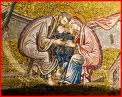
“What,” you may ask, “Is the manutergium?” The manutergium (from the Latin manu+tergium = hand towel) was a long cloth that was wrapped around the hands of the newly ordained priest after the Bishop anointed his hands with the sacred Chrism (oil).  The purpose was to prevent excess oil from dripping onto vestments or the floor during the remainder of the ordination rites. (In the picture to the right, the newly ordained priest has his hands wrapped with the manutergium).

The use of the manutergium was discontinued in the current Rite of Ordination. Currently, the newly ordained steps aside to a table after his hands are anointed and uses a purificator to wipe away any excess oil. While it is not technically called the manutergium nor is it exactly the same in design or usage, (for the hands are not wrapped by it), nevertheless this is still a cloth used to wipe away the excess Chrism (oil).

Manutergium redivivus! In recent years many newly ordained have carefully set aside these purificators in a bag with their name on it so that they may retain this purificator and present it to their mother. The same word has been retained for the cloth (manutergium).

According to tradition, the mother of a priest is to keep this precious cloth in a safe place. Upon her death this cloth is placed in her hand as her body lies in the casket. It serves as a reminder that one  of her sons is a priest. She, according to tradition has this as a special glory,  and is to present this manutergium to the Lord at her judgement. Although there is no free ticket to heaven, it is a special honor to have borne a son who became a priest. As I said, Fr. Reutemann presented his manutergium to his mother.

My own story – I also presented the manutergium to my mother  21 years ago. It was very rare in those days for a priest to do so, but I had read of this tradition and was taken by it. I carefully set aside the cloth  I had used to wipe my hands in a bag with my name and asked a seminarian friend of mine who was serving the mass to “guard it with his life!” He did so and proudly handed it to me after the mass having acquitted well his sacred duty. At my first Mass I presented it to my mother.

Five years ago my mother died very suddenly. I wondered if we could find the manutergium in her effects. Sure enough there it was carefully stored in her dresser. I sadly but proudly placed it in her hands at the funeral home and she carried it to her grave. I wept as the casket was closed, but the last sight I had was of my mother carrying that maniturgia to present to the Lord. I pray the Lord well considered it as my mother appeared before him for the great judgment we must all face.

A beautiful tradition from the Lost Liturgies file. Magnificently, this tradition is reviving as many younger priests practice it in a new but similar way.

This video shows the anointing of the priest’s hands in the Current Rite of Ordination. As the Bishop anoints the hands of the priest he says: The Lord Jesus Christ, whom the Father anointed with the Holy Spirit, empower, guard and preserve you, that you may sanctify the Christian people and offer sacrifice to God.

Facets of a Faithful Father

The Gospel for today’s Mass provides a rich reflection for today’s observance of  Father’s Day in this country. The Lord gives three fundamental prescriptions for those who would be his prophets and witnesses. He tells them to be Personal, Passionate and Promising. While these prescriptions are not limited to fathers, yet I would like to apply them especially to fathers.

Here then are three Facets of a Faithful Father:

1. PERSONAL WITNESS – Jesus asks the apostles who the crowds say he is. Various answers are supplied: John the Baptist redivivus, Elijah, or one of the prophets of old. But then comes the question that they had to answer and so do we: But who do you say that I am? No prophet, no witness of Jesus, no father can evade this question. In the end we cannot merely quote what others say.

It is a true fact that we must never go off and invent our own religion. We must remain faithful to the teaching of the Church, to Scripture, to Tradition, to the Catechism. We must say with St. Paul, “I handed on to you what I myself received.” (1 Cor 11:23)

But it is also true that we cannot go on forever being a second-hand witness. It is not enough to know about God, we must personally know the Lord. It is not enough to say, “My pastor said….Saint so and so said…..my mother said…..” This witness is precious. But there comes a moment when we have to be able to declare in a very personal affirmation: “And I say….” We must be able to affirm what we personally know to be true. Faith has to move from a merely inferential understanding based on what others have said to an experiential declaration. In effect the Christian has to be able to say, “What the Church teaches, what Scriptures affirm, I personally know by experience to be true. I know the Lord, not just from the pages of a book, I know him for myself. I have personally experienced that what the Lord teaches through the Church and her Scriptures is infallibly true.

Every child needs this testimony from his or her father. Too many men today are passive fathers, especially when it comes to faith. They leave the task of the teaching of the faith to their wife and to other women. While it is surely true that a mother has an essential  role, as do other catechists, the scriptures say: Fathers, do not provoke your children to anger, but bring them up with the training and instruction of the Lord (Eph 6:4). Notice then that it is primarily the duty of the father to bring up his children in the training and instruction of the Lord. But as noted, most children get this from their mother in our culture. She brings them to Church, she teaches them prayer and reads to them from the Bible. While mothers do and should share this task, Scripture assigns this task primarily to fathers. A man raises his children in the training and practice of the faith. He teaches them to pray, he reads scripture to them and leads his wife and children to Mass every Sunday. He insists along with Joshua, “As for me and my household we shall serve the Lord.” (Jos 24:15)

And a father cannot be content to merely quote others, or read from book. He must personally testify to them about the faith. Every father must answer the Lord’s question: “Who do YOU say that I am.” He must come to the firm conviction and experience that Jesus Christ is the Lord, that he is Messiah and savior and the only name given by which he and his family will ever be saved. And, growing in his own personal knowledge and experience of God he must then give his personal witness to his wife and children. Children are starving today to hear of their father’s faith and to see him as a man who speaks with authority about the things of the Lord. Every, prophet and every father must give personal and first hand witness to the truth of the Faith.

2. PASSIONATE WITNESS – Lifting high the Cross is essential to the Christian witness. To say our witness should be passionate means that the Passion of the Christ must be central to our proclamation.

Jesus temporarily silences the apostles insofar as announcing that he is the Messiah due to misunderstandings of the day as to the true mission of the Messiah. He then goes on to teach: The Son of Man must suffer greatly and be rejected by the elders, the chief priests, and the scribes, and be killed and on the third day be raised. In so doing he clarifies his true mission. But he also says, If anyone wishes to come after me, he must deny himself and take up his cross daily and follow me. Thus he plants the cross firmly in the center of every Christian life.

We have come through a bad period in the history of the Church that has notably diminished the cross of Christ. In the 1970s and 80s it was fashionable to replace crucifixes with resurrection statues. Many parishes set aside kneeling at Mass since “kneeling is penitential but we are a ‘resurrection people.'”  Preaching too largely turned aside from announcing the demands of discipleship and the tribulations of living the faith in a world hostile to our faith. Instead, self esteem, affirmation, and “God is love” sermons predominated. Themes such as these and celebrating the resurrection are not bad in themselves but they were not balanced with sermons and teachings that were sober about sin and our need to battle against temptation, the world, the flesh and the devil. The cross of self-discipline and accepting the limits that faith reasonably insisted upon were suppressed. A kind of “Cross-less Christianity” became the norm.

But the true witness or prophet of Christ must hold high the Cross. Jesus insists upon it in today’s Gospel and many other places. Accepting the world’s hatred, resisting temptation, self-discipline, and conforming our lives to the revealed truth are all crosses we are expected to carry. We are also summon others to walk in these ways and help them to carry their crosses.

A father must surely give passionate witness to his children. First he must be willing to carry his cross for them, and sacrificially serve them. He must also insist that they learn of the cross. He must prepare them for the world’s scorn. He must insist that they learn self discipline and to resist sin. He must also ensure that they conform themselves to the truth. Where necessary he must discipline and impose the cross so that they learn it’s value.

I am surely grateful to my own father in this regard. He insisted that I do what was right and learn self-discipline. I learned that talking back to my mother and not doing what I was told had a price. I learned that he expected me to work hard to become a man. I was to study and get good grades. I was to be respectful of my elders and never defame my family’s name.  I was to grow into a good and productive citizen of this great land live a respectable and godly life. All of this required some crosses: self-discipline, curbing my excessive desires to goof off and be lazy, submitting to lawful authority and so forth. My Father insisted, like the Lord, that I carry such crosses and I am grateful.

3.PROMISING WITNESS– Jesus concludes the Gospel in these words: whoever loses his life for my sake will save it. In insisting on the Cross Jesus is not advocating suffering and self-denial for it’s own sake. Rather, the cross leads to life!

A Christian prophet and witness to the Lord ought to be able to know and then declare the truth of this in their life. The cross is like a tuning fork. Not only does it keep us on the right pitch or true Christianity  it also signals the beginning of a great symphony. In my own life I have discovered the truth of what the Lord declares. The more I have submitted myself to the Lord and followed the way of the Cross, the more I have found true life. In dying increasingly to sin by the Lord’s grace I am coming more to life. I am less greedy, more generous, less lustful, more loving, less angry, more amiable, less critical, more compassionate, less timid, more trusting. God never fails. He holds forth the cross only to give life. And I promise you in the Lord Jesus Christ, that if you will take up the cross you will find life.

Every Father must also be able to declare this to his children. He must be able to show in his own life how obeying the Lord and accepting life’s crosses has brought blessings. He must give his children hope and zeal in the crosses they endure and the crosses he must sometimes impose. He must point his children to a better way and help them desire it at great cost. My own Father made me many promises that my life would be far better, simpler and peaceful if I would learn to discipline myself, learn self-control, respect my elders and stay away from sinful and self-destructive behaviors. And he was right. He always linked the disciplines he imposed to a better life in the future. I am glad he saw a better life for me and insisted that I carry the cross to get there. It was just his own way of saying, “Whoever looses his life for the Lord and for what is right and just, will save it.”  Thanks Dad.

By the way that’s my dad in the photo above, I am at the far right.

Why All This???

Look above you. Why all this?? Why such a large universe, billions of galaxies with billions of stars each?  Perhaps one solar system would have been sufficient. Look around you. Why all this?? Not one species of bird, but thousands.  Tens of thousands of kinds of animals and birds. The sea is filled with a massive variety of fish and other sea life. Billions of people with amazing variety, each with their own story. Why all this???

What if the answer is love? God is love and love seeks to share with others. Love seeks union and manifests beauty. Love is extravagant and ever expansive.

Science can say “what”  and some of the “how”  but it cannot answer “why.”  But God has writ the answer all around us in an extravagant and magnificent cosmos. We and all things exist by his extravagent love.

Why all this? Love! Behold the magnificence of all things and that of your very self. Only love would do all this. Only love.

What if we are surrounded by love?

Here is a nice video from The Life After Sunday Website

The Hidden and Mysterious Word in the Lord’s Prayer

In the Gospel for today’s Mass the Lord gives us the most familiar prayer of all, the “Lord’s Prayer.” It is a prayer shared by and prized by all Christians. Few if any have not committed to memory. Yet hidden within the Lord’s prayer is a mysterious word that both Greek and Biblical scholars have little agreement over or even a clear understanding of in terms of its precise meaning. I call it “hidden” only because most Christians do not read Greek and are unaware of the difficulties and debate surrounding the word. They simply accept that the most common English translation of the Our Father as undisputed. To them the problem is hidden.

The mysterious word occurs right in the middle of the prayer: τὸν ἄρτον ἡμῶν τὸν ἐπιούσιον (ton arton hēmōn ton epiousion) which is rendered most usually as “give us this day our daily bread.” The problematic word is epiousion. The difficulty is that the word  seems to exist nowhere else in ancient Greek and that no one really knows what it means. Even the Greek Fathers who spoke and wrote Greek as their mother-tongue were unaware of it’s exact meaning. It occurs no where else in the Bible (with the exception of the parallel passage in Luke’s version of the Our Father in Luke 11:3). It appears nowhere in wider Greek literature, whether Christian or Pagan. The early Church Father Origen, a most learned and well read man, thought that Matthew and Luke, or the early Church had “made up” or coined the term.

So, frankly, we are at a loss as to the exact and original meaning of this word!  It’s actually pretty embarrassing when you think of it. Right there in the most memorable text of Christendom is a word whose meaning seems quite uncertain.

Now, to be sure, over the centuries there have been many theories and positions as to what this word is getting at. Let’s look at a  few.

  1. Grammatical Analysis– The Greek word seems to be a compound word from epi+ousios. Now epi means over, above, beyond, in addition to, or some similar superlative. Ousious refers to the substance of something. Hence, to put these words together we have something amounting to supersubstantial, or super-essential.
  2. The Eucharist – Some of the Greek and Latin Fathers thought is clearly referred to the Eucharist and surely not to ordinary food or bread. Origien for example cites how Jesus rebuked the people in John 6 for seeking bread that perishes rather than the Bread which endures unto eternal life which is Jesus’ flesh and which he will give us. (cf Origen On Prayer 27.2) St. Cyprian too, while admitting that “bread”  can be understood simply, goes on to advance that the bread referred to here is more certainly Christ himself in the Eucharist (cf. Treatise on the Lord’s Prayer, 18).
  3. Ordinary and daily bread – St. John Chrysostom however favors a notion that the bread for which we pray is only “bread for today: Just enough for one day….Here Jesus condescends to the infirmity of our nature….[which] does not permit you to go without food….I require necessary food not a complete freedom from natural necessities….It is not for wastefulness or extravagant clothing that we pray, but only for bread and only for bread on a daily basis so as not to worry about tomorrow (Gospel of Matthew Homily 19.5)
  4. Bread for tomorrow – St. Jerome says, The word used by the Hebrews to denote supersubstantial bread is maar. I found that it means “for tomorrow” so that the meaning here is “give us this day our bread for tomorrow” that is, for the future (Commentary on Matthew 1.6.11). Many modern scholars favor this understanding as well.
  5. Supernatural bread – But St.  Jerome also says in the same place: We can also understand supersubstantial bread in another sense as bread that is above all substances and surpasses all creatures (ibid).  In this sense he also seems to see it linked to the Eucharist. When he translated the text into Latin as the Pope had asked him to do he rendered it rather literally: panem nostrum supersubstantialem da nobis hodie (give us today our supersubstantial bread). If you look up the text of Matthew 6:11 in the Douay Rheims Bible you will see the word “supersubstantial” since that English text renders the Vulgate Latin quite literally.
  6. Every good thing necessary for subsistence – The Catechism of the Catholic Church adopts an inclusive approach: Daily” (epiousios) occurs nowhere else in the New Testament. Taken in a temporal sense, this word is a pedagogical repetition of “this day,” to confirm us in trust “without reservation.” Taken in the qualitative sense, it signifies what is necessary for life, and more broadly every good thing sufficient for subsistence. Taken literally (epi-ousios: “super-essential”), it refers directly to the Bread of Life, the Body of Christ, the “medicine of immortality,” without which we have no life within us. Finally in this connection, its heavenly meaning is evident: “this day” is the Day of the Lord, the day of the feast of the kingdom, anticipated in the Eucharist that is already the foretaste of the kingdom to come. For this reason it is fitting for the Eucharistic liturgy to be celebrated each day. (CCC # 2837) As such the Catechism attempts no resolution to the problem but simply indicates that several interpretations are possible and non-exclusive to one another.

So when we have a Greek word that is used no where else and when such important and determinative Fathers struggle to understand it and show forth rather significant disagreement,  we are surely left at a loss. It seems clear that we have something of a mystery.

Reverencing the Mystery – But perhaps the Lord intended that we should ponder this text and see a kind of multiple meaning. Surely it is right that we should pray for our worldly food. Likewise we should pray for all that is needed for subsistence, whether just for today or for tomorrow as well. And surely we should ask for the Bread of Life, the Holy Eucharist which is the necessary Bread that draws us to eternal life and which (Who) is over and above all earthly substances.

So there it is, the hidden and mysterious word in the middle of the Our Father. Most modern translations have settled on the word “daily.”  For the record, the Latin Liturgy also uses the word daily (quotidianum). But in truth no one word can capture what is said here. The Lord has left us a mystery to ponder. I know many of you who read here are learned in Greek, Latin, the Fathers, and scripture scholarship and I am interested in your thoughts. This article is incomplete and has not covered every possible facet of the argument. I leave that you,  all who wish to comment.

Hypocrisy Is More Than We Usually Think. An analysis of Jesus’teaching on hypocrisy in Matthew 6.

In the Gospel from today’s Mass Jesus gives an extended teaching on the problem of hypocrisy. You can read it here: Matthew 6 – On Hypocrisy. In the modern age we have tended to reduce the notion of hypocrisy to duplicity. The modern notion is that a  hypocrite is someone who says one thing but does another, a person who is two-faced, who is inconsistent or phony. Jesus’ teaching on Hypocrisy does not exclude this notion but is far richer.

The Biblical understanding enunciated by Jesus is rooted in the original mean of the Greek word  hypokritḗs  which means “stage actor.”  At one level it is easy to see how this word has come to mean some one who is phony. In other words what they claim to be they really are not, they are just acting a role but when no one is looking (i.e. the audience is gone) they revert to their true self which is some one quite different. But Jesus in his teaching here develops the understanding far more richly that shows how sad and poignant hypocrisy is, what its origin is and how it can be overcome.

Hypocrisy defined – In effect Jesus describes hypocrisy as the sad state of a person who reduces himself to being an actor on a stage because he does not know God the Father. There are many people who live their life in a desperate search for human approval and applause. They discern their dignity and worth not from God (who is in effect a stranger to them) but from what other human beings think of them. They are willing to adapt themselves often in dramatic ways to win approval. They are willing to play many roles and wear many masks to give the audience what they want. They are like actors on a stage who seek applause or perhaps laughter and approval.  Notice the way Jesus describes the heart of hypocrisy:

Jesus said to his disciples: “Take care not to perform righteous deeds in order that people may see them;….The Lord goes on to say that they blow a trumpet so that others will see them giving alms, they pray ostentatiously so that others may see they are praying, and they alter their appearance so that others may see they are fasting.

The heart of hypocrisy – Thus, the goal of such a person is to be seen. They are on stage and seek to ingratiate themselves to the audience and win applause.  Hence they engage in some action “in order that people may see them.” It is clear that this is ultimately very sad. A lonely actor on a stage performing whatever role is required in order to win approval from the current audience. Their inner core or deepest self is repressed and replaced by the demands of others.  This is the true heart of and description of hypocrisy.

Many take this desperate need for approval from others to very self destructive extremes. Many young people,  due to peer pressure,  will engage in dangerous and unhealthy practices to win approval. Some will drop out of school, join gangs and commit crimes. Others will drink heavily or use drugs. Still others will tattoo and pierce their bodies, engage in sexual activity before marriage, and do many risky things. The need for approval is often the deep drive that underlies this desperate behavior. But like actors on a stage seeking applause they rush to fill these rolls and wait for the applause and acceptance. Adults too will often compromise core principles in order to fit in and be liked, gain promotions or earn access. Christians will hide their faith, playing the role of a secular modern in order to win approval. Some will act deceitfully to please a boss, others will gossip or engage in any number of sinful behaviors to ingratiate themselves to a group.

It is also clear that our modern notion of hypocrisy as duplicity, while incomplete,  is not wrong either. Why does the hypocrite act inconsistently, often in a duplicitous manner? Because the audience changes and he must change with it. So to one group he will say “yes” and to another group he will say “no.” Since the goal of the hypocrite (actor) is to be seen and win approval, the answer must change if the group does. Hence he will morph, hide his true thoughts or outright lie to gain the approval. He no longer has a core, his identity is outside of himself in what ever the audience requires in order to grant him approval.

Why does this happen to a person? Here too Jesus is rather clear. This happens to a person who does not know God the Father. The great tragedy of many lives is that they do not know the Father. They may know ABOUT God, but they do not personally know God or his love for them. God is at best a benevolent stranger who runs the universe but he is in some remote heaven and the interaction that many have with him is vague and abstract. God exists but he is on the periphery of life. In effect he is a stranger.

Notice the remedy that Jesus assigns for each example of hypocrisy he cites:

Your heavenly Father, who sees in secret will repay you for giving alms….Your heavenly Father who sees in secret will repay you for praying…..Your heavenly Father who sees what is hidden will repay you for your fasting.

In other words  the goal in life and the remedy for hypocrisy is that  it is enough that Your heavenly Father sees what you do. Now of course, as long as God the Father remains a distant and aloof figure what he sees never WILL be enough. But to the degree that we begin to experience God the Father’s love for us, his providence and his good will toward us, then we become less concerned with what others think. We begin to come down off the stage and be less concerned for the approval of men and more focused on and then satisfied with the approval of God.

Notice too the intimacy that Jesus points too. He is “Your heavenly Father.” He is not merely the “Deity.” He is not merely God in heaven. He is not even merely the Father. He is “YOUR heavenly Father.”  He is the one who created you, sustains you, provides for and loves you.

Journeying away from Hypocrisy – To the degree that this becomes real for us and is more than words on the page of a book or inferential knowledge base only on what others have said, to the degree that this is a real experience for us, we start to climb off the stage. We are less the actor (the hypocrite) and more the authentic self God has created us to be. We begin to loose our obsession with what others think of us. We are less desperate for their approval. It is not that we become sociopaths caring not one whit what others think. We still groom ourselves etc but we are not obsessed with the good opinion of others. It is enough that  we know our heavenly Father and his love for us.

Hence, hypocrisy, at least as Jesus teaches it here.  is a richer concept than we often think of today. To this sad and poingnant problem, Jesus addresses a very powerful and personal solution of knowing “your heavenly Father” and expereincing his love for you. Thank you Lord Jesus!

Learning the Latin of the Hymns for Benediction and Adoration

I sometimes get requests for help in understanding the Latin texts of the very familiar hymns for Eucharistic Adoration and Benediction. The O Salutaris and Tantum Ergo, though familiar to many Catholics remain only vaguely understood in terms of a word-for-word translation. Most know the poetic English renderings (“O Saving Victim Opening Wide” and “Humbly Let us Voice our Homage”) but this does not necessarily facilitate a word-for-word understanding as the Latin is sung. What I hope to do here,  and in greater detail in the attached PDF files, is to give a very literal rendering that preserves the word order of the Latin so that one can understand the Latin precisely. In the PDF I also give a brief word study of each word in both hymns. It is my hope to bring these hymns more alive for the faithful who sing them who may not be highly skilled in Latin.

1. The O Salutaris – The Author is St. Thomas Aquinas. These are the last two verses of a longer hymn Verbum Supernum Prodiens (The heavenly Word, going forth) which was composed for Lauds (Morning Prayer) of the Divine Office of Corpus Christi. The meter is Iambic Dimeter, accentual with alternating rhyme. This hymn was said to so please even the hostile Rousseau that he would have given all his poetry to be its author.  I propose here to record the Latin text to the left and then a very literal English translation to the right which also preserves the word order for easy comparison:

    • O salutaris Hostia    (O saving victim)
    • quae caeli pandis ostium    (who of heaven opens the gate – i.e. who opens the gate of heaven)
    • bella premunt hostilia    (wars press hostile – i.e. hostile wars press)
    • da robur fer auxilium    (give strength, bear aid)
    • Uni Trinoque Domino    (To the One and Threefold Lord)
    • sit sempiterna gloria    (may there be eternal glory)
    • qui vitam sine termino    (who life without end)
    • nobis donet in patria    (to us may he grant in the Fatherland)

I have prepared a printable and more thorough word study here: Study the O SALUTARIS

2. The Tantum Ergo– The author is St. Thomas Aquinas. It was composed for Vespers (Evening Prayer) of the Divine Office for the Feast of Corpus Christi. The meter is trochaic tetrameter catalectic, rhyming at both the caesura and at the end of the line. These two verses are the last two of the full hymn Pange Lingua.  There is here a wonderful union of sweetness of melody with clear-cut dogmatic teaching. I propose here to record the Latin text to the left and then a very literal English translation to the right which also preserves the word order for easy comparison:

    • Tantum ergo sacramentum   (So great therefore a sacrament)
    • veneremur cernui    (let us venerate with bowed heads)
    • et antiquum documentum    (and the ancient document)
    • novo cedat ritui    (to the new, give way, rite    i.e. gives way to the new rite)
    • Praestet fides supplementum    (may supply faith a supplement  i.e. may faith supply a supplement)
    • Sensuum defectui.    (of the senses for the defect  i.e. for the defect of the senses)
    • Genitori Genitoque    (To the One who generates and to the one who is generated (i.e. Father and Son)
    • Laus et jubilatio    (be praise and joy)
    • Salus, honor, virtus, quoque    (health, honor, strength also)
    • sit et benedictio    (may there be and blessing)
    • Procedenti ab utroque    (to the One proceeding from both)
    • Compar sit laudatio    (equal may there be praise  i.e. may there be equal praise)

I have prepared a printable and more thorough word study here: Study the TANTUM ERGO.

I hope that this may be of some help along with the printable PDF word studies. Venite Adoremus (Come let us adore).

Here is setting of the Tantum Ergo by Mozart which I paired with some video footage I found:

Was the Black Community Targeted by the Abortion Industry?

June is Abortion Awareness Month in the African American Community. It is a tragic and curious fact that just over 30% of the abortions in this country are performed on African American women. But the African American community is only 12% of the US population. This means of course that the Black population is strongly over-represented in terms of abortion deaths. Hence the need for an abortion awareness month in the Black Community. Recent statistics from the Guttmacher institute indicate that  1784 Black children are killed by abortion every day in the USA.

Why are African American children five times more likely to die by abortion than white children? Like all sociological phenomena, one simple explanation is not enough. Surely the breakdown of the Black family structure is a factor. High poverty rates must also be influential. Others explain that women in poverty often have less access to contraceptives and other “health-care” that might help prevent “unwanted” pregnancies. But others also note that the Black community was historically targeted by Planned Parenthood and other abortion providers. Currently 78% of Planned parenthood clinics are  located in minority neighborhoods. I would like to take a brief look at this historical phenomenon.

Margaret Sanger’s “Negro Project” – I do not propose to give a complete description of the origins of Planned Parenthood. You can read a more through description of that history here: Margaret Sanger and the “Negro Project” and here: The Pivot of Civilization . But fundamentally Planned Parenthood’s founder, Margaret Sanger was a believer in Eugenics. This was a theory that held that certain races of the human family were inherently inferior and that they should be eliminated from the gene pool through the use of contraceptives, sterilization and even abortion. Doing this would help “purify” the human race of undesirable traits (negative eugenics).

Where were these undesirable traits found in the human gene pool that Eugenicists sought to minimize or remove? You guessed it, darker skinned peoples such as African Americans, Gypsies, and various indigenous peoples had these “undesirable” traits, tended to live in poverty and were targeted for reduction and elimination by the eugenics movement. The movement became quite widespread by the 1930s and influenced Adolf Hitler in his genocidal programs.

Here in America a chief proponent of eugenics was Margaret Sanger. In 1922 Sanger wrote against outreach to the poor since it caused them merely to become more numerous:

The most serious charge that can be brought against modern “benevolence” is that it encourages the perpetuation of defectives, delinquents and dependents. These are the most dangerous elements in the world community, the most devastating curse on human progress and expression (from page 108 of her book The Pivot of Civilization).

In 1926 she began to propose sterilization for those who were “unfit”:

It now remains for the U.S. government to set a sensible example to the world by offering a bonus or yearly pension to all obviously unfit parents who allow themselves to be sterilized by harmless and scientific means. In this way the moron and the diseased would have no posterity to inherit their unhappy condition. The number of the feeble-minded would decrease and a heavy burden would be lifted from the shoulders of the fit (in the Birth Control Review Oct. 1926).

The Eugenics movement used the word “moron” to describe those caught in the cycle of poverty and attributed their inability to escape that cycle as evidence of their inferior genes and poorer mental capacity. By 1929 she chose to target African Americans especially for her “benevolent” outreach establishing her first clinic in Harlem. By 1939 she began her “Negro Project”  establishing clinics and locating them especially in poorer neighborhoods to “encourage” Blacks and other poor people to reproduce less. The distribution of contraceptives was her primary strategy.  She saw Black ministers as “useful” in her campaign and rather infamously wrote to her Regional Director Dr. Clarence Gamble:

The minister’s work is also important and he should be trained, perhaps by the Federation as to our ideals and the goal that we hope to reach. We do not want word to go out that we want to exterminate the Negro population, and the minister is the man who can straighten out that idea if it ever occurs to any of their more rebellious members (Letter to Gamble, Dec 10, 1939).

After World War II the Eugenics movement was discredited so Margaret Sanger adjusted her rhetoric and spoke of trying to “help the poor” and of “promoting better health” but the method, the plan and the targeted groups remained the same. Today it is instructive to note that the usual location of Planned Parenthood Clinics remains largely poor Black and Latino neighborhoods. After 1973 Planned Parenthood added to its arsenal by becoming the largest provider of abortions in this country.

Was Sanger successful? Well, as noted, African Americans are 12% of the American Population. But just over 30% of abortions are performed on Black women. Some conclude to moral problems in the Black Community. Others conclude that the Black Community has been targeted. You decide. Today as noted, 78% of Planned Parenthood clinics are located in minority neighborhoods.

In an interesting twist of fate, Whites and Northern Europeans (races that Sanger and the Eugenics movement would have considered most “fit”) bought into contraception in a big way after 1965 and now themselves face a kind of demographic implosion. Meanwhile many “Third World” races and nations (considered by Sanger and the Eugenics movement as “inferior”) are now set to demographically dominate the world. I have written of the demographic implosion of Europe here: Contraception is Suicide

As stated above, the high rate of abortion in the Black Community is likely complicated and surely cannot be reduced to one thing. But the targeting of the Black Community cannot be dismissed as a factor. The quotes from the distant past might be dismissed by some. But the current location of most Abortion “Clinics” in Black and Latino neighborhoods cannot be so easily dismissed.

The trailer is below and features a series of quotes from proponents of Eugenics (Sanger among them) in the early half of the 20th Century. Make sure you have a strong stomach before you watch since the quotes are ugly and horrible examples of racism that has thankfully and hopefully has abated to a large degree.

Here is another video that effectively addresses abortion using a hip hop format:

In Defense of the Use of Military Imagery in the Church

Last week in the blog I penned what was intended as a humorous post based on a video which asked: Is the Church a Cruise Ship or a Battleship?  The video rather humorously depicts how many people want their parish to be like a cruise ship: comfortable, pleasant, with a popular captain and crew, fundamentally existing to please me and serve my needs. The video, and I as well, tweaked this point of view by going to the other end of the spectrum insofar as ocean-going vessels are concerned and suggested that the image of battleship might be more appropriate. In such a ship, my comfort and good pleasure is less the focus. Mission, noble purpose, being well equipped, and effectively engaging the spiritual battle against the world, the flesh and the devil  are more the focus in a battleship image.

Now, as is often the case when any military imagery is used, some of the commenters took offense, or were alarmed at what the use of such imagery might lead to. I want to address some of the concerns in this regard and make something of a defense for the long tradition of military metaphors for the Christian life and by extension the Church.

To begin, lets be clear, the primary Biblical images of the Church are the Bride of Christ and the Body of Christ. Every other image is subordinate to these. But that said the Church can be compared to many things, all of which convey some truth. To say that the Church is like a battleship does not deny the principle images of Body and Bride any more than saying the Church is like a ship, an ark, a family, or a garden, or colony of bees for that matter. All of these images might capture some aspect of the Church worth consideration. A few of the comments from last week suggested that the metaphor of a battleship somehow precluded other images such as Bride and Body. It  does not. One metaphor does not preclude another. “King Jesus has a garden full of diverse flowers”  and each of them has something to say, something to teach that does not cancel the others.

But the specific concern for some seems to be military images per se. Back in January when I wrote of priests as soldiers and more recently last week, commenters had some of the following concerns:

  • I find your militaristic and pugilistic imagery not only off-putting, but bordering on un-Christian.
  • The church should have nothing to do with the military. War and all that comes with it are evil and unnecessary. The church a living body, not a machine like the military would want to treat it. The analogy is insufficient…..
  • Boats figure frequently in the Gospels in the ministry of Jesus–but none of them are battleships. Jesus rode in the fishing boats….Jesus was also pretty clearly opposed to the occasionally militant ideas of his (often obtuse) disciples…..peoples’ desire to make Jesus or His Church into a militaristic organization are hard pressed to find their justification in anything but the weak human desire to impose violence as a supposed solution to evil…..

Now, to be clear, the use of the image of a battleship is not to make the Church a militaristic organization. She is not, she is the Bride of Christ and also his body. But the Church and the Christian can and do have qualities LIKE a soldier or instrument of Battle. Paul for example refers to the Word of God as a sword and says that the Christian should be equipped like a soldier:

Therefore, put on the armor of God, that you may be able to resist on the evil day and, having done everything, to hold your ground. So stand fast with your loins girded in truth, clothed with righteousness as a breastplate, and your feet shod in readiness for the gospel of peace. In all circumstances, hold faith as a shield, to quench all (the) flaming arrows of the evil one.  And take the helmet of salvation and the sword of the Spirit, which is the word of God. (Eph 6:13-17)

Now Paul, while using military images is not calling for violent action. Rather he is saying that,  like a soldier equipped for battle,  a Christian should realize that he too is in a spiritual battle which requires the weaponry of the truth, righteousness, faith, serenity, confidence of salvation, and the Word of God for his sword.

To me military imagery evokes things like discipline, honor, duty, self-sacrifice, laying down ones life for one’s friends, obedience, authority, chain of command, and the like. Christian tradition is rich with military themes. One of the great hymns for the martyrs is “Deus Tuorum Militum” (Oh God of thy soldiers). The beautiful hymn “For all the saints has this line: “And when the strife is fierce, the warfare long, steals on the ear a distant triumph song, and hearts are brave again and arms are strong! Alleluia.” Another line says “The golden evening brightens in the west, soon, soon to faithful warriors cometh rest….” The Protestant tradition also features songs like “Onward Christian Soldiers” and “I am On the Battlefield for my Lord.” When Pope Benedict visited the White House the “Battle Hymn of the Republic” was sung and that hymn is in almost every Catholic Hymnal. The hymn bespeaks the necessity of engaging the great struggle for justice and freedom and links it to the great battle described in the Book of Revelation between Christ and Satan:  He is trampling out the vintage where the grapes of wrath are stored; He hath loosed the fateful lightning of His terrible swift sword: His truth is marching on….

The Church Militant – Then too, one of the most traditional references in the Church’s lexicon of herself  on earth is the “Church Militant.”  The Church in heaven is the Church Triumphant. The Church in Purgatory is the Church suffering.  But the Church here on earth is the Church Militant. In other words the Church here on earth is engaged in a great battle,  still. She battles against error and sin, she shed the light of the truth to a world that prefers the darkness and snatches souls from Satan’s grasp in a great battle. In the Easter Sequence Hymn the battle waged by Christ and continued through his mystical Body is described in this way: Mors et vita duello. Conflixere mirando, dux vitae mortuus, regnat vivus (Death and life have clashed in a wondrous battle, The king of life dies, yet reigns (now) alive). The Church militant continues to experience the unfolding of this great paschal mystery as she, by God’s grace makes daring raids into Satan’s stronghold and leads souls to freedom and victory. Her weapons are the truth of God’s Word, the healing and powerful sacraments and intrepid evangelical souls who witness to the truth and proclaim it to the world. Yes, the Church is surely in a great battle. The Hymn “The Church’s One Foundation”  describes this battle as thus:

Mid toil and tribulation, and tumult of her war,
she waits the consummation,of peace forevermore;
till, with the vision glorious, her longing eyes are blest,
and the great church victorious, shall be the church at rest.

Then too is one of the principle prayers of the Church which invokes the great leader of the Host (a word which means “army”) of Angels:

Saint Michael the Archangel, defend us in battle.
Be our protection against the wickedness and snares of the devil.
May God rebuke him, we humbly pray;
and do Thou, O Prince of the Heavenly Host –
by the Divine Power of God –
cast into hell, satan and all the evil spirits,
who roam throughout the world seeking the ruin of souls.

In all these images and expressions it is clear that they do not mean that the Church should buy jeeps and tanks or any worldly weaponry. But the images of battle are invoked to remind the Christian to have the virtues of the solider and to be aware that a battle is taking place all around us that requires sober vigilance and properly discerned action.

The Church for her part has a a key role in summoning Christians to enter the battle (the conflixere mirando) by defining clearly the crucial battles that much be waged on a multi-front war. As St. Paul warns, If the trumpet does not sound a clear call, who will get ready for battle? (1 Cor 14:8). He exhorts Timothy to “Fight the Good fight” (1 Tim 6:12).  He also distinguishes our warfare in these words:

For though we live in the world, we do not wage war as the world does. The weapons we fight with are not the weapons of the world. On the contrary, they have divine power to demolish strongholds. We demolish arguments and every pretension that sets itself up against the knowledge of God, and we take captive every thought to make it obedient to Christ. And we will be ready to punish every act of disobedience, once your obedience is complete. (1 Cor 10:3-6)

Hence, In defense of military imagery I invoke long Christian Tradition, the witness of Scripture and the fittingness of the imagery to describe the life of the Christian and also the  Church. While distinctions are important as have been made above, it remains a true fact that we are in a great battle and as such, a spiritualized understanding of the soldier, weapons and battle are both fitting and essential. As with any imagery, one is free to make use of it as it suits them. There may be some who find such imagery less helpful. But there are many who find it encouraging and truthful. It ought not be excluded as a category, image or metaphor  in the Church’s self understanding.

And there was war in heaven. Michael and his angels fought against the dragon, and the dragon and his angels fought back. But he was not strong enough, and they lost their place in heaven. The great dragon was hurled down—that ancient serpent called the devil, or Satan, who leads the whole world astray. He was hurled to the earth, and his angels with him….When the dragon saw that he had been hurled to the earth, he pursued the woman who had given birth to the male child..from his mouth the serpent spewed water like a river, to overtake the woman and sweep her away with the torrent. But the earth helped the woman by opening its mouth and swallowing the river that the dragon had spewed out of his mouth. Then the dragon was enraged at the woman and went off to make war against the rest of her offspring—those who obey God’s commandments and hold to the testimony of Jesus(Rev 12, selectae)

Thanks to Cynthia BC  for pointing me to this video: Onward, Christian soldiers, Marching as to war, With the cross of Jesus Going on before. Christ, the royal Master, Leads against the Foe; Forward into battle See His banners go! Onward, Christian soldiers, Marching as to war, With the cross of Jesus Going on before!