Are you familiar with the expression, “Always read the fine print?” Doyou always read the fine print? I know I don’t. I once heard a comedy routine that put “always read the fine print” in the same category as “rinse and repeat” and “do not insert cotton swab into the ear canal.” The point was, of course, that we usually ignore this good advice.
In today’s gospel, however, Jesus tells us that we do need to read the fine print when it comes to the law of God. He promises us that until the end of time, not an iota, not a dot of God’s law will pass away. Jesus explained that he wouldn’t abolish even the smallest part of it, as some of his contemporaries had feared, or perhaps had hoped.
But we might ask ourselves the question: Who would want this law to pass away? Who would wish to see it abolished? In today’s first reading, Moses said that the keeping of this just, life-giving law brings God close to us, and shows us to be wise and intelligent.
And let’s be honest: Who amongst us doesn’t want justice, life, wisdom, and intelligence? Who amongst us doesn’t want God to be close beside us? Deep down, this is what we all want, because God has made us this way. That’s why Jesus said that those who keep and teach God’s law are truly great in the kingdom of God. Indeed, when it comes to God’s law, we should always read the fine print.
If, on the way to court, you received advice on how you could influence the judge to be less severe in your case, would you not consider following that advice? Surely I would, unless the “way” involved bribery, or something corrupt. And, in fact, Jesus our very judge, has described an upright way that we can avoid severity on the Day of Judgment. Simply put, the way is for us to show mercy.
Now I don’t know about you, but I am going to need a lot of mercy on the Day of Judgment. So I, and probably you as well, am glad that the Lord has shown how we can positively influence the Day we are judged and see that mercy is magnified. Consider some of the following texts.
Blessed are the merciful, for they will be shown mercy. (Matt 5:7)
For if you forgive men when they sin against you, your heavenly Father will also forgive you. But if you do not forgive men their sins, your Father will not forgive your sins. (Matt 6:14-15)
Speak and act as those who are going to be judged by the law that gives freedom, because judgment without mercy will be shown to anyone who has not been merciful. But mercy triumphs over judgment! (James 2:12-13)
If a man shuts his ears to the cry of the poor, he too will cry out and not be answered. (Proverbs 21:13)
Do not condemn, and you will not be condemned. Forgive, and you will be forgiven. (Luke 6:37)
For the measure with which you measure others, will be the measure by which you are measured (Mark 4:24)
And then there is the terrifying parable too long to quote here of the man who owed a huge debt he could never repay. The king cancelled the whole debt. But the man refused to cancel the debt of one who owed him a smaller amount. To this unmerciful man the King then decreed: You wicked servant,’ he said, ‘I canceled all that debt of yours because you begged me to. Shouldn’t you have had mercy on your fellow servant just as I had on you?’ In anger his master turned him over to the jailers to be tortured, until he should pay back all he owed. “This is how my heavenly Father will treat each of you unless you forgive your brother from your heart.” (Matt 18:32-35)
So the basic point is clear enough, if we want to be shown mercy in our judgment (and trust me, we’re all going to need a LOT of it), then we need to pray for a merciful heart.
Let’s go so far to say that if anyone is harsh, mean-spirited, unforgiving, hypercritical or condemning, he is a fool. He is simply storing up wrath for himself on the Day of Judgment. Now why do that?
Mercy is our only hope to avoid strict judgment. And these texts show us that mercy here will lead to mercy there.
It is true that there are times in this world when punishments must be issued and penalties assessed. But to the degree that these are made with an eye to correction and reform then they are part of love, and relate to mercy. For, fraternal correction is a work of charity. It is better to suffer punishment here that leads to reform, than to evade punishment here and possibly end in hell. Thus, not all punishment is excluded by the edict of mercy, but, only let mercy and love be the sources from which it comes.
So, some advice to the wise, bury the hatchet now, ask the Lord for a merciful and forgiving heart, or suffer the full force of a strict judgment. Pay attention! The judge is willing to be influenced on our behalf and has signaled what will move him in our direction. Why hesitate any longer? The merciful are blessed because they are going to be shown mercy. And without mercy, we don’t stand a chance.
Here is the great Miserere by Allegri. The text, sung in Latin is Psalm 51 which begins, “Have Mercy on me Lord in your great mercy.” In the verses the soprano hits a remarkable high ‘C.’ The Tallis Scholars sing. The soprano closest to the camera in the blue dress, during the early footage is Tessa Bonner who died in the past year. We pray, that she who sings of mercy here, did, in fact, find that mercy in abundance.
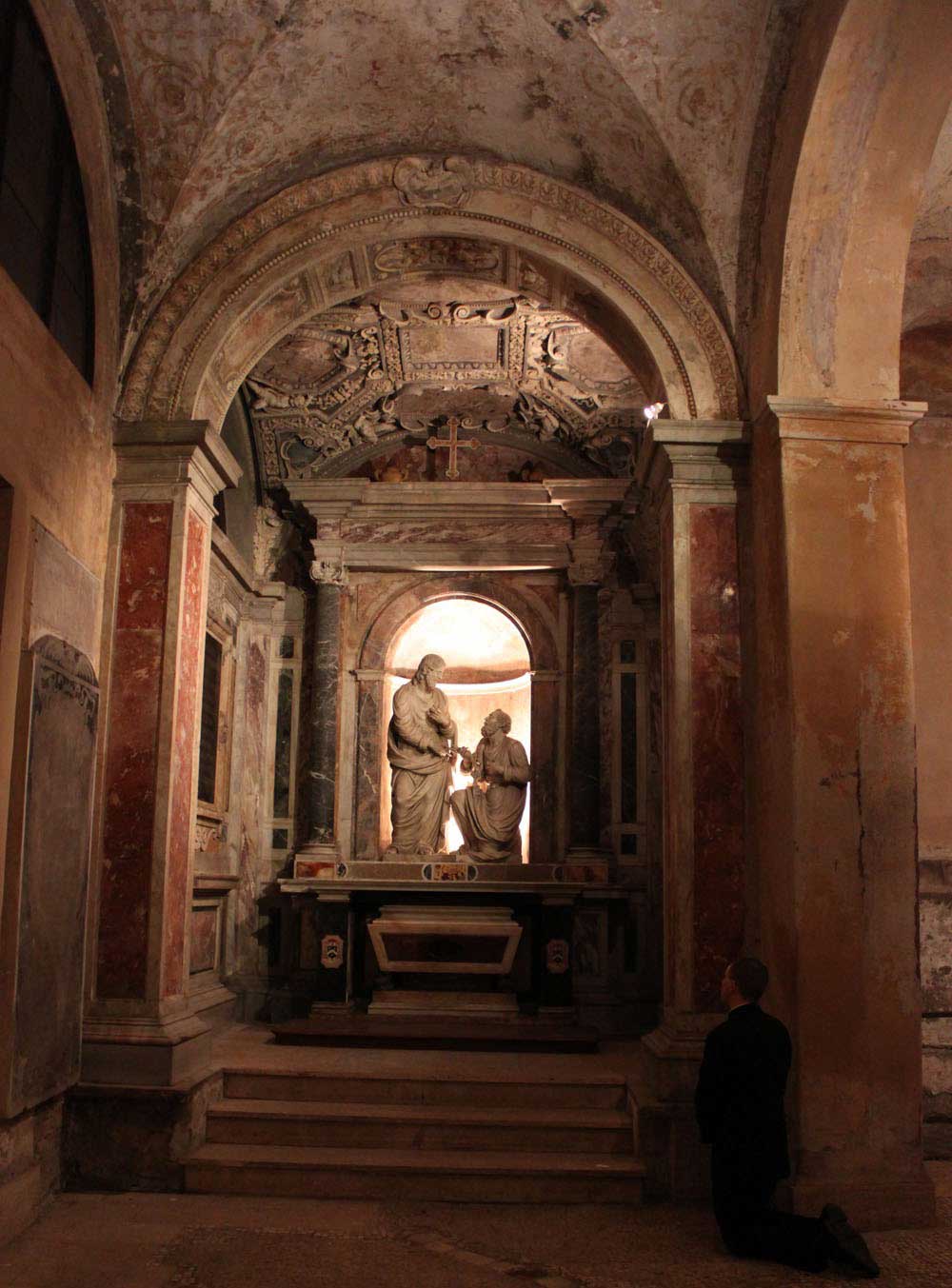
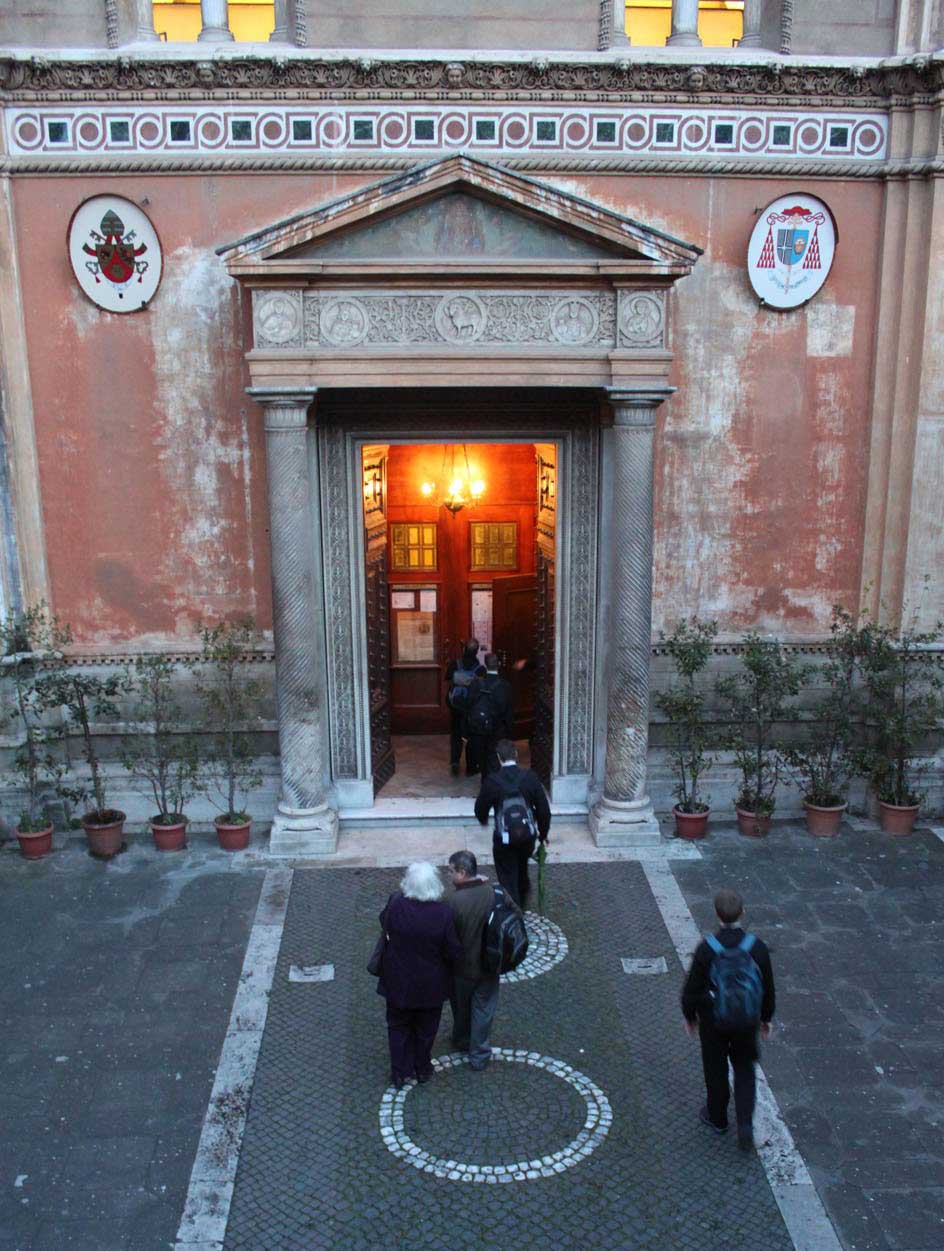
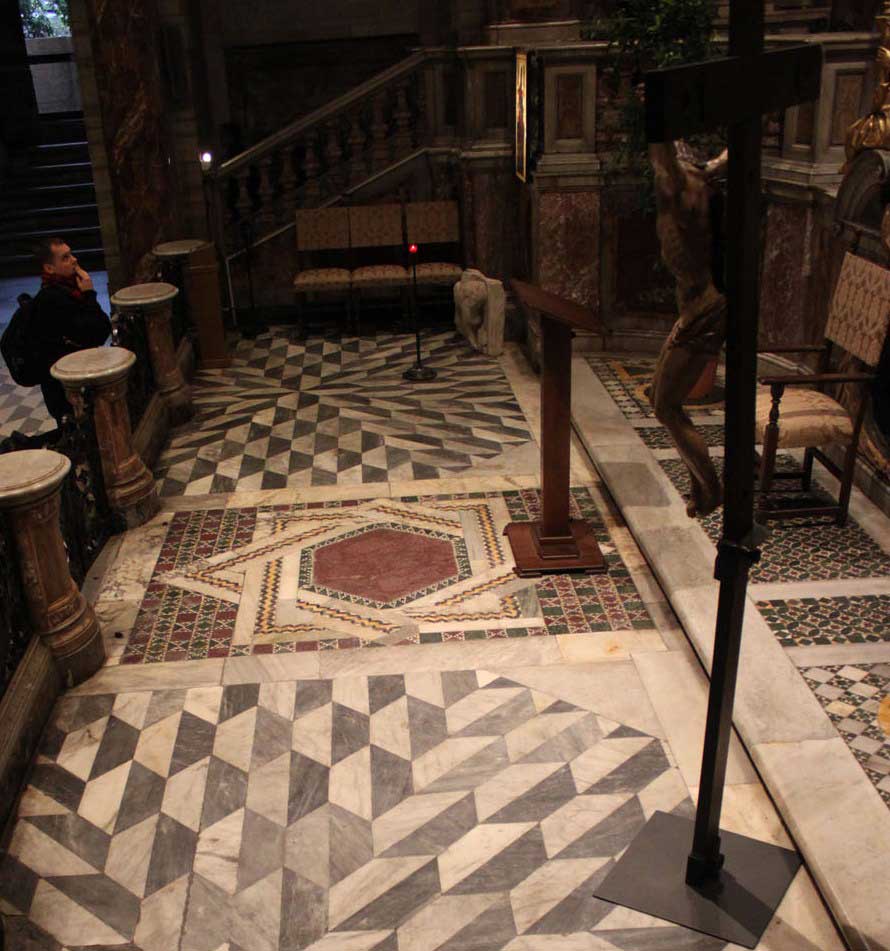
This old basilica takes its name from one of two sisters, Pudentiana and Praxedes, who lived in the time of the first Christian persecutions. They are said to have buried martyrs from the persecutions in a well, which is now on the left side of the Church. When Pope Paschal I began moving relics from the catacombs these two sister’s names appear together first in a list of holy virgins whose relics were being transferred. This Church also holds, in a chapel at the head of the left aisle, a slice of St. Peter’s altar table. The rest of it can be found embedded into the Papal altar in the basilica of St. John Lateran.
At the front of the Church, in the apse, there is a mosaic of Christ and the apostles from the 4th Century in front of a Roman Panorama, although representing Churches in Jerusalem that had been built by Constantine. It is meant to represent the heavenly Jerusalem towards which we are all on pilgrimage.
The Path to Humility and Love
The priest this morning (Fr. Nicholas Schneider, Diocese of Bismarck ), preached on what exactly the amounts were that the two servants owed. He mentioned that the fellow servant owed the other a “much smaller amount.” This smaller amount was actually 100 denari, the equivalent of 100 days’ wages. On the other hand the “huge” debt that the first servant was forgiven of by his master was 100 talents which could be up to 150,000 day’s wages. We are being told in the Gospel today, that whatever debts or offenses our neighbors may cause us are really that “much smaller amount” which is conceivably payable, when compared with that “huge” amount , because of our sins, that we owe to God, which in no way we could ever be able to pay back. And yet, the Good Master has been so kind as to forgive us that debt. Viewed in this way, it would be good to follow St. John Chrysostom’s advice to make small of the ways in which our neighbors give us offense and to realize and really accuse ourselves before the Lord of the Greatness of our sins, no matter how small. Going before the Lord in this way, will lead us to a deeper humility, a more profound love of God, who always shows us his great mercy and asks us to share in it.
St. Peter never played baseball. Nevertheless, “Three strikes and you’re out!” seems to be what he had in mind when he asked Jesus about the limits of forgiveness. Like we’re often tempted to do, he assumed that forgiveness has its limits. Jesus understood this. That’s why he stressed that those who follow him are to forgive without limit.
Jesus doesn’t say that we need to condone what was done to us, deny our pain in being hurt, or trust the person who harmed us. However, he does call us to make the decision to forgive, and free ourselves from resentment and the desire for revenge.
When we refuse to forgive, we contribute to the world’s sorrow (and there’s enough of that already); we demonize the person who wronged us (and that’s unfair to them); and we deny ourselves the gift of God’s forgiveness (which is foolishness to us).
Forgiveness is indeed hard, but Jesus shows us the way. As Pope John Paul II reminds us, “Jesus’ cross invites us to respond to love with love.”
One of the struggles people often have in praying is that they are not sure what to “do” when they pray. This is especially true for those who want to pray for more than a few moments at a time. Perhaps they have taken up the laudable custom of making a holy hour before the Blessed Sacrament, or of devoting themselves to a half hour of mental prayer each day. It is often helpful to have a structure, for prayer of this sort, and Jesus himself actually gives us one in the Our Father.
I want to recommend for your consideration that the Our Father gives us more than words to say. It also gives us a structure for our prayer life, a basic plan for our spiritual life. It makes sense that when one goes to pray, understanding the basic structure and elements of prayer will be helpful. And the Lord does not disappoint us or leave us unschooled in the basic shape of prayer.
Lord teach us to pray – Consider that, according to Luke, the Lord gave the Our Father, he was responding to a request of the apostles who said, Lord, teach us to pray, just as John taught his disciples (Luke 11:1). They did not ask to be given words to say, but to taught how to pray. Thus, while the words of the Our Father are precious, it is also important to look at the underlying structure implicit in the prayer so as to learn “how to pray.” The insight is that Jesus, more than giving words is illustrating by these words what ought to be going on in us interiorly, in our mind and heart as we pray: Here is what the mind and heart of a person of prayer is like.
Let’s consider then, five basic disciplines, taught by Jesus in the Our Father that form a kind of structure for prayer:
1. RELATE – Our Father who art in heaven – Here begins true spirituality: Relate to the Father! Relate to him with family intimacy, affection, reverence and love. We are not praying the “the Deity” or the “Godhead.” We are praying to our Father who loves us, who provides for us and, who sent his only Son to die for us and save us. When Jesus lives his life in us and His Spirit dwells in us we begin to experience God as our Abba, (Father).
As developed in other New Testament texts, the deeper Christian word Abba underlies the prayer. Abba is the family word for the more generic and formal word “father.” When my Father was alive I did not call him “Father” I called him “Dad.” This is really what the word Abba is getting at. It is the family word for Father. It indicates family ties, intimacy, close bonds. Why the word Abba is not used here in the Our Father is uncertain. St. Paul develops the theme here: For you did not receive the spirit of slavery to fall back into fear, but you have received the spirit of sonship. When we cry, “Abba! Father!” (Rom 8:15 ) and here: And because you are sons, God has sent the Spirit of his Son into our hearts, crying, “Abba! Father!”(Gal 4:6 ).
Ask God for the gift to experience him as Abba. At the heart of our worship and prayer is a deep and personal experience of God’s love and fatherly care for us. The first discipline or practice of the Spiritual life is to RELATE to God as to a Father who loves us and to experience him as Abba.
2. REJOICE – hallowed by thy name! The praise and love of God is the essential discipline and element of our spiritual lives. He is the giver of every good and perfect gift and to Him our praise is due. Praise and thanksgiving make us people of hope and joy. It is for this that we were made. God created us, so that we…might live for his praise and glory (Eph 1:12).
Our prayer life should feature much joyful praise. Take a psalm of praise and pray it joyfully. Take the Gloria of the Mass and pray it with gusto! Rejoice in God, praise his name. Give glory to him who rides above the clouds.
There may be times when, due to some sadness or difficulty, we do not feel emotionally like praising God. Praise the anyhow! Scripture says, I will bless the LORD at all times: his praise shall continually be in my mouth (Psalm 34:1). Praise is to be a regular discipline of prayer, rooted even more in the will, than just the feelings. God is worthy our praise.
Ultimately praise is a refreshing way to pray, since we were made to praise God, and when we do what we were made to do, we experience a kind of satisfaction and a sense of fulfillment. The second element and discipline of the spiritual life is a life of vigorous praise: REJOICE!
3. RECEIVE – thy kingdom come, thy will be done on earth as it is in heaven – At the heart of this petition is an openness to God’s will, to his word of instruction, to his plan for us and for this world. When Jesus lives in us we hunger for God’s word and strive to know his will and have it operative in our life.
A basic component and discipline of the prayer and the spiritual life, is to receive the Word and instruction of God, so that his will might be manifest to us, and we can obey. We ought to pray the Scriptures (lectio divina). We ought to study the faith through the Catechism or other means. These are ways that we become open to God’s will that his Kingdom might be manifest in our lives.
The Third element and discipline of prayer and the spiritual life is an openness to to God’s teachings through the Church and Scriptures: RECEIVE!
4. REQUEST – Give us today our daily bread – Intercessory prayer is at the heart of the Christian life. Allow “bread,” in this case, to be a symbol of all our needs. Our greatest need of course is to be fed by God, and thus bread also points to the faithful reception of the Eucharist.
Intercessory prayer is the prayer of asking for God’s help in every need. Take every opportunity to pray for others. When watching the news or reading the newspaper, pray the news. Much of the news contains many things for which to pray: victims of crime, disaster or war, the jobless, homeless and afflicted. Many are locked in sin and bad behavior, corruption, confusion, bad priorities and the like. Many are away from the sacraments and no longer seek their Eucharistic bread who is Christ. Pray, pray, pray.
There are also good things we hear of and we should be grateful and ask that solutions be lasting. This intercessory prayer flows from our love and solidarity with others. We see the world with the compassion of Christ and pray. The fourth element and discipline of prayer and the spiritual life is to INTERCEDE for ourselves and others.
5. REPENT – and forgive us our trespasses, as we forgive those who trespass against us, and lead us not into temptation but deliver us from evil. – Sin is understood at two levels here: 1: sin – (lowercase) our personal sins and trespasses, also referred to as our “trespasses.” 2. Sin (upper case) – referring to the whole climate of sin, the structures of sin that reinforce and underlie our own sins. Referred to here as “evil.”
An essential element of our spiritual life is that we come to recognize the sins, and deep drives of sins, in our own life, to beg deliverance from them as well as mercy. It is also true that we live in a sin soaked world were the powers and principalities of evil have great influence. We cannot fail to recognize this and pray that it’s power will be curbed.
Then too, we must also pray for the grace to show mercy to others. For it often happens that sin escalates through resentments, and retribution rooted in unforgiving attitudes. We must pray to be delivered from these hurts and resentments so as to be able to break the cycle of violence and revenge that keeps sin multiplying.
But in the end we must pray for the Lord’s grace and mercy to end evil in our own lives and that the whole world. The Fifth element and discipline of prayer and the spiritual life is to REPENT of evil.
So here then is a structure for our prayer and spiritual life contained in the Our Father. Jesus teaches us to pray, and gives us a basic structure for prayer. Note:
Some may use this an actual structure for daily prayer. Hence, if they are going to spend 25 minutes praying, they spend about five minutes on each aspect.
Others may use this structure for an over all reference for their spiritual life in general. Hence, one might ask if these aspects and disciplines are reflected well in their overall prayer life.
It does not follow that all five need to be done every day without fail, but the Lord teaches here the basic elements that ought to be present in our spiritual life in a regular sort of way.
For those whose personal prayer time is more contemplative (rather than meditative) #s 3,4 & 5 would likely be accomplished at times other than personal prayer time. These are usually accomplished in or by attending Mass, reading the Liturgy of the Hours, or other spiritual reading. Aspirations and sighs through the day are often a good way to accomplish intercessory prayer as well. Repentance too is can be accomplished by a daily examination of conscience before bed and of course by regular confession.
Today’s Basilica of St. Mark recalls not only the evangelist Mark, but a holy Pope of the same name who constructed a basilica here in the mid-fourth century.
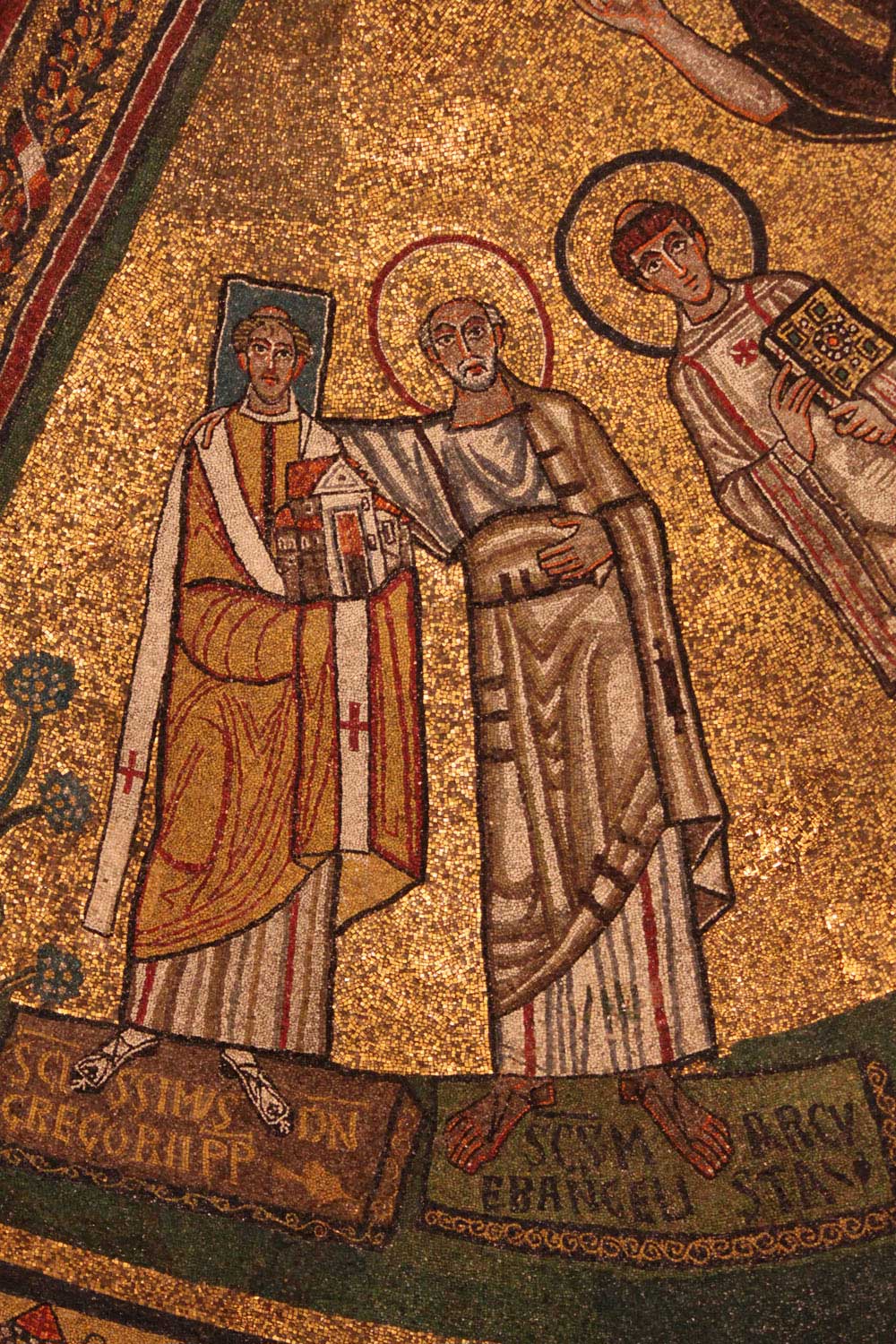
This was replaced by another basilica in the sixth century and a third in the ninth century. What we have now is the third church, whose most notable addition is the beautiful mosaic depicting twelve lambs heading from Jerusalem and Bethlehem towards the Christ. A rather typical image in mosaics, here we see an insightful and somewhat humorous addition as St. Mark the Evangelist rests his hand on the shoulder of Pope Gregory the IV of the ninth century. The image seems to recall the bond between saints in Heaven, represented by St. Mark the Evangelist, and saintly Christians still on earth, represented by Pope Gregory, whose blue halo indicates that he was still living at the time of the mosaic’s construction. Such a bond exists most strongly during the Mass, when the angels and saints in Heaven “gather” to celebrate with us, but even outside Mass the “Church triumphant” is praying for each one of us.
Sometimes God chooses the “little way”
Perhaps this or other articles of the Faith can seem trifling or irrelevant at times, but today’s first reading (2 Kgs 5:1-15b) gives us reason to stop and reconsider. Naaman, commander of the Syrian army, travels to Israel to be healed of his leprosy by Elisha the prophet. Apparently expecting Elisha to amaze him with some incredible and awe-inspiring act, Naaman is disappointed to hear Elisha’s rather banal counsel: “Go and wash seven times in the Jordan, and your flesh will heal, and you will be clean.”
Though Naaman indignantly intends to return home, his servants are wise enough to advise him to follow through on Elisha’s counsel. “My father,” they said, “if the prophet had told you to do something extraordinary, would you not have done it? All the more now, since he said to you, ‘Wash and be clean,’ should you do as he said.”
This story not only recalls the fact that God’s ways often surprise us, but also points especially to the fact that God often uses rather simple, “small” means to accomplish great effects, whenever we act out of faith and hope in Him. One might think of many Gospel instances of this truth, such as a woman simply reaching out to touch Jesus’ tassel to be healed (Luke 8:40-48), or a centurion expressing great respect and trust in his authority (Matt. 8: 4-13). One could also think of the countless ways Christians since the first centuries have placed their trust in God’s power to heal and bestow graces through the veneration of relics, saints, and holy sites, beginning even in the times of the apostles (see Acts 19).
Whether it be devotion to the saints, the belief that Jesus can forgive and strengthen through the Sacraments of Reconciliation and the Eucharist, or the conviction that one can grow closer to Christ through prayer, fasting, and almsgiving, God challenges us to trust that He can work miracles if we trust him. This Lent is the perfect opportunity to return to not only accepting Christ’s words as true, but also act on them in even the “smallest” of ways.
“So Naaman went down and plunged into the Jordan seven times at the word of the man of God. His flesh became again like the flesh of a little child, and he was clean.”
One cell phone company’s ad campaign features a character in all sorts of remote places asking, “Can you hear me now?” The implication is that if he were using another cell phone provider, his words would have fallen on deaf ears.
It’s frustrating when others fail to hear what he have to say, for whatever reason. But it’s tragic when we fail to hear what God has to say to us. Consider today’s gospel. Jesus gave two examples of God’s people refusing to hear God’s word as spoken by God’s prophets, Elijah and Elisha. People didn’t like God’s word as spoken through Jesus either, and they tried to kill him.
All of us are guilty of failing to listen to God’s word. Maybe our Lord is challenging us through today’s gospel to ask ourselves what it is we don’t want to hear, won’t allow ourselves to hear, or are failing to hear because we just aren’t listening at all. Is it about money? Forgiveness? Our use of time? Sex? Are we too proud to hear? Too angry? Too indifferent? Too addicted?
Perhaps we can all use the remainder of Lent to truly open our ears to God, so that should he say to us, “Can you hear me now?” our answer will be an emphatic “Yes!”
Back in seminary days, an older priest, and well known scripture scholar, who was leading us in a retreat, stopped his train of thought, perhaps perceiving we were having difficulty, and said, “Do you know what is the biggest obstacle for us in understanding the Word of God?” I was expecting a geeky answer like, “We don’t know enough Greek,” or “We haven’t studied the Historical Critical Method carefully enough.” But the priest pleasantly surprised me we he paused, looked around the room and then said, “The biggest obstacle we have to understanding the Word of God, is our sin.” (Fr. Francis Martin, who has a video ministry here: Fr. Francis Martin YouTube Page). Scholars, academicians, even unbelievers, to some extent, can tell you what a biblical text is talking about, about its historical context etc. But only the holy, the Saints, can tell you what the text really means. He went on to encourage us in the discipline of study, but warned us that all the study in the world could not be of great help, if we did not have a clean heart. Indeed, a theologian who does not pray is a dangerous man.
And Old Gospel song says, “None can walk up there, but the pure in heart.” In the plainest sense, “up there” means heaven. But “up there” also refers to the higher things of God and the spiritual life. To walk “up there” means to be able to see and grasp the things of God, and, increasingly, God himself.
Fulton Sheen was famous for saying toward the end of his life something to the effect, that we have tried, in modern times, every possible way to build up the Church: committees, study groups, task forces, seminars, advanced degrees in every sort of theology and religious study. But there is only one thing that we have not tried, and that is holiness. He went on to recommend that every priest commit to make a daily Holy Hour.
This week in the Office of Readings from the Breviary the following reading recalls of all these things:
God is seen by those who have the capacity to see him…. All have eyes, but some have eyes that are shrouded in darkness, unable to see the light of the sun. Because the blind cannot see it, it does not follow that the sun does not shine. The blind must trace the cause back to themselves and their eyes.
In the same way, you have eyes in your mind that are shrouded in darkness because of your sins and evil deeds. A person’s soul should be clean, like a mirror reflecting light. If there is rust on the mirror his face cannot be seen in it.
In the same way, no one who has sin within him can see God. But if you will you can be healed. Hand yourself over to the doctor, and he will open the eyes of your mind and heart. Who is to be the doctor? It is God, who heals and gives life through his Word and wisdom…. If you understand this, and live in purity and holiness and justice, you may see God. But, before all, faith and the fear of God must take the first place in your heart.
From the book addressed to Autolycus by Saint Theophilus of Antioch, bishop
So there it is, None can walk up there, but the pure in heart. Blessed are the Pure of Heart, for they shall see God (Matt 5:8).
Biblical Portrait – This coming Sunday we will read the Gospel of the man born blind. In a pivotal moment, Jesus smeared this man’s eyelids with clay and sent him to the Pool of Siloam to wash. He comes back able to see. When asked how he came to see he says, in effect, “I went, I washed and now I see.” This is baptismal theology even if in seminal form. We cannot see until we are washed. In the end it is Baptism, Confession and a holy life by God’s grace that give the greatest light, that lay the foundation to enable us to “walk up there.”
Testimony of St Cyprian – One of the great theologians and Fathers of the Church, St. Cyprian, experienced the vision that Baptism and holiness brings:
And I myself was bound fast, held by so many errors of my past life, from which I did not believe I could extricate myself. I was disposed therefore to yield to my clinging vices; and, despairing of better ways, I indulged my sins…But afterwards, when the stain of my past life had been washed away by means of the waters of rebirth, a light from above poured itself upon my chastened and now pure heart; afterwards, through the Spirit which is breathed from heaven, a second birth made of me a new man. And then in marvelous manner, doubts immediately clarified themselves, the closed opened…and what had been thought impossible was able to be done (“Letter to Donatus,” 4).
St. Cyprian was a learned man. He knew his theology, had studied law and rhetoric. But only after baptism did some things make sense, seem possible and enable Cyprian to “walk up there.”
I too am a witness of this. I have come to understand some things only after many years of prayer and growth: daily holy hours, daily mass and the liturgy of the hours, weekly confession, only then do some things clarify and does that which had been in darkness come to light. Studies have had their place in my life to be sure, But only the path to holiness (combined with study) can ever really bring light.
We’ve tried everything else, how about holiness? Study is great, don’t neglect to study the faith, but holiness is even greater. I have some people in spiritual direction who have not spent years studying theology, but they grasp well, almost as if by infused knowledge, the things of God. This is wisdom. A great intellect is a wonderful gift, but a pure heart is the greatest gift of all.
Here’s a video on the beauty of prayer especially before the Blessed Sacrament. It is set to the words of a beautiful Eucharistic Hymn “Jesus My Lord, My God, My All” directed by the late Richard Proulx (RIP).