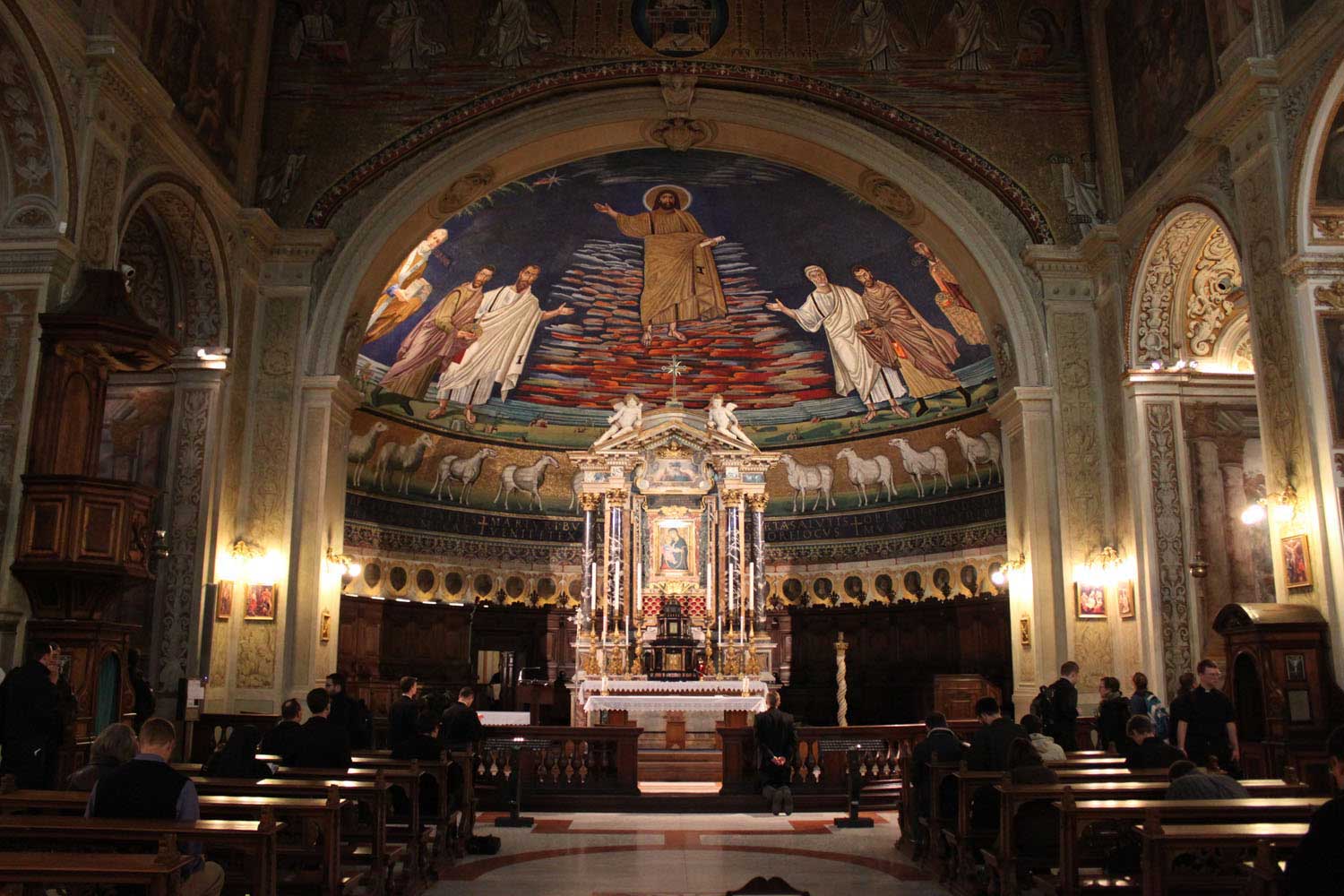
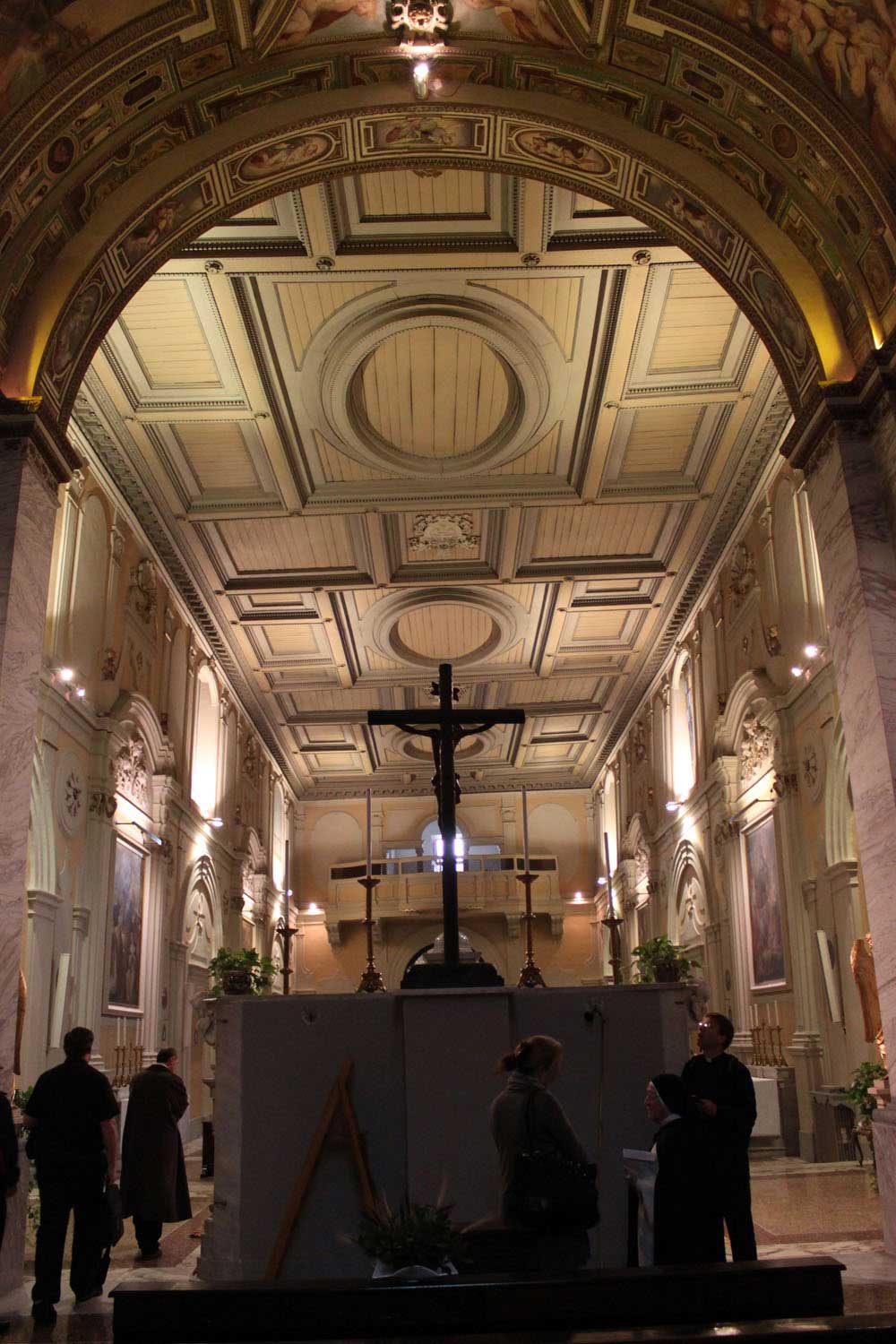
Our Roman station church liturgies take us today to the church of St. Balbina. Little is known of this saint, though it is said she was a virgin who died a martyr’s death. Her remains are located under the main altar of this church, which has been in use since the late 4th century A.D. The church is located south of the Vatican on the Aventine Hill, very near the Circus Maximus. In a way this location is fitting because most if not all of the Christians who were martyred for their faith in Rome would have been murdered not in the Coliseum, but in Circus Maximus, under the shadow of the Emperor’s palace.
Today’s first reading from Isaiah calls us to recognize our sinfulness in the eyes of the Lord. But this recognition of our sin is not without hope, for the Lord also offers us the opportunity of returning to him. Speaking through Isaiah the Lord says, “Wash yourselves clean!…Though your sins be like scarlet, they may become white as snow”. The homily this morning focused on this invitation, which is part of every celebration of the Eucharist. At the beginning of every Mass, we are called to remember our sins, adopting the attitude of the tax collector in the Temple who prayed, “O God, be merciful to me a sinner”. And we then cry “Lord, have mercy!”, like the two blind men on the road to Jericho who called out to Jesus, “Lord, Son of David, have pity on us!” Like these two blind men, we thus dispose ourselves to encounter the Lord Jesus in the Eucharist.
During Lent, we are called to remember that it is only through the sacrifice of Jesus Christ that we are able to follow the command of the Lord to “Wash ourselves clean!” Our Lord calls us today to recognize that we are still not perfect, that we still cling to some sins, large or small. But he also invites us to again repent, and to receive his forgiveness in the Sacrament of Reconciliation. For it is only in this Sacrament, in this particular encounter with the Lord Jesus, that “though our sins be like scarlet, they may become white as snow!”
When my grade school son asked me about the appropriateness of a word he’d heard at school, I explained that he shouldn’t use it under any circumstances. He looked at me and said: “But Dad, I’ve heard you and Mom use it!” Oops… I realized that what I had taught my son was: “Do as I say, but not as I do.”
Which is not a good position to be in, as Jesus acknowledged in today’s gospel, when he lamented that the religious leaders of his day didn’t always practice what they preached. But that could be said about any one of us, couldn’t it? We all give moral instruction or correction to others, and we run the risk of being a hypocrite: of talking the talk, without walking the walk.
Sometimes we realize this and choose not to say anything at all, when actually we should be saying something. For instance, many parents avoid speaking about sex or drinking or drugs with their children, because their own histories are, shall we say, less than perfect.
So what are we to do? If we say something, others might simply roll their eyes at us; but if we say nothing, they might turn their eyes elsewhere and find answers that are contrary to those Jesus would give. Thankfully, Jesus suggests a way forward when he taught about humility in today’s gospel. When speaking to others about moral matters, we need to humbly admit that we ourselves are far from perfect, and humbly place ourselves beside those we instruct, instead of exalting ourselves above them. Because at one level, we all stand before Christ as brothers and sisters: as students before our teacher, servants before our master, sinners before our savior.
Should we do this, what others will hear is: “Do as Jesus says…not as I do.”
In his book Jesus of Nazareth Part II The Holy Father takes up the issue of the Evangelization of the Jewish People and offers a position that I must say quite surprises me. As an obedient son of the Church, I must also say that it is for me somewhat of a corrective position. For the position he annunciates has not been my point of view. I trust the Pope and must now consider how I must amend my prior thinking based on his observations. Yet, truth be told, I am still a bit stunned by what he says.
It is a fact that the Pope has set his reflections outside the Papal Magisterium, for he says in the forward to volume 1:
It goes without saying that this book is in no way an exercise of the Magisterium, but is solely an expression of my personal search “for the face of the Lord” (cf. Ps 27:8). Everyone is free, then, to contradict me. I would only ask my readers for that initial good will without which there can be no understanding. (Jesus of Nazareth, Vol. 1, Forward, xxiv)
Nevertheless, I cannot simply regard him as any sort of theologian with whom I may dispute. He, even when he speculates outside the formal magisterial structures, commands my respect and my soul ought to be teachable even in these matters.
So, with all this in mind let me set forth what the Pope teaches about the evangelization of the Jewish People and offer a few reflections.
Background – The Pope, in Chapter Two of Jesus of Nazareth (Vol. 2) is reflecting on the evangelical mission of the Church to preach the Gospel to all the nations. The urgency with which the Apostles undertake this mission is related to the teaching of Jesus that the Gospel must first be preached to all the nations prior to his coming (Matt. 24:14; Mk 13:10). Thus, the End Time can come only after the Gospel has been brought to all peoples. The Pope calls this period “the time of the Gentiles” (Cf. Rom. 11:25-26).
During this time, he argues that the principle focus and mission of the Church is ad Gentes (to the nations). For as Paul teaches, A hardening has come upon part of Israel, until the full number of Gentiles come in, and so, all Israel will be saved (Rom. 11:25-26). For now, the Pope argues, the Church’s priority is, thus, the Gentiles.
Let me allow the Pope to speak:
In this regard, the question of Israel’s mission has always been present….Here I should like to recall the advice given by Bernard of Clairvaux to his pupil Pope Eugene III on this matter. He reminds the Pope that his duty of care extends not only to Christians, but: “You also have obligations toward unbelievers, whether Jew, Greek, or Gentile” (De Consideratione III/1, 2). Then he immediately corrects himself and observes more accurately: “Granted, with regard to the Jews, time excuses you; for them a determined point in time has been fixed, which cannot be anticipated. The full number of the Gentiles must come in first. But what do you say about these Gentiles?. . . …(De Consideratione III/1, 3).
Hildegard Brem comments on this passage as follows: “In the light of Romans 11:25, the Church must not concern herself with the conversion of the Jews, since she must wait for the time fixed for this by God, ‘until the full number of the Gentiles comes in’ (Rom 11:25)….(quoted in Sämtliche Werke, ed. Winkler, I, p. 834).
The prophecy of the time of the Gentiles and the corresponding mission is a core element of Jesus’ eschatological message. The special mission to evangelize the Gentiles, which Paul received from the risen Lord, is firmly anchored in the message given by Jesus to his disciples before his Passion. The time of the Gentiles—“the time of the Church”—which, as we have seen, is proclaimed in all the Gospels, constitutes an essential element of Jesus’ eschatological message.
….In the meantime, Israel retains its own mission. Israel is in the hands of God, who will save it “as a whole” at the proper time, when the number of the Gentiles is complete….the evangelization of the Gentiles was now the disciples’ particular task…. (Jesus of Nazareth, Vol 2, pp. 44-46).
To be honest this notion is completely new to me. I have never considered the Jewish people a temporarily lower priority for the Church, let alone temporarily exempt from the evangelical mission of the Church. The initial thought of this troubles me. Yet the Pope seems clearly to hold this view, for though he quotes others, he does not critique their views.
I have always considered the Jewish People to be an essential focus of the evangelical mission of the Church, here and now. It seems to me that Paul, as he evangelized went first to the Synagogues and gained whatever converts he could, and then turned to the Gentiles. He speaks of his ministry as bringing good or ill to those who obey or disobey, Jew first, then Gentile (Rom 2:9-10).This, at least, was my thinking and what it was based on.
Yet now, having laid my teaching at the feet of Peter, it appears that I may have “run in vain” (cf. Gal 2:2). The Pope seems to hold, (granted he does not formally teach it), that the time of the Jews is only later. For now, the focus is the Gentiles.
In a way this explains a lot. I have often been puzzled over the low priority given the mission to the Jews in Rome. There even seems to be a certain apologetic opinion among some in Rome, that the Jews should not be “proselytized” and evangleized, and that those who do so, are doing something wrong. Some have even gone so far as to say the Jews are already in a saving covenant (which I do not thing the Pope is saying here). I have usually presumed such positions were more than influenced by a European anxiety and (an understandable) guilt over the Holocaust that made Church officials anxious to suggest the Jewish people were lacking something, in not having faith in Christ. I never considered a theological basis for the position as the Pope has presented it here.
I have read some rather vigorous discussions about Romans 11 where Paul writes, as already noted: I do not want you to be ignorant of this mystery, brothers, so that you may not be conceited: Israel has experienced a hardening in part until the full number of the Gentiles has come in. And so all Israel will be saved. (25-26).
Some have interpreted this passage to mean that the Jewish People will all be saved ultimately.
Some think it means literally every Jew,
Others think that most Jews will be saved and that “all Israel” is more of a corporate notion than an “every man, woman and child,” notion.
Still others, such as I, have thought that “all Israel” refers to believers in Jesus Christ, both Jew and Gentile. For, it would seem, that Paul defines Israel only as those who accept the Messiah, Jesus. For, in Romans 11 he describes Israel as an olive tree. And unbelieving branches were pruned off (11:20), and believing branches (Gentiles) were grafted in. The pruned branches can be re-grafted, but only if they come to faith in Jesus. Thus, in the end, “all Israel” means believing Jews and Gentiles together in Christ. And though surely Paul is hopeful that many of the pruned branches will be re-grafted, it has seemed to me that “all Israel” can refer only to true believers in Jesus Christ, Jew and Gentile.
If I understand the Pope however, it would appear that my grasp of Romans 11 (as stated in # 4 above) has been flawed, at least insofar as the position he annunciates. If I interpret him properly, He sees “all Israel” as referring to those Jews who will be saved at the end of the age.
So here is to me a stunning passage that requires me to carefully rethink how I have understood the matter. This is so even though the Pope does not claim magisterial authority, at least for me, since I respect even his non-infallible teaching and want to give it serious consideration and assent.
Some Questions – And yet I wonder of the practical application of this view and have some questions. Please understand that these questions are not rhetorical, they are actual questions I have because I want to learn.
Does this mean that it is always wrong to seek Jewish converts?
Or does this position of the Pope simply explain why the mission field of the Jewish people has been meager? (For, as Paul says, a hardening has come upon them for a season until the full number of Gentiles enters).
While it is possible to understand a corporate conversion of the Jews at the end of the age, what of the Jews today and yesterday? Are they included in this notion? What will come of them?
Are the Jewish People today in an operative covenant with God that we as Catholics ought to recognize (as some suggest in quoting Rom 11:29 for God’s gifts and his call are irrevocable)? Or did the Old Covenant end with the destruction of the temple? (as others suggest in quoting Hebrews 8:13 which says, By calling this covenant “new,” he has made the first one obsolete; and what is obsolete and aging will soon disappear)?
Well, enough said, you need not, dear reader, follow me all the way as I think out loud. But in a brief couple of paragraphs the Pope has managed to powerfully question the way I have thought. I still have questions but I am willing to be taught. Perhaps some of you have wrestled with this already and have something to offer to the discussion. Above all, I am sure the Pope would be happy to know that his book has us thinking, discussing and praying.
One of the delights to be discovered about the city of Rome is its three-dimensionality: the city exists in layers. In a three-thousand-year-old city, it seems that every building is built on top of an older building. In the case of today’s station church, in fact, two older buildings. The current church of St. Clement, dedicated in 1128 and named after the fourth pope, rises on the ruins of its older 4th century predecessor. This, in turn, lies on top of a cluster of buildings from the imperial Roman era, one of which belonged to a wealthy Christian and had been entrusted to the Church for use as a parish. Few buildings better exemplify the continuity of our faith from its earliest days as a small and persecuted sect to its current status as a mature and flourishing religion.
Ecumenical Considerations
In addition to these archaeological delights, St. Clement holds another type of treasure: the relics of both St. Clement and of St. Ignatius of Antioch. The two men took opposite routes in their lives: St. Clement was exiled from Rome around 100 by the emperor and was later martyred near the Black Sea in the east, where he had gone to evangelize; St. Ignatius was arrested around the same time in Antioch (in Syria) and brought west to Rome to be thrown to the lions in the Coliseum. Today’s celebrant noted that in this church, “The Church breathes deeply with both lungs” – that is, with a faith handed on by both eastern Greek and western Latin Christians. We might pause today in our own Lenten journey to pray for the many other Christians who are also making this journey to Easter, our Orthodox and Protestant brethren, and to ask God that, through Christ, we might soon all be united in worship and belief as were Sts. Clement and Ignatius.
Pilgrim Profile
After Mass I stopped to chat with a tall and lanky college student who sang in today’s choir. Ephrem Shaffer is a seminarian from the diocese of St. Cloud, Minnesota, and a student at the University of St. Thomas in St. Paul, Minnesota. Ephrem arrived in Rome in January for a semester abroad, along with some 30 other students from St. Thomas. His dark and cold morning walk this morning to the 7 a.m. station church Mass took him about 50 minutes – “Done in a Lenten spirit of penance!” he laughs. But the lure of seeing ancient churches and approaching saints’ relics is tough to resist. “It is hard to think of faith as mythical after visiting these places. The saints are real people, and they have passed on to us an Incarnational faith.”
When a car speeds past us on the highway, we typically label the driver “reckless” or a “jerk.” But when we’re the one speeding, it’s because we’re in a hurry for a very important reason! We condemn others but excuse ourselves for doing the exact same thing! We reason that we act with the best of motives, but assume that others do not. Why? Because we evaluate ourselves based on our intentions, but judge others based on their behavior.
Jesus cautions us in today’s gospel about applying this double standard; he warns us against being quick to judge and condemn. Instead, he invites us to imitate the compassion, forgiveness, and generosity of God the Father. He invites us, in the words of Charles de Foucauld: “Do unto others, as you would have God do unto you.”
I am asked, not infrequently, about the apparent limits of God’s omnipotence. It would seem, on the face of it, that I am freely able to say “no” to God, to overrule Him, to thwart his will for me or others. If this is so, then how can we say God is omnipotent? Further, if God is so powerful, why does evil seem to go unchecked? In many ways, God does not seem powerful at all. From this perspective evil and Satan seem more powerful, more influential and able to rule than God. Is God really omnipotent (all powerful)?
As you likely know, greater minds than I have pondered these questions and I will not likely break new ground here. But in struggling with this question, that I frequently get asked, I would like to approach it from different angles. They are listed below in no particular order. No one point is meant to be a complete answer in itself, just an aspect of the problem and an appreciation of the mystery with which we are dealing.
1. The Aspect of Balance and Mystery. It is a common requirement in both theology and life that we must hold seemingly contradictory truths at the same time and in some balance. For example God is both immanent (profoundly an intimately present here) and yet transcendent (beyond the here and now). God is one, and three. Or, Man is fundamentally good, gifted and powerful, and yet sinful, foolish, weak and dependant. We are free, yet also limited and so forth.
These truths are in fact all true, and must simply be held at the same time and in proper balance. While it may be true that we can resolve some of the conflicting truths about man by simply saying that our excellences are only limited, this sort of solution is not possible with God. God is absolutely powerful, transcendent, immanent, one, three, and all powerful. There is no way of saying that God is “sort of” powerful, one, three, and so forth.
Thus, given the limits of our knowledge and language, we are often called to hold two competing truths in tension. How they are fully resolved and worked out is mysterious. This may at times frustrate us, but ultimately, mysteries are more to be respected and appreciated than solved and overcome. That we are free, and God is omnipotent are two truths in tension. We must hold them both, in tension, with appreciation for the deep mystery of them both.
2. The Aspect of our Limited Vision – We usually like to think we either have things figured out, or that eventually we will figure them out. But the fact is, we are of limited vision and intellect. We see only a small part of the picture. The world in which we live is mysterious.
To the modern mind, the word “mystery” refers to something which must be solved, which we must get to the bottom of. Hence, we tend to reduce everything, including creation, God and ourselves to a “who-dunit” novel.
But from the Christian perspective, “mystery” refers to something which we see, partially, but much more of which lies hidden. For example, our five senses can perceive the physical attributes of other people, and we might even come to know some of the “inner workings” of people we know. But in the end, there is much more of the human person that lies hidden. We do not even know ourselves fully (cf 1 Cor 13:12).
This is mystery. Our lives, the world around us, all of creation, and God are shot through with deep mystery. We see some aspects, but more lies hid that we often imagine.
Admit it – In striving to “solve” the mysterious interplay between God’s omnipotence and our freedom, or the existence of evil, we ought to admit that there is much we do not know, and cannot expect to know. Thus, the contradiction is only apparent. Our limited minds cannot see the whole picture. So, it is wrong for us to simply declare that God’s omnipotence cannot be reconciled with our freedom or the existence of evil. The fact is we do not know that. The most we can say this that there SEEMS to be a contradiction here, and the best we can do is to admit our limitations in seeing the whole picture.
3. The Aspect of the Mystery of Time – The deep mystery of time seems to be an important factor here as well. Part of understanding God’s omnipotence is to recall that he dwells in eternity. God does not live in serial time like we do. For God, past, present and future are all the same. God is not watching creation and human history unfold like a movie that ticks steadily by. He is not up in heaven watching things happen, then pondering what to do in response. God knows us before he makes us (Jer 1:4), he knows everything we will ever do (e.g. Psalm 139:16). Nothing is a surprise to God. God does not react to events, and reformulate his plans, based on unexpected human choices. He is pure act and everything is already accomplished, done. The future is not distant or foggy to God. It is present to him and known by him from all eternity.
Clearly for us, eternity is a mystery. The comprehensive “now” of God, his sweeping knowledge of time as comprehensively present to Him, can be described by us, but not really understood. But the fact is, our “no” to God does not thwart His plans. He has always known who would shake their fist at Him and who would obey. His plans have already incorporated our free choices. He doesn’t have to “go back to the drawing board” based on a stupid or sinful choice by me. He knows the way I go, and will shepherd me rightly.
Why exactly God allows so much static in the system, so much sin and rebellion, is another mysterious thing. But it does not follow that, because he has allowed it, that his power is somehow diminished. He has always known of the static, of the sin, some of it awful, and has already resolved and overcome its apparent power. Jesus said on the Cross (in our serial time), “It is finished.” God’s work is done, it has always been done. The working out of the details in our slices of time is not always easy to see. But the victory has always been won.
So, the mysterious interplay between God’s omnipotence, our freedom and the problem of evil is caught up in the mystery of time.
4. The Aspect of a Correct Understanding of Freedom – The proper understanding of freedom is also a factor in understanding the relationship between God’s omnipotence and our freedom. From our perspective, especially that of our flesh, freedom is the capacity to do whatever I please. But this is not a biblical understanding of freedom. From a biblical perspective, freedom is the capacity, the power, to obey God. Jesus says that “Whoever sins is a slave of sin” (John 8:34). Scripture also says, Don’t you know that when you offer yourselves to someone to obey him as slaves, you are slaves to the one whom you obey–whether you are slaves to sin, which leads to death, or to obedience, which leads to righteousness? (Romans 6:16). And again, They promise them freedom, while they themselves are slaves of depravity–for a man is a slave to whatever has mastered him. (2 Peter 2:19).
Hence from this point of view, our sinful choices are not an exercise of our power so as to somehow diminish God’s power. When we sin we do not demonstrate our power, so much as our slavery. True freedom is the capacity to obey God. The catechism teaches: The more one does what is good, the freer one becomes. There is no true freedom except in the service of what is good and just. The choice to disobey and do evil is an abuse of freedom and leads to “the slavery of sin.” (CCC 1733)
So, ultimately Man’s freedom, from this perspective, cannot be pitted against God’s omnipotence. For true freedom is only to obey God and hence respect his power. The sinful use of freedom is ultimately an exercise of a power, but a manifestation of slavery.
5. The Aspect of the Paradox of Power – In this case I am simply going to let the Catechism speak for itself:
Faith in God the Father Almighty can be put to the test by the experience of evil and suffering. God can sometimes seem to be absent and incapable of stopping evil. But in the most mysterious way God the Father has revealed his almighty power in the voluntary humiliation and Resurrection of his Son, by which he conquered evil. Christ crucified is thus “the power of God and the wisdom of God. For the foolishness of God is wiser than men, and the weakness of God is stronger than men.” (1 Cor 1:24-25) It is in Christ’s Resurrection and exaltation that the Father has shown forth “the immeasurable greatness of his power in us who believe”. (Eph 1:19-22) Only faith can embrace the mysterious ways of God’s almighty power. This faith glories in its weaknesses in order to draw to itself Christ’s power. (cf. 2 Cor 12:9; Phil 4:13) (CCC 272- 273)
Here then are just some of the aspects, both of the problem and of insight into the mystery of the interplay between God’s Omnipotence, our freedom and the problem of evil.
As usual, the list is incomplete and I invite you to add to it. Further, I know some of you may wish to either dispute or distinguish some of what I have offered. I encourage all this since this is a discussion of what is ultimately a very great mystery and no one post can capture the whole of the issue or exhaust its aspects.
Photo Credit above right (Facebook – Right click for URL)
Here is Fr. Barron’s take on part of the issue in response to a recent movie:
Over the holidays I was approached at a party by a friend whose eyes were filled with tears. She had lost her dad earlier in the year, and she still grieving. The fact that it was Christmastime only made things worse, as it often does. My friend also shared with me that her dad’s death was affecting her faith. She said: “I’m not really sure what I believe any more.” God seemed very distant to her. She was wondering if God even existed at all.
My friend’s experience is not unusual. When someone close to us dies, we’re often forced to take a good hard look at our beliefs– beliefs we may have been taking for granted. It can seem as if God doesn’t care; we can feel as if God has abandoned us; we can think that we’re being punished. But in reality Jesus understands what we’re going through. And he doesn’t leave us to face our crisis alone. When we’re filled with grief, Jesus is right there beside us, whether we’re able to recognize it or not.
We can see Jesus’ love for those who grieve in the gospel account of the Transfiguration. Jesus knew that his death was approaching. Jesus knew also that his death would leave his disciples sad, confused, and angry. So he took three of them-Peter, James and John- up to a mountaintop, to show them something they would never forget. On that mountaintop, Jesus was transfigured before them. The disciples were awestruck by the magnificence of his glory, amazed to see him speak with Moses and Elijah, and knocked to their knees upon hearing the voice of God the Father himself. Jesus blessed his friends with this experience to leave them with a memory that would be a source of hope when it would be easy to despair, and a sign that his story would end, not with death and a cross, but with resurrection and an empty tomb.
I imagine that many of us here today have been through a significant experience of grief. At some point, all of us will, as we face the death of those we love. And of course, death isn’t the only thing that can lead to grief. There’s also divorce, the loss of a job, suffering a major illnesses, and moving away from a beloved home, just to name a few. Grief is inevitable. Today’s transfiguration gospel, however, gives us five clues about how we as Christians can prepare for, face, and emerge on the other side grief.
First, we need to prepare ourselves beforehand, just as Jesus prepared his disciples for his death. To do this, we need to develop our relationship with God now. Because if God is a stranger to us today, chances are he will still be a stranger to us when grief strikes. We need something to fall back on when things fall apart.
Second, we need to embrace our memories. Jesus wanted his friends to remember his transfiguration in the hours and days after his death. We too need to remember how God has touched our lives in special ways. This will help us to trust and to endure during difficult times. If we’re grieving someone who has died, we need to hang on to and celebrate the good memories we have of that person. And if there are bad memories, then we can’t ignore them either. Perhaps we’ll need to forgive that person for things they did to us. Perhaps we’ll need to forgive ourselves for things we did to them.
Third, we need to reach out to others for their support. It’s been said that misery loves company. But misery is more miserable when we face it alone. That’s why Jesus shared the transfiguration with three disciples, and not just one, because after his death, he didn’t want them to suffer alone. And he doesn’t want us to suffer alone either. When we grieve, others can pray for us, pray with us, give us practical help, and bolster our faith by sharing their stories of how the Lord may have help them during their time of grief.
Fourth, we need to express our grief. Jesus shared his transfiguration with his friends because he knew they would be sad after his death. Jesus himself had wept at the grave of his friend Lazarus. And it’s okay for us to cry too. When someone we love has died, sometimes people say things like: “He’s in a better place now;” or “At least she’s not suffering any more;” or “I guess God needed another angel.” They mean well. But there’s an implication that we should cheer up, or even that our sadness is selfish somehow. But tears aren’t selfish. They’re a sign of our loss, and often a sign of our love.
Fifth, we need to pray while we grieve, even if we don’t feel much like praying. We may think that we can’t pray, because we associate prayer with feelings of warmth and peace. Any when we’re grieving, we usually feel anything but warm and peaceful. But prayer isn’t just about happy feelings. Prayer is an honest communication between us and God. If we’re feeling angry, confused, hurt, or hopeless, we need to share this with God, even if we think he isn’t going to like what we have to say! At the same time, we need to listen to the voice of Jesus spoken to us in Scripture, just as God the Father told the disciples to do on the Transfiguration mount.
The truth is that when we grieve, God knows exactly how we feel, and God knows what we’re thinking. There’s no sense trying to hide it from him, especially since he loves us so much. And because he loves us, he won’t allow grief to have the final word. Because for we Christians, it is our resurrection hope that night is always followed by the morning, and that grief can be transfigured into joy.
The second Sunday of Lent always features the transfiguration. This is done in the first place because we are following the Lord on his final journey to Jerusalem and this journey up Mt Tabor was one of the stops Jesus himself made with Peter, James and John. It is commonly held that Jesus did this to prepare his apostles for the difficult days ahead. There’s a line from an old spiritual which says, Sometimes I up, sometimes I’m down, sometimes I’m almost on the ground…..but see what the end shall be. And this is what the Lord is doing here: he is showing us what the end shall be. There is a cross to get through, but there is glory on the other side.
There also seems a purpose in placing this account here in that it helps describe the pattern of the Christian life which is the paschal mystery. For we are always dying and rising with Christ in repeated cycles as we journey to an eternal Easter (cf 2 Cor4:10). This Gospel shows forth the pattern of the cross, in the climb, and rising, in the glory of the mountaintop. Then it is back down the mountain again, only to climb another mountain, (Golgotha) and through it find another glory (Easter Sunday). Here is the pattern of the Christian life: the paschal mystery. Let’s look a little closer at the Gospel in three stages.
I. The Purpose of Trials. The text says – Jesus took Peter, James, and John and led them up a high mountain apart by themselves. Now we often pass over this fact, that they had to climb that mountain. And the climb was no easy task. Any one who has been to the sight of Tabor knows what high mountain it is. The climb was almost 2000 feet, high and steep. It may have taken the better part of a day and probably had its dangers. Once at the top it is like looking from an airplane window out on the Jezreel Valley (a.k.a. Megiddo or Armageddon).
So here is a symbol of the cross and of struggle. A climb was up the rough side of the mountain: exhausting, difficult, testing their strength.
I have it on the best of authority that as they climbed they were singing gospel songs: I’m comin’ up on the rough side of the mountain, and I’m doin’ my best to carry on! Another songs says, My soul looks back and wonders how I got over! Yet another says, We are climbing Jacob’s ladder, every round goes higher, higher.
Now, this climb reminds us of our life. For often we have had to climb, to endure and have our strength tested. Perhaps it was the climb of getting a college degree. Perhaps it was the climb of raising children, or building a career. What do you have that you really value that did not come at the price of a climb….of effort and struggle?
And most of us know that, though the climb is difficult, there is glory at the top is we but endure and push through. Life’s difficulties are often the prelude to success and greater strength.
Though we might wish that life had no struggles, it would seem that the Lord intends the climb for us. For, the cross alone leads to true glory. Where would we be without some of the crosses in our life? Let’s ponder some of the Purposes of problems:
God uses problems to DIRECT us. Sometimes God must light a fire under you to get you moving. Problems often point us in a new directions and motivate us to change. Is God trying to get your attention? “Sometimes it takes a painful situation to make us change our ways,” Proverbs 20:30 says: Blows and wounds cleanse away evil, and beatings purge the inner most being. Another old gospel song speaks of the need of suffering to keep us focused on God: Now the way may not be too easy. But you never said it would be. Cause when our way gets a little too easy, you know we tend to stray from thee. Sad but true, God sometimes needs to use problems to direct our steps to him.
God uses problems to INSPECT us. People are like tea bags.. if you want to know what’s inside them, just drop them into hot water! Has God ever tested your faith with a
problem? What do problems reveal about you? Our problems have a way of helping to see what we’re really made of. I have discovered many strengths I never knew I had through trials and testings. There is a test in every testimony and trials have a way of purifying and strengthening our faith as well as inspecting our faith to see whether it is really genuine. 1 Peter 1:6 says, In this you greatly rejoice, though now for a little while you may have had to suffer grief in all kinds of trials. These trials are only to test your faith, to see whether or not it is strong and pure.
God uses problems to CORRECT us. Some lessons we learn only through pain and failure. It’s likely that as a child your parents told you not to touch a hot stove. But you probably learned by being burned. Sometimes we only learn the value of something health, money, a relationship by losing it. Scripture says in Psalm 119:71-72 It was good for me to be afflicted so that I might learn your decrees and also in Psalm 119:67 it says Before I was afflicted, I strayed. But now I keep you word.
God uses problems to PROTECT us. A problem can be a blessing in disguise if it prevents you from being harmed by something more serious. A man was fired for refusing to do something unethical that his boss had asked him to do. His unemployment was a problem-but it saved him from being convicted and sent to prison a year later when management’s actions were eventually discovered. Scripture says in Genesis 50:20 as Joseph speaks to his brothers You intended to harm me, but God intended it for good to accomplish what is now being done, the saving of many lives.”
God uses problems to PERFECT us. Problems, when responded to correctly, are character builders. God is far more interested in your character than your comfort. Romans 5:3 says We can rejoice, too, when we run into problems and trials, for we know that they are good for us they help us learn to be patient. And patience develops strength of character in us and helps us trust God more each time we use it until finally our hope and faith are strong and steady. And 1 Peter 1:7 says You are being tested as fire tests gold and purifies it and your faith is far more precious to God than mere gold; so if your faith remains strong after being tried in the fiery trials, it will bring you much praise and glory and honor on the day of his return.
So here it is, the cross symbolized by the climb. But after the cross comes the glory. Let’s look at stage two:
II. The Productiveness of Trials. The text says, And he was transfigured before them, and his clothes became dazzling white, such as no fuller on earth could bleach them. Then Elijah appeared to them along with Moses, and they were conversing with Jesus. Then Peter said to Jesus in reply, “Rabbi, it is good that we are here! Let us make three tents: one for you, one for Moses, and one for Elijah.” He hardly knew what to say, they were so terrified. Then a cloud came, casting a shadow over them; from the cloud came a voice, “This is my beloved Son. Listen to him.”
All the climbing has paid off. Now comes the fruit of all that hard work! The Lord gives them a glimpse of glory! They get to see the glory that Jesus has always had with the Father. He is dazzlingly bright. A similar vision from the book of revelation gives us more detail:
I turned around to see the voice that was speaking to me. And when I turned I saw seven golden lampstands, and among the lampstands was someone like a son of man, dressed in a robe reaching down to his feet and with a golden sash around his chest. The hair on his head was white like wool, as white as snow, and his eyes were like blazing fire. His feet were like bronze glowing in a furnace, and his voice was like the sound of rushing waters. In his right hand he held seven stars, ….. His face was like the sun shining in all its brilliance. When I saw him, I fell at his feet as though dead. Then he placed his right hand on me and said: “Do not be afraid. I am the First and the Last. I am the Living One; I was dead, and now look, I am alive for ever and ever! And I hold the keys of death and Hades. (Rev 1:12-17)
Yes, all the climbing has paid off. Now comes the glory, the life, the reward or endurance and struggle. Are you enjoying any the fruits of your crosses now? If we think about it, our crosses, if they were carried in faith have made us more confident, stronger. Some of us have discovered gifts, abilities and endurance we never knew we had. Our crosses have brought us life!
The other night I went over to the Church and played the pipe organ. It was most enjoyable and the fruit of years of hard work.
And not only have my own crosses brought me life, but the crosses of others have also blessed me and brought me life. See the trials do produce. Enjoy it!
St. Paul says, that this momentary affliction is producing for us a weight of glory beyond all compare (2 Cor 4:14). He also says For I consider that the sufferings of this present time are not worth comparing with the glory that is to be revealed to us. (Rom 8:18).
An old gospel song says, By and by, when the morning comes, and all the saints of God are gathered home, we’ll tell the story, of how we’ve overcome. And we’ll understand it better, by and by.
So then, here is the glory that comes after the climb. Here is the life that comes from the cross. Here is the paschal mystery: Always carrying about in our selves the dying of Christ so also that the life of Christ may be manifest in us (2 Cor 4:10).
III. The Pattern of Trials – The text says, Suddenly, looking around, they no longer saw anyone but Jesus alone with them. As they were coming down from the mountain, he charged them not to relate what they had seen to anyone, except when the Son of Man had risen from the dead.
Notice that, although Peter wanted to stay, Jesus makes it clear that they must go down the mountain for now and walk a very dark valley, to another hill, Golgotha. For now, the pattern must repeat. The cross has led to glory, but more crosses are needed before final glory. An old spiritual says, We are climbing Jacob’s ladder….every round goes higher, higher, soldiers of the cross!
This is our life. Always carrying within our self the dying of Christ so also that [the rising of Christ], the life of Christ may be manifest in us (cf 2 Cor 4:10).
There are difficult days ahead for Jesus and the apostles. But the crosses lead to a final and lasting glory. This is our life too. The paschal mystery, the pattern and rhythm of our life.
Here is an excerpt from the Song We are Climbing Jacob’s Ladder. The Text says that every round goes higher, higher! Almost as if imagining a spiral staircase even as the rounds get pitched higher musically. For this is the pattern of our life that we die with Christ so as to live with him. And each time we come back around to the cross, or back around to glory, we are one round higher and one level closer to final glory.