Who is it today that you’re finding it difficult to love? Is it someone at home, on the job, in the neighborhood, at church, in the public spotlight? Whoever it may be, today’s gospel challenges us to make the intentional effort- to go the extra mile- to love that person.
As we heard, a scribe asked Jesus what he thought was the first of all the commandments. But Jesus didn’t just give him the first, which is the commandment to love God above all else. Jesus gave him the second as well, which is the commandment to love our neighbor as ourselves. Jesus did this because we cannot love God if we don’t love our neighbor.
But just how are we to love? What are we supposed to do? St. Thomas Aquinas said, “Love is wanting what is best for a person and doing what you reasonably can to bring goodness and good things to that person.”
Applying this to the person we’re finding it difficult to love will take different forms, depending on the circumstances. We may need to exercise patience, swallow our pride, offer forgiveness, be intentionally kind, give them some type of help, or make amends for something hurtful we may have done to them.
But regardless of what we might need to do to these difficult people, love them we must, if we wish to be people who truly love God.
In yesterday’s Blog post, we discussed that there are significant numbers of Catholics who do not hold the Catholic faith regarding the question of homosexual activity, and so-called gay “marriage.” Some of this may be due to willful rejection of the teaching, but much is likely due to confusion brought on by a loud culture and a quiet pulpit. I want to share with you a letter I wrote to my congregation a couple of years ago to try and make clear the Catholic and Biblical teaching on homosexuality. I wrote it and preached it to strive and give clear teaching in a confused age. I offer it to you for your own consideration.
Dear Parishioners,
In recent years, homosexuality has been frequently in the news. An increasingly nationwide effort to give recognition to so-called gay “marriage,” is only the latest matter to receive a lot of attention. Prior to this, the Episcopalian denomination ordained as a bishop a man who openly practices homosexual behavior. This action has divided the Episcopalian denomination in two. Prior to this, the last fifteen years have also seen the Episcopalian and other Protestant denominations liturgically celebrate gay “marriages” and unions. This too has caused great divisions in those denominations. Even among the Catholic faithful, mistaken notions about homosexuality and marriage have taken hold.
Hence, it is necessary once again to teach on this matter, and reassert what Scripture plainly teaches. Now the fact is, the Scriptures are very clear by unambiguously, and in an uncompromising way, depicting homosexual activity as a serious sin and a moral disorder. Attempts by some to reinterpret scripture to mean something else are fanciful, at best, and usually use theories that require twisted logic, and questionable historical views that set aside the very plain meaning of the texts.
I want to share a few of these Biblical texts with you. But before I do, let me state the context of this reflection and make two very important clarifications.
First, as to the context, I want to be clear here that my reflections are directed to fellow Christians, namely you. Hence I use Scripture as the main point of departure since we share a belief in the normative and authoritative status of God’s Word. In other settings, speaking for example to the secular world, Natural Law arguments are more suitable. But, here, the Scriptures are our main focus. And, as your pastor, I want you to have a clear, biblical understanding of what is taught in this matter. I have a duty to teach you on matters of the faith and morals and I do not want you to share in the confusion manifest in the world, and even among Christians.
As a second point of clarification it is important to note that it is homosexual activity that is condemned, not all persons of homosexual orientation. It is a fact that some individuals are attracted to members of the same sex. Why this is or how it comes to be is not fully understood, but it is, nonetheless, simply a fact for some individuals. Since sexual orientation is not usually a matter of direct choice or even immediate control, it is not itself an object of moral condemnation. Merely to be tempted to commit a certain sin does not make one evil or bad, or even guilty for that temptation. Rather, it is to give way to the temptation and commit the sin that makes one a sinner. Many homosexual persons live chaste lives, and, although tempted to commit homosexual acts, they do not in fact do so. This is courageous, holy and praiseworthy. Sadly, though, some with a homosexual orientation not only commit the sin of homosexual activity, but they openly flaunt this fact, and dismiss Biblical texts that clearly forbid such activity. For these, we can only hope and pray for conversion. I hope you can see, however, why we must distinguish between homosexual orientation and homosexual activity.
A third clarification that we must make is that we should be careful not to single out homosexual activity as though it were the only sexual sin God condemns. Clearly, all who are heterosexual are also called to sexual purity. The same Bible which condemns homosexual activity also clearly condemns acts of fornication (i.e. illicit sexual union such as premarital sex) and acts of adultery. The Bible describes these as serious sins, which can and do exclude people from the Kingdom of God and from Heaven (cf Eph 5:5-7; Gal 5:16-21; Rev 21:5-8; Rev. 22:14-16; Mt. 15:19-20; 1 Cor 6:9-20; Col 3:5-6; 1 Thess 4:1-8; 1 Tim 1:8-11; Heb 13:4). Sadly, many people today live in open violation of Biblical teaching. Many engage in premarital sex (fornicate) and say it is alright because “everyone’s doing it.” Many live together without benefit of marriage. This, like homosexual activity, is sinful. It is wrong, and should be repented of immediately. Hence, homosexual activity is not singled out by the Bible or by Christians. Every human being, without exception, whether heterosexual or homosexual, is called to sexual purity, to chastity, and to self-control. Any violation of this is a sin. Put more positively, God’s command of chastity means that sexual purity is possible for everyone with God’s grace. God empowers us to do what he commands!
With these two clarifications in mind, we can turn our attention now to the Biblical teaching on homosexuality.
As stated above, the Bible clearly and unambiguously condemns homosexual activity. For example:
You shall not lie with a male as with a woman; it is an abomination (Leviticus 18: 22)
If a man lies with a male as with a female, both of them have committed an abomination (Lev 20:13).
Likewise, the story of the destruction of Sodom and Gomorrah depicts, among other things, the sinfulness of homosexual activity. It is too lengthy to reproduce here in its entirety, but you can read about it in Genesis 19.
For the wrath of God is revealed from heaven against all ungodliness and wickedness of men who by their wickedness suppress the truth. For what can be known about God is plain to them, because God has shown it to them…in the things that have been made. So they are without excuse; they became futile in their thinking and their senseless minds were darkened. Claiming to be wise, they became fools…For this reason God gave them up to dishonorable passions. Their women exchanged natural relations for unnatural, and the men likewise gave up natural relations with women and were consumed with passion for one another, men committing shameless acts with men and receiving in their own persons the due penalty for their error. And since they did not see fit to acknowledge God, God gave them up to a base mind and to improper conduct. (Romans 1:18ff)
Do you not know that the wicked will not inherit the kingdom of God? Do not be deceived: neither the fornicators, nor idolaters, nor adulterers, nor male prostitutes nor homosexual offenders nor thieves nor the greedy nor drunkards nor slanders nor swindlers will inherit the kingdom of God. (1 Corinthians 6-9)
The law is not laid down for the just but for the lawless and disobedient, for the ungodly and sinners, for the unholy and profane, for those who strike their fathers and mothers, for murderers, the sexually immoral, for those who practice homosexuality, enslavers, liars, perjurers, and whatever else is contrary to sound doctrine, in accordance with the gospel of the glory of the blessed God with which I have been entrusted. 1 Timothy 1: 8-11
Note that, in many of these texts, homosexual activity is listed among other sexual offenses a person can commit. Again, it is not merely singled out. Here then, is what the Bible teaches: homosexual activity is wrong as are other sexual sins such as fornication and adultery. It is true that there are not a huge number of texts regarding homosexual activity. But, whenever it is mentioned, it is clearly and uncompromisingly condemned. Further, this condemnation occurs at every stage of biblical revelation, revelation right through to the end.
Sadly, today, many have set aside the Biblical and Church teachings on homosexual activity. They not only declare that it is not sinful, but they even celebrate it as though it were good. It is bad enough when non-believers do this, but it is even more tragic when people who call themselves Christians do such things. As we have seen, a number of the Protestant denominations (e.g., the United Church of Christ, the Episcopalian denominations and some of the Presbyterian and other mainline Protestant denominations) have begun celebrating and blessing homosexual unions and promoting clergy who are actively and publicly engaging in homosexual activity.
In effect they sanction such behavior and are setting aside the Word of God, or reinterpreting it to suit their own agenda. Psalm 2:1 laments: And why do the people imagine a vain thing? In the Gospels, Jesus knew that some would use him to promote their own wrongful agendas. And so He, too, lamented: Take heed that no one leads you astray. Many will come in my name, saying ‘I am he!’ and they will lead many astray (Mark 13:5). St. Paul also knew that some would distort the Christian faith. And so he said: I know that, after my departure, fierce wolves will come in among you, not sparing the flock; and from among your own selves will arise men speaking perverse things, to draw away disciples after them (Acts 20: 29).
We live an era where there is often deep confusion about moral issues. In the area of sexual morality, the confusion is especially deep today. This confusion has touched even many Christians, who are living and promoting unbiblical lifestyles.
In such a climate, we must speak the truth that comes from God and live it. Suppressing the truth leads to great distortions, confusion, and suffering. The sexual promiscuity of our own day has led to great suffering: venereal disease, AIDS, abortion, teenage pregnancy, broken marriages, divorce, single parenthood.
The confusion about homosexual activity is just one more symptom of the general sexual confusion of our day. In suppressing the truth from God, many have become debased and confused, and many among us call good that which God calls sin. Indeed, the text from Romans 1, quoted above says that the approval of homosexual behavior, is a sign of deep confusion and a darkened mind. Indeed the approval of any sexual sinfulness is of the darkness.
Some who oppose the teaching of Scripture and the Church have taken to calling opposition to their view “hatred” and “bigotry.” But we who are of faith must insist that the Church’s opposition to homosexual behavior is rooted in a principled obedience to the Word of God which we believe to be revealed by God and to which we owe docility and obedience. We can say and teach no other than what God has reveled consistently in his Word.
Perhaps it is best to conclude with a statement from the Catechism which expresses clarity of doctrine but also respect for the homosexual person:
Homosexuality refers to relations between men or between women who experience an exclusive or predominant sexual attraction toward persons of the same sex. It has taken a great variety of forms through the centuries and in different cultures. Its psychological genesis remains largely unexplained. Basing itself on Sacred Scripture, which presents homosexual acts as acts of grave depravity, tradition has always declared that “homosexual acts are intrinsically disordered.” They are contrary to the natural law. They close the sexual act to the gift of life. They do not proceed from a genuine affective and sexual complementarity. Under no circumstances can they be approved.
The number of men and women who have deep-seated homosexual tendencies is not negligible. This inclination, which is objectively disordered, constitutes for most of them a trial. They must be accepted with respect, compassion, and sensitivity. Every sign of unjust discrimination in their regard should be avoided. These persons are called to fulfill God’s will in their lives and, if they are Christians, to unite to the sacrifice of the Lord’s Cross the difficulties they may encounter from their condition.
Homosexual persons are called to chastity. By the virtues of self-mastery that teach them inner freedom, at times by the support of disinterested friendship, by prayer and sacramental grace, they can and should gradually and resolutely approach Christian perfection. (CCC 2357-2359)
I write to you with concern in these times of confusion in the hopes that you will in no way share the error and confusion of these times. We are not to be conformed to this world but to be transformed by the renewing of our minds (cf Rom 12:1). I pray that this letter has helped in some way to clarify and confirm you in the Ancient and Apostolic faith entrusted to the Church. Please share this letter if you have found it helpful.
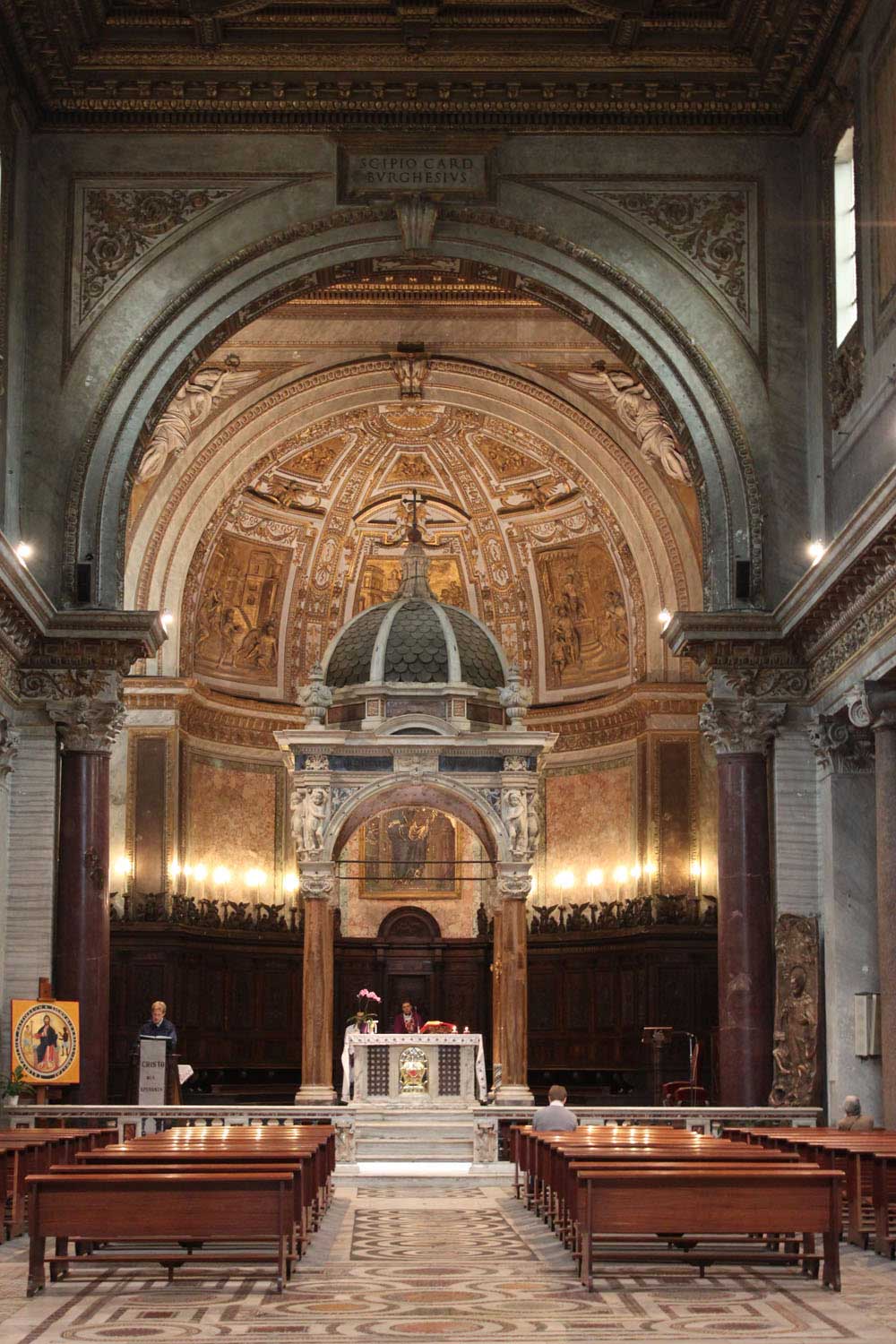
Our pilgrimage today takes us to the small church of Saints Cosmas and Damian, a basilica actually located in the Roman Forum, the ancient center of Rome. Parts of this church in fact come from buildings in use during the time of the Roman Empire. The present day church also boasts of a beautiful mosaic of Christ behind the altar in the apse, artwork that dates back to the 6th century. This basilica honors the two brothers, Cosmas and Damian, who were tortured and beheaded for their faith around the year 303 A.D. In fact, their names appear in Eucharistic Prayer I (the Roman Canon).
Today’s Responsorial Psalm reads, “If today you hear his voice, harden not your hearts”. The homily at Mass spoke of Lent being a time where we look into our hearts to see what it is we really desire. We have many wants and needs, but during Lent we must ask ourselves frankly: “Is Jesus Christ enough for me?” If we are not satisfied with him in this life, will we be satisfied with him in the next? This Lent Jesus Christ is calling us anew, calling us to trust that by seeking him first, everything else will be given to us. Let us not harden our hearts to his invitation.
Are you with me or against me? This is the choice Jesus presents to us in today’s gospel. As we heard, Jesus had performed a miraculous healing. Critics said his action was evil. Jesus said it was a sign of the kingdom of God. Then he said we needed to choose whose side we were on. If you think about it, this is a choice we need to make every day, if not several times a day.
On our worst days, we reject Jesus altogether. We’re like the people Jeremiah spoke about in the first reading: disobedient, disloyal, deaf to God’s word. On other days, however, we do want to side with Jesus…but only on our terms. In other words:
• We’re willing to sacrifice…within reasonable limits;
• We’re willing to forgive…those people who are truly sorry;
• We’re willing to love…those people we find lovable;
• We’re willing to give…so long as we receive;
• We’re happy to follow Jesus…as long as he goes where we want him to.
Today’s gospel reminds us that we can’t have it both ways. As Jesus said, the kingdom of God has indeed come upon us. And we need to choose to follow our king, without limit, and without compromise. So today when we hear his voice, let us harden not our hearts.
It has been clear for some time now in the Church that Catholics, as a group, are growing more distant from the Church teaching on sexual matters. It seems well demonstrated that most Catholics form their view on these matters more from the culture than the scriptures or the teachings of the Church. The culture shouts promiscuity and normalizes both the heterosexual and homosexual expressions of it. Meanwhile, I’m sad to say, many clergy and catechists remain quite silent and vague about it. This is not true of all, but I know that a common complaint on the part of the faithful is, that what they hear from the pulpit, is filled with vagaries and generalities. Only rarely do they hear straightforward teaching on sexual matters and other important topics as well, such as the need to attend Mass, go to confession, the reality of hell etc.
With the combination of a loud culture and quiet pulpit and classroom, it is no surprise that that recent statistics show that a growing number of Catholics do not hold the Catholic faith when it comes to moral issues, especially the sexual ones. Here are some excerpts from a recent article over at the CARA (Center for Applied Research in the Apostolate) blog written by Mark Gray:
In 2010, 20% of adult Catholics “strongly agreed” that “homosexual couples should have the right to marry one another.” An additional 28% “agreed.” Thus, overall 48% of Catholic respondents indicated some level of agreement with this statement. The margin of error for the 2010 Catholic data is ±5.8 percentage points. Thus, the point estimate for agreement could range as high as 54% or as low as 42%. ….Levels of agreement with the statement have grown [over the years] as disagreement has diminished.
There is another [General Social Survey] GSS question that has a longer history that is related to the results of the marriage question shown above. The GSS asks respondents if “sexual relations between two adults of the same sex” is wrong. In the 2010 GSS, for the first time, the percentage of adult Catholics indicating this is “not wrong at all” outnumbered those who said it was “always wrong” (44% compared to 42%)…(margin of error was ±5.9 percentage points).
As one can see from the trend in the figure [above right], the real point of change occurs somewhere in the early 1990s and has continued to evolve to this day. Responses to this question differ by age with younger Catholics being more likely than older Catholics to say this is “not wrong at all.” However, the sharp change in the population overall in the early 1990s cannot be explained by generational replacement alone.
It is the case that frequency of Mass attendance correlates with responses to these questions….The only complication to this…. is that Mass attendance varies by age and generation ….So is it Mass attendance that makes one more likely to oppose civil unions or marriage for same-sex couples or is it something generational? It is likely both but which matters more? And again the figure above indicates some sort of “period effect” in the early 1990s that is also likely important. Margin of error for sub-groups is the biggest obstacle to understanding and disentangling these effects.
The full article is here: Catholic Attitudes. Please note, Mr. Gray’s purpose in the article is to report the numbers not to advocate for or against what they say.
My own thoughts are that the generational factor is very significant. I understand that Mr Gray above thinks there are other factors too. I accept that but would still highlight the generational factor. There are increasing numbers of young people who have never known a time when the wider culture did not approve of homosexual behavior. Those of us about 45 and older DO remember such a time, but the younger ones have largely had a steady diet of “there’s nothing wrong with homosexual behavior and if anyone thinks so, they’re a bigot.” And as they have heard this, the Church has only vaguely set forth a principled case for the wrongness of promiscuity in general, and homosexual activity in particular.
To paraphrase a well known quote from the last election, The Church’s chickens are coming home to roost. To put it Biblically: For if the trumpet give an uncertain sound, who shall prepare himself to the battle? (1 Cor 14:8).
In the Church I think we have to accept that a generational shift has occurred, both in the Church and in the culture. And it has happened on our watch.
Rear-guard action? With the increasing move to give legal recognition to (so-called) gay marriage, the Church is scrambling to teach the faithful again on the basics of marriage. But, truth be told, it’s something of a rear-guard action. Marriage has been in trouble for a long time in this country, family sizes have decreased, divorce has skyrocketed and cohabitation and single parent families are becoming as common as marriage. Gay “marriage” is just the latest confusion, polygamy is surely next.
Yes, we have returned to the battle late. When the first no-fault divorce laws went into effect in 1969 and the ten years following, I am unaware that there was much of a collective effort by the Church to oppose and turn back that horrible idea.
Inward focused! Of course in 1969 we were rather inwardly focused. We were moving around the furniture in our sanctuaries, tuning up guitars and having endless debates about women’s (lack of) ordination, Church authority and the like. And while we looked inward and debated among ourselves, we lost the culture. We stopped evangelizing and articulating a clear moral vision for our culture in a way that was effective.
I am told the situation is worse in Europe. Both Pope John Paul and Pope Benedict have said we have to start all over again there and completely re-evangelize Europe.
But start we must. And while we do so, we will called all sorts of names by a culture that now finds the Gospel and its moral vision to be obnoxious, even hateful. It will be our task to re-propose the Gospel in creative and thoughtful ways, and to present why it makes sense and is not, in fact hateful.
I think some of the younger clergy, religious and laity have become better prepared to do just this. I am impressed with the dedication, fidelity, creativeness and zeal of many of the younger and emerging leaders in the Church. In a way their presence and numbers is something of a paradox, since, as the numbers above show, there seems to be an overall generational shift away from the Church. It is almost as if these younger and emerging leaders, (clergy, religious and lay), have been snatched by the Lord from a raging torrent and set on solid rock. And now they have zeal to snatch others from the torrent and draw them to the solid rock of the Church and Christ. It is a small but significant army. And the trumpet the Church is sounding is becoming clearer too, more and more are mustering for the great struggle to re-evangelize the culture.
In tomorrow’s blog I’d like to address the Biblical teaching on homosexual activity as well as heterosexual promiscuity. I do this in an attempt to answer those surveyed above who think there is nothing wrong with either. Just my own little way of trying to turn back some of the numbers and not be among those who have been far too silent.
Here is Fr. Barron’s take on how we lost the culture and what we might do to re-evangelize it.
Wednesday after the Third Sunday of Lent brings us to San Sisto. This Church was built to mark the spot where on his way to martyrdom Pope Saint Sixtus II (257-258) met St. Lawrence. St. Sixtus’s courageous witness has earned him a place in the Roman Canon, Eucharistic prayer one.
Early records from 595 mention this church existing. In 1219 Pope Honorius III entrusted this church to the newly formed Dominican order, and St. Dominic himself lived here before he died in 1221.
Our reflection today focuses on the early Christian martyrs. One of emperor Nero’s favorite hobbies was to find new ways to torture Christians in Rome. One way was to set them on fire, making torches out of them to light the streets of Rome at night. What Nero did not realize is that the light from these torches would shine through the millennia, pierce through the centuries, and become a beacon for Christians throughout history. The reason we celebrate the early martyrs is because they had the faith Christ calls us to in the Gospel today. In the violent storm of their lives, they trusted in the Lord and publically proclaimed that their primary allegiance was to Christ over any earthly power. They trusted that not even death could separate them from the love of Christ. We pray that St. Sixtus will intercede for us so that God would grant us the same profound faith that he and the martyrs had. May the light that early martyrs produced continue to illuminate our path to sanctity.
Are you familiar with the expression, “Always read the fine print?” Doyou always read the fine print? I know I don’t. I once heard a comedy routine that put “always read the fine print” in the same category as “rinse and repeat” and “do not insert cotton swab into the ear canal.” The point was, of course, that we usually ignore this good advice.
In today’s gospel, however, Jesus tells us that we do need to read the fine print when it comes to the law of God. He promises us that until the end of time, not an iota, not a dot of God’s law will pass away. Jesus explained that he wouldn’t abolish even the smallest part of it, as some of his contemporaries had feared, or perhaps had hoped.
But we might ask ourselves the question: Who would want this law to pass away? Who would wish to see it abolished? In today’s first reading, Moses said that the keeping of this just, life-giving law brings God close to us, and shows us to be wise and intelligent.
And let’s be honest: Who amongst us doesn’t want justice, life, wisdom, and intelligence? Who amongst us doesn’t want God to be close beside us? Deep down, this is what we all want, because God has made us this way. That’s why Jesus said that those who keep and teach God’s law are truly great in the kingdom of God. Indeed, when it comes to God’s law, we should always read the fine print.
If, on the way to court, you received advice on how you could influence the judge to be less severe in your case, would you not consider following that advice? Surely I would, unless the “way” involved bribery, or something corrupt. And, in fact, Jesus our very judge, has described an upright way that we can avoid severity on the Day of Judgment. Simply put, the way is for us to show mercy.
Now I don’t know about you, but I am going to need a lot of mercy on the Day of Judgment. So I, and probably you as well, am glad that the Lord has shown how we can positively influence the Day we are judged and see that mercy is magnified. Consider some of the following texts.
Blessed are the merciful, for they will be shown mercy. (Matt 5:7)
For if you forgive men when they sin against you, your heavenly Father will also forgive you. But if you do not forgive men their sins, your Father will not forgive your sins. (Matt 6:14-15)
Speak and act as those who are going to be judged by the law that gives freedom, because judgment without mercy will be shown to anyone who has not been merciful. But mercy triumphs over judgment! (James 2:12-13)
If a man shuts his ears to the cry of the poor, he too will cry out and not be answered. (Proverbs 21:13)
Do not condemn, and you will not be condemned. Forgive, and you will be forgiven. (Luke 6:37)
For the measure with which you measure others, will be the measure by which you are measured (Mark 4:24)
And then there is the terrifying parable too long to quote here of the man who owed a huge debt he could never repay. The king cancelled the whole debt. But the man refused to cancel the debt of one who owed him a smaller amount. To this unmerciful man the King then decreed: You wicked servant,’ he said, ‘I canceled all that debt of yours because you begged me to. Shouldn’t you have had mercy on your fellow servant just as I had on you?’ In anger his master turned him over to the jailers to be tortured, until he should pay back all he owed. “This is how my heavenly Father will treat each of you unless you forgive your brother from your heart.” (Matt 18:32-35)
So the basic point is clear enough, if we want to be shown mercy in our judgment (and trust me, we’re all going to need a LOT of it), then we need to pray for a merciful heart.
Let’s go so far to say that if anyone is harsh, mean-spirited, unforgiving, hypercritical or condemning, he is a fool. He is simply storing up wrath for himself on the Day of Judgment. Now why do that?
Mercy is our only hope to avoid strict judgment. And these texts show us that mercy here will lead to mercy there.
It is true that there are times in this world when punishments must be issued and penalties assessed. But to the degree that these are made with an eye to correction and reform then they are part of love, and relate to mercy. For, fraternal correction is a work of charity. It is better to suffer punishment here that leads to reform, than to evade punishment here and possibly end in hell. Thus, not all punishment is excluded by the edict of mercy, but, only let mercy and love be the sources from which it comes.
So, some advice to the wise, bury the hatchet now, ask the Lord for a merciful and forgiving heart, or suffer the full force of a strict judgment. Pay attention! The judge is willing to be influenced on our behalf and has signaled what will move him in our direction. Why hesitate any longer? The merciful are blessed because they are going to be shown mercy. And without mercy, we don’t stand a chance.
Here is the great Miserere by Allegri. The text, sung in Latin is Psalm 51 which begins, “Have Mercy on me Lord in your great mercy.” In the verses the soprano hits a remarkable high ‘C.’ The Tallis Scholars sing. The soprano closest to the camera in the blue dress, during the early footage is Tessa Bonner who died in the past year. We pray, that she who sings of mercy here, did, in fact, find that mercy in abundance.