How would you describe heaven on earth? Lying on a beach? Winning the lottery? A bigger house? Maybe just catching up on sleep and getting the bills paid?
Jesus gives us his prescription for heaven on earth in today’s gospel. He speaks of he and his Father coming to us, making their dwelling us, and loving us- which is what happens in heaven! To enjoy this, however, we need to love Jesus by keeping his commandments.
Jesus commands us to love one another in the way he has loved us. In other words, we can bring about heaven on earth by loving each other the way Jesus wants us to. Which means that when we don’t love others, we create a little bit of hell. Heaven and hell are not just reserved for the next life. In a sense, they’re really a continuation of the way we choose to live our lives today. So even if we never lie on a beach, win the lottery, get a bigger house, or pay all the bills, life can indeed be heavenly, whenever we make the decision to love.
In recent years, the Catholic Church has come under great scrutiny in terms of the sexual abuse of minors. Painful though it has been, it has been salutary in many ways. That such abuse has occurred, even once, let alone with the frequency we have all discovered, is both tragic and scandalous. That the Church has been scrutinized, and called to account by many, has meant that an increasingly serious and comprehensive set of protective measures has been put in place to root out the sexual abuse of minors. This both helps to protect the young and purify the Church.
Consider the graph to the upper right and we shall see that the reports of this sinful and abusive behavior came rather suddenly on the scene in large numbers about 1960, and peaked in the early 1980s. I recall that, about that time (1985), in this Archdiocese we were rocked with some allegations that brought some very painful sins to light. Cardinal Hickey however, began a very through investigation of the problem, and was one of the bishops at that time who undertook a rather sweeping plan to ensure that young people were protected from this in the future. As a seminarian during those years I was expected to attend seminars that alerted us to the problem and we were all given extensive psychological testing and background checks to ensure we were free of any past sins and offenses in this matter, and free of any tendencies toward them.
As you can see by the graph above right, the number of reported incidents drops precipitously after the mid 1980s. While it is true that in 2002 the issue heated up in the news, the incidents that came to light at that time were largely from 20 to 30 years prior. The real anger at that time had more to do with the failure to discipline and remove abuser priests, a failure that had, or was still occurring, in certain dioceses. But in terms of actual incidences, you can see that the number has come dramatically down to its current level. Though not zero, which is the only acceptable number, we do see a remarkable drop. The graph at the left indicates a dramatic drop in the number of abuse cases by priests ordained after 1985. This too demonstrates that, by that time, most dioceses were very careful to do background checks and perform psychological testing that prevented abusers from entering the priesthood.
Hence, the painful period where sin in the Church has been laid bare has had the salutary effect of purifying the Church and, even more importantly, seeing that children are adequately protected from abuse.
So where do we go from here? How serious are we, as a society and a Country, about making sure that children everywhere are protected from sexual abuse? For if our concerns are really about the children, then we must come to see that the Catholic Church is not the only place children have sexually abused. And we must come to see that some non-church settings, children are still being abused in large numbers.
One of the most dangerous places for our children in terms of sexual abuse are the public schools. Consider clicking on this Google news search for stories about arrests for sexual abuse of minors allegations in the last month. You will see page after page of news items about teachers being arrested for sexually molesting the young people under their care. The search “teacher, student, sex, arrest” yields over 550 news reports (30+ Google pages). (Hat tip to Mark Gray for this Google information)
Note two observations of the media coverage of this. First, the stories are being covered. Hence it would be wrong to say the media is “ignoring” the story. Secondly, however, there seems to be no connecting of these stories. They are all considered to be individual cases, unconnected if you will. These stories tend to be framed as an individual teacher who is just “a bad apple.”
And this failure to connect these individual cases and see them as linked to an overall problem that must be addressed, endangers children.
When the abuse cases in the Church arose, they were seen collectively and it was proposed (rightly to some extent) that there was a problem in the Catholic Church, that something linked all these cases together in the wider culture of the Church. Some (incorrectly) blamed celibacy, others the culture of clerical exoneration, still others to the lack of oversight and discipline by the bishops, and “cover-ups.”
Problem in the Public Schools? But in considering these (very) numerous cases in the public school system, few in the media or elsewhere seem to be willing to propose that there is a problem in the public schools, that there is something that links these cases together. What exactly that problem is, is currently debatable. But the point is, who is demanding investigations? Who is demanding a systematic analysis of the public school system or insisting that further measures be instituted to protect children? Who is looking into the kinds of background checks that the schools perform before they hire teachers? Are there psychological tests to weed out potential abusers? Are there seminars for the teachers to help them recognize the signs of potential abuse taking place on their campuses? Are students taught about their rights and what to do in bad situations? Is there a climate of openness and concern that encourages students to report situations which make them feel uncomfortable, or when they feel they are receiving unwanted attention from a teacher or staff member? What are the procedures for dealing with credible allegations? Are public school systems properly vigilant in protecting children from predators?
Who is asking these questions and probing the “wider context” of the school systems in this country? Are we doing enough to protect our children? Apparently not. Look again at the Google link listed above. We are not dealing with a small problem here, it is widespread, and sadly, common.
Are we willing to take this issue of the sexual abuse of minors to the next level?
And while we are at it, are we willing to address the sexualization of children that takes place in our culture especially in ads, on sitcoms, in movies and music? Why do we tolerate TV shows that depict sexually active teenagers? Why is it so difficult for mothers to buy modest clothes for their daughters at most stores? Why do companies like Abercrombie and Fitch which advertise padded bras and swim tops for 8 year olds, and sell thongs to preteen girls, continue to make money? In short, why are we as a culture not more outraged at the sexualization of children and young teenagers? Sexualizing children and teens does not help protect them from predators who are already confused. If we are serious about protecting the young from sexual abuse, then we ought to stop having such a high tolerance for this sort of thing in our culture. We have discussed this previously on the blog HERE.
I realize that some who read this post will want to read it simply as a priest deflecting attention from the Church. I can and will deny this allegation and have stated clearly that I think the Church has received rebuke, properly. But frankly dear reader, my motivations in raising this are beside the point. The questions I raise remain valid, if we are going to be serious about protecting children. Is our concern really about children and, if so, are we collectively willing to take our concern about the sexual abuse of minors to the next level?
I am interested in your responses and observations.
By his resurrection Jesus has brought us from death to life. He has snatched us from this present evil age (Gal 1:4), and from the death directed desires of our body (Rom 6:12), and made us into a new and living creation (2 Cor 5:17). As such, we have exchanged the tombstones that once indicated we were dead in our sins, and have become living stones in the spiritual edifice which is the Body of Christ, and also the Church.
In the Epistle for today’s Mass (1 Peter 2:4-9) we are summoned to this new life and told what some of its characteristics are. Let’s take a look at how we go from being tombstones to living stones by seeing this epistle in three sections.
1. The Call of salvation – The text says: Come to him, a living stone, rejected by human beings but chosen and precious in the sight of God, and, like living stones, let yourselves be built into a spiritual house
Notice first the invitation that is made – Come to Him! Let yourself be built! The entire Christian life is based on our response to an invitation to accept Jesus Christ and to let him transform our life. We are to say, “yes” not only to Jesus, but also to what he can do for us. He will take our broken, crumbling lives and rebuild them. And in what sense will he do this?
Well look next at the images that are offered:
Living Stones – a Stone is an odd image for life. Generally we can think of nothing less living than a stone. So the text says living stones. What does it mean to be a living stone? First it means to be alive! To be full of life! Secondly it means that some of the better qualities of stone are to be ours. A stone is firm, not easily moved, weighty, and able to withstand a heavy load. And thus, we too are to be strong and firm in our faith; not easily moved about by the currents of the world, or tossed to and fro by the waves and carried about by every wind of doctrine, by human cunning, by craftiness in deceitful schemes (Eph 4:14). Stable and firm, we are also able to carry the weight and difficulties that this world imposes. And, we are able to support and carry others in their time of need. Yes, living stones: strong, firm, not easily moved and alive, quite alive!
a spiritual house – The image is that we as living stones make up, in a spiritual sense, the walls of the Church. Together we are fitted into a wall that is strong and sure. Thus, we are not saved merely unto ourselves, but we are saved also for the sake of others. Together, and by God’s grace, we depend on one another to carry our share of the weight. All the stones in a wall do their part. Remove one stone and the whole wall is weakened and threatened. Only together, with all doing their part, is the wall solid and sure.
2. The Choice for salvation – The text says, whoever believes in it shall not be put to shame. Therefore, its value is for you who have faith, but for those without faith: The stone that the builders rejected has become the cornerstone, and a stone that will make people stumble, and a rock that will make them fall. They stumble by disobeying the word, as is their destiny.
Simply put we have a choice to make and that choice will determine if Jesus is the cornerstone who supports us, or a stumbling block over whom we trip and fall. It is an interesting thing that when someone is being rescued at sea that some reach and grab the life ring that is tossed to them, others resist and fight attempts to save them, seeing it as something that will cause them further danger.
What is meant here by cornerstone? We usually think today of a ceremonial stone with an inscription and possibly some historical things inside. But the cornerstone, here, refers more to the stone at the bottom of an arch or row of bricks that supports the whole arch. It had to be a very carefully crafted stone since all the other stones depended on its integrity and perfect shape to support them. And this is Jesus Christ for us. We are all leaning on Jesus, and he is the perfect stone who carries our weight.
But for those who reject Christ, he is a stone over whom they trip and fall, a stumbling block. Surely Jesus wants to save us all, but some reject him and thus, he becomes as a stumbling block. What this means is that we cannot remain neutral about Jesus, we have to decide, one way or the other about him: Yes = salvation, no = condemnation. Thus he will either be a cornerstone or a stumbling block, there is no third way. To those who knowingly reject him, he is a stumbling block. And this image also explains some of the venomous attacks on Christ and Christianity from the world. For when one trips over something and falls, he tends to turn and curse what caused him to fall.
So the choice is ours. May it be Christ, and may he be our cornerstone, The only One on whom we lean and rely. Only this will bring us from being tombstones to living stones.
3. The Characteristics of salvation – The text says, You are “a chosen race, a royal priesthood, a holy nation, a people of his own, so that you may announce the praises” of him who called you out of darkness into his wonderful light.
Note four characteristics of those who are no longer tombstones, but are living stones:
Our Pedigree– the text calls us a “chosen race.” We reflected earlier on making Christ our choice. But here the text reminds us that before we chose him, he chose us. If we got an invitation to dinner at the White House, we would sense that we had “made it” and would proudly tell our friends of the great dignity we had received. Yet, too easily we make little notice that we are chosen by God and invited to the great Wedding Feast of the Lamb. The fact is, we are chosen, we have a pedigree. We are of the household of God. And this is a very great dignity, greater than any worldly dignity, and able to overcome any indignity that the world heaps upon us. We are a chosen race.
Our Priesthood – All of us who are baptized into Christ Jesus are made priest, prophet and king. And this “royal” priesthood, while different from the ministerial priesthood of the men who minister the sacraments, has this similarity: every priest is enabled to offer a sacrifice pleasing to God. In the old Testament, priests offered something distinct from them, usually an animal, such as a lamb. But in the priesthood of Jesus Christ, the priest and the victim are one and the same, for Jesus offered himself. Hence, all the baptized are equipped by God to offer the pleasing sacrifice of their very self to God. Herein is a very great dignity given us by Jesus: to have a perfect right to stand in his Father’s presence, praise him, and offer a fitting sacrifice. The ministerial priests of the Church bring us the sacraments, and only they can do this. But every baptized believer shares in the royal priesthood wherein they freely offer themselves to God.
Our Place – The text calls us a holy nation. The word “holy” means to be “set apart.” Hence we are called out from the many, to be a people that is set apart for God. And while all are invited to Christ, only those who accept the invitation, receive the grace to be called a holy nation. As such we should understand that our role is not to “fit in” with this sin-soaked world, but, rather, to stand apart from it, to be recognizably distinct from from it. Our behavior, our priorities, our love, our joy, and charity should be obvious to all. To be a holy nation is a great honor, but also a great responsibility. May the curse of scripture never be said about us: As it is written: “God’s name is blasphemed among the Gentiles because of you. (Rom 2:24)
Our Proclamation – the text says the Lord has acted in our life so that you may announce the praises of him, who called you out of darkness into his own, wonderful light. Yes the Lord has been good to us and is changing our life! If you are faithful, then you know what he has done for you and you have a testimony to give! Scripture says elsewhere that we were made for the praise of his glory (Eph 1:6). Do people hear you praise the Lord? Have you glorified his name among the Gentiles (Rom 15:9)? Do people know of your gratitude and have they heard of your witness to the Lord? Can you articulate how God has called you out of darkness into his marvelous light? You ought to be a witness for the Lord! This is a central and necessary characteristic of those who are no longer tombstones, but living stones.
This song points to Jesus as the cornerstone on which all of us who are living stones must lean:
And here is another old hymn that speaks of standing on Christ, the solid rock:
Is Jesus a genie in a bottle? We might think so, given his words in today’s gospel: “If you ask anything of me in my name, I will do it.” Given this, instead of asking, “Show us the Father,” like Phillip did, we might be tempted to demand: “Show me the money!”
But consider what else Jesus said. He insisted that he didn’t speak on his own, but that he said what the Father wanted him to say, because he is in the Father, and the Father is in him.
We aren’t one with the Father in the way Jesus is. However, we are united with Jesus by the Holy Spirit at baptism. The Father works in Jesus, and Jesus works in us, through the Spirit. This allows us to pray in his name. When we do this, we’re not speaking on our own. Instead, we’re inspired to say what Jesus wants us to say.
This is the key to understanding, not only Jesus’ promise to fulfill our requests, but also his insistence that we’d do the same works he did- even greater ones! Not through our power, of course, but through his. Jesus will do what we ask him to do- when we ask what he wants us to ask.
After all, he’s not a genie in a bottle. He’s God’s Son, dwelling in our hearts.
Years ago, in High School, I dated Paula, who liked square dancing. So, most Saturday nights we were down at the community center, she in her petticoats and dress, I in my jeans, button down western shirt with a scarf tie and hand towel.
Square dancing has some basic moves that beginners learn. And so it was that Paula and I started with the basics. But in square dancing there are different levels, and so eventually we cleared the floor and watched those who knew the more advanced moves. Sometimes there were several levels of dancers. I remember being amazed at the complicated moves the move senior members had learned and wondered how I would ever master it. But, little by little the moves were learned, and we got to stay on the floor just a little longer as the months and years ticked by.
Image of the Church? I was over at YouTube and came upon the video below of a square dance group that’s pretty advanced. I remember many of the moves they do, but some of it was above what I ever learned. And suddenly it occurred to me that I saw an image of the Church.
Please forgive me. I know you think I must be theological geek at this point. Surely as a young man I never gave a thought to the Church, in terms of square dancing. But now with this great love for God and for the Church, I can’t help it, I see the Church in square dancing. Just a few thoughts:
1. Every Square Dance needs a caller and, if the dancers in the square are the body, he is the head. He calls the moves, and the dancers must listen and respond. He has the authority to set direction and maintain order. If a square falls into disorder he reestablishes order by calling them home. Not only that, it is also the role of the Caller to teach new moves and drill the dancers until they master it. So the caller is the source for unity and direction for the square.
This is also the role of the Pope and the Local Bishop in the Church who also have the authority to set direction, maintain unity and restore order when necessary. It is also their role to teach the faith, along with their priests and catechists until the faithful master the Christian walk (dance).
2. As long as everyone listens carefully, and fulfills their particular role in the particular moves, the dance continues. But when, usually through error, one or more of the dancers veers away from the directed move, the square either stumbles or falls apart. As long as the dancers are open to learn, the square will continue to get better, and become a good, and disciplined group who increasingly enjoy advanced square dancing.
So too with the Church. When all listen carefully and do their part, the Church is strong and well ordered. When the faithful do not listen, or persist in error, the Church stumbles and is less effective. Disunity leads to a poor Christian walk (dance), not only for individuals, but also for groups and parishes. But if the faithful are willing to learn to and grow, the dance of faith becomes deeper and richer, more enjoyable, and just plain fun.
3. Everyone has a role, but not the same. When the caller calls a dance move, what you do in response depends on where you are in the square at that time. You might just stand still while others move, or you might be the one who switches positions. And all this varies from move to move.
And so it is with the Church. We have varied and different roles depending on where we are in the Church. Some of our roles are stable but others change depending on the situation. As a pastor, I am a leader and teacher in my parish. But at a meeting with the bishop I am a learner and a man under authority. In the parish I may take the lead when it comes to teaching the faith, but I may need to learn from my parishioners when it comes to understanding some technical legal matter, or car repair, etc. In such cases many of my parishioners can show me the way. We all have different gifts and talents and they all interact in various ways, depending on the situation. At times we lead, at times we follow, at times we stand still, while others move about us. All at the direction of the caller.
4. There is an etiquette to square dancing. There are bows, and curtseys, there’s a way you hold a lady’s hand, and there is a graciousness expected by all. Especially for those in higher levels, proper attire is also expected. Timeliness is also important since it is necessary to have eight people to form a square and get things underway. Thus everyone needs to be committed and timely. If just one of the eight is late, seven others are left standing. In larger groups, where there are numerous squares, people can mix and match a bit, but one missing member always impacts many other people.
In the Church too, basic kindness and generosity are also expected and necessary. Where there is Charity and truth, God himself is there. Further, people must be true to their commitments and be timely or many others suffer.
5. There is a great intricacy to square dancing where many aspect are interacting at once. It is almost mind-boggling to watch as the dance unfolds.
So too with the Church, there are many layers and great intricacy at work. Some are praying, some are studying, some are raising children, some are preaching, some are evangelizing, some are caring for the poor, some are praying in front of abortion clinics. But all are responding to the great call of the Shepherd Jesus speaking through his Pope and Bishops, through the Scriptures and the Tradition. It is a great dance of wonderful intricacy, and everyone interacts at different levels, all at once.
So there you have it: the Church as a square dance. Enter the dance, learn the moves and have a great time.
This video shows Square Dancing at a more advanced level. I got close to this, but never this good. Paula’s parents could have danced like this in their sleep.
When asked what heaven will be like, an American bishop wrote of his first visit to his parents’ native village in Italy. Because he had seen pictures of it for years, everything looked familiar to him when he arrived in person. “I know this place,” he thought. “I am finally at home.” He hoped that he would feel the same way- that he was finally at home- upon entering heaven.
Heaven is indeed our true home, as Jesus explained in today’s gospel. He was speaking during the Last Supper with his disciples, who were troubled that he was soon to leave them. Jesus soothed their fears by explaining that his departure was a good thing, because he was going to prepare a place for them in heaven. Yet he would return one day to take them to their heavenly home- the Father’s house
There is room for us in the Father’s house, too. This is hope for us when life gets hard. It reminds us that we’ve not yet arrived at our final destination, as this life is but a way station to a “better place.” As he did with his disciples, Jesus tells us not to worry, because regardless of where this life takes us, we are always “homeward bound.”
You may say, “This title is Greek to me.” Actually, it contains Latin and it refers to an important balance in our spiritual life. It is phrase that speaks of reverent bowing before the Holy One who draws me close.
Fascinosum is where we get the word fascinating. It refers to something that calls to me, draws me, peaks my interest, something that strongly attracts.
Tremendumis where we get the word tremendous. It refers to something awesome. Something too big to comprehend or grasp. Hence we draw back in a kind of reverential fear mixed with a kind of bewilderment. And we feel small before the tremendous.
Many ancient authors used these words to describe the human person before God: drawn by God’s inexorable beauty yet compelled to fall prostrate before His awesome majesty. Scripture speaks of this experience in many places. Here are but a few:
I saw the Lord seated on a high and lofty throne, with the train of his garment filling the temple. Seraphim were stationed above; each of them had six wings: with two they veiled their faces, with two they veiled their feet, and with two they hovered aloft. “Holy, holy, holy is the LORD of hosts!” they cried one to the other. “All the earth is filled with his glory!” At the sound of that cry, the frame of the door shook and the house was filled with smoke. Then I said, “Woe is me, I am doomed! For I am a man of unclean lips, living among a people of unclean lips; yet my eyes have seen the King, the LORD of hosts!” Then one of the Seraphim flew to me, holding an ember which he had taken with tongs from the altar. He touched my mouth with it. “See,” he said, “now that this has touched your lips, your wickedness is removed, your sin purged.” (Isaiah 6:1-5)
And Jesus was transfigured before them; his face shone like the sun and his clothes became white as light. And behold, Moses and Elijah appeared to them, conversing with him. Then Peter said to Jesus in reply, “Lord, it is good that we are here. If you wish, I will make three tents here, one for you, one for Moses, and one for Elijah.” While he was still speaking, behold, a bright cloud cast a shadow over them, then from the cloud came a voice that said, “This is my beloved Son, with whom I am well pleased; listen to him.” When the disciples heard this, they fell prostrate and were very much afraid. But Jesus came and touched them, saying, “Rise, and do not be afraid.” (Matt 17:1-6)
I [John] saw seven gold lampstands and in the midst of the lampstands one like a son of man, wearing an ankle-length robe, with a gold sash around his chest. The hair of his head was as white as white wool or as snow, and his eyes were like a fiery flame. His feet were like polished brass refined in a furnace, and his voice was like the sound of rushing water. In his right hand he held seven stars. A sharp two-edged sword came out of his mouth, and his face shone like the sun at its brightest. When I caught sight of him, I fell down at his feet as though dead. He touched me with his right hand and said, “Do not be afraid. I am the first and the last, the one who lives. (Rev 1:15-17)
Note the pattern of these theophanies: They are drawn by God and behold his beauty (fascinosum), they instinctively fall prostrate and need to be reassured by God (tremendum). It is an awesome thing to fall into the hands of a living God! (Heb 10:31). The most interesting passage to me is the third one involving John the Beloved. This is the same John who, at the Last Supper, was perfectly capable of leaning back on the Lord’s shoulder to ask him a question. Yet now, as he beholds the full glory of Christ in the heavenly realm, he falls to his face. The Lord’s glory is fully unveiled here and John, who appreciates the beauty and describes it to us is ultimately compelled to fall down.
We have come through an era that has trivialized God in many ways. Perhaps it was an over correction to a more severe time of the 1950s when any misstep of ours could result in a quick trip to hell if we didn’t get to confession immediately. Mortal sin was understood only objectively by many in those days and by God, even if there were two feet of snow on the ground and you missed Church, your were in sin and had to get to confession asap. Fear was a strong motivator for many in those days.
But we over corrected and by the 1970s the usual notion was that God didn’t seem to care what we did. He was rendered quite harmless actually and it seemed that his main purpose was to affirm us. As for Jesus, gone was the unrelenting and uncompromising prophet of the Scriptures, only to replaced by a kind of “Mr Rogers,” or “Buddy Jesus” version who just went about saying nice things. The Jesus who cleansed the Temple, rebuked unbelief, demanded first place in our life, insisted on the cross, warned of coming judgement and hell, and spoke with such authority that even the guards sent to arrest him came back empty handed saying “no one has ever spoken like that man”, this Jesus was no where to be found by the 1970s
And thus we have needed a return to the balance that fascinosum et tremendum offers. Surely we sense a deep desire for God, we are drawn to him in all his beauty and glory. But we are encountering God here and we are but creatures. A reverential fear is appropriate for the Father and the Son, and the Holy Spirit. It may well be that God will reassure us, but our instinct to tremendum is a proper and biblical one. The Biblical saints knew both fascinosum and tremendum and they show us what a true encounter with God includes.
This does not mean that our liturgies need be somber, for reverence and joy can occupy the same heart. But in the end, it is God whom we worship and falling to our knees is wholly appropriate. Seeking the necessary purification and striving for the holiness without which no one will see God (Heb 12:14) is appropriate. I wish you plenty of fascinosum and equal doses of tremendum!
Here’s a video where Cardinal “Glitch” gets the balance a little wrong:
Maybe this is a little closer to where we need to be:
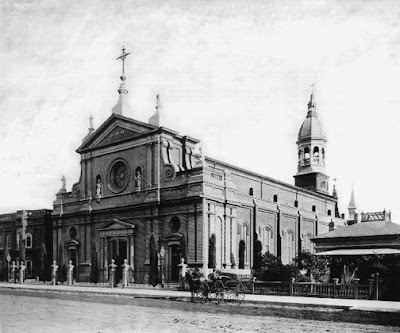
One of the saddest things to experience is the closing of some of our oldest and most beautiful Catholic Churches. These older churches are some of our most magnificent in terms of architecture, theology and faith coming together. Most of these beautiful structures which are closed have succumbed to the wrecking ball. But some of them live in strange and often painful ways, becoming performing arts centers, condominiums, restaurants, and other various secular purposes.
I recently ran across a couple of “then and now” videos that struck me to the heart with sadness.
The first video below is from 1944, a Solemn High Mass in St. Vibiana’s Church in Los Angeles. The Church is packed to the rafters with people at a Christmas Midnight Mass. The choir sings, the incense rises, and clergy pray in Latin and Greek. The scene closes with people flocking to the altar rail for Holy Communion.
The second video shows St. Vibiana’s today (now called “The Vibiana”). It is now a performing arts center and a marketplace. The video shows the vendors along the interior selling wine and scarves and other such things. The high altar where God was once worshiped, and which was home to the Blessed Sacrament, looms in the background, now a mere backdrop for shoppers, dancers, and actors. The confessionals, where once absolution was granted and mercy celebrated, are now storage closets.
Sigh…..
The story of St. Vibana’s is perhaps more well known than most, for it was once the Cathedral Church of Los Angeles. Built in 1876, it was damaged by an earthquake in 1994. The Archdiocese of Los Angeles had long considered the building (which seated 1200) too small for its needs and had wanted to build a new Cathedral. Hence it was decided to tear the damaged building down. But a coalition of Catholics and preservationists fought to save the building, and the City took possession of it. Meanwhile the Archdiocese went on with plans to build the current, new Cathedral, dedicated in 2002. Eventually “The Vibiana” was sold to a private developer who now rents it for various functions.
This same story is at work in other cities too where beautiful, old Churches, now have secular uses. At some level, one can rejoice that the wreckers ball did not swing. But at another level it is troubling to see once sacred buildings used in this manner, and there is the thought that maybe the total loss would have been more dignified.
I don’t have simple answers. We have discussed before the severe decline in Mass attendance and other demographic shifts. But after all the discussions, what it ultimately what it means is shown in video 2 below. Granted, St Vibiana’s closed for reasons other than low Mass attendance, but in other cities it is low attendance that is the driving force behind the closings.
A tale of two videos: then and now. What do you think? Has St. Vibiana’s survived now that she is just “The Vibiaba?” Or is this a fate worse than death? What uses have you seen of some the surviving, but closed churches in other cities?

 How would you describe heaven on earth? Lying on a beach? Winning the lottery? A bigger house? Maybe just catching up on sleep and getting the bills paid?

 One of the saddest things to experience is the closing of some of our oldest and most beautiful Catholic Churches. These older churches are some of our most magnificent in terms of architecture, theology and faith coming together. Most of these beautiful structures which are closed have succumbed to the wrecking ball. But some of them live in strange and often painful ways, becoming performing arts centers, condominiums, restaurants, and other various secular purposes.